

浮沉爱分享
102 Posts

浮沉爱分享
Report
Block User
失败总是贯穿人生,能抓住不确定性中的确定性,就已经很强了
币安钱包邀请码:GO8C19ZH
Open Trade
FLORK Holder
Frequent Trader
2.7 Years
25 Following
140 Followers
139 Liked
Posts
Portfolio
All
Quotes
·
--
Don’t mix 4x hype and wear: KII, AEON, and DOS have larger turnover gaps
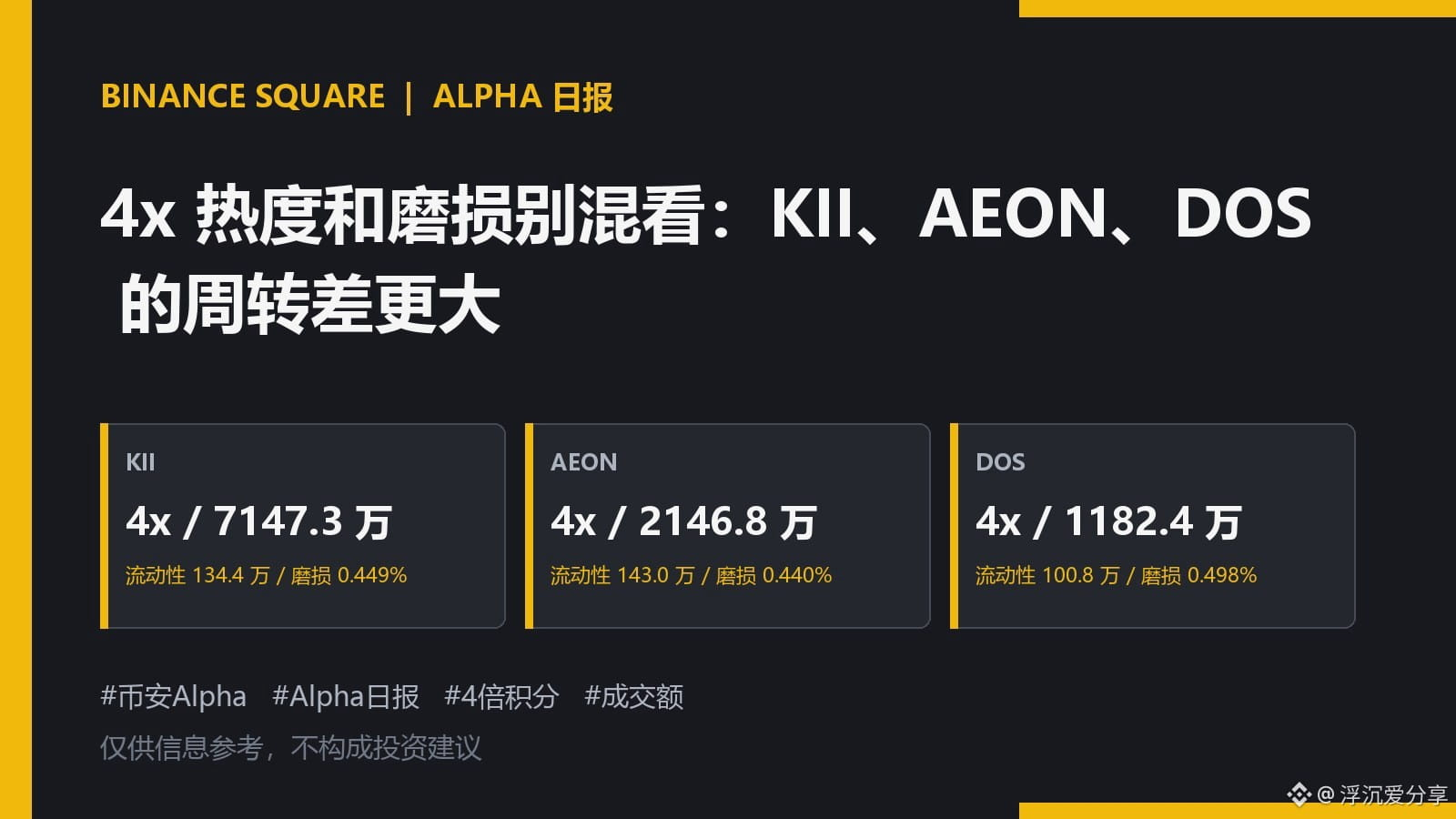
In the Aug 15 4x queue, KII’s 24h成交 (trading value) is about 71.473 million, with an estimated wear of about 0.449%; AEON’s 24h成交 is about 21.468 million, with an estimated wear of about 0.440%; DOS’s 24h成交 is about 11.824 million, with an estimated wear of about 0.498%. A higher multiplier doesn’t equal a lower cost—hype and wear must be examined separately. If you want to chase the ranking today, first add up the buy-only volume, fees, Gas, slippage, wear, and regional restrictions together.
$KII $AEON $DOS #币安Alpha #Alpha日报 #4倍积分 #成交额
Don’t mix 4x hype and wear: KII, AEON, and DOS have larger turnover gaps
In the Aug 15 4x queue, KII’s 24h成交 (trading value) is about 71.473 million, with an estimated wear of about 0.449%; AEON’s 24h成交 is about 21.468 million, with an estimated wear of about 0.440%; DOS’s 24h成交 is about 11.824 million, with an estimated wear of about 0.498%. A higher multiplier doesn’t equal a lower cost—hype and wear must be examined separately. If you want to chase the ranking today, first add up the buy-only volume, fees, Gas, slippage, wear, and regional restrictions together.
$KII $AEON $DOS #币安Alpha #Alpha日报 #4倍积分 #成交额
In the Aug 15 4x queue, KII’s 24h成交 (trading value) is about 71.473 million, with an estimated wear of about 0.449%; AEON’s 24h成交 is about 21.468 million, with an estimated wear of about 0.440%; DOS’s 24h成交 is about 11.824 million, with an estimated wear of about 0.498%. A higher multiplier doesn’t equal a lower cost—hype and wear must be examined separately. If you want to chase the ranking today, first add up the buy-only volume, fees, Gas, slippage, wear, and regional restrictions together.
$KII $AEON $DOS #币安Alpha #Alpha日报 #4倍积分 #成交额
1
1.2k
·
--
On August 14, check first 4x low-wear: BSB, AEON, AGT can handle 2,000 USDT more
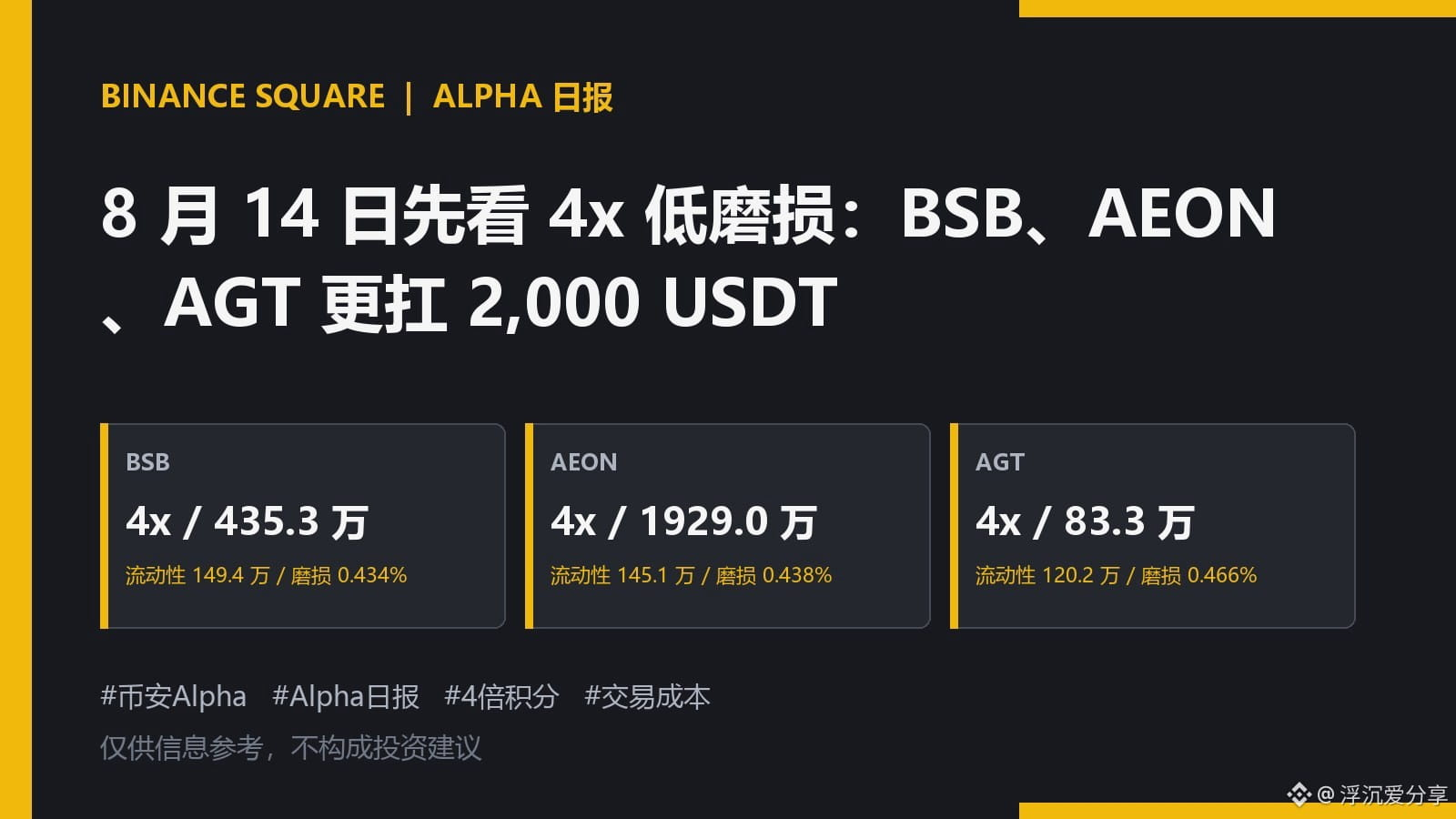
According to the Binance Alpha official list captured in Beijing time on August 14, within the 4x category, the one-sided slippage proxy value for the nominal 2,000 USDT for BSB, AEON, and AGT is approximately 0.134% to 0.166%, for an estimated wear of about 0.434% to 0.466%. If you look at the Alpha scoring coins with stronger load tolerance today first, this group of three is more suitable for priority re-checking; you still need to separately account for fees, gas, slippage, wear, ranking thresholds, and regional restrictions.
$BSB $AEON $AGT #币安Alpha #Alpha日报 #4倍积分 # transaction costs
On August 14, check first 4x low-wear: BSB, AEON, AGT can handle 2,000 USDT more
According to the Binance Alpha official list captured in Beijing time on August 14, within the 4x category, the one-sided slippage proxy value for the nominal 2,000 USDT for BSB, AEON, and AGT is approximately 0.134% to 0.166%, for an estimated wear of about 0.434% to 0.466%. If you look at the Alpha scoring coins with stronger load tolerance today first, this group of three is more suitable for priority re-checking; you still need to separately account for fees, gas, slippage, wear, ranking thresholds, and regional restrictions.
$BSB $AEON $AGT #币安Alpha #Alpha日报 #4倍积分 # transaction costs
According to the Binance Alpha official list captured in Beijing time on August 14, within the 4x category, the one-sided slippage proxy value for the nominal 2,000 USDT for BSB, AEON, and AGT is approximately 0.134% to 0.166%, for an estimated wear of about 0.434% to 0.466%. If you look at the Alpha scoring coins with stronger load tolerance today first, this group of three is more suitable for priority re-checking; you still need to separately account for fees, gas, slippage, wear, ranking thresholds, and regional restrictions.
$BSB $AEON $AGT #币安Alpha #Alpha日报 #4倍积分 # transaction costs
1.1k
·
--
Recheck 1x cost on August 13: the heat for YZY, VVV, and SPX is not equal to low wear
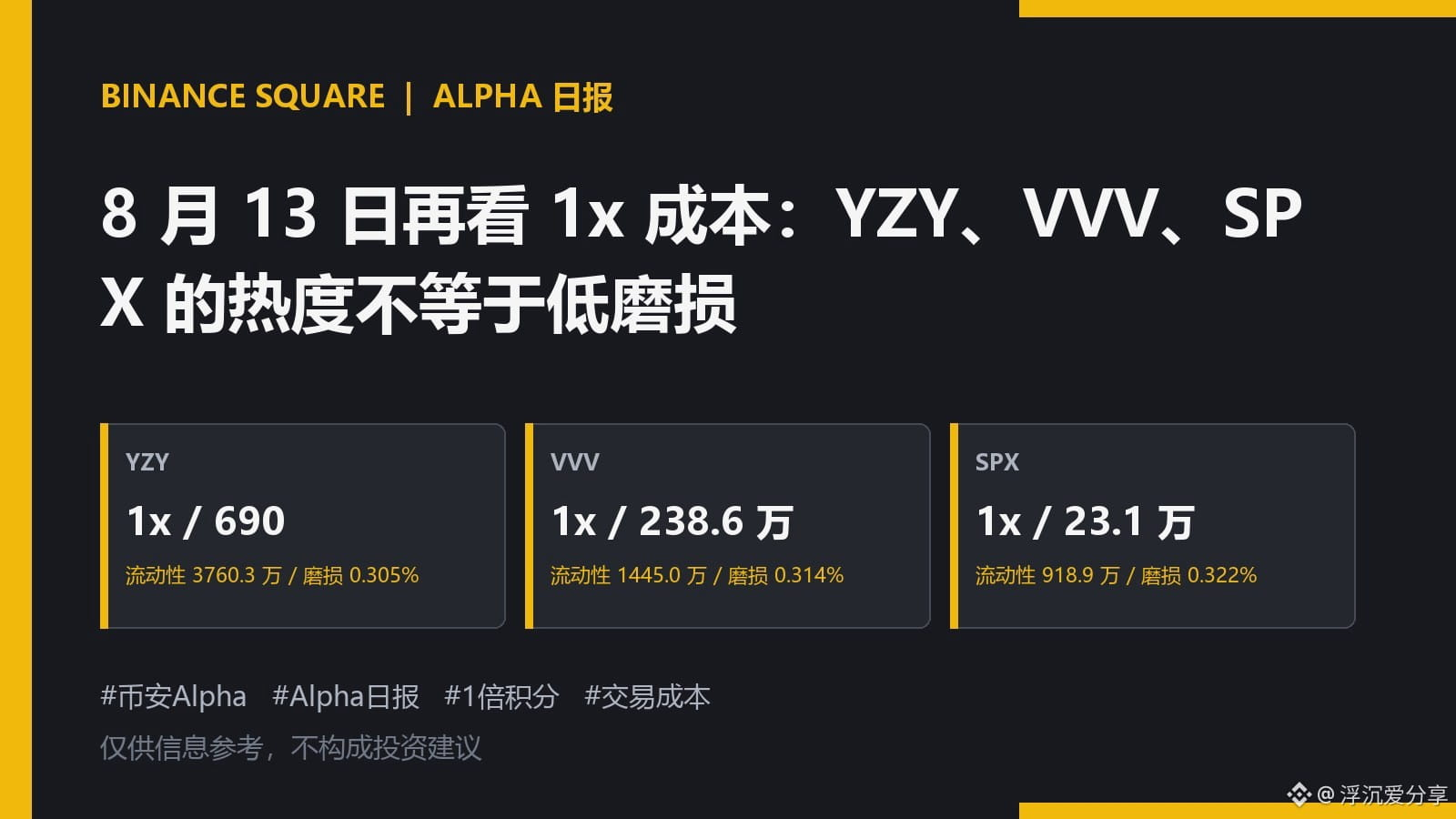
According to the official Binance Alpha list on August 13, the estimated wear for YZY in 1x is about 0.305%, for VVV about 0.314%, and for SPX about 0.322%. Some tokens trade more actively, but that doesn’t necessarily mean the cost is the lowest. If you care more about point efficiency today, break down trade volume, liquidity, slippage, and wear first—then decide whether to chase the hype or control costs.
$YZY $VVV $SPX #币安Alpha #Alpha日报 #1倍积分 #交易成本
Recheck 1x cost on August 13: the heat for YZY, VVV, and SPX is not equal to low wear
According to the official Binance Alpha list on August 13, the estimated wear for YZY in 1x is about 0.305%, for VVV about 0.314%, and for SPX about 0.322%. Some tokens trade more actively, but that doesn’t necessarily mean the cost is the lowest. If you care more about point efficiency today, break down trade volume, liquidity, slippage, and wear first—then decide whether to chase the hype or control costs.
$YZY $VVV $SPX #币安Alpha #Alpha日报 #1倍积分 #交易成本
According to the official Binance Alpha list on August 13, the estimated wear for YZY in 1x is about 0.305%, for VVV about 0.314%, and for SPX about 0.322%. Some tokens trade more actively, but that doesn’t necessarily mean the cost is the lowest. If you care more about point efficiency today, break down trade volume, liquidity, slippage, and wear first—then decide whether to chase the hype or control costs.
$YZY $VVV $SPX #币安Alpha #Alpha日报 #1倍积分 #交易成本
235
·
--
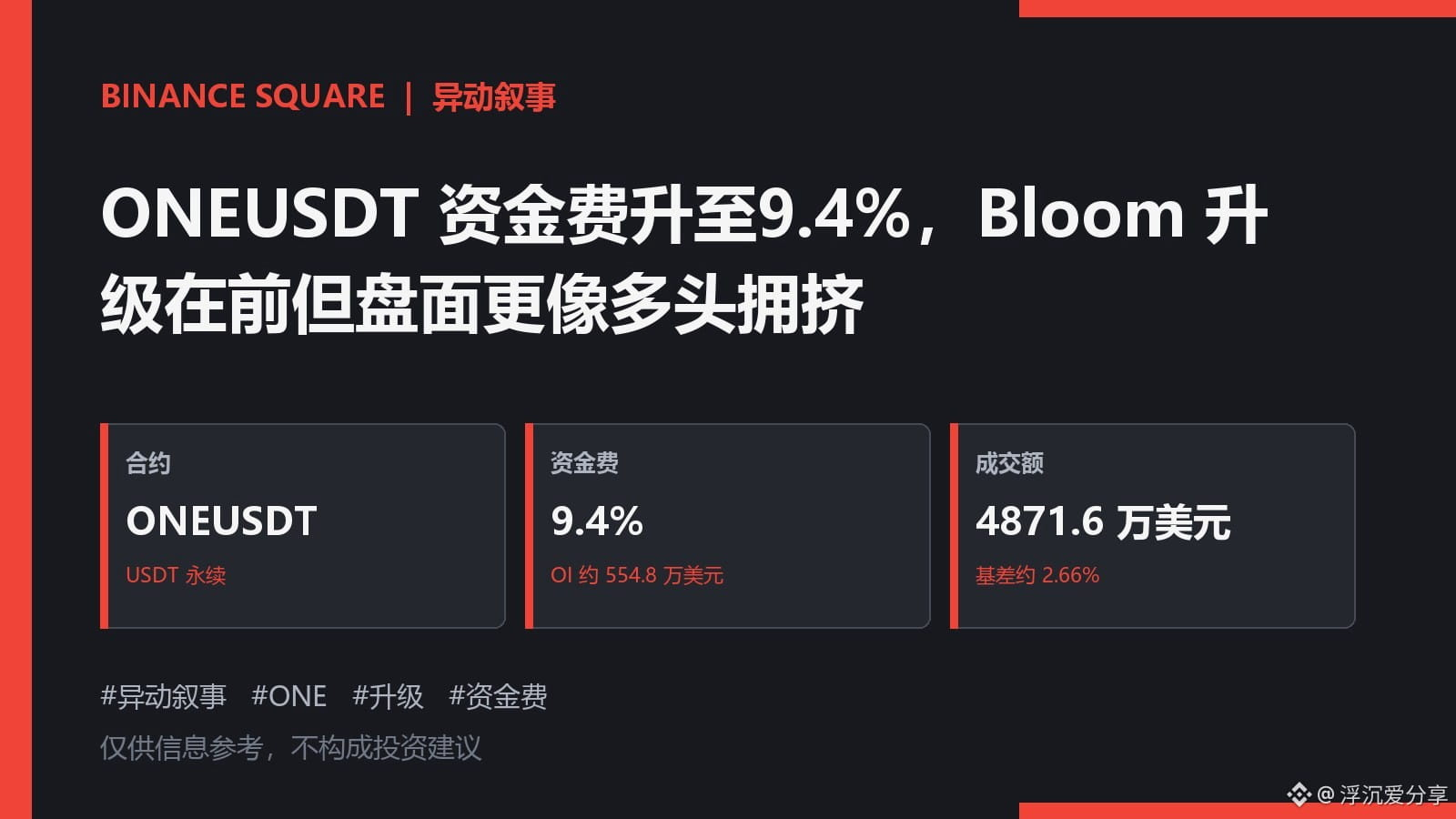
ONEUSDT funding rate rises to 9.4%, Bloom upgrade comes first, but the chart looks more like crowded longs
Confirmed fact: Harmony’s official team activated Mainnet v2026.1.0 “Bloom” on 2026-07-13, requiring validators and RPC nodes to upgrade. Market discussion: although the upgrade itself happened a while ago, today’s more direct signals are the positive funding rate and a clear premium, suggesting that crowded longs are stronger than the intensity of new news. Inference: if there is no more recent on-chain activity or ecosystem data to carry the momentum, the market looks more like leftover expectations from the earlier upgrade. Chasing price higher should guard against emotion reversal and a quick pullback.
{future}(ONEUSDT) $ONE #异动叙事 #ONE #升级 # funding rate
ONEUSDT funding rate rises to 9.4%, Bloom upgrade comes first, but the chart looks more like crowded longs
Confirmed fact: Harmony’s official team activated Mainnet v2026.1.0 “Bloom” on 2026-07-13, requiring validators and RPC nodes to upgrade. Market discussion: although the upgrade itself happened a while ago, today’s more direct signals are the positive funding rate and a clear premium, suggesting that crowded longs are stronger than the intensity of new news. Inference: if there is no more recent on-chain activity or ecosystem data to carry the momentum, the market looks more like leftover expectations from the earlier upgrade. Chasing price higher should guard against emotion reversal and a quick pullback.
$ONE #异动叙事 #ONE #升级 # funding rate
Confirmed fact: Harmony’s official team activated Mainnet v2026.1.0 “Bloom” on 2026-07-13, requiring validators and RPC nodes to upgrade. Market discussion: although the upgrade itself happened a while ago, today’s more direct signals are the positive funding rate and a clear premium, suggesting that crowded longs are stronger than the intensity of new news. Inference: if there is no more recent on-chain activity or ecosystem data to carry the momentum, the market looks more like leftover expectations from the earlier upgrade. Chasing price higher should guard against emotion reversal and a quick pullback.
$ONE #异动叙事 #ONE #升级 # funding rate
1
284
·
--
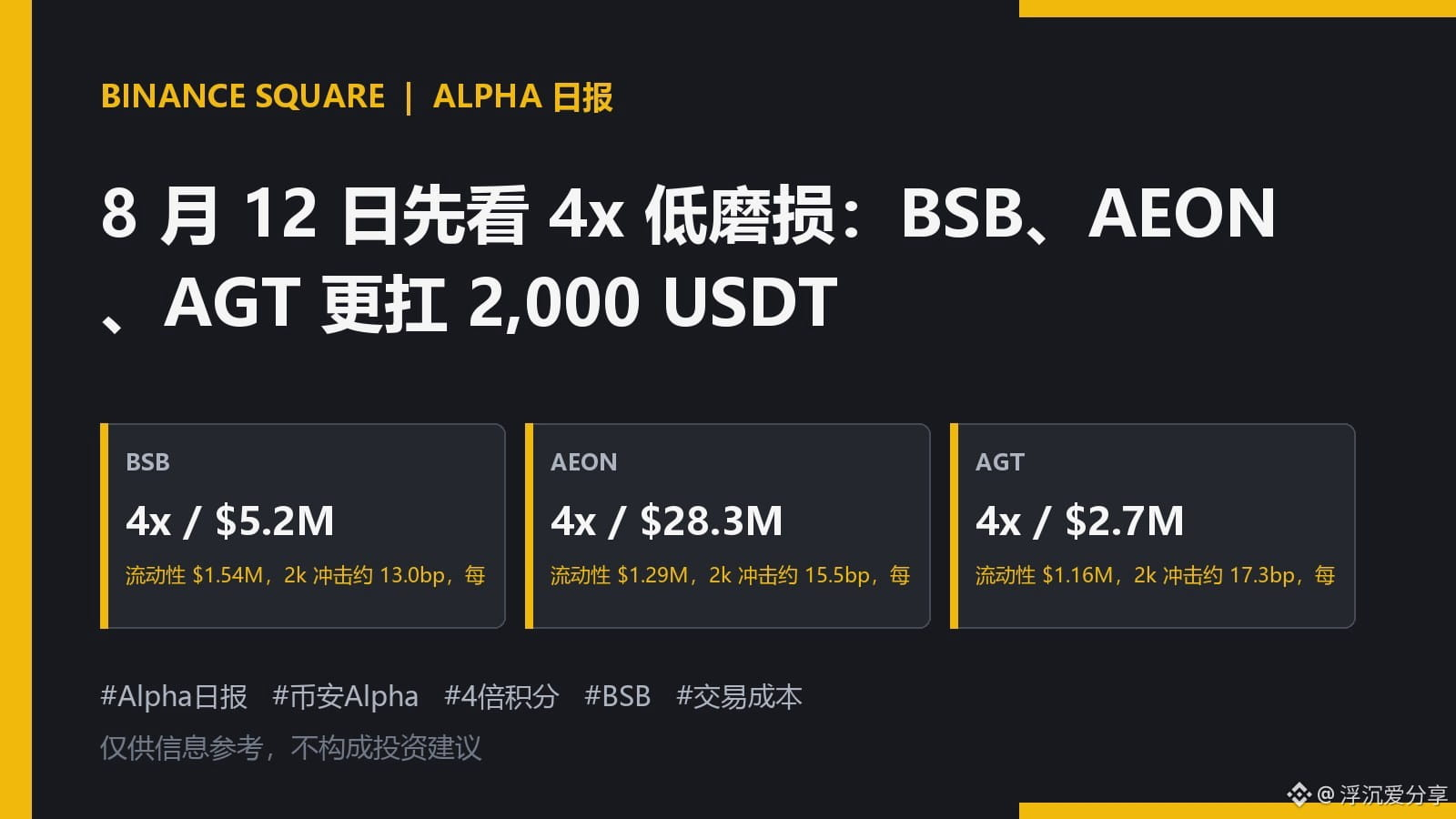
August 12 first check 4x low wear: BSB, AEON, AGT hold up 2,000 USDT
Today, first look at this 4x Alpha set: BSB, AEON, AGT. According to the Binance Alpha public token list snapshot, their 24h trading volumes are roughly $5.2M, $28.3M, and $2.7M respectively; for a single 2,000 USDT trade, the estimated impact is about 13.0 to 17.3 bp. If you’re only doing point-earning, first combine fees, Gas, slippage, and buy-side wear, then evaluate the 4x multiplier—don’t split orders just to chase rankings or do wash trades.
$BSB $AEON $AGT #Alpha日报 #币安Alpha #4倍积分 #BSB #交易成本
August 12 first check 4x low wear: BSB, AEON, AGT hold up 2,000 USDT
Today, first look at this 4x Alpha set: BSB, AEON, AGT. According to the Binance Alpha public token list snapshot, their 24h trading volumes are roughly $5.2M, $28.3M, and $2.7M respectively; for a single 2,000 USDT trade, the estimated impact is about 13.0 to 17.3 bp. If you’re only doing point-earning, first combine fees, Gas, slippage, and buy-side wear, then evaluate the 4x multiplier—don’t split orders just to chase rankings or do wash trades.
$BSB $AEON $AGT #Alpha日报 #币安Alpha #4倍积分 #BSB #交易成本
Today, first look at this 4x Alpha set: BSB, AEON, AGT. According to the Binance Alpha public token list snapshot, their 24h trading volumes are roughly $5.2M, $28.3M, and $2.7M respectively; for a single 2,000 USDT trade, the estimated impact is about 13.0 to 17.3 bp. If you’re only doing point-earning, first combine fees, Gas, slippage, and buy-side wear, then evaluate the 4x multiplier—don’t split orders just to chase rankings or do wash trades.
$BSB $AEON $AGT #Alpha日报 #币安Alpha #4倍积分 #BSB #交易成本
1.1k
·
--
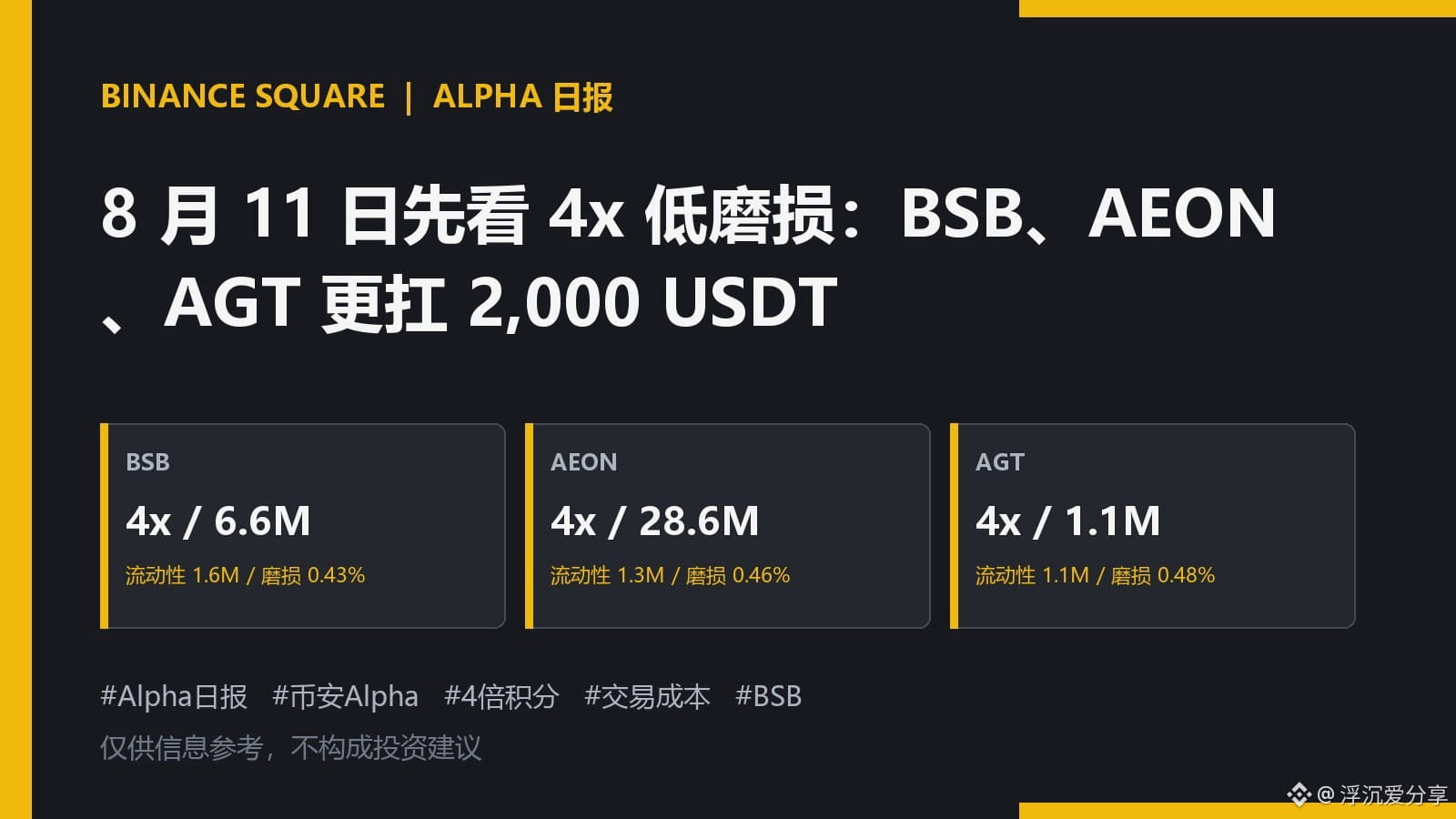
On August 11, check first: 4x low-friction performance. BSB, AEON, and AGT can handle 2,000 USDT better
Today, first separate the 4x points from trading friction. BSB, AEON, and AGT’s publicly available liquidity are still the best among the 4x set for absorbing a single trade of about 2,000 USDT; rough friction is around 0.48%. A higher multiple doesn’t necessarily mean it’s suitable for heavy positions—actual fills depend on routing, Gas, slippage, order book depth, ranking entry thresholds, and regional restrictions. Don’t force more volume just to chase points.
$BSB $AEON $AGT #Alpha日报 #币安Alpha #4倍积分 #交易成本 #BSB
On August 11, check first: 4x low-friction performance. BSB, AEON, and AGT can handle 2,000 USDT better
Today, first separate the 4x points from trading friction. BSB, AEON, and AGT’s publicly available liquidity are still the best among the 4x set for absorbing a single trade of about 2,000 USDT; rough friction is around 0.48%. A higher multiple doesn’t necessarily mean it’s suitable for heavy positions—actual fills depend on routing, Gas, slippage, order book depth, ranking entry thresholds, and regional restrictions. Don’t force more volume just to chase points.
$BSB $AEON $AGT #Alpha日报 #币安Alpha #4倍积分 #交易成本 #BSB
Today, first separate the 4x points from trading friction. BSB, AEON, and AGT’s publicly available liquidity are still the best among the 4x set for absorbing a single trade of about 2,000 USDT; rough friction is around 0.48%. A higher multiple doesn’t necessarily mean it’s suitable for heavy positions—actual fills depend on routing, Gas, slippage, order book depth, ranking entry thresholds, and regional restrictions. Don’t force more volume just to chase points.
$BSB $AEON $AGT #Alpha日报 #币安Alpha #4倍积分 #交易成本 #BSB
1
965
·
--
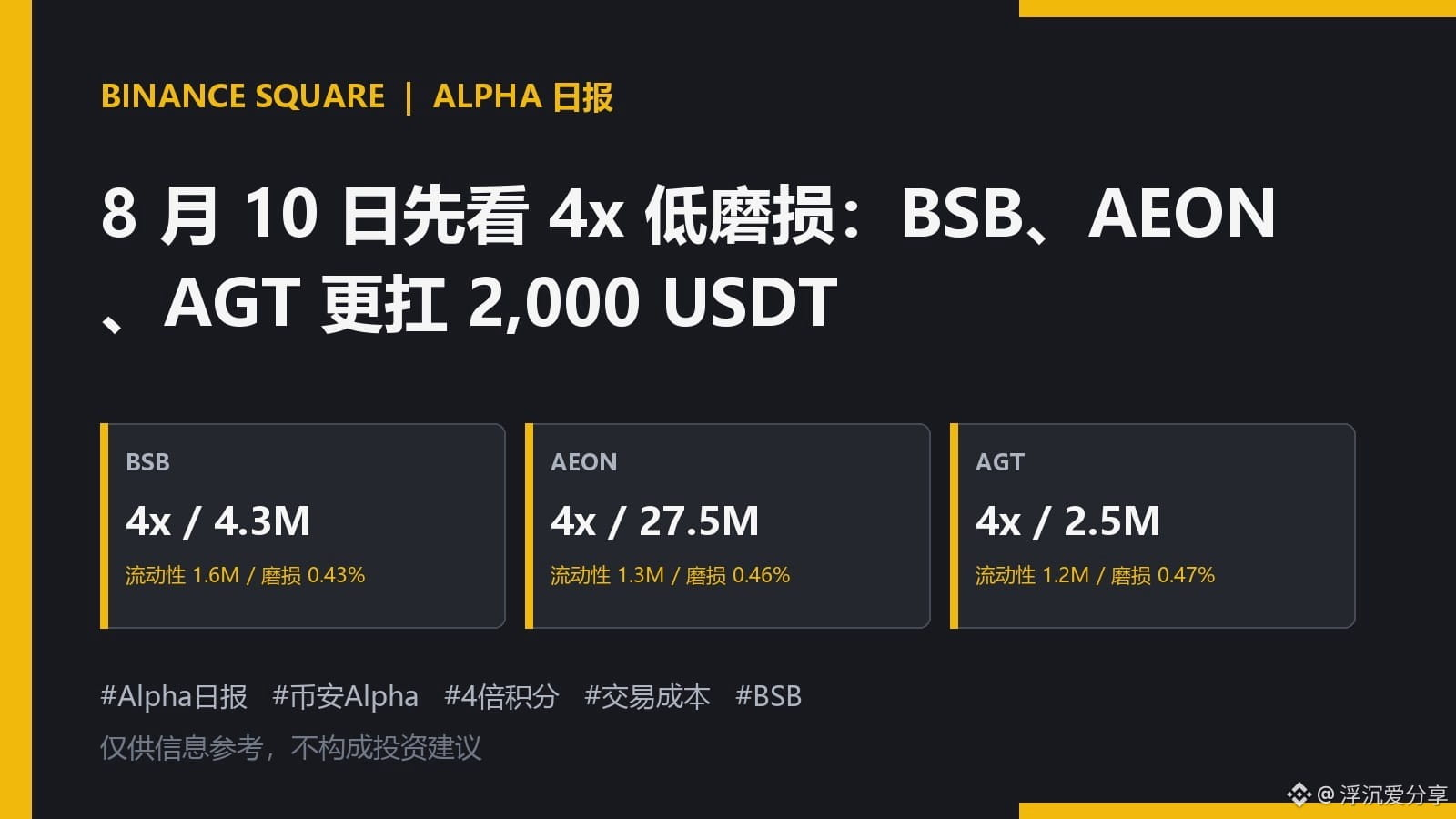
August 10: First look at 4x low wear: BSB, AEON, AGT can handle 2,000 USDT better
Today, let’s separate the 4x points from trading wear. The publicly available liquidity of BSB, AEON, and AGT can absorb roughly a 2,000 USDT single transaction more effectively; the approximate wear is kept around 0.48%, which is more cost-effective than GRVT and AIA. A higher multiplier doesn’t necessarily mean it’s suitable for heavy allocation—actual fills still depend on routing, gas, price spread, regional eligibility, and ranking pressure. Don’t hard-push volume just to catch up.
$BSB $AEON $AGT #Alpha日报 #币安Alpha #4倍积分 #交易成本 #BSB
August 10: First look at 4x low wear: BSB, AEON, AGT can handle 2,000 USDT better
Today, let’s separate the 4x points from trading wear. The publicly available liquidity of BSB, AEON, and AGT can absorb roughly a 2,000 USDT single transaction more effectively; the approximate wear is kept around 0.48%, which is more cost-effective than GRVT and AIA. A higher multiplier doesn’t necessarily mean it’s suitable for heavy allocation—actual fills still depend on routing, gas, price spread, regional eligibility, and ranking pressure. Don’t hard-push volume just to catch up.
$BSB $AEON $AGT #Alpha日报 #币安Alpha #4倍积分 #交易成本 #BSB
Today, let’s separate the 4x points from trading wear. The publicly available liquidity of BSB, AEON, and AGT can absorb roughly a 2,000 USDT single transaction more effectively; the approximate wear is kept around 0.48%, which is more cost-effective than GRVT and AIA. A higher multiplier doesn’t necessarily mean it’s suitable for heavy allocation—actual fills still depend on routing, gas, price spread, regional eligibility, and ranking pressure. Don’t hard-push volume just to catch up.
$BSB $AEON $AGT #Alpha日报 #币安Alpha #4倍积分 #交易成本 #BSB
1k
·
--
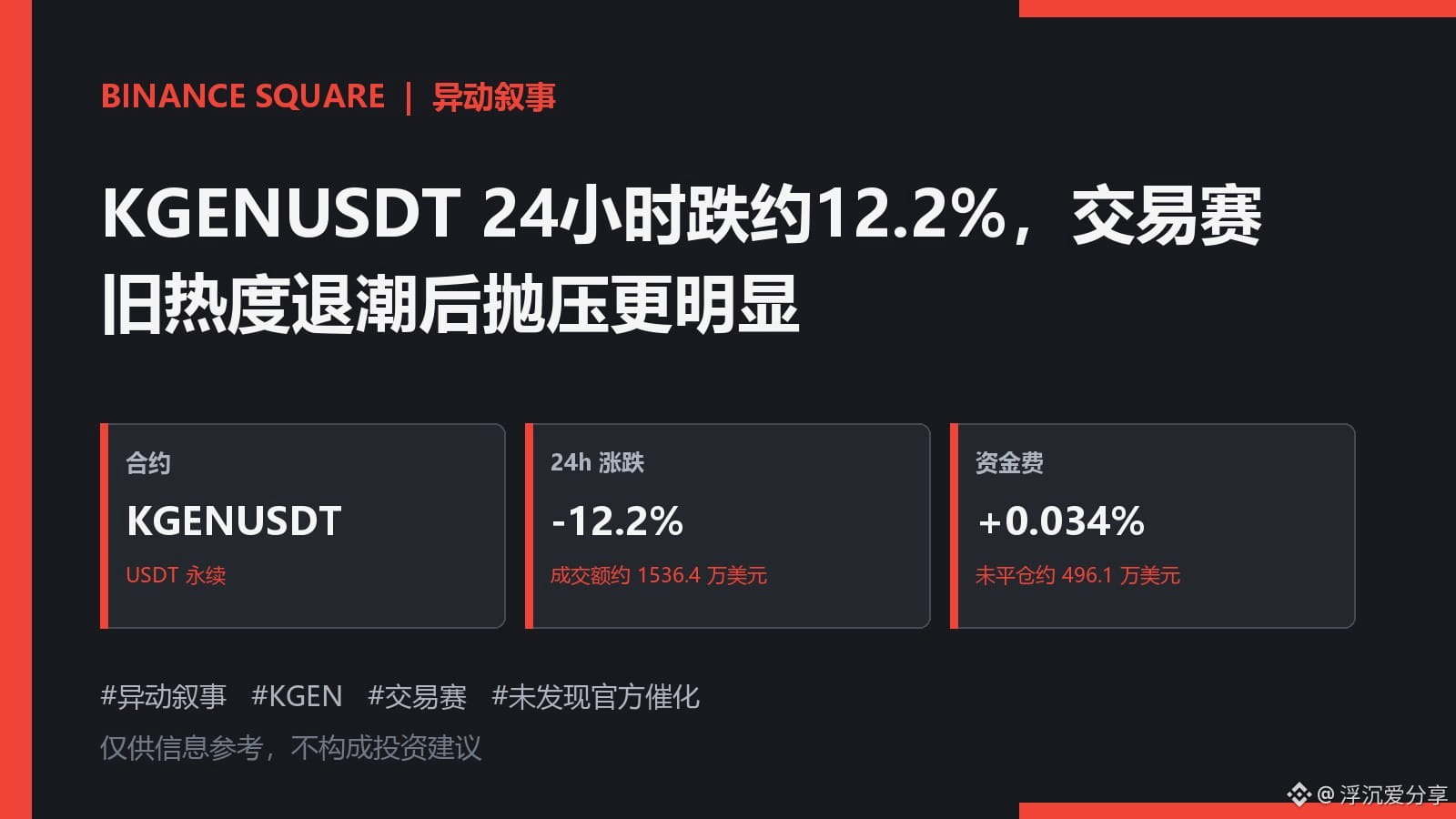
KGENUSDT 24-hour drop of about 12.2%; after the excitement from the trading contest cooled down, sell pressure has become more obvious.
Binance Alpha launched a KGEN trading contest on June 25, 2026, and provided two activity windows—this is a verified fact. As of the review on August 9, 2026, no new official follow-up or additional single-coin catalyst from the project team has been found. So today is more like the release of sell pressure after the hype from the old event has faded. The fact that funding rates are still pointing to crowded long positioning indicates longs may still be crowded; this is part of market discussion and does not mean the downtrend will continue unconditionally. For futures trading, you still need to guard against sudden pumps followed by rapid liquidation.
{future}(KGENUSDT) $KGEN #异动叙事 #KGEN #交易赛 #No official catalysts found
KGENUSDT 24-hour drop of about 12.2%; after the excitement from the trading contest cooled down, sell pressure has become more obvious.
Binance Alpha launched a KGEN trading contest on June 25, 2026, and provided two activity windows—this is a verified fact. As of the review on August 9, 2026, no new official follow-up or additional single-coin catalyst from the project team has been found. So today is more like the release of sell pressure after the hype from the old event has faded. The fact that funding rates are still pointing to crowded long positioning indicates longs may still be crowded; this is part of market discussion and does not mean the downtrend will continue unconditionally. For futures trading, you still need to guard against sudden pumps followed by rapid liquidation.
$KGEN #异动叙事 #KGEN #交易赛 #No official catalysts found
Binance Alpha launched a KGEN trading contest on June 25, 2026, and provided two activity windows—this is a verified fact. As of the review on August 9, 2026, no new official follow-up or additional single-coin catalyst from the project team has been found. So today is more like the release of sell pressure after the hype from the old event has faded. The fact that funding rates are still pointing to crowded long positioning indicates longs may still be crowded; this is part of market discussion and does not mean the downtrend will continue unconditionally. For futures trading, you still need to guard against sudden pumps followed by rapid liquidation.
$KGEN #异动叙事 #KGEN #交易赛 #No official catalysts found
201
·
--
August 9 first look at 4x low-wear: BSB, AEON, AGT can handle 2,000 USDT more
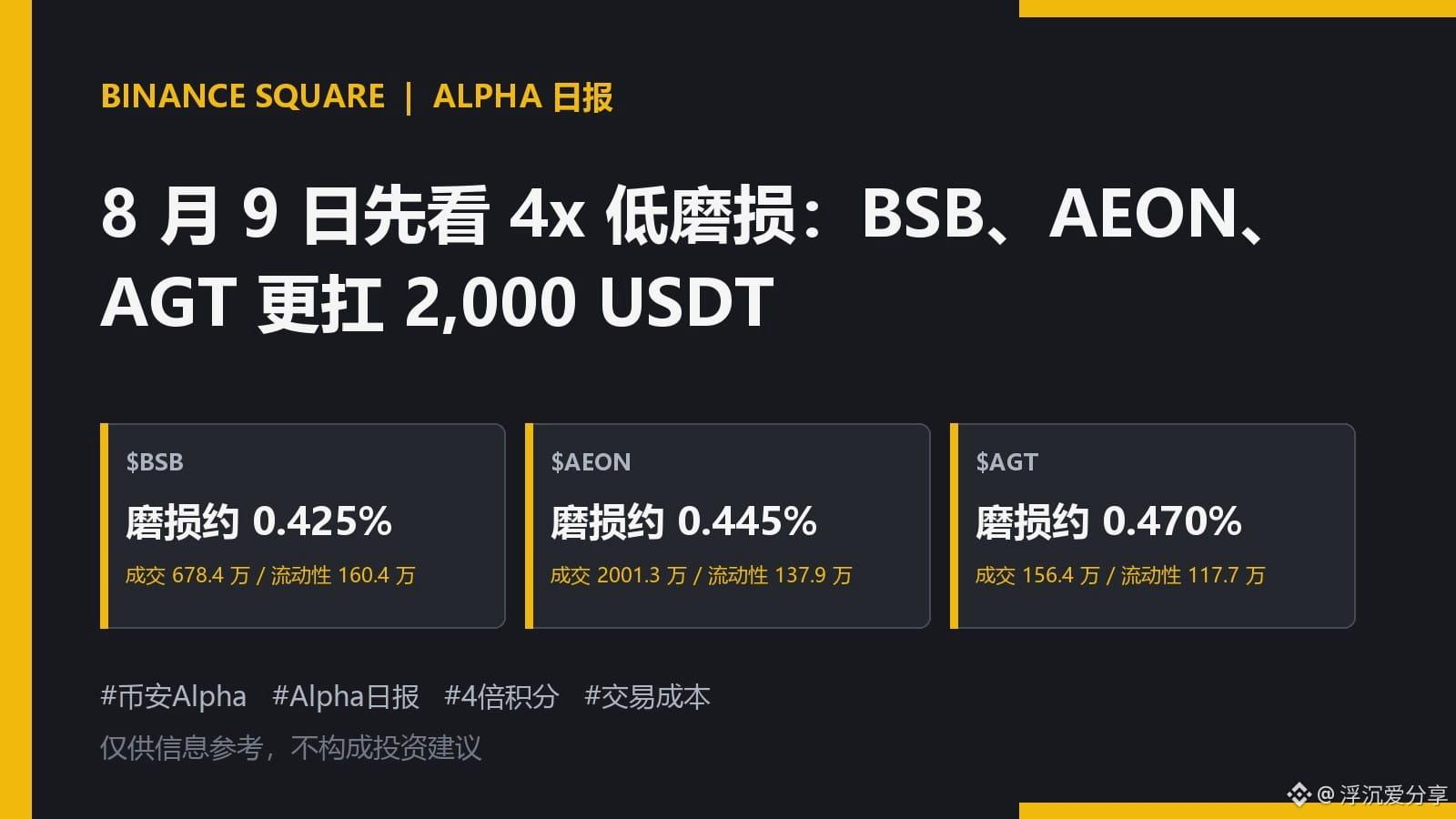
Based on the Binance Alpha official list captured on August 9 Beijing time, within the 4x category, the implied unilateral-slippage proxy value of the 2,000 USDT nominal order for $BSB, $AEON, and $AGT is approximately 0.12% to 0.17%; the estimated wear is roughly 0.425% to 0.470%. If you screen for higher-resilience coins today first, this set of three is more suitable for initial re-checking. Fees, Gas, slippage, wear, ranking, and regional restrictions still need to be calculated separately.
$BSB $AEON $AGT #币安Alpha #Alpha日报 #4倍积分 # transaction cost
August 9 first look at 4x low-wear: BSB, AEON, AGT can handle 2,000 USDT more
Based on the Binance Alpha official list captured on August 9 Beijing time, within the 4x category, the implied unilateral-slippage proxy value of the 2,000 USDT nominal order for $BSB , $AEON, and $AGT is approximately 0.12% to 0.17%; the estimated wear is roughly 0.425% to 0.470%. If you screen for higher-resilience coins today first, this set of three is more suitable for initial re-checking. Fees, Gas, slippage, wear, ranking, and regional restrictions still need to be calculated separately.
$BSB $AEON $AGT #币安Alpha #Alpha日报 #4倍积分 # transaction cost
Based on the Binance Alpha official list captured on August 9 Beijing time, within the 4x category, the implied unilateral-slippage proxy value of the 2,000 USDT nominal order for $BSB , $AEON, and $AGT is approximately 0.12% to 0.17%; the estimated wear is roughly 0.425% to 0.470%. If you screen for higher-resilience coins today first, this set of three is more suitable for initial re-checking. Fees, Gas, slippage, wear, ranking, and regional restrictions still need to be calculated separately.
$BSB $AEON $AGT #币安Alpha #Alpha日报 #4倍积分 # transaction cost
100
·
--
August 8: Check first the 4x lower-wear picks: BSB, AEON, AGT—each can handle 2,000 USDT
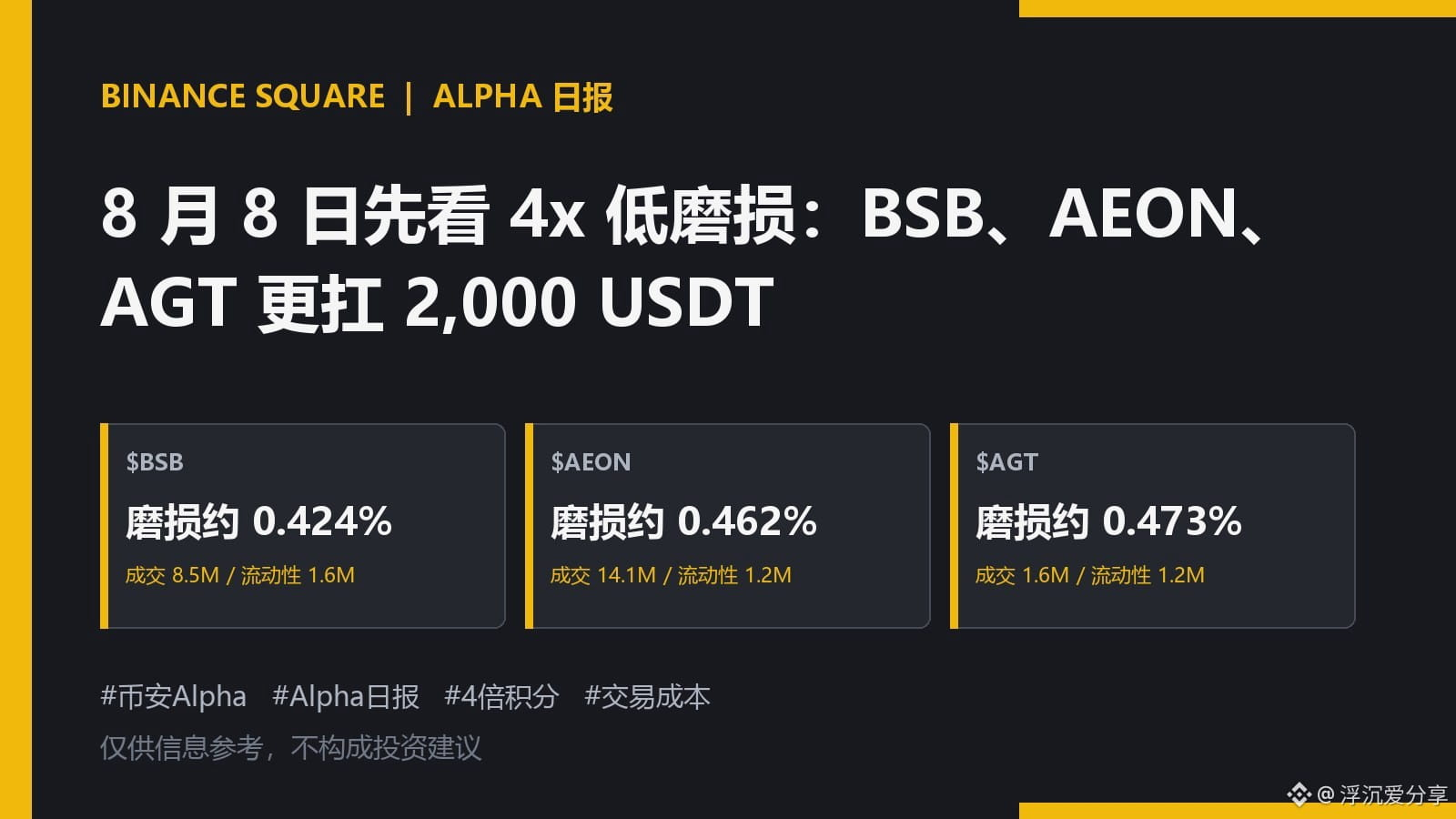
Based on the Binance Alpha public list captured at 2026-08-08 Beijing time: in the current 4x queue, for the $BSB, $AEON, and $AGT entries, the estimated buy nominal amount of 2,000 USDT implies an estimated slippage of about 0.124% to 0.173%, with one-way wear of roughly 0.424% to 0.473%. If today you first filter for more stable Alpha-integration tokens, these three are more worth re-checking first—but you still need to calculate separately the trading fees, Gas, slippage, wear, ranking, and regional restrictions.
$BSB $AEON $AGT #币安Alpha #Alpha日报 #4倍积分 #transaction cost
August 8: Check first the 4x lower-wear picks: BSB, AEON, AGT—each can handle 2,000 USDT
Based on the Binance Alpha public list captured at 2026-08-08 Beijing time: in the current 4x queue, for the $BSB , $AEON, and $AGT entries, the estimated buy nominal amount of 2,000 USDT implies an estimated slippage of about 0.124% to 0.173%, with one-way wear of roughly 0.424% to 0.473%. If today you first filter for more stable Alpha-integration tokens, these three are more worth re-checking first—but you still need to calculate separately the trading fees, Gas, slippage, wear, ranking, and regional restrictions.
$BSB $AEON $AGT #币安Alpha #Alpha日报 #4倍积分 #transaction cost
Based on the Binance Alpha public list captured at 2026-08-08 Beijing time: in the current 4x queue, for the $BSB , $AEON, and $AGT entries, the estimated buy nominal amount of 2,000 USDT implies an estimated slippage of about 0.124% to 0.173%, with one-way wear of roughly 0.424% to 0.473%. If today you first filter for more stable Alpha-integration tokens, these three are more worth re-checking first—but you still need to calculate separately the trading fees, Gas, slippage, wear, ranking, and regional restrictions.
$BSB $AEON $AGT #币安Alpha #Alpha日报 #4倍积分 #transaction cost
1.1k
·
--
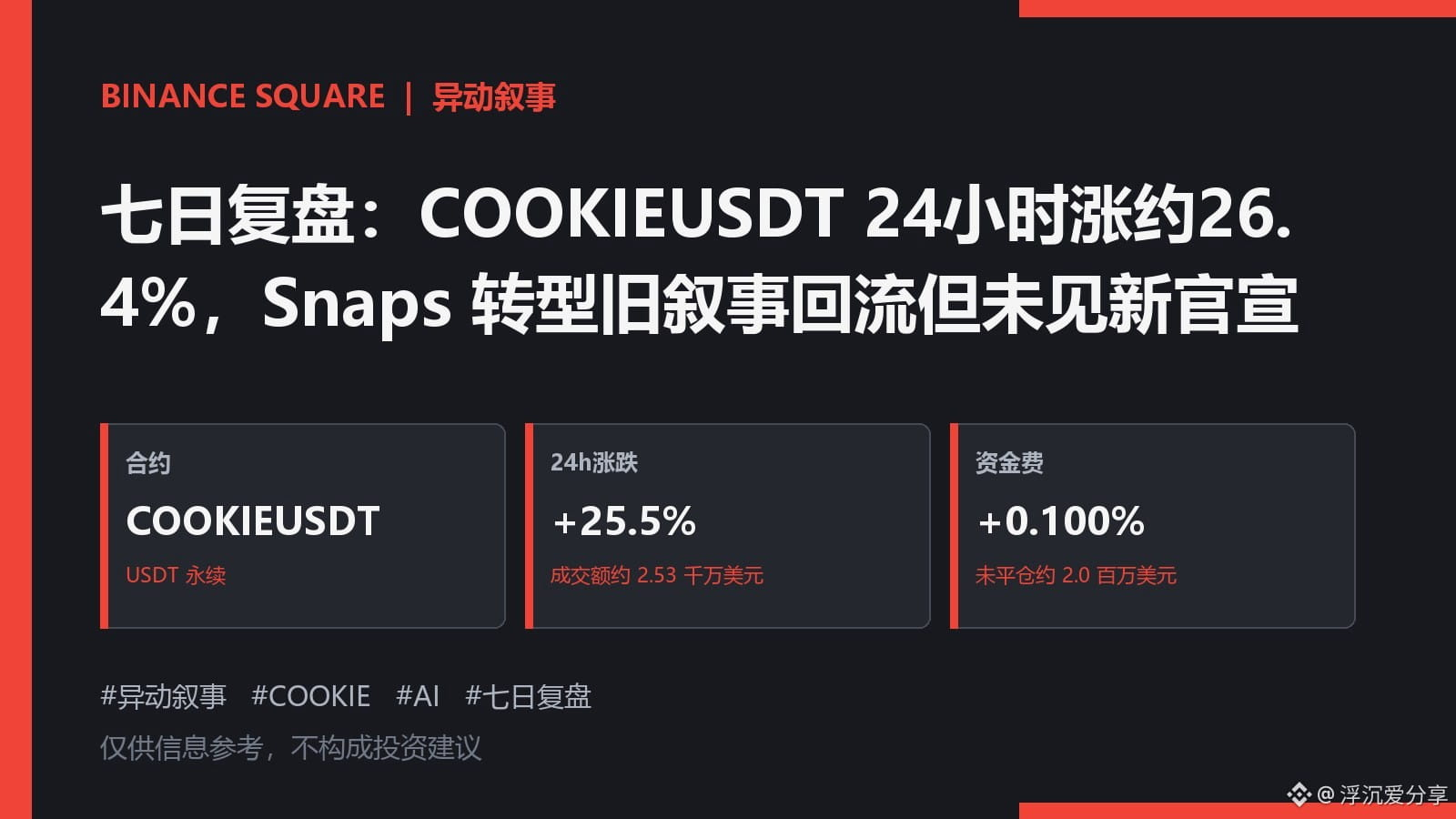
Seven-Day Recap: COOKIEUSDT surged about 26.4% in 24 hours. Snaps shifted to old narratives again, but no new official announcements were seen
What has been confirmed is that the Cookie DAO officially announced the sunset of Snaps and shifted its focus to a new direction: Rally. As of the re-check on August 7, 2026, no nearer-term official added catalyst has been seen. Today’s upswing looks more like capital reigniting the old AI / InfoFi narrative rather than the project team issuing a major update on the day. With high turnover, perp contracts can easily pump and dump quickly—watch out for pin/needle risks.
{future}(COOKIEUSDT) $COOKIE #异动叙事 #COOKIE #AI #Seven-Day Recap
Seven-Day Recap: COOKIEUSDT surged about 26.4% in 24 hours. Snaps shifted to old narratives again, but no new official announcements were seen
What has been confirmed is that the Cookie DAO officially announced the sunset of Snaps and shifted its focus to a new direction: Rally. As of the re-check on August 7, 2026, no nearer-term official added catalyst has been seen. Today’s upswing looks more like capital reigniting the old AI / InfoFi narrative rather than the project team issuing a major update on the day. With high turnover, perp contracts can easily pump and dump quickly—watch out for pin/needle risks.
$COOKIE #异动叙事 #COOKIE #AI #Seven-Day Recap
What has been confirmed is that the Cookie DAO officially announced the sunset of Snaps and shifted its focus to a new direction: Rally. As of the re-check on August 7, 2026, no nearer-term official added catalyst has been seen. Today’s upswing looks more like capital reigniting the old AI / InfoFi narrative rather than the project team issuing a major update on the day. With high turnover, perp contracts can easily pump and dump quickly—watch out for pin/needle risks.
$COOKIE #异动叙事 #COOKIE #AI #Seven-Day Recap
157
·
--
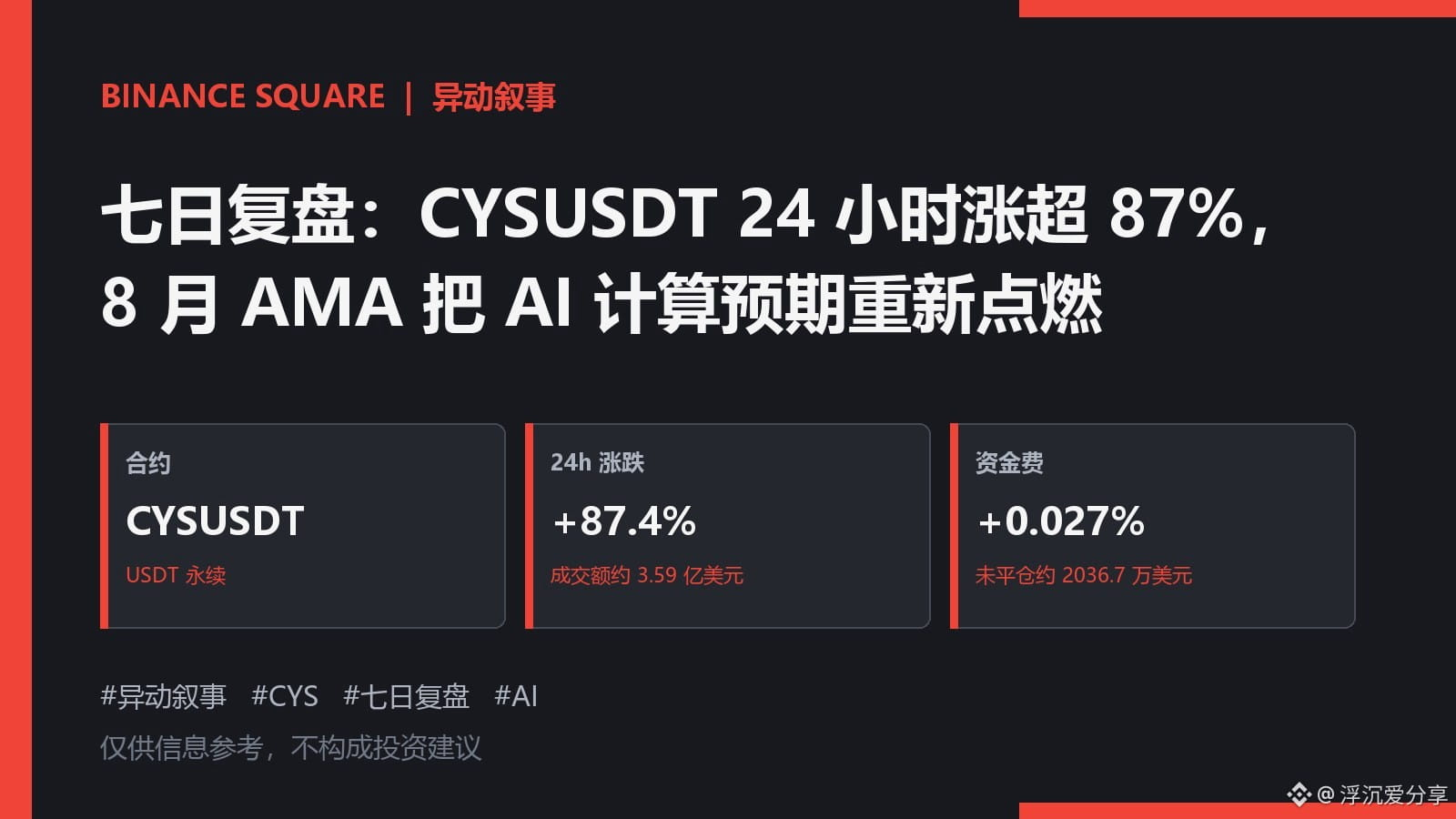
7-Day Recap: CYSUSDT surged more than 87% in 24 hours; August AMA reignites AI computation expectations
Cysic’s official X has already teased the first biweekly AMA of August, saying it will continue to update progress related to Venus and decentralized AI. Official documentation has also been continuously published for products such as CyOps and Venus—these are confirmed facts. Today’s sudden spike looks more like capital repricing the existing product line and the AMA expectations together, rather than a single execution-focused announcement. With funding rates indicating longs starting to crowd in, the derivatives side must also guard against profit taking and wick-like stop-hunts.
{future}(CYSUSDT) $CYS #异动叙事 #CYS #七日复盘 #AI
7-Day Recap: CYSUSDT surged more than 87% in 24 hours; August AMA reignites AI computation expectations
Cysic’s official X has already teased the first biweekly AMA of August, saying it will continue to update progress related to Venus and decentralized AI. Official documentation has also been continuously published for products such as CyOps and Venus—these are confirmed facts. Today’s sudden spike looks more like capital repricing the existing product line and the AMA expectations together, rather than a single execution-focused announcement. With funding rates indicating longs starting to crowd in, the derivatives side must also guard against profit taking and wick-like stop-hunts.
$CYS #异动叙事 #CYS #七日复盘 #AI
Cysic’s official X has already teased the first biweekly AMA of August, saying it will continue to update progress related to Venus and decentralized AI. Official documentation has also been continuously published for products such as CyOps and Venus—these are confirmed facts. Today’s sudden spike looks more like capital repricing the existing product line and the AMA expectations together, rather than a single execution-focused announcement. With funding rates indicating longs starting to crowd in, the derivatives side must also guard against profit taking and wick-like stop-hunts.
$CYS #异动叙事 #CYS #七日复盘 #AI
152
·
--
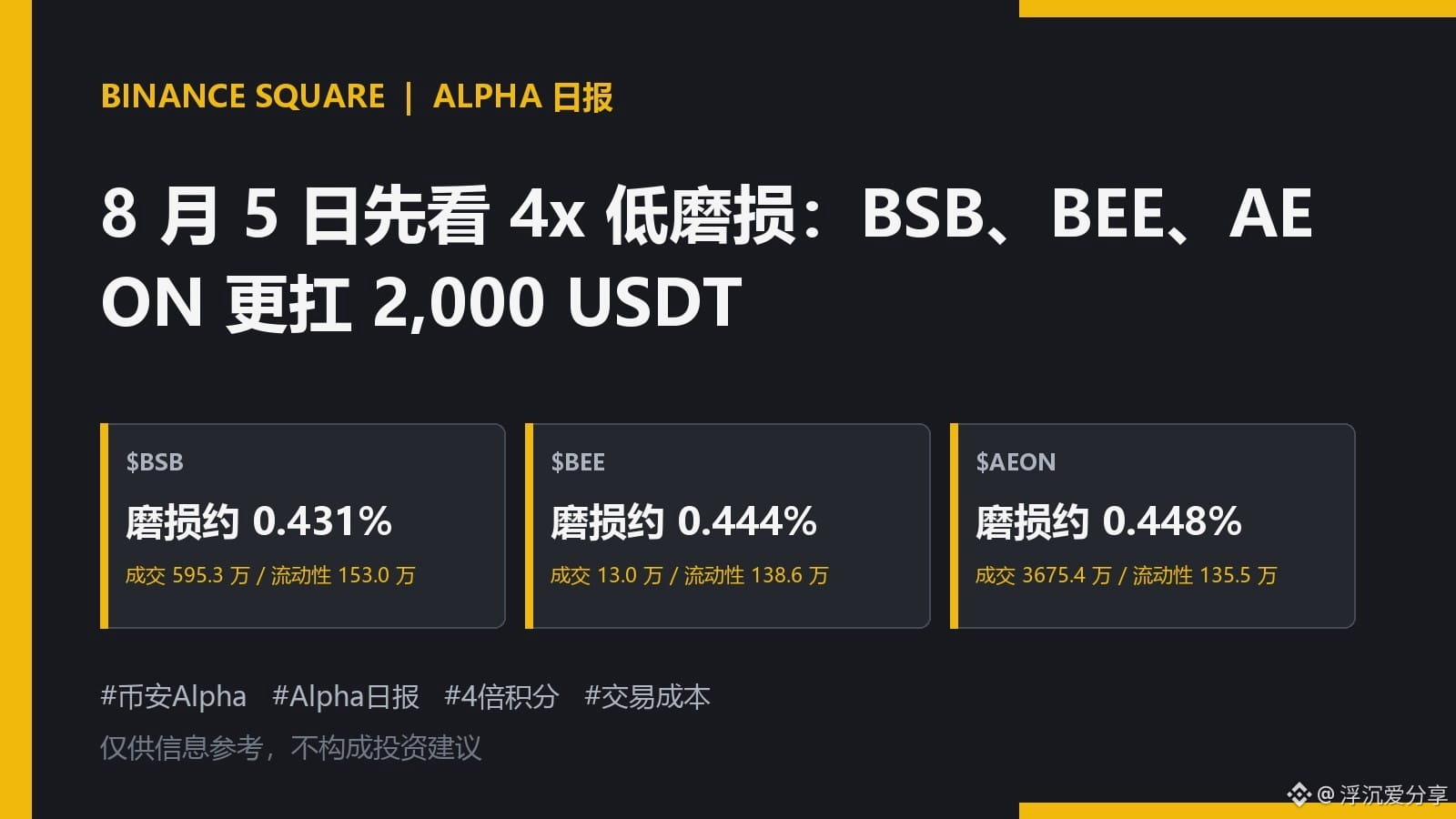
August 5: Check first for 4x lower wear and tear: BSB, BEE, AEON can handle more than 2,000 USDT
Based on the Binance Alpha official list captured on August 5 (Beijing time), within the 4x category, the 2,000 USDT notional one-way slippage proxy values for $BSB, $BEE, and $AEON are approximately 0.13% to 0.15%. Roughly estimated wear and tear is about 0.431% to 0.448%. If today you first filter for coins with stronger ability to handle orders, these three are more suitable to review first. Fees, Gas, slippage, wear and tear, ranking, and regional restrictions still need to be calculated separately.
$BSB $BEE $AEON #币安Alpha #Alpha日报 #4倍积分 #trading cost
August 5: Check first for 4x lower wear and tear: BSB, BEE, AEON can handle more than 2,000 USDT
Based on the Binance Alpha official list captured on August 5 (Beijing time), within the 4x category, the 2,000 USDT notional one-way slippage proxy values for $BSB , $BEE, and $AEON are approximately 0.13% to 0.15%. Roughly estimated wear and tear is about 0.431% to 0.448%. If today you first filter for coins with stronger ability to handle orders, these three are more suitable to review first. Fees, Gas, slippage, wear and tear, ranking, and regional restrictions still need to be calculated separately.
$BSB $BEE $AEON #币安Alpha #Alpha日报 #4倍积分 #trading cost
Based on the Binance Alpha official list captured on August 5 (Beijing time), within the 4x category, the 2,000 USDT notional one-way slippage proxy values for $BSB , $BEE, and $AEON are approximately 0.13% to 0.15%. Roughly estimated wear and tear is about 0.431% to 0.448%. If today you first filter for coins with stronger ability to handle orders, these three are more suitable to review first. Fees, Gas, slippage, wear and tear, ranking, and regional restrictions still need to be calculated separately.
$BSB $BEE $AEON #币安Alpha #Alpha日报 #4倍积分 #trading cost
731
·
--
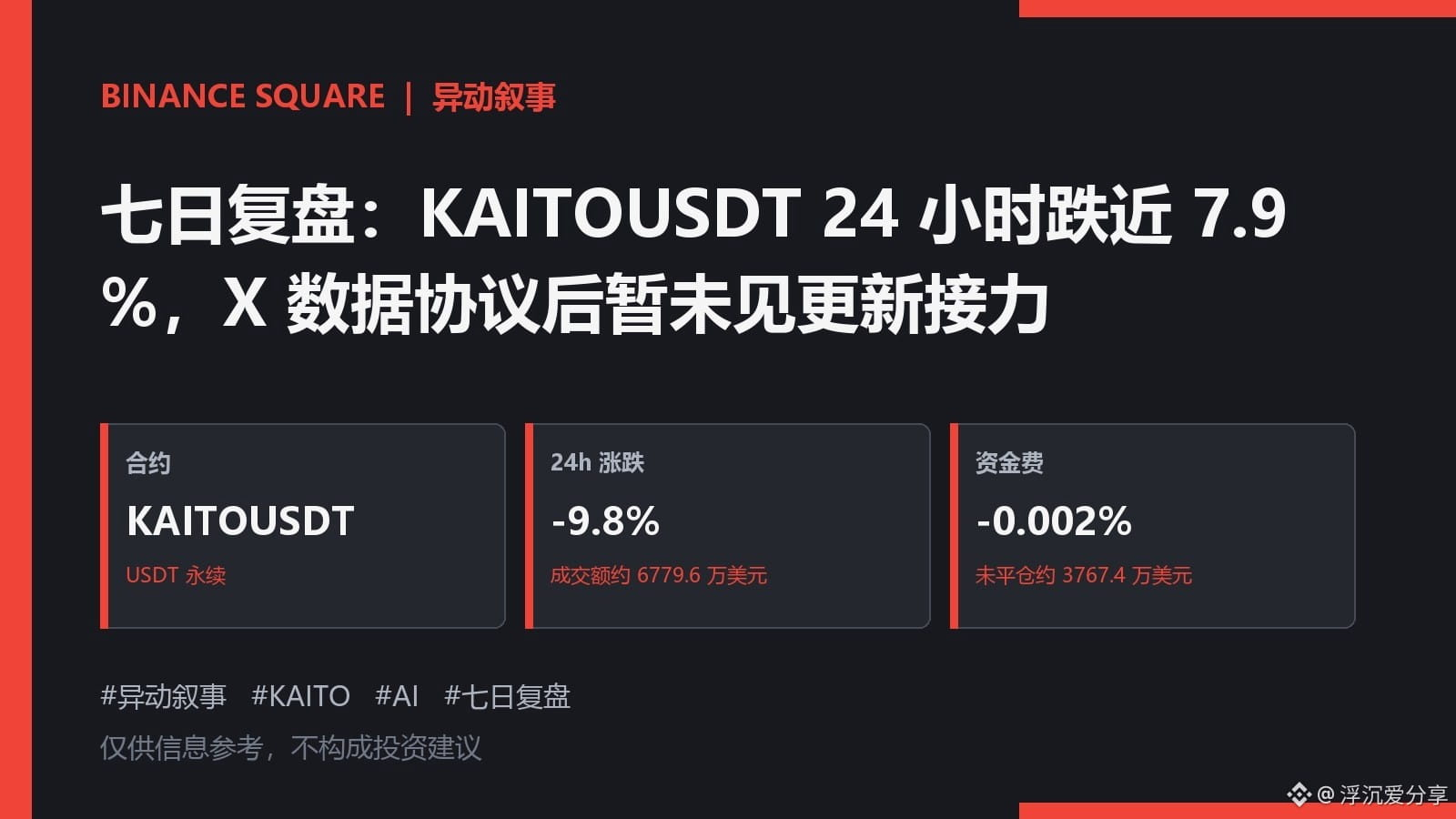
Seven-Day Recap: KAITOUSDT Falls Nearly 7.9% in 24 Hours—No Further Updates Observed Yet After the X Data Protocol
On July 23, 2026, Kaito’s official X confirmed that the project has reached a data agreement with X, which is a verified fact. When rechecked again on August 4, no newer official development was found that could more adequately explain today’s drop. It therefore seems more like a pullback and cooled positions after an earlier positive catalyst. The narrative hasn’t been disproven, but when there is negative feedback on the derivatives side, it can also quickly “stab” the trade.
{future}(KAITOUSDT) $KAITO #异动叙事 #KAITO #AI #Seven-Day Recap
Seven-Day Recap: KAITOUSDT Falls Nearly 7.9% in 24 Hours—No Further Updates Observed Yet After the X Data Protocol
On July 23, 2026, Kaito’s official X confirmed that the project has reached a data agreement with X, which is a verified fact. When rechecked again on August 4, no newer official development was found that could more adequately explain today’s drop. It therefore seems more like a pullback and cooled positions after an earlier positive catalyst. The narrative hasn’t been disproven, but when there is negative feedback on the derivatives side, it can also quickly “stab” the trade.
$KAITO #异动叙事 #KAITO #AI #Seven-Day Recap
On July 23, 2026, Kaito’s official X confirmed that the project has reached a data agreement with X, which is a verified fact. When rechecked again on August 4, no newer official development was found that could more adequately explain today’s drop. It therefore seems more like a pullback and cooled positions after an earlier positive catalyst. The narrative hasn’t been disproven, but when there is negative feedback on the derivatives side, it can also quickly “stab” the trade.
$KAITO #异动叙事 #KAITO #AI #Seven-Day Recap
149
·
--
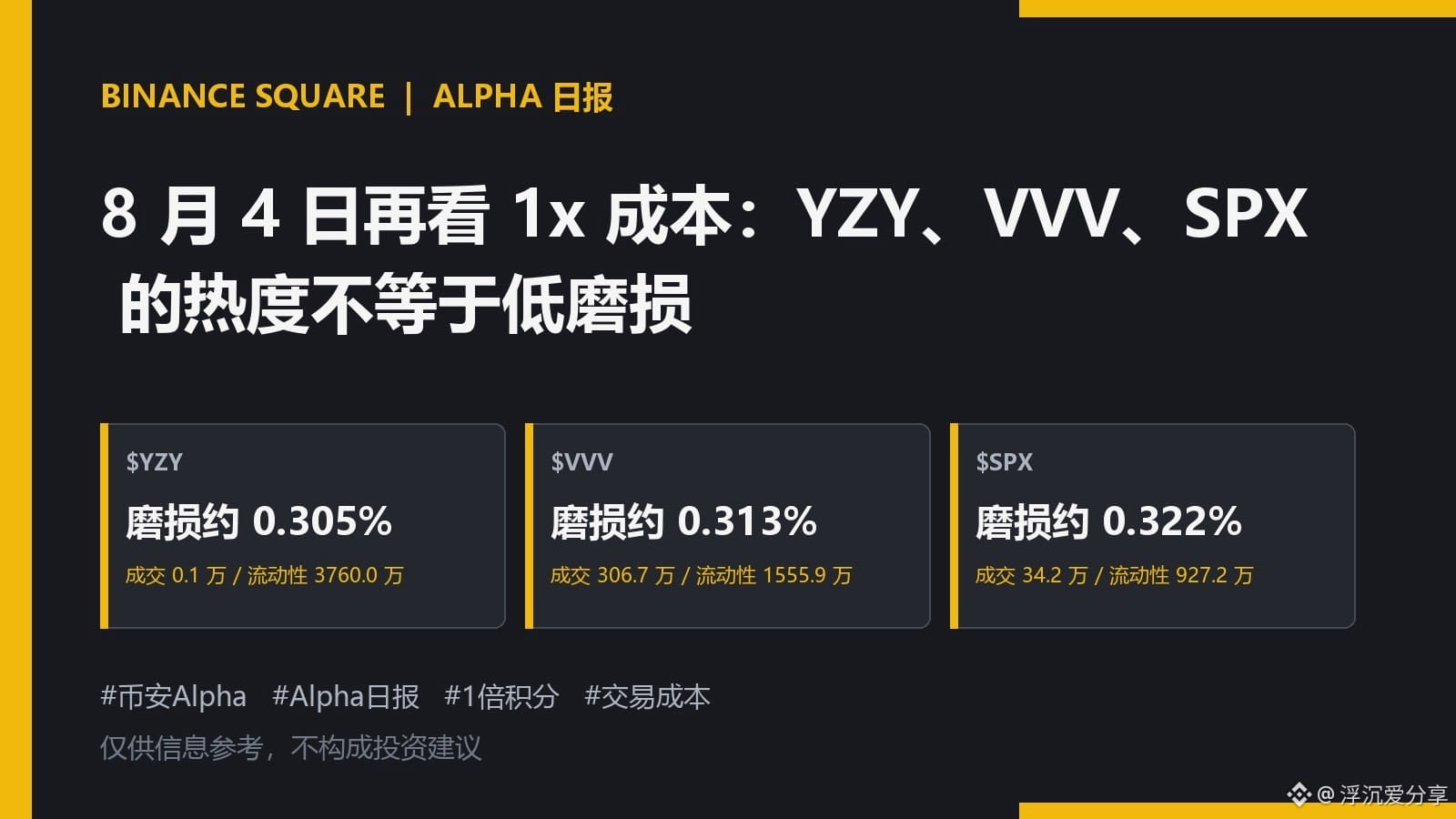
August 4: Recheck 1x cost—YZY, VVV, SPX’s hype is not equal to low wear
According to the official Binance Alpha list on August 4, within 1x, $YZY is roughly estimated to have wear of about 0.305%, $VVV roughly estimated wear of about 0.313%, and $SPX roughly estimated wear of about 0.322%. Some coins may have higher 24h trading volume, but that doesn’t necessarily mean the cost is the lowest. If you value point efficiency more today, first break down trading volume, liquidity, slippage, and wear, then decide whether to chase the hype or control costs.
$YZY $VVV $SPX #币安Alpha #Alpha日报 #1倍积分 # transaction cost
August 4: Recheck 1x cost—YZY, VVV, SPX’s hype is not equal to low wear
According to the official Binance Alpha list on August 4, within 1x, $YZY is roughly estimated to have wear of about 0.305%, $VVV roughly estimated wear of about 0.313%, and $SPX roughly estimated wear of about 0.322%. Some coins may have higher 24h trading volume, but that doesn’t necessarily mean the cost is the lowest. If you value point efficiency more today, first break down trading volume, liquidity, slippage, and wear, then decide whether to chase the hype or control costs.
$YZY $VVV $SPX #币安Alpha #Alpha日报 #1倍积分 # transaction cost
According to the official Binance Alpha list on August 4, within 1x, $YZY is roughly estimated to have wear of about 0.305%, $VVV roughly estimated wear of about 0.313%, and $SPX roughly estimated wear of about 0.322%. Some coins may have higher 24h trading volume, but that doesn’t necessarily mean the cost is the lowest. If you value point efficiency more today, first break down trading volume, liquidity, slippage, and wear, then decide whether to chase the hype or control costs.
$YZY $VVV $SPX #币安Alpha #Alpha日报 #1倍积分 # transaction cost
116
·
--
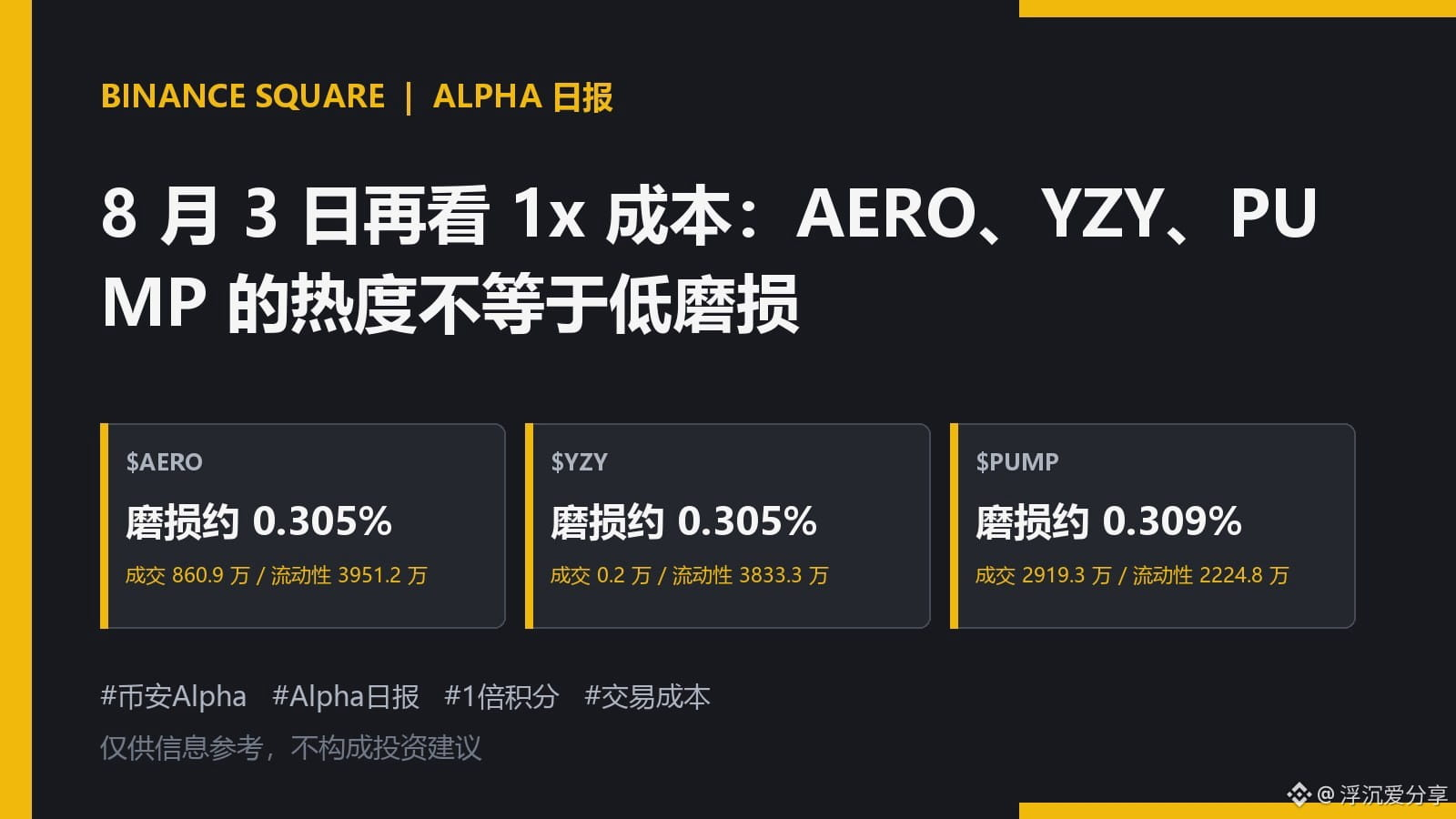
Re-check the 1x cost on August 3: the hype for AERO, YZY, and PUMP doesn’t equal low wear
According to the official Binance Alpha list on August 3, the estimated wear for 1x $AERO is about 0.305%, $YZY is about 0.305%, and $PUMP is about 0.309%. Some coins have higher 24h trading volume, but that doesn’t necessarily mean the cost is the lowest. If today you care more about point efficiency, break down trading volume, liquidity, slippage, and wear first—then decide whether to chase the hype or control costs.
$AERO $YZY $PUMP #币安Alpha #Alpha日报 #1倍积分 #交易成本
Re-check the 1x cost on August 3: the hype for AERO, YZY, and PUMP doesn’t equal low wear
According to the official Binance Alpha list on August 3, the estimated wear for 1x $AERO is about 0.305%, $YZY is about 0.305%, and $PUMP is about 0.309%. Some coins have higher 24h trading volume, but that doesn’t necessarily mean the cost is the lowest. If today you care more about point efficiency, break down trading volume, liquidity, slippage, and wear first—then decide whether to chase the hype or control costs.
$AERO $YZY $PUMP #币安Alpha #Alpha日报 #1倍积分 #交易成本
According to the official Binance Alpha list on August 3, the estimated wear for 1x $AERO is about 0.305%, $YZY is about 0.305%, and $PUMP is about 0.309%. Some coins have higher 24h trading volume, but that doesn’t necessarily mean the cost is the lowest. If today you care more about point efficiency, break down trading volume, liquidity, slippage, and wear first—then decide whether to chase the hype or control costs.
$AERO $YZY $PUMP #币安Alpha #Alpha日报 #1倍积分 #交易成本
1
251
·
--
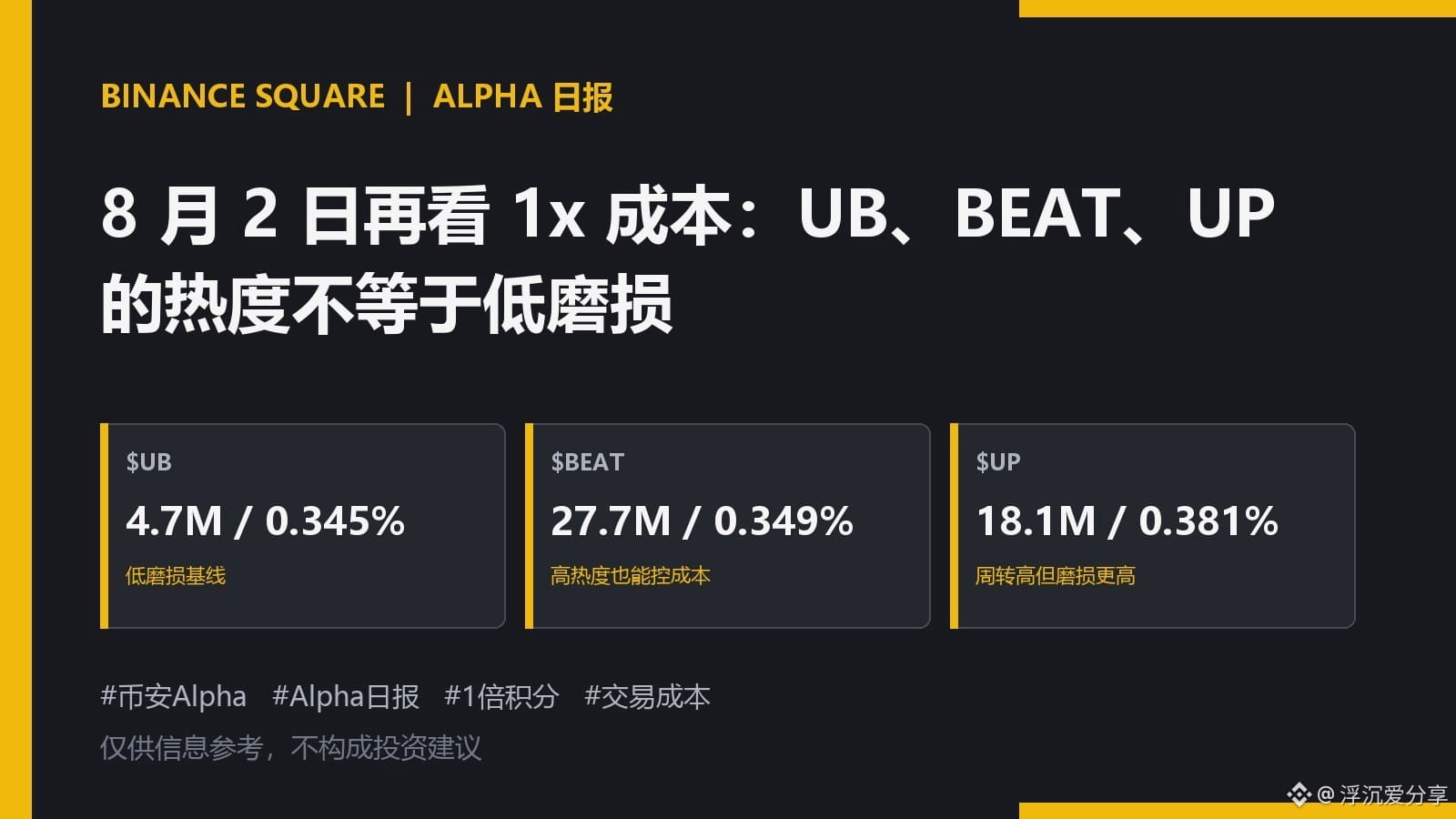
Revisiting the 1x cost on August 2: the popularity of UB, BEAT, and UP is not the same as low wear
In today’s 1x queue, the popularity and costs of UB, BEAT, and UP have also diverged. UB has about 4.7M in 24h trades, with estimated wear of roughly 0.345%; BEAT has about 27.7M in trades, with wear of about 0.349%; UP has about 18.1M in trades, with wear of about 0.381%. If you’re only trying to keep trading costs steady, UB and BEAT are closer to the low-wear range—but the buy amount is counted only for buys, not sells, so you still need to factor in the trading fee, Gas, and the ranking threshold together.
$UB $BEAT $UP #币安Alpha #Alpha日报 #1倍积分 #交易成本
Revisiting the 1x cost on August 2: the popularity of UB, BEAT, and UP is not the same as low wear
In today’s 1x queue, the popularity and costs of UB, BEAT, and UP have also diverged. UB has about 4.7M in 24h trades, with estimated wear of roughly 0.345%; BEAT has about 27.7M in trades, with wear of about 0.349%; UP has about 18.1M in trades, with wear of about 0.381%. If you’re only trying to keep trading costs steady, UB and BEAT are closer to the low-wear range—but the buy amount is counted only for buys, not sells, so you still need to factor in the trading fee, Gas, and the ranking threshold together.
$UB $BEAT $UP #币安Alpha #Alpha日报 #1倍积分 #交易成本
In today’s 1x queue, the popularity and costs of UB, BEAT, and UP have also diverged. UB has about 4.7M in 24h trades, with estimated wear of roughly 0.345%; BEAT has about 27.7M in trades, with wear of about 0.349%; UP has about 18.1M in trades, with wear of about 0.381%. If you’re only trying to keep trading costs steady, UB and BEAT are closer to the low-wear range—but the buy amount is counted only for buys, not sells, so you still need to factor in the trading fee, Gas, and the ranking threshold together.
$UB $BEAT $UP #币安Alpha #Alpha日报 #1倍积分 #交易成本
84
·
--
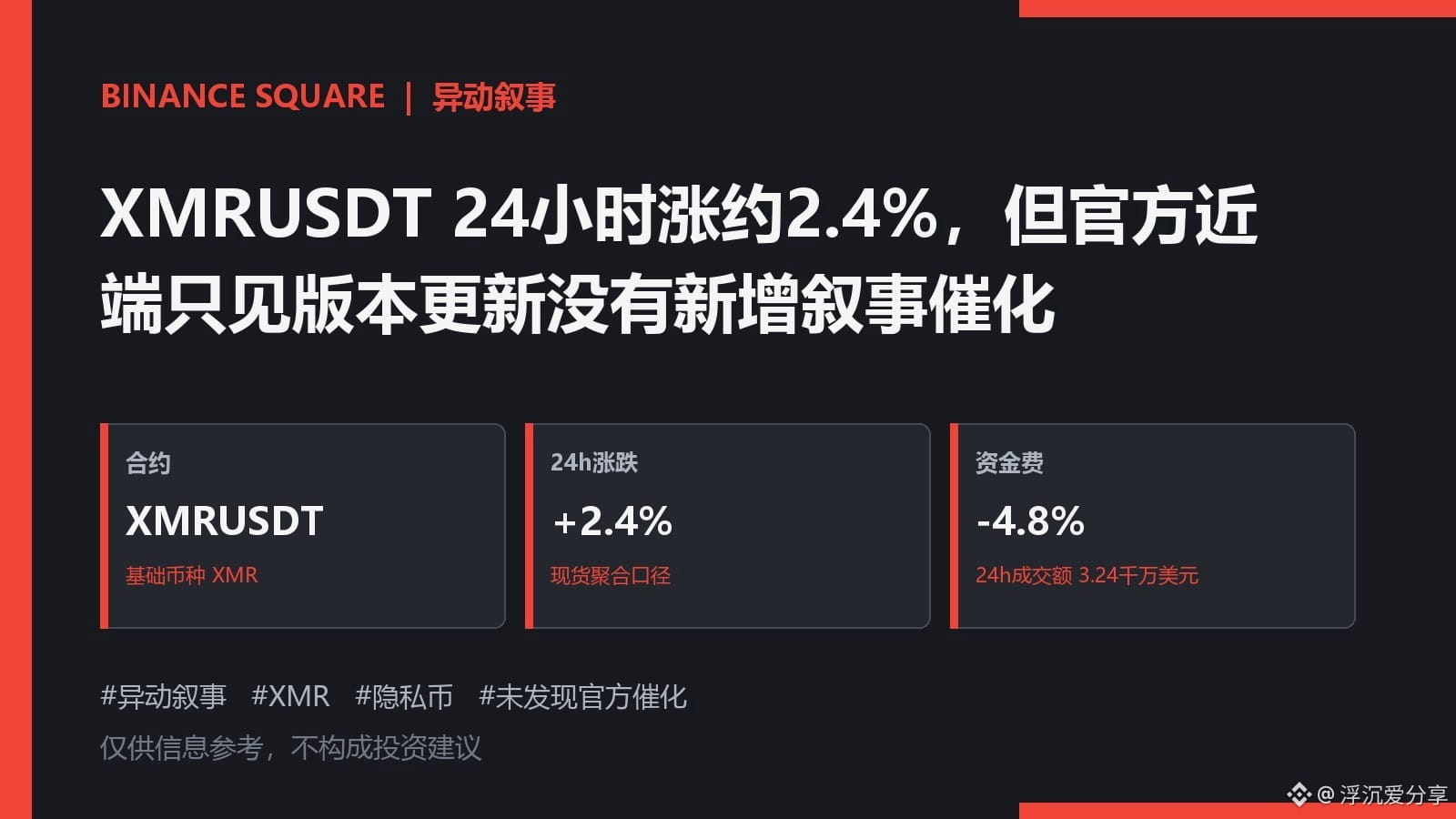
XMRUSDT rose about 2.4% over the past 24 hours, but the official near-term view shows only version updates with no new narrative catalyst
Verified facts: The Monero official release page shows that the most recent software update was GUI 0.18.5.2 on 2026-07-21, with a 0.18.5.1 patch version earlier in July. Market discussion: The independent trend of privacy coins is often interpreted as a rotation driven by risk-hedging. Inference: As of 2026-08-01, no new official catalyst has been found that can directly explain today’s contract moves; therefore this can only be written as a funds-flow observation explicitly marked as “no official catalyst found.” The negative funding rate is very deep—both a rebound and a sudden liquidation can suddenly intensify.
{future}(XMRUSDT) $XMR #异动叙事 #XMR #隐私币 #No official catalyst found
XMRUSDT rose about 2.4% over the past 24 hours, but the official near-term view shows only version updates with no new narrative catalyst
Verified facts: The Monero official release page shows that the most recent software update was GUI 0.18.5.2 on 2026-07-21, with a 0.18.5.1 patch version earlier in July. Market discussion: The independent trend of privacy coins is often interpreted as a rotation driven by risk-hedging. Inference: As of 2026-08-01, no new official catalyst has been found that can directly explain today’s contract moves; therefore this can only be written as a funds-flow observation explicitly marked as “no official catalyst found.” The negative funding rate is very deep—both a rebound and a sudden liquidation can suddenly intensify.
$XMR #异动叙事 #XMR #隐私币 #No official catalyst found
Verified facts: The Monero official release page shows that the most recent software update was GUI 0.18.5.2 on 2026-07-21, with a 0.18.5.1 patch version earlier in July. Market discussion: The independent trend of privacy coins is often interpreted as a rotation driven by risk-hedging. Inference: As of 2026-08-01, no new official catalyst has been found that can directly explain today’s contract moves; therefore this can only be written as a funds-flow observation explicitly marked as “no official catalyst found.” The negative funding rate is very deep—both a rebound and a sudden liquidation can suddenly intensify.
$XMR #异动叙事 #XMR #隐私币 #No official catalyst found
149
·
--
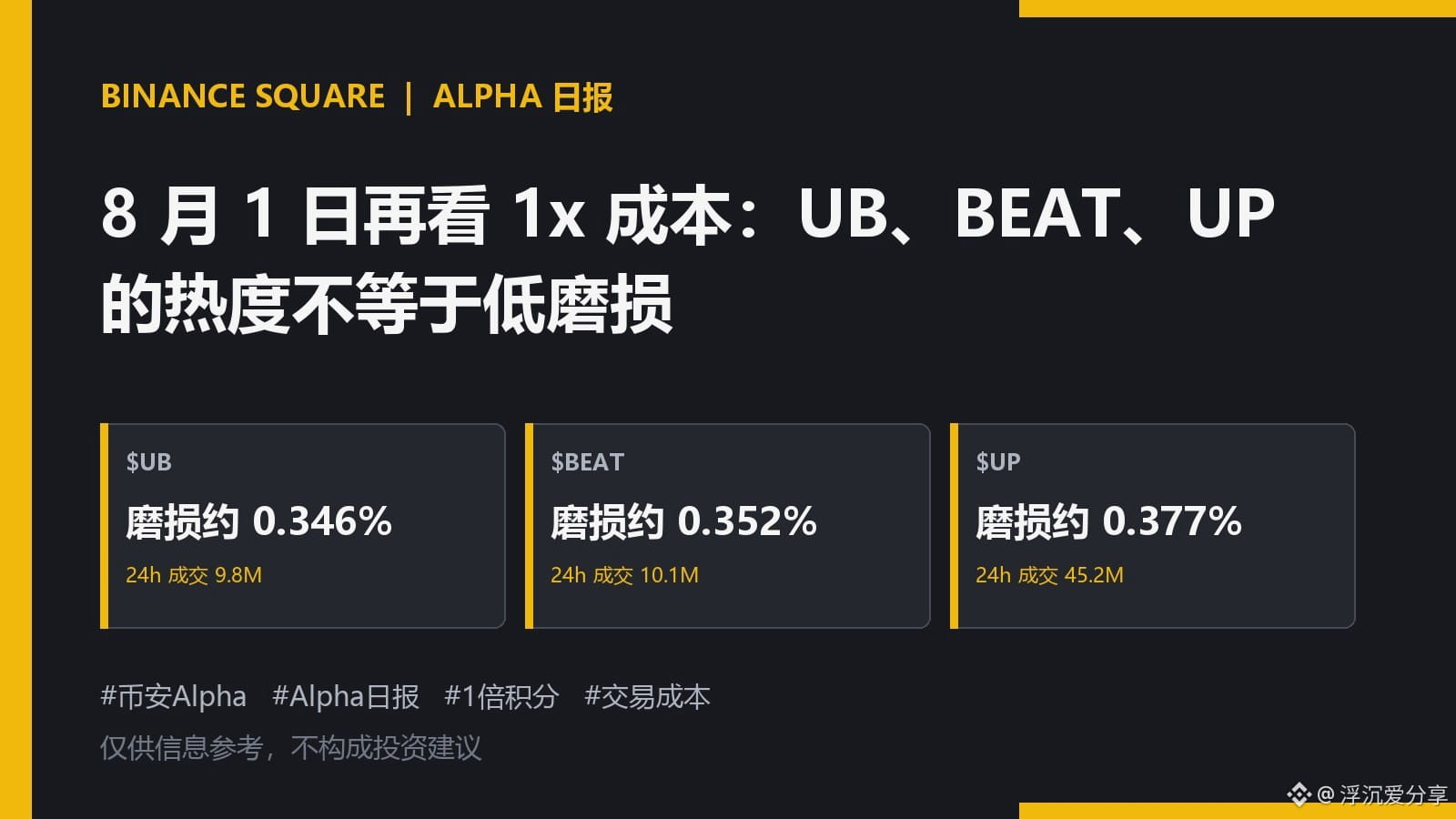
Revisiting the 1x Cost on August 1: The heat levels for UB, BEAT, and UP are not the same as low wear
According to today’s Alpha list, the rough estimated wear for UB, BEAT, and UP is about 0.346%, 0.352%, and 0.377%, respectively. While UP’s 24h trading volume is about 45.2M and is clearly higher, that doesn’t automatically mean it’s lower in wear. If you do 1x points today, it’s better to break down heat, trading volume, slippage, and fees first, and then decide whether to lower costs or chase faster turnover.
$UB $BEAT $UP #币安Alpha #Alpha日报 #1倍积分 #Transaction Costs
Revisiting the 1x Cost on August 1: The heat levels for UB, BEAT, and UP are not the same as low wear
According to today’s Alpha list, the rough estimated wear for UB, BEAT, and UP is about 0.346%, 0.352%, and 0.377%, respectively. While UP’s 24h trading volume is about 45.2M and is clearly higher, that doesn’t automatically mean it’s lower in wear. If you do 1x points today, it’s better to break down heat, trading volume, slippage, and fees first, and then decide whether to lower costs or chase faster turnover.
$UB $BEAT $UP #币安Alpha #Alpha日报 #1倍积分 #Transaction Costs
According to today’s Alpha list, the rough estimated wear for UB, BEAT, and UP is about 0.346%, 0.352%, and 0.377%, respectively. While UP’s 24h trading volume is about 45.2M and is clearly higher, that doesn’t automatically mean it’s lower in wear. If you do 1x points today, it’s better to break down heat, trading volume, slippage, and fees first, and then decide whether to lower costs or chase faster turnover.
$UB $BEAT $UP #币安Alpha #Alpha日报 #1倍积分 #Transaction Costs
1
169
·
--
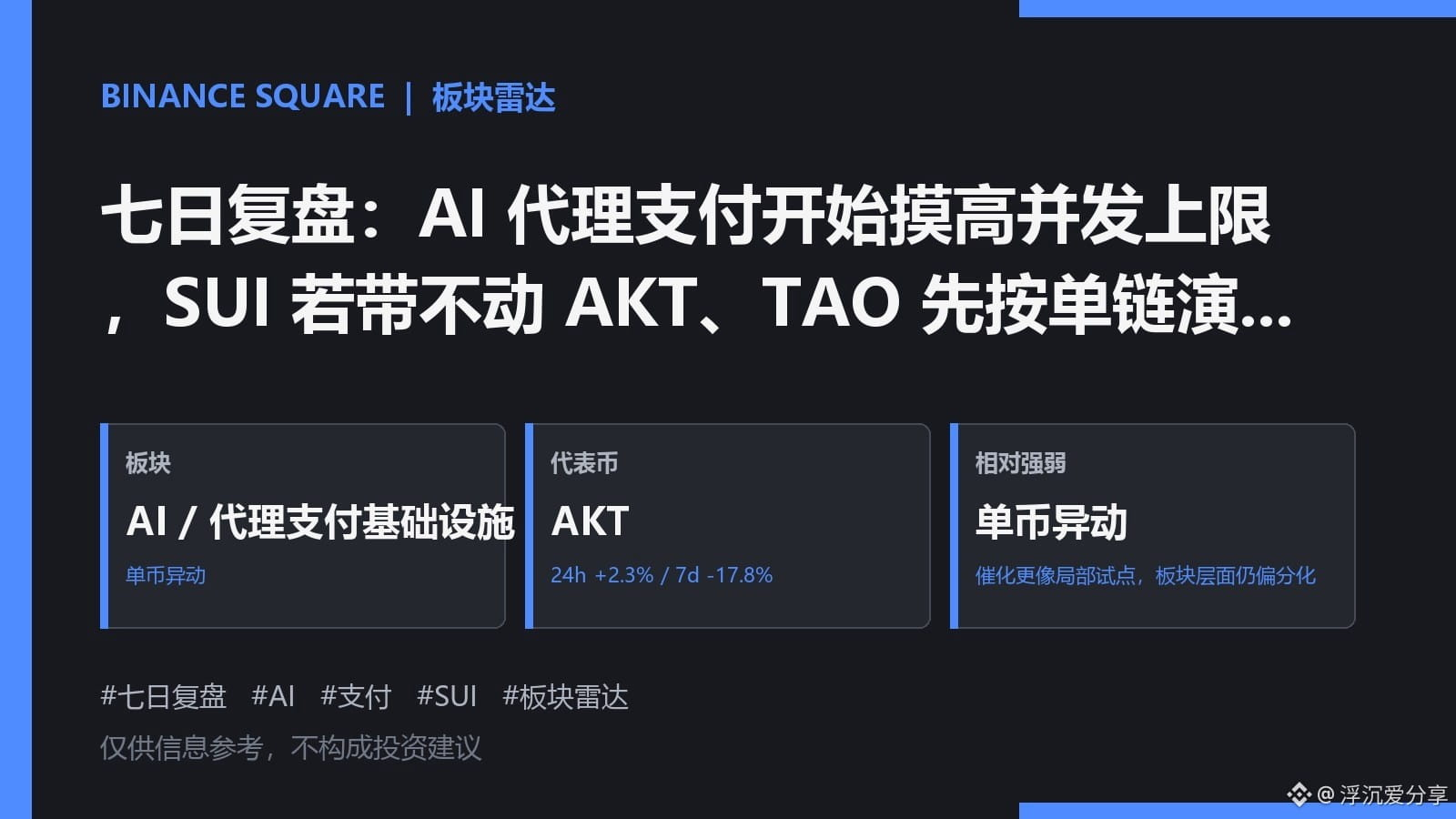
Seven-Day Recap: AI Agent Payments Begin Probing Higher Concurrency Limits; If SUI Can’t Carry AKT/TAO, Start by Showing a Single-Chain Demo
SUI brings to the forefront high-concurrency demos of AI agents handling payments, chat, and game interactions, as AI storytelling starts to validate the execution layer rather than just the model layer. If SUI can’t carry AKT/TAO, the market is more likely to view it as a single-chain showcase, not a spreading AI infrastructure play. The conditions for success are that AI representatives’ coin linkage turns stronger; the main failure risk is that demo traffic is hard to convert into sustained demand, and that real business calls are still insufficient.
$SUI $AKT $TAO #七日复盘 #AI #支付 #SUI #Sector Radar
Seven-Day Recap: AI Agent Payments Begin Probing Higher Concurrency Limits; If SUI Can’t Carry AKT/TAO, Start by Showing a Single-Chain Demo
SUI brings to the forefront high-concurrency demos of AI agents handling payments, chat, and game interactions, as AI storytelling starts to validate the execution layer rather than just the model layer. If SUI can’t carry AKT/TAO, the market is more likely to view it as a single-chain showcase, not a spreading AI infrastructure play. The conditions for success are that AI representatives’ coin linkage turns stronger; the main failure risk is that demo traffic is hard to convert into sustained demand, and that real business calls are still insufficient.
$SUI $AKT $TAO #七日复盘 #AI #支付 #SUI #Sector Radar
SUI brings to the forefront high-concurrency demos of AI agents handling payments, chat, and game interactions, as AI storytelling starts to validate the execution layer rather than just the model layer. If SUI can’t carry AKT/TAO, the market is more likely to view it as a single-chain showcase, not a spreading AI infrastructure play. The conditions for success are that AI representatives’ coin linkage turns stronger; the main failure risk is that demo traffic is hard to convert into sustained demand, and that real business calls are still insufficient.
$SUI $AKT $TAO #七日复盘 #AI #支付 #SUI #Sector Radar
297
Log in to explore more content
Join global crypto users on Binance Square
⚡️ Get latest and useful information about crypto.
💬 Trusted by the world’s largest crypto exchange.
👍 Discover real insights from verified creators.
Email / Phone number