
加密脉搏
25 Posts

加密脉搏
Report
Block User
用 3 分钟看懂今天的币圈|宏观数据、ETF 资金流、热门代币|欢迎评论区一起聊
18 Following
75 Followers
7 Liked
Posts
·
--
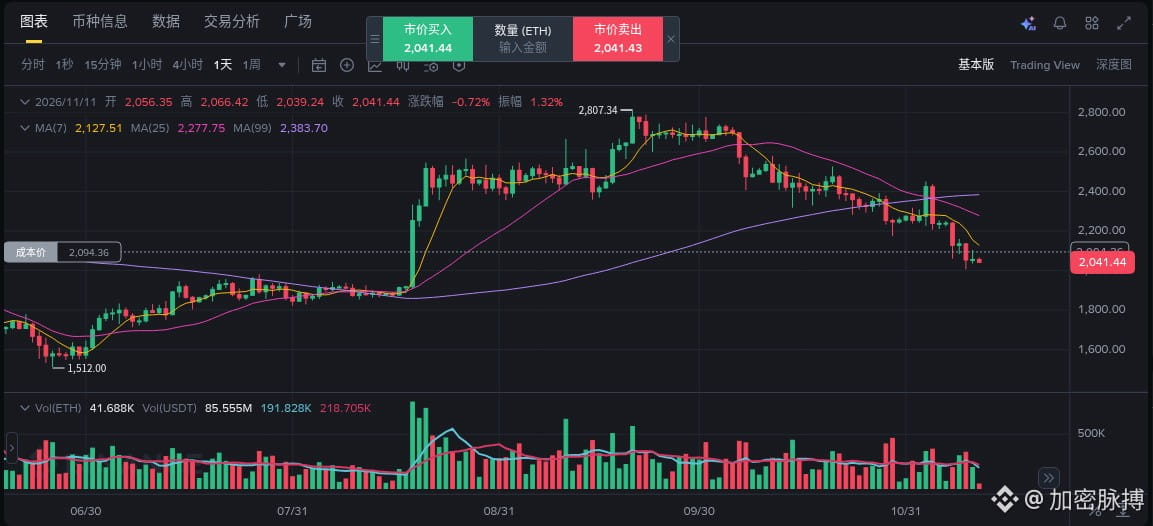
I just saw the U.S. spot Ethereum ETF data for November 11, Eastern Time, and it gave me pause.
According to SoSoValue, U.S. spot Ethereum ETFs saw net outflows of $144.81 million that day, marking the fifth consecutive trading day of net outflows. Even more striking, BlackRock’s ETHA alone saw $129.78 million flow out, and none of the 11 funds recorded net inflows. The entire market had seen outflows of just $1.32 million the previous day, so the figure jumped roughly 110-fold in a single day.
On the price front, $ETH is still hovering around the $2,000 mark. Today, it traded roughly between $2,035 and $2,100. The fact that it held up against such heavy redemptions without breaking down suggests there are still buyers in the spot market. But I wouldn’t interpret that as confirmation of a bottom. Outflows have suddenly surged, led by the flagship product, so for now I see this as short-term pressure. If it falls back below $2,000, that would mean buying support wasn’t strong enough, and my assessment would be wrong. To turn more optimistic, I’d need to see at least one day of positive net flows—not just a price holding firm.
Do you think $ETH will break below $2,000 first, or will spot ETFs post a day of net inflows first?
Personal opinion, not investment advice.
2
·
--
Both are privacy coins, but they’ve gone in completely different directions this week.
The broader market’s Fear & Greed Index is at 28 (Fear), and most coins are down. $XMR , however, is up about 4% over the past 24 hours and is now around $582;
by contrast, $ZEC is down 4% over 24 hours and nearly 27% over 7 days, with its price already below $1,000 (around $994).
My take:
ZEC surged too hard earlier, and this move is giving back some of those gains as profit-takers cash out. XMR hasn’t been hyped much, so its holders are relatively steadfast, making it more resilient in a down market.
But don’t take this as a signal that “XMR is about to take off.” Coins that rise against the trend in a weak market can easily fall to catch up if the broader market drops again. I’m more focused on whether ZEC can hold the $1,000 psychological level. Only if it does will it be worth discussing an oversold rebound.
Which privacy coin do you favor—or are you staying away from both?
(Personal opinion, not investment advice)
297
·
--
The probability of a rate hike in December is 87%—this may be the most underestimated bearish factor in crypto lately.
After CPI came in hotter than expected, fed funds futures put the probability of a 25-basis-point hike at the December 8–9 meeting at 87.3%.
There’s another figure I find even more worrying: total stablecoin supply fell by about $14.2 billion over 30 days, its fastest contraction since June 2022. Money is leaving, not just rotating within the market.
$ETH has been hit the hardest: it’s now around 2,060, down more than 15% over the past 7 days—much weaker than $BTC at -8%. When liquidity tightens, funds usually flee higher-beta assets first.
My take:
I’m not rushing to buy the ETH dip until rate-hike expectations have been priced in and stablecoins start flowing back in. If I’m looking for a reversal signal, I’d trust a bottoming and recovery in stablecoin supply more than a candlestick chart.
Do you think once the rate hike happens, the bad news will be behind us—or is the downturn just beginning?
(Just my personal opinion, not investment advice)
148
·
--
When the broader market tightens, meme coins tend to fall harder. $PEPE has been sliding with market sentiment over the past couple of days, and its Binance spot price briefly approached the round-number level of 0.000005. In the short term, liquidations of long positions have clearly outnumbered those of shorts, and buyers seem hesitant around this level. I think 0.000005 is the key psychological level right now. If it holds, the price might catch its breath, but it has failed to break above the 0.0000055 area several times before, so don't expect it to rally on its own without a surge in volume. The Fear Index is still around 26, and in times like these, meme coins are driven more by sentiment than by stories. Would you take a look around 0.000005, or wait for the broader market to stabilize first?
When the broader market tightens, meme coins tend to fall harder. $PEPE has been sliding with market sentiment over the past couple of days, and its Binance spot price briefly approached the round-number level of 0.000005. In the short term, liquidations of long positions have clearly outnumbered those of shorts, and buyers seem hesitant around this level. I think 0.000005 is the key psychological level right now. If it holds, the price might catch its breath, but it has failed to break above the 0.0000055 area several times before, so don't expect it to rally on its own without a surge in volume. The Fear Index is still around 26, and in times like these, meme coins are driven more by sentiment than by stories. Would you take a look around 0.000005, or wait for the broader market to stabilize first?
817
·
--
$XRP is back around $1.06 for now, after dipping to nearly $1.03 intraday. It’s down about 15% this week. More striking than the price is the money flowing out: U.S. spot XRP ETFs recorded about $10.42 million in net outflows on the 9th, their largest single-day outflow since March. What makes things even more awkward is that futures funding rates remain elevated, suggesting some traders are still stubbornly holding long positions through this downturn. Technically, $1.05 is the immediate support; if it breaks, the $1 mark is next. For some breathing room, XRP needs to reclaim the $1.08–$1.10 range. Being oversold doesn’t mean a reversal is imminent. Until outflows stop, I’m more concerned with whether support can hold. Do you think the $1 level will hold?
$XRP is back around $1.06 for now, after dipping to nearly $1.03 intraday. It’s down about 15% this week. More striking than the price is the money flowing out: U.S. spot XRP ETFs recorded about $10.42 million in net outflows on the 9th, their largest single-day outflow since March. What makes things even more awkward is that futures funding rates remain elevated, suggesting some traders are still stubbornly holding long positions through this downturn. Technically, $1.05 is the immediate support; if it breaks, the $1 mark is next. For some breathing room, XRP needs to reclaim the $1.08–$1.10 range. Being oversold doesn’t mean a reversal is imminent. Until outflows stop, I’m more concerned with whether support can hold. Do you think the $1 level will hold?
19
·
--
After CPI came out, everyone was watching to see whether $BTC could hold 73,000, but I think $SOL is in a tougher spot. It had mostly stayed above $85 last week, but plunged straight through after the data was released. It’s now hovering around $83, and at one point dipped below $82 intraday. Spot SOL ETFs haven’t been holding up either: they were still seeing net outflows in early November, with institutions pulling out. My take is simple: $82 to $77 is the most important near-term support zone. If it doesn’t hold, there’s room to fall further. To turn things around, it needs to reclaim $85 first. No matter how impressive the network upgrade is, short-term prices are still driven by capital flows. Do you think it can stay above $80 this time?
After CPI came out, everyone was watching to see whether $BTC could hold 73,000, but I think $SOL is in a tougher spot. It had mostly stayed above $85 last week, but plunged straight through after the data was released. It’s now hovering around $83, and at one point dipped below $82 intraday. Spot SOL ETFs haven’t been holding up either: they were still seeing net outflows in early November, with institutions pulling out. My take is simple: $82 to $77 is the most important near-term support zone. If it doesn’t hold, there’s room to fall further. To turn things around, it needs to reclaim $85 first. No matter how impressive the network upgrade is, short-term prices are still driven by capital flows. Do you think it can stay above $80 this time?
99
Log in to explore more content
Join global crypto users on Binance Square
⚡️ Get latest and useful information about crypto.
💬 Trusted by the world’s largest crypto exchange.
👍 Discover real insights from verified creators.
Email / Phone number
Trending Topics
HuangRisksOusterOverReportedAffairWithSubordinate
44,711 views
674 Discussing
Nvidia Board Meets to Decide Jensen Huang's Future as Crisis Deepens
Binance News
·37 Likes
·40.9k views
AnthropicRejectsIPODelayValuationinQuestion
495,592 views
4,097 Discussing
CoreWeaveJumps10%On168%RevenueGrowth
78,958 views
993 Discussing