

DX Labs
1.4k Posts
DX Labs
Report
Block User
Crypto trader, Web3 explorer, Analyzing market structure, tracking trends, and managing risk. Sharing insights, not financial advice.
Open Trade
High-Frequency Trader
1.9 Years
12 Following
1.4K+ Followers
1.7K+ Liked
Posts
Portfolio
All
Quotes
Live
·
--
TP HIT 🎯
TP HIT 🎯
DX Labs
·
--
BearishNot 100% winnable. Not financial advice.
$ALLO
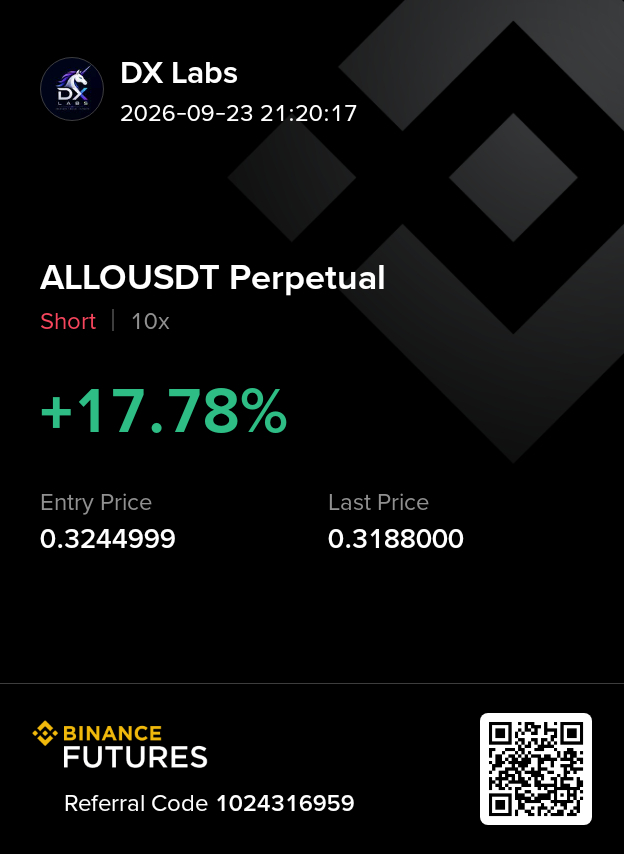
Enter short exactly at 0.3245.
Stop loss exactly at 0.3330.
TP1 exactly at 0.3150.
TP2 exactly at 0.3050.
Wait for bounce to 0.3245. Do not short current price 0.3205 (below lower Bollinger Band). Max 10x leverage.
$ALLO
Enter short exactly at 0.3245.
Stop loss exactly at 0.3330.
TP1 exactly at 0.3150.
TP2 exactly at 0.3050.
Wait for bounce to 0.3245. Do not short current price 0.3205 (below lower Bollinger Band). Max 10x leverage.
6
·
--
Institutions are sitting on a trillion dollars’ worth of BTC, with zero yield. It’s not that they don’t want to earn—it's that they don’t dare. Wrapping BTC is basically handing assets over to a cross-chain bridge. Lending it out means you have to trust the counterparty. And compliance is unlikely to clear the hurdle.
@babylonlabs_io This time is specifically about untangling that knot. Trustless Bitcoin Vaults keep BTC on the native chain—no bridging, no leaving the account. At the same time, they use timestamps and a penalty mechanism to add security for PoS networks, while also generating yield.
Put simply, the core idea is one sentence: you don’t give up custody, yet you can still earn yield. Over $2 billion has already been staked. It doesn’t look like a niche play anymore—it looks more like infrastructure growing into place.
Of course, it’s still early. The penalty mechanism carries risks, yields differ across chains, and regulation is still being explored. But if “self-custody yield” becomes a standard institutional requirement, then BTC may well flow into this path.
DYOR, not investment advice.
$BABY #baby
If you’re an institution holding BTC but you don’t dare to make it earn yield—what step are you stuck on?
@babylonlabs_io ’s Trustless Bitcoin Vaults keep BTC on the native chain: no bridging, no wrapping. They also help secure PoS networks and let you earn yield.
Self-custody and yield finally aren’t a single-choice question anymore.
DYOR, not investment advice.
Institutions are sitting on a trillion dollars’ worth of BTC, with zero yield. It’s not that they don’t want to earn—it's that they don’t dare. Wrapping BTC is basically handing assets over to a cross-chain bridge. Lending it out means you have to trust the counterparty. And compliance is unlikely to clear the hurdle.
@BabylonLabs_io This time is specifically about untangling that knot. Trustless Bitcoin Vaults keep BTC on the native chain—no bridging, no leaving the account. At the same time, they use timestamps and a penalty mechanism to add security for PoS networks, while also generating yield.
Put simply, the core idea is one sentence: you don’t give up custody, yet you can still earn yield. Over $2 billion has already been staked. It doesn’t look like a niche play anymore—it looks more like infrastructure growing into place.
Of course, it’s still early. The penalty mechanism carries risks, yields differ across chains, and regulation is still being explored. But if “self-custody yield” becomes a standard institutional requirement, then BTC may well flow into this path.
DYOR, not investment advice.
$BABY #baby
If you’re an institution holding BTC but you don’t dare to make it earn yield—what step are you stuck on?
@BabylonLabs_io ’s Trustless Bitcoin Vaults keep BTC on the native chain: no bridging, no wrapping. They also help secure PoS networks and let you earn yield.
Self-custody and yield finally aren’t a single-choice question anymore.
DYOR, not investment advice.
@BabylonLabs_io This time is specifically about untangling that knot. Trustless Bitcoin Vaults keep BTC on the native chain—no bridging, no leaving the account. At the same time, they use timestamps and a penalty mechanism to add security for PoS networks, while also generating yield.
Put simply, the core idea is one sentence: you don’t give up custody, yet you can still earn yield. Over $2 billion has already been staked. It doesn’t look like a niche play anymore—it looks more like infrastructure growing into place.
Of course, it’s still early. The penalty mechanism carries risks, yields differ across chains, and regulation is still being explored. But if “self-custody yield” becomes a standard institutional requirement, then BTC may well flow into this path.
DYOR, not investment advice.
$BABY #baby
If you’re an institution holding BTC but you don’t dare to make it earn yield—what step are you stuck on?
@BabylonLabs_io ’s Trustless Bitcoin Vaults keep BTC on the native chain: no bridging, no wrapping. They also help secure PoS networks and let you earn yield.
Self-custody and yield finally aren’t a single-choice question anymore.
DYOR, not investment advice.
1️⃣ 不信跨链桥
0%
2️⃣ 怕对手方风险
0%
3️⃣ 合规过不了
0%
4️⃣ 已经在赚了
0%
0 votes • Voting closed
239
·
--
Everyone keeps talking about liquidity fragmentation, but very few people talk about security fragmentation. Now there are dozens of PoS chains fighting their own battles; each one needs to build up security from scratch. The result is that none of them is truly solid. This is the real thing that’s holding the industry back from moving forward—but unfortunately, not many people seem to notice.
@babylonlabs_io fundamentally solves this problem: it lets idle Bitcoin directly provide security to these chains, without cross-chain bridges or wrapped coins. Trustless Bitcoin Vaults make the entire process verifiable on the Bitcoin blockchain. The chain inherits Bitcoin-level security, and holders also enable the BTC that used to just sit idle to start earning yield.
Still early, but this shared-security approach is definitely stronger than everyone fighting their own wars. DYOR.
$BABY #baby
What is the risk in crypto infrastructure that’s easiest to overlook right now?
Most people didn’t even consider the first one, but [they think] this is really the key. DYOR, not investment advice.
Everyone keeps talking about liquidity fragmentation, but very few people talk about security fragmentation. Now there are dozens of PoS chains fighting their own battles; each one needs to build up security from scratch. The result is that none of them is truly solid. This is the real thing that’s holding the industry back from moving forward—but unfortunately, not many people seem to notice.
@BabylonLabs_io fundamentally solves this problem: it lets idle Bitcoin directly provide security to these chains, without cross-chain bridges or wrapped coins. Trustless Bitcoin Vaults make the entire process verifiable on the Bitcoin blockchain. The chain inherits Bitcoin-level security, and holders also enable the BTC that used to just sit idle to start earning yield.
Still early, but this shared-security approach is definitely stronger than everyone fighting their own wars. DYOR.
$BABY #baby
What is the risk in crypto infrastructure that’s easiest to overlook right now?
Most people didn’t even consider the first one, but [they think] this is really the key. DYOR, not investment advice.
@BabylonLabs_io fundamentally solves this problem: it lets idle Bitcoin directly provide security to these chains, without cross-chain bridges or wrapped coins. Trustless Bitcoin Vaults make the entire process verifiable on the Bitcoin blockchain. The chain inherits Bitcoin-level security, and holders also enable the BTC that used to just sit idle to start earning yield.
Still early, but this shared-security approach is definitely stronger than everyone fighting their own wars. DYOR.
$BABY #baby
What is the risk in crypto infrastructure that’s easiest to overlook right now?
Most people didn’t even consider the first one, but [they think] this is really the key. DYOR, not investment advice.
1️⃣ 安全碎片化
0%
2️⃣ 流动性碎片化
100%
3️⃣ 跨链桥漏洞
0%
4️⃣ MEV问题
0%
1 votes • Voting closed
4
159
·
--
Ethereum has EigenLayer to play with restaking. What about Bitcoin? There hasn’t been anything similar— the safest, largest by market cap chain, yet the assets are basically idle. They can only be used for trading or left to gather dust. That’s the biggest anomaly.
Babylon wants to solve this: letting BTC provide security to other PoS chains, oracles, and bridges without cross-chain transfers or custody—directly. Logically it’s similar to EigenLayer’s restaking, but this time the main character is Bitcoin itself.
Early data looks promising, but the validator ecosystem and real adoption rate haven’t been extensively tested at scale yet—there are still risks.
The room for imagination is huge, but we’re still in the early stage. Stay rational, and do your own research.
$BABY #baby @babylonlabs_io
BTC is already the largest asset by market cap, but most of it is "sleeping."
Babylon wants BTC to be able to restake like ETH does—empowering the security of other chains.
What do you think?
Drop your thoughts in the comments 👇
Ethereum has EigenLayer to play with restaking. What about Bitcoin? There hasn’t been anything similar— the safest, largest by market cap chain, yet the assets are basically idle. They can only be used for trading or left to gather dust. That’s the biggest anomaly.
Babylon wants to solve this: letting BTC provide security to other PoS chains, oracles, and bridges without cross-chain transfers or custody—directly. Logically it’s similar to EigenLayer’s restaking, but this time the main character is Bitcoin itself.
Early data looks promising, but the validator ecosystem and real adoption rate haven’t been extensively tested at scale yet—there are still risks.
The room for imagination is huge, but we’re still in the early stage. Stay rational, and do your own research.
$BABY #baby @BabylonLabs_io
BTC is already the largest asset by market cap, but most of it is "sleeping."
Babylon wants BTC to be able to restake like ETH does—empowering the security of other chains.
What do you think?
Drop your thoughts in the comments 👇
Babylon wants to solve this: letting BTC provide security to other PoS chains, oracles, and bridges without cross-chain transfers or custody—directly. Logically it’s similar to EigenLayer’s restaking, but this time the main character is Bitcoin itself.
Early data looks promising, but the validator ecosystem and real adoption rate haven’t been extensively tested at scale yet—there are still risks.
The room for imagination is huge, but we’re still in the early stage. Stay rational, and do your own research.
$BABY #baby @BabylonLabs_io
BTC is already the largest asset by market cap, but most of it is "sleeping."
Babylon wants BTC to be able to restake like ETH does—empowering the security of other chains.
What do you think?
Drop your thoughts in the comments 👇
1️⃣ 看好,BTC 再质押是下一个叙事
50%
2️⃣ 观望,风险和采用还没验证
0%
3️⃣ 不看好,BTC 应该保持简单
50%
4️⃣ 不了解 Babylon,想先做研究
0%
4 votes • Voting closed
2
245
·
--
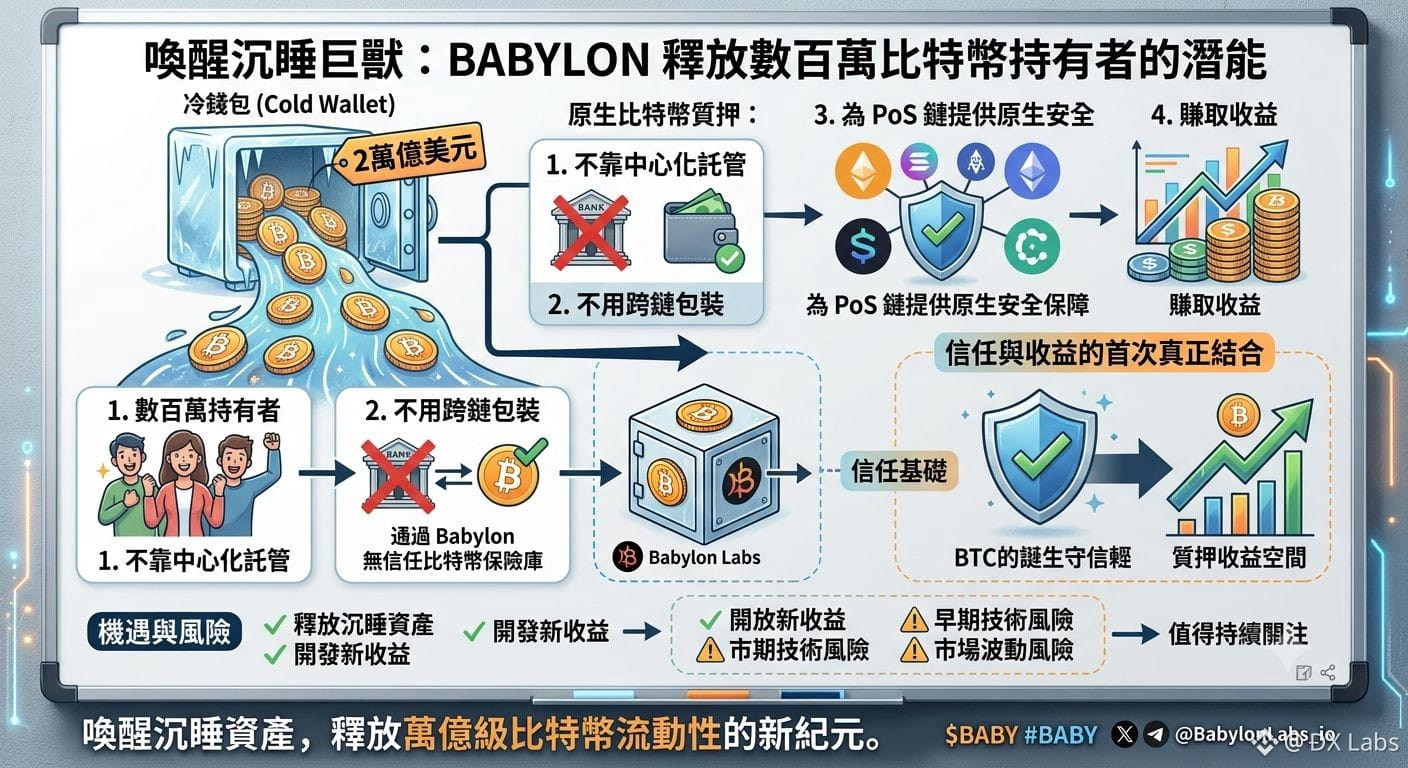
Imagine millions of Bitcoin holders finally waking up the sleeping BTC—this is exactly what Babylon aims to do. No cross-chain wrapping, no reliance on centralized custody—native BTC can provide security for PoS chains while generating yield. This could be Bitcoin’s trust foundation and the opportunity to truly combine it for the first time with the upside potential of the staking track. Of course, it’s still early, and the risks are significant, but this direction is definitely worth continued attention.$BABY #baby @babylonlabs_io
Imagine millions of Bitcoin holders finally waking up the sleeping BTC—this is exactly what Babylon aims to do. No cross-chain wrapping, no reliance on centralized custody—native BTC can provide security for PoS chains while generating yield. This could be Bitcoin’s trust foundation and the opportunity to truly combine it for the first time with the upside potential of the staking track. Of course, it’s still early, and the risks are significant, but this direction is definitely worth continued attention.$BABY #baby @BabylonLabs_io
1
113
Log in to explore more content
Join global crypto users on Binance Square
⚡️ Get latest and useful information about crypto.
💬 Trusted by the world’s largest crypto exchange.
👍 Discover real insights from verified creators.
Email / Phone number