

DVC达文西
1.4k Posts

DVC达文西
Report
Block User
请叫我全名:达文西
Open Trade
Frequent Trader
10.7 Months
148 Following
15.2K+ Followers
3.4K+ Liked
Posts
Portfolio
All
Quotes
Live
·
--
#dusk $DUSK @Dusk_Foundation After going through the whitepapers of Aleph Zero and Nym, I finally understand that Dusk’s moat isn’t privacy itself
Not long ago, I pulled a few privacy projects out for comparison: Aleph Zero focuses on privacy contracts, Nym does anonymity at the network layer, and Dusk goes all-in on finance. At first I thought they were all just “privacy”—how different could it be? But on closer inspection, I realized the moat isn’t in technical buzzwords at all.
Nym’s privacy is at the network layer, solving the question of “who is communicating with whom,” which helps finance settlement only to a limited extent. Aleph Zero wants to build general-purpose privacy contracts—but being general-purpose means it can cover many scenarios without being truly precise. What institutions want isn’t a万能 tool; it’s a compliant runway designed specifically for securities and bonds.
Dusk’s XSC is exactly that runway. It ties together privacy, programmability, and auditability, so issuers, investors, and regulators can each see what they need to see. Even more important is single-block finality: settlement is finality. That isn’t a core design goal in Aleph Zero or Nym, because they don’t position themselves as financial settlement infrastructure.
Now I think Dusk’s moat isn’t that its ZK algorithms are more novel—it’s that it dares to bake “securities compliance” into the base layer. While other projects compete on anonymity, it’s waiting for Europe’s regulatory window. That choice may feel dull in the short term, but it could be the lifeline in the long run.
What do you think is the most irreplaceable aspect of Dusk when compared with Aleph Zero and Nym?
#dusk $DUSK @Dusk After going through the whitepapers of Aleph Zero and Nym, I finally understand that Dusk’s moat isn’t privacy itself
Not long ago, I pulled a few privacy projects out for comparison: Aleph Zero focuses on privacy contracts, Nym does anonymity at the network layer, and Dusk goes all-in on finance. At first I thought they were all just “privacy”—how different could it be? But on closer inspection, I realized the moat isn’t in technical buzzwords at all.
Nym’s privacy is at the network layer, solving the question of “who is communicating with whom,” which helps finance settlement only to a limited extent. Aleph Zero wants to build general-purpose privacy contracts—but being general-purpose means it can cover many scenarios without being truly precise. What institutions want isn’t a万能 tool; it’s a compliant runway designed specifically for securities and bonds.
Dusk’s XSC is exactly that runway. It ties together privacy, programmability, and auditability, so issuers, investors, and regulators can each see what they need to see. Even more important is single-block finality: settlement is finality. That isn’t a core design goal in Aleph Zero or Nym, because they don’t position themselves as financial settlement infrastructure.
Now I think Dusk’s moat isn’t that its ZK algorithms are more novel—it’s that it dares to bake “securities compliance” into the base layer. While other projects compete on anonymity, it’s waiting for Europe’s regulatory window. That choice may feel dull in the short term, but it could be the lifeline in the long run.
What do you think is the most irreplaceable aspect of Dusk when compared with Aleph Zero and Nym?
Not long ago, I pulled a few privacy projects out for comparison: Aleph Zero focuses on privacy contracts, Nym does anonymity at the network layer, and Dusk goes all-in on finance. At first I thought they were all just “privacy”—how different could it be? But on closer inspection, I realized the moat isn’t in technical buzzwords at all.
Nym’s privacy is at the network layer, solving the question of “who is communicating with whom,” which helps finance settlement only to a limited extent. Aleph Zero wants to build general-purpose privacy contracts—but being general-purpose means it can cover many scenarios without being truly precise. What institutions want isn’t a万能 tool; it’s a compliant runway designed specifically for securities and bonds.
Dusk’s XSC is exactly that runway. It ties together privacy, programmability, and auditability, so issuers, investors, and regulators can each see what they need to see. Even more important is single-block finality: settlement is finality. That isn’t a core design goal in Aleph Zero or Nym, because they don’t position themselves as financial settlement infrastructure.
Now I think Dusk’s moat isn’t that its ZK algorithms are more novel—it’s that it dares to bake “securities compliance” into the base layer. While other projects compete on anonymity, it’s waiting for Europe’s regulatory window. That choice may feel dull in the short term, but it could be the lifeline in the long run.
What do you think is the most irreplaceable aspect of Dusk when compared with Aleph Zero and Nym?
A. XSC原生支持证券合规
100%
B. 单区块最终性适合结算
0%
C. 专注金融场景而非通用隐私
0%
1 votes • Voting closed
146
·
--
#dusk $DUSK @Dusk_Foundation How loud are retail investors in Dusk governance? I looked through the whitepaper, and it’s a bit heartbreaking
I used to think that public chain governance is basically “the more coins you have, the more you get to decide.” I figured Dusk would be similar. But when I actually read the governance chapters in the whitepaper, I found it’s not that simple—and not as optimistic.
Dusk’s governance uses time-weighted voting. In short, the longer you stake DUSK, the higher your vote weight. This design does encourage long-term holders and is arguably a bit fairer than simply letting whoever has more money win. But here’s the catch: institutions and whales can easily lock up for years, while retail investors don’t usually have the patience or the capital. So in practice, the weight still leans toward large holders.
That said, there’s one part I found surprisingly interesting: Dusk also includes adjustments to the XSC compliance framework within the governance scope. This means that although retail investors have a smaller voice, they’re not completely without channels—especially on topics involving compliance parameters, auditing rules, and the like. The community can propose changes, and node operators and token holders vote alongside them. It’s like opening a narrow door for ordinary people.
So my conclusion is: in Dusk governance, retail investors do have a voice, but not a big one. It’s more “decided by long-term stakers” rather than “decided by those with the most tokens.” It’s better than a pure whale-dominated game, but it’s still a bit short of true decentralization. The ecosystem is still early-stage, and there aren’t many governance issues yet. If European institutions really come in, retail voices may be further diluted.
What kind of governance design in Dusk do you think benefits you the most?
#dusk $DUSK @Dusk How loud are retail investors in Dusk governance? I looked through the whitepaper, and it’s a bit heartbreaking
I used to think that public chain governance is basically “the more coins you have, the more you get to decide.” I figured Dusk would be similar. But when I actually read the governance chapters in the whitepaper, I found it’s not that simple—and not as optimistic.
Dusk’s governance uses time-weighted voting. In short, the longer you stake DUSK, the higher your vote weight. This design does encourage long-term holders and is arguably a bit fairer than simply letting whoever has more money win. But here’s the catch: institutions and whales can easily lock up for years, while retail investors don’t usually have the patience or the capital. So in practice, the weight still leans toward large holders.
That said, there’s one part I found surprisingly interesting: Dusk also includes adjustments to the XSC compliance framework within the governance scope. This means that although retail investors have a smaller voice, they’re not completely without channels—especially on topics involving compliance parameters, auditing rules, and the like. The community can propose changes, and node operators and token holders vote alongside them. It’s like opening a narrow door for ordinary people.
So my conclusion is: in Dusk governance, retail investors do have a voice, but not a big one. It’s more “decided by long-term stakers” rather than “decided by those with the most tokens.” It’s better than a pure whale-dominated game, but it’s still a bit short of true decentralization. The ecosystem is still early-stage, and there aren’t many governance issues yet. If European institutions really come in, retail voices may be further diluted.
What kind of governance design in Dusk do you think benefits you the most?
I used to think that public chain governance is basically “the more coins you have, the more you get to decide.” I figured Dusk would be similar. But when I actually read the governance chapters in the whitepaper, I found it’s not that simple—and not as optimistic.
Dusk’s governance uses time-weighted voting. In short, the longer you stake DUSK, the higher your vote weight. This design does encourage long-term holders and is arguably a bit fairer than simply letting whoever has more money win. But here’s the catch: institutions and whales can easily lock up for years, while retail investors don’t usually have the patience or the capital. So in practice, the weight still leans toward large holders.
That said, there’s one part I found surprisingly interesting: Dusk also includes adjustments to the XSC compliance framework within the governance scope. This means that although retail investors have a smaller voice, they’re not completely without channels—especially on topics involving compliance parameters, auditing rules, and the like. The community can propose changes, and node operators and token holders vote alongside them. It’s like opening a narrow door for ordinary people.
So my conclusion is: in Dusk governance, retail investors do have a voice, but not a big one. It’s more “decided by long-term stakers” rather than “decided by those with the most tokens.” It’s better than a pure whale-dominated game, but it’s still a bit short of true decentralization. The ecosystem is still early-stage, and there aren’t many governance issues yet. If European institutions really come in, retail voices may be further diluted.
What kind of governance design in Dusk do you think benefits you the most?
A. 时间加权投票,鼓励长期持有
100%
B. 合规框架调整可社区提案
0%
C. 散户声音小,但至少节点不是全由巨鲸控制
0%
1 votes • Voting closed
1
169
·
--
#dusk $DUSK @Dusk_Foundation To help my friends in finance understand Dusk clearly, I held back for three days—and finally got it down to one sentence.
I have a friend who works in fixed income at a securities firm. Every time I bring up blockchain, he thinks it’s a scam. Later, after I studied the Dusk whitepaper, I finally managed to say: “Dusk is a ledger built for on-chain settlement between securities and bonds. Regulators can audit it, but peers can’t just view it.”
He paused and asked, “Can it settle in real time?” I nodded—finality is per block, so there’s no need to wait until T+2. Then he asked, “Will customers’ holdings be exposed?” I said no—XSC only shows authorized parties, and regulators can verify anytime when they come to audit. Finally he asked, “Does Europe recognize it?” I told him it primarily targets European DLT pilots—built specifically for compliance.
He went silent for a few seconds and said that if it truly gets adopted, the backend could save half the manpower. In that moment, I realized Dusk isn’t selling a coin—it’s selling a settlement machine designed for traditional finance professionals, one that can pass audits.
This line never mentioned “disruption.” It only hits the three most painful issues for them: slow settlement, data exposure, and hard compliance.
Which point do you think would most convince people in traditional finance?
#dusk $DUSK @Dusk To help my friends in finance understand Dusk clearly, I held back for three days—and finally got it down to one sentence.
I have a friend who works in fixed income at a securities firm. Every time I bring up blockchain, he thinks it’s a scam. Later, after I studied the Dusk whitepaper, I finally managed to say: “Dusk is a ledger built for on-chain settlement between securities and bonds. Regulators can audit it, but peers can’t just view it.”
He paused and asked, “Can it settle in real time?” I nodded—finality is per block, so there’s no need to wait until T+2. Then he asked, “Will customers’ holdings be exposed?” I said no—XSC only shows authorized parties, and regulators can verify anytime when they come to audit. Finally he asked, “Does Europe recognize it?” I told him it primarily targets European DLT pilots—built specifically for compliance.
He went silent for a few seconds and said that if it truly gets adopted, the backend could save half the manpower. In that moment, I realized Dusk isn’t selling a coin—it’s selling a settlement machine designed for traditional finance professionals, one that can pass audits.
This line never mentioned “disruption.” It only hits the three most painful issues for them: slow settlement, data exposure, and hard compliance.
Which point do you think would most convince people in traditional finance?
I have a friend who works in fixed income at a securities firm. Every time I bring up blockchain, he thinks it’s a scam. Later, after I studied the Dusk whitepaper, I finally managed to say: “Dusk is a ledger built for on-chain settlement between securities and bonds. Regulators can audit it, but peers can’t just view it.”
He paused and asked, “Can it settle in real time?” I nodded—finality is per block, so there’s no need to wait until T+2. Then he asked, “Will customers’ holdings be exposed?” I said no—XSC only shows authorized parties, and regulators can verify anytime when they come to audit. Finally he asked, “Does Europe recognize it?” I told him it primarily targets European DLT pilots—built specifically for compliance.
He went silent for a few seconds and said that if it truly gets adopted, the backend could save half the manpower. In that moment, I realized Dusk isn’t selling a coin—it’s selling a settlement machine designed for traditional finance professionals, one that can pass audits.
This line never mentioned “disruption.” It only hits the three most painful issues for them: slow settlement, data exposure, and hard compliance.
Which point do you think would most convince people in traditional finance?
A. 单区块最终性,不用等T+2
0%
B. 持仓不公开,但监管可查
0%
C. 欧洲DLT试点,合规窗口明确
0%
0 votes • Voting closed
171
·
--
#dusk $DUSK @Dusk_Foundation I read the Dusk whitepaper three times before I realized there’s a hidden mechanism for the DUSK token.
In the past, when I looked at DUSK, I thought it was just like any other public blockchain: staking, gas, and governance—nothing more. Later, to figure out exactly how the XSC contract runs, I reread the token chapter in the whitepaper and discovered a mechanism that the market completely overlooks: compliance verification consumes value.
Simply put, DUSK isn’t only used to pay transaction fees. Each time the XSC contract executes a compliance audit, it consumes a tiny amount of DUSK as an “audit proof fee.” This portion of DUSK doesn’t go to validators; instead, it’s locked into a compliance reserve pool, used to pay for future regulatory audits or network security compensation. In other words, the more active the on-chain financial business is, the greater the DUSK compliance consumption becomes—forming a hidden thread of “business-driven deflation.”
There’s also that nodes don’t just stake; they must additionally freeze an extra amount of DUSK as a “service performance bond.” If a node leaks data or acts maliciously during operation, the performance bond is directly confiscated. This design turns “privacy responsibility” into a hard constraint at the token layer—something many public chains don’t do.
So I think what’s overlooked in the DUSK token model are exactly these small details designed for compliance and security. They may not show a pump effect in the short term, but in the long run they determine whether DUSK can become a necessity for financial settlement.
Which overlooked mechanism do you think is the most valuable?
#dusk $DUSK @Dusk I read the Dusk whitepaper three times before I realized there’s a hidden mechanism for the DUSK token.
In the past, when I looked at DUSK, I thought it was just like any other public blockchain: staking, gas, and governance—nothing more. Later, to figure out exactly how the XSC contract runs, I reread the token chapter in the whitepaper and discovered a mechanism that the market completely overlooks: compliance verification consumes value.
Simply put, DUSK isn’t only used to pay transaction fees. Each time the XSC contract executes a compliance audit, it consumes a tiny amount of DUSK as an “audit proof fee.” This portion of DUSK doesn’t go to validators; instead, it’s locked into a compliance reserve pool, used to pay for future regulatory audits or network security compensation. In other words, the more active the on-chain financial business is, the greater the DUSK compliance consumption becomes—forming a hidden thread of “business-driven deflation.”
There’s also that nodes don’t just stake; they must additionally freeze an extra amount of DUSK as a “service performance bond.” If a node leaks data or acts maliciously during operation, the performance bond is directly confiscated. This design turns “privacy responsibility” into a hard constraint at the token layer—something many public chains don’t do.
So I think what’s overlooked in the DUSK token model are exactly these small details designed for compliance and security. They may not show a pump effect in the short term, but in the long run they determine whether DUSK can become a necessity for financial settlement.
Which overlooked mechanism do you think is the most valuable?
In the past, when I looked at DUSK, I thought it was just like any other public blockchain: staking, gas, and governance—nothing more. Later, to figure out exactly how the XSC contract runs, I reread the token chapter in the whitepaper and discovered a mechanism that the market completely overlooks: compliance verification consumes value.
Simply put, DUSK isn’t only used to pay transaction fees. Each time the XSC contract executes a compliance audit, it consumes a tiny amount of DUSK as an “audit proof fee.” This portion of DUSK doesn’t go to validators; instead, it’s locked into a compliance reserve pool, used to pay for future regulatory audits or network security compensation. In other words, the more active the on-chain financial business is, the greater the DUSK compliance consumption becomes—forming a hidden thread of “business-driven deflation.”
There’s also that nodes don’t just stake; they must additionally freeze an extra amount of DUSK as a “service performance bond.” If a node leaks data or acts maliciously during operation, the performance bond is directly confiscated. This design turns “privacy responsibility” into a hard constraint at the token layer—something many public chains don’t do.
So I think what’s overlooked in the DUSK token model are exactly these small details designed for compliance and security. They may not show a pump effect in the short term, but in the long run they determine whether DUSK can become a necessity for financial settlement.
Which overlooked mechanism do you think is the most valuable?
A. 合规验证消耗带来的业务通缩
0%
B. 节点质保金把隐私责任代币化
0%
C. 治理中时间加权投票的长期激励
0%
0 votes • Voting closed
103
·
--
#dusk $DUSK @Dusk_Foundation Whitepaper promises—how much has been delivered in the code? I counted for Dusk
I’m a pretty picky person. After reading a whitepaper, I always want to dig into the code to see whether it’s just hype or something truly implemented. I spent all night going through Dusk’s GitHub, and honestly, it was a bit surprising.
This confidential security contract standard, XSC, isn’t just left at the concept level. In the mainnet code, there are already corresponding contract templates and validation logic—not something that can be done by simply tweaking Ethereum. Single-block finality is also genuinely running; I didn’t see any rollback records in the block explorer, which lines up with the whitepaper.
But if you ask me “how much has actually been implemented,” I’d say: the tools are ready, but the customers aren’t fully in place yet. There aren’t many XSC contracts on-chain yet; most of what I saw involves testing and node-related interactions. I didn’t notice large-scale issuance of security-tokenized assets. The team is clearly waiting for the compliance window on the Europe side, and they didn’t rush to publish fake data.
So from the whitepaper to the code, a lot of the technical promises have been fulfilled. The business rollout is still waiting for the wind. This isn’t failing to deliver—more like a surgical scalpel that’s been sterilized, but the patient hasn’t been brought in yet.
What do you think Dusk needs most right now?
#dusk $DUSK @Dusk Whitepaper promises—how much has been delivered in the code? I counted for Dusk
I’m a pretty picky person. After reading a whitepaper, I always want to dig into the code to see whether it’s just hype or something truly implemented. I spent all night going through Dusk’s GitHub, and honestly, it was a bit surprising.
This confidential security contract standard, XSC, isn’t just left at the concept level. In the mainnet code, there are already corresponding contract templates and validation logic—not something that can be done by simply tweaking Ethereum. Single-block finality is also genuinely running; I didn’t see any rollback records in the block explorer, which lines up with the whitepaper.
But if you ask me “how much has actually been implemented,” I’d say: the tools are ready, but the customers aren’t fully in place yet. There aren’t many XSC contracts on-chain yet; most of what I saw involves testing and node-related interactions. I didn’t notice large-scale issuance of security-tokenized assets. The team is clearly waiting for the compliance window on the Europe side, and they didn’t rush to publish fake data.
So from the whitepaper to the code, a lot of the technical promises have been fulfilled. The business rollout is still waiting for the wind. This isn’t failing to deliver—more like a surgical scalpel that’s been sterilized, but the patient hasn’t been brought in yet.
What do you think Dusk needs most right now?
I’m a pretty picky person. After reading a whitepaper, I always want to dig into the code to see whether it’s just hype or something truly implemented. I spent all night going through Dusk’s GitHub, and honestly, it was a bit surprising.
This confidential security contract standard, XSC, isn’t just left at the concept level. In the mainnet code, there are already corresponding contract templates and validation logic—not something that can be done by simply tweaking Ethereum. Single-block finality is also genuinely running; I didn’t see any rollback records in the block explorer, which lines up with the whitepaper.
But if you ask me “how much has actually been implemented,” I’d say: the tools are ready, but the customers aren’t fully in place yet. There aren’t many XSC contracts on-chain yet; most of what I saw involves testing and node-related interactions. I didn’t notice large-scale issuance of security-tokenized assets. The team is clearly waiting for the compliance window on the Europe side, and they didn’t rush to publish fake data.
So from the whitepaper to the code, a lot of the technical promises have been fulfilled. The business rollout is still waiting for the wind. This isn’t failing to deliver—more like a surgical scalpel that’s been sterilized, but the patient hasn’t been brought in yet.
What do you think Dusk needs most right now?
A. 更多真实金融资产发行
100%
B. 开发者生态和工具
0%
C. 更清晰的时间表和机构合作
0%
1 votes • Voting closed
123
·
--
#dusk $DUSK @Dusk_Foundation I initially thought, as a privacy chain, it would definitely prioritize anonymous payments—simple and direct. But after reading the Dusk whitepaper, I realized it never treated payments as the focus from start to finish. In XSC, S stands for securities, not security. This project is targeting the asset side.
Why not payments? Because the privacy needs around payments aren’t actually that urgent. In everyday transfers, people care about speed and cost-effectiveness. Anonymity isn’t a must-have, and privacy payments carry extremely high regulatory risk. Exchanges may delist them, compliance teams closely monitor them—essentially it’s just inviting trouble for yourself.
What Dusk is most likely to land first—I bet on securitization. Europe has DLT pilot mechanisms. Traditional securities settlement starts at T+2, with a lot of manual reconciliation in between—the pain points are extremely clear. With XSC, you can do on-chain atomic settlement, plus auditable privacy: the issuer doesn’t have to disclose the baseline price publicly, while regulators can still verify compliance in real time. There’s also an opportunity in supply-chain finance. The core company is most afraid that settlement amounts will be visible to competitors. XSC can precisely hide sensitive data.
Now Dusk mainnet already supports XSC, and the team is also pushing securities tokenization and RWA in Europe—the direction hasn’t gone off course. So don’t wait for it to do whatever kind of privacy payments. The cake it wants to eat is on the asset side, and it’s much bigger than payments.
#dusk $DUSK @Dusk I initially thought, as a privacy chain, it would definitely prioritize anonymous payments—simple and direct. But after reading the Dusk whitepaper, I realized it never treated payments as the focus from start to finish. In XSC, S stands for securities, not security. This project is targeting the asset side.
Why not payments? Because the privacy needs around payments aren’t actually that urgent. In everyday transfers, people care about speed and cost-effectiveness. Anonymity isn’t a must-have, and privacy payments carry extremely high regulatory risk. Exchanges may delist them, compliance teams closely monitor them—essentially it’s just inviting trouble for yourself.
What Dusk is most likely to land first—I bet on securitization. Europe has DLT pilot mechanisms. Traditional securities settlement starts at T+2, with a lot of manual reconciliation in between—the pain points are extremely clear. With XSC, you can do on-chain atomic settlement, plus auditable privacy: the issuer doesn’t have to disclose the baseline price publicly, while regulators can still verify compliance in real time. There’s also an opportunity in supply-chain finance. The core company is most afraid that settlement amounts will be visible to competitors. XSC can precisely hide sensitive data.
Now Dusk mainnet already supports XSC, and the team is also pushing securities tokenization and RWA in Europe—the direction hasn’t gone off course. So don’t wait for it to do whatever kind of privacy payments. The cake it wants to eat is on the asset side, and it’s much bigger than payments.
Why not payments? Because the privacy needs around payments aren’t actually that urgent. In everyday transfers, people care about speed and cost-effectiveness. Anonymity isn’t a must-have, and privacy payments carry extremely high regulatory risk. Exchanges may delist them, compliance teams closely monitor them—essentially it’s just inviting trouble for yourself.
What Dusk is most likely to land first—I bet on securitization. Europe has DLT pilot mechanisms. Traditional securities settlement starts at T+2, with a lot of manual reconciliation in between—the pain points are extremely clear. With XSC, you can do on-chain atomic settlement, plus auditable privacy: the issuer doesn’t have to disclose the baseline price publicly, while regulators can still verify compliance in real time. There’s also an opportunity in supply-chain finance. The core company is most afraid that settlement amounts will be visible to competitors. XSC can precisely hide sensitive data.
Now Dusk mainnet already supports XSC, and the team is also pushing securities tokenization and RWA in Europe—the direction hasn’t gone off course. So don’t wait for it to do whatever kind of privacy payments. The cake it wants to eat is on the asset side, and it’s much bigger than payments.
196
·
--
#dusk $DUSK @Dusk_Foundation Just research one privacy-focused financial public chain? I choose Dusk for three reasons
The question I get asked the most lately is: with so many privacy chains out there, why are you so focused on Dusk? Honestly, I didn’t pick it from the start either. After reading the whitepaper and comparing a few projects, I felt it was the least like something “doing privacy for privacy’s sake.”
First reason: XSC isn’t just hiding contracts—it enables financial business to run on-chain. For complex logic like issuing securities, paying interest, and redeeming, it can do data encryption while still allowing regulatory verification. Compared to projects that only offer anonymous transfers, there’s simply far more here.
Second reason: the settlement finality of an independent Layer-1. Finance is most afraid of rollbacks. Dusk’s per-block finality means a transaction is final—there’s no need to wait the way you do on Ethereum, wondering for ten-plus minutes whether a reorg is coming. This kind of stability is exactly what traditional institutions value.
Third reason: it doesn’t pretend. The mainnet technical metrics haven’t been oversold. The ecosystem may move slowly, but it hasn’t tried to make data look good by farming shady “meme” contracts. Now it’s focusing on tokenizing European securities—the direction is clear, and it’s just waiting for real business to come in.
So I look at it—not because I think it’ll pump in the short term, but because it feels like a clear-headed path.
Out of the three reasons I chose Dusk, which one do you think holds up best?
#dusk $DUSK @Dusk Just research one privacy-focused financial public chain? I choose Dusk for three reasons
The question I get asked the most lately is: with so many privacy chains out there, why are you so focused on Dusk? Honestly, I didn’t pick it from the start either. After reading the whitepaper and comparing a few projects, I felt it was the least like something “doing privacy for privacy’s sake.”
First reason: XSC isn’t just hiding contracts—it enables financial business to run on-chain. For complex logic like issuing securities, paying interest, and redeeming, it can do data encryption while still allowing regulatory verification. Compared to projects that only offer anonymous transfers, there’s simply far more here.
Second reason: the settlement finality of an independent Layer-1. Finance is most afraid of rollbacks. Dusk’s per-block finality means a transaction is final—there’s no need to wait the way you do on Ethereum, wondering for ten-plus minutes whether a reorg is coming. This kind of stability is exactly what traditional institutions value.
Third reason: it doesn’t pretend. The mainnet technical metrics haven’t been oversold. The ecosystem may move slowly, but it hasn’t tried to make data look good by farming shady “meme” contracts. Now it’s focusing on tokenizing European securities—the direction is clear, and it’s just waiting for real business to come in.
So I look at it—not because I think it’ll pump in the short term, but because it feels like a clear-headed path.
Out of the three reasons I chose Dusk, which one do you think holds up best?
The question I get asked the most lately is: with so many privacy chains out there, why are you so focused on Dusk? Honestly, I didn’t pick it from the start either. After reading the whitepaper and comparing a few projects, I felt it was the least like something “doing privacy for privacy’s sake.”
First reason: XSC isn’t just hiding contracts—it enables financial business to run on-chain. For complex logic like issuing securities, paying interest, and redeeming, it can do data encryption while still allowing regulatory verification. Compared to projects that only offer anonymous transfers, there’s simply far more here.
Second reason: the settlement finality of an independent Layer-1. Finance is most afraid of rollbacks. Dusk’s per-block finality means a transaction is final—there’s no need to wait the way you do on Ethereum, wondering for ten-plus minutes whether a reorg is coming. This kind of stability is exactly what traditional institutions value.
Third reason: it doesn’t pretend. The mainnet technical metrics haven’t been oversold. The ecosystem may move slowly, but it hasn’t tried to make data look good by farming shady “meme” contracts. Now it’s focusing on tokenizing European securities—the direction is clear, and it’s just waiting for real business to come in.
So I look at it—not because I think it’ll pump in the short term, but because it feels like a clear-headed path.
Out of the three reasons I chose Dusk, which one do you think holds up best?
A. XSC真能跑金融合约
0%
B. 单区块最终性适合结算
0%
C. 团队不刷量、方向务实
0%
0 votes • Voting closed
121
·
--
#dusk $DUSK @Dusk_Foundation Traditional financial institutions are putting assets on-chain—why not choose Ethereum first? I only understood after reading the Dusk whitepaper
I used to think that if institutions were going to go on-chain, they’d definitely head straight for Ethereum—big ecosystem, lots of tools, and tons of developers. But after chatting with a friend of mine who works in compliance at a brokerage, he said something very real: for institutions, Ethereum is basically a “glass house.” All transaction data is public—holdings, amounts, counterparties. Competitors can just open a browser and scrape everything clean. Compliance teams literally don’t dare to sign off.
Later, I took this question and dug into the Dusk whitepaper. I found out it’s not trying to be a general-purpose chain at all—it’s built specifically for financial use cases. XSC encrypts contract data, but regulators can still verify compliance—so it effectively stitches “privacy” and “auditability” together. Finality at the block level prevents rollbacks—settlement is settlement—so you don’t have to wait for a dozen confirmations like on Ethereum and worry about reorgs. Most importantly, Dusk is an independent Layer-1, so it doesn’t require patching on top of Ethereum. No MEV, no congestion and other “mess” that institutions don’t really know how to deal with.
I feel like what institutions want isn’t the Swiss Army knife of “can run everything,” but a scalpel: “made only for finance and done reliably.” Dusk is now clearly focusing on European securities tokenization and RWA, which is an obvious sign of where it’s headed.
When traditional institutions put things on-chain, what do you think is the first thing that blocks them?
#dusk $DUSK @Dusk Traditional financial institutions are putting assets on-chain—why not choose Ethereum first? I only understood after reading the Dusk whitepaper
I used to think that if institutions were going to go on-chain, they’d definitely head straight for Ethereum—big ecosystem, lots of tools, and tons of developers. But after chatting with a friend of mine who works in compliance at a brokerage, he said something very real: for institutions, Ethereum is basically a “glass house.” All transaction data is public—holdings, amounts, counterparties. Competitors can just open a browser and scrape everything clean. Compliance teams literally don’t dare to sign off.
Later, I took this question and dug into the Dusk whitepaper. I found out it’s not trying to be a general-purpose chain at all—it’s built specifically for financial use cases. XSC encrypts contract data, but regulators can still verify compliance—so it effectively stitches “privacy” and “auditability” together. Finality at the block level prevents rollbacks—settlement is settlement—so you don’t have to wait for a dozen confirmations like on Ethereum and worry about reorgs. Most importantly, Dusk is an independent Layer-1, so it doesn’t require patching on top of Ethereum. No MEV, no congestion and other “mess” that institutions don’t really know how to deal with.
I feel like what institutions want isn’t the Swiss Army knife of “can run everything,” but a scalpel: “made only for finance and done reliably.” Dusk is now clearly focusing on European securities tokenization and RWA, which is an obvious sign of where it’s headed.
When traditional institutions put things on-chain, what do you think is the first thing that blocks them?
I used to think that if institutions were going to go on-chain, they’d definitely head straight for Ethereum—big ecosystem, lots of tools, and tons of developers. But after chatting with a friend of mine who works in compliance at a brokerage, he said something very real: for institutions, Ethereum is basically a “glass house.” All transaction data is public—holdings, amounts, counterparties. Competitors can just open a browser and scrape everything clean. Compliance teams literally don’t dare to sign off.
Later, I took this question and dug into the Dusk whitepaper. I found out it’s not trying to be a general-purpose chain at all—it’s built specifically for financial use cases. XSC encrypts contract data, but regulators can still verify compliance—so it effectively stitches “privacy” and “auditability” together. Finality at the block level prevents rollbacks—settlement is settlement—so you don’t have to wait for a dozen confirmations like on Ethereum and worry about reorgs. Most importantly, Dusk is an independent Layer-1, so it doesn’t require patching on top of Ethereum. No MEV, no congestion and other “mess” that institutions don’t really know how to deal with.
I feel like what institutions want isn’t the Swiss Army knife of “can run everything,” but a scalpel: “made only for finance and done reliably.” Dusk is now clearly focusing on European securities tokenization and RWA, which is an obvious sign of where it’s headed.
When traditional institutions put things on-chain, what do you think is the first thing that blocks them?
A. 数据隐私和合规审计
100%
B. 结算最终性,怕回滚
0%
C. 链上生态太杂,干扰太多
0%
1 votes • Voting closed
277
·
--
#dusk $DUSK @Dusk_Foundation The Impossible Trilemma of Privacy Public Chains—Did Dusk only solve two-thirds?
Recently, I pulled up and compared a few privacy-focused public chain whitepapers side by side. The more I looked, the more I felt that many projects are just stalling. Some push privacy to the extreme, yet can only handle anonymous transfers—once you touch smart contracts, everything falls apart. Others, for the sake of compliance, cripple privacy to be almost identical to a transparent chain. Privacy, compliance, and programmability—these three things seem inherently incompatible on privacy public chains.
But Dusk’s approach in its whitepaper for XSC is a bit different. It uses zero-knowledge proofs to encrypt transaction data, while still leaving regulators with a verifiable entry point—turning “privacy” and “compliance” from opposites into coexistence. Even more importantly, XSC itself is designed for financial contracts: it can run complex logic like securities issuance, coupon payments, and redemption—not just transfers. In other words, it aims to hold all three corners at once.
That said, let me be candid: Dusk has only managed to clear the most difficult technical hurdle so far. The mainnet already supports XSC, and consensus and settlement are stable. But the ecosystem is still early—real financial institutions haven’t come in at scale yet. So “solving it” for now remains at the technically feasible stage, and it still has distance to go before real market validation.
I think this is already better than those projects that only talk about privacy and avoid compliance. But the remaining step is the most critical.
Where do you think Dusk is most likely to get stuck?
#dusk $DUSK @Dusk The Impossible Trilemma of Privacy Public Chains—Did Dusk only solve two-thirds?
Recently, I pulled up and compared a few privacy-focused public chain whitepapers side by side. The more I looked, the more I felt that many projects are just stalling. Some push privacy to the extreme, yet can only handle anonymous transfers—once you touch smart contracts, everything falls apart. Others, for the sake of compliance, cripple privacy to be almost identical to a transparent chain. Privacy, compliance, and programmability—these three things seem inherently incompatible on privacy public chains.
But Dusk’s approach in its whitepaper for XSC is a bit different. It uses zero-knowledge proofs to encrypt transaction data, while still leaving regulators with a verifiable entry point—turning “privacy” and “compliance” from opposites into coexistence. Even more importantly, XSC itself is designed for financial contracts: it can run complex logic like securities issuance, coupon payments, and redemption—not just transfers. In other words, it aims to hold all three corners at once.
That said, let me be candid: Dusk has only managed to clear the most difficult technical hurdle so far. The mainnet already supports XSC, and consensus and settlement are stable. But the ecosystem is still early—real financial institutions haven’t come in at scale yet. So “solving it” for now remains at the technically feasible stage, and it still has distance to go before real market validation.
I think this is already better than those projects that only talk about privacy and avoid compliance. But the remaining step is the most critical.
Where do you think Dusk is most likely to get stuck?
Recently, I pulled up and compared a few privacy-focused public chain whitepapers side by side. The more I looked, the more I felt that many projects are just stalling. Some push privacy to the extreme, yet can only handle anonymous transfers—once you touch smart contracts, everything falls apart. Others, for the sake of compliance, cripple privacy to be almost identical to a transparent chain. Privacy, compliance, and programmability—these three things seem inherently incompatible on privacy public chains.
But Dusk’s approach in its whitepaper for XSC is a bit different. It uses zero-knowledge proofs to encrypt transaction data, while still leaving regulators with a verifiable entry point—turning “privacy” and “compliance” from opposites into coexistence. Even more importantly, XSC itself is designed for financial contracts: it can run complex logic like securities issuance, coupon payments, and redemption—not just transfers. In other words, it aims to hold all three corners at once.
That said, let me be candid: Dusk has only managed to clear the most difficult technical hurdle so far. The mainnet already supports XSC, and consensus and settlement are stable. But the ecosystem is still early—real financial institutions haven’t come in at scale yet. So “solving it” for now remains at the technically feasible stage, and it still has distance to go before real market validation.
I think this is already better than those projects that only talk about privacy and avoid compliance. But the remaining step is the most critical.
Where do you think Dusk is most likely to get stuck?
A. 技术还没完全跑通
100%
B. 技术通了但没机构敢用
0%
C. 机构想用但监管不批
0%
1 votes • Voting closed
142
·
--
#dusk $DUSK @Dusk_Foundation To be honest, when I first looked at the DUSK token, my first reaction was to calculate the staking APR. I thought the whole thing’s demand was basically about lockups and voting. Later, I put myself in the shoes of an institution that wants to issue debt on-chain, and then I realized I was off target.
In the whitepaper, DUSK’s role isn’t just governance and staking—it’s the fee and settlement medium for all financial operations on the network. What does that mean? If a company tokenizes a bond on Dusk, then every step—coupon payments, redemption, transfers, compliance verification—consumes DUSK. It’s not a one-time buy-and-hold situation; it’s continuous, repeated, and the larger the amounts, the more frequent the operations. This kind of demand comes from real business, not from propping things up with lockups.
Even more importantly, Dusk’s finality in settlement gives institutions the confidence to use it. When they use it, real transaction volume grows. And once transaction volume rises, DUSK consumption becomes genuinely substantial. This is healthier than many chains’ tokens that rely on “staking to pump demand,” because someone is paying for settlement utility—not just gambling on price.
The Dusk ecosystem is still early, but I can see it moving toward securities tokenization and RWA. Clearly, it wants DUSK to become a necessity in financial settlement. I think that’s the logic that allows the token to stand the test of time—rather than the number game of staking yield.
Which real business do you think will bring DUSK sustained consumption first?
#dusk $DUSK @Dusk To be honest, when I first looked at the DUSK token, my first reaction was to calculate the staking APR. I thought the whole thing’s demand was basically about lockups and voting. Later, I put myself in the shoes of an institution that wants to issue debt on-chain, and then I realized I was off target.
In the whitepaper, DUSK’s role isn’t just governance and staking—it’s the fee and settlement medium for all financial operations on the network. What does that mean? If a company tokenizes a bond on Dusk, then every step—coupon payments, redemption, transfers, compliance verification—consumes DUSK. It’s not a one-time buy-and-hold situation; it’s continuous, repeated, and the larger the amounts, the more frequent the operations. This kind of demand comes from real business, not from propping things up with lockups.
Even more importantly, Dusk’s finality in settlement gives institutions the confidence to use it. When they use it, real transaction volume grows. And once transaction volume rises, DUSK consumption becomes genuinely substantial. This is healthier than many chains’ tokens that rely on “staking to pump demand,” because someone is paying for settlement utility—not just gambling on price.
The Dusk ecosystem is still early, but I can see it moving toward securities tokenization and RWA. Clearly, it wants DUSK to become a necessity in financial settlement. I think that’s the logic that allows the token to stand the test of time—rather than the number game of staking yield.
Which real business do you think will bring DUSK sustained consumption first?
In the whitepaper, DUSK’s role isn’t just governance and staking—it’s the fee and settlement medium for all financial operations on the network. What does that mean? If a company tokenizes a bond on Dusk, then every step—coupon payments, redemption, transfers, compliance verification—consumes DUSK. It’s not a one-time buy-and-hold situation; it’s continuous, repeated, and the larger the amounts, the more frequent the operations. This kind of demand comes from real business, not from propping things up with lockups.
Even more importantly, Dusk’s finality in settlement gives institutions the confidence to use it. When they use it, real transaction volume grows. And once transaction volume rises, DUSK consumption becomes genuinely substantial. This is healthier than many chains’ tokens that rely on “staking to pump demand,” because someone is paying for settlement utility—not just gambling on price.
The Dusk ecosystem is still early, but I can see it moving toward securities tokenization and RWA. Clearly, it wants DUSK to become a necessity in financial settlement. I think that’s the logic that allows the token to stand the test of time—rather than the number game of staking yield.
Which real business do you think will bring DUSK sustained consumption first?
A. 代币化债券的付息和赎回
100%
B. 合规稳定币的转账结算
0%
C. 供应链金融的多方对账
0%
1 votes • Voting closed
1
109
·
--
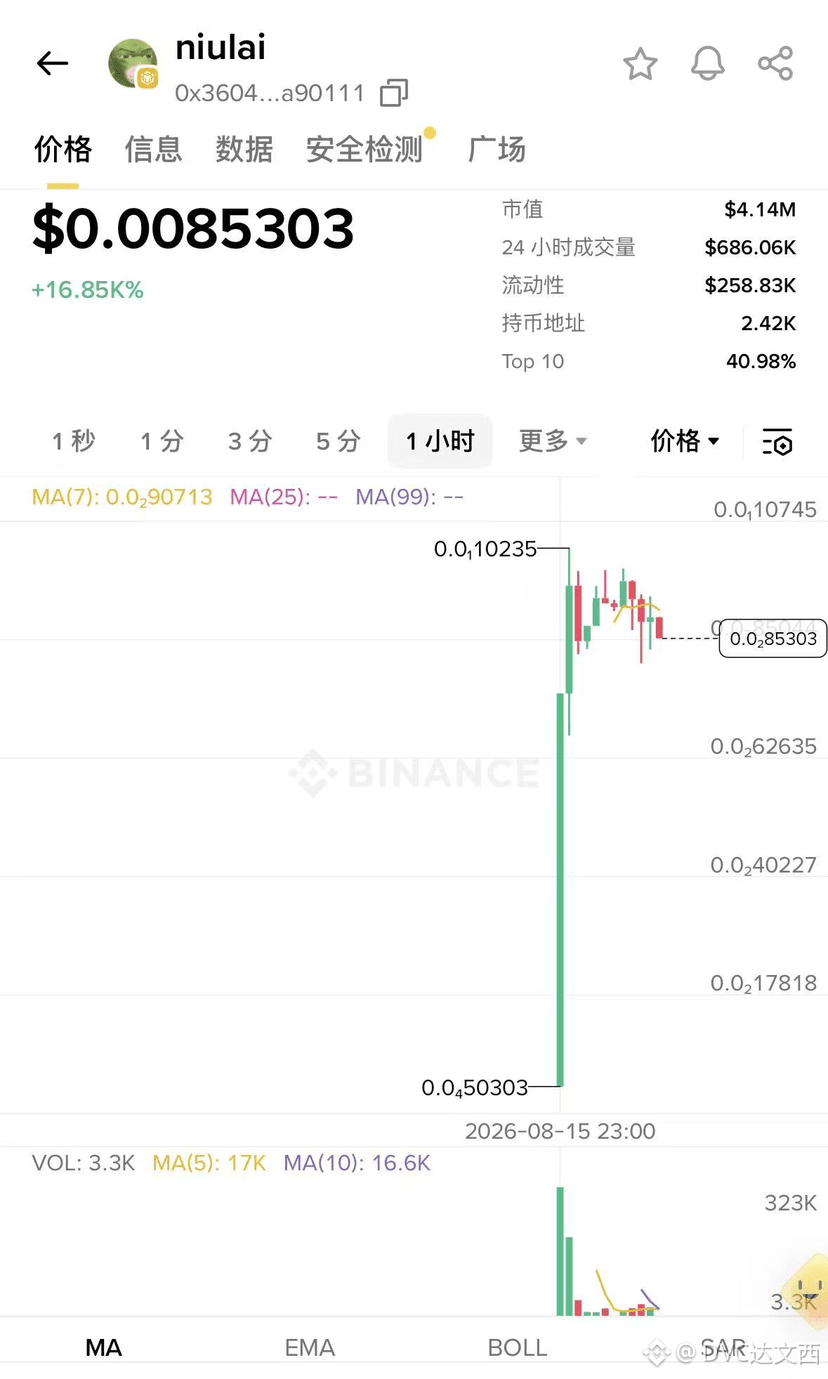
Today I was chatting with a friend about $niulai, and suddenly felt that the concept of “Shadow Coins” is actually quite imaginative.
In the past, movies were just movies, and Memes were just Memes.
Now some people are trying to put the two together, turning movie IP into a part of community discussion.
《Niu Lai》 is the entry point for this attempt.
Whether it can truly form a new track is hard to judge for now, but this kind of early exploration is still worth a look. #niulai #牛来
Today I was chatting with a friend about $niulai, and suddenly felt that the concept of “Shadow Coins” is actually quite imaginative.
In the past, movies were just movies, and Memes were just Memes.
Now some people are trying to put the two together, turning movie IP into a part of community discussion.
《Niu Lai》 is the entry point for this attempt.
Whether it can truly form a new track is hard to judge for now, but this kind of early exploration is still worth a look. #niulai #牛来
In the past, movies were just movies, and Memes were just Memes.
Now some people are trying to put the two together, turning movie IP into a part of community discussion.
《Niu Lai》 is the entry point for this attempt.
Whether it can truly form a new track is hard to judge for now, but this kind of early exploration is still worth a look. #niulai #牛来
124
·
--
#dusk $DUSK @Dusk_Foundation I also doubted at first. People have been shouting about zero-knowledge proofs (ZK) in the crypto world for so many years—how many of them have actually been used in financial scenarios? Most projects claim, “We have ZK,” but all they can do is anonymous transfers. What changed my mind from the Dusk whitepaper is this: it doesn’t treat ZK as a fig leaf. Instead, it treats it as a compliance tool.
How does it get implemented in practice? For example, when traditional financial institutions put things on-chain, they fear two things most: data leakage and the inability to account to regulators. Dusk’s technical approach is to use ZK to prove that “a transaction meets the rules, the assets are real, and there’s no wrongdoing,” without having to disclose all transaction details. It’s like showing regulators a stamped proof, rather than handing over the entire ledger. This isn’t “hiding”—it’s “verifiable privacy.”
I recently looked at the real data from their mainnet: proof generation isn’t as slow as people imagine, and the final transaction confirmation time is acceptable for financial settlement. That turns ZK from “cool in theory” into something usable. Remember, financial scenarios don’t fear technical complexity; they fear uncertainty and non-auditability. Dusk addresses both of these.
Whether ZK can succeed in financial privacy doesn’t hinge on whether the algorithm is newer or more advanced—it hinges on whether institutions are willing to put real business through it and try. At least, Dusk has paved the way to the point where people can actually walk it.
Which pain point do you think zero-knowledge proofs should tackle first in financial privacy?
#dusk $DUSK @Dusk I also doubted at first. People have been shouting about zero-knowledge proofs (ZK) in the crypto world for so many years—how many of them have actually been used in financial scenarios? Most projects claim, “We have ZK,” but all they can do is anonymous transfers. What changed my mind from the Dusk whitepaper is this: it doesn’t treat ZK as a fig leaf. Instead, it treats it as a compliance tool.
How does it get implemented in practice? For example, when traditional financial institutions put things on-chain, they fear two things most: data leakage and the inability to account to regulators. Dusk’s technical approach is to use ZK to prove that “a transaction meets the rules, the assets are real, and there’s no wrongdoing,” without having to disclose all transaction details. It’s like showing regulators a stamped proof, rather than handing over the entire ledger. This isn’t “hiding”—it’s “verifiable privacy.”
I recently looked at the real data from their mainnet: proof generation isn’t as slow as people imagine, and the final transaction confirmation time is acceptable for financial settlement. That turns ZK from “cool in theory” into something usable. Remember, financial scenarios don’t fear technical complexity; they fear uncertainty and non-auditability. Dusk addresses both of these.
Whether ZK can succeed in financial privacy doesn’t hinge on whether the algorithm is newer or more advanced—it hinges on whether institutions are willing to put real business through it and try. At least, Dusk has paved the way to the point where people can actually walk it.
Which pain point do you think zero-knowledge proofs should tackle first in financial privacy?
How does it get implemented in practice? For example, when traditional financial institutions put things on-chain, they fear two things most: data leakage and the inability to account to regulators. Dusk’s technical approach is to use ZK to prove that “a transaction meets the rules, the assets are real, and there’s no wrongdoing,” without having to disclose all transaction details. It’s like showing regulators a stamped proof, rather than handing over the entire ledger. This isn’t “hiding”—it’s “verifiable privacy.”
I recently looked at the real data from their mainnet: proof generation isn’t as slow as people imagine, and the final transaction confirmation time is acceptable for financial settlement. That turns ZK from “cool in theory” into something usable. Remember, financial scenarios don’t fear technical complexity; they fear uncertainty and non-auditability. Dusk addresses both of these.
Whether ZK can succeed in financial privacy doesn’t hinge on whether the algorithm is newer or more advanced—it hinges on whether institutions are willing to put real business through it and try. At least, Dusk has paved the way to the point where people can actually walk it.
Which pain point do you think zero-knowledge proofs should tackle first in financial privacy?
A. 向监管证明合规又不泄露客户数据
100%
B. 隐藏交易金额和持仓
0%
C. 保护交易策略不被竞争对手发现
0%
1 votes • Voting closed
181
·
--
#dusk $DUSK @Dusk_Foundation It turns out I never really took Dusk seriously at first. I thought privacy public chains all follow the same playbook: hide transactions and then shout about decentralization. It wasn’t until I actually read its whitepaper that I realized from day one, Dusk never set out to be a “privacy payment” chain—it was aiming for financial infrastructure.
What really stood out to me in the whitepaper was the XSC Confidential Security Contract standard. It doesn’t simply encrypt smart contracts; instead, it ensures that issuers, regulators, and traders can each only see the parts they’re supposed to. In plain terms, it’s “selective disclosure,” not everything hidden and not everything exposed. Traditional financial institutions aren’t most afraid of on-chain performance—they’re afraid of getting hit from both sides: compliance and data leaks. Dusk’s design slots right into that gap.
It also insists on building an independent Layer-1, rather than patching on top of Ethereum. Financial use cases demand settlement certainty and programmable privacy—not a temporary L2 workaround. I looked at its recent real-world progress: the ecosystem isn’t exactly lively, but the direction hasn’t gone off course. It’s been steadily tackling the tough bones like RWA and tokenized securities.
So my current view is this: the gap between privacy chains isn’t about which ZK algorithm gets updated—it’s about “who you design for.” Dusk feels more like it’s building a privacy chain that institutions can pass audits with, rather than a mixer for retail users.
Which scenario do you think Dusk is most likely to break through first?
#dusk $DUSK @Dusk It turns out I never really took Dusk seriously at first. I thought privacy public chains all follow the same playbook: hide transactions and then shout about decentralization. It wasn’t until I actually read its whitepaper that I realized from day one, Dusk never set out to be a “privacy payment” chain—it was aiming for financial infrastructure.
What really stood out to me in the whitepaper was the XSC Confidential Security Contract standard. It doesn’t simply encrypt smart contracts; instead, it ensures that issuers, regulators, and traders can each only see the parts they’re supposed to. In plain terms, it’s “selective disclosure,” not everything hidden and not everything exposed. Traditional financial institutions aren’t most afraid of on-chain performance—they’re afraid of getting hit from both sides: compliance and data leaks. Dusk’s design slots right into that gap.
It also insists on building an independent Layer-1, rather than patching on top of Ethereum. Financial use cases demand settlement certainty and programmable privacy—not a temporary L2 workaround. I looked at its recent real-world progress: the ecosystem isn’t exactly lively, but the direction hasn’t gone off course. It’s been steadily tackling the tough bones like RWA and tokenized securities.
So my current view is this: the gap between privacy chains isn’t about which ZK algorithm gets updated—it’s about “who you design for.” Dusk feels more like it’s building a privacy chain that institutions can pass audits with, rather than a mixer for retail users.
Which scenario do you think Dusk is most likely to break through first?
What really stood out to me in the whitepaper was the XSC Confidential Security Contract standard. It doesn’t simply encrypt smart contracts; instead, it ensures that issuers, regulators, and traders can each only see the parts they’re supposed to. In plain terms, it’s “selective disclosure,” not everything hidden and not everything exposed. Traditional financial institutions aren’t most afraid of on-chain performance—they’re afraid of getting hit from both sides: compliance and data leaks. Dusk’s design slots right into that gap.
It also insists on building an independent Layer-1, rather than patching on top of Ethereum. Financial use cases demand settlement certainty and programmable privacy—not a temporary L2 workaround. I looked at its recent real-world progress: the ecosystem isn’t exactly lively, but the direction hasn’t gone off course. It’s been steadily tackling the tough bones like RWA and tokenized securities.
So my current view is this: the gap between privacy chains isn’t about which ZK algorithm gets updated—it’s about “who you design for.” Dusk feels more like it’s building a privacy chain that institutions can pass audits with, rather than a mixer for retail users.
Which scenario do you think Dusk is most likely to break through first?
A. 债券/证券类RWA代币化
0%
B. 供应链金融
0%
C. 合规稳定币或支付结算
0%
0 votes • Voting closed
120
·
--
#baby $BABY I reread the Babylon whitepaper again, this time from a different angle. Instead of digging into technical details, I’ll treat it like a business plan and focus on one question: who ends up paying for this?
My first instinct is that it’s the PoS chains. The whitepaper lays it out pretty clearly: when a new chain is launched, what it lacks most is security. The token price is unstable, there are too few validators, and the chain could be attacked at any time. Buying Babylon’s service is like buying a “Bitcoin-level security insurance policy” for yourself, which you can explain to both users and investors. This set of customers has a real need and should be the first to foot the bill.
But the further I read, the more it seems to me that the real big spenders might not have entered the market at scale yet.
There’s a section in the whitepaper that mentions the need for cross-chain security within the Cosmos ecosystem, and that really clicked for me. Cosmos chains are already interconnected via IBC; when one chain has an issue, it can implicate a whole chain of others. Could it be that later, some cross-chain protocol or a DeFi platform itself pays for Babylon’s service—insuring every asset it bridges out—and then spreads that cost across the fees? At that point, it’s no longer the chain paying; it’s the application layer paying.
If you think further, institutional customers could even show up. For example, an exchange may want to support deposits and withdrawals for a particular PoS chain, but it worries that the chain’s finality isn’t stable enough and that transaction rollbacks could cause it to lose money. Rather than taking that risk itself, it would be better to buy Babylon’s finality guarantee service and push the risk elsewhere. This is similar to how credit default swaps work in traditional finance.
If this direction works out, what Babylon sells won’t just be “security,” but a form of credit derivative that can be priced and traded. The whitepaper doesn’t spell this out explicitly, but the data and logic already hint at it. Right now I think Babylon’s early customers are PoS chains, but its long-term customers could be any business entities that need a Bitcoin-level security endorsement.@babylonlabs_io
One question: who do you think Babylon’s biggest customer base will ultimately be?
#baby $BABY I reread the Babylon whitepaper again, this time from a different angle. Instead of digging into technical details, I’ll treat it like a business plan and focus on one question: who ends up paying for this?
My first instinct is that it’s the PoS chains. The whitepaper lays it out pretty clearly: when a new chain is launched, what it lacks most is security. The token price is unstable, there are too few validators, and the chain could be attacked at any time. Buying Babylon’s service is like buying a “Bitcoin-level security insurance policy” for yourself, which you can explain to both users and investors. This set of customers has a real need and should be the first to foot the bill.
But the further I read, the more it seems to me that the real big spenders might not have entered the market at scale yet.
There’s a section in the whitepaper that mentions the need for cross-chain security within the Cosmos ecosystem, and that really clicked for me. Cosmos chains are already interconnected via IBC; when one chain has an issue, it can implicate a whole chain of others. Could it be that later, some cross-chain protocol or a DeFi platform itself pays for Babylon’s service—insuring every asset it bridges out—and then spreads that cost across the fees? At that point, it’s no longer the chain paying; it’s the application layer paying.
If you think further, institutional customers could even show up. For example, an exchange may want to support deposits and withdrawals for a particular PoS chain, but it worries that the chain’s finality isn’t stable enough and that transaction rollbacks could cause it to lose money. Rather than taking that risk itself, it would be better to buy Babylon’s finality guarantee service and push the risk elsewhere. This is similar to how credit default swaps work in traditional finance.
If this direction works out, what Babylon sells won’t just be “security,” but a form of credit derivative that can be priced and traded. The whitepaper doesn’t spell this out explicitly, but the data and logic already hint at it. Right now I think Babylon’s early customers are PoS chains, but its long-term customers could be any business entities that need a Bitcoin-level security endorsement.@BabylonLabs_io
One question: who do you think Babylon’s biggest customer base will ultimately be?
My first instinct is that it’s the PoS chains. The whitepaper lays it out pretty clearly: when a new chain is launched, what it lacks most is security. The token price is unstable, there are too few validators, and the chain could be attacked at any time. Buying Babylon’s service is like buying a “Bitcoin-level security insurance policy” for yourself, which you can explain to both users and investors. This set of customers has a real need and should be the first to foot the bill.
But the further I read, the more it seems to me that the real big spenders might not have entered the market at scale yet.
There’s a section in the whitepaper that mentions the need for cross-chain security within the Cosmos ecosystem, and that really clicked for me. Cosmos chains are already interconnected via IBC; when one chain has an issue, it can implicate a whole chain of others. Could it be that later, some cross-chain protocol or a DeFi platform itself pays for Babylon’s service—insuring every asset it bridges out—and then spreads that cost across the fees? At that point, it’s no longer the chain paying; it’s the application layer paying.
If you think further, institutional customers could even show up. For example, an exchange may want to support deposits and withdrawals for a particular PoS chain, but it worries that the chain’s finality isn’t stable enough and that transaction rollbacks could cause it to lose money. Rather than taking that risk itself, it would be better to buy Babylon’s finality guarantee service and push the risk elsewhere. This is similar to how credit default swaps work in traditional finance.
If this direction works out, what Babylon sells won’t just be “security,” but a form of credit derivative that can be priced and traded. The whitepaper doesn’t spell this out explicitly, but the data and logic already hint at it. Right now I think Babylon’s early customers are PoS chains, but its long-term customers could be any business entities that need a Bitcoin-level security endorsement.@BabylonLabs_io
One question: who do you think Babylon’s biggest customer base will ultimately be?
A. PoS 链,尤其是新链,安全是它们的绝对刚需
0%
B. 跨链协议和 DeFi 平台,应用层的安全需求更市场化
0%
C. 机构客户,交易所和托管方才有动力为安全花大钱
0%
0 votes • Voting closed
108
·
--
#baby $BABY Before talking about Babylon, I kept focusing on the technology, until I started calculating staking returns and realized the core issue: how is its security service actually priced?
After going through the whitepaper, the logic is very clear. The buyer is the PoS chain, and it pays for Bitcoin-level finality security using a hybrid model of transaction fees plus token inflation, periodically paying the protocol a “premium.” There are two types of recipients: finality providers (nodes) get the larger share, while BTC stakers get a smaller share. The principle is: those who do the work get more, and those who stake the coins get a basic return, avoiding unearned gains.
What interests me most is pricing power. The whitepaper explicitly leaves it to market supply and demand, rather than having the project team decide. The more PoS chains there are and the larger the transaction volume, the higher the demand for security, so total payments naturally rise. At the same time, competition among nodes means that nodes with better reputations—fewer penalties and higher uptime—can quote higher prices, and PoS chains are willing to pay more for peace of mind. This creates pricing based on “security reputation,” similar to a credit-rating market.
Of course, details still need refinement: cross-chain price comparisons, standardized service packages, mechanisms to prevent price wars, and so on. But the overall direction is right—the pricing power is not put in the hands of the project team or large holders, but given to the market and reputation.@babylonlabs_io
Finally, one question: who will ultimately decide the pricing of Babylon’s security service?
My choice is A. What do you think?
#baby $BABY Before talking about Babylon, I kept focusing on the technology, until I started calculating staking returns and realized the core issue: how is its security service actually priced?
After going through the whitepaper, the logic is very clear. The buyer is the PoS chain, and it pays for Bitcoin-level finality security using a hybrid model of transaction fees plus token inflation, periodically paying the protocol a “premium.” There are two types of recipients: finality providers (nodes) get the larger share, while BTC stakers get a smaller share. The principle is: those who do the work get more, and those who stake the coins get a basic return, avoiding unearned gains.
What interests me most is pricing power. The whitepaper explicitly leaves it to market supply and demand, rather than having the project team decide. The more PoS chains there are and the larger the transaction volume, the higher the demand for security, so total payments naturally rise. At the same time, competition among nodes means that nodes with better reputations—fewer penalties and higher uptime—can quote higher prices, and PoS chains are willing to pay more for peace of mind. This creates pricing based on “security reputation,” similar to a credit-rating market.
Of course, details still need refinement: cross-chain price comparisons, standardized service packages, mechanisms to prevent price wars, and so on. But the overall direction is right—the pricing power is not put in the hands of the project team or large holders, but given to the market and reputation.@BabylonLabs_io
Finally, one question: who will ultimately decide the pricing of Babylon’s security service?
My choice is A. What do you think?
After going through the whitepaper, the logic is very clear. The buyer is the PoS chain, and it pays for Bitcoin-level finality security using a hybrid model of transaction fees plus token inflation, periodically paying the protocol a “premium.” There are two types of recipients: finality providers (nodes) get the larger share, while BTC stakers get a smaller share. The principle is: those who do the work get more, and those who stake the coins get a basic return, avoiding unearned gains.
What interests me most is pricing power. The whitepaper explicitly leaves it to market supply and demand, rather than having the project team decide. The more PoS chains there are and the larger the transaction volume, the higher the demand for security, so total payments naturally rise. At the same time, competition among nodes means that nodes with better reputations—fewer penalties and higher uptime—can quote higher prices, and PoS chains are willing to pay more for peace of mind. This creates pricing based on “security reputation,” similar to a credit-rating market.
Of course, details still need refinement: cross-chain price comparisons, standardized service packages, mechanisms to prevent price wars, and so on. But the overall direction is right—the pricing power is not put in the hands of the project team or large holders, but given to the market and reputation.@BabylonLabs_io
Finally, one question: who will ultimately decide the pricing of Babylon’s security service?
My choice is A. What do you think?
A. 市场供需 — 出价高者得,信誉好者胜
0%
B. 大户节点 — 集中抬价
0%
C. 协议治理 — BABY持有者投票调控
0%
0 votes • Voting closed
1
1
107
·
--
#baby $BABY Babylon’s Finality Provider Must Maintain Two Sets of State—BTC and PoS—this Design’s Trade-Off
The first time I saw Babylon’s requirements for finality provider nodes, I thought: “This threshold is way too high.” You have to run both a full Bitcoin node and a PoS chain node—both ledgers must be kept in sync in real time. Doesn’t that just wear nodes out?
Later, I chatted with a friend who has run a validator node, and he一句话 hit me: “Hard work is exactly what it should be.”
What Babylon is trying to do is anchor the finality of PoS chain transactions to Bitcoin. If a node only looks at the PoS chain and not the BTC chain, how would it know whether Bitcoin has actually confirmed? How would it determine whether the slashing conditions truly triggered? In plain terms: to be the judge, you need to personally observe data from both chains—you can’t rely on secondhand reports.
This is a trade-off in security redundancy. Running only one ledger is obviously lighter, but in signing it’s essentially “guessing” what’s happening on the other side. Guess correctly and you’re fine—guess wrong and the entire finality commitment collapses.
Babylon chooses to make nodes work hard, which in essence rejects the “light-client illusion.” You either perform full verification or you don’t participate—there’s no middle ground.
The cost is very clear: hardware costs double, bandwidth overhead doubles, and operational complexity for nodes jumps by a full level. This will definitely filter out some would-be casual users who want to run nodes easily, leaving mostly professional infrastructure teams.
But what you get in return is tangible: behind every finality signature is the node’s real confirmation of the complete state on both chains. No delegation, no proxy, no domino effect of “I trust him and he trusts you.” This concrete, hard security thickness can’t be replaced by laziness.
I think this design really shows how the Babylon team prioritizes value: security comes first, convenience can be pushed back a bit.@babylonlabs_io
One question: do you think the high node threshold is a good thing or a risk?
#baby $BABY Babylon’s Finality Provider Must Maintain Two Sets of State—BTC and PoS—this Design’s Trade-Off
The first time I saw Babylon’s requirements for finality provider nodes, I thought: “This threshold is way too high.” You have to run both a full Bitcoin node and a PoS chain node—both ledgers must be kept in sync in real time. Doesn’t that just wear nodes out?
Later, I chatted with a friend who has run a validator node, and he一句话 hit me: “Hard work is exactly what it should be.”
What Babylon is trying to do is anchor the finality of PoS chain transactions to Bitcoin. If a node only looks at the PoS chain and not the BTC chain, how would it know whether Bitcoin has actually confirmed? How would it determine whether the slashing conditions truly triggered? In plain terms: to be the judge, you need to personally observe data from both chains—you can’t rely on secondhand reports.
This is a trade-off in security redundancy. Running only one ledger is obviously lighter, but in signing it’s essentially “guessing” what’s happening on the other side. Guess correctly and you’re fine—guess wrong and the entire finality commitment collapses.
Babylon chooses to make nodes work hard, which in essence rejects the “light-client illusion.” You either perform full verification or you don’t participate—there’s no middle ground.
The cost is very clear: hardware costs double, bandwidth overhead doubles, and operational complexity for nodes jumps by a full level. This will definitely filter out some would-be casual users who want to run nodes easily, leaving mostly professional infrastructure teams.
But what you get in return is tangible: behind every finality signature is the node’s real confirmation of the complete state on both chains. No delegation, no proxy, no domino effect of “I trust him and he trusts you.” This concrete, hard security thickness can’t be replaced by laziness.
I think this design really shows how the Babylon team prioritizes value: security comes first, convenience can be pushed back a bit.@BabylonLabs_io
One question: do you think the high node threshold is a good thing or a risk?
The first time I saw Babylon’s requirements for finality provider nodes, I thought: “This threshold is way too high.” You have to run both a full Bitcoin node and a PoS chain node—both ledgers must be kept in sync in real time. Doesn’t that just wear nodes out?
Later, I chatted with a friend who has run a validator node, and he一句话 hit me: “Hard work is exactly what it should be.”
What Babylon is trying to do is anchor the finality of PoS chain transactions to Bitcoin. If a node only looks at the PoS chain and not the BTC chain, how would it know whether Bitcoin has actually confirmed? How would it determine whether the slashing conditions truly triggered? In plain terms: to be the judge, you need to personally observe data from both chains—you can’t rely on secondhand reports.
This is a trade-off in security redundancy. Running only one ledger is obviously lighter, but in signing it’s essentially “guessing” what’s happening on the other side. Guess correctly and you’re fine—guess wrong and the entire finality commitment collapses.
Babylon chooses to make nodes work hard, which in essence rejects the “light-client illusion.” You either perform full verification or you don’t participate—there’s no middle ground.
The cost is very clear: hardware costs double, bandwidth overhead doubles, and operational complexity for nodes jumps by a full level. This will definitely filter out some would-be casual users who want to run nodes easily, leaving mostly professional infrastructure teams.
But what you get in return is tangible: behind every finality signature is the node’s real confirmation of the complete state on both chains. No delegation, no proxy, no domino effect of “I trust him and he trusts you.” This concrete, hard security thickness can’t be replaced by laziness.
I think this design really shows how the Babylon team prioritizes value: security comes first, convenience can be pushed back a bit.@BabylonLabs_io
One question: do you think the high node threshold is a good thing or a risk?
A. 好事,安全不能打折,专业的事交给专业的节点做
100%
B. 隐患,门槛太高会导致节点集中,反而变相中心化
0%
C. 短期难受,长期看协议稳定运行之后硬件成本会降下来
0%
1 votes • Voting closed
7
5
241
·
--
#baby $BABY I rewrote the Babylon whitepaper the night before yesterday, forcing myself not to skip anything I didn’t understand. The moment I finally got to the “Finality Gadget,” I had to chew through it three times—then suddenly it clicked. This thing isn’t playing games or being mysterious. It’s the cleverest little piece in Babylon’s entire architecture.
Let me put it in plain language.
PoS chains have a natural flaw: transactions that are confirmed can still be rolled back. Today you see a transaction that “succeeds,” and tomorrow it might be overturned due to a chain fork. In financial scenarios, that’s a nightmare—you think the money has arrived, but then it’s gone the next day.
So what exactly does Babylon’s Finality Gadget do? It brings Bitcoin in as the “final judge.” Every time the PoS chain produces a batch of blocks, the Finality Gadget imprints that batch’s fingerprint onto the Bitcoin blockchain. Once that fingerprint is confirmed on the Bitcoin chain, those PoS blocks are truly “final”—because Bitcoin’s history is immutable. You can’t just go back and change Bitcoin’s ledger, right?
In other words, the Finality Gadget uses Bitcoin’s irreversibility to seal up the PoS chain’s ledger. Before the seal goes on, transactions are “temporarily valid.” After the seal goes on, transactions are “as good as set in stone.”
When I understood it to this point, a metaphor popped into my head: a PoS chain is like a clerk who might later sneakily alter a couple entries in the books. Babylon’s Finality Gadget is like making a copy of the ledger every ten minutes and putting it into a safe, where the key is held by the network’s total computing power. Anyone who wants to weasel out of payment has to first try to break into the Bitcoin safe.
That’s what Babylon is really selling. Not just “BTC staking earns interest.” It’s that it makes transactions on the PoS chain dare to say the four words “final confirmation” for the first time—and this confidence comes from Bitcoin.
Let me ask everyone: do you think “Bitcoin-level finality” is a must-have for PoS chains, or just a nice-to-have? @BabylonLabs_io
#baby $BABY I rewrote the Babylon whitepaper the night before yesterday, forcing myself not to skip anything I didn’t understand. The moment I finally got to the “Finality Gadget,” I had to chew through it three times—then suddenly it clicked. This thing isn’t playing games or being mysterious. It’s the cleverest little piece in Babylon’s entire architecture.
Let me put it in plain language.
PoS chains have a natural flaw: transactions that are confirmed can still be rolled back. Today you see a transaction that “succeeds,” and tomorrow it might be overturned due to a chain fork. In financial scenarios, that’s a nightmare—you think the money has arrived, but then it’s gone the next day.
So what exactly does Babylon’s Finality Gadget do? It brings Bitcoin in as the “final judge.” Every time the PoS chain produces a batch of blocks, the Finality Gadget imprints that batch’s fingerprint onto the Bitcoin blockchain. Once that fingerprint is confirmed on the Bitcoin chain, those PoS blocks are truly “final”—because Bitcoin’s history is immutable. You can’t just go back and change Bitcoin’s ledger, right?
In other words, the Finality Gadget uses Bitcoin’s irreversibility to seal up the PoS chain’s ledger. Before the seal goes on, transactions are “temporarily valid.” After the seal goes on, transactions are “as good as set in stone.”
When I understood it to this point, a metaphor popped into my head: a PoS chain is like a clerk who might later sneakily alter a couple entries in the books. Babylon’s Finality Gadget is like making a copy of the ledger every ten minutes and putting it into a safe, where the key is held by the network’s total computing power. Anyone who wants to weasel out of payment has to first try to break into the Bitcoin safe.
That’s what Babylon is really selling. Not just “BTC staking earns interest.” It’s that it makes transactions on the PoS chain dare to say the four words “final confirmation” for the first time—and this confidence comes from Bitcoin.
Let me ask everyone: do you think “Bitcoin-level finality” is a must-have for PoS chains, or just a nice-to-have? @BabylonLabs_io
Let me put it in plain language.
PoS chains have a natural flaw: transactions that are confirmed can still be rolled back. Today you see a transaction that “succeeds,” and tomorrow it might be overturned due to a chain fork. In financial scenarios, that’s a nightmare—you think the money has arrived, but then it’s gone the next day.
So what exactly does Babylon’s Finality Gadget do? It brings Bitcoin in as the “final judge.” Every time the PoS chain produces a batch of blocks, the Finality Gadget imprints that batch’s fingerprint onto the Bitcoin blockchain. Once that fingerprint is confirmed on the Bitcoin chain, those PoS blocks are truly “final”—because Bitcoin’s history is immutable. You can’t just go back and change Bitcoin’s ledger, right?
In other words, the Finality Gadget uses Bitcoin’s irreversibility to seal up the PoS chain’s ledger. Before the seal goes on, transactions are “temporarily valid.” After the seal goes on, transactions are “as good as set in stone.”
When I understood it to this point, a metaphor popped into my head: a PoS chain is like a clerk who might later sneakily alter a couple entries in the books. Babylon’s Finality Gadget is like making a copy of the ledger every ten minutes and putting it into a safe, where the key is held by the network’s total computing power. Anyone who wants to weasel out of payment has to first try to break into the Bitcoin safe.
That’s what Babylon is really selling. Not just “BTC staking earns interest.” It’s that it makes transactions on the PoS chain dare to say the four words “final confirmation” for the first time—and this confidence comes from Bitcoin.
Let me ask everyone: do you think “Bitcoin-level finality” is a must-have for PoS chains, or just a nice-to-have? @BabylonLabs_io
A. 刚需,小链尤其需要借比特币的信誉给自己背书
100%
B. 锦上添花,大链自己的共识够用了,这只是加分项
0%
C. 得看成本,如果打时间戳太贵,小链可能用不起
0%
2 votes • Voting closed
2
3.2k
·
--
#baby $BABY At midnight, I was reading the Babylon whitepaper. When I saw them drawing the asset flow and the trust model as a diagram, I suddenly sat up straight. They didn’t “optimize the bridge”—they deleted the entire bridge.
The sidechain logic is to move assets: your BTC must be moved from the mainnet to somewhere else, and on the way there has to be a bridge. Babylon’s logic is different: it doesn’t move your BTC. Your BTC stays in your own UTXOs on the Bitcoin mainnet, never leaving. What it does is attach a condition to that UTXO: if a validator/node on the PoS chain misbehaves, then once an on-chain encrypted proof is submitted, the slashing is automatically triggered. In the meantime, your coins are completely still—no one can touch them.
At the time, I drew two arrows on paper. Sidechain: BTC → locked into a custody address → mapped tokens → risk is concentrated on the bridge. Babylon: BTC → keep it in your wallet → attach the slashing condition → risk is pushed over to the misbehaving node.
How should I describe the feeling? It’s like you thought there was only one way to cross a river—fix the bridge—then someone tells you you don’t even need to cross the river; just put a camera on the far bank and watch.
Of course, that doesn’t mean Babylon has no risk. Whether the slashing contract itself is secure, what the boundary conditions are for malicious slashing, and whether the unlock process can get stuck during extreme market conditions—these are all real issues. But the nature of the problems changes: it’s no longer “whether you trust the custodian,” but “whether you can verify the on-chain logic.” The former depends on people’s character; the latter depends on code.
I still don’t think Babylon is the ultimate answer. But it did something that sidechains have never really done: it acknowledges that the bridge is a dead spot, and works around it instead of patching it.
What do you think about the “no-bridge” route?
A. The direction is right—bridges were always the biggest single point of failure in the Bitcoin ecosystem
B. It bypasses the bridge, but the slashing logic itself could become a new vulnerability
C. Too early to tell—wait and see whether anything goes wrong after one year of running on the mainnet @BabylonLabs_io
#baby $BABY At midnight, I was reading the Babylon whitepaper. When I saw them drawing the asset flow and the trust model as a diagram, I suddenly sat up straight. They didn’t “optimize the bridge”—they deleted the entire bridge.
The sidechain logic is to move assets: your BTC must be moved from the mainnet to somewhere else, and on the way there has to be a bridge. Babylon’s logic is different: it doesn’t move your BTC. Your BTC stays in your own UTXOs on the Bitcoin mainnet, never leaving. What it does is attach a condition to that UTXO: if a validator/node on the PoS chain misbehaves, then once an on-chain encrypted proof is submitted, the slashing is automatically triggered. In the meantime, your coins are completely still—no one can touch them.
At the time, I drew two arrows on paper. Sidechain: BTC → locked into a custody address → mapped tokens → risk is concentrated on the bridge. Babylon: BTC → keep it in your wallet → attach the slashing condition → risk is pushed over to the misbehaving node.
How should I describe the feeling? It’s like you thought there was only one way to cross a river—fix the bridge—then someone tells you you don’t even need to cross the river; just put a camera on the far bank and watch.
Of course, that doesn’t mean Babylon has no risk. Whether the slashing contract itself is secure, what the boundary conditions are for malicious slashing, and whether the unlock process can get stuck during extreme market conditions—these are all real issues. But the nature of the problems changes: it’s no longer “whether you trust the custodian,” but “whether you can verify the on-chain logic.” The former depends on people’s character; the latter depends on code.
I still don’t think Babylon is the ultimate answer. But it did something that sidechains have never really done: it acknowledges that the bridge is a dead spot, and works around it instead of patching it.
What do you think about the “no-bridge” route?
A. The direction is right—bridges were always the biggest single point of failure in the Bitcoin ecosystem
B. It bypasses the bridge, but the slashing logic itself could become a new vulnerability
C. Too early to tell—wait and see whether anything goes wrong after one year of running on the mainnet @BabylonLabs_io
The sidechain logic is to move assets: your BTC must be moved from the mainnet to somewhere else, and on the way there has to be a bridge. Babylon’s logic is different: it doesn’t move your BTC. Your BTC stays in your own UTXOs on the Bitcoin mainnet, never leaving. What it does is attach a condition to that UTXO: if a validator/node on the PoS chain misbehaves, then once an on-chain encrypted proof is submitted, the slashing is automatically triggered. In the meantime, your coins are completely still—no one can touch them.
At the time, I drew two arrows on paper. Sidechain: BTC → locked into a custody address → mapped tokens → risk is concentrated on the bridge. Babylon: BTC → keep it in your wallet → attach the slashing condition → risk is pushed over to the misbehaving node.
How should I describe the feeling? It’s like you thought there was only one way to cross a river—fix the bridge—then someone tells you you don’t even need to cross the river; just put a camera on the far bank and watch.
Of course, that doesn’t mean Babylon has no risk. Whether the slashing contract itself is secure, what the boundary conditions are for malicious slashing, and whether the unlock process can get stuck during extreme market conditions—these are all real issues. But the nature of the problems changes: it’s no longer “whether you trust the custodian,” but “whether you can verify the on-chain logic.” The former depends on people’s character; the latter depends on code.
I still don’t think Babylon is the ultimate answer. But it did something that sidechains have never really done: it acknowledges that the bridge is a dead spot, and works around it instead of patching it.
What do you think about the “no-bridge” route?
A. The direction is right—bridges were always the biggest single point of failure in the Bitcoin ecosystem
B. It bypasses the bridge, but the slashing logic itself could become a new vulnerability
C. Too early to tell—wait and see whether anything goes wrong after one year of running on the mainnet @BabylonLabs_io
1
104
·
--
#baby $BABY Team up with flow-staking protocols like Stride—suddenly the chessboard under Babylon is much bigger
I’ve always felt Babylon had a small downside: self-custody staking is safe, but the staked BTC is locked up, so you can’t use it for anything else at the same time. Safety is maxed out, but liquidity is sacrificed.
Then a couple of days ago I saw news that Babylon and Stride are collaborating, and I felt a chill down my spine.
Stride is a veteran in flow staking in the Cosmos ecosystem. Simply put: you stake your tokens, and it gives you a derivative receipt. This receipt can be used elsewhere—lending, trading, providing liquidity, whatever you like. But previously, most flow-staking schemes ran on PoS chains, with little to do with Bitcoin.
Now these two are coming together, and the logic clicks: you self-custody stake BTC on Babylon, and at the same time you get an on-chain receipt from Stride—evidence that you’ve actually staked your coins. And this receipt can be circulated across the Cosmos ecosystem, even further.
What does that mean? Before, after your BTC was staked, you could only wait for rewards to arrive. Now, it’s like you hold an extra “certificate of deposit.” That certificate can be used as collateral to borrow money, put into a liquidity pool to earn trading fees, and even bridged to other places as a kind of “credit card.” Bitcoin is no longer just that pile of gold coins sitting in a cold wallet—it becomes a machine that can do work on its own.
When I read this collaboration announcement, an image popped into my head: Babylon turns Bitcoin into the “vault” of a PoS chain, and Stride installs “wheels” on that vault. With this partnership, Bitcoin’s composability suddenly breaks out of its usual boundaries—it’s no longer trapped in the safety narrative, and it’s truly charging into the mainstream waters of DeFi. @BabylonLabs_io
#baby $BABY Team up with flow-staking protocols like Stride—suddenly the chessboard under Babylon is much bigger
I’ve always felt Babylon had a small downside: self-custody staking is safe, but the staked BTC is locked up, so you can’t use it for anything else at the same time. Safety is maxed out, but liquidity is sacrificed.
Then a couple of days ago I saw news that Babylon and Stride are collaborating, and I felt a chill down my spine.
Stride is a veteran in flow staking in the Cosmos ecosystem. Simply put: you stake your tokens, and it gives you a derivative receipt. This receipt can be used elsewhere—lending, trading, providing liquidity, whatever you like. But previously, most flow-staking schemes ran on PoS chains, with little to do with Bitcoin.
Now these two are coming together, and the logic clicks: you self-custody stake BTC on Babylon, and at the same time you get an on-chain receipt from Stride—evidence that you’ve actually staked your coins. And this receipt can be circulated across the Cosmos ecosystem, even further.
What does that mean? Before, after your BTC was staked, you could only wait for rewards to arrive. Now, it’s like you hold an extra “certificate of deposit.” That certificate can be used as collateral to borrow money, put into a liquidity pool to earn trading fees, and even bridged to other places as a kind of “credit card.” Bitcoin is no longer just that pile of gold coins sitting in a cold wallet—it becomes a machine that can do work on its own.
When I read this collaboration announcement, an image popped into my head: Babylon turns Bitcoin into the “vault” of a PoS chain, and Stride installs “wheels” on that vault. With this partnership, Bitcoin’s composability suddenly breaks out of its usual boundaries—it’s no longer trapped in the safety narrative, and it’s truly charging into the mainstream waters of DeFi. @BabylonLabs_io
I’ve always felt Babylon had a small downside: self-custody staking is safe, but the staked BTC is locked up, so you can’t use it for anything else at the same time. Safety is maxed out, but liquidity is sacrificed.
Then a couple of days ago I saw news that Babylon and Stride are collaborating, and I felt a chill down my spine.
Stride is a veteran in flow staking in the Cosmos ecosystem. Simply put: you stake your tokens, and it gives you a derivative receipt. This receipt can be used elsewhere—lending, trading, providing liquidity, whatever you like. But previously, most flow-staking schemes ran on PoS chains, with little to do with Bitcoin.
Now these two are coming together, and the logic clicks: you self-custody stake BTC on Babylon, and at the same time you get an on-chain receipt from Stride—evidence that you’ve actually staked your coins. And this receipt can be circulated across the Cosmos ecosystem, even further.
What does that mean? Before, after your BTC was staked, you could only wait for rewards to arrive. Now, it’s like you hold an extra “certificate of deposit.” That certificate can be used as collateral to borrow money, put into a liquidity pool to earn trading fees, and even bridged to other places as a kind of “credit card.” Bitcoin is no longer just that pile of gold coins sitting in a cold wallet—it becomes a machine that can do work on its own.
When I read this collaboration announcement, an image popped into my head: Babylon turns Bitcoin into the “vault” of a PoS chain, and Stride installs “wheels” on that vault. With this partnership, Bitcoin’s composability suddenly breaks out of its usual boundaries—it’s no longer trapped in the safety narrative, and it’s truly charging into the mainstream waters of DeFi. @BabylonLabs_io
1
206
·
--
#baby $BABY The other day I posted an interaction screenshot from the Babylon testnet in the group. Someone immediately chimed in with a sarcastic remark: “Here comes another track where you’re going to farm an airdrop. You old farmers in this group never stop for a second.”
I can’t be bothered to explain, but I know this for sure—Babylon’s testnet interaction cadence is completely different from all the “weird stuff” I used to mess with.
Back when I farmed other things, what was the deal? You were racing the clock—scrambling for allocations. Gas fees would skyrocket, and you still had to grit your teeth and push through. Finish one bridge, then a swap; finish a swap, then take out a loan. If you didn’t touch it for a day, you felt like someone would overtake you. Exhausting as hell. In the end, the project team一句 “witch filtering” just wiped out half a year of effort.
Babylon doesn’t work like that. It doesn’t care who’s fast or who’s doing the most. It’s about long-term, continuous on-chain behavior. My current rhythm is: spend five minutes every three days—check in, look up node status, and simulate a staking flow. That’s it. Five minutes is already generous; sometimes I just do it while I’m on the toilet.
Even better, it doesn’t compete for time with other protocols. When I do L2 tasks, I can switch over and click twice. Between doing cross-chain bridge stuff, I handle the validator-node checks. These actions feel as natural as brushing your teeth every day—they just fit into my routine. No separate schedule needed.
Most importantly, what Babylon is doing is the real business of Bitcoin’s security layer, not a money-pool game. You don’t have to shuffle assets around. You don’t need to worry about impermanent loss. And you don’t have to fear the team running off—your coins are self-custodied in your wallet, so no one can touch them. The testnet interaction is simply proving one thing: you’re a long-term participant, not someone here to grab a quick handful and run.
My mindset is really steady now. I still run the high-frequency projects that require watching the charts every day, but for Babylon—this low-frequency, long-cycle “pit”—I’m quietly taking my time too. Two legs, no conflict. Once the mainnet launches, this continuously accumulated record of on-chain behavior may be far more valuable than the people who rush in on a temporary impulse. @BabylonLabs_io
#baby $BABY The other day I posted an interaction screenshot from the Babylon testnet in the group. Someone immediately chimed in with a sarcastic remark: “Here comes another track where you’re going to farm an airdrop. You old farmers in this group never stop for a second.”
I can’t be bothered to explain, but I know this for sure—Babylon’s testnet interaction cadence is completely different from all the “weird stuff” I used to mess with.
Back when I farmed other things, what was the deal? You were racing the clock—scrambling for allocations. Gas fees would skyrocket, and you still had to grit your teeth and push through. Finish one bridge, then a swap; finish a swap, then take out a loan. If you didn’t touch it for a day, you felt like someone would overtake you. Exhausting as hell. In the end, the project team一句 “witch filtering” just wiped out half a year of effort.
Babylon doesn’t work like that. It doesn’t care who’s fast or who’s doing the most. It’s about long-term, continuous on-chain behavior. My current rhythm is: spend five minutes every three days—check in, look up node status, and simulate a staking flow. That’s it. Five minutes is already generous; sometimes I just do it while I’m on the toilet.
Even better, it doesn’t compete for time with other protocols. When I do L2 tasks, I can switch over and click twice. Between doing cross-chain bridge stuff, I handle the validator-node checks. These actions feel as natural as brushing your teeth every day—they just fit into my routine. No separate schedule needed.
Most importantly, what Babylon is doing is the real business of Bitcoin’s security layer, not a money-pool game. You don’t have to shuffle assets around. You don’t need to worry about impermanent loss. And you don’t have to fear the team running off—your coins are self-custodied in your wallet, so no one can touch them. The testnet interaction is simply proving one thing: you’re a long-term participant, not someone here to grab a quick handful and run.
My mindset is really steady now. I still run the high-frequency projects that require watching the charts every day, but for Babylon—this low-frequency, long-cycle “pit”—I’m quietly taking my time too. Two legs, no conflict. Once the mainnet launches, this continuously accumulated record of on-chain behavior may be far more valuable than the people who rush in on a temporary impulse. @BabylonLabs_io
I can’t be bothered to explain, but I know this for sure—Babylon’s testnet interaction cadence is completely different from all the “weird stuff” I used to mess with.
Back when I farmed other things, what was the deal? You were racing the clock—scrambling for allocations. Gas fees would skyrocket, and you still had to grit your teeth and push through. Finish one bridge, then a swap; finish a swap, then take out a loan. If you didn’t touch it for a day, you felt like someone would overtake you. Exhausting as hell. In the end, the project team一句 “witch filtering” just wiped out half a year of effort.
Babylon doesn’t work like that. It doesn’t care who’s fast or who’s doing the most. It’s about long-term, continuous on-chain behavior. My current rhythm is: spend five minutes every three days—check in, look up node status, and simulate a staking flow. That’s it. Five minutes is already generous; sometimes I just do it while I’m on the toilet.
Even better, it doesn’t compete for time with other protocols. When I do L2 tasks, I can switch over and click twice. Between doing cross-chain bridge stuff, I handle the validator-node checks. These actions feel as natural as brushing your teeth every day—they just fit into my routine. No separate schedule needed.
Most importantly, what Babylon is doing is the real business of Bitcoin’s security layer, not a money-pool game. You don’t have to shuffle assets around. You don’t need to worry about impermanent loss. And you don’t have to fear the team running off—your coins are self-custodied in your wallet, so no one can touch them. The testnet interaction is simply proving one thing: you’re a long-term participant, not someone here to grab a quick handful and run.
My mindset is really steady now. I still run the high-frequency projects that require watching the charts every day, but for Babylon—this low-frequency, long-cycle “pit”—I’m quietly taking my time too. Two legs, no conflict. Once the mainnet launches, this continuously accumulated record of on-chain behavior may be far more valuable than the people who rush in on a temporary impulse. @BabylonLabs_io
1
3
188
Log in to explore more content
Join global crypto users on Binance Square
⚡️ Get latest and useful information about crypto.
💬 Trusted by the world’s largest crypto exchange.
👍 Discover real insights from verified creators.
Email / Phone number
Trending Topics
SECHaltsCryptoETFReviewsAmidFundingLapse
3,015 views
113 Discussing
#SECHaltsCryptoETFReviewsAmidFundingLapse
SEC Halts Crypto ETF Reviews Amid Funding Lapse
The U.S. Securities and Exchange Commission (SEC) has reportedly paused certain cryptocurrency ETF review activities amid a government funding lapse.
This development has created uncertainty in the crypto market, particularly for investors and companies waiting for regulatory decisions on crypto-related exchange-traded funds (ETFs).
Impact on the Crypto Market
The delay could affect the approval timeline of pending crypto ETF applications. Investors are closely monitoring the situation as regulatory clarity remains an important factor in the growth of the digital asset industry.
Although the pause does not necessarily mean that crypto ETF applications will be rejected, it highlights how government funding disruptions can influence financial regulatory processes.
What Happens Next?
Market participants will be watching for updates on government funding and the SEC's ability to resume normal operations.
Crypto ETFs remain an important topic for institutional adoption, market development, and investor confidence.
Conclusion: The temporary halt highlights the importance of regulatory stability for the future of cryptocurrency investments.
#Crypto #Bitcoin #ETF #SEC #CryptoNews #Blockchain #Binance
King2112
·0 Likes
·72 views
ZcashETFPostsFirstWeeklyOutflow$93.6M
55,837 views
167 Discussing
GreekPoliceBustCryptoScamRingArrest17
163,475 views
1,147 Discussing