
牧羊的加密日记
836 Posts

牧羊的加密日记
Report
Block User
Web3熬夜冠军选手/MEME项目志愿者/二级市场资深被套股东/"分享有用和及时的消息"/💚📡:DL08686

SOL Holder
High-Frequency Trader
8.7 Years
48 Following
10.6K+ Followers
19.4K+ Liked
Posts
All
Quotes
Videos
·
--
BTC is consolidating at high levels, while privacy coin ZEC surged 47% in a single day.
BTC is up about 25% over the past week and is currently trading near 78K. In terms of news, improving expectations for the U.S. Treasury’s buyback policy have fueled expectations of easier liquidity, becoming the main narrative behind this rally.
Today, the most worth watching is ZEC’s 47% daily gain: it broke through the $800 mark and hit a multi-year high. What’s behind it? Grayscale has filed for the U.S.’s first spot privacy-coin ETF application. The privacy sector has returned to mainstream institutional attention—so what does that mean? Institutions are bringing privacy coins into a more compliant and accessible framework, and the valuation logic for the sector may be rewritten from here.
That said, amid the excitement there are also plenty of noise. SAND suffered a security incident, with over 500 million tokens maliciously minted. The Korean exchange has issued a warning. In addition, radar signals show multiple coins simultaneously sending “avoid” signals, and some “smart money” appears to be withdrawing from high levels—market liquidity is ebbing.
On the macro front, traffic through the Strait of Hormuz has fallen to just 20% of pre-war levels, and oil prices remain elevated around $87. U.S.-Canada trade negotiations have broken down, and tariffs have officially taken effect. The safe-haven narrative is still present, but since BTC is already up 25%, there isn’t enough new near-term catalyst—high-level consolidation is likely to dominate.
For market observation only.
BTC is consolidating at high levels, while privacy coin ZEC surged 47% in a single day.
BTC is up about 25% over the past week and is currently trading near 78K. In terms of news, improving expectations for the U.S. Treasury’s buyback policy have fueled expectations of easier liquidity, becoming the main narrative behind this rally.
Today, the most worth watching is ZEC’s 47% daily gain: it broke through the $800 mark and hit a multi-year high. What’s behind it? Grayscale has filed for the U.S.’s first spot privacy-coin ETF application. The privacy sector has returned to mainstream institutional attention—so what does that mean? Institutions are bringing privacy coins into a more compliant and accessible framework, and the valuation logic for the sector may be rewritten from here.
That said, amid the excitement there are also plenty of noise. SAND suffered a security incident, with over 500 million tokens maliciously minted. The Korean exchange has issued a warning. In addition, radar signals show multiple coins simultaneously sending “avoid” signals, and some “smart money” appears to be withdrawing from high levels—market liquidity is ebbing.
On the macro front, traffic through the Strait of Hormuz has fallen to just 20% of pre-war levels, and oil prices remain elevated around $87. U.S.-Canada trade negotiations have broken down, and tariffs have officially taken effect. The safe-haven narrative is still present, but since BTC is already up 25%, there isn’t enough new near-term catalyst—high-level consolidation is likely to dominate.
For market observation only.
BTC is up about 25% over the past week and is currently trading near 78K. In terms of news, improving expectations for the U.S. Treasury’s buyback policy have fueled expectations of easier liquidity, becoming the main narrative behind this rally.
Today, the most worth watching is ZEC’s 47% daily gain: it broke through the $800 mark and hit a multi-year high. What’s behind it? Grayscale has filed for the U.S.’s first spot privacy-coin ETF application. The privacy sector has returned to mainstream institutional attention—so what does that mean? Institutions are bringing privacy coins into a more compliant and accessible framework, and the valuation logic for the sector may be rewritten from here.
That said, amid the excitement there are also plenty of noise. SAND suffered a security incident, with over 500 million tokens maliciously minted. The Korean exchange has issued a warning. In addition, radar signals show multiple coins simultaneously sending “avoid” signals, and some “smart money” appears to be withdrawing from high levels—market liquidity is ebbing.
On the macro front, traffic through the Strait of Hormuz has fallen to just 20% of pre-war levels, and oil prices remain elevated around $87. U.S.-Canada trade negotiations have broken down, and tariffs have officially taken effect. The safe-haven narrative is still present, but since BTC is already up 25%, there isn’t enough new near-term catalyst—high-level consolidation is likely to dominate.
For market observation only.
352
·
--
The privacy-coin narrative is back—this time led by ZEC
Grayscale filed for the first US spot privacy coin ETF application with the SEC. ZEC’s single-day gain once nearly hit 50%, with the price breaking above $800 and setting a multi-year high. The privacy sector has been quiet for a long time, and this news has given dormant capital a reason to return.
It’s not just ZEC. ADA, XLM, and LINK—among other established layer-1 networks—have recently been moving up along with BTC, with OI expanding in tandem. The sector’s heat feels real. But it’s also worth noting: multiple monitoring systems have repeatedly issued “high-position risk” warnings, and some coins have been downgraded from key candidates to avoidance lists. As a result, the cost-effectiveness of chasing the price is declining.
How to observe: In narrative-driven markets, once the news is priced in, the sentiment premium often unwinds. It may be better to wait for a pullback and then assess whether support holds. If you don’t have a position, there’s no need to rush in. For those watching from lower levels, patience is key—wait for a better opportunity.
For market observation only.
The privacy-coin narrative is back—this time led by ZEC
Grayscale filed for the first US spot privacy coin ETF application with the SEC. ZEC’s single-day gain once nearly hit 50%, with the price breaking above $800 and setting a multi-year high. The privacy sector has been quiet for a long time, and this news has given dormant capital a reason to return.
It’s not just ZEC. ADA, XLM, and LINK—among other established layer-1 networks—have recently been moving up along with BTC, with OI expanding in tandem. The sector’s heat feels real. But it’s also worth noting: multiple monitoring systems have repeatedly issued “high-position risk” warnings, and some coins have been downgraded from key candidates to avoidance lists. As a result, the cost-effectiveness of chasing the price is declining.
How to observe: In narrative-driven markets, once the news is priced in, the sentiment premium often unwinds. It may be better to wait for a pullback and then assess whether support holds. If you don’t have a position, there’s no need to rush in. For those watching from lower levels, patience is key—wait for a better opportunity.
For market observation only.
Grayscale filed for the first US spot privacy coin ETF application with the SEC. ZEC’s single-day gain once nearly hit 50%, with the price breaking above $800 and setting a multi-year high. The privacy sector has been quiet for a long time, and this news has given dormant capital a reason to return.
It’s not just ZEC. ADA, XLM, and LINK—among other established layer-1 networks—have recently been moving up along with BTC, with OI expanding in tandem. The sector’s heat feels real. But it’s also worth noting: multiple monitoring systems have repeatedly issued “high-position risk” warnings, and some coins have been downgraded from key candidates to avoidance lists. As a result, the cost-effectiveness of chasing the price is declining.
How to observe: In narrative-driven markets, once the news is priced in, the sentiment premium often unwinds. It may be better to wait for a pullback and then assess whether support holds. If you don’t have a position, there’s no need to rush in. For those watching from lower levels, patience is key—wait for a better opportunity.
For market observation only.
369
·
--
Funds retreat from meme coins and are being shifted into mainstream value coins and DeFi blue chips
Why pay attention
Over the past few days, overheated memes and meme coins have started to cool down. There’s a clear clue on the market: funds are flowing back into mainstream value coins and DeFi blue chips.
AAVE has been listed by the community for consecutive rounds. It’s mainstream DeFi with no risk flags. Structurally, it’s waiting for a pullback to be supported. This kind of “wait for a pullback” rhythm is healthier than a one-day spike.
Mainstream value coins like BCH and XLM have also appeared on the list consecutively, with solid continuity. This suggests it’s not just one pocket of capital at work—rather, the main storyline is switching.
Risk warning
These targets are still in the pullback-waiting phase; they are not already confirmed as having moved.
Overheated coins that are near the peak are still spreading. Don’t let the momentum of a single-day spike throw off your timing.
Manage your position size and keep an eye on “heat” yourself—don’t load up too much at once.
For market observation only.
Funds retreat from meme coins and are being shifted into mainstream value coins and DeFi blue chips
Why pay attention
Over the past few days, overheated memes and meme coins have started to cool down. There’s a clear clue on the market: funds are flowing back into mainstream value coins and DeFi blue chips.
AAVE has been listed by the community for consecutive rounds. It’s mainstream DeFi with no risk flags. Structurally, it’s waiting for a pullback to be supported. This kind of “wait for a pullback” rhythm is healthier than a one-day spike.
Mainstream value coins like BCH and XLM have also appeared on the list consecutively, with solid continuity. This suggests it’s not just one pocket of capital at work—rather, the main storyline is switching.
Risk warning
These targets are still in the pullback-waiting phase; they are not already confirmed as having moved.
Overheated coins that are near the peak are still spreading. Don’t let the momentum of a single-day spike throw off your timing.
Manage your position size and keep an eye on “heat” yourself—don’t load up too much at once.
For market observation only.
Why pay attention
Over the past few days, overheated memes and meme coins have started to cool down. There’s a clear clue on the market: funds are flowing back into mainstream value coins and DeFi blue chips.
AAVE has been listed by the community for consecutive rounds. It’s mainstream DeFi with no risk flags. Structurally, it’s waiting for a pullback to be supported. This kind of “wait for a pullback” rhythm is healthier than a one-day spike.
Mainstream value coins like BCH and XLM have also appeared on the list consecutively, with solid continuity. This suggests it’s not just one pocket of capital at work—rather, the main storyline is switching.
Risk warning
These targets are still in the pullback-waiting phase; they are not already confirmed as having moved.
Overheated coins that are near the peak are still spreading. Don’t let the momentum of a single-day spike throw off your timing.
Manage your position size and keep an eye on “heat” yourself—don’t load up too much at once.
For market observation only.
553
·
--
BTC 64,000 Support Is Being Shaken
In the afternoon, the market had no major surprises. BTC has been ranging around 64,000 for nearly 24 hours, but three things combined are making this level feel delicate:
The U.S. 30-year Treasury auction yield has surged to 5.216%, the highest since 2001. Funds are being piled back into U.S. Treasuries, creating a persistent “drain” effect on risk assets. U.S. Bitcoin ETFs saw net outflows for the second consecutive day: a daily outflow of $131 million. ARKB led with nearly $60 million outflow—indicating institutional allocation capital is pulling back. Rekt Capital issued a warning: BTC’s August buying momentum has clearly weakened. This key support—the 200-week moving average—is starting to wobble. If it breaks below 62,000, it could trigger a chain reaction of liquidations.
So what does this mean? With institutional ETF capital continuing to flow out and macro pressure not easing, BTC is testing the validity of the key support level below. On-chain, multiple high-activity tokens are also showing unusual wallet activity and top-end warnings—risk is building within altcoins. If 62,000 is lost, this downswing may not be over yet.
For market observation only.
BTC 64,000 Support Is Being Shaken
In the afternoon, the market had no major surprises. BTC has been ranging around 64,000 for nearly 24 hours, but three things combined are making this level feel delicate:
The U.S. 30-year Treasury auction yield has surged to 5.216%, the highest since 2001. Funds are being piled back into U.S. Treasuries, creating a persistent “drain” effect on risk assets. U.S. Bitcoin ETFs saw net outflows for the second consecutive day: a daily outflow of $131 million. ARKB led with nearly $60 million outflow—indicating institutional allocation capital is pulling back. Rekt Capital issued a warning: BTC’s August buying momentum has clearly weakened. This key support—the 200-week moving average—is starting to wobble. If it breaks below 62,000, it could trigger a chain reaction of liquidations.
So what does this mean? With institutional ETF capital continuing to flow out and macro pressure not easing, BTC is testing the validity of the key support level below. On-chain, multiple high-activity tokens are also showing unusual wallet activity and top-end warnings—risk is building within altcoins. If 62,000 is lost, this downswing may not be over yet.
For market observation only.
In the afternoon, the market had no major surprises. BTC has been ranging around 64,000 for nearly 24 hours, but three things combined are making this level feel delicate:
The U.S. 30-year Treasury auction yield has surged to 5.216%, the highest since 2001. Funds are being piled back into U.S. Treasuries, creating a persistent “drain” effect on risk assets. U.S. Bitcoin ETFs saw net outflows for the second consecutive day: a daily outflow of $131 million. ARKB led with nearly $60 million outflow—indicating institutional allocation capital is pulling back. Rekt Capital issued a warning: BTC’s August buying momentum has clearly weakened. This key support—the 200-week moving average—is starting to wobble. If it breaks below 62,000, it could trigger a chain reaction of liquidations.
So what does this mean? With institutional ETF capital continuing to flow out and macro pressure not easing, BTC is testing the validity of the key support level below. On-chain, multiple high-activity tokens are also showing unusual wallet activity and top-end warnings—risk is building within altcoins. If 62,000 is lost, this downswing may not be over yet.
For market observation only.
192
·
--
BTC has been stuck in the 62,000–66,000 range for quite a while; tonight’s CPI is the key to breaking the deadlock.
On the one hand, US stocks have held up fairly strongly on the periphery. In the AI compute space, SK Hynix and Nebius are both up by double digits, providing emotional support to the crypto market.
But on the other hand, spot trading volume has hit the lowest level since 2019. With low liquidity, sideways consolidation is easiest to amplify—especially around the time CPI is released tonight.
One more signal worth watching: some institutions’ willingness to hold coins appears to be loosening. Some positions are choosing to take profits at this level, which puts a certain amount of pressure on near-term sentiment.
Overall view: ahead of tonight’s CPI, the market will likely continue to consolidate while shrinking volume, without any major moves. Wait for the data to land before judging the direction—no need to place a bet in advance.
For market observation only.
BTC has been stuck in the 62,000–66,000 range for quite a while; tonight’s CPI is the key to breaking the deadlock.
On the one hand, US stocks have held up fairly strongly on the periphery. In the AI compute space, SK Hynix and Nebius are both up by double digits, providing emotional support to the crypto market.
But on the other hand, spot trading volume has hit the lowest level since 2019. With low liquidity, sideways consolidation is easiest to amplify—especially around the time CPI is released tonight.
One more signal worth watching: some institutions’ willingness to hold coins appears to be loosening. Some positions are choosing to take profits at this level, which puts a certain amount of pressure on near-term sentiment.
Overall view: ahead of tonight’s CPI, the market will likely continue to consolidate while shrinking volume, without any major moves. Wait for the data to land before judging the direction—no need to place a bet in advance.
For market observation only.
On the one hand, US stocks have held up fairly strongly on the periphery. In the AI compute space, SK Hynix and Nebius are both up by double digits, providing emotional support to the crypto market.
But on the other hand, spot trading volume has hit the lowest level since 2019. With low liquidity, sideways consolidation is easiest to amplify—especially around the time CPI is released tonight.
One more signal worth watching: some institutions’ willingness to hold coins appears to be loosening. Some positions are choosing to take profits at this level, which puts a certain amount of pressure on near-term sentiment.
Overall view: ahead of tonight’s CPI, the market will likely continue to consolidate while shrinking volume, without any major moves. Wait for the data to land before judging the direction—no need to place a bet in advance.
For market observation only.
149
·
--
BTC churned for another day, with a narrow range trading between 64.7K–65.2K.
Position heat has contracted—price isn’t moving. This indicates both sides’ capital are waiting, waiting for macro factors to give direction. Don’t guess in this kind of market; focus on the range: 64.7K is short-term support—if it breaks down, conditions look weaker. 65.2K is the resistance level—only a breakout and hold above it counts as a directional signal.
Altcoins are the real focus today. APR 24h surged up more than 140%. AVAAI and VELVET also saw consecutive unusual moves. Warnings are lighting up at higher levels—classic “it may already be late” signals. The market is concentrating on digesting high-priced names; higher-heat assets should keep watching from the sidelines. Main funds are clearly rotating back into majors and the AI sector. VIRTUAL, for example, has capital resonance with the AI narrative—but don’t rush; wait for a pullback and see if there’s support.
In one sentence: BTC waits for signals; altcoins wait for the pullback. When there’s no direction, keeping your hands disciplined is the best strategy.
For market observation only.
BTC churned for another day, with a narrow range trading between 64.7K–65.2K.
Position heat has contracted—price isn’t moving. This indicates both sides’ capital are waiting, waiting for macro factors to give direction. Don’t guess in this kind of market; focus on the range: 64.7K is short-term support—if it breaks down, conditions look weaker. 65.2K is the resistance level—only a breakout and hold above it counts as a directional signal.
Altcoins are the real focus today. APR 24h surged up more than 140%. AVAAI and VELVET also saw consecutive unusual moves. Warnings are lighting up at higher levels—classic “it may already be late” signals. The market is concentrating on digesting high-priced names; higher-heat assets should keep watching from the sidelines. Main funds are clearly rotating back into majors and the AI sector. VIRTUAL, for example, has capital resonance with the AI narrative—but don’t rush; wait for a pullback and see if there’s support.
In one sentence: BTC waits for signals; altcoins wait for the pullback. When there’s no direction, keeping your hands disciplined is the best strategy.
For market observation only.
Position heat has contracted—price isn’t moving. This indicates both sides’ capital are waiting, waiting for macro factors to give direction. Don’t guess in this kind of market; focus on the range: 64.7K is short-term support—if it breaks down, conditions look weaker. 65.2K is the resistance level—only a breakout and hold above it counts as a directional signal.
Altcoins are the real focus today. APR 24h surged up more than 140%. AVAAI and VELVET also saw consecutive unusual moves. Warnings are lighting up at higher levels—classic “it may already be late” signals. The market is concentrating on digesting high-priced names; higher-heat assets should keep watching from the sidelines. Main funds are clearly rotating back into majors and the AI sector. VIRTUAL, for example, has capital resonance with the AI narrative—but don’t rush; wait for a pullback and see if there’s support.
In one sentence: BTC waits for signals; altcoins wait for the pullback. When there’s no direction, keeping your hands disciplined is the best strategy.
For market observation only.
202
·
--
CTR: The quietly shifting small-cap coins on-chain
Recently, CTR has shown consecutive large outflows on-chain, with the money-movement signal appearing for a second straight day. The current market cap is only $12 million, leaving about 8% of room before the 20-day high.
Why it’s worth watching: On-chain activity often comes before any on-screen price reaction. If it can hold and stabilize around 0.0085–0.0090 after a pullback, the structure will likely look relatively healthy. Compared with the “meme coins” that have already surged 40%+, this level is more suitable for watching than for chasing.
Risk points: On-chain activity doesn’t necessarily mean a rise—it could also be insiders reducing their positions. Small-cap coins also tend to have poor liquidity, making entry and exit costs high.
DOGE: Community consensus quietly recovering
DOGE suddenly appeared at the top of the community opportunities list, and the ETF narrative seems to be gaining new momentum. It’s about 7% away from the 20-day high. Against the backdrop of today’s broadly cooled altcoin market, the resilience of major coins is worth paying attention to.
If BTC can hold steady around 64K, major coins like DOGE with narrative support are more likely to receive capital momentum. The overall market is cautious today—wait for a pullback near 0.068–0.069 and then watch how strong the support/holding is.
For market observation only.
CTR: The quietly shifting small-cap coins on-chain
Recently, CTR has shown consecutive large outflows on-chain, with the money-movement signal appearing for a second straight day. The current market cap is only $12 million, leaving about 8% of room before the 20-day high.
Why it’s worth watching: On-chain activity often comes before any on-screen price reaction. If it can hold and stabilize around 0.0085–0.0090 after a pullback, the structure will likely look relatively healthy. Compared with the “meme coins” that have already surged 40%+, this level is more suitable for watching than for chasing.
Risk points: On-chain activity doesn’t necessarily mean a rise—it could also be insiders reducing their positions. Small-cap coins also tend to have poor liquidity, making entry and exit costs high.
DOGE: Community consensus quietly recovering
DOGE suddenly appeared at the top of the community opportunities list, and the ETF narrative seems to be gaining new momentum. It’s about 7% away from the 20-day high. Against the backdrop of today’s broadly cooled altcoin market, the resilience of major coins is worth paying attention to.
If BTC can hold steady around 64K, major coins like DOGE with narrative support are more likely to receive capital momentum. The overall market is cautious today—wait for a pullback near 0.068–0.069 and then watch how strong the support/holding is.
For market observation only.
Recently, CTR has shown consecutive large outflows on-chain, with the money-movement signal appearing for a second straight day. The current market cap is only $12 million, leaving about 8% of room before the 20-day high.
Why it’s worth watching: On-chain activity often comes before any on-screen price reaction. If it can hold and stabilize around 0.0085–0.0090 after a pullback, the structure will likely look relatively healthy. Compared with the “meme coins” that have already surged 40%+, this level is more suitable for watching than for chasing.
Risk points: On-chain activity doesn’t necessarily mean a rise—it could also be insiders reducing their positions. Small-cap coins also tend to have poor liquidity, making entry and exit costs high.
DOGE: Community consensus quietly recovering
DOGE suddenly appeared at the top of the community opportunities list, and the ETF narrative seems to be gaining new momentum. It’s about 7% away from the 20-day high. Against the backdrop of today’s broadly cooled altcoin market, the resilience of major coins is worth paying attention to.
If BTC can hold steady around 64K, major coins like DOGE with narrative support are more likely to receive capital momentum. The overall market is cautious today—wait for a pullback near 0.068–0.069 and then watch how strong the support/holding is.
For market observation only.
419
·
--
Curve managed to quietly stabilize.
Today’s counterfeiters’ overall rhythm is: meme high-level distribution, and then capital starts switching into DeFi structural coins. CVX is the cleanest signal name in this Curve ecosystem cycle—hitting all three columns at once (entry window + early radar + early entry). CRV enters the same structure in the same period; the two Curve brothers coordinate to accumulate, not a lonely single-stock play.
On the tape, CVX’s 24-hour gain is only 11.1%—one of the few in the entire field that hasn’t been blown up. The fee structure is clean; there hasn’t been that overextended pattern where it rallies and then gets dumped.
Note, though: the multi-source confirmation signal has been gone for a while, and the position sizing/tiers are still on the early side. Directional validation still needs a second source to follow up. Until then, observe the pullback and the support/consolidation zone; don’t chase a breakout.
For market observation only; not investment advice.
Curve managed to quietly stabilize.
Today’s counterfeiters’ overall rhythm is: meme high-level distribution, and then capital starts switching into DeFi structural coins. CVX is the cleanest signal name in this Curve ecosystem cycle—hitting all three columns at once (entry window + early radar + early entry). CRV enters the same structure in the same period; the two Curve brothers coordinate to accumulate, not a lonely single-stock play.
On the tape, CVX’s 24-hour gain is only 11.1%—one of the few in the entire field that hasn’t been blown up. The fee structure is clean; there hasn’t been that overextended pattern where it rallies and then gets dumped.
Note, though: the multi-source confirmation signal has been gone for a while, and the position sizing/tiers are still on the early side. Directional validation still needs a second source to follow up. Until then, observe the pullback and the support/consolidation zone; don’t chase a breakout.
For market observation only; not investment advice.
Today’s counterfeiters’ overall rhythm is: meme high-level distribution, and then capital starts switching into DeFi structural coins. CVX is the cleanest signal name in this Curve ecosystem cycle—hitting all three columns at once (entry window + early radar + early entry). CRV enters the same structure in the same period; the two Curve brothers coordinate to accumulate, not a lonely single-stock play.
On the tape, CVX’s 24-hour gain is only 11.1%—one of the few in the entire field that hasn’t been blown up. The fee structure is clean; there hasn’t been that overextended pattern where it rallies and then gets dumped.
Note, though: the multi-source confirmation signal has been gone for a while, and the position sizing/tiers are still on the early side. Directional validation still needs a second source to follow up. Until then, observe the pullback and the support/consolidation zone; don’t chase a breakout.
For market observation only; not investment advice.
184
·
--
BTC has been ranging around 65K for almost two weeks, and the market is waiting for what?
This week, BTC has consolidated around the 65K level. The weekly gain is +3.8%, but trading volume continues to contract—plain and simple, nobody wants to make the first move.
One noteworthy signal: institutional positions have swung to net long positions, while ETF funds have started flowing back in. On the other side, retail chips are steadily moving out of exchanges. This divergence is interesting: institutions are quietly building positions, while retail holders are handing over their supply. Highly controlled consolidation like this often comes as a precursor to a directional move.
Altcoins are also showing some activity. Small-cap coins are beginning to show sporadic bursts of interest. Although they haven’t formed a coordinated push yet, capital attention is spreading in that direction. The key still is whether BTC can break through the monthly-line resistance. Once that level is breached, short-term sentiment can shift quickly.
Just for market observation.
BTC has been ranging around 65K for almost two weeks, and the market is waiting for what?
This week, BTC has consolidated around the 65K level. The weekly gain is +3.8%, but trading volume continues to contract—plain and simple, nobody wants to make the first move.
One noteworthy signal: institutional positions have swung to net long positions, while ETF funds have started flowing back in. On the other side, retail chips are steadily moving out of exchanges. This divergence is interesting: institutions are quietly building positions, while retail holders are handing over their supply. Highly controlled consolidation like this often comes as a precursor to a directional move.
Altcoins are also showing some activity. Small-cap coins are beginning to show sporadic bursts of interest. Although they haven’t formed a coordinated push yet, capital attention is spreading in that direction. The key still is whether BTC can break through the monthly-line resistance. Once that level is breached, short-term sentiment can shift quickly.
Just for market observation.
This week, BTC has consolidated around the 65K level. The weekly gain is +3.8%, but trading volume continues to contract—plain and simple, nobody wants to make the first move.
One noteworthy signal: institutional positions have swung to net long positions, while ETF funds have started flowing back in. On the other side, retail chips are steadily moving out of exchanges. This divergence is interesting: institutions are quietly building positions, while retail holders are handing over their supply. Highly controlled consolidation like this often comes as a precursor to a directional move.
Altcoins are also showing some activity. Small-cap coins are beginning to show sporadic bursts of interest. Although they haven’t formed a coordinated push yet, capital attention is spreading in that direction. The key still is whether BTC can break through the monthly-line resistance. Once that level is breached, short-term sentiment can shift quickly.
Just for market observation.
138
·
--
BTC is undergoing neutral consolidation near 64.9K. The 65K resistance level has not been broken, and the short-term direction is unclear.
A signal worth watching: yesterday, all 11 structure signals were downgraded. The hype around small-cap Meme coins is clearly cooling, and funds are starting to shift toward the mainstream and AI sectors. On the BNB Chain, Meme coins have all shown high-level warning signals—be mindful of the risks.
BTC key range: 65K is the short-term resistance above, and 64K is support below. Wait for a directional choice. For now, stay neutral and wait for macro catalysts.
STAR/DOGE/NEAR are in the watchlist only—don’t chase. Wait for pullback-structure confirmation.
Just a market observation.
BTC is undergoing neutral consolidation near 64.9K. The 65K resistance level has not been broken, and the short-term direction is unclear.
A signal worth watching: yesterday, all 11 structure signals were downgraded. The hype around small-cap Meme coins is clearly cooling, and funds are starting to shift toward the mainstream and AI sectors. On the BNB Chain, Meme coins have all shown high-level warning signals—be mindful of the risks.
BTC key range: 65K is the short-term resistance above, and 64K is support below. Wait for a directional choice. For now, stay neutral and wait for macro catalysts.
STAR/DOGE/NEAR are in the watchlist only—don’t chase. Wait for pullback-structure confirmation.
Just a market observation.
A signal worth watching: yesterday, all 11 structure signals were downgraded. The hype around small-cap Meme coins is clearly cooling, and funds are starting to shift toward the mainstream and AI sectors. On the BNB Chain, Meme coins have all shown high-level warning signals—be mindful of the risks.
BTC key range: 65K is the short-term resistance above, and 64K is support below. Wait for a directional choice. For now, stay neutral and wait for macro catalysts.
STAR/DOGE/NEAR are in the watchlist only—don’t chase. Wait for pullback-structure confirmation.
Just a market observation.
190
·
--
$1B+ enters in a week, but the price stays put
One of the most worth-noting things from today: last week, spot Bitcoin and Ethereum ETF net inflows exceeded $1 billion—best week since April. About 80% came from BlackRock alone.
But what about the price? BTC today has been grinding between 64.7K and 65.2K, with a gain of less than half a percentage point over 24 hours.
What does this mean—
1. The money is real, but it isn’t entering through the order book.
ETF net inflows reflect allocation demand: weekly subscriptions with weekly settlements. It holds up the floor, not the hand that pushes the price in the short term. That’s why the picture feels disjointed: on the institutional side, accumulation continues, and trading volume on the screen is three times yesterday’s—but over the whole market, open interest changes almost nothing within 24 hours. Yes, there’s activity, but not many people are really “putting in cash” with conviction.
2. Two long upper wicks say more than any headline.
Over the weekend, BTC twice tapped above 65.4K and was knocked back both times. It didn’t manage to hold that level even once by close. Someone is trimming up there—this is the most straightforward interpretation. Around 65.2K to 65.4K is essentially the market’s ceiling right now.
3. The exit of an old platform isn’t bad news—it signals an industry upgrade.
BitMEX, which has been operating for 11 years, announced it will shut down. It was once one of the most important derivatives exchanges in this space. Its departure suggests one thing: liquidity and users are concentrating into more compliant, more institutional channels. That $1 billion into ETFs is, in a way, the other side of the same story. The old era is ending, but that doesn’t mean the market is over.
4. Don’t ignore two mid-term variables.
Mining difficulty is expected to be lowered by 5.36% on August 22. Miners’ cost pressure hasn’t eased yet. Meanwhile, the governance controversy over block space in BIP-110 is still simmering, and there’s significant disagreement within the community. Neither of these two items affects the price in the short term, but they determine what this chain will look like next year.
There’s another background factor that’s easy to overlook: the Middle East de-escalation expectations that drove this round of gains last week have already reversed by this weekend. Energy-related risks are spreading instead. Yet the price hasn’t given back even a single bit. This indicates that the market’s focus has quietly shifted tracks—from geopolitics to a weaker dollar and expectations for interest rates. That’s the most information-rich change this week.
In one sentence today: institutions are adding, retail is watching from the sidelines, and the price is pretending to be dead. 65.2K is the most important line right now. Only once it holds above this range of consolidation does it count as having direction; if it can’t, then it’s still just going back and forth within the range.
For market observation only.
$1B+ enters in a week, but the price stays put
One of the most worth-noting things from today: last week, spot Bitcoin and Ethereum ETF net inflows exceeded $1 billion—best week since April. About 80% came from BlackRock alone.
But what about the price? BTC today has been grinding between 64.7K and 65.2K, with a gain of less than half a percentage point over 24 hours.
What does this mean—
1. The money is real, but it isn’t entering through the order book.
ETF net inflows reflect allocation demand: weekly subscriptions with weekly settlements. It holds up the floor, not the hand that pushes the price in the short term. That’s why the picture feels disjointed: on the institutional side, accumulation continues, and trading volume on the screen is three times yesterday’s—but over the whole market, open interest changes almost nothing within 24 hours. Yes, there’s activity, but not many people are really “putting in cash” with conviction.
2. Two long upper wicks say more than any headline.
Over the weekend, BTC twice tapped above 65.4K and was knocked back both times. It didn’t manage to hold that level even once by close. Someone is trimming up there—this is the most straightforward interpretation. Around 65.2K to 65.4K is essentially the market’s ceiling right now.
3. The exit of an old platform isn’t bad news—it signals an industry upgrade.
BitMEX, which has been operating for 11 years, announced it will shut down. It was once one of the most important derivatives exchanges in this space. Its departure suggests one thing: liquidity and users are concentrating into more compliant, more institutional channels. That $1 billion into ETFs is, in a way, the other side of the same story. The old era is ending, but that doesn’t mean the market is over.
4. Don’t ignore two mid-term variables.
Mining difficulty is expected to be lowered by 5.36% on August 22. Miners’ cost pressure hasn’t eased yet. Meanwhile, the governance controversy over block space in BIP-110 is still simmering, and there’s significant disagreement within the community. Neither of these two items affects the price in the short term, but they determine what this chain will look like next year.
There’s another background factor that’s easy to overlook: the Middle East de-escalation expectations that drove this round of gains last week have already reversed by this weekend. Energy-related risks are spreading instead. Yet the price hasn’t given back even a single bit. This indicates that the market’s focus has quietly shifted tracks—from geopolitics to a weaker dollar and expectations for interest rates. That’s the most information-rich change this week.
In one sentence today: institutions are adding, retail is watching from the sidelines, and the price is pretending to be dead. 65.2K is the most important line right now. Only once it holds above this range of consolidation does it count as having direction; if it can’t, then it’s still just going back and forth within the range.
For market observation only.
One of the most worth-noting things from today: last week, spot Bitcoin and Ethereum ETF net inflows exceeded $1 billion—best week since April. About 80% came from BlackRock alone.
But what about the price? BTC today has been grinding between 64.7K and 65.2K, with a gain of less than half a percentage point over 24 hours.
What does this mean—
1. The money is real, but it isn’t entering through the order book.
ETF net inflows reflect allocation demand: weekly subscriptions with weekly settlements. It holds up the floor, not the hand that pushes the price in the short term. That’s why the picture feels disjointed: on the institutional side, accumulation continues, and trading volume on the screen is three times yesterday’s—but over the whole market, open interest changes almost nothing within 24 hours. Yes, there’s activity, but not many people are really “putting in cash” with conviction.
2. Two long upper wicks say more than any headline.
Over the weekend, BTC twice tapped above 65.4K and was knocked back both times. It didn’t manage to hold that level even once by close. Someone is trimming up there—this is the most straightforward interpretation. Around 65.2K to 65.4K is essentially the market’s ceiling right now.
3. The exit of an old platform isn’t bad news—it signals an industry upgrade.
BitMEX, which has been operating for 11 years, announced it will shut down. It was once one of the most important derivatives exchanges in this space. Its departure suggests one thing: liquidity and users are concentrating into more compliant, more institutional channels. That $1 billion into ETFs is, in a way, the other side of the same story. The old era is ending, but that doesn’t mean the market is over.
4. Don’t ignore two mid-term variables.
Mining difficulty is expected to be lowered by 5.36% on August 22. Miners’ cost pressure hasn’t eased yet. Meanwhile, the governance controversy over block space in BIP-110 is still simmering, and there’s significant disagreement within the community. Neither of these two items affects the price in the short term, but they determine what this chain will look like next year.
There’s another background factor that’s easy to overlook: the Middle East de-escalation expectations that drove this round of gains last week have already reversed by this weekend. Energy-related risks are spreading instead. Yet the price hasn’t given back even a single bit. This indicates that the market’s focus has quietly shifted tracks—from geopolitics to a weaker dollar and expectations for interest rates. That’s the most information-rich change this week.
In one sentence today: institutions are adding, retail is watching from the sidelines, and the price is pretending to be dead. 65.2K is the most important line right now. Only once it holds above this range of consolidation does it count as having direction; if it can’t, then it’s still just going back and forth within the range.
For market observation only.
110
·
--
Bitcoin quietly set a new seven-day high over the weekend, and just as quietly slipped back.
The same level was rejected twice.
It touched above 65,482 two times—each time it printed a long upper wick and then retreated. During the uptick in volume, the trading value was three times higher than the day before yesterday, but the market’s actual betting size didn’t move by a single cent.
What does that mean? Spectacle isn’t the same as real money. Weekend funds thawed and came back, but no one is willing to truly put their chips on the table above 65,000.
Even more interesting is the macro picture: this past weekend, conditions in the Middle East were actually worsening. There were reports from the Strait of Hormuz that “pre-war conditions cannot be restored,” and Saudi energy infrastructure was also hit in an attack. Oil prices rose, yet Bitcoin didn’t fall.
The logic that pushed prices up last week (geopolitical easing) has already been disproven, but the price didn’t drop along with it. The market’s focus has quietly shifted to the line of “the U.S. dollar weakening, and the Fed not being as hawkish.” That is the single most worth watching thing this week.
Structurally, from the positioning data, large holders’ holdings have been increasing for six consecutive days, while retail hasn’t followed. The whole market is still playing with existing liquidity; enthusiasm is concentrated in just a handful of names.
Today, there are two directions worth watching: overhead resistance at 65,163—only if it holds can we look higher; and support at 64,700—if it breaks, this push upward becomes invalid. Overall judgment: after the range shifts up, the top is rotating/clearing out, direction is still undecided, and no signal has yet appeared.
Only for market observation.
Bitcoin quietly set a new seven-day high over the weekend, and just as quietly slipped back.
The same level was rejected twice.
It touched above 65,482 two times—each time it printed a long upper wick and then retreated. During the uptick in volume, the trading value was three times higher than the day before yesterday, but the market’s actual betting size didn’t move by a single cent.
What does that mean? Spectacle isn’t the same as real money. Weekend funds thawed and came back, but no one is willing to truly put their chips on the table above 65,000.
Even more interesting is the macro picture: this past weekend, conditions in the Middle East were actually worsening. There were reports from the Strait of Hormuz that “pre-war conditions cannot be restored,” and Saudi energy infrastructure was also hit in an attack. Oil prices rose, yet Bitcoin didn’t fall.
The logic that pushed prices up last week (geopolitical easing) has already been disproven, but the price didn’t drop along with it. The market’s focus has quietly shifted to the line of “the U.S. dollar weakening, and the Fed not being as hawkish.” That is the single most worth watching thing this week.
Structurally, from the positioning data, large holders’ holdings have been increasing for six consecutive days, while retail hasn’t followed. The whole market is still playing with existing liquidity; enthusiasm is concentrated in just a handful of names.
Today, there are two directions worth watching: overhead resistance at 65,163—only if it holds can we look higher; and support at 64,700—if it breaks, this push upward becomes invalid. Overall judgment: after the range shifts up, the top is rotating/clearing out, direction is still undecided, and no signal has yet appeared.
Only for market observation.
The same level was rejected twice.
It touched above 65,482 two times—each time it printed a long upper wick and then retreated. During the uptick in volume, the trading value was three times higher than the day before yesterday, but the market’s actual betting size didn’t move by a single cent.
What does that mean? Spectacle isn’t the same as real money. Weekend funds thawed and came back, but no one is willing to truly put their chips on the table above 65,000.
Even more interesting is the macro picture: this past weekend, conditions in the Middle East were actually worsening. There were reports from the Strait of Hormuz that “pre-war conditions cannot be restored,” and Saudi energy infrastructure was also hit in an attack. Oil prices rose, yet Bitcoin didn’t fall.
The logic that pushed prices up last week (geopolitical easing) has already been disproven, but the price didn’t drop along with it. The market’s focus has quietly shifted to the line of “the U.S. dollar weakening, and the Fed not being as hawkish.” That is the single most worth watching thing this week.
Structurally, from the positioning data, large holders’ holdings have been increasing for six consecutive days, while retail hasn’t followed. The whole market is still playing with existing liquidity; enthusiasm is concentrated in just a handful of names.
Today, there are two directions worth watching: overhead resistance at 65,163—only if it holds can we look higher; and support at 64,700—if it breaks, this push upward becomes invalid. Overall judgment: after the range shifts up, the top is rotating/clearing out, direction is still undecided, and no signal has yet appeared.
Only for market observation.
219
·
--
May I ask, isn’t it copycat season right now?
This is absolutely a full-blown copycat rampage season.
But this round of copycat season is different from what many people imagined back in 2021.
In the past, it was like a flood—people grabbed a bunch of copycats with their eyes closed, waiting for the wind to blow.
Now, this playbook has already become a thing of the past!
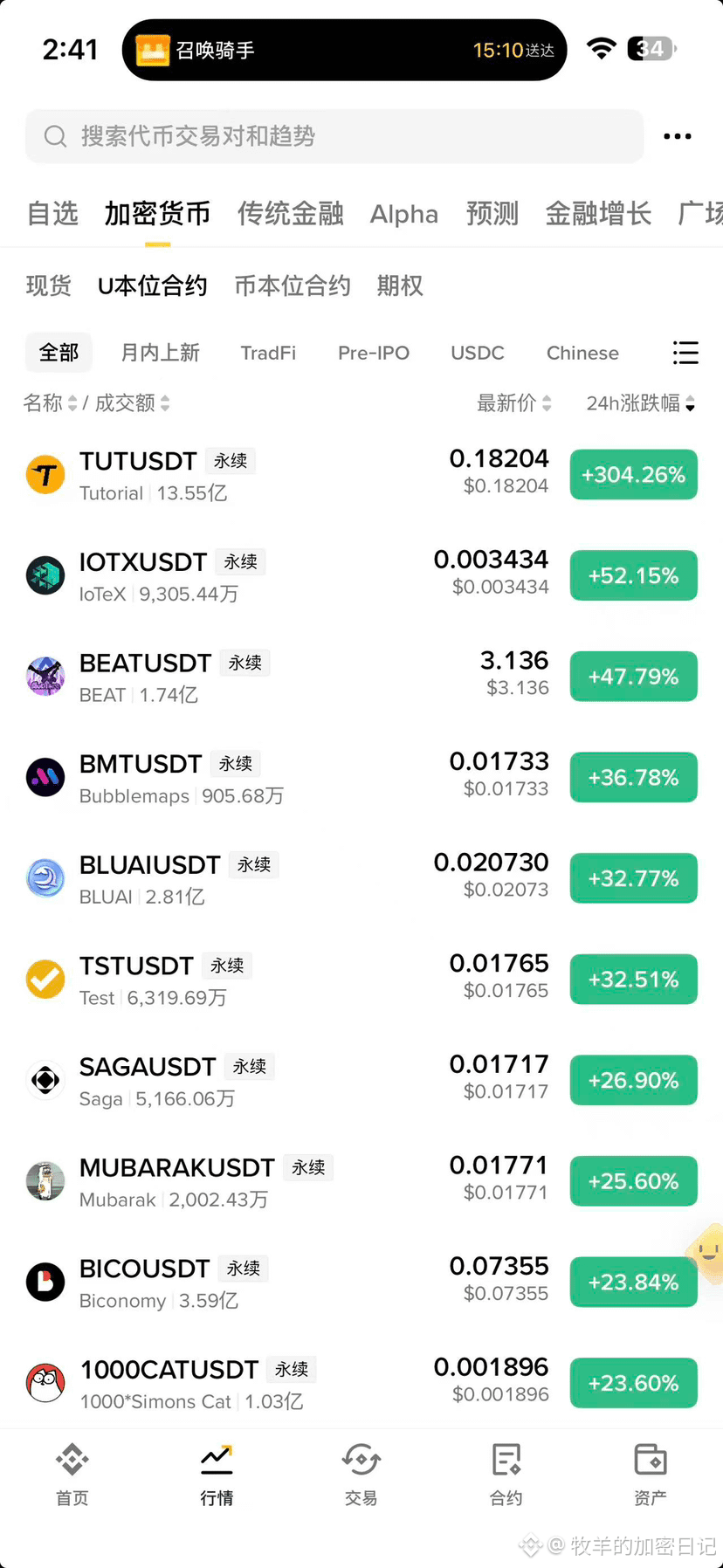
The current copycat market is more like local high-control + perpetuals counterparty orders + a blow-off行情.
A typical example is $TUT .
In 24 hours it surged by around 300%. The perpetual trading did over a billion in U, and the spot trading also did more than 100 million U.
At the moment, in the long/short account structure, most people in the market are still leaning short.
Retail accounts are mostly short, and top accounts are also mostly short.
This kind of行情 is not the traditional “everyone looks for longs together, and then it slowly goes up.”
It’s controlling liquidity and supply tightly, then using the shorts in the perpetual market as fuel.
The more the shorts refuse to accept it, the easier it is to push the price upward.
The more the price is pushed up, the more shorts end up with stop-losses and liquidations.
In the end, it turns into a very brutal round of local copycat acceleration.
So I think most people holding copycat coins shouldn’t fantasize about replaying 2021.
Change is the most important thing.
Those who still think they can just hold a pile of old copycats and break even might only be able to wait for the bull market in their dreams.
The market has changed.
What needs to be studied now is:
- Where capital is playing;
- Which coins share common traits;
- Which coins show signs of being tightly controlled;
- Which coins have perpetuals counterparty positions;
- Which coins can squeeze the shorts into fuel;
- When to rotate positions, and when it’s time to leave.
This round isn’t about a broad market sending money to everyone.
It’s a hunt—for sentiment, for inertia, and for those still living in the old version.
Those who dare to change their mindset first get to see the opportunities.
Those who dare to admit the market has changed have the资格 to enjoy the volatility of this copycat round.
Brave people get to enjoy the world first.
Of course, a reminder: for this kind of行情, it’s better to participate with small capital.
Going all-in is absolutely not the move!
First, because the up-and-down fluctuations are huge. Second, if your position size is too big, you’ll become a target in the eyes of the market makers!
Move a bit with the trend for each coin, and basically you can still bite off some meat and drink a little soup.
What’s very important is to keep an eye on the chart—if something looks wrong, withdraw immediately.
Also don’t assume you can profit from both long and short; it’s very easy to end up losing the whole game!
$MMT
#山寨币热点
May I ask, isn’t it copycat season right now?
This is absolutely a full-blown copycat rampage season.
But this round of copycat season is different from what many people imagined back in 2021.
In the past, it was like a flood—people grabbed a bunch of copycats with their eyes closed, waiting for the wind to blow.
Now, this playbook has already become a thing of the past!
The current copycat market is more like local high-control + perpetuals counterparty orders + a blow-off行情.
A typical example is $TUT .
In 24 hours it surged by around 300%. The perpetual trading did over a billion in U, and the spot trading also did more than 100 million U.
At the moment, in the long/short account structure, most people in the market are still leaning short.
Retail accounts are mostly short, and top accounts are also mostly short.
This kind of行情 is not the traditional “everyone looks for longs together, and then it slowly goes up.”
It’s controlling liquidity and supply tightly, then using the shorts in the perpetual market as fuel.
The more the shorts refuse to accept it, the easier it is to push the price upward.
The more the price is pushed up, the more shorts end up with stop-losses and liquidations.
In the end, it turns into a very brutal round of local copycat acceleration.
So I think most people holding copycat coins shouldn’t fantasize about replaying 2021.
Change is the most important thing.
Those who still think they can just hold a pile of old copycats and break even might only be able to wait for the bull market in their dreams.
The market has changed.
What needs to be studied now is:
- Where capital is playing;
- Which coins share common traits;
- Which coins show signs of being tightly controlled;
- Which coins have perpetuals counterparty positions;
- Which coins can squeeze the shorts into fuel;
- When to rotate positions, and when it’s time to leave.
This round isn’t about a broad market sending money to everyone.
It’s a hunt—for sentiment, for inertia, and for those still living in the old version.
Those who dare to change their mindset first get to see the opportunities.
Those who dare to admit the market has changed have the资格 to enjoy the volatility of this copycat round.
Brave people get to enjoy the world first.
Of course, a reminder: for this kind of行情, it’s better to participate with small capital.
Going all-in is absolutely not the move!
First, because the up-and-down fluctuations are huge. Second, if your position size is too big, you’ll become a target in the eyes of the market makers!
Move a bit with the trend for each coin, and basically you can still bite off some meat and drink a little soup.
What’s very important is to keep an eye on the chart—if something looks wrong, withdraw immediately.
Also don’t assume you can profit from both long and short; it’s very easy to end up losing the whole game!
$MMT
#山寨币热点
This is absolutely a full-blown copycat rampage season.
But this round of copycat season is different from what many people imagined back in 2021.
In the past, it was like a flood—people grabbed a bunch of copycats with their eyes closed, waiting for the wind to blow.
Now, this playbook has already become a thing of the past!
The current copycat market is more like local high-control + perpetuals counterparty orders + a blow-off行情.
A typical example is $TUT .
In 24 hours it surged by around 300%. The perpetual trading did over a billion in U, and the spot trading also did more than 100 million U.
At the moment, in the long/short account structure, most people in the market are still leaning short.
Retail accounts are mostly short, and top accounts are also mostly short.
This kind of行情 is not the traditional “everyone looks for longs together, and then it slowly goes up.”
It’s controlling liquidity and supply tightly, then using the shorts in the perpetual market as fuel.
The more the shorts refuse to accept it, the easier it is to push the price upward.
The more the price is pushed up, the more shorts end up with stop-losses and liquidations.
In the end, it turns into a very brutal round of local copycat acceleration.
So I think most people holding copycat coins shouldn’t fantasize about replaying 2021.
Change is the most important thing.
Those who still think they can just hold a pile of old copycats and break even might only be able to wait for the bull market in their dreams.
The market has changed.
What needs to be studied now is:
- Where capital is playing;
- Which coins share common traits;
- Which coins show signs of being tightly controlled;
- Which coins have perpetuals counterparty positions;
- Which coins can squeeze the shorts into fuel;
- When to rotate positions, and when it’s time to leave.
This round isn’t about a broad market sending money to everyone.
It’s a hunt—for sentiment, for inertia, and for those still living in the old version.
Those who dare to change their mindset first get to see the opportunities.
Those who dare to admit the market has changed have the资格 to enjoy the volatility of this copycat round.
Brave people get to enjoy the world first.
Of course, a reminder: for this kind of行情, it’s better to participate with small capital.
Going all-in is absolutely not the move!
First, because the up-and-down fluctuations are huge. Second, if your position size is too big, you’ll become a target in the eyes of the market makers!
Move a bit with the trend for each coin, and basically you can still bite off some meat and drink a little soup.
What’s very important is to keep an eye on the chart—if something looks wrong, withdraw immediately.
Also don’t assume you can profit from both long and short; it’s very easy to end up losing the whole game!
$MMT
#山寨币热点
1k
Log in to explore more content
Join global crypto users on Binance Square
⚡️ Get latest and useful information about crypto.
💬 Trusted by the world’s largest crypto exchange.
👍 Discover real insights from verified creators.
Email / Phone number
Trending Topics
USAugustPPIRisesLessThanExpected
35,078 views
655 Discussing
🚨 US AUG PPI: Rises LESS Than Expected! Bullish for Crypto? 🚀
PPI +0.4% MoM as expected, but CORE PPI only +0.2% vs +0.3% expected - cooling!
What it means:
• Wholesale inflation softer than feared
• Fed rate hike chance now 62% - but dovish signals coming
• Core PCE revisions expected downward - bullish
• BTC usually pumps on softer PPI
Fed meeting Sep 15-16 - Market now expects pause, not hike?
Is this the green light for Q4 rally?
#Bitcoin #PPI #Fed #CryptoNews #BTC#usaugustppiriseslessthanexpected
True News
·1 Likes
·1.3k views
SECApprovesNasdaqTexasCommodityTrustRule
20,892 views
490 Discussing
ECBRaisesRatesSecondTimeTo2.5%
17,972 views
362 Discussing