
abobka
340 Posts

abobka
Report
Block User
Crypto-influencer, amazing mom, crazy head
Open Trade

U Holder
Frequent Trader
4.8 Years
628 Following
215 Followers
792 Liked
Posts
Portfolio
·
--
I love CZ and Donald Trump, made world fuel great again💵💵💵
I love CZ and Donald Trump, made world fuel great again💵💵💵
2
60
·
--
Bullish
Holding $BNB 39.8 USDT
2029
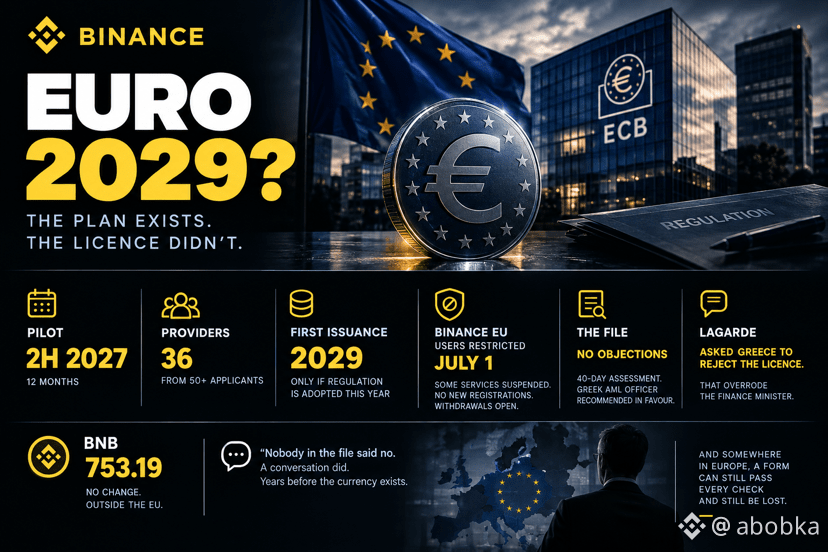
That is when the euro that helped block Binance might first exist.
The pilot hasn't started either:
🔸 starts in the second half of 2027, runs 12 months
🔸 36 payment providers picked from more than 50 who applied
🔸 first issuance aimed at 2029, and only if the Regulation is adopted this year
The exchange that already exists got its EU users trimmed back on July 1. Some services suspended, no new registrations, withdrawals left open.
How we got here, per the WSJ. Lagarde asked Greece's prime minister to reject the licence. She had signalled it back in May. That reportedly overrode the finance minister.
The stated worry is dollar stablecoins pulling further ahead in Europe while the ECB's own coin is still a slide deck.
The file itself was clean enough. A 40-day assessment, no formal objections, and the Greek regulator's own AML officer recommending in favour.
Binance's side of it: the compliance story is wrong. More than 300 million dollars a year spent on it. 1500 people doing it. The sanctions and retaliation talk, categorically false.
Make of that what you like. What I keep rereading is the mechanism. Nobody in the file said no. A conversation did, years before the currency behind it exists.
That's the part worth holding onto if you ever file anything in Europe. You can pass every check and still lose it in a room you were never in.
$BNB sits at 753.19 as if none of it happened, because outside the EU none of it did)
Anyone here actually lost access on July 1?
#InjectiveLaunchesINJOnSolana
2029
That is when the euro that helped block Binance might first exist.
The pilot hasn't started either:
🔸 starts in the second half of 2027, runs 12 months
🔸 36 payment providers picked from more than 50 who applied
🔸 first issuance aimed at 2029, and only if the Regulation is adopted this year
The exchange that already exists got its EU users trimmed back on July 1. Some services suspended, no new registrations, withdrawals left open.
How we got here, per the WSJ. Lagarde asked Greece's prime minister to reject the licence. She had signalled it back in May. That reportedly overrode the finance minister.
The stated worry is dollar stablecoins pulling further ahead in Europe while the ECB's own coin is still a slide deck.
The file itself was clean enough. A 40-day assessment, no formal objections, and the Greek regulator's own AML officer recommending in favour.
Binance's side of it: the compliance story is wrong. More than 300 million dollars a year spent on it. 1500 people doing it. The sanctions and retaliation talk, categorically false.
Make of that what you like. What I keep rereading is the mechanism. Nobody in the file said no. A conversation did, years before the currency behind it exists.
That's the part worth holding onto if you ever file anything in Europe. You can pass every check and still lose it in a room you were never in.
$BNB sits at 753.19 as if none of it happened, because outside the EU none of it did)
Anyone here actually lost access on July 1?
#InjectiveLaunchesINJOnSolana
That is when the euro that helped block Binance might first exist.
The pilot hasn't started either:
🔸 starts in the second half of 2027, runs 12 months
🔸 36 payment providers picked from more than 50 who applied
🔸 first issuance aimed at 2029, and only if the Regulation is adopted this year
The exchange that already exists got its EU users trimmed back on July 1. Some services suspended, no new registrations, withdrawals left open.
How we got here, per the WSJ. Lagarde asked Greece's prime minister to reject the licence. She had signalled it back in May. That reportedly overrode the finance minister.
The stated worry is dollar stablecoins pulling further ahead in Europe while the ECB's own coin is still a slide deck.
The file itself was clean enough. A 40-day assessment, no formal objections, and the Greek regulator's own AML officer recommending in favour.
Binance's side of it: the compliance story is wrong. More than 300 million dollars a year spent on it. 1500 people doing it. The sanctions and retaliation talk, categorically false.
Make of that what you like. What I keep rereading is the mechanism. Nobody in the file said no. A conversation did, years before the currency behind it exists.
That's the part worth holding onto if you ever file anything in Europe. You can pass every check and still lose it in a room you were never in.
$BNB sits at 753.19 as if none of it happened, because outside the EU none of it did)
Anyone here actually lost access on July 1?
#InjectiveLaunchesINJOnSolana
1
6
16
·
--
Bearish
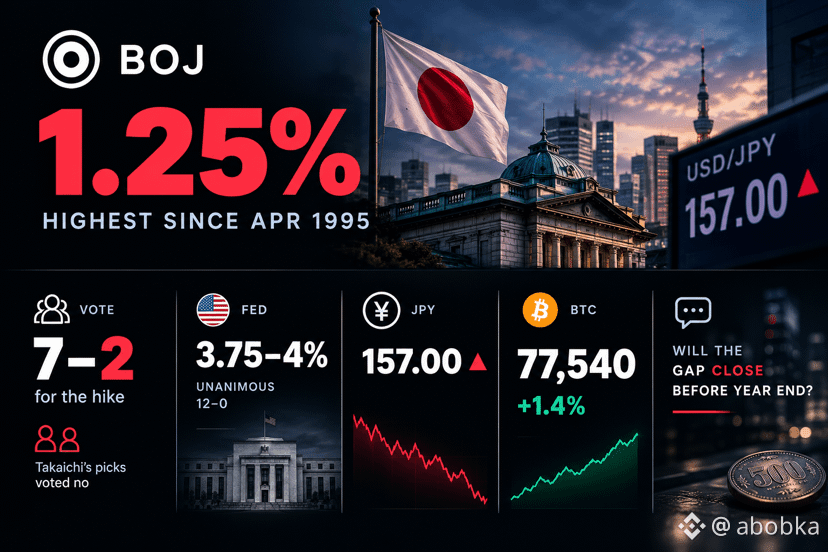
🔸 BoJ 1.25%, highest since April 1995
and the yen still slid to about 157 per dollar)
The vote, not the rate:
🔸 7-2 for the hike
🔸 against: Toichiro Asada and Ayano Sato
🔸 both appointed under Takaichi
Two of the prime minister's own picks voted no, and that is what the market traded.
Carol Kong at Commonwealth Bank put it straight: those dissents triggered a sell-off in the JPY.
Attrill at NAB: they couldn't even get a unanimous vote, and 160 is on his map now.
So the carry trade didn't die today. It got marginally safer to hold, which is the opposite of what the headline promises:
🔸 Japan 1.25%
🔸 the Fed 3.75-4%, unanimous 12-0 on 16 September
🔸 16 of 18 there expect another hike this year
The gap widens from the American side faster than Japan closes it.
$BTC at 77,540, up 1.4% on the day, is that same trade breathing out. I don't read that as strength, it's funding cost doing the work.
The BOJ says it hikes again if its outlook holds. Two of them already said not yet)
What's your read, does that gap close before year end?
{future}(BTCUSDT)
#BOJHikesRatesTo31YearHigh
🔸 BoJ 1.25%, highest since April 1995
and the yen still slid to about 157 per dollar)
The vote, not the rate:
🔸 7-2 for the hike
🔸 against: Toichiro Asada and Ayano Sato
🔸 both appointed under Takaichi
Two of the prime minister's own picks voted no, and that is what the market traded.
Carol Kong at Commonwealth Bank put it straight: those dissents triggered a sell-off in the JPY.
Attrill at NAB: they couldn't even get a unanimous vote, and 160 is on his map now.
So the carry trade didn't die today. It got marginally safer to hold, which is the opposite of what the headline promises:
🔸 Japan 1.25%
🔸 the Fed 3.75-4%, unanimous 12-0 on 16 September
🔸 16 of 18 there expect another hike this year
The gap widens from the American side faster than Japan closes it.
$BTC at 77,540, up 1.4% on the day, is that same trade breathing out. I don't read that as strength, it's funding cost doing the work.
The BOJ says it hikes again if its outlook holds. Two of them already said not yet)
What's your read, does that gap close before year end?
#BOJHikesRatesTo31YearHigh
and the yen still slid to about 157 per dollar)
The vote, not the rate:
🔸 7-2 for the hike
🔸 against: Toichiro Asada and Ayano Sato
🔸 both appointed under Takaichi
Two of the prime minister's own picks voted no, and that is what the market traded.
Carol Kong at Commonwealth Bank put it straight: those dissents triggered a sell-off in the JPY.
Attrill at NAB: they couldn't even get a unanimous vote, and 160 is on his map now.
So the carry trade didn't die today. It got marginally safer to hold, which is the opposite of what the headline promises:
🔸 Japan 1.25%
🔸 the Fed 3.75-4%, unanimous 12-0 on 16 September
🔸 16 of 18 there expect another hike this year
The gap widens from the American side faster than Japan closes it.
$BTC at 77,540, up 1.4% on the day, is that same trade breathing out. I don't read that as strength, it's funding cost doing the work.
The BOJ says it hikes again if its outlook holds. Two of them already said not yet)
What's your read, does that gap close before year end?
#BOJHikesRatesTo31YearHigh
1
6
131
·
--
Bullish
🔸 S&P Global buys the auditor
The company that audits the code S&P wants to rate. Signed today, price not disclosed, which usually means the number was big enough to be awkward)
What OpenZeppelin is, for anyone who knows the name only as an import line:
🔸 more than 37 trillion dollars has moved through their Contracts library
🔸 900+ security engagements
🔸 10,000+ vulnerabilities found before anything hit production
The library itself is fine:
open source, permanently
every released version stays up and nobody can withdraw it
Brener stays CEO, audits keep running
the whole thing just reports into S&P Global Ratings now
The conflict:
the group that wants to grade your contract risk now owns the shop that finds it. Le Pallec at S&P Ratings says the plan out loud, that OpenZeppelin complements their onchain risk assessment. No mystery about it.
Audits don't get worse overnight. The customer changed, though. An audit is something a protocol buys for itself and publishes. A grade gets sold to the institution on the other side, and that buyer wants one letter, not a list.
That's the direction for everything settling on $ETH rails: tokenized funds, stablecoins, treasury desks. Someone was always going to price smart contract risk. Turns out it's the credit guys, and they bought the toolmaker instead of building one.
Smart buy on their side, honestly. Just read the audit and the grade as two documents, because from today they share a parent.
Would you take an S&P grade over the audit itself?
#snp500 #S&P500
🔸 S&P Global buys the auditor
The company that audits the code S&P wants to rate. Signed today, price not disclosed, which usually means the number was big enough to be awkward)
What OpenZeppelin is, for anyone who knows the name only as an import line:
🔸 more than 37 trillion dollars has moved through their Contracts library
🔸 900+ security engagements
🔸 10,000+ vulnerabilities found before anything hit production
The library itself is fine:
open source, permanently
every released version stays up and nobody can withdraw it
Brener stays CEO, audits keep running
the whole thing just reports into S&P Global Ratings now
The conflict:
the group that wants to grade your contract risk now owns the shop that finds it. Le Pallec at S&P Ratings says the plan out loud, that OpenZeppelin complements their onchain risk assessment. No mystery about it.
Audits don't get worse overnight. The customer changed, though. An audit is something a protocol buys for itself and publishes. A grade gets sold to the institution on the other side, and that buyer wants one letter, not a list.
That's the direction for everything settling on $ETH rails: tokenized funds, stablecoins, treasury desks. Someone was always going to price smart contract risk. Turns out it's the credit guys, and they bought the toolmaker instead of building one.
Smart buy on their side, honestly. Just read the audit and the grade as two documents, because from today they share a parent.
Would you take an S&P grade over the audit itself?
#snp500 #S&P500
The company that audits the code S&P wants to rate. Signed today, price not disclosed, which usually means the number was big enough to be awkward)
What OpenZeppelin is, for anyone who knows the name only as an import line:
🔸 more than 37 trillion dollars has moved through their Contracts library
🔸 900+ security engagements
🔸 10,000+ vulnerabilities found before anything hit production
The library itself is fine:
open source, permanently
every released version stays up and nobody can withdraw it
Brener stays CEO, audits keep running
the whole thing just reports into S&P Global Ratings now
The conflict:
the group that wants to grade your contract risk now owns the shop that finds it. Le Pallec at S&P Ratings says the plan out loud, that OpenZeppelin complements their onchain risk assessment. No mystery about it.
Audits don't get worse overnight. The customer changed, though. An audit is something a protocol buys for itself and publishes. A grade gets sold to the institution on the other side, and that buyer wants one letter, not a list.
That's the direction for everything settling on $ETH rails: tokenized funds, stablecoins, treasury desks. Someone was always going to price smart contract risk. Turns out it's the credit guys, and they bought the toolmaker instead of building one.
Smart buy on their side, honestly. Just read the audit and the grade as two documents, because from today they share a parent.
Would you take an S&P grade over the audit itself?
#snp500 #S&P500

10
69
·
--
Bullish
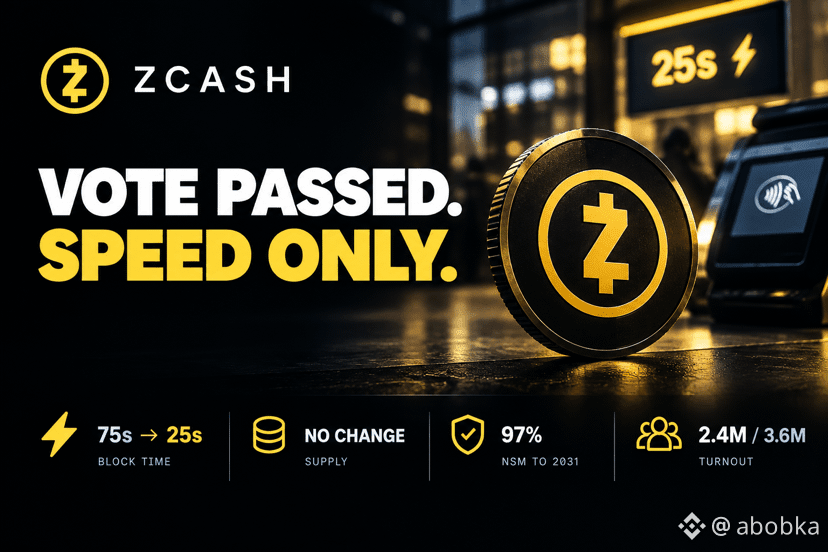
$ZEC is up 132% in a month and the vote everyone is citing changes the supply by zero coins.
The ballot, plainly:
🔸 block time 75 seconds to 25 seconds, backed by 99.9% of voting ZEC
🔸 halving schedule kept, 98.9%
🔸 issuance per block drops so daily emission stays the same
🔸 Network Sustainability Mechanism reissuance pushed to February 2031, 97% in favour
Three of those four are holders saying "leave the money rules alone". The single change is speed, and speed is a usability fix, not a scarcity event.
Good news. Just not the news being priced. A shielded payment that confirms in 25 seconds can sit behind a terminal. One that takes 75 cannot.
Turnout was about 2.4 million ZEC out of roughly 3.6 million eligible, so this is a real mandate rather than a handful of whales in a forum thread.
And there's still no activation date. Anything not implemented by 30 September drops out of the upgrade.
Watch what ships)
What are you actually holding $ZEC for, the privacy or the month it's having?
#ParadigmDisclosesZECHolding
$ZEC is up 132% in a month and the vote everyone is citing changes the supply by zero coins.
The ballot, plainly:
🔸 block time 75 seconds to 25 seconds, backed by 99.9% of voting ZEC
🔸 halving schedule kept, 98.9%
🔸 issuance per block drops so daily emission stays the same
🔸 Network Sustainability Mechanism reissuance pushed to February 2031, 97% in favour
Three of those four are holders saying "leave the money rules alone". The single change is speed, and speed is a usability fix, not a scarcity event.
Good news. Just not the news being priced. A shielded payment that confirms in 25 seconds can sit behind a terminal. One that takes 75 cannot.
Turnout was about 2.4 million ZEC out of roughly 3.6 million eligible, so this is a real mandate rather than a handful of whales in a forum thread.
And there's still no activation date. Anything not implemented by 30 September drops out of the upgrade.
Watch what ships)
What are you actually holding $ZEC for, the privacy or the month it's having?
#ParadigmDisclosesZECHolding
The ballot, plainly:
🔸 block time 75 seconds to 25 seconds, backed by 99.9% of voting ZEC
🔸 halving schedule kept, 98.9%
🔸 issuance per block drops so daily emission stays the same
🔸 Network Sustainability Mechanism reissuance pushed to February 2031, 97% in favour
Three of those four are holders saying "leave the money rules alone". The single change is speed, and speed is a usability fix, not a scarcity event.
Good news. Just not the news being priced. A shielded payment that confirms in 25 seconds can sit behind a terminal. One that takes 75 cannot.
Turnout was about 2.4 million ZEC out of roughly 3.6 million eligible, so this is a real mandate rather than a handful of whales in a forum thread.
And there's still no activation date. Anything not implemented by 30 September drops out of the upgrade.
Watch what ships)
What are you actually holding $ZEC for, the privacy or the month it's having?
#ParadigmDisclosesZECHolding
1
11
435
·
--
Hey, whats real chance to get into the top 100, should i try it or stay away, sir?
Hey, whats real chance to get into the top 100, should i try it or stay away, sir?
10
90
·
--
Verified
up to $5 million in Coinbase stock is a range. $1 million to $5 million, as of December 31, 2025
that's all the form gives. no share count, nothing on 2026
Hassett sat on Coinbase's advisory council until January 2025
the SEC dropped its Coinbase case in February 2025
Hassett told CNBC about staying out of crypto matters after checking with ethics officials
people want the form to say conflict or no conflict. it can't, it's a box with a range in it
i don't hold $COINB. just reading the paperwork)
#Coinbase
up to $5 million in Coinbase stock is a range. $1 million to $5 million, as of December 31, 2025
that's all the form gives. no share count, nothing on 2026
Hassett sat on Coinbase's advisory council until January 2025
the SEC dropped its Coinbase case in February 2025
Hassett told CNBC about staying out of crypto matters after checking with ethics officials
people want the form to say conflict or no conflict. it can't, it's a box with a range in it
i don't hold $COINB . just reading the paperwork)
#Coinbase
that's all the form gives. no share count, nothing on 2026
Hassett sat on Coinbase's advisory council until January 2025
the SEC dropped its Coinbase case in February 2025
Hassett told CNBC about staying out of crypto matters after checking with ethics officials
people want the form to say conflict or no conflict. it can't, it's a box with a range in it
i don't hold $COINB . just reading the paperwork)
#Coinbase
2
17
29
·
--
bank stablecoin, the fine print:
- 21 institutions, first half of 2027
- issuer can't pay yield, GENIUS Act
- launch depends on the entity getting formed
- yield idea from a DeFi chain CEO: take the dollar somewhere the issuer doesn't control
same CEO, next quote: "the loss generally sits with the depositor"
a bank dollar stops being a bank dollar the second you make it earn. contracts, oracles, liquidity, all on you
i'll keep mine boring. anyway)
#Stablecoins
bank stablecoin, the fine print:
- 21 institutions, first half of 2027
- issuer can't pay yield, GENIUS Act
- launch depends on the entity getting formed
- yield idea from a DeFi chain CEO: take the dollar somewhere the issuer doesn't control
same CEO, next quote: "the loss generally sits with the depositor"
a bank dollar stops being a bank dollar the second you make it earn. contracts, oracles, liquidity, all on you
i'll keep mine boring. anyway)
#Stablecoins
- 21 institutions, first half of 2027
- issuer can't pay yield, GENIUS Act
- launch depends on the entity getting formed
- yield idea from a DeFi chain CEO: take the dollar somewhere the issuer doesn't control
same CEO, next quote: "the loss generally sits with the depositor"
a bank dollar stops being a bank dollar the second you make it earn. contracts, oracles, liquidity, all on you
i'll keep mine boring. anyway)
#Stablecoins
14
14
·
--
"$151 million crypto VC week"
$100 million of it is one company: Nasdaq agreeing to put money into Kraken's parent. agreeing, which isn't the same word as paid
the rest:
- Latitude $35 million, stablecoin payments
- $7 million, $6 million, $3 million for everyone else
so i read this week as Nasdaq buying tokenized stock plumbing, tokens planned for Q2 2027
and a tokenized stock is still a claim on whoever holds the actual share
anyway, the small rounds are the real venture market right now. it's quiet)
#VentureCapital
"$151 million crypto VC week"
$100 million of it is one company: Nasdaq agreeing to put money into Kraken's parent. agreeing, which isn't the same word as paid
the rest:
- Latitude $35 million, stablecoin payments
- $7 million, $6 million, $3 million for everyone else
so i read this week as Nasdaq buying tokenized stock plumbing, tokens planned for Q2 2027
and a tokenized stock is still a claim on whoever holds the actual share
anyway, the small rounds are the real venture market right now. it's quiet)
#VentureCapital
$100 million of it is one company: Nasdaq agreeing to put money into Kraken's parent. agreeing, which isn't the same word as paid
the rest:
- Latitude $35 million, stablecoin payments
- $7 million, $6 million, $3 million for everyone else
so i read this week as Nasdaq buying tokenized stock plumbing, tokens planned for Q2 2027
and a tokenized stock is still a claim on whoever holds the actual share
anyway, the small rounds are the real venture market right now. it's quiet)
#VentureCapital
11
11
·
--
Bitcoin Suisse, founded 2013, now cutting:
- up to 60 of 120 Swiss roles
- Copenhagen dev office, closing
- a new hub in Vietnam
- Bratislava kept
- consultation until September 20
company calls it "strategy, not survival" and says it's not about bitcoin's price or any distress
sending dev and back-office work to cheaper hubs is cost cutting, whatever the memo calls it. only one side of this story is talking so far
follow if you want the September 20 outcome, i'll be refreshing their press page like it's a chart)
#Layoffs
Bitcoin Suisse, founded 2013, now cutting:
- up to 60 of 120 Swiss roles
- Copenhagen dev office, closing
- a new hub in Vietnam
- Bratislava kept
- consultation until September 20
company calls it "strategy, not survival" and says it's not about bitcoin's price or any distress
sending dev and back-office work to cheaper hubs is cost cutting, whatever the memo calls it. only one side of this story is talking so far
follow if you want the September 20 outcome, i'll be refreshing their press page like it's a chart)
#Layoffs
- up to 60 of 120 Swiss roles
- Copenhagen dev office, closing
- a new hub in Vietnam
- Bratislava kept
- consultation until September 20
company calls it "strategy, not survival" and says it's not about bitcoin's price or any distress
sending dev and back-office work to cheaper hubs is cost cutting, whatever the memo calls it. only one side of this story is talking so far
follow if you want the September 20 outcome, i'll be refreshing their press page like it's a chart)
#Layoffs
6
6
·
--
the SEC's tokenized stock plan is about the register
transfer agents could keep official records on a blockchain. 60-day comment period. first real rewrite of those rules since the late 1970s and early 1980s
what it doesn't do: turn an offshore stock token into a share. no votes, no dividends automatically. most of those tokens are still claims on an intermediary
even the analyst quoted on it says the difference is how ownership gets recorded
then i scroll down and the same piece plugs Bitget's $1.16 billion in token volume. sure)
#TokenizedStocks
the SEC's tokenized stock plan is about the register
transfer agents could keep official records on a blockchain. 60-day comment period. first real rewrite of those rules since the late 1970s and early 1980s
what it doesn't do: turn an offshore stock token into a share. no votes, no dividends automatically. most of those tokens are still claims on an intermediary
even the analyst quoted on it says the difference is how ownership gets recorded
then i scroll down and the same piece plugs Bitget's $1.16 billion in token volume. sure)
#TokenizedStocks
transfer agents could keep official records on a blockchain. 60-day comment period. first real rewrite of those rules since the late 1970s and early 1980s
what it doesn't do: turn an offshore stock token into a share. no votes, no dividends automatically. most of those tokens are still claims on an intermediary
even the analyst quoted on it says the difference is how ownership gets recorded
then i scroll down and the same piece plugs Bitget's $1.16 billion in token volume. sure)
#TokenizedStocks
4
4
·
--
NFT weekly report, two numbers from the same outlet
a week ago: $75.54 million in seven days
this week: $46.78 million, called "up 6.8%"
that only works if the base week got rewritten, and i can't find that mentioned anywhere
under it:
- buyer addresses fell 84.67%
- transactions rose 48.75%
- one BRC-20 collection, $2.90 million, nine transactions, seven buyers
fewer buyers, more transactions. that's churn
none of this moves $BTC and i'm not pretending it does. screenshotting both reports for next week)
#NFT
NFT weekly report, two numbers from the same outlet
a week ago: $75.54 million in seven days
this week: $46.78 million, called "up 6.8%"
that only works if the base week got rewritten, and i can't find that mentioned anywhere
under it:
- buyer addresses fell 84.67%
- transactions rose 48.75%
- one BRC-20 collection, $2.90 million, nine transactions, seven buyers
fewer buyers, more transactions. that's churn
none of this moves $BTC and i'm not pretending it does. screenshotting both reports for next week)
#NFT
a week ago: $75.54 million in seven days
this week: $46.78 million, called "up 6.8%"
that only works if the base week got rewritten, and i can't find that mentioned anywhere
under it:
- buyer addresses fell 84.67%
- transactions rose 48.75%
- one BRC-20 collection, $2.90 million, nine transactions, seven buyers
fewer buyers, more transactions. that's churn
none of this moves $BTC and i'm not pretending it does. screenshotting both reports for next week)
#NFT
3
13
·
--
"restrained" $52 million isn't seized $52 million
seized: two wallets, about $12 million. the rest is restraint sought on 47 more wallets
Xinbi moved at least $21 billion by April 2026
next to that, this is a rounding error
the freeze button is the story. USDT can be stopped, that's why this worked
and Xinbi had already shifted about $2.8 million into USDD, which can't be frozen
i keep part of my stables in USDT. same button works on me. fine with that, mostly)
#Tether
"restrained" $52 million isn't seized $52 million
seized: two wallets, about $12 million. the rest is restraint sought on 47 more wallets
Xinbi moved at least $21 billion by April 2026
next to that, this is a rounding error
the freeze button is the story. USDT can be stopped, that's why this worked
and Xinbi had already shifted about $2.8 million into USDD, which can't be frozen
i keep part of my stables in USDT. same button works on me. fine with that, mostly)
#Tether
seized: two wallets, about $12 million. the rest is restraint sought on 47 more wallets
Xinbi moved at least $21 billion by April 2026
next to that, this is a rounding error
the freeze button is the story. USDT can be stopped, that's why this worked
and Xinbi had already shifted about $2.8 million into USDD, which can't be frozen
i keep part of my stables in USDT. same button works on me. fine with that, mostly)
#Tether
3
3
·
--
Robinhood's August:
equities $335.4 billion
crypto $17.5 billion
event contracts, 4.7 billion of them (count, not dollars)
crypto's the side dish. the "up 61%" starts from July's $10.9 billion. against last August's $28.1 billion it's down 38%
the retail app is the weak part, down 46% on the year. the exchange arm, down 30%
event contracts are roughly 15 times last year and down 23% from July, so even the hot product cooled off this month
no $HOODB for me. a 61% i'd have to squint at)
#Robinhood
Robinhood's August:
equities $335.4 billion
crypto $17.5 billion
event contracts, 4.7 billion of them (count, not dollars)
crypto's the side dish. the "up 61%" starts from July's $10.9 billion. against last August's $28.1 billion it's down 38%
the retail app is the weak part, down 46% on the year. the exchange arm, down 30%
event contracts are roughly 15 times last year and down 23% from July, so even the hot product cooled off this month
no $HOODB for me. a 61% i'd have to squint at)
#Robinhood
equities $335.4 billion
crypto $17.5 billion
event contracts, 4.7 billion of them (count, not dollars)
crypto's the side dish. the "up 61%" starts from July's $10.9 billion. against last August's $28.1 billion it's down 38%
the retail app is the weak part, down 46% on the year. the exchange arm, down 30%
event contracts are roughly 15 times last year and down 23% from July, so even the hot product cooled off this month
no $HOODB for me. a 61% i'd have to squint at)
#Robinhood
3
19
·
--
four words from toly and the feed wrote a whole thriller
"Profitability at $1t mcap"
no company named, no math. the labs are private, there's no mcap to be profitable at
the essay toly poked at wants AI to improve slower. it doesn't ask to stop research. Altman only backed the evaluators part. Musk: "Dario is right"
none of it touches $SOL. follow if you like watching someone refuse to pick a side on a sarcastic post. i'm staying out of this one)
#AI
four words from toly and the feed wrote a whole thriller
"Profitability at $1t mcap"
no company named, no math. the labs are private, there's no mcap to be profitable at
the essay toly poked at wants AI to improve slower. it doesn't ask to stop research. Altman only backed the evaluators part. Musk: "Dario is right"
none of it touches $SOL . follow if you like watching someone refuse to pick a side on a sarcastic post. i'm staying out of this one)
#AI
"Profitability at $1t mcap"
no company named, no math. the labs are private, there's no mcap to be profitable at
the essay toly poked at wants AI to improve slower. it doesn't ask to stop research. Altman only backed the evaluators part. Musk: "Dario is right"
none of it touches $SOL . follow if you like watching someone refuse to pick a side on a sarcastic post. i'm staying out of this one)
#AI
3
3
·
--
Singapore laundering case, the numbers:
- S$3 billion total
- first two auctions: bags and jewellery, S$2.9 million to S$3.9 million (crumbs next to the total)
- a 15.02-carat yellow diamond ring in there, S$200,000 to S$300,000
the crypto part, from court records:
- December 2020, 499,980 USDT sold for S$657,980
- with help from a former Citibank relationship manager
- Wang Qiming 24 months, Su Baolin 14 months
people love blaming crypto rails for this stuff. i'd say the stablecoin was the easy part, cashing out needed a banker
anyway. somebody's buying that ring
#AML
Singapore laundering case, the numbers:
- S$3 billion total
- first two auctions: bags and jewellery, S$2.9 million to S$3.9 million (crumbs next to the total)
- a 15.02-carat yellow diamond ring in there, S$200,000 to S$300,000
the crypto part, from court records:
- December 2020, 499,980 USDT sold for S$657,980
- with help from a former Citibank relationship manager
- Wang Qiming 24 months, Su Baolin 14 months
people love blaming crypto rails for this stuff. i'd say the stablecoin was the easy part, cashing out needed a banker
anyway. somebody's buying that ring
#AML
- S$3 billion total
- first two auctions: bags and jewellery, S$2.9 million to S$3.9 million (crumbs next to the total)
- a 15.02-carat yellow diamond ring in there, S$200,000 to S$300,000
the crypto part, from court records:
- December 2020, 499,980 USDT sold for S$657,980
- with help from a former Citibank relationship manager
- Wang Qiming 24 months, Su Baolin 14 months
people love blaming crypto rails for this stuff. i'd say the stablecoin was the easy part, cashing out needed a banker
anyway. somebody's buying that ring
#AML
1
6
·
--
Uniswap, 30 days, what sits under the headline:
- v4 close to $38 billion
- v3 roughly $32 billion
- v2 more than $1.2 billion
- protocol revenue about $325,000 a day, up from about $114,000 before Proposal 100
so yes, more than $70 billion. and $UNI is -8.9% on the week
a token holder lives on the last line of that list
"more than the next three DEXs combined", no names given. Raydium and PancakeSwap both beat it at points in 2025
i don't hold UNI, just reading the list)
#DeFi
Uniswap, 30 days, what sits under the headline:
- v4 close to $38 billion
- v3 roughly $32 billion
- v2 more than $1.2 billion
- protocol revenue about $325,000 a day, up from about $114,000 before Proposal 100
so yes, more than $70 billion. and $UNI is -8.9% on the week
a token holder lives on the last line of that list
"more than the next three DEXs combined", no names given. Raydium and PancakeSwap both beat it at points in 2025
i don't hold UNI, just reading the list)
#DeFi
- v4 close to $38 billion
- v3 roughly $32 billion
- v2 more than $1.2 billion
- protocol revenue about $325,000 a day, up from about $114,000 before Proposal 100
so yes, more than $70 billion. and $UNI is -8.9% on the week
a token holder lives on the last line of that list
"more than the next three DEXs combined", no names given. Raydium and PancakeSwap both beat it at points in 2025
i don't hold UNI, just reading the list)
#DeFi
2
15
·
--
$100 million in tokenized stocks on Base in one day. record
earlier i posted that 97% of tokenized equity trading happens on Solana. both count trades. neither tells me who holds these
missing from the Base figure:
- wallet counts
- trade sizes
- per-token volume
what's there: $730.9 million over 30 days, $557.1 million of it on Aerodrome. 76% on one DEX
one of the tokens tracks SpaceX, which isn't public
follow if you want me to keep not knowing, loudly. no $COINB, no stock tokens on my side)
#TokenizedStocks
$100 million in tokenized stocks on Base in one day. record
earlier i posted that 97% of tokenized equity trading happens on Solana. both count trades. neither tells me who holds these
missing from the Base figure:
- wallet counts
- trade sizes
- per-token volume
what's there: $730.9 million over 30 days, $557.1 million of it on Aerodrome. 76% on one DEX
one of the tokens tracks SpaceX, which isn't public
follow if you want me to keep not knowing, loudly. no $COINB , no stock tokens on my side)
#TokenizedStocks
earlier i posted that 97% of tokenized equity trading happens on Solana. both count trades. neither tells me who holds these
missing from the Base figure:
- wallet counts
- trade sizes
- per-token volume
what's there: $730.9 million over 30 days, $557.1 million of it on Aerodrome. 76% on one DEX
one of the tokens tracks SpaceX, which isn't public
follow if you want me to keep not knowing, loudly. no $COINB , no stock tokens on my side)
#TokenizedStocks
2
6
·
--
UK crypto licensing, what i actually read as a BNB holder
Binance's FCA bid was reported in August. no filing confirmed by Binance
the deadlines:
- apply Sep. 30, 2026 to Feb. 28, 2027
- new regime expected Oct. 25, 2027
- old registrations don't carry over
- miss it and you may have to stop until approved
- apply on time, still no guarantee
the "opens the market" line is from a CEO's letter to the FT. the FCA wrote deadlines
$BNB is -2.1% on the day anyway. i'll care when there's a filing
#FCA
UK crypto licensing, what i actually read as a BNB holder
Binance's FCA bid was reported in August. no filing confirmed by Binance
the deadlines:
- apply Sep. 30, 2026 to Feb. 28, 2027
- new regime expected Oct. 25, 2027
- old registrations don't carry over
- miss it and you may have to stop until approved
- apply on time, still no guarantee
the "opens the market" line is from a CEO's letter to the FT. the FCA wrote deadlines
$BNB is -2.1% on the day anyway. i'll care when there's a filing
#FCA
Binance's FCA bid was reported in August. no filing confirmed by Binance
the deadlines:
- apply Sep. 30, 2026 to Feb. 28, 2027
- new regime expected Oct. 25, 2027
- old registrations don't carry over
- miss it and you may have to stop until approved
- apply on time, still no guarantee
the "opens the market" line is from a CEO's letter to the FT. the FCA wrote deadlines
$BNB is -2.1% on the day anyway. i'll care when there's a filing
#FCA
2
9
Log in to explore more content
Join global crypto users on Binance Square
⚡️ Get latest and useful information about crypto.
💬 Trusted by the world’s largest crypto exchange.
👍 Discover real insights from verified creators.
Email / Phone number
Trending Topics
BTCBreaks80K
15,439 views
507 Discussing
🚨 BITCOIN $80K IS BACK IN FOCUS! 🔥
BTC is pushing toward the $80,000 psychological resistance after reclaiming the $78K zone. A clean breakout and hold above $80K could bring $82K–$85K into focus next. 📈
But traders need to watch the rejection zone carefully — losing $77K–$78K could trigger another pullback.
🎯 Key levels:
• 🔥 Breakout: $80K
• 🚀 Next zone: $82K–$85K
• ⚠️ Support: $77K–$78K
$80K isn’t just a number — it’s the level bulls need to conquer.
Are we about to see the next BTC breakout? 👇
#bitcoin #BTC #BinanceSquare #btcbreaks80k
$BTC
ASHFAQ NAEEM
·3 Likes
·4.1k views
比特币突破8万
24,414 views
78 Discussing
BuffettBecomesBerkshireChairmanEmeritus
571 views
96 Discussing