
币反佣
737 Posts

币反佣
Report
Block User
微信公众号是:安叔谈币 每周固定结算|明细随时可查可核|不聊暴富,只帮你把交易成本降下来。
8.6K+ Following
2.6K+ Followers
771 Liked
Posts
All
Quotes
Videos
·
--
For every buyer, there has to be a seller. So why can the contract data show different "taker buy volume" and "taker sell volume"?
Because every trade has both a buyer and a seller. But when measuring taker direction, we only look at who takes orders already resting in the order book.
Here’s a hypothetical example. The same contract has only two trades during the same period.
In the first trade, someone places an order to sell 3 contracts, and a buyer immediately buys them. Those 3 contracts count as taker buys.
In the second trade, someone places an order to buy 2 contracts, and a seller immediately sells to them. Those 2 contracts count as taker sells.
Across both trades, the buyer bought 5 contracts in total, and the seller also sold 5. But broken down by taker direction, buyers took 3 contracts, while sellers took 2.
So next time you see "taker buy volume is higher," you can read it as "buyers took more orders during this period." This metric alone can't tell you whether the price will rise or fall in the next period.
#合约数据 #主动买入量
For every buyer, there has to be a seller. So why can the contract data show different "taker buy volume" and "taker sell volume"?
Because every trade has both a buyer and a seller. But when measuring taker direction, we only look at who takes orders already resting in the order book.
Here’s a hypothetical example. The same contract has only two trades during the same period.
In the first trade, someone places an order to sell 3 contracts, and a buyer immediately buys them. Those 3 contracts count as taker buys.
In the second trade, someone places an order to buy 2 contracts, and a seller immediately sells to them. Those 2 contracts count as taker sells.
Across both trades, the buyer bought 5 contracts in total, and the seller also sold 5. But broken down by taker direction, buyers took 3 contracts, while sellers took 2.
So next time you see "taker buy volume is higher," you can read it as "buyers took more orders during this period." This metric alone can't tell you whether the price will rise or fall in the next period.
#合约数据 #主动买入量
Because every trade has both a buyer and a seller. But when measuring taker direction, we only look at who takes orders already resting in the order book.
Here’s a hypothetical example. The same contract has only two trades during the same period.
In the first trade, someone places an order to sell 3 contracts, and a buyer immediately buys them. Those 3 contracts count as taker buys.
In the second trade, someone places an order to buy 2 contracts, and a seller immediately sells to them. Those 2 contracts count as taker sells.
Across both trades, the buyer bought 5 contracts in total, and the seller also sold 5. But broken down by taker direction, buyers took 3 contracts, while sellers took 2.
So next time you see "taker buy volume is higher," you can read it as "buyers took more orders during this period." This metric alone can't tell you whether the price will rise or fall in the next period.
#合约数据 #主动买入量
125


·
--
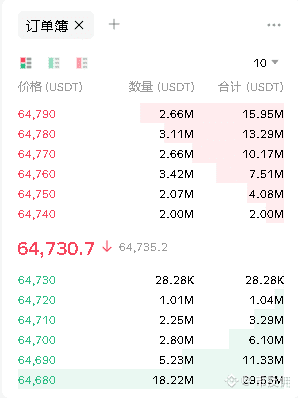
Before placing the order, I saw the best ask price was 100 USDT. After buying, why did the average execution price turn into 100.8?
Here’s a simulated example. The lowest ask price for both coins is 100 USDT, and you place a market order to buy 10 of each. Assume the order book does not change during execution, and fees are calculated separately.
For the first coin, there are enough sell orders at the 100 USDT level, so all 10 are filled at 100, costing 1,000 USDT in total.
For the second coin, there are only 2 available at the 100 USDT level. After buying those 2, the remaining 8 have to move to the next level and are filled at 101. The total cost is 1,008 USDT, and the average execution price is 100.8 USDT.
If you had estimated based on the best ask price, then the extra 8 USDT is the slippage cost of this order.
So when looking at the order book, besides checking how much the cheapest sell level is, also see how much you can buy at that level. If that level is not enough, the prices at the following levels will also be included in your average execution price.$BTC $ETH
{spot}(ETHUSDT)
{spot}(BTCUSDT)
#滑点 #交易成本 #订单簿
Before placing the order, I saw the best ask price was 100 USDT. After buying, why did the average execution price turn into 100.8?
Here’s a simulated example. The lowest ask price for both coins is 100 USDT, and you place a market order to buy 10 of each. Assume the order book does not change during execution, and fees are calculated separately.
For the first coin, there are enough sell orders at the 100 USDT level, so all 10 are filled at 100, costing 1,000 USDT in total.
For the second coin, there are only 2 available at the 100 USDT level. After buying those 2, the remaining 8 have to move to the next level and are filled at 101. The total cost is 1,008 USDT, and the average execution price is 100.8 USDT.
If you had estimated based on the best ask price, then the extra 8 USDT is the slippage cost of this order.
So when looking at the order book, besides checking how much the cheapest sell level is, also see how much you can buy at that level. If that level is not enough, the prices at the following levels will also be included in your average execution price.$BTC $ETH
#滑点 #交易成本 #订单簿
Here’s a simulated example. The lowest ask price for both coins is 100 USDT, and you place a market order to buy 10 of each. Assume the order book does not change during execution, and fees are calculated separately.
For the first coin, there are enough sell orders at the 100 USDT level, so all 10 are filled at 100, costing 1,000 USDT in total.
For the second coin, there are only 2 available at the 100 USDT level. After buying those 2, the remaining 8 have to move to the next level and are filled at 101. The total cost is 1,008 USDT, and the average execution price is 100.8 USDT.
If you had estimated based on the best ask price, then the extra 8 USDT is the slippage cost of this order.
So when looking at the order book, besides checking how much the cheapest sell level is, also see how much you can buy at that level. If that level is not enough, the prices at the following levels will also be included in your average execution price.$BTC $ETH
#滑点 #交易成本 #订单簿

286
·
--
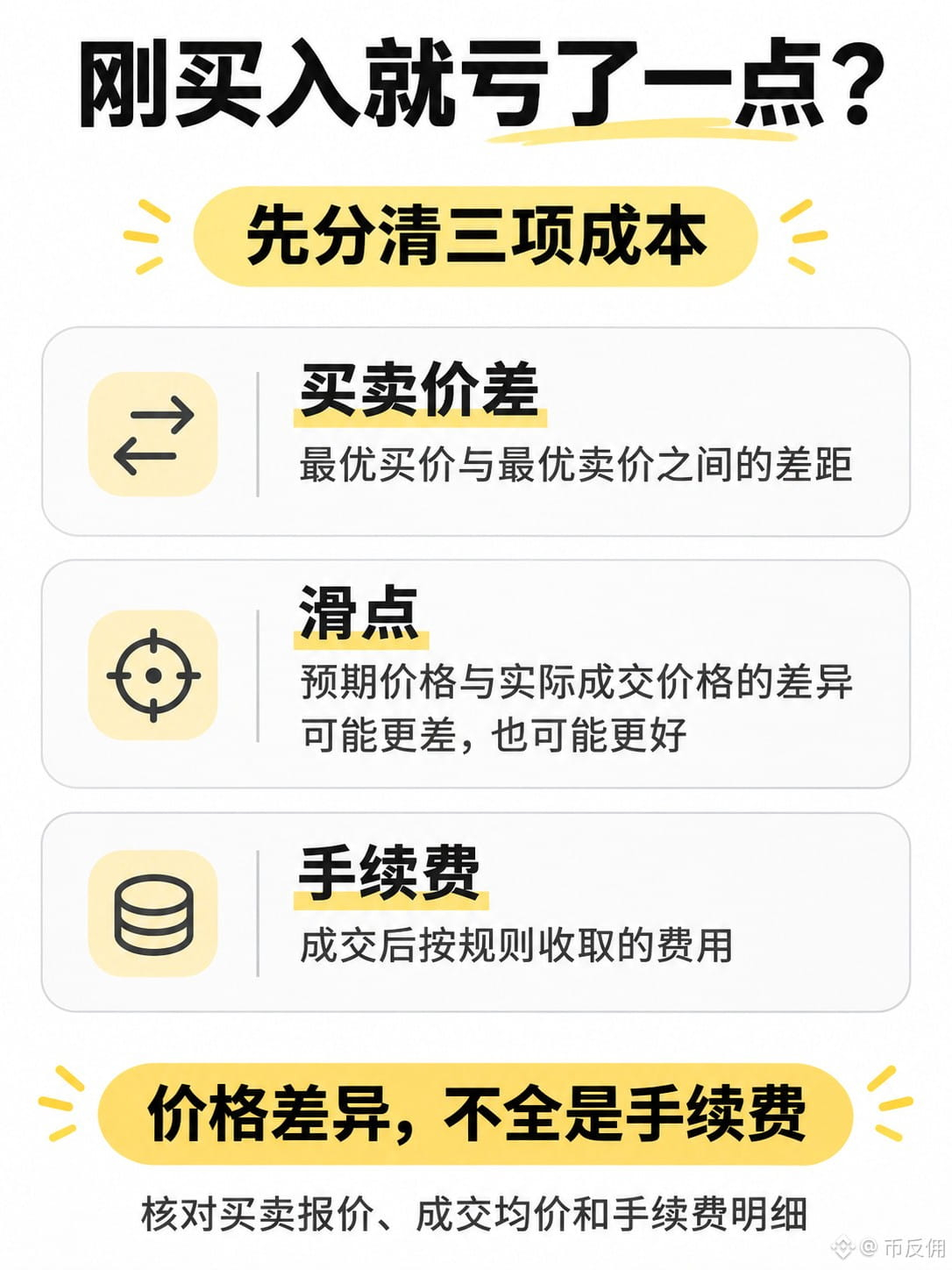
(Spread, slippage, and fees)
If you’re already at a small loss right after buying, are the fees really that high?
First, distinguish between three things: the bid-ask spread, slippage, and fees.
For example, suppose an asset’s lowest ask is 100.1U and its highest bid is 100U. If you buy immediately and then sell right away, and assume the quotes and quantities haven’t changed, you’ll still lose 0.1U per unit due to the spread, even before fees. That’s the bid-ask spread.
In another scenario, when you place an order, you see the lowest ask at 100.1U, but there isn’t enough quantity available at that price. Your order continues buying at higher ask prices, bringing the average execution price to 100.3U.
Compared with 100.1U, the extra 0.2U is the unfavorable slippage on this buy. Slippage can also result in a better-than-expected execution price.
Fees should be checked separately in your trade details. The unrealized loss shown in your account is also affected by valuation methods and price movements, so it shouldn’t all be attributed to fees.
When reviewing a trade, look separately at the bid and ask quotes, average execution price, and fees to see where the costs came from.
(Spread, slippage, and fees)
If you’re already at a small loss right after buying, are the fees really that high?
First, distinguish between three things: the bid-ask spread, slippage, and fees.
For example, suppose an asset’s lowest ask is 100.1U and its highest bid is 100U. If you buy immediately and then sell right away, and assume the quotes and quantities haven’t changed, you’ll still lose 0.1U per unit due to the spread, even before fees. That’s the bid-ask spread.
In another scenario, when you place an order, you see the lowest ask at 100.1U, but there isn’t enough quantity available at that price. Your order continues buying at higher ask prices, bringing the average execution price to 100.3U.
Compared with 100.1U, the extra 0.2U is the unfavorable slippage on this buy. Slippage can also result in a better-than-expected execution price.
Fees should be checked separately in your trade details. The unrealized loss shown in your account is also affected by valuation methods and price movements, so it shouldn’t all be attributed to fees.
When reviewing a trade, look separately at the bid and ask quotes, average execution price, and fees to see where the costs came from.
If you’re already at a small loss right after buying, are the fees really that high?
First, distinguish between three things: the bid-ask spread, slippage, and fees.
For example, suppose an asset’s lowest ask is 100.1U and its highest bid is 100U. If you buy immediately and then sell right away, and assume the quotes and quantities haven’t changed, you’ll still lose 0.1U per unit due to the spread, even before fees. That’s the bid-ask spread.
In another scenario, when you place an order, you see the lowest ask at 100.1U, but there isn’t enough quantity available at that price. Your order continues buying at higher ask prices, bringing the average execution price to 100.3U.
Compared with 100.1U, the extra 0.2U is the unfavorable slippage on this buy. Slippage can also result in a better-than-expected execution price.
Fees should be checked separately in your trade details. The unrealized loss shown in your account is also affected by valuation methods and price movements, so it shouldn’t all be attributed to fees.
When reviewing a trade, look separately at the bid and ask quotes, average execution price, and fees to see where the costs came from.
121
·
--

Article
How to Reduce Binance Fees: Several Ways for Spot and Futures, ExplainedWhen trading, many people focus most on market movements and profits and losses. They often don’t pay close attention to fees until they’ve been trading for a while.
This is especially true for futures. The fee for a single trade may not seem like much, but opening, closing, increasing, and reducing a position all generate trades. When trading frequently, the fees can add up noticeably over time.
So how can you reduce Binance fees? There are only a few common ways.
1. Enable BNB fee deductions
This is the most straightforward option. Binance currently offers a 25% fee discount when you pay trading fees with BNB on Spot and Margin, and a 10% discount when you use BNB to pay fees on USDⓈ-M Futures.
How to Reduce Binance Fees: Several Ways for Spot and Futures, Explained
When trading, many people focus most on market movements and profits and losses. They often don’t pay close attention to fees until they’ve been trading for a while.
This is especially true for futures. The fee for a single trade may not seem like much, but opening, closing, increasing, and reducing a position all generate trades. When trading frequently, the fees can add up noticeably over time.
So how can you reduce Binance fees? There are only a few common ways.
1. Enable BNB fee deductions
This is the most straightforward option. Binance currently offers a 25% fee discount when you pay trading fees with BNB on Spot and Margin, and a 10% discount when you use BNB to pay fees on USDⓈ-M Futures.
This is especially true for futures. The fee for a single trade may not seem like much, but opening, closing, increasing, and reducing a position all generate trades. When trading frequently, the fees can add up noticeably over time.
So how can you reduce Binance fees? There are only a few common ways.
1. Enable BNB fee deductions
This is the most straightforward option. Binance currently offers a 25% fee discount when you pay trading fees with BNB on Spot and Margin, and a 10% discount when you use BNB to pay fees on USDⓈ-M Futures.
33
·
--

Article
Does entering a Binance invitation code guarantee you’ll get rebates?Many people entered an invitation code when signing up for Binance, but later wondered: Other people get fee rebates when they trade, so why haven’t I received any?
The truth is, many people confuse these two things from the start: entering an invitation code ≠ automatically getting rebates. The most basic purpose of an invitation code is to establish a referral relationship between you and the person who invited you.
As for whether you can receive rebates on fees from future trades, that also depends on whether the referral relationship has a corresponding fee rebate set up for the invitee.
So there are a few possible scenarios: someone enters an invitation code when registering and a rebate is set up, in which case they’ll receive rebates as expected after trading. Someone else may have entered an invitation code, but no rebate rate was set for the invitee, so they won’t receive any fee rebates no matter how long they trade.
Does entering a Binance invitation code guarantee you’ll get rebates?
Many people entered an invitation code when signing up for Binance, but later wondered: Other people get fee rebates when they trade, so why haven’t I received any?
The truth is, many people confuse these two things from the start: entering an invitation code ≠ automatically getting rebates. The most basic purpose of an invitation code is to establish a referral relationship between you and the person who invited you.
As for whether you can receive rebates on fees from future trades, that also depends on whether the referral relationship has a corresponding fee rebate set up for the invitee.
So there are a few possible scenarios: someone enters an invitation code when registering and a rebate is set up, in which case they’ll receive rebates as expected after trading. Someone else may have entered an invitation code, but no rebate rate was set for the invitee, so they won’t receive any fee rebates no matter how long they trade.
The truth is, many people confuse these two things from the start: entering an invitation code ≠ automatically getting rebates. The most basic purpose of an invitation code is to establish a referral relationship between you and the person who invited you.
As for whether you can receive rebates on fees from future trades, that also depends on whether the referral relationship has a corresponding fee rebate set up for the invitee.
So there are a few possible scenarios: someone enters an invitation code when registering and a rebate is set up, in which case they’ll receive rebates as expected after trading. Someone else may have entered an invitation code, but no rebate rate was set for the invitee, so they won’t receive any fee rebates no matter how long they trade.
29
·
--

Article
Many people trade for a long time before realizing they could be getting their trading fees backMany people trade for months or even years before seeing someone mention rebates in the community and suddenly realizing: Why do others get part of their trading fees back every month, while I never have?
The reason is actually pretty simple.
What is a trading fee rebate?
Every spot or futures trade you make incurs a fee. If your account has an applicable rebate arrangement, part of that fee will be returned to you at a set rate.
If you don’t trade much, you may not notice the difference. But if you trade futures regularly over the long term, your fees can add up to more than you’d expect over the course of a month.
Many people trade for a long time before realizing they could be getting their trading fees back
Many people trade for months or even years before seeing someone mention rebates in the community and suddenly realizing: Why do others get part of their trading fees back every month, while I never have?
The reason is actually pretty simple.
What is a trading fee rebate?
Every spot or futures trade you make incurs a fee. If your account has an applicable rebate arrangement, part of that fee will be returned to you at a set rate.
If you don’t trade much, you may not notice the difference. But if you trade futures regularly over the long term, your fees can add up to more than you’d expect over the course of a month.
The reason is actually pretty simple.
What is a trading fee rebate?
Every spot or futures trade you make incurs a fee. If your account has an applicable rebate arrangement, part of that fee will be returned to you at a set rate.
If you don’t trade much, you may not notice the difference. But if you trade futures regularly over the long term, your fees can add up to more than you’d expect over the course of a month.
131
·
--

Article
What’s the Difference Between Rebates and Referrers?Many people who are new to Binance think “rebates” and “referrers” are the same thing. They are related, but they work in completely different ways.
Let’s start with rebates. They’re easy to understand: after you incur trading fees, a portion of those fees is returned to you based on the applicable rebate rate. So what determines how much you receive isn’t just the rebate rate—it also depends on how much in fees you actually generate.
Here’s a simple example:
The rebate rate is 20% in both cases, but if you generate just 10 USDT in trading fees in a month versus 1,000 USDT, the amount you ultimately receive will be completely different.
What’s the Difference Between Rebates and Referrers?
Many people who are new to Binance think “rebates” and “referrers” are the same thing. They are related, but they work in completely different ways.
Let’s start with rebates. They’re easy to understand: after you incur trading fees, a portion of those fees is returned to you based on the applicable rebate rate. So what determines how much you receive isn’t just the rebate rate—it also depends on how much in fees you actually generate.
Here’s a simple example:
The rebate rate is 20% in both cases, but if you generate just 10 USDT in trading fees in a month versus 1,000 USDT, the amount you ultimately receive will be completely different.
Let’s start with rebates. They’re easy to understand: after you incur trading fees, a portion of those fees is returned to you based on the applicable rebate rate. So what determines how much you receive isn’t just the rebate rate—it also depends on how much in fees you actually generate.
Here’s a simple example:
The rebate rate is 20% in both cases, but if you generate just 10 USDT in trading fees in a month versus 1,000 USDT, the amount you ultimately receive will be completely different.
2
489
·
--
Why did I still get charged a Taker fee even though I placed a limit order?
Many people have a misconception: “If I clearly placed a limit order, why am I not a Maker?”
In fact, a limit order is not necessarily a Maker order.
The key is this: when you place the order, does it immediately match and fill with orders that already exist in the market?
For example:
Placing a price and waiting for someone else to come fill it usually counts as Maker (providing liquidity).
But if your limit order happens to match an existing resting order in the order book and fills right away, that trade may be classified as Taker.
A simple way to understand it:
Maker: your order enters the order book and waits for others to trade against it.
Taker: your order directly consumes existing orders in the market.
So to determine Maker/Taker, it’s not about whether it’s “limit” or “market,” but about whether your order increases the market’s resting order depth.
In fee calculations, order type is only one factor—the final determination is based on the platform’s actual trade execution records.
#区块链 #交易日常 #交易心态 #手续费
Why did I still get charged a Taker fee even though I placed a limit order?
Many people have a misconception: “If I clearly placed a limit order, why am I not a Maker?”
In fact, a limit order is not necessarily a Maker order.
The key is this: when you place the order, does it immediately match and fill with orders that already exist in the market?
For example:
Placing a price and waiting for someone else to come fill it usually counts as Maker (providing liquidity).
But if your limit order happens to match an existing resting order in the order book and fills right away, that trade may be classified as Taker.
A simple way to understand it:
Maker: your order enters the order book and waits for others to trade against it.
Taker: your order directly consumes existing orders in the market.
So to determine Maker/Taker, it’s not about whether it’s “limit” or “market,” but about whether your order increases the market’s resting order depth.
In fee calculations, order type is only one factor—the final determination is based on the platform’s actual trade execution records.
#区块链 #交易日常 #交易心态 #手续费
Many people have a misconception: “If I clearly placed a limit order, why am I not a Maker?”
In fact, a limit order is not necessarily a Maker order.
The key is this: when you place the order, does it immediately match and fill with orders that already exist in the market?
For example:
Placing a price and waiting for someone else to come fill it usually counts as Maker (providing liquidity).
But if your limit order happens to match an existing resting order in the order book and fills right away, that trade may be classified as Taker.
A simple way to understand it:
Maker: your order enters the order book and waits for others to trade against it.
Taker: your order directly consumes existing orders in the market.
So to determine Maker/Taker, it’s not about whether it’s “limit” or “market,” but about whether your order increases the market’s resting order depth.
In fee calculations, order type is only one factor—the final determination is based on the platform’s actual trade execution records.
#区块链 #交易日常 #交易心态 #手续费

247
Log in to explore more content
Join global crypto users on Binance Square
⚡️ Get latest and useful information about crypto.
💬 Trusted by the world’s largest crypto exchange.
👍 Discover real insights from verified creators.
Email / Phone number
Trending Topics
IsAnthropic’s$1.5TMarketCapJustified?
22,511 views
124 Discussing
Anthropic Set to Open at $105 in Record Nasdaq Debut
Binance News
·12 Likes
·17k views
13FInstitutionsBitcoinSpotETPHoldingsHitRecord
560 views
20 Discussing
BTCRemainsUnderPressureAfterHawkishFOMCMinutes
293,418 views
2,218 Discussing