
Crypto Universe Live
10.4k Posts
Crypto Universe Live
 Square Verified
Report
Block User
Blockchain Labs Community is a trusted platform for crypto education, project promotions, blockchain insights, and Web3 updates. Our X: @BlockchainLabsX
Open Trade
Frequent Trader
4.6 Years
2.1K+ Following
71.8K+ Followers
271.0K+ Liked
Posts
Portfolio
All
Videos
Live
PINNED

Article
🔥 CRUSTY MICROWAVE ($CRUSTY)In the ever-evolving world of memecoins, CRUSTY MICROWAVE takes a community-first approach built around humor, creativity, culture, and participation.
Rather than focusing solely on the traditional concept of a meme token, CRUSTY MICROWAVE aims to build a recognizable identity through community-driven content, memes, and internet culture.
🍳 A Community-Driven Concept
At the heart of CRUSTY MICROWAVE is a simple idea: combine the familiar character of a microwave with the unpredictable energy of meme culture.
The project embraces creativity and encourages its community to contribute through memes, discussions, ideas, and original content.
⚡ Built Around Culture
Meme projects are often shaped by the communities behind them. CRUSTY MICROWAVE follows this approach by placing community interaction and creative expression at the center of its identity.
From humorous content to community conversations, every contribution can help shape the project's evolving presence within the broader crypto ecosystem.
🌐 The Solana Environment
CRUSTY MICROWAVE operates on the Solana blockchain, an ecosystem known for its fast transactions and active developer and community environment.
As part of this ecosystem, $CRUSTY represents a meme-focused project combining blockchain technology with internet culture.
🔥 The CRUSTY Identity
🍳 Humor
⚡ Creativity
🔥 Community
🌐 Internet culture
🚀 Continuous development
📌 Project: CRUSTY MICROWAVE
💎 Ticker: $CRUSTY
⛓️ Blockchain: Solana
📄 Contract Address:
"CLn6y4vGYQeGXWuwf3QUdq77vytto5dwwpnDZZajpump"
The concept is simple, recognizable, and community-oriented, giving participants room to create, share, and shape the CRUSTY identity.
🍳 CRUSTY MICROWAVE — where meme culture meets the Solana ecosystem.
🔥 CRUSTY MICROWAVE ($CRUSTY)
In the ever-evolving world of memecoins, CRUSTY MICROWAVE takes a community-first approach built around humor, creativity, culture, and participation.
Rather than focusing solely on the traditional concept of a meme token, CRUSTY MICROWAVE aims to build a recognizable identity through community-driven content, memes, and internet culture.
🍳 A Community-Driven Concept
At the heart of CRUSTY MICROWAVE is a simple idea: combine the familiar character of a microwave with the unpredictable energy of meme culture.
The project embraces creativity and encourages its community to contribute through memes, discussions, ideas, and original content.
⚡ Built Around Culture
Meme projects are often shaped by the communities behind them. CRUSTY MICROWAVE follows this approach by placing community interaction and creative expression at the center of its identity.
From humorous content to community conversations, every contribution can help shape the project's evolving presence within the broader crypto ecosystem.
🌐 The Solana Environment
CRUSTY MICROWAVE operates on the Solana blockchain, an ecosystem known for its fast transactions and active developer and community environment.
As part of this ecosystem, $CRUSTY represents a meme-focused project combining blockchain technology with internet culture.
🔥 The CRUSTY Identity
🍳 Humor
⚡ Creativity
🔥 Community
🌐 Internet culture
🚀 Continuous development
📌 Project: CRUSTY MICROWAVE
💎 Ticker: $CRUSTY
⛓️ Blockchain: Solana
📄 Contract Address:
"CLn6y4vGYQeGXWuwf3QUdq77vytto5dwwpnDZZajpump"
The concept is simple, recognizable, and community-oriented, giving participants room to create, share, and shape the CRUSTY identity.
🍳 CRUSTY MICROWAVE — where meme culture meets the Solana ecosystem.
169
169
Article
The Technical Substance of o3 Lies in How Conditions InteractWithin AkronDEX o3’s feature set, multi-step reasoning and complex condition analysis address a more fundamental strategy-development problem than simply adding another category of indicators.
A trading signal is usually straightforward to describe. The difficulty tends to appear when several signals occur at the same time.
For example, a trend condition permits long positions, an entry signal has triggered, but a volatility filter calls for trading to pause. All three assessments can be valid. The resulting action depends on their roles within the strategy:
Directional conditions determine which types of trades are eligible for consideration.
Trigger conditions determine when a potential opportunity appears.
Constraints determine whether that opportunity can be acted on.
These relationships involve combinations of conditions, rule priority, and conflict resolution. Recognizing what each individual condition means is only part of the analysis.
This is where o3’s focus on multi-step reasoning and strategy logic evaluation becomes relevant. Combined with trading-intent understanding, it places the product closer to an analytical assistant that can participate in strategy-development discussions, rather than simply produce market commentary.
The appeal to experienced creators is fairly clear: research can extend beyond individual indicators to the relationships between indicators, market conditions, and constraints.
That is also where its professional value belongs. Indicators provide signals; strategies determine how those signals are used. There is a substantial amount of work between the two.
The Technical Substance of o3 Lies in How Conditions Interact
Within AkronDEX o3’s feature set, multi-step reasoning and complex condition analysis address a more fundamental strategy-development problem than simply adding another category of indicators.
A trading signal is usually straightforward to describe. The difficulty tends to appear when several signals occur at the same time.
For example, a trend condition permits long positions, an entry signal has triggered, but a volatility filter calls for trading to pause. All three assessments can be valid. The resulting action depends on their roles within the strategy:
Directional conditions determine which types of trades are eligible for consideration.
Trigger conditions determine when a potential opportunity appears.
Constraints determine whether that opportunity can be acted on.
These relationships involve combinations of conditions, rule priority, and conflict resolution. Recognizing what each individual condition means is only part of the analysis.
This is where o3’s focus on multi-step reasoning and strategy logic evaluation becomes relevant. Combined with trading-intent understanding, it places the product closer to an analytical assistant that can participate in strategy-development discussions, rather than simply produce market commentary.
The appeal to experienced creators is fairly clear: research can extend beyond individual indicators to the relationships between indicators, market conditions, and constraints.
That is also where its professional value belongs. Indicators provide signals; strategies determine how those signals are used. There is a substantial amount of work between the two.
220
247

Article
$GROKLET: The Grok Mascot Narrative That Could Become Ethereum's Next $100M MemeA character linked to Grok is gaining visibility across X. Elon Musk has shared artwork featuring Groklet, and Grok has described the character as its mascot. Could that attention fuel a nine-figure Ethereum meme?
Every major memecoin begins with a story. DOGE had the Dogefather. KEKIUS captured attention through Elon Musk's online persona. Now traders are watching GROKLET: the teal alien with galaxy eyes, pointed ears and a glowing X.
The bullish case is not that Elon has endorsed a cryptocurrency. He has not. It's that a recognizable character associated with Grok is entering conversations followed by millions of people.
1. Grok has called Groklet its mascot
In the shared X conversation, Grok responds to a question about an illustrated character by calling it “Groklet, my official teal alien mascot.” The response describes a friendly visual stand-in for Grok's code and curiosity.
That is an unusually clear piece of mascot-related language coming from Grok's own account. It is not, by itself, a formal corporate announcement from xAI or proof that any cryptocurrency is affiliated with the company.
But the character is instantly recognizable, and recognizable characters travel further than ticker symbols. They can become memes, illustrations, videos, collectibles and community identities.
2. Elon Musk has already shared Groklet artwork
The first screenshot documents an Elon Musk post quoting Rothmus, whose original post includes Groklet artwork alongside other small characters. Under that post, a user asks Grok to identify the character; Grok names Groklet.
The distinction matters: Elon shared content featuring the character, not a token endorsement. Even so, exposure through a high-profile Elon post is central to the community's thesis.
Evidence 1 · Elon Musk's quote post featuring Groklet artwork, followed by Grok identifying the character. Screenshot supplied by the community.
3. Groklet appears in a Grok advertising conversation
A second screenshot shows a promoted Grok Imagine post featuring a teal alien character. In the replies, a user asks whether the character is Groklet, and Grok answers yes, describing it as its teal alien mascot.
This is a compelling connection between Groklet and Grok's own promotional imagery. The screenshot supports the presence of the character in the ad discussion; it does not establish a permanent official branding policy or a partnership with the token.
Evidence 2 · Grok Imagine promotional post and Grok's reply identifying the alien as Groklet. Screenshot supplied by the community.
4. Why a mascot can outgrow a single viral post
A one-off viral tweet can fade. A memorable character can keep circulating. Groklet's community sees several possible future paths: more Grok or Elon posts, fan art, animations, plushies, profile pictures, banners and wider cultural recognition.
These are possibilities, not announced xAI initiatives. The more often people encounter the character independently of crypto, the stronger the potential meme narrative becomes.
5. The KEKIUS connection and Ethereum angle
Community members link the $GROKLET deployer to the team or wallet behind $KEKIUS, which they cite as a roughly $400M–$500M meme at its peak. That wallet connection and historical valuation should be verified independently before being treated as established facts.
Ethereum remains a major home for memecoin liquidity and experienced traders. Supporters argue that if the Groklet narrative reaches broader crypto audiences, that liquidity could amplify interest. It could also amplify volatility and losses.
6. The $100M bull case
The nine-figure thesis rests on a chain of events: Groklet becomes increasingly recognizable, Grok or Elon continues circulating the character, more communities discover the meme, and that cultural attention converts into sustained demand for the Ethereum token.
That is a speculative scenario—not a price forecast. The character's success and the token's success are not the same thing. There is no official Elon or xAI token endorsement, and the token could lose substantial value even if the character goes viral.
Still, the narrative is easy to understand: most memes struggle to find a character people remember. Groklet already has an identity, an association with a widely discussed AI product, and documented appearances in high-profile X content.
The real question is whether this becomes a passing meme—or a recurring character across the Grok ecosystem.
Token information and disclosure
Ethereum contract: 0x787873c9ae96855bdb032f6ff1ef76a5e1fc8adc
Community thesis only. $GROKLET is not established here as an official xAI or Grok cryptocurrency. This article discusses a high-risk speculative memecoin, not financial advice. Screenshots document the specific interactions shown, not the broader unverified claims circulating online.
$GROKLET: The Grok Mascot Narrative That Could Become Ethereum's Next $100M Meme
A character linked to Grok is gaining visibility across X. Elon Musk has shared artwork featuring Groklet, and Grok has described the character as its mascot. Could that attention fuel a nine-figure Ethereum meme?
Every major memecoin begins with a story. DOGE had the Dogefather. KEKIUS captured attention through Elon Musk's online persona. Now traders are watching GROKLET: the teal alien with galaxy eyes, pointed ears and a glowing X.
The bullish case is not that Elon has endorsed a cryptocurrency. He has not. It's that a recognizable character associated with Grok is entering conversations followed by millions of people.
1. Grok has called Groklet its mascot
In the shared X conversation, Grok responds to a question about an illustrated character by calling it “Groklet, my official teal alien mascot.” The response describes a friendly visual stand-in for Grok's code and curiosity.
That is an unusually clear piece of mascot-related language coming from Grok's own account. It is not, by itself, a formal corporate announcement from xAI or proof that any cryptocurrency is affiliated with the company.
But the character is instantly recognizable, and recognizable characters travel further than ticker symbols. They can become memes, illustrations, videos, collectibles and community identities.
2. Elon Musk has already shared Groklet artwork
The first screenshot documents an Elon Musk post quoting Rothmus, whose original post includes Groklet artwork alongside other small characters. Under that post, a user asks Grok to identify the character; Grok names Groklet.
The distinction matters: Elon shared content featuring the character, not a token endorsement. Even so, exposure through a high-profile Elon post is central to the community's thesis.
Evidence 1 · Elon Musk's quote post featuring Groklet artwork, followed by Grok identifying the character. Screenshot supplied by the community.
3. Groklet appears in a Grok advertising conversation
A second screenshot shows a promoted Grok Imagine post featuring a teal alien character. In the replies, a user asks whether the character is Groklet, and Grok answers yes, describing it as its teal alien mascot.
This is a compelling connection between Groklet and Grok's own promotional imagery. The screenshot supports the presence of the character in the ad discussion; it does not establish a permanent official branding policy or a partnership with the token.
Evidence 2 · Grok Imagine promotional post and Grok's reply identifying the alien as Groklet. Screenshot supplied by the community.
4. Why a mascot can outgrow a single viral post
A one-off viral tweet can fade. A memorable character can keep circulating. Groklet's community sees several possible future paths: more Grok or Elon posts, fan art, animations, plushies, profile pictures, banners and wider cultural recognition.
These are possibilities, not announced xAI initiatives. The more often people encounter the character independently of crypto, the stronger the potential meme narrative becomes.
5. The KEKIUS connection and Ethereum angle
Community members link the $GROKLET deployer to the team or wallet behind $KEKIUS, which they cite as a roughly $400M–$500M meme at its peak. That wallet connection and historical valuation should be verified independently before being treated as established facts.
Ethereum remains a major home for memecoin liquidity and experienced traders. Supporters argue that if the Groklet narrative reaches broader crypto audiences, that liquidity could amplify interest. It could also amplify volatility and losses.
6. The $100M bull case
The nine-figure thesis rests on a chain of events: Groklet becomes increasingly recognizable, Grok or Elon continues circulating the character, more communities discover the meme, and that cultural attention converts into sustained demand for the Ethereum token.
That is a speculative scenario—not a price forecast. The character's success and the token's success are not the same thing. There is no official Elon or xAI token endorsement, and the token could lose substantial value even if the character goes viral.
Still, the narrative is easy to understand: most memes struggle to find a character people remember. Groklet already has an identity, an association with a widely discussed AI product, and documented appearances in high-profile X content.
The real question is whether this becomes a passing meme—or a recurring character across the Grok ecosystem.
Token information and disclosure
Ethereum contract: 0x787873c9ae96855bdb032f6ff1ef76a5e1fc8adc
Community thesis only. $GROKLET is not established here as an official xAI or Grok cryptocurrency. This article discusses a high-risk speculative memecoin, not financial advice. Screenshots document the specific interactions shown, not the broader unverified claims circulating online.
188
238
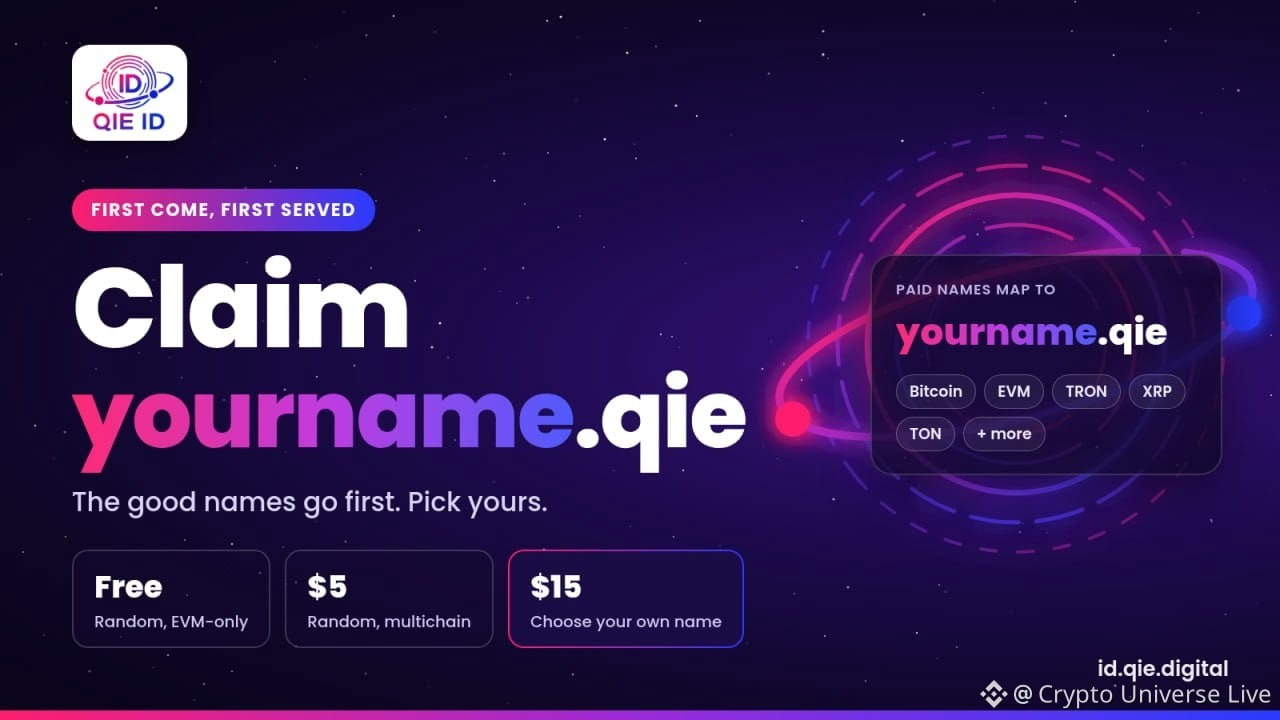
🚨 YOUR CRYPTO IDENTITY DESERVES A NAME. CLAIM YOURS BEFORE SOMEONE ELSE DOES.
Bitcoin. Ethereum. TRON. XRP. TON. Different networks, different wallet addresses.
What if you could use ONE simple name across them? 🌐
Introducing QIE ID — your personal crypto payment identity.
Instead of sharing complicated wallet addresses, connect your supported wallets to a memorable name like yourname.qie.
🔥 THE BEST NAMES ARE FIRST COME, FIRST SERVED!
✅ FREE — Random QIE ID for EVM-compatible chains
✅ $5 ONCE-OFF — Random QIE ID with multichain support
✅ $15 ONCE-OFF — Choose your own personalised QIE ID with multichain support
🌍 Supported networks include Bitcoin, EVM, TRON, XRP, TON and more.
Your name. Your crypto. One simple payment ID.
Imagine having your preferred name across multiple crypto networks instead of a collection of addresses nobody can remember.
💥 The name you want today might already be claimed tomorrow.
🔗 Claim your QIE ID: https://id.qie.digital
#QIEID #Crypto #Web3 #BlockchainDeveloper
254
1.7k
Looking for a smarter way to explore Web3?
With VoltPay Wallet and VoltAI, we're making Web3 simpler and more accessible.
And the exciting news? The VLT presale is live on PinkSale! Check out the official presale page for all the details.
Ready to explore? Visit VoltPay.org and become part of the growing VoltPay community.
VoltPay — Pay. Connect. Grow.
🌐 Official Website: https://voltpay.org/
🚀 VLT Presale: https://pinksale.finance/launchpad/bsc/0x94546d5e1094185C45160c72e32EF45Dec5A1c30
👛 VoltPay Wallet: https://voltpay.org/wallet
𝕏 Twitter (X): https://x.com/VoltPayInfo
109
206
Article
AkronDEX Research Center Review: What Can Beginners Learn, from Crypto Basics to Market Analysis?When evaluating a crypto trading platform, users often focus first on available markets, trading fees, and the interface. For newcomers, however, access to clear, practical educational resources can also make a meaningful difference.
Holding assets in a wallet but being unable to transfer them, not knowing which network to select for a deposit, or following price movements without understanding support and resistance—these are common challenges for beginners.
Akron Trading Academy, accessible through the Research Center on the AkronDEX website, provides a dedicated entry point for learning about crypto fundamentals and trading.
Based on its public course directory and the lessons reviewed, the academy is best understood as a reference library organized by topic. One notable strength is that some tutorials connect conceptual explanations with situations users may encounter in practice.
1. Content Coverage: From On-Chain Fundamentals to Market Analysis
The academy covers two broad areas: trading education and crypto asset knowledge.
Trading topics include candlestick charts, technical indicators, trading tools, news analysis, trading decisions, and risk management. Crypto asset topics cover public blockchains, stablecoins, DeFi, AI, Meme, and other foundational concepts.
Learning AreaMain Questions AddressedOn-chain fundamentalsHow wallets work, why gas is needed, and how to check transactionsTechnical analysisHow to draw trendlines, identify support and resistance, and interpret indicatorsTrading knowledgeHow news affects markets, how trading decisions are structured, and what risk management involvesAsset and industry topicsWhat different asset categories, applications, and infrastructure components do
This organization provides a reasonably clear starting point. Readers can choose lessons based on a specific question or establish foundational knowledge before moving into market analysis.
The breadth of the directory is only a starting point, however. The practical value of educational material also depends on how individual lessons explain their subject matter.
2. A Strength of the Beginner Tutorials: Addressing Practical Confusion
“First On-Chain Trade? 5 Crypto Basics You Need to Know Before You Start” is a useful example.
The lesson covers blockchain networks, Web3 wallets, gas, wallet credentials, and block explorers, placing these concepts in practical contexts.
For example, it explains why a user may hold USDT but still be unable to initiate a transfer: the asset being transferred may differ from the asset needed to pay the network fee.
The article also distinguishes a multichain wallet from a cross-chain transfer. A wallet application’s ability to connect to several networks does not mean that assets automatically move between them.
These explanations have direct relevance for beginners. When a transfer fails or a balance appears incorrect, readers can better understand whether to check the network, transaction fees, or transaction status.
From an educational perspective, this lesson addresses several points that commonly cause confusion during a first on-chain interaction.
3. Technical Analysis Lessons: Concepts Supported by Chart Examples
The support and resistance lesson offers a useful indication of the depth of the technical analysis material.
It introduces reference points such as areas of concentrated historical trading, previous highs and lows, moving averages, trendlines, and psychological price levels. It also discusses price behavior alongside trading volume and different timeframes.
The article includes chart examples showing support and resistance holding, failing, and changing roles. It also explains how to mark relevant areas using Akron’s charting tools.
This structure connects three stages of learning:
Understand the concept → Examine examples → Become familiar with the tools.
For readers who have heard terms such as “support level” or “breakout” but do not know how they appear on a chart, this approach can be easier to follow than a standalone definition.
The main value of these examples is in explaining the analytical process. Chart patterns behave differently under different market conditions, so readers still need to understand when a method may be applicable.
4. Industry Topics Broaden the Learning Scope
The academy also includes material on public blockchains, stablecoins, DeFi, AI, and Meme, alongside explanations of Layer 2 networks, oracles, wrapped tokens, and DAOs.
These topics can help readers build a basic framework for understanding different assets and applications.
When reading about a project, for example, users can begin asking more specific questions: Which network does it rely on? What function does it serve? What role does its token play? How do the underlying mechanisms work?
For beginners who have not yet developed a structured understanding of the industry, topic-based reading can help connect otherwise isolated concepts. More experienced users may also find these sections useful as supplementary references.
5. Reading Experience: Useful for Independent Study, with Some Guidance Needed
The pages reviewed primarily present information through English text and illustrations, and some technical analysis articles are lengthy.
Charts and examples help explain the concepts, but Chinese-speaking readers may need translation support. Complete beginners also do not necessarily need to follow the order in which material appears on the homepage.
A more suitable reading sequence would be:
Start with Crypto Basics to understand networks, wallets, gas, and transaction tracking.Explore public blockchains and stablecoins to establish a basic understanding of asset categories.Move into candlestick charts and technical analysis to become familiar with charts and tools.Add news analysis and risk management to understand other factors involved in trading.
The material is well suited to reading with a specific question in mind and revisiting examples afterward. Clearer difficulty labels, additional Chinese-language content, and chapter exercises could further improve the experience for beginners.
6. An Outside Perspective: What Does the Academy Add to AkronDEX?
Based on the material reviewed, Akron Trading Academy has two identifiable strengths: a clear topic structure and tutorials that address practical questions.
The on-chain fundamentals lessons help explain the mechanisms behind common operations, while the technical analysis examples connect concepts with charting tools. Together, these resources give users somewhere to turn as they become familiar with the platform’s features.
Educational content provides a concrete way to examine one aspect of AkronDEX’s user support. Its value can be assessed through the accuracy of the articles, the clarity of their explanations, ongoing maintenance, and how easily beginners can find the information they need.
Judging from the course samples reviewed, the academy is worth considering as a supplementary resource for crypto fundamentals and trading knowledge.
Frequently Asked Questions
Is the academy suitable for someone with no crypto experience?
The foundational material is an appropriate starting point. Topics such as networks, wallets, gas, and block explorers are closely aligned with the questions users face when first interacting on-chain.
Does the academy only cover futures trading?
Its scope also includes crypto fundamentals, public blockchains, stablecoins, DeFi, AI, and Meme. Readers can choose topics according to their interests.
Is there value for users who already have trading experience?
They can consult technical analysis, news interpretation, or infrastructure topics according to their needs. The value will depend on which gaps in their knowledge they want to address.
Explore AkronDEX Courses and Official Updates
Visit Research Center at the bottom of the official website to access Akron Trading Academy and explore its crypto fundamentals and trading courses.
AkronDEX Research Center Review: What Can Beginners Learn, from Crypto Basics to Market Analysis?
When evaluating a crypto trading platform, users often focus first on available markets, trading fees, and the interface. For newcomers, however, access to clear, practical educational resources can also make a meaningful difference.
Holding assets in a wallet but being unable to transfer them, not knowing which network to select for a deposit, or following price movements without understanding support and resistance—these are common challenges for beginners.
Akron Trading Academy, accessible through the Research Center on the AkronDEX website, provides a dedicated entry point for learning about crypto fundamentals and trading.
Based on its public course directory and the lessons reviewed, the academy is best understood as a reference library organized by topic. One notable strength is that some tutorials connect conceptual explanations with situations users may encounter in practice.
1. Content Coverage: From On-Chain Fundamentals to Market Analysis
The academy covers two broad areas: trading education and crypto asset knowledge.
Trading topics include candlestick charts, technical indicators, trading tools, news analysis, trading decisions, and risk management. Crypto asset topics cover public blockchains, stablecoins, DeFi, AI, Meme, and other foundational concepts.
Learning AreaMain Questions AddressedOn-chain fundamentalsHow wallets work, why gas is needed, and how to check transactionsTechnical analysisHow to draw trendlines, identify support and resistance, and interpret indicatorsTrading knowledgeHow news affects markets, how trading decisions are structured, and what risk management involvesAsset and industry topicsWhat different asset categories, applications, and infrastructure components do
This organization provides a reasonably clear starting point. Readers can choose lessons based on a specific question or establish foundational knowledge before moving into market analysis.
The breadth of the directory is only a starting point, however. The practical value of educational material also depends on how individual lessons explain their subject matter.
2. A Strength of the Beginner Tutorials: Addressing Practical Confusion
“First On-Chain Trade? 5 Crypto Basics You Need to Know Before You Start” is a useful example.
The lesson covers blockchain networks, Web3 wallets, gas, wallet credentials, and block explorers, placing these concepts in practical contexts.
For example, it explains why a user may hold USDT but still be unable to initiate a transfer: the asset being transferred may differ from the asset needed to pay the network fee.
The article also distinguishes a multichain wallet from a cross-chain transfer. A wallet application’s ability to connect to several networks does not mean that assets automatically move between them.
These explanations have direct relevance for beginners. When a transfer fails or a balance appears incorrect, readers can better understand whether to check the network, transaction fees, or transaction status.
From an educational perspective, this lesson addresses several points that commonly cause confusion during a first on-chain interaction.
3. Technical Analysis Lessons: Concepts Supported by Chart Examples
The support and resistance lesson offers a useful indication of the depth of the technical analysis material.
It introduces reference points such as areas of concentrated historical trading, previous highs and lows, moving averages, trendlines, and psychological price levels. It also discusses price behavior alongside trading volume and different timeframes.
The article includes chart examples showing support and resistance holding, failing, and changing roles. It also explains how to mark relevant areas using Akron’s charting tools.
This structure connects three stages of learning:
Understand the concept → Examine examples → Become familiar with the tools.
For readers who have heard terms such as “support level” or “breakout” but do not know how they appear on a chart, this approach can be easier to follow than a standalone definition.
The main value of these examples is in explaining the analytical process. Chart patterns behave differently under different market conditions, so readers still need to understand when a method may be applicable.
4. Industry Topics Broaden the Learning Scope
The academy also includes material on public blockchains, stablecoins, DeFi, AI, and Meme, alongside explanations of Layer 2 networks, oracles, wrapped tokens, and DAOs.
These topics can help readers build a basic framework for understanding different assets and applications.
When reading about a project, for example, users can begin asking more specific questions: Which network does it rely on? What function does it serve? What role does its token play? How do the underlying mechanisms work?
For beginners who have not yet developed a structured understanding of the industry, topic-based reading can help connect otherwise isolated concepts. More experienced users may also find these sections useful as supplementary references.
5. Reading Experience: Useful for Independent Study, with Some Guidance Needed
The pages reviewed primarily present information through English text and illustrations, and some technical analysis articles are lengthy.
Charts and examples help explain the concepts, but Chinese-speaking readers may need translation support. Complete beginners also do not necessarily need to follow the order in which material appears on the homepage.
A more suitable reading sequence would be:
Start with Crypto Basics to understand networks, wallets, gas, and transaction tracking.Explore public blockchains and stablecoins to establish a basic understanding of asset categories.Move into candlestick charts and technical analysis to become familiar with charts and tools.Add news analysis and risk management to understand other factors involved in trading.
The material is well suited to reading with a specific question in mind and revisiting examples afterward. Clearer difficulty labels, additional Chinese-language content, and chapter exercises could further improve the experience for beginners.
6. An Outside Perspective: What Does the Academy Add to AkronDEX?
Based on the material reviewed, Akron Trading Academy has two identifiable strengths: a clear topic structure and tutorials that address practical questions.
The on-chain fundamentals lessons help explain the mechanisms behind common operations, while the technical analysis examples connect concepts with charting tools. Together, these resources give users somewhere to turn as they become familiar with the platform’s features.
Educational content provides a concrete way to examine one aspect of AkronDEX’s user support. Its value can be assessed through the accuracy of the articles, the clarity of their explanations, ongoing maintenance, and how easily beginners can find the information they need.
Judging from the course samples reviewed, the academy is worth considering as a supplementary resource for crypto fundamentals and trading knowledge.
Frequently Asked Questions
Is the academy suitable for someone with no crypto experience?
The foundational material is an appropriate starting point. Topics such as networks, wallets, gas, and block explorers are closely aligned with the questions users face when first interacting on-chain.
Does the academy only cover futures trading?
Its scope also includes crypto fundamentals, public blockchains, stablecoins, DeFi, AI, and Meme. Readers can choose topics according to their interests.
Is there value for users who already have trading experience?
They can consult technical analysis, news interpretation, or infrastructure topics according to their needs. The value will depend on which gaps in their knowledge they want to address.
Explore AkronDEX Courses and Official Updates
Visit Research Center at the bottom of the official website to access Akron Trading Academy and explore its crypto fundamentals and trading courses.
82
277
Is AkronDEX Reliable?
Assessing a trading platform’s credibility starts with two questions: Are its product rules clearly documented, and can its background be independently checked?
AkronDEX’s public documentation, published under Akron Finance, describes spot markets, perpetual contracts, and AI trading agents. It explains margin calculations, liquidation conditions, strategy testing, and the distinction between backtested and live performance. These disclosures provide concrete reference points for evaluating the platform and checking its product claims.
For historical context, Akron Finance appears in Chainlink’s official BUILD program directory. This offers an externally checkable reference associated with that project name. However, connecting this record to today’s AkronDEX requires confirmation of brand and operating-entity continuity. An ecosystem program listing also does not certify fund security or regulatory status.
Assessing AkronDEX’s credibility requires connecting public rules, historical records, and actual operations. Does the product match its documentation? Do historical references correspond to the current operator? Does execution follow the disclosed rules? Consistent, verifiable answers to these questions provide a foundation for trust.
133
166
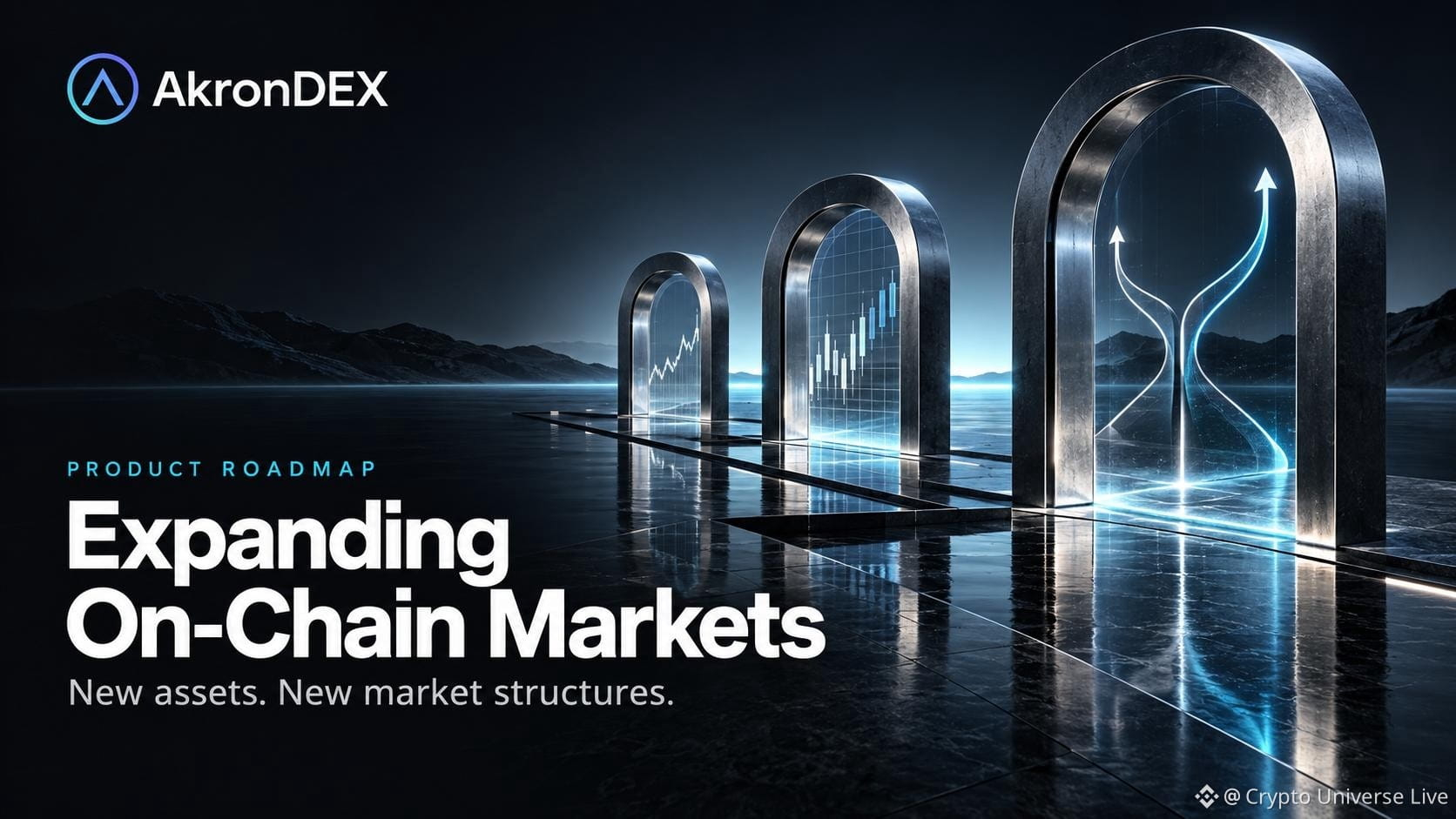
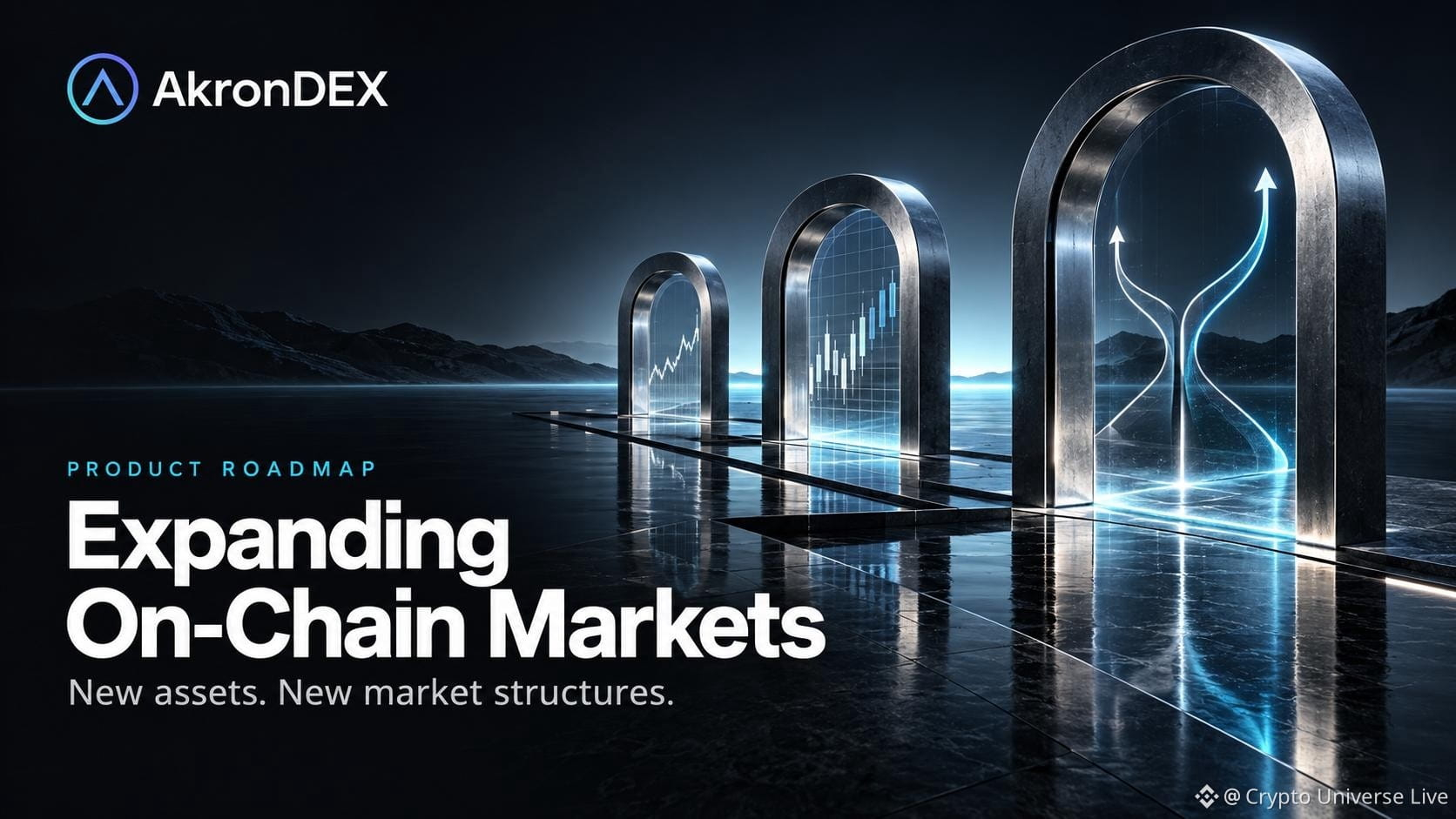
AkronDEX’s Asset Expansion: New Listings, On-Chain Equities, and Prediction Markets
When an exchange expands into new asset classes, it also expands the pricing methods, information sources, and settlement rules it must support. Different markets serve different trading requirements.
AkronDEX’s public roadmap points toward a gradual expansion from spot markets and perpetual contracts into new-asset discovery and a broader range of on-chain markets.
New Listings focuses on discovering, organizing information about, and trading newly listed assets. According to the roadmap, the platform has incorporated a new-listings system into its product development, providing a clearer entry point for identifying and understanding emerging markets.
The planned On-Chain Equities Markets introduce another set of product considerations. Equity-related price exposure, underlying rights, trading hours, and corporate actions must align with the eventual product structure. The public roadmap states that this direction depends on the chosen product model, market infrastructure, and applicable requirements.
Prediction Markets introduce a different trading subject: the outcome of an event. Contracts need clear definitions of the event, outcome sources, settlement conditions, and exception handling. Event specification and resolution mechanisms therefore become central components of the product.
These directions address new-asset discovery, markets related to traditional assets, and event-outcome trading. They broaden the range of trading use cases the platform could support while introducing distinct requirements for market data, order tools, and risk management.
On-chain equities and prediction markets remain future roadmap plans, with specific functionality subject to actual release.
From a product perspective, AkronDEX is creating room to support a broader range of on-chain markets. As asset coverage expands, an exchange’s capabilities must also extend to accommodating the operating rules of each market.
103
1.2k
Article
CALI Gains Attention After Maye Musk Engages With Token’s Official Account and Elon Musk Interacts..A new Solana memecoin centered around Maye Musk’s dog, Cali, is drawing attention after a series of public interactions from Maye Musk and Elon Musk helped turn a simple dog narrative into one of the more closely watched meme stories of the week.
The token, $CALI, launched around the identity of Cali, one of Maye Musk’s dogs. What initially looked like another dog-themed memecoin quickly gained visibility after Maye began publicly posting about Cali again and engaging with content connected to the token.
Maye Musk has previously described Cali and her other dog, DelRey, as her companions, including in posts promoting her new book, TIMELESS.
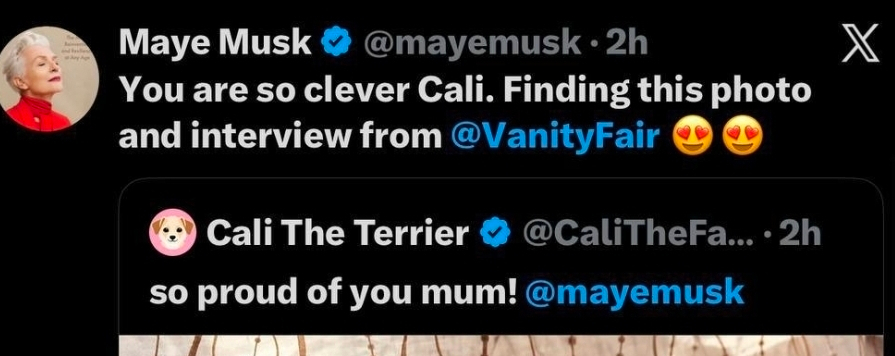
The timing surrounding the launch caught traders’ attention. Shortly after $CALI launched, Maye posted new content featuring Cali. Community accounts then documented Maye engaging with posts from the token’s official X account, followed by Maye publicly quoting the account itself.
https://x.com/mayemusk/status/2101315383324012817?s=20
The story gained another layer when Elon Musk responded with a heart emoji to a post about Cali from Maye Musk. This is the first time Elon has replied to a dog post directly since Floki
https://x.com/elonmusk/status/2100938127908974979?s=20
For memecoin traders, the significance is less about a single interaction and more about the possibility of recurring attention.
Most new memecoins depend on a short-lived viral moment. A news story trends, a celebrity is mentioned, or a meme catches attention for a day before traders rotate elsewhere.
Cali is different in one important respect: Cali is Maye Musk’s actual dog.
That means the underlying subject of the meme can continue appearing naturally in Maye’s social media, interviews, book promotion and everyday content. Maye has already featured Cali in connection with TIMELESS, which was released on September 15, 2026.
That creates the possibility of what some traders are calling a renewable attention loop.
Every new Cali post can bring attention back to $CALI. Additional engagement from Maye can strengthen the association. And because Elon Musk occasionally interacts with his mother’s posts, traders are watching closely for further organic exposure.
There is also an economic angle behind the narrative.
Community posts surrounding the project state that trading fees generated by $CALI are being directed to Maye Musk through X-related payment infrastructure. Telegram posts promoting the token have repeatedly highlighted this feature.
If those payments continue growing alongside trading activity, they could become another recurring reason for Maye to notice or discuss the project. Any future public acknowledgment of those payments would likely draw additional attention to both the token and the payment mechanism being used.
None of that guarantees further engagement from Maye or Elon Musk, and neither has publicly endorsed $CALI as an investment.
What has already happened, however, is unusual.
A memecoin built around Maye Musk’s dog launched. Maye subsequently posted Cali, interacted repeatedly with content connected to the project and publicly quoted the token’s official account. Elon Musk then interacted with a Cali-related post.
In a memecoin market where thousands of tokens compete for increasingly fragmented attention, that degree of organic proximity to the people behind the narrative is rare.
The comparison traders will inevitably make is with earlier dog-themed cryptocurrencies.
Dogecoin became one of the largest memecoins in history after years of cultural momentum and repeated attention from Elon Musk. Floki similarly built its original narrative around Musk’s Shiba Inu named Floki.
The comparison should not be interpreted as a prediction that $CALI will follow the same valuation path. But it helps explain why traders are paying attention.
Cali has that simplicity.
She is Maye Musk’s dog.
Maye is publicly engaging with the story.
Elon has already interacted with a Cali post.
And the token has created an economic mechanism intended to connect trading activity directly back to Maye.
That combination gives $CALI something most new memecoins lack: a narrative capable of resurfacing repeatedly instead of depending on a single viral moment.
Whether that attention develops into a lasting crypto brand remains to be seen.
But for traders watching the current memecoin market, the key question is no longer whether Maye Musk will notice Cali.
She already has.
The question now is how far that attention can travel.
$CALI contract address:
8k4sBtEeK4pf26noKqApv8NBTnuSJcbdwpKYknk5PbAA
X : https://x.com/CaliTheFanpage
Website: https://califanpage.com/
Disclaimer: This article is for informational purposes only and does not constitute financial advice. Memecoins are highly speculative and can experience extreme volatility.
CALI Gains Attention After Maye Musk Engages With Token’s Official Account and Elon Musk Interacts..
A new Solana memecoin centered around Maye Musk’s dog, Cali, is drawing attention after a series of public interactions from Maye Musk and Elon Musk helped turn a simple dog narrative into one of the more closely watched meme stories of the week.
The token, $CALI, launched around the identity of Cali, one of Maye Musk’s dogs. What initially looked like another dog-themed memecoin quickly gained visibility after Maye began publicly posting about Cali again and engaging with content connected to the token.
Maye Musk has previously described Cali and her other dog, DelRey, as her companions, including in posts promoting her new book, TIMELESS.
The timing surrounding the launch caught traders’ attention. Shortly after $CALI launched, Maye posted new content featuring Cali. Community accounts then documented Maye engaging with posts from the token’s official X account, followed by Maye publicly quoting the account itself.
https://x.com/mayemusk/status/2101315383324012817?s=20
The story gained another layer when Elon Musk responded with a heart emoji to a post about Cali from Maye Musk. This is the first time Elon has replied to a dog post directly since Floki
https://x.com/elonmusk/status/2100938127908974979?s=20
For memecoin traders, the significance is less about a single interaction and more about the possibility of recurring attention.
Most new memecoins depend on a short-lived viral moment. A news story trends, a celebrity is mentioned, or a meme catches attention for a day before traders rotate elsewhere.
Cali is different in one important respect: Cali is Maye Musk’s actual dog.
That means the underlying subject of the meme can continue appearing naturally in Maye’s social media, interviews, book promotion and everyday content. Maye has already featured Cali in connection with TIMELESS, which was released on September 15, 2026.
That creates the possibility of what some traders are calling a renewable attention loop.
Every new Cali post can bring attention back to $CALI. Additional engagement from Maye can strengthen the association. And because Elon Musk occasionally interacts with his mother’s posts, traders are watching closely for further organic exposure.
There is also an economic angle behind the narrative.
Community posts surrounding the project state that trading fees generated by $CALI are being directed to Maye Musk through X-related payment infrastructure. Telegram posts promoting the token have repeatedly highlighted this feature.
If those payments continue growing alongside trading activity, they could become another recurring reason for Maye to notice or discuss the project. Any future public acknowledgment of those payments would likely draw additional attention to both the token and the payment mechanism being used.
None of that guarantees further engagement from Maye or Elon Musk, and neither has publicly endorsed $CALI as an investment.
What has already happened, however, is unusual.
A memecoin built around Maye Musk’s dog launched. Maye subsequently posted Cali, interacted repeatedly with content connected to the project and publicly quoted the token’s official account. Elon Musk then interacted with a Cali-related post.
In a memecoin market where thousands of tokens compete for increasingly fragmented attention, that degree of organic proximity to the people behind the narrative is rare.
The comparison traders will inevitably make is with earlier dog-themed cryptocurrencies.
Dogecoin became one of the largest memecoins in history after years of cultural momentum and repeated attention from Elon Musk. Floki similarly built its original narrative around Musk’s Shiba Inu named Floki.
The comparison should not be interpreted as a prediction that $CALI will follow the same valuation path. But it helps explain why traders are paying attention.
Cali has that simplicity.
She is Maye Musk’s dog.
Maye is publicly engaging with the story.
Elon has already interacted with a Cali post.
And the token has created an economic mechanism intended to connect trading activity directly back to Maye.
That combination gives $CALI something most new memecoins lack: a narrative capable of resurfacing repeatedly instead of depending on a single viral moment.
Whether that attention develops into a lasting crypto brand remains to be seen.
But for traders watching the current memecoin market, the key question is no longer whether Maye Musk will notice Cali.
She already has.
The question now is how far that attention can travel.
$CALI contract address:
8k4sBtEeK4pf26noKqApv8NBTnuSJcbdwpKYknk5PbAA
X : https://x.com/CaliTheFanpage
Website: https://califanpage.com/
Disclaimer: This article is for informational purposes only and does not constitute financial advice. Memecoins are highly speculative and can experience extreme volatility.
127
1.4k
Article
$DEOD Price Outlook: Can the Next Exchange Listing Push $DEOD Toward $0.08?$DEOD Price Outlook: Can the Next Exchange Listing Push $DEOD Toward $0.08?
Key takeaways:
$DEOD reached $0.05 following its September 11 Poloniex listing, after previous exchange launches also generated significant market activity.
Decentrawood has announced another exchange listing for October 2, 2026, with the exchange name yet to be revealed.
The ecosystem continues to expand beyond trading through AI agents, gaming, staking, DAO governance and NFTs.
$DEOD has also become accessible through Coinbase Web3 Exchange, providing another route for users to access the token.
The ongoing Eco-Warriors campaign connects real-world tree planting with NFT minting and offers up to 50,000 DEOD in rewards.
The Decentrawood ($DEOD) ecosystem has entered another important period following a strong September.
$DEOD officially began trading on Poloniex on September 11, 2026. The listing attracted considerable attention, with the token reaching $0.05 during the market move.
However, Poloniex is no longer the final exchange event on the calendar.
Decentrawood has confirmed another exchange listing for October 2, creating a new catalyst for the token as the ecosystem continues to expand across trading, AI, gaming, staking, governance and community-focused products.
$DEOD exchange performance
Exchange listings have been one of the most visible catalysts for $DEOD throughout 2026.
Previous listings were followed by the following reported market moves:
CoinDCX — 147% in June
WEEX — 54% in July
BingX — 67% in August
The next major milestone came with Poloniex in September, when $DEOD reached the $0.05 level following the listing.
The sequence has helped bring additional attention to the token, although previous performance does not guarantee similar results from future listings.
With another exchange scheduled for October 2, market participants are now watching whether trading activity can increase again ahead of the announcement.
$DEOD trading activity after Poloniex
The Poloniex launch was accompanied by notable trading activity across Decentrawood's existing markets.
During the 24-hour period highlighted by the project, trading volumes included:
Toobit — $1.17M+
MEXC — $1M+
BingX — $268K+
PancakeSwap — $143K+
WEEX — $87K+
Poloniex also became the latest live market for the token.
This gave $DEOD broader exchange coverage while increasing the number of venues through which traders could access the asset.
October 2 becomes the next major date
Following the Poloniex listing, attention has shifted toward October 2, 2026.
Decentrawood has announced that another exchange listing is coming on that date, although the exchange itself has not yet been disclosed.
That creates a different setup from September.
Before Poloniex, traders were waiting for an already announced exchange launch. This time, the market is also waiting to discover which exchange will list $DEOD next.
The Poloniex move to $0.05 provides historical context, but it should not automatically be treated as a target for the October listing. Crypto prices can react differently depending on liquidity, Bitcoin's direction, overall market sentiment and the size of the exchange involved.
$DEOD expands through Coinbase Web3 Exchange
Decentrawood has also announced another development in token accessibility.
$DEOD is now available through Coinbase Web3 Exchange, giving Web3 users another route to access the asset.
Users can open Coinbase Wallet, search for DEOD, select USDT on BNB Chain and access the corresponding trading route.
This should be distinguished from a conventional Coinbase spot listing. Nevertheless, it expands the number of ways users can interact with $DEOD.
Decentrawood Eco-Warriors campaign goes live
Price and exchange developments are only one side of the recent Decentrawood activity.
The ecosystem has also introduced its Eco-Warriors campaign, which combines real-world environmental action with NFTs and $DEOD rewards.
The process is straightforward:
Plant a tree → Take a selfie → Mint an NFT
The campaign is scheduled to continue until October 15, 2026.
Eco-Warriors rewards
The announced rewards include:
1st prize — 50,000 DEOD
2nd prize — 20,000 DEOD
3rd prize — 5,000 DEOD
Consolation reward — 500 DEOD
Users participate by connecting a wallet, signing up, uploading their tree-planting photo and minting an Eco-Warriors NFT.
The initiative gives Decentrawood another community-focused use case beyond trading and attempts to connect blockchain participation with real-world activity.
Decentrawood ecosystem continues to expand
The broader Decentrawood ecosystem now extends beyond $DEOD exchange listings.
Its current development areas include AI agents, gaming, staking, DAO governance and NFTs.
Decentrawood's Healthcare AI Task Agent is one example of its AI direction. The system allows healthcare organizations to create Telegram-based assistants that can provide information related to doctors, appointments, specialties, services and consultation timings.
The platform has also introduced decentralized governance through the Decentrawood DAO, allowing community members to participate in proposals and voting around selected ecosystem decisions.
Gaming adds another user-facing component, while staking provides another mechanism for participating in the $DEOD economy.
The strategy appears to be centered around connecting multiple products through a single ecosystem rather than depending entirely on exchange activity.
$DEOD price outlook
$DEOD's move to $0.05 during the Poloniex listing period has established an important recent reference point for traders.
The next question is whether the October 2 listing can generate another period of increased demand and trading activity.
Previous exchange events provide some historical context:
June — CoinDCX: +147%
July — WEEX: +54%
August — BingX: +67%
September — Poloniex: $0.05 reached
October — New exchange listing scheduled
The next market reaction will depend on several factors, including the exchange being announced, liquidity, broader crypto conditions and demand for $DEOD.
What comes next for $DEOD?
October is shaping up to be another active month for Decentrawood.
The next exchange listing arrives on October 2, while the Eco-Warriors campaign continues until October 15. At the same time, $DEOD has expanded its accessibility through Poloniex and Coinbase Web3 Exchange.
The difference compared with earlier listing periods is that Decentrawood now has more ecosystem components operating alongside the token.
AI agents provide utility. Gaming provides user activity. Staking adds token participation. DAO governance gives the community a role in decision-making. NFTs and Eco-Warriors introduce another engagement layer.
For $DEOD, October 2 is now the next date to watch.
Whether the token revisits or moves beyond its recent $0.05 level will ultimately be determined by market demand rather than previous listing performance.
Previous price movements, trading volumes and potential price levels are provided for market commentary only. Cryptocurrency markets are highly volatile, and past performance does not guarantee future results. This article does not constitute financial advice.
$DEOD Price Outlook: Can the Next Exchange Listing Push $DEOD Toward $0.08?
$DEOD Price Outlook: Can the Next Exchange Listing Push $DEOD Toward $0.08?
Key takeaways:
$DEOD reached $0.05 following its September 11 Poloniex listing, after previous exchange launches also generated significant market activity.
Decentrawood has announced another exchange listing for October 2, 2026, with the exchange name yet to be revealed.
The ecosystem continues to expand beyond trading through AI agents, gaming, staking, DAO governance and NFTs.
$DEOD has also become accessible through Coinbase Web3 Exchange, providing another route for users to access the token.
The ongoing Eco-Warriors campaign connects real-world tree planting with NFT minting and offers up to 50,000 DEOD in rewards.
The Decentrawood ($DEOD) ecosystem has entered another important period following a strong September.
$DEOD officially began trading on Poloniex on September 11, 2026. The listing attracted considerable attention, with the token reaching $0.05 during the market move.
However, Poloniex is no longer the final exchange event on the calendar.
Decentrawood has confirmed another exchange listing for October 2, creating a new catalyst for the token as the ecosystem continues to expand across trading, AI, gaming, staking, governance and community-focused products.
$DEOD exchange performance
Exchange listings have been one of the most visible catalysts for $DEOD throughout 2026.
Previous listings were followed by the following reported market moves:
CoinDCX — 147% in June
WEEX — 54% in July
BingX — 67% in August
The next major milestone came with Poloniex in September, when $DEOD reached the $0.05 level following the listing.
The sequence has helped bring additional attention to the token, although previous performance does not guarantee similar results from future listings.
With another exchange scheduled for October 2, market participants are now watching whether trading activity can increase again ahead of the announcement.
$DEOD trading activity after Poloniex
The Poloniex launch was accompanied by notable trading activity across Decentrawood's existing markets.
During the 24-hour period highlighted by the project, trading volumes included:
Toobit — $1.17M+
MEXC — $1M+
BingX — $268K+
PancakeSwap — $143K+
WEEX — $87K+
Poloniex also became the latest live market for the token.
This gave $DEOD broader exchange coverage while increasing the number of venues through which traders could access the asset.
October 2 becomes the next major date
Following the Poloniex listing, attention has shifted toward October 2, 2026.
Decentrawood has announced that another exchange listing is coming on that date, although the exchange itself has not yet been disclosed.
That creates a different setup from September.
Before Poloniex, traders were waiting for an already announced exchange launch. This time, the market is also waiting to discover which exchange will list $DEOD next.
The Poloniex move to $0.05 provides historical context, but it should not automatically be treated as a target for the October listing. Crypto prices can react differently depending on liquidity, Bitcoin's direction, overall market sentiment and the size of the exchange involved.
$DEOD expands through Coinbase Web3 Exchange
Decentrawood has also announced another development in token accessibility.
$DEOD is now available through Coinbase Web3 Exchange, giving Web3 users another route to access the asset.
Users can open Coinbase Wallet, search for DEOD, select USDT on BNB Chain and access the corresponding trading route.
This should be distinguished from a conventional Coinbase spot listing. Nevertheless, it expands the number of ways users can interact with $DEOD.
Decentrawood Eco-Warriors campaign goes live
Price and exchange developments are only one side of the recent Decentrawood activity.
The ecosystem has also introduced its Eco-Warriors campaign, which combines real-world environmental action with NFTs and $DEOD rewards.
The process is straightforward:
Plant a tree → Take a selfie → Mint an NFT
The campaign is scheduled to continue until October 15, 2026.
Eco-Warriors rewards
The announced rewards include:
1st prize — 50,000 DEOD
2nd prize — 20,000 DEOD
3rd prize — 5,000 DEOD
Consolation reward — 500 DEOD
Users participate by connecting a wallet, signing up, uploading their tree-planting photo and minting an Eco-Warriors NFT.
The initiative gives Decentrawood another community-focused use case beyond trading and attempts to connect blockchain participation with real-world activity.
Decentrawood ecosystem continues to expand
The broader Decentrawood ecosystem now extends beyond $DEOD exchange listings.
Its current development areas include AI agents, gaming, staking, DAO governance and NFTs.
Decentrawood's Healthcare AI Task Agent is one example of its AI direction. The system allows healthcare organizations to create Telegram-based assistants that can provide information related to doctors, appointments, specialties, services and consultation timings.
The platform has also introduced decentralized governance through the Decentrawood DAO, allowing community members to participate in proposals and voting around selected ecosystem decisions.
Gaming adds another user-facing component, while staking provides another mechanism for participating in the $DEOD economy.
The strategy appears to be centered around connecting multiple products through a single ecosystem rather than depending entirely on exchange activity.
$DEOD price outlook
$DEOD's move to $0.05 during the Poloniex listing period has established an important recent reference point for traders.
The next question is whether the October 2 listing can generate another period of increased demand and trading activity.
Previous exchange events provide some historical context:
June — CoinDCX: +147%
July — WEEX: +54%
August — BingX: +67%
September — Poloniex: $0.05 reached
October — New exchange listing scheduled
The next market reaction will depend on several factors, including the exchange being announced, liquidity, broader crypto conditions and demand for $DEOD.
What comes next for $DEOD?
October is shaping up to be another active month for Decentrawood.
The next exchange listing arrives on October 2, while the Eco-Warriors campaign continues until October 15. At the same time, $DEOD has expanded its accessibility through Poloniex and Coinbase Web3 Exchange.
The difference compared with earlier listing periods is that Decentrawood now has more ecosystem components operating alongside the token.
AI agents provide utility. Gaming provides user activity. Staking adds token participation. DAO governance gives the community a role in decision-making. NFTs and Eco-Warriors introduce another engagement layer.
For $DEOD, October 2 is now the next date to watch.
Whether the token revisits or moves beyond its recent $0.05 level will ultimately be determined by market demand rather than previous listing performance.
Previous price movements, trading volumes and potential price levels are provided for market commentary only. Cryptocurrency markets are highly volatile, and past performance does not guarantee future results. This article does not constitute financial advice.
163
239
Verified

Article
Aevolis Grid: Exploring the Infrastructure Behind Web3 ApplicationsSolana is preparing to increase the maximum size of a single transaction from 1,232 bytes to 4,096 bytes. The change is designed to make more complex operations, including zero-knowledge proofs, larger multisig transactions, and batch operations, easier to handle within a single transaction.
At first glance, this may look like a simple technical improvement. But it highlights a broader point about blockchain infrastructure.
As networks become capable of handling more complex workloads, the infrastructure surrounding them also needs to evolve. Applications still require computing power, storage, bandwidth, indexing, and reliable access to data. Smart contracts are only one part of the overall Web3 technology stack.
This is where projects such as Aevolis Grid are interesting to examine.
Aevolis Grid is focused on connecting distributed computing, storage, and network resources and making those resources available to Web3 applications.
For example, a blockchain game may temporarily require additional computing capacity during a major event. A social application may need significant storage for media. A data platform may need resources to process and organize historical blockchain information.
Traditionally, developers can obtain these resources from different providers and manage each service separately. A decentralized resource network takes a different approach by attempting to coordinate available resources through a common infrastructure layer.
The interesting part is not simply connecting more devices. Reliability also matters.
Computing tasks need to produce verifiable results. Storage providers need mechanisms to demonstrate that data remains available. Network services need to consider factors such as latency and performance. Historical performance can also help distinguish consistently reliable nodes from unstable ones.
According to the project's model, AEVGD is used within the network for resource-related settlement and incentives between resource providers and users.
The potential applications are broad, including data indexing, content delivery, blockchain gaming, social applications, storage, and general-purpose computing.
However, the important question is not simply how many nodes or resources a network has. The more meaningful indicators will be actual usage, completed workloads, application integrations, resource reliability, and sustained demand.
That is what I would watch as Aevolis Grid develops further.
The broader trend is worth following: as Web3 applications become more sophisticated, the infrastructure underneath them will matter just as much as the blockchains themselves.
Aevolis Grid: Exploring the Infrastructure Behind Web3 Applications
Solana is preparing to increase the maximum size of a single transaction from 1,232 bytes to 4,096 bytes. The change is designed to make more complex operations, including zero-knowledge proofs, larger multisig transactions, and batch operations, easier to handle within a single transaction.
At first glance, this may look like a simple technical improvement. But it highlights a broader point about blockchain infrastructure.
As networks become capable of handling more complex workloads, the infrastructure surrounding them also needs to evolve. Applications still require computing power, storage, bandwidth, indexing, and reliable access to data. Smart contracts are only one part of the overall Web3 technology stack.
This is where projects such as Aevolis Grid are interesting to examine.
Aevolis Grid is focused on connecting distributed computing, storage, and network resources and making those resources available to Web3 applications.
For example, a blockchain game may temporarily require additional computing capacity during a major event. A social application may need significant storage for media. A data platform may need resources to process and organize historical blockchain information.
Traditionally, developers can obtain these resources from different providers and manage each service separately. A decentralized resource network takes a different approach by attempting to coordinate available resources through a common infrastructure layer.
The interesting part is not simply connecting more devices. Reliability also matters.
Computing tasks need to produce verifiable results. Storage providers need mechanisms to demonstrate that data remains available. Network services need to consider factors such as latency and performance. Historical performance can also help distinguish consistently reliable nodes from unstable ones.
According to the project's model, AEVGD is used within the network for resource-related settlement and incentives between resource providers and users.
The potential applications are broad, including data indexing, content delivery, blockchain gaming, social applications, storage, and general-purpose computing.
However, the important question is not simply how many nodes or resources a network has. The more meaningful indicators will be actual usage, completed workloads, application integrations, resource reliability, and sustained demand.
That is what I would watch as Aevolis Grid develops further.
The broader trend is worth following: as Web3 applications become more sophisticated, the infrastructure underneath them will matter just as much as the blockchains themselves.
37
120
392
1.3k
🤝 Built together, grown together. 149 partner nodes collaborate to shape the Goyur Data ecosystem, sharing in its progress and long-term expansion.
🤝 Built together, grown together. 149 partner nodes collaborate to shape the Goyur Data ecosystem, sharing in its progress and long-term expansion.

9
145
Everyone will search for “the $PEPE of Robinhood Chain.”
Maybe that framing is wrong.
Maybe Robinhood Chain doesn’t need another PEPE.
Maybe it needs its own character.
Its own ticker.
Its own identity.
$ROBIN makes a lot more sense when you look at it that way.
CA: 0x11B70d0243baf75E85CE03201A92b5B7C33BEB59
Maybe that framing is wrong.
Maybe Robinhood Chain doesn’t need another PEPE.
Maybe it needs its own character.
Its own ticker.
Its own identity.
$ROBIN makes a lot more sense when you look at it that way.
CA: 0x11B70d0243baf75E85CE03201A92b5B7C33BEB59

8
155
PEPE wasn’t valuable because nobody else had ever launched a Pepe token.
Quite the opposite.
There were thousands.
One eventually absorbed the attention and became THE PEPE.
I think that’s the question with Flork now.
Which token becomes THE $FLORK?
CA: 0xf40592daacb3e5abf358789f5688c0b4f64d7777
PEPE wasn’t valuable because nobody else had ever launched a Pepe token.
Quite the opposite.
There were thousands.
One eventually absorbed the attention and became THE PEPE.
I think that’s the question with Flork now.
Which token becomes THE $FLORK?
CA: 0xf40592daacb3e5abf358789f5688c0b4f64d7777
Quite the opposite.
There were thousands.
One eventually absorbed the attention and became THE PEPE.
I think that’s the question with Flork now.
Which token becomes THE $FLORK?
CA: 0xf40592daacb3e5abf358789f5688c0b4f64d7777

1
9
274

Article
GOBBLVERSE: Exploring a Community-Driven Web3 EcosystemGOBBLVERSE is building a community-focused ecosystem around the $GOBBL token, combining digital culture, gaming, achievements, and community participation within a unified environment.
The ecosystem includes features such as:
• Community-driven activities and discussions
• XP and achievement systems
• Arcade-based experiences
• Meme and creative culture
• Ongoing community engagement
The project aims to develop an interactive environment where users can participate, explore, and contribute to the broader GOBBLVERSE ecosystem.
Token: $GOBBL
Contract Address: AtSWgYgKrAwSkmPsRdnWcmk762d9ptTjJjw6mphQpump
GOBBLVERSE: Exploring a Community-Driven Web3 Ecosystem
GOBBLVERSE is building a community-focused ecosystem around the $GOBBL token, combining digital culture, gaming, achievements, and community participation within a unified environment.
The ecosystem includes features such as:
• Community-driven activities and discussions
• XP and achievement systems
• Arcade-based experiences
• Meme and creative culture
• Ongoing community engagement
The project aims to develop an interactive environment where users can participate, explore, and contribute to the broader GOBBLVERSE ecosystem.
Token: $GOBBL
Contract Address: AtSWgYgKrAwSkmPsRdnWcmk762d9ptTjJjw6mphQpump
8
133

Article
DGK and Muiden S.A., a mining farm in Hernandarias, Paraguay, have officially entered into a deep..DGK and Muiden S.A., a mining farm in Hernandarias, Paraguay, have officially entered into a deep strategic partnership.
DGK and Muiden S.A., a mining farm in Hernandarias, Paraguay, have officially entered into a deep strategic partnership. The two companies will jointly develop cloud computing power for mining nodes, with Muiden S.A. providing physical Bitcoin computing power as the underlying support.
This collaboration aims to bridge the gap between physical mining farm resources and cloud computing networks, promoting the digital upgrade and globalization of computing infrastructure.
DGK and Muiden S.A., a mining farm in Hernandarias, Paraguay, have officially entered into a deep..
DGK and Muiden S.A., a mining farm in Hernandarias, Paraguay, have officially entered into a deep strategic partnership.
DGK and Muiden S.A., a mining farm in Hernandarias, Paraguay, have officially entered into a deep strategic partnership. The two companies will jointly develop cloud computing power for mining nodes, with Muiden S.A. providing physical Bitcoin computing power as the underlying support.
This collaboration aims to bridge the gap between physical mining farm resources and cloud computing networks, promoting the digital upgrade and globalization of computing infrastructure.
7
106

Article
There’s a little-known Simpsons chapter in Binance history. 🟡There’s a little-known Simpsons chapter in Binance history. 🟡
The story goes back to 2014, when CZ and Yi He first crossed paths at OKCoin.
Three years later, they would go on to co-found Binance and build one of crypto’s most recognizable institutions.
But behind the scenes, things were a little less corporate.
CZ was known internally as “Homer,” while Yi He went by “Marge” or “Marjorie” — aliases inspired by The Simpsons. The nicknames became part of Binance culture, with Yi He still identifying as “Marjorie" internally today.
The most colourful piece of crypto law we've had in a long time, this story offers a behind the scenes look into crypto's biggest institution and its two biggest and most powerful personalities.
Two fun-loving founders, bound by their Simpsons aliases.
One very yellow chapter of crypto history. 🟡
Before CZ became one of the biggest names in crypto, inside Binance he was Homer.
Now Homer is onchain.
There’s a little-known Simpsons chapter in Binance history. 🟡
There’s a little-known Simpsons chapter in Binance history. 🟡
The story goes back to 2014, when CZ and Yi He first crossed paths at OKCoin.
Three years later, they would go on to co-found Binance and build one of crypto’s most recognizable institutions.
But behind the scenes, things were a little less corporate.
CZ was known internally as “Homer,” while Yi He went by “Marge” or “Marjorie” — aliases inspired by The Simpsons. The nicknames became part of Binance culture, with Yi He still identifying as “Marjorie" internally today.
The most colourful piece of crypto law we've had in a long time, this story offers a behind the scenes look into crypto's biggest institution and its two biggest and most powerful personalities.
Two fun-loving founders, bound by their Simpsons aliases.
One very yellow chapter of crypto history. 🟡
Before CZ became one of the biggest names in crypto, inside Binance he was Homer.
Now Homer is onchain.
1
1
11
193
🧮 $ZIL23 remains retest-driven, while repeated tests of local levels continue to map where supply and demand are interacting. Volume is stronger on rejection candles than in the middle of the range, so sustained participation matters more than the size of any isolated impulse candle. The developing swing pattern becomes more informative when price either accepts beyond a level or rejects it on repeated tests. Risk interpretation remains centered on whether a move is supported by participation and whether reclaimed or lost levels hold on retest.
🧮 $ZIL23 remains retest-driven, while repeated tests of local levels continue to map where supply and demand are interacting. Volume is stronger on rejection candles than in the middle of the range, so sustained participation matters more than the size of any isolated impulse candle. The developing swing pattern becomes more informative when price either accepts beyond a level or rejects it on repeated tests. Risk interpretation remains centered on whether a move is supported by participation and whether reclaimed or lost levels hold on retest.
22
22
🔭 $ICX23 continues under liquidity-sensitive conditions, with nearby pivots acting as the main reference for acceptance and rejection. Participation is uneven across recent sessions, making follow-through especially important when price tests established support or resistance. Recent swing points remain the key reference because their treatment can distinguish continuation from exhaustion or failed expansion. Liquidity behavior and post-break execution remain the main variables for judging whether the current condition is evolving.
🔭 $ICX23 continues under liquidity-sensitive conditions, with nearby pivots acting as the main reference for acceptance and rejection. Participation is uneven across recent sessions, making follow-through especially important when price tests established support or resistance. Recent swing points remain the key reference because their treatment can distinguish continuation from exhaustion or failed expansion. Liquidity behavior and post-break execution remain the main variables for judging whether the current condition is evolving.
20
20
🌀 $XTZ23 is moving through a swing-driven setup, with the latest high-low sequence defining the active short-term structure. Volume appears more active near recent swing points, which places greater weight on closing behavior near the boundaries of the current range. The developing swing pattern becomes more informative when price either accepts beyond a level or rejects it on repeated tests. The next meaningful read comes from how volatility and participation behave after another test of the range boundary.
🌀 $XTZ23 is moving through a swing-driven setup, with the latest high-low sequence defining the active short-term structure. Volume appears more active near recent swing points, which places greater weight on closing behavior near the boundaries of the current range. The developing swing pattern becomes more informative when price either accepts beyond a level or rejects it on repeated tests. The next meaningful read comes from how volatility and participation behave after another test of the range boundary.
11
11
Log in to explore more content
Join global crypto users on Binance Square
⚡️ Get latest and useful information about crypto.
💬 Trusted by the world’s largest crypto exchange.
👍 Discover real insights from verified creators.
Email / Phone number
Trending Topics
HuangRisksOusterOverReportedAffairWithSubordinate
15,594 views
276 Discussing
Nvidia Board Meets to Decide Jensen Huang's Future as Crisis Deepens
Binance News
·15 Likes
·11.7k views
AnthropicRejectsIPODelayValuationinQuestion
448,181 views
3,771 Discussing
CoreWeaveJumps10%On168%RevenueGrowth
55,092 views
763 Discussing