
CryptoStas
7 Posts

CryptoStas
Report
Block User
BINANCE ANGEL👀 P2P MERCHANT
5 Following
9 Followers
14 Liked
Posts
PINNED
·
--
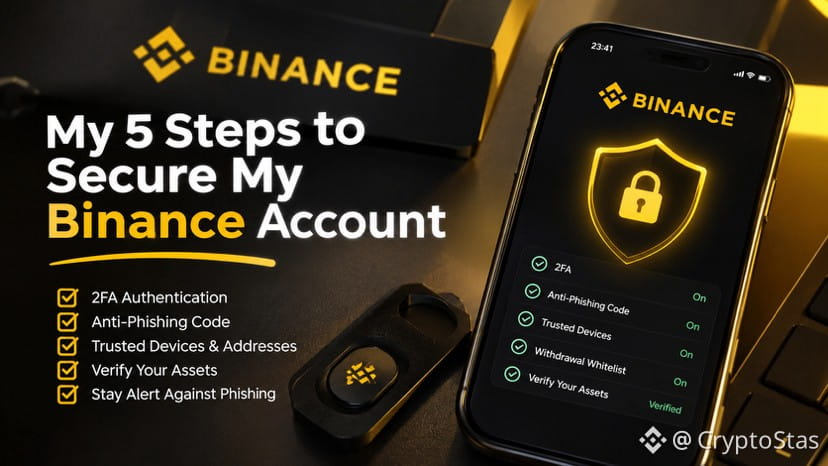
🛡️ My 5 Steps to Secure My Binance Account
Crypto security is not optional. Protecting your assets starts with good daily habits.
Here are 5 steps I follow:
1️⃣ Enable 2FA
I use two-factor authentication to add an extra layer of protection, even if someone discovers my password.
2️⃣ Anti-Phishing Code
I use a personal anti-phishing code to identify genuine Binance emails and avoid phishing attempts.
3️⃣ Manage Trusted Devices
I regularly review devices connected to my account and manage my withdrawal address whitelist.
4️⃣ Verify Your Assets – Proof of Reserves
I use Binance’s Proof of Reserves page:
https://www.binance.com/en/proof-of-reserves
With Verify Your Assets, I can independently check whether my holdings are included in Binance’s Proof of Reserves. This adds transparency and peace of mind.
5️⃣ Avoid Phishing Links
I never share verification codes or click suspicious links. I always access Binance through official channels.
Final advice:
Don’t wait for a security incident to protect your crypto. Review your settings regularly and stay alert.
#ThankYouBinancians #BinanceAngels #CryptoSecurity

Best Wishes!
From CryptoStas
1
1
·
--
Article
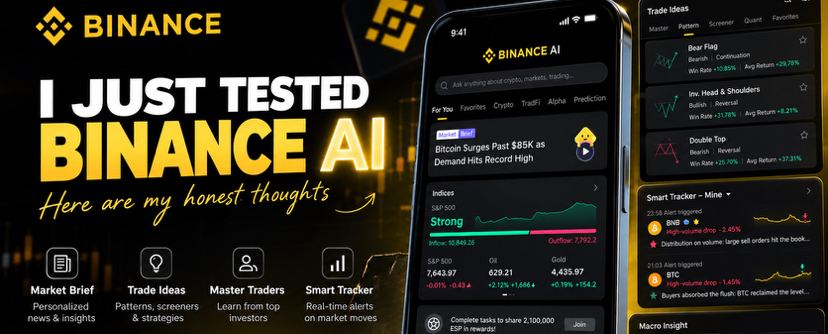
BINANCE AII just tested Binance AI — and here’s what caught my attention.
As someone involved in crypto P2P, I don’t look at the market through price charts alone. Liquidity, volatility, market sentiment, and timing all matter.
That’s why I’m interested in what Binance Intelligence brings together.
🔎 Market Brief — a way to catch up on market developments without jumping between multiple sources.
📊 Trade Ideas — patterns, screeners, and quantitative strategies that can help turn observations into testable trading hypotheses.
🧠 Master Traders — an opportunity to explore investor portfolios and understand how different approaches to capital allocation work.
🔔 Smart Tracker — a useful concept for keeping an eye on significant market moves without staring at charts all day.
My biggest takeaway: AI is most valuable when it helps reduce research time, organize information, and uncover questions worth investigating.
But there’s a line I wouldn’t cross: a historical win rate isn’t a guarantee of future performance, and a trading signal isn’t a substitute for risk management.
I’d still want to verify the data, understand the methodology, and test any strategy before putting capital at risk.
For me, the real question isn’t whether AI can predict every move.
It’s whether it can help me research faster, see the market from a different angle, and make better-informed decisions.
That’s what I want to explore next.
What would you test first: Market Brief, Trade Ideas, or Master Traders?
@Binance_Angels #BinanceAI #BİNANCE #CryptoTrading #CryptoResearch
BINANCE AI
I just tested Binance AI — and here’s what caught my attention.
As someone involved in crypto P2P, I don’t look at the market through price charts alone. Liquidity, volatility, market sentiment, and timing all matter.
That’s why I’m interested in what Binance Intelligence brings together.
🔎 Market Brief — a way to catch up on market developments without jumping between multiple sources.
📊 Trade Ideas — patterns, screeners, and quantitative strategies that can help turn observations into testable trading hypotheses.
🧠 Master Traders — an opportunity to explore investor portfolios and understand how different approaches to capital allocation work.
🔔 Smart Tracker — a useful concept for keeping an eye on significant market moves without staring at charts all day.
My biggest takeaway: AI is most valuable when it helps reduce research time, organize information, and uncover questions worth investigating.
But there’s a line I wouldn’t cross: a historical win rate isn’t a guarantee of future performance, and a trading signal isn’t a substitute for risk management.
I’d still want to verify the data, understand the methodology, and test any strategy before putting capital at risk.
For me, the real question isn’t whether AI can predict every move.
It’s whether it can help me research faster, see the market from a different angle, and make better-informed decisions.
That’s what I want to explore next.
What would you test first: Market Brief, Trade Ideas, or Master Traders?
@Binance Angels #BinanceAI #BİNANCE #CryptoTrading #CryptoResearch
1
99
·
--
My Binance Weekend Starter Pack
Weekends are for relaxing, but the crypto market never sleeps.
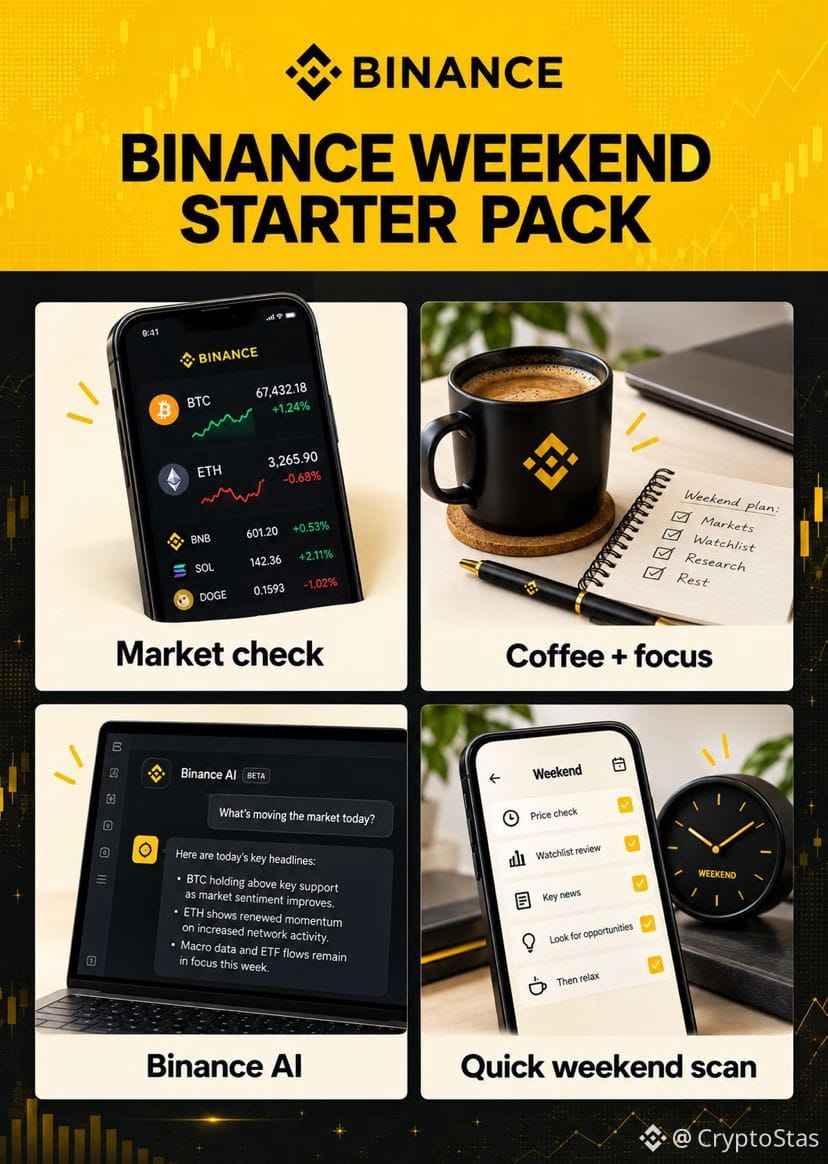
Here's my Binance Weekend Starter Pack:
📊 Market check — I start by checking BTC, ETH and overall market movements.
☕ Coffee & focus — A quiet moment to review the market and plan my weekend.
🤖 Binance AI — My go-to Binance product over the weekend. I use it to get quick market insights, explore what's moving and better understand market trends without spending hours browsing multiple sources.
📱 Quick weekend scan — A short check of market developments and my watchlist, then back to enjoying the weekend.
One platform, 24/7 access, and smarter market research.
What's in your weekend starter pack?
#BinanceWeekend #BinanceAngels #BinanceAI #Crypto @Binance_Angels
My Binance Weekend Starter Pack
Weekends are for relaxing, but the crypto market never sleeps.
Here's my Binance Weekend Starter Pack:
📊 Market check — I start by checking BTC, ETH and overall market movements.
☕ Coffee & focus — A quiet moment to review the market and plan my weekend.
🤖 Binance AI — My go-to Binance product over the weekend. I use it to get quick market insights, explore what's moving and better understand market trends without spending hours browsing multiple sources.
📱 Quick weekend scan — A short check of market developments and my watchlist, then back to enjoying the weekend.
One platform, 24/7 access, and smarter market research.
What's in your weekend starter pack?
#BinanceWeekend #BinanceAngels #BinanceAI #Crypto @Binance Angels
1
120
·
--
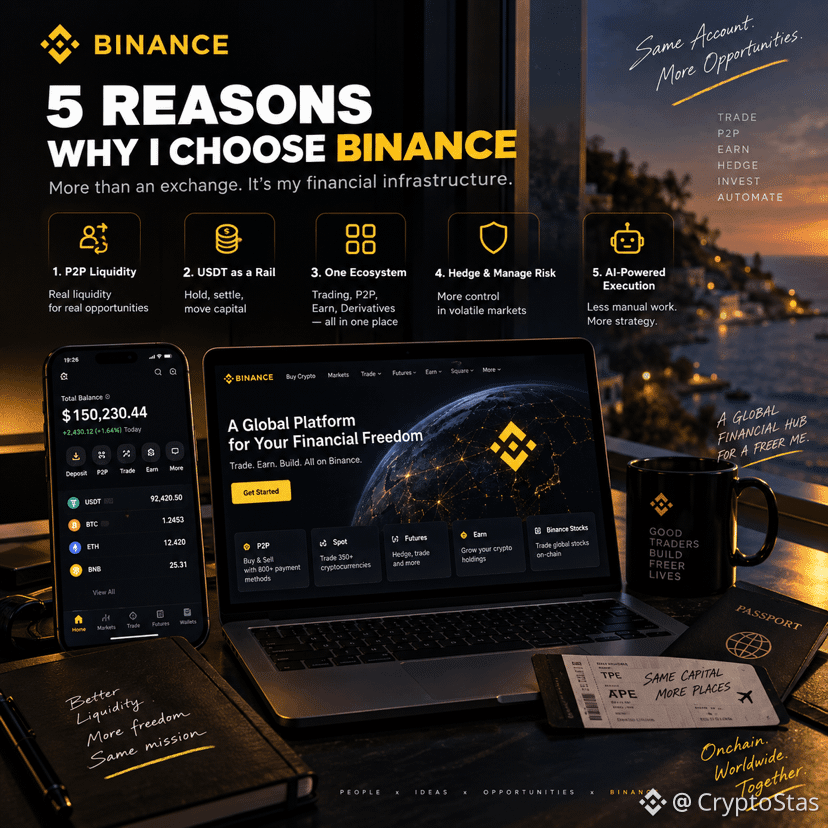
📣 5 Reasons Why I Choose Binance
After spending years around crypto P2P, I stopped looking at an exchange as just a place to trade.
For me, Binance is infrastructure.
I use it as part of my daily workflow — liquidity, USDT, P2P, risk management and moving capital where it needs to go.
Here are 5 reasons why I choose Binance 👇
1️⃣ P2P is where liquidity becomes real
In P2P, you don’t just need an asset.
You need liquidity at the right moment.
When you’re working with multiple transactions, counterparties and payment rails, having access to a deep marketplace makes a real difference.
For me, Binance P2P is not just a feature I occasionally open.
It’s part of the infrastructure I use when working with crypto.
2️⃣ USDT is my financial rail
In my P2P workflow, USDT is much more than a trading pair.
It is a way to hold liquidity, settle transactions and move capital between different operations.
Instead of constantly converting everything back into fiat, I can keep part of my working capital in a digital form that is native to the ecosystem I’m operating in.
That saves time — and in P2P, time is money.
3️⃣ One ecosystem makes P2P operations simpler
When you’re doing P2P seriously, fragmentation becomes expensive.
One app for liquidity.
Another for trading.
Another for hedging.
Another for moving funds.
I prefer having as much as possible under one roof.
Spot, P2P, derivatives, Earn and other tools being connected to the same account means fewer unnecessary transfers and fewer points of operational friction.
4️⃣ Hedging instead of blindly taking risk
P2P inventory can create exposure.
Sometimes I don’t want to completely close a position just because market conditions changed.
Derivatives can give me another option: hedge part of the exposure while keeping the underlying position.
For me, that’s a risk-management tool first — not simply a betting interface.
#WhyBinance
@Binance_Angels
#BinanceAngles
📣 5 Reasons Why I Choose Binance
After spending years around crypto P2P, I stopped looking at an exchange as just a place to trade.
For me, Binance is infrastructure.
I use it as part of my daily workflow — liquidity, USDT, P2P, risk management and moving capital where it needs to go.
Here are 5 reasons why I choose Binance 👇
1️⃣ P2P is where liquidity becomes real
In P2P, you don’t just need an asset.
You need liquidity at the right moment.
When you’re working with multiple transactions, counterparties and payment rails, having access to a deep marketplace makes a real difference.
For me, Binance P2P is not just a feature I occasionally open.
It’s part of the infrastructure I use when working with crypto.
2️⃣ USDT is my financial rail
In my P2P workflow, USDT is much more than a trading pair.
It is a way to hold liquidity, settle transactions and move capital between different operations.
Instead of constantly converting everything back into fiat, I can keep part of my working capital in a digital form that is native to the ecosystem I’m operating in.
That saves time — and in P2P, time is money.
3️⃣ One ecosystem makes P2P operations simpler
When you’re doing P2P seriously, fragmentation becomes expensive.
One app for liquidity.
Another for trading.
Another for hedging.
Another for moving funds.
I prefer having as much as possible under one roof.
Spot, P2P, derivatives, Earn and other tools being connected to the same account means fewer unnecessary transfers and fewer points of operational friction.
4️⃣ Hedging instead of blindly taking risk
P2P inventory can create exposure.
Sometimes I don’t want to completely close a position just because market conditions changed.
Derivatives can give me another option: hedge part of the exposure while keeping the underlying position.
For me, that’s a risk-management tool first — not simply a betting interface.
#WhyBinance
@Binance Angels
#BinanceAngles
2
103
Log in to explore more content
Join global crypto users on Binance Square
⚡️ Get latest and useful information about crypto.
💬 Trusted by the world’s largest crypto exchange.
👍 Discover real insights from verified creators.
Email / Phone number
Trending Topics
HuangExitNvidiaStrategyInFocus
101,275 views
1,117 Discussing
STOCKS | Nvidia’s Jensen Huang Resigns, Colette Kress Named as Interim CEO
Binance News
·28 Likes
·37.2k views
AnthropicRejectsIPODelayValuationinQuestion
707,739 views
5,351 Discussing
HedgeFundsCMEBitcoinNetShortsFall89%
0 views
19 Discussing