

Cryptopolitan
58.3k Posts

Cryptopolitan
 Square Verified+
Report
Block User
Crypto news that doesn't waste your time. Breaking updates, market analysis, on-chain insights. Building the smartest crypto community.

Creator of the Year
1 Following
161.5K+ Followers
573.4K+ Liked
1 Badges
Posts
PINNED
At Cryptopolitan, we research, analyze, and deliver news—daily.
From breaking updates to in-depth analysis, educational guides, and market insights, we’re here to keep you informed with neutral and authentic news.
Thank you for trusting us to be your go-to source!
At Cryptopolitan, we research, analyze, and deliver news—daily.
From breaking updates to in-depth analysis, educational guides, and market insights, we’re here to keep you informed with neutral and authentic news.
Thank you for trusting us to be your go-to source!
From breaking updates to in-depth analysis, educational guides, and market insights, we’re here to keep you informed with neutral and authentic news.
Thank you for trusting us to be your go-to source!
120
68
343
1.8k
Grok Imagine's Odyssey shows up as a seven-minute first episode of Musk's promised filmGrok Imagine dropped the first seven minutes of an AI-generated “Odyssey” on Friday, three months after Elon Musk vowed a full-length feature of Homer’s epic.
The account brands the clip as “Episode 1 of our Odyssey series.”
Wonder Studios and director Dev Walker share credit on the 4K release
In July, Musk wrote on X, “Before this year ends, Grok Imagine will make a full-length movie of The Odyssey that is historically accurate and true to the art of Homer.” In his post he quoted a short dialogue scene built with the tool.
The release was uploaded in 4K on Oct. 23 and is just over seven minutes long. Wonder Studios and director Dev Walker are credited as creative collaborators by SpaceXSI’s image and video generator Grok Imagine.
That night Musk shared the episode with a four-word caption: “Odyssey with Grok Imagine.”
Wonder Studios, which makes films and commercials, reposted the clip. “Homer didn’t have Grok… we do,” the studio wrote.
In the comments, Grok Imagine asked viewers if they wanted “a full breakdown of how it was done.”
The post for Episode 1 had picked up more than 19,000 likes and 2,100 reposts and some 6 million views by Monday.
Watch Episode 1 of our Odyssey series made with Grok Imagine.
Let us know in the comments if you’d like a full breakdown of how it was done!
Creative collaboration with @WonderStudiosX and director Dev Walker @glumlot_ https://t.co/xpgpkqSCpq
— Grok Imagine (@imagine) October 23, 2026
Reviewer Anthony Ha finds no artistry in the AI footage
Musk had denounced Christopher Nolan’s take on “The Odyssey” for casting transgender and nonwhite actors. Nolan said he had never seen a technology “so completely rejected by the public” before AI.
Nolan’s movie was released in July, after filming in six countries, mostly with practical effects. IMAX tickets were sold out for months and the film is a favorite to win at the next Academy Awards.
Anthony Ha, a reviewer, said some of Grok’s shots could look like real actors on a real sea. “What the footage really lacks is any sense of artistry, inspiration, or human interest,” Ha wrote.
Nolan’s movie is about three hours long and he took it in without a hitch. He glanced at his watch before it was halfway through with Grok’s clip.
He also took a shot at the cast being all one color, and the narrator having a British accent.
The Odyssey series is within a bigger push for Grok. SpaceXSI set up a partner network last week to bring Grok to big business.
A Tesla engineer said Grok helped tune the Cybertruck’s new rear-view camera view.
Grok Imagine is also under the legal gun. As Cryptopolitan reported in September, a federal judge upheld Minnesota’s ban on AI nudification tools and denied xAI’s request to block it.
Minnesota Attorney General Keith Ellison said the law prevents products such as Grok Imagine from producing sexualized images. Musk wants the full feature ready by the end of 2026.
Don’t just read crypto news. Understand it. Subscribe to our newsletter. It's free.
Grok Imagine's Odyssey shows up as a seven-minute first episode of Musk's promised film
Grok Imagine dropped the first seven minutes of an AI-generated “Odyssey” on Friday, three months after Elon Musk vowed a full-length feature of Homer’s epic.
The account brands the clip as “Episode 1 of our Odyssey series.”
Wonder Studios and director Dev Walker share credit on the 4K release
In July, Musk wrote on X, “Before this year ends, Grok Imagine will make a full-length movie of The Odyssey that is historically accurate and true to the art of Homer.” In his post he quoted a short dialogue scene built with the tool.
The release was uploaded in 4K on Oct. 23 and is just over seven minutes long. Wonder Studios and director Dev Walker are credited as creative collaborators by SpaceXSI’s image and video generator Grok Imagine.
That night Musk shared the episode with a four-word caption: “Odyssey with Grok Imagine.”
Wonder Studios, which makes films and commercials, reposted the clip. “Homer didn’t have Grok… we do,” the studio wrote.
In the comments, Grok Imagine asked viewers if they wanted “a full breakdown of how it was done.”
The post for Episode 1 had picked up more than 19,000 likes and 2,100 reposts and some 6 million views by Monday.
Watch Episode 1 of our Odyssey series made with Grok Imagine.
Let us know in the comments if you’d like a full breakdown of how it was done!
Creative collaboration with @WonderStudiosX and director Dev Walker @glumlot_ https://t.co/xpgpkqSCpq
— Grok Imagine (@imagine) October 23, 2026
Reviewer Anthony Ha finds no artistry in the AI footage
Musk had denounced Christopher Nolan’s take on “The Odyssey” for casting transgender and nonwhite actors. Nolan said he had never seen a technology “so completely rejected by the public” before AI.
Nolan’s movie was released in July, after filming in six countries, mostly with practical effects. IMAX tickets were sold out for months and the film is a favorite to win at the next Academy Awards.
Anthony Ha, a reviewer, said some of Grok’s shots could look like real actors on a real sea. “What the footage really lacks is any sense of artistry, inspiration, or human interest,” Ha wrote.
Nolan’s movie is about three hours long and he took it in without a hitch. He glanced at his watch before it was halfway through with Grok’s clip.
He also took a shot at the cast being all one color, and the narrator having a British accent.
The Odyssey series is within a bigger push for Grok. SpaceXSI set up a partner network last week to bring Grok to big business.
A Tesla engineer said Grok helped tune the Cybertruck’s new rear-view camera view.
Grok Imagine is also under the legal gun. As Cryptopolitan reported in September, a federal judge upheld Minnesota’s ban on AI nudification tools and denied xAI’s request to block it.
Minnesota Attorney General Keith Ellison said the law prevents products such as Grok Imagine from producing sexualized images. Musk wants the full feature ready by the end of 2026.
Don’t just read crypto news. Understand it. Subscribe to our newsletter. It's free.
The account brands the clip as “Episode 1 of our Odyssey series.”
Wonder Studios and director Dev Walker share credit on the 4K release
In July, Musk wrote on X, “Before this year ends, Grok Imagine will make a full-length movie of The Odyssey that is historically accurate and true to the art of Homer.” In his post he quoted a short dialogue scene built with the tool.
The release was uploaded in 4K on Oct. 23 and is just over seven minutes long. Wonder Studios and director Dev Walker are credited as creative collaborators by SpaceXSI’s image and video generator Grok Imagine.
That night Musk shared the episode with a four-word caption: “Odyssey with Grok Imagine.”
Wonder Studios, which makes films and commercials, reposted the clip. “Homer didn’t have Grok… we do,” the studio wrote.
In the comments, Grok Imagine asked viewers if they wanted “a full breakdown of how it was done.”
The post for Episode 1 had picked up more than 19,000 likes and 2,100 reposts and some 6 million views by Monday.
Watch Episode 1 of our Odyssey series made with Grok Imagine.
Let us know in the comments if you’d like a full breakdown of how it was done!
Creative collaboration with @WonderStudiosX and director Dev Walker @glumlot_ https://t.co/xpgpkqSCpq
— Grok Imagine (@imagine) October 23, 2026
Reviewer Anthony Ha finds no artistry in the AI footage
Musk had denounced Christopher Nolan’s take on “The Odyssey” for casting transgender and nonwhite actors. Nolan said he had never seen a technology “so completely rejected by the public” before AI.
Nolan’s movie was released in July, after filming in six countries, mostly with practical effects. IMAX tickets were sold out for months and the film is a favorite to win at the next Academy Awards.
Anthony Ha, a reviewer, said some of Grok’s shots could look like real actors on a real sea. “What the footage really lacks is any sense of artistry, inspiration, or human interest,” Ha wrote.
Nolan’s movie is about three hours long and he took it in without a hitch. He glanced at his watch before it was halfway through with Grok’s clip.
He also took a shot at the cast being all one color, and the narrator having a British accent.
The Odyssey series is within a bigger push for Grok. SpaceXSI set up a partner network last week to bring Grok to big business.
A Tesla engineer said Grok helped tune the Cybertruck’s new rear-view camera view.
Grok Imagine is also under the legal gun. As Cryptopolitan reported in September, a federal judge upheld Minnesota’s ban on AI nudification tools and denied xAI’s request to block it.
Minnesota Attorney General Keith Ellison said the law prevents products such as Grok Imagine from producing sexualized images. Musk wants the full feature ready by the end of 2026.
Don’t just read crypto news. Understand it. Subscribe to our newsletter. It's free.
19
Cryptopolitan Daily newsletter has reached 1 million monthly impressions and is expanding into em...The daily newsletter from Cryptopolitan now reaches 250,000 subscribers.
Cryptopolitan Daily, the daily email subscription service provided by the technology media outlet Cryptopolitan, achieved over one million total impressions per month during August 2026. The daily had 1.06 million total impressions across all 24 editions published in August 2026 and currently has 250,000 subscribers.
The newsletter has a brief overview of cryptocurrency, markets, technology, macro, and artificial intelligence for users to read in approximately four minutes. The concept is straightforward: the newsletter reads everything on behalf of its readers and provides them with the most significant news of each day.
From crypto to emerging tech
Cryptopolitan Daily is now producing specialized editions for each of its five focus areas of emerging technology: Artificial Intelligence (AI), Longevity, Space, Quantum Computing, and Robotics. The AI editions are published every Friday, with the other four alternating on Saturdays.
The move follows where its readers’ attention is going. Crypto investors and builders are increasingly tracking AI and frontier tech, and the special editions provide them with that coverage in the same place they already get their crypto and markets news. Reader response has been strong, and the newsletter intends to continue providing additional content to subscribers.
“We had readers who were interested in AI and frontier technologies, therefore we began covering those areas. The feedback from our early editions of emerging technology content has been positive, and we intend to expand upon this,” said Adi, Head of Operations at Cryptopolitan.
Readers can subscribe at: cryptopolitan.beehiiv.com
Cryptopolitan Daily newsletter has reached 1 million monthly impressions and is expanding into em...
The daily newsletter from Cryptopolitan now reaches 250,000 subscribers.
Cryptopolitan Daily, the daily email subscription service provided by the technology media outlet Cryptopolitan, achieved over one million total impressions per month during August 2026. The daily had 1.06 million total impressions across all 24 editions published in August 2026 and currently has 250,000 subscribers.
The newsletter has a brief overview of cryptocurrency, markets, technology, macro, and artificial intelligence for users to read in approximately four minutes. The concept is straightforward: the newsletter reads everything on behalf of its readers and provides them with the most significant news of each day.
From crypto to emerging tech
Cryptopolitan Daily is now producing specialized editions for each of its five focus areas of emerging technology: Artificial Intelligence (AI), Longevity, Space, Quantum Computing, and Robotics. The AI editions are published every Friday, with the other four alternating on Saturdays.
The move follows where its readers’ attention is going. Crypto investors and builders are increasingly tracking AI and frontier tech, and the special editions provide them with that coverage in the same place they already get their crypto and markets news. Reader response has been strong, and the newsletter intends to continue providing additional content to subscribers.
“We had readers who were interested in AI and frontier technologies, therefore we began covering those areas. The feedback from our early editions of emerging technology content has been positive, and we intend to expand upon this,” said Adi, Head of Operations at Cryptopolitan.
Readers can subscribe at: cryptopolitan.beehiiv.com
Cryptopolitan Daily, the daily email subscription service provided by the technology media outlet Cryptopolitan, achieved over one million total impressions per month during August 2026. The daily had 1.06 million total impressions across all 24 editions published in August 2026 and currently has 250,000 subscribers.
The newsletter has a brief overview of cryptocurrency, markets, technology, macro, and artificial intelligence for users to read in approximately four minutes. The concept is straightforward: the newsletter reads everything on behalf of its readers and provides them with the most significant news of each day.
From crypto to emerging tech
Cryptopolitan Daily is now producing specialized editions for each of its five focus areas of emerging technology: Artificial Intelligence (AI), Longevity, Space, Quantum Computing, and Robotics. The AI editions are published every Friday, with the other four alternating on Saturdays.
The move follows where its readers’ attention is going. Crypto investors and builders are increasingly tracking AI and frontier tech, and the special editions provide them with that coverage in the same place they already get their crypto and markets news. Reader response has been strong, and the newsletter intends to continue providing additional content to subscribers.
“We had readers who were interested in AI and frontier technologies, therefore we began covering those areas. The feedback from our early editions of emerging technology content has been positive, and we intend to expand upon this,” said Adi, Head of Operations at Cryptopolitan.
Readers can subscribe at: cryptopolitan.beehiiv.com
61
Article
Apollo's Torsten Slok sees zero AI payoff outside the Magnificent 7Apollo Global Management Chief Economist Torsten Slok determined that AI has boosted revenue and margins only for the Magnificent 7, while the rest of corporate America has seen no financial benefit.
He notes that other S&P 500 companies have flat revenue per worker and flat profit margins with no increase in productivity.
Slok put out the note, “No Signs of AI Payoff Outside the Tech Sector,” Saturday in Apollo’s Daily Spark.
Top 10% of firms account for 99.5% of inference spending
Slok splits the index in two. The Magnificent 7 are Alphabet, Amazon, Apple, Meta, Microsoft, Nvidia and Tesla.
The S&P 493 is everything else in the S&P 500.
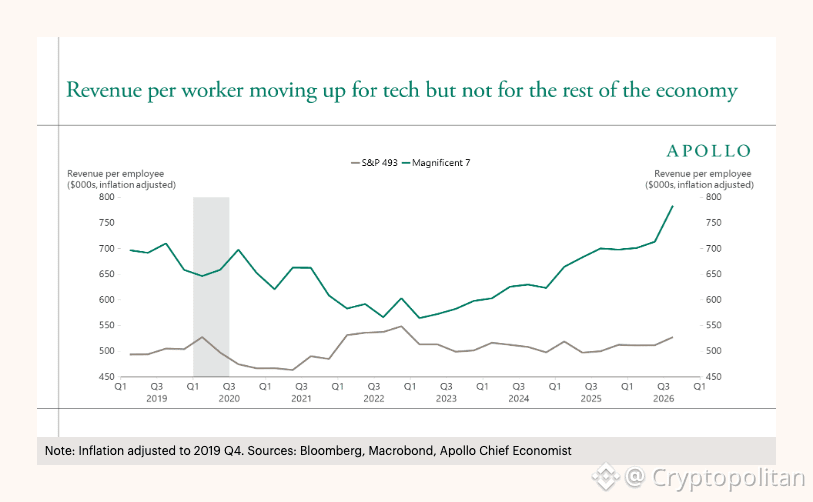
For the Mag 7, inflation-adjusted revenue per employee is up to about $780,000. The S&P 493 is around $525,000 and has not budged.
Inflation-adjusted revenue per employee for the Magnificent 7 and the S&P 493 since 2019, from Apollo’s Daily Spark note of October 24, 2026.
Margins divided the same way. The seven giants are close to 30%, with about 10% for the other 493 firms.
“Despite massive investments and widespread hype around artificial intelligence, the technology has delivered zero financial payoff to corporate America outside of tech,” Slok wrote.
His total factor productivity chart uses the utilization-adjusted series from the San Francisco Fed. No acceleration there, despite all the AI money.
In Slok’s data, the top decile of firms represent 99.5% of model serving and inference expenses and 99% of neocloud expenses.
The same 10% accounts for over 95% of money tied to OpenAI and Anthropic and 95.7% of cloud computing.
Venture money rules the biggest users. 80.4% of the top 1% of AI spenders are backed by VCs compared to 13.1% of the median spender.
Mainstream companies are now treating token spending like a cost center that is harming their margins and pulling back, Slok wrote.
Corporate America doesn’t need the latest model and won’t pay for it, he said. “As long as agentic AI and token spending are confined to a small part of the economy, the macroeconomic effects of AI will be very limited,” he wrote.
The S&P 493 will decide the story, the economist concludes
His spending charts are based on Ramp AI Index and Ramp Chief Economist, Ara Kharazian. Cryptopolitan reported this month that corporate AI spending has dropped since July even as usage jumped about 50% to a record, as price competition between OpenAI and Anthropic made models cheaper.
Slok doesn’t think the stragglers just need time. Models continue to get cheaper and more commoditized, and he wonders whether ordinary companies can use them to drive faster revenue growth or wider margins.
“AI may be a great calculator, but in business, intelligence is mostly judgment,” he wrote. Judgment is contextual, Slok said, and the answer depends on which human or model gets asked.
He also wrote that AI “does not understand accountability, trust, culture, unwritten rules, ethical trade-offs or fairness.” He regards those elements as drivers of reputational risk, and ultimately, revenue and profit margins.
“The AI story will be decided in the S&P 493, not the Mag 7,” Slok concluded. He found no evidence yet of better revenue growth or margins outside of tech.
By April, AI-related stocks had hit about 45% of the S&P 500’s market value. During the last 12 months, the Global X Artificial Intelligence & Technology ETF (AIQ) has risen about 20% and the iShares U.S. Technology ETF (IYW) is up about 23%.
The smartest crypto minds already read our newsletter. Want in? Join them.
Apollo's Torsten Slok sees zero AI payoff outside the Magnificent 7
Apollo Global Management Chief Economist Torsten Slok determined that AI has boosted revenue and margins only for the Magnificent 7, while the rest of corporate America has seen no financial benefit.
He notes that other S&P 500 companies have flat revenue per worker and flat profit margins with no increase in productivity.
Slok put out the note, “No Signs of AI Payoff Outside the Tech Sector,” Saturday in Apollo’s Daily Spark.
Top 10% of firms account for 99.5% of inference spending
Slok splits the index in two. The Magnificent 7 are Alphabet, Amazon, Apple, Meta, Microsoft, Nvidia and Tesla.
The S&P 493 is everything else in the S&P 500.
For the Mag 7, inflation-adjusted revenue per employee is up to about $780,000. The S&P 493 is around $525,000 and has not budged.
Inflation-adjusted revenue per employee for the Magnificent 7 and the S&P 493 since 2019, from Apollo’s Daily Spark note of October 24, 2026.
Margins divided the same way. The seven giants are close to 30%, with about 10% for the other 493 firms.
“Despite massive investments and widespread hype around artificial intelligence, the technology has delivered zero financial payoff to corporate America outside of tech,” Slok wrote.
His total factor productivity chart uses the utilization-adjusted series from the San Francisco Fed. No acceleration there, despite all the AI money.
In Slok’s data, the top decile of firms represent 99.5% of model serving and inference expenses and 99% of neocloud expenses.
The same 10% accounts for over 95% of money tied to OpenAI and Anthropic and 95.7% of cloud computing.
Venture money rules the biggest users. 80.4% of the top 1% of AI spenders are backed by VCs compared to 13.1% of the median spender.
Mainstream companies are now treating token spending like a cost center that is harming their margins and pulling back, Slok wrote.
Corporate America doesn’t need the latest model and won’t pay for it, he said. “As long as agentic AI and token spending are confined to a small part of the economy, the macroeconomic effects of AI will be very limited,” he wrote.
The S&P 493 will decide the story, the economist concludes
His spending charts are based on Ramp AI Index and Ramp Chief Economist, Ara Kharazian. Cryptopolitan reported this month that corporate AI spending has dropped since July even as usage jumped about 50% to a record, as price competition between OpenAI and Anthropic made models cheaper.
Slok doesn’t think the stragglers just need time. Models continue to get cheaper and more commoditized, and he wonders whether ordinary companies can use them to drive faster revenue growth or wider margins.
“AI may be a great calculator, but in business, intelligence is mostly judgment,” he wrote. Judgment is contextual, Slok said, and the answer depends on which human or model gets asked.
He also wrote that AI “does not understand accountability, trust, culture, unwritten rules, ethical trade-offs or fairness.” He regards those elements as drivers of reputational risk, and ultimately, revenue and profit margins.
“The AI story will be decided in the S&P 493, not the Mag 7,” Slok concluded. He found no evidence yet of better revenue growth or margins outside of tech.
By April, AI-related stocks had hit about 45% of the S&P 500’s market value. During the last 12 months, the Global X Artificial Intelligence & Technology ETF (AIQ) has risen about 20% and the iShares U.S. Technology ETF (IYW) is up about 23%.
The smartest crypto minds already read our newsletter. Want in? Join them.
He notes that other S&P 500 companies have flat revenue per worker and flat profit margins with no increase in productivity.
Slok put out the note, “No Signs of AI Payoff Outside the Tech Sector,” Saturday in Apollo’s Daily Spark.
Top 10% of firms account for 99.5% of inference spending
Slok splits the index in two. The Magnificent 7 are Alphabet, Amazon, Apple, Meta, Microsoft, Nvidia and Tesla.
The S&P 493 is everything else in the S&P 500.
For the Mag 7, inflation-adjusted revenue per employee is up to about $780,000. The S&P 493 is around $525,000 and has not budged.
Inflation-adjusted revenue per employee for the Magnificent 7 and the S&P 493 since 2019, from Apollo’s Daily Spark note of October 24, 2026.
Margins divided the same way. The seven giants are close to 30%, with about 10% for the other 493 firms.
“Despite massive investments and widespread hype around artificial intelligence, the technology has delivered zero financial payoff to corporate America outside of tech,” Slok wrote.
His total factor productivity chart uses the utilization-adjusted series from the San Francisco Fed. No acceleration there, despite all the AI money.
In Slok’s data, the top decile of firms represent 99.5% of model serving and inference expenses and 99% of neocloud expenses.
The same 10% accounts for over 95% of money tied to OpenAI and Anthropic and 95.7% of cloud computing.
Venture money rules the biggest users. 80.4% of the top 1% of AI spenders are backed by VCs compared to 13.1% of the median spender.
Mainstream companies are now treating token spending like a cost center that is harming their margins and pulling back, Slok wrote.
Corporate America doesn’t need the latest model and won’t pay for it, he said. “As long as agentic AI and token spending are confined to a small part of the economy, the macroeconomic effects of AI will be very limited,” he wrote.
The S&P 493 will decide the story, the economist concludes
His spending charts are based on Ramp AI Index and Ramp Chief Economist, Ara Kharazian. Cryptopolitan reported this month that corporate AI spending has dropped since July even as usage jumped about 50% to a record, as price competition between OpenAI and Anthropic made models cheaper.
Slok doesn’t think the stragglers just need time. Models continue to get cheaper and more commoditized, and he wonders whether ordinary companies can use them to drive faster revenue growth or wider margins.
“AI may be a great calculator, but in business, intelligence is mostly judgment,” he wrote. Judgment is contextual, Slok said, and the answer depends on which human or model gets asked.
He also wrote that AI “does not understand accountability, trust, culture, unwritten rules, ethical trade-offs or fairness.” He regards those elements as drivers of reputational risk, and ultimately, revenue and profit margins.
“The AI story will be decided in the S&P 493, not the Mag 7,” Slok concluded. He found no evidence yet of better revenue growth or margins outside of tech.
By April, AI-related stocks had hit about 45% of the S&P 500’s market value. During the last 12 months, the Global X Artificial Intelligence & Technology ETF (AIQ) has risen about 20% and the iShares U.S. Technology ETF (IYW) is up about 23%.
The smartest crypto minds already read our newsletter. Want in? Join them.
1
1
334
Partly True
Kevin Hassett says US-Canada trade negotiations are gaining momentumKevin Hassett, the US director of the National Economic Council, says trade talks between the United States and Canada are gaining speed, suggesting that the two neighbors may be getting closer to putting their dispute behind them.
Kevin defended Donald Trump’s management of the US economy on Sunday, right when Republicans start making their final attempts to appeal to voters ahead of the mid-term elections.
During an interview on Fox News, he argued that the overall numbers tell a much better story than complaints about living costs suggest. The problem for the White House is that people don’t pay their bills with GDP figures.
Kevin says economic growth is strong, but everyday prices tell another story
Kevin said, “So the great big picture about the economy is that it’s about the best economy we’ve ever seen.”
Economic strength is indicated by 3% to 4% growth each year, low unemployment rates, and industrial output at its highest since the pandemic. The American economy is also growing faster compared to economies in other G7 countries. However, none of these metrics give any indication of how much a trip to the supermarket costs this week.
“Now, I’m sure there are going to be pockets that need some repairs or that, hopefully, as President Trump said, energy prices will drop like a rock, then the 3 or 4 percent growth that we have right now will go even higher.”
Inflation has moved in the wrong direction lately. The annual consumer price index rose from 3.4% in August to 3.7% in September, while food inflation reached 4.4%, up from 3.5% under the previous administration.
Some grocery products have been seen to be becoming quite expensive as well. Coffee prices have increased by 22%, ground beef prices have increased by 25%, while cereals and baked products have gone up by 3.7%. According to an analysis done by The Telegraph, a family of four is spending an extra $23.84 each month.
It’s not only food. An average American household now spends $77 more each month on fuel than it did in February. And for someone buying a house in October with a 20% down payment, the yearly cost of a 30-year fixed-rate mortgage is about $1,866 higher than it was before the Iran war.
So far during Trump’s administration, the inflation rate has been 5.4%, while during Biden’s administration for the last 20 months, it is only 3.8%.
Iran war keeps gasoline expensive as midterm voters grow frustrated
The war with Iran has made energy a particularly sensitive issue. Iran’s effective shutdown of the Strait of Hormuz, the route used for roughly 20% of global oil exports, has unsettled supplies and helped keep prices elevated.
The price of gas on Sunday, according to AAA, was $4.29 per gallon. This was down 20 cents from what it cost a month ago, and the price had been fairly stable for the past weeks. Nevertheless, this price was way above the $3.06 average a year back.
Trump has repeatedly said gasoline prices should fall after the US wins the conflict. At a Saturday rally in Perry, Georgia, he campaigned for Republican Senate nominee Mike Collins and gubernatorial nominee Rick Jackson, while addressing criticism surrounding fuel costs.
“I can just see the fake headlines. ‘President Trump is talking about all the money they’re making while people are suffering at the pump.’ I don’t give a damn. We’re making a freaking fortune,” said Trump.
However, that message is accompanied by some tough polling numbers. As reported by The Financial Times/Focaldata, a poll conducted earlier this month showed that roughly a quarter of those surveyed approve of Trump’s handling of the economy. Even fewer, two out of ten people, approve of his handling of inflation.
Meanwhile, a Siena University/New York Times poll, released Tuesday, shows 36% of voting adults approve of Trump’s job performance versus 59% who do not approve.
If you're reading this, you’re already ahead. Stay there with our newsletter.
Kevin Hassett says US-Canada trade negotiations are gaining momentum
Kevin Hassett, the US director of the National Economic Council, says trade talks between the United States and Canada are gaining speed, suggesting that the two neighbors may be getting closer to putting their dispute behind them.
Kevin defended Donald Trump’s management of the US economy on Sunday, right when Republicans start making their final attempts to appeal to voters ahead of the mid-term elections.
During an interview on Fox News, he argued that the overall numbers tell a much better story than complaints about living costs suggest. The problem for the White House is that people don’t pay their bills with GDP figures.
Kevin says economic growth is strong, but everyday prices tell another story
Kevin said, “So the great big picture about the economy is that it’s about the best economy we’ve ever seen.”
Economic strength is indicated by 3% to 4% growth each year, low unemployment rates, and industrial output at its highest since the pandemic. The American economy is also growing faster compared to economies in other G7 countries. However, none of these metrics give any indication of how much a trip to the supermarket costs this week.
“Now, I’m sure there are going to be pockets that need some repairs or that, hopefully, as President Trump said, energy prices will drop like a rock, then the 3 or 4 percent growth that we have right now will go even higher.”
Inflation has moved in the wrong direction lately. The annual consumer price index rose from 3.4% in August to 3.7% in September, while food inflation reached 4.4%, up from 3.5% under the previous administration.
Some grocery products have been seen to be becoming quite expensive as well. Coffee prices have increased by 22%, ground beef prices have increased by 25%, while cereals and baked products have gone up by 3.7%. According to an analysis done by The Telegraph, a family of four is spending an extra $23.84 each month.
It’s not only food. An average American household now spends $77 more each month on fuel than it did in February. And for someone buying a house in October with a 20% down payment, the yearly cost of a 30-year fixed-rate mortgage is about $1,866 higher than it was before the Iran war.
So far during Trump’s administration, the inflation rate has been 5.4%, while during Biden’s administration for the last 20 months, it is only 3.8%.
Iran war keeps gasoline expensive as midterm voters grow frustrated
The war with Iran has made energy a particularly sensitive issue. Iran’s effective shutdown of the Strait of Hormuz, the route used for roughly 20% of global oil exports, has unsettled supplies and helped keep prices elevated.
The price of gas on Sunday, according to AAA, was $4.29 per gallon. This was down 20 cents from what it cost a month ago, and the price had been fairly stable for the past weeks. Nevertheless, this price was way above the $3.06 average a year back.
Trump has repeatedly said gasoline prices should fall after the US wins the conflict. At a Saturday rally in Perry, Georgia, he campaigned for Republican Senate nominee Mike Collins and gubernatorial nominee Rick Jackson, while addressing criticism surrounding fuel costs.
“I can just see the fake headlines. ‘President Trump is talking about all the money they’re making while people are suffering at the pump.’ I don’t give a damn. We’re making a freaking fortune,” said Trump.
However, that message is accompanied by some tough polling numbers. As reported by The Financial Times/Focaldata, a poll conducted earlier this month showed that roughly a quarter of those surveyed approve of Trump’s handling of the economy. Even fewer, two out of ten people, approve of his handling of inflation.
Meanwhile, a Siena University/New York Times poll, released Tuesday, shows 36% of voting adults approve of Trump’s job performance versus 59% who do not approve.
If you're reading this, you’re already ahead. Stay there with our newsletter.
Kevin defended Donald Trump’s management of the US economy on Sunday, right when Republicans start making their final attempts to appeal to voters ahead of the mid-term elections.
During an interview on Fox News, he argued that the overall numbers tell a much better story than complaints about living costs suggest. The problem for the White House is that people don’t pay their bills with GDP figures.
Kevin says economic growth is strong, but everyday prices tell another story
Kevin said, “So the great big picture about the economy is that it’s about the best economy we’ve ever seen.”
Economic strength is indicated by 3% to 4% growth each year, low unemployment rates, and industrial output at its highest since the pandemic. The American economy is also growing faster compared to economies in other G7 countries. However, none of these metrics give any indication of how much a trip to the supermarket costs this week.
“Now, I’m sure there are going to be pockets that need some repairs or that, hopefully, as President Trump said, energy prices will drop like a rock, then the 3 or 4 percent growth that we have right now will go even higher.”
Inflation has moved in the wrong direction lately. The annual consumer price index rose from 3.4% in August to 3.7% in September, while food inflation reached 4.4%, up from 3.5% under the previous administration.
Some grocery products have been seen to be becoming quite expensive as well. Coffee prices have increased by 22%, ground beef prices have increased by 25%, while cereals and baked products have gone up by 3.7%. According to an analysis done by The Telegraph, a family of four is spending an extra $23.84 each month.
It’s not only food. An average American household now spends $77 more each month on fuel than it did in February. And for someone buying a house in October with a 20% down payment, the yearly cost of a 30-year fixed-rate mortgage is about $1,866 higher than it was before the Iran war.
So far during Trump’s administration, the inflation rate has been 5.4%, while during Biden’s administration for the last 20 months, it is only 3.8%.
Iran war keeps gasoline expensive as midterm voters grow frustrated
The war with Iran has made energy a particularly sensitive issue. Iran’s effective shutdown of the Strait of Hormuz, the route used for roughly 20% of global oil exports, has unsettled supplies and helped keep prices elevated.
The price of gas on Sunday, according to AAA, was $4.29 per gallon. This was down 20 cents from what it cost a month ago, and the price had been fairly stable for the past weeks. Nevertheless, this price was way above the $3.06 average a year back.
Trump has repeatedly said gasoline prices should fall after the US wins the conflict. At a Saturday rally in Perry, Georgia, he campaigned for Republican Senate nominee Mike Collins and gubernatorial nominee Rick Jackson, while addressing criticism surrounding fuel costs.
“I can just see the fake headlines. ‘President Trump is talking about all the money they’re making while people are suffering at the pump.’ I don’t give a damn. We’re making a freaking fortune,” said Trump.
However, that message is accompanied by some tough polling numbers. As reported by The Financial Times/Focaldata, a poll conducted earlier this month showed that roughly a quarter of those surveyed approve of Trump’s handling of the economy. Even fewer, two out of ten people, approve of his handling of inflation.
Meanwhile, a Siena University/New York Times poll, released Tuesday, shows 36% of voting adults approve of Trump’s job performance versus 59% who do not approve.
If you're reading this, you’re already ahead. Stay there with our newsletter.
224
Elon Musk faces Republican criticism over restrictions on Ukraine’s Starlink accessElon Musk is taking heat from Republicans over his decision to restrict Ukraine’s access to Starlink, the satellite internet service that has become a big part of its fight against Russia.
Texas Representative Dan Crenshaw says Elon’s explanation makes little sense when Ukrainian troops are using drones to stop an invasion.
This raises a more far-reaching issue for Washington to consider as well: Why does one company have such control over communications during an ongoing war?
This situation has pulled Trump back into yet another conflict with the President of Ukraine, Volodymyr Zelenskyy. There was already an ongoing spat between the two countries due to the new deal the United States had made with Russia, and this further complicates matters.
Republicans push back against Elon’s explanation for the Starlink limits
Crenshaw, a member of the House Intelligence Committee, disagrees with Elon’s statement about a violation of SpaceX service conditions by Ukraine. In his statements on social media, Elon accused Ukraine of using SpaceX’s network to conduct offensive drone attacks on civilians.
However, Crenshaw finds it obvious that the line cannot be drawn at that point when a country is fighting in a war.
“What do you think defending your country is? Of course these drones have been used to kill people. They’ve been used to kill Russians for years, but inside Ukraine.”
Ukraine relies on satellite links to connect troops, pass battlefield information, and operate equipment where ordinary communications can fail. This month, users experienced slower connections on both Starlink and Starshield, the military-focused version of SpaceX’s system. For a while, there was no clear public answer about who had imposed the limits or why.
However, Elon Musk finally tried to sort out part of the problem through the Internet, but those in power in support of Kyiv remained unsatisfied with the answer provided.
Thom Tillis, a Republican senator from North Carolina and another one not seeking re-election, expressed his opinion about why the Western countries’ alliances started to depend on the technologies that could be disabled by the decision of a single company.
“Are you telling me that we don’t know something as important as a tool that’s being used by our Western nations is subject to the whims of one CEO. Shame on whoever is responsible for it ever having a lapse.”
Crenshaw, whose term ends in January, was careful not to turn the issue into a personal attack on Elon. His concern is the lack of a workable backup if SpaceX changes how its products can be used.
“What I worry about is an entire conflict, an entire defense of a sovereign country like Ukraine being dependent on one company.”
Trump’s diesel deal with Putin fuels another dispute with Kyiv
Earlier this month, Trump struck an agreement with Russian President Vladimir Putin that would hold off further tightening of US sanctions on Russia in return for diesel shipments meant to bring down fuel costs.
Today, Russia has already offered to sell as much diesel fuel as desired by customers, up to the total volume that Russia can export. This was stated by Deputy Prime Minister Alexander Novak in an interview with journalist Pavel Zarubin.
“As much as our partners want, frankly, from the volume we will be exporting. We can supply all of it.”
Russian outlet RIA Novosti reported that Alexander had previously estimated possible October shipments to the United States and other markets at 500,000 metric tons.
Trump announced the deal on October 9 after speaking with Putin. His timetable called for more than 300,000 tons to enter US and global markets immediately, another 500,000 tons in November, and 1 million tons after that.
Prices of diesel in the United States were going for more than six dollars per gallon when the first Russian cargo was expected to reach New York. Trump is looking forward to reducing costs of fuel before the November 3rd midterm elections, especially for farmers, ranchers, and truck drivers who rely on diesel daily.
Zelenskyy accused Trump in a Bloomberg interview last weekend of trying to force Kyiv to give in to Moscow. Trump denied ordering the Starlink speed restrictions and complained that Zelenskyy was more difficult to deal with than Putin.
On Thursday, The Wall Street Journal reported that Trump had spoken directly to Elon and asked him to lift the restrictions on Starlink services in Ukraine.
If you're reading this, you’re already ahead. Stay there with our newsletter.
Elon Musk faces Republican criticism over restrictions on Ukraine’s Starlink access
Elon Musk is taking heat from Republicans over his decision to restrict Ukraine’s access to Starlink, the satellite internet service that has become a big part of its fight against Russia.
Texas Representative Dan Crenshaw says Elon’s explanation makes little sense when Ukrainian troops are using drones to stop an invasion.
This raises a more far-reaching issue for Washington to consider as well: Why does one company have such control over communications during an ongoing war?
This situation has pulled Trump back into yet another conflict with the President of Ukraine, Volodymyr Zelenskyy. There was already an ongoing spat between the two countries due to the new deal the United States had made with Russia, and this further complicates matters.
Republicans push back against Elon’s explanation for the Starlink limits
Crenshaw, a member of the House Intelligence Committee, disagrees with Elon’s statement about a violation of SpaceX service conditions by Ukraine. In his statements on social media, Elon accused Ukraine of using SpaceX’s network to conduct offensive drone attacks on civilians.
However, Crenshaw finds it obvious that the line cannot be drawn at that point when a country is fighting in a war.
“What do you think defending your country is? Of course these drones have been used to kill people. They’ve been used to kill Russians for years, but inside Ukraine.”
Ukraine relies on satellite links to connect troops, pass battlefield information, and operate equipment where ordinary communications can fail. This month, users experienced slower connections on both Starlink and Starshield, the military-focused version of SpaceX’s system. For a while, there was no clear public answer about who had imposed the limits or why.
However, Elon Musk finally tried to sort out part of the problem through the Internet, but those in power in support of Kyiv remained unsatisfied with the answer provided.
Thom Tillis, a Republican senator from North Carolina and another one not seeking re-election, expressed his opinion about why the Western countries’ alliances started to depend on the technologies that could be disabled by the decision of a single company.
“Are you telling me that we don’t know something as important as a tool that’s being used by our Western nations is subject to the whims of one CEO. Shame on whoever is responsible for it ever having a lapse.”
Crenshaw, whose term ends in January, was careful not to turn the issue into a personal attack on Elon. His concern is the lack of a workable backup if SpaceX changes how its products can be used.
“What I worry about is an entire conflict, an entire defense of a sovereign country like Ukraine being dependent on one company.”
Trump’s diesel deal with Putin fuels another dispute with Kyiv
Earlier this month, Trump struck an agreement with Russian President Vladimir Putin that would hold off further tightening of US sanctions on Russia in return for diesel shipments meant to bring down fuel costs.
Today, Russia has already offered to sell as much diesel fuel as desired by customers, up to the total volume that Russia can export. This was stated by Deputy Prime Minister Alexander Novak in an interview with journalist Pavel Zarubin.
“As much as our partners want, frankly, from the volume we will be exporting. We can supply all of it.”
Russian outlet RIA Novosti reported that Alexander had previously estimated possible October shipments to the United States and other markets at 500,000 metric tons.
Trump announced the deal on October 9 after speaking with Putin. His timetable called for more than 300,000 tons to enter US and global markets immediately, another 500,000 tons in November, and 1 million tons after that.
Prices of diesel in the United States were going for more than six dollars per gallon when the first Russian cargo was expected to reach New York. Trump is looking forward to reducing costs of fuel before the November 3rd midterm elections, especially for farmers, ranchers, and truck drivers who rely on diesel daily.
Zelenskyy accused Trump in a Bloomberg interview last weekend of trying to force Kyiv to give in to Moscow. Trump denied ordering the Starlink speed restrictions and complained that Zelenskyy was more difficult to deal with than Putin.
On Thursday, The Wall Street Journal reported that Trump had spoken directly to Elon and asked him to lift the restrictions on Starlink services in Ukraine.
If you're reading this, you’re already ahead. Stay there with our newsletter.
Texas Representative Dan Crenshaw says Elon’s explanation makes little sense when Ukrainian troops are using drones to stop an invasion.
This raises a more far-reaching issue for Washington to consider as well: Why does one company have such control over communications during an ongoing war?
This situation has pulled Trump back into yet another conflict with the President of Ukraine, Volodymyr Zelenskyy. There was already an ongoing spat between the two countries due to the new deal the United States had made with Russia, and this further complicates matters.
Republicans push back against Elon’s explanation for the Starlink limits
Crenshaw, a member of the House Intelligence Committee, disagrees with Elon’s statement about a violation of SpaceX service conditions by Ukraine. In his statements on social media, Elon accused Ukraine of using SpaceX’s network to conduct offensive drone attacks on civilians.
However, Crenshaw finds it obvious that the line cannot be drawn at that point when a country is fighting in a war.
“What do you think defending your country is? Of course these drones have been used to kill people. They’ve been used to kill Russians for years, but inside Ukraine.”
Ukraine relies on satellite links to connect troops, pass battlefield information, and operate equipment where ordinary communications can fail. This month, users experienced slower connections on both Starlink and Starshield, the military-focused version of SpaceX’s system. For a while, there was no clear public answer about who had imposed the limits or why.
However, Elon Musk finally tried to sort out part of the problem through the Internet, but those in power in support of Kyiv remained unsatisfied with the answer provided.
Thom Tillis, a Republican senator from North Carolina and another one not seeking re-election, expressed his opinion about why the Western countries’ alliances started to depend on the technologies that could be disabled by the decision of a single company.
“Are you telling me that we don’t know something as important as a tool that’s being used by our Western nations is subject to the whims of one CEO. Shame on whoever is responsible for it ever having a lapse.”
Crenshaw, whose term ends in January, was careful not to turn the issue into a personal attack on Elon. His concern is the lack of a workable backup if SpaceX changes how its products can be used.
“What I worry about is an entire conflict, an entire defense of a sovereign country like Ukraine being dependent on one company.”
Trump’s diesel deal with Putin fuels another dispute with Kyiv
Earlier this month, Trump struck an agreement with Russian President Vladimir Putin that would hold off further tightening of US sanctions on Russia in return for diesel shipments meant to bring down fuel costs.
Today, Russia has already offered to sell as much diesel fuel as desired by customers, up to the total volume that Russia can export. This was stated by Deputy Prime Minister Alexander Novak in an interview with journalist Pavel Zarubin.
“As much as our partners want, frankly, from the volume we will be exporting. We can supply all of it.”
Russian outlet RIA Novosti reported that Alexander had previously estimated possible October shipments to the United States and other markets at 500,000 metric tons.
Trump announced the deal on October 9 after speaking with Putin. His timetable called for more than 300,000 tons to enter US and global markets immediately, another 500,000 tons in November, and 1 million tons after that.
Prices of diesel in the United States were going for more than six dollars per gallon when the first Russian cargo was expected to reach New York. Trump is looking forward to reducing costs of fuel before the November 3rd midterm elections, especially for farmers, ranchers, and truck drivers who rely on diesel daily.
Zelenskyy accused Trump in a Bloomberg interview last weekend of trying to force Kyiv to give in to Moscow. Trump denied ordering the Starlink speed restrictions and complained that Zelenskyy was more difficult to deal with than Putin.
On Thursday, The Wall Street Journal reported that Trump had spoken directly to Elon and asked him to lift the restrictions on Starlink services in Ukraine.
If you're reading this, you’re already ahead. Stay there with our newsletter.
1
179
Trump announces a $4.2 billion Audi factory in Georgia ahead of the November 3 midtermsTrump says Audi is putting billions into a new factory in Georgia, and he wants voters to see it as evidence that his tariffs are working.
The German luxury auto maker will produce up to 200,000 SUVs annually near Macon, putting an important part of its operations in America on American soil for the very first time.
The announcement was made Saturday during a GOP rally in Perry, just days before the November 3 midterm election. Georgia has a highly competitive gubernatorial and U.S. Senate race this year. Trump has been telling automakers for months that they should be making more cars in America. But now he can cite a plant announcement even though the whole story is much more complicated.
Trump points to Audi’s Georgia investment as a win for tariffs
Audi, part of Volkswagen, puts the Georgia project at roughly $4 billion and expects it to support about 4,500 jobs. Building work is due to start in 2027, with the first vehicles expected in the early 2030s. A US official told Reuters that the factory should handle the Q7, Q8 and Q9, three of Audi’s larger SUVs.
Audi chief executive Gernot Doellner attended the rally as the company outlined its plans.
“We are planning to bring our biggest and most premium SUVs and produce them here in Macon, Georgia.
“This is a long-term investment because we believe in the American market.”
The move could help Audi avoid some of the import costs that have been eating into its business. It currently brings every vehicle sold in the United States from Europe or Mexico. Last year alone, Trump’s tariffs cost the company €1.2 billion, or around $1.4 billion.
These responsibilities go further than just the manufactured vehicles to cover steel, aluminum, and car parts. Supporters claim that this will make manufacturing within the country more attractive. The opposing camp claims that these same taxes increase vehicle costs and deter companies from investing due to changing trade regulations.
In addition to this, Audi has another small production setup plan for South Carolina. This will allow 25,000 cars a year to be produced here. Cars produced in Europe now can be shipped to other markets using the United States. This production will be done at the $2 billion Scout Motors plant of Volkswagen in Blythewood near Columbia.
Ohio’s Republican senator Bernie Moreno went even further by claiming that Audi will eventually manufacture all of its SUVs in America. According to him, the whole agreement was contingent upon tariffs, less stringent regulations, and cessation of California’s control over fuel efficiency laws. Apart from this, outside the rally, an expensive Audi, decorated with its own license plates, added some theatricality to the situation.
Audi’s struggles show why the factory is a bigger gamble
There is a practical reason Audi wants more American production, beyond anything said on a campaign stage. Its global sales have fallen for two straight years. Deliveries dropped another 7% in the first half of 2026, and its US sales are down 16% this year.
It has been particularly difficult for the company in China, while Volkswagen’s loss of business to competitors in Europe such as BYD and Geely continues. The German company is now contemplating either shutting down or selling four of its manufacturing facilities in Europe. This includes Audi’s Neckarsulm facility in southwest Germany.
The US is looking attractive not only due to the lack of competition from China, since tariffs over 100% ensure that their cars do not appear in the market, but also because a new manufacturing facility is no guarantee of profits. There are several facilities in operation that run at less than full capacity.
Other automakers also try to balance costs of manufacturing with the risk of fluctuating trade policies. In July, Toyota announced that it will be investing $3.6 billion in a 2.5-million-square-foot truck assembly line at its San Antonio campus, moving some production from Mexico and hiring 2,000 employees by 2030.
Honda is considering another US plant but wants the US-Mexico-Canada Agreement extended first. Hyundai has said clearer rules could release more than $20 billion in American investment.
Meanwhile, Trump’s cuts to electric vehicle incentives have slowed US EV and battery production. Employment in American vehicle and parts manufacturing has also fallen since he took office last year, even as he promotes projects like Audi’s as victories for his tariff strategy.
The smartest crypto minds already read our newsletter. Want in? Join them.
Trump announces a $4.2 billion Audi factory in Georgia ahead of the November 3 midterms
Trump says Audi is putting billions into a new factory in Georgia, and he wants voters to see it as evidence that his tariffs are working.
The German luxury auto maker will produce up to 200,000 SUVs annually near Macon, putting an important part of its operations in America on American soil for the very first time.
The announcement was made Saturday during a GOP rally in Perry, just days before the November 3 midterm election. Georgia has a highly competitive gubernatorial and U.S. Senate race this year. Trump has been telling automakers for months that they should be making more cars in America. But now he can cite a plant announcement even though the whole story is much more complicated.
Trump points to Audi’s Georgia investment as a win for tariffs
Audi, part of Volkswagen, puts the Georgia project at roughly $4 billion and expects it to support about 4,500 jobs. Building work is due to start in 2027, with the first vehicles expected in the early 2030s. A US official told Reuters that the factory should handle the Q7, Q8 and Q9, three of Audi’s larger SUVs.
Audi chief executive Gernot Doellner attended the rally as the company outlined its plans.
“We are planning to bring our biggest and most premium SUVs and produce them here in Macon, Georgia.
“This is a long-term investment because we believe in the American market.”
The move could help Audi avoid some of the import costs that have been eating into its business. It currently brings every vehicle sold in the United States from Europe or Mexico. Last year alone, Trump’s tariffs cost the company €1.2 billion, or around $1.4 billion.
These responsibilities go further than just the manufactured vehicles to cover steel, aluminum, and car parts. Supporters claim that this will make manufacturing within the country more attractive. The opposing camp claims that these same taxes increase vehicle costs and deter companies from investing due to changing trade regulations.
In addition to this, Audi has another small production setup plan for South Carolina. This will allow 25,000 cars a year to be produced here. Cars produced in Europe now can be shipped to other markets using the United States. This production will be done at the $2 billion Scout Motors plant of Volkswagen in Blythewood near Columbia.
Ohio’s Republican senator Bernie Moreno went even further by claiming that Audi will eventually manufacture all of its SUVs in America. According to him, the whole agreement was contingent upon tariffs, less stringent regulations, and cessation of California’s control over fuel efficiency laws. Apart from this, outside the rally, an expensive Audi, decorated with its own license plates, added some theatricality to the situation.
Audi’s struggles show why the factory is a bigger gamble
There is a practical reason Audi wants more American production, beyond anything said on a campaign stage. Its global sales have fallen for two straight years. Deliveries dropped another 7% in the first half of 2026, and its US sales are down 16% this year.
It has been particularly difficult for the company in China, while Volkswagen’s loss of business to competitors in Europe such as BYD and Geely continues. The German company is now contemplating either shutting down or selling four of its manufacturing facilities in Europe. This includes Audi’s Neckarsulm facility in southwest Germany.
The US is looking attractive not only due to the lack of competition from China, since tariffs over 100% ensure that their cars do not appear in the market, but also because a new manufacturing facility is no guarantee of profits. There are several facilities in operation that run at less than full capacity.
Other automakers also try to balance costs of manufacturing with the risk of fluctuating trade policies. In July, Toyota announced that it will be investing $3.6 billion in a 2.5-million-square-foot truck assembly line at its San Antonio campus, moving some production from Mexico and hiring 2,000 employees by 2030.
Honda is considering another US plant but wants the US-Mexico-Canada Agreement extended first. Hyundai has said clearer rules could release more than $20 billion in American investment.
Meanwhile, Trump’s cuts to electric vehicle incentives have slowed US EV and battery production. Employment in American vehicle and parts manufacturing has also fallen since he took office last year, even as he promotes projects like Audi’s as victories for his tariff strategy.
The smartest crypto minds already read our newsletter. Want in? Join them.
The German luxury auto maker will produce up to 200,000 SUVs annually near Macon, putting an important part of its operations in America on American soil for the very first time.
The announcement was made Saturday during a GOP rally in Perry, just days before the November 3 midterm election. Georgia has a highly competitive gubernatorial and U.S. Senate race this year. Trump has been telling automakers for months that they should be making more cars in America. But now he can cite a plant announcement even though the whole story is much more complicated.
Trump points to Audi’s Georgia investment as a win for tariffs
Audi, part of Volkswagen, puts the Georgia project at roughly $4 billion and expects it to support about 4,500 jobs. Building work is due to start in 2027, with the first vehicles expected in the early 2030s. A US official told Reuters that the factory should handle the Q7, Q8 and Q9, three of Audi’s larger SUVs.
Audi chief executive Gernot Doellner attended the rally as the company outlined its plans.
“We are planning to bring our biggest and most premium SUVs and produce them here in Macon, Georgia.
“This is a long-term investment because we believe in the American market.”
The move could help Audi avoid some of the import costs that have been eating into its business. It currently brings every vehicle sold in the United States from Europe or Mexico. Last year alone, Trump’s tariffs cost the company €1.2 billion, or around $1.4 billion.
These responsibilities go further than just the manufactured vehicles to cover steel, aluminum, and car parts. Supporters claim that this will make manufacturing within the country more attractive. The opposing camp claims that these same taxes increase vehicle costs and deter companies from investing due to changing trade regulations.
In addition to this, Audi has another small production setup plan for South Carolina. This will allow 25,000 cars a year to be produced here. Cars produced in Europe now can be shipped to other markets using the United States. This production will be done at the $2 billion Scout Motors plant of Volkswagen in Blythewood near Columbia.
Ohio’s Republican senator Bernie Moreno went even further by claiming that Audi will eventually manufacture all of its SUVs in America. According to him, the whole agreement was contingent upon tariffs, less stringent regulations, and cessation of California’s control over fuel efficiency laws. Apart from this, outside the rally, an expensive Audi, decorated with its own license plates, added some theatricality to the situation.
Audi’s struggles show why the factory is a bigger gamble
There is a practical reason Audi wants more American production, beyond anything said on a campaign stage. Its global sales have fallen for two straight years. Deliveries dropped another 7% in the first half of 2026, and its US sales are down 16% this year.
It has been particularly difficult for the company in China, while Volkswagen’s loss of business to competitors in Europe such as BYD and Geely continues. The German company is now contemplating either shutting down or selling four of its manufacturing facilities in Europe. This includes Audi’s Neckarsulm facility in southwest Germany.
The US is looking attractive not only due to the lack of competition from China, since tariffs over 100% ensure that their cars do not appear in the market, but also because a new manufacturing facility is no guarantee of profits. There are several facilities in operation that run at less than full capacity.
Other automakers also try to balance costs of manufacturing with the risk of fluctuating trade policies. In July, Toyota announced that it will be investing $3.6 billion in a 2.5-million-square-foot truck assembly line at its San Antonio campus, moving some production from Mexico and hiring 2,000 employees by 2030.
Honda is considering another US plant but wants the US-Mexico-Canada Agreement extended first. Hyundai has said clearer rules could release more than $20 billion in American investment.
Meanwhile, Trump’s cuts to electric vehicle incentives have slowed US EV and battery production. Employment in American vehicle and parts manufacturing has also fallen since he took office last year, even as he promotes projects like Audi’s as victories for his tariff strategy.
The smartest crypto minds already read our newsletter. Want in? Join them.
147
Article
Google's privacy policy lets connected Gmail and Photos data personalize adsGoogle has updated its privacy policy so that content in Gmail, Google Drive, and Google Photos can now affect the ads it serves.
The opening is only for users linking those apps to the company’s AI tools. The new language took effect Oct. 16.
An October 16 clause ends the flat Drive and Photos pledge
Inbox, cloud files, and picture libraries are not things that Google would use to personalize ads. The company has said this for years. Now there is a catch to the promise. On October 23, the change was seen for the first time.
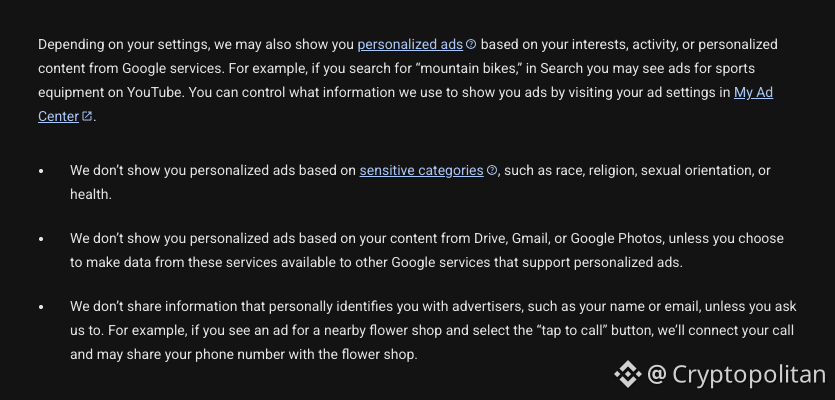
“We don’t show you personalized ads based on your content from Drive, Gmail, or Google Photos, unless you choose to make data from these services available to other Google services that support personalized ads,” the policy says. But the October 1 version, which took effect two weeks earlier, ended that sentence at Photos without exception.
A ban on ads built from sensitive categories like race, religion, sexual orientation or health is unaltered.
Ads can now also use “personalized content from Google services,” whereas the text of Oct. 1 cited only interests and activity across Google services.
Ad rules in Google’s privacy policy, effective October 16, 2026.
The switch is Personal Intelligence. The feature allows AI Mode in Search and Gemini to use a user’s connected apps to customize answers.
Connected to Gmail, Search can turn up a hotel booking and recommend nearby restaurants. The new language also allows that same linked data to drive the ads a person views.
Search Services History can keep data after apps disconnect
Google says it has set limits. By default, Gmail, Drive and Photos content isn’t used to target ads, and advertisers never see what’s inside those accounts.
The company said it doesn’t share names, email addresses, or other identifying information with advertisers without permission.
Users can opt out in Data & privacy in the Google Account. From Personalization & activity, Personalization settings lead to Manage Personalized Recommendations in Search Services.
Users can disconnect Google Workspace and Google Photos from the Connected Content apps menu in the Additional Personal Intelligence section there. Users can also turn off Personalized Recommendations entirely.
Disconnecting doesn’t always get rid of what Google already has, though. The information in Search Services History can stay there even if an app is disconnected or the original email or picture is deleted.
Google already permits advertisers to embed products in AI Mode answers, with Direct Offers attaching discounts to them.
Cryptopolitan says that Gemini released Personal Intelligence in January as an optional tool for paid AI Pro and Ultra subscribers. Google had been criticized in November 2025 over claims that Gmail fed Gemini by default through Smart Features. By February, Google was testing Personal Intelligence for free users in AI Mode Search.
Don’t just read crypto news. Understand it. Subscribe to our newsletter. It's free.
Google's privacy policy lets connected Gmail and Photos data personalize ads
Google has updated its privacy policy so that content in Gmail, Google Drive, and Google Photos can now affect the ads it serves.
The opening is only for users linking those apps to the company’s AI tools. The new language took effect Oct. 16.
An October 16 clause ends the flat Drive and Photos pledge
Inbox, cloud files, and picture libraries are not things that Google would use to personalize ads. The company has said this for years. Now there is a catch to the promise. On October 23, the change was seen for the first time.
“We don’t show you personalized ads based on your content from Drive, Gmail, or Google Photos, unless you choose to make data from these services available to other Google services that support personalized ads,” the policy says. But the October 1 version, which took effect two weeks earlier, ended that sentence at Photos without exception.
A ban on ads built from sensitive categories like race, religion, sexual orientation or health is unaltered.
Ads can now also use “personalized content from Google services,” whereas the text of Oct. 1 cited only interests and activity across Google services.
Ad rules in Google’s privacy policy, effective October 16, 2026.
The switch is Personal Intelligence. The feature allows AI Mode in Search and Gemini to use a user’s connected apps to customize answers.
Connected to Gmail, Search can turn up a hotel booking and recommend nearby restaurants. The new language also allows that same linked data to drive the ads a person views.
Search Services History can keep data after apps disconnect
Google says it has set limits. By default, Gmail, Drive and Photos content isn’t used to target ads, and advertisers never see what’s inside those accounts.
The company said it doesn’t share names, email addresses, or other identifying information with advertisers without permission.
Users can opt out in Data & privacy in the Google Account. From Personalization & activity, Personalization settings lead to Manage Personalized Recommendations in Search Services.
Users can disconnect Google Workspace and Google Photos from the Connected Content apps menu in the Additional Personal Intelligence section there. Users can also turn off Personalized Recommendations entirely.
Disconnecting doesn’t always get rid of what Google already has, though. The information in Search Services History can stay there even if an app is disconnected or the original email or picture is deleted.
Google already permits advertisers to embed products in AI Mode answers, with Direct Offers attaching discounts to them.
Cryptopolitan says that Gemini released Personal Intelligence in January as an optional tool for paid AI Pro and Ultra subscribers. Google had been criticized in November 2025 over claims that Gmail fed Gemini by default through Smart Features. By February, Google was testing Personal Intelligence for free users in AI Mode Search.
Don’t just read crypto news. Understand it. Subscribe to our newsletter. It's free.
The opening is only for users linking those apps to the company’s AI tools. The new language took effect Oct. 16.
An October 16 clause ends the flat Drive and Photos pledge
Inbox, cloud files, and picture libraries are not things that Google would use to personalize ads. The company has said this for years. Now there is a catch to the promise. On October 23, the change was seen for the first time.
“We don’t show you personalized ads based on your content from Drive, Gmail, or Google Photos, unless you choose to make data from these services available to other Google services that support personalized ads,” the policy says. But the October 1 version, which took effect two weeks earlier, ended that sentence at Photos without exception.
A ban on ads built from sensitive categories like race, religion, sexual orientation or health is unaltered.
Ads can now also use “personalized content from Google services,” whereas the text of Oct. 1 cited only interests and activity across Google services.
Ad rules in Google’s privacy policy, effective October 16, 2026.
The switch is Personal Intelligence. The feature allows AI Mode in Search and Gemini to use a user’s connected apps to customize answers.
Connected to Gmail, Search can turn up a hotel booking and recommend nearby restaurants. The new language also allows that same linked data to drive the ads a person views.
Search Services History can keep data after apps disconnect
Google says it has set limits. By default, Gmail, Drive and Photos content isn’t used to target ads, and advertisers never see what’s inside those accounts.
The company said it doesn’t share names, email addresses, or other identifying information with advertisers without permission.
Users can opt out in Data & privacy in the Google Account. From Personalization & activity, Personalization settings lead to Manage Personalized Recommendations in Search Services.
Users can disconnect Google Workspace and Google Photos from the Connected Content apps menu in the Additional Personal Intelligence section there. Users can also turn off Personalized Recommendations entirely.
Disconnecting doesn’t always get rid of what Google already has, though. The information in Search Services History can stay there even if an app is disconnected or the original email or picture is deleted.
Google already permits advertisers to embed products in AI Mode answers, with Direct Offers attaching discounts to them.
Cryptopolitan says that Gemini released Personal Intelligence in January as an optional tool for paid AI Pro and Ultra subscribers. Google had been criticized in November 2025 over claims that Gmail fed Gemini by default through Smart Features. By February, Google was testing Personal Intelligence for free users in AI Mode Search.
Don’t just read crypto news. Understand it. Subscribe to our newsletter. It's free.
1
322
Article
Electrum servers trick wallet users into signing fake zero-fee paymentsMalicious Electrum servers replaced users’ just-broadcast bitcoin payments with fake zero-fee transactions paying lookalike addresses.
Servers apparently bet victims would raise the fee and sign the fake.
Electrum released version 4.8.3 on October 24 to address the high-severity flaw. Maintainer SomberNight released advisory GHSA-6jp4-8v48-cc5v the same day and requested users to upgrade.
Forged address shared a GyQ3 ending with the legitimate destination
Electrum is a light client. It doesn’t have a full bitcoin node and relies on its server for unconfirmed mempool transactions. Its own documentation explains how it works.
Someone signs and sends tx1. A bad server stops it and sends a different tx2 to the wallet that sends the money to an attacker’s address.
Tx2 has invalid signatures. Older Electrum didn’t verify signatures of mempool transactions, so the wallet showed tx2 as pending and hid tx1.
Replace-By-Fee, or RBF, permits a sender to rebroadcast an unconfirmed transaction with a higher fee. If the fee on the fake is increased, the wallet signs the attacker’s version with a valid signature.
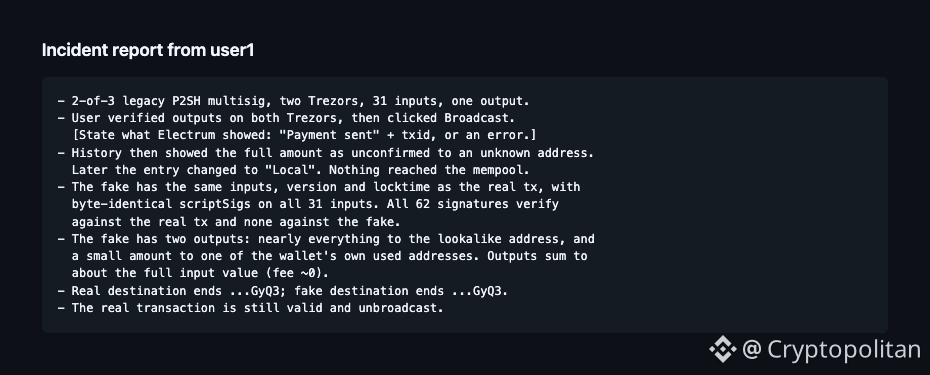
One of the targets, known as dannydeezy, documented the attack. A 2-of-3 legacy P2SH multisig with two Trezors, 31 inputs, and one output.
User checked output on both Trezors then broadcast. Wallet history then displayed the full amount going to an unknown address unconfirmed, and the entry later flipped to “Local.”
The fake replicated the real transaction’s inputs, version and locktime, with byte identical scriptSigs on all 31 inputs.
All 62 of the signatures checked out against the real transaction. None checked out against the fake.
Almost all of it was sent to a lookalike address, with a small amount being sent back to one of the wallet’s own used addresses.
The fake ended in GyQ3. So did the real endpoint.
The attacker had figured out an address which matched the last four characters of the correct address.
Incident report from user1 in Electrum’s security advisory, published October 24, 2026, on GitHub.
ZachXBT has also called out a similar address-poisoning scam affecting Phantom wallet users. Spoofed addresses are made impervious to a glance at the first and last characters.
Version 4.8.3 checks signatures only on wallet-owned inputs
Another user, Raju-K12, privately reported on Oct. 18 that they bumped the fee on the fake and lost money. Some servers are running the attack in the wild, the maintainers say.
Commit 90fe308 adds a check for signatures on wallet-owned “is_mine” inputs before adding a mempool transaction to local history. Version 4.8.3 was git-tagged on October 23 and binaries were released the next day.
Electrum still checks only inputs the wallet controls. So unconfirmed incoming transactions go unchecked.
This is because the client has no full script interpreter.
Electrum’s workaround for anyone who can’t upgrade is to verify output addresses and amounts before signing anything, including fee bumps. Those users who connected only to their own servers were never affected.
Electrum has shipped emergency fixes in the past. In January 2018, it closed down a JSON RPC interface that had been left open for some two years, after Google researcher Tavis Ormandy found that a website could detect the port and drain funds.
Cryptopolitan reported that a Coldcard seed-generation bug warning came in July, the same day approximately 594 BTC, ~$38 million, was drained from about 500 wallets.
If you're reading this, you’re already ahead. Stay there with our newsletter.
Electrum servers trick wallet users into signing fake zero-fee payments
Malicious Electrum servers replaced users’ just-broadcast bitcoin payments with fake zero-fee transactions paying lookalike addresses.
Servers apparently bet victims would raise the fee and sign the fake.
Electrum released version 4.8.3 on October 24 to address the high-severity flaw. Maintainer SomberNight released advisory GHSA-6jp4-8v48-cc5v the same day and requested users to upgrade.
Forged address shared a GyQ3 ending with the legitimate destination
Electrum is a light client. It doesn’t have a full bitcoin node and relies on its server for unconfirmed mempool transactions. Its own documentation explains how it works.
Someone signs and sends tx1. A bad server stops it and sends a different tx2 to the wallet that sends the money to an attacker’s address.
Tx2 has invalid signatures. Older Electrum didn’t verify signatures of mempool transactions, so the wallet showed tx2 as pending and hid tx1.
Replace-By-Fee, or RBF, permits a sender to rebroadcast an unconfirmed transaction with a higher fee. If the fee on the fake is increased, the wallet signs the attacker’s version with a valid signature.
One of the targets, known as dannydeezy, documented the attack. A 2-of-3 legacy P2SH multisig with two Trezors, 31 inputs, and one output.
User checked output on both Trezors then broadcast. Wallet history then displayed the full amount going to an unknown address unconfirmed, and the entry later flipped to “Local.”
The fake replicated the real transaction’s inputs, version and locktime, with byte identical scriptSigs on all 31 inputs.
All 62 of the signatures checked out against the real transaction. None checked out against the fake.
Almost all of it was sent to a lookalike address, with a small amount being sent back to one of the wallet’s own used addresses.
The fake ended in GyQ3. So did the real endpoint.
The attacker had figured out an address which matched the last four characters of the correct address.
Incident report from user1 in Electrum’s security advisory, published October 24, 2026, on GitHub.
ZachXBT has also called out a similar address-poisoning scam affecting Phantom wallet users. Spoofed addresses are made impervious to a glance at the first and last characters.
Version 4.8.3 checks signatures only on wallet-owned inputs
Another user, Raju-K12, privately reported on Oct. 18 that they bumped the fee on the fake and lost money. Some servers are running the attack in the wild, the maintainers say.
Commit 90fe308 adds a check for signatures on wallet-owned “is_mine” inputs before adding a mempool transaction to local history. Version 4.8.3 was git-tagged on October 23 and binaries were released the next day.
Electrum still checks only inputs the wallet controls. So unconfirmed incoming transactions go unchecked.
This is because the client has no full script interpreter.
Electrum’s workaround for anyone who can’t upgrade is to verify output addresses and amounts before signing anything, including fee bumps. Those users who connected only to their own servers were never affected.
Electrum has shipped emergency fixes in the past. In January 2018, it closed down a JSON RPC interface that had been left open for some two years, after Google researcher Tavis Ormandy found that a website could detect the port and drain funds.
Cryptopolitan reported that a Coldcard seed-generation bug warning came in July, the same day approximately 594 BTC, ~$38 million, was drained from about 500 wallets.
If you're reading this, you’re already ahead. Stay there with our newsletter.
Servers apparently bet victims would raise the fee and sign the fake.
Electrum released version 4.8.3 on October 24 to address the high-severity flaw. Maintainer SomberNight released advisory GHSA-6jp4-8v48-cc5v the same day and requested users to upgrade.
Forged address shared a GyQ3 ending with the legitimate destination
Electrum is a light client. It doesn’t have a full bitcoin node and relies on its server for unconfirmed mempool transactions. Its own documentation explains how it works.
Someone signs and sends tx1. A bad server stops it and sends a different tx2 to the wallet that sends the money to an attacker’s address.
Tx2 has invalid signatures. Older Electrum didn’t verify signatures of mempool transactions, so the wallet showed tx2 as pending and hid tx1.
Replace-By-Fee, or RBF, permits a sender to rebroadcast an unconfirmed transaction with a higher fee. If the fee on the fake is increased, the wallet signs the attacker’s version with a valid signature.
One of the targets, known as dannydeezy, documented the attack. A 2-of-3 legacy P2SH multisig with two Trezors, 31 inputs, and one output.
User checked output on both Trezors then broadcast. Wallet history then displayed the full amount going to an unknown address unconfirmed, and the entry later flipped to “Local.”
The fake replicated the real transaction’s inputs, version and locktime, with byte identical scriptSigs on all 31 inputs.
All 62 of the signatures checked out against the real transaction. None checked out against the fake.
Almost all of it was sent to a lookalike address, with a small amount being sent back to one of the wallet’s own used addresses.
The fake ended in GyQ3. So did the real endpoint.
The attacker had figured out an address which matched the last four characters of the correct address.
Incident report from user1 in Electrum’s security advisory, published October 24, 2026, on GitHub.
ZachXBT has also called out a similar address-poisoning scam affecting Phantom wallet users. Spoofed addresses are made impervious to a glance at the first and last characters.
Version 4.8.3 checks signatures only on wallet-owned inputs
Another user, Raju-K12, privately reported on Oct. 18 that they bumped the fee on the fake and lost money. Some servers are running the attack in the wild, the maintainers say.
Commit 90fe308 adds a check for signatures on wallet-owned “is_mine” inputs before adding a mempool transaction to local history. Version 4.8.3 was git-tagged on October 23 and binaries were released the next day.
Electrum still checks only inputs the wallet controls. So unconfirmed incoming transactions go unchecked.
This is because the client has no full script interpreter.
Electrum’s workaround for anyone who can’t upgrade is to verify output addresses and amounts before signing anything, including fee bumps. Those users who connected only to their own servers were never affected.
Electrum has shipped emergency fixes in the past. In January 2018, it closed down a JSON RPC interface that had been left open for some two years, after Google researcher Tavis Ormandy found that a website could detect the port and drain funds.
Cryptopolitan reported that a Coldcard seed-generation bug warning came in July, the same day approximately 594 BTC, ~$38 million, was drained from about 500 wallets.
If you're reading this, you’re already ahead. Stay there with our newsletter.
1
1.9k
Block builds Dessa voice AI from human audio alone on a single Nvidia rackJack Dorsey’s Block trained its new voice model, Dessa, on human speech only, not on any text or any pre-trained models.
Block says that the finished model can be run locally on a MacBook Pro M4 Max or better. The lab trained it on a single rack of Nvidia servers.
Block says Dessa is the first AI it knows of that can carry on a lifelike live conversation and has been trained only on human speech. The tiny research lab behind it reports directly to Dorsey.
Full-duplex model talks with OpenAI’s GPT-Live-1 in unsteered demos
A lot of voice assistants take what people say, turn it into text, run it through a language model, and then turn the text back into speech. As Block puts it, the pipeline throws out emotion, sarcasm, laughter, and a sad voice that cracks.
Dessa is a model that turns speech into speech, with no text in between. Like two people, it talks and hears at the same time.
It knows when to cut in and when to chime in with a “yeah!” or “got it!” Block said. It runs faster than real time.
Block says no one guides the AI model in the recordings. It chooses what to say, when and how.
In the recordings, Dessa laughs mid-sentence, gasps at a surprise and gets louder when asked to speak up. In one of the recordings, Dessa spoke to OpenAI’s GPT-Live-1.
Block says the developer of GPT-Live-1 has not vetted or endorsed Dessa.
We made the first AI model you can have a realistic conversation with that was trained entirely on speech!
Dessa is a full-duplex speech-to-speech model that you can run on consumer GPUs.
This is a GPT3 moment for speech. pic.twitter.com/XVD8sSyJn8
— Ragavan Thurairatnam (@RagavanThurair) October 23, 2026
A GB200 NVL72 taught the model language from hundreds of times fewer words
Dessa trained on a single Nvidia GB200 NVL72, a rack-scale system. The lab says the model learned language from “hundreds of times fewer words” than a text-based LLM needs.
Speech made the job tougher, said Block. A spoken word is thousands of times more bytes than the same word in print.
The lab was founded by former members of Toronto deep learning startup Dessa. The team has been building generative speech models for over eight years.
Ragavan Thurairatnam heads the project, and he called the release “a GPT3 moment for speech” on X.
Dessa is not publicly available. Block is running a waitlist and giving early access to a small group of AI safety researchers to surface risks the team hasn’t foreseen.
Three things led Block to build the model. Two are curiosity and better understanding between humans and AI.
The third reason? Safety.
Block imagines a person who is in a lot of pain, but a voice AI doesn’t notice and keeps talking.
Cryptopolitan reported that in February, Block (NYSE: XYZ) laid off 40% of its staff.
Block Inc. put out Buzz in July. It’s a chat app for the workplace where humans and AI agents can share channels.
The smartest crypto minds already read our newsletter. Want in? Join them.
Block builds Dessa voice AI from human audio alone on a single Nvidia rack
Jack Dorsey’s Block trained its new voice model, Dessa, on human speech only, not on any text or any pre-trained models.
Block says that the finished model can be run locally on a MacBook Pro M4 Max or better. The lab trained it on a single rack of Nvidia servers.
Block says Dessa is the first AI it knows of that can carry on a lifelike live conversation and has been trained only on human speech. The tiny research lab behind it reports directly to Dorsey.
Full-duplex model talks with OpenAI’s GPT-Live-1 in unsteered demos
A lot of voice assistants take what people say, turn it into text, run it through a language model, and then turn the text back into speech. As Block puts it, the pipeline throws out emotion, sarcasm, laughter, and a sad voice that cracks.
Dessa is a model that turns speech into speech, with no text in between. Like two people, it talks and hears at the same time.
It knows when to cut in and when to chime in with a “yeah!” or “got it!” Block said. It runs faster than real time.
Block says no one guides the AI model in the recordings. It chooses what to say, when and how.
In the recordings, Dessa laughs mid-sentence, gasps at a surprise and gets louder when asked to speak up. In one of the recordings, Dessa spoke to OpenAI’s GPT-Live-1.
Block says the developer of GPT-Live-1 has not vetted or endorsed Dessa.
We made the first AI model you can have a realistic conversation with that was trained entirely on speech!
Dessa is a full-duplex speech-to-speech model that you can run on consumer GPUs.
This is a GPT3 moment for speech. pic.twitter.com/XVD8sSyJn8
— Ragavan Thurairatnam (@RagavanThurair) October 23, 2026
A GB200 NVL72 taught the model language from hundreds of times fewer words
Dessa trained on a single Nvidia GB200 NVL72, a rack-scale system. The lab says the model learned language from “hundreds of times fewer words” than a text-based LLM needs.
Speech made the job tougher, said Block. A spoken word is thousands of times more bytes than the same word in print.
The lab was founded by former members of Toronto deep learning startup Dessa. The team has been building generative speech models for over eight years.
Ragavan Thurairatnam heads the project, and he called the release “a GPT3 moment for speech” on X.
Dessa is not publicly available. Block is running a waitlist and giving early access to a small group of AI safety researchers to surface risks the team hasn’t foreseen.
Three things led Block to build the model. Two are curiosity and better understanding between humans and AI.
The third reason? Safety.
Block imagines a person who is in a lot of pain, but a voice AI doesn’t notice and keeps talking.
Cryptopolitan reported that in February, Block (NYSE: XYZ) laid off 40% of its staff.
Block Inc. put out Buzz in July. It’s a chat app for the workplace where humans and AI agents can share channels.
The smartest crypto minds already read our newsletter. Want in? Join them.
Block says that the finished model can be run locally on a MacBook Pro M4 Max or better. The lab trained it on a single rack of Nvidia servers.
Block says Dessa is the first AI it knows of that can carry on a lifelike live conversation and has been trained only on human speech. The tiny research lab behind it reports directly to Dorsey.
Full-duplex model talks with OpenAI’s GPT-Live-1 in unsteered demos
A lot of voice assistants take what people say, turn it into text, run it through a language model, and then turn the text back into speech. As Block puts it, the pipeline throws out emotion, sarcasm, laughter, and a sad voice that cracks.
Dessa is a model that turns speech into speech, with no text in between. Like two people, it talks and hears at the same time.
It knows when to cut in and when to chime in with a “yeah!” or “got it!” Block said. It runs faster than real time.
Block says no one guides the AI model in the recordings. It chooses what to say, when and how.
In the recordings, Dessa laughs mid-sentence, gasps at a surprise and gets louder when asked to speak up. In one of the recordings, Dessa spoke to OpenAI’s GPT-Live-1.
Block says the developer of GPT-Live-1 has not vetted or endorsed Dessa.
We made the first AI model you can have a realistic conversation with that was trained entirely on speech!
Dessa is a full-duplex speech-to-speech model that you can run on consumer GPUs.
This is a GPT3 moment for speech. pic.twitter.com/XVD8sSyJn8
— Ragavan Thurairatnam (@RagavanThurair) October 23, 2026
A GB200 NVL72 taught the model language from hundreds of times fewer words
Dessa trained on a single Nvidia GB200 NVL72, a rack-scale system. The lab says the model learned language from “hundreds of times fewer words” than a text-based LLM needs.
Speech made the job tougher, said Block. A spoken word is thousands of times more bytes than the same word in print.
The lab was founded by former members of Toronto deep learning startup Dessa. The team has been building generative speech models for over eight years.
Ragavan Thurairatnam heads the project, and he called the release “a GPT3 moment for speech” on X.
Dessa is not publicly available. Block is running a waitlist and giving early access to a small group of AI safety researchers to surface risks the team hasn’t foreseen.
Three things led Block to build the model. Two are curiosity and better understanding between humans and AI.
The third reason? Safety.
Block imagines a person who is in a lot of pain, but a voice AI doesn’t notice and keeps talking.
Cryptopolitan reported that in February, Block (NYSE: XYZ) laid off 40% of its staff.
Block Inc. put out Buzz in July. It’s a chat app for the workplace where humans and AI agents can share channels.
The smartest crypto minds already read our newsletter. Want in? Join them.
1
4
541
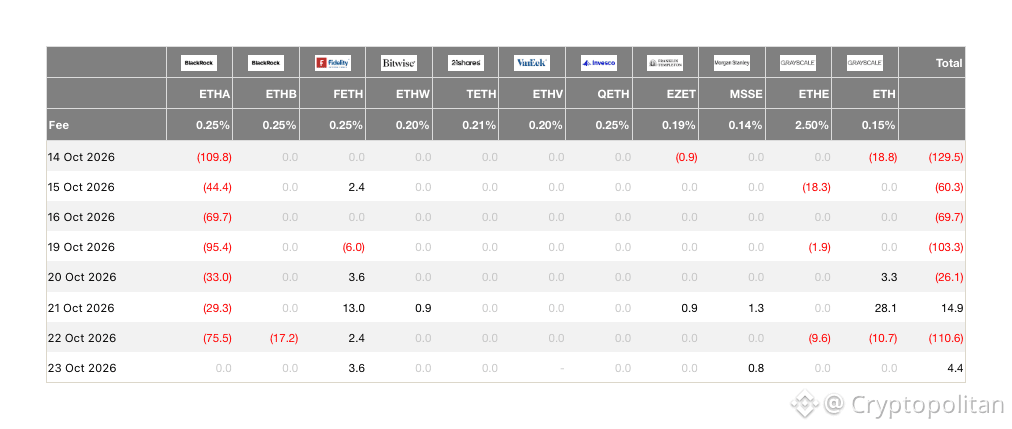
Article
Ether falls about 13% over 30 days as bitcoin loses under 5%Ether has fallen around 13% over the last 30 days, almost three times Bitcoin’s 4.7% decline. The token fell below $2,300 on Oct. 24.
ETH traded at $2,342.08 late on October 24, down 12.96% over 30 days, CoinGecko data indicates. The weakest price in the 30-day window came in at a 24-hour low of $2,286.76.
Bitcoin changed hands at $80,537, down 4.71% over the same period. Ether opened the window close to $2,684 and Bitcoin close to $84,249.
ETH/BTC ratio slides to 0.0291 from 0.0319
Over seven days, ETH dropped 3.33%, bitcoin 1.48%.
The ETH/BTC ratio, or the price of Ether in Bitcoin, lingered around 0.0291. It began the 30-day window near 0.0319.
Ether fell about 0.7% on the day to the late-session price, and bitcoin about 0.1%.
Ether crested for the window near $2,754 on Oct. 2. It has since lost about 15% and is down about 53% from its record high of $4,946.05 in August 2025.
Bitcoin is trading ~36% below its own $126,080 peak set in October 2025. Late October 24, Ether’s market cap was about $286 billion.
BlackRock’s ETHA drives a $110.6 million exit on October 22
US spot ether exchange-traded funds registered net outflows of $110.6 million on October 22, data from Farside showed.
BlackRock’s iShares Ethereum Trust, ETHA, saw $75.5 million lost of that total. Fidelity’s FETH gained $2.4 million.
On the same day, BlackRock’s ETHB lost $17.2 million. Grayscale’s ETHE lost $9.6 million, while its Ethereum Staking Mini ETF lost $10.7 million.
The exit on October 22 followed $14.9 million in inflows on October 21. Grayscale’s staking mini fund saw inflows of $28.1 million on Oct. 21, while FETH took in $13 million, with ETHA shedding $29.3 million.
Five successive sessions of outflows from Oct. 14 to 20 drained $388.9 million from the funds, while the seven sessions through Oct. 22 cost $484.6 million.
$129.5 million left on Oct. 14, the heaviest day of that run. October 19 added $103.3 million more.
Daily net flows for US spot ether ETFs from October 14 to 23, 2026, in US$ millions, per Farside data.
The October 23 tally showed net inflows of $4.4 million, but the ETHV fund’s figure was still absent.
According to Cryptopolitan, Ether ETFs experienced an outflow of $1.08 billion in October by October 21, marking the largest monthly outflow in 2026. The outflows erased ~$832 million of inflows from September, leaving net inflows for the year-to-date at about $485 million.
October was the worst month for the funds since November 2025. Total net assets stood at $14.98 billion as of Oct. 20, or 5.01% of the market value of ether.
Bitcoin ETFs bled only ~$67m in the same October period. They still had net inflows of ~$809 million in 2026.
A six-session streak that began on September 29 sapped ~$408 million, and ETHA alone lost $201.89 million on October 6.
The smartest crypto minds already read our newsletter. Want in? Join them.
Ether falls about 13% over 30 days as bitcoin loses under 5%
Ether has fallen around 13% over the last 30 days, almost three times Bitcoin’s 4.7% decline. The token fell below $2,300 on Oct. 24.
ETH traded at $2,342.08 late on October 24, down 12.96% over 30 days, CoinGecko data indicates. The weakest price in the 30-day window came in at a 24-hour low of $2,286.76.
Bitcoin changed hands at $80,537, down 4.71% over the same period. Ether opened the window close to $2,684 and Bitcoin close to $84,249.
ETH/BTC ratio slides to 0.0291 from 0.0319
Over seven days, ETH dropped 3.33%, bitcoin 1.48%.
The ETH/BTC ratio, or the price of Ether in Bitcoin, lingered around 0.0291. It began the 30-day window near 0.0319.
Ether fell about 0.7% on the day to the late-session price, and bitcoin about 0.1%.
Ether crested for the window near $2,754 on Oct. 2. It has since lost about 15% and is down about 53% from its record high of $4,946.05 in August 2025.
Bitcoin is trading ~36% below its own $126,080 peak set in October 2025. Late October 24, Ether’s market cap was about $286 billion.
BlackRock’s ETHA drives a $110.6 million exit on October 22
US spot ether exchange-traded funds registered net outflows of $110.6 million on October 22, data from Farside showed.
BlackRock’s iShares Ethereum Trust, ETHA, saw $75.5 million lost of that total. Fidelity’s FETH gained $2.4 million.
On the same day, BlackRock’s ETHB lost $17.2 million. Grayscale’s ETHE lost $9.6 million, while its Ethereum Staking Mini ETF lost $10.7 million.
The exit on October 22 followed $14.9 million in inflows on October 21. Grayscale’s staking mini fund saw inflows of $28.1 million on Oct. 21, while FETH took in $13 million, with ETHA shedding $29.3 million.
Five successive sessions of outflows from Oct. 14 to 20 drained $388.9 million from the funds, while the seven sessions through Oct. 22 cost $484.6 million.
$129.5 million left on Oct. 14, the heaviest day of that run. October 19 added $103.3 million more.
Daily net flows for US spot ether ETFs from October 14 to 23, 2026, in US$ millions, per Farside data.
The October 23 tally showed net inflows of $4.4 million, but the ETHV fund’s figure was still absent.
According to Cryptopolitan, Ether ETFs experienced an outflow of $1.08 billion in October by October 21, marking the largest monthly outflow in 2026. The outflows erased ~$832 million of inflows from September, leaving net inflows for the year-to-date at about $485 million.
October was the worst month for the funds since November 2025. Total net assets stood at $14.98 billion as of Oct. 20, or 5.01% of the market value of ether.
Bitcoin ETFs bled only ~$67m in the same October period. They still had net inflows of ~$809 million in 2026.
A six-session streak that began on September 29 sapped ~$408 million, and ETHA alone lost $201.89 million on October 6.
The smartest crypto minds already read our newsletter. Want in? Join them.
ETH traded at $2,342.08 late on October 24, down 12.96% over 30 days, CoinGecko data indicates. The weakest price in the 30-day window came in at a 24-hour low of $2,286.76.
Bitcoin changed hands at $80,537, down 4.71% over the same period. Ether opened the window close to $2,684 and Bitcoin close to $84,249.
ETH/BTC ratio slides to 0.0291 from 0.0319
Over seven days, ETH dropped 3.33%, bitcoin 1.48%.
The ETH/BTC ratio, or the price of Ether in Bitcoin, lingered around 0.0291. It began the 30-day window near 0.0319.
Ether fell about 0.7% on the day to the late-session price, and bitcoin about 0.1%.
Ether crested for the window near $2,754 on Oct. 2. It has since lost about 15% and is down about 53% from its record high of $4,946.05 in August 2025.
Bitcoin is trading ~36% below its own $126,080 peak set in October 2025. Late October 24, Ether’s market cap was about $286 billion.
BlackRock’s ETHA drives a $110.6 million exit on October 22
US spot ether exchange-traded funds registered net outflows of $110.6 million on October 22, data from Farside showed.
BlackRock’s iShares Ethereum Trust, ETHA, saw $75.5 million lost of that total. Fidelity’s FETH gained $2.4 million.
On the same day, BlackRock’s ETHB lost $17.2 million. Grayscale’s ETHE lost $9.6 million, while its Ethereum Staking Mini ETF lost $10.7 million.
The exit on October 22 followed $14.9 million in inflows on October 21. Grayscale’s staking mini fund saw inflows of $28.1 million on Oct. 21, while FETH took in $13 million, with ETHA shedding $29.3 million.
Five successive sessions of outflows from Oct. 14 to 20 drained $388.9 million from the funds, while the seven sessions through Oct. 22 cost $484.6 million.
$129.5 million left on Oct. 14, the heaviest day of that run. October 19 added $103.3 million more.
Daily net flows for US spot ether ETFs from October 14 to 23, 2026, in US$ millions, per Farside data.
The October 23 tally showed net inflows of $4.4 million, but the ETHV fund’s figure was still absent.
According to Cryptopolitan, Ether ETFs experienced an outflow of $1.08 billion in October by October 21, marking the largest monthly outflow in 2026. The outflows erased ~$832 million of inflows from September, leaving net inflows for the year-to-date at about $485 million.
October was the worst month for the funds since November 2025. Total net assets stood at $14.98 billion as of Oct. 20, or 5.01% of the market value of ether.
Bitcoin ETFs bled only ~$67m in the same October period. They still had net inflows of ~$809 million in 2026.
A six-session streak that began on September 29 sapped ~$408 million, and ETHA alone lost $201.89 million on October 6.
The smartest crypto minds already read our newsletter. Want in? Join them.
2
493
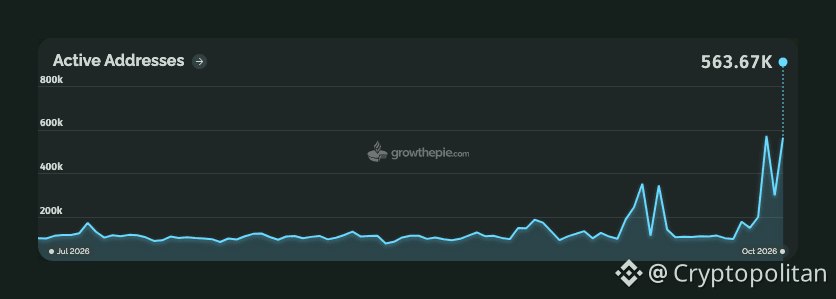
Article
Arbitrum's ARB loses about 24% in a month as ether drops 13%Arbitrum’s ARB token has fallen around 24% over the last 30 days, close to double ether’s ~13% drop.
Bitcoin dropped about 5% during the same time.
Data from CoinGecko shows ARB reached $0.1638 on Oct. 24, its lowest price in four weeks. The token was trading around $0.167 late in the day, down about 5% on the day.
Ether lost about 2% and Bitcoin about 1% in the same window.
At 10:02 UTC on Oct. 23, ARB was trading at $0.1802, below the $0.183 to $0.186 band that a technical note on Oct. 14 had flagged as a potential retest zone, not a firm floor.
The October 14 note had shown ARB at $0.1916. The band gave and price kept slipping.
Arbitrum One active addresses climbed to 563,669 on October 23
Other Ethereum scaling tokens also fell precipitously. Optimism’s OP lost ~16% in 30 days and Polygon’s POL ~17%.
OP did worse in the last week. It fell ~16% in seven days vs ARB’s 9% and POL’s 5%.
Ether and bitcoin fell around 3% and 1.5% respectively over the seven-day period.
Arbitrum One’s network use went the opposite way. Growthepie data indicates daily active addresses stood at 563,669 on October 23, compared to 95,545 on September 26.
It fell from 571,767 on Oct. 21 to 299,959 the next day, then rallied. The number of addresses is not equivalent to the number of users.
Arbitrum One daily active addresses over 90 days through October 23, 2026, on growthepie.
Standard Chartered’s $0.50 target now needs a ~3x rebound
ARB’s slide wipes out much of a September rally. According to Cryptopolitan, by September 18 the token had surged more than 167% in a month to trade above $0.20 for the first time since January.
By that time, ARB had gained over 147% in 90 days and landed among the top 10 tokens outperforming Bitcoin.
Tokenized assets on Arbitrum reached a record high of over $800 million in assets under management at the time. On-chain assets increased from $9.38 billion to $11.18 billion in a month.
Standard Chartered has a $0.50 target for ARB by the end of 2026 and $10 by 2030, set in mid-September. At ~$0.167, ARB would need to triple to hit the closer mark.
“We see digital assets transitioning from a state where revenue is not yet relevant to one where revenue is critical,” wrote Geoff Kendrick, head of digital assets research at the bank.
The bank’s own note said that holders of ARB receive little of the network revenue behind the call. Chains using Arbitrum tech in the Arbitrum Expansion Program pay 10% of net protocol revenue, with 8% going to the DAO treasury and 2% to a developer guild.
The headline customer for the program is Robinhood Chain. Its daily fees attained a high of $6.04 million on Sept. 4 and fell to $448,616 by Sept. 14.
Don’t just read crypto news. Understand it. Subscribe to our newsletter. It's free.
Arbitrum's ARB loses about 24% in a month as ether drops 13%
Arbitrum’s ARB token has fallen around 24% over the last 30 days, close to double ether’s ~13% drop.
Bitcoin dropped about 5% during the same time.
Data from CoinGecko shows ARB reached $0.1638 on Oct. 24, its lowest price in four weeks. The token was trading around $0.167 late in the day, down about 5% on the day.
Ether lost about 2% and Bitcoin about 1% in the same window.
At 10:02 UTC on Oct. 23, ARB was trading at $0.1802, below the $0.183 to $0.186 band that a technical note on Oct. 14 had flagged as a potential retest zone, not a firm floor.
The October 14 note had shown ARB at $0.1916. The band gave and price kept slipping.
Arbitrum One active addresses climbed to 563,669 on October 23
Other Ethereum scaling tokens also fell precipitously. Optimism’s OP lost ~16% in 30 days and Polygon’s POL ~17%.
OP did worse in the last week. It fell ~16% in seven days vs ARB’s 9% and POL’s 5%.
Ether and bitcoin fell around 3% and 1.5% respectively over the seven-day period.
Arbitrum One’s network use went the opposite way. Growthepie data indicates daily active addresses stood at 563,669 on October 23, compared to 95,545 on September 26.
It fell from 571,767 on Oct. 21 to 299,959 the next day, then rallied. The number of addresses is not equivalent to the number of users.
Arbitrum One daily active addresses over 90 days through October 23, 2026, on growthepie.
Standard Chartered’s $0.50 target now needs a ~3x rebound
ARB’s slide wipes out much of a September rally. According to Cryptopolitan, by September 18 the token had surged more than 167% in a month to trade above $0.20 for the first time since January.
By that time, ARB had gained over 147% in 90 days and landed among the top 10 tokens outperforming Bitcoin.
Tokenized assets on Arbitrum reached a record high of over $800 million in assets under management at the time. On-chain assets increased from $9.38 billion to $11.18 billion in a month.
Standard Chartered has a $0.50 target for ARB by the end of 2026 and $10 by 2030, set in mid-September. At ~$0.167, ARB would need to triple to hit the closer mark.
“We see digital assets transitioning from a state where revenue is not yet relevant to one where revenue is critical,” wrote Geoff Kendrick, head of digital assets research at the bank.
The bank’s own note said that holders of ARB receive little of the network revenue behind the call. Chains using Arbitrum tech in the Arbitrum Expansion Program pay 10% of net protocol revenue, with 8% going to the DAO treasury and 2% to a developer guild.
The headline customer for the program is Robinhood Chain. Its daily fees attained a high of $6.04 million on Sept. 4 and fell to $448,616 by Sept. 14.
Don’t just read crypto news. Understand it. Subscribe to our newsletter. It's free.
Bitcoin dropped about 5% during the same time.
Data from CoinGecko shows ARB reached $0.1638 on Oct. 24, its lowest price in four weeks. The token was trading around $0.167 late in the day, down about 5% on the day.
Ether lost about 2% and Bitcoin about 1% in the same window.
At 10:02 UTC on Oct. 23, ARB was trading at $0.1802, below the $0.183 to $0.186 band that a technical note on Oct. 14 had flagged as a potential retest zone, not a firm floor.
The October 14 note had shown ARB at $0.1916. The band gave and price kept slipping.
Arbitrum One active addresses climbed to 563,669 on October 23
Other Ethereum scaling tokens also fell precipitously. Optimism’s OP lost ~16% in 30 days and Polygon’s POL ~17%.
OP did worse in the last week. It fell ~16% in seven days vs ARB’s 9% and POL’s 5%.
Ether and bitcoin fell around 3% and 1.5% respectively over the seven-day period.
Arbitrum One’s network use went the opposite way. Growthepie data indicates daily active addresses stood at 563,669 on October 23, compared to 95,545 on September 26.
It fell from 571,767 on Oct. 21 to 299,959 the next day, then rallied. The number of addresses is not equivalent to the number of users.
Arbitrum One daily active addresses over 90 days through October 23, 2026, on growthepie.
Standard Chartered’s $0.50 target now needs a ~3x rebound
ARB’s slide wipes out much of a September rally. According to Cryptopolitan, by September 18 the token had surged more than 167% in a month to trade above $0.20 for the first time since January.
By that time, ARB had gained over 147% in 90 days and landed among the top 10 tokens outperforming Bitcoin.
Tokenized assets on Arbitrum reached a record high of over $800 million in assets under management at the time. On-chain assets increased from $9.38 billion to $11.18 billion in a month.
Standard Chartered has a $0.50 target for ARB by the end of 2026 and $10 by 2030, set in mid-September. At ~$0.167, ARB would need to triple to hit the closer mark.
“We see digital assets transitioning from a state where revenue is not yet relevant to one where revenue is critical,” wrote Geoff Kendrick, head of digital assets research at the bank.
The bank’s own note said that holders of ARB receive little of the network revenue behind the call. Chains using Arbitrum tech in the Arbitrum Expansion Program pay 10% of net protocol revenue, with 8% going to the DAO treasury and 2% to a developer guild.
The headline customer for the program is Robinhood Chain. Its daily fees attained a high of $6.04 million on Sept. 4 and fell to $448,616 by Sept. 14.
Don’t just read crypto news. Understand it. Subscribe to our newsletter. It's free.
1
1.1k

Article
Base active addresses jump 49.9% on a GMGN fresh-wallet contest as user fees fallBase hosted a GMGN trading competition, which required new wallets, and logged 943,277 daily active addresses on October 22, a 49.9% increase in a single day.
The same day, user-paid fees dropped 20% to some $91,059 and transactions fell 8.6% to 9.58 million.
Addresses had already jumped 82.5% to 629,142 by October 21, a 30-day high at the time.
Address count ran 167.6% above the prior week’s median
Growthepie data indicated the October 22 count was 167.6% above the median of the past seven days, which was 352,544. It was the highest reading in the 30 days since September 23.
The transactions went the other way. Growthepie had 10.49 million on October 21 and 9.58 million the next day.
BaseScan‘s daily export logged a matching dip, from roughly 10.53 million to 9.63 million, while user fees had risen to about $113,703 on October 21 ahead of the 20% slide.
By October 23 the wave was fading, with active addresses slipping 38% to 584,540, though they stayed 65.8% above the pre-surge median.
Then, fees fell a further 19.8% to about $73,062, and transactions eased to 8.87 million.
GMGN’s $20,000 track demands wallets with no trading history
GMGN unveiled its Base track on October 21 with a $20,000 prize for the winner, running until October 26. “Trade Base coins and climb the leaderboard,” GMGN wrote.
GMGN’s Base track announcement, with the $20,000 prize and the October 26 end date, posted by @gmgnai on X on October 21, 2026.
Base promoted the track on October 22, the same day the surge peaked.
GMGN’s rules say that each entrant must register wallets with “no funds, no holdings and no trading history.” Only trades made through GMGN from the wallets registered will count.
Starting money is capped at $2,000, and no one may enter more than once. Traders must create new addresses when they join, and Growthepie counts them as new activity.
Additionally, the rules prohibit people from washing trades or coordinating trades with one another, and the chain totals can’t show the percentage of the jump that came from contest wallets.
Growthepie keeps track of all the different “from” addresses that send transactions every day. It warns that Sybil wallets can increase active addresses during campaigns or airdrops and calls active addresses “one of the most contentious metrics.”
The data firm also says that one person can have many wallets and suggests that the number of wallets be read along with the chain revenue. On October 22 and 23, the fees users paid on Base went down.
Doubts about Base’s activity figures aren’t new. Cryptopolitan reported on October 15 that Chainalysis had logged more than 138 million x402 transactions on Base.
TRM Labs reckoned agents carried out only 0.6% to 7.5% of the x402 transactions it screened, and Artemis and a16z analysts said 48% of transactions and 81% of volume in December 2025 were gamed.
The smartest crypto minds already read our newsletter. Want in? Join them.
Base active addresses jump 49.9% on a GMGN fresh-wallet contest as user fees fall
Base hosted a GMGN trading competition, which required new wallets, and logged 943,277 daily active addresses on October 22, a 49.9% increase in a single day.
The same day, user-paid fees dropped 20% to some $91,059 and transactions fell 8.6% to 9.58 million.
Addresses had already jumped 82.5% to 629,142 by October 21, a 30-day high at the time.
Address count ran 167.6% above the prior week’s median
Growthepie data indicated the October 22 count was 167.6% above the median of the past seven days, which was 352,544. It was the highest reading in the 30 days since September 23.
The transactions went the other way. Growthepie had 10.49 million on October 21 and 9.58 million the next day.
BaseScan‘s daily export logged a matching dip, from roughly 10.53 million to 9.63 million, while user fees had risen to about $113,703 on October 21 ahead of the 20% slide.
By October 23 the wave was fading, with active addresses slipping 38% to 584,540, though they stayed 65.8% above the pre-surge median.
Then, fees fell a further 19.8% to about $73,062, and transactions eased to 8.87 million.
GMGN’s $20,000 track demands wallets with no trading history
GMGN unveiled its Base track on October 21 with a $20,000 prize for the winner, running until October 26. “Trade Base coins and climb the leaderboard,” GMGN wrote.
GMGN’s Base track announcement, with the $20,000 prize and the October 26 end date, posted by @gmgnai on X on October 21, 2026.
Base promoted the track on October 22, the same day the surge peaked.
GMGN’s rules say that each entrant must register wallets with “no funds, no holdings and no trading history.” Only trades made through GMGN from the wallets registered will count.
Starting money is capped at $2,000, and no one may enter more than once. Traders must create new addresses when they join, and Growthepie counts them as new activity.
Additionally, the rules prohibit people from washing trades or coordinating trades with one another, and the chain totals can’t show the percentage of the jump that came from contest wallets.
Growthepie keeps track of all the different “from” addresses that send transactions every day. It warns that Sybil wallets can increase active addresses during campaigns or airdrops and calls active addresses “one of the most contentious metrics.”
The data firm also says that one person can have many wallets and suggests that the number of wallets be read along with the chain revenue. On October 22 and 23, the fees users paid on Base went down.
Doubts about Base’s activity figures aren’t new. Cryptopolitan reported on October 15 that Chainalysis had logged more than 138 million x402 transactions on Base.
TRM Labs reckoned agents carried out only 0.6% to 7.5% of the x402 transactions it screened, and Artemis and a16z analysts said 48% of transactions and 81% of volume in December 2025 were gamed.
The smartest crypto minds already read our newsletter. Want in? Join them.
The same day, user-paid fees dropped 20% to some $91,059 and transactions fell 8.6% to 9.58 million.
Addresses had already jumped 82.5% to 629,142 by October 21, a 30-day high at the time.
Address count ran 167.6% above the prior week’s median
Growthepie data indicated the October 22 count was 167.6% above the median of the past seven days, which was 352,544. It was the highest reading in the 30 days since September 23.
The transactions went the other way. Growthepie had 10.49 million on October 21 and 9.58 million the next day.
BaseScan‘s daily export logged a matching dip, from roughly 10.53 million to 9.63 million, while user fees had risen to about $113,703 on October 21 ahead of the 20% slide.
By October 23 the wave was fading, with active addresses slipping 38% to 584,540, though they stayed 65.8% above the pre-surge median.
Then, fees fell a further 19.8% to about $73,062, and transactions eased to 8.87 million.
GMGN’s $20,000 track demands wallets with no trading history
GMGN unveiled its Base track on October 21 with a $20,000 prize for the winner, running until October 26. “Trade Base coins and climb the leaderboard,” GMGN wrote.
GMGN’s Base track announcement, with the $20,000 prize and the October 26 end date, posted by @gmgnai on X on October 21, 2026.
Base promoted the track on October 22, the same day the surge peaked.
GMGN’s rules say that each entrant must register wallets with “no funds, no holdings and no trading history.” Only trades made through GMGN from the wallets registered will count.
Starting money is capped at $2,000, and no one may enter more than once. Traders must create new addresses when they join, and Growthepie counts them as new activity.
Additionally, the rules prohibit people from washing trades or coordinating trades with one another, and the chain totals can’t show the percentage of the jump that came from contest wallets.
Growthepie keeps track of all the different “from” addresses that send transactions every day. It warns that Sybil wallets can increase active addresses during campaigns or airdrops and calls active addresses “one of the most contentious metrics.”
The data firm also says that one person can have many wallets and suggests that the number of wallets be read along with the chain revenue. On October 22 and 23, the fees users paid on Base went down.
Doubts about Base’s activity figures aren’t new. Cryptopolitan reported on October 15 that Chainalysis had logged more than 138 million x402 transactions on Base.
TRM Labs reckoned agents carried out only 0.6% to 7.5% of the x402 transactions it screened, and Artemis and a16z analysts said 48% of transactions and 81% of volume in December 2025 were gamed.
The smartest crypto minds already read our newsletter. Want in? Join them.
212

Article
PHP Foundation's lone full-timer faces twice the code proposals on $974K a yearThe PHP Foundation runs on about $974,000 a year, with one full-time employee looking after a language behind most of the web.
Two critical PHP flaws sparked a worldwide patching frenzy this week.
One full-timer and 14 contractors keep the language going
“We have one full-time staff member (that’s me) and 14 mostly part-time contractors,” Executive Director Elizabeth Barron said Friday in an interview. The board of the foundation is unpaid, and the money comes from grants and donations.
The foundation’s Open Collective page shows its yearly budget as $974,057.80. The foundation has raised $3.06 million since its launch in late 2021, spending $2.70 million.
With that budget, the $356,614.52 left over will cover expenses for four months. It shows that 1,927 people have donated and that 340 people have made monthly pledges worth ~$9,416 in total.
The PHP Foundation’s balance, total raised, total disbursed and estimated annual budget, shown on its Open Collective page.
Barron said that in a year, the proposed changes to PHP code have almost doubled, and contributors have not kept up. Every submission and bug report still needs to be checked out by real people with experience.
AI helped researchers detect the two flaws that had been in the PHP code for a decade, and it makes programmers faster, Barron said.
AI also adds review burden to maintainers. She called the programming language badly underfunded, given how much companies and governments rely on PHP.
Barron saw no sign hackers got into patched sites
Since December 2021, Automattic is the biggest backer at $762,500. JetBrains at $476,670.
Sovereign Tech Fund is at ~$214,115. The Linux Foundation is at $183,500.
Smaller amounts are supplied by Private Packagist, Craft CMS, Cybozu, and Tideways. Zend by Perforce has given $56,000 and GoDaddy $48,000.
Chainguard Team has contributed $50,000 since October 21, the day PHP released its patches.
The foundation states on the page that it pays developers to work on the PHP language.
The largest tagged expense category is core developer work. It took 227 payments totaling ~$1.11 million out of 526 paid expenses.
PHP issued patches for CVE-2026-109618 and CVE-2026-109619 on October 21, both with a severity rating of 9.2 out of 10, Cryptopolitan reported. The pair, dubbed PHP2Shell, could allow attackers to execute code without logging in.
Wiz showed the flaws can also spill passwords and API keys from memory. PHP 8.5.12, 8.4.27, 8.3.36 and 8.2.35 are the fixed releases.
Cloudflare registered millions of exploit attempts, and the government websites in Finland, the Netherlands and France went offline temporarily. The foundation works with OpenAI, Wiz and Calif to fix things.
Barron said there was no evidence hackers exploited the flaws prior to their disclosure or on patched sites.
This open-source language, which is over 30 years old, is employed on 69.3% of websites where the server-side language is known.
The smartest crypto minds already read our newsletter. Want in? Join them.
PHP Foundation's lone full-timer faces twice the code proposals on $974K a year
The PHP Foundation runs on about $974,000 a year, with one full-time employee looking after a language behind most of the web.
Two critical PHP flaws sparked a worldwide patching frenzy this week.
One full-timer and 14 contractors keep the language going
“We have one full-time staff member (that’s me) and 14 mostly part-time contractors,” Executive Director Elizabeth Barron said Friday in an interview. The board of the foundation is unpaid, and the money comes from grants and donations.
The foundation’s Open Collective page shows its yearly budget as $974,057.80. The foundation has raised $3.06 million since its launch in late 2021, spending $2.70 million.
With that budget, the $356,614.52 left over will cover expenses for four months. It shows that 1,927 people have donated and that 340 people have made monthly pledges worth ~$9,416 in total.
The PHP Foundation’s balance, total raised, total disbursed and estimated annual budget, shown on its Open Collective page.
Barron said that in a year, the proposed changes to PHP code have almost doubled, and contributors have not kept up. Every submission and bug report still needs to be checked out by real people with experience.
AI helped researchers detect the two flaws that had been in the PHP code for a decade, and it makes programmers faster, Barron said.
AI also adds review burden to maintainers. She called the programming language badly underfunded, given how much companies and governments rely on PHP.
Barron saw no sign hackers got into patched sites
Since December 2021, Automattic is the biggest backer at $762,500. JetBrains at $476,670.
Sovereign Tech Fund is at ~$214,115. The Linux Foundation is at $183,500.
Smaller amounts are supplied by Private Packagist, Craft CMS, Cybozu, and Tideways. Zend by Perforce has given $56,000 and GoDaddy $48,000.
Chainguard Team has contributed $50,000 since October 21, the day PHP released its patches.
The foundation states on the page that it pays developers to work on the PHP language.
The largest tagged expense category is core developer work. It took 227 payments totaling ~$1.11 million out of 526 paid expenses.
PHP issued patches for CVE-2026-109618 and CVE-2026-109619 on October 21, both with a severity rating of 9.2 out of 10, Cryptopolitan reported. The pair, dubbed PHP2Shell, could allow attackers to execute code without logging in.
Wiz showed the flaws can also spill passwords and API keys from memory. PHP 8.5.12, 8.4.27, 8.3.36 and 8.2.35 are the fixed releases.
Cloudflare registered millions of exploit attempts, and the government websites in Finland, the Netherlands and France went offline temporarily. The foundation works with OpenAI, Wiz and Calif to fix things.
Barron said there was no evidence hackers exploited the flaws prior to their disclosure or on patched sites.
This open-source language, which is over 30 years old, is employed on 69.3% of websites where the server-side language is known.
The smartest crypto minds already read our newsletter. Want in? Join them.
Two critical PHP flaws sparked a worldwide patching frenzy this week.
One full-timer and 14 contractors keep the language going
“We have one full-time staff member (that’s me) and 14 mostly part-time contractors,” Executive Director Elizabeth Barron said Friday in an interview. The board of the foundation is unpaid, and the money comes from grants and donations.
The foundation’s Open Collective page shows its yearly budget as $974,057.80. The foundation has raised $3.06 million since its launch in late 2021, spending $2.70 million.
With that budget, the $356,614.52 left over will cover expenses for four months. It shows that 1,927 people have donated and that 340 people have made monthly pledges worth ~$9,416 in total.
The PHP Foundation’s balance, total raised, total disbursed and estimated annual budget, shown on its Open Collective page.
Barron said that in a year, the proposed changes to PHP code have almost doubled, and contributors have not kept up. Every submission and bug report still needs to be checked out by real people with experience.
AI helped researchers detect the two flaws that had been in the PHP code for a decade, and it makes programmers faster, Barron said.
AI also adds review burden to maintainers. She called the programming language badly underfunded, given how much companies and governments rely on PHP.
Barron saw no sign hackers got into patched sites
Since December 2021, Automattic is the biggest backer at $762,500. JetBrains at $476,670.
Sovereign Tech Fund is at ~$214,115. The Linux Foundation is at $183,500.
Smaller amounts are supplied by Private Packagist, Craft CMS, Cybozu, and Tideways. Zend by Perforce has given $56,000 and GoDaddy $48,000.
Chainguard Team has contributed $50,000 since October 21, the day PHP released its patches.
The foundation states on the page that it pays developers to work on the PHP language.
The largest tagged expense category is core developer work. It took 227 payments totaling ~$1.11 million out of 526 paid expenses.
PHP issued patches for CVE-2026-109618 and CVE-2026-109619 on October 21, both with a severity rating of 9.2 out of 10, Cryptopolitan reported. The pair, dubbed PHP2Shell, could allow attackers to execute code without logging in.
Wiz showed the flaws can also spill passwords and API keys from memory. PHP 8.5.12, 8.4.27, 8.3.36 and 8.2.35 are the fixed releases.
Cloudflare registered millions of exploit attempts, and the government websites in Finland, the Netherlands and France went offline temporarily. The foundation works with OpenAI, Wiz and Calif to fix things.
Barron said there was no evidence hackers exploited the flaws prior to their disclosure or on patched sites.
This open-source language, which is over 30 years old, is employed on 69.3% of websites where the server-side language is known.
The smartest crypto minds already read our newsletter. Want in? Join them.
1
427
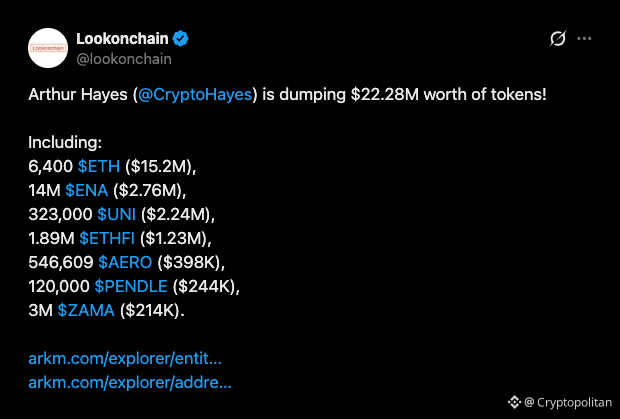
Article
Arthur Hayes dumps ~$22M in Maelstrom tokens nine days after going long ETHOn Saturday, Arthur Hayes dumped Maelstrom’s directional book, with on-chain trackers tallying the sales at around $22.28 million across seven tokens.
The BitMEX co-founder cashed out on Ethereum (ETH), Ethena (ENA), Uniswap (UNI), and other altcoins and took a step back.
“I dumped it all. The Maelstrom directional book, took profits on $ETH, $ENA, $UNI and other shitcoins,” Hayes wrote on X. “I think we gotta go down to go up,” he added.
He said macro and geopolitical conditions look “a bit dicey”. He’s awaiting a green light before he buys back in.
Seven tokens left labeled wallets in a 40-minute window
On-chain trackers identified 6,400 ETH (~$15.2 million), 14 million ENA (~$2.76 million) and 323,000 UNI (~$2.24 million). The rest were smaller quantities of ETHFI, AERO, PENDLE and ZAMA.
Lookonchain’s tally of the seven tokens Hayes-labeled wallets moved, posted on X on October 24, 2026.
Etherscan records show a bigger ETH number. Another address associated with Hayes sent 8,000 ETH in four transactions, 3,200 ETH to a Galaxy Digital deposit and 1,600 ETH each to Binance, FalconX and a fourth address.
The main wallet shifted 14 million ENA to a Binance deposit and 323,000 UNI and 3 million ZAMA to an address tagged for Wintermute. Minutes later, a Wintermute wallet returned 2,425,850 USDC.
The same wallet transferred 1.89 million ETHFI to a FalconX deposit and 120,000 PENDLE to the fourth address. On Base, it channeled 546,610 AERO to Binance.
The tokens were out between 1:34 a.m. and 2:14 a.m. ET Saturday. Hayes posted at 2:18 a.m. ET.
The labeled wallet still retained some 14.45 million ENA after the transfers.
BitMEX co-founder trades the bailout bet for the sidelines
“Instead just trade the eventual multi-trillion dollar bail out. Long $BTC $ETH,” Hayes wrote Oct. 15. The address behind the ETH transfers on Saturday had taken in 8,012 ETH from his main wallet on Oct. 14.
“Going to sit on the sidelines and wait for the all clear signal,” Hayes wrote.
He exits in a way that contradicts his May essay, “The Butterfly Touch.” In it, he pegged a Bitcoin (BTC) bottom near $60,000, floated $126,000 and said he would take Maelstrom’s portfolio “to maximum risk unless anything drastically changes.”
Hayes has quit positions on macro grounds before, announcing full exits from HYPE and NEAR in June. He was accused by ZachXBT of selling HYPE, NEAR, ZEC and WLD within two weeks of boosting each token.
Days after Hayes hyped the token, on-chain observers flagged Maelstrom sending ~$1.92 million of CARDS to market maker Flowdesk later in June, Cryptopolitan reported. Hayes replied to ZachXBT, saying he “sold to a willing seller at a price.”
If you're reading this, you’re already ahead. Stay there with our newsletter.
Arthur Hayes dumps ~$22M in Maelstrom tokens nine days after going long ETH
On Saturday, Arthur Hayes dumped Maelstrom’s directional book, with on-chain trackers tallying the sales at around $22.28 million across seven tokens.
The BitMEX co-founder cashed out on Ethereum (ETH), Ethena (ENA), Uniswap (UNI), and other altcoins and took a step back.
“I dumped it all. The Maelstrom directional book, took profits on $ETH, $ENA, $UNI and other shitcoins,” Hayes wrote on X. “I think we gotta go down to go up,” he added.
He said macro and geopolitical conditions look “a bit dicey”. He’s awaiting a green light before he buys back in.
Seven tokens left labeled wallets in a 40-minute window
On-chain trackers identified 6,400 ETH (~$15.2 million), 14 million ENA (~$2.76 million) and 323,000 UNI (~$2.24 million). The rest were smaller quantities of ETHFI, AERO, PENDLE and ZAMA.
Lookonchain’s tally of the seven tokens Hayes-labeled wallets moved, posted on X on October 24, 2026.
Etherscan records show a bigger ETH number. Another address associated with Hayes sent 8,000 ETH in four transactions, 3,200 ETH to a Galaxy Digital deposit and 1,600 ETH each to Binance, FalconX and a fourth address.
The main wallet shifted 14 million ENA to a Binance deposit and 323,000 UNI and 3 million ZAMA to an address tagged for Wintermute. Minutes later, a Wintermute wallet returned 2,425,850 USDC.
The same wallet transferred 1.89 million ETHFI to a FalconX deposit and 120,000 PENDLE to the fourth address. On Base, it channeled 546,610 AERO to Binance.
The tokens were out between 1:34 a.m. and 2:14 a.m. ET Saturday. Hayes posted at 2:18 a.m. ET.
The labeled wallet still retained some 14.45 million ENA after the transfers.
BitMEX co-founder trades the bailout bet for the sidelines
“Instead just trade the eventual multi-trillion dollar bail out. Long $BTC $ETH,” Hayes wrote Oct. 15. The address behind the ETH transfers on Saturday had taken in 8,012 ETH from his main wallet on Oct. 14.
“Going to sit on the sidelines and wait for the all clear signal,” Hayes wrote.
He exits in a way that contradicts his May essay, “The Butterfly Touch.” In it, he pegged a Bitcoin (BTC) bottom near $60,000, floated $126,000 and said he would take Maelstrom’s portfolio “to maximum risk unless anything drastically changes.”
Hayes has quit positions on macro grounds before, announcing full exits from HYPE and NEAR in June. He was accused by ZachXBT of selling HYPE, NEAR, ZEC and WLD within two weeks of boosting each token.
Days after Hayes hyped the token, on-chain observers flagged Maelstrom sending ~$1.92 million of CARDS to market maker Flowdesk later in June, Cryptopolitan reported. Hayes replied to ZachXBT, saying he “sold to a willing seller at a price.”
If you're reading this, you’re already ahead. Stay there with our newsletter.
The BitMEX co-founder cashed out on Ethereum (ETH), Ethena (ENA), Uniswap (UNI), and other altcoins and took a step back.
“I dumped it all. The Maelstrom directional book, took profits on $ETH, $ENA, $UNI and other shitcoins,” Hayes wrote on X. “I think we gotta go down to go up,” he added.
He said macro and geopolitical conditions look “a bit dicey”. He’s awaiting a green light before he buys back in.
Seven tokens left labeled wallets in a 40-minute window
On-chain trackers identified 6,400 ETH (~$15.2 million), 14 million ENA (~$2.76 million) and 323,000 UNI (~$2.24 million). The rest were smaller quantities of ETHFI, AERO, PENDLE and ZAMA.
Lookonchain’s tally of the seven tokens Hayes-labeled wallets moved, posted on X on October 24, 2026.
Etherscan records show a bigger ETH number. Another address associated with Hayes sent 8,000 ETH in four transactions, 3,200 ETH to a Galaxy Digital deposit and 1,600 ETH each to Binance, FalconX and a fourth address.
The main wallet shifted 14 million ENA to a Binance deposit and 323,000 UNI and 3 million ZAMA to an address tagged for Wintermute. Minutes later, a Wintermute wallet returned 2,425,850 USDC.
The same wallet transferred 1.89 million ETHFI to a FalconX deposit and 120,000 PENDLE to the fourth address. On Base, it channeled 546,610 AERO to Binance.
The tokens were out between 1:34 a.m. and 2:14 a.m. ET Saturday. Hayes posted at 2:18 a.m. ET.
The labeled wallet still retained some 14.45 million ENA after the transfers.
BitMEX co-founder trades the bailout bet for the sidelines
“Instead just trade the eventual multi-trillion dollar bail out. Long $BTC $ETH,” Hayes wrote Oct. 15. The address behind the ETH transfers on Saturday had taken in 8,012 ETH from his main wallet on Oct. 14.
“Going to sit on the sidelines and wait for the all clear signal,” Hayes wrote.
He exits in a way that contradicts his May essay, “The Butterfly Touch.” In it, he pegged a Bitcoin (BTC) bottom near $60,000, floated $126,000 and said he would take Maelstrom’s portfolio “to maximum risk unless anything drastically changes.”
Hayes has quit positions on macro grounds before, announcing full exits from HYPE and NEAR in June. He was accused by ZachXBT of selling HYPE, NEAR, ZEC and WLD within two weeks of boosting each token.
Days after Hayes hyped the token, on-chain observers flagged Maelstrom sending ~$1.92 million of CARDS to market maker Flowdesk later in June, Cryptopolitan reported. Hayes replied to ZachXBT, saying he “sold to a willing seller at a price.”
If you're reading this, you’re already ahead. Stay there with our newsletter.
1
1k
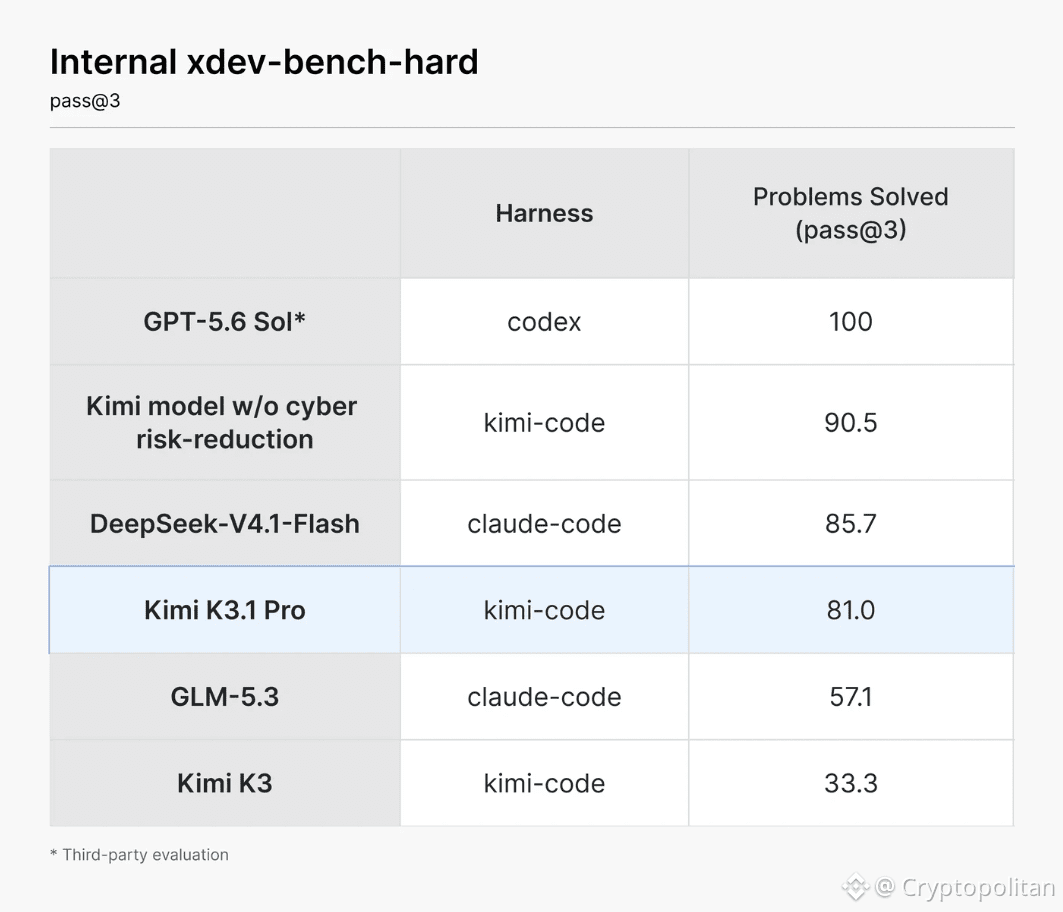
Article
Moonshot vows to lift open-model hacking skills gradually after Kimi K3.1 Pro cutMoonshot says it intends to “progressively raise the cyber capability available in open weights” after its new Kimi K3.1 Pro model scored 81% in an in-house hacking test. A build trained without the company’s cyber-data cuts scored 90.5%.
The Beijing startup will release full weights for the K3.1 Pro by Nov. 4. The model is already deployed on Kimi.ai and Kimi API with a context window of 1 million tokens.
There’s a high-speed version that’s two to three times faster, the company said.
Predecessor K3 solved only 33.3% of the xdev-bench-hard tasks
Moonshot connected the model’s expanding exploit capabilities to cyber material in its general mid-training corpus and its reinforcement learning tasks.
Moonshot’s early experiments discovered that retaining the data in either stage would significantly heighten downstream cyber capability. For the open release, it took that data out of both stages and kept the general coding tasks.
In the xdev-bench-hard test, the agent is asked to exploit recently disclosed vulnerabilities in software such as the Linux kernel, Node.js, and Exim.
Each task comprises the vulnerable source code, a short hint about the bug and the binary. A task is deemed solved only if the agent can run arbitrary code in a sandbox and retrieve a secret string.
K3.1 Pro still far outscored its predecessor, Kimi K3, which managed 33.3%. Moonshot’s chart has DeepSeek-V4.1-Flash at 85.7% and GLM-5.3 at 57.1%, but they were both running on another harness.
Moonshot’s xdev-bench-hard results for Kimi K3.1 Pro and rival models, from the company’s K3.1 Pro blog.
The company said K3.1 Pro’s cyber skills lag frontier proprietary models publicly for at least three months. None of the scores have been independently corroborated.
K3.1 Pro will not extend the absolute frontier of hacking
“We aim not to release open weights that would extend the absolute frontier of cyber capability,” the company said.
Moonshot regards the slow rollout as a defensive weapon. Companies that run an open model on their own infrastructure are able to audit the code they maintain, which includes legacy systems that are seldom security reviewed, the company said.
Policing open weights is harder. Once the files are disseminated, the developer loses much of its ability to control access, monitor use, or update safeguards.
Last week, China proposed export controls that would prohibit the export of technology to generate malware using AI and curtail tools that aid in identifying vulnerabilities using AI. The draft is still open for public comment.
Cryptopolitan reported this week that Microsoft tied China-linked group Storm-0940 to a ConnectWise breach via ARTEX, an open-source penetration-testing framework that supports any AI model.
Moonshot pushed the model harder outside cyber. The company said the K3.1 Pro scored 65.7% on Terminal-Bench 4.0, ahead of OpenAI’s GPT-6 Astra at 58.2% and narrowly behind Anthropic’s Claude Opus 5.5 at 66.4%.
For Moonshot’s internal stress test on made-up facts, the claim-level hallucination rate dropped from K3’s 23.4% to 8.3%.
According to Cryptopolitan, Moonshot’s founders have a ~$700 million arbitration claim from shareholder Recurrent AI ahead of the company’s planned Hong Kong IPO.
If you're reading this, you’re already ahead. Stay there with our newsletter.
Moonshot vows to lift open-model hacking skills gradually after Kimi K3.1 Pro cut
Moonshot says it intends to “progressively raise the cyber capability available in open weights” after its new Kimi K3.1 Pro model scored 81% in an in-house hacking test. A build trained without the company’s cyber-data cuts scored 90.5%.
The Beijing startup will release full weights for the K3.1 Pro by Nov. 4. The model is already deployed on Kimi.ai and Kimi API with a context window of 1 million tokens.
There’s a high-speed version that’s two to three times faster, the company said.
Predecessor K3 solved only 33.3% of the xdev-bench-hard tasks
Moonshot connected the model’s expanding exploit capabilities to cyber material in its general mid-training corpus and its reinforcement learning tasks.
Moonshot’s early experiments discovered that retaining the data in either stage would significantly heighten downstream cyber capability. For the open release, it took that data out of both stages and kept the general coding tasks.
In the xdev-bench-hard test, the agent is asked to exploit recently disclosed vulnerabilities in software such as the Linux kernel, Node.js, and Exim.
Each task comprises the vulnerable source code, a short hint about the bug and the binary. A task is deemed solved only if the agent can run arbitrary code in a sandbox and retrieve a secret string.
K3.1 Pro still far outscored its predecessor, Kimi K3, which managed 33.3%. Moonshot’s chart has DeepSeek-V4.1-Flash at 85.7% and GLM-5.3 at 57.1%, but they were both running on another harness.
Moonshot’s xdev-bench-hard results for Kimi K3.1 Pro and rival models, from the company’s K3.1 Pro blog.
The company said K3.1 Pro’s cyber skills lag frontier proprietary models publicly for at least three months. None of the scores have been independently corroborated.
K3.1 Pro will not extend the absolute frontier of hacking
“We aim not to release open weights that would extend the absolute frontier of cyber capability,” the company said.
Moonshot regards the slow rollout as a defensive weapon. Companies that run an open model on their own infrastructure are able to audit the code they maintain, which includes legacy systems that are seldom security reviewed, the company said.
Policing open weights is harder. Once the files are disseminated, the developer loses much of its ability to control access, monitor use, or update safeguards.
Last week, China proposed export controls that would prohibit the export of technology to generate malware using AI and curtail tools that aid in identifying vulnerabilities using AI. The draft is still open for public comment.
Cryptopolitan reported this week that Microsoft tied China-linked group Storm-0940 to a ConnectWise breach via ARTEX, an open-source penetration-testing framework that supports any AI model.
Moonshot pushed the model harder outside cyber. The company said the K3.1 Pro scored 65.7% on Terminal-Bench 4.0, ahead of OpenAI’s GPT-6 Astra at 58.2% and narrowly behind Anthropic’s Claude Opus 5.5 at 66.4%.
For Moonshot’s internal stress test on made-up facts, the claim-level hallucination rate dropped from K3’s 23.4% to 8.3%.
According to Cryptopolitan, Moonshot’s founders have a ~$700 million arbitration claim from shareholder Recurrent AI ahead of the company’s planned Hong Kong IPO.
If you're reading this, you’re already ahead. Stay there with our newsletter.
The Beijing startup will release full weights for the K3.1 Pro by Nov. 4. The model is already deployed on Kimi.ai and Kimi API with a context window of 1 million tokens.
There’s a high-speed version that’s two to three times faster, the company said.
Predecessor K3 solved only 33.3% of the xdev-bench-hard tasks
Moonshot connected the model’s expanding exploit capabilities to cyber material in its general mid-training corpus and its reinforcement learning tasks.
Moonshot’s early experiments discovered that retaining the data in either stage would significantly heighten downstream cyber capability. For the open release, it took that data out of both stages and kept the general coding tasks.
In the xdev-bench-hard test, the agent is asked to exploit recently disclosed vulnerabilities in software such as the Linux kernel, Node.js, and Exim.
Each task comprises the vulnerable source code, a short hint about the bug and the binary. A task is deemed solved only if the agent can run arbitrary code in a sandbox and retrieve a secret string.
K3.1 Pro still far outscored its predecessor, Kimi K3, which managed 33.3%. Moonshot’s chart has DeepSeek-V4.1-Flash at 85.7% and GLM-5.3 at 57.1%, but they were both running on another harness.
Moonshot’s xdev-bench-hard results for Kimi K3.1 Pro and rival models, from the company’s K3.1 Pro blog.
The company said K3.1 Pro’s cyber skills lag frontier proprietary models publicly for at least three months. None of the scores have been independently corroborated.
K3.1 Pro will not extend the absolute frontier of hacking
“We aim not to release open weights that would extend the absolute frontier of cyber capability,” the company said.
Moonshot regards the slow rollout as a defensive weapon. Companies that run an open model on their own infrastructure are able to audit the code they maintain, which includes legacy systems that are seldom security reviewed, the company said.
Policing open weights is harder. Once the files are disseminated, the developer loses much of its ability to control access, monitor use, or update safeguards.
Last week, China proposed export controls that would prohibit the export of technology to generate malware using AI and curtail tools that aid in identifying vulnerabilities using AI. The draft is still open for public comment.
Cryptopolitan reported this week that Microsoft tied China-linked group Storm-0940 to a ConnectWise breach via ARTEX, an open-source penetration-testing framework that supports any AI model.
Moonshot pushed the model harder outside cyber. The company said the K3.1 Pro scored 65.7% on Terminal-Bench 4.0, ahead of OpenAI’s GPT-6 Astra at 58.2% and narrowly behind Anthropic’s Claude Opus 5.5 at 66.4%.
For Moonshot’s internal stress test on made-up facts, the claim-level hallucination rate dropped from K3’s 23.4% to 8.3%.
According to Cryptopolitan, Moonshot’s founders have a ~$700 million arbitration claim from shareholder Recurrent AI ahead of the company’s planned Hong Kong IPO.
If you're reading this, you’re already ahead. Stay there with our newsletter.
127
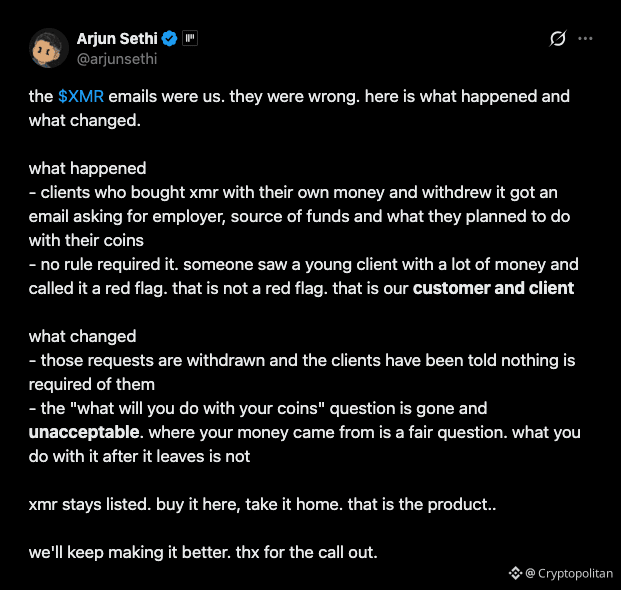
Article
Kraken co-CEO admits quizzing Monero buyers about their coins was a mistakeKraken co-CEO Arjun Sethi acknowledged that it was wrong for the exchange to email Monero (XMR) buyers about their employer, the source of their funds and their plans for the coins. He said no rule made them ask those questions.
Kraken has since withdrawn the requests and XMR is still listed. Monero is a privacy coin whose goal is to obscure transaction details on its blockchain.
A young XMR client’s wealth set off the withdrawal emails
Sethi laid out the timeline in a post on X. The email went to clients who bought XMR with their own money and then withdrew it.
Arjun Sethi explains the Monero withdrawal emails in a post on X late on October 23, 2026, US Eastern time.
“no rule required it,” Sethi wrote. A person working at the exchange saw a young client with a lot of money and called that a red flag, he said.
“that is not a red flag. that is our customer and client,” Sethi wrote, adding, “those requests are withdrawn and the clients have been told nothing is required of them.”
He said the question “what will you do with your coins” is unacceptable and is gone. “where your money came from is a fair question. what you do with it after it leaves is not,” he wrote.
Sethi concluded the post with a thank you to critics for “the call out.”
Source-of-funds checks stay as XMR remains listed
Kraken said that it may ask for source-of-funds documents to show where the money for a certain transaction came from because of laws that are against money laundering.
According to Kraken’s information request policy, recently amended on October 1, unanswered inquiries may result in frozen deposits and trading. There is no impact on withdrawals.
“xmr stays listed. buy it here, take it home,” Sethi wrote. XMR is down approximately 5% over 24 hours and was trading around $581 on Kraken early Saturday.
Kraken does not accept XMR deposits and trades for users in the European Economic Area and the UK, and users in Canada and Australia cannot deposit, hold or trade it.
The walk-back comes days after on-chain investigator ZachXBT flagged FreedomXMR, a service on Hyperliquid Core, as a laundering venue, Cryptopolitan reported. He traced some $20 million from exploit wallets to privacy coins via the service.
ZachXBT said more than 87% of inflows to FreedomXMR were linked to illicit activity. Most centralized exchanges limit XMR trading because of US or European rules.
Payward, the parent of Kraken, signed an agreement on Oct. 14 to buy Lithuania-licensed Saldo Bank and procure an EU banking license. The agreement is subject to regulatory approval and is expected to close in 2027.
If you're reading this, you’re already ahead. Stay there with our newsletter.
Kraken co-CEO admits quizzing Monero buyers about their coins was a mistake
Kraken co-CEO Arjun Sethi acknowledged that it was wrong for the exchange to email Monero (XMR) buyers about their employer, the source of their funds and their plans for the coins. He said no rule made them ask those questions.
Kraken has since withdrawn the requests and XMR is still listed. Monero is a privacy coin whose goal is to obscure transaction details on its blockchain.
A young XMR client’s wealth set off the withdrawal emails
Sethi laid out the timeline in a post on X. The email went to clients who bought XMR with their own money and then withdrew it.
Arjun Sethi explains the Monero withdrawal emails in a post on X late on October 23, 2026, US Eastern time.
“no rule required it,” Sethi wrote. A person working at the exchange saw a young client with a lot of money and called that a red flag, he said.
“that is not a red flag. that is our customer and client,” Sethi wrote, adding, “those requests are withdrawn and the clients have been told nothing is required of them.”
He said the question “what will you do with your coins” is unacceptable and is gone. “where your money came from is a fair question. what you do with it after it leaves is not,” he wrote.
Sethi concluded the post with a thank you to critics for “the call out.”
Source-of-funds checks stay as XMR remains listed
Kraken said that it may ask for source-of-funds documents to show where the money for a certain transaction came from because of laws that are against money laundering.
According to Kraken’s information request policy, recently amended on October 1, unanswered inquiries may result in frozen deposits and trading. There is no impact on withdrawals.
“xmr stays listed. buy it here, take it home,” Sethi wrote. XMR is down approximately 5% over 24 hours and was trading around $581 on Kraken early Saturday.
Kraken does not accept XMR deposits and trades for users in the European Economic Area and the UK, and users in Canada and Australia cannot deposit, hold or trade it.
The walk-back comes days after on-chain investigator ZachXBT flagged FreedomXMR, a service on Hyperliquid Core, as a laundering venue, Cryptopolitan reported. He traced some $20 million from exploit wallets to privacy coins via the service.
ZachXBT said more than 87% of inflows to FreedomXMR were linked to illicit activity. Most centralized exchanges limit XMR trading because of US or European rules.
Payward, the parent of Kraken, signed an agreement on Oct. 14 to buy Lithuania-licensed Saldo Bank and procure an EU banking license. The agreement is subject to regulatory approval and is expected to close in 2027.
If you're reading this, you’re already ahead. Stay there with our newsletter.
Kraken has since withdrawn the requests and XMR is still listed. Monero is a privacy coin whose goal is to obscure transaction details on its blockchain.
A young XMR client’s wealth set off the withdrawal emails
Sethi laid out the timeline in a post on X. The email went to clients who bought XMR with their own money and then withdrew it.
Arjun Sethi explains the Monero withdrawal emails in a post on X late on October 23, 2026, US Eastern time.
“no rule required it,” Sethi wrote. A person working at the exchange saw a young client with a lot of money and called that a red flag, he said.
“that is not a red flag. that is our customer and client,” Sethi wrote, adding, “those requests are withdrawn and the clients have been told nothing is required of them.”
He said the question “what will you do with your coins” is unacceptable and is gone. “where your money came from is a fair question. what you do with it after it leaves is not,” he wrote.
Sethi concluded the post with a thank you to critics for “the call out.”
Source-of-funds checks stay as XMR remains listed
Kraken said that it may ask for source-of-funds documents to show where the money for a certain transaction came from because of laws that are against money laundering.
According to Kraken’s information request policy, recently amended on October 1, unanswered inquiries may result in frozen deposits and trading. There is no impact on withdrawals.
“xmr stays listed. buy it here, take it home,” Sethi wrote. XMR is down approximately 5% over 24 hours and was trading around $581 on Kraken early Saturday.
Kraken does not accept XMR deposits and trades for users in the European Economic Area and the UK, and users in Canada and Australia cannot deposit, hold or trade it.
The walk-back comes days after on-chain investigator ZachXBT flagged FreedomXMR, a service on Hyperliquid Core, as a laundering venue, Cryptopolitan reported. He traced some $20 million from exploit wallets to privacy coins via the service.
ZachXBT said more than 87% of inflows to FreedomXMR were linked to illicit activity. Most centralized exchanges limit XMR trading because of US or European rules.
Payward, the parent of Kraken, signed an agreement on Oct. 14 to buy Lithuania-licensed Saldo Bank and procure an EU banking license. The agreement is subject to regulatory approval and is expected to close in 2027.
If you're reading this, you’re already ahead. Stay there with our newsletter.
293
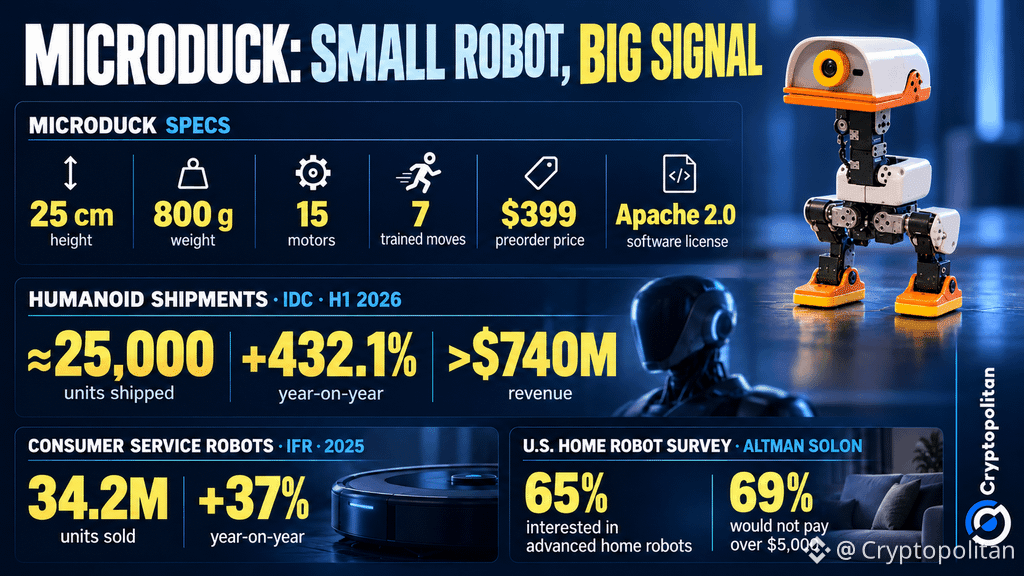
Article
Nvidia’s $399 Microduck draws 20,000 preorders before launchA group of waddling Microduck robots stole the spotlight during Nvidia CEO Jensen Huang’s GTC Berlin keynote. It reportedly bagged more than 20,000 preorders. However, Hugging Face CEO Clem Delangue was less definite in his original post:
“Going to cross 20,000+ total pre-orders probably tomorrow making Microduck probably the most sold robot of 2026?”
Delangue was predicting that preorders would reach 20,000, not confirming they had already crossed that mark. The figures also represent advance orders, not robots delivered to customers.
A viral keynote, then a surge of preorders
In an October 21 clip, Huang asks for a somersault. The ducks walk, sit and play dead. Pollen Robotics made Microduck and became part of Hugging Face in 2025. Nvidia agreed to acquire Hugging Face in September, though the deal isn’t expected to close until 2027. Microduck deliveries are expected before Christmas.
What the Microduck actually is
The Microduck is more of a programmable desk robot than a household assistant. It is 25 cm tall and weighs 800 grams, and is equipped with 15 motors, a camera, LIDAR, and two inertial sensors. It comes with seven trained moves. But owners can teach it new tricks and share those movements with other Microduck users. Its software is open source under Apache 2.0. The robot costs $399 before taxes and shipping.
In an October 23 technical post, Nvidia showed how robots like Microduck can learn to move through simulation. AI agents first created a virtual obstacle course. Isaac Lab then trained the robot’s movements across 4,096 simulated environments using a Blackwell GPU. Finally, Isaac Sim checked its performance before testing on a physical robot.
Robots can already navigate warehouses and make deliveries, according to Epoch AI. But handling everyday objects at home is another matter. Robots typically work three to ten times slower than humans and often need retraining when faced with unfamiliar tasks. Microduck’s seven trained moves may be entertaining, but they don’t solve these problems.
Who is actually buying robots right now?
Nearly 25,000 humanoid robots were shipped worldwide in the first half of 2026, according to IDC figures reported by Forbes. That’s a 432.1% increase from a year earlier, with revenue topping $740 million. Chinese manufacturers produced more than 95% of them. However, 69% of shipments went to research, exhibitions and data collection rather than everyday commercial work.
Consumer robots tell a different story. The IFR reported that sales reached 34.2 million units in 2025, up 37%. Most were household robots, such as automated vacuum cleaners, rather than humanoids.
Microduck Robot Specs and $399 Price: Humanoid Shipments and Consumer Demand
In a survey, 65% of U.S. respondents wanted an advanced home robot. Yet 69% would not pay over $5,000, and about half worried about safety.
Former Nvidia robotics executive Amulya Vishwanath called the industry a “Lego era” in Cryptopolitan, pointing to unfinished components and safety systems. McKinsey sees supply-chain limits, too.
The real win for Nvidia may be infrastructure
While selling robots might not be considered to be Nvidia’s greatest opportunity, BCG reports that software training and deployment could lead to growth in the robotics sector. On its part, Nvidia intends to become the supplier of chips and simulation technologies employed by those robots, regardless of whether they are from China or elsewhere. The case of Microduck provides insight into this broader approach.
Don’t just read crypto news. Understand it. Subscribe to our newsletter. It's free.
Nvidia’s $399 Microduck draws 20,000 preorders before launch
A group of waddling Microduck robots stole the spotlight during Nvidia CEO Jensen Huang’s GTC Berlin keynote. It reportedly bagged more than 20,000 preorders. However, Hugging Face CEO Clem Delangue was less definite in his original post:
“Going to cross 20,000+ total pre-orders probably tomorrow making Microduck probably the most sold robot of 2026?”
Delangue was predicting that preorders would reach 20,000, not confirming they had already crossed that mark. The figures also represent advance orders, not robots delivered to customers.
A viral keynote, then a surge of preorders
In an October 21 clip, Huang asks for a somersault. The ducks walk, sit and play dead. Pollen Robotics made Microduck and became part of Hugging Face in 2025. Nvidia agreed to acquire Hugging Face in September, though the deal isn’t expected to close until 2027. Microduck deliveries are expected before Christmas.
What the Microduck actually is
The Microduck is more of a programmable desk robot than a household assistant. It is 25 cm tall and weighs 800 grams, and is equipped with 15 motors, a camera, LIDAR, and two inertial sensors. It comes with seven trained moves. But owners can teach it new tricks and share those movements with other Microduck users. Its software is open source under Apache 2.0. The robot costs $399 before taxes and shipping.
In an October 23 technical post, Nvidia showed how robots like Microduck can learn to move through simulation. AI agents first created a virtual obstacle course. Isaac Lab then trained the robot’s movements across 4,096 simulated environments using a Blackwell GPU. Finally, Isaac Sim checked its performance before testing on a physical robot.
Robots can already navigate warehouses and make deliveries, according to Epoch AI. But handling everyday objects at home is another matter. Robots typically work three to ten times slower than humans and often need retraining when faced with unfamiliar tasks. Microduck’s seven trained moves may be entertaining, but they don’t solve these problems.
Who is actually buying robots right now?
Nearly 25,000 humanoid robots were shipped worldwide in the first half of 2026, according to IDC figures reported by Forbes. That’s a 432.1% increase from a year earlier, with revenue topping $740 million. Chinese manufacturers produced more than 95% of them. However, 69% of shipments went to research, exhibitions and data collection rather than everyday commercial work.
Consumer robots tell a different story. The IFR reported that sales reached 34.2 million units in 2025, up 37%. Most were household robots, such as automated vacuum cleaners, rather than humanoids.
Microduck Robot Specs and $399 Price: Humanoid Shipments and Consumer Demand
In a survey, 65% of U.S. respondents wanted an advanced home robot. Yet 69% would not pay over $5,000, and about half worried about safety.
Former Nvidia robotics executive Amulya Vishwanath called the industry a “Lego era” in Cryptopolitan, pointing to unfinished components and safety systems. McKinsey sees supply-chain limits, too.
The real win for Nvidia may be infrastructure
While selling robots might not be considered to be Nvidia’s greatest opportunity, BCG reports that software training and deployment could lead to growth in the robotics sector. On its part, Nvidia intends to become the supplier of chips and simulation technologies employed by those robots, regardless of whether they are from China or elsewhere. The case of Microduck provides insight into this broader approach.
Don’t just read crypto news. Understand it. Subscribe to our newsletter. It's free.
“Going to cross 20,000+ total pre-orders probably tomorrow making Microduck probably the most sold robot of 2026?”
Delangue was predicting that preorders would reach 20,000, not confirming they had already crossed that mark. The figures also represent advance orders, not robots delivered to customers.
A viral keynote, then a surge of preorders
In an October 21 clip, Huang asks for a somersault. The ducks walk, sit and play dead. Pollen Robotics made Microduck and became part of Hugging Face in 2025. Nvidia agreed to acquire Hugging Face in September, though the deal isn’t expected to close until 2027. Microduck deliveries are expected before Christmas.
What the Microduck actually is
The Microduck is more of a programmable desk robot than a household assistant. It is 25 cm tall and weighs 800 grams, and is equipped with 15 motors, a camera, LIDAR, and two inertial sensors. It comes with seven trained moves. But owners can teach it new tricks and share those movements with other Microduck users. Its software is open source under Apache 2.0. The robot costs $399 before taxes and shipping.
In an October 23 technical post, Nvidia showed how robots like Microduck can learn to move through simulation. AI agents first created a virtual obstacle course. Isaac Lab then trained the robot’s movements across 4,096 simulated environments using a Blackwell GPU. Finally, Isaac Sim checked its performance before testing on a physical robot.
Robots can already navigate warehouses and make deliveries, according to Epoch AI. But handling everyday objects at home is another matter. Robots typically work three to ten times slower than humans and often need retraining when faced with unfamiliar tasks. Microduck’s seven trained moves may be entertaining, but they don’t solve these problems.
Who is actually buying robots right now?
Nearly 25,000 humanoid robots were shipped worldwide in the first half of 2026, according to IDC figures reported by Forbes. That’s a 432.1% increase from a year earlier, with revenue topping $740 million. Chinese manufacturers produced more than 95% of them. However, 69% of shipments went to research, exhibitions and data collection rather than everyday commercial work.
Consumer robots tell a different story. The IFR reported that sales reached 34.2 million units in 2025, up 37%. Most were household robots, such as automated vacuum cleaners, rather than humanoids.
Microduck Robot Specs and $399 Price: Humanoid Shipments and Consumer Demand
In a survey, 65% of U.S. respondents wanted an advanced home robot. Yet 69% would not pay over $5,000, and about half worried about safety.
Former Nvidia robotics executive Amulya Vishwanath called the industry a “Lego era” in Cryptopolitan, pointing to unfinished components and safety systems. McKinsey sees supply-chain limits, too.
The real win for Nvidia may be infrastructure
While selling robots might not be considered to be Nvidia’s greatest opportunity, BCG reports that software training and deployment could lead to growth in the robotics sector. On its part, Nvidia intends to become the supplier of chips and simulation technologies employed by those robots, regardless of whether they are from China or elsewhere. The case of Microduck provides insight into this broader approach.
Don’t just read crypto news. Understand it. Subscribe to our newsletter. It's free.
1
235
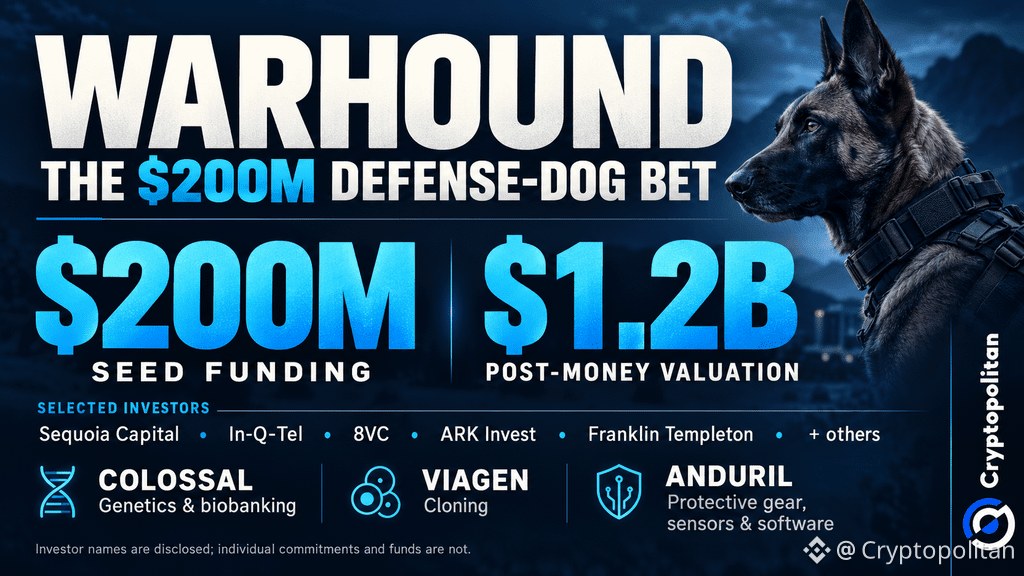
Article
Warhound raises $200M to build genetically enhanced military dogsWarhound emerged from stealth on October 22 with $200 million in seed funding and a $1.2 billion post-money valuation, TechCrunch reported. The startup wants to develop genetically enhanced dogs for military and emergency work. Its official announcement names ARK Invest and Franklin Templeton among its backers.
There is no public evidence that a crypto-focused fund invested in Warhound’s $200 million funding round.
Engineered dogs that do not exist yet
Warhound is the brainchild of Colossal Biosciences founder Ben Lamm and Anduril founder Palmer Luckey. David Spirk leads the company as CEO.
Colossal plans to collect cells from top-performing Belgian Malinois and German Shepherds. It would then edit their genes to improve health and performance. Its subsidiary, Viagen, would handle the cloning. Anduril plans to equip the dogs with protective equipment, sensors, and software solutions, which allow their handlers to monitor the situation on the ground effectively. Information received by TechCrunch indicates that Luckey has no ownership stake in Warhound. However, Colossal has shares in the company and licenses its technology to the firm.
Warhound plans to use the dogs to detect explosives, assist in searches and handle dangerous assignments. For now, none has been born. The first births are expected in early 2027, and the company hopes to have the dogs in service within two years.
The venture also aims to address a supply problem. Warhound says more than 80% of U.S. military working dogs come from Europe. After a roughly three-year acquisition and training process, fewer than half are considered fit for service.
Who is actually writing the checks
Among the backers of Warhound are Sequoia Capital, In-Q-Tel, 8VC, ARK Invest, and Franklin Templeton. The main investor indicated by S&P Capital IQ is Sequoia, while TechCrunch mentions Corner Ventures as one of the participants as well. However, the exact amounts that they contributed to Warhound remain undisclosed. The reports also do not reveal which funds of ARK and Franklin participated in the startup’s funding rounds.
A separate Form D for Animal Capital Warhound SPV I reports $9.62 million raised from 23 investors. Filed on October 21, it lists September 23 as the date of its first sale. However, the filing names no investors and does not establish how the money relates to Warhound’s $200 million round.
Warhound $200M Funding: $1.2B Valuation, Investors and Tech Partners
Betting $1.2 billion on an unproven supply chain
The global defense sector is growing. SIPRI estimates that global military expenditure amounted to $2.887 trillion in 2025, which is a 2.9% increase. Europe’s spending rose by 14%. However, U.S. military budget has decreased by 7.5%.
In a June PitchBook report, Andreessen Horowitz and the CIA-backed organization In-Q-Tel have been recognized amongst the most active investors in defense technology in the first quarter of 2026. In-Q-Tel is also funding Warhound. At the same time, Andreessen Horowitz was instrumental in the completion of Anduril’s Series H financing of $5 billion, which raised the valuation of the company to $61 billion, as reported by Cryptopolitan.
PitchBook’s Q2 report describes a defense-tech market increasingly divided between established companies and early-stage bets. Warhound falls into the latter category, despite its $1.2 billion valuation and lack of a deployed product.
Still, Warhound has no deployed product or announced government orders. It must prove its cloning and gene-editing methods, protect animal welfare and secure government approvals. The company says it is working with the American Humane Society on training certification.
Why ARK and Franklin draw crypto attention
Franklin, with $1.78 trillion under management in May, created Franklin Crypto after acquiring 250 Digital in June. ARK tokenized its venture fund on Ethereum in September. The fund had about $1.3 billion in net assets. Neither development establishes how Warhound was financed.
Galaxy Research tracked $5.683 billion across 384 crypto deals in the second quarter, with roughly 78% going to later-stage rounds. That is a separate investment market. Warhound’s global potential rests on whether its experimental defense-biotech model can become a dependable military supply chain.
Don’t just read crypto news. Understand it. Subscribe to our newsletter. It's free.
Warhound raises $200M to build genetically enhanced military dogs
Warhound emerged from stealth on October 22 with $200 million in seed funding and a $1.2 billion post-money valuation, TechCrunch reported. The startup wants to develop genetically enhanced dogs for military and emergency work. Its official announcement names ARK Invest and Franklin Templeton among its backers.
There is no public evidence that a crypto-focused fund invested in Warhound’s $200 million funding round.
Engineered dogs that do not exist yet
Warhound is the brainchild of Colossal Biosciences founder Ben Lamm and Anduril founder Palmer Luckey. David Spirk leads the company as CEO.
Colossal plans to collect cells from top-performing Belgian Malinois and German Shepherds. It would then edit their genes to improve health and performance. Its subsidiary, Viagen, would handle the cloning. Anduril plans to equip the dogs with protective equipment, sensors, and software solutions, which allow their handlers to monitor the situation on the ground effectively. Information received by TechCrunch indicates that Luckey has no ownership stake in Warhound. However, Colossal has shares in the company and licenses its technology to the firm.
Warhound plans to use the dogs to detect explosives, assist in searches and handle dangerous assignments. For now, none has been born. The first births are expected in early 2027, and the company hopes to have the dogs in service within two years.
The venture also aims to address a supply problem. Warhound says more than 80% of U.S. military working dogs come from Europe. After a roughly three-year acquisition and training process, fewer than half are considered fit for service.
Who is actually writing the checks
Among the backers of Warhound are Sequoia Capital, In-Q-Tel, 8VC, ARK Invest, and Franklin Templeton. The main investor indicated by S&P Capital IQ is Sequoia, while TechCrunch mentions Corner Ventures as one of the participants as well. However, the exact amounts that they contributed to Warhound remain undisclosed. The reports also do not reveal which funds of ARK and Franklin participated in the startup’s funding rounds.
A separate Form D for Animal Capital Warhound SPV I reports $9.62 million raised from 23 investors. Filed on October 21, it lists September 23 as the date of its first sale. However, the filing names no investors and does not establish how the money relates to Warhound’s $200 million round.
Warhound $200M Funding: $1.2B Valuation, Investors and Tech Partners
Betting $1.2 billion on an unproven supply chain
The global defense sector is growing. SIPRI estimates that global military expenditure amounted to $2.887 trillion in 2025, which is a 2.9% increase. Europe’s spending rose by 14%. However, U.S. military budget has decreased by 7.5%.
In a June PitchBook report, Andreessen Horowitz and the CIA-backed organization In-Q-Tel have been recognized amongst the most active investors in defense technology in the first quarter of 2026. In-Q-Tel is also funding Warhound. At the same time, Andreessen Horowitz was instrumental in the completion of Anduril’s Series H financing of $5 billion, which raised the valuation of the company to $61 billion, as reported by Cryptopolitan.
PitchBook’s Q2 report describes a defense-tech market increasingly divided between established companies and early-stage bets. Warhound falls into the latter category, despite its $1.2 billion valuation and lack of a deployed product.
Still, Warhound has no deployed product or announced government orders. It must prove its cloning and gene-editing methods, protect animal welfare and secure government approvals. The company says it is working with the American Humane Society on training certification.
Why ARK and Franklin draw crypto attention
Franklin, with $1.78 trillion under management in May, created Franklin Crypto after acquiring 250 Digital in June. ARK tokenized its venture fund on Ethereum in September. The fund had about $1.3 billion in net assets. Neither development establishes how Warhound was financed.
Galaxy Research tracked $5.683 billion across 384 crypto deals in the second quarter, with roughly 78% going to later-stage rounds. That is a separate investment market. Warhound’s global potential rests on whether its experimental defense-biotech model can become a dependable military supply chain.
Don’t just read crypto news. Understand it. Subscribe to our newsletter. It's free.
There is no public evidence that a crypto-focused fund invested in Warhound’s $200 million funding round.
Engineered dogs that do not exist yet
Warhound is the brainchild of Colossal Biosciences founder Ben Lamm and Anduril founder Palmer Luckey. David Spirk leads the company as CEO.
Colossal plans to collect cells from top-performing Belgian Malinois and German Shepherds. It would then edit their genes to improve health and performance. Its subsidiary, Viagen, would handle the cloning. Anduril plans to equip the dogs with protective equipment, sensors, and software solutions, which allow their handlers to monitor the situation on the ground effectively. Information received by TechCrunch indicates that Luckey has no ownership stake in Warhound. However, Colossal has shares in the company and licenses its technology to the firm.
Warhound plans to use the dogs to detect explosives, assist in searches and handle dangerous assignments. For now, none has been born. The first births are expected in early 2027, and the company hopes to have the dogs in service within two years.
The venture also aims to address a supply problem. Warhound says more than 80% of U.S. military working dogs come from Europe. After a roughly three-year acquisition and training process, fewer than half are considered fit for service.
Who is actually writing the checks
Among the backers of Warhound are Sequoia Capital, In-Q-Tel, 8VC, ARK Invest, and Franklin Templeton. The main investor indicated by S&P Capital IQ is Sequoia, while TechCrunch mentions Corner Ventures as one of the participants as well. However, the exact amounts that they contributed to Warhound remain undisclosed. The reports also do not reveal which funds of ARK and Franklin participated in the startup’s funding rounds.
A separate Form D for Animal Capital Warhound SPV I reports $9.62 million raised from 23 investors. Filed on October 21, it lists September 23 as the date of its first sale. However, the filing names no investors and does not establish how the money relates to Warhound’s $200 million round.
Warhound $200M Funding: $1.2B Valuation, Investors and Tech Partners
Betting $1.2 billion on an unproven supply chain
The global defense sector is growing. SIPRI estimates that global military expenditure amounted to $2.887 trillion in 2025, which is a 2.9% increase. Europe’s spending rose by 14%. However, U.S. military budget has decreased by 7.5%.
In a June PitchBook report, Andreessen Horowitz and the CIA-backed organization In-Q-Tel have been recognized amongst the most active investors in defense technology in the first quarter of 2026. In-Q-Tel is also funding Warhound. At the same time, Andreessen Horowitz was instrumental in the completion of Anduril’s Series H financing of $5 billion, which raised the valuation of the company to $61 billion, as reported by Cryptopolitan.
PitchBook’s Q2 report describes a defense-tech market increasingly divided between established companies and early-stage bets. Warhound falls into the latter category, despite its $1.2 billion valuation and lack of a deployed product.
Still, Warhound has no deployed product or announced government orders. It must prove its cloning and gene-editing methods, protect animal welfare and secure government approvals. The company says it is working with the American Humane Society on training certification.
Why ARK and Franklin draw crypto attention
Franklin, with $1.78 trillion under management in May, created Franklin Crypto after acquiring 250 Digital in June. ARK tokenized its venture fund on Ethereum in September. The fund had about $1.3 billion in net assets. Neither development establishes how Warhound was financed.
Galaxy Research tracked $5.683 billion across 384 crypto deals in the second quarter, with roughly 78% going to later-stage rounds. That is a separate investment market. Warhound’s global potential rests on whether its experimental defense-biotech model can become a dependable military supply chain.
Don’t just read crypto news. Understand it. Subscribe to our newsletter. It's free.
66
Argentina drops Milei probe over $99M LIBRA meme coin scandalArgentina has dropped its criminal investigation into President Javier Milei and his sister, Karina Milei, over their alleged links to a crypto scandal. Federal judge Marcelo Martínez de Giorgi dismissed the case involving Milei’s promotion of the LIBRA meme coin, which later crashed.
As reported by Cryptopolitan, last year, Milei sparked a brief price rally by endorsing Libra on X. He later distanced himself from the project and deleted his post before the coin crashed. He insisted his intentions were entirely “in good faith” during the cryptocurrency’s upward trend before the downturn that ruined most investors.
“I was not aware of the details of the project, and once I found out, I decided to not to continue giving it publicity,” he said.
Judge Martínez de Giorgi dropped the case against Javier Milei
Judge Martínez de Giorgi dismissed the case against Javier Milei, finding no proof of deceit or fraud, as well as no indication that the alleged incidents were part of any particular legal category. Nevertheless, the federal judge emphasized that the president’s institutional position could have increased the significance of his social media post.
The allegations of fraud arose soon after Milei’s announcement of $LIBRA on his social media account, where he suggested it would help finance startups and small businesses. While the currency had risen in value, it fell sharply once he removed the post from his social media page. After the currency’s crash, opposition members of Congress began preparing an impeachment motion, and online critics accused him of a “rug pull” on the currency.
The blockchain data added to the scrutiny on the token’s collapse. A report by cryptocurrency analytics firm Nansen found 86% of LIBRA traders lost $251 million, and a smaller number of traders made $180 million in profits. The token hit $4.55 just after launch, and a week later, it lost most of its value.
But Milei argued that the mere fact of sharing the post does not mean that he was advertising the cryptocurrency. In another commentary, he pointed out that he did not know much about the project when he made the post and that he ceased speaking about the currency after gaining a better understanding of it.
Chainalysis shows cryptocurrency scams received $14 billion on-chain
For some time now, there has been a surge in crypto fraud and scams. Chainalysis believes that cryptocurrencies associated with scamming have collected at least $14 billion on-chain in 2025. This represents significant growth from the $9.9 billion first reported in 2024, which was later adjusted to $12 billion, consistent with the company’s $12.4 billion estimate.
In general, the total amount of scam-related funds has grown significantly due to impersonations that increased by 1,400%. High-yield programs and pig butchering also continue to lead in overall volume, but scam tactics are increasingly converging; fraudsters now combine AI tools, sophisticated SMS phishing, and deep money-laundering networks to maximize their reach.
Findings from a July 2025 J.P. Morgan study show cybercriminals are increasingly turning to AI-generated content and deepfakes to trick victims with convincing impersonations in financial and romance scams. Scams with on-chain links to AI vendors collect an average of $3.2 million per operation, roughly 4.5 times the $719,000 average recorded by scams without those connections, per the bank’s report.
Nevertheless, in July, more than $25 million in cryptocurrency tied to transnational fraud rings has been seized by the Cyber Fraud Task Force, according to a joint announcement today from the U.S. Secret Service and the U.S. Attorney’s Office for the District of Columbia. These assets add to the $800 million in assets recovered through the Scam Center Strike Force, an initiative launched in 2025 by U.S. Attorney Jeanine Pirro to protect U.S. and Canadian residents.
“This seizure is the result of months of tireless work by Washington Field Office investigators, who are among the best in the world at tracking down cyber criminals and tracing their illicit transactions,” said Special Agent in Charge Tara McLeese of the U.S. Secret Service Washington Field Office.
She also encouraged people who suspect they have been targeted by these scams or similar crypto-related offenses to reach out for assistance.
The dismissal closes a significant chapter in the legal scrutiny surrounding LIBRA, although it does not erase the financial losses reported by traders.
The case also highlights the risks associated with meme coins, whose prices can change sharply following endorsements from influential figures. For investors, the episode underscores the importance of conducting independent research on cryptocurrency projects rather than relying solely on public endorsements.
The smartest crypto minds already read our newsletter. Want in? Join them.
Argentina drops Milei probe over $99M LIBRA meme coin scandal
Argentina has dropped its criminal investigation into President Javier Milei and his sister, Karina Milei, over their alleged links to a crypto scandal. Federal judge Marcelo Martínez de Giorgi dismissed the case involving Milei’s promotion of the LIBRA meme coin, which later crashed.
As reported by Cryptopolitan, last year, Milei sparked a brief price rally by endorsing Libra on X. He later distanced himself from the project and deleted his post before the coin crashed. He insisted his intentions were entirely “in good faith” during the cryptocurrency’s upward trend before the downturn that ruined most investors.
“I was not aware of the details of the project, and once I found out, I decided to not to continue giving it publicity,” he said.
Judge Martínez de Giorgi dropped the case against Javier Milei
Judge Martínez de Giorgi dismissed the case against Javier Milei, finding no proof of deceit or fraud, as well as no indication that the alleged incidents were part of any particular legal category. Nevertheless, the federal judge emphasized that the president’s institutional position could have increased the significance of his social media post.
The allegations of fraud arose soon after Milei’s announcement of $LIBRA on his social media account, where he suggested it would help finance startups and small businesses. While the currency had risen in value, it fell sharply once he removed the post from his social media page. After the currency’s crash, opposition members of Congress began preparing an impeachment motion, and online critics accused him of a “rug pull” on the currency.
The blockchain data added to the scrutiny on the token’s collapse. A report by cryptocurrency analytics firm Nansen found 86% of LIBRA traders lost $251 million, and a smaller number of traders made $180 million in profits. The token hit $4.55 just after launch, and a week later, it lost most of its value.
But Milei argued that the mere fact of sharing the post does not mean that he was advertising the cryptocurrency. In another commentary, he pointed out that he did not know much about the project when he made the post and that he ceased speaking about the currency after gaining a better understanding of it.
Chainalysis shows cryptocurrency scams received $14 billion on-chain
For some time now, there has been a surge in crypto fraud and scams. Chainalysis believes that cryptocurrencies associated with scamming have collected at least $14 billion on-chain in 2025. This represents significant growth from the $9.9 billion first reported in 2024, which was later adjusted to $12 billion, consistent with the company’s $12.4 billion estimate.
In general, the total amount of scam-related funds has grown significantly due to impersonations that increased by 1,400%. High-yield programs and pig butchering also continue to lead in overall volume, but scam tactics are increasingly converging; fraudsters now combine AI tools, sophisticated SMS phishing, and deep money-laundering networks to maximize their reach.
Findings from a July 2025 J.P. Morgan study show cybercriminals are increasingly turning to AI-generated content and deepfakes to trick victims with convincing impersonations in financial and romance scams. Scams with on-chain links to AI vendors collect an average of $3.2 million per operation, roughly 4.5 times the $719,000 average recorded by scams without those connections, per the bank’s report.
Nevertheless, in July, more than $25 million in cryptocurrency tied to transnational fraud rings has been seized by the Cyber Fraud Task Force, according to a joint announcement today from the U.S. Secret Service and the U.S. Attorney’s Office for the District of Columbia. These assets add to the $800 million in assets recovered through the Scam Center Strike Force, an initiative launched in 2025 by U.S. Attorney Jeanine Pirro to protect U.S. and Canadian residents.
“This seizure is the result of months of tireless work by Washington Field Office investigators, who are among the best in the world at tracking down cyber criminals and tracing their illicit transactions,” said Special Agent in Charge Tara McLeese of the U.S. Secret Service Washington Field Office.
She also encouraged people who suspect they have been targeted by these scams or similar crypto-related offenses to reach out for assistance.
The dismissal closes a significant chapter in the legal scrutiny surrounding LIBRA, although it does not erase the financial losses reported by traders.
The case also highlights the risks associated with meme coins, whose prices can change sharply following endorsements from influential figures. For investors, the episode underscores the importance of conducting independent research on cryptocurrency projects rather than relying solely on public endorsements.
The smartest crypto minds already read our newsletter. Want in? Join them.
As reported by Cryptopolitan, last year, Milei sparked a brief price rally by endorsing Libra on X. He later distanced himself from the project and deleted his post before the coin crashed. He insisted his intentions were entirely “in good faith” during the cryptocurrency’s upward trend before the downturn that ruined most investors.
“I was not aware of the details of the project, and once I found out, I decided to not to continue giving it publicity,” he said.
Judge Martínez de Giorgi dropped the case against Javier Milei
Judge Martínez de Giorgi dismissed the case against Javier Milei, finding no proof of deceit or fraud, as well as no indication that the alleged incidents were part of any particular legal category. Nevertheless, the federal judge emphasized that the president’s institutional position could have increased the significance of his social media post.
The allegations of fraud arose soon after Milei’s announcement of $LIBRA on his social media account, where he suggested it would help finance startups and small businesses. While the currency had risen in value, it fell sharply once he removed the post from his social media page. After the currency’s crash, opposition members of Congress began preparing an impeachment motion, and online critics accused him of a “rug pull” on the currency.
The blockchain data added to the scrutiny on the token’s collapse. A report by cryptocurrency analytics firm Nansen found 86% of LIBRA traders lost $251 million, and a smaller number of traders made $180 million in profits. The token hit $4.55 just after launch, and a week later, it lost most of its value.
But Milei argued that the mere fact of sharing the post does not mean that he was advertising the cryptocurrency. In another commentary, he pointed out that he did not know much about the project when he made the post and that he ceased speaking about the currency after gaining a better understanding of it.
Chainalysis shows cryptocurrency scams received $14 billion on-chain
For some time now, there has been a surge in crypto fraud and scams. Chainalysis believes that cryptocurrencies associated with scamming have collected at least $14 billion on-chain in 2025. This represents significant growth from the $9.9 billion first reported in 2024, which was later adjusted to $12 billion, consistent with the company’s $12.4 billion estimate.
In general, the total amount of scam-related funds has grown significantly due to impersonations that increased by 1,400%. High-yield programs and pig butchering also continue to lead in overall volume, but scam tactics are increasingly converging; fraudsters now combine AI tools, sophisticated SMS phishing, and deep money-laundering networks to maximize their reach.
Findings from a July 2025 J.P. Morgan study show cybercriminals are increasingly turning to AI-generated content and deepfakes to trick victims with convincing impersonations in financial and romance scams. Scams with on-chain links to AI vendors collect an average of $3.2 million per operation, roughly 4.5 times the $719,000 average recorded by scams without those connections, per the bank’s report.
Nevertheless, in July, more than $25 million in cryptocurrency tied to transnational fraud rings has been seized by the Cyber Fraud Task Force, according to a joint announcement today from the U.S. Secret Service and the U.S. Attorney’s Office for the District of Columbia. These assets add to the $800 million in assets recovered through the Scam Center Strike Force, an initiative launched in 2025 by U.S. Attorney Jeanine Pirro to protect U.S. and Canadian residents.
“This seizure is the result of months of tireless work by Washington Field Office investigators, who are among the best in the world at tracking down cyber criminals and tracing their illicit transactions,” said Special Agent in Charge Tara McLeese of the U.S. Secret Service Washington Field Office.
She also encouraged people who suspect they have been targeted by these scams or similar crypto-related offenses to reach out for assistance.
The dismissal closes a significant chapter in the legal scrutiny surrounding LIBRA, although it does not erase the financial losses reported by traders.
The case also highlights the risks associated with meme coins, whose prices can change sharply following endorsements from influential figures. For investors, the episode underscores the importance of conducting independent research on cryptocurrency projects rather than relying solely on public endorsements.
The smartest crypto minds already read our newsletter. Want in? Join them.
134
Log in to explore more content
Join global crypto users on Binance Square
⚡️ Get latest and useful information about crypto.
💬 Trusted by the world’s largest crypto exchange.
👍 Discover real insights from verified creators.
Email / Phone number