
Crypto_Paykash
2.4k Posts

Crypto_Paykash
Report
Block User
Crypto enthusiast | Exploring blockchain and digital assets | Content creator | Writer | CMC KOL.
Open Trade
Occasional Trader
4.4 Years
18 Following
1.8K+ Followers
3.2K+ Liked
Posts
Portfolio
All
Quotes
PINNED
Article
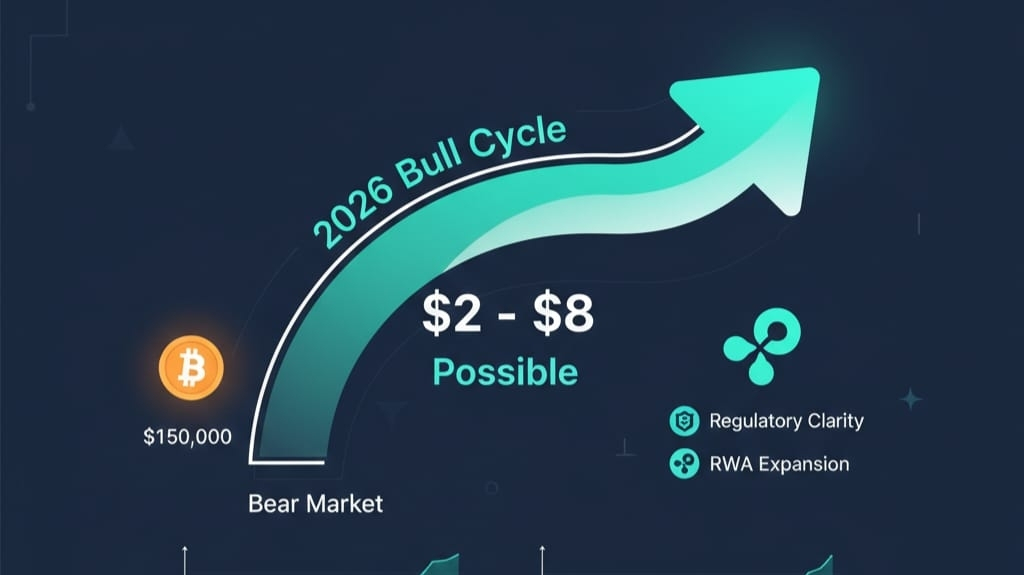
Understanding XRP’s Potential Cycle Turn in 2026Crypto markets move in cycles periods of rapid growth followed by deep corrections. In early 2026, sentiment feels bearish: Bitcoin sits near $69K after pulling back from 2025 highs, while major altcoins like Solana (SOL) and are down roughly 40–45% year-to-date. Historically, however, these pessimistic phases often set the stage for the next major rally.
XRP is particularly interesting right now. Trading around $1.40–$1.60, it remains below its 2018 ATH of $3.65 but far above the $0.20 lows seen in past downturns. The big question: Could 2026 mark a cycle turn from bear to bull?
What Are Crypto Market Cycles?
Crypto cycles typically align with Bitcoin’s four-year halving rhythm:
Accumulation, Bull Market, Distribution, Bear Market.
While we appear to be in a cooling phase, catalysts like ETF approvals, regulatory clarity, and institutional adoption can accelerate a reversal.
XRP’s 2026 Outlook
Analysts remain mixed but increasingly optimistic.
Conservative views: $2–$4 without major catalysts.
Bullish scenarios: $5–$8 if ETFs, regulation, and adoption improve.
Extreme upside: Higher targets depend heavily on mass institutional use.
Key drivers to watch:
Institutional inflows through potential XRP ETFs
Regulatory progress for Ripple
Expansion into real-world assets (RWAs)
A broader Bitcoin recovery
Technically, XRP appears to be defending previous breakout zones, suggesting $1.40 could act as strong support but regulatory setbacks or prolonged bearish conditions could keep it range-bound.
XRP vs. Solana: Speed vs. Stability
Solana tends to move faster due to retail hype, DeFi activity, and meme-coin ecosystems. Its cycles are explosive but volatile.
SOL: High-beta asset that often rebounds quickly.
XRP: Slower mover with stronger institutional narratives.
If alt season returns, may surge first, but XRP could deliver steadier, more sustainable gains.
XRP vs. Bitcoin: Following the Market Leader
Bitcoin still dictates macro direction. Historically, alts rally after BTC strengthens.
A BTC push toward new highs could lift XRP into the $4–$8 range.
Unlike Bitcoin’s scarcity-driven growth, XRP’s upside relies more on adoption and utility.
Expect higher volatility but also larger percentage moves.
In Conclusion:
Market cycles reward patience. While sentiment is uncertain, consolidation often comes before expansion.
The edge belongs to investors who stay informed and think long-term because the biggest moves usually begin when conviction is quiet.
Understanding XRP’s Potential Cycle Turn in 2026
Crypto markets move in cycles periods of rapid growth followed by deep corrections. In early 2026, sentiment feels bearish: Bitcoin sits near $69K after pulling back from 2025 highs, while major altcoins like Solana (SOL) and are down roughly 40–45% year-to-date. Historically, however, these pessimistic phases often set the stage for the next major rally.
XRP is particularly interesting right now. Trading around $1.40–$1.60, it remains below its 2018 ATH of $3.65 but far above the $0.20 lows seen in past downturns. The big question: Could 2026 mark a cycle turn from bear to bull?
What Are Crypto Market Cycles?
Crypto cycles typically align with Bitcoin’s four-year halving rhythm:
Accumulation, Bull Market, Distribution, Bear Market.
While we appear to be in a cooling phase, catalysts like ETF approvals, regulatory clarity, and institutional adoption can accelerate a reversal.
XRP’s 2026 Outlook
Analysts remain mixed but increasingly optimistic.
Conservative views: $2–$4 without major catalysts.
Bullish scenarios: $5–$8 if ETFs, regulation, and adoption improve.
Extreme upside: Higher targets depend heavily on mass institutional use.
Key drivers to watch:
Institutional inflows through potential XRP ETFs
Regulatory progress for Ripple
Expansion into real-world assets (RWAs)
A broader Bitcoin recovery
Technically, XRP appears to be defending previous breakout zones, suggesting $1.40 could act as strong support but regulatory setbacks or prolonged bearish conditions could keep it range-bound.
XRP vs. Solana: Speed vs. Stability
Solana tends to move faster due to retail hype, DeFi activity, and meme-coin ecosystems. Its cycles are explosive but volatile.
SOL: High-beta asset that often rebounds quickly.
XRP: Slower mover with stronger institutional narratives.
If alt season returns, may surge first, but XRP could deliver steadier, more sustainable gains.
XRP vs. Bitcoin: Following the Market Leader
Bitcoin still dictates macro direction. Historically, alts rally after BTC strengthens.
A BTC push toward new highs could lift XRP into the $4–$8 range.
Unlike Bitcoin’s scarcity-driven growth, XRP’s upside relies more on adoption and utility.
Expect higher volatility but also larger percentage moves.
In Conclusion:
Market cycles reward patience. While sentiment is uncertain, consolidation often comes before expansion.
The edge belongs to investors who stay informed and think long-term because the biggest moves usually begin when conviction is quiet.
XRP is particularly interesting right now. Trading around $1.40–$1.60, it remains below its 2018 ATH of $3.65 but far above the $0.20 lows seen in past downturns. The big question: Could 2026 mark a cycle turn from bear to bull?
What Are Crypto Market Cycles?
Crypto cycles typically align with Bitcoin’s four-year halving rhythm:
Accumulation, Bull Market, Distribution, Bear Market.
While we appear to be in a cooling phase, catalysts like ETF approvals, regulatory clarity, and institutional adoption can accelerate a reversal.
XRP’s 2026 Outlook
Analysts remain mixed but increasingly optimistic.
Conservative views: $2–$4 without major catalysts.
Bullish scenarios: $5–$8 if ETFs, regulation, and adoption improve.
Extreme upside: Higher targets depend heavily on mass institutional use.
Key drivers to watch:
Institutional inflows through potential XRP ETFs
Regulatory progress for Ripple
Expansion into real-world assets (RWAs)
A broader Bitcoin recovery
Technically, XRP appears to be defending previous breakout zones, suggesting $1.40 could act as strong support but regulatory setbacks or prolonged bearish conditions could keep it range-bound.
XRP vs. Solana: Speed vs. Stability
Solana tends to move faster due to retail hype, DeFi activity, and meme-coin ecosystems. Its cycles are explosive but volatile.
SOL: High-beta asset that often rebounds quickly.
XRP: Slower mover with stronger institutional narratives.
If alt season returns, may surge first, but XRP could deliver steadier, more sustainable gains.
XRP vs. Bitcoin: Following the Market Leader
Bitcoin still dictates macro direction. Historically, alts rally after BTC strengthens.
A BTC push toward new highs could lift XRP into the $4–$8 range.
Unlike Bitcoin’s scarcity-driven growth, XRP’s upside relies more on adoption and utility.
Expect higher volatility but also larger percentage moves.
In Conclusion:
Market cycles reward patience. While sentiment is uncertain, consolidation often comes before expansion.
The edge belongs to investors who stay informed and think long-term because the biggest moves usually begin when conviction is quiet.
8
5
71
55.5k
What Is Left for AI Stocks After the Midterm Election Shock?
The AI narrative has taken another hit following the Democrats' sweeping midterm victory, with investors becoming more concerned about potential data center restrictions, energy demand and tighter regulatory oversight.
Stocks like $IREN , $CIFR , $NBIS and $CRWV are particularly exposed because their growth depends heavily on expanding AI infrastructure.
But I don't think the AI opportunity is over. The next phase could simply become more selective.
1. AI demand
2. Power availability
3. Signed contracts
4. Funding and dilution
5. Regulatory clarity
For me, the next winners may not necessarily be the companies announcing the biggest AI expansion plans, but those capable of turning their investments into sustainable revenue and cash flow.
The market is becoming less willing to reward promises without execution.
What Is Left for AI Stocks After the Midterm Election Shock?
The AI narrative has taken another hit following the Democrats' sweeping midterm victory, with investors becoming more concerned about potential data center restrictions, energy demand and tighter regulatory oversight.
Stocks like $IREN , $CIFR , $NBIS and $CRWV are particularly exposed because their growth depends heavily on expanding AI infrastructure.
But I don't think the AI opportunity is over. The next phase could simply become more selective.
1. AI demand
2. Power availability
3. Signed contracts
4. Funding and dilution
5. Regulatory clarity
For me, the next winners may not necessarily be the companies announcing the biggest AI expansion plans, but those capable of turning their investments into sustainable revenue and cash flow.
The market is becoming less willing to reward promises without execution.
The AI narrative has taken another hit following the Democrats' sweeping midterm victory, with investors becoming more concerned about potential data center restrictions, energy demand and tighter regulatory oversight.
Stocks like $IREN , $CIFR , $NBIS and $CRWV are particularly exposed because their growth depends heavily on expanding AI infrastructure.
But I don't think the AI opportunity is over. The next phase could simply become more selective.
1. AI demand
2. Power availability
3. Signed contracts
4. Funding and dilution
5. Regulatory clarity
For me, the next winners may not necessarily be the companies announcing the biggest AI expansion plans, but those capable of turning their investments into sustainable revenue and cash flow.
The market is becoming less willing to reward promises without execution.
424
Verified
The Midterm election outcome doesn't seem to be aligning well with the AI stock market narrative, and Trump remains a major factor in the uncertainty surrounding the sector.
Where does that leave us now, and what should investors expect next?
We've also seen oil pull back towards $90, yet it still seems to be holding relatively high levels. What's keeping prices elevated despite the recent decline?
The Midterm election outcome doesn't seem to be aligning well with the AI stock market narrative, and Trump remains a major factor in the uncertainty surrounding the sector.
Where does that leave us now, and what should investors expect next?
We've also seen oil pull back towards $90, yet it still seems to be holding relatively high levels. What's keeping prices elevated despite the recent decline?
Where does that leave us now, and what should investors expect next?
We've also seen oil pull back towards $90, yet it still seems to be holding relatively high levels. What's keeping prices elevated despite the recent decline?
1
2
422
I've been watching the reaction across AI stocks following the US midterm elections, and I think there's more behind the selloff than just political uncertainty.
The Democratic victories in Congress and key states like Texas and Georgia have raised concerns about the future of AI infrastructure development in the US.
AI companies are investing billions of dollars in new data centers, GPUs, computing capacity and energy infrastructure. However, growing opposition from local communities over electricity costs, environmental concerns and land use could make future projects more difficult to approve.
This is where investors are becoming cautious.
Companies like $IREN , $CIFR.US , $APLD and $CORZ could face increased uncertainty around permitting, construction timelines and financing. $CRWV is also worth watching given its massive infrastructure spending and funding requirements.
Even $NVDAB could feel some indirect pressure if slower data center expansion eventually affects demand expectations for AI chips.
What's particularly concerning is that several communities have already voted in favour of restrictions or temporary moratoriums on new data center developments. That introduces another layer of risk for companies counting on rapid expansion.
However, I don't think this automatically means the AI boom is coming to an end.
The demand for computing power hasn't suddenly disappeared. What the market is reassessing is how quickly companies can build, how much it will cost and whether their projected returns can justify the enormous capital investments.
For me, the important distinction is between a company facing temporary political and permitting challenges and one experiencing a genuine deterioration in AI demand.
The AI infrastructure opportunity is still there, but the market may be entering a phase where execution matters more than ambitious expansion plans.
#USMidterms-WhatAreMarketsExpecting?
I've been watching the reaction across AI stocks following the US midterm elections, and I think there's more behind the selloff than just political uncertainty.
The Democratic victories in Congress and key states like Texas and Georgia have raised concerns about the future of AI infrastructure development in the US.
AI companies are investing billions of dollars in new data centers, GPUs, computing capacity and energy infrastructure. However, growing opposition from local communities over electricity costs, environmental concerns and land use could make future projects more difficult to approve.
This is where investors are becoming cautious.
Companies like $IREN , $CIFR.US , $APLD and $CORZ could face increased uncertainty around permitting, construction timelines and financing. $CRWV is also worth watching given its massive infrastructure spending and funding requirements.
Even $NVDAB could feel some indirect pressure if slower data center expansion eventually affects demand expectations for AI chips.
What's particularly concerning is that several communities have already voted in favour of restrictions or temporary moratoriums on new data center developments. That introduces another layer of risk for companies counting on rapid expansion.
However, I don't think this automatically means the AI boom is coming to an end.
The demand for computing power hasn't suddenly disappeared. What the market is reassessing is how quickly companies can build, how much it will cost and whether their projected returns can justify the enormous capital investments.
For me, the important distinction is between a company facing temporary political and permitting challenges and one experiencing a genuine deterioration in AI demand.
The AI infrastructure opportunity is still there, but the market may be entering a phase where execution matters more than ambitious expansion plans.
#USMidterms-WhatAreMarketsExpecting?
The Democratic victories in Congress and key states like Texas and Georgia have raised concerns about the future of AI infrastructure development in the US.
AI companies are investing billions of dollars in new data centers, GPUs, computing capacity and energy infrastructure. However, growing opposition from local communities over electricity costs, environmental concerns and land use could make future projects more difficult to approve.
This is where investors are becoming cautious.
Companies like $IREN , $CIFR.US , $APLD and $CORZ could face increased uncertainty around permitting, construction timelines and financing. $CRWV is also worth watching given its massive infrastructure spending and funding requirements.
Even $NVDAB could feel some indirect pressure if slower data center expansion eventually affects demand expectations for AI chips.
What's particularly concerning is that several communities have already voted in favour of restrictions or temporary moratoriums on new data center developments. That introduces another layer of risk for companies counting on rapid expansion.
However, I don't think this automatically means the AI boom is coming to an end.
The demand for computing power hasn't suddenly disappeared. What the market is reassessing is how quickly companies can build, how much it will cost and whether their projected returns can justify the enormous capital investments.
For me, the important distinction is between a company facing temporary political and permitting challenges and one experiencing a genuine deterioration in AI demand.
The AI infrastructure opportunity is still there, but the market may be entering a phase where execution matters more than ambitious expansion plans.
#USMidterms-WhatAreMarketsExpecting?
558
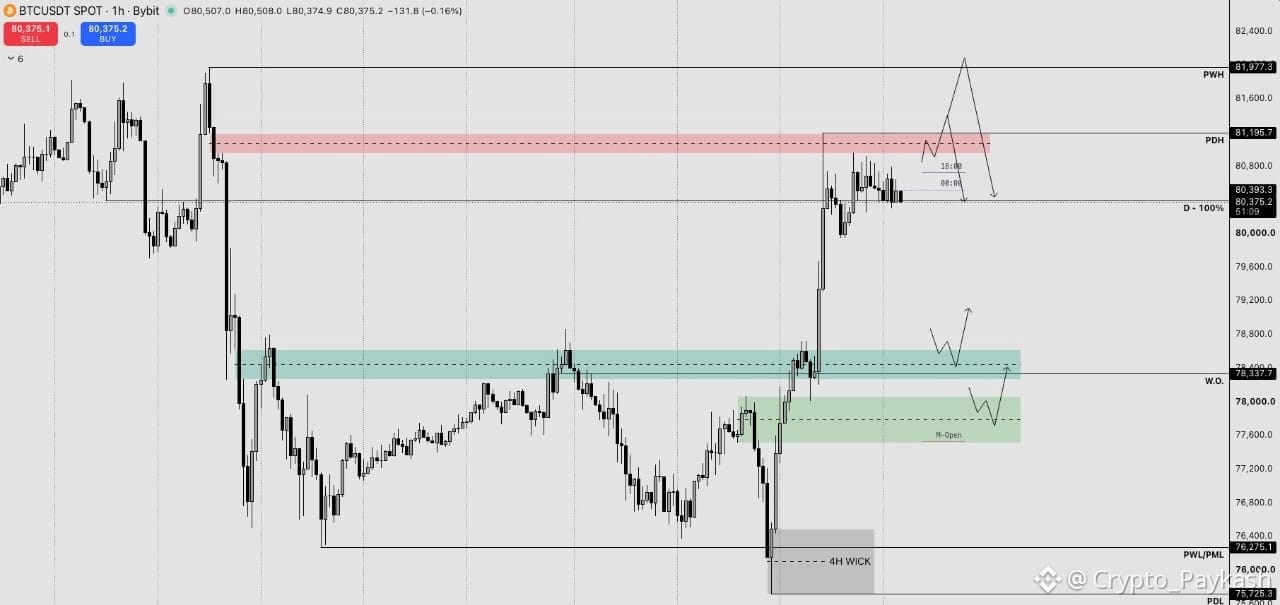
$BTC managed to close the daily candle above the 80.3K daily imbalance after moving back towards 81.1K.
That's a positive development, but I still think 82K is the key level to reclaim this month, as it represents the 50% midpoint of October's range.
For now, Bitcoin is consolidating after testing the 81.1K 1H imbalance. Although this is a short-term area of interest, I'm not looking to open shorts just yet.
I'd rather see price sweep the 81.2K PDH or potentially the 82K PWH before considering hedge shorts, provided a clear trigger appears.
Since sell-side liquidity below the PWL/PML has already been taken, I'd like to see price work towards the buy-side liquidity levels next.
I'm still holding my long from 76.1K, so there's no reason to chase price here. I'd rather wait for cleaner retests.
For potential long continuations, 78.7K is my first area of interest. The 77.7K region, around and below the monthly open, is another zone where I'll be watching for confirmation.
One thing I'm keeping in mind is NFP. I'm generally not keen on taking fresh positions the day before the release because Bitcoin often gets stuck in consolidation as the market waits for the data. I'd rather stay patient than force a trade.
#BTCRebounds80K
$BTC managed to close the daily candle above the 80.3K daily imbalance after moving back towards 81.1K.
That's a positive development, but I still think 82K is the key level to reclaim this month, as it represents the 50% midpoint of October's range.
For now, Bitcoin is consolidating after testing the 81.1K 1H imbalance. Although this is a short-term area of interest, I'm not looking to open shorts just yet.
I'd rather see price sweep the 81.2K PDH or potentially the 82K PWH before considering hedge shorts, provided a clear trigger appears.
Since sell-side liquidity below the PWL/PML has already been taken, I'd like to see price work towards the buy-side liquidity levels next.
I'm still holding my long from 76.1K, so there's no reason to chase price here. I'd rather wait for cleaner retests.
For potential long continuations, 78.7K is my first area of interest. The 77.7K region, around and below the monthly open, is another zone where I'll be watching for confirmation.
One thing I'm keeping in mind is NFP. I'm generally not keen on taking fresh positions the day before the release because Bitcoin often gets stuck in consolidation as the market waits for the data. I'd rather stay patient than force a trade.
#BTCRebounds80K
That's a positive development, but I still think 82K is the key level to reclaim this month, as it represents the 50% midpoint of October's range.
For now, Bitcoin is consolidating after testing the 81.1K 1H imbalance. Although this is a short-term area of interest, I'm not looking to open shorts just yet.
I'd rather see price sweep the 81.2K PDH or potentially the 82K PWH before considering hedge shorts, provided a clear trigger appears.
Since sell-side liquidity below the PWL/PML has already been taken, I'd like to see price work towards the buy-side liquidity levels next.
I'm still holding my long from 76.1K, so there's no reason to chase price here. I'd rather wait for cleaner retests.
For potential long continuations, 78.7K is my first area of interest. The 77.7K region, around and below the monthly open, is another zone where I'll be watching for confirmation.
One thing I'm keeping in mind is NFP. I'm generally not keen on taking fresh positions the day before the release because Bitcoin often gets stuck in consolidation as the market waits for the data. I'd rather stay patient than force a trade.
#BTCRebounds80K
930
Democrat Gina Hinojosa has defeated Republican Greg Abbott in the Texas governor's race.
Existing infrastructure could become more valuable
$IRENB already has substantial land, power capacity and data center development plans in Texas.
Childress and Sweetwater become particularly important, Sweetwater 2 (SW2) still needs its data center permit despite having power interconnection approval.
The remaining pipeline faces more uncertainty, A moratorium or stricter permitting process could delay future expansion, increase costs and affect how quickly IREN can bring its wider pipeline online.
I don't think this automatically destroys the IREN investment thesis, but I wouldn't immediately call it bullish either.
The potential advantage is that IREN has already secured significant power and infrastructure that would be difficult for new competitors to replicate.
However, having secured power doesn't automatically mean every future data center receives approval.
Hinojosa cannot simply change every permitting rule unilaterally. The scope of her executive authority and cooperation from the Texas legislature will matter.
This is a development worth monitoring closely.
#USMidterms-WhatAreMarketsExpecting?
Democrat Gina Hinojosa has defeated Republican Greg Abbott in the Texas governor's race.
Existing infrastructure could become more valuable
$IRENB already has substantial land, power capacity and data center development plans in Texas.
Childress and Sweetwater become particularly important, Sweetwater 2 (SW2) still needs its data center permit despite having power interconnection approval.
The remaining pipeline faces more uncertainty, A moratorium or stricter permitting process could delay future expansion, increase costs and affect how quickly IREN can bring its wider pipeline online.
I don't think this automatically destroys the IREN investment thesis, but I wouldn't immediately call it bullish either.
The potential advantage is that IREN has already secured significant power and infrastructure that would be difficult for new competitors to replicate.
However, having secured power doesn't automatically mean every future data center receives approval.
Hinojosa cannot simply change every permitting rule unilaterally. The scope of her executive authority and cooperation from the Texas legislature will matter.
This is a development worth monitoring closely.
#USMidterms-WhatAreMarketsExpecting?
Existing infrastructure could become more valuable
$IRENB already has substantial land, power capacity and data center development plans in Texas.
Childress and Sweetwater become particularly important, Sweetwater 2 (SW2) still needs its data center permit despite having power interconnection approval.
The remaining pipeline faces more uncertainty, A moratorium or stricter permitting process could delay future expansion, increase costs and affect how quickly IREN can bring its wider pipeline online.
I don't think this automatically destroys the IREN investment thesis, but I wouldn't immediately call it bullish either.
The potential advantage is that IREN has already secured significant power and infrastructure that would be difficult for new competitors to replicate.
However, having secured power doesn't automatically mean every future data center receives approval.
Hinojosa cannot simply change every permitting rule unilaterally. The scope of her executive authority and cooperation from the Texas legislature will matter.
This is a development worth monitoring closely.
#USMidterms-WhatAreMarketsExpecting?
396
$AMD latest earnings make this an interesting question.
The company delivered a record $13.38 billion in quarterly revenue, up 45% year over year. More importantly, its Data Center revenue jumped 97% to $8.55 billion, showing just how much demand is building across AI infrastructure. AMD also guided for approximately $17 billion in Q4 revenue.
$NVDA remains the dominant player in AI accelerators, and I don't think that changes overnight. Its CUDA ecosystem, software advantage and established relationships with hyperscalers give it a strong competitive position.
But the AI opportunity is getting bigger, and it doesn't necessarily belong to one company.
AMD is becoming a serious alternative for customers looking to diversify their chip suppliers. Its EPYC processors, Instinct GPUs and rack-scale Helios systems give it more ways to compete in the data center market.
AI infrastructure requires more than NVIDIA GPUs. It needs CPUs, memory, networking, storage, power and data center capacity.
Companies across this entire supply chain could benefit as investment in AI continues.
Personally, I think investors should look beyond NVIDIA when evaluating the AI trade. AMD's latest results are another reminder that there are multiple ways to benefit from this growth cycle.
NVIDIA may still be leading the race, but the competition is getting more interesting.
$AMD latest earnings make this an interesting question.
The company delivered a record $13.38 billion in quarterly revenue, up 45% year over year. More importantly, its Data Center revenue jumped 97% to $8.55 billion, showing just how much demand is building across AI infrastructure. AMD also guided for approximately $17 billion in Q4 revenue.
$NVDA remains the dominant player in AI accelerators, and I don't think that changes overnight. Its CUDA ecosystem, software advantage and established relationships with hyperscalers give it a strong competitive position.
But the AI opportunity is getting bigger, and it doesn't necessarily belong to one company.
AMD is becoming a serious alternative for customers looking to diversify their chip suppliers. Its EPYC processors, Instinct GPUs and rack-scale Helios systems give it more ways to compete in the data center market.
AI infrastructure requires more than NVIDIA GPUs. It needs CPUs, memory, networking, storage, power and data center capacity.
Companies across this entire supply chain could benefit as investment in AI continues.
Personally, I think investors should look beyond NVIDIA when evaluating the AI trade. AMD's latest results are another reminder that there are multiple ways to benefit from this growth cycle.
NVIDIA may still be leading the race, but the competition is getting more interesting.
The company delivered a record $13.38 billion in quarterly revenue, up 45% year over year. More importantly, its Data Center revenue jumped 97% to $8.55 billion, showing just how much demand is building across AI infrastructure. AMD also guided for approximately $17 billion in Q4 revenue.
$NVDA remains the dominant player in AI accelerators, and I don't think that changes overnight. Its CUDA ecosystem, software advantage and established relationships with hyperscalers give it a strong competitive position.
But the AI opportunity is getting bigger, and it doesn't necessarily belong to one company.
AMD is becoming a serious alternative for customers looking to diversify their chip suppliers. Its EPYC processors, Instinct GPUs and rack-scale Helios systems give it more ways to compete in the data center market.
AI infrastructure requires more than NVIDIA GPUs. It needs CPUs, memory, networking, storage, power and data center capacity.
Companies across this entire supply chain could benefit as investment in AI continues.
Personally, I think investors should look beyond NVIDIA when evaluating the AI trade. AMD's latest results are another reminder that there are multiple ways to benefit from this growth cycle.
NVIDIA may still be leading the race, but the competition is getting more interesting.
395
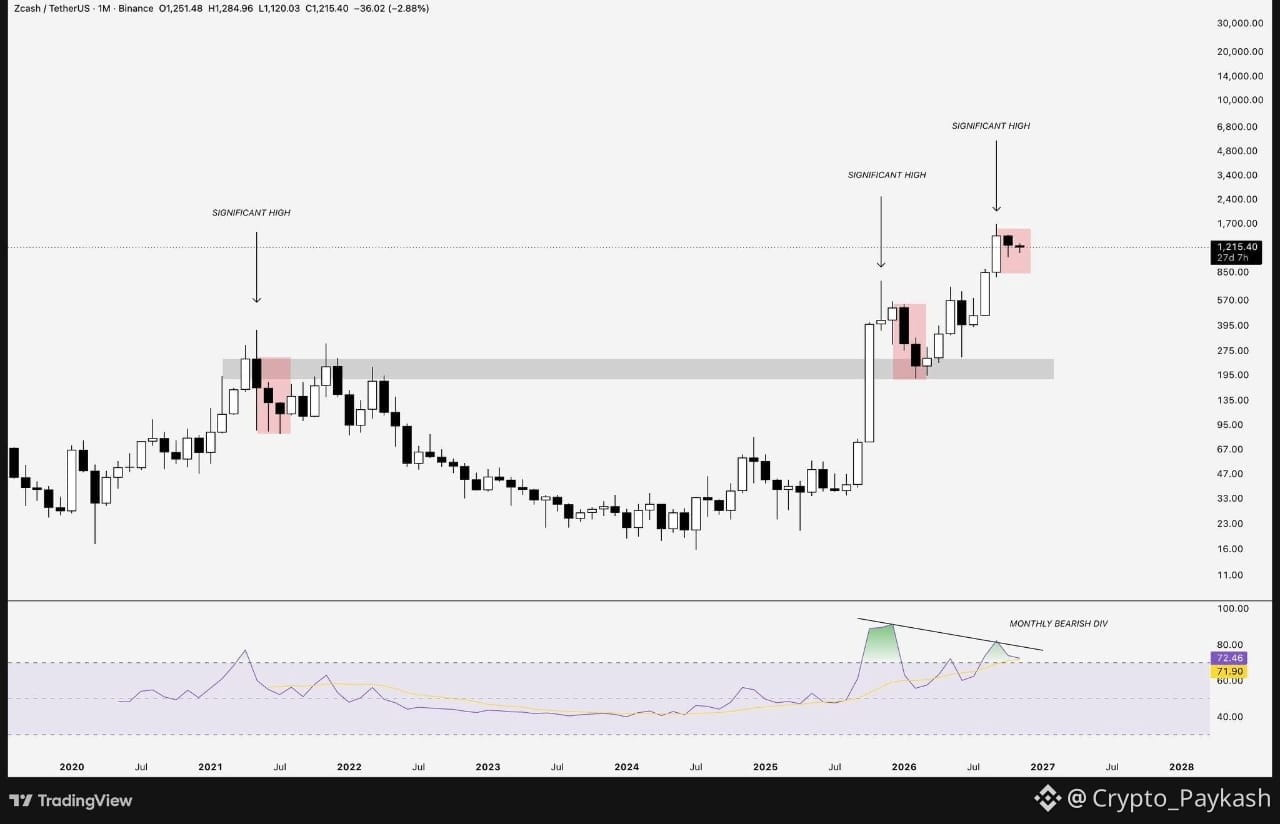
Looking at $ZEC previous cycles, I think there's a good chance it still needs more time to cool down.
After its last two major monthly peaks, Zcash went through roughly two to three months of downside consolidation. Both times, the market needed time to digest the strong rallies before finding its next direction.
I'm not sure why this cycle would be any different.
There's another detail worth watching. During both previous corrections, monthly RSI gradually cooled off from overbought levels back toward the middle range.
This time, price has pushed to a much higher high, but monthly RSI has failed to follow, creating a bearish divergence between the two major peaks.
That doesn't mean we can't see some strong relief rallies along the way. But I still think further downside and a longer consolidation period are possible before ZEC is ready for another sustained move higher.
It's a market I'm keeping an eye on, but I'm not in a hurry to call the bottom.
Looking at $ZEC previous cycles, I think there's a good chance it still needs more time to cool down.
After its last two major monthly peaks, Zcash went through roughly two to three months of downside consolidation. Both times, the market needed time to digest the strong rallies before finding its next direction.
I'm not sure why this cycle would be any different.
There's another detail worth watching. During both previous corrections, monthly RSI gradually cooled off from overbought levels back toward the middle range.
This time, price has pushed to a much higher high, but monthly RSI has failed to follow, creating a bearish divergence between the two major peaks.
That doesn't mean we can't see some strong relief rallies along the way. But I still think further downside and a longer consolidation period are possible before ZEC is ready for another sustained move higher.
It's a market I'm keeping an eye on, but I'm not in a hurry to call the bottom.
After its last two major monthly peaks, Zcash went through roughly two to three months of downside consolidation. Both times, the market needed time to digest the strong rallies before finding its next direction.
I'm not sure why this cycle would be any different.
There's another detail worth watching. During both previous corrections, monthly RSI gradually cooled off from overbought levels back toward the middle range.
This time, price has pushed to a much higher high, but monthly RSI has failed to follow, creating a bearish divergence between the two major peaks.
That doesn't mean we can't see some strong relief rallies along the way. But I still think further downside and a longer consolidation period are possible before ZEC is ready for another sustained move higher.
It's a market I'm keeping an eye on, but I'm not in a hurry to call the bottom.
415
A shift in political control could have some interesting implications for the AI infrastructure sector.
Democrats could push for tougher environmental standards, tighter electricity regulations, and greater oversight of AI development. This is particularly relevant for companies like $IREN , $NBIS , $CRWV , and $CIFR.
Stricter regulations could increase development costs and slow down new data center projects. However, there's another side to this: companies that have already secured substantial power capacity, land, and infrastructure could gain a competitive advantage as new developments become more difficult.
AI leaders like $NVDA and $AMD could also face increased scrutiny around AI safety, competition, and infrastructure expansion.
Personally, I wouldn't automatically view this as bearish for the entire sector. Political changes matter, but execution, financing, power availability, and actual customer demand remain much bigger factors in determining which companies succeed.
Also, a change in congressional control doesn't mean every proposed regulation becomes law overnight. Trump remains president, and major policy changes would still face legislative and political hurdles.
#USMidterms-WhatAreMarketsExpecting?
A shift in political control could have some interesting implications for the AI infrastructure sector.
Democrats could push for tougher environmental standards, tighter electricity regulations, and greater oversight of AI development. This is particularly relevant for companies like $IREN , $NBIS , $CRWV , and $CIFR.
Stricter regulations could increase development costs and slow down new data center projects. However, there's another side to this: companies that have already secured substantial power capacity, land, and infrastructure could gain a competitive advantage as new developments become more difficult.
AI leaders like $NVDA and $AMD could also face increased scrutiny around AI safety, competition, and infrastructure expansion.
Personally, I wouldn't automatically view this as bearish for the entire sector. Political changes matter, but execution, financing, power availability, and actual customer demand remain much bigger factors in determining which companies succeed.
Also, a change in congressional control doesn't mean every proposed regulation becomes law overnight. Trump remains president, and major policy changes would still face legislative and political hurdles.
#USMidterms-WhatAreMarketsExpecting?
Democrats could push for tougher environmental standards, tighter electricity regulations, and greater oversight of AI development. This is particularly relevant for companies like $IREN , $NBIS , $CRWV , and $CIFR.
Stricter regulations could increase development costs and slow down new data center projects. However, there's another side to this: companies that have already secured substantial power capacity, land, and infrastructure could gain a competitive advantage as new developments become more difficult.
AI leaders like $NVDA and $AMD could also face increased scrutiny around AI safety, competition, and infrastructure expansion.
Personally, I wouldn't automatically view this as bearish for the entire sector. Political changes matter, but execution, financing, power availability, and actual customer demand remain much bigger factors in determining which companies succeed.
Also, a change in congressional control doesn't mean every proposed regulation becomes law overnight. Trump remains president, and major policy changes would still face legislative and political hurdles.
#USMidterms-WhatAreMarketsExpecting?
610
$IREN has around $4 billion in contracted ARR tied to its 2026 capacity, but only about $1 billion was operational ARR as of August 26.
The $MSFT deal is worth roughly $9.7 billion over five years and covers four 50MW IT deployments. IREN is targeting Q4 2026 delivery for Horizons 2–4, making November 5 an important date to watch.
The main point is how quickly IREN can turn those contracts into actual revenue without putting more pressure on its balance sheet.
The Microsoft GPU financing and customer prepayments help, but I still want to see how financing costs, potential dilution and returns on invested capital develop as the company scales.
Thursday's earnings should give us a better picture. I'm particularly interested in whether management remains confident about its deployment timelines and provides more clarity on when the Microsoft contract will start contributing meaningfully to reported revenue.
$IREN has around $4 billion in contracted ARR tied to its 2026 capacity, but only about $1 billion was operational ARR as of August 26.
The $MSFT deal is worth roughly $9.7 billion over five years and covers four 50MW IT deployments. IREN is targeting Q4 2026 delivery for Horizons 2–4, making November 5 an important date to watch.
The main point is how quickly IREN can turn those contracts into actual revenue without putting more pressure on its balance sheet.
The Microsoft GPU financing and customer prepayments help, but I still want to see how financing costs, potential dilution and returns on invested capital develop as the company scales.
Thursday's earnings should give us a better picture. I'm particularly interested in whether management remains confident about its deployment timelines and provides more clarity on when the Microsoft contract will start contributing meaningfully to reported revenue.
The $MSFT deal is worth roughly $9.7 billion over five years and covers four 50MW IT deployments. IREN is targeting Q4 2026 delivery for Horizons 2–4, making November 5 an important date to watch.
The main point is how quickly IREN can turn those contracts into actual revenue without putting more pressure on its balance sheet.
The Microsoft GPU financing and customer prepayments help, but I still want to see how financing costs, potential dilution and returns on invested capital develop as the company scales.
Thursday's earnings should give us a better picture. I'm particularly interested in whether management remains confident about its deployment timelines and provides more clarity on when the Microsoft contract will start contributing meaningfully to reported revenue.
513
Verified
Markets are under pressure today, with investors asking whether the huge spending on AI infrastructure will actually generate enough returns to justify current valuations.
Oracle dropped sharply after saying it plans to raise $20 billion through debt and equity, while $AMD and Intel also saw heavy selling.
Worries about AI investment profitability are spreading across tech stocks.
There’s also caution around the US midterm elections, and tech earnings are adding to the pressure Apple’s latest outlook flagged rising memory costs and margin strain.
What I’m watching is AI infrastructure like $IREN , $NBIS , $CIFR , MU, and AMD, I want to see whether this selloff is just temporary sentiment or a sign that investors are getting more selective.
Either way, companies will need to show that their big capital investments can turn into real revenue and profits.
#USMidtermElections
Markets are under pressure today, with investors asking whether the huge spending on AI infrastructure will actually generate enough returns to justify current valuations.
Oracle dropped sharply after saying it plans to raise $20 billion through debt and equity, while $AMD and Intel also saw heavy selling.
Worries about AI investment profitability are spreading across tech stocks.
There’s also caution around the US midterm elections, and tech earnings are adding to the pressure Apple’s latest outlook flagged rising memory costs and margin strain.
What I’m watching is AI infrastructure like $IREN , $NBIS , $CIFR , MU, and AMD, I want to see whether this selloff is just temporary sentiment or a sign that investors are getting more selective.
Either way, companies will need to show that their big capital investments can turn into real revenue and profits.
#USMidtermElections
Oracle dropped sharply after saying it plans to raise $20 billion through debt and equity, while $AMD and Intel also saw heavy selling.
Worries about AI investment profitability are spreading across tech stocks.
There’s also caution around the US midterm elections, and tech earnings are adding to the pressure Apple’s latest outlook flagged rising memory costs and margin strain.
What I’m watching is AI infrastructure like $IREN , $NBIS , $CIFR , MU, and AMD, I want to see whether this selloff is just temporary sentiment or a sign that investors are getting more selective.
Either way, companies will need to show that their big capital investments can turn into real revenue and profits.
#USMidtermElections
1
664
With $IREN November 5 earnings coming up, here’s what I’ll be watching most closely:
· Depreciation: How fast is it rising as more GPUs come online?
· AI Cloud margins: Is revenue growing faster than the cost of delivering computing capacity?
· SG&A: Are corporate and employee expenses becoming more manageable?
· Operating cash flow: How much is coming from actual operations versus customer prepayments?
· Funding: Can IREN finance its expansion without leaning too heavily on debt or diluting shareholders?
· GPU utilisation: Are the deployed GPUs generating revenue consistently?
#USMidtermElections
With $IREN November 5 earnings coming up, here’s what I’ll be watching most closely:
· Depreciation: How fast is it rising as more GPUs come online?
· AI Cloud margins: Is revenue growing faster than the cost of delivering computing capacity?
· SG&A: Are corporate and employee expenses becoming more manageable?
· Operating cash flow: How much is coming from actual operations versus customer prepayments?
· Funding: Can IREN finance its expansion without leaning too heavily on debt or diluting shareholders?
· GPU utilisation: Are the deployed GPUs generating revenue consistently?
#USMidtermElections
· Depreciation: How fast is it rising as more GPUs come online?
· AI Cloud margins: Is revenue growing faster than the cost of delivering computing capacity?
· SG&A: Are corporate and employee expenses becoming more manageable?
· Operating cash flow: How much is coming from actual operations versus customer prepayments?
· Funding: Can IREN finance its expansion without leaning too heavily on debt or diluting shareholders?
· GPU utilisation: Are the deployed GPUs generating revenue consistently?
#USMidtermElections
443
Verified
Big Tech is pouring billions into AI infrastructure, and I’m increasingly focused on when that spending will actually start turning into meaningful profit.
$MSFT , $GOOGL and $AMZN are putting huge amounts into data centres, GPUs, networking and power capacity to keep up with AI demand. The opportunity is clear, but the economics now matter just as much as the growth.
Adding more capacity doesn’t automatically lead to higher profits. These companies still have to deal with electricity costs, depreciation, maintenance and the constant expense of upgrading hardware.
What i’ll be watching is cloud revenue growth compared with capital spending. Are Azure, Google Cloud and AWS bringing in enough extra revenue to justify the billions being invested?
Right now, I don’t think AI demand is the problem. But how efficiently these companies can monetise it?
Over the next few quarters, I expect investors to pay much closer attention to cash flow, margins and return on invested capital not just how much companies are spending on AI.
The AI infrastructure race is still moving forward, but eventually returns will matter more than the size of the investment.
Big Tech is pouring billions into AI infrastructure, and I’m increasingly focused on when that spending will actually start turning into meaningful profit.
$MSFT , $GOOGL and $AMZN are putting huge amounts into data centres, GPUs, networking and power capacity to keep up with AI demand. The opportunity is clear, but the economics now matter just as much as the growth.
Adding more capacity doesn’t automatically lead to higher profits. These companies still have to deal with electricity costs, depreciation, maintenance and the constant expense of upgrading hardware.
What i’ll be watching is cloud revenue growth compared with capital spending. Are Azure, Google Cloud and AWS bringing in enough extra revenue to justify the billions being invested?
Right now, I don’t think AI demand is the problem. But how efficiently these companies can monetise it?
Over the next few quarters, I expect investors to pay much closer attention to cash flow, margins and return on invested capital not just how much companies are spending on AI.
The AI infrastructure race is still moving forward, but eventually returns will matter more than the size of the investment.
$MSFT , $GOOGL and $AMZN are putting huge amounts into data centres, GPUs, networking and power capacity to keep up with AI demand. The opportunity is clear, but the economics now matter just as much as the growth.
Adding more capacity doesn’t automatically lead to higher profits. These companies still have to deal with electricity costs, depreciation, maintenance and the constant expense of upgrading hardware.
What i’ll be watching is cloud revenue growth compared with capital spending. Are Azure, Google Cloud and AWS bringing in enough extra revenue to justify the billions being invested?
Right now, I don’t think AI demand is the problem. But how efficiently these companies can monetise it?
Over the next few quarters, I expect investors to pay much closer attention to cash flow, margins and return on invested capital not just how much companies are spending on AI.
The AI infrastructure race is still moving forward, but eventually returns will matter more than the size of the investment.
2
1.3k
$CIFR and $IREN are two AI infrastructure plays I’m watching closely over the next six months.
Both have growth potential, but the main part is how well they can execute.
For IREN, the November 5 earnings report is one to watch. I want to see how quickly its AI business is translating into revenue and whether expansion plans remain on track.
My focus for IREN:
· Revenue growth versus contracted ARR
· Progress on Microsoft deployments
· Capital spending, funding needs and potential dilution
For CIFR, the opportunity depends on turning its data-center pipeline into projects that generate revenue without putting too much pressure on its balance sheet.
What I’m watching:
· New tenant agreements and existing contracts
· Construction progress and delivery timelines
· How the company funds its expansion
AI demand is creating major opportunities, but having a large pipeline doesn’t automatically translate into shareholder value.
Over the next six months, execution, revenue growth and how each company manages its funding could make the difference.
$CIFR and $IREN are two AI infrastructure plays I’m watching closely over the next six months.
Both have growth potential, but the main part is how well they can execute.
For IREN, the November 5 earnings report is one to watch. I want to see how quickly its AI business is translating into revenue and whether expansion plans remain on track.
My focus for IREN:
· Revenue growth versus contracted ARR
· Progress on Microsoft deployments
· Capital spending, funding needs and potential dilution
For CIFR, the opportunity depends on turning its data-center pipeline into projects that generate revenue without putting too much pressure on its balance sheet.
What I’m watching:
· New tenant agreements and existing contracts
· Construction progress and delivery timelines
· How the company funds its expansion
AI demand is creating major opportunities, but having a large pipeline doesn’t automatically translate into shareholder value.
Over the next six months, execution, revenue growth and how each company manages its funding could make the difference.
Both have growth potential, but the main part is how well they can execute.
For IREN, the November 5 earnings report is one to watch. I want to see how quickly its AI business is translating into revenue and whether expansion plans remain on track.
My focus for IREN:
· Revenue growth versus contracted ARR
· Progress on Microsoft deployments
· Capital spending, funding needs and potential dilution
For CIFR, the opportunity depends on turning its data-center pipeline into projects that generate revenue without putting too much pressure on its balance sheet.
What I’m watching:
· New tenant agreements and existing contracts
· Construction progress and delivery timelines
· How the company funds its expansion
AI demand is creating major opportunities, but having a large pipeline doesn’t automatically translate into shareholder value.
Over the next six months, execution, revenue growth and how each company manages its funding could make the difference.
1
1.7k
The Binance hack is a reminder that cybersecurity could become one of the biggest bottlenecks in the AI era.
As AI adoption grows, inference demand will rise, but so will the sophistication of cyberattacks. Companies like $CRWD and $PANW are working to strengthen threat detection and security, while $GOOGL , $MSFT and NVDA are investing across AI infrastructure and deployment.
AI can help exchanges detect suspicious transactions, flag unusual wallet activity and respond to threats faster. But the same technology can help attackers automate phishing, exploit vulnerabilities and create more convincing scams.
This goes beyond crypto. In stock markets, AI can improve fraud detection, risk management and trading efficiency, but automated attacks and misinformation can also increase volatility and undermine confidence.
The inference side matters just as much. $NVDA provides computing infrastructure, while $AMD and $AVGO are also important players in the AI compute and semiconductor supply chain. As AI moves into real-time applications, demand for faster, cheaper and more efficient inference should grow.
The next winners in the AI value chain may not just be chipmakers and data center operators. Cybersecurity companies and inference infrastructure providers could become equally important as AI scales.
AI creates opportunities on both sides, but the more powerful it becomes, the more valuable security and trust will be.
The Binance hack is a reminder that cybersecurity could become one of the biggest bottlenecks in the AI era.
As AI adoption grows, inference demand will rise, but so will the sophistication of cyberattacks. Companies like $CRWD and $PANW are working to strengthen threat detection and security, while $GOOGL , $MSFT and NVDA are investing across AI infrastructure and deployment.
AI can help exchanges detect suspicious transactions, flag unusual wallet activity and respond to threats faster. But the same technology can help attackers automate phishing, exploit vulnerabilities and create more convincing scams.
This goes beyond crypto. In stock markets, AI can improve fraud detection, risk management and trading efficiency, but automated attacks and misinformation can also increase volatility and undermine confidence.
The inference side matters just as much. $NVDA provides computing infrastructure, while $AMD and $AVGO are also important players in the AI compute and semiconductor supply chain. As AI moves into real-time applications, demand for faster, cheaper and more efficient inference should grow.
The next winners in the AI value chain may not just be chipmakers and data center operators. Cybersecurity companies and inference infrastructure providers could become equally important as AI scales.
AI creates opportunities on both sides, but the more powerful it becomes, the more valuable security and trust will be.
As AI adoption grows, inference demand will rise, but so will the sophistication of cyberattacks. Companies like $CRWD and $PANW are working to strengthen threat detection and security, while $GOOGL , $MSFT and NVDA are investing across AI infrastructure and deployment.
AI can help exchanges detect suspicious transactions, flag unusual wallet activity and respond to threats faster. But the same technology can help attackers automate phishing, exploit vulnerabilities and create more convincing scams.
This goes beyond crypto. In stock markets, AI can improve fraud detection, risk management and trading efficiency, but automated attacks and misinformation can also increase volatility and undermine confidence.
The inference side matters just as much. $NVDA provides computing infrastructure, while $AMD and $AVGO are also important players in the AI compute and semiconductor supply chain. As AI moves into real-time applications, demand for faster, cheaper and more efficient inference should grow.
The next winners in the AI value chain may not just be chipmakers and data center operators. Cybersecurity companies and inference infrastructure providers could become equally important as AI scales.
AI creates opportunities on both sides, but the more powerful it becomes, the more valuable security and trust will be.
2
2.2k
Big Tech has the cash to keep investing in AI, but investors are becoming more cautious about smaller AI cloud companies relying heavily on debt to fund their growing backlogs.
That concern showed up after hours, with Amazon falling 7% and $CRWV , $NBIS and $IREN dropping between 5.8% and 6.7%. Alphabet also slipped another 1.5% after already losing nearly 13% during regular trading.
The market is starting to look beyond AI demand and order backlogs. Having big customers is one thing; funding the infrastructure, managing debt and turning those investments into real cash flow is another.
Big Tech has the cash to keep investing in AI, but investors are becoming more cautious about smaller AI cloud companies relying heavily on debt to fund their growing backlogs.
That concern showed up after hours, with Amazon falling 7% and $CRWV , $NBIS and $IREN dropping between 5.8% and 6.7%. Alphabet also slipped another 1.5% after already losing nearly 13% during regular trading.
The market is starting to look beyond AI demand and order backlogs. Having big customers is one thing; funding the infrastructure, managing debt and turning those investments into real cash flow is another.
That concern showed up after hours, with Amazon falling 7% and $CRWV , $NBIS and $IREN dropping between 5.8% and 6.7%. Alphabet also slipped another 1.5% after already losing nearly 13% during regular trading.
The market is starting to look beyond AI demand and order backlogs. Having big customers is one thing; funding the infrastructure, managing debt and turning those investments into real cash flow is another.
4
2
4.7k
Verified
Nebius $NBIS is showing that access to capital still matters in the AI infrastructure race.
After securing a $775 million facility, the company has now secured $3.5 billion from Citi, strengthening its financing capacity as it expands its AI infrastructure.
Building AI data centers requires enormous upfront spending on GPUs, power, land and cooling systems. Access to financing can help Nebius scale faster and compete for growing demand from AI companies.
But the good part I’m watching is how efficiently that capital turns into revenue and cash flow. More funding creates room to grow, but execution, debt obligations and returns on invested capital will determine the long-term outcome.
In AI infrastructure, securing capital is one advantage. Turning it into profitable growth is the real test.
Nebius $NBIS is showing that access to capital still matters in the AI infrastructure race.
After securing a $775 million facility, the company has now secured $3.5 billion from Citi, strengthening its financing capacity as it expands its AI infrastructure.
Building AI data centers requires enormous upfront spending on GPUs, power, land and cooling systems. Access to financing can help Nebius scale faster and compete for growing demand from AI companies.
But the good part I’m watching is how efficiently that capital turns into revenue and cash flow. More funding creates room to grow, but execution, debt obligations and returns on invested capital will determine the long-term outcome.
In AI infrastructure, securing capital is one advantage. Turning it into profitable growth is the real test.
After securing a $775 million facility, the company has now secured $3.5 billion from Citi, strengthening its financing capacity as it expands its AI infrastructure.
Building AI data centers requires enormous upfront spending on GPUs, power, land and cooling systems. Access to financing can help Nebius scale faster and compete for growing demand from AI companies.
But the good part I’m watching is how efficiently that capital turns into revenue and cash flow. More funding creates room to grow, but execution, debt obligations and returns on invested capital will determine the long-term outcome.
In AI infrastructure, securing capital is one advantage. Turning it into profitable growth is the real test.
906
AI infrastructure is facing a problem that money alone cannot solve.
Companies can order more GPUs and commit billions to new data centers, but they still need reliable electricity, grid connections, skilled workers and regulatory approval to bring that capacity online.
This is where the gap between AI demand and actual computing capacity becomes important.
For companies like $IREN , $NBIS , $CRWV and $CIFR power availability and construction timelines can be just as important as GPU supply. Delays can push revenue further out while interest expenses, equipment costs and other capital requirements continue to build.
The financial impact also differs by company. Established operators with existing power infrastructure may have an advantage, while companies expanding aggressively could face more pressure on cash flow and potential dilution.
AI demand is growing, but the companies best positioned to benefit will be those that can turn power, land and infrastructure into paying compute capacity on time.
In this cycle, having the capital to build is one thing. Getting the infrastructure operational and generating returns is what matters.
AI infrastructure is facing a problem that money alone cannot solve.
Companies can order more GPUs and commit billions to new data centers, but they still need reliable electricity, grid connections, skilled workers and regulatory approval to bring that capacity online.
This is where the gap between AI demand and actual computing capacity becomes important.
For companies like $IREN , $NBIS , $CRWV and $CIFR power availability and construction timelines can be just as important as GPU supply. Delays can push revenue further out while interest expenses, equipment costs and other capital requirements continue to build.
The financial impact also differs by company. Established operators with existing power infrastructure may have an advantage, while companies expanding aggressively could face more pressure on cash flow and potential dilution.
AI demand is growing, but the companies best positioned to benefit will be those that can turn power, land and infrastructure into paying compute capacity on time.
In this cycle, having the capital to build is one thing. Getting the infrastructure operational and generating returns is what matters.
Companies can order more GPUs and commit billions to new data centers, but they still need reliable electricity, grid connections, skilled workers and regulatory approval to bring that capacity online.
This is where the gap between AI demand and actual computing capacity becomes important.
For companies like $IREN , $NBIS , $CRWV and $CIFR power availability and construction timelines can be just as important as GPU supply. Delays can push revenue further out while interest expenses, equipment costs and other capital requirements continue to build.
The financial impact also differs by company. Established operators with existing power infrastructure may have an advantage, while companies expanding aggressively could face more pressure on cash flow and potential dilution.
AI demand is growing, but the companies best positioned to benefit will be those that can turn power, land and infrastructure into paying compute capacity on time.
In this cycle, having the capital to build is one thing. Getting the infrastructure operational and generating returns is what matters.
899
Looking at the next 4 years, I'm focused on the AI stocks that could benefit most as the industry moves from massive infrastructure spending to real cash flow.
$IREN is on my radar for its AI cloud expansion and power capacity. $CIFR is another one I'm watching as its data center plans develop, while $NVDA remains main of supplying the chips powering this entire buildout.
Each comes with different risks, especially around execution, funding and valuation, but I'm more in what these companies can deliver by 2030 than in chasing every short-term move.
#FedWatch
Looking at the next 4 years, I'm focused on the AI stocks that could benefit most as the industry moves from massive infrastructure spending to real cash flow.
$IREN is on my radar for its AI cloud expansion and power capacity. $CIFR is another one I'm watching as its data center plans develop, while $NVDA remains main of supplying the chips powering this entire buildout.
Each comes with different risks, especially around execution, funding and valuation, but I'm more in what these companies can deliver by 2030 than in chasing every short-term move.
#FedWatch
$IREN is on my radar for its AI cloud expansion and power capacity. $CIFR is another one I'm watching as its data center plans develop, while $NVDA remains main of supplying the chips powering this entire buildout.
Each comes with different risks, especially around execution, funding and valuation, but I'm more in what these companies can deliver by 2030 than in chasing every short-term move.
#FedWatch
2
573
The next leg of the AI trade may not be just about chips and infrastructure.
Companies like $NVDA, $AMD, $AVGO, and $MU are supplying the hardware powering the AI boom. Data center players like $IREN, $NBIS, and $CRWV are building the compute capacity needed to run these models.
But the other side of the trade is getting just as interesting: the companies actually using AI to grow their businesses.
Think $MSFT, $GOOGL, $AMZN, and $META. They’re weaving AI into software, cloud services, advertising, and enterprise tools—and that could turn adoption into recurring revenue and better margins.
The big difference is that infrastructure companies are spending heavily to keep up with demand, while AI adopters still need to prove the technology drives measurable business results.
Across both groups, I’m watching three things: revenue growth, free cash flow, and whether AI spending actually turns into real earnings.
The infrastructure buildout may be laying the foundation, but the companies that monetize AI efficiently could be the next group investors start paying closer attention to.
The long-term winners won’t necessarily be the ones spending the most on AI they’ll be the ones getting the most value out of it.
The next leg of the AI trade may not be just about chips and infrastructure.
Companies like $NVDA, $AMD, $AVGO, and $MU are supplying the hardware powering the AI boom. Data center players like $IREN, $NBIS, and $CRWV are building the compute capacity needed to run these models.
But the other side of the trade is getting just as interesting: the companies actually using AI to grow their businesses.
Think $MSFT, $GOOGL, $AMZN, and $META. They’re weaving AI into software, cloud services, advertising, and enterprise tools—and that could turn adoption into recurring revenue and better margins.
The big difference is that infrastructure companies are spending heavily to keep up with demand, while AI adopters still need to prove the technology drives measurable business results.
Across both groups, I’m watching three things: revenue growth, free cash flow, and whether AI spending actually turns into real earnings.
The infrastructure buildout may be laying the foundation, but the companies that monetize AI efficiently could be the next group investors start paying closer attention to.
The long-term winners won’t necessarily be the ones spending the most on AI they’ll be the ones getting the most value out of it.
Companies like $NVDA, $AMD, $AVGO, and $MU are supplying the hardware powering the AI boom. Data center players like $IREN, $NBIS, and $CRWV are building the compute capacity needed to run these models.
But the other side of the trade is getting just as interesting: the companies actually using AI to grow their businesses.
Think $MSFT, $GOOGL, $AMZN, and $META. They’re weaving AI into software, cloud services, advertising, and enterprise tools—and that could turn adoption into recurring revenue and better margins.
The big difference is that infrastructure companies are spending heavily to keep up with demand, while AI adopters still need to prove the technology drives measurable business results.
Across both groups, I’m watching three things: revenue growth, free cash flow, and whether AI spending actually turns into real earnings.
The infrastructure buildout may be laying the foundation, but the companies that monetize AI efficiently could be the next group investors start paying closer attention to.
The long-term winners won’t necessarily be the ones spending the most on AI they’ll be the ones getting the most value out of it.
6
11.9k
Log in to explore more content
Join global crypto users on Binance Square
⚡️ Get latest and useful information about crypto.
💬 Trusted by the world’s largest crypto exchange.
👍 Discover real insights from verified creators.
Email / Phone number
Trending Topics
BitcoinRebounds$75KAsChipsLead
3,614 views
88 Discussing
Market Watch | Bitcoin Rebounds to $75,600 After Dip Below $75,000 as Chip Stocks Lead Rally on Jobs Beat
Binance News
·8 Likes
·3.7k views
JobsReportRaisesHikeOdds
70,906 views
788 Discussing
US Data Center Rules May Constrain AI Expansion
8,406 views
89 Discussing