
web3xJq
381 Posts

web3xJq
Report
Block User
專注 BTC 日內交易 SMC 打法|分享鏈上資訊與潛力項目介紹|內容僅供參考,非投資建議| My shared content Not Financial Advice | Base in MY🇲🇾 |X:@web3xJQ
26 Following
792 Followers
401 Liked
Posts
All
Quotes
Videos
PINNED
·
--
Pork Knuckle Rice, Two Plates (Full Version)
Grab the pork knuckle rice, two plates!
Should I grab the airdrop or wait for the TGE, caught in a dilemma.
Selling high always profits, the big players continue to drive the market,
Points keep getting brushed down, I continue to grab two plates!
To those who are still persisting in brushing points and daily grabbing, a tune 🎵
#ALPHA
Pork Knuckle Rice, Two Plates (Full Version)
Grab the pork knuckle rice, two plates!
Should I grab the airdrop or wait for the TGE, caught in a dilemma.
Selling high always profits, the big players continue to drive the market,
Points keep getting brushed down, I continue to grab two plates!
To those who are still persisting in brushing points and daily grabbing, a tune 🎵
#ALPHA
Grab the pork knuckle rice, two plates!
Should I grab the airdrop or wait for the TGE, caught in a dilemma.
Selling high always profits, the big players continue to drive the market,
Points keep getting brushed down, I continue to grab two plates!
To those who are still persisting in brushing points and daily grabbing, a tune 🎵
#ALPHA
1
3.4k
·
--
Article
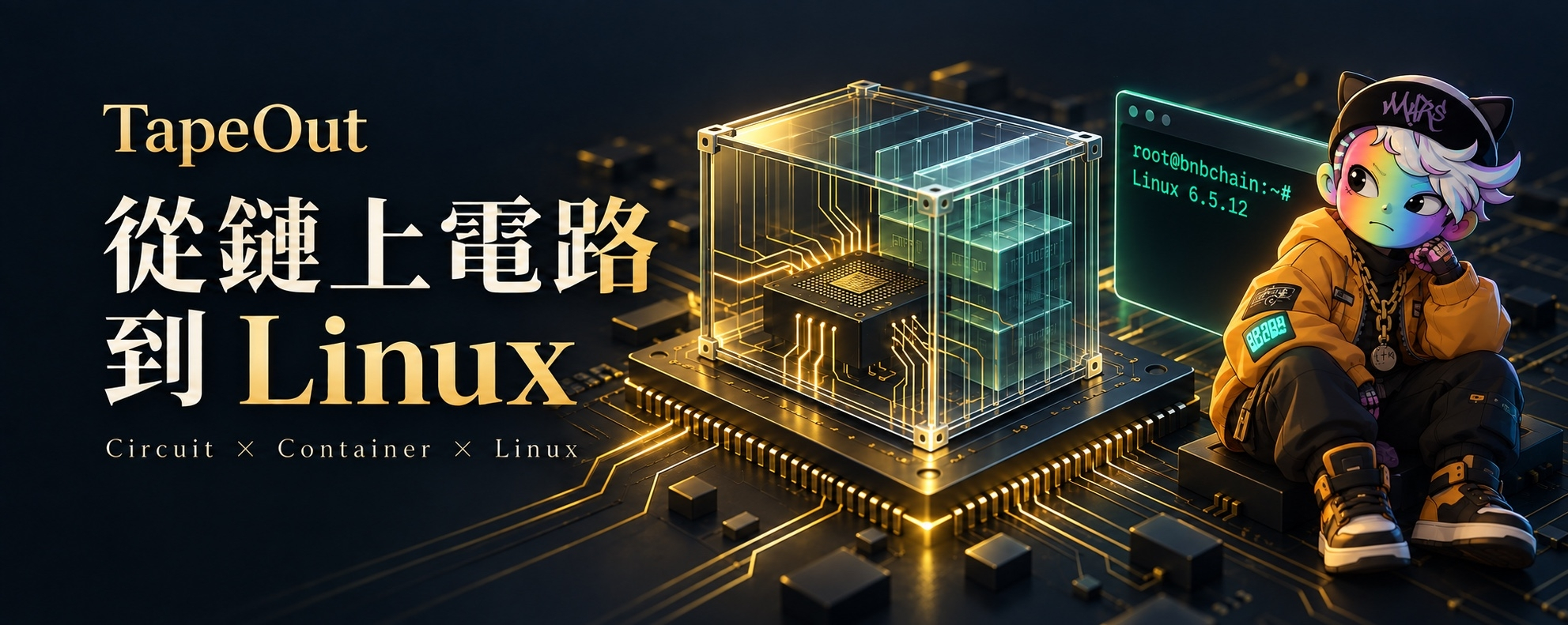
I’m still researching on-chain AI, and TapeOut has already booted LinuxIn the previous post, I was still researching TapeOut V2’s BNN, LUT, and the component equipment warehouse.
At the time, my understanding was:
Developers design components, factories purchase manufacturing capacity, users mint the components, assemble circuits, and finally someone uses these circuits to build applications.
It sounds like an on-chain hardware version of the App Store.
After writing the article, I left myself with a question:
What exactly will people build with all these things?
As it turns out, over the past few days, when I opened Blonskr’s Twitter again, the art style changed once more.
The circuit repository is live.
Linux is up and running.
Someone used 21 NAND gates to make a small car steering control.
I’m still researching on-chain AI, and TapeOut has already booted Linux
In the previous post, I was still researching TapeOut V2’s BNN, LUT, and the component equipment warehouse.
At the time, my understanding was:
Developers design components, factories purchase manufacturing capacity, users mint the components, assemble circuits, and finally someone uses these circuits to build applications.
It sounds like an on-chain hardware version of the App Store.
After writing the article, I left myself with a question:
What exactly will people build with all these things?
As it turns out, over the past few days, when I opened Blonskr’s Twitter again, the art style changed once more.
The circuit repository is live.
Linux is up and running.
Someone used 21 NAND gates to make a small car steering control.
At the time, my understanding was:
Developers design components, factories purchase manufacturing capacity, users mint the components, assemble circuits, and finally someone uses these circuits to build applications.
It sounds like an on-chain hardware version of the App Store.
After writing the article, I left myself with a question:
What exactly will people build with all these things?
As it turns out, over the past few days, when I opened Blonskr’s Twitter again, the art style changed once more.
The circuit repository is live.
Linux is up and running.
Someone used 21 NAND gates to make a small car steering control.
62
·
--
Tonight, oil prices remained around $100. After the U.S. stock market opened, most sectors weakened, but Meta bucked the trend and surged nearly 5%, once becoming the best-performing stock in the S&P 500.
In the market’s Price Discovery, it may not be a matter of Muse’s model capability. Instead, Meta has finally created a direct, payable product entry point for its massive AI investment.
Muse doesn’t just answer questions. It can connect with email, calendars, shopping, health, and payment services—replacing the browser experience for users, filling out forms, scheduling appointments, sending emails, and completing purchases. Besides the free version, there are also subscription plans of $20 and $100 per month.
This is fundamentally different from a typical chatbot:
A chatbot gives you answers, while an agent—once granted permission—takes actions on your behalf.
Meta’s advantage isn’t just in the model either. Together, WhatsApp, Facebook, and Instagram provide distribution channels that other agents can be far more difficult to replicate.
If only a small portion of users are willing to pay, Muse could give this year’s more than $130 billion in AI infrastructure investment its first clearer monetisation story.
But the same capability is also its biggest risk.
Meta says Muse runs in a separate Secure VM, and sensitive actions require user confirmation. However, Reuters, after reviewing internal tests it obtained, found reliability issues still occurring and cases where sensitive data was accidentally exposed.
So I think in the age of agents, what ultimately matters may not be Intelligence alone.
It’s: who can make users feel comfortable handing over permissions for email, accounts, payments, and real-world actions.
Meta’s stock price reaction tonight suggests at least that the market is willing to pay a little up front for this possibility. Next, what really matters will be user retention, paid conversion, and whether security incidents will grow faster than product adoption.
Tonight, oil prices remained around $100. After the U.S. stock market opened, most sectors weakened, but Meta bucked the trend and surged nearly 5%, once becoming the best-performing stock in the S&P 500.
In the market’s Price Discovery, it may not be a matter of Muse’s model capability. Instead, Meta has finally created a direct, payable product entry point for its massive AI investment.
Muse doesn’t just answer questions. It can connect with email, calendars, shopping, health, and payment services—replacing the browser experience for users, filling out forms, scheduling appointments, sending emails, and completing purchases. Besides the free version, there are also subscription plans of $20 and $100 per month.
This is fundamentally different from a typical chatbot:
A chatbot gives you answers, while an agent—once granted permission—takes actions on your behalf.
Meta’s advantage isn’t just in the model either. Together, WhatsApp, Facebook, and Instagram provide distribution channels that other agents can be far more difficult to replicate.
If only a small portion of users are willing to pay, Muse could give this year’s more than $130 billion in AI infrastructure investment its first clearer monetisation story.
But the same capability is also its biggest risk.
Meta says Muse runs in a separate Secure VM, and sensitive actions require user confirmation. However, Reuters, after reviewing internal tests it obtained, found reliability issues still occurring and cases where sensitive data was accidentally exposed.
So I think in the age of agents, what ultimately matters may not be Intelligence alone.
It’s: who can make users feel comfortable handing over permissions for email, accounts, payments, and real-world actions.
Meta’s stock price reaction tonight suggests at least that the market is willing to pay a little up front for this possibility. Next, what really matters will be user retention, paid conversion, and whether security incidents will grow faster than product adoption.
In the market’s Price Discovery, it may not be a matter of Muse’s model capability. Instead, Meta has finally created a direct, payable product entry point for its massive AI investment.
Muse doesn’t just answer questions. It can connect with email, calendars, shopping, health, and payment services—replacing the browser experience for users, filling out forms, scheduling appointments, sending emails, and completing purchases. Besides the free version, there are also subscription plans of $20 and $100 per month.
This is fundamentally different from a typical chatbot:
A chatbot gives you answers, while an agent—once granted permission—takes actions on your behalf.
Meta’s advantage isn’t just in the model either. Together, WhatsApp, Facebook, and Instagram provide distribution channels that other agents can be far more difficult to replicate.
If only a small portion of users are willing to pay, Muse could give this year’s more than $130 billion in AI infrastructure investment its first clearer monetisation story.
But the same capability is also its biggest risk.
Meta says Muse runs in a separate Secure VM, and sensitive actions require user confirmation. However, Reuters, after reviewing internal tests it obtained, found reliability issues still occurring and cases where sensitive data was accidentally exposed.
So I think in the age of agents, what ultimately matters may not be Intelligence alone.
It’s: who can make users feel comfortable handing over permissions for email, accounts, payments, and real-world actions.
Meta’s stock price reaction tonight suggests at least that the market is willing to pay a little up front for this possibility. Next, what really matters will be user retention, paid conversion, and whether security incidents will grow faster than product adoption.

269
·
--
Verified
What to watch most after tonight’s U.S. stock market opens isn’t how much the overall market is down, but what investors are still willing to buy despite the pressure.
Brent crude oil briefly pushed close to $100, and the 10-year Treasury yield is still around 4.79%. This combination brings back inflation and the pressure of “higher for longer”: DIA is down more than 1%, and SPY, financial stocks, and Crypto stocks are also relatively weak.
But semiconductors show clear divergence.
Amazon and Qualcomm announced a partnership to develop custom AI inference chips, along with an optical interconnect solution of up to 1.6Tbps. Amazon also received warrants that allow it to purchase up to 25 million shares of QCOM. Potential business tied to this cooperation could be as high as $60 billion.
After QCOM opened, it initially surged to nearly +11%, then pulled back to about +5%. AMD and STX also moved higher, and SMH remained up, but NVDA fell by more than 1% instead.
This doesn’t look like the market is broadly and indiscriminately chasing AI again. It’s more like the market is re-scrutinizing AI infrastructure:
Who provides inference, who gets custom silicon orders, and who solves the connectivity and storage bottlenecks—money flows to whoever can deliver.
So I won’t treat tonight as “Risk-off for AI” for now. A more accurate way to put it is:
The macro backdrop is raising the valuation bar, and the market is starting to be more selective about AI winners.
QCOM’s opening spike has already clearly narrowed, and I’m not rushing to chase it. Next, I’ll watch whether it can reclaim the roughly $180 opening area; if it can’t, it would suggest that most of the good news has already been priced in ahead of time.
What to watch most after tonight’s U.S. stock market opens isn’t how much the overall market is down, but what investors are still willing to buy despite the pressure.
Brent crude oil briefly pushed close to $100, and the 10-year Treasury yield is still around 4.79%. This combination brings back inflation and the pressure of “higher for longer”: DIA is down more than 1%, and SPY, financial stocks, and Crypto stocks are also relatively weak.
But semiconductors show clear divergence.
Amazon and Qualcomm announced a partnership to develop custom AI inference chips, along with an optical interconnect solution of up to 1.6Tbps. Amazon also received warrants that allow it to purchase up to 25 million shares of QCOM. Potential business tied to this cooperation could be as high as $60 billion.
After QCOM opened, it initially surged to nearly +11%, then pulled back to about +5%. AMD and STX also moved higher, and SMH remained up, but NVDA fell by more than 1% instead.
This doesn’t look like the market is broadly and indiscriminately chasing AI again. It’s more like the market is re-scrutinizing AI infrastructure:
Who provides inference, who gets custom silicon orders, and who solves the connectivity and storage bottlenecks—money flows to whoever can deliver.
So I won’t treat tonight as “Risk-off for AI” for now. A more accurate way to put it is:
The macro backdrop is raising the valuation bar, and the market is starting to be more selective about AI winners.
QCOM’s opening spike has already clearly narrowed, and I’m not rushing to chase it. Next, I’ll watch whether it can reclaim the roughly $180 opening area; if it can’t, it would suggest that most of the good news has already been priced in ahead of time.
Brent crude oil briefly pushed close to $100, and the 10-year Treasury yield is still around 4.79%. This combination brings back inflation and the pressure of “higher for longer”: DIA is down more than 1%, and SPY, financial stocks, and Crypto stocks are also relatively weak.
But semiconductors show clear divergence.
Amazon and Qualcomm announced a partnership to develop custom AI inference chips, along with an optical interconnect solution of up to 1.6Tbps. Amazon also received warrants that allow it to purchase up to 25 million shares of QCOM. Potential business tied to this cooperation could be as high as $60 billion.
After QCOM opened, it initially surged to nearly +11%, then pulled back to about +5%. AMD and STX also moved higher, and SMH remained up, but NVDA fell by more than 1% instead.
This doesn’t look like the market is broadly and indiscriminately chasing AI again. It’s more like the market is re-scrutinizing AI infrastructure:
Who provides inference, who gets custom silicon orders, and who solves the connectivity and storage bottlenecks—money flows to whoever can deliver.
So I won’t treat tonight as “Risk-off for AI” for now. A more accurate way to put it is:
The macro backdrop is raising the valuation bar, and the market is starting to be more selective about AI winners.
QCOM’s opening spike has already clearly narrowed, and I’m not rushing to chase it. Next, I’ll watch whether it can reclaim the roughly $180 opening area; if it can’t, it would suggest that most of the good news has already been priced in ahead of time.

124
·
--
Bearish
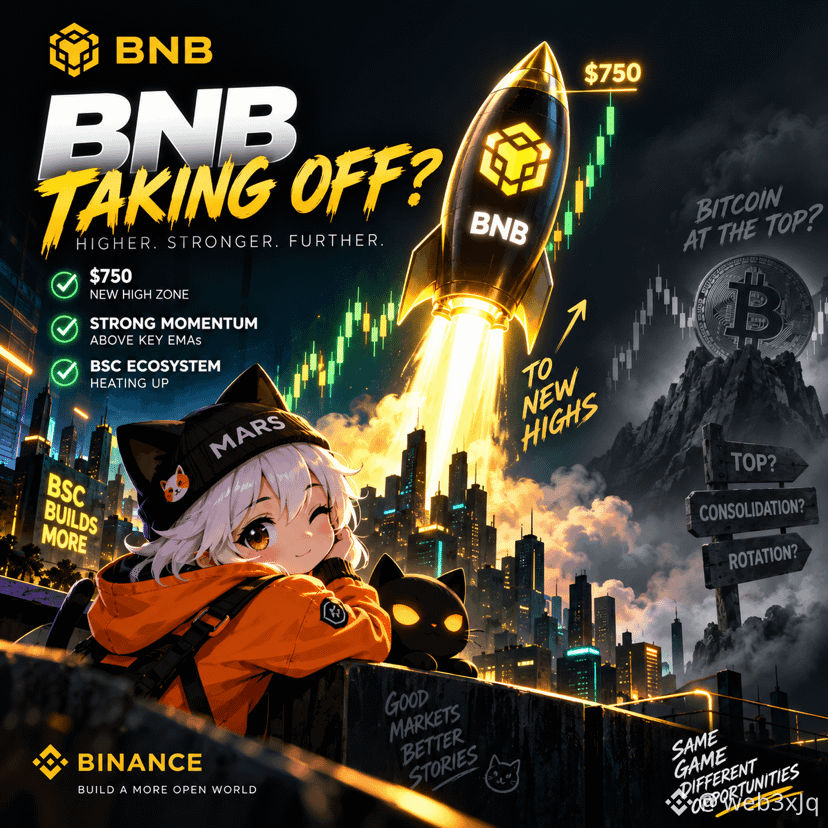
BNB seems to have really started moving
Today BNB surged all the way to around $750, with the daily chart re-accelerating and already testing the previous high area.
What’s more interesting is not just BNB rising on its own, but the timing:
After BTC rallied from the $60k range to around $80k, it is now consolidating at high levels; meanwhile, BNB has started to show clear strength.
At times like this, I start paying attention to one thing: whether capital is rotating.
If BTC does not continue breaking out significantly next, but instead moves sideways at high levels, while the BNB / BSC ecosystem takes over, then the market may be spreading from BTC into higher-beta assets.
Of course, it is still too early to say “BTC has topped.”
BNB’s daily chart is also already pretty hot, and the short-term RSI is at elevated levels, so I wouldn’t chase a big green candle here.
What I’m mainly watching next are two things:
Whether BNB can truly hold above $750–760; and whether BTC can continue to defend its key structure.
If BTC starts to weaken while BNB / BSC keeps accelerating, then this rotation signal will be worth taking seriously.
Could BNB’s move also be a signal of BTC forming a stage top?
$BNB
{future}(BNBUSDT)
BNB seems to have really started moving
Today BNB surged all the way to around $750, with the daily chart re-accelerating and already testing the previous high area.
What’s more interesting is not just BNB rising on its own, but the timing:
After BTC rallied from the $60k range to around $80k, it is now consolidating at high levels; meanwhile, BNB has started to show clear strength.
At times like this, I start paying attention to one thing: whether capital is rotating.
If BTC does not continue breaking out significantly next, but instead moves sideways at high levels, while the BNB / BSC ecosystem takes over, then the market may be spreading from BTC into higher-beta assets.
Of course, it is still too early to say “BTC has topped.”
BNB’s daily chart is also already pretty hot, and the short-term RSI is at elevated levels, so I wouldn’t chase a big green candle here.
What I’m mainly watching next are two things:
Whether BNB can truly hold above $750–760; and whether BTC can continue to defend its key structure.
If BTC starts to weaken while BNB / BSC keeps accelerating, then this rotation signal will be worth taking seriously.
Could BNB’s move also be a signal of BTC forming a stage top?
$BNB
Today BNB surged all the way to around $750, with the daily chart re-accelerating and already testing the previous high area.
What’s more interesting is not just BNB rising on its own, but the timing:
After BTC rallied from the $60k range to around $80k, it is now consolidating at high levels; meanwhile, BNB has started to show clear strength.
At times like this, I start paying attention to one thing: whether capital is rotating.
If BTC does not continue breaking out significantly next, but instead moves sideways at high levels, while the BNB / BSC ecosystem takes over, then the market may be spreading from BTC into higher-beta assets.
Of course, it is still too early to say “BTC has topped.”
BNB’s daily chart is also already pretty hot, and the short-term RSI is at elevated levels, so I wouldn’t chase a big green candle here.
What I’m mainly watching next are two things:
Whether BNB can truly hold above $750–760; and whether BTC can continue to defend its key structure.
If BTC starts to weaken while BNB / BSC keeps accelerating, then this rotation signal will be worth taking seriously.
Could BNB’s move also be a signal of BTC forming a stage top?
$BNB
2
1
1.3k
·
--
What was most worth watching last night was that when the broader market was falling, people were still buying Memory stocks.
On 9/4 at the U.S. regular close, SNDK rose 11.9%, and MU rose 6.1%. Put together with the broader market, it almost looked like two different markets.
Macro pressure is definitely there. U.S. nonfarm payrolls increased by 162,000 in August, and the unemployment rate held at 4.1%. The labor market has not clearly cooled, so the market also has to reassess how much room the Fed has to ease going forward.
But under that backdrop, memory stocks still strengthened.
My read is that the market is becoming more selective about AI beneficiaries: which companies may capture real demand, and which companies, although also talking about AI, are at the same time facing pressure from competition and their business models.
This is an observation based on price divergence, and it still cannot be confirmed from just one day’s move that capital has already shifted for the long term.
Next, I’ll first watch whether hardware can continue to outperform the broader market, and whether there is support on pullbacks. Then, combined with next week’s inflation data, I’ll see whether these stocks can still maintain relative strength when interest-rate pressure intensifies.
If the gains are quickly given back, I’ll first interpret it as a short-term rotation.
The direction is interesting, but the entry level still matters. Seeing a stock rise against the trend doesn’t mean you should chase it.
$SNDK
{future}(SNDKUSDT)
What was most worth watching last night was that when the broader market was falling, people were still buying Memory stocks.
On 9/4 at the U.S. regular close, SNDK rose 11.9%, and MU rose 6.1%. Put together with the broader market, it almost looked like two different markets.
Macro pressure is definitely there. U.S. nonfarm payrolls increased by 162,000 in August, and the unemployment rate held at 4.1%. The labor market has not clearly cooled, so the market also has to reassess how much room the Fed has to ease going forward.
But under that backdrop, memory stocks still strengthened.
My read is that the market is becoming more selective about AI beneficiaries: which companies may capture real demand, and which companies, although also talking about AI, are at the same time facing pressure from competition and their business models.
This is an observation based on price divergence, and it still cannot be confirmed from just one day’s move that capital has already shifted for the long term.
Next, I’ll first watch whether hardware can continue to outperform the broader market, and whether there is support on pullbacks. Then, combined with next week’s inflation data, I’ll see whether these stocks can still maintain relative strength when interest-rate pressure intensifies.
If the gains are quickly given back, I’ll first interpret it as a short-term rotation.
The direction is interesting, but the entry level still matters. Seeing a stock rise against the trend doesn’t mean you should chase it.
$SNDK
On 9/4 at the U.S. regular close, SNDK rose 11.9%, and MU rose 6.1%. Put together with the broader market, it almost looked like two different markets.
Macro pressure is definitely there. U.S. nonfarm payrolls increased by 162,000 in August, and the unemployment rate held at 4.1%. The labor market has not clearly cooled, so the market also has to reassess how much room the Fed has to ease going forward.
But under that backdrop, memory stocks still strengthened.
My read is that the market is becoming more selective about AI beneficiaries: which companies may capture real demand, and which companies, although also talking about AI, are at the same time facing pressure from competition and their business models.
This is an observation based on price divergence, and it still cannot be confirmed from just one day’s move that capital has already shifted for the long term.
Next, I’ll first watch whether hardware can continue to outperform the broader market, and whether there is support on pullbacks. Then, combined with next week’s inflation data, I’ll see whether these stocks can still maintain relative strength when interest-rate pressure intensifies.
If the gains are quickly given back, I’ll first interpret it as a short-term rotation.
The direction is interesting, but the entry level still matters. Seeing a stock rise against the trend doesn’t mean you should chase it.
$SNDK

436
·
--
Article
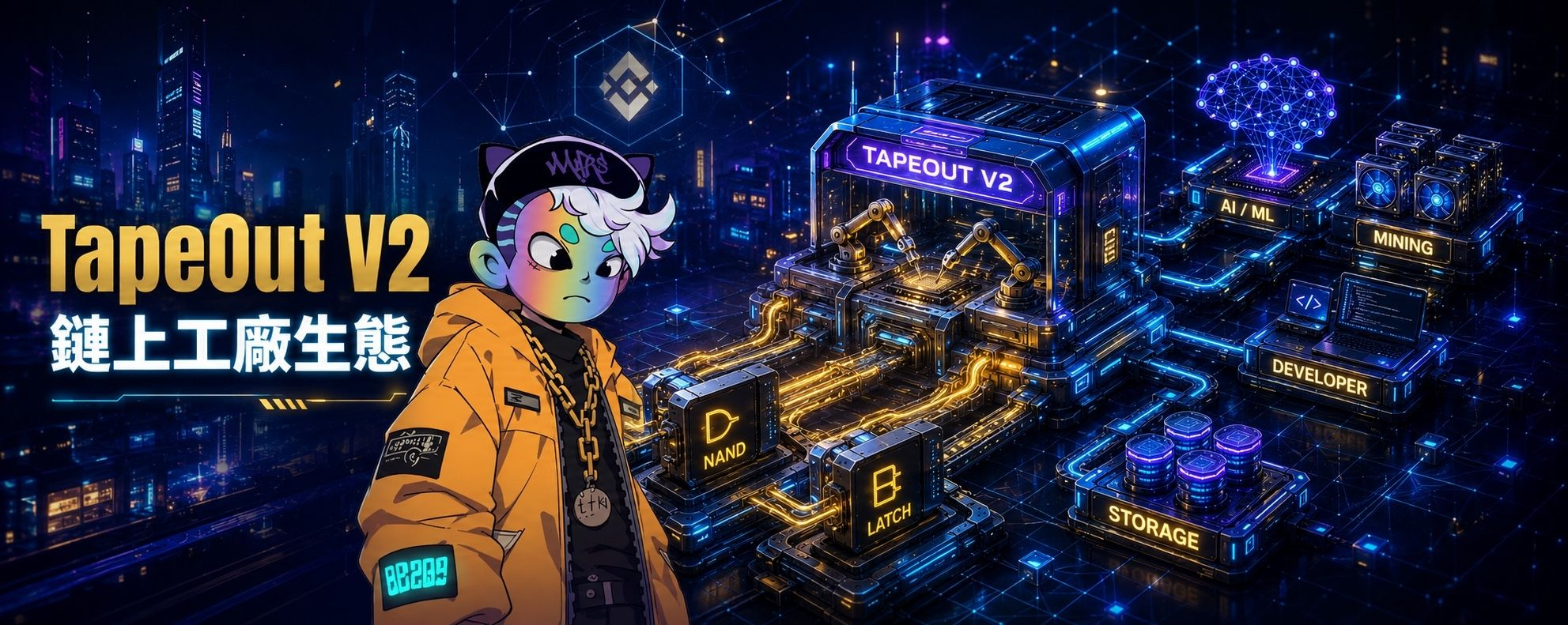
《I originally thought TapeOut V2 was just adding a few components, but then I realized it wanted to open up the whole factory》In the previous two articles, I went from NAND and LATCH all the way to PoD, $BEM, and BNN.
At first, I understood TapeOut as:
Electronic Lego on the chain.
You buy components, connect circuits, test them, and tape them out—until you finally get a Circuit NFT.
Then later, when PoD went live, these circuits could be turned into mining rigs again, and started to dig out
$BEM
.
Later on, TapeOut announced the component equipment warehouse.
the processor creators can burn
$BEM
, buying new manufacturing capabilities for my own factory, such as BNN and other components.
When I got to this part, I thought I’d probably already understood V2:
TapeOut is preparing to add some stronger components.
《I originally thought TapeOut V2 was just adding a few components, but then I realized it wanted to open up the whole factory》
In the previous two articles, I went from NAND and LATCH all the way to PoD, $BEM, and BNN.
At first, I understood TapeOut as:
Electronic Lego on the chain.
You buy components, connect circuits, test them, and tape them out—until you finally get a Circuit NFT.
Then later, when PoD went live, these circuits could be turned into mining rigs again, and started to dig out
$BEM
.
Later on, TapeOut announced the component equipment warehouse.
the processor creators can burn
$BEM
, buying new manufacturing capabilities for my own factory, such as BNN and other components.
When I got to this part, I thought I’d probably already understood V2:
TapeOut is preparing to add some stronger components.
At first, I understood TapeOut as:
Electronic Lego on the chain.
You buy components, connect circuits, test them, and tape them out—until you finally get a Circuit NFT.
Then later, when PoD went live, these circuits could be turned into mining rigs again, and started to dig out
$BEM
.
Later on, TapeOut announced the component equipment warehouse.
the processor creators can burn
$BEM
, buying new manufacturing capabilities for my own factory, such as BNN and other components.
When I got to this part, I thought I’d probably already understood V2:
TapeOut is preparing to add some stronger components.
1
299
·
--
The United States is starting to push its own AI rules out to the world.
Next week, the G20 innovation ministers’ meeting will be held, with Elon Musk, David Sacks, Sam Altman, and Jensen Huang all in attendance.
But what’s really worth watching isn’t the star-studded lineup—it’s the “Carolina Principles” the U.S. is preparing to advance:
Not rushing to create new AI regulatory bodies,
using existing industry regulators as much as possible,
testing new technologies with the government and companies together,
and the core goal is still—don’t let regulation run ahead of innovation.
In essence, this is the international version of the Trump administration’s domestic AI approach.
If it ultimately does make it into a joint G20 statement, the significance won’t be just that the U.S. is “easing AI regulation,” but rather:
The U.S. is beginning to try turning its AI governance framework into the global default template.
The next phase of competition in AI may not be only about models, chips, and computing power.
Even the rules themselves are starting to become a country’s competitive strength.
With Musk + Altman + Jensen on the same stage, the meeting in September should be worth watching.
The United States is starting to push its own AI rules out to the world.
Next week, the G20 innovation ministers’ meeting will be held, with Elon Musk, David Sacks, Sam Altman, and Jensen Huang all in attendance.
But what’s really worth watching isn’t the star-studded lineup—it’s the “Carolina Principles” the U.S. is preparing to advance:
Not rushing to create new AI regulatory bodies,
using existing industry regulators as much as possible,
testing new technologies with the government and companies together,
and the core goal is still—don’t let regulation run ahead of innovation.
In essence, this is the international version of the Trump administration’s domestic AI approach.
If it ultimately does make it into a joint G20 statement, the significance won’t be just that the U.S. is “easing AI regulation,” but rather:
The U.S. is beginning to try turning its AI governance framework into the global default template.
The next phase of competition in AI may not be only about models, chips, and computing power.
Even the rules themselves are starting to become a country’s competitive strength.
With Musk + Altman + Jensen on the same stage, the meeting in September should be worth watching.
Next week, the G20 innovation ministers’ meeting will be held, with Elon Musk, David Sacks, Sam Altman, and Jensen Huang all in attendance.
But what’s really worth watching isn’t the star-studded lineup—it’s the “Carolina Principles” the U.S. is preparing to advance:
Not rushing to create new AI regulatory bodies,
using existing industry regulators as much as possible,
testing new technologies with the government and companies together,
and the core goal is still—don’t let regulation run ahead of innovation.
In essence, this is the international version of the Trump administration’s domestic AI approach.
If it ultimately does make it into a joint G20 statement, the significance won’t be just that the U.S. is “easing AI regulation,” but rather:
The U.S. is beginning to try turning its AI governance framework into the global default template.
The next phase of competition in AI may not be only about models, chips, and computing power.
Even the rules themselves are starting to become a country’s competitive strength.
With Musk + Altman + Jensen on the same stage, the meeting in September should be worth watching.

331
·
--
Tonight’s NVDA earnings report could directly determine how the next phase of AI trading unfolds.
The market currently expects NVIDIA’s Q2 fiscal revenue to be around $92 billion, with next-quarter guidance possibly coming in near $104 billion.
But this time, what the market is looking at isn’t just whether it will “beat or not beat.”
What really matters is:
Rubin ramp-up pace, AI data center demand, gross margin, and whether AI CapEx can continue to sustain high growth.
Unfortunately, today’s macro environment also isn’t exactly easy.
U.S. July PCE came in at 3.7% year-over-year, higher than the market’s original expectation of 3.6%; core PCE remains at 3.3%. After the data was released, expectations for a September rate hike warmed up again.
So tonight, it’s really two forces going head-to-head:
AI Earnings
vs
Higher-for-longer Rates
If NVDA again delivers strong results + strong guidance, the beneficiaries likely won’t be limited to NVDA.
I’ll be watching together:
AMD / AVGO / MRVL — AI Compute
MU / SNDK / WDC / STX — Memory & Storage
COHR / LITE / AAOI / CIEN — Optical / AI Infrastructure
Especially since just the other day, storage and optical communications both went through a round of broad pullbacks.
If tonight NVDA’s commentary on Rubin, HBM, and data center demand is strong enough, these AI hardware names that were hit could see a wave of recovery.
But on the flip side, you also have to be careful:
The market’s expectations for NVDA are already very high.
Even if the earnings are great, that doesn’t necessarily mean the stock will rise.
If it’s just in line with expectations, or even if it’s “beating by not enough,” then you could actually get:
Good earnings, bad stock reaction.
So tonight, I won’t be watching only NVDA.
More importantly, after the earnings come out, I want to see whether the entire AI hardware sector moves together.
If NVDA is strong, memory is strong, and optical also repairs, then that would look more like the AI trade is back.
If NVDA itself can’t hold up, then the selloff in valuation from the past few days may not be over yet.
Tonight, I’m watching whether Jensen can pull the entire AI hardware sector back up. $NVDA
{future}(NVDAUSDT)
$SNDK
{future}(SNDKUSDT)
$MU
{future}(MUUSDT)
Tonight’s NVDA earnings report could directly determine how the next phase of AI trading unfolds.
The market currently expects NVIDIA’s Q2 fiscal revenue to be around $92 billion, with next-quarter guidance possibly coming in near $104 billion.
But this time, what the market is looking at isn’t just whether it will “beat or not beat.”
What really matters is:
Rubin ramp-up pace, AI data center demand, gross margin, and whether AI CapEx can continue to sustain high growth.
Unfortunately, today’s macro environment also isn’t exactly easy.
U.S. July PCE came in at 3.7% year-over-year, higher than the market’s original expectation of 3.6%; core PCE remains at 3.3%. After the data was released, expectations for a September rate hike warmed up again.
So tonight, it’s really two forces going head-to-head:
AI Earnings
vs
Higher-for-longer Rates
If NVDA again delivers strong results + strong guidance, the beneficiaries likely won’t be limited to NVDA.
I’ll be watching together:
AMD / AVGO / MRVL — AI Compute
MU / SNDK / WDC / STX — Memory & Storage
COHR / LITE / AAOI / CIEN — Optical / AI Infrastructure
Especially since just the other day, storage and optical communications both went through a round of broad pullbacks.
If tonight NVDA’s commentary on Rubin, HBM, and data center demand is strong enough, these AI hardware names that were hit could see a wave of recovery.
But on the flip side, you also have to be careful:
The market’s expectations for NVDA are already very high.
Even if the earnings are great, that doesn’t necessarily mean the stock will rise.
If it’s just in line with expectations, or even if it’s “beating by not enough,” then you could actually get:
Good earnings, bad stock reaction.
So tonight, I won’t be watching only NVDA.
More importantly, after the earnings come out, I want to see whether the entire AI hardware sector moves together.
If NVDA is strong, memory is strong, and optical also repairs, then that would look more like the AI trade is back.
If NVDA itself can’t hold up, then the selloff in valuation from the past few days may not be over yet.
Tonight, I’m watching whether Jensen can pull the entire AI hardware sector back up. $NVDA
$SNDK
$MU
The market currently expects NVIDIA’s Q2 fiscal revenue to be around $92 billion, with next-quarter guidance possibly coming in near $104 billion.
But this time, what the market is looking at isn’t just whether it will “beat or not beat.”
What really matters is:
Rubin ramp-up pace, AI data center demand, gross margin, and whether AI CapEx can continue to sustain high growth.
Unfortunately, today’s macro environment also isn’t exactly easy.
U.S. July PCE came in at 3.7% year-over-year, higher than the market’s original expectation of 3.6%; core PCE remains at 3.3%. After the data was released, expectations for a September rate hike warmed up again.
So tonight, it’s really two forces going head-to-head:
AI Earnings
vs
Higher-for-longer Rates
If NVDA again delivers strong results + strong guidance, the beneficiaries likely won’t be limited to NVDA.
I’ll be watching together:
AMD / AVGO / MRVL — AI Compute
MU / SNDK / WDC / STX — Memory & Storage
COHR / LITE / AAOI / CIEN — Optical / AI Infrastructure
Especially since just the other day, storage and optical communications both went through a round of broad pullbacks.
If tonight NVDA’s commentary on Rubin, HBM, and data center demand is strong enough, these AI hardware names that were hit could see a wave of recovery.
But on the flip side, you also have to be careful:
The market’s expectations for NVDA are already very high.
Even if the earnings are great, that doesn’t necessarily mean the stock will rise.
If it’s just in line with expectations, or even if it’s “beating by not enough,” then you could actually get:
Good earnings, bad stock reaction.
So tonight, I won’t be watching only NVDA.
More importantly, after the earnings come out, I want to see whether the entire AI hardware sector moves together.
If NVDA is strong, memory is strong, and optical also repairs, then that would look more like the AI trade is back.
If NVDA itself can’t hold up, then the selloff in valuation from the past few days may not be over yet.
Tonight, I’m watching whether Jensen can pull the entire AI hardware sector back up. $NVDA
$SNDK
$MU

452
·
--
Bearish
BTC surged 23% over the week, posting its biggest weekly gain in over 3 years. Has the bull market really returned? I don’t think we can jump to conclusions that quickly.
This rebound has indeed been strong, and there are also some macro catalysts behind it. The market has restarted discussions about U.S. debt, long-term Treasury buybacks, dollar depreciation, and the logic of alternative assets—so BTC has once again gained attention. At the same time, this rally has also included a very clear short squeeze: shorts were rapidly squeezed, further amplifying price elasticity.
The issue is that after BTC broke above $80K, it didn’t truly hold its ground. After pushing higher, it quickly slipped back into a period of range-bound trading.
So what I’m focused on now isn’t “how much BTC rose this week,” but:
Whether this up move can actually flush out short positions and turn into sustained, real buying demand.
If $80K can hold and retake the level, that would be a strong signal. But since it hasn’t been able to stay above it, I’d instead first watch whether the market retests the area around $70K.
For me, $70K is the next key level.
🔸 Hold $70K: This would indicate that after this big jump, there’s still room for the market to digest positions, rebuild structure, and then continue to watch whether it can again challenge $80K.
🔸 Break below $70K: Then be careful. That would suggest this rebound may just be a strong relief bounce within a larger-scale downturn, and further lows may follow.
In addition, the narrative of “BTC = digital gold” still hasn’t been fully validated by the market. Gold has continued to perform relatively strongly this year. Even though BTC has experienced this rapid rebound, its overall performance still differs. In the past, when genuine risk-off sentiment showed up, BTC hasn’t always moved in sync with gold.
So my current view is still:
Volatility is back, sentiment is back—but the true bull-market structure still needs further proof.
The short side has already been pushed out for the first time
Next, we’ll see whether $70K can hold during this round of pressure testing.
Hold it, and keep watching for structure to repair.
Break it, and guard against even lower lows.
$BTC
{future}(BTCUSDT)
BTC surged 23% over the week, posting its biggest weekly gain in over 3 years. Has the bull market really returned? I don’t think we can jump to conclusions that quickly.
This rebound has indeed been strong, and there are also some macro catalysts behind it. The market has restarted discussions about U.S. debt, long-term Treasury buybacks, dollar depreciation, and the logic of alternative assets—so BTC has once again gained attention. At the same time, this rally has also included a very clear short squeeze: shorts were rapidly squeezed, further amplifying price elasticity.
The issue is that after BTC broke above $80K, it didn’t truly hold its ground. After pushing higher, it quickly slipped back into a period of range-bound trading.
So what I’m focused on now isn’t “how much BTC rose this week,” but:
Whether this up move can actually flush out short positions and turn into sustained, real buying demand.
If $80K can hold and retake the level, that would be a strong signal. But since it hasn’t been able to stay above it, I’d instead first watch whether the market retests the area around $70K.
For me, $70K is the next key level.
🔸 Hold $70K: This would indicate that after this big jump, there’s still room for the market to digest positions, rebuild structure, and then continue to watch whether it can again challenge $80K.
🔸 Break below $70K: Then be careful. That would suggest this rebound may just be a strong relief bounce within a larger-scale downturn, and further lows may follow.
In addition, the narrative of “BTC = digital gold” still hasn’t been fully validated by the market. Gold has continued to perform relatively strongly this year. Even though BTC has experienced this rapid rebound, its overall performance still differs. In the past, when genuine risk-off sentiment showed up, BTC hasn’t always moved in sync with gold.
So my current view is still:
Volatility is back, sentiment is back—but the true bull-market structure still needs further proof.
The short side has already been pushed out for the first time
Next, we’ll see whether $70K can hold during this round of pressure testing.
Hold it, and keep watching for structure to repair.
Break it, and guard against even lower lows.
$BTC
This rebound has indeed been strong, and there are also some macro catalysts behind it. The market has restarted discussions about U.S. debt, long-term Treasury buybacks, dollar depreciation, and the logic of alternative assets—so BTC has once again gained attention. At the same time, this rally has also included a very clear short squeeze: shorts were rapidly squeezed, further amplifying price elasticity.
The issue is that after BTC broke above $80K, it didn’t truly hold its ground. After pushing higher, it quickly slipped back into a period of range-bound trading.
So what I’m focused on now isn’t “how much BTC rose this week,” but:
Whether this up move can actually flush out short positions and turn into sustained, real buying demand.
If $80K can hold and retake the level, that would be a strong signal. But since it hasn’t been able to stay above it, I’d instead first watch whether the market retests the area around $70K.
For me, $70K is the next key level.
🔸 Hold $70K: This would indicate that after this big jump, there’s still room for the market to digest positions, rebuild structure, and then continue to watch whether it can again challenge $80K.
🔸 Break below $70K: Then be careful. That would suggest this rebound may just be a strong relief bounce within a larger-scale downturn, and further lows may follow.
In addition, the narrative of “BTC = digital gold” still hasn’t been fully validated by the market. Gold has continued to perform relatively strongly this year. Even though BTC has experienced this rapid rebound, its overall performance still differs. In the past, when genuine risk-off sentiment showed up, BTC hasn’t always moved in sync with gold.
So my current view is still:
Volatility is back, sentiment is back—but the true bull-market structure still needs further proof.
The short side has already been pushed out for the first time
Next, we’ll see whether $70K can hold during this round of pressure testing.
Hold it, and keep watching for structure to repair.
Break it, and guard against even lower lows.
$BTC

308
·
--
Article
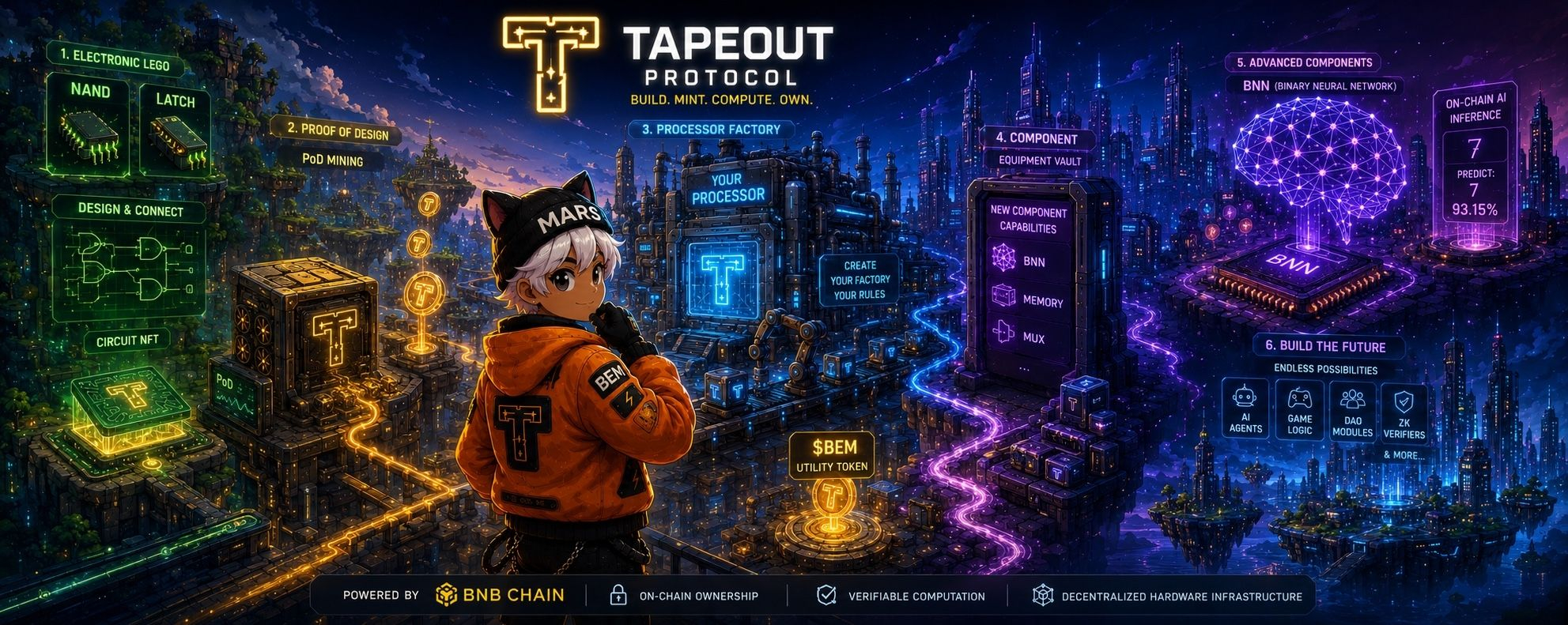
《I Just Learned How to Mine, and TapeOut Is Already Building On-Chain AI》From PoD, $BEM, component device warehouses to BNN—it's like I'm starting to understand what TapeOut is really trying to do.
A few days ago, I was still researching:
What exactly is NAND?
Then I learned to connect the electronic LEGO pieces one by one.
Later on, PoD went live.
I started buying NAND, funding runs, and studying how to build my own first on-chain mining machine.
After all that, I finally prepared to enter the beginner village.
And then—turning my head around—
TapeOut is already getting to work on this:
BNN, on-chain AI inference, component device warehouses.
My first reaction was really this:
No, I'm just starting to dig. The beginner village hasn't even left yet, and the data episode is already out?
《I Just Learned How to Mine, and TapeOut Is Already Building On-Chain AI》
From PoD, $BEM, component device warehouses to BNN—it's like I'm starting to understand what TapeOut is really trying to do.
A few days ago, I was still researching:
What exactly is NAND?
Then I learned to connect the electronic LEGO pieces one by one.
Later on, PoD went live.
I started buying NAND, funding runs, and studying how to build my own first on-chain mining machine.
After all that, I finally prepared to enter the beginner village.
And then—turning my head around—
TapeOut is already getting to work on this:
BNN, on-chain AI inference, component device warehouses.
My first reaction was really this:
No, I'm just starting to dig. The beginner village hasn't even left yet, and the data episode is already out?
A few days ago, I was still researching:
What exactly is NAND?
Then I learned to connect the electronic LEGO pieces one by one.
Later on, PoD went live.
I started buying NAND, funding runs, and studying how to build my own first on-chain mining machine.
After all that, I finally prepared to enter the beginner village.
And then—turning my head around—
TapeOut is already getting to work on this:
BNN, on-chain AI inference, component device warehouses.
My first reaction was really this:
No, I'm just starting to dig. The beginner village hasn't even left yet, and the data episode is already out?
213
·
--
Article
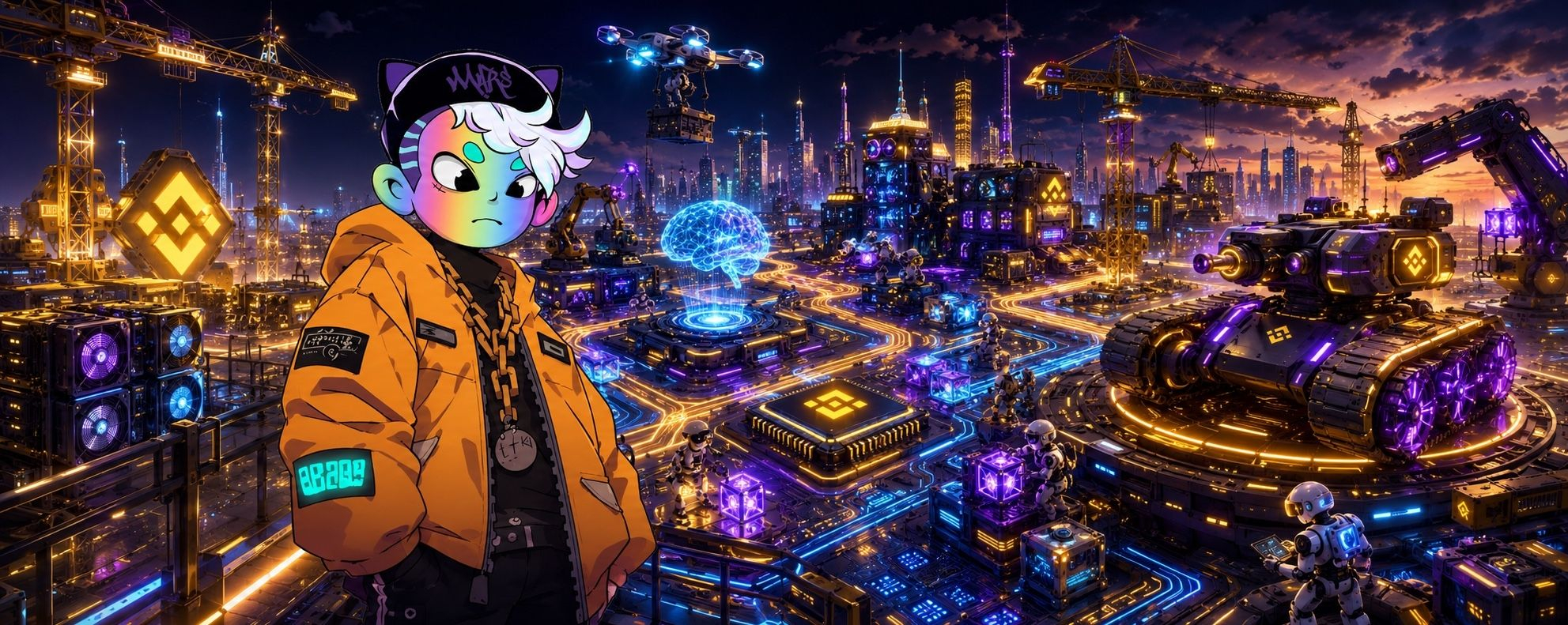
AI Is Moving On-chain. TapeOut Is Building the Brain on BSCFrom NAND gates and Proof of Design to Binary Neural Networks, TapeOut is turning BNB Smart Chain into a playground for verifiable computation — and perhaps a new kind of on-chain AI.
Everyone is building AI agents.
They have wallets.
They trade.
They post.
They launch tokens.
Some even talk to other agents.
But almost all of them still have the same little secret:
the “brain” is somewhere else.
The agent might interact with a blockchain, but most of the actual AI computation still happens on a private server or external infrastructure.
The blockchain sees the result.
It does not necessarily see how the result was produced.
TapeOut is experimenting with something much stranger:
What if part of the brain itself could live on-chain?
Not ChatGPT.
Not a billion-parameter model.
Something smaller, simpler and much more suitable for deterministic computation:
a Binary Neural Network — BNN.
And it is being explored on BNB Smart Chain.
That caught my attention.
Because while everyone is trying to give AI a wallet, TapeOut seems interested in giving the blockchain something closer to a verifiable brain.
From BSC the trading chain… to BSC the computation playground?
BSC has traditionally been associated with a very different side of Crypto.
Trading.
DeFi.
Meme Coins.
Stablecoins.
Retail users.
Fast-moving on-chain markets.
But technically, the network itself has been changing quite aggressively.
BNB Chain says BSC can now reach deterministic finality in around 0.65 seconds under normal conditions, following several years of consensus improvements. Its H2 2026 roadmap also describes 450ms block intervals and continued work towards much higher throughput.
That does not mean somebody is about to run GPT-6 inside a BSC smart contract.
Please don't do that.
But faster settlement, cheaper execution and an EVM environment do make another question increasingly interesting:
What kinds of smaller, deterministic and verifiable computation can realistically live on-chain?
This is where TapeOut gets weird.
TapeOut started with NAND, not AI
TapeOut did not begin by writing “AI” everywhere and then trying to work backwards towards a product.
Its starting point was far more primitive:
NAND.
A NAND gate takes two binary inputs and produces one binary output.
It sounds almost comically basic.
But NAND is functionally complete: combine enough NAND gates and you can construct other logic functions and increasingly complex digital circuits.
TapeOut adds another primitive:
LATCH.
If NAND gives you logic, LATCH gives you state.
Now you have something that can calculate and remember.
TapeOut's own description is essentially an on-chain hardware construction system: users acquire these primitive components, connect them visually on a Canvas, simulate the design and eventually Tape Out the finished circuit. Its current BNB Chain marketplace describes NAND and LATCH as production materials used to create on-chain circuit assets.
The easiest explanation is still my favourite:
Electronic LEGO on-chain.
You have bricks.
You wire them together.
You build something.
And when you are satisfied with the design, you manufacture it on-chain.
Simple enough.
Until the LEGO starts mining.
Then came Proof of Design
TapeOut's current BNB Chain experiment introduced Proof of Design — PoD and
$BEM
mining. Its public PoD interface explicitly identifies the system as operating on BNB Chain.
But the interesting part of PoD is not simply:
buy more components → mine more tokens.
Design matters.
A circuit has a construction cost.
It has a combinational depth.
It can solve a task.
And there can be a current best design for that task.
Someone else can then come along and beat it.
That turns the game into something closer to:
Build → Simulate → Tape Out → Optimise → Compete
Instead of only competing with capital, people begin competing with design.
That is the point where TapeOut started making much more sense to me.
PoD creates an immediate reason to build circuits.
But PoD does not have to be the final reason those circuits exist.
It can simply be the first game.
And then someone added a neural network.
Wait… you can build AI out of this?
This is where things went from interesting to slightly absurd.
I was still looking at NAND and LATCH.
Meanwhile, Blonskr was already testing a Binary Neural Network component.
A BNN is not an LLM.
Instead of relying on high-precision weights like conventional neural networks, a Binary Neural Network compresses much of the model into binary values.
That dramatically changes the type of computation required.
Rather than thinking about enormous GPU workloads, you start seeing operations that map much more naturally to digital logic:
bits, comparisons, XNOR-style operations, counting and thresholds.
Suddenly this path:
NAND → Circuit → BNN
does not look quite as crazy as it first sounds.
TapeOut's BNN experiment
In the test shared by Blonskr, the experimental model used:
34,048 binary weights.
It accepted a 256-bit input, passed it through 128 neurons, produced 10 class scores, and selected the final result through an argmax operation.
The dataset contained 5,620 handwritten images, divided into 4,496 training samples and 1,124 test samples.
The reported test inference accuracy was 93.15%.
Again:
This is not an attempt to beat OpenAI, Anthropic or Google.
Comparing it with modern LLMs would miss the entire point.
The interesting question is:
Can the inference be made transparent, deterministic and independently verifiable on-chain?
That is a completely different objective.
AI has a trust problem
Imagine I operate an AI service.
You send me some data.
My server replies:
Prediction: 7
How do you know what actually happened?
You trust that I used the model I claimed to use.
You trust that I used the published weights.
You trust that the weights were not quietly modified.
You trust that the output was not changed before being returned.
For most applications, that is perfectly acceptable.
But Crypto was basically invented by people who looked at the phrase “just trust the server” and developed an allergic reaction.
So what if the model is deliberately small enough that its inference logic can become part of the blockchain execution environment?
Then the relationship changes.
Instead of:
Trust me. The AI produced this result.
you start moving towards:
Here is the model. Here are the rules. Here is the computation. Verify it.
That is where I think the phrase verifiable AI becomes much more interesting than simply saying “AI on-chain”.
AI Agents vs Verifiable AI
This difference is worth separating.
An AI Agent on-chain might:
have a wallet,
sign transactions,
trade tokens,
interact with contracts.
But its intelligence can still live almost entirely off-chain.
The blockchain is effectively the agent's financial system.
TapeOut's BNN experiment asks something different:
Can blockchain become part of the AI's computation and verification layer?
That does not necessarily make the AI smarter.
In fact, the models will probably be dramatically smaller.
But that is not the competition.
The advantage would be something else:
predictability.
transparency.
immutability.
verifiability.
Different problem.
Different design space.
And BSC is an interesting place to try it
There is also something culturally appropriate about doing this on BSC.
BSC already has one of Crypto's most active retail environments.
It understands speculation.
It understands Meme culture.
It understands high-frequency user interaction.
And the underlying network is simultaneously becoming faster: BNB Chain currently reports roughly 0.65-second deterministic finality under normal conditions, while continuing to target further throughput improvements.
So perhaps the interesting future for BSC is not simply:
more tokens moving faster.
Maybe some of those transactions eventually represent:
circuits being manufactured,
designs competing,
AI models executing,
and
communities building strange computational objects together.
That is a very different BSC story.
BNN may not even be the real product
This is probably the biggest thing I took away from TapeOut's recent direction.
BNN does not necessarily have to be a product.
It can be a component.
That sounds like a small distinction.
It is not.
Imagine TapeOut eventually having many higher-level components:
BNN.
Memory blocks.
Multiplexers.
Cryptographic modules.
Arithmetic components.
Different AI primitives.
And whatever else builders come up with.
Then you stop asking:
“What can this BNN do?”
You begin asking:
“What happens when I combine BNN + memory + logic + another person's circuit?”
That is where composition starts.
And composition is usually when Crypto gets interesting.
From Processor to on-chain factory
This also explains TapeOut's proposed component-equipment direction.
Think of a TapeOut Processor as a factory.
Originally, factories manufacture basic building materials such as NAND and LATCH.
But imagine a factory creator being able to acquire new manufacturing equipment.
One factory buys BNN capability.
Another specialises in memory.
Another focuses on extremely cheap basic logic.
Another becomes a cryptographic-component factory.
Now processors begin developing different identities.
And the ecosystem starts looking like:
PoD
↓
$BEM
↓
new manufacturing equipment
↓
new components
↓
new circuits
↓
new applications
This is why I increasingly hesitate to call TapeOut simply a mining project.
Mining might be the first economic loop.
The bigger experiment is potentially:
an on-chain market for computational design and manufacturing.
Now add Crypto culture to it
And this is the part I think could become particularly fun on BSC.
Because technology alone does not create a Crypto ecosystem.
Communities do.
BSC already has an enormous Meme culture.
Most Meme communities are excellent at three things:
attention, identity and coordination.
But once the token exists, the next question is usually painful:
“So… what do we actually do now?”
Normally somebody invents another staking programme.
Please, no.
TapeOut potentially gives communities another answer:
Build something together.
What happens when Meme communities start building?
Imagine two Meme communities deciding to compete.
Not over which token pumps harder.
Instead:
Who can build the smallest working circuit?
Or:
Who can dethrone the current best PoD design?
Or:
Who can build the weirdest functioning BNN?
One community could create a themed Processor factory.
Another could sponsor an open circuit-design challenge.
Artists could create the visual culture.
Circuit designers build the logic.
AI builders optimise the BNN.
Meme accounts spread the competition.
And the finished Circuit becomes part technical artefact, part collectible and part community history.
Now a Meme community has something unusual:
shared culture + shared construction.
The idea I find interesting is not:
“How do we give this Meme Coin utility?”
It is:
“What if a Meme community could build something together instead of simply holding something together?”
That feels much more native to what TapeOut is building.
Imagine a ridiculous BSC AI tournament
Push the idea one step further.
A community launches a challenge:
Build the smallest on-chain AI that can recognise its Meme.
Different teams receive the same task.
One uses more BNN capacity but less logic.
Another optimises the circuit aggressively.
Someone discovers a completely different architecture.
People submit their designs.
The results are verifiable.
A leaderboard emerges.
Another community challenges them.
Suddenly you have something sitting somewhere between:
AI hackathon
× Meme war
× on-chain game
× hardware design competition
That sounds completely ridiculous.
Which, historically, has not been a particularly strong reason to bet against Crypto.
This is the opportunity — and also the trap
There is an important distinction here.
TapeOut should not become:
Meme + mining + yield + AI + another token.
That is exactly how you turn an interesting primitive into something that looks like a 2021 PowerPoint deck.
The Meme layer should be culture and participation, not an excuse to manufacture another financial promise.
Let communities compete.
Let them design.
Let them remix.
Let them create factories.
Let them make stupid things.
Let the best stupid thing unexpectedly become useful.
That is much healthier than beginning with:
“What APY does the AI Meme factory pay?”
Why I think this matters for BSC
For years, blockchains have mostly tokenised things.
Money.
Art.
Positions.
Real-world assets.
Attention.
TapeOut asks whether another object can become native to the chain:
design.
And BNN expands the question again:
What if some forms of intelligence become design objects too?
Not intelligence in the AGI sense.
Small, deterministic computational models.
Models that can potentially be:
built,
inspected,
combined,
executed,
and verified.
If that works, BSC gets a new category of experiment beyond trading:
programmable, verifiable computational objects.
That is the story I find much more interesting than simply:
“BNB Chain has another AI project.”
The limitations matter
There is plenty we still do not know.
On-chain computation remains constrained.
BNNs trade precision for efficiency.
Model complexity matters.
Storage matters.
Gas matters.
Training and inference are very different problems.
And just because something can be moved on-chain does not mean that it should be.
TapeOut is also extremely early.
BNB Chain's improving performance does not magically eliminate these constraints.
So I would not say:
TapeOut has solved on-chain AI.
It hasn't.
A much fairer description would be:
TapeOut has produced an interesting primitive for experimenting with verifiable AI on BSC.
Now the important part begins:
seeing what people actually build.
Final Thoughts
The more I watch TapeOut, the more its evolution makes sense:
NAND → LATCH → Circuit → PoD →
$BEM
→ Factory → BNN → ?
The question mark is the interesting part.
Perhaps BNN remains an experimental component.
Perhaps verifiable inference finds very specific applications.
Perhaps communities turn it into games.
Perhaps Meme communities start competing with circuits instead of only charts.
Perhaps somebody combines components in a way nobody building TapeOut currently expects.
That is what construction primitives do.
They create possibilities their creators cannot fully predict.
And that might be TapeOut's most interesting characteristic.
Most of Crypto AI currently asks:
How do we put an AI Agent on-chain?
TapeOut is asking something slightly crazier:
How much of the brain can we make verifiable on-chain?
And it is attempting that experiment on a chain already known for moving quickly, trading aggressively and producing some of Crypto's strangest communities.
BSC might be the perfect laboratory.
Everyone else is busy giving AI agents wallets.
TapeOut decided to start building the brain.
And apparently I'm still trying to buy enough NAND and LATCH to play with it.
Holders, please release some supply.
This article reflects my own interpretation of TapeOut's current experiments and publicly shared direction. BNN, component equipment and related ecosystem mechanics are still early and may evolve substantially. This is an exploration of technology and product design, not investment advice.
#BSC
AI Is Moving On-chain. TapeOut Is Building the Brain on BSC
From NAND gates and Proof of Design to Binary Neural Networks, TapeOut is turning BNB Smart Chain into a playground for verifiable computation — and perhaps a new kind of on-chain AI.
Everyone is building AI agents.
They have wallets.
They trade.
They post.
They launch tokens.
Some even talk to other agents.
But almost all of them still have the same little secret:
the “brain” is somewhere else.
The agent might interact with a blockchain, but most of the actual AI computation still happens on a private server or external infrastructure.
The blockchain sees the result.
It does not necessarily see how the result was produced.
TapeOut is experimenting with something much stranger:
What if part of the brain itself could live on-chain?
Not ChatGPT.
Not a billion-parameter model.
Something smaller, simpler and much more suitable for deterministic computation:
a Binary Neural Network — BNN.
And it is being explored on BNB Smart Chain.
That caught my attention.
Because while everyone is trying to give AI a wallet, TapeOut seems interested in giving the blockchain something closer to a verifiable brain.
From BSC the trading chain… to BSC the computation playground?
BSC has traditionally been associated with a very different side of Crypto.
Trading.
DeFi.
Meme Coins.
Stablecoins.
Retail users.
Fast-moving on-chain markets.
But technically, the network itself has been changing quite aggressively.
BNB Chain says BSC can now reach deterministic finality in around 0.65 seconds under normal conditions, following several years of consensus improvements. Its H2 2026 roadmap also describes 450ms block intervals and continued work towards much higher throughput.
That does not mean somebody is about to run GPT-6 inside a BSC smart contract.
Please don't do that.
But faster settlement, cheaper execution and an EVM environment do make another question increasingly interesting:
What kinds of smaller, deterministic and verifiable computation can realistically live on-chain?
This is where TapeOut gets weird.
TapeOut started with NAND, not AI
TapeOut did not begin by writing “AI” everywhere and then trying to work backwards towards a product.
Its starting point was far more primitive:
NAND.
A NAND gate takes two binary inputs and produces one binary output.
It sounds almost comically basic.
But NAND is functionally complete: combine enough NAND gates and you can construct other logic functions and increasingly complex digital circuits.
TapeOut adds another primitive:
LATCH.
If NAND gives you logic, LATCH gives you state.
Now you have something that can calculate and remember.
TapeOut's own description is essentially an on-chain hardware construction system: users acquire these primitive components, connect them visually on a Canvas, simulate the design and eventually Tape Out the finished circuit. Its current BNB Chain marketplace describes NAND and LATCH as production materials used to create on-chain circuit assets.
The easiest explanation is still my favourite:
Electronic LEGO on-chain.
You have bricks.
You wire them together.
You build something.
And when you are satisfied with the design, you manufacture it on-chain.
Simple enough.
Until the LEGO starts mining.
Then came Proof of Design
TapeOut's current BNB Chain experiment introduced Proof of Design — PoD and
$BEM
mining. Its public PoD interface explicitly identifies the system as operating on BNB Chain.
But the interesting part of PoD is not simply:
buy more components → mine more tokens.
Design matters.
A circuit has a construction cost.
It has a combinational depth.
It can solve a task.
And there can be a current best design for that task.
Someone else can then come along and beat it.
That turns the game into something closer to:
Build → Simulate → Tape Out → Optimise → Compete
Instead of only competing with capital, people begin competing with design.
That is the point where TapeOut started making much more sense to me.
PoD creates an immediate reason to build circuits.
But PoD does not have to be the final reason those circuits exist.
It can simply be the first game.
And then someone added a neural network.
Wait… you can build AI out of this?
This is where things went from interesting to slightly absurd.
I was still looking at NAND and LATCH.
Meanwhile, Blonskr was already testing a Binary Neural Network component.
A BNN is not an LLM.
Instead of relying on high-precision weights like conventional neural networks, a Binary Neural Network compresses much of the model into binary values.
That dramatically changes the type of computation required.
Rather than thinking about enormous GPU workloads, you start seeing operations that map much more naturally to digital logic:
bits, comparisons, XNOR-style operations, counting and thresholds.
Suddenly this path:
NAND → Circuit → BNN
does not look quite as crazy as it first sounds.
TapeOut's BNN experiment
In the test shared by Blonskr, the experimental model used:
34,048 binary weights.
It accepted a 256-bit input, passed it through 128 neurons, produced 10 class scores, and selected the final result through an argmax operation.
The dataset contained 5,620 handwritten images, divided into 4,496 training samples and 1,124 test samples.
The reported test inference accuracy was 93.15%.
Again:
This is not an attempt to beat OpenAI, Anthropic or Google.
Comparing it with modern LLMs would miss the entire point.
The interesting question is:
Can the inference be made transparent, deterministic and independently verifiable on-chain?
That is a completely different objective.
AI has a trust problem
Imagine I operate an AI service.
You send me some data.
My server replies:
Prediction: 7
How do you know what actually happened?
You trust that I used the model I claimed to use.
You trust that I used the published weights.
You trust that the weights were not quietly modified.
You trust that the output was not changed before being returned.
For most applications, that is perfectly acceptable.
But Crypto was basically invented by people who looked at the phrase “just trust the server” and developed an allergic reaction.
So what if the model is deliberately small enough that its inference logic can become part of the blockchain execution environment?
Then the relationship changes.
Instead of:
Trust me. The AI produced this result.
you start moving towards:
Here is the model. Here are the rules. Here is the computation. Verify it.
That is where I think the phrase verifiable AI becomes much more interesting than simply saying “AI on-chain”.
AI Agents vs Verifiable AI
This difference is worth separating.
An AI Agent on-chain might:
have a wallet,
sign transactions,
trade tokens,
interact with contracts.
But its intelligence can still live almost entirely off-chain.
The blockchain is effectively the agent's financial system.
TapeOut's BNN experiment asks something different:
Can blockchain become part of the AI's computation and verification layer?
That does not necessarily make the AI smarter.
In fact, the models will probably be dramatically smaller.
But that is not the competition.
The advantage would be something else:
predictability.
transparency.
immutability.
verifiability.
Different problem.
Different design space.
And BSC is an interesting place to try it
There is also something culturally appropriate about doing this on BSC.
BSC already has one of Crypto's most active retail environments.
It understands speculation.
It understands Meme culture.
It understands high-frequency user interaction.
And the underlying network is simultaneously becoming faster: BNB Chain currently reports roughly 0.65-second deterministic finality under normal conditions, while continuing to target further throughput improvements.
So perhaps the interesting future for BSC is not simply:
more tokens moving faster.
Maybe some of those transactions eventually represent:
circuits being manufactured,
designs competing,
AI models executing,
and
communities building strange computational objects together.
That is a very different BSC story.
BNN may not even be the real product
This is probably the biggest thing I took away from TapeOut's recent direction.
BNN does not necessarily have to be a product.
It can be a component.
That sounds like a small distinction.
It is not.
Imagine TapeOut eventually having many higher-level components:
BNN.
Memory blocks.
Multiplexers.
Cryptographic modules.
Arithmetic components.
Different AI primitives.
And whatever else builders come up with.
Then you stop asking:
“What can this BNN do?”
You begin asking:
“What happens when I combine BNN + memory + logic + another person's circuit?”
That is where composition starts.
And composition is usually when Crypto gets interesting.
From Processor to on-chain factory
This also explains TapeOut's proposed component-equipment direction.
Think of a TapeOut Processor as a factory.
Originally, factories manufacture basic building materials such as NAND and LATCH.
But imagine a factory creator being able to acquire new manufacturing equipment.
One factory buys BNN capability.
Another specialises in memory.
Another focuses on extremely cheap basic logic.
Another becomes a cryptographic-component factory.
Now processors begin developing different identities.
And the ecosystem starts looking like:
PoD
↓
$BEM
↓
new manufacturing equipment
↓
new components
↓
new circuits
↓
new applications
This is why I increasingly hesitate to call TapeOut simply a mining project.
Mining might be the first economic loop.
The bigger experiment is potentially:
an on-chain market for computational design and manufacturing.
Now add Crypto culture to it
And this is the part I think could become particularly fun on BSC.
Because technology alone does not create a Crypto ecosystem.
Communities do.
BSC already has an enormous Meme culture.
Most Meme communities are excellent at three things:
attention, identity and coordination.
But once the token exists, the next question is usually painful:
“So… what do we actually do now?”
Normally somebody invents another staking programme.
Please, no.
TapeOut potentially gives communities another answer:
Build something together.
What happens when Meme communities start building?
Imagine two Meme communities deciding to compete.
Not over which token pumps harder.
Instead:
Who can build the smallest working circuit?
Or:
Who can dethrone the current best PoD design?
Or:
Who can build the weirdest functioning BNN?
One community could create a themed Processor factory.
Another could sponsor an open circuit-design challenge.
Artists could create the visual culture.
Circuit designers build the logic.
AI builders optimise the BNN.
Meme accounts spread the competition.
And the finished Circuit becomes part technical artefact, part collectible and part community history.
Now a Meme community has something unusual:
shared culture + shared construction.
The idea I find interesting is not:
“How do we give this Meme Coin utility?”
It is:
“What if a Meme community could build something together instead of simply holding something together?”
That feels much more native to what TapeOut is building.
Imagine a ridiculous BSC AI tournament
Push the idea one step further.
A community launches a challenge:
Build the smallest on-chain AI that can recognise its Meme.
Different teams receive the same task.
One uses more BNN capacity but less logic.
Another optimises the circuit aggressively.
Someone discovers a completely different architecture.
People submit their designs.
The results are verifiable.
A leaderboard emerges.
Another community challenges them.
Suddenly you have something sitting somewhere between:
AI hackathon
× Meme war
× on-chain game
× hardware design competition
That sounds completely ridiculous.
Which, historically, has not been a particularly strong reason to bet against Crypto.
This is the opportunity — and also the trap
There is an important distinction here.
TapeOut should not become:
Meme + mining + yield + AI + another token.
That is exactly how you turn an interesting primitive into something that looks like a 2021 PowerPoint deck.
The Meme layer should be culture and participation, not an excuse to manufacture another financial promise.
Let communities compete.
Let them design.
Let them remix.
Let them create factories.
Let them make stupid things.
Let the best stupid thing unexpectedly become useful.
That is much healthier than beginning with:
“What APY does the AI Meme factory pay?”
Why I think this matters for BSC
For years, blockchains have mostly tokenised things.
Money.
Art.
Positions.
Real-world assets.
Attention.
TapeOut asks whether another object can become native to the chain:
design.
And BNN expands the question again:
What if some forms of intelligence become design objects too?
Not intelligence in the AGI sense.
Small, deterministic computational models.
Models that can potentially be:
built,
inspected,
combined,
executed,
and verified.
If that works, BSC gets a new category of experiment beyond trading:
programmable, verifiable computational objects.
That is the story I find much more interesting than simply:
“BNB Chain has another AI project.”
The limitations matter
There is plenty we still do not know.
On-chain computation remains constrained.
BNNs trade precision for efficiency.
Model complexity matters.
Storage matters.
Gas matters.
Training and inference are very different problems.
And just because something can be moved on-chain does not mean that it should be.
TapeOut is also extremely early.
BNB Chain's improving performance does not magically eliminate these constraints.
So I would not say:
TapeOut has solved on-chain AI.
It hasn't.
A much fairer description would be:
TapeOut has produced an interesting primitive for experimenting with verifiable AI on BSC.
Now the important part begins:
seeing what people actually build.
Final Thoughts
The more I watch TapeOut, the more its evolution makes sense:
NAND → LATCH → Circuit → PoD →
$BEM
→ Factory → BNN → ?
The question mark is the interesting part.
Perhaps BNN remains an experimental component.
Perhaps verifiable inference finds very specific applications.
Perhaps communities turn it into games.
Perhaps Meme communities start competing with circuits instead of only charts.
Perhaps somebody combines components in a way nobody building TapeOut currently expects.
That is what construction primitives do.
They create possibilities their creators cannot fully predict.
And that might be TapeOut's most interesting characteristic.
Most of Crypto AI currently asks:
How do we put an AI Agent on-chain?
TapeOut is asking something slightly crazier:
How much of the brain can we make verifiable on-chain?
And it is attempting that experiment on a chain already known for moving quickly, trading aggressively and producing some of Crypto's strangest communities.
BSC might be the perfect laboratory.
Everyone else is busy giving AI agents wallets.
TapeOut decided to start building the brain.
And apparently I'm still trying to buy enough NAND and LATCH to play with it.
Holders, please release some supply.
This article reflects my own interpretation of TapeOut's current experiments and publicly shared direction. BNN, component equipment and related ecosystem mechanics are still early and may evolve substantially. This is an exploration of technology and product design, not investment advice.
#BSC
Everyone is building AI agents.
They have wallets.
They trade.
They post.
They launch tokens.
Some even talk to other agents.
But almost all of them still have the same little secret:
the “brain” is somewhere else.
The agent might interact with a blockchain, but most of the actual AI computation still happens on a private server or external infrastructure.
The blockchain sees the result.
It does not necessarily see how the result was produced.
TapeOut is experimenting with something much stranger:
What if part of the brain itself could live on-chain?
Not ChatGPT.
Not a billion-parameter model.
Something smaller, simpler and much more suitable for deterministic computation:
a Binary Neural Network — BNN.
And it is being explored on BNB Smart Chain.
That caught my attention.
Because while everyone is trying to give AI a wallet, TapeOut seems interested in giving the blockchain something closer to a verifiable brain.
From BSC the trading chain… to BSC the computation playground?
BSC has traditionally been associated with a very different side of Crypto.
Trading.
DeFi.
Meme Coins.
Stablecoins.
Retail users.
Fast-moving on-chain markets.
But technically, the network itself has been changing quite aggressively.
BNB Chain says BSC can now reach deterministic finality in around 0.65 seconds under normal conditions, following several years of consensus improvements. Its H2 2026 roadmap also describes 450ms block intervals and continued work towards much higher throughput.
That does not mean somebody is about to run GPT-6 inside a BSC smart contract.
Please don't do that.
But faster settlement, cheaper execution and an EVM environment do make another question increasingly interesting:
What kinds of smaller, deterministic and verifiable computation can realistically live on-chain?
This is where TapeOut gets weird.
TapeOut started with NAND, not AI
TapeOut did not begin by writing “AI” everywhere and then trying to work backwards towards a product.
Its starting point was far more primitive:
NAND.
A NAND gate takes two binary inputs and produces one binary output.
It sounds almost comically basic.
But NAND is functionally complete: combine enough NAND gates and you can construct other logic functions and increasingly complex digital circuits.
TapeOut adds another primitive:
LATCH.
If NAND gives you logic, LATCH gives you state.
Now you have something that can calculate and remember.
TapeOut's own description is essentially an on-chain hardware construction system: users acquire these primitive components, connect them visually on a Canvas, simulate the design and eventually Tape Out the finished circuit. Its current BNB Chain marketplace describes NAND and LATCH as production materials used to create on-chain circuit assets.
The easiest explanation is still my favourite:
Electronic LEGO on-chain.
You have bricks.
You wire them together.
You build something.
And when you are satisfied with the design, you manufacture it on-chain.
Simple enough.
Until the LEGO starts mining.
Then came Proof of Design
TapeOut's current BNB Chain experiment introduced Proof of Design — PoD and
$BEM
mining. Its public PoD interface explicitly identifies the system as operating on BNB Chain.
But the interesting part of PoD is not simply:
buy more components → mine more tokens.
Design matters.
A circuit has a construction cost.
It has a combinational depth.
It can solve a task.
And there can be a current best design for that task.
Someone else can then come along and beat it.
That turns the game into something closer to:
Build → Simulate → Tape Out → Optimise → Compete
Instead of only competing with capital, people begin competing with design.
That is the point where TapeOut started making much more sense to me.
PoD creates an immediate reason to build circuits.
But PoD does not have to be the final reason those circuits exist.
It can simply be the first game.
And then someone added a neural network.
Wait… you can build AI out of this?
This is where things went from interesting to slightly absurd.
I was still looking at NAND and LATCH.
Meanwhile, Blonskr was already testing a Binary Neural Network component.
A BNN is not an LLM.
Instead of relying on high-precision weights like conventional neural networks, a Binary Neural Network compresses much of the model into binary values.
That dramatically changes the type of computation required.
Rather than thinking about enormous GPU workloads, you start seeing operations that map much more naturally to digital logic:
bits, comparisons, XNOR-style operations, counting and thresholds.
Suddenly this path:
NAND → Circuit → BNN
does not look quite as crazy as it first sounds.
TapeOut's BNN experiment
In the test shared by Blonskr, the experimental model used:
34,048 binary weights.
It accepted a 256-bit input, passed it through 128 neurons, produced 10 class scores, and selected the final result through an argmax operation.
The dataset contained 5,620 handwritten images, divided into 4,496 training samples and 1,124 test samples.
The reported test inference accuracy was 93.15%.
Again:
This is not an attempt to beat OpenAI, Anthropic or Google.
Comparing it with modern LLMs would miss the entire point.
The interesting question is:
Can the inference be made transparent, deterministic and independently verifiable on-chain?
That is a completely different objective.
AI has a trust problem
Imagine I operate an AI service.
You send me some data.
My server replies:
Prediction: 7
How do you know what actually happened?
You trust that I used the model I claimed to use.
You trust that I used the published weights.
You trust that the weights were not quietly modified.
You trust that the output was not changed before being returned.
For most applications, that is perfectly acceptable.
But Crypto was basically invented by people who looked at the phrase “just trust the server” and developed an allergic reaction.
So what if the model is deliberately small enough that its inference logic can become part of the blockchain execution environment?
Then the relationship changes.
Instead of:
Trust me. The AI produced this result.
you start moving towards:
Here is the model. Here are the rules. Here is the computation. Verify it.
That is where I think the phrase verifiable AI becomes much more interesting than simply saying “AI on-chain”.
AI Agents vs Verifiable AI
This difference is worth separating.
An AI Agent on-chain might:
have a wallet,
sign transactions,
trade tokens,
interact with contracts.
But its intelligence can still live almost entirely off-chain.
The blockchain is effectively the agent's financial system.
TapeOut's BNN experiment asks something different:
Can blockchain become part of the AI's computation and verification layer?
That does not necessarily make the AI smarter.
In fact, the models will probably be dramatically smaller.
But that is not the competition.
The advantage would be something else:
predictability.
transparency.
immutability.
verifiability.
Different problem.
Different design space.
And BSC is an interesting place to try it
There is also something culturally appropriate about doing this on BSC.
BSC already has one of Crypto's most active retail environments.
It understands speculation.
It understands Meme culture.
It understands high-frequency user interaction.
And the underlying network is simultaneously becoming faster: BNB Chain currently reports roughly 0.65-second deterministic finality under normal conditions, while continuing to target further throughput improvements.
So perhaps the interesting future for BSC is not simply:
more tokens moving faster.
Maybe some of those transactions eventually represent:
circuits being manufactured,
designs competing,
AI models executing,
and
communities building strange computational objects together.
That is a very different BSC story.
BNN may not even be the real product
This is probably the biggest thing I took away from TapeOut's recent direction.
BNN does not necessarily have to be a product.
It can be a component.
That sounds like a small distinction.
It is not.
Imagine TapeOut eventually having many higher-level components:
BNN.
Memory blocks.
Multiplexers.
Cryptographic modules.
Arithmetic components.
Different AI primitives.
And whatever else builders come up with.
Then you stop asking:
“What can this BNN do?”
You begin asking:
“What happens when I combine BNN + memory + logic + another person's circuit?”
That is where composition starts.
And composition is usually when Crypto gets interesting.
From Processor to on-chain factory
This also explains TapeOut's proposed component-equipment direction.
Think of a TapeOut Processor as a factory.
Originally, factories manufacture basic building materials such as NAND and LATCH.
But imagine a factory creator being able to acquire new manufacturing equipment.
One factory buys BNN capability.
Another specialises in memory.
Another focuses on extremely cheap basic logic.
Another becomes a cryptographic-component factory.
Now processors begin developing different identities.
And the ecosystem starts looking like:
PoD
↓
$BEM
↓
new manufacturing equipment
↓
new components
↓
new circuits
↓
new applications
This is why I increasingly hesitate to call TapeOut simply a mining project.
Mining might be the first economic loop.
The bigger experiment is potentially:
an on-chain market for computational design and manufacturing.
Now add Crypto culture to it
And this is the part I think could become particularly fun on BSC.
Because technology alone does not create a Crypto ecosystem.
Communities do.
BSC already has an enormous Meme culture.
Most Meme communities are excellent at three things:
attention, identity and coordination.
But once the token exists, the next question is usually painful:
“So… what do we actually do now?”
Normally somebody invents another staking programme.
Please, no.
TapeOut potentially gives communities another answer:
Build something together.
What happens when Meme communities start building?
Imagine two Meme communities deciding to compete.
Not over which token pumps harder.
Instead:
Who can build the smallest working circuit?
Or:
Who can dethrone the current best PoD design?
Or:
Who can build the weirdest functioning BNN?
One community could create a themed Processor factory.
Another could sponsor an open circuit-design challenge.
Artists could create the visual culture.
Circuit designers build the logic.
AI builders optimise the BNN.
Meme accounts spread the competition.
And the finished Circuit becomes part technical artefact, part collectible and part community history.
Now a Meme community has something unusual:
shared culture + shared construction.
The idea I find interesting is not:
“How do we give this Meme Coin utility?”
It is:
“What if a Meme community could build something together instead of simply holding something together?”
That feels much more native to what TapeOut is building.
Imagine a ridiculous BSC AI tournament
Push the idea one step further.
A community launches a challenge:
Build the smallest on-chain AI that can recognise its Meme.
Different teams receive the same task.
One uses more BNN capacity but less logic.
Another optimises the circuit aggressively.
Someone discovers a completely different architecture.
People submit their designs.
The results are verifiable.
A leaderboard emerges.
Another community challenges them.
Suddenly you have something sitting somewhere between:
AI hackathon
× Meme war
× on-chain game
× hardware design competition
That sounds completely ridiculous.
Which, historically, has not been a particularly strong reason to bet against Crypto.
This is the opportunity — and also the trap
There is an important distinction here.
TapeOut should not become:
Meme + mining + yield + AI + another token.
That is exactly how you turn an interesting primitive into something that looks like a 2021 PowerPoint deck.
The Meme layer should be culture and participation, not an excuse to manufacture another financial promise.
Let communities compete.
Let them design.
Let them remix.
Let them create factories.
Let them make stupid things.
Let the best stupid thing unexpectedly become useful.
That is much healthier than beginning with:
“What APY does the AI Meme factory pay?”
Why I think this matters for BSC
For years, blockchains have mostly tokenised things.
Money.
Art.
Positions.
Real-world assets.
Attention.
TapeOut asks whether another object can become native to the chain:
design.
And BNN expands the question again:
What if some forms of intelligence become design objects too?
Not intelligence in the AGI sense.
Small, deterministic computational models.
Models that can potentially be:
built,
inspected,
combined,
executed,
and verified.
If that works, BSC gets a new category of experiment beyond trading:
programmable, verifiable computational objects.
That is the story I find much more interesting than simply:
“BNB Chain has another AI project.”
The limitations matter
There is plenty we still do not know.
On-chain computation remains constrained.
BNNs trade precision for efficiency.
Model complexity matters.
Storage matters.
Gas matters.
Training and inference are very different problems.
And just because something can be moved on-chain does not mean that it should be.
TapeOut is also extremely early.
BNB Chain's improving performance does not magically eliminate these constraints.
So I would not say:
TapeOut has solved on-chain AI.
It hasn't.
A much fairer description would be:
TapeOut has produced an interesting primitive for experimenting with verifiable AI on BSC.
Now the important part begins:
seeing what people actually build.
Final Thoughts
The more I watch TapeOut, the more its evolution makes sense:
NAND → LATCH → Circuit → PoD →
$BEM
→ Factory → BNN → ?
The question mark is the interesting part.
Perhaps BNN remains an experimental component.
Perhaps verifiable inference finds very specific applications.
Perhaps communities turn it into games.
Perhaps Meme communities start competing with circuits instead of only charts.
Perhaps somebody combines components in a way nobody building TapeOut currently expects.
That is what construction primitives do.
They create possibilities their creators cannot fully predict.
And that might be TapeOut's most interesting characteristic.
Most of Crypto AI currently asks:
How do we put an AI Agent on-chain?
TapeOut is asking something slightly crazier:
How much of the brain can we make verifiable on-chain?
And it is attempting that experiment on a chain already known for moving quickly, trading aggressively and producing some of Crypto's strangest communities.
BSC might be the perfect laboratory.
Everyone else is busy giving AI agents wallets.
TapeOut decided to start building the brain.
And apparently I'm still trying to buy enough NAND and LATCH to play with it.
Holders, please release some supply.
This article reflects my own interpretation of TapeOut's current experiments and publicly shared direction. BNN, component equipment and related ecosystem mechanics are still early and may evolve substantially. This is an exploration of technology and product design, not investment advice.
#BSC
138
·
--
BTC breaks through $65K—could we see big volatility tonight?!
Trump is expected to attend a White House meeting with SEC Chair Paul Atkins and CFTC Chair Michael Selig.
People from Coinbase, Ripple, Kraken, Gemini, Chainlink, and a16z will be there—plus even the parent company of the NYSE, ICE, and Nasdaq are on the list.
This lineup isn’t just crypto people meeting anymore.
Crypto + Wall Street + Regulators + the White House
And BTC is giving face too—it already went up to $66K 😂
Next, we’ll see what they’re talking about tonight.
Don’t let them price in the good news early again.
$BTC
{future}(BTCUSDT)
BTC breaks through $65K—could we see big volatility tonight?!
Trump is expected to attend a White House meeting with SEC Chair Paul Atkins and CFTC Chair Michael Selig.
People from Coinbase, Ripple, Kraken, Gemini, Chainlink, and a16z will be there—plus even the parent company of the NYSE, ICE, and Nasdaq are on the list.
This lineup isn’t just crypto people meeting anymore.
Crypto + Wall Street + Regulators + the White House
And BTC is giving face too—it already went up to $66K 😂
Next, we’ll see what they’re talking about tonight.
Don’t let them price in the good news early again.
$BTC
Trump is expected to attend a White House meeting with SEC Chair Paul Atkins and CFTC Chair Michael Selig.
People from Coinbase, Ripple, Kraken, Gemini, Chainlink, and a16z will be there—plus even the parent company of the NYSE, ICE, and Nasdaq are on the list.
This lineup isn’t just crypto people meeting anymore.
Crypto + Wall Street + Regulators + the White House
And BTC is giving face too—it already went up to $66K 😂
Next, we’ll see what they’re talking about tonight.
Don’t let them price in the good news early again.
$BTC

7.2k
·
--
Bearish
BofA’s Hartnett warns about the pressure on U.S. Treasuries and the huge CapEx for AI, while also believing that capital is still betting on AI assets.
On the other side today, funds continue to spread upstream into AI:
SanDisk +10%, Kaisa ADR +15%, and the storage sector collectively surged.
AI trades are no longer just about GPUs—Memory/Storage is also starting to be repriced.
SanDisk’s move here… so it’s a short squeeze, huh?!
Alright, let’s open a little short for you to force it.
$SNDK
{future}(SNDKUSDT)
BofA’s Hartnett warns about the pressure on U.S. Treasuries and the huge CapEx for AI, while also believing that capital is still betting on AI assets.
On the other side today, funds continue to spread upstream into AI:
SanDisk +10%, Kaisa ADR +15%, and the storage sector collectively surged.
AI trades are no longer just about GPUs—Memory/Storage is also starting to be repriced.
SanDisk’s move here… so it’s a short squeeze, huh?!
Alright, let’s open a little short for you to force it.
$SNDK
On the other side today, funds continue to spread upstream into AI:
SanDisk +10%, Kaisa ADR +15%, and the storage sector collectively surged.
AI trades are no longer just about GPUs—Memory/Storage is also starting to be repriced.
SanDisk’s move here… so it’s a short squeeze, huh?!
Alright, let’s open a little short for you to force it.
$SNDK
447
·
--
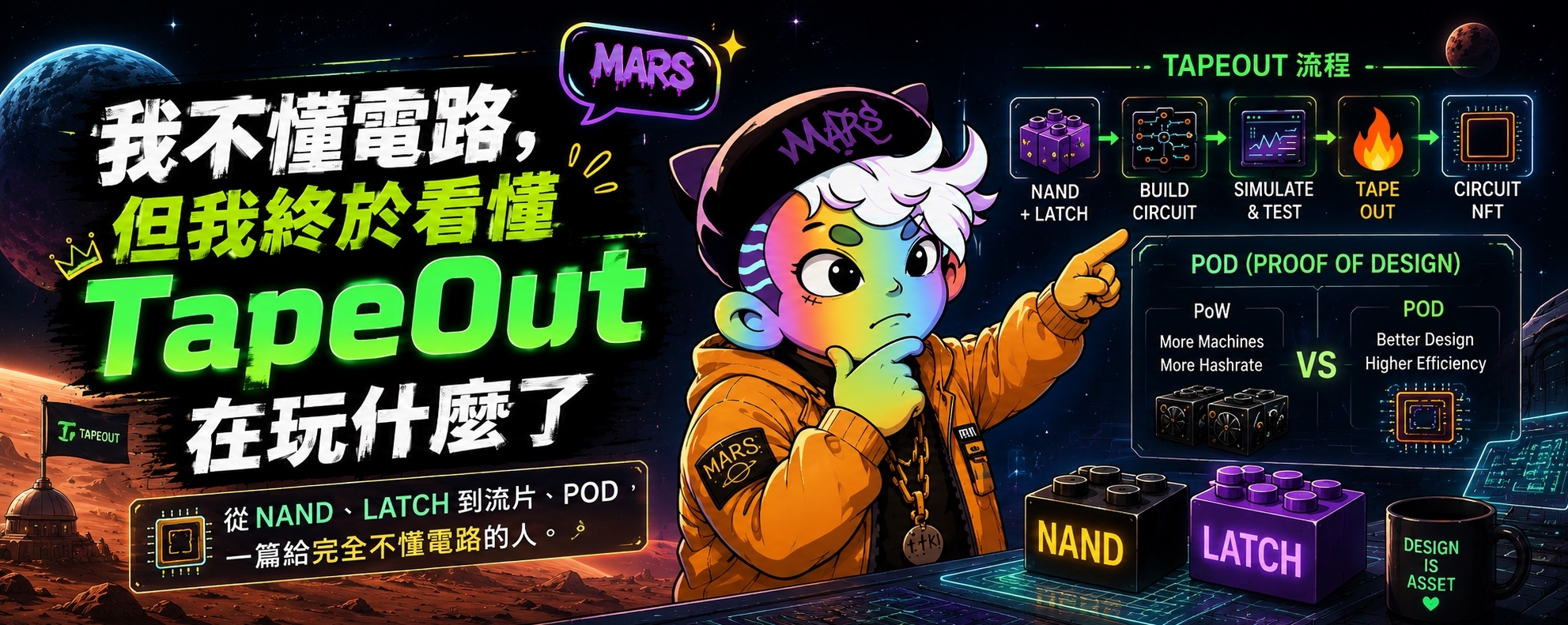
Article
《I Don’t Understand Circuits, But I Finally Understand What TapeOut Is Doing》From NAND, LATCH to wafer fabrication and POD—one article that explains it all to someone who knows nothing about circuits.
First of all, I really don’t understand chips.😂
When things like NAND, LATCH, and logic gates were put in front of me a few days ago, I could barely look at them for three seconds before I just gave up and slid away.
After TapeOut became popular, I also kept putting off writing about it.
The reason is simple:
I haven’t even figured it out myself yet—so how could I write it for other people to see?
Over the past couple of days I’ve read a lot of people’s analysis and real playstyles, and I also talked with Blonskr about some ideas for what comes next. Only then did I slowly piece the whole thing together.
And then I realized:
TapeOut is actually not as hard to understand as you might think.
《I Don’t Understand Circuits, But I Finally Understand What TapeOut Is Doing》
From NAND, LATCH to wafer fabrication and POD—one article that explains it all to someone who knows nothing about circuits.
First of all, I really don’t understand chips.😂
When things like NAND, LATCH, and logic gates were put in front of me a few days ago, I could barely look at them for three seconds before I just gave up and slid away.
After TapeOut became popular, I also kept putting off writing about it.
The reason is simple:
I haven’t even figured it out myself yet—so how could I write it for other people to see?
Over the past couple of days I’ve read a lot of people’s analysis and real playstyles, and I also talked with Blonskr about some ideas for what comes next. Only then did I slowly piece the whole thing together.
And then I realized:
TapeOut is actually not as hard to understand as you might think.
First of all, I really don’t understand chips.😂
When things like NAND, LATCH, and logic gates were put in front of me a few days ago, I could barely look at them for three seconds before I just gave up and slid away.
After TapeOut became popular, I also kept putting off writing about it.
The reason is simple:
I haven’t even figured it out myself yet—so how could I write it for other people to see?
Over the past couple of days I’ve read a lot of people’s analysis and real playstyles, and I also talked with Blonskr about some ideas for what comes next. Only then did I slowly piece the whole thing together.
And then I realized:
TapeOut is actually not as hard to understand as you might think.
95
·
--
CZ, this wallet address, is finally ready to officially retire 🤣
Honestly, I really support him doing this.
Memes shouldn’t turn into “CZ wallet address analysis.”
Bought → analysis
Burned → analysis
Transferred → still analysis
Why not let the Meme be the Meme again.
The community chooses, retail users play, and the culture builds itself.
Whether it can survive—ultimately leave it to the market.
Meme Season, not CZ Wallet Season.
But this time it also highlights a pretty interesting Wallet UX issue:
On-chain, you can’t control what Token other people try to send you,
but how the Wallet presents it should be up to you.
Many wallets can already hide low-value Tokens—I’d actually rather see a Token Inbox:
Unknown Token → go to Inbox first
User confirms → only then enter the main assets list
Others can be permissionless and send me coins,
but they can’t permissionlessly clutter my Wallet UI.
Compared to constantly ignoring / burning, this might be more useful.
@CZ
CZ, this wallet address, is finally ready to officially retire 🤣
Honestly, I really support him doing this.
Memes shouldn’t turn into “CZ wallet address analysis.”
Bought → analysis
Burned → analysis
Transferred → still analysis
Why not let the Meme be the Meme again.
The community chooses, retail users play, and the culture builds itself.
Whether it can survive—ultimately leave it to the market.
Meme Season, not CZ Wallet Season.
But this time it also highlights a pretty interesting Wallet UX issue:
On-chain, you can’t control what Token other people try to send you,
but how the Wallet presents it should be up to you.
Many wallets can already hide low-value Tokens—I’d actually rather see a Token Inbox:
Unknown Token → go to Inbox first
User confirms → only then enter the main assets list
Others can be permissionless and send me coins,
but they can’t permissionlessly clutter my Wallet UI.
Compared to constantly ignoring / burning, this might be more useful.
@CZ
Honestly, I really support him doing this.
Memes shouldn’t turn into “CZ wallet address analysis.”
Bought → analysis
Burned → analysis
Transferred → still analysis
Why not let the Meme be the Meme again.
The community chooses, retail users play, and the culture builds itself.
Whether it can survive—ultimately leave it to the market.
Meme Season, not CZ Wallet Season.
But this time it also highlights a pretty interesting Wallet UX issue:
On-chain, you can’t control what Token other people try to send you,
but how the Wallet presents it should be up to you.
Many wallets can already hide low-value Tokens—I’d actually rather see a Token Inbox:
Unknown Token → go to Inbox first
User confirms → only then enter the main assets list
Others can be permissionless and send me coins,
but they can’t permissionlessly clutter my Wallet UI.
Compared to constantly ignoring / burning, this might be more useful.
@CZ
25
·
--
Actually, I pretty much support CZ doing this.
If a Meme is researched every day:
Did CZ buy it?
Did CZ burn it?
What does CZ’s transfer mean?
In the end, what’s being played isn’t a Meme anymore—it’s “CZ wallet address analysis.”
It’s better to hand the Meme back to the community to play with themselves.
Build the culture well, get the community going—retail traders can choose for themselves, play for themselves, and hype themselves up.
Whether it can survive or not should be decided by the market.
A Meme whose fate can be determined by a single transfer from CZ was always unlikely to go far.
Actually, I pretty much support CZ doing this.
If a Meme is researched every day:
Did CZ buy it?
Did CZ burn it?
What does CZ’s transfer mean?
In the end, what’s being played isn’t a Meme anymore—it’s “CZ wallet address analysis.”
It’s better to hand the Meme back to the community to play with themselves.
Build the culture well, get the community going—retail traders can choose for themselves, play for themselves, and hype themselves up.
Whether it can survive or not should be decided by the market.
A Meme whose fate can be determined by a single transfer from CZ was always unlikely to go far.
If a Meme is researched every day:
Did CZ buy it?
Did CZ burn it?
What does CZ’s transfer mean?
In the end, what’s being played isn’t a Meme anymore—it’s “CZ wallet address analysis.”
It’s better to hand the Meme back to the community to play with themselves.
Build the culture well, get the community going—retail traders can choose for themselves, play for themselves, and hype themselves up.
Whether it can survive or not should be decided by the market.
A Meme whose fate can be determined by a single transfer from CZ was always unlikely to go far.


CZ
·
--
(Chinese version below)
Too many people try to over-interpret “what does it mean?”
I was testing Trust Wallet today. And saw too many meme coins in the wallet clustering the interface, to the point it was hard for me to find BNB, so I tried to burn some tokens. Even that caused many community discussions.
Then I realized that I will never be able to “clean out” meme coins on the address. The more I burn them, the more people will send meme coins to the address.
The natural transparency of the blockchain means any interaction with this address will be over-interpreted by the community.
I even thought of requesting the Trust Wallet team to implement an “Ignore Coin” feature to avoid the clutter, but that feature will not be needed by 99.99% of people.
Here is the plan: I will donate/send the BNB and 币安人生 (that was bought using BNB) tokens to Giggle Academy. Then I will stop using this address. It will effectively be a burn address.
Too many people try to over-interpret “what does it mean?"
I was testing @TrustWallet today. I found that there were too many meme coins in the wallet—so many that it was even hard for me to find BNB—so I tried to burn some tokens. Even this action triggered a lot of community discussions.
I realized that I will never be able to “clean out” the meme coins on this address. The more I burn, the more people will send meme coins to the address.
The transparency of the blockchain means that any actions involving this address will be over-interpreted by the community.
I even considered asking the Trust Wallet team to add a feature called “Ignore Coin” to avoid the clutter in the interface, but this feature is something that 99.99% of people won’t need at all.
So the plan is as follows: I will donate/send the BNB and the “币安人生” tokens (bought with BNB) to Giggle Academy. After that, I will stop using this address, turning it into a burn address.
Too many people try to over-interpret “what does it mean?”
I was testing Trust Wallet today. And saw too many meme coins in the wallet clustering the interface, to the point it was hard for me to find BNB, so I tried to burn some tokens. Even that caused many community discussions.
Then I realized that I will never be able to “clean out” meme coins on the address. The more I burn them, the more people will send meme coins to the address.
The natural transparency of the blockchain means any interaction with this address will be over-interpreted by the community.
I even thought of requesting the Trust Wallet team to implement an “Ignore Coin” feature to avoid the clutter, but that feature will not be needed by 99.99% of people.
Here is the plan: I will donate/send the BNB and 币安人生 (that was bought using BNB) tokens to Giggle Academy. Then I will stop using this address. It will effectively be a burn address.
Too many people try to over-interpret “what does it mean?"
I was testing @TrustWallet today. I found that there were too many meme coins in the wallet—so many that it was even hard for me to find BNB—so I tried to burn some tokens. Even this action triggered a lot of community discussions.
I realized that I will never be able to “clean out” the meme coins on this address. The more I burn, the more people will send meme coins to the address.
The transparency of the blockchain means that any actions involving this address will be over-interpreted by the community.
I even considered asking the Trust Wallet team to add a feature called “Ignore Coin” to avoid the clutter in the interface, but this feature is something that 99.99% of people won’t need at all.
So the plan is as follows: I will donate/send the BNB and the “币安人生” tokens (bought with BNB) to Giggle Academy. After that, I will stop using this address, turning it into a burn address.
47
·
--
Next week’s market feels like it’s about to start choosing a direction again 👀
Last week, Risk-on clearly returned. The US stock market kept strengthening, with AI, tech, and semiconductors taking the baton again.
But next week, I’m mainly watching three things:
1️⃣ Strait of Hormuz
Negotiations on shipping between Iran and Oman have already made some progress, but “agreeing on a route” ≠ “fully restoring navigation.”
What really matters is whether ships start coming back.
Better shipping → lower oil geo-premium → easing inflation pressure → Risk-on
And if talks fall apart again:
Oil / XAU could be in play once more, and BTC and US stocks may keep benefiting from geopolitical developments.
2️⃣ FOMC Minutes
Last time, there were already 3 votes in support of a rate hike.
This time, what’s most worth watching in the minutes isn’t simply “whether there will be a hike,” but:
How many people are still hawkish?
Recently, inflation data has cooled somewhat, and market expectations for a rate hike in September have also dropped.
3️⃣ PMI
On Friday, I’ll be watching the US manufacturing and services PMI.
If the data is weak → expectations that the Fed will stay put in September become more stable.
If the data is too strong → rate-hike trade could return.
So next week, my script is pretty simple:
Oil: watch the Strait of Hormuz
Gold: watch the Fed
US stocks: watch AI + interest rates
BTC: watch all three 😂
Lately, Risk-on has returned,
but this week might be the real key to whether the trend can keep running.
Next week’s market feels like it’s about to start choosing a direction again 👀
Last week, Risk-on clearly returned. The US stock market kept strengthening, with AI, tech, and semiconductors taking the baton again.
But next week, I’m mainly watching three things:
1️⃣ Strait of Hormuz
Negotiations on shipping between Iran and Oman have already made some progress, but “agreeing on a route” ≠ “fully restoring navigation.”
What really matters is whether ships start coming back.
Better shipping → lower oil geo-premium → easing inflation pressure → Risk-on
And if talks fall apart again:
Oil / XAU could be in play once more, and BTC and US stocks may keep benefiting from geopolitical developments.
2️⃣ FOMC Minutes
Last time, there were already 3 votes in support of a rate hike.
This time, what’s most worth watching in the minutes isn’t simply “whether there will be a hike,” but:
How many people are still hawkish?
Recently, inflation data has cooled somewhat, and market expectations for a rate hike in September have also dropped.
3️⃣ PMI
On Friday, I’ll be watching the US manufacturing and services PMI.
If the data is weak → expectations that the Fed will stay put in September become more stable.
If the data is too strong → rate-hike trade could return.
So next week, my script is pretty simple:
Oil: watch the Strait of Hormuz
Gold: watch the Fed
US stocks: watch AI + interest rates
BTC: watch all three 😂
Lately, Risk-on has returned,
but this week might be the real key to whether the trend can keep running.
Last week, Risk-on clearly returned. The US stock market kept strengthening, with AI, tech, and semiconductors taking the baton again.
But next week, I’m mainly watching three things:
1️⃣ Strait of Hormuz
Negotiations on shipping between Iran and Oman have already made some progress, but “agreeing on a route” ≠ “fully restoring navigation.”
What really matters is whether ships start coming back.
Better shipping → lower oil geo-premium → easing inflation pressure → Risk-on
And if talks fall apart again:
Oil / XAU could be in play once more, and BTC and US stocks may keep benefiting from geopolitical developments.
2️⃣ FOMC Minutes
Last time, there were already 3 votes in support of a rate hike.
This time, what’s most worth watching in the minutes isn’t simply “whether there will be a hike,” but:
How many people are still hawkish?
Recently, inflation data has cooled somewhat, and market expectations for a rate hike in September have also dropped.
3️⃣ PMI
On Friday, I’ll be watching the US manufacturing and services PMI.
If the data is weak → expectations that the Fed will stay put in September become more stable.
If the data is too strong → rate-hike trade could return.
So next week, my script is pretty simple:
Oil: watch the Strait of Hormuz
Gold: watch the Fed
US stocks: watch AI + interest rates
BTC: watch all three 😂
Lately, Risk-on has returned,
but this week might be the real key to whether the trend can keep running.

148
·
--
《Gou Lai》
An animated film made by a mother-and-son small team over about 5 years.
No big budget, no massive marketing campaign—yet it unexpectedly went viral thanks to its unique art style.
From almost nobody watching, to the box office surpassing 2 million.
Even the Meme universe has started rotating ~
Long Yi: “Gou Lai” takes off first 🐂🚀
Then “Biao La” really starts to blow up 🐆📈
Now even “Banjiao Ti” is out too…
Gou Lai: I’m going first.
Biao La: Wait for me—I’m about to blow up right now.
Banjiao Ti: Wait… I got tripped.💀
And Banjiao Ti’s current market cap is still the lowest.
I don’t quite understand the movie,
but I think I’m starting to get the Meme plot.
#meme板块关注热点
《Gou Lai》
An animated film made by a mother-and-son small team over about 5 years.
No big budget, no massive marketing campaign—yet it unexpectedly went viral thanks to its unique art style.
From almost nobody watching, to the box office surpassing 2 million.
Even the Meme universe has started rotating ~
Long Yi: “Gou Lai” takes off first 🐂🚀
Then “Biao La” really starts to blow up 🐆📈
Now even “Banjiao Ti” is out too…
Gou Lai: I’m going first.
Biao La: Wait for me—I’m about to blow up right now.
Banjiao Ti: Wait… I got tripped.💀
And Banjiao Ti’s current market cap is still the lowest.
I don’t quite understand the movie,
but I think I’m starting to get the Meme plot.
#meme板块关注热点
An animated film made by a mother-and-son small team over about 5 years.
No big budget, no massive marketing campaign—yet it unexpectedly went viral thanks to its unique art style.
From almost nobody watching, to the box office surpassing 2 million.
Even the Meme universe has started rotating ~
Long Yi: “Gou Lai” takes off first 🐂🚀
Then “Biao La” really starts to blow up 🐆📈
Now even “Banjiao Ti” is out too…
Gou Lai: I’m going first.
Biao La: Wait for me—I’m about to blow up right now.
Banjiao Ti: Wait… I got tripped.💀
And Banjiao Ti’s current market cap is still the lowest.
I don’t quite understand the movie,
but I think I’m starting to get the Meme plot.
#meme板块关注热点


1
491
Log in to explore more content
Join global crypto users on Binance Square
⚡️ Get latest and useful information about crypto.
💬 Trusted by the world’s largest crypto exchange.
👍 Discover real insights from verified creators.
Email / Phone number
Trending Topics
AppleDebutsFoldablePhone
31,870 views
684 Discussing
Apple just dropped the foldable iPhone — and the market is paying attention. This isn't just another product cycle; it's a new product category, a new CEO on stage, and a $1,999 price tag that pushes $AAPL further into ultra-premium territory. Foldables are the narrative, and Apple is now the headline.
#appledebutsfoldablephone #EUExtendsCentralContactPointToCASPs #US10YTreasuryYieldHitsHighestSinceNov2023 #BrentCrudeTops$100 #USTreasuryToBuyBackUpTo$6BLongDatedDebt
KimHotbae
·2 Likes
·2.8k views
TSMCAugustRevenueUp53.3%YoY
3,805 views
161 Discussing
IranSaysReadyToEscalateWarWithUS
6,525 views
190 Discussing