

橘子 _
251 Posts

橘子 _
Report
Block User
推特:@0xaurskyo | Web3 探索 碎碎念BP-6013FF1895D4
126 Following
4.8K+ Followers
487 Liked
Posts
All
Quotes
Live
·
--
Recently I’ve been looking at on-chain AI, and I’m growing increasingly skeptical of that simplistic idea that “smart money is buying.”
Just because an address bought something doesn’t necessarily mean it’s bullish.
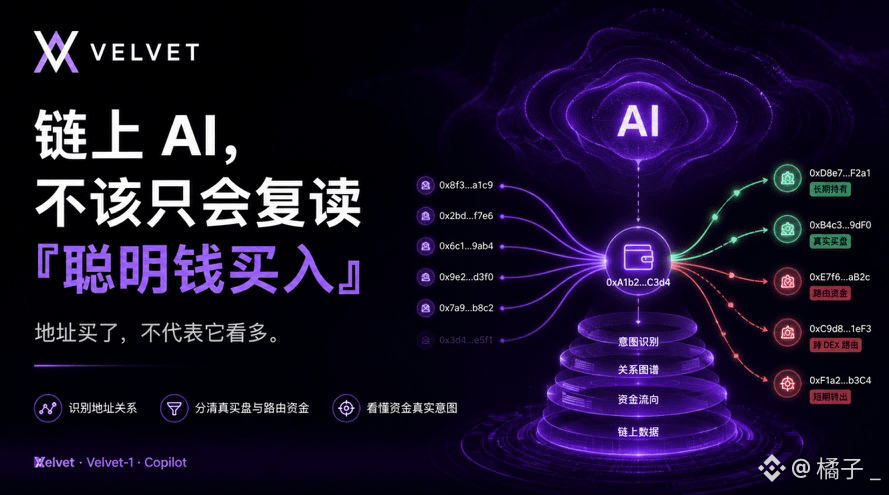
It could be a market maker replenishing inventory. It could be an intermediate address used for cross-chain settlement. Or it could simply be the same entity moving assets between different wallets. On-chain records don’t lie—but explaining every inflow as a viewpoint is still a long way from understanding real transactions.
This is also the hardest layer for Crypto-specific models: they can’t just read transactions. They have to identify relationships between addresses, understand why funds moved, and know that the meaning of the same action can be completely different across different times and different liquidity environments.
I follow Velvet @Velvet_Capital and the training of Velvet-1. I’m not trying to get it to guess the next coin with the biggest price increase. I’d rather know whether, inside Copilot, it can separate these easy-to-confuse behaviors: which are genuine buy orders, which are merely routing, and which funds come in without taking any price risk.
Once you can judge at this layer, AI starts to get close to being a research tool.
Otherwise, so-called on-chain insights are very likely just restating what the block explorer already shows.
Recently I’ve been looking at on-chain AI, and I’m growing increasingly skeptical of that simplistic idea that “smart money is buying.”
Just because an address bought something doesn’t necessarily mean it’s bullish.
It could be a market maker replenishing inventory. It could be an intermediate address used for cross-chain settlement. Or it could simply be the same entity moving assets between different wallets. On-chain records don’t lie—but explaining every inflow as a viewpoint is still a long way from understanding real transactions.
This is also the hardest layer for Crypto-specific models: they can’t just read transactions. They have to identify relationships between addresses, understand why funds moved, and know that the meaning of the same action can be completely different across different times and different liquidity environments.
I follow Velvet @Velvet_Capital and the training of Velvet-1. I’m not trying to get it to guess the next coin with the biggest price increase. I’d rather know whether, inside Copilot, it can separate these easy-to-confuse behaviors: which are genuine buy orders, which are merely routing, and which funds come in without taking any price risk.
Once you can judge at this layer, AI starts to get close to being a research tool.
Otherwise, so-called on-chain insights are very likely just restating what the block explorer already shows.
Just because an address bought something doesn’t necessarily mean it’s bullish.
It could be a market maker replenishing inventory. It could be an intermediate address used for cross-chain settlement. Or it could simply be the same entity moving assets between different wallets. On-chain records don’t lie—but explaining every inflow as a viewpoint is still a long way from understanding real transactions.
This is also the hardest layer for Crypto-specific models: they can’t just read transactions. They have to identify relationships between addresses, understand why funds moved, and know that the meaning of the same action can be completely different across different times and different liquidity environments.
I follow Velvet @Velvet_Capital and the training of Velvet-1. I’m not trying to get it to guess the next coin with the biggest price increase. I’d rather know whether, inside Copilot, it can separate these easy-to-confuse behaviors: which are genuine buy orders, which are merely routing, and which funds come in without taking any price risk.
Once you can judge at this layer, AI starts to get close to being a research tool.
Otherwise, so-called on-chain insights are very likely just restating what the block explorer already shows.
116
·
--
Article
Palantir Q2 Beats Expectations: What the market is buying isn’t an AI story, but growth deliveredPalantir jumps more than 10%: this time, what’s truly being repriced isn’t the AI story—it’s the pace of execution
Palantir has turned in yet another hard-to-find-fault earnings report.
Revenue in the second quarter of 2026 reached US$1.935 billion, up 93% year over year and clearly above market expectations of about US$1.8 billion; adjusted earnings per share were US$0.41, also exceeding analysts’ expectations. After the earnings report was released, the stock price rose in after-hours trading by as much as about 10%–14%. The figures provided by different media outlets vary slightly, mainly due to differences in the reporting time points. The U.S. Securities and Exchange Commission
Just looking at these numbers, it’s easy to attribute the rise to an “earnings beat.”
Palantir Q2 Beats Expectations: What the market is buying isn’t an AI story, but growth delivered
Palantir jumps more than 10%: this time, what’s truly being repriced isn’t the AI story—it’s the pace of execution
Palantir has turned in yet another hard-to-find-fault earnings report.
Revenue in the second quarter of 2026 reached US$1.935 billion, up 93% year over year and clearly above market expectations of about US$1.8 billion; adjusted earnings per share were US$0.41, also exceeding analysts’ expectations. After the earnings report was released, the stock price rose in after-hours trading by as much as about 10%–14%. The figures provided by different media outlets vary slightly, mainly due to differences in the reporting time points. The U.S. Securities and Exchange Commission
Just looking at these numbers, it’s easy to attribute the rise to an “earnings beat.”
Palantir has turned in yet another hard-to-find-fault earnings report.
Revenue in the second quarter of 2026 reached US$1.935 billion, up 93% year over year and clearly above market expectations of about US$1.8 billion; adjusted earnings per share were US$0.41, also exceeding analysts’ expectations. After the earnings report was released, the stock price rose in after-hours trading by as much as about 10%–14%. The figures provided by different media outlets vary slightly, mainly due to differences in the reporting time points. The U.S. Securities and Exchange Commission
Just looking at these numbers, it’s easy to attribute the rise to an “earnings beat.”
2
1
126
·
--
One of the most overestimated things about trading AI is that it can lay out a very smooth-sounding logic.
But on-chain, many good trades aren’t good because the story is seamless.
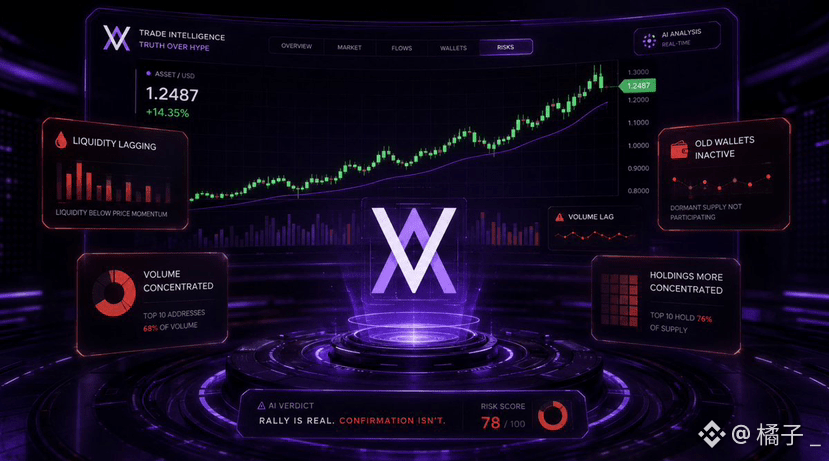
When an asset goes up, and AI only tells you things like “increased capital attention” or “market sentiment is heating up,” that’s not very useful. I’d rather see: what *didn’t* happen.
It rose, but liquidity didn’t keep up.
People were calling for it, but the old wallets didn’t keep buying.
Trading volume increased, but most of it came from just a few large orders.
Price made a new high, but on-chain holdings are actually even more concentrated.
These “things that feel off” are often more valuable than pretty conclusions.
So my expectations for tools like Velvet @Velvet_Capital AI Copilot aren’t for it to summarize the market for me.
I’d rather have it act like a trading assistant that throws cold water—before I place an order—bringing up the gaps I didn’t notice.
The most expensive mistake in crypto isn’t missing opportunities.
It’s after you spot an opportunity, automatically ignoring all the evidence that doesn’t support your own judgment.
One of the most overestimated things about trading AI is that it can lay out a very smooth-sounding logic.
But on-chain, many good trades aren’t good because the story is seamless.
When an asset goes up, and AI only tells you things like “increased capital attention” or “market sentiment is heating up,” that’s not very useful. I’d rather see: what *didn’t* happen.
It rose, but liquidity didn’t keep up.
People were calling for it, but the old wallets didn’t keep buying.
Trading volume increased, but most of it came from just a few large orders.
Price made a new high, but on-chain holdings are actually even more concentrated.
These “things that feel off” are often more valuable than pretty conclusions.
So my expectations for tools like Velvet @Velvet_Capital AI Copilot aren’t for it to summarize the market for me.
I’d rather have it act like a trading assistant that throws cold water—before I place an order—bringing up the gaps I didn’t notice.
The most expensive mistake in crypto isn’t missing opportunities.
It’s after you spot an opportunity, automatically ignoring all the evidence that doesn’t support your own judgment.
But on-chain, many good trades aren’t good because the story is seamless.
When an asset goes up, and AI only tells you things like “increased capital attention” or “market sentiment is heating up,” that’s not very useful. I’d rather see: what *didn’t* happen.
It rose, but liquidity didn’t keep up.
People were calling for it, but the old wallets didn’t keep buying.
Trading volume increased, but most of it came from just a few large orders.
Price made a new high, but on-chain holdings are actually even more concentrated.
These “things that feel off” are often more valuable than pretty conclusions.
So my expectations for tools like Velvet @Velvet_Capital AI Copilot aren’t for it to summarize the market for me.
I’d rather have it act like a trading assistant that throws cold water—before I place an order—bringing up the gaps I didn’t notice.
The most expensive mistake in crypto isn’t missing opportunities.
It’s after you spot an opportunity, automatically ignoring all the evidence that doesn’t support your own judgment.
87
·
--
The most annoying thing in on-chain trading isn’t failing to find a token.
It’s that once you’ve found one, you still have to keep watching it.
Many opportunities aren’t suitable to buy immediately at the start, so you can only put them into your watchlist first:
Will the wallet activity keep coming in?
Will liquidity get thicker?
Is there any KOL discussion spreading?
Is the price still sitting at a spot nobody has noticed yet?
The problem is, no one can keep staring at it forever.
You go to sleep, open a meeting, go out for dinner—then come back to find the conditions have changed, but the most critical window has already passed.
So when I look at Velvet @Velvet_Capital working on an AI Copilot and its own on-chain model, I don’t really want to interpret it as:
“AI helps you catch 100x coins.” That sounds like nonsense.
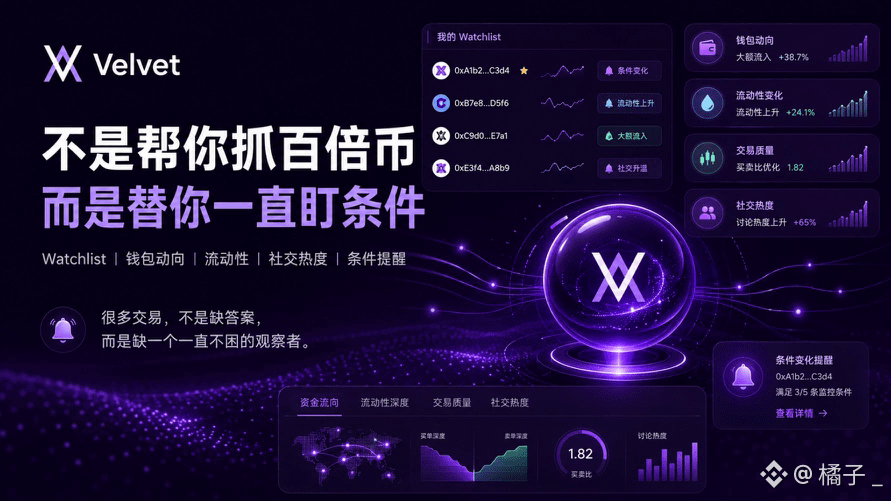
What I want instead is something that can help me monitor conditions.
For example, if I’m watching a new token on Arbitrum or Base, I don’t want the AI to tell me whether I should buy it.
I want it to remind me when conditions change:
Liquidity suddenly spikes;
A few old wallets start buying in;
Trading activity is no longer just low-volume wash trading;
Social attention has already clearly moved to lag behind the price.
Something like this is simple, but it’s genuinely useful.
What traders spend most of their energy on every day isn’t making a single decision—it’s maintaining dozens of half-formed judgments.
Which ones are still worth watching, and which ones have already stopped working;
Which signals are just noise, and which ones need to be re-evaluated.
Human brains easily mix these together, and in the end you trade based on instinct.
If Velvet’s AI can help on this layer, I think it’s more practical than “giving me an answer.”
Many trades aren’t missing answers—they’re missing an observer who stays clear-headed, doesn’t get emotional, and doesn’t get fed up.
Sometimes, a great tool isn’t meant to make you more aggressive—it’s meant to help you not miss the things you were already seeing, but would otherwise overlook.
The most annoying thing in on-chain trading isn’t failing to find a token.
It’s that once you’ve found one, you still have to keep watching it.
Many opportunities aren’t suitable to buy immediately at the start, so you can only put them into your watchlist first:
Will the wallet activity keep coming in?
Will liquidity get thicker?
Is there any KOL discussion spreading?
Is the price still sitting at a spot nobody has noticed yet?
The problem is, no one can keep staring at it forever.
You go to sleep, open a meeting, go out for dinner—then come back to find the conditions have changed, but the most critical window has already passed.
So when I look at Velvet @Velvet_Capital working on an AI Copilot and its own on-chain model, I don’t really want to interpret it as:
“AI helps you catch 100x coins.” That sounds like nonsense.
What I want instead is something that can help me monitor conditions.
For example, if I’m watching a new token on Arbitrum or Base, I don’t want the AI to tell me whether I should buy it.
I want it to remind me when conditions change:
Liquidity suddenly spikes;
A few old wallets start buying in;
Trading activity is no longer just low-volume wash trading;
Social attention has already clearly moved to lag behind the price.
Something like this is simple, but it’s genuinely useful.
What traders spend most of their energy on every day isn’t making a single decision—it’s maintaining dozens of half-formed judgments.
Which ones are still worth watching, and which ones have already stopped working;
Which signals are just noise, and which ones need to be re-evaluated.
Human brains easily mix these together, and in the end you trade based on instinct.
If Velvet’s AI can help on this layer, I think it’s more practical than “giving me an answer.”
Many trades aren’t missing answers—they’re missing an observer who stays clear-headed, doesn’t get emotional, and doesn’t get fed up.
Sometimes, a great tool isn’t meant to make you more aggressive—it’s meant to help you not miss the things you were already seeing, but would otherwise overlook.
It’s that once you’ve found one, you still have to keep watching it.
Many opportunities aren’t suitable to buy immediately at the start, so you can only put them into your watchlist first:
Will the wallet activity keep coming in?
Will liquidity get thicker?
Is there any KOL discussion spreading?
Is the price still sitting at a spot nobody has noticed yet?
The problem is, no one can keep staring at it forever.
You go to sleep, open a meeting, go out for dinner—then come back to find the conditions have changed, but the most critical window has already passed.
So when I look at Velvet @Velvet_Capital working on an AI Copilot and its own on-chain model, I don’t really want to interpret it as:
“AI helps you catch 100x coins.” That sounds like nonsense.
What I want instead is something that can help me monitor conditions.
For example, if I’m watching a new token on Arbitrum or Base, I don’t want the AI to tell me whether I should buy it.
I want it to remind me when conditions change:
Liquidity suddenly spikes;
A few old wallets start buying in;
Trading activity is no longer just low-volume wash trading;
Social attention has already clearly moved to lag behind the price.
Something like this is simple, but it’s genuinely useful.
What traders spend most of their energy on every day isn’t making a single decision—it’s maintaining dozens of half-formed judgments.
Which ones are still worth watching, and which ones have already stopped working;
Which signals are just noise, and which ones need to be re-evaluated.
Human brains easily mix these together, and in the end you trade based on instinct.
If Velvet’s AI can help on this layer, I think it’s more practical than “giving me an answer.”
Many trades aren’t missing answers—they’re missing an observer who stays clear-headed, doesn’t get emotional, and doesn’t get fed up.
Sometimes, a great tool isn’t meant to make you more aggressive—it’s meant to help you not miss the things you were already seeing, but would otherwise overlook.
205
·
--
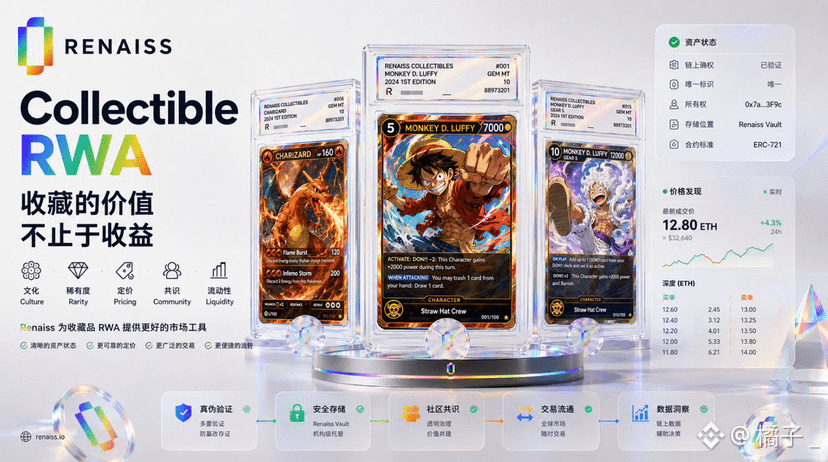
When many people hear “RWA,” the first thing that comes to mind is usually yield, U.S. Treasuries, real estate, and credit.
But collectible-based RWA can’t be viewed that way. The earliest source of value for collectibles wasn’t cash flow—it was culture, aesthetics, scarcity, and community consensus.
Why would someone want to buy a card?
Not because it’s like a bond, and not because you can calculate a stable return curve.
It’s because someone genuinely wants to own it, show it off, trade it—and even treat it as part of their identity and interests.
That’s also what I find interesting about Renaiss @renaissxyz.
It doesn’t plug into traditional financial assets—it moves into a market that already has real users, real emotions, and established offline trading habits.
Pokemon, One Piece—TCGs like these are easy for regular users to understand, and collectors also have their own set of judgment criteria.
The problem wasn’t that nobody liked these things. The issue was that their value has historically been difficult to distribute, price, and manage more efficiently.
So when I look at Renaiss, I don’t really like summarizing it with the three words “financialization.”
It’s more like: on top of the collectibles’ existing market, add another layer of tools:
Can the asset’s status be made clearer?
Can the price reference be more trustworthy?
Can the trading radius be expanded?
Can users rely less on gut feeling and more on information to make judgments?
If you get this wrong, of course it turns collectibles into packaged short-term chips.
But if you get it right, it can actually make collectors much clearer about what they’re buying and holding—and what price the market is ultimately willing to give them.
That’s also the difference between Renaiss and many purely narrative RWA projects.
It’s facing a group of collectors that already exists, rather than first creating an asset and then spending time educating the market to believe it has value.
That said, the yardsticks are also very practical: are users really more likely to discover good assets? Is pricing more transparent? Is trading smoother? And in the end, are collectors willing to stay for the long term?
When many people hear “RWA,” the first thing that comes to mind is usually yield, U.S. Treasuries, real estate, and credit.
But collectible-based RWA can’t be viewed that way. The earliest source of value for collectibles wasn’t cash flow—it was culture, aesthetics, scarcity, and community consensus.
Why would someone want to buy a card?
Not because it’s like a bond, and not because you can calculate a stable return curve.
It’s because someone genuinely wants to own it, show it off, trade it—and even treat it as part of their identity and interests.
That’s also what I find interesting about Renaiss @renaissxyz.
It doesn’t plug into traditional financial assets—it moves into a market that already has real users, real emotions, and established offline trading habits.
Pokemon, One Piece—TCGs like these are easy for regular users to understand, and collectors also have their own set of judgment criteria.
The problem wasn’t that nobody liked these things. The issue was that their value has historically been difficult to distribute, price, and manage more efficiently.
So when I look at Renaiss, I don’t really like summarizing it with the three words “financialization.”
It’s more like: on top of the collectibles’ existing market, add another layer of tools:
Can the asset’s status be made clearer?
Can the price reference be more trustworthy?
Can the trading radius be expanded?
Can users rely less on gut feeling and more on information to make judgments?
If you get this wrong, of course it turns collectibles into packaged short-term chips.
But if you get it right, it can actually make collectors much clearer about what they’re buying and holding—and what price the market is ultimately willing to give them.
That’s also the difference between Renaiss and many purely narrative RWA projects.
It’s facing a group of collectors that already exists, rather than first creating an asset and then spending time educating the market to believe it has value.
That said, the yardsticks are also very practical: are users really more likely to discover good assets? Is pricing more transparent? Is trading smoother? And in the end, are collectors willing to stay for the long term?
But collectible-based RWA can’t be viewed that way. The earliest source of value for collectibles wasn’t cash flow—it was culture, aesthetics, scarcity, and community consensus.
Why would someone want to buy a card?
Not because it’s like a bond, and not because you can calculate a stable return curve.
It’s because someone genuinely wants to own it, show it off, trade it—and even treat it as part of their identity and interests.
That’s also what I find interesting about Renaiss @renaissxyz.
It doesn’t plug into traditional financial assets—it moves into a market that already has real users, real emotions, and established offline trading habits.
Pokemon, One Piece—TCGs like these are easy for regular users to understand, and collectors also have their own set of judgment criteria.
The problem wasn’t that nobody liked these things. The issue was that their value has historically been difficult to distribute, price, and manage more efficiently.
So when I look at Renaiss, I don’t really like summarizing it with the three words “financialization.”
It’s more like: on top of the collectibles’ existing market, add another layer of tools:
Can the asset’s status be made clearer?
Can the price reference be more trustworthy?
Can the trading radius be expanded?
Can users rely less on gut feeling and more on information to make judgments?
If you get this wrong, of course it turns collectibles into packaged short-term chips.
But if you get it right, it can actually make collectors much clearer about what they’re buying and holding—and what price the market is ultimately willing to give them.
That’s also the difference between Renaiss and many purely narrative RWA projects.
It’s facing a group of collectors that already exists, rather than first creating an asset and then spending time educating the market to believe it has value.
That said, the yardsticks are also very practical: are users really more likely to discover good assets? Is pricing more transparent? Is trading smoother? And in the end, are collectors willing to stay for the long term?
296
·
--
Alright, first Robinhood, then Stable, and now Arc
After a roundabout detour, the funds ultimately end up back at BSC memes
Round after round of storytelling
And big brother @CZ said it too—over the next few weeks, he may personally buy or sell one or two, to test out new things
May the best meme win
Believe $BNB is buying—$BNB , let’s build together!
Alright, first Robinhood, then Stable, and now Arc
After a roundabout detour, the funds ultimately end up back at BSC memes
Round after round of storytelling
And big brother @CZ said it too—over the next few weeks, he may personally buy or sell one or two, to test out new things
May the best meme win
Believe $BNB is buying—$BNB , let’s build together!
After a roundabout detour, the funds ultimately end up back at BSC memes
Round after round of storytelling
And big brother @CZ said it too—over the next few weeks, he may personally buy or sell one or two, to test out new things
May the best meme win
Believe $BNB is buying—$BNB , let’s build together!
261
·
--
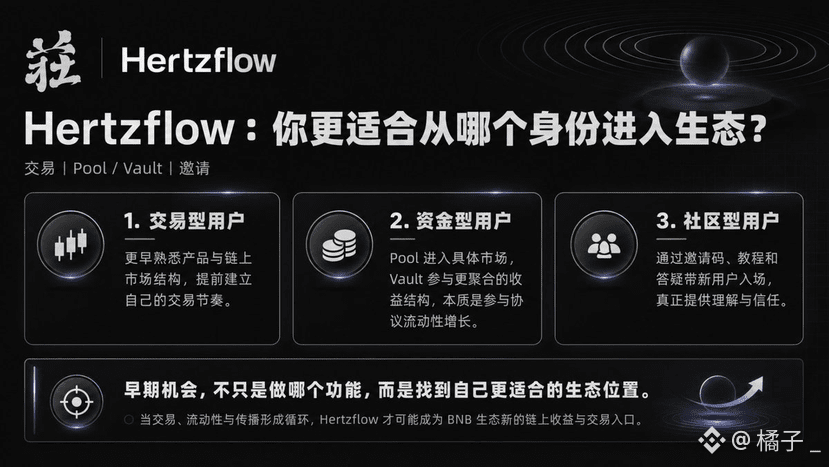
Many people look at Hertzflow and their first reaction is: trading, joining a pool, doing invitations—which one should I choose?
But if you switch perspectives, it might be simpler: what role do you want to enter @Hertzflow_xyz as, and do it earlier?
For trading-oriented users, you can start with the product itself.
What Hertzflow wants to do isn’t just opening long and short positions—it’s to bring more Oracle-supported assets into the on-chain markets.
In the future, on-chain perp trading may not be limited to only BTC, ETH, and a few mainstream coins.
The earlier you get familiar with the product, the easier it is to find your trading rhythm when new markets emerge.
For capital-oriented users, focus on Pools and Vaults.
If Hertzflow is going to build yield-generating assets in the BNB ecosystem, liquidity is definitely core.
A Pool corresponds to a specific market, while a Vault concentrates different yield structures a bit more.
For regular users, it’s not just depositing funds and waiting for returns—it’s providing liquidity to the market while taking on risk.
For community-oriented users, the invitation system may be lighter.
If you don’t have a large amount of capital and high-frequency trading isn’t suitable, you can bring new users in through invite codes, tutorials, and community Q&A.
A truly effective invitation isn’t just dropping a link—it’s helping others understand how to use Hertzflow, where the risks are, and whether it fits them.
So in Hertzflow’s early stage, the opportunity may not be to build every feature all at once.
Finding the role that suits you comes first. Some people trade, some provide liquidity, and some are responsible for explaining the product clearly.
Whether these roles can form a cycle is what will determine whether Hertzflow ultimately becomes a common trading protocol—or a new on-chain trading entry point in the BNB ecosystem.
Verifying my Binance Square account for YZi Labs Amplify via EchoHunt: EH-5VYA2M
Many people look at Hertzflow and their first reaction is: trading, joining a pool, doing invitations—which one should I choose?
But if you switch perspectives, it might be simpler: what role do you want to enter @Hertzflow_xyz as, and do it earlier?
For trading-oriented users, you can start with the product itself.
What Hertzflow wants to do isn’t just opening long and short positions—it’s to bring more Oracle-supported assets into the on-chain markets.
In the future, on-chain perp trading may not be limited to only BTC, ETH, and a few mainstream coins.
The earlier you get familiar with the product, the easier it is to find your trading rhythm when new markets emerge.
For capital-oriented users, focus on Pools and Vaults.
If Hertzflow is going to build yield-generating assets in the BNB ecosystem, liquidity is definitely core.
A Pool corresponds to a specific market, while a Vault concentrates different yield structures a bit more.
For regular users, it’s not just depositing funds and waiting for returns—it’s providing liquidity to the market while taking on risk.
For community-oriented users, the invitation system may be lighter.
If you don’t have a large amount of capital and high-frequency trading isn’t suitable, you can bring new users in through invite codes, tutorials, and community Q&A.
A truly effective invitation isn’t just dropping a link—it’s helping others understand how to use Hertzflow, where the risks are, and whether it fits them.
So in Hertzflow’s early stage, the opportunity may not be to build every feature all at once.
Finding the role that suits you comes first. Some people trade, some provide liquidity, and some are responsible for explaining the product clearly.
Whether these roles can form a cycle is what will determine whether Hertzflow ultimately becomes a common trading protocol—or a new on-chain trading entry point in the BNB ecosystem.
Verifying my Binance Square account for YZi Labs Amplify via EchoHunt: EH-5VYA2M
But if you switch perspectives, it might be simpler: what role do you want to enter @Hertzflow_xyz as, and do it earlier?
For trading-oriented users, you can start with the product itself.
What Hertzflow wants to do isn’t just opening long and short positions—it’s to bring more Oracle-supported assets into the on-chain markets.
In the future, on-chain perp trading may not be limited to only BTC, ETH, and a few mainstream coins.
The earlier you get familiar with the product, the easier it is to find your trading rhythm when new markets emerge.
For capital-oriented users, focus on Pools and Vaults.
If Hertzflow is going to build yield-generating assets in the BNB ecosystem, liquidity is definitely core.
A Pool corresponds to a specific market, while a Vault concentrates different yield structures a bit more.
For regular users, it’s not just depositing funds and waiting for returns—it’s providing liquidity to the market while taking on risk.
For community-oriented users, the invitation system may be lighter.
If you don’t have a large amount of capital and high-frequency trading isn’t suitable, you can bring new users in through invite codes, tutorials, and community Q&A.
A truly effective invitation isn’t just dropping a link—it’s helping others understand how to use Hertzflow, where the risks are, and whether it fits them.
So in Hertzflow’s early stage, the opportunity may not be to build every feature all at once.
Finding the role that suits you comes first. Some people trade, some provide liquidity, and some are responsible for explaining the product clearly.
Whether these roles can form a cycle is what will determine whether Hertzflow ultimately becomes a common trading protocol—or a new on-chain trading entry point in the BNB ecosystem.
Verifying my Binance Square account for YZi Labs Amplify via EchoHunt: EH-5VYA2M
199
·
--
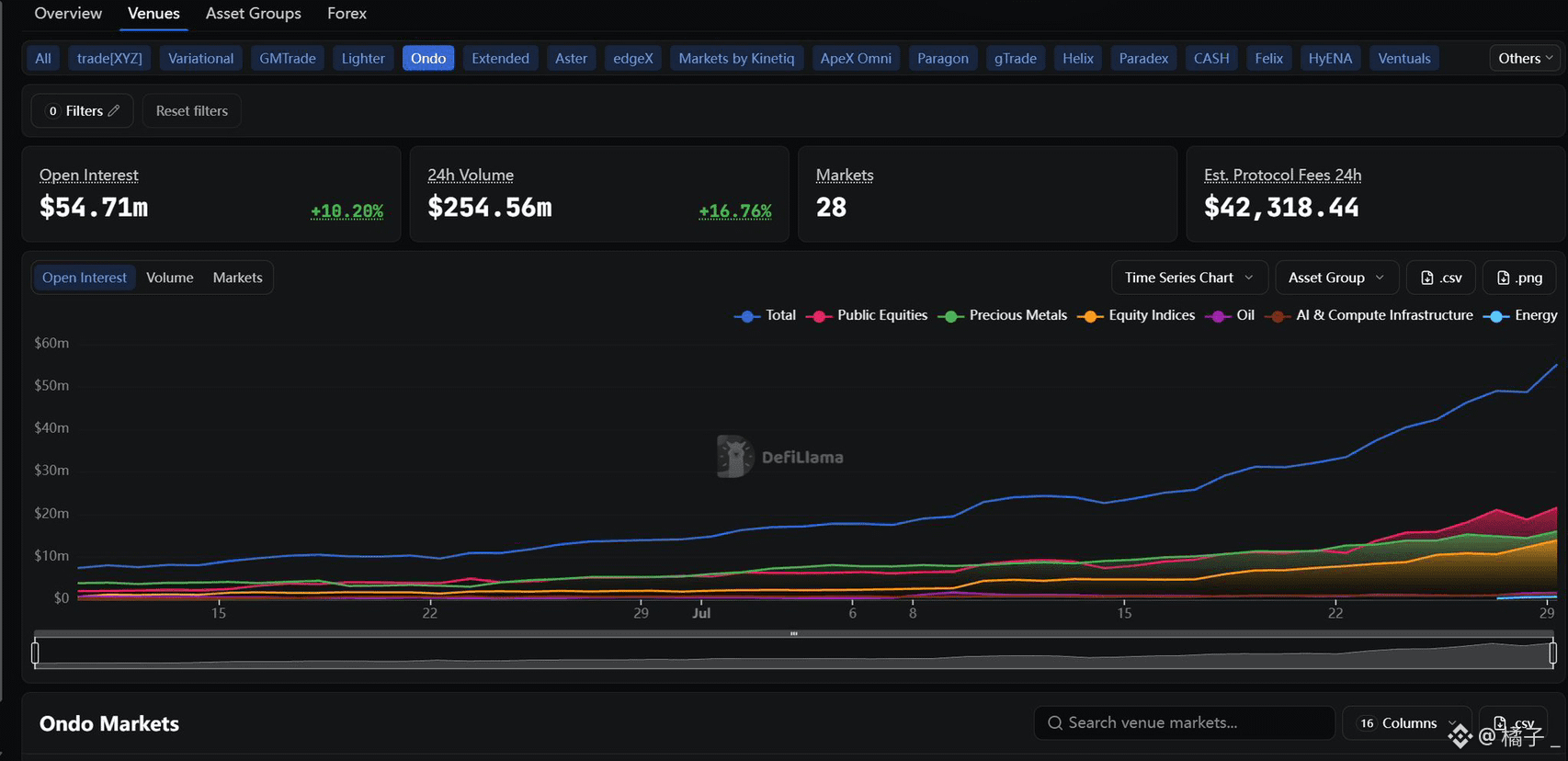
Ondo Chain doesn’t stay stuck in the narrative of “building a chain for RWA,” but instead evolves further into the Ondo Network
The problems it addresses are very straightforward:
On-chain, it can achieve non-custodial operations and public verification, but for long periods the matching speed, transaction privacy, and user experience have lagged behind CEXs.
Ondo Network (@Ondo) chooses to handle execution, verification, and settlement separately—while preserving asset self-custody and on-chain verifiability, it pushes the order-matching experience to CEX-level performance.
The first application running on this architecture is @OndoPerps
Recently, its 24-hour trading volume at one point exceeded Lighter—indicating that the market needs more than just “tokenized stocks,” but also leverage, liquidity, and trading tools built around these assets.
Ondo is moving from an RWA issuance platform toward a complete on-chain financial market infrastructure.🙌
$ONDO
Ondo Chain doesn’t stay stuck in the narrative of “building a chain for RWA,” but instead evolves further into the Ondo Network
The problems it addresses are very straightforward:
On-chain, it can achieve non-custodial operations and public verification, but for long periods the matching speed, transaction privacy, and user experience have lagged behind CEXs.
Ondo Network (@Ondo) chooses to handle execution, verification, and settlement separately—while preserving asset self-custody and on-chain verifiability, it pushes the order-matching experience to CEX-level performance.
The first application running on this architecture is @OndoPerps
Recently, its 24-hour trading volume at one point exceeded Lighter—indicating that the market needs more than just “tokenized stocks,” but also leverage, liquidity, and trading tools built around these assets.
Ondo is moving from an RWA issuance platform toward a complete on-chain financial market infrastructure.🙌
$ONDO
The problems it addresses are very straightforward:
On-chain, it can achieve non-custodial operations and public verification, but for long periods the matching speed, transaction privacy, and user experience have lagged behind CEXs.
Ondo Network (@Ondo) chooses to handle execution, verification, and settlement separately—while preserving asset self-custody and on-chain verifiability, it pushes the order-matching experience to CEX-level performance.
The first application running on this architecture is @OndoPerps
Recently, its 24-hour trading volume at one point exceeded Lighter—indicating that the market needs more than just “tokenized stocks,” but also leverage, liquidity, and trading tools built around these assets.
Ondo is moving from an RWA issuance platform toward a complete on-chain financial market infrastructure.🙌
$ONDO
229
·
--
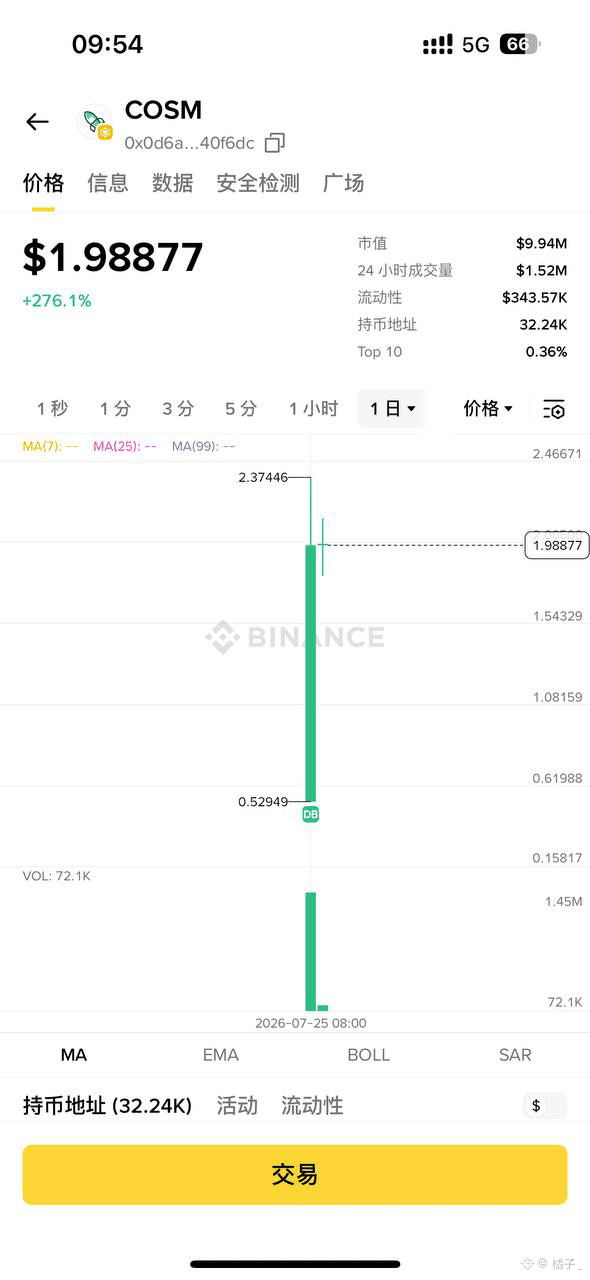
📊 The premise of the compound interest effect is finding a vehicle for continuous positive accumulation.
COSM has several key conditions for compound growth:
🔹 Returns are continuously reinvested—what you earn today will be added on top tomorrow
🔹 Benefits keep getting updated—each time you participate, you accumulate new entitlements
🔹 The ecosystem keeps expanding—the more users there are, the richer the resources, and the thicker the value
🔹 Ongoing institutional support—this isn’t a one-time investment, but long-term co-building
Improve a little every day, and over the course of a year the gap becomes exponentially large.
COSM is creating a compound-interest environment for long-term participants.
The earlier you enter, the longer the compound-interest cycle.
#COSM
📊 The premise of the compound interest effect is finding a vehicle for continuous positive accumulation.
COSM has several key conditions for compound growth:
🔹 Returns are continuously reinvested—what you earn today will be added on top tomorrow
🔹 Benefits keep getting updated—each time you participate, you accumulate new entitlements
🔹 The ecosystem keeps expanding—the more users there are, the richer the resources, and the thicker the value
🔹 Ongoing institutional support—this isn’t a one-time investment, but long-term co-building
Improve a little every day, and over the course of a year the gap becomes exponentially large.
COSM is creating a compound-interest environment for long-term participants.
The earlier you enter, the longer the compound-interest cycle.
#COSM
COSM has several key conditions for compound growth:
🔹 Returns are continuously reinvested—what you earn today will be added on top tomorrow
🔹 Benefits keep getting updated—each time you participate, you accumulate new entitlements
🔹 The ecosystem keeps expanding—the more users there are, the richer the resources, and the thicker the value
🔹 Ongoing institutional support—this isn’t a one-time investment, but long-term co-building
Improve a little every day, and over the course of a year the gap becomes exponentially large.
COSM is creating a compound-interest environment for long-term participants.
The earlier you enter, the longer the compound-interest cycle.
#COSM
121
·
--
There’s a real issue with on-chain trading: self-custody feels secure, but the trading experience and execution efficiency often can’t keep up.
@grvt_io uses a hybrid architecture of off-chain order matching and on-chain settlement. Trading speed is handled by a high-performance matching system, while funds custody, margin, and risk management are executed by on-chain contracts—together with ZK technology to protect trading data.
For traders, this route is quite practical. You don’t have to hand full control of asset custody over to the platform, and you also don’t have to endure complicated and slow experiences in the name of “decentralization.”
With safety, privacy, and execution efficiency addressed at the same time, on-chain derivatives have a chance to truly reach a larger market.
#grvt
There’s a real issue with on-chain trading: self-custody feels secure, but the trading experience and execution efficiency often can’t keep up.
@grvt_io uses a hybrid architecture of off-chain order matching and on-chain settlement. Trading speed is handled by a high-performance matching system, while funds custody, margin, and risk management are executed by on-chain contracts—together with ZK technology to protect trading data.
For traders, this route is quite practical. You don’t have to hand full control of asset custody over to the platform, and you also don’t have to endure complicated and slow experiences in the name of “decentralization.”
With safety, privacy, and execution efficiency addressed at the same time, on-chain derivatives have a chance to truly reach a larger market.
#grvt
@grvt_io uses a hybrid architecture of off-chain order matching and on-chain settlement. Trading speed is handled by a high-performance matching system, while funds custody, margin, and risk management are executed by on-chain contracts—together with ZK technology to protect trading data.
For traders, this route is quite practical. You don’t have to hand full control of asset custody over to the platform, and you also don’t have to endure complicated and slow experiences in the name of “decentralization.”
With safety, privacy, and execution efficiency addressed at the same time, on-chain derivatives have a chance to truly reach a larger market.
#grvt
105
·
--

Article
With Newton Mainnet Beta Live, the real change is the underlying logic of DeFiMany people see Newton as a new DeFi project, but I’d rather think of it as a layer of infrastructure.
The reason is simple.
Most on-chain protocols can already carry out transactions, but it’s hard for them to answer one question: why should this transaction be allowed to execute?
@NewtonProtocol ’s approach isn’t to add more features, but to introduce an authorization mechanism before the transaction is officially settled.
After Newton Mainnet Beta launches, each transaction will perform checks according to a predefined strategy and generate an on-chain verifiable authorization proof. Only when the conditions are met will the transaction continue to execute.
With Newton Mainnet Beta Live, the real change is the underlying logic of DeFi
Many people see Newton as a new DeFi project, but I’d rather think of it as a layer of infrastructure.
The reason is simple.
Most on-chain protocols can already carry out transactions, but it’s hard for them to answer one question: why should this transaction be allowed to execute?
@NewtonProtocol ’s approach isn’t to add more features, but to introduce an authorization mechanism before the transaction is officially settled.
After Newton Mainnet Beta launches, each transaction will perform checks according to a predefined strategy and generate an on-chain verifiable authorization proof. Only when the conditions are met will the transaction continue to execute.
The reason is simple.
Most on-chain protocols can already carry out transactions, but it’s hard for them to answer one question: why should this transaction be allowed to execute?
@NewtonProtocol ’s approach isn’t to add more features, but to introduce an authorization mechanism before the transaction is officially settled.
After Newton Mainnet Beta launches, each transaction will perform checks according to a predefined strategy and generate an on-chain verifiable authorization proof. Only when the conditions are met will the transaction continue to execute.
91
·
--
Verified
DeFi has always pursued openness, but openness doesn’t mean there are no rules.
@NewtonProtocol NewtonProtocol wants to write the rules directly into the transaction flow. Each transaction will undergo strategy validation before execution; only after passing validation will the settlement be completed, along with generating an on-chain verifiable authorization proof.
For Vaults, RWAs, stablecoins, and even future AI agents, this on-chain authorization capability is more valuable than post-hoc risk control.
Newton Mainnet Beta is live—worth keeping an eye on.
#newt $NEWT
DeFi has always pursued openness, but openness doesn’t mean there are no rules.
@NewtonProtocol NewtonProtocol wants to write the rules directly into the transaction flow. Each transaction will undergo strategy validation before execution; only after passing validation will the settlement be completed, along with generating an on-chain verifiable authorization proof.
For Vaults, RWAs, stablecoins, and even future AI agents, this on-chain authorization capability is more valuable than post-hoc risk control.
Newton Mainnet Beta is live—worth keeping an eye on.
#newt $NEWT
@NewtonProtocol NewtonProtocol wants to write the rules directly into the transaction flow. Each transaction will undergo strategy validation before execution; only after passing validation will the settlement be completed, along with generating an on-chain verifiable authorization proof.
For Vaults, RWAs, stablecoins, and even future AI agents, this on-chain authorization capability is more valuable than post-hoc risk control.
Newton Mainnet Beta is live—worth keeping an eye on.
#newt $NEWT

1
111
·
--
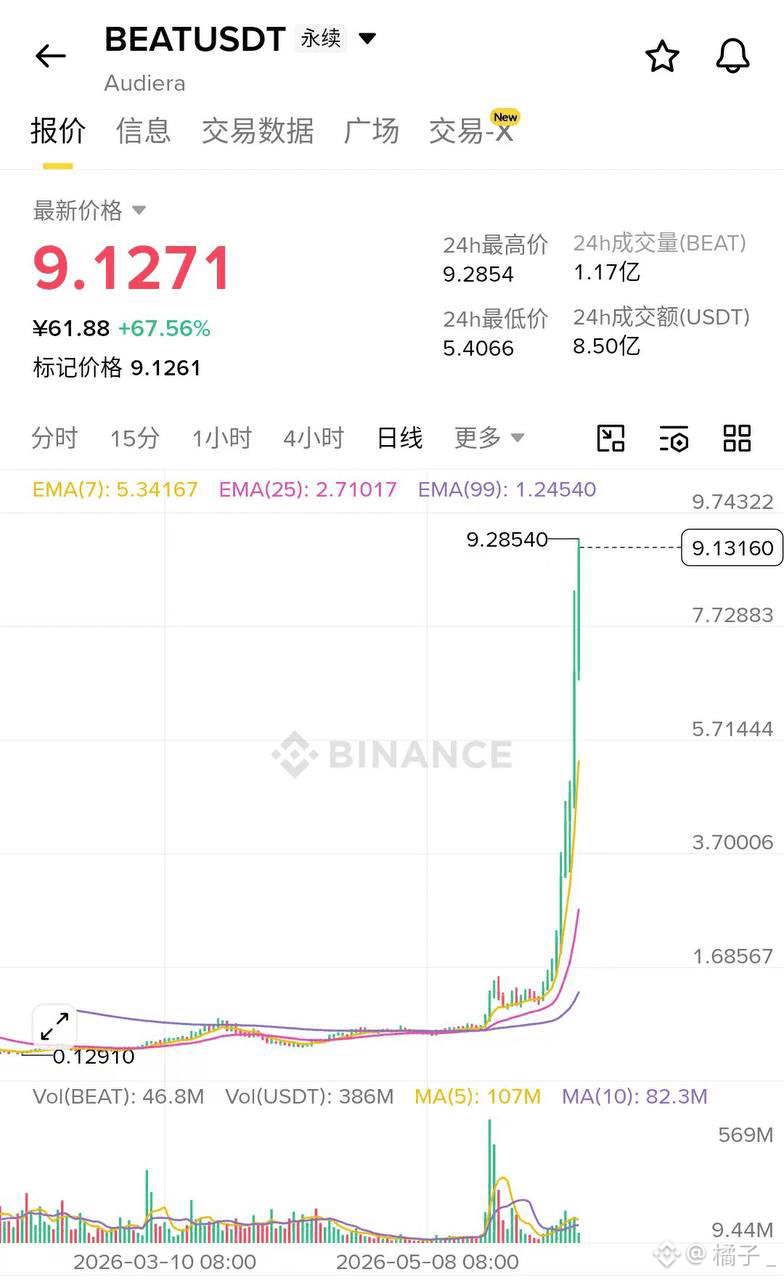
Here's a harsh reality.\nThe ones feeling the worst right now.\nMight not be the ones sitting on cash.\nBut those who once held the bags.\nBecause at least the cash holders aren't in the game.\nThe ones who sold too early are watching prices hit new highs daily.\n$BEAT $8.\nThose in the know get it.\n$BNB #binance $BEAT
Here's a harsh reality.\nThe ones feeling the worst right now.\nMight not be the ones sitting on cash.\nBut those who once held the bags.\nBecause at least the cash holders aren't in the game.\nThe ones who sold too early are watching prices hit new highs daily.\n$BEAT $8.\nThose in the know get it.\n$BNB #binance $BEAT
90
·
--
Looking at all the airdrop controversies now, I've realized that the hardest pill to swallow isn’t just the stricter rules, but the sudden realization that I’ve completely misunderstood the relationship between both parties.
We often subconsciously think: I’m testing for you, doing tasks, grinding through cycles, helping with data, so the project team will at least keep some "favor" for me. But the reality is, the project team's true concern has never been about who worked the hardest, but rather who will be the most valuable and likely to stick around in the future.
So, the @GeniusOfficial incident stirred emotions not just because the bar is set high, but because it laid this logic bare on the table.
That comment from CZ many found harsh, but it’s really just a reminder: those who can weather the cycles are always the minority. The project team assumes that most people will leave, so they keep raising the filtering intensity; they’d rather miss out than over-distribute.
The issue is that this mindset is a gamble in itself. Being too aggressive in filtering can indeed weed out short-term traffic, but it might also push away those genuinely willing to participate long-term. In the end, those who remain might not be the biggest supporters of the project, but simply the ones who can endure the most.
After this, I actually want to clarify one thing:
In the target function of a project, do I belong to the "future users," or am I just "data that needs to be filtered out"?
#genius $GENIUS
Looking at all the airdrop controversies now, I've realized that the hardest pill to swallow isn’t just the stricter rules, but the sudden realization that I’ve completely misunderstood the relationship between both parties.
We often subconsciously think: I’m testing for you, doing tasks, grinding through cycles, helping with data, so the project team will at least keep some "favor" for me. But the reality is, the project team's true concern has never been about who worked the hardest, but rather who will be the most valuable and likely to stick around in the future.
So, the @GeniusOfficial incident stirred emotions not just because the bar is set high, but because it laid this logic bare on the table.
That comment from CZ many found harsh, but it’s really just a reminder: those who can weather the cycles are always the minority. The project team assumes that most people will leave, so they keep raising the filtering intensity; they’d rather miss out than over-distribute.
The issue is that this mindset is a gamble in itself. Being too aggressive in filtering can indeed weed out short-term traffic, but it might also push away those genuinely willing to participate long-term. In the end, those who remain might not be the biggest supporters of the project, but simply the ones who can endure the most.
After this, I actually want to clarify one thing:
In the target function of a project, do I belong to the "future users," or am I just "data that needs to be filtered out"?
#genius $GENIUS
We often subconsciously think: I’m testing for you, doing tasks, grinding through cycles, helping with data, so the project team will at least keep some "favor" for me. But the reality is, the project team's true concern has never been about who worked the hardest, but rather who will be the most valuable and likely to stick around in the future.
So, the @GeniusOfficial incident stirred emotions not just because the bar is set high, but because it laid this logic bare on the table.
That comment from CZ many found harsh, but it’s really just a reminder: those who can weather the cycles are always the minority. The project team assumes that most people will leave, so they keep raising the filtering intensity; they’d rather miss out than over-distribute.
The issue is that this mindset is a gamble in itself. Being too aggressive in filtering can indeed weed out short-term traffic, but it might also push away those genuinely willing to participate long-term. In the end, those who remain might not be the biggest supporters of the project, but simply the ones who can endure the most.
After this, I actually want to clarify one thing:
In the target function of a project, do I belong to the "future users," or am I just "data that needs to be filtered out"?
#genius $GENIUS
128
·
--
I think @GeniusOfficial is interesting not just because it created another trading entry point, but because it tackles some of the most annoying aspects of on-chain trading all in one go.
Before, on-chain trading felt like moving bricks between a bunch of tools: checking prices, finding liquidity, switching chains, signing transactions, bridging assets, and watching for slippage.
What Genius aims to do is consolidate these actions into a single terminal, bringing users closer to the execution experience of a CEX while keeping asset control in their own hands.
So, the focus of $GENIUS isn't just on "trading," but on repackaging the on-chain trading workflow.
DeFi has no shortage of opportunities; what it lacks is a seamless execution environment that minimizes errors, switches, and exposures.
#genius $GENIUS
I think @GeniusOfficial is interesting not just because it created another trading entry point, but because it tackles some of the most annoying aspects of on-chain trading all in one go.
Before, on-chain trading felt like moving bricks between a bunch of tools: checking prices, finding liquidity, switching chains, signing transactions, bridging assets, and watching for slippage.
What Genius aims to do is consolidate these actions into a single terminal, bringing users closer to the execution experience of a CEX while keeping asset control in their own hands.
So, the focus of $GENIUS isn't just on "trading," but on repackaging the on-chain trading workflow.
DeFi has no shortage of opportunities; what it lacks is a seamless execution environment that minimizes errors, switches, and exposures.
#genius $GENIUS
Before, on-chain trading felt like moving bricks between a bunch of tools: checking prices, finding liquidity, switching chains, signing transactions, bridging assets, and watching for slippage.
What Genius aims to do is consolidate these actions into a single terminal, bringing users closer to the execution experience of a CEX while keeping asset control in their own hands.
So, the focus of $GENIUS isn't just on "trading," but on repackaging the on-chain trading workflow.
DeFi has no shortage of opportunities; what it lacks is a seamless execution environment that minimizes errors, switches, and exposures.
#genius $GENIUS

133
·
--
What really gets me hyped about Genius isn’t just making the trade button smoother, but how it tackles the biggest pains in on-chain trading: finding liquidity pools, switching chains, swapping wallets, waiting for confirmations, and exposing positions.
If @GeniusOfficial can bundle cross-chain execution, Ghost Orders, non-custodial accounts, and market data all into one terminal, then $GENIUS ’s narrative goes beyond just being a trading tool—it’s a complete repackage of the on-chain trading experience.
DeFi is full of opportunities; what we need is a faster, quieter, and less error-prone execution environment.
#genius $GENIUS
What really gets me hyped about Genius isn’t just making the trade button smoother, but how it tackles the biggest pains in on-chain trading: finding liquidity pools, switching chains, swapping wallets, waiting for confirmations, and exposing positions.
If @GeniusOfficial can bundle cross-chain execution, Ghost Orders, non-custodial accounts, and market data all into one terminal, then $GENIUS ’s narrative goes beyond just being a trading tool—it’s a complete repackage of the on-chain trading experience.
DeFi is full of opportunities; what we need is a faster, quieter, and less error-prone execution environment.
#genius $GENIUS
If @GeniusOfficial can bundle cross-chain execution, Ghost Orders, non-custodial accounts, and market data all into one terminal, then $GENIUS ’s narrative goes beyond just being a trading tool—it’s a complete repackage of the on-chain trading experience.
DeFi is full of opportunities; what we need is a faster, quieter, and less error-prone execution environment.
#genius $GENIUS

161
Log in to explore more content
Join global crypto users on Binance Square
⚡️ Get latest and useful information about crypto.
💬 Trusted by the world’s largest crypto exchange.
👍 Discover real insights from verified creators.
Email / Phone number
Trending Topics
CircleMints500MUSDCOnSolana
106,668 views
2,247 Discussing
#circlemints500musdconsolana
🚨 $500M USDC MINTED ON SOLANA! 💵🔥
Circle Treasury just minted 500M USDC on Solana, pushing total global supply to $75.2B! 📈✨
💡 Quick Reality Check:
🔹 Minting = Fresh Inventory Creation (Not instant buying power!🛒
🔹 Real Trigger = Capital Deployment into DeFi, Exchanges & Pools! 🌐🚀
🎯 Coins to Watch:
⚡ $SOL — Network activity is booming, and fresh liquidity continues to drive ecosystem growth!
💎 $RARE — A high-volatility altcoin that reacts fast to fresh market liquidity and sentiment!🪐
💥 Are you accumulating now or waiting for full capital deployment? Drop your thoughts below! 👇✨
#CircleMints500MUSDCOnSolana
#PolymarketBankFailureBetsDrawFDICConcern
#BlackRockBuildsTokenizedPortfoliosForOndo
#BitwiseFilesToListNEARETFOnNYSEArca
Hifza Rubab
·5 Likes
·4.6k views
PolymarketBankFailureBetsDrawFDICConcern
101,772 views
1,952 Discussing
BlackRockBuildsTokenizedPortfoliosForOndo
96,570 views
1,393 Discussing