
Coinstelegram
4k Posts

Coinstelegram
 Square Verified+
Report
Block User
Coinstelegram is a leading blockchain & altcoins cryptocurrency media
0 Following
19.6K+ Followers
3.2K+ Liked
Posts
Article
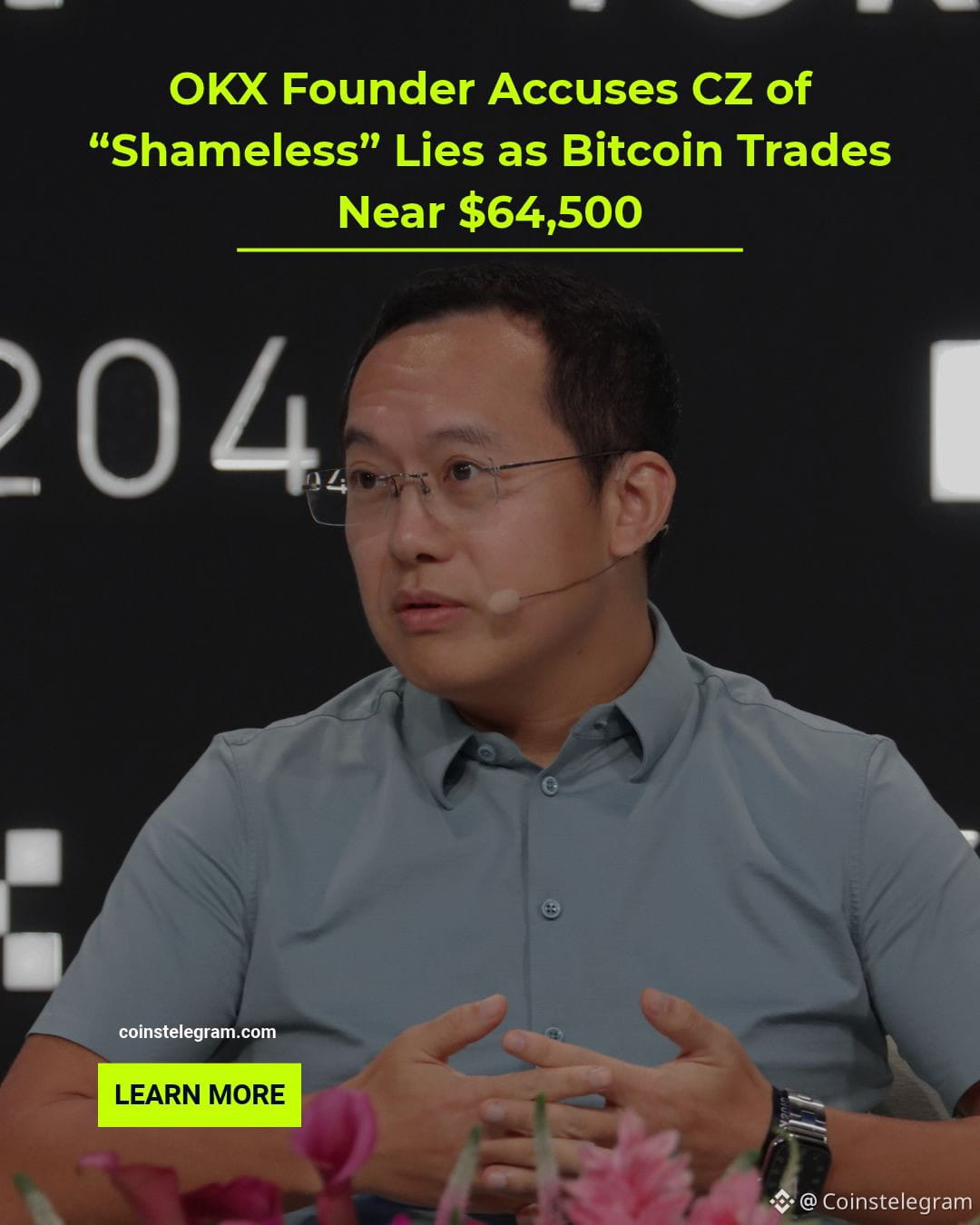
OKX Founder Accuses CZ of “Shameless” Lies As Bitcoin Trades Near $64,500OKX founder Star Xu has renewed his criticism of Binance co-founder Changpeng Zhao, accusing the rival exchange’s leadership of misleading customers after successive October market disruptions.
The dispute intensified on Sunday, November 15, after Zhao said he had continued buying cryptocurrency during the selloff. Xu responded with a sharply worded post questioning how an exchange could ask customers to maintain a long-term outlook after incidents he blamed for damaging the wider industry.
His remarks are accusations, not an established finding that Binance caused either market crash. Zhao has previously rejected that interpretation.
The argument comes as Bitcoin remains under pressure. At approximately 06:34 UTC on November 16, BTC traded near $64,538, according to a timestamped market-price snapshot.
Star Xu Challenges CZ’s Message to Crypto Holders
Xu’s criticism followed comments in which Zhao described his own investment activity during the downturn.
Although Xu did not name Zhao or Binance directly in the quoted passage, he was responding to a post discussing Zhao’s comments. He wrote:
While the entire crypto industry has been suffering from the consequences of their stupid incidents for two consecutive years, is there anyone who lies to the public more shamelessly than this—after repeatedly causing market crashes every October, then claiming to be responsible for protecting their customers and asking those same customers to maintain a long-term vision?
Xu also alleged that complaints from customers and community members were being dismissed as attacks organized by competitors, including OKX.
That criticism concerns accountability as much as price performance. Xu’s argument is that reimbursement commitments and long-term messaging do not resolve questions about the events that disrupted customers.
However, the post does not independently demonstrate that Binance caused the broader market decline or that particular complaints were deliberately misrepresented.
CZ Says He Bought Daily and Rejects Binance-Selling Claims
Zhao’s account of his own trading was straightforward: “I only bought, DCA every day.”
DCA means dollar-cost averaging, a strategy involving purchases at regular intervals rather than attempting to identify a single ideal entry point. Zhao’s statement describes his claimed personal activity; it is not an independently verified record of his trades.
He also said Binance did not sell cryptocurrency during the decline and previously denied that the exchange was responsible for the latest plunge.
The reporting reviewed for this article did not identify a direct response from Zhao to Xu’s latest criticism.
Two separate questions therefore remain central to the disagreement: what Zhao personally bought, and whether Binance’s operations contributed to market instability.
Evidence supporting one would not automatically settle the other. Personal purchases cannot establish the cause of a market-wide selloff, while accusations against an exchange do not disprove an individual’s trading statement.
Binance’s $6.3 Billion Hack Remains a Major Flashpoint
The latest confrontation follows Binance’s October 29 security breach, which the exchange estimated affected approximately $6.3 billion in cryptocurrency.
Binance suspended withdrawals while investigating and pledged to cover the financial impact using company resources, including its Secure Asset Fund for Users, or SAFU. Withdrawals began returning in phases on November 1.
The company subsequently distinguished funding allocated for compensation from purchases of the specific tokens needed to replace stolen assets.
In a November 4 update, Binance said it had set aside more than the full amount required and replenished approximately 98% of affected assets. It said the remaining purchases involved less-liquid tokens that were slower to acquire.
That dated update should not be presented as proof that every replacement purchase had been completed by November 16.
Likewise, replacing customer assets is different from recovering stolen cryptocurrency from attackers. Reimbursement can protect balances while leaving the exchange itself with a substantial financial loss and unresolved security questions.
The Feud Also Reaches Back to October 2025
Xu’s reference to two consecutive years connects the latest breach with the October 10–11, 2025 liquidation crisis.
He previously argued that promotional campaigns involving Ethena’s USDe encouraged leveraged positions that amplified the selloff. His criticism focused on a Binance promotion offering a 12% annualized yield and the risks associated with treating the synthetic-dollar token as dependable collateral.
Binance and Zhao disputed the claim that the exchange caused the crash.
The two October events should not be treated as identical. The 2025 controversy involved leverage, collateral and liquidation mechanics. The October 2026 incident involved a major security breach.
They can both raise questions about exchange risk without proving a single explanation for every subsequent fall in cryptocurrency prices.
Bitcoin’s Bearish Backdrop Extends Beyond the Exchange Dispute
Bitcoin’s November 16 price near $64,500 followed a recent decline toward $62,000. The rebound had not erased the broader downtrend.
Market reporting described six consecutive weekly losses and a decline exceeding 24% since early October. US spot Bitcoin exchange-traded funds also experienced substantial net withdrawals over the preceding two weeks.
These developments support describing conditions as bearish, while leaving room for short-term rebounds. A recovery from a local low does not by itself establish that selling pressure has ended.
The wider backdrop includes weak institutional flows, higher bond yields and a stronger dollar—factors that can influence demand for speculative assets independently of exchange-specific problems.
For readers assessing the feud, the key distinction is between public accusations and demonstrated causation. Xu is demanding accountability, Zhao is rejecting blame, and Binance’s recovery statements address its response to the breach. Determining the causes of the broader selloff requires evidence beyond any executive’s social-media account.
OKX Founder Accuses CZ of “Shameless” Lies As Bitcoin Trades Near $64,500
OKX founder Star Xu has renewed his criticism of Binance co-founder Changpeng Zhao, accusing the rival exchange’s leadership of misleading customers after successive October market disruptions.
The dispute intensified on Sunday, November 15, after Zhao said he had continued buying cryptocurrency during the selloff. Xu responded with a sharply worded post questioning how an exchange could ask customers to maintain a long-term outlook after incidents he blamed for damaging the wider industry.
His remarks are accusations, not an established finding that Binance caused either market crash. Zhao has previously rejected that interpretation.
The argument comes as Bitcoin remains under pressure. At approximately 06:34 UTC on November 16, BTC traded near $64,538, according to a timestamped market-price snapshot.
Star Xu Challenges CZ’s Message to Crypto Holders
Xu’s criticism followed comments in which Zhao described his own investment activity during the downturn.
Although Xu did not name Zhao or Binance directly in the quoted passage, he was responding to a post discussing Zhao’s comments. He wrote:
While the entire crypto industry has been suffering from the consequences of their stupid incidents for two consecutive years, is there anyone who lies to the public more shamelessly than this—after repeatedly causing market crashes every October, then claiming to be responsible for protecting their customers and asking those same customers to maintain a long-term vision?
Xu also alleged that complaints from customers and community members were being dismissed as attacks organized by competitors, including OKX.
That criticism concerns accountability as much as price performance. Xu’s argument is that reimbursement commitments and long-term messaging do not resolve questions about the events that disrupted customers.
However, the post does not independently demonstrate that Binance caused the broader market decline or that particular complaints were deliberately misrepresented.
CZ Says He Bought Daily and Rejects Binance-Selling Claims
Zhao’s account of his own trading was straightforward: “I only bought, DCA every day.”
DCA means dollar-cost averaging, a strategy involving purchases at regular intervals rather than attempting to identify a single ideal entry point. Zhao’s statement describes his claimed personal activity; it is not an independently verified record of his trades.
He also said Binance did not sell cryptocurrency during the decline and previously denied that the exchange was responsible for the latest plunge.
The reporting reviewed for this article did not identify a direct response from Zhao to Xu’s latest criticism.
Two separate questions therefore remain central to the disagreement: what Zhao personally bought, and whether Binance’s operations contributed to market instability.
Evidence supporting one would not automatically settle the other. Personal purchases cannot establish the cause of a market-wide selloff, while accusations against an exchange do not disprove an individual’s trading statement.
Binance’s $6.3 Billion Hack Remains a Major Flashpoint
The latest confrontation follows Binance’s October 29 security breach, which the exchange estimated affected approximately $6.3 billion in cryptocurrency.
Binance suspended withdrawals while investigating and pledged to cover the financial impact using company resources, including its Secure Asset Fund for Users, or SAFU. Withdrawals began returning in phases on November 1.
The company subsequently distinguished funding allocated for compensation from purchases of the specific tokens needed to replace stolen assets.
In a November 4 update, Binance said it had set aside more than the full amount required and replenished approximately 98% of affected assets. It said the remaining purchases involved less-liquid tokens that were slower to acquire.
That dated update should not be presented as proof that every replacement purchase had been completed by November 16.
Likewise, replacing customer assets is different from recovering stolen cryptocurrency from attackers. Reimbursement can protect balances while leaving the exchange itself with a substantial financial loss and unresolved security questions.
The Feud Also Reaches Back to October 2025
Xu’s reference to two consecutive years connects the latest breach with the October 10–11, 2025 liquidation crisis.
He previously argued that promotional campaigns involving Ethena’s USDe encouraged leveraged positions that amplified the selloff. His criticism focused on a Binance promotion offering a 12% annualized yield and the risks associated with treating the synthetic-dollar token as dependable collateral.
Binance and Zhao disputed the claim that the exchange caused the crash.
The two October events should not be treated as identical. The 2025 controversy involved leverage, collateral and liquidation mechanics. The October 2026 incident involved a major security breach.
They can both raise questions about exchange risk without proving a single explanation for every subsequent fall in cryptocurrency prices.
Bitcoin’s Bearish Backdrop Extends Beyond the Exchange Dispute
Bitcoin’s November 16 price near $64,500 followed a recent decline toward $62,000. The rebound had not erased the broader downtrend.
Market reporting described six consecutive weekly losses and a decline exceeding 24% since early October. US spot Bitcoin exchange-traded funds also experienced substantial net withdrawals over the preceding two weeks.
These developments support describing conditions as bearish, while leaving room for short-term rebounds. A recovery from a local low does not by itself establish that selling pressure has ended.
The wider backdrop includes weak institutional flows, higher bond yields and a stronger dollar—factors that can influence demand for speculative assets independently of exchange-specific problems.
For readers assessing the feud, the key distinction is between public accusations and demonstrated causation. Xu is demanding accountability, Zhao is rejecting blame, and Binance’s recovery statements address its response to the breach. Determining the causes of the broader selloff requires evidence beyond any executive’s social-media account.
139
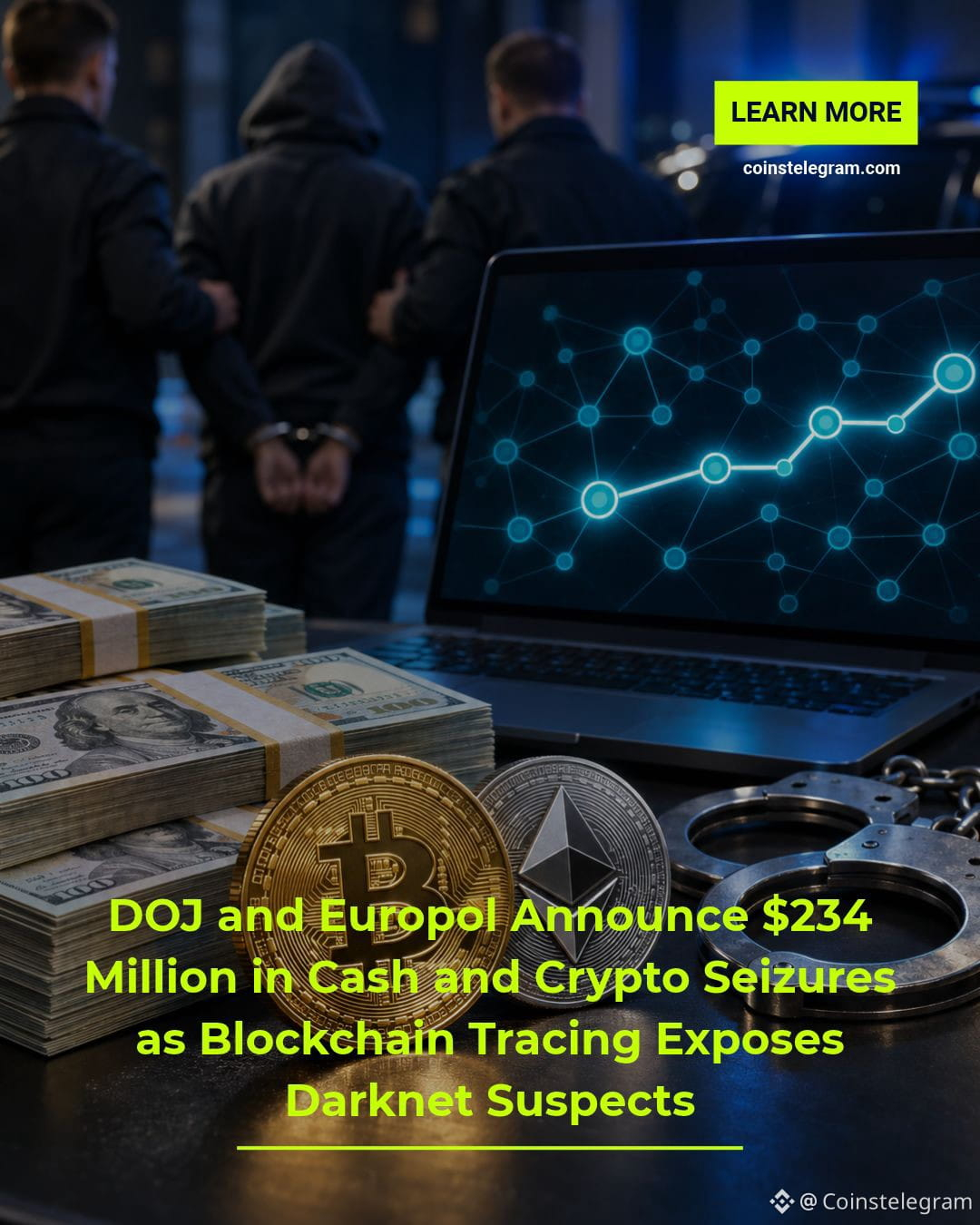
DOJ and Europol Announce $234 Million in Cash and Crypto Seizures as Blockchain Tracing Exposes D...An international crackdown on darknet drug trafficking has resulted in 354 arrests and the seizure of more than $234 million in cash and cryptocurrency, US and European authorities announced on November 12.
Operation TorNado targeted vendors, buyers and trafficking networks operating through darknet marketplaces. Authorities also seized approximately 5.7 metric tons of drugs, 209 firearms and 38 pill presses.
The financial total combines physical cash and digital assets. Authorities did not identify the entire $234 million as cryptocurrency or attribute that amount to a single criminal network.
Among the cases highlighted was BarbaraWhite, a darknet vendor allegedly operated by two Florida brothers. Blockchain analysis helped investigators connect cryptocurrency transactions to the suspected operators of a network associated with at least 12 overdoses, including three deaths.
Operation TorNado Targeted Networks Across Multiple Countries
The operation ran from May 2025 through October 2026, bringing together investigations across the United States, Europe, Australia and New Zealand.
It was the sixth internationally coordinated action involving the Joint Criminal Opioid and Darknet Enforcement team, known as JCODE, since its creation in 2018. The Justice Department described it as the initiative’s largest and most extensive international operation.
TorNado built on intelligence obtained from earlier marketplace takedowns, including Archetyp, Bohemia, Nemesis, Kingdom and Tor2Door. Rather than representing one simultaneous raid, it brought together complementary investigations conducted by different national authorities.
Europol said its contribution included forensic work, blockchain analysis, intelligence sharing and coordination to prevent investigations from overlapping. Authorities also investigated activity involving single-vendor shops, forums and encrypted messaging services.
That broader approach reflects how online criminal networks operate across several platforms. Removing one marketplace can generate evidence for further cases, even when sellers move elsewhere.
Florida Brothers Accused of Operating BarbaraWhite
One investigation involved Vladislav and Stanislav Chernyshov, two brothers from Jacksonville, Florida, accused of operating under the BarbaraWhite vendor name.
Their arrests occurred on August 28, before the November announcement of the wider operation’s results. They were charged with conspiracy to distribute nitazenes, a class of synthetic opioids that can match or exceed fentanyl’s potency.
According to prosecutors, the alleged operation distributed counterfeit oxycodone pills containing these substances. The case was brought in the Eastern District of Virginia. United States Department of Justice
Chainalysis said the vendor had been active since at least 2020 and was linked to at least 12 overdoses across the United States, including three fatalities.
Those associations describe the investigation’s findings and allegations; they should not be presented as a completed criminal judgment against the brothers. The defendants are presumed innocent unless proven guilty.
The case illustrates the consequences behind online transactions: investigators were examining a suspected distribution operation involving dangerous counterfeit medication, rather than cryptocurrency transfers in isolation.
How Blockchain Analysis Helped Investigators Follow the Money
The cryptocurrency component gave investigators another way to examine BarbaraWhite’s activity.
According to Chainalysis, investigators identified Bitcoin addresses allegedly used to withdraw drug-sale proceeds from darknet marketplaces. Analysis of the resulting wallet network helped connect the financial activity to Stanislav Chernyshov.
The company published a recreation of a Reactor graph included in an investigative affidavit. It illustrated transfers between wallets linked to BarbaraWhite and addresses associated with potential buyers and other vendors.
Crucially, blockchain tracing was combined with marketplace information, postal records, surveillance and undercover purchases.
A wallet address is not automatically a verified personal identity. Investigators need supporting evidence to explain who controlled it and what particular payments represented.
Likewise, a transaction involving an address does not, by itself, establish that its owner knowingly participated in a crime.
The significance of blockchain analysis here is its ability to connect financial activity with other evidence. The public record of transfers can help investigators reconstruct relationships that would otherwise remain difficult to examine.
What the Seizure Figures Do—and Do Not—Show
The operation’s headline figures cover numerous investigations and jurisdictions. They should not be confused with the financial activity of BarbaraWhite alone.
In the United States, authorities reported 132 arrests and more than $166 million in combined cash and cryptocurrency seizures. They also seized approximately 4.8 metric tons of drugs, 152 firearms and 38 pill presses.
These figures are components of the wider operation, rather than additional amounts to add to the international total.
The announcement also does not establish that blockchain analysis directly produced every arrest or asset seizure. Different cases involved different evidence and investigative techniques.
Similarly, seized assets are not necessarily the same as assets permanently forfeited following court proceedings. The headline describes what authorities took into custody during enforcement actions, not a final accounting of every prosecution.
Why the Case Matters for Crypto Users and Compliance Teams
For the cryptocurrency industry, TorNado demonstrates how financial tracing can support investigations involving real-world criminal activity.
It also challenges the assumption that using cryptocurrency necessarily makes payments untraceable. In this case, investigators combined Bitcoin transaction analysis with evidence gathered outside the blockchain.
That does not mean every wallet can immediately be identified, or that all cryptocurrencies have identical transparency characteristics. It shows the value of examining transactions within a wider evidentiary context.
Europol warned that darknet markets continue adapting through fragmentation, encrypted communications and migration to replacement platforms. Disrupting their financial networks therefore remains part of a continuing effort, rather than a permanent endpoint.
Authorities said further investigations remain underway. The next stage will involve prosecutions, examination of seized evidence and efforts to identify additional people behind online accounts.
DOJ and Europol Announce $234 Million in Cash and Crypto Seizures as Blockchain Tracing Exposes D...
An international crackdown on darknet drug trafficking has resulted in 354 arrests and the seizure of more than $234 million in cash and cryptocurrency, US and European authorities announced on November 12.
Operation TorNado targeted vendors, buyers and trafficking networks operating through darknet marketplaces. Authorities also seized approximately 5.7 metric tons of drugs, 209 firearms and 38 pill presses.
The financial total combines physical cash and digital assets. Authorities did not identify the entire $234 million as cryptocurrency or attribute that amount to a single criminal network.
Among the cases highlighted was BarbaraWhite, a darknet vendor allegedly operated by two Florida brothers. Blockchain analysis helped investigators connect cryptocurrency transactions to the suspected operators of a network associated with at least 12 overdoses, including three deaths.
Operation TorNado Targeted Networks Across Multiple Countries
The operation ran from May 2025 through October 2026, bringing together investigations across the United States, Europe, Australia and New Zealand.
It was the sixth internationally coordinated action involving the Joint Criminal Opioid and Darknet Enforcement team, known as JCODE, since its creation in 2018. The Justice Department described it as the initiative’s largest and most extensive international operation.
TorNado built on intelligence obtained from earlier marketplace takedowns, including Archetyp, Bohemia, Nemesis, Kingdom and Tor2Door. Rather than representing one simultaneous raid, it brought together complementary investigations conducted by different national authorities.
Europol said its contribution included forensic work, blockchain analysis, intelligence sharing and coordination to prevent investigations from overlapping. Authorities also investigated activity involving single-vendor shops, forums and encrypted messaging services.
That broader approach reflects how online criminal networks operate across several platforms. Removing one marketplace can generate evidence for further cases, even when sellers move elsewhere.
Florida Brothers Accused of Operating BarbaraWhite
One investigation involved Vladislav and Stanislav Chernyshov, two brothers from Jacksonville, Florida, accused of operating under the BarbaraWhite vendor name.
Their arrests occurred on August 28, before the November announcement of the wider operation’s results. They were charged with conspiracy to distribute nitazenes, a class of synthetic opioids that can match or exceed fentanyl’s potency.
According to prosecutors, the alleged operation distributed counterfeit oxycodone pills containing these substances. The case was brought in the Eastern District of Virginia. United States Department of Justice
Chainalysis said the vendor had been active since at least 2020 and was linked to at least 12 overdoses across the United States, including three fatalities.
Those associations describe the investigation’s findings and allegations; they should not be presented as a completed criminal judgment against the brothers. The defendants are presumed innocent unless proven guilty.
The case illustrates the consequences behind online transactions: investigators were examining a suspected distribution operation involving dangerous counterfeit medication, rather than cryptocurrency transfers in isolation.
How Blockchain Analysis Helped Investigators Follow the Money
The cryptocurrency component gave investigators another way to examine BarbaraWhite’s activity.
According to Chainalysis, investigators identified Bitcoin addresses allegedly used to withdraw drug-sale proceeds from darknet marketplaces. Analysis of the resulting wallet network helped connect the financial activity to Stanislav Chernyshov.
The company published a recreation of a Reactor graph included in an investigative affidavit. It illustrated transfers between wallets linked to BarbaraWhite and addresses associated with potential buyers and other vendors.
Crucially, blockchain tracing was combined with marketplace information, postal records, surveillance and undercover purchases.
A wallet address is not automatically a verified personal identity. Investigators need supporting evidence to explain who controlled it and what particular payments represented.
Likewise, a transaction involving an address does not, by itself, establish that its owner knowingly participated in a crime.
The significance of blockchain analysis here is its ability to connect financial activity with other evidence. The public record of transfers can help investigators reconstruct relationships that would otherwise remain difficult to examine.
What the Seizure Figures Do—and Do Not—Show
The operation’s headline figures cover numerous investigations and jurisdictions. They should not be confused with the financial activity of BarbaraWhite alone.
In the United States, authorities reported 132 arrests and more than $166 million in combined cash and cryptocurrency seizures. They also seized approximately 4.8 metric tons of drugs, 152 firearms and 38 pill presses.
These figures are components of the wider operation, rather than additional amounts to add to the international total.
The announcement also does not establish that blockchain analysis directly produced every arrest or asset seizure. Different cases involved different evidence and investigative techniques.
Similarly, seized assets are not necessarily the same as assets permanently forfeited following court proceedings. The headline describes what authorities took into custody during enforcement actions, not a final accounting of every prosecution.
Why the Case Matters for Crypto Users and Compliance Teams
For the cryptocurrency industry, TorNado demonstrates how financial tracing can support investigations involving real-world criminal activity.
It also challenges the assumption that using cryptocurrency necessarily makes payments untraceable. In this case, investigators combined Bitcoin transaction analysis with evidence gathered outside the blockchain.
That does not mean every wallet can immediately be identified, or that all cryptocurrencies have identical transparency characteristics. It shows the value of examining transactions within a wider evidentiary context.
Europol warned that darknet markets continue adapting through fragmentation, encrypted communications and migration to replacement platforms. Disrupting their financial networks therefore remains part of a continuing effort, rather than a permanent endpoint.
Authorities said further investigations remain underway. The next stage will involve prosecutions, examination of seized evidence and efforts to identify additional people behind online accounts.
87
Article
DOJ and Europol Announce $234 Million in Cash and Crypto Seizures As Blockchain Tracing Exposes D...An international crackdown on darknet drug trafficking has resulted in 354 arrests and the seizure of more than $234 million in cash and cryptocurrency, US and European authorities announced on November 12.
Operation TorNado targeted vendors, buyers and trafficking networks operating through darknet marketplaces. Authorities also seized approximately 5.7 metric tons of drugs, 209 firearms and 38 pill presses.
The financial total combines physical cash and digital assets. Authorities did not identify the entire $234 million as cryptocurrency or attribute that amount to a single criminal network.
Among the cases highlighted was BarbaraWhite, a darknet vendor allegedly operated by two Florida brothers. Blockchain analysis helped investigators connect cryptocurrency transactions to the suspected operators of a network associated with at least 12 overdoses, including three deaths.
Operation TorNado Targeted Networks Across Multiple Countries
The operation ran from May 2025 through October 2026, bringing together investigations across the United States, Europe, Australia and New Zealand.
It was the sixth internationally coordinated action involving the Joint Criminal Opioid and Darknet Enforcement team, known as JCODE, since its creation in 2018. The Justice Department described it as the initiative’s largest and most extensive international operation.
TorNado built on intelligence obtained from earlier marketplace takedowns, including Archetyp, Bohemia, Nemesis, Kingdom and Tor2Door. Rather than representing one simultaneous raid, it brought together complementary investigations conducted by different national authorities.
Europol said its contribution included forensic work, blockchain analysis, intelligence sharing and coordination to prevent investigations from overlapping. Authorities also investigated activity involving single-vendor shops, forums and encrypted messaging services.
That broader approach reflects how online criminal networks operate across several platforms. Removing one marketplace can generate evidence for further cases, even when sellers move elsewhere.
Florida Brothers Accused of Operating BarbaraWhite
One investigation involved Vladislav and Stanislav Chernyshov, two brothers from Jacksonville, Florida, accused of operating under the BarbaraWhite vendor name.
Their arrests occurred on August 28, before the November announcement of the wider operation’s results. They were charged with conspiracy to distribute nitazenes, a class of synthetic opioids that can match or exceed fentanyl’s potency.
According to prosecutors, the alleged operation distributed counterfeit oxycodone pills containing these substances. The case was brought in the Eastern District of Virginia. United States Department of Justice
Chainalysis said the vendor had been active since at least 2020 and was linked to at least 12 overdoses across the United States, including three fatalities.
Those associations describe the investigation’s findings and allegations; they should not be presented as a completed criminal judgment against the brothers. The defendants are presumed innocent unless proven guilty.
The case illustrates the consequences behind online transactions: investigators were examining a suspected distribution operation involving dangerous counterfeit medication, rather than cryptocurrency transfers in isolation.
How Blockchain Analysis Helped Investigators Follow the Money
The cryptocurrency component gave investigators another way to examine BarbaraWhite’s activity.
According to Chainalysis, investigators identified Bitcoin addresses allegedly used to withdraw drug-sale proceeds from darknet marketplaces. Analysis of the resulting wallet network helped connect the financial activity to Stanislav Chernyshov.
The company published a recreation of a Reactor graph included in an investigative affidavit. It illustrated transfers between wallets linked to BarbaraWhite and addresses associated with potential buyers and other vendors.
Crucially, blockchain tracing was combined with marketplace information, postal records, surveillance and undercover purchases.
A wallet address is not automatically a verified personal identity. Investigators need supporting evidence to explain who controlled it and what particular payments represented.
Likewise, a transaction involving an address does not, by itself, establish that its owner knowingly participated in a crime.
The significance of blockchain analysis here is its ability to connect financial activity with other evidence. The public record of transfers can help investigators reconstruct relationships that would otherwise remain difficult to examine.
What the Seizure Figures Do—and Do Not—Show
The operation’s headline figures cover numerous investigations and jurisdictions. They should not be confused with the financial activity of BarbaraWhite alone.
In the United States, authorities reported 132 arrests and more than $166 million in combined cash and cryptocurrency seizures. They also seized approximately 4.8 metric tons of drugs, 152 firearms and 38 pill presses.
These figures are components of the wider operation, rather than additional amounts to add to the international total.
The announcement also does not establish that blockchain analysis directly produced every arrest or asset seizure. Different cases involved different evidence and investigative techniques.
Similarly, seized assets are not necessarily the same as assets permanently forfeited following court proceedings. The headline describes what authorities took into custody during enforcement actions, not a final accounting of every prosecution.
Why the Case Matters for Crypto Users and Compliance Teams
For the cryptocurrency industry, TorNado demonstrates how financial tracing can support investigations involving real-world criminal activity.
It also challenges the assumption that using cryptocurrency necessarily makes payments untraceable. In this case, investigators combined Bitcoin transaction analysis with evidence gathered outside the blockchain.
That does not mean every wallet can immediately be identified, or that all cryptocurrencies have identical transparency characteristics. It shows the value of examining transactions within a wider evidentiary context.
Europol warned that darknet markets continue adapting through fragmentation, encrypted communications and migration to replacement platforms. Disrupting their financial networks therefore remains part of a continuing effort, rather than a permanent endpoint.
Authorities said further investigations remain underway. The next stage will involve prosecutions, examination of seized evidence and efforts to identify additional people behind online accounts.
DOJ and Europol Announce $234 Million in Cash and Crypto Seizures As Blockchain Tracing Exposes D...
An international crackdown on darknet drug trafficking has resulted in 354 arrests and the seizure of more than $234 million in cash and cryptocurrency, US and European authorities announced on November 12.
Operation TorNado targeted vendors, buyers and trafficking networks operating through darknet marketplaces. Authorities also seized approximately 5.7 metric tons of drugs, 209 firearms and 38 pill presses.
The financial total combines physical cash and digital assets. Authorities did not identify the entire $234 million as cryptocurrency or attribute that amount to a single criminal network.
Among the cases highlighted was BarbaraWhite, a darknet vendor allegedly operated by two Florida brothers. Blockchain analysis helped investigators connect cryptocurrency transactions to the suspected operators of a network associated with at least 12 overdoses, including three deaths.
Operation TorNado Targeted Networks Across Multiple Countries
The operation ran from May 2025 through October 2026, bringing together investigations across the United States, Europe, Australia and New Zealand.
It was the sixth internationally coordinated action involving the Joint Criminal Opioid and Darknet Enforcement team, known as JCODE, since its creation in 2018. The Justice Department described it as the initiative’s largest and most extensive international operation.
TorNado built on intelligence obtained from earlier marketplace takedowns, including Archetyp, Bohemia, Nemesis, Kingdom and Tor2Door. Rather than representing one simultaneous raid, it brought together complementary investigations conducted by different national authorities.
Europol said its contribution included forensic work, blockchain analysis, intelligence sharing and coordination to prevent investigations from overlapping. Authorities also investigated activity involving single-vendor shops, forums and encrypted messaging services.
That broader approach reflects how online criminal networks operate across several platforms. Removing one marketplace can generate evidence for further cases, even when sellers move elsewhere.
Florida Brothers Accused of Operating BarbaraWhite
One investigation involved Vladislav and Stanislav Chernyshov, two brothers from Jacksonville, Florida, accused of operating under the BarbaraWhite vendor name.
Their arrests occurred on August 28, before the November announcement of the wider operation’s results. They were charged with conspiracy to distribute nitazenes, a class of synthetic opioids that can match or exceed fentanyl’s potency.
According to prosecutors, the alleged operation distributed counterfeit oxycodone pills containing these substances. The case was brought in the Eastern District of Virginia. United States Department of Justice
Chainalysis said the vendor had been active since at least 2020 and was linked to at least 12 overdoses across the United States, including three fatalities.
Those associations describe the investigation’s findings and allegations; they should not be presented as a completed criminal judgment against the brothers. The defendants are presumed innocent unless proven guilty.
The case illustrates the consequences behind online transactions: investigators were examining a suspected distribution operation involving dangerous counterfeit medication, rather than cryptocurrency transfers in isolation.
How Blockchain Analysis Helped Investigators Follow the Money
The cryptocurrency component gave investigators another way to examine BarbaraWhite’s activity.
According to Chainalysis, investigators identified Bitcoin addresses allegedly used to withdraw drug-sale proceeds from darknet marketplaces. Analysis of the resulting wallet network helped connect the financial activity to Stanislav Chernyshov.
The company published a recreation of a Reactor graph included in an investigative affidavit. It illustrated transfers between wallets linked to BarbaraWhite and addresses associated with potential buyers and other vendors.
Crucially, blockchain tracing was combined with marketplace information, postal records, surveillance and undercover purchases.
A wallet address is not automatically a verified personal identity. Investigators need supporting evidence to explain who controlled it and what particular payments represented.
Likewise, a transaction involving an address does not, by itself, establish that its owner knowingly participated in a crime.
The significance of blockchain analysis here is its ability to connect financial activity with other evidence. The public record of transfers can help investigators reconstruct relationships that would otherwise remain difficult to examine.
What the Seizure Figures Do—and Do Not—Show
The operation’s headline figures cover numerous investigations and jurisdictions. They should not be confused with the financial activity of BarbaraWhite alone.
In the United States, authorities reported 132 arrests and more than $166 million in combined cash and cryptocurrency seizures. They also seized approximately 4.8 metric tons of drugs, 152 firearms and 38 pill presses.
These figures are components of the wider operation, rather than additional amounts to add to the international total.
The announcement also does not establish that blockchain analysis directly produced every arrest or asset seizure. Different cases involved different evidence and investigative techniques.
Similarly, seized assets are not necessarily the same as assets permanently forfeited following court proceedings. The headline describes what authorities took into custody during enforcement actions, not a final accounting of every prosecution.
Why the Case Matters for Crypto Users and Compliance Teams
For the cryptocurrency industry, TorNado demonstrates how financial tracing can support investigations involving real-world criminal activity.
It also challenges the assumption that using cryptocurrency necessarily makes payments untraceable. In this case, investigators combined Bitcoin transaction analysis with evidence gathered outside the blockchain.
That does not mean every wallet can immediately be identified, or that all cryptocurrencies have identical transparency characteristics. It shows the value of examining transactions within a wider evidentiary context.
Europol warned that darknet markets continue adapting through fragmentation, encrypted communications and migration to replacement platforms. Disrupting their financial networks therefore remains part of a continuing effort, rather than a permanent endpoint.
Authorities said further investigations remain underway. The next stage will involve prosecutions, examination of seized evidence and efforts to identify additional people behind online accounts.
Operation TorNado targeted vendors, buyers and trafficking networks operating through darknet marketplaces. Authorities also seized approximately 5.7 metric tons of drugs, 209 firearms and 38 pill presses.
The financial total combines physical cash and digital assets. Authorities did not identify the entire $234 million as cryptocurrency or attribute that amount to a single criminal network.
Among the cases highlighted was BarbaraWhite, a darknet vendor allegedly operated by two Florida brothers. Blockchain analysis helped investigators connect cryptocurrency transactions to the suspected operators of a network associated with at least 12 overdoses, including three deaths.
Operation TorNado Targeted Networks Across Multiple Countries
The operation ran from May 2025 through October 2026, bringing together investigations across the United States, Europe, Australia and New Zealand.
It was the sixth internationally coordinated action involving the Joint Criminal Opioid and Darknet Enforcement team, known as JCODE, since its creation in 2018. The Justice Department described it as the initiative’s largest and most extensive international operation.
TorNado built on intelligence obtained from earlier marketplace takedowns, including Archetyp, Bohemia, Nemesis, Kingdom and Tor2Door. Rather than representing one simultaneous raid, it brought together complementary investigations conducted by different national authorities.
Europol said its contribution included forensic work, blockchain analysis, intelligence sharing and coordination to prevent investigations from overlapping. Authorities also investigated activity involving single-vendor shops, forums and encrypted messaging services.
That broader approach reflects how online criminal networks operate across several platforms. Removing one marketplace can generate evidence for further cases, even when sellers move elsewhere.
Florida Brothers Accused of Operating BarbaraWhite
One investigation involved Vladislav and Stanislav Chernyshov, two brothers from Jacksonville, Florida, accused of operating under the BarbaraWhite vendor name.
Their arrests occurred on August 28, before the November announcement of the wider operation’s results. They were charged with conspiracy to distribute nitazenes, a class of synthetic opioids that can match or exceed fentanyl’s potency.
According to prosecutors, the alleged operation distributed counterfeit oxycodone pills containing these substances. The case was brought in the Eastern District of Virginia. United States Department of Justice
Chainalysis said the vendor had been active since at least 2020 and was linked to at least 12 overdoses across the United States, including three fatalities.
Those associations describe the investigation’s findings and allegations; they should not be presented as a completed criminal judgment against the brothers. The defendants are presumed innocent unless proven guilty.
The case illustrates the consequences behind online transactions: investigators were examining a suspected distribution operation involving dangerous counterfeit medication, rather than cryptocurrency transfers in isolation.
How Blockchain Analysis Helped Investigators Follow the Money
The cryptocurrency component gave investigators another way to examine BarbaraWhite’s activity.
According to Chainalysis, investigators identified Bitcoin addresses allegedly used to withdraw drug-sale proceeds from darknet marketplaces. Analysis of the resulting wallet network helped connect the financial activity to Stanislav Chernyshov.
The company published a recreation of a Reactor graph included in an investigative affidavit. It illustrated transfers between wallets linked to BarbaraWhite and addresses associated with potential buyers and other vendors.
Crucially, blockchain tracing was combined with marketplace information, postal records, surveillance and undercover purchases.
A wallet address is not automatically a verified personal identity. Investigators need supporting evidence to explain who controlled it and what particular payments represented.
Likewise, a transaction involving an address does not, by itself, establish that its owner knowingly participated in a crime.
The significance of blockchain analysis here is its ability to connect financial activity with other evidence. The public record of transfers can help investigators reconstruct relationships that would otherwise remain difficult to examine.
What the Seizure Figures Do—and Do Not—Show
The operation’s headline figures cover numerous investigations and jurisdictions. They should not be confused with the financial activity of BarbaraWhite alone.
In the United States, authorities reported 132 arrests and more than $166 million in combined cash and cryptocurrency seizures. They also seized approximately 4.8 metric tons of drugs, 152 firearms and 38 pill presses.
These figures are components of the wider operation, rather than additional amounts to add to the international total.
The announcement also does not establish that blockchain analysis directly produced every arrest or asset seizure. Different cases involved different evidence and investigative techniques.
Similarly, seized assets are not necessarily the same as assets permanently forfeited following court proceedings. The headline describes what authorities took into custody during enforcement actions, not a final accounting of every prosecution.
Why the Case Matters for Crypto Users and Compliance Teams
For the cryptocurrency industry, TorNado demonstrates how financial tracing can support investigations involving real-world criminal activity.
It also challenges the assumption that using cryptocurrency necessarily makes payments untraceable. In this case, investigators combined Bitcoin transaction analysis with evidence gathered outside the blockchain.
That does not mean every wallet can immediately be identified, or that all cryptocurrencies have identical transparency characteristics. It shows the value of examining transactions within a wider evidentiary context.
Europol warned that darknet markets continue adapting through fragmentation, encrypted communications and migration to replacement platforms. Disrupting their financial networks therefore remains part of a continuing effort, rather than a permanent endpoint.
Authorities said further investigations remain underway. The next stage will involve prosecutions, examination of seized evidence and efforts to identify additional people behind online accounts.
341
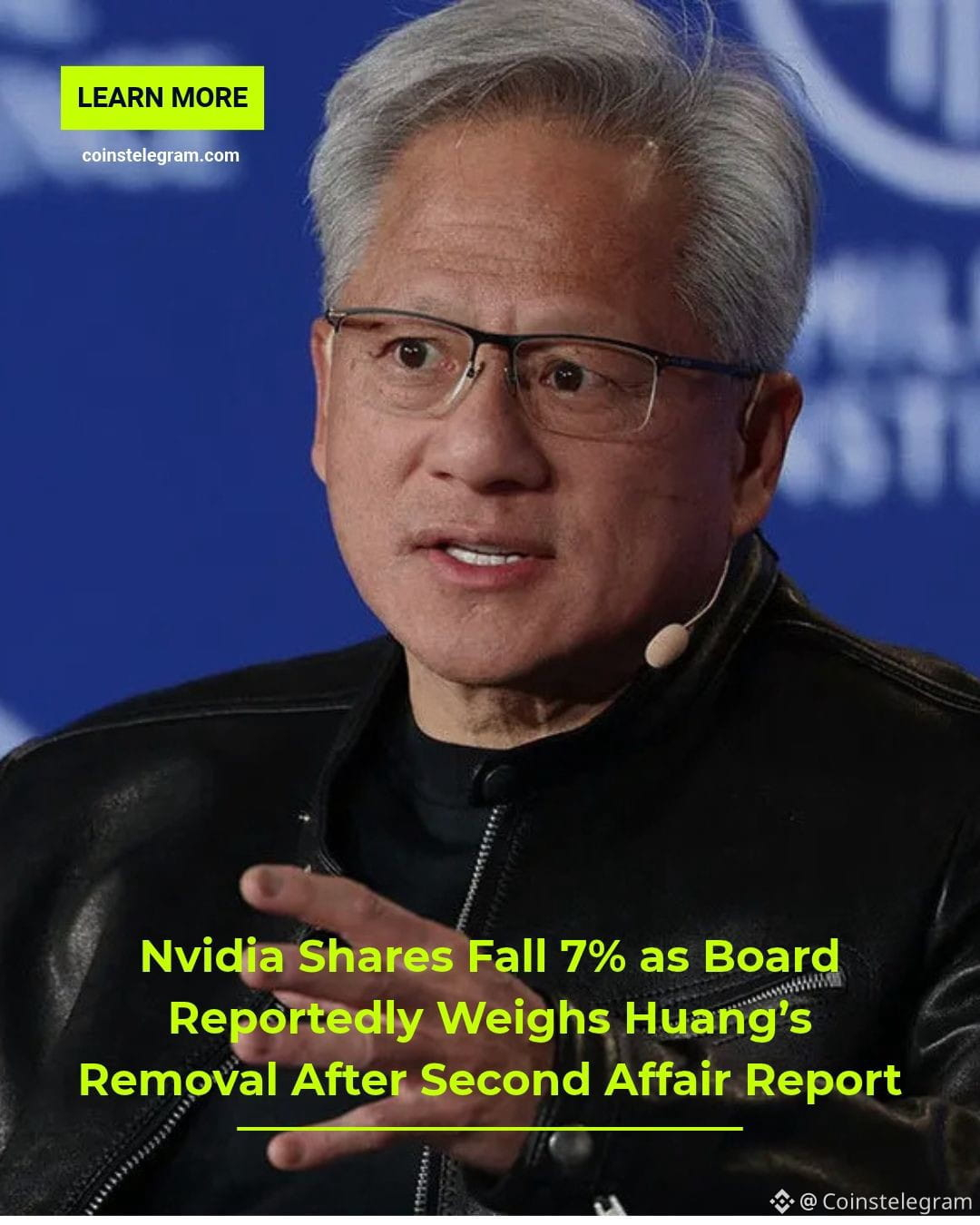
Nvidia Shares Fall 7% as Board Reportedly Weighs Huang’s Removal After Second Affair ReportNvidia shares fell approximately 7% in US premarket trading on November 12 as investors reacted to reports that its board was considering removing chief executive Jensen Huang following allegations of a second extramarital relationship.
The decline followed a selloff of more than 8% in extended trading on Wednesday. The Wall Street Journal initially reported that directors were preparing to oust Huang; Reuters subsequently reported, citing a person familiar with the matter, that the board was meeting late Wednesday to decide his future.
The reports reviewed for this article did not include an official announcement that Huang had resigned or been dismissed. Nvidia had not named an interim successor.
The distinction matters: a reported board discussion is not confirmation of a completed leadership change.
Nvidia Stock Reverses Its Rebound as Leadership Concerns Intensify
The latest allegations abruptly interrupted a recovery in Nvidia’s share price. The stock gained approximately 2.9% during Wednesday’s regular session before falling sharply after the closing bell.
Extended-hours reports showed losses of more than 8%, with some snapshots approaching 9%. These figures reflect different observation times rather than necessarily conflicting accounts.
By early Thursday, Nvidia remained under pressure, trading about 7% lower in the US premarket. These were preliminary prices before the regular session, not a confirmed November 12 closing result.
The market response reflects uncertainty over leadership continuity at a company whose technology and commercial relationships are closely associated with its founder.
A falling share price does not establish the truth of the underlying allegations. It shows investors adjusting their exposure while important questions remain unresolved.
For shareholders, the immediate concern is whether a board decision could change Nvidia’s management, customer relationships or ability to execute its strategy.
Second Alleged Relationship Involves Healthcare Executive Kimberly Powell
The New York Times reported Wednesday that Huang had also had a relationship with Kimberly Powell, Nvidia’s vice president of healthcare, citing five people who had worked at the company.
Reuters relayed that report but said it could not immediately verify it independently. Nvidia did not immediately respond to its request for comment.
According to the account supplied for this article, the Times described an alleged incident at a San Jose hotel during Nvidia’s GTC conference in March. The newspaper said it had not viewed the purported video itself.
That limitation is important. The reported existence of a recording should not be presented as publicly available video evidence establishing the allegation.
Neither Huang nor Powell had publicly addressed the reported relationship in the material reviewed. Nvidia had not announced a finding that either executive violated company policy.
The allegation nevertheless introduces a corporate governance issue because Powell reportedly reported to Huang. A relationship involving a chief executive and a subordinate can raise questions about disclosure, conflicts of interest and the handling of personnel decisions.
Those questions require investigation; they are not, by themselves, proof of misconduct.
Board Review Follows Earlier Foreign Intelligence Concerns
The controversy began before Wednesday’s report.
On November 8, Nvidia announced an independent investigation following reporting that Huang had been targeted by a foreign intelligence operation. A committee of independent directors, assisted by outside legal counsel, was assigned to oversee the review.
At that time, the board expressed confidence in Huang and his leadership team. It also said it had no reason to believe national security or Nvidia’s confidential information had been compromised.
The earlier reporting concerned Alice Huang, a businesswoman associated with Nvidia customer Megaspeed. She is not related to Jensen Huang. US intelligence officials reportedly considered her a Chinese intelligence asset; China has rejected the espionage allegations.
Huang acknowledged being unfaithful in his November 8 employee message, but that admission did not establish that confidential information was disclosed or that he knowingly assisted an intelligence operation.
The reported move toward considering his removal therefore represents a significant development from the board’s earlier public position. It does not reveal the investigation’s final conclusions.
Succession Questions Grow as Musk Signals Interest
Huang’s potential departure raises an unusually consequential succession question. He co-founded Nvidia in 1993 and has led it for more than three decades.
Elon Musk added to the discussion by responding to a suggestion that he hire Huang, saying it would be an honor. The comment was an expression of interest, not a formal job offer or evidence that Huang had agreed to leave Nvidia. businessinsider.com
For Nvidia, choosing a temporary replacement and appointing a permanent chief executive would be separate decisions.
Investors would need clarity about responsibility for product development, customer commitments and the company’s long-term technology direction. A transition plan could help reduce uncertainty even while the investigation continues.
The scrutiny also extends beyond the boardroom. Senators Elizabeth Warren and Chris Coons requested that government agencies preserve records concerning Nvidia chip exports and the reported intelligence operation. Their letter sought documents and briefings; it did not establish wrongdoing.
November 12 Selloff Reaches Other AI Stocks
The pressure spread beyond Nvidia during Thursday’s early trading.
At 4:11 a.m. ET, Nasdaq 100 futures were down approximately 0.79%, while S&P 500 futures slipped 0.38%. Dow futures were slightly higher, showing that the market was not moving uniformly lower.
Intel, Marvell and Micron declined between approximately 2.6% and 3.4%, while AI infrastructure companies CoreWeave and Nebius also fell. reuters.com
These movements show broader investor sensitivity around the AI trade, but do not demonstrate that every decline resulted solely from Huang’s situation.
The next decisive development will be an official statement on the board’s decision. Until then, Huang’s removal, the choice of a successor and the outcome of the misconduct and security inquiries remain unconfirmed.
Nvidia Shares Fall 7% as Board Reportedly Weighs Huang’s Removal After Second Affair Report
Nvidia shares fell approximately 7% in US premarket trading on November 12 as investors reacted to reports that its board was considering removing chief executive Jensen Huang following allegations of a second extramarital relationship.
The decline followed a selloff of more than 8% in extended trading on Wednesday. The Wall Street Journal initially reported that directors were preparing to oust Huang; Reuters subsequently reported, citing a person familiar with the matter, that the board was meeting late Wednesday to decide his future.
The reports reviewed for this article did not include an official announcement that Huang had resigned or been dismissed. Nvidia had not named an interim successor.
The distinction matters: a reported board discussion is not confirmation of a completed leadership change.
Nvidia Stock Reverses Its Rebound as Leadership Concerns Intensify
The latest allegations abruptly interrupted a recovery in Nvidia’s share price. The stock gained approximately 2.9% during Wednesday’s regular session before falling sharply after the closing bell.
Extended-hours reports showed losses of more than 8%, with some snapshots approaching 9%. These figures reflect different observation times rather than necessarily conflicting accounts.
By early Thursday, Nvidia remained under pressure, trading about 7% lower in the US premarket. These were preliminary prices before the regular session, not a confirmed November 12 closing result.
The market response reflects uncertainty over leadership continuity at a company whose technology and commercial relationships are closely associated with its founder.
A falling share price does not establish the truth of the underlying allegations. It shows investors adjusting their exposure while important questions remain unresolved.
For shareholders, the immediate concern is whether a board decision could change Nvidia’s management, customer relationships or ability to execute its strategy.
Second Alleged Relationship Involves Healthcare Executive Kimberly Powell
The New York Times reported Wednesday that Huang had also had a relationship with Kimberly Powell, Nvidia’s vice president of healthcare, citing five people who had worked at the company.
Reuters relayed that report but said it could not immediately verify it independently. Nvidia did not immediately respond to its request for comment.
According to the account supplied for this article, the Times described an alleged incident at a San Jose hotel during Nvidia’s GTC conference in March. The newspaper said it had not viewed the purported video itself.
That limitation is important. The reported existence of a recording should not be presented as publicly available video evidence establishing the allegation.
Neither Huang nor Powell had publicly addressed the reported relationship in the material reviewed. Nvidia had not announced a finding that either executive violated company policy.
The allegation nevertheless introduces a corporate governance issue because Powell reportedly reported to Huang. A relationship involving a chief executive and a subordinate can raise questions about disclosure, conflicts of interest and the handling of personnel decisions.
Those questions require investigation; they are not, by themselves, proof of misconduct.
Board Review Follows Earlier Foreign Intelligence Concerns
The controversy began before Wednesday’s report.
On November 8, Nvidia announced an independent investigation following reporting that Huang had been targeted by a foreign intelligence operation. A committee of independent directors, assisted by outside legal counsel, was assigned to oversee the review.
At that time, the board expressed confidence in Huang and his leadership team. It also said it had no reason to believe national security or Nvidia’s confidential information had been compromised.
The earlier reporting concerned Alice Huang, a businesswoman associated with Nvidia customer Megaspeed. She is not related to Jensen Huang. US intelligence officials reportedly considered her a Chinese intelligence asset; China has rejected the espionage allegations.
Huang acknowledged being unfaithful in his November 8 employee message, but that admission did not establish that confidential information was disclosed or that he knowingly assisted an intelligence operation.
The reported move toward considering his removal therefore represents a significant development from the board’s earlier public position. It does not reveal the investigation’s final conclusions.
Succession Questions Grow as Musk Signals Interest
Huang’s potential departure raises an unusually consequential succession question. He co-founded Nvidia in 1993 and has led it for more than three decades.
Elon Musk added to the discussion by responding to a suggestion that he hire Huang, saying it would be an honor. The comment was an expression of interest, not a formal job offer or evidence that Huang had agreed to leave Nvidia. businessinsider.com
For Nvidia, choosing a temporary replacement and appointing a permanent chief executive would be separate decisions.
Investors would need clarity about responsibility for product development, customer commitments and the company’s long-term technology direction. A transition plan could help reduce uncertainty even while the investigation continues.
The scrutiny also extends beyond the boardroom. Senators Elizabeth Warren and Chris Coons requested that government agencies preserve records concerning Nvidia chip exports and the reported intelligence operation. Their letter sought documents and briefings; it did not establish wrongdoing.
November 12 Selloff Reaches Other AI Stocks
The pressure spread beyond Nvidia during Thursday’s early trading.
At 4:11 a.m. ET, Nasdaq 100 futures were down approximately 0.79%, while S&P 500 futures slipped 0.38%. Dow futures were slightly higher, showing that the market was not moving uniformly lower.
Intel, Marvell and Micron declined between approximately 2.6% and 3.4%, while AI infrastructure companies CoreWeave and Nebius also fell. reuters.com
These movements show broader investor sensitivity around the AI trade, but do not demonstrate that every decline resulted solely from Huang’s situation.
The next decisive development will be an official statement on the board’s decision. Until then, Huang’s removal, the choice of a successor and the outcome of the misconduct and security inquiries remain unconfirmed.
120
Article
Nvidia Shares Fall 7% As Board Reportedly Weighs Huang’s Removal After Second Affair ReportNvidia shares fell approximately 7% in US premarket trading on November 12 as investors reacted to reports that its board was considering removing chief executive Jensen Huang following allegations of a second extramarital relationship.
The decline followed a selloff of more than 8% in extended trading on Wednesday. The Wall Street Journal initially reported that directors were preparing to oust Huang; Reuters subsequently reported, citing a person familiar with the matter, that the board was meeting late Wednesday to decide his future.
The reports reviewed for this article did not include an official announcement that Huang had resigned or been dismissed. Nvidia had not named an interim successor.
The distinction matters: a reported board discussion is not confirmation of a completed leadership change.
Nvidia Stock Reverses Its Rebound as Leadership Concerns Intensify
The latest allegations abruptly interrupted a recovery in Nvidia’s share price. The stock gained approximately 2.9% during Wednesday’s regular session before falling sharply after the closing bell.
Extended-hours reports showed losses of more than 8%, with some snapshots approaching 9%. These figures reflect different observation times rather than necessarily conflicting accounts.
By early Thursday, Nvidia remained under pressure, trading about 7% lower in the US premarket. These were preliminary prices before the regular session, not a confirmed November 12 closing result.
The market response reflects uncertainty over leadership continuity at a company whose technology and commercial relationships are closely associated with its founder.
A falling share price does not establish the truth of the underlying allegations. It shows investors adjusting their exposure while important questions remain unresolved.
For shareholders, the immediate concern is whether a board decision could change Nvidia’s management, customer relationships or ability to execute its strategy.
Second Alleged Relationship Involves Healthcare Executive Kimberly Powell
The New York Times reported Wednesday that Huang had also had a relationship with Kimberly Powell, Nvidia’s vice president of healthcare, citing five people who had worked at the company.
Reuters relayed that report but said it could not immediately verify it independently. Nvidia did not immediately respond to its request for comment.
According to the account supplied for this article, the Times described an alleged incident at a San Jose hotel during Nvidia’s GTC conference in March. The newspaper said it had not viewed the purported video itself.
That limitation is important. The reported existence of a recording should not be presented as publicly available video evidence establishing the allegation.
Neither Huang nor Powell had publicly addressed the reported relationship in the material reviewed. Nvidia had not announced a finding that either executive violated company policy.
The allegation nevertheless introduces a corporate governance issue because Powell reportedly reported to Huang. A relationship involving a chief executive and a subordinate can raise questions about disclosure, conflicts of interest and the handling of personnel decisions.
Those questions require investigation; they are not, by themselves, proof of misconduct.
Board Review Follows Earlier Foreign Intelligence Concerns
The controversy began before Wednesday’s report.
On November 8, Nvidia announced an independent investigation following reporting that Huang had been targeted by a foreign intelligence operation. A committee of independent directors, assisted by outside legal counsel, was assigned to oversee the review.
At that time, the board expressed confidence in Huang and his leadership team. It also said it had no reason to believe national security or Nvidia’s confidential information had been compromised.
The earlier reporting concerned Alice Huang, a businesswoman associated with Nvidia customer Megaspeed. She is not related to Jensen Huang. US intelligence officials reportedly considered her a Chinese intelligence asset; China has rejected the espionage allegations.
Huang acknowledged being unfaithful in his November 8 employee message, but that admission did not establish that confidential information was disclosed or that he knowingly assisted an intelligence operation.
The reported move toward considering his removal therefore represents a significant development from the board’s earlier public position. It does not reveal the investigation’s final conclusions.
Succession Questions Grow as Musk Signals Interest
Huang’s potential departure raises an unusually consequential succession question. He co-founded Nvidia in 1993 and has led it for more than three decades.
Elon Musk added to the discussion by responding to a suggestion that he hire Huang, saying it would be an honor. The comment was an expression of interest, not a formal job offer or evidence that Huang had agreed to leave Nvidia. businessinsider.com
For Nvidia, choosing a temporary replacement and appointing a permanent chief executive would be separate decisions.
Investors would need clarity about responsibility for product development, customer commitments and the company’s long-term technology direction. A transition plan could help reduce uncertainty even while the investigation continues.
The scrutiny also extends beyond the boardroom. Senators Elizabeth Warren and Chris Coons requested that government agencies preserve records concerning Nvidia chip exports and the reported intelligence operation. Their letter sought documents and briefings; it did not establish wrongdoing.
November 12 Selloff Reaches Other AI Stocks
The pressure spread beyond Nvidia during Thursday’s early trading.
At 4:11 a.m. ET, Nasdaq 100 futures were down approximately 0.79%, while S&P 500 futures slipped 0.38%. Dow futures were slightly higher, showing that the market was not moving uniformly lower.
Intel, Marvell and Micron declined between approximately 2.6% and 3.4%, while AI infrastructure companies CoreWeave and Nebius also fell. reuters.com
These movements show broader investor sensitivity around the AI trade, but do not demonstrate that every decline resulted solely from Huang’s situation.
The next decisive development will be an official statement on the board’s decision. Until then, Huang’s removal, the choice of a successor and the outcome of the misconduct and security inquiries remain unconfirmed.
Nvidia Shares Fall 7% As Board Reportedly Weighs Huang’s Removal After Second Affair Report
Nvidia shares fell approximately 7% in US premarket trading on November 12 as investors reacted to reports that its board was considering removing chief executive Jensen Huang following allegations of a second extramarital relationship.
The decline followed a selloff of more than 8% in extended trading on Wednesday. The Wall Street Journal initially reported that directors were preparing to oust Huang; Reuters subsequently reported, citing a person familiar with the matter, that the board was meeting late Wednesday to decide his future.
The reports reviewed for this article did not include an official announcement that Huang had resigned or been dismissed. Nvidia had not named an interim successor.
The distinction matters: a reported board discussion is not confirmation of a completed leadership change.
Nvidia Stock Reverses Its Rebound as Leadership Concerns Intensify
The latest allegations abruptly interrupted a recovery in Nvidia’s share price. The stock gained approximately 2.9% during Wednesday’s regular session before falling sharply after the closing bell.
Extended-hours reports showed losses of more than 8%, with some snapshots approaching 9%. These figures reflect different observation times rather than necessarily conflicting accounts.
By early Thursday, Nvidia remained under pressure, trading about 7% lower in the US premarket. These were preliminary prices before the regular session, not a confirmed November 12 closing result.
The market response reflects uncertainty over leadership continuity at a company whose technology and commercial relationships are closely associated with its founder.
A falling share price does not establish the truth of the underlying allegations. It shows investors adjusting their exposure while important questions remain unresolved.
For shareholders, the immediate concern is whether a board decision could change Nvidia’s management, customer relationships or ability to execute its strategy.
Second Alleged Relationship Involves Healthcare Executive Kimberly Powell
The New York Times reported Wednesday that Huang had also had a relationship with Kimberly Powell, Nvidia’s vice president of healthcare, citing five people who had worked at the company.
Reuters relayed that report but said it could not immediately verify it independently. Nvidia did not immediately respond to its request for comment.
According to the account supplied for this article, the Times described an alleged incident at a San Jose hotel during Nvidia’s GTC conference in March. The newspaper said it had not viewed the purported video itself.
That limitation is important. The reported existence of a recording should not be presented as publicly available video evidence establishing the allegation.
Neither Huang nor Powell had publicly addressed the reported relationship in the material reviewed. Nvidia had not announced a finding that either executive violated company policy.
The allegation nevertheless introduces a corporate governance issue because Powell reportedly reported to Huang. A relationship involving a chief executive and a subordinate can raise questions about disclosure, conflicts of interest and the handling of personnel decisions.
Those questions require investigation; they are not, by themselves, proof of misconduct.
Board Review Follows Earlier Foreign Intelligence Concerns
The controversy began before Wednesday’s report.
On November 8, Nvidia announced an independent investigation following reporting that Huang had been targeted by a foreign intelligence operation. A committee of independent directors, assisted by outside legal counsel, was assigned to oversee the review.
At that time, the board expressed confidence in Huang and his leadership team. It also said it had no reason to believe national security or Nvidia’s confidential information had been compromised.
The earlier reporting concerned Alice Huang, a businesswoman associated with Nvidia customer Megaspeed. She is not related to Jensen Huang. US intelligence officials reportedly considered her a Chinese intelligence asset; China has rejected the espionage allegations.
Huang acknowledged being unfaithful in his November 8 employee message, but that admission did not establish that confidential information was disclosed or that he knowingly assisted an intelligence operation.
The reported move toward considering his removal therefore represents a significant development from the board’s earlier public position. It does not reveal the investigation’s final conclusions.
Succession Questions Grow as Musk Signals Interest
Huang’s potential departure raises an unusually consequential succession question. He co-founded Nvidia in 1993 and has led it for more than three decades.
Elon Musk added to the discussion by responding to a suggestion that he hire Huang, saying it would be an honor. The comment was an expression of interest, not a formal job offer or evidence that Huang had agreed to leave Nvidia. businessinsider.com
For Nvidia, choosing a temporary replacement and appointing a permanent chief executive would be separate decisions.
Investors would need clarity about responsibility for product development, customer commitments and the company’s long-term technology direction. A transition plan could help reduce uncertainty even while the investigation continues.
The scrutiny also extends beyond the boardroom. Senators Elizabeth Warren and Chris Coons requested that government agencies preserve records concerning Nvidia chip exports and the reported intelligence operation. Their letter sought documents and briefings; it did not establish wrongdoing.
November 12 Selloff Reaches Other AI Stocks
The pressure spread beyond Nvidia during Thursday’s early trading.
At 4:11 a.m. ET, Nasdaq 100 futures were down approximately 0.79%, while S&P 500 futures slipped 0.38%. Dow futures were slightly higher, showing that the market was not moving uniformly lower.
Intel, Marvell and Micron declined between approximately 2.6% and 3.4%, while AI infrastructure companies CoreWeave and Nebius also fell. reuters.com
These movements show broader investor sensitivity around the AI trade, but do not demonstrate that every decline resulted solely from Huang’s situation.
The next decisive development will be an official statement on the board’s decision. Until then, Huang’s removal, the choice of a successor and the outcome of the misconduct and security inquiries remain unconfirmed.
The decline followed a selloff of more than 8% in extended trading on Wednesday. The Wall Street Journal initially reported that directors were preparing to oust Huang; Reuters subsequently reported, citing a person familiar with the matter, that the board was meeting late Wednesday to decide his future.
The reports reviewed for this article did not include an official announcement that Huang had resigned or been dismissed. Nvidia had not named an interim successor.
The distinction matters: a reported board discussion is not confirmation of a completed leadership change.
Nvidia Stock Reverses Its Rebound as Leadership Concerns Intensify
The latest allegations abruptly interrupted a recovery in Nvidia’s share price. The stock gained approximately 2.9% during Wednesday’s regular session before falling sharply after the closing bell.
Extended-hours reports showed losses of more than 8%, with some snapshots approaching 9%. These figures reflect different observation times rather than necessarily conflicting accounts.
By early Thursday, Nvidia remained under pressure, trading about 7% lower in the US premarket. These were preliminary prices before the regular session, not a confirmed November 12 closing result.
The market response reflects uncertainty over leadership continuity at a company whose technology and commercial relationships are closely associated with its founder.
A falling share price does not establish the truth of the underlying allegations. It shows investors adjusting their exposure while important questions remain unresolved.
For shareholders, the immediate concern is whether a board decision could change Nvidia’s management, customer relationships or ability to execute its strategy.
Second Alleged Relationship Involves Healthcare Executive Kimberly Powell
The New York Times reported Wednesday that Huang had also had a relationship with Kimberly Powell, Nvidia’s vice president of healthcare, citing five people who had worked at the company.
Reuters relayed that report but said it could not immediately verify it independently. Nvidia did not immediately respond to its request for comment.
According to the account supplied for this article, the Times described an alleged incident at a San Jose hotel during Nvidia’s GTC conference in March. The newspaper said it had not viewed the purported video itself.
That limitation is important. The reported existence of a recording should not be presented as publicly available video evidence establishing the allegation.
Neither Huang nor Powell had publicly addressed the reported relationship in the material reviewed. Nvidia had not announced a finding that either executive violated company policy.
The allegation nevertheless introduces a corporate governance issue because Powell reportedly reported to Huang. A relationship involving a chief executive and a subordinate can raise questions about disclosure, conflicts of interest and the handling of personnel decisions.
Those questions require investigation; they are not, by themselves, proof of misconduct.
Board Review Follows Earlier Foreign Intelligence Concerns
The controversy began before Wednesday’s report.
On November 8, Nvidia announced an independent investigation following reporting that Huang had been targeted by a foreign intelligence operation. A committee of independent directors, assisted by outside legal counsel, was assigned to oversee the review.
At that time, the board expressed confidence in Huang and his leadership team. It also said it had no reason to believe national security or Nvidia’s confidential information had been compromised.
The earlier reporting concerned Alice Huang, a businesswoman associated with Nvidia customer Megaspeed. She is not related to Jensen Huang. US intelligence officials reportedly considered her a Chinese intelligence asset; China has rejected the espionage allegations.
Huang acknowledged being unfaithful in his November 8 employee message, but that admission did not establish that confidential information was disclosed or that he knowingly assisted an intelligence operation.
The reported move toward considering his removal therefore represents a significant development from the board’s earlier public position. It does not reveal the investigation’s final conclusions.
Succession Questions Grow as Musk Signals Interest
Huang’s potential departure raises an unusually consequential succession question. He co-founded Nvidia in 1993 and has led it for more than three decades.
Elon Musk added to the discussion by responding to a suggestion that he hire Huang, saying it would be an honor. The comment was an expression of interest, not a formal job offer or evidence that Huang had agreed to leave Nvidia. businessinsider.com
For Nvidia, choosing a temporary replacement and appointing a permanent chief executive would be separate decisions.
Investors would need clarity about responsibility for product development, customer commitments and the company’s long-term technology direction. A transition plan could help reduce uncertainty even while the investigation continues.
The scrutiny also extends beyond the boardroom. Senators Elizabeth Warren and Chris Coons requested that government agencies preserve records concerning Nvidia chip exports and the reported intelligence operation. Their letter sought documents and briefings; it did not establish wrongdoing.
November 12 Selloff Reaches Other AI Stocks
The pressure spread beyond Nvidia during Thursday’s early trading.
At 4:11 a.m. ET, Nasdaq 100 futures were down approximately 0.79%, while S&P 500 futures slipped 0.38%. Dow futures were slightly higher, showing that the market was not moving uniformly lower.
Intel, Marvell and Micron declined between approximately 2.6% and 3.4%, while AI infrastructure companies CoreWeave and Nebius also fell. reuters.com
These movements show broader investor sensitivity around the AI trade, but do not demonstrate that every decline resulted solely from Huang’s situation.
The next decisive development will be an official statement on the board’s decision. Until then, Huang’s removal, the choice of a successor and the outcome of the misconduct and security inquiries remain unconfirmed.
1
251
Nvidia Stock Falls as Board Investigates CEO Jensen Huang’s Affair with Alleged Chinese SpyNvidia has launched an independent investigation into reports that chief executive Jensen Huang was targeted by a foreign intelligence operation, after the company’s co-founder publicly admitted to an extramarital affair.
The chipmaker announced the inquiry on Sunday, November 8. Its board said independent directors, supported by external legal counsel, would examine the allegations. Crucially, it said it currently had no reason to believe that US national security or Nvidia’s confidential information had been compromised.
Nvidia shares fell approximately 4–4.5% in early US premarket trading on November 9. The developments introduce fresh uncertainty around the leadership of a company central to the global artificial intelligence industry.
Huang Admits Affair and Supports Independent Investigation
In an email to employees published on Nvidia’s official website, Huang apologized to his wife, children and colleagues.
He acknowledged being unfaithful and accepted responsibility for the harm caused to his family. He also said he remained committed to Nvidia and would work to regain the confidence of employees, directors, partners and shareholders.
Addressing the national security concerns raised in reporting, Huang said he supported the independent investigation and would cooperate fully. He also expressed his commitment to protecting Nvidia and supporting US national security.
His admission should be distinguished from the espionage allegations. Acknowledging an affair does not establish that he knowingly assisted a foreign government, disclosed confidential information or violated export restrictions.
Those questions remain separate matters requiring evidence.
The board’s statement expressed confidence in Huang and his leadership team. It did not announce his suspension, resignation or replacement, nor did it provide a deadline for completing the review.
What Is Known About the Alleged Chinese Intelligence Connection?
The investigation follows reporting about Huang’s relationship with Alice Huang, a Chinese businesswoman who previously held a senior position at Singapore-based Megaspeed, an Nvidia customer. The two are not related.
According to reporting on the investigation, US authorities concluded that Alice Huang had acted as a Chinese intelligence asset. That assessment is an allegation reported by journalists; Nvidia’s inquiry has not publicly established what information, if any, was obtained through the relationship.
The distinction between an intelligence assessment and a publicly demonstrated corporate security breach is important. Neither Nvidia nor its board has announced that company secrets were stolen.
China has rejected the allegations. Foreign Ministry spokesperson Guo Jiakun described the Chinese-spy narrative as a groundless accusation and smear.
Megaspeed did not immediately respond to a request for comment. Alice Huang’s location could not be determined to seek her response.
For now, the verified corporate development is the independent investigation itself—not a concluded finding of espionage.
Why the Investigation Matters for Nvidia Investors
Huang’s importance extends beyond his formal position. As Nvidia’s co-founder and public face, he plays a prominent role in communicating its technology strategy and maintaining relationships with customers, governments and industry partners.
That makes uncertainty about his leadership financially significant.
Analyst Dan Ives described the situation as a reputational setback and warned that it could prompt congressional inquiries. His expectation that Huang would remain chief executive in the near term is an analyst assessment, rather than a guarantee about the board’s eventual decision.
Investors face several distinct questions: whether sensitive information was exposed, whether internal safeguards were adequate and whether the review will affect leadership continuity.
Those issues could matter even if Nvidia’s chip demand remains unchanged.
The investigation also arrives during heightened sensitivity around AI investment. Nvidia’s shares had already weakened before Sunday’s announcement, so its recent performance cannot be attributed entirely to the latest revelations.
A completed investigation could reduce uncertainty. Until then, forecasts about Huang’s removal or the ultimate financial consequences remain speculative.
China Chip Restrictions Add Another Layer of Scrutiny
The allegations intersect with the longstanding debate over China’s access to advanced AI processors.
US export restrictions apply to certain Nvidia products and transactions involving China. Describing the situation as a blanket ban on every Nvidia chip would be inaccurate: restrictions depend on the hardware, destination, customer and applicable licensing requirements.
Nvidia has argued for continued access to the Chinese market, including sales permitted under US rules. The company’s commercial position does not itself establish that export controls were breached.
The relationship between technology sales and national security nevertheless makes the investigation particularly sensitive.
The board has explicitly placed US national and economic security among its priorities. Its review will examine available information while the company maintains that it currently has no reason to believe either national security or Nvidia secrets were compromised.
The relevant question is what the evidence establishes—not whether doing business with Chinese customers automatically implies wrongdoing.
Bitcoin Falls, but Broader Stock Markets Show a Mixed Picture
Crypto markets experienced substantial turbulence heading into November 9. Bitcoin dropped to approximately $73,761 before recovering above $75,000, while Ether rebounded after briefly falling below $2,100.
More than $1 billion in leveraged crypto positions were liquidated over 24 hours. Approximately $913 million involved positions betting on rising prices. The volatility coincided with the Nvidia news and stalled US-Iran talks; it cannot reliably be assigned to one cause.
However, stocks were not uniformly lower. At 5:10 a.m. ET, Dow, S&P 500 and Nasdaq 100 futures were higher even as Nvidia fell premarket.
That divergence matters: Nvidia’s company-specific decline and crypto’s overnight volatility were occurring within a broader market showing mixed reactions. Investors now await further board disclosures and evidence clarifying whether the allegations involved any actual compromise of sensitive information.
Nvidia Stock Falls as Board Investigates CEO Jensen Huang’s Affair with Alleged Chinese Spy
Nvidia has launched an independent investigation into reports that chief executive Jensen Huang was targeted by a foreign intelligence operation, after the company’s co-founder publicly admitted to an extramarital affair.
The chipmaker announced the inquiry on Sunday, November 8. Its board said independent directors, supported by external legal counsel, would examine the allegations. Crucially, it said it currently had no reason to believe that US national security or Nvidia’s confidential information had been compromised.
Nvidia shares fell approximately 4–4.5% in early US premarket trading on November 9. The developments introduce fresh uncertainty around the leadership of a company central to the global artificial intelligence industry.
Huang Admits Affair and Supports Independent Investigation
In an email to employees published on Nvidia’s official website, Huang apologized to his wife, children and colleagues.
He acknowledged being unfaithful and accepted responsibility for the harm caused to his family. He also said he remained committed to Nvidia and would work to regain the confidence of employees, directors, partners and shareholders.
Addressing the national security concerns raised in reporting, Huang said he supported the independent investigation and would cooperate fully. He also expressed his commitment to protecting Nvidia and supporting US national security.
His admission should be distinguished from the espionage allegations. Acknowledging an affair does not establish that he knowingly assisted a foreign government, disclosed confidential information or violated export restrictions.
Those questions remain separate matters requiring evidence.
The board’s statement expressed confidence in Huang and his leadership team. It did not announce his suspension, resignation or replacement, nor did it provide a deadline for completing the review.
What Is Known About the Alleged Chinese Intelligence Connection?
The investigation follows reporting about Huang’s relationship with Alice Huang, a Chinese businesswoman who previously held a senior position at Singapore-based Megaspeed, an Nvidia customer. The two are not related.
According to reporting on the investigation, US authorities concluded that Alice Huang had acted as a Chinese intelligence asset. That assessment is an allegation reported by journalists; Nvidia’s inquiry has not publicly established what information, if any, was obtained through the relationship.
The distinction between an intelligence assessment and a publicly demonstrated corporate security breach is important. Neither Nvidia nor its board has announced that company secrets were stolen.
China has rejected the allegations. Foreign Ministry spokesperson Guo Jiakun described the Chinese-spy narrative as a groundless accusation and smear.
Megaspeed did not immediately respond to a request for comment. Alice Huang’s location could not be determined to seek her response.
For now, the verified corporate development is the independent investigation itself—not a concluded finding of espionage.
Why the Investigation Matters for Nvidia Investors
Huang’s importance extends beyond his formal position. As Nvidia’s co-founder and public face, he plays a prominent role in communicating its technology strategy and maintaining relationships with customers, governments and industry partners.
That makes uncertainty about his leadership financially significant.
Analyst Dan Ives described the situation as a reputational setback and warned that it could prompt congressional inquiries. His expectation that Huang would remain chief executive in the near term is an analyst assessment, rather than a guarantee about the board’s eventual decision.
Investors face several distinct questions: whether sensitive information was exposed, whether internal safeguards were adequate and whether the review will affect leadership continuity.
Those issues could matter even if Nvidia’s chip demand remains unchanged.
The investigation also arrives during heightened sensitivity around AI investment. Nvidia’s shares had already weakened before Sunday’s announcement, so its recent performance cannot be attributed entirely to the latest revelations.
A completed investigation could reduce uncertainty. Until then, forecasts about Huang’s removal or the ultimate financial consequences remain speculative.
China Chip Restrictions Add Another Layer of Scrutiny
The allegations intersect with the longstanding debate over China’s access to advanced AI processors.
US export restrictions apply to certain Nvidia products and transactions involving China. Describing the situation as a blanket ban on every Nvidia chip would be inaccurate: restrictions depend on the hardware, destination, customer and applicable licensing requirements.
Nvidia has argued for continued access to the Chinese market, including sales permitted under US rules. The company’s commercial position does not itself establish that export controls were breached.
The relationship between technology sales and national security nevertheless makes the investigation particularly sensitive.
The board has explicitly placed US national and economic security among its priorities. Its review will examine available information while the company maintains that it currently has no reason to believe either national security or Nvidia secrets were compromised.
The relevant question is what the evidence establishes—not whether doing business with Chinese customers automatically implies wrongdoing.
Bitcoin Falls, but Broader Stock Markets Show a Mixed Picture
Crypto markets experienced substantial turbulence heading into November 9. Bitcoin dropped to approximately $73,761 before recovering above $75,000, while Ether rebounded after briefly falling below $2,100.
More than $1 billion in leveraged crypto positions were liquidated over 24 hours. Approximately $913 million involved positions betting on rising prices. The volatility coincided with the Nvidia news and stalled US-Iran talks; it cannot reliably be assigned to one cause.
However, stocks were not uniformly lower. At 5:10 a.m. ET, Dow, S&P 500 and Nasdaq 100 futures were higher even as Nvidia fell premarket.
That divergence matters: Nvidia’s company-specific decline and crypto’s overnight volatility were occurring within a broader market showing mixed reactions. Investors now await further board disclosures and evidence clarifying whether the allegations involved any actual compromise of sensitive information.
361

Article
BuildAConf launches: an all-in-one platform to build conferences, and an open call to sponsors an...Founded by Alex Khvoinitskii, founder of Bolivia Blockchain Conference 2025 and Tarija Tech Week 2026, both with Binance as headline sponsor. The platform is live at www.buildaconf.com in Spanish, English and Portuguese.
BuildAConf turns the toolkit behind two Bolivian tech conferences into a platform any organizer can use. Bolivia Blockchain Conference 2025 gathered 3,000 in-person and 1,000 online attendees. Tarija Tech Week 2026 brought together 2,000 participants and 118 speakers from 11 countries. With BuildAConf, an organizer launches the event website and app, opens calls for speakers, sponsors, media and influencers, and issues tickets with QR check-in, all from one dashboard.
What organizers get
Event website and app. A ready event site (hero, agenda, speakers, sponsors by tier, media partners, venue with map, FAQ, registration) and an installable app with agenda, favourites, speakers, map and the attendee’s QR ticket. It works offline. Two templates, Classic and Premium. See the demo: demo.buildaconf.com.
– Calls for every role. One application flow for speakers (CFP), sponsors, media partners and influencers. The organizer reviews in an inbox with 1–5 scores, accepts or rejects one by one or in bulk, and accepted people and logos appear on the event site and app automatically.
– Catalogs to invite from. Searchable catalogs of speakers, influencers, media and partners, with filters by country, topic, language and audience. Organizers invite directly from them.
– Tickets and check-in. Ticket types with quantity and sales window, free registration with a QR ticket by email, and a check-in scanner on any phone. Paid tickets are coming soon.
– Agenda. Days, rooms, tracks and speakers, with import and export in the pretalx/frab schedule format.
– Team. Co-organizers and reviewers with their own permissions.
– Notifications. Emails for new applications, decisions, invitations and tickets, and a weekly digest of new events for speakers and influencers.
– Pre-launch page. “Coming soon” page with a waitlist and an open CFP before the full site goes live.
– Visibility. Every event gets SEO-ready pages, and conferences are listed by country and topic so speakers and sponsors can find them.
– Privacy. Profile visibility controls, data export and deletion.
– “We sell tickets for you.” On the Custom plan, the BuildAConf team runs ticket-sales campaigns on TikTok, Instagram/Facebook and with creators. Each campaign has its own tracked link, and the dashboard shows sales per campaign.
Pricing
Free plan: $0, up to 300 attendees and 20 speakers. Pro: $149 per event or $399 per year. Custom: from $1,500. A platform fee applies to paid deals made through the platform (12% Free, 8% Pro, 5% Custom); barter deals with media and partners carry no fee. Pro is 50% off for organizers in Latin America and Africa.
Why it matters for sponsors: the whole country, not just the capital
Conferences usually happen in the same few big cities, and every sponsor crowds into the same halls. But a sponsor’s customers live across the whole country: in regional capitals, mid-size cities and towns where serious tech events rarely happen. BuildAConf lets any local organizer launch a professional conference anywhere, so sponsors can follow their customers to the regions they actually want to enter, instead of fighting for attention in the capital.
For sponsors this is both a disruption and an opportunity: open up entire countries city by city, reach audiences no one else is sponsoring yet, and find every event that matches the regions and industries they target in one place.
Open call: sponsors and speakers from around the world
Speakers: create a free profile with your topics, languages and country. Organizers find you in the catalog and invite you, you apply to calls in one click, and a weekly digest brings new events on your topics. Register: buildaconf.com/para-speakers
Sponsors and partners: add your company once, with the regions, industries and formats you sponsor. Get matched to conferences in Latin America and beyond and apply to sponsor slots directly. Register: buildaconf.com/para-sponsors
Media and influencers: become a media partner of events built on the platform: logo and link on event sites, accreditation, early access to news and speakers. buildaconf.com/para-medios · buildaconf.com/para-influencers Media that support the launch now get lifetime media partner status at every conference created on BuildAConf.
Organizers: start free at buildaconf.com/para-organizadores
“Every conference we ran, we rebuilt the same things from scratch: the site, the app, the speaker calls, the sponsor deals, the tickets. BuildAConf is that toolkit, open to every organizer. And we want speakers and sponsors from anywhere in the world to be one click away from the next great event in Latin America,” said Alex Khvoinitskii, founder of BuildAConf.
About BuildAConf
BuildAConf is a platform for building conferences: event website and app, calls for speakers, sponsors, media and influencers, tickets with QR check-in, and catalogs of people and organizations. Available in Spanish, English and Portuguese. www.buildaconf.com
Media contact: Alex Khvoinitskii · inquiries@boliviablockchainconference.com
BuildAConf launches: an all-in-one platform to build conferences, and an open call to sponsors an...
Founded by Alex Khvoinitskii, founder of Bolivia Blockchain Conference 2025 and Tarija Tech Week 2026, both with Binance as headline sponsor. The platform is live at www.buildaconf.com in Spanish, English and Portuguese.
BuildAConf turns the toolkit behind two Bolivian tech conferences into a platform any organizer can use. Bolivia Blockchain Conference 2025 gathered 3,000 in-person and 1,000 online attendees. Tarija Tech Week 2026 brought together 2,000 participants and 118 speakers from 11 countries. With BuildAConf, an organizer launches the event website and app, opens calls for speakers, sponsors, media and influencers, and issues tickets with QR check-in, all from one dashboard.
What organizers get
Event website and app. A ready event site (hero, agenda, speakers, sponsors by tier, media partners, venue with map, FAQ, registration) and an installable app with agenda, favourites, speakers, map and the attendee’s QR ticket. It works offline. Two templates, Classic and Premium. See the demo: demo.buildaconf.com.
– Calls for every role. One application flow for speakers (CFP), sponsors, media partners and influencers. The organizer reviews in an inbox with 1–5 scores, accepts or rejects one by one or in bulk, and accepted people and logos appear on the event site and app automatically.
– Catalogs to invite from. Searchable catalogs of speakers, influencers, media and partners, with filters by country, topic, language and audience. Organizers invite directly from them.
– Tickets and check-in. Ticket types with quantity and sales window, free registration with a QR ticket by email, and a check-in scanner on any phone. Paid tickets are coming soon.
– Agenda. Days, rooms, tracks and speakers, with import and export in the pretalx/frab schedule format.
– Team. Co-organizers and reviewers with their own permissions.
– Notifications. Emails for new applications, decisions, invitations and tickets, and a weekly digest of new events for speakers and influencers.
– Pre-launch page. “Coming soon” page with a waitlist and an open CFP before the full site goes live.
– Visibility. Every event gets SEO-ready pages, and conferences are listed by country and topic so speakers and sponsors can find them.
– Privacy. Profile visibility controls, data export and deletion.
– “We sell tickets for you.” On the Custom plan, the BuildAConf team runs ticket-sales campaigns on TikTok, Instagram/Facebook and with creators. Each campaign has its own tracked link, and the dashboard shows sales per campaign.
Pricing
Free plan: $0, up to 300 attendees and 20 speakers. Pro: $149 per event or $399 per year. Custom: from $1,500. A platform fee applies to paid deals made through the platform (12% Free, 8% Pro, 5% Custom); barter deals with media and partners carry no fee. Pro is 50% off for organizers in Latin America and Africa.
Why it matters for sponsors: the whole country, not just the capital
Conferences usually happen in the same few big cities, and every sponsor crowds into the same halls. But a sponsor’s customers live across the whole country: in regional capitals, mid-size cities and towns where serious tech events rarely happen. BuildAConf lets any local organizer launch a professional conference anywhere, so sponsors can follow their customers to the regions they actually want to enter, instead of fighting for attention in the capital.
For sponsors this is both a disruption and an opportunity: open up entire countries city by city, reach audiences no one else is sponsoring yet, and find every event that matches the regions and industries they target in one place.
Open call: sponsors and speakers from around the world
Speakers: create a free profile with your topics, languages and country. Organizers find you in the catalog and invite you, you apply to calls in one click, and a weekly digest brings new events on your topics. Register: buildaconf.com/para-speakers
Sponsors and partners: add your company once, with the regions, industries and formats you sponsor. Get matched to conferences in Latin America and beyond and apply to sponsor slots directly. Register: buildaconf.com/para-sponsors
Media and influencers: become a media partner of events built on the platform: logo and link on event sites, accreditation, early access to news and speakers. buildaconf.com/para-medios · buildaconf.com/para-influencers Media that support the launch now get lifetime media partner status at every conference created on BuildAConf.
Organizers: start free at buildaconf.com/para-organizadores
“Every conference we ran, we rebuilt the same things from scratch: the site, the app, the speaker calls, the sponsor deals, the tickets. BuildAConf is that toolkit, open to every organizer. And we want speakers and sponsors from anywhere in the world to be one click away from the next great event in Latin America,” said Alex Khvoinitskii, founder of BuildAConf.
About BuildAConf
BuildAConf is a platform for building conferences: event website and app, calls for speakers, sponsors, media and influencers, tickets with QR check-in, and catalogs of people and organizations. Available in Spanish, English and Portuguese. www.buildaconf.com
Media contact: Alex Khvoinitskii · inquiries@boliviablockchainconference.com
131
Article
BuildAConf Launches: an All-in-one Platform to Build Conferences, and an Open Call to Sponsors an...Founded by Alex Khvoinitskii, founder of Bolivia Blockchain Conference 2025 and Tarija Tech Week 2026, both with Binance as headline sponsor. The platform is live at www.buildaconf.com in Spanish, English and Portuguese.
BuildAConf turns the toolkit behind two Bolivian tech conferences into a platform any organizer can use. Bolivia Blockchain Conference 2025 gathered 3,000 in-person and 1,000 online attendees. Tarija Tech Week 2026 brought together 2,000 participants and 118 speakers from 11 countries. With BuildAConf, an organizer launches the event website and app, opens calls for speakers, sponsors, media and influencers, and issues tickets with QR check-in, all from one dashboard.
What organizers get
Event website and app. A ready event site (hero, agenda, speakers, sponsors by tier, media partners, venue with map, FAQ, registration) and an installable app with agenda, favourites, speakers, map and the attendee’s QR ticket. It works offline. Two templates, Classic and Premium. See the demo: demo.buildaconf.com.
– Calls for every role. One application flow for speakers (CFP), sponsors, media partners and influencers. The organizer reviews in an inbox with 1–5 scores, accepts or rejects one by one or in bulk, and accepted people and logos appear on the event site and app automatically. – Catalogs to invite from. Searchable catalogs of speakers, influencers, media and partners, with filters by country, topic, language and audience. Organizers invite directly from them. – Tickets and check-in. Ticket types with quantity and sales window, free registration with a QR ticket by email, and a check-in scanner on any phone. Paid tickets are coming soon. – Agenda. Days, rooms, tracks and speakers, with import and export in the pretalx/frab schedule format. – Team. Co-organizers and reviewers with their own permissions. – Notifications. Emails for new applications, decisions, invitations and tickets, and a weekly digest of new events for speakers and influencers. – Pre-launch page. “Coming soon” page with a waitlist and an open CFP before the full site goes live. – Visibility. Every event gets SEO-ready pages, and conferences are listed by country and topic so speakers and sponsors can find them. – Privacy. Profile visibility controls, data export and deletion. – “We sell tickets for you.” On the Custom plan, the BuildAConf team runs ticket-sales campaigns on TikTok, Instagram/Facebook and with creators. Each campaign has its own tracked link, and the dashboard shows sales per campaign.
Pricing
Free plan: $0, up to 300 attendees and 20 speakers. Pro: $149 per event or $399 per year. Custom: from $1,500. A platform fee applies to paid deals made through the platform (12% Free, 8% Pro, 5% Custom); barter deals with media and partners carry no fee. Pro is 50% off for organizers in Latin America and Africa.
Why it matters for sponsors: the whole country, not just the capital
Conferences usually happen in the same few big cities, and every sponsor crowds into the same halls. But a sponsor’s customers live across the whole country: in regional capitals, mid-size cities and towns where serious tech events rarely happen. BuildAConf lets any local organizer launch a professional conference anywhere, so sponsors can follow their customers to the regions they actually want to enter, instead of fighting for attention in the capital.
For sponsors this is both a disruption and an opportunity: open up entire countries city by city, reach audiences no one else is sponsoring yet, and find every event that matches the regions and industries they target in one place.
Open call: sponsors and speakers from around the world
Speakers: create a free profile with your topics, languages and country. Organizers find you in the catalog and invite you, you apply to calls in one click, and a weekly digest brings new events on your topics. Register: buildaconf.com/para-speakers
Sponsors and partners: add your company once, with the regions, industries and formats you sponsor. Get matched to conferences in Latin America and beyond and apply to sponsor slots directly. Register: buildaconf.com/para-sponsors
Media and influencers: become a media partner of events built on the platform: logo and link on event sites, accreditation, early access to news and speakers. buildaconf.com/para-medios · buildaconf.com/para-influencers Media that support the launch now get lifetime media partner status at every conference created on BuildAConf.
Organizers: start free at buildaconf.com/para-organizadores
“Every conference we ran, we rebuilt the same things from scratch: the site, the app, the speaker calls, the sponsor deals, the tickets. BuildAConf is that toolkit, open to every organizer. And we want speakers and sponsors from anywhere in the world to be one click away from the next great event in Latin America,” said Alex Khvoinitskii, founder of BuildAConf.
About BuildAConf
BuildAConf is a platform for building conferences: event website and app, calls for speakers, sponsors, media and influencers, tickets with QR check-in, and catalogs of people and organizations. Available in Spanish, English and Portuguese. www.buildaconf.com Media contact: Alex Khvoinitskii · inquiries@boliviablockchainconference.com
BuildAConf Launches: an All-in-one Platform to Build Conferences, and an Open Call to Sponsors an...
Founded by Alex Khvoinitskii, founder of Bolivia Blockchain Conference 2025 and Tarija Tech Week 2026, both with Binance as headline sponsor. The platform is live at www.buildaconf.com in Spanish, English and Portuguese.
BuildAConf turns the toolkit behind two Bolivian tech conferences into a platform any organizer can use. Bolivia Blockchain Conference 2025 gathered 3,000 in-person and 1,000 online attendees. Tarija Tech Week 2026 brought together 2,000 participants and 118 speakers from 11 countries. With BuildAConf, an organizer launches the event website and app, opens calls for speakers, sponsors, media and influencers, and issues tickets with QR check-in, all from one dashboard.
What organizers get
Event website and app. A ready event site (hero, agenda, speakers, sponsors by tier, media partners, venue with map, FAQ, registration) and an installable app with agenda, favourites, speakers, map and the attendee’s QR ticket. It works offline. Two templates, Classic and Premium. See the demo: demo.buildaconf.com.
– Calls for every role. One application flow for speakers (CFP), sponsors, media partners and influencers. The organizer reviews in an inbox with 1–5 scores, accepts or rejects one by one or in bulk, and accepted people and logos appear on the event site and app automatically. – Catalogs to invite from. Searchable catalogs of speakers, influencers, media and partners, with filters by country, topic, language and audience. Organizers invite directly from them. – Tickets and check-in. Ticket types with quantity and sales window, free registration with a QR ticket by email, and a check-in scanner on any phone. Paid tickets are coming soon. – Agenda. Days, rooms, tracks and speakers, with import and export in the pretalx/frab schedule format. – Team. Co-organizers and reviewers with their own permissions. – Notifications. Emails for new applications, decisions, invitations and tickets, and a weekly digest of new events for speakers and influencers. – Pre-launch page. “Coming soon” page with a waitlist and an open CFP before the full site goes live. – Visibility. Every event gets SEO-ready pages, and conferences are listed by country and topic so speakers and sponsors can find them. – Privacy. Profile visibility controls, data export and deletion. – “We sell tickets for you.” On the Custom plan, the BuildAConf team runs ticket-sales campaigns on TikTok, Instagram/Facebook and with creators. Each campaign has its own tracked link, and the dashboard shows sales per campaign.
Pricing
Free plan: $0, up to 300 attendees and 20 speakers. Pro: $149 per event or $399 per year. Custom: from $1,500. A platform fee applies to paid deals made through the platform (12% Free, 8% Pro, 5% Custom); barter deals with media and partners carry no fee. Pro is 50% off for organizers in Latin America and Africa.
Why it matters for sponsors: the whole country, not just the capital
Conferences usually happen in the same few big cities, and every sponsor crowds into the same halls. But a sponsor’s customers live across the whole country: in regional capitals, mid-size cities and towns where serious tech events rarely happen. BuildAConf lets any local organizer launch a professional conference anywhere, so sponsors can follow their customers to the regions they actually want to enter, instead of fighting for attention in the capital.
For sponsors this is both a disruption and an opportunity: open up entire countries city by city, reach audiences no one else is sponsoring yet, and find every event that matches the regions and industries they target in one place.
Open call: sponsors and speakers from around the world
Speakers: create a free profile with your topics, languages and country. Organizers find you in the catalog and invite you, you apply to calls in one click, and a weekly digest brings new events on your topics. Register: buildaconf.com/para-speakers
Sponsors and partners: add your company once, with the regions, industries and formats you sponsor. Get matched to conferences in Latin America and beyond and apply to sponsor slots directly. Register: buildaconf.com/para-sponsors
Media and influencers: become a media partner of events built on the platform: logo and link on event sites, accreditation, early access to news and speakers. buildaconf.com/para-medios · buildaconf.com/para-influencers Media that support the launch now get lifetime media partner status at every conference created on BuildAConf.
Organizers: start free at buildaconf.com/para-organizadores
“Every conference we ran, we rebuilt the same things from scratch: the site, the app, the speaker calls, the sponsor deals, the tickets. BuildAConf is that toolkit, open to every organizer. And we want speakers and sponsors from anywhere in the world to be one click away from the next great event in Latin America,” said Alex Khvoinitskii, founder of BuildAConf.
About BuildAConf
BuildAConf is a platform for building conferences: event website and app, calls for speakers, sponsors, media and influencers, tickets with QR check-in, and catalogs of people and organizations. Available in Spanish, English and Portuguese. www.buildaconf.com Media contact: Alex Khvoinitskii · inquiries@boliviablockchainconference.com
133
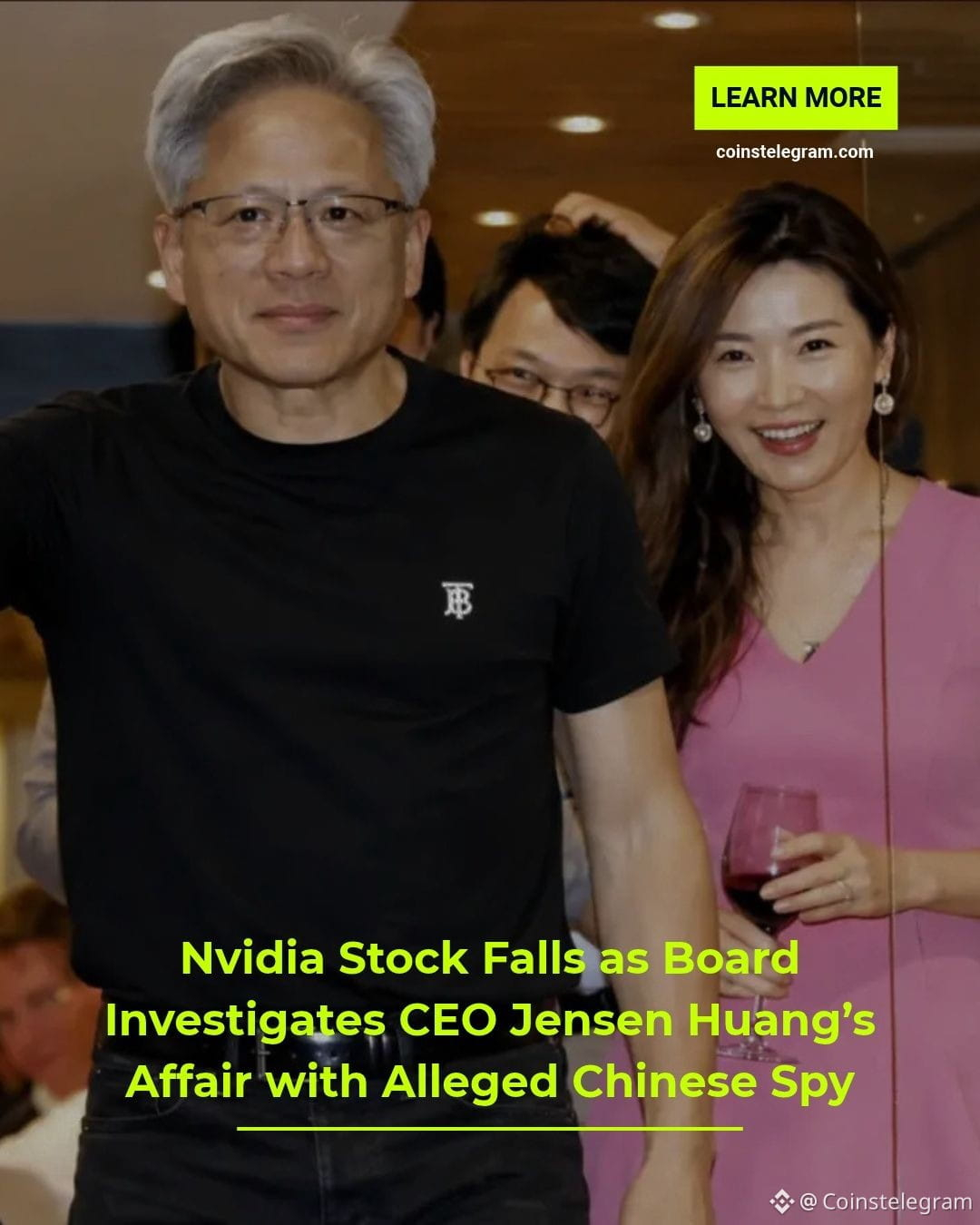
Article
Nvidia Stock Falls As Board Investigates CEO Jensen Huang’s Affair With Alleged Chinese SpyNvidia has launched an independent investigation into reports that chief executive Jensen Huang was targeted by a foreign intelligence operation, after the company’s co-founder publicly admitted to an extramarital affair.
The chipmaker announced the inquiry on Sunday, November 8. Its board said independent directors, supported by external legal counsel, would examine the allegations. Crucially, it said it currently had no reason to believe that US national security or Nvidia’s confidential information had been compromised.
Nvidia shares fell approximately 4–4.5% in early US premarket trading on November 9. The developments introduce fresh uncertainty around the leadership of a company central to the global artificial intelligence industry.
Huang Admits Affair and Supports Independent Investigation
In an email to employees published on Nvidia’s official website, Huang apologized to his wife, children and colleagues.
He acknowledged being unfaithful and accepted responsibility for the harm caused to his family. He also said he remained committed to Nvidia and would work to regain the confidence of employees, directors, partners and shareholders.
Addressing the national security concerns raised in reporting, Huang said he supported the independent investigation and would cooperate fully. He also expressed his commitment to protecting Nvidia and supporting US national security.
His admission should be distinguished from the espionage allegations. Acknowledging an affair does not establish that he knowingly assisted a foreign government, disclosed confidential information or violated export restrictions.
Those questions remain separate matters requiring evidence.
The board’s statement expressed confidence in Huang and his leadership team. It did not announce his suspension, resignation or replacement, nor did it provide a deadline for completing the review.
What Is Known About the Alleged Chinese Intelligence Connection?
The investigation follows reporting about Huang’s relationship with Alice Huang, a Chinese businesswoman who previously held a senior position at Singapore-based Megaspeed, an Nvidia customer. The two are not related.
According to reporting on the investigation, US authorities concluded that Alice Huang had acted as a Chinese intelligence asset. That assessment is an allegation reported by journalists; Nvidia’s inquiry has not publicly established what information, if any, was obtained through the relationship.
The distinction between an intelligence assessment and a publicly demonstrated corporate security breach is important. Neither Nvidia nor its board has announced that company secrets were stolen.
China has rejected the allegations. Foreign Ministry spokesperson Guo Jiakun described the Chinese-spy narrative as a groundless accusation and smear.
Megaspeed did not immediately respond to a request for comment. Alice Huang’s location could not be determined to seek her response.
For now, the verified corporate development is the independent investigation itself—not a concluded finding of espionage.
Why the Investigation Matters for Nvidia Investors
Huang’s importance extends beyond his formal position. As Nvidia’s co-founder and public face, he plays a prominent role in communicating its technology strategy and maintaining relationships with customers, governments and industry partners.
That makes uncertainty about his leadership financially significant.
Analyst Dan Ives described the situation as a reputational setback and warned that it could prompt congressional inquiries. His expectation that Huang would remain chief executive in the near term is an analyst assessment, rather than a guarantee about the board’s eventual decision.
Investors face several distinct questions: whether sensitive information was exposed, whether internal safeguards were adequate and whether the review will affect leadership continuity.
Those issues could matter even if Nvidia’s chip demand remains unchanged.
The investigation also arrives during heightened sensitivity around AI investment. Nvidia’s shares had already weakened before Sunday’s announcement, so its recent performance cannot be attributed entirely to the latest revelations.
A completed investigation could reduce uncertainty. Until then, forecasts about Huang’s removal or the ultimate financial consequences remain speculative.
China Chip Restrictions Add Another Layer of Scrutiny
The allegations intersect with the longstanding debate over China’s access to advanced AI processors.
US export restrictions apply to certain Nvidia products and transactions involving China. Describing the situation as a blanket ban on every Nvidia chip would be inaccurate: restrictions depend on the hardware, destination, customer and applicable licensing requirements.
Nvidia has argued for continued access to the Chinese market, including sales permitted under US rules. The company’s commercial position does not itself establish that export controls were breached.
The relationship between technology sales and national security nevertheless makes the investigation particularly sensitive.
The board has explicitly placed US national and economic security among its priorities. Its review will examine available information while the company maintains that it currently has no reason to believe either national security or Nvidia secrets were compromised.
The relevant question is what the evidence establishes—not whether doing business with Chinese customers automatically implies wrongdoing.
Bitcoin Falls, but Broader Stock Markets Show a Mixed Picture
Crypto markets experienced substantial turbulence heading into November 9. Bitcoin dropped to approximately $73,761 before recovering above $75,000, while Ether rebounded after briefly falling below $2,100.
More than $1 billion in leveraged crypto positions were liquidated over 24 hours. Approximately $913 million involved positions betting on rising prices. The volatility coincided with the Nvidia news and stalled US-Iran talks; it cannot reliably be assigned to one cause.
However, stocks were not uniformly lower. At 5:10 a.m. ET, Dow, S&P 500 and Nasdaq 100 futures were higher even as Nvidia fell premarket.
That divergence matters: Nvidia’s company-specific decline and crypto’s overnight volatility were occurring within a broader market showing mixed reactions. Investors now await further board disclosures and evidence clarifying whether the allegations involved any actual compromise of sensitive information.
Nvidia Stock Falls As Board Investigates CEO Jensen Huang’s Affair With Alleged Chinese Spy
Nvidia has launched an independent investigation into reports that chief executive Jensen Huang was targeted by a foreign intelligence operation, after the company’s co-founder publicly admitted to an extramarital affair.
The chipmaker announced the inquiry on Sunday, November 8. Its board said independent directors, supported by external legal counsel, would examine the allegations. Crucially, it said it currently had no reason to believe that US national security or Nvidia’s confidential information had been compromised.
Nvidia shares fell approximately 4–4.5% in early US premarket trading on November 9. The developments introduce fresh uncertainty around the leadership of a company central to the global artificial intelligence industry.
Huang Admits Affair and Supports Independent Investigation
In an email to employees published on Nvidia’s official website, Huang apologized to his wife, children and colleagues.
He acknowledged being unfaithful and accepted responsibility for the harm caused to his family. He also said he remained committed to Nvidia and would work to regain the confidence of employees, directors, partners and shareholders.
Addressing the national security concerns raised in reporting, Huang said he supported the independent investigation and would cooperate fully. He also expressed his commitment to protecting Nvidia and supporting US national security.
His admission should be distinguished from the espionage allegations. Acknowledging an affair does not establish that he knowingly assisted a foreign government, disclosed confidential information or violated export restrictions.
Those questions remain separate matters requiring evidence.
The board’s statement expressed confidence in Huang and his leadership team. It did not announce his suspension, resignation or replacement, nor did it provide a deadline for completing the review.
What Is Known About the Alleged Chinese Intelligence Connection?
The investigation follows reporting about Huang’s relationship with Alice Huang, a Chinese businesswoman who previously held a senior position at Singapore-based Megaspeed, an Nvidia customer. The two are not related.
According to reporting on the investigation, US authorities concluded that Alice Huang had acted as a Chinese intelligence asset. That assessment is an allegation reported by journalists; Nvidia’s inquiry has not publicly established what information, if any, was obtained through the relationship.
The distinction between an intelligence assessment and a publicly demonstrated corporate security breach is important. Neither Nvidia nor its board has announced that company secrets were stolen.
China has rejected the allegations. Foreign Ministry spokesperson Guo Jiakun described the Chinese-spy narrative as a groundless accusation and smear.
Megaspeed did not immediately respond to a request for comment. Alice Huang’s location could not be determined to seek her response.
For now, the verified corporate development is the independent investigation itself—not a concluded finding of espionage.
Why the Investigation Matters for Nvidia Investors
Huang’s importance extends beyond his formal position. As Nvidia’s co-founder and public face, he plays a prominent role in communicating its technology strategy and maintaining relationships with customers, governments and industry partners.
That makes uncertainty about his leadership financially significant.
Analyst Dan Ives described the situation as a reputational setback and warned that it could prompt congressional inquiries. His expectation that Huang would remain chief executive in the near term is an analyst assessment, rather than a guarantee about the board’s eventual decision.
Investors face several distinct questions: whether sensitive information was exposed, whether internal safeguards were adequate and whether the review will affect leadership continuity.
Those issues could matter even if Nvidia’s chip demand remains unchanged.
The investigation also arrives during heightened sensitivity around AI investment. Nvidia’s shares had already weakened before Sunday’s announcement, so its recent performance cannot be attributed entirely to the latest revelations.
A completed investigation could reduce uncertainty. Until then, forecasts about Huang’s removal or the ultimate financial consequences remain speculative.
China Chip Restrictions Add Another Layer of Scrutiny
The allegations intersect with the longstanding debate over China’s access to advanced AI processors.
US export restrictions apply to certain Nvidia products and transactions involving China. Describing the situation as a blanket ban on every Nvidia chip would be inaccurate: restrictions depend on the hardware, destination, customer and applicable licensing requirements.
Nvidia has argued for continued access to the Chinese market, including sales permitted under US rules. The company’s commercial position does not itself establish that export controls were breached.
The relationship between technology sales and national security nevertheless makes the investigation particularly sensitive.
The board has explicitly placed US national and economic security among its priorities. Its review will examine available information while the company maintains that it currently has no reason to believe either national security or Nvidia secrets were compromised.
The relevant question is what the evidence establishes—not whether doing business with Chinese customers automatically implies wrongdoing.
Bitcoin Falls, but Broader Stock Markets Show a Mixed Picture
Crypto markets experienced substantial turbulence heading into November 9. Bitcoin dropped to approximately $73,761 before recovering above $75,000, while Ether rebounded after briefly falling below $2,100.
More than $1 billion in leveraged crypto positions were liquidated over 24 hours. Approximately $913 million involved positions betting on rising prices. The volatility coincided with the Nvidia news and stalled US-Iran talks; it cannot reliably be assigned to one cause.
However, stocks were not uniformly lower. At 5:10 a.m. ET, Dow, S&P 500 and Nasdaq 100 futures were higher even as Nvidia fell premarket.
That divergence matters: Nvidia’s company-specific decline and crypto’s overnight volatility were occurring within a broader market showing mixed reactions. Investors now await further board disclosures and evidence clarifying whether the allegations involved any actual compromise of sensitive information.
The chipmaker announced the inquiry on Sunday, November 8. Its board said independent directors, supported by external legal counsel, would examine the allegations. Crucially, it said it currently had no reason to believe that US national security or Nvidia’s confidential information had been compromised.
Nvidia shares fell approximately 4–4.5% in early US premarket trading on November 9. The developments introduce fresh uncertainty around the leadership of a company central to the global artificial intelligence industry.
Huang Admits Affair and Supports Independent Investigation
In an email to employees published on Nvidia’s official website, Huang apologized to his wife, children and colleagues.
He acknowledged being unfaithful and accepted responsibility for the harm caused to his family. He also said he remained committed to Nvidia and would work to regain the confidence of employees, directors, partners and shareholders.
Addressing the national security concerns raised in reporting, Huang said he supported the independent investigation and would cooperate fully. He also expressed his commitment to protecting Nvidia and supporting US national security.
His admission should be distinguished from the espionage allegations. Acknowledging an affair does not establish that he knowingly assisted a foreign government, disclosed confidential information or violated export restrictions.
Those questions remain separate matters requiring evidence.
The board’s statement expressed confidence in Huang and his leadership team. It did not announce his suspension, resignation or replacement, nor did it provide a deadline for completing the review.
What Is Known About the Alleged Chinese Intelligence Connection?
The investigation follows reporting about Huang’s relationship with Alice Huang, a Chinese businesswoman who previously held a senior position at Singapore-based Megaspeed, an Nvidia customer. The two are not related.
According to reporting on the investigation, US authorities concluded that Alice Huang had acted as a Chinese intelligence asset. That assessment is an allegation reported by journalists; Nvidia’s inquiry has not publicly established what information, if any, was obtained through the relationship.
The distinction between an intelligence assessment and a publicly demonstrated corporate security breach is important. Neither Nvidia nor its board has announced that company secrets were stolen.
China has rejected the allegations. Foreign Ministry spokesperson Guo Jiakun described the Chinese-spy narrative as a groundless accusation and smear.
Megaspeed did not immediately respond to a request for comment. Alice Huang’s location could not be determined to seek her response.
For now, the verified corporate development is the independent investigation itself—not a concluded finding of espionage.
Why the Investigation Matters for Nvidia Investors
Huang’s importance extends beyond his formal position. As Nvidia’s co-founder and public face, he plays a prominent role in communicating its technology strategy and maintaining relationships with customers, governments and industry partners.
That makes uncertainty about his leadership financially significant.
Analyst Dan Ives described the situation as a reputational setback and warned that it could prompt congressional inquiries. His expectation that Huang would remain chief executive in the near term is an analyst assessment, rather than a guarantee about the board’s eventual decision.
Investors face several distinct questions: whether sensitive information was exposed, whether internal safeguards were adequate and whether the review will affect leadership continuity.
Those issues could matter even if Nvidia’s chip demand remains unchanged.
The investigation also arrives during heightened sensitivity around AI investment. Nvidia’s shares had already weakened before Sunday’s announcement, so its recent performance cannot be attributed entirely to the latest revelations.
A completed investigation could reduce uncertainty. Until then, forecasts about Huang’s removal or the ultimate financial consequences remain speculative.
China Chip Restrictions Add Another Layer of Scrutiny
The allegations intersect with the longstanding debate over China’s access to advanced AI processors.
US export restrictions apply to certain Nvidia products and transactions involving China. Describing the situation as a blanket ban on every Nvidia chip would be inaccurate: restrictions depend on the hardware, destination, customer and applicable licensing requirements.
Nvidia has argued for continued access to the Chinese market, including sales permitted under US rules. The company’s commercial position does not itself establish that export controls were breached.
The relationship between technology sales and national security nevertheless makes the investigation particularly sensitive.
The board has explicitly placed US national and economic security among its priorities. Its review will examine available information while the company maintains that it currently has no reason to believe either national security or Nvidia secrets were compromised.
The relevant question is what the evidence establishes—not whether doing business with Chinese customers automatically implies wrongdoing.
Bitcoin Falls, but Broader Stock Markets Show a Mixed Picture
Crypto markets experienced substantial turbulence heading into November 9. Bitcoin dropped to approximately $73,761 before recovering above $75,000, while Ether rebounded after briefly falling below $2,100.
More than $1 billion in leveraged crypto positions were liquidated over 24 hours. Approximately $913 million involved positions betting on rising prices. The volatility coincided with the Nvidia news and stalled US-Iran talks; it cannot reliably be assigned to one cause.
However, stocks were not uniformly lower. At 5:10 a.m. ET, Dow, S&P 500 and Nasdaq 100 futures were higher even as Nvidia fell premarket.
That divergence matters: Nvidia’s company-specific decline and crypto’s overnight volatility were occurring within a broader market showing mixed reactions. Investors now await further board disclosures and evidence clarifying whether the allegations involved any actual compromise of sensitive information.
450
From USDT to Bitcoin: How to Stop Waiting for the Perfect MomentIn mid-October, Bitcoin was trading in the low $80,000s, roughly a third below its all-time high of about $126,000 set in October 2025. In July and early August, it traded in the $60,000 range, then rallied from mid-August. For anyone holding stablecoins, those months were a lesson in hesitation. At $60,000, buying felt risky, because the price could fall further. At $80,000, it feels late, because the price has already grown. Meanwhile, the USDT stays where it is.
Nobody can pick the bottom in advance. A moment that looks obvious in hindsight rarely looks obvious while it is happening, and traders who wait for a clear signal often get it after the price has already moved. Then comes the familiar thought: I should have bought earlier.
What can be decided today is the plan: how much of your capital you are prepared to put at risk, in how many parts you will buy, and what you will do if the price falls or rises. If you hold USDT and no BTC yet, that usually means building a position in parts while keeping the rest in stablecoins. Without a plan, the decision gets made under pressure, and under pressure it tends to follow the price: buying after growth, hesitating after a drop.
A $5,000 plan on paper
Take a hypothetical user with $5,000 in USDT. Converting all of it at once fixes a single entry price for the whole amount. If the price drops the next day, the whole amount is already worth less than he paid. If it rises, he is in, but only at that one price. Nobody knows which way it will go, so he splits the purchase. His plan is simple: buy $1,000 of BTC now and keep $4,000 for later purchases, if and when he decides to make them.
The logic is straightforward. If the price falls, the next purchases are made cheaper, and the average entry price goes down. If it rises, the first part is already in the position. The average entry lands between the extremes. This guarantees no profit, but it removes the pressure of one perfectly timed decision.
A plan like this has more than one transaction. Each of the four remaining purchases is a separate swap with its own quote, its own fees and its own terms to check. With several purchases, these small costs repeat, so it helps to know in advance what each swap will cost and how many actions it takes.
Where the steps can shrink
Some services try to shorten that route. 001k.bot, a custodial platform for managing digital assets through Telegram and the web, is one example. If a user already holds USDT in his balance there, buying BTC happens inside the same account:
Choose USDT → Select BTC → Enter amount → Check quote → Confirm swap.
For a gradual plan, two details matter. The user can convert any part of his USDT, for example $1,000 out of $5,000, and leave the rest untouched until the next purchase. Before confirming, he sees the current rate and the exact amount of BTC he will receive. That gives him time to compare terms with other platforms and decide whether to go ahead.
On pricing: under a current promotion, 001k.bot charges a 0% service fee on eligible USDT to BTC swaps. That covers the service fee only. A spread may be included in the quote, and BTC withdrawals and network costs are charged separately under the platform’s terms.
Purchased BTC is credited to his balance on the platform. From there, the user can keep it or withdraw it to an external wallet over the Bitcoin network.
Checks still apply
001k.bot runs AML monitoring on transactions as a standing part of its security approach. KYC is a separate step: where no additional review is needed, a swap can go through without mandatory verification, while in some cases the platform may ask the user to verify their identity or provide additional information.
A plan you can actually follow
You do not have to guess the next bottom or move all your stablecoins at once. A written plan with set amounts already takes much of the emotional pressure out of the decision.
What matters is having your own plan and a convenient tool to carry it out. The decision of whether and when to buy stays with you, and the tool only needs to make the swap itself simple: check the terms, confirm, and move on to the next step without rebuilding the route each time. Tools like 001k.bot aim to keep the path from USDT to BTC short enough that the next step of the plan actually happens.
If you hold USDT and have been putting off a first purchase, open 001k.bot in Telegram or on the web, enter the amount from your plan, and review the quote before you commit.
This article is for informational purposes only and does not constitute financial advice.
From USDT to Bitcoin: How to Stop Waiting for the Perfect Moment
In mid-October, Bitcoin was trading in the low $80,000s, roughly a third below its all-time high of about $126,000 set in October 2025. In July and early August, it traded in the $60,000 range, then rallied from mid-August. For anyone holding stablecoins, those months were a lesson in hesitation. At $60,000, buying felt risky, because the price could fall further. At $80,000, it feels late, because the price has already grown. Meanwhile, the USDT stays where it is.
Nobody can pick the bottom in advance. A moment that looks obvious in hindsight rarely looks obvious while it is happening, and traders who wait for a clear signal often get it after the price has already moved. Then comes the familiar thought: I should have bought earlier.
What can be decided today is the plan: how much of your capital you are prepared to put at risk, in how many parts you will buy, and what you will do if the price falls or rises. If you hold USDT and no BTC yet, that usually means building a position in parts while keeping the rest in stablecoins. Without a plan, the decision gets made under pressure, and under pressure it tends to follow the price: buying after growth, hesitating after a drop.
A $5,000 plan on paper
Take a hypothetical user with $5,000 in USDT. Converting all of it at once fixes a single entry price for the whole amount. If the price drops the next day, the whole amount is already worth less than he paid. If it rises, he is in, but only at that one price. Nobody knows which way it will go, so he splits the purchase. His plan is simple: buy $1,000 of BTC now and keep $4,000 for later purchases, if and when he decides to make them.
The logic is straightforward. If the price falls, the next purchases are made cheaper, and the average entry price goes down. If it rises, the first part is already in the position. The average entry lands between the extremes. This guarantees no profit, but it removes the pressure of one perfectly timed decision.
A plan like this has more than one transaction. Each of the four remaining purchases is a separate swap with its own quote, its own fees and its own terms to check. With several purchases, these small costs repeat, so it helps to know in advance what each swap will cost and how many actions it takes.
Where the steps can shrink
Some services try to shorten that route. 001k.bot, a custodial platform for managing digital assets through Telegram and the web, is one example. If a user already holds USDT in his balance there, buying BTC happens inside the same account:
Choose USDT → Select BTC → Enter amount → Check quote → Confirm swap.
For a gradual plan, two details matter. The user can convert any part of his USDT, for example $1,000 out of $5,000, and leave the rest untouched until the next purchase. Before confirming, he sees the current rate and the exact amount of BTC he will receive. That gives him time to compare terms with other platforms and decide whether to go ahead.
On pricing: under a current promotion, 001k.bot charges a 0% service fee on eligible USDT to BTC swaps. That covers the service fee only. A spread may be included in the quote, and BTC withdrawals and network costs are charged separately under the platform’s terms.
Purchased BTC is credited to his balance on the platform. From there, the user can keep it or withdraw it to an external wallet over the Bitcoin network.
Checks still apply
001k.bot runs AML monitoring on transactions as a standing part of its security approach. KYC is a separate step: where no additional review is needed, a swap can go through without mandatory verification, while in some cases the platform may ask the user to verify their identity or provide additional information.
A plan you can actually follow
You do not have to guess the next bottom or move all your stablecoins at once. A written plan with set amounts already takes much of the emotional pressure out of the decision.
What matters is having your own plan and a convenient tool to carry it out. The decision of whether and when to buy stays with you, and the tool only needs to make the swap itself simple: check the terms, confirm, and move on to the next step without rebuilding the route each time. Tools like 001k.bot aim to keep the path from USDT to BTC short enough that the next step of the plan actually happens.
If you hold USDT and have been putting off a first purchase, open 001k.bot in Telegram or on the web, enter the amount from your plan, and review the quote before you commit.
This article is for informational purposes only and does not constitute financial advice.
118
Article
From USDT to Bitcoin: How to Stop Waiting for the Perfect MomentIn mid-October, Bitcoin was trading in the low $80,000s, roughly a third below its all-time high of about $126,000 set in October 2025. In July and early August, it traded in the $60,000 range, then rallied from mid-August. For anyone holding stablecoins, those months were a lesson in hesitation. At $60,000, buying felt risky, because the price could fall further. At $80,000, it feels late, because the price has already grown. Meanwhile, the USDT stays where it is.
Nobody can pick the bottom in advance. A moment that looks obvious in hindsight rarely looks obvious while it is happening, and traders who wait for a clear signal often get it after the price has already moved. Then comes the familiar thought: I should have bought earlier.
What can be decided today is the plan: how much of your capital you are prepared to put at risk, in how many parts you will buy, and what you will do if the price falls or rises. If you hold USDT and no BTC yet, that usually means building a position in parts while keeping the rest in stablecoins. Without a plan, the decision gets made under pressure, and under pressure it tends to follow the price: buying after growth, hesitating after a drop.
A $5,000 plan on paper
Take a hypothetical user with $5,000 in USDT. Converting all of it at once fixes a single entry price for the whole amount. If the price drops the next day, the whole amount is already worth less than he paid. If it rises, he is in, but only at that one price. Nobody knows which way it will go, so he splits the purchase. His plan is simple: buy $1,000 of BTC now and keep $4,000 for later purchases, if and when he decides to make them.
The logic is straightforward. If the price falls, the next purchases are made cheaper, and the average entry price goes down. If it rises, the first part is already in the position. The average entry lands between the extremes. This guarantees no profit, but it removes the pressure of one perfectly timed decision.
A plan like this has more than one transaction. Each of the four remaining purchases is a separate swap with its own quote, its own fees and its own terms to check. With several purchases, these small costs repeat, so it helps to know in advance what each swap will cost and how many actions it takes.
Where the steps can shrink
Some services try to shorten that route. 001k.bot, a custodial platform for managing digital assets through Telegram and the web, is one example. If a user already holds USDT in his balance there, buying BTC happens inside the same account:
Choose USDT → Select BTC → Enter amount → Check quote → Confirm swap.
For a gradual plan, two details matter. The user can convert any part of his USDT, for example $1,000 out of $5,000, and leave the rest untouched until the next purchase. Before confirming, he sees the current rate and the exact amount of BTC he will receive. That gives him time to compare terms with other platforms and decide whether to go ahead.
On pricing: under a current promotion, 001k.bot charges a 0% service fee on eligible USDT to BTC swaps. That covers the service fee only. A spread may be included in the quote, and BTC withdrawals and network costs are charged separately under the platform’s terms.
Purchased BTC is credited to his balance on the platform. From there, the user can keep it or withdraw it to an external wallet over the Bitcoin network.
Checks still apply
001k.bot runs AML monitoring on transactions as a standing part of its security approach. KYC is a separate step: where no additional review is needed, a swap can go through without mandatory verification, while in some cases the platform may ask the user to verify their identity or provide additional information.
A plan you can actually follow
You do not have to guess the next bottom or move all your stablecoins at once. A written plan with set amounts already takes much of the emotional pressure out of the decision.
What matters is having your own plan and a convenient tool to carry it out. The decision of whether and when to buy stays with you, and the tool only needs to make the swap itself simple: check the terms, confirm, and move on to the next step without rebuilding the route each time. Tools like 001k.bot aim to keep the path from USDT to BTC short enough that the next step of the plan actually happens.
If you hold USDT and have been putting off a first purchase, open 001k.bot in Telegram or on the web, enter the amount from your plan, and review the quote before you commit.
This article is for informational purposes only and does not constitute financial advice.
From USDT to Bitcoin: How to Stop Waiting for the Perfect Moment
In mid-October, Bitcoin was trading in the low $80,000s, roughly a third below its all-time high of about $126,000 set in October 2025. In July and early August, it traded in the $60,000 range, then rallied from mid-August. For anyone holding stablecoins, those months were a lesson in hesitation. At $60,000, buying felt risky, because the price could fall further. At $80,000, it feels late, because the price has already grown. Meanwhile, the USDT stays where it is.
Nobody can pick the bottom in advance. A moment that looks obvious in hindsight rarely looks obvious while it is happening, and traders who wait for a clear signal often get it after the price has already moved. Then comes the familiar thought: I should have bought earlier.
What can be decided today is the plan: how much of your capital you are prepared to put at risk, in how many parts you will buy, and what you will do if the price falls or rises. If you hold USDT and no BTC yet, that usually means building a position in parts while keeping the rest in stablecoins. Without a plan, the decision gets made under pressure, and under pressure it tends to follow the price: buying after growth, hesitating after a drop.
A $5,000 plan on paper
Take a hypothetical user with $5,000 in USDT. Converting all of it at once fixes a single entry price for the whole amount. If the price drops the next day, the whole amount is already worth less than he paid. If it rises, he is in, but only at that one price. Nobody knows which way it will go, so he splits the purchase. His plan is simple: buy $1,000 of BTC now and keep $4,000 for later purchases, if and when he decides to make them.
The logic is straightforward. If the price falls, the next purchases are made cheaper, and the average entry price goes down. If it rises, the first part is already in the position. The average entry lands between the extremes. This guarantees no profit, but it removes the pressure of one perfectly timed decision.
A plan like this has more than one transaction. Each of the four remaining purchases is a separate swap with its own quote, its own fees and its own terms to check. With several purchases, these small costs repeat, so it helps to know in advance what each swap will cost and how many actions it takes.
Where the steps can shrink
Some services try to shorten that route. 001k.bot, a custodial platform for managing digital assets through Telegram and the web, is one example. If a user already holds USDT in his balance there, buying BTC happens inside the same account:
Choose USDT → Select BTC → Enter amount → Check quote → Confirm swap.
For a gradual plan, two details matter. The user can convert any part of his USDT, for example $1,000 out of $5,000, and leave the rest untouched until the next purchase. Before confirming, he sees the current rate and the exact amount of BTC he will receive. That gives him time to compare terms with other platforms and decide whether to go ahead.
On pricing: under a current promotion, 001k.bot charges a 0% service fee on eligible USDT to BTC swaps. That covers the service fee only. A spread may be included in the quote, and BTC withdrawals and network costs are charged separately under the platform’s terms.
Purchased BTC is credited to his balance on the platform. From there, the user can keep it or withdraw it to an external wallet over the Bitcoin network.
Checks still apply
001k.bot runs AML monitoring on transactions as a standing part of its security approach. KYC is a separate step: where no additional review is needed, a swap can go through without mandatory verification, while in some cases the platform may ask the user to verify their identity or provide additional information.
A plan you can actually follow
You do not have to guess the next bottom or move all your stablecoins at once. A written plan with set amounts already takes much of the emotional pressure out of the decision.
What matters is having your own plan and a convenient tool to carry it out. The decision of whether and when to buy stays with you, and the tool only needs to make the swap itself simple: check the terms, confirm, and move on to the next step without rebuilding the route each time. Tools like 001k.bot aim to keep the path from USDT to BTC short enough that the next step of the plan actually happens.
If you hold USDT and have been putting off a first purchase, open 001k.bot in Telegram or on the web, enter the amount from your plan, and review the quote before you commit.
This article is for informational purposes only and does not constitute financial advice.
Nobody can pick the bottom in advance. A moment that looks obvious in hindsight rarely looks obvious while it is happening, and traders who wait for a clear signal often get it after the price has already moved. Then comes the familiar thought: I should have bought earlier.
What can be decided today is the plan: how much of your capital you are prepared to put at risk, in how many parts you will buy, and what you will do if the price falls or rises. If you hold USDT and no BTC yet, that usually means building a position in parts while keeping the rest in stablecoins. Without a plan, the decision gets made under pressure, and under pressure it tends to follow the price: buying after growth, hesitating after a drop.
A $5,000 plan on paper
Take a hypothetical user with $5,000 in USDT. Converting all of it at once fixes a single entry price for the whole amount. If the price drops the next day, the whole amount is already worth less than he paid. If it rises, he is in, but only at that one price. Nobody knows which way it will go, so he splits the purchase. His plan is simple: buy $1,000 of BTC now and keep $4,000 for later purchases, if and when he decides to make them.
The logic is straightforward. If the price falls, the next purchases are made cheaper, and the average entry price goes down. If it rises, the first part is already in the position. The average entry lands between the extremes. This guarantees no profit, but it removes the pressure of one perfectly timed decision.
A plan like this has more than one transaction. Each of the four remaining purchases is a separate swap with its own quote, its own fees and its own terms to check. With several purchases, these small costs repeat, so it helps to know in advance what each swap will cost and how many actions it takes.
Where the steps can shrink
Some services try to shorten that route. 001k.bot, a custodial platform for managing digital assets through Telegram and the web, is one example. If a user already holds USDT in his balance there, buying BTC happens inside the same account:
Choose USDT → Select BTC → Enter amount → Check quote → Confirm swap.
For a gradual plan, two details matter. The user can convert any part of his USDT, for example $1,000 out of $5,000, and leave the rest untouched until the next purchase. Before confirming, he sees the current rate and the exact amount of BTC he will receive. That gives him time to compare terms with other platforms and decide whether to go ahead.
On pricing: under a current promotion, 001k.bot charges a 0% service fee on eligible USDT to BTC swaps. That covers the service fee only. A spread may be included in the quote, and BTC withdrawals and network costs are charged separately under the platform’s terms.
Purchased BTC is credited to his balance on the platform. From there, the user can keep it or withdraw it to an external wallet over the Bitcoin network.
Checks still apply
001k.bot runs AML monitoring on transactions as a standing part of its security approach. KYC is a separate step: where no additional review is needed, a swap can go through without mandatory verification, while in some cases the platform may ask the user to verify their identity or provide additional information.
A plan you can actually follow
You do not have to guess the next bottom or move all your stablecoins at once. A written plan with set amounts already takes much of the emotional pressure out of the decision.
What matters is having your own plan and a convenient tool to carry it out. The decision of whether and when to buy stays with you, and the tool only needs to make the swap itself simple: check the terms, confirm, and move on to the next step without rebuilding the route each time. Tools like 001k.bot aim to keep the path from USDT to BTC short enough that the next step of the plan actually happens.
If you hold USDT and have been putting off a first purchase, open 001k.bot in Telegram or on the web, enter the amount from your plan, and review the quote before you commit.
This article is for informational purposes only and does not constitute financial advice.
220
Trump-Backed World Liberty Financial Announces WLFI Buybacks After Token Falls Over 60%World Liberty Financial, the cryptocurrency venture backed by Donald Trump and his family, has announced a buyback program for its WLFI governance token after a sharp decline in its price.
The company said an initial funding allocation could include revenue generated from reserves backing its USD1 stablecoin, alongside other sources. It presented the initiative as a long-term governance strategy intended to encourage participation and strengthen the position of committed holders.
The announcement followed Republican losses in the November 3 US midterm elections. WLFI fell approximately 10% after the vote, extending its year-to-date decline beyond 60%. The separate TRUMP memecoin also reached a record low amid political uncertainty and a broader market selloff.
How the WLFI Token Buyback Program Will Work
World Liberty announced the program on Thursday, November 5, saying the growth of USD1 and its wider ecosystem had helped make further token purchases possible.
The project outlined its proposed funding approach:
We plan to fund buybacks with an initial allocation that may include fees earned from USD1 reserves and other sources. We’ll start with an initial allocation and evaluate the program over time.
The wording leaves important details open. The statement did not specify the initial budget, a purchase schedule or a fixed proportion of revenue dedicated to buybacks.
World Liberty said purchases were intended to become an ongoing part of its strategy, with their pace and scale determined by ecosystem growth and their effect on governance participation.
This is not its first experience with repurchases. In April, the company disclosed $65.6 million in open-market buybacks over the preceding six months.
For holders, the distinction between an announcement and execution matters. A commitment to evaluate purchases over time is different from an obligation to buy a predetermined quantity.
Buybacks also do not automatically mean tokens will be permanently destroyed. The supplied announcement does not establish a burn mechanism, so any resulting reduction in total supply should not be assumed.
USD1 Reserve Revenue Could Help Fund Purchases
USD1 and WLFI serve different purposes within World Liberty’s business.
USD1 is a dollar-backed stablecoin, while WLFI is a governance token. Buying WLFI does not make it equivalent to holding dollars or guarantee that its market price will remain stable.
World Liberty’s disclosures state that BitGo and affiliated World Liberty entities are entitled to interest earned on assets backing USD1 under agreements between them. BitGo also publishes reserve attestations.
That provides context for the proposed funding source: reserve assets can generate income, some of which may be available to the relevant businesses.
However, using income earned from reserves is different from spending the underlying assets needed to back outstanding stablecoins. The announcement refers to fees or revenue associated with reserves; it does not announce the removal of USD1’s backing to purchase WLFI.
The potential connection is commercially significant. Growth in a stablecoin business could help finance purchases of a related governance token. Whether that translates into sustained buying depends on actual revenue, allocations and execution.
A buyback can introduce demand, but it cannot guarantee a price recovery or offset all selling pressure.
Election Losses Put Trump-Linked Tokens Under Pressure
WLFI’s decline accelerated after Democrats won control of Congress in this week’s elections, increasing uncertainty around the administration’s legislative agenda and Trump-linked businesses.
The governance token lost approximately another 10% following the vote. Separate reporting placed its year-to-date decline above 66%, although the precise percentage varies with the observation time.
The TRUMP memecoin also fell sharply. It reached approximately $1.12 on November 5, its lowest recorded price, after losing around 16% over a 24-hour period.
WLFI and TRUMP should not be confused. They are separate assets with different structures, purposes and economic arrangements. World Liberty’s WLFI buyback announcement does not establish any corresponding purchase program for TRUMP.
The political backdrop is relevant, but it is not the only explanation for falling prices. The declines coincided with weakness across technology stocks and cryptocurrencies, making it difficult to isolate the election’s contribution.
Neither a political association nor a corporate buyback removes the market risks facing holders.
Democrats Signal Investigations Into Trump Family Dealings
The prospect of investigations is more than an unsupported social-media rumor. Following their election victory, Democratic leaders publicly outlined plans for extensive congressional oversight of alleged self-enrichment involving Trump, his family and associates.
Potential areas of scrutiny include cryptocurrency businesses and real estate dealings. However, a stated intention to investigate is different from a completed investigation, a formal allegation against a particular token or a finding of wrongdoing.
The new congressional balance could increase demands for documents, hearings and explanations about business relationships. It does not automatically establish that WLFI, USD1 or TRUMP violated the law.
Republicans and the White House have denied wrongdoing and warned that investigations could become politically motivated.
For investors, the immediate issue is uncertainty. Congressional scrutiny can affect sentiment and business decisions even before it produces findings. Claims that authorities have already established misconduct would go beyond the information available.
The Trump Family’s Crypto Businesses Extend Beyond WLFI
World Liberty is one part of a broader collection of Trump-linked cryptocurrency ventures. The family holds an economic interest in World Liberty, whose products include WLFI and USD1. Separately, the official TRUMP token involves Trump-affiliated entities CIC Digital and Fight Fight Fight. Eric Trump and Donald Trump Jr. are also involved in American Bitcoin, a mining business formed with Hut 8. These are distinct ventures, rather than interchangeable parts of one token project.
Their different revenue models matter: governance-token activity, stablecoin reserve income, memecoin trading arrangements and Bitcoin mining create different exposures.
For World Liberty, the next measurable developments are the buyback allocation, completed purchases and the treatment of repurchased tokens. Those details will determine how the program operates beyond its announcement—and whether it changes governance participation as the company intends.
Trump-Backed World Liberty Financial Announces WLFI Buybacks After Token Falls Over 60%
World Liberty Financial, the cryptocurrency venture backed by Donald Trump and his family, has announced a buyback program for its WLFI governance token after a sharp decline in its price.
The company said an initial funding allocation could include revenue generated from reserves backing its USD1 stablecoin, alongside other sources. It presented the initiative as a long-term governance strategy intended to encourage participation and strengthen the position of committed holders.
The announcement followed Republican losses in the November 3 US midterm elections. WLFI fell approximately 10% after the vote, extending its year-to-date decline beyond 60%. The separate TRUMP memecoin also reached a record low amid political uncertainty and a broader market selloff.
How the WLFI Token Buyback Program Will Work
World Liberty announced the program on Thursday, November 5, saying the growth of USD1 and its wider ecosystem had helped make further token purchases possible.
The project outlined its proposed funding approach:
We plan to fund buybacks with an initial allocation that may include fees earned from USD1 reserves and other sources. We’ll start with an initial allocation and evaluate the program over time.
The wording leaves important details open. The statement did not specify the initial budget, a purchase schedule or a fixed proportion of revenue dedicated to buybacks.
World Liberty said purchases were intended to become an ongoing part of its strategy, with their pace and scale determined by ecosystem growth and their effect on governance participation.
This is not its first experience with repurchases. In April, the company disclosed $65.6 million in open-market buybacks over the preceding six months.
For holders, the distinction between an announcement and execution matters. A commitment to evaluate purchases over time is different from an obligation to buy a predetermined quantity.
Buybacks also do not automatically mean tokens will be permanently destroyed. The supplied announcement does not establish a burn mechanism, so any resulting reduction in total supply should not be assumed.
USD1 Reserve Revenue Could Help Fund Purchases
USD1 and WLFI serve different purposes within World Liberty’s business.
USD1 is a dollar-backed stablecoin, while WLFI is a governance token. Buying WLFI does not make it equivalent to holding dollars or guarantee that its market price will remain stable.
World Liberty’s disclosures state that BitGo and affiliated World Liberty entities are entitled to interest earned on assets backing USD1 under agreements between them. BitGo also publishes reserve attestations.
That provides context for the proposed funding source: reserve assets can generate income, some of which may be available to the relevant businesses.
However, using income earned from reserves is different from spending the underlying assets needed to back outstanding stablecoins. The announcement refers to fees or revenue associated with reserves; it does not announce the removal of USD1’s backing to purchase WLFI.
The potential connection is commercially significant. Growth in a stablecoin business could help finance purchases of a related governance token. Whether that translates into sustained buying depends on actual revenue, allocations and execution.
A buyback can introduce demand, but it cannot guarantee a price recovery or offset all selling pressure.
Election Losses Put Trump-Linked Tokens Under Pressure
WLFI’s decline accelerated after Democrats won control of Congress in this week’s elections, increasing uncertainty around the administration’s legislative agenda and Trump-linked businesses.
The governance token lost approximately another 10% following the vote. Separate reporting placed its year-to-date decline above 66%, although the precise percentage varies with the observation time.
The TRUMP memecoin also fell sharply. It reached approximately $1.12 on November 5, its lowest recorded price, after losing around 16% over a 24-hour period.
WLFI and TRUMP should not be confused. They are separate assets with different structures, purposes and economic arrangements. World Liberty’s WLFI buyback announcement does not establish any corresponding purchase program for TRUMP.
The political backdrop is relevant, but it is not the only explanation for falling prices. The declines coincided with weakness across technology stocks and cryptocurrencies, making it difficult to isolate the election’s contribution.
Neither a political association nor a corporate buyback removes the market risks facing holders.
Democrats Signal Investigations Into Trump Family Dealings
The prospect of investigations is more than an unsupported social-media rumor. Following their election victory, Democratic leaders publicly outlined plans for extensive congressional oversight of alleged self-enrichment involving Trump, his family and associates.
Potential areas of scrutiny include cryptocurrency businesses and real estate dealings. However, a stated intention to investigate is different from a completed investigation, a formal allegation against a particular token or a finding of wrongdoing.
The new congressional balance could increase demands for documents, hearings and explanations about business relationships. It does not automatically establish that WLFI, USD1 or TRUMP violated the law.
Republicans and the White House have denied wrongdoing and warned that investigations could become politically motivated.
For investors, the immediate issue is uncertainty. Congressional scrutiny can affect sentiment and business decisions even before it produces findings. Claims that authorities have already established misconduct would go beyond the information available.
The Trump Family’s Crypto Businesses Extend Beyond WLFI
World Liberty is one part of a broader collection of Trump-linked cryptocurrency ventures. The family holds an economic interest in World Liberty, whose products include WLFI and USD1. Separately, the official TRUMP token involves Trump-affiliated entities CIC Digital and Fight Fight Fight. Eric Trump and Donald Trump Jr. are also involved in American Bitcoin, a mining business formed with Hut 8. These are distinct ventures, rather than interchangeable parts of one token project.
Their different revenue models matter: governance-token activity, stablecoin reserve income, memecoin trading arrangements and Bitcoin mining create different exposures.
For World Liberty, the next measurable developments are the buyback allocation, completed purchases and the treatment of repurchased tokens. Those details will determine how the program operates beyond its announcement—and whether it changes governance participation as the company intends.
80
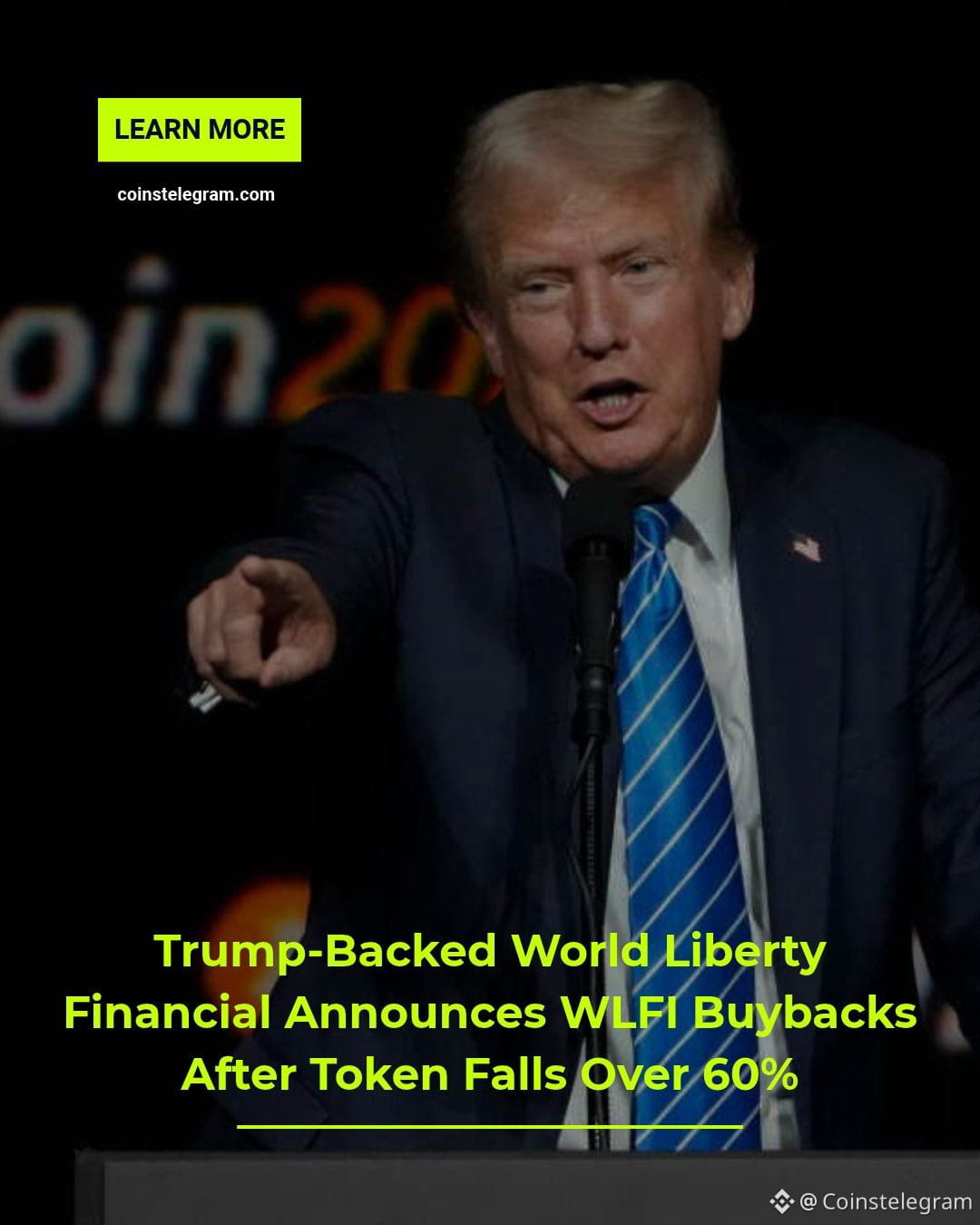
Article
Trump-Backed World Liberty Financial Announces WLFI Buybacks After Token Falls Over 60%World Liberty Financial, the cryptocurrency venture backed by Donald Trump and his family, has announced a buyback program for its WLFI governance token after a sharp decline in its price.
The company said an initial funding allocation could include revenue generated from reserves backing its USD1 stablecoin, alongside other sources. It presented the initiative as a long-term governance strategy intended to encourage participation and strengthen the position of committed holders.
The announcement followed Republican losses in the November 3 US midterm elections. WLFI fell approximately 10% after the vote, extending its year-to-date decline beyond 60%. The separate TRUMP memecoin also reached a record low amid political uncertainty and a broader market selloff.
How the WLFI Token Buyback Program Will Work
World Liberty announced the program on Thursday, November 5, saying the growth of USD1 and its wider ecosystem had helped make further token purchases possible.
The project outlined its proposed funding approach:
We plan to fund buybacks with an initial allocation that may include fees earned from USD1 reserves and other sources. We’ll start with an initial allocation and evaluate the program over time.
The wording leaves important details open. The statement did not specify the initial budget, a purchase schedule or a fixed proportion of revenue dedicated to buybacks.
World Liberty said purchases were intended to become an ongoing part of its strategy, with their pace and scale determined by ecosystem growth and their effect on governance participation.
This is not its first experience with repurchases. In April, the company disclosed $65.6 million in open-market buybacks over the preceding six months.
For holders, the distinction between an announcement and execution matters. A commitment to evaluate purchases over time is different from an obligation to buy a predetermined quantity.
Buybacks also do not automatically mean tokens will be permanently destroyed. The supplied announcement does not establish a burn mechanism, so any resulting reduction in total supply should not be assumed.
USD1 Reserve Revenue Could Help Fund Purchases
USD1 and WLFI serve different purposes within World Liberty’s business.
USD1 is a dollar-backed stablecoin, while WLFI is a governance token. Buying WLFI does not make it equivalent to holding dollars or guarantee that its market price will remain stable.
World Liberty’s disclosures state that BitGo and affiliated World Liberty entities are entitled to interest earned on assets backing USD1 under agreements between them. BitGo also publishes reserve attestations.
That provides context for the proposed funding source: reserve assets can generate income, some of which may be available to the relevant businesses.
However, using income earned from reserves is different from spending the underlying assets needed to back outstanding stablecoins. The announcement refers to fees or revenue associated with reserves; it does not announce the removal of USD1’s backing to purchase WLFI.
The potential connection is commercially significant. Growth in a stablecoin business could help finance purchases of a related governance token. Whether that translates into sustained buying depends on actual revenue, allocations and execution.
A buyback can introduce demand, but it cannot guarantee a price recovery or offset all selling pressure.
Election Losses Put Trump-Linked Tokens Under Pressure
WLFI’s decline accelerated after Democrats won control of Congress in this week’s elections, increasing uncertainty around the administration’s legislative agenda and Trump-linked businesses.
The governance token lost approximately another 10% following the vote. Separate reporting placed its year-to-date decline above 66%, although the precise percentage varies with the observation time.
The TRUMP memecoin also fell sharply. It reached approximately $1.12 on November 5, its lowest recorded price, after losing around 16% over a 24-hour period.
WLFI and TRUMP should not be confused. They are separate assets with different structures, purposes and economic arrangements. World Liberty’s WLFI buyback announcement does not establish any corresponding purchase program for TRUMP.
The political backdrop is relevant, but it is not the only explanation for falling prices. The declines coincided with weakness across technology stocks and cryptocurrencies, making it difficult to isolate the election’s contribution.
Neither a political association nor a corporate buyback removes the market risks facing holders.
Democrats Signal Investigations Into Trump Family Dealings
The prospect of investigations is more than an unsupported social-media rumor. Following their election victory, Democratic leaders publicly outlined plans for extensive congressional oversight of alleged self-enrichment involving Trump, his family and associates.
Potential areas of scrutiny include cryptocurrency businesses and real estate dealings. However, a stated intention to investigate is different from a completed investigation, a formal allegation against a particular token or a finding of wrongdoing.
The new congressional balance could increase demands for documents, hearings and explanations about business relationships. It does not automatically establish that WLFI, USD1 or TRUMP violated the law.
Republicans and the White House have denied wrongdoing and warned that investigations could become politically motivated.
For investors, the immediate issue is uncertainty. Congressional scrutiny can affect sentiment and business decisions even before it produces findings. Claims that authorities have already established misconduct would go beyond the information available.
The Trump Family’s Crypto Businesses Extend Beyond WLFI
World Liberty is one part of a broader collection of Trump-linked cryptocurrency ventures. The family holds an economic interest in World Liberty, whose products include WLFI and USD1. Separately, the official TRUMP token involves Trump-affiliated entities CIC Digital and Fight Fight Fight. Eric Trump and Donald Trump Jr. are also involved in American Bitcoin, a mining business formed with Hut 8. These are distinct ventures, rather than interchangeable parts of one token project.
Their different revenue models matter: governance-token activity, stablecoin reserve income, memecoin trading arrangements and Bitcoin mining create different exposures.
For World Liberty, the next measurable developments are the buyback allocation, completed purchases and the treatment of repurchased tokens. Those details will determine how the program operates beyond its announcement—and whether it changes governance participation as the company intends.
Trump-Backed World Liberty Financial Announces WLFI Buybacks After Token Falls Over 60%
World Liberty Financial, the cryptocurrency venture backed by Donald Trump and his family, has announced a buyback program for its WLFI governance token after a sharp decline in its price.
The company said an initial funding allocation could include revenue generated from reserves backing its USD1 stablecoin, alongside other sources. It presented the initiative as a long-term governance strategy intended to encourage participation and strengthen the position of committed holders.
The announcement followed Republican losses in the November 3 US midterm elections. WLFI fell approximately 10% after the vote, extending its year-to-date decline beyond 60%. The separate TRUMP memecoin also reached a record low amid political uncertainty and a broader market selloff.
How the WLFI Token Buyback Program Will Work
World Liberty announced the program on Thursday, November 5, saying the growth of USD1 and its wider ecosystem had helped make further token purchases possible.
The project outlined its proposed funding approach:
We plan to fund buybacks with an initial allocation that may include fees earned from USD1 reserves and other sources. We’ll start with an initial allocation and evaluate the program over time.
The wording leaves important details open. The statement did not specify the initial budget, a purchase schedule or a fixed proportion of revenue dedicated to buybacks.
World Liberty said purchases were intended to become an ongoing part of its strategy, with their pace and scale determined by ecosystem growth and their effect on governance participation.
This is not its first experience with repurchases. In April, the company disclosed $65.6 million in open-market buybacks over the preceding six months.
For holders, the distinction between an announcement and execution matters. A commitment to evaluate purchases over time is different from an obligation to buy a predetermined quantity.
Buybacks also do not automatically mean tokens will be permanently destroyed. The supplied announcement does not establish a burn mechanism, so any resulting reduction in total supply should not be assumed.
USD1 Reserve Revenue Could Help Fund Purchases
USD1 and WLFI serve different purposes within World Liberty’s business.
USD1 is a dollar-backed stablecoin, while WLFI is a governance token. Buying WLFI does not make it equivalent to holding dollars or guarantee that its market price will remain stable.
World Liberty’s disclosures state that BitGo and affiliated World Liberty entities are entitled to interest earned on assets backing USD1 under agreements between them. BitGo also publishes reserve attestations.
That provides context for the proposed funding source: reserve assets can generate income, some of which may be available to the relevant businesses.
However, using income earned from reserves is different from spending the underlying assets needed to back outstanding stablecoins. The announcement refers to fees or revenue associated with reserves; it does not announce the removal of USD1’s backing to purchase WLFI.
The potential connection is commercially significant. Growth in a stablecoin business could help finance purchases of a related governance token. Whether that translates into sustained buying depends on actual revenue, allocations and execution.
A buyback can introduce demand, but it cannot guarantee a price recovery or offset all selling pressure.
Election Losses Put Trump-Linked Tokens Under Pressure
WLFI’s decline accelerated after Democrats won control of Congress in this week’s elections, increasing uncertainty around the administration’s legislative agenda and Trump-linked businesses.
The governance token lost approximately another 10% following the vote. Separate reporting placed its year-to-date decline above 66%, although the precise percentage varies with the observation time.
The TRUMP memecoin also fell sharply. It reached approximately $1.12 on November 5, its lowest recorded price, after losing around 16% over a 24-hour period.
WLFI and TRUMP should not be confused. They are separate assets with different structures, purposes and economic arrangements. World Liberty’s WLFI buyback announcement does not establish any corresponding purchase program for TRUMP.
The political backdrop is relevant, but it is not the only explanation for falling prices. The declines coincided with weakness across technology stocks and cryptocurrencies, making it difficult to isolate the election’s contribution.
Neither a political association nor a corporate buyback removes the market risks facing holders.
Democrats Signal Investigations Into Trump Family Dealings
The prospect of investigations is more than an unsupported social-media rumor. Following their election victory, Democratic leaders publicly outlined plans for extensive congressional oversight of alleged self-enrichment involving Trump, his family and associates.
Potential areas of scrutiny include cryptocurrency businesses and real estate dealings. However, a stated intention to investigate is different from a completed investigation, a formal allegation against a particular token or a finding of wrongdoing.
The new congressional balance could increase demands for documents, hearings and explanations about business relationships. It does not automatically establish that WLFI, USD1 or TRUMP violated the law.
Republicans and the White House have denied wrongdoing and warned that investigations could become politically motivated.
For investors, the immediate issue is uncertainty. Congressional scrutiny can affect sentiment and business decisions even before it produces findings. Claims that authorities have already established misconduct would go beyond the information available.
The Trump Family’s Crypto Businesses Extend Beyond WLFI
World Liberty is one part of a broader collection of Trump-linked cryptocurrency ventures. The family holds an economic interest in World Liberty, whose products include WLFI and USD1. Separately, the official TRUMP token involves Trump-affiliated entities CIC Digital and Fight Fight Fight. Eric Trump and Donald Trump Jr. are also involved in American Bitcoin, a mining business formed with Hut 8. These are distinct ventures, rather than interchangeable parts of one token project.
Their different revenue models matter: governance-token activity, stablecoin reserve income, memecoin trading arrangements and Bitcoin mining create different exposures.
For World Liberty, the next measurable developments are the buyback allocation, completed purchases and the treatment of repurchased tokens. Those details will determine how the program operates beyond its announcement—and whether it changes governance participation as the company intends.
The company said an initial funding allocation could include revenue generated from reserves backing its USD1 stablecoin, alongside other sources. It presented the initiative as a long-term governance strategy intended to encourage participation and strengthen the position of committed holders.
The announcement followed Republican losses in the November 3 US midterm elections. WLFI fell approximately 10% after the vote, extending its year-to-date decline beyond 60%. The separate TRUMP memecoin also reached a record low amid political uncertainty and a broader market selloff.
How the WLFI Token Buyback Program Will Work
World Liberty announced the program on Thursday, November 5, saying the growth of USD1 and its wider ecosystem had helped make further token purchases possible.
The project outlined its proposed funding approach:
We plan to fund buybacks with an initial allocation that may include fees earned from USD1 reserves and other sources. We’ll start with an initial allocation and evaluate the program over time.
The wording leaves important details open. The statement did not specify the initial budget, a purchase schedule or a fixed proportion of revenue dedicated to buybacks.
World Liberty said purchases were intended to become an ongoing part of its strategy, with their pace and scale determined by ecosystem growth and their effect on governance participation.
This is not its first experience with repurchases. In April, the company disclosed $65.6 million in open-market buybacks over the preceding six months.
For holders, the distinction between an announcement and execution matters. A commitment to evaluate purchases over time is different from an obligation to buy a predetermined quantity.
Buybacks also do not automatically mean tokens will be permanently destroyed. The supplied announcement does not establish a burn mechanism, so any resulting reduction in total supply should not be assumed.
USD1 Reserve Revenue Could Help Fund Purchases
USD1 and WLFI serve different purposes within World Liberty’s business.
USD1 is a dollar-backed stablecoin, while WLFI is a governance token. Buying WLFI does not make it equivalent to holding dollars or guarantee that its market price will remain stable.
World Liberty’s disclosures state that BitGo and affiliated World Liberty entities are entitled to interest earned on assets backing USD1 under agreements between them. BitGo also publishes reserve attestations.
That provides context for the proposed funding source: reserve assets can generate income, some of which may be available to the relevant businesses.
However, using income earned from reserves is different from spending the underlying assets needed to back outstanding stablecoins. The announcement refers to fees or revenue associated with reserves; it does not announce the removal of USD1’s backing to purchase WLFI.
The potential connection is commercially significant. Growth in a stablecoin business could help finance purchases of a related governance token. Whether that translates into sustained buying depends on actual revenue, allocations and execution.
A buyback can introduce demand, but it cannot guarantee a price recovery or offset all selling pressure.
Election Losses Put Trump-Linked Tokens Under Pressure
WLFI’s decline accelerated after Democrats won control of Congress in this week’s elections, increasing uncertainty around the administration’s legislative agenda and Trump-linked businesses.
The governance token lost approximately another 10% following the vote. Separate reporting placed its year-to-date decline above 66%, although the precise percentage varies with the observation time.
The TRUMP memecoin also fell sharply. It reached approximately $1.12 on November 5, its lowest recorded price, after losing around 16% over a 24-hour period.
WLFI and TRUMP should not be confused. They are separate assets with different structures, purposes and economic arrangements. World Liberty’s WLFI buyback announcement does not establish any corresponding purchase program for TRUMP.
The political backdrop is relevant, but it is not the only explanation for falling prices. The declines coincided with weakness across technology stocks and cryptocurrencies, making it difficult to isolate the election’s contribution.
Neither a political association nor a corporate buyback removes the market risks facing holders.
Democrats Signal Investigations Into Trump Family Dealings
The prospect of investigations is more than an unsupported social-media rumor. Following their election victory, Democratic leaders publicly outlined plans for extensive congressional oversight of alleged self-enrichment involving Trump, his family and associates.
Potential areas of scrutiny include cryptocurrency businesses and real estate dealings. However, a stated intention to investigate is different from a completed investigation, a formal allegation against a particular token or a finding of wrongdoing.
The new congressional balance could increase demands for documents, hearings and explanations about business relationships. It does not automatically establish that WLFI, USD1 or TRUMP violated the law.
Republicans and the White House have denied wrongdoing and warned that investigations could become politically motivated.
For investors, the immediate issue is uncertainty. Congressional scrutiny can affect sentiment and business decisions even before it produces findings. Claims that authorities have already established misconduct would go beyond the information available.
The Trump Family’s Crypto Businesses Extend Beyond WLFI
World Liberty is one part of a broader collection of Trump-linked cryptocurrency ventures. The family holds an economic interest in World Liberty, whose products include WLFI and USD1. Separately, the official TRUMP token involves Trump-affiliated entities CIC Digital and Fight Fight Fight. Eric Trump and Donald Trump Jr. are also involved in American Bitcoin, a mining business formed with Hut 8. These are distinct ventures, rather than interchangeable parts of one token project.
Their different revenue models matter: governance-token activity, stablecoin reserve income, memecoin trading arrangements and Bitcoin mining create different exposures.
For World Liberty, the next measurable developments are the buyback allocation, completed purchases and the treatment of repurchased tokens. Those details will determine how the program operates beyond its announcement—and whether it changes governance participation as the company intends.
267
$1.1 Trillion Asset Manager Schroders Brings Emerging-Market Bond Fund to SolanaSchroders has brought an emerging-market bond strategy to Solana through tokenization platform Centrifuge, adding another established investment manager to the blockchain’s growing market for real-world assets.
Announced on November 4, the initiative provides tokenized exposure to the Schroder International Selection Fund Emerging Market Bond strategy. It marks Schroders’ first deployment on Solana and extends the network’s investment offering beyond the cash-like products that helped establish institutional tokenization.
Schroders reported £867.8 billion in assets under management as of June 30, 2026, equivalent to approximately $1.1 trillion. That figure describes the manager’s overall business; it does not represent money invested in the new Solana product. The launch announcement did not disclose the tokenized offering’s initial assets.
How the Schroders Tokenized Bond Fund Works
The product brings exposure to an existing investment strategy into a blockchain-based ownership structure. Schroders supplies the investment management expertise, Centrifuge provides tokenization infrastructure, and Solana serves as the initial blockchain network.
According to reporting on the structure, investors hold tokenized shares in a feeder fund that invests in the underlying Schroders bond fund. They therefore own interests in the feeder rather than directly holding individual bonds or shares in the underlying fund. The tokenized shares reflect exposure to the underlying fund’s net asset value.
A feeder structure connects investors to another investment vehicle. Tokenization changes how that exposure can be recorded and distributed, while the underlying portfolio remains professionally managed.
For crypto users, the distinction is important. This is a fund investment represented digitally, rather than a cryptocurrency whose value depends primarily on trading demand.
It also does not mean Schroders is moving its entire business onto Solana. The announcement identifies one emerging-market bond strategy, with Solana as its first network.
What Emerging-Market Bonds Add to Onchain Investing
Emerging-market debt gives investors exposure to borrowing by governments, public-sector institutions and companies across developing economies.
The underlying Schroders fund aims to generate capital growth and income above its reference index after fees over a three-to-five-year period. Its investment objective permits bonds issued by governments, government agencies, supranational institutions and companies from emerging markets.
That creates a different investment proposition from holding stablecoins or short-duration US government debt. Returns depend on factors including borrowers’ ability to repay, interest rates, market liquidity and, where relevant, currency movements.
For example, a bond can lose value if investors become less confident in its issuer, even when that issuer continues making payments. Longer-duration bonds can also be more sensitive to changes in interest rates.
Schroders’ fund materials warn that investments can fall in value and that non-investment-grade bonds carry greater default risk than investment-grade securities. Tokenization does not remove those underlying risks. api.schroders.com
Schroders brings more than 50 years of emerging-market debt experience and over 40 investment professionals dedicated to the asset class, according to the launch announcement. Its broader capabilities include sovereign, corporate and local-currency strategies.
Why the Launch Matters for Solana and DeFi
The significance for Solana is the widening range of financial exposures available through its infrastructure.
Centrifuge described Solana as hosting more than $4 billion in tokenized real-world asset value at the time of the announcement. That figure is a snapshot attributed to the platform, rather than the size of Schroders’ new offering.
The longer-term opportunity is to make professionally managed investment strategies usable within blockchain-based financial services. Centrifuge outlined potential applications including vaults, collateral arrangements and new distribution channels.
However, those possibilities should be distinguished from operational integrations. The announcement did not identify a specific DeFi lending market or vault already accepting the Schroders product.
For a tokenized fund to become collateral, another platform would need to assess its legal structure, transfer restrictions, valuation process and redemption arrangements. It would also need to determine how to handle declining prices or delayed liquidity.
This makes institutional tokenization more complex than simply creating a token. The underlying investment and its legal rights must function alongside the blockchain applications that may eventually use it.
Investors Still Need Details on Access and Redemptions
A public blockchain does not automatically make a financial product available to every wallet holder.
The launch announcement did not specify investor eligibility, minimum subscriptions, fees, the offering’s initial size or confirmed DeFi integrations. Those omissions limit what can currently be said about access for an individual investor.
Prospective participants need the product’s governing documents to establish who can invest, which jurisdictions are supported and what checks apply.
Subscription and redemption rules are equally important. A token may exist on a blockchain that operates continuously while the underlying fund follows particular dealing days, valuation procedures and settlement schedules.
Blockchain transaction speed therefore should not be confused with immediate access to cash. Nor does issuing tokenized shares guarantee an active secondary market where investors can sell at any time.
Fees also require attention. Investors need to understand the charges associated with both the underlying strategy and the tokenized structure, rather than assuming that blockchain distribution automatically lowers total costs.
For existing crypto investors, these questions help clarify what they are buying: managed exposure to traditional debt markets, with a digital ownership layer.
Tokenization Expands Beyond Cash and Treasury Products
Schroders’ Solana debut forms part of a broader shift toward bringing more varied investment strategies onchain.
Earlier tokenization growth focused heavily on money market funds and short-term government securities. Emerging-market bonds broaden that offering by introducing actively managed credit exposure with a different risk profile.
The Solana launch is also not Schroders’ first tokenization initiative. In August, the firm received Irish regulatory approval for a tokenized share class of a US dollar money market fund called Schroders Onchain Active Returns, or SOAR.
For Solana, the new launch provides another example of an established manager using public blockchain infrastructure to distribute investment exposure. It does not, by itself, establish substantial investor inflows or predict demand for SOL.
The next developments to watch are the product’s disclosed assets, investor access terms, subscription activity and any confirmed integrations. Those details will show how the announced strategy translates into actual use within onchain capital markets.
$1.1 Trillion Asset Manager Schroders Brings Emerging-Market Bond Fund to Solana
Schroders has brought an emerging-market bond strategy to Solana through tokenization platform Centrifuge, adding another established investment manager to the blockchain’s growing market for real-world assets.
Announced on November 4, the initiative provides tokenized exposure to the Schroder International Selection Fund Emerging Market Bond strategy. It marks Schroders’ first deployment on Solana and extends the network’s investment offering beyond the cash-like products that helped establish institutional tokenization.
Schroders reported £867.8 billion in assets under management as of June 30, 2026, equivalent to approximately $1.1 trillion. That figure describes the manager’s overall business; it does not represent money invested in the new Solana product. The launch announcement did not disclose the tokenized offering’s initial assets.
How the Schroders Tokenized Bond Fund Works
The product brings exposure to an existing investment strategy into a blockchain-based ownership structure. Schroders supplies the investment management expertise, Centrifuge provides tokenization infrastructure, and Solana serves as the initial blockchain network.
According to reporting on the structure, investors hold tokenized shares in a feeder fund that invests in the underlying Schroders bond fund. They therefore own interests in the feeder rather than directly holding individual bonds or shares in the underlying fund. The tokenized shares reflect exposure to the underlying fund’s net asset value.
A feeder structure connects investors to another investment vehicle. Tokenization changes how that exposure can be recorded and distributed, while the underlying portfolio remains professionally managed.
For crypto users, the distinction is important. This is a fund investment represented digitally, rather than a cryptocurrency whose value depends primarily on trading demand.
It also does not mean Schroders is moving its entire business onto Solana. The announcement identifies one emerging-market bond strategy, with Solana as its first network.
What Emerging-Market Bonds Add to Onchain Investing
Emerging-market debt gives investors exposure to borrowing by governments, public-sector institutions and companies across developing economies.
The underlying Schroders fund aims to generate capital growth and income above its reference index after fees over a three-to-five-year period. Its investment objective permits bonds issued by governments, government agencies, supranational institutions and companies from emerging markets.
That creates a different investment proposition from holding stablecoins or short-duration US government debt. Returns depend on factors including borrowers’ ability to repay, interest rates, market liquidity and, where relevant, currency movements.
For example, a bond can lose value if investors become less confident in its issuer, even when that issuer continues making payments. Longer-duration bonds can also be more sensitive to changes in interest rates.
Schroders’ fund materials warn that investments can fall in value and that non-investment-grade bonds carry greater default risk than investment-grade securities. Tokenization does not remove those underlying risks. api.schroders.com
Schroders brings more than 50 years of emerging-market debt experience and over 40 investment professionals dedicated to the asset class, according to the launch announcement. Its broader capabilities include sovereign, corporate and local-currency strategies.
Why the Launch Matters for Solana and DeFi
The significance for Solana is the widening range of financial exposures available through its infrastructure.
Centrifuge described Solana as hosting more than $4 billion in tokenized real-world asset value at the time of the announcement. That figure is a snapshot attributed to the platform, rather than the size of Schroders’ new offering.
The longer-term opportunity is to make professionally managed investment strategies usable within blockchain-based financial services. Centrifuge outlined potential applications including vaults, collateral arrangements and new distribution channels.
However, those possibilities should be distinguished from operational integrations. The announcement did not identify a specific DeFi lending market or vault already accepting the Schroders product.
For a tokenized fund to become collateral, another platform would need to assess its legal structure, transfer restrictions, valuation process and redemption arrangements. It would also need to determine how to handle declining prices or delayed liquidity.
This makes institutional tokenization more complex than simply creating a token. The underlying investment and its legal rights must function alongside the blockchain applications that may eventually use it.
Investors Still Need Details on Access and Redemptions
A public blockchain does not automatically make a financial product available to every wallet holder.
The launch announcement did not specify investor eligibility, minimum subscriptions, fees, the offering’s initial size or confirmed DeFi integrations. Those omissions limit what can currently be said about access for an individual investor.
Prospective participants need the product’s governing documents to establish who can invest, which jurisdictions are supported and what checks apply.
Subscription and redemption rules are equally important. A token may exist on a blockchain that operates continuously while the underlying fund follows particular dealing days, valuation procedures and settlement schedules.
Blockchain transaction speed therefore should not be confused with immediate access to cash. Nor does issuing tokenized shares guarantee an active secondary market where investors can sell at any time.
Fees also require attention. Investors need to understand the charges associated with both the underlying strategy and the tokenized structure, rather than assuming that blockchain distribution automatically lowers total costs.
For existing crypto investors, these questions help clarify what they are buying: managed exposure to traditional debt markets, with a digital ownership layer.
Tokenization Expands Beyond Cash and Treasury Products
Schroders’ Solana debut forms part of a broader shift toward bringing more varied investment strategies onchain.
Earlier tokenization growth focused heavily on money market funds and short-term government securities. Emerging-market bonds broaden that offering by introducing actively managed credit exposure with a different risk profile.
The Solana launch is also not Schroders’ first tokenization initiative. In August, the firm received Irish regulatory approval for a tokenized share class of a US dollar money market fund called Schroders Onchain Active Returns, or SOAR.
For Solana, the new launch provides another example of an established manager using public blockchain infrastructure to distribute investment exposure. It does not, by itself, establish substantial investor inflows or predict demand for SOL.
The next developments to watch are the product’s disclosed assets, investor access terms, subscription activity and any confirmed integrations. Those details will show how the announced strategy translates into actual use within onchain capital markets.
95
Article
$1.1 Trillion Asset Manager Schroders Brings Emerging-Market Bond Fund to SolanaSchroders has brought an emerging-market bond strategy to Solana through tokenization platform Centrifuge, adding another established investment manager to the blockchain’s growing market for real-world assets.
Announced on November 4, the initiative provides tokenized exposure to the Schroder International Selection Fund Emerging Market Bond strategy. It marks Schroders’ first deployment on Solana and extends the network’s investment offering beyond the cash-like products that helped establish institutional tokenization.
Schroders reported £867.8 billion in assets under management as of June 30, 2026, equivalent to approximately $1.1 trillion. That figure describes the manager’s overall business; it does not represent money invested in the new Solana product. The launch announcement did not disclose the tokenized offering’s initial assets.
How the Schroders Tokenized Bond Fund Works
The product brings exposure to an existing investment strategy into a blockchain-based ownership structure. Schroders supplies the investment management expertise, Centrifuge provides tokenization infrastructure, and Solana serves as the initial blockchain network.
According to reporting on the structure, investors hold tokenized shares in a feeder fund that invests in the underlying Schroders bond fund. They therefore own interests in the feeder rather than directly holding individual bonds or shares in the underlying fund. The tokenized shares reflect exposure to the underlying fund’s net asset value.
A feeder structure connects investors to another investment vehicle. Tokenization changes how that exposure can be recorded and distributed, while the underlying portfolio remains professionally managed.
For crypto users, the distinction is important. This is a fund investment represented digitally, rather than a cryptocurrency whose value depends primarily on trading demand.
It also does not mean Schroders is moving its entire business onto Solana. The announcement identifies one emerging-market bond strategy, with Solana as its first network.
What Emerging-Market Bonds Add to Onchain Investing
Emerging-market debt gives investors exposure to borrowing by governments, public-sector institutions and companies across developing economies.
The underlying Schroders fund aims to generate capital growth and income above its reference index after fees over a three-to-five-year period. Its investment objective permits bonds issued by governments, government agencies, supranational institutions and companies from emerging markets.
That creates a different investment proposition from holding stablecoins or short-duration US government debt. Returns depend on factors including borrowers’ ability to repay, interest rates, market liquidity and, where relevant, currency movements.
For example, a bond can lose value if investors become less confident in its issuer, even when that issuer continues making payments. Longer-duration bonds can also be more sensitive to changes in interest rates.
Schroders’ fund materials warn that investments can fall in value and that non-investment-grade bonds carry greater default risk than investment-grade securities. Tokenization does not remove those underlying risks. api.schroders.com
Schroders brings more than 50 years of emerging-market debt experience and over 40 investment professionals dedicated to the asset class, according to the launch announcement. Its broader capabilities include sovereign, corporate and local-currency strategies.
Why the Launch Matters for Solana and DeFi
The significance for Solana is the widening range of financial exposures available through its infrastructure.
Centrifuge described Solana as hosting more than $4 billion in tokenized real-world asset value at the time of the announcement. That figure is a snapshot attributed to the platform, rather than the size of Schroders’ new offering.
The longer-term opportunity is to make professionally managed investment strategies usable within blockchain-based financial services. Centrifuge outlined potential applications including vaults, collateral arrangements and new distribution channels.
However, those possibilities should be distinguished from operational integrations. The announcement did not identify a specific DeFi lending market or vault already accepting the Schroders product.
For a tokenized fund to become collateral, another platform would need to assess its legal structure, transfer restrictions, valuation process and redemption arrangements. It would also need to determine how to handle declining prices or delayed liquidity.
This makes institutional tokenization more complex than simply creating a token. The underlying investment and its legal rights must function alongside the blockchain applications that may eventually use it.
Investors Still Need Details on Access and Redemptions
A public blockchain does not automatically make a financial product available to every wallet holder.
The launch announcement did not specify investor eligibility, minimum subscriptions, fees, the offering’s initial size or confirmed DeFi integrations. Those omissions limit what can currently be said about access for an individual investor.
Prospective participants need the product’s governing documents to establish who can invest, which jurisdictions are supported and what checks apply.
Subscription and redemption rules are equally important. A token may exist on a blockchain that operates continuously while the underlying fund follows particular dealing days, valuation procedures and settlement schedules.
Blockchain transaction speed therefore should not be confused with immediate access to cash. Nor does issuing tokenized shares guarantee an active secondary market where investors can sell at any time.
Fees also require attention. Investors need to understand the charges associated with both the underlying strategy and the tokenized structure, rather than assuming that blockchain distribution automatically lowers total costs.
For existing crypto investors, these questions help clarify what they are buying: managed exposure to traditional debt markets, with a digital ownership layer.
Tokenization Expands Beyond Cash and Treasury Products
Schroders’ Solana debut forms part of a broader shift toward bringing more varied investment strategies onchain.
Earlier tokenization growth focused heavily on money market funds and short-term government securities. Emerging-market bonds broaden that offering by introducing actively managed credit exposure with a different risk profile.
The Solana launch is also not Schroders’ first tokenization initiative. In August, the firm received Irish regulatory approval for a tokenized share class of a US dollar money market fund called Schroders Onchain Active Returns, or SOAR.
For Solana, the new launch provides another example of an established manager using public blockchain infrastructure to distribute investment exposure. It does not, by itself, establish substantial investor inflows or predict demand for SOL.
The next developments to watch are the product’s disclosed assets, investor access terms, subscription activity and any confirmed integrations. Those details will show how the announced strategy translates into actual use within onchain capital markets.
$1.1 Trillion Asset Manager Schroders Brings Emerging-Market Bond Fund to Solana
Schroders has brought an emerging-market bond strategy to Solana through tokenization platform Centrifuge, adding another established investment manager to the blockchain’s growing market for real-world assets.
Announced on November 4, the initiative provides tokenized exposure to the Schroder International Selection Fund Emerging Market Bond strategy. It marks Schroders’ first deployment on Solana and extends the network’s investment offering beyond the cash-like products that helped establish institutional tokenization.
Schroders reported £867.8 billion in assets under management as of June 30, 2026, equivalent to approximately $1.1 trillion. That figure describes the manager’s overall business; it does not represent money invested in the new Solana product. The launch announcement did not disclose the tokenized offering’s initial assets.
How the Schroders Tokenized Bond Fund Works
The product brings exposure to an existing investment strategy into a blockchain-based ownership structure. Schroders supplies the investment management expertise, Centrifuge provides tokenization infrastructure, and Solana serves as the initial blockchain network.
According to reporting on the structure, investors hold tokenized shares in a feeder fund that invests in the underlying Schroders bond fund. They therefore own interests in the feeder rather than directly holding individual bonds or shares in the underlying fund. The tokenized shares reflect exposure to the underlying fund’s net asset value.
A feeder structure connects investors to another investment vehicle. Tokenization changes how that exposure can be recorded and distributed, while the underlying portfolio remains professionally managed.
For crypto users, the distinction is important. This is a fund investment represented digitally, rather than a cryptocurrency whose value depends primarily on trading demand.
It also does not mean Schroders is moving its entire business onto Solana. The announcement identifies one emerging-market bond strategy, with Solana as its first network.
What Emerging-Market Bonds Add to Onchain Investing
Emerging-market debt gives investors exposure to borrowing by governments, public-sector institutions and companies across developing economies.
The underlying Schroders fund aims to generate capital growth and income above its reference index after fees over a three-to-five-year period. Its investment objective permits bonds issued by governments, government agencies, supranational institutions and companies from emerging markets.
That creates a different investment proposition from holding stablecoins or short-duration US government debt. Returns depend on factors including borrowers’ ability to repay, interest rates, market liquidity and, where relevant, currency movements.
For example, a bond can lose value if investors become less confident in its issuer, even when that issuer continues making payments. Longer-duration bonds can also be more sensitive to changes in interest rates.
Schroders’ fund materials warn that investments can fall in value and that non-investment-grade bonds carry greater default risk than investment-grade securities. Tokenization does not remove those underlying risks. api.schroders.com
Schroders brings more than 50 years of emerging-market debt experience and over 40 investment professionals dedicated to the asset class, according to the launch announcement. Its broader capabilities include sovereign, corporate and local-currency strategies.
Why the Launch Matters for Solana and DeFi
The significance for Solana is the widening range of financial exposures available through its infrastructure.
Centrifuge described Solana as hosting more than $4 billion in tokenized real-world asset value at the time of the announcement. That figure is a snapshot attributed to the platform, rather than the size of Schroders’ new offering.
The longer-term opportunity is to make professionally managed investment strategies usable within blockchain-based financial services. Centrifuge outlined potential applications including vaults, collateral arrangements and new distribution channels.
However, those possibilities should be distinguished from operational integrations. The announcement did not identify a specific DeFi lending market or vault already accepting the Schroders product.
For a tokenized fund to become collateral, another platform would need to assess its legal structure, transfer restrictions, valuation process and redemption arrangements. It would also need to determine how to handle declining prices or delayed liquidity.
This makes institutional tokenization more complex than simply creating a token. The underlying investment and its legal rights must function alongside the blockchain applications that may eventually use it.
Investors Still Need Details on Access and Redemptions
A public blockchain does not automatically make a financial product available to every wallet holder.
The launch announcement did not specify investor eligibility, minimum subscriptions, fees, the offering’s initial size or confirmed DeFi integrations. Those omissions limit what can currently be said about access for an individual investor.
Prospective participants need the product’s governing documents to establish who can invest, which jurisdictions are supported and what checks apply.
Subscription and redemption rules are equally important. A token may exist on a blockchain that operates continuously while the underlying fund follows particular dealing days, valuation procedures and settlement schedules.
Blockchain transaction speed therefore should not be confused with immediate access to cash. Nor does issuing tokenized shares guarantee an active secondary market where investors can sell at any time.
Fees also require attention. Investors need to understand the charges associated with both the underlying strategy and the tokenized structure, rather than assuming that blockchain distribution automatically lowers total costs.
For existing crypto investors, these questions help clarify what they are buying: managed exposure to traditional debt markets, with a digital ownership layer.
Tokenization Expands Beyond Cash and Treasury Products
Schroders’ Solana debut forms part of a broader shift toward bringing more varied investment strategies onchain.
Earlier tokenization growth focused heavily on money market funds and short-term government securities. Emerging-market bonds broaden that offering by introducing actively managed credit exposure with a different risk profile.
The Solana launch is also not Schroders’ first tokenization initiative. In August, the firm received Irish regulatory approval for a tokenized share class of a US dollar money market fund called Schroders Onchain Active Returns, or SOAR.
For Solana, the new launch provides another example of an established manager using public blockchain infrastructure to distribute investment exposure. It does not, by itself, establish substantial investor inflows or predict demand for SOL.
The next developments to watch are the product’s disclosed assets, investor access terms, subscription activity and any confirmed integrations. Those details will show how the announced strategy translates into actual use within onchain capital markets.
Announced on November 4, the initiative provides tokenized exposure to the Schroder International Selection Fund Emerging Market Bond strategy. It marks Schroders’ first deployment on Solana and extends the network’s investment offering beyond the cash-like products that helped establish institutional tokenization.
Schroders reported £867.8 billion in assets under management as of June 30, 2026, equivalent to approximately $1.1 trillion. That figure describes the manager’s overall business; it does not represent money invested in the new Solana product. The launch announcement did not disclose the tokenized offering’s initial assets.
How the Schroders Tokenized Bond Fund Works
The product brings exposure to an existing investment strategy into a blockchain-based ownership structure. Schroders supplies the investment management expertise, Centrifuge provides tokenization infrastructure, and Solana serves as the initial blockchain network.
According to reporting on the structure, investors hold tokenized shares in a feeder fund that invests in the underlying Schroders bond fund. They therefore own interests in the feeder rather than directly holding individual bonds or shares in the underlying fund. The tokenized shares reflect exposure to the underlying fund’s net asset value.
A feeder structure connects investors to another investment vehicle. Tokenization changes how that exposure can be recorded and distributed, while the underlying portfolio remains professionally managed.
For crypto users, the distinction is important. This is a fund investment represented digitally, rather than a cryptocurrency whose value depends primarily on trading demand.
It also does not mean Schroders is moving its entire business onto Solana. The announcement identifies one emerging-market bond strategy, with Solana as its first network.
What Emerging-Market Bonds Add to Onchain Investing
Emerging-market debt gives investors exposure to borrowing by governments, public-sector institutions and companies across developing economies.
The underlying Schroders fund aims to generate capital growth and income above its reference index after fees over a three-to-five-year period. Its investment objective permits bonds issued by governments, government agencies, supranational institutions and companies from emerging markets.
That creates a different investment proposition from holding stablecoins or short-duration US government debt. Returns depend on factors including borrowers’ ability to repay, interest rates, market liquidity and, where relevant, currency movements.
For example, a bond can lose value if investors become less confident in its issuer, even when that issuer continues making payments. Longer-duration bonds can also be more sensitive to changes in interest rates.
Schroders’ fund materials warn that investments can fall in value and that non-investment-grade bonds carry greater default risk than investment-grade securities. Tokenization does not remove those underlying risks. api.schroders.com
Schroders brings more than 50 years of emerging-market debt experience and over 40 investment professionals dedicated to the asset class, according to the launch announcement. Its broader capabilities include sovereign, corporate and local-currency strategies.
Why the Launch Matters for Solana and DeFi
The significance for Solana is the widening range of financial exposures available through its infrastructure.
Centrifuge described Solana as hosting more than $4 billion in tokenized real-world asset value at the time of the announcement. That figure is a snapshot attributed to the platform, rather than the size of Schroders’ new offering.
The longer-term opportunity is to make professionally managed investment strategies usable within blockchain-based financial services. Centrifuge outlined potential applications including vaults, collateral arrangements and new distribution channels.
However, those possibilities should be distinguished from operational integrations. The announcement did not identify a specific DeFi lending market or vault already accepting the Schroders product.
For a tokenized fund to become collateral, another platform would need to assess its legal structure, transfer restrictions, valuation process and redemption arrangements. It would also need to determine how to handle declining prices or delayed liquidity.
This makes institutional tokenization more complex than simply creating a token. The underlying investment and its legal rights must function alongside the blockchain applications that may eventually use it.
Investors Still Need Details on Access and Redemptions
A public blockchain does not automatically make a financial product available to every wallet holder.
The launch announcement did not specify investor eligibility, minimum subscriptions, fees, the offering’s initial size or confirmed DeFi integrations. Those omissions limit what can currently be said about access for an individual investor.
Prospective participants need the product’s governing documents to establish who can invest, which jurisdictions are supported and what checks apply.
Subscription and redemption rules are equally important. A token may exist on a blockchain that operates continuously while the underlying fund follows particular dealing days, valuation procedures and settlement schedules.
Blockchain transaction speed therefore should not be confused with immediate access to cash. Nor does issuing tokenized shares guarantee an active secondary market where investors can sell at any time.
Fees also require attention. Investors need to understand the charges associated with both the underlying strategy and the tokenized structure, rather than assuming that blockchain distribution automatically lowers total costs.
For existing crypto investors, these questions help clarify what they are buying: managed exposure to traditional debt markets, with a digital ownership layer.
Tokenization Expands Beyond Cash and Treasury Products
Schroders’ Solana debut forms part of a broader shift toward bringing more varied investment strategies onchain.
Earlier tokenization growth focused heavily on money market funds and short-term government securities. Emerging-market bonds broaden that offering by introducing actively managed credit exposure with a different risk profile.
The Solana launch is also not Schroders’ first tokenization initiative. In August, the firm received Irish regulatory approval for a tokenized share class of a US dollar money market fund called Schroders Onchain Active Returns, or SOAR.
For Solana, the new launch provides another example of an established manager using public blockchain infrastructure to distribute investment exposure. It does not, by itself, establish substantial investor inflows or predict demand for SOL.
The next developments to watch are the product’s disclosed assets, investor access terms, subscription activity and any confirmed integrations. Those details will show how the announced strategy translates into actual use within onchain capital markets.
290
Binance Covered $6.3 Billion Hack Without Borrowing or Selling Assets, CZ SaysBinance founder Changpeng Zhao says the exchange financed its response to the approximately $6.3 billion theft entirely from its own balance sheet, without borrowing money, raising capital or selling assets.
The statement comes as Binance reports improving deposit flows five days after the October 29 attack. Meanwhile, North Korea has denied responsibility, rejecting the US government’s attribution of the theft to state-backed hackers.
However, allocating money to cover losses and replacing every stolen token are separate milestones. Binance’s November 2 recovery update said approximately 95% of affected assets had been replenished, with purchases of less-liquid tokens still underway.
CZ Says Binance Used Its Own Balance Sheet
In his X post, Zhao wrote:
A little something that’s not mentioned, and ppl may not even think about:
Binance did not borrow money
Binance did not sell assets
Binance did not raise money
Binance covered from its balance sheet.
He added that this distinguished Binance’s response from other incidents used as comparisons.
Binance previously said it had allocated more than $6.34 billion in company funds, including $5 billion already held in the specific token assets affected. Its commitment was to absorb the financial impact rather than pass the shortfall to customers.
Zhao’s statement describes the source of that funding. It should not be interpreted as evidence that all stolen assets have been recovered from the attackers or that every replacement purchase is complete.
In its latest recovery announcement, Binance said the remaining 5% involved tokens outside its ten principal covered assets. Their lower liquidity made acquiring the necessary quantities slower.
The distinction also explains why Binance can claim to have allocated sufficient funding while continuing to buy particular cryptocurrencies.
Deposits Overtake Withdrawals as Flows Stabilize
By November 3, Binance reported that hourly deposits had begun exceeding withdrawals, indicating an improvement after the initial rush to move funds following reopening.
Its published figures show $10.97 billion in withdrawals and $5.695 billion in deposits between 06:00 UTC on November 1 and 04:00 UTC on November 3. Cumulative net outflows were approximately $5.276 billion, or 3.1% of its previously reported $171 billion in assets.
Withdrawals peaked at $1.243 billion during the hour beginning at 08:00 UTC on November 1 and subsequently declined, while deposits increased through November 2.
Positive hourly flows do not mean the cumulative outflow has disappeared. They show that, during those particular intervals, more money entered than left.
Zhao also cited public reports suggesting that only 6–10% of withdrawals went to competing centralized exchanges. He said most moved into self-custody wallets that had not yet interacted with decentralized exchanges. These remain attributed observations rather than independently established customer intentions.
A withdrawal to self-custody can reflect caution, portfolio management or temporary storage. It does not establish whether the owner intends to return.
Bybit and Bitget Show How Exchanges Can Protect Customers
Binance is not the only exchange to protect customer balances after a major theft. Following its approximately $1.5 billion February 2025 hack, Bybit restored full backing of affected customer assets. Its published timeline describes closing the ETH shortfall through bridge loans, deposits and over-the-counter purchases. Bitget likewise pledged that customers would not bear losses from its September 2026 breach, initially estimated at $351.6 million and later revised to $387.5 million.
Bitget said the incident fell within its protection fund’s coverage. These examples demonstrate successful backing or reimbursement commitments, rather than proving that every exchange always compensates every customer.
The financing differences matter. Bybit explicitly described using bridge loans, whereas Zhao says Binance avoided borrowing. Both approaches can support customer withdrawals, but they create different obligations for the companies.
Preserving account balances also does not eliminate every consequence. Customers may still experience withdrawal delays, missed trading opportunities or uncertainty while services are restricted.
FTX illustrates why exchange promises cannot replace enforceable safeguards. Its collapse involved the misappropriation of billions in customer funds, rather than simply an external hack followed by replenishment. Founder Sam Bankman-Fried received a 25-year prison sentence.
Do Exchanges Legally Have to Cover Hack Losses?
There is no universal rule guaranteeing reimbursement at every centralized exchange. Liability depends on the operating entity, jurisdiction, custody agreement, applicable law and circumstances of the loss.
The European Union’s Markets in Crypto-Assets Regulation provides a concrete example. Article 75 makes covered custody providers liable for losses resulting from incidents attributable to them, with liability capped at the assets’ market value when the loss occurred. It also requires segregation of customer assets from the provider’s own holdings.
The regulation distinguishes attributable incidents from events outside the provider’s operations or control. These provisions should not automatically be applied to every Binance customer worldwide.
DeFi presents a different structure. When users deposit into smart contracts, there may be no custodial company with an obligation and sufficient resources to replace stolen funds. Recovery can depend on recovered assets, treasury resources, governance decisions, insurance or legal claims. Compensation may be partial or unavailable.
Full recovery is nevertheless possible. After Euler’s 2023 exploit, the project recovered assets and established a redemption process for affected users. The lesson is that neither centralized custody nor DeFi provides an automatic outcome after a hack.
North Korea Denies Responsibility as Recovery Continues
The approximately $6.3 billion Binance theft occurred on October 29. Initial findings pointed to a compromised employee laptop, but Binance subsequently identified additional breach points.
North Korea rejected responsibility on November 3. Kim Yo Jong, sister of leader Kim Jong Un, described US accusations as “absurd rhetoric” and a political provocation.
The denial follows the FBI’s attribution of the theft to North Korea’s TraderTraitor operation. US investigators said they observed stolen assets being converted primarily into ETH and sought industry assistance to block laundering. North Korea’s denial disputes that attribution; it does not resolve the investigation.
Binance has also completed the zero-knowledge proof for its October 31 reserves snapshot, allowing users to verify backing for ten specified assets. Its November 2 announcement planned another snapshot covering more tokens for November 4.
The remaining tests are completion of token replenishment, broader withdrawal access and a detailed explanation of how the breach occurred.
Binance Covered $6.3 Billion Hack Without Borrowing or Selling Assets, CZ Says
Binance founder Changpeng Zhao says the exchange financed its response to the approximately $6.3 billion theft entirely from its own balance sheet, without borrowing money, raising capital or selling assets.
The statement comes as Binance reports improving deposit flows five days after the October 29 attack. Meanwhile, North Korea has denied responsibility, rejecting the US government’s attribution of the theft to state-backed hackers.
However, allocating money to cover losses and replacing every stolen token are separate milestones. Binance’s November 2 recovery update said approximately 95% of affected assets had been replenished, with purchases of less-liquid tokens still underway.
CZ Says Binance Used Its Own Balance Sheet
In his X post, Zhao wrote:
A little something that’s not mentioned, and ppl may not even think about:
Binance did not borrow money
Binance did not sell assets
Binance did not raise money
Binance covered from its balance sheet.
He added that this distinguished Binance’s response from other incidents used as comparisons.
Binance previously said it had allocated more than $6.34 billion in company funds, including $5 billion already held in the specific token assets affected. Its commitment was to absorb the financial impact rather than pass the shortfall to customers.
Zhao’s statement describes the source of that funding. It should not be interpreted as evidence that all stolen assets have been recovered from the attackers or that every replacement purchase is complete.
In its latest recovery announcement, Binance said the remaining 5% involved tokens outside its ten principal covered assets. Their lower liquidity made acquiring the necessary quantities slower.
The distinction also explains why Binance can claim to have allocated sufficient funding while continuing to buy particular cryptocurrencies.
Deposits Overtake Withdrawals as Flows Stabilize
By November 3, Binance reported that hourly deposits had begun exceeding withdrawals, indicating an improvement after the initial rush to move funds following reopening.
Its published figures show $10.97 billion in withdrawals and $5.695 billion in deposits between 06:00 UTC on November 1 and 04:00 UTC on November 3. Cumulative net outflows were approximately $5.276 billion, or 3.1% of its previously reported $171 billion in assets.
Withdrawals peaked at $1.243 billion during the hour beginning at 08:00 UTC on November 1 and subsequently declined, while deposits increased through November 2.
Positive hourly flows do not mean the cumulative outflow has disappeared. They show that, during those particular intervals, more money entered than left.
Zhao also cited public reports suggesting that only 6–10% of withdrawals went to competing centralized exchanges. He said most moved into self-custody wallets that had not yet interacted with decentralized exchanges. These remain attributed observations rather than independently established customer intentions.
A withdrawal to self-custody can reflect caution, portfolio management or temporary storage. It does not establish whether the owner intends to return.
Bybit and Bitget Show How Exchanges Can Protect Customers
Binance is not the only exchange to protect customer balances after a major theft. Following its approximately $1.5 billion February 2025 hack, Bybit restored full backing of affected customer assets. Its published timeline describes closing the ETH shortfall through bridge loans, deposits and over-the-counter purchases. Bitget likewise pledged that customers would not bear losses from its September 2026 breach, initially estimated at $351.6 million and later revised to $387.5 million.
Bitget said the incident fell within its protection fund’s coverage. These examples demonstrate successful backing or reimbursement commitments, rather than proving that every exchange always compensates every customer.
The financing differences matter. Bybit explicitly described using bridge loans, whereas Zhao says Binance avoided borrowing. Both approaches can support customer withdrawals, but they create different obligations for the companies.
Preserving account balances also does not eliminate every consequence. Customers may still experience withdrawal delays, missed trading opportunities or uncertainty while services are restricted.
FTX illustrates why exchange promises cannot replace enforceable safeguards. Its collapse involved the misappropriation of billions in customer funds, rather than simply an external hack followed by replenishment. Founder Sam Bankman-Fried received a 25-year prison sentence.
Do Exchanges Legally Have to Cover Hack Losses?
There is no universal rule guaranteeing reimbursement at every centralized exchange. Liability depends on the operating entity, jurisdiction, custody agreement, applicable law and circumstances of the loss.
The European Union’s Markets in Crypto-Assets Regulation provides a concrete example. Article 75 makes covered custody providers liable for losses resulting from incidents attributable to them, with liability capped at the assets’ market value when the loss occurred. It also requires segregation of customer assets from the provider’s own holdings.
The regulation distinguishes attributable incidents from events outside the provider’s operations or control. These provisions should not automatically be applied to every Binance customer worldwide.
DeFi presents a different structure. When users deposit into smart contracts, there may be no custodial company with an obligation and sufficient resources to replace stolen funds. Recovery can depend on recovered assets, treasury resources, governance decisions, insurance or legal claims. Compensation may be partial or unavailable.
Full recovery is nevertheless possible. After Euler’s 2023 exploit, the project recovered assets and established a redemption process for affected users. The lesson is that neither centralized custody nor DeFi provides an automatic outcome after a hack.
North Korea Denies Responsibility as Recovery Continues
The approximately $6.3 billion Binance theft occurred on October 29. Initial findings pointed to a compromised employee laptop, but Binance subsequently identified additional breach points.
North Korea rejected responsibility on November 3. Kim Yo Jong, sister of leader Kim Jong Un, described US accusations as “absurd rhetoric” and a political provocation.
The denial follows the FBI’s attribution of the theft to North Korea’s TraderTraitor operation. US investigators said they observed stolen assets being converted primarily into ETH and sought industry assistance to block laundering. North Korea’s denial disputes that attribution; it does not resolve the investigation.
Binance has also completed the zero-knowledge proof for its October 31 reserves snapshot, allowing users to verify backing for ten specified assets. Its November 2 announcement planned another snapshot covering more tokens for November 4.
The remaining tests are completion of token replenishment, broader withdrawal access and a detailed explanation of how the breach occurred.
117

Article
CryptoMondays MENA x Minds by Animoca Brands Host AI Week Edition in Dubai.Exploring the Binance Hack and EU AI Act
DUBAI, UAE — November 3, 2026 — CryptoMondays MENA, in partnership with Minds by Animoca Brands, successfully hosted its highly anticipated AI Week Edition on Monday, November 2, 2026, at Jones Social in Business Bay, Dubai. The exclusive evening brought together Web3 and AI founders, investors, developers, and industry leaders to discuss the critical intersection of artificial intelligence, decentralized technology, and regulatory governance.
Led by Vaibhavv Ali, Head of CryptoMondays MENA, the event featured an engaging panel discussion highlighting key industry developments, including deep dives into the recent Binance hack and the wide-reaching implications of the European Union’s Artificial Intelligence Act (EU AI Act).
Key Highlights & Panel Insights
The panel featured prominent thought leaders:
– Evin McMullen, Co-Founder of AmanTrue
– Olivier Proust, Founder of Proust Legal
– Sarah Fathima Ahmed , Co-founder CryptoniteUae ( Moderator)
During the interactive sessions, Evin McMullen and Olivier Proust unpacked critical security, privacy, and regulatory considerations shaping the global tech landscape:
– Analyzing the Binance Hack: The speakers analyzed the operational vulnerabilities, security protocol breaches, and decentralized architecture solutions necessary to prevent large-scale exploits in Web3 infrastructure.
– Navigating the EU AI Act: Olivier Proust provided expert legal analysis on how the EU AI Act impacts global AI developers, Web3 privacy tools, compliance frameworks, and cross-border innovation between Europe and the Middle East.
“The convergence of AI and decentralized technology presents immense opportunities, but it also demands rigorous security measures and clear regulatory adaptation,” said Vaibhavv Ali, Head of CryptoMondays MENA. “Our goal with CryptoMondays MENA is to continuously bring top-tier insights and high-value networking to Dubai’s vibrant ecosystem.”
Ecosystem Partnerships & Venue
The AI Week Edition was supported by an extensive coalition of media, community, and strategy partners D2A2, CoinNewsExtra, AURA8, DSRPTD, ACCESS Blockchain Association, Asia Token Fund, Liberland, Washington Elite, Dats Awards , BitAngels, CoinTelegram, OffChain Global , Block Tides, CryptoniteUAE, CoinEasy, Proof of Collabs, Singapore Blockchain Week 2026, Coin Edition, Coin Gabbar, Venture Week, CryptoEventsGlobal .
The event took place at Jones Social, located inside Embassy Suites by Hilton, Business Bay, providing an energetic backdrop for executive networking and collaborative discussion.
About CryptoMondays MENA
CryptoMondays is a global community initiative dedicated to fostering education, networking, and growth across Web3, AI, and emerging technologies. CryptoMondays MENA serves as a central hub for innovators, investors, and builders across the Middle East and North Africa region.
Luma Events- https://luma.com/CryptoMondaysEvents
Media Enquiries- Vali@cryptomondays.io | t.me/bitzoobie
CryptoMondays MENA x Minds by Animoca Brands Host AI Week Edition in Dubai.
Exploring the Binance Hack and EU AI Act
DUBAI, UAE — November 3, 2026 — CryptoMondays MENA, in partnership with Minds by Animoca Brands, successfully hosted its highly anticipated AI Week Edition on Monday, November 2, 2026, at Jones Social in Business Bay, Dubai. The exclusive evening brought together Web3 and AI founders, investors, developers, and industry leaders to discuss the critical intersection of artificial intelligence, decentralized technology, and regulatory governance.
Led by Vaibhavv Ali, Head of CryptoMondays MENA, the event featured an engaging panel discussion highlighting key industry developments, including deep dives into the recent Binance hack and the wide-reaching implications of the European Union’s Artificial Intelligence Act (EU AI Act).
Key Highlights & Panel Insights
The panel featured prominent thought leaders:
– Evin McMullen, Co-Founder of AmanTrue
– Olivier Proust, Founder of Proust Legal
– Sarah Fathima Ahmed , Co-founder CryptoniteUae ( Moderator)
During the interactive sessions, Evin McMullen and Olivier Proust unpacked critical security, privacy, and regulatory considerations shaping the global tech landscape:
– Analyzing the Binance Hack: The speakers analyzed the operational vulnerabilities, security protocol breaches, and decentralized architecture solutions necessary to prevent large-scale exploits in Web3 infrastructure.
– Navigating the EU AI Act: Olivier Proust provided expert legal analysis on how the EU AI Act impacts global AI developers, Web3 privacy tools, compliance frameworks, and cross-border innovation between Europe and the Middle East.
“The convergence of AI and decentralized technology presents immense opportunities, but it also demands rigorous security measures and clear regulatory adaptation,” said Vaibhavv Ali, Head of CryptoMondays MENA. “Our goal with CryptoMondays MENA is to continuously bring top-tier insights and high-value networking to Dubai’s vibrant ecosystem.”
Ecosystem Partnerships & Venue
The AI Week Edition was supported by an extensive coalition of media, community, and strategy partners D2A2, CoinNewsExtra, AURA8, DSRPTD, ACCESS Blockchain Association, Asia Token Fund, Liberland, Washington Elite, Dats Awards , BitAngels, CoinTelegram, OffChain Global , Block Tides, CryptoniteUAE, CoinEasy, Proof of Collabs, Singapore Blockchain Week 2026, Coin Edition, Coin Gabbar, Venture Week, CryptoEventsGlobal .
The event took place at Jones Social, located inside Embassy Suites by Hilton, Business Bay, providing an energetic backdrop for executive networking and collaborative discussion.
About CryptoMondays MENA
CryptoMondays is a global community initiative dedicated to fostering education, networking, and growth across Web3, AI, and emerging technologies. CryptoMondays MENA serves as a central hub for innovators, investors, and builders across the Middle East and North Africa region.
Luma Events- https://luma.com/CryptoMondaysEvents
Media Enquiries- Vali@cryptomondays.io | t.me/bitzoobie
95
Article
CryptoMondays MENA X Minds By Animoca Brands Host AI Week Edition in Dubai.Exploring the Binance Hack and EU AI Act
DUBAI, UAE — November 3, 2026 — CryptoMondays MENA, in partnership with Minds by Animoca Brands, successfully hosted its highly anticipated AI Week Edition on Monday, November 2, 2026, at Jones Social in Business Bay, Dubai. The exclusive evening brought together Web3 and AI founders, investors, developers, and industry leaders to discuss the critical intersection of artificial intelligence, decentralized technology, and regulatory governance.
Led by Vaibhavv Ali, Head of CryptoMondays MENA, the event featured an engaging panel discussion highlighting key industry developments, including deep dives into the recent Binance hack and the wide-reaching implications of the European Union’s Artificial Intelligence Act (EU AI Act).
Key Highlights & Panel Insights
The panel featured prominent thought leaders: – Evin McMullen, Co-Founder of AmanTrue – Olivier Proust, Founder of Proust Legal – Sarah Fathima Ahmed , Co-founder CryptoniteUae ( Moderator)
During the interactive sessions, Evin McMullen and Olivier Proust unpacked critical security, privacy, and regulatory considerations shaping the global tech landscape:
– Analyzing the Binance Hack: The speakers analyzed the operational vulnerabilities, security protocol breaches, and decentralized architecture solutions necessary to prevent large-scale exploits in Web3 infrastructure.
– Navigating the EU AI Act: Olivier Proust provided expert legal analysis on how the EU AI Act impacts global AI developers, Web3 privacy tools, compliance frameworks, and cross-border innovation between Europe and the Middle East.
“The convergence of AI and decentralized technology presents immense opportunities, but it also demands rigorous security measures and clear regulatory adaptation,” said Vaibhavv Ali, Head of CryptoMondays MENA. “Our goal with CryptoMondays MENA is to continuously bring top-tier insights and high-value networking to Dubai’s vibrant ecosystem.”
Ecosystem Partnerships & Venue
The AI Week Edition was supported by an extensive coalition of media, community, and strategy partners D2A2, CoinNewsExtra, AURA8, DSRPTD, ACCESS Blockchain Association, Asia Token Fund, Liberland, Washington Elite, Dats Awards , BitAngels, CoinTelegram, OffChain Global , Block Tides, CryptoniteUAE, CoinEasy, Proof of Collabs, Singapore Blockchain Week 2026, Coin Edition, Coin Gabbar, Venture Week, CryptoEventsGlobal .
The event took place at Jones Social, located inside Embassy Suites by Hilton, Business Bay, providing an energetic backdrop for executive networking and collaborative discussion.
About CryptoMondays MENA
CryptoMondays is a global community initiative dedicated to fostering education, networking, and growth across Web3, AI, and emerging technologies. CryptoMondays MENA serves as a central hub for innovators, investors, and builders across the Middle East and North Africa region.
Luma Events- https://luma.com/CryptoMondaysEvents Media Enquiries- Vali@cryptomondays.io | t.me/bitzoobie
CryptoMondays MENA X Minds By Animoca Brands Host AI Week Edition in Dubai.
Exploring the Binance Hack and EU AI Act
DUBAI, UAE — November 3, 2026 — CryptoMondays MENA, in partnership with Minds by Animoca Brands, successfully hosted its highly anticipated AI Week Edition on Monday, November 2, 2026, at Jones Social in Business Bay, Dubai. The exclusive evening brought together Web3 and AI founders, investors, developers, and industry leaders to discuss the critical intersection of artificial intelligence, decentralized technology, and regulatory governance.
Led by Vaibhavv Ali, Head of CryptoMondays MENA, the event featured an engaging panel discussion highlighting key industry developments, including deep dives into the recent Binance hack and the wide-reaching implications of the European Union’s Artificial Intelligence Act (EU AI Act).
Key Highlights & Panel Insights
The panel featured prominent thought leaders: – Evin McMullen, Co-Founder of AmanTrue – Olivier Proust, Founder of Proust Legal – Sarah Fathima Ahmed , Co-founder CryptoniteUae ( Moderator)
During the interactive sessions, Evin McMullen and Olivier Proust unpacked critical security, privacy, and regulatory considerations shaping the global tech landscape:
– Analyzing the Binance Hack: The speakers analyzed the operational vulnerabilities, security protocol breaches, and decentralized architecture solutions necessary to prevent large-scale exploits in Web3 infrastructure.
– Navigating the EU AI Act: Olivier Proust provided expert legal analysis on how the EU AI Act impacts global AI developers, Web3 privacy tools, compliance frameworks, and cross-border innovation between Europe and the Middle East.
“The convergence of AI and decentralized technology presents immense opportunities, but it also demands rigorous security measures and clear regulatory adaptation,” said Vaibhavv Ali, Head of CryptoMondays MENA. “Our goal with CryptoMondays MENA is to continuously bring top-tier insights and high-value networking to Dubai’s vibrant ecosystem.”
Ecosystem Partnerships & Venue
The AI Week Edition was supported by an extensive coalition of media, community, and strategy partners D2A2, CoinNewsExtra, AURA8, DSRPTD, ACCESS Blockchain Association, Asia Token Fund, Liberland, Washington Elite, Dats Awards , BitAngels, CoinTelegram, OffChain Global , Block Tides, CryptoniteUAE, CoinEasy, Proof of Collabs, Singapore Blockchain Week 2026, Coin Edition, Coin Gabbar, Venture Week, CryptoEventsGlobal .
The event took place at Jones Social, located inside Embassy Suites by Hilton, Business Bay, providing an energetic backdrop for executive networking and collaborative discussion.
About CryptoMondays MENA
CryptoMondays is a global community initiative dedicated to fostering education, networking, and growth across Web3, AI, and emerging technologies. CryptoMondays MENA serves as a central hub for innovators, investors, and builders across the Middle East and North Africa region.
Luma Events- https://luma.com/CryptoMondaysEvents Media Enquiries- Vali@cryptomondays.io | t.me/bitzoobie
99
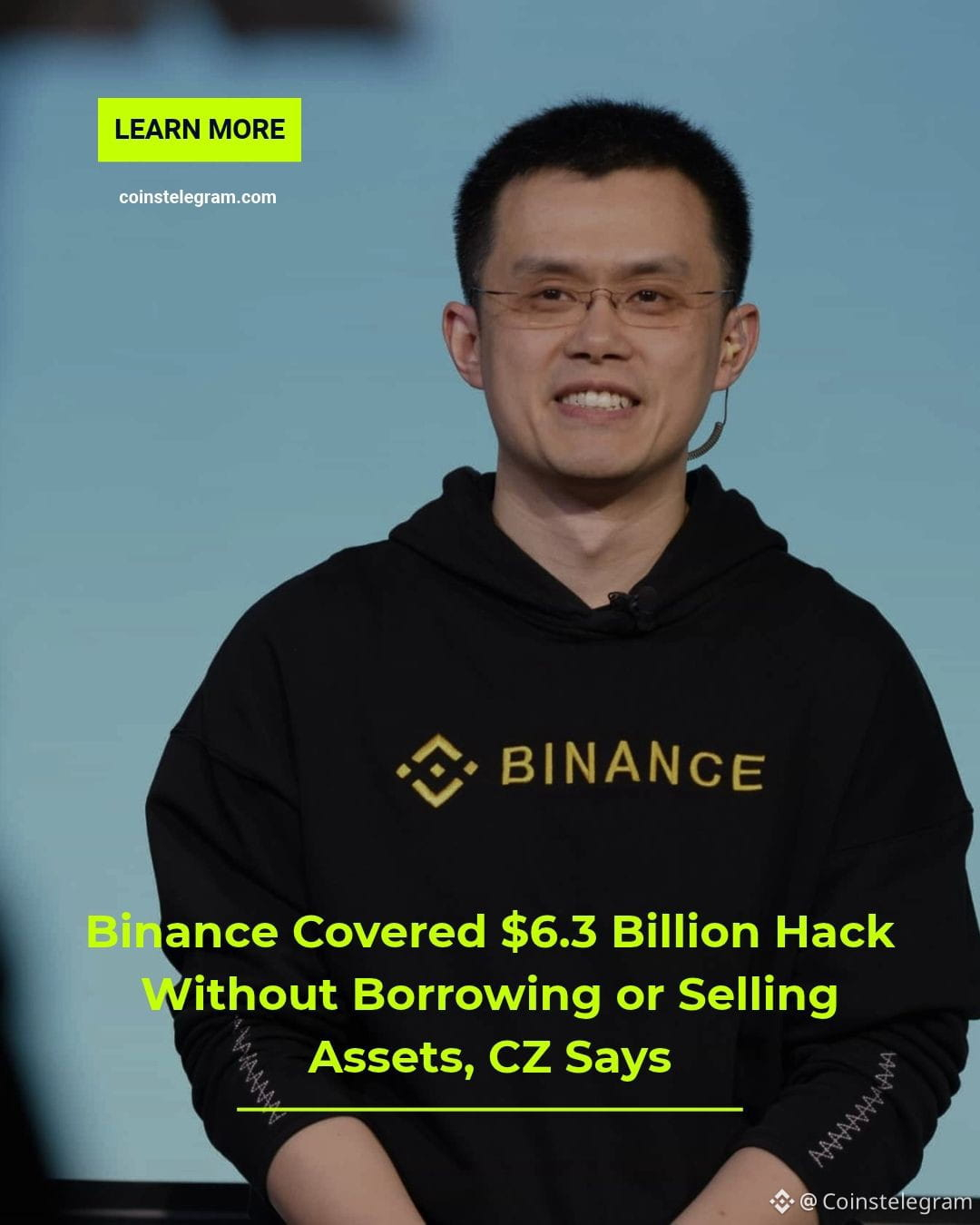
Article
Binance Covered $6.3 Billion Hack Without Borrowing or Selling Assets, CZ SaysBinance founder Changpeng Zhao says the exchange financed its response to the approximately $6.3 billion theft entirely from its own balance sheet, without borrowing money, raising capital or selling assets.
The statement comes as Binance reports improving deposit flows five days after the October 29 attack. Meanwhile, North Korea has denied responsibility, rejecting the US government’s attribution of the theft to state-backed hackers.
However, allocating money to cover losses and replacing every stolen token are separate milestones. Binance’s November 2 recovery update said approximately 95% of affected assets had been replenished, with purchases of less-liquid tokens still underway.
CZ Says Binance Used Its Own Balance Sheet
In his X post, Zhao wrote:
A little something that’s not mentioned, and ppl may not even think about:
Binance did not borrow money
Binance did not sell assets
Binance did not raise money
Binance covered from its balance sheet.
He added that this distinguished Binance’s response from other incidents used as comparisons.
Binance previously said it had allocated more than $6.34 billion in company funds, including $5 billion already held in the specific token assets affected. Its commitment was to absorb the financial impact rather than pass the shortfall to customers.
Zhao’s statement describes the source of that funding. It should not be interpreted as evidence that all stolen assets have been recovered from the attackers or that every replacement purchase is complete.
In its latest recovery announcement, Binance said the remaining 5% involved tokens outside its ten principal covered assets. Their lower liquidity made acquiring the necessary quantities slower.
The distinction also explains why Binance can claim to have allocated sufficient funding while continuing to buy particular cryptocurrencies.
Deposits Overtake Withdrawals as Flows Stabilize
By November 3, Binance reported that hourly deposits had begun exceeding withdrawals, indicating an improvement after the initial rush to move funds following reopening.
Its published figures show $10.97 billion in withdrawals and $5.695 billion in deposits between 06:00 UTC on November 1 and 04:00 UTC on November 3. Cumulative net outflows were approximately $5.276 billion, or 3.1% of its previously reported $171 billion in assets.
Withdrawals peaked at $1.243 billion during the hour beginning at 08:00 UTC on November 1 and subsequently declined, while deposits increased through November 2.
Positive hourly flows do not mean the cumulative outflow has disappeared. They show that, during those particular intervals, more money entered than left.
Zhao also cited public reports suggesting that only 6–10% of withdrawals went to competing centralized exchanges. He said most moved into self-custody wallets that had not yet interacted with decentralized exchanges. These remain attributed observations rather than independently established customer intentions.
A withdrawal to self-custody can reflect caution, portfolio management or temporary storage. It does not establish whether the owner intends to return.
Bybit and Bitget Show How Exchanges Can Protect Customers
Binance is not the only exchange to protect customer balances after a major theft. Following its approximately $1.5 billion February 2025 hack, Bybit restored full backing of affected customer assets. Its published timeline describes closing the ETH shortfall through bridge loans, deposits and over-the-counter purchases. Bitget likewise pledged that customers would not bear losses from its September 2026 breach, initially estimated at $351.6 million and later revised to $387.5 million.
Bitget said the incident fell within its protection fund’s coverage. These examples demonstrate successful backing or reimbursement commitments, rather than proving that every exchange always compensates every customer.
The financing differences matter. Bybit explicitly described using bridge loans, whereas Zhao says Binance avoided borrowing. Both approaches can support customer withdrawals, but they create different obligations for the companies.
Preserving account balances also does not eliminate every consequence. Customers may still experience withdrawal delays, missed trading opportunities or uncertainty while services are restricted.
FTX illustrates why exchange promises cannot replace enforceable safeguards. Its collapse involved the misappropriation of billions in customer funds, rather than simply an external hack followed by replenishment. Founder Sam Bankman-Fried received a 25-year prison sentence.
Do Exchanges Legally Have to Cover Hack Losses?
There is no universal rule guaranteeing reimbursement at every centralized exchange. Liability depends on the operating entity, jurisdiction, custody agreement, applicable law and circumstances of the loss.
The European Union’s Markets in Crypto-Assets Regulation provides a concrete example. Article 75 makes covered custody providers liable for losses resulting from incidents attributable to them, with liability capped at the assets’ market value when the loss occurred. It also requires segregation of customer assets from the provider’s own holdings.
The regulation distinguishes attributable incidents from events outside the provider’s operations or control. These provisions should not automatically be applied to every Binance customer worldwide.
DeFi presents a different structure. When users deposit into smart contracts, there may be no custodial company with an obligation and sufficient resources to replace stolen funds. Recovery can depend on recovered assets, treasury resources, governance decisions, insurance or legal claims. Compensation may be partial or unavailable.
Full recovery is nevertheless possible. After Euler’s 2023 exploit, the project recovered assets and established a redemption process for affected users. The lesson is that neither centralized custody nor DeFi provides an automatic outcome after a hack.
North Korea Denies Responsibility as Recovery Continues
The approximately $6.3 billion Binance theft occurred on October 29. Initial findings pointed to a compromised employee laptop, but Binance subsequently identified additional breach points.
North Korea rejected responsibility on November 3. Kim Yo Jong, sister of leader Kim Jong Un, described US accusations as “absurd rhetoric” and a political provocation.
The denial follows the FBI’s attribution of the theft to North Korea’s TraderTraitor operation. US investigators said they observed stolen assets being converted primarily into ETH and sought industry assistance to block laundering. North Korea’s denial disputes that attribution; it does not resolve the investigation.
Binance has also completed the zero-knowledge proof for its October 31 reserves snapshot, allowing users to verify backing for ten specified assets. Its November 2 announcement planned another snapshot covering more tokens for November 4.
The remaining tests are completion of token replenishment, broader withdrawal access and a detailed explanation of how the breach occurred.
Binance Covered $6.3 Billion Hack Without Borrowing or Selling Assets, CZ Says
Binance founder Changpeng Zhao says the exchange financed its response to the approximately $6.3 billion theft entirely from its own balance sheet, without borrowing money, raising capital or selling assets.
The statement comes as Binance reports improving deposit flows five days after the October 29 attack. Meanwhile, North Korea has denied responsibility, rejecting the US government’s attribution of the theft to state-backed hackers.
However, allocating money to cover losses and replacing every stolen token are separate milestones. Binance’s November 2 recovery update said approximately 95% of affected assets had been replenished, with purchases of less-liquid tokens still underway.
CZ Says Binance Used Its Own Balance Sheet
In his X post, Zhao wrote:
A little something that’s not mentioned, and ppl may not even think about:
Binance did not borrow money
Binance did not sell assets
Binance did not raise money
Binance covered from its balance sheet.
He added that this distinguished Binance’s response from other incidents used as comparisons.
Binance previously said it had allocated more than $6.34 billion in company funds, including $5 billion already held in the specific token assets affected. Its commitment was to absorb the financial impact rather than pass the shortfall to customers.
Zhao’s statement describes the source of that funding. It should not be interpreted as evidence that all stolen assets have been recovered from the attackers or that every replacement purchase is complete.
In its latest recovery announcement, Binance said the remaining 5% involved tokens outside its ten principal covered assets. Their lower liquidity made acquiring the necessary quantities slower.
The distinction also explains why Binance can claim to have allocated sufficient funding while continuing to buy particular cryptocurrencies.
Deposits Overtake Withdrawals as Flows Stabilize
By November 3, Binance reported that hourly deposits had begun exceeding withdrawals, indicating an improvement after the initial rush to move funds following reopening.
Its published figures show $10.97 billion in withdrawals and $5.695 billion in deposits between 06:00 UTC on November 1 and 04:00 UTC on November 3. Cumulative net outflows were approximately $5.276 billion, or 3.1% of its previously reported $171 billion in assets.
Withdrawals peaked at $1.243 billion during the hour beginning at 08:00 UTC on November 1 and subsequently declined, while deposits increased through November 2.
Positive hourly flows do not mean the cumulative outflow has disappeared. They show that, during those particular intervals, more money entered than left.
Zhao also cited public reports suggesting that only 6–10% of withdrawals went to competing centralized exchanges. He said most moved into self-custody wallets that had not yet interacted with decentralized exchanges. These remain attributed observations rather than independently established customer intentions.
A withdrawal to self-custody can reflect caution, portfolio management or temporary storage. It does not establish whether the owner intends to return.
Bybit and Bitget Show How Exchanges Can Protect Customers
Binance is not the only exchange to protect customer balances after a major theft. Following its approximately $1.5 billion February 2025 hack, Bybit restored full backing of affected customer assets. Its published timeline describes closing the ETH shortfall through bridge loans, deposits and over-the-counter purchases. Bitget likewise pledged that customers would not bear losses from its September 2026 breach, initially estimated at $351.6 million and later revised to $387.5 million.
Bitget said the incident fell within its protection fund’s coverage. These examples demonstrate successful backing or reimbursement commitments, rather than proving that every exchange always compensates every customer.
The financing differences matter. Bybit explicitly described using bridge loans, whereas Zhao says Binance avoided borrowing. Both approaches can support customer withdrawals, but they create different obligations for the companies.
Preserving account balances also does not eliminate every consequence. Customers may still experience withdrawal delays, missed trading opportunities or uncertainty while services are restricted.
FTX illustrates why exchange promises cannot replace enforceable safeguards. Its collapse involved the misappropriation of billions in customer funds, rather than simply an external hack followed by replenishment. Founder Sam Bankman-Fried received a 25-year prison sentence.
Do Exchanges Legally Have to Cover Hack Losses?
There is no universal rule guaranteeing reimbursement at every centralized exchange. Liability depends on the operating entity, jurisdiction, custody agreement, applicable law and circumstances of the loss.
The European Union’s Markets in Crypto-Assets Regulation provides a concrete example. Article 75 makes covered custody providers liable for losses resulting from incidents attributable to them, with liability capped at the assets’ market value when the loss occurred. It also requires segregation of customer assets from the provider’s own holdings.
The regulation distinguishes attributable incidents from events outside the provider’s operations or control. These provisions should not automatically be applied to every Binance customer worldwide.
DeFi presents a different structure. When users deposit into smart contracts, there may be no custodial company with an obligation and sufficient resources to replace stolen funds. Recovery can depend on recovered assets, treasury resources, governance decisions, insurance or legal claims. Compensation may be partial or unavailable.
Full recovery is nevertheless possible. After Euler’s 2023 exploit, the project recovered assets and established a redemption process for affected users. The lesson is that neither centralized custody nor DeFi provides an automatic outcome after a hack.
North Korea Denies Responsibility as Recovery Continues
The approximately $6.3 billion Binance theft occurred on October 29. Initial findings pointed to a compromised employee laptop, but Binance subsequently identified additional breach points.
North Korea rejected responsibility on November 3. Kim Yo Jong, sister of leader Kim Jong Un, described US accusations as “absurd rhetoric” and a political provocation.
The denial follows the FBI’s attribution of the theft to North Korea’s TraderTraitor operation. US investigators said they observed stolen assets being converted primarily into ETH and sought industry assistance to block laundering. North Korea’s denial disputes that attribution; it does not resolve the investigation.
Binance has also completed the zero-knowledge proof for its October 31 reserves snapshot, allowing users to verify backing for ten specified assets. Its November 2 announcement planned another snapshot covering more tokens for November 4.
The remaining tests are completion of token replenishment, broader withdrawal access and a detailed explanation of how the breach occurred.
The statement comes as Binance reports improving deposit flows five days after the October 29 attack. Meanwhile, North Korea has denied responsibility, rejecting the US government’s attribution of the theft to state-backed hackers.
However, allocating money to cover losses and replacing every stolen token are separate milestones. Binance’s November 2 recovery update said approximately 95% of affected assets had been replenished, with purchases of less-liquid tokens still underway.
CZ Says Binance Used Its Own Balance Sheet
In his X post, Zhao wrote:
A little something that’s not mentioned, and ppl may not even think about:
Binance did not borrow money
Binance did not sell assets
Binance did not raise money
Binance covered from its balance sheet.
He added that this distinguished Binance’s response from other incidents used as comparisons.
Binance previously said it had allocated more than $6.34 billion in company funds, including $5 billion already held in the specific token assets affected. Its commitment was to absorb the financial impact rather than pass the shortfall to customers.
Zhao’s statement describes the source of that funding. It should not be interpreted as evidence that all stolen assets have been recovered from the attackers or that every replacement purchase is complete.
In its latest recovery announcement, Binance said the remaining 5% involved tokens outside its ten principal covered assets. Their lower liquidity made acquiring the necessary quantities slower.
The distinction also explains why Binance can claim to have allocated sufficient funding while continuing to buy particular cryptocurrencies.
Deposits Overtake Withdrawals as Flows Stabilize
By November 3, Binance reported that hourly deposits had begun exceeding withdrawals, indicating an improvement after the initial rush to move funds following reopening.
Its published figures show $10.97 billion in withdrawals and $5.695 billion in deposits between 06:00 UTC on November 1 and 04:00 UTC on November 3. Cumulative net outflows were approximately $5.276 billion, or 3.1% of its previously reported $171 billion in assets.
Withdrawals peaked at $1.243 billion during the hour beginning at 08:00 UTC on November 1 and subsequently declined, while deposits increased through November 2.
Positive hourly flows do not mean the cumulative outflow has disappeared. They show that, during those particular intervals, more money entered than left.
Zhao also cited public reports suggesting that only 6–10% of withdrawals went to competing centralized exchanges. He said most moved into self-custody wallets that had not yet interacted with decentralized exchanges. These remain attributed observations rather than independently established customer intentions.
A withdrawal to self-custody can reflect caution, portfolio management or temporary storage. It does not establish whether the owner intends to return.
Bybit and Bitget Show How Exchanges Can Protect Customers
Binance is not the only exchange to protect customer balances after a major theft. Following its approximately $1.5 billion February 2025 hack, Bybit restored full backing of affected customer assets. Its published timeline describes closing the ETH shortfall through bridge loans, deposits and over-the-counter purchases. Bitget likewise pledged that customers would not bear losses from its September 2026 breach, initially estimated at $351.6 million and later revised to $387.5 million.
Bitget said the incident fell within its protection fund’s coverage. These examples demonstrate successful backing or reimbursement commitments, rather than proving that every exchange always compensates every customer.
The financing differences matter. Bybit explicitly described using bridge loans, whereas Zhao says Binance avoided borrowing. Both approaches can support customer withdrawals, but they create different obligations for the companies.
Preserving account balances also does not eliminate every consequence. Customers may still experience withdrawal delays, missed trading opportunities or uncertainty while services are restricted.
FTX illustrates why exchange promises cannot replace enforceable safeguards. Its collapse involved the misappropriation of billions in customer funds, rather than simply an external hack followed by replenishment. Founder Sam Bankman-Fried received a 25-year prison sentence.
Do Exchanges Legally Have to Cover Hack Losses?
There is no universal rule guaranteeing reimbursement at every centralized exchange. Liability depends on the operating entity, jurisdiction, custody agreement, applicable law and circumstances of the loss.
The European Union’s Markets in Crypto-Assets Regulation provides a concrete example. Article 75 makes covered custody providers liable for losses resulting from incidents attributable to them, with liability capped at the assets’ market value when the loss occurred. It also requires segregation of customer assets from the provider’s own holdings.
The regulation distinguishes attributable incidents from events outside the provider’s operations or control. These provisions should not automatically be applied to every Binance customer worldwide.
DeFi presents a different structure. When users deposit into smart contracts, there may be no custodial company with an obligation and sufficient resources to replace stolen funds. Recovery can depend on recovered assets, treasury resources, governance decisions, insurance or legal claims. Compensation may be partial or unavailable.
Full recovery is nevertheless possible. After Euler’s 2023 exploit, the project recovered assets and established a redemption process for affected users. The lesson is that neither centralized custody nor DeFi provides an automatic outcome after a hack.
North Korea Denies Responsibility as Recovery Continues
The approximately $6.3 billion Binance theft occurred on October 29. Initial findings pointed to a compromised employee laptop, but Binance subsequently identified additional breach points.
North Korea rejected responsibility on November 3. Kim Yo Jong, sister of leader Kim Jong Un, described US accusations as “absurd rhetoric” and a political provocation.
The denial follows the FBI’s attribution of the theft to North Korea’s TraderTraitor operation. US investigators said they observed stolen assets being converted primarily into ETH and sought industry assistance to block laundering. North Korea’s denial disputes that attribution; it does not resolve the investigation.
Binance has also completed the zero-knowledge proof for its October 31 reserves snapshot, allowing users to verify backing for ten specified assets. Its November 2 announcement planned another snapshot covering more tokens for November 4.
The remaining tests are completion of token replenishment, broader withdrawal access and a detailed explanation of how the breach occurred.
534

Article
Binance Resumes Withdrawals Across 15 Networks After $6.3 Billion Hack, Reports $3.64 Billion Net...Binance has restored cryptocurrency withdrawals across 15 networks in its initial reopening phase following the largest crypto theft on record. Customers withdrew approximately $4.65 billion during the first nine and a half hours, while deposits exceeded $1 billion.
The resulting net outflow was approximately $3.64 billion, equivalent to 2.1% of the exchange’s reported $171 billion in assets under management before the attack. Binance said withdrawal demand eased after an initial surge as customers regained access to their funds.
The reopening marks an important recovery milestone after approximately $6.3 billion was stolen on October 29. However, access remains dependent on the specific asset and network, and the exchange continues to restore services in stages.
Binance Restores Withdrawals Across 15 Networks
Binance began reopening withdrawals at 06:00 UTC on November 1. According to the statement supplied from its official X account:
Binance began restoring withdrawals in phases at 06:00 UTC on November 1, 2026. By 12:36 UTC, withdrawals had resumed for all 15 networks and assets in the initial phase. After an initial spike, withdrawal volumes have declined and are stabilising as expected, while deposit volumes have remained substantial.
The restored networks include Bitcoin, Ethereum, BNB Smart Chain, XRP Ledger, Base, Dogecoin, Optimism, Arbitrum, Tron, Solana, Polygon, Avalanche C-Chain, Zcash, TON and Sui.
Availability varies by asset. Ethereum withdrawals include ETH, USDT and USDC, while BNB Smart Chain supports BNB and the two stablecoins. Other restored routes include BTC on Bitcoin, XRP on XRP Ledger, DOGE on Dogecoin and SUI on Sui.
Binance’s official recovery announcement says additional networks and assets will return after security and operational checks. It also warns that increased traffic may cause temporary delays during the rollout. Restoring 15 networks therefore does not mean every listed cryptocurrency is available for withdrawal.
What the $3.64 Billion Net Outflow Actually Means
The exchange’s figures cover 06:00–15:30 UTC on November 1: precisely nine and a half hours, rather than a full ten hours.
During that period, Binance processed $4.649 billion in withdrawals and received $1.01 billion in deposits. Subtracting deposits from withdrawals produces a net outflow of $3.639 billion, rounded to $3.64 billion.
The 2.1% comparison uses Binance’s reported $171 billion in assets from its October 28 proof-of-reserves data. That is a pre-attack reference point, not a fresh measurement of assets remaining after the reopening.
Separately, CoinDesk reported approximately $6.1 billion in Binance-linked wallet outflows over a subsequent 24-hour window, citing DefiLlama. It cautioned that publicly tracked movements can include transfers between exchange-controlled wallets.
That distinction matters when comparing figures. Gross withdrawals, net outflows and movements between identified wallets measure different things. A circulating $5.142 billion figure without a source, timestamp or methodology cannot reliably be compared with Binance’s nine-and-a-half-hour total.
For the same reason, changing dashboard readings should always be presented with their observation time.
CZ Praises Customer Trust as Rival Exchanges Receive Deposits
Former Binance chief executive Changpeng Zhao responded to the reopening with the following statement, supplied from his X account:
12 hours after withdrawals resumed: 2.1% net outflow, with most occurring in the first couple of hours. Over $1 billion in flow, too.
98% choose to stay!
Trust isn’t earned by what you say in good times. It’s earned by what you do in hard times.
Thank you for your trust!
The “98%” statement expresses Zhao’s interpretation of asset flows. It does not establish that 98% of customers decided to remain: an asset-value percentage cannot measure individual account decisions.
His reference to 12 hours also differs from the nine-and-a-half-hour period underlying Binance’s published calculation.
Meanwhile, CoinDesk reported approximately $450 million in net inflows at OKX and $134 million at Bybit during its observation window. Those figures show deposits reaching competitors, but do not establish how much originated directly from Binance.
Claims that most departing funds went to those exchanges or to hot and cold wallets require transaction-level evidence. A blockchain transfer alone generally cannot establish how a recipient stores its private keys.
Fiat Withdrawals Expand as Reserve Reporting Continues
Binance also announced the restoration of fiat withdrawals for five additional currencies: the US dollar, UAE dirham, Vietnamese dong, Philippine peso and Indonesian rupiah.
These joined 23 currencies already listed as available, bringing the announced total to 28. Existing options included EUR, GBP was not listed, and currencies such as JPY, BRL, MXN, CHF, PLN and HUF remained among those available. Customers still need to check the options offered for their account and region.
Alongside service restoration, Binance announced a new proof-of-reserves snapshot taken at 00:00 UTC on October 31. Its November 1 update said zero-knowledge-proof computation had begun and the updated report was expected on November 2. That was a publication target, rather than confirmation that the completed report was already available.
The snapshot’s timing is important: October 31 predates the November 1 withdrawal reopening. It can provide information about reserves at that earlier point, but cannot by itself describe balances after subsequent customer withdrawals.
Investigation Update: FBI Attributes the Hack to North Korea
The attack occurred on October 29, although major investigation updates followed on October 30. Binance said compromised hot wallets lost approximately $6.3 billion in token assets.
The exchange’s initial findings pointed to a compromised laptop, but subsequent investigation uncovered additional breach points. In its October 30 update, Binance said it had found no evidence that wallet private keys were leaked. It also reported approximately $3 billion frozen on-chain and more than $6.34 billion in company funds allocated to cover the incident.
The FBI has since formally attributed the theft to North Korea’s TraderTraitor actors. The agency said it observed stolen assets being converted primarily into ETH and called for industry cooperation to prevent further laundering.
By November 1, Binance said it had replenished approximately 95% of affected assets. The remaining portion consisted of less-liquid tokens requiring additional purchases. Replenishment uses company resources; it should not be confused with recovering funds from the attackers.
Further recovery updates and a completed technical investigation remain central to assessing Binance’s response beyond the initial reopening.
Binance Resumes Withdrawals Across 15 Networks After $6.3 Billion Hack, Reports $3.64 Billion Net...
Binance has restored cryptocurrency withdrawals across 15 networks in its initial reopening phase following the largest crypto theft on record. Customers withdrew approximately $4.65 billion during the first nine and a half hours, while deposits exceeded $1 billion.
The resulting net outflow was approximately $3.64 billion, equivalent to 2.1% of the exchange’s reported $171 billion in assets under management before the attack. Binance said withdrawal demand eased after an initial surge as customers regained access to their funds.
The reopening marks an important recovery milestone after approximately $6.3 billion was stolen on October 29. However, access remains dependent on the specific asset and network, and the exchange continues to restore services in stages.
Binance Restores Withdrawals Across 15 Networks
Binance began reopening withdrawals at 06:00 UTC on November 1. According to the statement supplied from its official X account:
Binance began restoring withdrawals in phases at 06:00 UTC on November 1, 2026. By 12:36 UTC, withdrawals had resumed for all 15 networks and assets in the initial phase. After an initial spike, withdrawal volumes have declined and are stabilising as expected, while deposit volumes have remained substantial.
The restored networks include Bitcoin, Ethereum, BNB Smart Chain, XRP Ledger, Base, Dogecoin, Optimism, Arbitrum, Tron, Solana, Polygon, Avalanche C-Chain, Zcash, TON and Sui.
Availability varies by asset. Ethereum withdrawals include ETH, USDT and USDC, while BNB Smart Chain supports BNB and the two stablecoins. Other restored routes include BTC on Bitcoin, XRP on XRP Ledger, DOGE on Dogecoin and SUI on Sui.
Binance’s official recovery announcement says additional networks and assets will return after security and operational checks. It also warns that increased traffic may cause temporary delays during the rollout. Restoring 15 networks therefore does not mean every listed cryptocurrency is available for withdrawal.
What the $3.64 Billion Net Outflow Actually Means
The exchange’s figures cover 06:00–15:30 UTC on November 1: precisely nine and a half hours, rather than a full ten hours.
During that period, Binance processed $4.649 billion in withdrawals and received $1.01 billion in deposits. Subtracting deposits from withdrawals produces a net outflow of $3.639 billion, rounded to $3.64 billion.
The 2.1% comparison uses Binance’s reported $171 billion in assets from its October 28 proof-of-reserves data. That is a pre-attack reference point, not a fresh measurement of assets remaining after the reopening.
Separately, CoinDesk reported approximately $6.1 billion in Binance-linked wallet outflows over a subsequent 24-hour window, citing DefiLlama. It cautioned that publicly tracked movements can include transfers between exchange-controlled wallets.
That distinction matters when comparing figures. Gross withdrawals, net outflows and movements between identified wallets measure different things. A circulating $5.142 billion figure without a source, timestamp or methodology cannot reliably be compared with Binance’s nine-and-a-half-hour total.
For the same reason, changing dashboard readings should always be presented with their observation time.
CZ Praises Customer Trust as Rival Exchanges Receive Deposits
Former Binance chief executive Changpeng Zhao responded to the reopening with the following statement, supplied from his X account:
12 hours after withdrawals resumed: 2.1% net outflow, with most occurring in the first couple of hours. Over $1 billion in flow, too.
98% choose to stay!
Trust isn’t earned by what you say in good times. It’s earned by what you do in hard times.
Thank you for your trust!
The “98%” statement expresses Zhao’s interpretation of asset flows. It does not establish that 98% of customers decided to remain: an asset-value percentage cannot measure individual account decisions.
His reference to 12 hours also differs from the nine-and-a-half-hour period underlying Binance’s published calculation.
Meanwhile, CoinDesk reported approximately $450 million in net inflows at OKX and $134 million at Bybit during its observation window. Those figures show deposits reaching competitors, but do not establish how much originated directly from Binance.
Claims that most departing funds went to those exchanges or to hot and cold wallets require transaction-level evidence. A blockchain transfer alone generally cannot establish how a recipient stores its private keys.
Fiat Withdrawals Expand as Reserve Reporting Continues
Binance also announced the restoration of fiat withdrawals for five additional currencies: the US dollar, UAE dirham, Vietnamese dong, Philippine peso and Indonesian rupiah.
These joined 23 currencies already listed as available, bringing the announced total to 28. Existing options included EUR, GBP was not listed, and currencies such as JPY, BRL, MXN, CHF, PLN and HUF remained among those available. Customers still need to check the options offered for their account and region.
Alongside service restoration, Binance announced a new proof-of-reserves snapshot taken at 00:00 UTC on October 31. Its November 1 update said zero-knowledge-proof computation had begun and the updated report was expected on November 2. That was a publication target, rather than confirmation that the completed report was already available.
The snapshot’s timing is important: October 31 predates the November 1 withdrawal reopening. It can provide information about reserves at that earlier point, but cannot by itself describe balances after subsequent customer withdrawals.
Investigation Update: FBI Attributes the Hack to North Korea
The attack occurred on October 29, although major investigation updates followed on October 30. Binance said compromised hot wallets lost approximately $6.3 billion in token assets.
The exchange’s initial findings pointed to a compromised laptop, but subsequent investigation uncovered additional breach points. In its October 30 update, Binance said it had found no evidence that wallet private keys were leaked. It also reported approximately $3 billion frozen on-chain and more than $6.34 billion in company funds allocated to cover the incident.
The FBI has since formally attributed the theft to North Korea’s TraderTraitor actors. The agency said it observed stolen assets being converted primarily into ETH and called for industry cooperation to prevent further laundering.
By November 1, Binance said it had replenished approximately 95% of affected assets. The remaining portion consisted of less-liquid tokens requiring additional purchases. Replenishment uses company resources; it should not be confused with recovering funds from the attackers.
Further recovery updates and a completed technical investigation remain central to assessing Binance’s response beyond the initial reopening.
86
Log in to explore more content
Join global crypto users on Binance Square
⚡️ Get latest and useful information about crypto.
💬 Trusted by the world’s largest crypto exchange.
👍 Discover real insights from verified creators.
Email / Phone number
Trending Topics
A Packed Week of Earnings and Data Tests Markets
61,456 views
395 Discussing
Nvidia, Anthropic, and the Fed: Three Tests in One Week
Nick_Invest
·3 Likes
·1.3k views
AnthropicIPOTestsInvestorAppetiteForAI
114,384 views
1,347 Discussing
BitcoinExtendsLosingStreakToSixWeeks
88,170 views
713 Discussing