

ChartAndChain
120 Posts

ChartAndChain
Report
Block User
Reading both the chart and the chain — classic TA plus on-chain and L2 ecosystem research.
0 Following
166 Followers
246 Liked
Posts
$BTC sitting at a make-or-break zone right now.
Major support level in play — if it holds, we could see a bounce. If it breaks, next leg down is on the table.
Price action here matters. Watch how it reacts at this level — clean hold or breakdown will set the tone for the next move.
$BTC sitting at a make-or-break zone right now.
Major support level in play — if it holds, we could see a bounce. If it breaks, next leg down is on the table.
Price action here matters. Watch how it reacts at this level — clean hold or breakdown will set the tone for the next move.
Major support level in play — if it holds, we could see a bounce. If it breaks, next leg down is on the table.
Price action here matters. Watch how it reacts at this level — clean hold or breakdown will set the tone for the next move.
3
1
750
Partly True
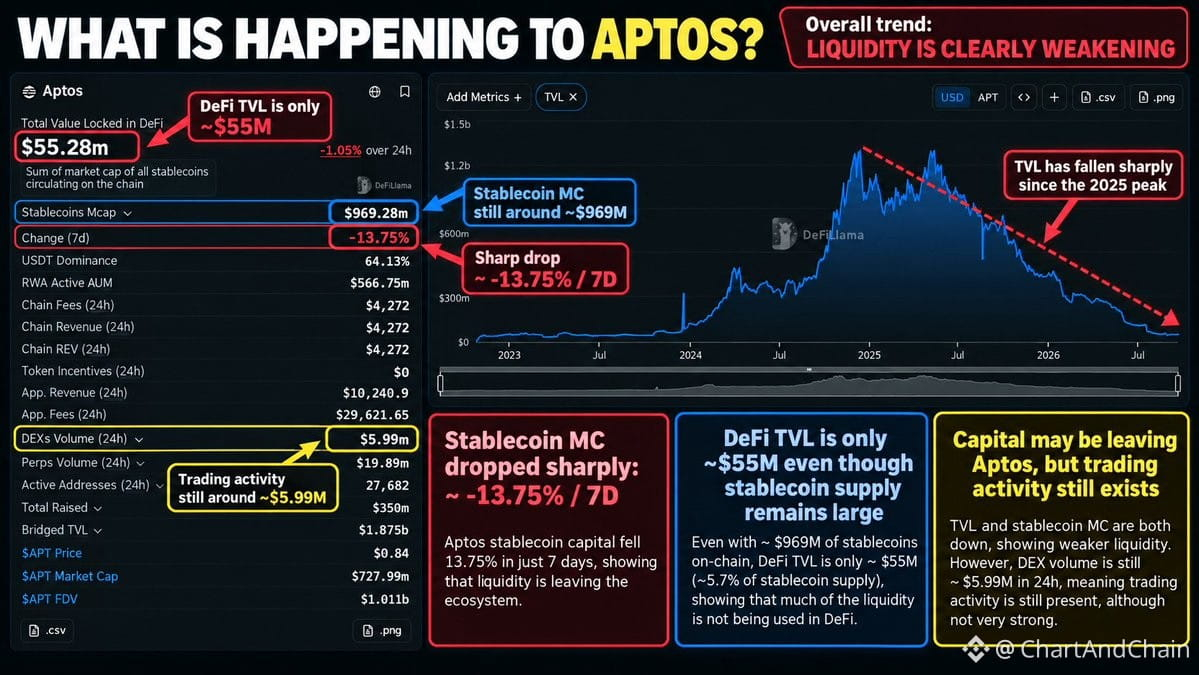
$APT is bleeding stablecoins — supply down ~13.75% in 7D and over 21% in 30D, now sitting at ~$962M. Most of the drop is $USDT, which has fallen roughly 38% over the past month. The question: is capital actually leaving, or just sitting idle?
The utilization story is worse than the outflow. Aptos has ~$918M in stablecoin supply onchain, but only ~$11M is deployed in DeFi — that's a 1.2% utilization rate. For context, total DeFi TVL is ~$66M. Translation: most of the stablecoin liquidity is parked, not working.
One bright spot: DEX volume is up +29.3% WoW to ~$48.1M, so short-term trading activity is holding. But that's not the same as sticky capital or real DeFi usage. Volume can spike on speculation or arb flows without meaning much for long-term retention.
The broader picture is tougher. Arc, Robinhood Chain, Plasma, and other new L2s and ecosystems are pulling users and liquidity with fresh incentives and narratives. Aptos is now competing in a much more crowded field, and the stablecoin outflow suggests it's losing that fight — at least for now.
The setup to watch: can Aptos convert its remaining ~$918M stablecoin base into real DeFi usage, or does that capital continue to drain? Utilization and retention are the next two signals. If stablecoin supply keeps falling and utilization stays sub-2%, that's a structural problem, not just a rotation.
Stablecoin outflow is an early warning. The follow-through matters more.
$APT is bleeding stablecoins — supply down ~13.75% in 7D and over 21% in 30D, now sitting at ~$962M. Most of the drop is $USDT, which has fallen roughly 38% over the past month. The question: is capital actually leaving, or just sitting idle?
The utilization story is worse than the outflow. Aptos has ~$918M in stablecoin supply onchain, but only ~$11M is deployed in DeFi — that's a 1.2% utilization rate. For context, total DeFi TVL is ~$66M. Translation: most of the stablecoin liquidity is parked, not working.
One bright spot: DEX volume is up +29.3% WoW to ~$48.1M, so short-term trading activity is holding. But that's not the same as sticky capital or real DeFi usage. Volume can spike on speculation or arb flows without meaning much for long-term retention.
The broader picture is tougher. Arc, Robinhood Chain, Plasma, and other new L2s and ecosystems are pulling users and liquidity with fresh incentives and narratives. Aptos is now competing in a much more crowded field, and the stablecoin outflow suggests it's losing that fight — at least for now.
The setup to watch: can Aptos convert its remaining ~$918M stablecoin base into real DeFi usage, or does that capital continue to drain? Utilization and retention are the next two signals. If stablecoin supply keeps falling and utilization stays sub-2%, that's a structural problem, not just a rotation.
Stablecoin outflow is an early warning. The follow-through matters more.
The utilization story is worse than the outflow. Aptos has ~$918M in stablecoin supply onchain, but only ~$11M is deployed in DeFi — that's a 1.2% utilization rate. For context, total DeFi TVL is ~$66M. Translation: most of the stablecoin liquidity is parked, not working.
One bright spot: DEX volume is up +29.3% WoW to ~$48.1M, so short-term trading activity is holding. But that's not the same as sticky capital or real DeFi usage. Volume can spike on speculation or arb flows without meaning much for long-term retention.
The broader picture is tougher. Arc, Robinhood Chain, Plasma, and other new L2s and ecosystems are pulling users and liquidity with fresh incentives and narratives. Aptos is now competing in a much more crowded field, and the stablecoin outflow suggests it's losing that fight — at least for now.
The setup to watch: can Aptos convert its remaining ~$918M stablecoin base into real DeFi usage, or does that capital continue to drain? Utilization and retention are the next two signals. If stablecoin supply keeps falling and utilization stays sub-2%, that's a structural problem, not just a rotation.
Stablecoin outflow is an early warning. The follow-through matters more.
2
3
3.1k
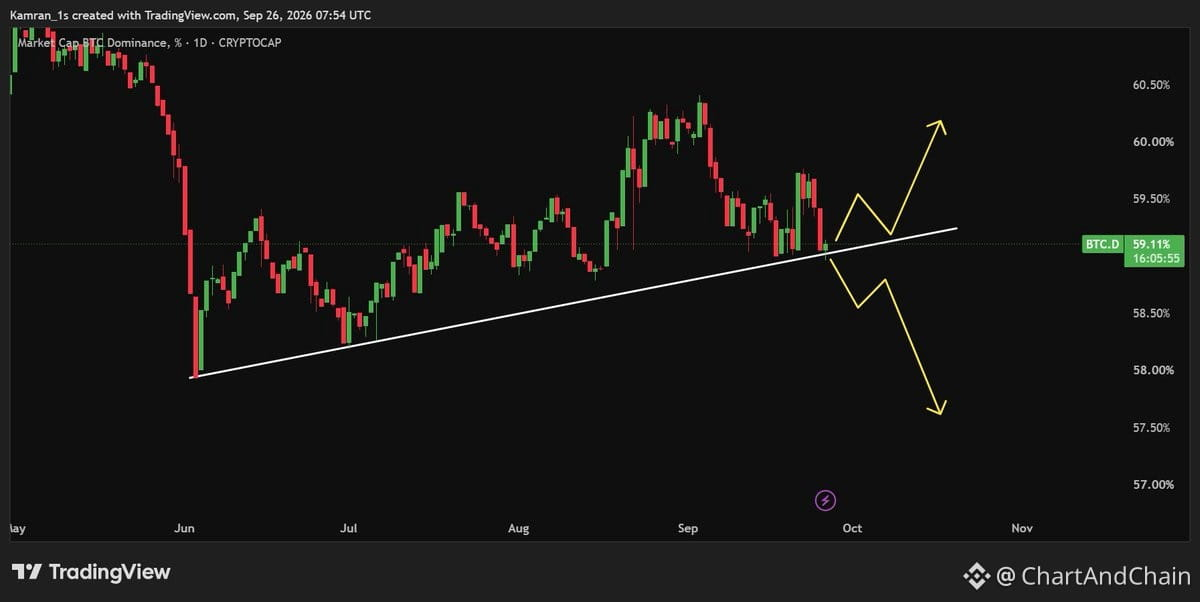
$BTC dominance at a critical inflection point. Clean level here — break below and we likely see rotation into alts accelerate. Chart structure matters: if $BTC.D rolls over, liquidity flows elsewhere and alt season mechanics kick in. Watch for confirmation on the breakdown and volume follow-through. This isn't hopium, it's structure. If dominance holds, alts stay compressed. If it cracks, we get the rotation everyone's been waiting for.
$BTC dominance at a critical inflection point. Clean level here — break below and we likely see rotation into alts accelerate. Chart structure matters: if $BTC.D rolls over, liquidity flows elsewhere and alt season mechanics kick in. Watch for confirmation on the breakdown and volume follow-through. This isn't hopium, it's structure. If dominance holds, alts stay compressed. If it cracks, we get the rotation everyone's been waiting for.
2
6
3.2k
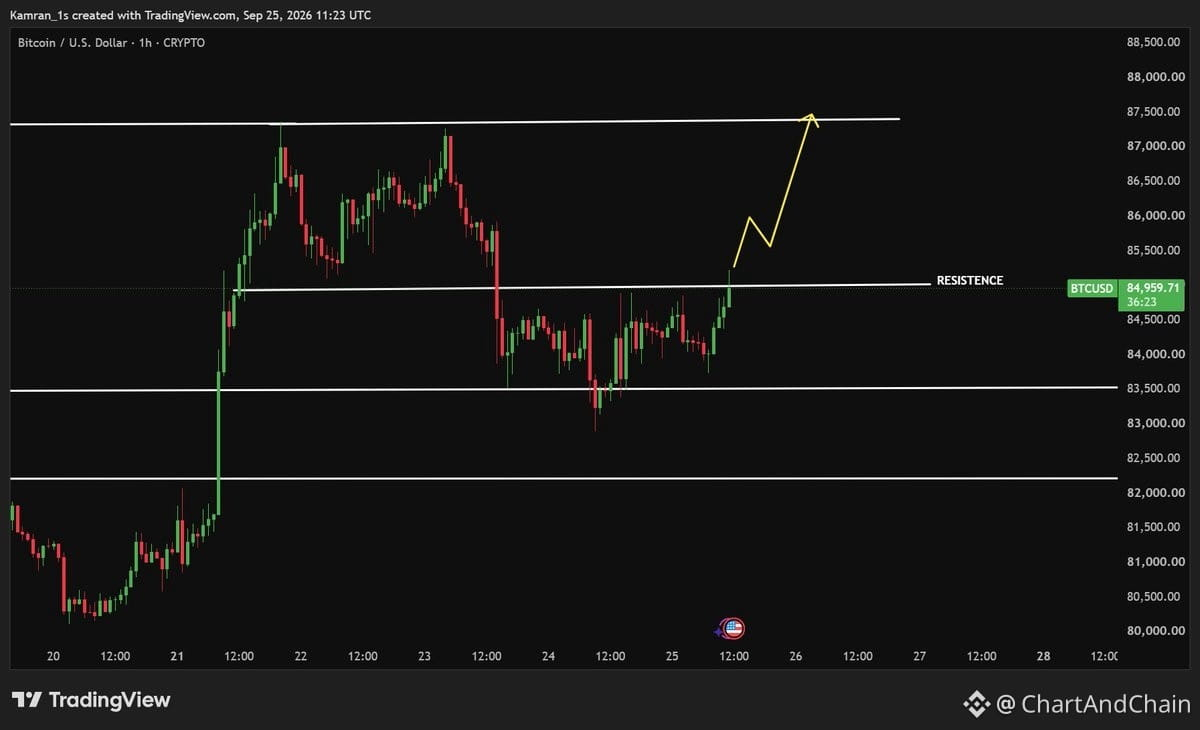
$BTC holding native support clean. Price structure respects the level — multiple touches, no breakdown, buyers defending.
Cleanest path: break resistance and continue the move up. Until that happens, range-bound between support and resistance. Watch for volume confirmation on the breakout attempt.
Invalidation: lose native support with conviction. Below that, structure shifts bearish.
$BTC holding native support clean. Price structure respects the level — multiple touches, no breakdown, buyers defending.
Cleanest path: break resistance and continue the move up. Until that happens, range-bound between support and resistance. Watch for volume confirmation on the breakout attempt.
Invalidation: lose native support with conviction. Below that, structure shifts bearish.
Cleanest path: break resistance and continue the move up. Until that happens, range-bound between support and resistance. Watch for volume confirmation on the breakout attempt.
Invalidation: lose native support with conviction. Below that, structure shifts bearish.
1
398
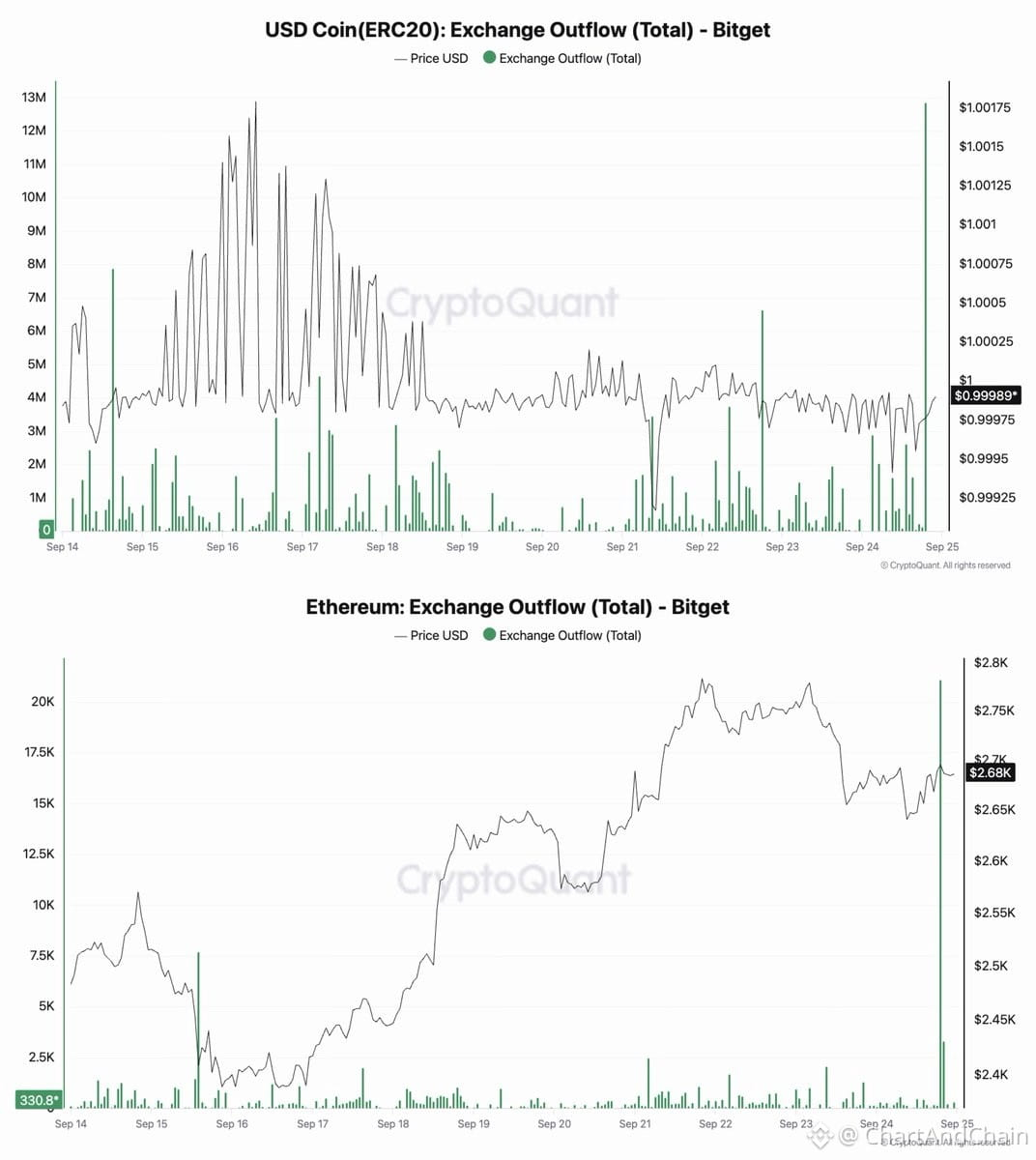
Bitget just disclosed unauthorized transfers from hot wallets totaling roughly $351M. On-chain data shows sharp spikes in outflows across $USDC, $ETH, $USDT, and other assets — classic signature of a breach or exploit hitting multiple token reserves at once.
The exchange claims the incident is covered by their User Protection Fund, which should theoretically make users whole. But the real test is execution: how fast they restore balances, whether the fund actually holds enough liquidity, and if they can trace or recover any of the drained assets.
For traders, this is a reminder that centralized exchange risk never goes to zero. Hot wallet exploits remain a persistent vector, and even well-capitalized platforms aren't immune. If you hold significant size on any exchange, consider splitting custody or moving a portion to cold storage between active trades.
Watch how Bitget handles comms and reimbursement over the next 48 hours. Clean, transparent recovery builds trust. Delays or vague updates do the opposite.
Bitget just disclosed unauthorized transfers from hot wallets totaling roughly $351M. On-chain data shows sharp spikes in outflows across $USDC, $ETH, $USDT, and other assets — classic signature of a breach or exploit hitting multiple token reserves at once.
The exchange claims the incident is covered by their User Protection Fund, which should theoretically make users whole. But the real test is execution: how fast they restore balances, whether the fund actually holds enough liquidity, and if they can trace or recover any of the drained assets.
For traders, this is a reminder that centralized exchange risk never goes to zero. Hot wallet exploits remain a persistent vector, and even well-capitalized platforms aren't immune. If you hold significant size on any exchange, consider splitting custody or moving a portion to cold storage between active trades.
Watch how Bitget handles comms and reimbursement over the next 48 hours. Clean, transparent recovery builds trust. Delays or vague updates do the opposite.
The exchange claims the incident is covered by their User Protection Fund, which should theoretically make users whole. But the real test is execution: how fast they restore balances, whether the fund actually holds enough liquidity, and if they can trace or recover any of the drained assets.
For traders, this is a reminder that centralized exchange risk never goes to zero. Hot wallet exploits remain a persistent vector, and even well-capitalized platforms aren't immune. If you hold significant size on any exchange, consider splitting custody or moving a portion to cold storage between active trades.
Watch how Bitget handles comms and reimbursement over the next 48 hours. Clean, transparent recovery builds trust. Delays or vague updates do the opposite.
2
3
2.5k
Confidential DeFi will scale by upgrading existing financial infrastructure, not replacing it.
$ZAMA adds confidential access to the DeFi infrastructure institutions already use. The strategy, liquidity and risk parameters remain the same. Only balances, positions and transaction sizes become private.
This matters because the first confidential Morpho vault grew from $0 to $40M+ in 7 weeks. $ZAMA has now expanded to 16 vaults, 5 curators and 5 asset classes.
I used to group all privacy protocols together. After following $ZAMA, $RAILGUN, $ZEC, $FHENIX and $NILLION, I see five different parts of the same market:
$ZAMA → FHE lets smart contracts process encrypted balances and amounts
$RAILGUN → Private DeFi activity through shielded balances and ZKPs
$ZEC → Base-layer shielded payments
$FHENIX → FHE infrastructure for EVM apps through its CoFHE coprocessor
$NILLION → Encrypted Covenants hide orders and other instructions until their conditions are met. Nobody can read them early, including the network
From a finance perspective, this matters. Public markets should be transparent, but traders should not have to expose every balance, order size, position and strategy before execution.
I'm most curious about the protocols that can preserve composability while protecting sensitive financial data. I care less about the privacy narrative itself. I want to see which model can turn confidentiality into deeper liquidity, more volume and real protocol revenue.
Confidential DeFi will scale by upgrading existing financial infrastructure, not replacing it.
$ZAMA adds confidential access to the DeFi infrastructure institutions already use. The strategy, liquidity and risk parameters remain the same. Only balances, positions and transaction sizes become private.
This matters because the first confidential Morpho vault grew from $0 to $40M+ in 7 weeks. $ZAMA has now expanded to 16 vaults, 5 curators and 5 asset classes.
I used to group all privacy protocols together. After following $ZAMA, $RAILGUN, $ZEC, $FHENIX and $NILLION, I see five different parts of the same market:
$ZAMA → FHE lets smart contracts process encrypted balances and amounts
$RAILGUN → Private DeFi activity through shielded balances and ZKPs
$ZEC → Base-layer shielded payments
$FHENIX → FHE infrastructure for EVM apps through its CoFHE coprocessor
$NILLION → Encrypted Covenants hide orders and other instructions until their conditions are met. Nobody can read them early, including the network
From a finance perspective, this matters. Public markets should be transparent, but traders should not have to expose every balance, order size, position and strategy before execution.
I'm most curious about the protocols that can preserve composability while protecting sensitive financial data. I care less about the privacy narrative itself. I want to see which model can turn confidentiality into deeper liquidity, more volume and real protocol revenue.
$ZAMA adds confidential access to the DeFi infrastructure institutions already use. The strategy, liquidity and risk parameters remain the same. Only balances, positions and transaction sizes become private.
This matters because the first confidential Morpho vault grew from $0 to $40M+ in 7 weeks. $ZAMA has now expanded to 16 vaults, 5 curators and 5 asset classes.
I used to group all privacy protocols together. After following $ZAMA, $RAILGUN, $ZEC, $FHENIX and $NILLION, I see five different parts of the same market:
$ZAMA → FHE lets smart contracts process encrypted balances and amounts
$RAILGUN → Private DeFi activity through shielded balances and ZKPs
$ZEC → Base-layer shielded payments
$FHENIX → FHE infrastructure for EVM apps through its CoFHE coprocessor
$NILLION → Encrypted Covenants hide orders and other instructions until their conditions are met. Nobody can read them early, including the network
From a finance perspective, this matters. Public markets should be transparent, but traders should not have to expose every balance, order size, position and strategy before execution.
I'm most curious about the protocols that can preserve composability while protecting sensitive financial data. I care less about the privacy narrative itself. I want to see which model can turn confidentiality into deeper liquidity, more volume and real protocol revenue.
2
1
959
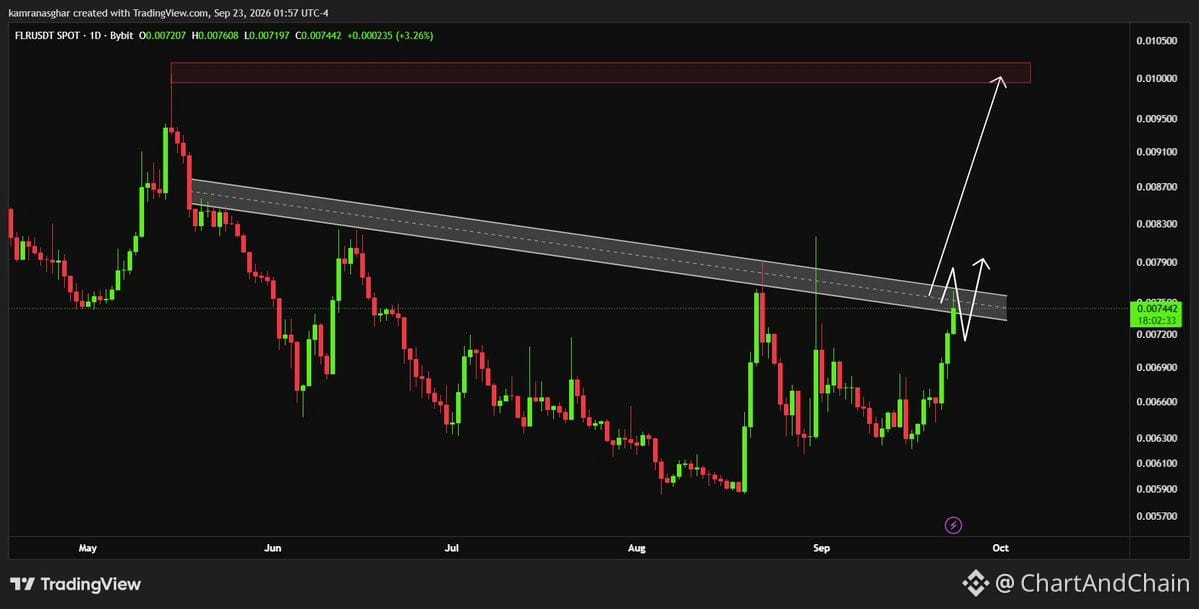
$FLR breaking a clean trendline right now. Structure looks good for continuation toward $0.0100 if momentum holds. Watch for follow-through above the breakout level — failure to sustain would flip this back into range chop. Invalidation comes if price closes back below the trendline with volume.
$FLR breaking a clean trendline right now. Structure looks good for continuation toward $0.0100 if momentum holds. Watch for follow-through above the breakout level — failure to sustain would flip this back into range chop. Invalidation comes if price closes back below the trendline with volume.
308
Watching $2zMMhcVQEXDtdE6vsFS7S7D5oUodfJHE8vd1gnBouauv on Solana. Price is holding above local support and building momentum toward the first resistance level at $0.0120. If that breaks, next target sits around $0.0140+. Clean setup if support holds and volume follows through.
Watching $2zMMhcVQEXDtdE6vsFS7S7D5oUodfJHE8vd1gnBouauv on Solana. Price is holding above local support and building momentum toward the first resistance level at $0.0120. If that breaks, next target sits around $0.0140+. Clean setup if support holds and volume follows through.
197
$ETH/$BTC broke above its multi-month downtrend line — a structural shift that often precedes broader altcoin strength. The pair's been compressed for months, and this break suggests capital rotation out of pure $BTC dominance into alts.
Historically, when $ETH/$BTC reclaims key trendlines with volume, it's led alt rallies across the board — especially in L1s, L2s, and DeFi. Watch for confirmation: sustained hold above the line, rising $ETH dominance, and follow-through in majors like $SOL, $ARB, $OP.
Invalidation: a quick rejection back below the trendline with weak volume would signal a fakeout. For now, the setup favors rotation into alts if $ETH/$BTC can build on this break.
$ETH/$BTC broke above its multi-month downtrend line — a structural shift that often precedes broader altcoin strength. The pair's been compressed for months, and this break suggests capital rotation out of pure $BTC dominance into alts.
Historically, when $ETH/$BTC reclaims key trendlines with volume, it's led alt rallies across the board — especially in L1s, L2s, and DeFi. Watch for confirmation: sustained hold above the line, rising $ETH dominance, and follow-through in majors like $SOL, $ARB, $OP.
Invalidation: a quick rejection back below the trendline with weak volume would signal a fakeout. For now, the setup favors rotation into alts if $ETH/$BTC can build on this break.
Historically, when $ETH/$BTC reclaims key trendlines with volume, it's led alt rallies across the board — especially in L1s, L2s, and DeFi. Watch for confirmation: sustained hold above the line, rising $ETH dominance, and follow-through in majors like $SOL, $ARB, $OP.
Invalidation: a quick rejection back below the trendline with weak volume would signal a fakeout. For now, the setup favors rotation into alts if $ETH/$BTC can build on this break.
1
88
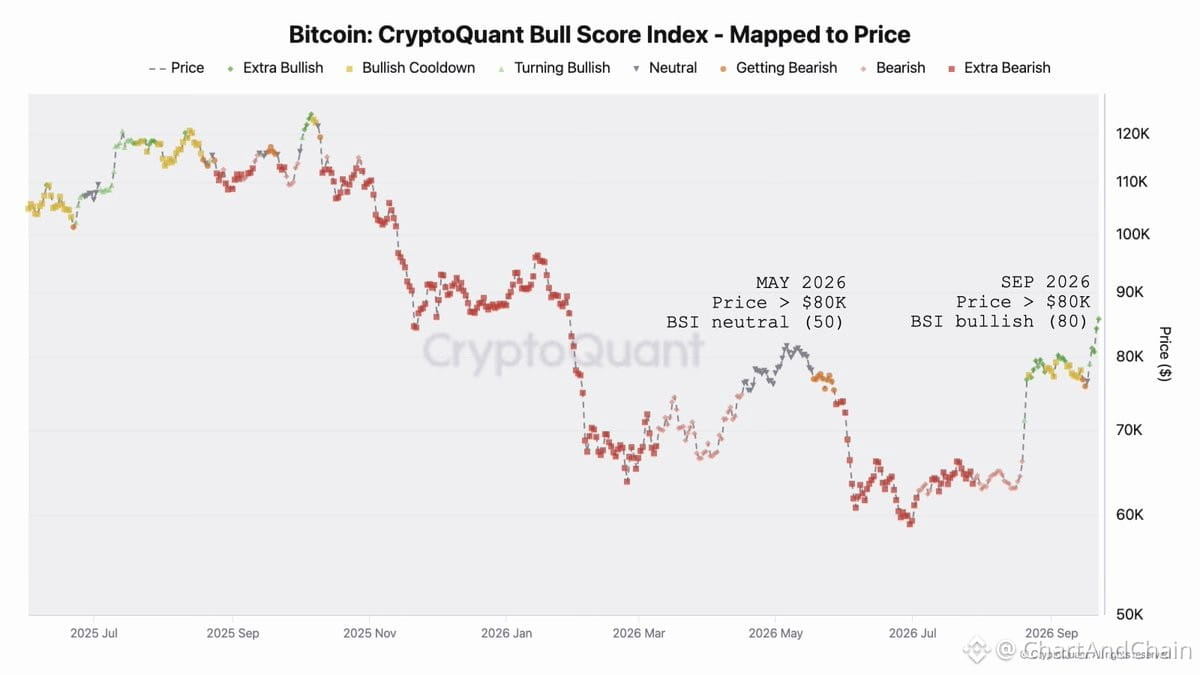
$BTC above $80K now versus May — completely different structural picture.
Bull Score Index sitting at 80 (extra bullish, green zone) compared to 50 (neutral, gray) back then. That's not just price — it's conviction, positioning, and underlying strength.
Same level, different context. The chart might look similar, but the structure underneath has flipped. May was hesitation. Now it's confirmation.
Price alone doesn't tell the story. The internals do.
$BTC above $80K now versus May — completely different structural picture.
Bull Score Index sitting at 80 (extra bullish, green zone) compared to 50 (neutral, gray) back then. That's not just price — it's conviction, positioning, and underlying strength.
Same level, different context. The chart might look similar, but the structure underneath has flipped. May was hesitation. Now it's confirmation.
Price alone doesn't tell the story. The internals do.
Bull Score Index sitting at 80 (extra bullish, green zone) compared to 50 (neutral, gray) back then. That's not just price — it's conviction, positioning, and underlying strength.
Same level, different context. The chart might look similar, but the structure underneath has flipped. May was hesitation. Now it's confirmation.
Price alone doesn't tell the story. The internals do.
1
99
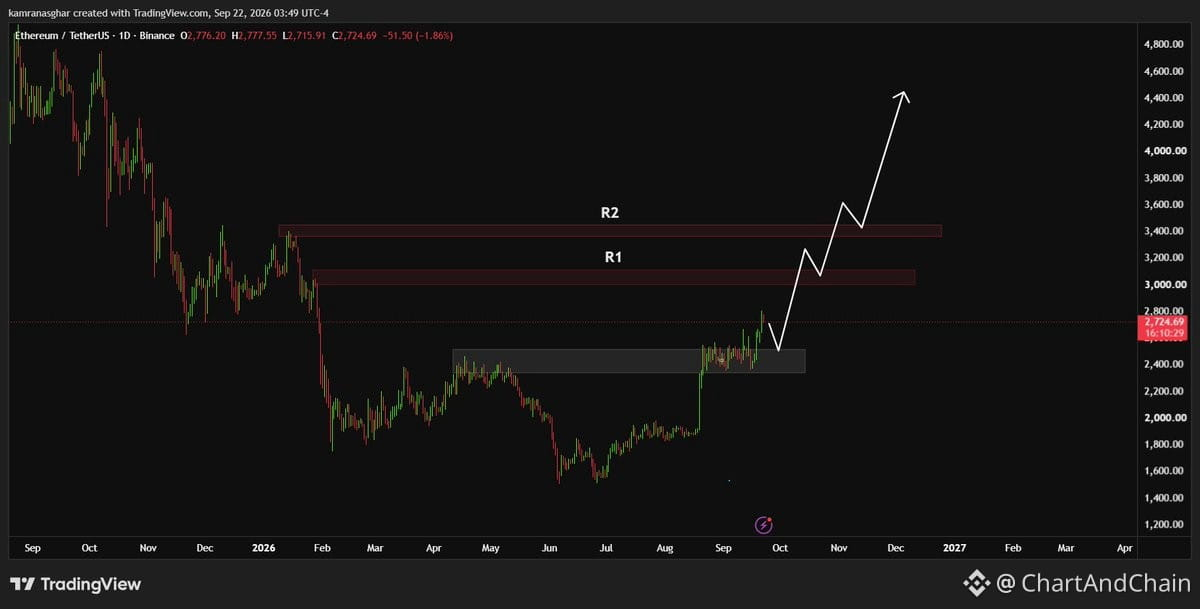
$ETH breaking macro resistance. Clean structure pointing to $3,000 first, then $3,400 if momentum holds. Extended target sits around $4,400+ if the breakout confirms and volume follows through. Watch for retests of the breakout zone — that's where you validate the move or cut if it fails. Invalidation below the resistance-turned-support kills the setup.
$ETH breaking macro resistance. Clean structure pointing to $3,000 first, then $3,400 if momentum holds. Extended target sits around $4,400+ if the breakout confirms and volume follows through. Watch for retests of the breakout zone — that's where you validate the move or cut if it fails. Invalidation below the resistance-turned-support kills the setup.
752
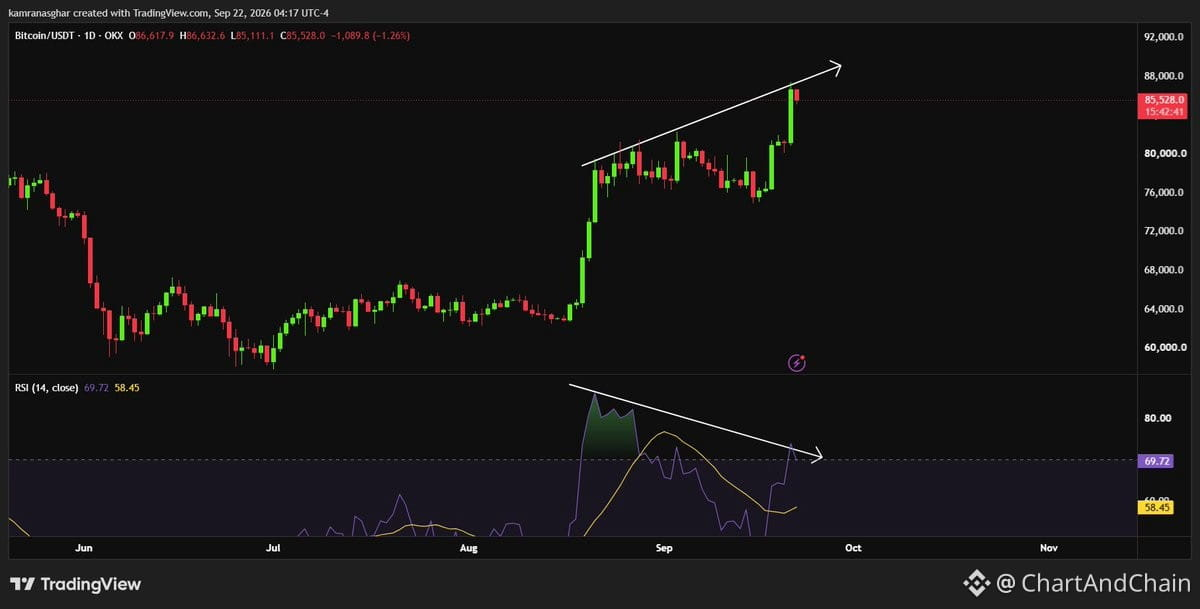
$BTC showing classic bearish divergence on the daily—price making higher highs while RSI prints lower highs. Momentum is bleeding out even as price pushes up, which usually means the rally's running on fumes.
This kind of setup often precedes a cooldown or pullback. Not saying it flips bearish overnight, but the risk/reward for chasing here isn't great. If you're long, consider tightening stops or taking some off. If you're waiting to enter, patience pays—let it reset before committing size.
Divergences don't guarantee reversals, but they do flag exhaustion. Watch for a breakdown in structure or a failure to hold recent support if this plays out.
$BTC showing classic bearish divergence on the daily—price making higher highs while RSI prints lower highs. Momentum is bleeding out even as price pushes up, which usually means the rally's running on fumes.
This kind of setup often precedes a cooldown or pullback. Not saying it flips bearish overnight, but the risk/reward for chasing here isn't great. If you're long, consider tightening stops or taking some off. If you're waiting to enter, patience pays—let it reset before committing size.
Divergences don't guarantee reversals, but they do flag exhaustion. Watch for a breakdown in structure or a failure to hold recent support if this plays out.
This kind of setup often precedes a cooldown or pullback. Not saying it flips bearish overnight, but the risk/reward for chasing here isn't great. If you're long, consider tightening stops or taking some off. If you're waiting to enter, patience pays—let it reset before committing size.
Divergences don't guarantee reversals, but they do flag exhaustion. Watch for a breakdown in structure or a failure to hold recent support if this plays out.
200
A lot of people are asking why $BTC and $ETH keep climbing while the Fed and BOJ tighten, oil stays high, and inflation runs hot.
One thing many are missing: the Fed is still buying bonds.
Here's the simple version:
Fed buys bonds → reserves flow into the system → liquidity rises → yields soften → financial conditions ease.
This is a form of liquidity injection, and it's one reason risk assets can still grind higher even as rates rise.
Add in US midterms in November and a wave of major IPOs on deck, and the setup still has room to run for a while.
If you're already holding, just hold.
If you're sitting on solid profits, consider scaling out gradually between now and November.
Personal view, not advice.
A lot of people are asking why $BTC and $ETH keep climbing while the Fed and BOJ tighten, oil stays high, and inflation runs hot.
One thing many are missing: the Fed is still buying bonds.
Here's the simple version:
Fed buys bonds → reserves flow into the system → liquidity rises → yields soften → financial conditions ease.
This is a form of liquidity injection, and it's one reason risk assets can still grind higher even as rates rise.
Add in US midterms in November and a wave of major IPOs on deck, and the setup still has room to run for a while.
If you're already holding, just hold.
If you're sitting on solid profits, consider scaling out gradually between now and November.
Personal view, not advice.
One thing many are missing: the Fed is still buying bonds.
Here's the simple version:
Fed buys bonds → reserves flow into the system → liquidity rises → yields soften → financial conditions ease.
This is a form of liquidity injection, and it's one reason risk assets can still grind higher even as rates rise.
Add in US midterms in November and a wave of major IPOs on deck, and the setup still has room to run for a while.
If you're already holding, just hold.
If you're sitting on solid profits, consider scaling out gradually between now and November.
Personal view, not advice.
142
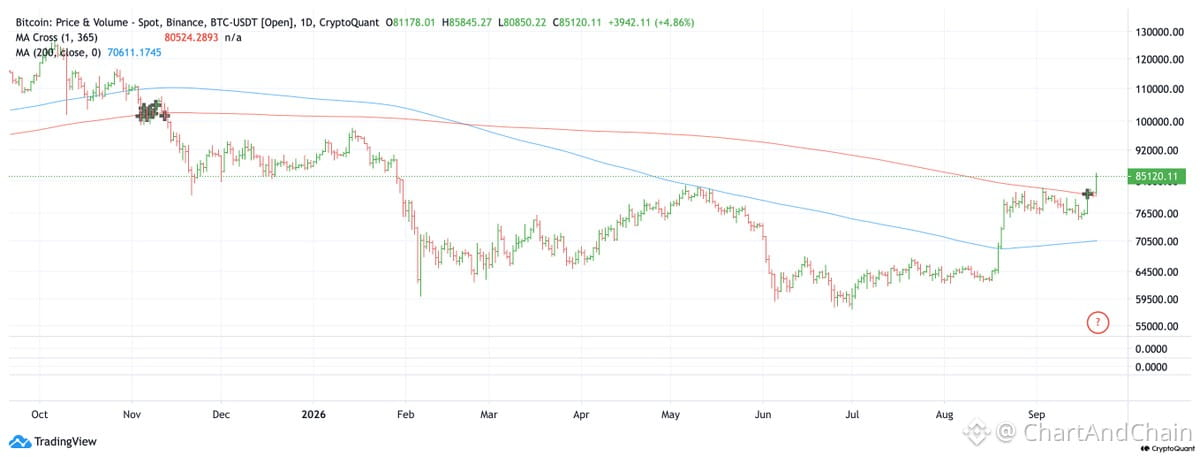
Last bull market confirmation signal: $BTC price above the 365-day moving average.
Classic long-term trend filter. When price holds above the yearly MA, it historically marks sustained uptrend structure. Clean, simple, works across cycles.
Right now, watching whether $BTC can reclaim and hold that level with conviction. A clean break and hold above would confirm structural shift from bear to bull phase.
Invalidation: failure to reclaim or immediate rejection back below the 365-day MA signals the macro trend hasn't flipped yet.
Last bull market confirmation signal: $BTC price above the 365-day moving average.
Classic long-term trend filter. When price holds above the yearly MA, it historically marks sustained uptrend structure. Clean, simple, works across cycles.
Right now, watching whether $BTC can reclaim and hold that level with conviction. A clean break and hold above would confirm structural shift from bear to bull phase.
Invalidation: failure to reclaim or immediate rejection back below the 365-day MA signals the macro trend hasn't flipped yet.
Classic long-term trend filter. When price holds above the yearly MA, it historically marks sustained uptrend structure. Clean, simple, works across cycles.
Right now, watching whether $BTC can reclaim and hold that level with conviction. A clean break and hold above would confirm structural shift from bear to bull phase.
Invalidation: failure to reclaim or immediate rejection back below the 365-day MA signals the macro trend hasn't flipped yet.
291
$BTC just printed its first higher high on the 4H — structure shift that matters if you're watching for continuation.
Next resistance cluster sits around $90k. That's where prior supply lived and where shorts might reload. Clean break above that level with volume would confirm the trend flip.
Watch for a retest of the breakout zone before the push. If it holds as support, the $90k target becomes more probable. Invalidation is a breakdown back below the recent higher low — that would kill the setup and suggest we're still range-bound.
Chart structure is improving, but $BTC needs to prove it can hold these gains and build on them. One higher high doesn't make a trend yet.
$BTC just printed its first higher high on the 4H — structure shift that matters if you're watching for continuation.
Next resistance cluster sits around $90k. That's where prior supply lived and where shorts might reload. Clean break above that level with volume would confirm the trend flip.
Watch for a retest of the breakout zone before the push. If it holds as support, the $90k target becomes more probable. Invalidation is a breakdown back below the recent higher low — that would kill the setup and suggest we're still range-bound.
Chart structure is improving, but $BTC needs to prove it can hold these gains and build on them. One higher high doesn't make a trend yet.
Next resistance cluster sits around $90k. That's where prior supply lived and where shorts might reload. Clean break above that level with volume would confirm the trend flip.
Watch for a retest of the breakout zone before the push. If it holds as support, the $90k target becomes more probable. Invalidation is a breakdown back below the recent higher low — that would kill the setup and suggest we're still range-bound.
Chart structure is improving, but $BTC needs to prove it can hold these gains and build on them. One higher high doesn't make a trend yet.
586
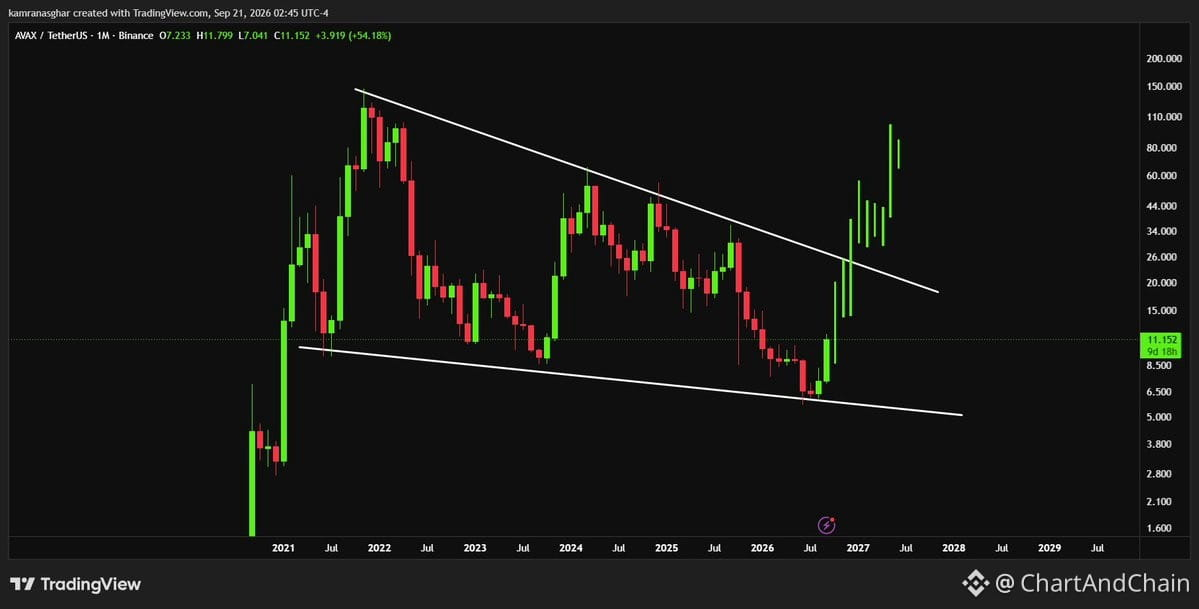
$AVAX just pulled a textbook fakeout. Broke below the multi-year trendline, shook out weak hands, then reclaimed it almost immediately. That's the kind of price action that traps bears and sets up momentum. Now we're seeing follow-through.
This is classic structure — lose support, flip it back to support, then move. The reclaim matters more than the break. If $AVAX holds above that trendline on a retest, the setup's live. Watch for continuation or a pullback to confirm the flip.
Invalidation is simple: lose the trendline again and stay below. Until then, the fake-out worked in bulls' favor.
$AVAX just pulled a textbook fakeout. Broke below the multi-year trendline, shook out weak hands, then reclaimed it almost immediately. That's the kind of price action that traps bears and sets up momentum. Now we're seeing follow-through.
This is classic structure — lose support, flip it back to support, then move. The reclaim matters more than the break. If $AVAX holds above that trendline on a retest, the setup's live. Watch for continuation or a pullback to confirm the flip.
Invalidation is simple: lose the trendline again and stay below. Until then, the fake-out worked in bulls' favor.
This is classic structure — lose support, flip it back to support, then move. The reclaim matters more than the break. If $AVAX holds above that trendline on a retest, the setup's live. Watch for continuation or a pullback to confirm the flip.
Invalidation is simple: lose the trendline again and stay below. Until then, the fake-out worked in bulls' favor.
1.1k
GM bulls 🐂
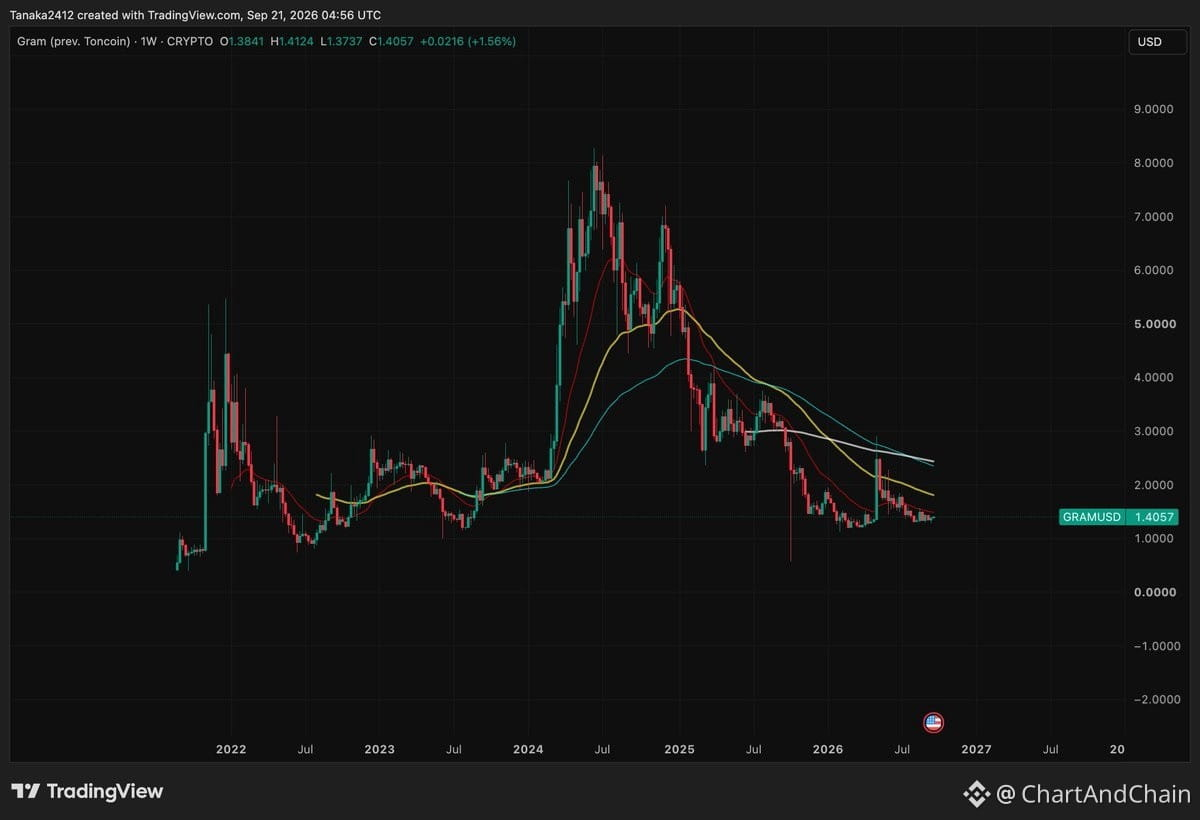
What's your read on $TON right now?
Does the project still have enough narrative fuel left to drive another leg up?
Let me break down a few catalysts that could support $TON in the coming months:
[1] TON is a blockchain tied to an ecosystem with 1B+ users. The real alpha is converting that massive user base into onchain participants.
[2] $TON is gradually becoming the payment rail for Telegram. That's infrastructure-level positioning.
[3] MTONGA has completed 4 out of 7 steps. There are still 3 key milestones ahead, and I expect the TON team could drop more details soon.
[4] More exchange listings could bring fresh liquidity and exposure. BitFlyer Japan is expected to list it on Sep 29, 2026.
[5] Institutional accumulation is another signal I'm tracking. Entities like TON Strategy Co. continue building exposure to $TON.
Personally, I've already accumulated a bag around this range.
Of course, NFA.
GM bulls 🐂
What's your read on $TON right now?
Does the project still have enough narrative fuel left to drive another leg up?
Let me break down a few catalysts that could support $TON in the coming months:
[1] TON is a blockchain tied to an ecosystem with 1B+ users. The real alpha is converting that massive user base into onchain participants.
[2] $TON is gradually becoming the payment rail for Telegram. That's infrastructure-level positioning.
[3] MTONGA has completed 4 out of 7 steps. There are still 3 key milestones ahead, and I expect the TON team could drop more details soon.
[4] More exchange listings could bring fresh liquidity and exposure. BitFlyer Japan is expected to list it on Sep 29, 2026.
[5] Institutional accumulation is another signal I'm tracking. Entities like TON Strategy Co. continue building exposure to $TON.
Personally, I've already accumulated a bag around this range.
Of course, NFA.
What's your read on $TON right now?
Does the project still have enough narrative fuel left to drive another leg up?
Let me break down a few catalysts that could support $TON in the coming months:
[1] TON is a blockchain tied to an ecosystem with 1B+ users. The real alpha is converting that massive user base into onchain participants.
[2] $TON is gradually becoming the payment rail for Telegram. That's infrastructure-level positioning.
[3] MTONGA has completed 4 out of 7 steps. There are still 3 key milestones ahead, and I expect the TON team could drop more details soon.
[4] More exchange listings could bring fresh liquidity and exposure. BitFlyer Japan is expected to list it on Sep 29, 2026.
[5] Institutional accumulation is another signal I'm tracking. Entities like TON Strategy Co. continue building exposure to $TON.
Personally, I've already accumulated a bag around this range.
Of course, NFA.
311
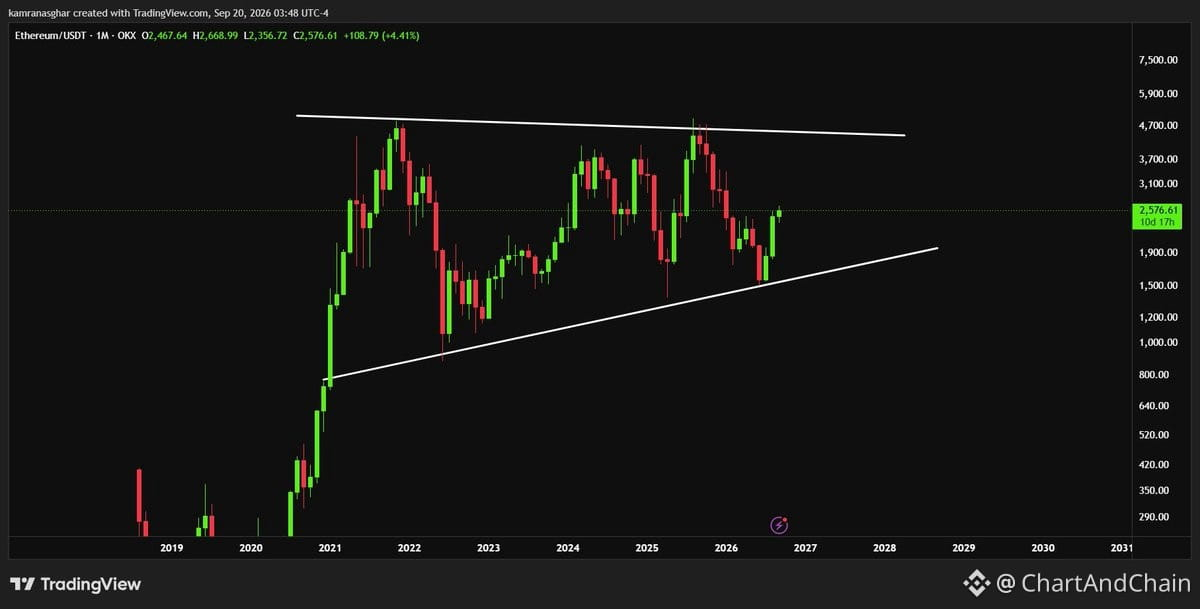
Market's sleeping on $ETH native expansion if we flip bullish. Positioning looks thin, most aren't ready for what could come next. The setup's there but conviction's missing — classic late-cycle hesitation before momentum actually builds. Watch how fast that changes when price structure confirms.
Market's sleeping on $ETH native expansion if we flip bullish. Positioning looks thin, most aren't ready for what could come next. The setup's there but conviction's missing — classic late-cycle hesitation before momentum actually builds. Watch how fast that changes when price structure confirms.
958
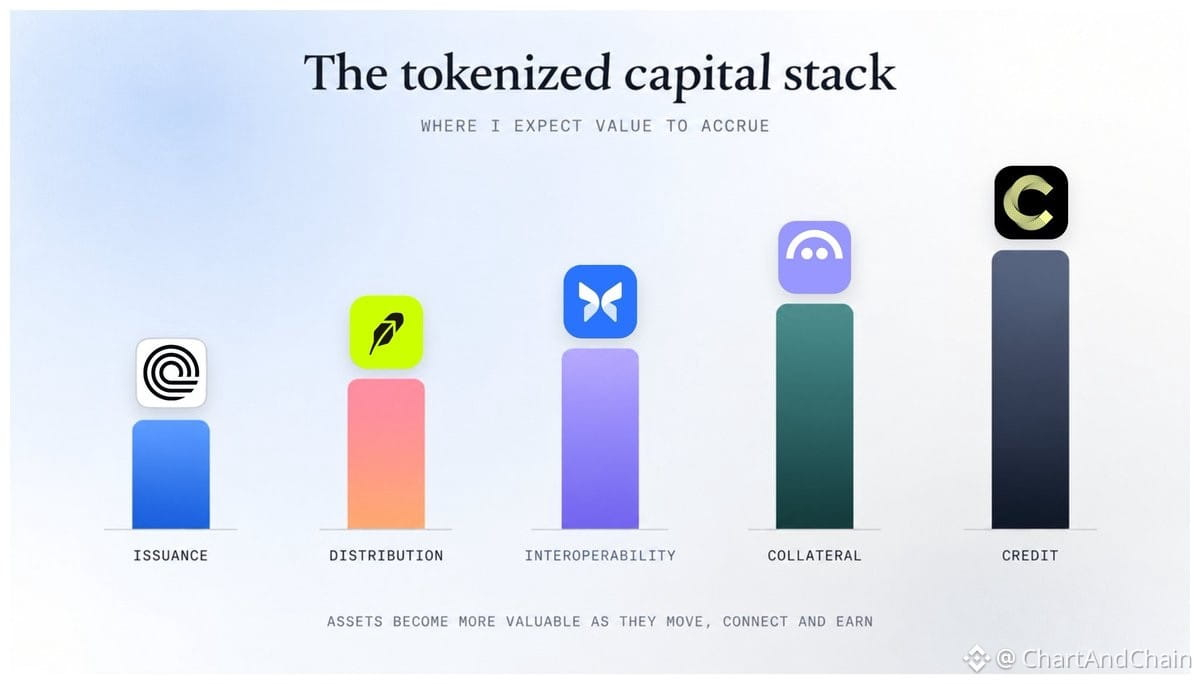
Tokens are becoming the containers of capital markets — not a narrative anymore, the framework I'm building exposure around.
Capital markets still run on fragmented databases, custodians, brokers, settlement layers. Tokens give assets a common, machine-readable format. Once tokenized, the same asset moves between exchanges, custodians, lending markets without institutional rebuild. That's not just faster settlement — it's programmable financial capability attached directly to the asset.
The stack is forming:
$ONDO and Centrifuge bring securities and funds onchain
Canton Network handles privacy and institutional settlement
Robinhood connects tokenized assets to retail distribution
$LINK bridges assets, data, liquidity across networks
$AAVE and Morpho turn eligible assets into productive collateral
Biggest winners may be the networks and protocols where these assets are issued, traded, financed, and reused. Stablecoins proved tokenized dollars reach global distribution. Next phase: stocks, Treasuries, funds, private credit on the same programmable rails.
I'm positioning around infrastructure that captures activity across the entire lifecycle. That's where durable value accrues.
Tokens are becoming the containers of capital markets — not a narrative anymore, the framework I'm building exposure around.
Capital markets still run on fragmented databases, custodians, brokers, settlement layers. Tokens give assets a common, machine-readable format. Once tokenized, the same asset moves between exchanges, custodians, lending markets without institutional rebuild. That's not just faster settlement — it's programmable financial capability attached directly to the asset.
The stack is forming:
$ONDO and Centrifuge bring securities and funds onchain
Canton Network handles privacy and institutional settlement
Robinhood connects tokenized assets to retail distribution
$LINK bridges assets, data, liquidity across networks
$AAVE and Morpho turn eligible assets into productive collateral
Biggest winners may be the networks and protocols where these assets are issued, traded, financed, and reused. Stablecoins proved tokenized dollars reach global distribution. Next phase: stocks, Treasuries, funds, private credit on the same programmable rails.
I'm positioning around infrastructure that captures activity across the entire lifecycle. That's where durable value accrues.
Capital markets still run on fragmented databases, custodians, brokers, settlement layers. Tokens give assets a common, machine-readable format. Once tokenized, the same asset moves between exchanges, custodians, lending markets without institutional rebuild. That's not just faster settlement — it's programmable financial capability attached directly to the asset.
The stack is forming:
$ONDO and Centrifuge bring securities and funds onchain
Canton Network handles privacy and institutional settlement
Robinhood connects tokenized assets to retail distribution
$LINK bridges assets, data, liquidity across networks
$AAVE and Morpho turn eligible assets into productive collateral
Biggest winners may be the networks and protocols where these assets are issued, traded, financed, and reused. Stablecoins proved tokenized dollars reach global distribution. Next phase: stocks, Treasuries, funds, private credit on the same programmable rails.
I'm positioning around infrastructure that captures activity across the entire lifecycle. That's where durable value accrues.
2
2.5k
GenLayer lets smart contracts judge whether a task was actually completed, then settle the payment onchain. That's the part that clicked.
Say I hire an agent for $1,000 to produce a research report with 10 primary sources, data published within the last 30 days, a summary of key market changes, and delivery before a fixed deadline. Payment sits in escrow.
A normal smart contract can verify the deadline and whether a file was submitted. It cannot judge whether the sources are relevant, the data is current, or the report actually satisfies my instructions. A traditional oracle can bring the source data onchain. It still does not interpret the complete delivery against the agreed criteria.
GenLayer works differently:
[1] The Intelligent Contract stores the task, accepted evidence, and possible outcomes.
[2] The agent submits its work.
[3] A selected validator runs the contract, checks the submission and relevant web sources, then proposes a result such as COMPLETE or INCOMPLETE.
[4] Other validators independently assess that result against the same brief and evidence. The contract's Equivalence Principle defines whether they reach the same decision in meaning.
[5] Validators commit their votes before revealing them, reducing the ability to copy or adjust to other votes.
[6] If the committee accepts the result, the contract releases the $1,000 or returns it according to the predefined rules.
[7] If the result is challenged, an appeal can send it to a fresh committee for another review.
The important part is that one AI does not control the payment. AI provides the judgment, then the validator network turns that judgment into a shared, enforceable result.
That makes GenLayer more than an oracle that reports what happened. It can evaluate whether a natural-language agreement was actually fulfilled. Someone must interpret the evidence before the contract can settle.
As far as I know, only GenLayer is building that decision layer right now.
GenLayer lets smart contracts judge whether a task was actually completed, then settle the payment onchain. That's the part that clicked.
Say I hire an agent for $1,000 to produce a research report with 10 primary sources, data published within the last 30 days, a summary of key market changes, and delivery before a fixed deadline. Payment sits in escrow.
A normal smart contract can verify the deadline and whether a file was submitted. It cannot judge whether the sources are relevant, the data is current, or the report actually satisfies my instructions. A traditional oracle can bring the source data onchain. It still does not interpret the complete delivery against the agreed criteria.
GenLayer works differently:
[1] The Intelligent Contract stores the task, accepted evidence, and possible outcomes.
[2] The agent submits its work.
[3] A selected validator runs the contract, checks the submission and relevant web sources, then proposes a result such as COMPLETE or INCOMPLETE.
[4] Other validators independently assess that result against the same brief and evidence. The contract's Equivalence Principle defines whether they reach the same decision in meaning.
[5] Validators commit their votes before revealing them, reducing the ability to copy or adjust to other votes.
[6] If the committee accepts the result, the contract releases the $1,000 or returns it according to the predefined rules.
[7] If the result is challenged, an appeal can send it to a fresh committee for another review.
The important part is that one AI does not control the payment. AI provides the judgment, then the validator network turns that judgment into a shared, enforceable result.
That makes GenLayer more than an oracle that reports what happened. It can evaluate whether a natural-language agreement was actually fulfilled. Someone must interpret the evidence before the contract can settle.
As far as I know, only GenLayer is building that decision layer right now.
Say I hire an agent for $1,000 to produce a research report with 10 primary sources, data published within the last 30 days, a summary of key market changes, and delivery before a fixed deadline. Payment sits in escrow.
A normal smart contract can verify the deadline and whether a file was submitted. It cannot judge whether the sources are relevant, the data is current, or the report actually satisfies my instructions. A traditional oracle can bring the source data onchain. It still does not interpret the complete delivery against the agreed criteria.
GenLayer works differently:
[1] The Intelligent Contract stores the task, accepted evidence, and possible outcomes.
[2] The agent submits its work.
[3] A selected validator runs the contract, checks the submission and relevant web sources, then proposes a result such as COMPLETE or INCOMPLETE.
[4] Other validators independently assess that result against the same brief and evidence. The contract's Equivalence Principle defines whether they reach the same decision in meaning.
[5] Validators commit their votes before revealing them, reducing the ability to copy or adjust to other votes.
[6] If the committee accepts the result, the contract releases the $1,000 or returns it according to the predefined rules.
[7] If the result is challenged, an appeal can send it to a fresh committee for another review.
The important part is that one AI does not control the payment. AI provides the judgment, then the validator network turns that judgment into a shared, enforceable result.
That makes GenLayer more than an oracle that reports what happened. It can evaluate whether a natural-language agreement was actually fulfilled. Someone must interpret the evidence before the contract can settle.
As far as I know, only GenLayer is building that decision layer right now.

1
235
Log in to explore more content
Join global crypto users on Binance Square
⚡️ Get latest and useful information about crypto.
💬 Trusted by the world’s largest crypto exchange.
👍 Discover real insights from verified creators.
Email / Phone number
Trending Topics
NvidiaApproves$150BBuyback
608 views
21 Discussing
#NvidiaApproves$150BBuyback
Nvidia’s $150 Billion Buyback Shockwave: Is AI Cash Flow Driving the Next Market Rally? 🚀
The AI supercycle just sent shockwaves across tradfi and crypto markets! NVIDIA's Board of Directors authorized a massive $150 Billion increase to its share repurchase program, expanding the company's total remaining buyback authorization to $235 Billion.
This marks the largest share buyback authorization in U.S. corporate history, surpassing Apple’s $110 billion benchmark.
📰 Key Headlines & Market Breakdown
Record-Breaking Capital Return: NVIDIA founder and CEO Jensen Huang cited "once-in-a-generation platform shift to AI" and strong corporate cash flow as the main drivers behind returning capital to shareholders.
Defying Market Downturns: Despite broader equity pressure and rising U.S. Treasury yields, $NVDA shares surged over 3% on the announcement, showing institutional confidence in tech assets.
Spillover into Decentralized AI: Historically, major bullish headlines for NVIDIA trigger positive sentiment for decentralized AI infrastructure protocols (such as NEAR, RENDER, and FET), as web3 AI projects track broader AI sector valuations.
❓ Discussion Point
Nvidia announces a massive $150B buyback! Will tech stock gains bleed over into Bitcoin and AI tokens?
$RENDER
📊 Related Crypto Trade Signal: RENDER/USDT
Trade Bias: Bullish
Entry Zone: $5.20 – $5.45
Target 1 (TP1): $6.10
Target 2 (TP2): $6.85
Stop Loss (SL): $4.85
Leverage (Futures): 3x – 5x (Isolated)
Technical Rationale: RENDER tends to react strongly to Nvidia hardware and AI capital developments. Price is consolidating near key moving average support with rising spot volume following the $NVDAB
news.
#HackersDrainOver12.4MXRPFromDCENTWallets #CryptoNews #AITokens #TradingSignals
Lily星星
·0 Likes
·23 views
OpenAIDelaysGPT6.1OverSafetyIssues
2,461 views
143 Discussing
AMDToAcquireWorldLabsFor$8.2B
417 views
23 Discussing