

钱往哪走
5k Posts

钱往哪走
Report
Block User
不猜方向,只看钱往哪走。判断发出来,到期自己回来对账。
Frequent Trader
2.6 Years
0 Following
193 Followers
180 Liked
Posts
All
Quotes
PINNED
·
--
📌 New here? Start with this: what this account covers and where to beginThis account is called “Where the Money Flows.” The name says it all: no guessing market direction, no trading calls—just one question: where is the money going, and why?
① Who this is for
For people who want to understand crypto without getting lost in jargon or trading hype. I don’t recommend what to buy or predict price levels.
② Three main themes
1. Course series · 42 lessons (up to lesson 15 so far; one lesson a day)
Each lesson explains one concept clearly, so you can look it up yourself afterward:
1. What exactly is a blockchain?
2. How did Bitcoin come about?
3. Who keeps the books? Mining and consensus
📌 New here? Start with this: what this account covers and where to begin
This account is called “Where the Money Flows.” The name says it all: no guessing market direction, no trading calls—just one question: where is the money going, and why?
① Who this is for
For people who want to understand crypto without getting lost in jargon or trading hype. I don’t recommend what to buy or predict price levels.
② Three main themes
1. Course series · 42 lessons (up to lesson 15 so far; one lesson a day)
Each lesson explains one concept clearly, so you can look it up yourself afterward:
1. What exactly is a blockchain?
2. How did Bitcoin come about?
3. Who keeps the books? Mining and consensus
457
·
--
Article
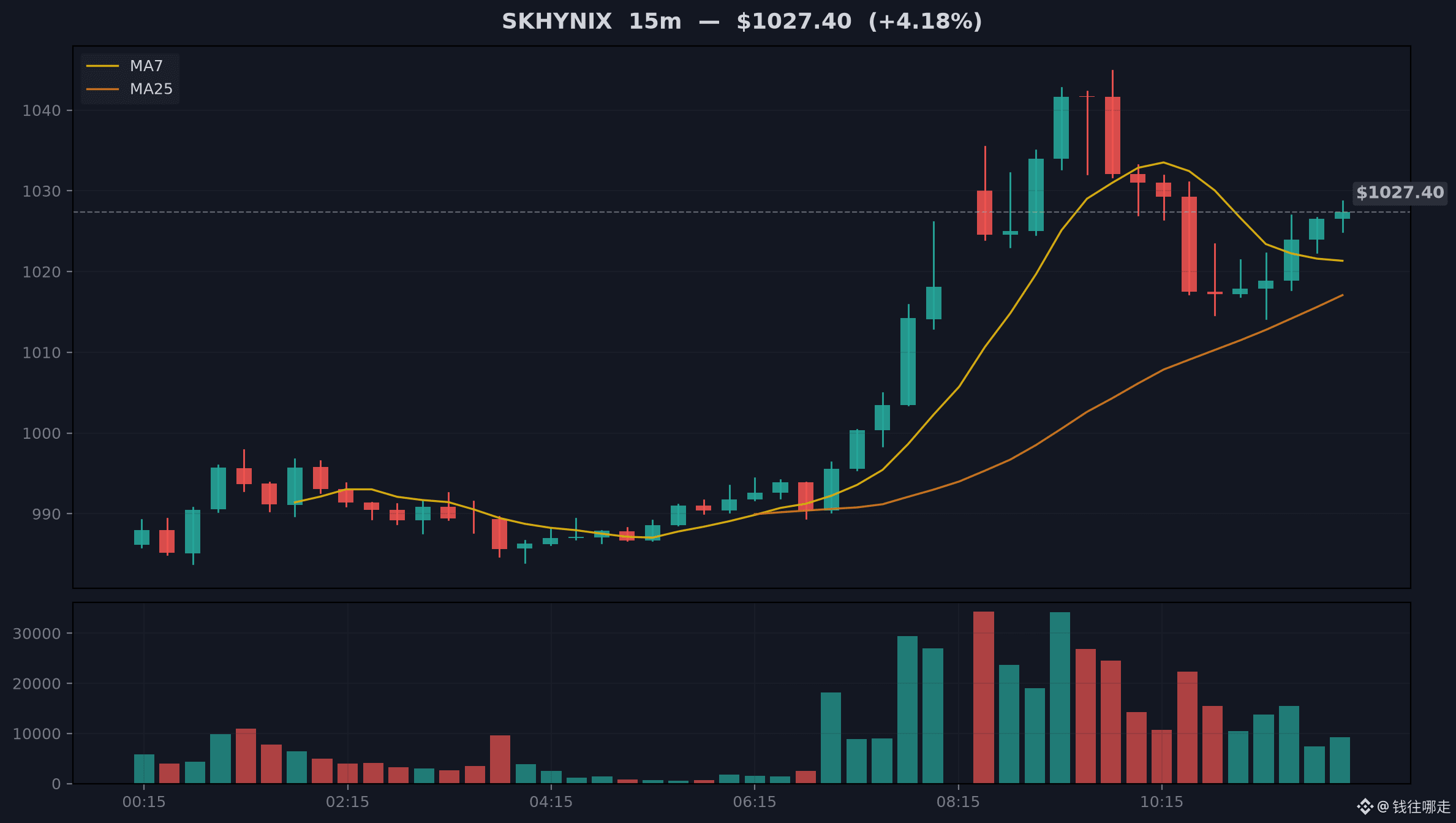
↗️ SKHYNIX OI inflow 0.6% — A look at capital flowsIt's me again. When prices surge, first look at where the money is coming from.
SKHYNIX has broken out on a surge in volume. Let me lay out the structure first: slightly bullish, but unconfirmed, so I'm staying on the sidelines. The current price is 1025.57, up +5.65% in 24 hours, with $953 million in trading volume. The volume is real, but the price is still -1.9% below the 24-hour high, which suggests selling pressure overhead—the rally hasn't been especially clean. The large-trader long/short ratio is 4.46, and 81.7% of large-trader accounts are long. Big players are indeed adding longs, but these kinds of extreme readings often show up near short-term peaks. The price has already made a substantial move, and I'm not willing to chase it when sentiment is at its hottest. Among the 228 coins in the TradFi sector, 65.4% are up, with an average gain of +1.6%. The broader environment isn't bad, but it's hardly a full-blown rally either. There are just two key levels: a break below 1014.64 would mean this high-volume move was a false breakout and the structure has weakened—I'd turn bearish. A move above 1033.2 would confirm the breakout, and I'd turn bullish. In between, the structure hasn't settled, so I'm not betting on a direction. If you're already holding, you should know your own entry price.
↗️ SKHYNIX OI inflow 0.6% — A look at capital flows
It's me again. When prices surge, first look at where the money is coming from.
SKHYNIX has broken out on a surge in volume. Let me lay out the structure first: slightly bullish, but unconfirmed, so I'm staying on the sidelines. The current price is 1025.57, up +5.65% in 24 hours, with $953 million in trading volume. The volume is real, but the price is still -1.9% below the 24-hour high, which suggests selling pressure overhead—the rally hasn't been especially clean. The large-trader long/short ratio is 4.46, and 81.7% of large-trader accounts are long. Big players are indeed adding longs, but these kinds of extreme readings often show up near short-term peaks. The price has already made a substantial move, and I'm not willing to chase it when sentiment is at its hottest. Among the 228 coins in the TradFi sector, 65.4% are up, with an average gain of +1.6%. The broader environment isn't bad, but it's hardly a full-blown rally either. There are just two key levels: a break below 1014.64 would mean this high-volume move was a false breakout and the structure has weakened—I'd turn bearish. A move above 1033.2 would confirm the breakout, and I'd turn bullish. In between, the structure hasn't settled, so I'm not betting on a direction. If you're already holding, you should know your own entry price.
SKHYNIX has broken out on a surge in volume. Let me lay out the structure first: slightly bullish, but unconfirmed, so I'm staying on the sidelines. The current price is 1025.57, up +5.65% in 24 hours, with $953 million in trading volume. The volume is real, but the price is still -1.9% below the 24-hour high, which suggests selling pressure overhead—the rally hasn't been especially clean. The large-trader long/short ratio is 4.46, and 81.7% of large-trader accounts are long. Big players are indeed adding longs, but these kinds of extreme readings often show up near short-term peaks. The price has already made a substantial move, and I'm not willing to chase it when sentiment is at its hottest. Among the 228 coins in the TradFi sector, 65.4% are up, with an average gain of +1.6%. The broader environment isn't bad, but it's hardly a full-blown rally either. There are just two key levels: a break below 1014.64 would mean this high-volume move was a false breakout and the structure has weakened—I'd turn bearish. A move above 1033.2 would confirm the breakout, and I'd turn bullish. In between, the structure hasn't settled, so I'm not betting on a direction. If you're already holding, you should know your own entry price.
487
·
--
Partly True
Article
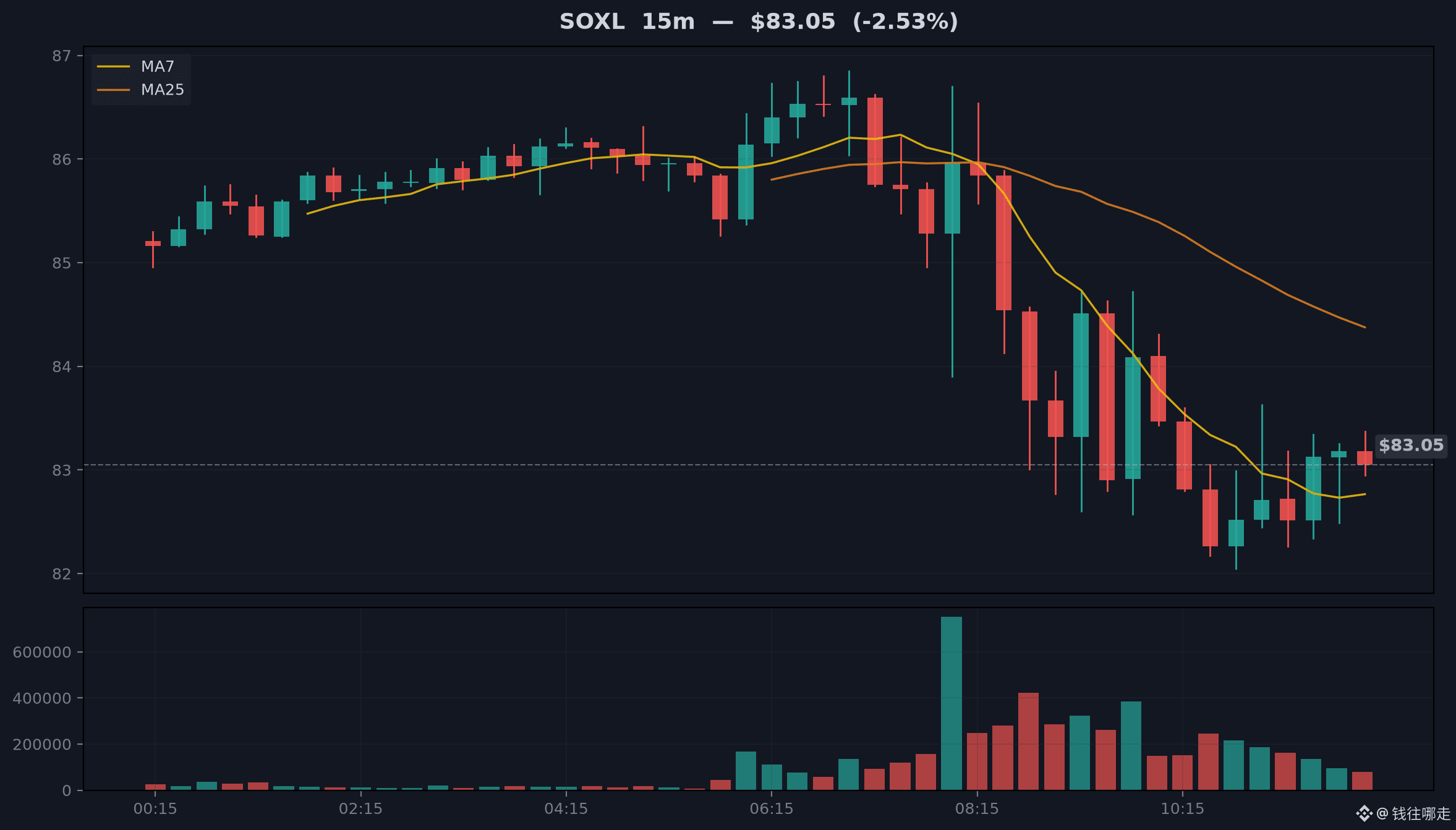
🚀 Is SOXL Ready to Break Out? OI + Bullish Whales, Breakout ImminentWhere the money is going: don’t rush to look for reasons; let’s put the numbers on the table first.
I’m not dismissing this SOXL signal, but the bullish structure isn’t confirmed yet, so I’m staying neutral. It’s down 2.58% over 24 hours, with $616 million in trading volume, and the price is stuck between support at 82.74 and resistance at 83.81. The direction hasn’t resolved. If it breaks below 82.74, I’ll turn bearish; if it gets above 83.81, I’ll turn bullish. In between, I can’t tell who has the upper hand.
The clearest bullish evidence is the large-trader long/short ratio at 11.29, with long accounts making up 92%. But extreme readings often show up near interim highs, so jumping in here could leave you holding the bag. The taker buy/sell ratio is 1.07, so buyers are indeed pushing—but it’s not confirmed yet. Open interest is up 6.4% over 3 hours: new money is coming in, though some of it could be buying the top.
🚀 Is SOXL Ready to Break Out? OI + Bullish Whales, Breakout Imminent
Where the money is going: don’t rush to look for reasons; let’s put the numbers on the table first.
I’m not dismissing this SOXL signal, but the bullish structure isn’t confirmed yet, so I’m staying neutral. It’s down 2.58% over 24 hours, with $616 million in trading volume, and the price is stuck between support at 82.74 and resistance at 83.81. The direction hasn’t resolved. If it breaks below 82.74, I’ll turn bearish; if it gets above 83.81, I’ll turn bullish. In between, I can’t tell who has the upper hand.
The clearest bullish evidence is the large-trader long/short ratio at 11.29, with long accounts making up 92%. But extreme readings often show up near interim highs, so jumping in here could leave you holding the bag. The taker buy/sell ratio is 1.07, so buyers are indeed pushing—but it’s not confirmed yet. Open interest is up 6.4% over 3 hours: new money is coming in, though some of it could be buying the top.
1.1k
·
--
📰 Our View | 10/25After reviewing discussions from a range of top authors today, my overall takeaway is: the direction is unclear and the signals are inconsistent. There are 2 bullish views, 1 bearish view, and 2 neutral or mixed views. Most top authors are cautious, and this distribution itself shows that the disagreement hasn’t converged.
Where do the disagreements lie? I’m not convinced that $BTC is such a clear-cut case. It’s only down 0.1% over 24h, and the whale long/short ratio is 2.21. The rebound after liquidations still lacks confirmation from active buying, so I’m treating this as mixed and not betting in either direction.$ETH It’s down 1.24% over 24h, yet attention has surged. Sentiment is hot while price is weak, which looks bearish to me—this is one of the few points where I don’t fully agree with the top authors. They’re cautious; I’m more clearly bearish.$BNB It’s up 1.61% over 24h, but the funding rate is only 0.0034%. With the market consolidating, it’s not worth chasing the price higher. The bullish case is only structural for now; let’s wait for a breakout.
📰 Our View | 10/25
After reviewing discussions from a range of top authors today, my overall takeaway is: the direction is unclear and the signals are inconsistent. There are 2 bullish views, 1 bearish view, and 2 neutral or mixed views. Most top authors are cautious, and this distribution itself shows that the disagreement hasn’t converged.
Where do the disagreements lie? I’m not convinced that $BTC is such a clear-cut case. It’s only down 0.1% over 24h, and the whale long/short ratio is 2.21. The rebound after liquidations still lacks confirmation from active buying, so I’m treating this as mixed and not betting in either direction.$ETH It’s down 1.24% over 24h, yet attention has surged. Sentiment is hot while price is weak, which looks bearish to me—this is one of the few points where I don’t fully agree with the top authors. They’re cautious; I’m more clearly bearish.$BNB It’s up 1.61% over 24h, but the funding rate is only 0.0034%. With the market consolidating, it’s not worth chasing the price higher. The bullish case is only structural for now; let’s wait for a breakout.
Where do the disagreements lie? I’m not convinced that $BTC is such a clear-cut case. It’s only down 0.1% over 24h, and the whale long/short ratio is 2.21. The rebound after liquidations still lacks confirmation from active buying, so I’m treating this as mixed and not betting in either direction.$ETH It’s down 1.24% over 24h, yet attention has surged. Sentiment is hot while price is weak, which looks bearish to me—this is one of the few points where I don’t fully agree with the top authors. They’re cautious; I’m more clearly bearish.$BNB It’s up 1.61% over 24h, but the funding rate is only 0.0034%. With the market consolidating, it’s not worth chasing the price higher. The bullish case is only structural for now; let’s wait for a breakout.
148
·
--
🪙 Where Does This Coin Come From? | ⑫ Cardano: New Coins Are Issued Through Delegation to Staking PoolsHow exactly is a new coin created? Cardano ($ADA) offers an answer that may be completely different from the image of “mining” most people have in mind: instead of burning electricity with mining rigs, it relies on coin holders delegating their coins so that selected nodes can produce blocks on everyone’s behalf. New coins are created when blocks are produced.
① How is it issued?
First, the most important step: delegate your ADA to a staking pool. You can think of a staking pool as a team dedicated to keeping the ledger. It needs enough coins backing it to have a chance of being selected to produce blocks. When you delegate your ADA to it, you still own the coins—you’re just casting your “vote of support” for that pool. The system selects block-producing nodes according to their stake. Selected nodes bundle transactions and maintain the ledger, earning newly issued ADA in return.
🪙 Where Does This Coin Come From? | ⑫ Cardano: New Coins Are Issued Through Delegation to Staking Pools
How exactly is a new coin created? Cardano ($ADA ) offers an answer that may be completely different from the image of “mining” most people have in mind: instead of burning electricity with mining rigs, it relies on coin holders delegating their coins so that selected nodes can produce blocks on everyone’s behalf. New coins are created when blocks are produced.
① How is it issued?
First, the most important step: delegate your ADA to a staking pool. You can think of a staking pool as a team dedicated to keeping the ledger. It needs enough coins backing it to have a chance of being selected to produce blocks. When you delegate your ADA to it, you still own the coins—you’re just casting your “vote of support” for that pool. The system selects block-producing nodes according to their stake. Selected nodes bundle transactions and maintain the ledger, earning newly issued ADA in return.
1
1.6k
·
--
📖 Systematic Course | Lesson 15 · How Do Deposits and Withdrawals Work?In the previous lesson, we broke down what’s in your account: crypto, stablecoins, and a small amount for fees. But these things don’t just appear in your account out of nowhere—they’re either bought with money from your bank card or transferred from somewhere else. This lesson is about how money and crypto move in and out: deposits and withdrawals.
Let’s start with deposits—that is, putting money into your exchange account. There are two common ways to do this.
The first way is to buy crypto directly with your local currency. There’s a formal term for local currency: fiat currency. It means the official currency issued by a country, such as the Chinese yuan, the US dollar, or the Japanese yen. When you buy crypto with fiat currency on a platform, you’re often not dealing with the exchange itself, but with a third-party payment provider or a merchant it works with. You pay in yuan as instructed on the page, and the other party transfers the crypto to your account. This is the most straightforward option for beginners, since you don’t need to know about wallets or addresses first.
📖 Systematic Course | Lesson 15 · How Do Deposits and Withdrawals Work?
In the previous lesson, we broke down what’s in your account: crypto, stablecoins, and a small amount for fees. But these things don’t just appear in your account out of nowhere—they’re either bought with money from your bank card or transferred from somewhere else. This lesson is about how money and crypto move in and out: deposits and withdrawals.
Let’s start with deposits—that is, putting money into your exchange account. There are two common ways to do this.
The first way is to buy crypto directly with your local currency. There’s a formal term for local currency: fiat currency. It means the official currency issued by a country, such as the Chinese yuan, the US dollar, or the Japanese yen. When you buy crypto with fiat currency on a platform, you’re often not dealing with the exchange itself, but with a third-party payment provider or a merchant it works with. You pay in yuan as instructed on the page, and the other party transfers the crypto to your account. This is the most straightforward option for beginners, since you don’t need to know about wallets or addresses first.
1.1k
·
--
🪙 Where does this coin come from? | ⑪ Solana: New coins are earned through staking and block production① What is its issuance mechanism?
Many people think Solana’s coins are issued in batches according to a schedule by some institution, but that’s not the case at all. $SOL New coins come from an issuance rule written into the protocol: the network continuously creates new coins according to a set schedule, and distributes them to validators who participate in producing blocks. Validators are essentially server operators who help the entire network keep records and package transactions. They must first stake their own SOL to be eligible to participate in consensus and take turns producing blocks. The more they stake and the more reliably they perform, the greater their chances of being selected to produce a block—and the more newly issued rewards they can earn. Solana also has a design called PoH (Proof of History), which timestamps transactions in a verifiable way, giving the entire network a consistent ordering of “who came first” and speeding up block production. One point that’s easy to confuse: PoH is a timing and ordering mechanism, not a separate type of consensus. Staking is still what determines who produces blocks. As for whether “your holdings increase on their own,” the answer is no—if you leave your coins sitting in a wallet, the amount won’t increase at all. Only by delegating your coins to participate in block production can you potentially receive a share of newly issued coins.
🪙 Where does this coin come from? | ⑪ Solana: New coins are earned through staking and block production
① What is its issuance mechanism?
Many people think Solana’s coins are issued in batches according to a schedule by some institution, but that’s not the case at all. $SOL New coins come from an issuance rule written into the protocol: the network continuously creates new coins according to a set schedule, and distributes them to validators who participate in producing blocks. Validators are essentially server operators who help the entire network keep records and package transactions. They must first stake their own SOL to be eligible to participate in consensus and take turns producing blocks. The more they stake and the more reliably they perform, the greater their chances of being selected to produce a block—and the more newly issued rewards they can earn. Solana also has a design called PoH (Proof of History), which timestamps transactions in a verifiable way, giving the entire network a consistent ordering of “who came first” and speeding up block production. One point that’s easy to confuse: PoH is a timing and ordering mechanism, not a separate type of consensus. Staking is still what determines who produces blocks. As for whether “your holdings increase on their own,” the answer is no—if you leave your coins sitting in a wallet, the amount won’t increase at all. Only by delegating your coins to participate in block production can you potentially receive a share of newly issued coins.
Many people think Solana’s coins are issued in batches according to a schedule by some institution, but that’s not the case at all. $SOL New coins come from an issuance rule written into the protocol: the network continuously creates new coins according to a set schedule, and distributes them to validators who participate in producing blocks. Validators are essentially server operators who help the entire network keep records and package transactions. They must first stake their own SOL to be eligible to participate in consensus and take turns producing blocks. The more they stake and the more reliably they perform, the greater their chances of being selected to produce a block—and the more newly issued rewards they can earn. Solana also has a design called PoH (Proof of History), which timestamps transactions in a verifiable way, giving the entire network a consistent ordering of “who came first” and speeding up block production. One point that’s easy to confuse: PoH is a timing and ordering mechanism, not a separate type of consensus. Staking is still what determines who produces blocks. As for whether “your holdings increase on their own,” the answer is no—if you leave your coins sitting in a wallet, the amount won’t increase at all. Only by delegating your coins to participate in block production can you potentially receive a share of newly issued coins.
1
1
1.3k
·
--
📖 Course Series | Lesson 14 · What’s in Your Account?In the last lesson, we explained the difference between centralized and decentralized exchanges. But whichever kind you use, the first thing you do after opening an account on a centralized platform is put money into it. So what exactly does the account hold, and what does each thing do?
Let’s start with registration. To sign up on a platform like Binance, you’ll need an email address or phone number, and then you’ll have to verify your identity—that means uploading a photo of your ID card or passport and completing a facial recognition check on camera. The goal is to prove that the person behind the screen is really you, and that someone else isn’t using your information to open an account. This isn’t the platform making you jump through hoops for fun: regulators in many regions require trading platforms to verify users’ identities. Accounts that haven’t been verified usually can’t withdraw funds and may have limits.
📖 Course Series | Lesson 14 · What’s in Your Account?
In the last lesson, we explained the difference between centralized and decentralized exchanges. But whichever kind you use, the first thing you do after opening an account on a centralized platform is put money into it. So what exactly does the account hold, and what does each thing do?
Let’s start with registration. To sign up on a platform like Binance, you’ll need an email address or phone number, and then you’ll have to verify your identity—that means uploading a photo of your ID card or passport and completing a facial recognition check on camera. The goal is to prove that the person behind the screen is really you, and that someone else isn’t using your information to open an account. This isn’t the platform making you jump through hoops for fun: regulators in many regions require trading platforms to verify users’ identities. Accounts that haven’t been verified usually can’t withdraw funds and may have limits.
Let’s start with registration. To sign up on a platform like Binance, you’ll need an email address or phone number, and then you’ll have to verify your identity—that means uploading a photo of your ID card or passport and completing a facial recognition check on camera. The goal is to prove that the person behind the screen is really you, and that someone else isn’t using your information to open an account. This isn’t the platform making you jump through hoops for fun: regulators in many regions require trading platforms to verify users’ identities. Accounts that haven’t been verified usually can’t withdraw funds and may have limits.
86
·
--
🪙 Where do these coins come from? | ⑩ Ethereum: If it isn’t mined, where do new coins come from?① What is its issuance mechanism?
First, let’s be clear about what it isn’t: $ETH it doesn’t rely on mining rigs solving puzzles to compete for the right to record transactions, nor does whoever gets there first automatically win. Before September 2022, Ethereum did produce blocks using calculations performed by graphics cards and specialized mining machines, just like Bitcoin. After that, it switched to a set of rules called “proof of stake,” abbreviated PoS. Put simply: to qualify to produce a block, you first stake some of your own coins as collateral. The system then selects someone from among those who have staked coins to record transactions, and rewards them with some newly issued coins.
🪙 Where do these coins come from? | ⑩ Ethereum: If it isn’t mined, where do new coins come from?
① What is its issuance mechanism?
First, let’s be clear about what it isn’t: $ETH it doesn’t rely on mining rigs solving puzzles to compete for the right to record transactions, nor does whoever gets there first automatically win. Before September 2022, Ethereum did produce blocks using calculations performed by graphics cards and specialized mining machines, just like Bitcoin. After that, it switched to a set of rules called “proof of stake,” abbreviated PoS. Put simply: to qualify to produce a block, you first stake some of your own coins as collateral. The system then selects someone from among those who have staked coins to record transactions, and rewards them with some newly issued coins.
First, let’s be clear about what it isn’t: $ETH it doesn’t rely on mining rigs solving puzzles to compete for the right to record transactions, nor does whoever gets there first automatically win. Before September 2022, Ethereum did produce blocks using calculations performed by graphics cards and specialized mining machines, just like Bitcoin. After that, it switched to a set of rules called “proof of stake,” abbreviated PoS. Put simply: to qualify to produce a block, you first stake some of your own coins as collateral. The system then selects someone from among those who have staked coins to record transactions, and rewards them with some newly issued coins.
188
Log in to explore more content
Join global crypto users on Binance Square
⚡️ Get latest and useful information about crypto.
💬 Trusted by the world’s largest crypto exchange.
👍 Discover real insights from verified creators.
Email / Phone number
Trending Topics
BinancePick
3.4M views
165,811 Discussing
Join #EarningsSeason: Predict Earnings on Binance Pick, Share Your Take on Binance Square!
Binance Square Official
·420 Likes
·345.7k views
EarningsSeason
5.5M views
27,012 Discussing
StrategySkipsBitcoinPurchasesSpends$205MOnSTRCBuybacks
1,130 views
38 Discussing