
撸毛-Captain
5.9k Posts

撸毛-Captain
Report
Block User
在职养老程序员。空闲撸各种空投。持续分享干货。推特:@mycndota
16 Following
107 Followers
89 Liked
Posts
All
Quotes
·
--
The entire system for Arcus, Lighter, and Entropy has been rebuilt. The previous project was too complex and had too much going on, so here’s a brief record of what changed this time:
The previous project combined multiple DEXs, with all kinds of combinations of arbitrage, grid trading, hedging, fees, and so on.
🟢 The project was tightly coupled and wasn’t designed according to a proper framework.
🟢 Claude is still my main designer; I hand all the coding over to Codex. When Codex writes code, don’t let it over-engineer things (especially with 5.6-sol and 6-astra).
🟢 As a result, the code turned into a mess (most of it was over-engineered by Codex—you ask for one small feature, and it might build an entire system for you).
🟢 Backtesting had already shown that Rust is faster than Python, so the codebase uses a Rust framework.
🟢 The old framework still had a small amount of REST; it’s now been fully converted to an end-to-end WebSocket setup.
🟢 Backtesting and live trading must use the same decision-making code. Never write a separate pile of code just for backtesting.
🟢 Log more data. If something can’t be fixed, optimize toward specific targets based on actual results—for example, what the P50, P55, … P95 metrics look like, and which conditions work best for your current results.
And so on. I’ll keep writing as things come to mind. I haven’t inspected the code in detail, but after running it for two days, I’m very happy with the results. SPY market making has stabilized again.
After all, not everyone can spend big on hardware to solve these problems. Our focus is on delivering extremely good value for money, without spending a lot, for arbitrage, bottom-fishing, market making that accounts for wear and tear, volume farming, and more arbitrage.
92
·
--
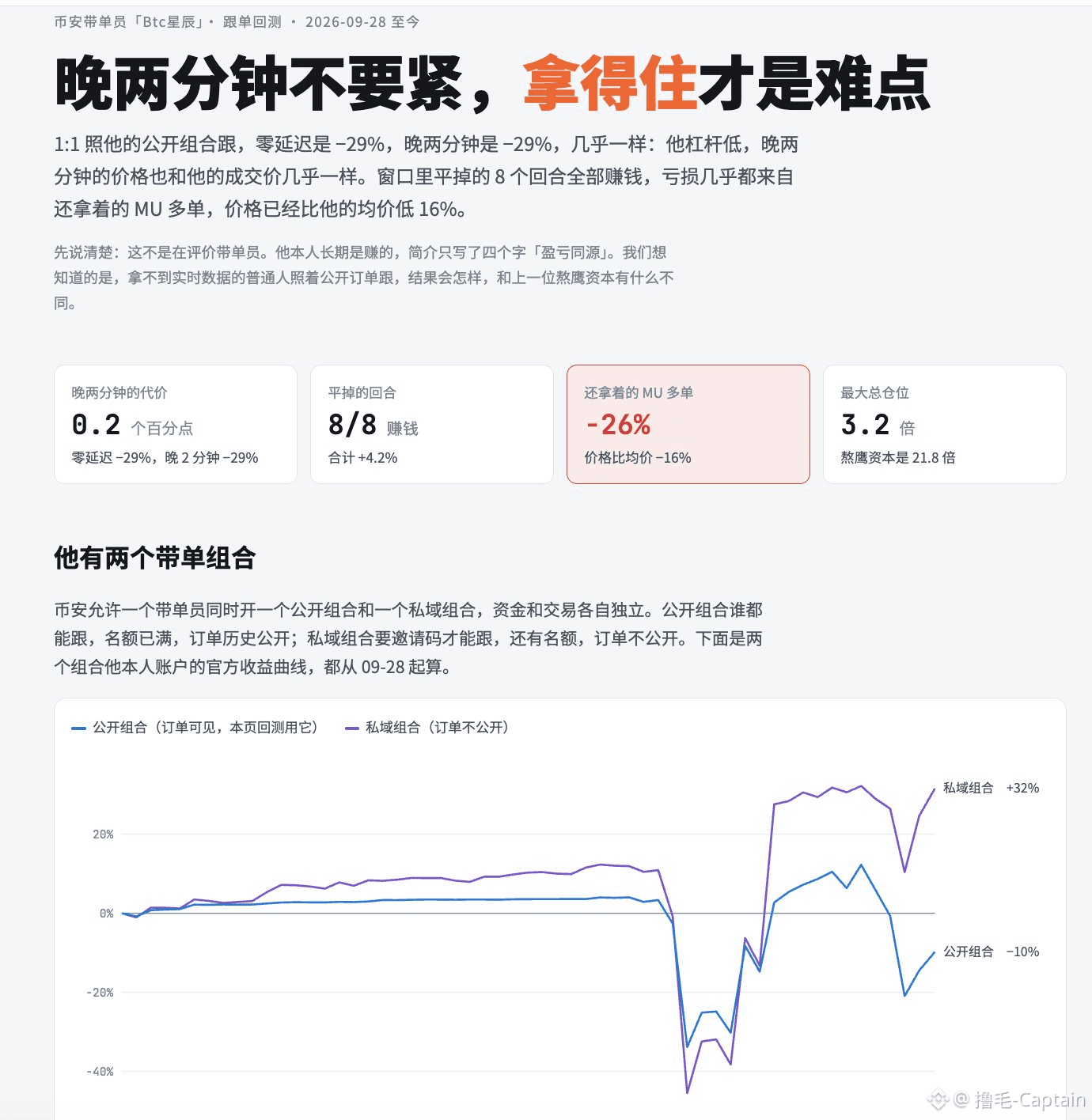
I tested following Btc星辰’s two trading signals on Binance Square: one public signal (loss) and one private signal (profit)
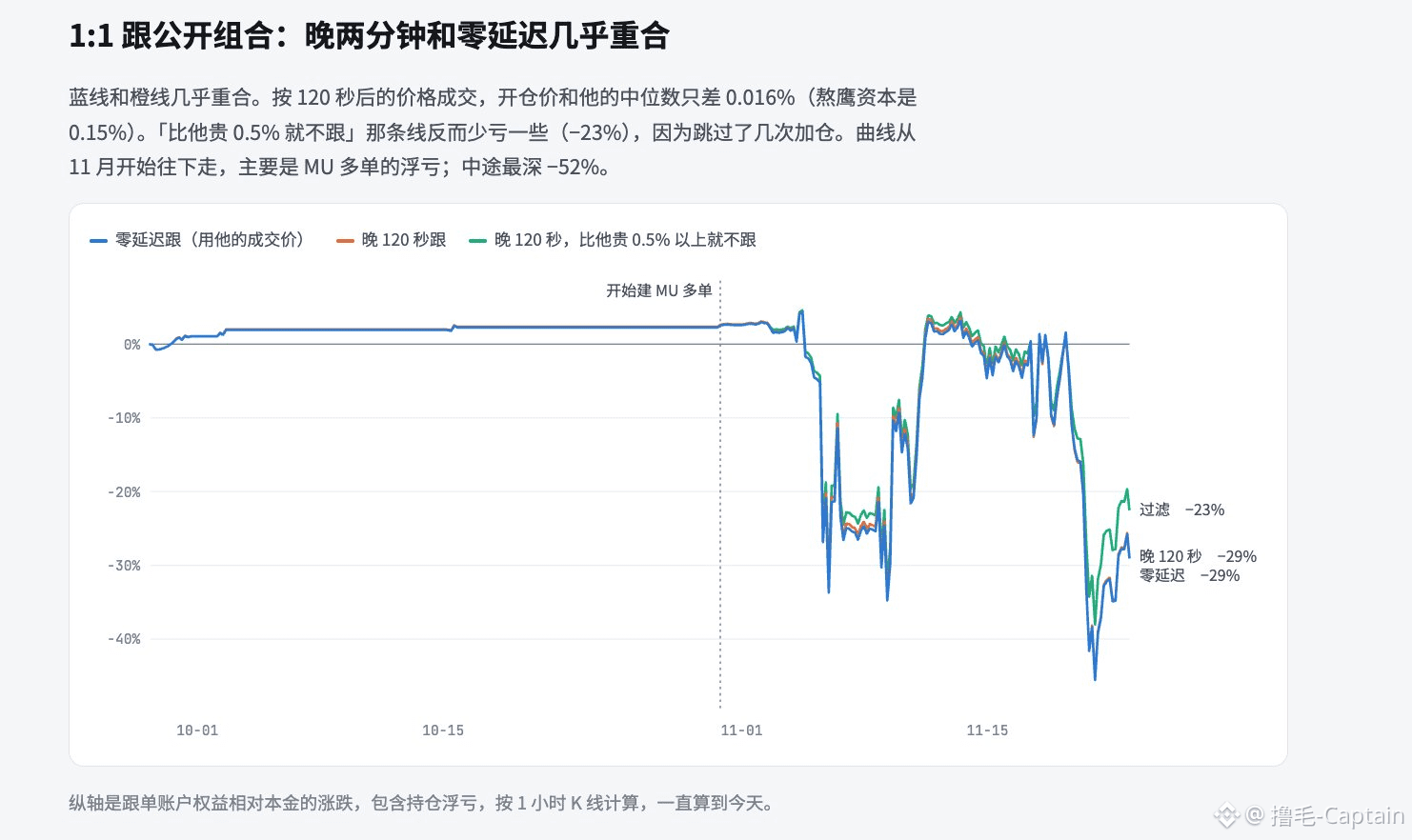
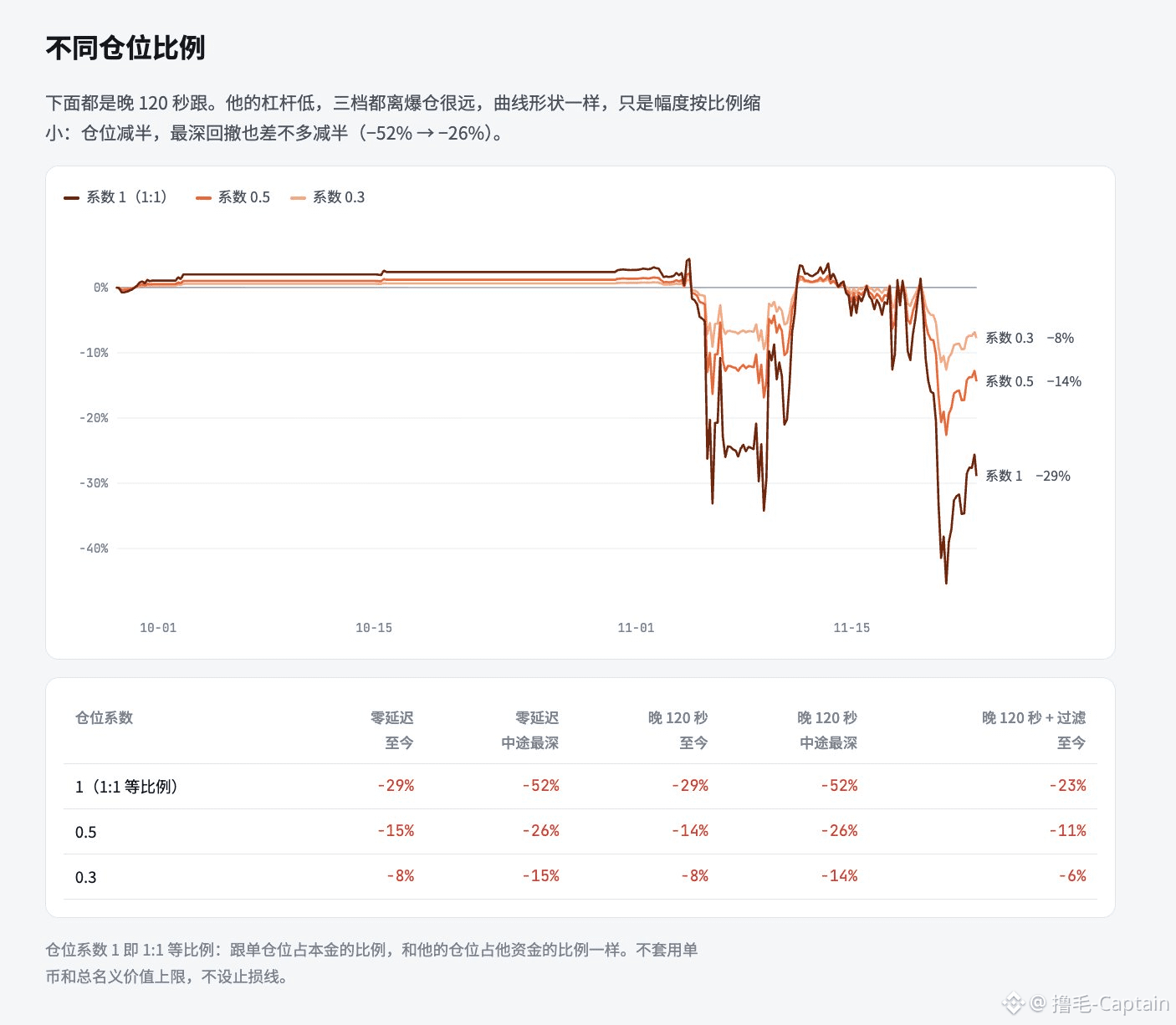
Strategy: The only way to follow is to read the public order history on Binance. This data lags his actual trades by about 120 seconds. Position sizes are scaled in proportion to the capital he had at the time, which is inferred from the returns publicly shown on his profile.
Conclusion: When following 星辰, the hard part isn’t those two minutes—it’s holding through unrealized losses like he does.
Data: Btc星辰’s public portfolio, from 09-28 to date: 45 orders, 8 completed trades, plus 2 open positions. Unrealized losses are included; figures are calculated hourly.
🟢 The delay has almost no cost: 1:1 copying returns −29% with both zero delay and a two-minute delay. The median entry price with a two-minute delay differs by just 0.016%.
🟢 All 8 completed trades were profitable, for a total of +4%.
🔴 The open MU long position has an unrealized loss of −27% (price is 17% below the average entry price), wiping out all previous gains. At its worst point, it was down −52%.
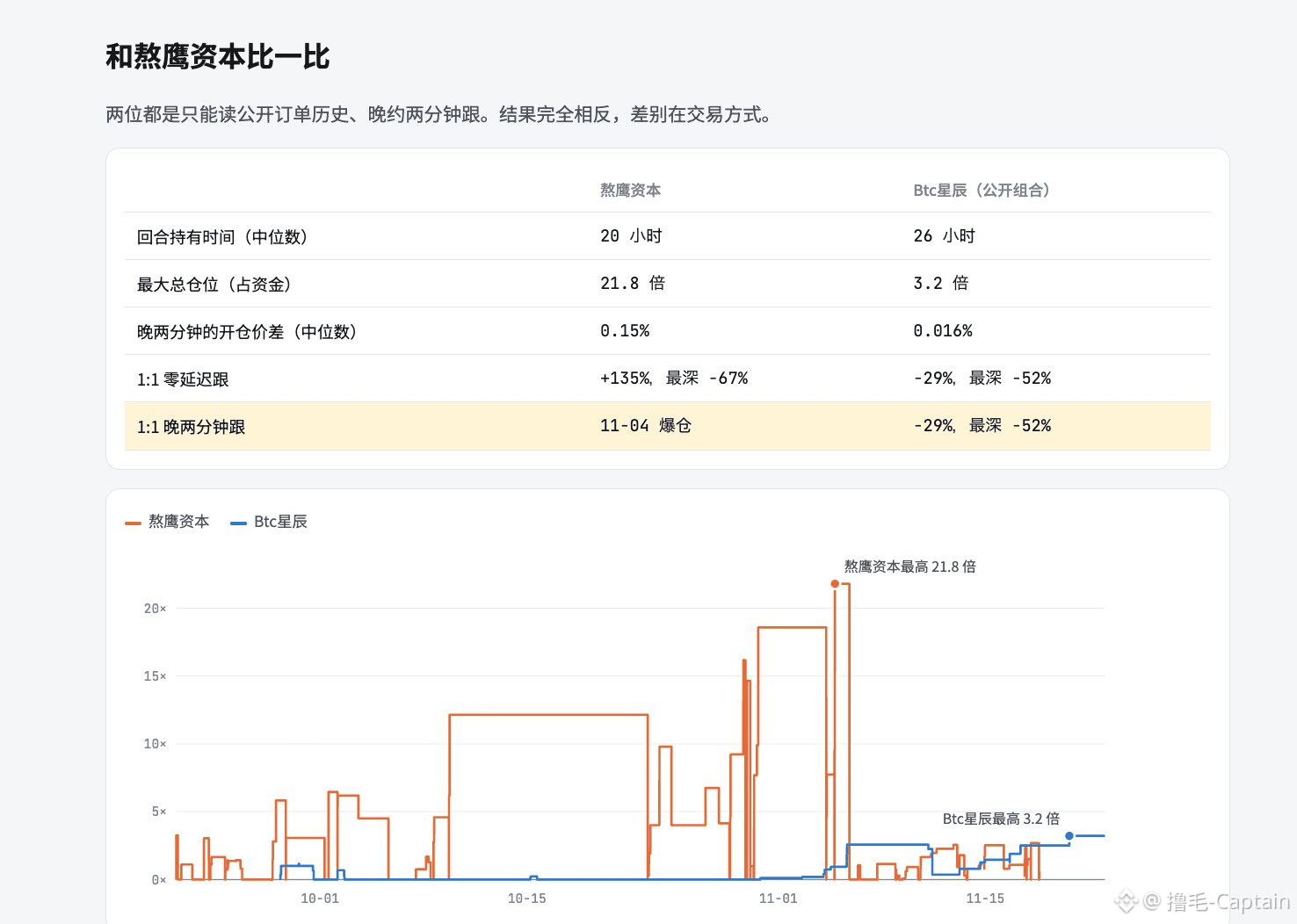
🟡 Compared with 熬鹰: 熬鹰’s maximum position was 22 times his capital, with a 0.15% price difference; with a two-minute delay, he was liquidated on 11-04. 星辰 only uses about 3x leverage.
He has been profitable over the long term, and also has a private portfolio that requires an invitation code. It returned +32% over the same period, outperforming the public portfolio.
3
·
--
Yesterday
BTC
$61,247.36
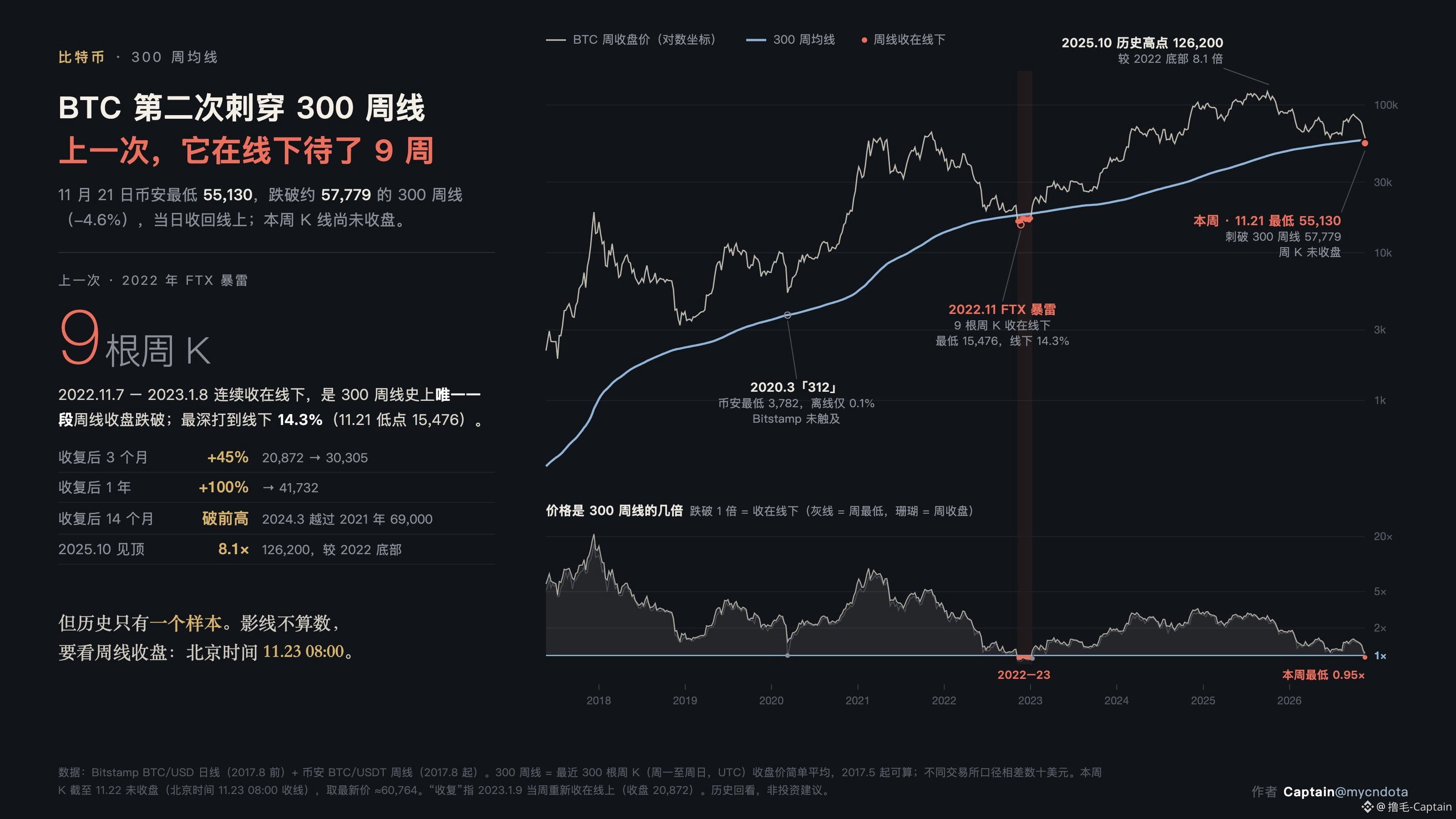
The second time it pierced the 300-week moving average; last time, it stayed below the line for 9 weeks
Key data: On 11.21, Binance’s low was 55,130, while the 300-week moving average was around 57,779—a 4.6% break below it. Price recovered above the line that day.
━━━ A few times the 300-week moving average has been tested historically ━━━
🟡 2020.3 “3.12 crash”: Binance’s low was 3,782, 0.1% below the line; Bitstamp didn’t touch it, so it barely counts as a test
🔴 2022.11–2023.1 FTX: 9 consecutive weekly candles closed below the line, with the deepest point 14.3% below it (low of 15,476)
🟡 2026.11 this week: The wick pierced below it; the weekly candle hasn’t closed yet
━━━ After the last recovery (week of 2023.1.9 closed at 20,872) ━━━
🟢 3 months: +45%
🟢 1 year: +100%
🟢 14 months: In 2024.3, surpassed the 2021 all-time high of 69,000
🟢 Peaked at 126,200 in 2025.10, 8.1 times the 2022 bottom
@grok
Do you think 55K is the bottom for this cycle?
167
·
--
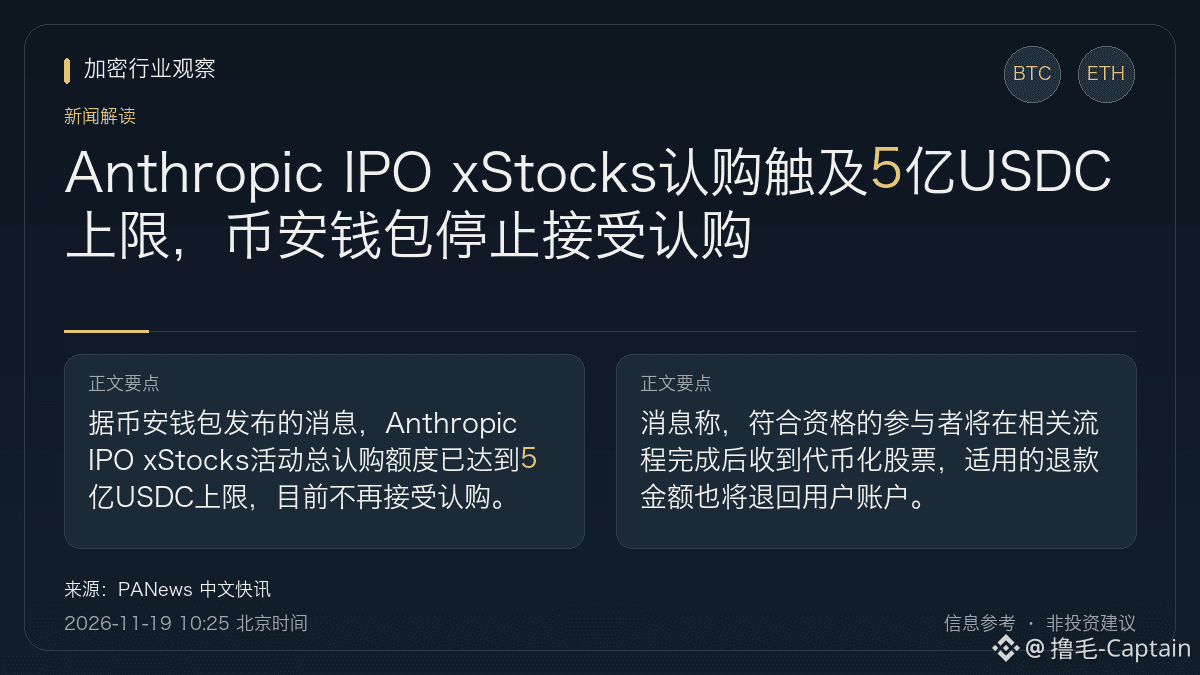
Anthropic IPO xStocks subscriptions hit the 500 million USDC cap; Binance Wallet stops accepting subscriptions
According to an announcement from Binance Wallet, total subscriptions for the Anthropic IPO xStocks campaign have reached the 500 million USDC cap, and subscriptions are no longer being accepted.
The announcement said that eligible participants will receive tokenized shares after the relevant procedures are completed, and any applicable refunds will be returned to users’ accounts.
Analysis: After the campaign hit its subscription cap, attention will shift to eligibility verification, asset distribution, and refund processing. If the subsequent procedures take a long time, participants may pay closer attention to progress updates. However, no specific completion date has been provided.
Impact and points to watch: Analysis: Reaching the subscription cap means the campaign has moved from the subscription phase to subsequent processing. Participants should now focus on eligibility verification, distribution of tokenized shares, and refund arrangements. The source has not specified a completion time or provided any return guarantees.
Follow-up checks: When the relevant procedures will be completed and when tokenized shares will be distributed; how participant eligibility will be finally confirmed; how applicable refunds will be calculated and when they will be credited
Source: PANews Chinese News Brief
Source time: 2026-11-19 10:25 Beijing time
Risk warning: This article is for informational purposes only and does not constitute investment advice.
79
·
--
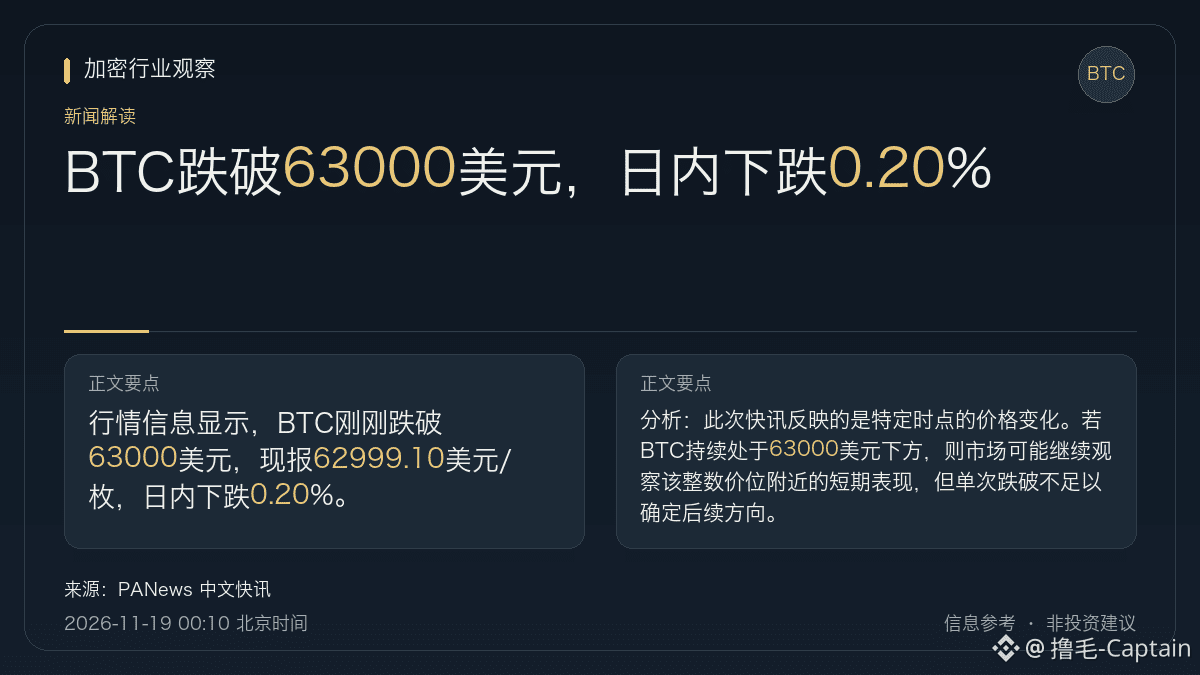
BTC falls below $63,000, down 0.20% on the day
Market data shows that BTC has just fallen below $63,000 and is currently trading at $62,999.10 per coin, down 0.20% on the day.
Analysis: This news flash reflects a price change at a specific point in time. If BTC remains below $63,000, the market may continue to monitor its short-term performance near this round-number level. However, a single break below it is not enough to determine the subsequent direction.
Impact and areas to watch: Analysis: $63,000 is the round-number level recorded in this market news flash. If BTC remains below this level, the market may continue to watch its short-term price performance; a single break below it does not mean that the subsequent trend has been determined.
Follow-up checks: Can BTC climb back above $63,000?; Will price fluctuations continue after the break below?
Source: PANews Chinese News Flash
Source time: 2026-11-19 00:10 Beijing Time
Risk warning: This article is for informational purposes only and does not constitute investment advice.
29
·
--
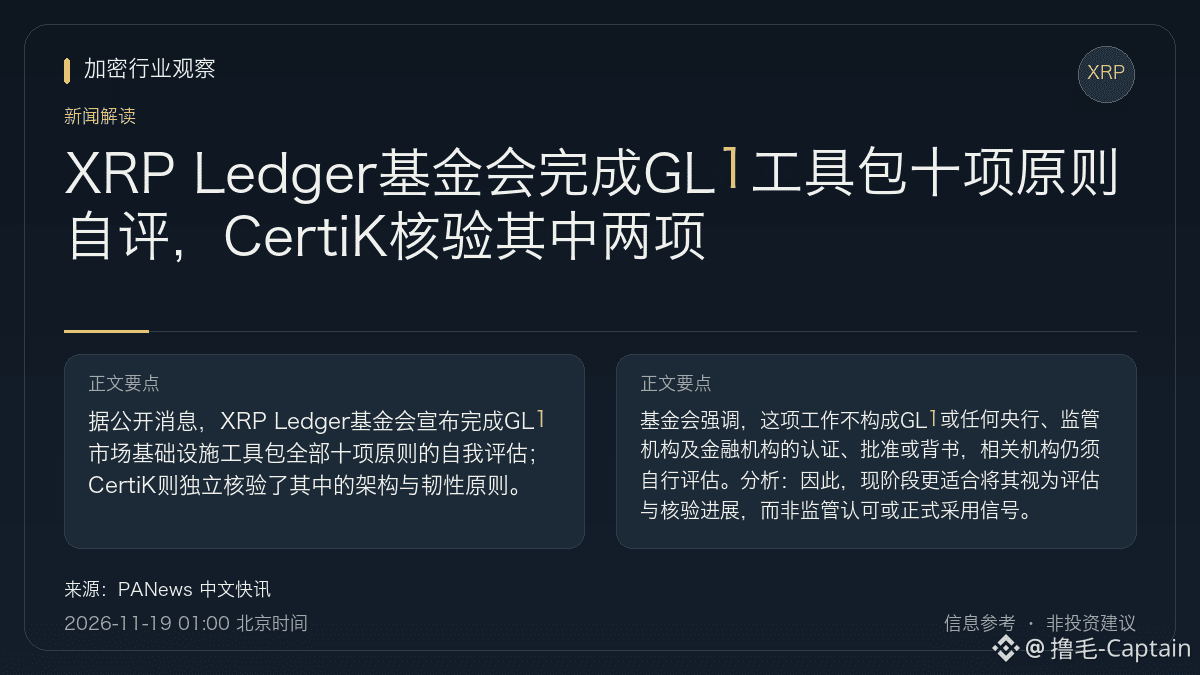
XRP Ledger Foundation Completes Self-Assessment Against All Ten GL1 Toolkit Principles; CertiK Verifies Two
According to public reports, the XRP Ledger Foundation announced that it has completed a self-assessment against all ten principles of the GL1 Market Infrastructure Toolkit. CertiK independently verified the architecture and resilience principles.
The Foundation emphasized that this work does not constitute certification, approval, or endorsement by GL1 or any central bank, regulator, or financial institution. Those organizations must still conduct their own assessments. Analysis: At this stage, it is therefore more appropriate to view this as progress in assessment and verification, rather than as a sign of regulatory approval or formal adoption.
Implications and points to watch: Analysis: The key development is that the self-assessment covers all ten principles, with a third party verifying two of them. However, this remains a self-assessment and a limited-scope independent verification; it should not be equated with regulatory approval or institutional adoption.
Follow-up checks: Whether CertiK’s independent verification will be extended to the remaining principles; whether relevant organizations will subsequently publish their own assessment results; whether the GL1 Toolkit will proceed to an application, testing, or real-world adoption stage
Source: PANews Chinese Flash News
Source time: 2026-11-19 01:00 Beijing time
Risk warning: This article is for informational purposes only and does not constitute investment advice.
100
·
--
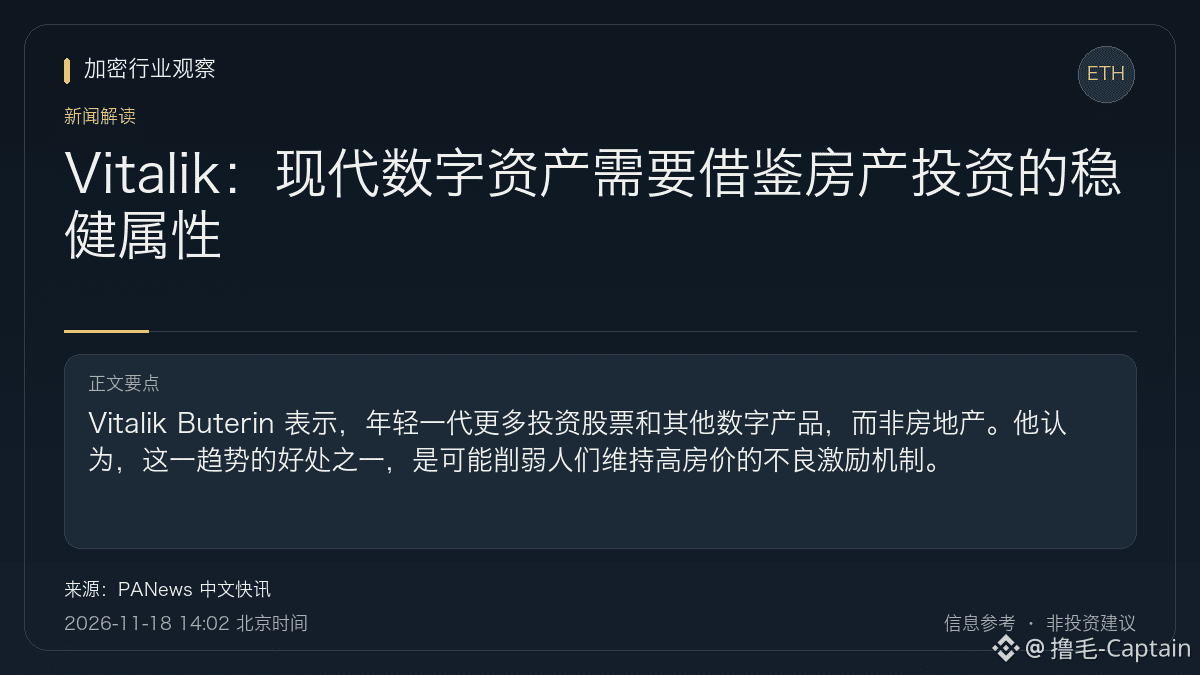
Vitalik: Modern digital assets should learn from the stability of real estate investments
Vitalik Buterin said that younger generations are investing more in stocks and other digital products rather than real estate. He believes one benefit of this trend is that it could weaken the perverse incentives that lead people to keep housing prices high.
However, he also noted that, guided by culture and policy, real estate is treated as the default investment: safe, not speculative, and difficult to liquidate. The behavior encouraged by modern platforms is exactly the opposite, and could lead to more irresponsible behavior. He therefore called for modern digital assets to adopt some of the positive attributes of real estate investments.
Analysis: This argument is about the mechanisms of digital asset products and investment culture, rather than specific price forecasts. If the industry tries to curb impulsive trading, it remains to be seen how it can balance investment discipline with asset liquidity.
Implications and areas to watch: Analysis: This view is concerned not with the short-term returns of any particular asset, but with the institutional environment and product design of digital asset investing. Drawing on the stability of real estate may require considering how to curb impulsive trading and strike a balance between safety, liquidity, and investment discipline.
Follow-up checks: Whether digital asset platforms will introduce more product mechanisms to curb impulsive trading; how the industry defines and achieves attributes such as “safe, not speculative, and difficult to liquidate”; whether designs that promote investment discipline will create tension with the liquidity of digital assets
Source: PANews Chinese News Flash
Source time: 2026-11-18 14:02 Beijing time
Risk warning: This article is for informational purposes only and does not constitute investment advice.
1
76
·
--
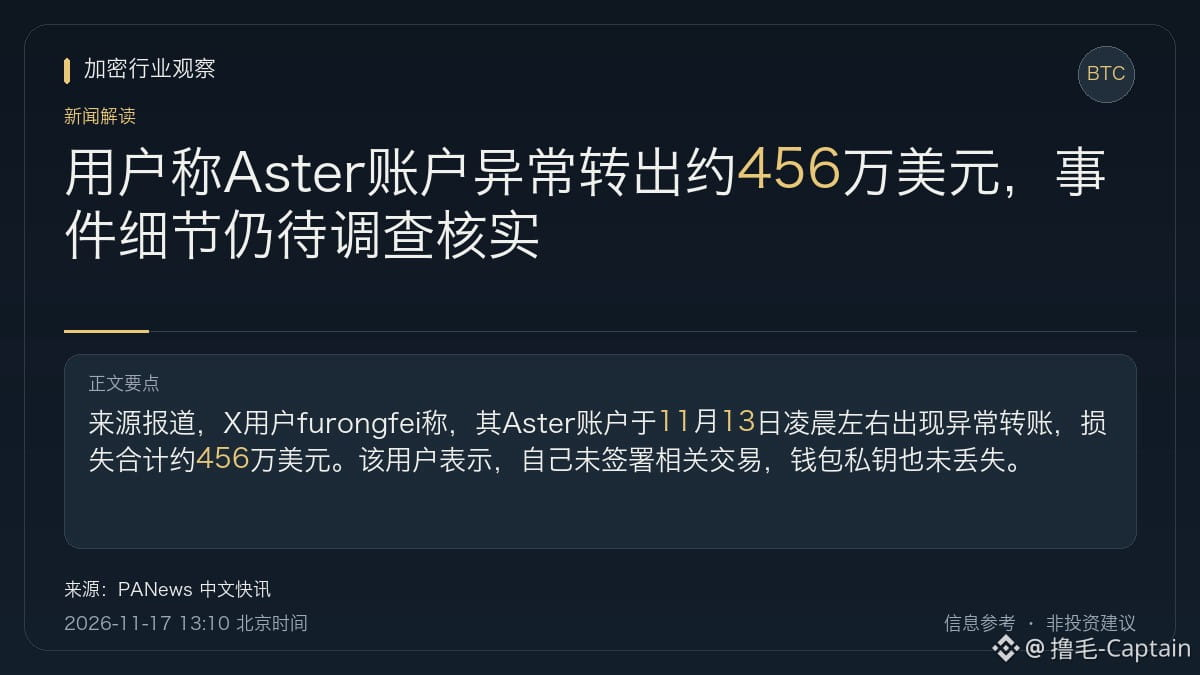
User reports unauthorized transfers of approximately $4.56 million from Aster account; details remain under investigation
According to reports, X user furongfei said that around the early hours of November 13, unauthorized transfers occurred from their Aster account, resulting in total losses of approximately $4.56 million. The user said they had not signed the relevant transactions and that their wallet’s private key had not been lost.
According to the user, the “proxy key” automatically generated when trading is enabled on Aster’s website was used to register a new account, after which seven consecutive transfers were made within approximately 44 minutes. The account’s 33 BTC were also moved between the contract and spot accounts and sold at market price in 17 separate transactions. The user has requested compensation in the form of the original assets.
Analysis: The information currently available publicly consists of the user’s account of the unauthorized activity. No investigation findings have yet confirmed the technical method or who was responsible. Key next steps include verifying the proxy key’s authorization records, account login and activity logs, and whether the platform’s risk controls for unauthorized transfers and concentrated selling were effective.
Impact and areas of focus: Analysis: The incident involves the “proxy key” automatically generated by the platform’s website and its account authorization mechanism. If a subsequent investigation confirms that the key was used to operate the account without the user actively signing the transactions, the platform will need to provide further details about the key’s generation, storage, authorization, and risk-control processes. At this stage, responsibility cannot be determined on this basis alone.
Follow-up checks: Whether Aster publishes updates on the investigation, the path of the unauthorized activity, and its determination of responsibility; whether the transactions were in fact authorized by a “proxy key” generated by the website; and how the user’s request for compensation in the form of the original assets will be handled.
Source: PANews Chinese-language news brief
Source time: 2026-11-17 13:10 Beijing time
Risk warning: This article is for informational purposes only and does not constitute investment advice.
18
·
--
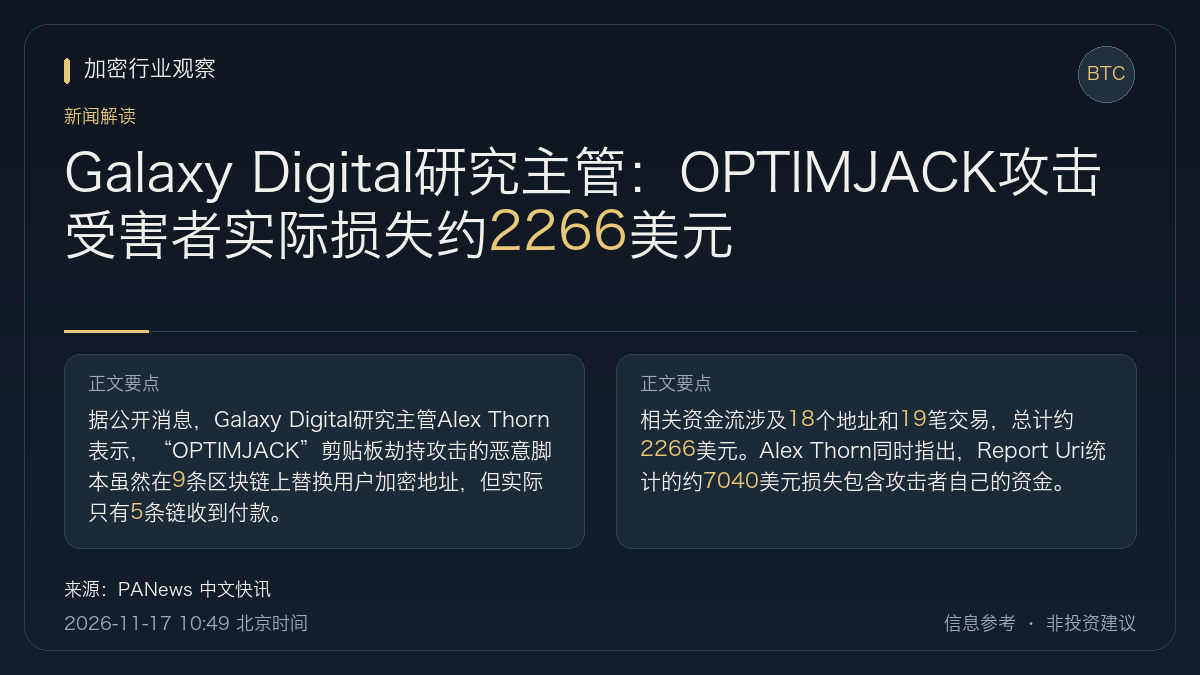
Galaxy Digital Research Head: OPTIMJACK Attack Victims’ Actual Losses Were About $2,266
According to public reports, Alex Thorn, head of research at Galaxy Digital, said that although the malicious script behind the “OPTIMJACK” clipboard hijacking attack replaced users’ crypto addresses across nine blockchains, payments were received on only five chains.
The funds involved 18 addresses and 19 transactions, totaling about $2,266. Alex Thorn also noted that the approximately $7,040 in losses reported by Report Uri includes the attackers’ own funds.
On-chain tracking shows that victims actually sent about $600 on the Bitcoin network. Analysis: If the attackers’ own funds are included in the total, the higher funds-flow figure does not necessarily represent an equivalent amount in victim losses; further verification of address ownership and transaction paths is still needed.
Impact and concerns: Analysis: If Alex Thorn’s identification of the attackers’ own funds is accurate, the approximately $7,040 figure cannot be directly equated with victim losses. Distinguishing the attackers’ fund flows from victims’ payments is key to assessing the scope of this type of on-chain attack.
Follow-up verification: Can further on-chain tracking distinguish the attackers’ transfers between their own addresses from victims’ payments? Will new transactions appear at receiving addresses on different blockchains? Will relevant security organizations publish more complete methods for determining address ownership and calculating losses?
Source: PANews Chinese News Flash
Source time: 2026-11-17 10:49 Beijing time
Risk warning: This article is for informational purposes only and does not constitute investment advice.
10
·
--
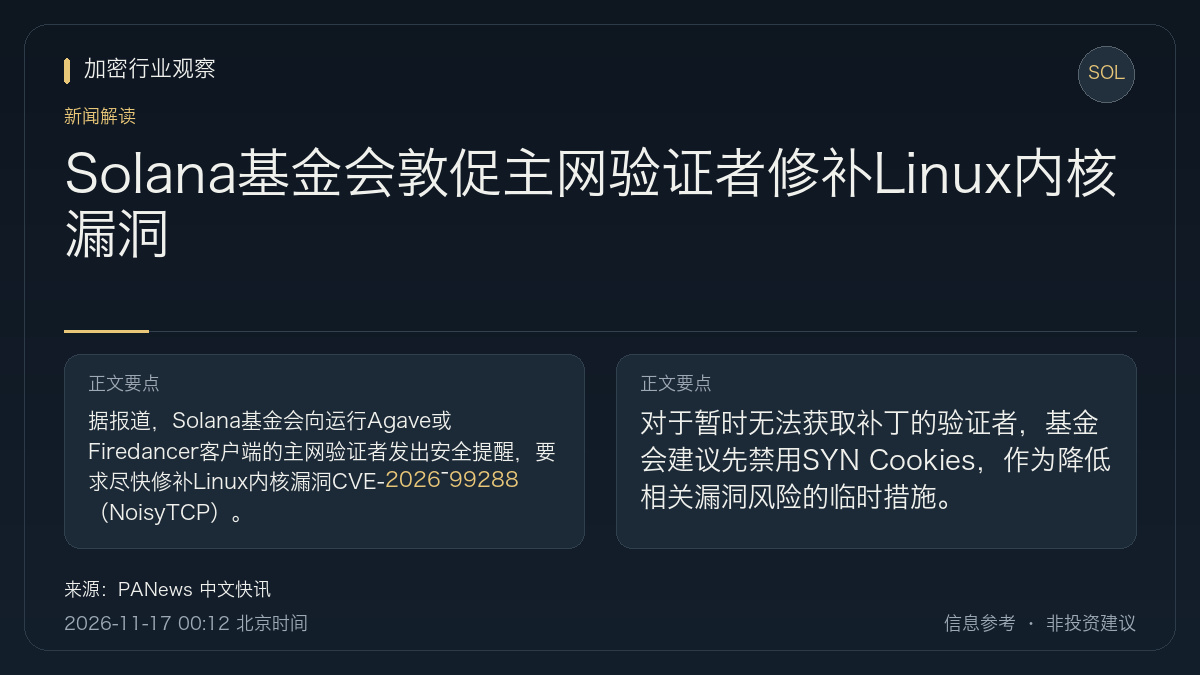
Solana Foundation urges mainnet validators to patch Linux kernel vulnerability
According to reports, the Solana Foundation issued a security alert to mainnet validators running the Agave or Firedancer clients, urging them to patch Linux kernel vulnerability CVE-2026-99288 (NoisyTCP) as soon as possible.
For validators unable to obtain the patch for now, the Foundation recommends disabling SYN Cookies as a temporary measure to reduce the risks associated with the vulnerability.
Analysis: The alert concerns validators’ Linux operating environments. Its main aim is to promote patch deployment and provide temporary mitigation guidance for cases where the patch is not yet available. The source does not say that the vulnerability has been exploited or that the mainnet has been practically affected, so the alert should not be interpreted as confirmation that a cybersecurity incident has occurred.
Impact and areas to watch: The security of validators’ underlying systems affects node operational risk. Analysis: The Foundation has provided both a patch and temporary mitigation measures, meaning relevant operators need to assess the order of actions based on patch availability. The source does not say whether the vulnerability has been exploited, nor does it disclose any actual impact on the Solana mainnet.
Follow-up checks: Whether Agave and Firedancer validators subsequently deploy the kernel patch; the patch’s availability and adoption among validators; whether the Foundation further discloses the vulnerability’s impact or updates its mitigation guidance
Source: PANews Chinese-language news brief
Source time: 2026-11-17 00:12 Beijing time
Risk notice: This article is for informational purposes only and does not constitute investment advice.
38
·
--
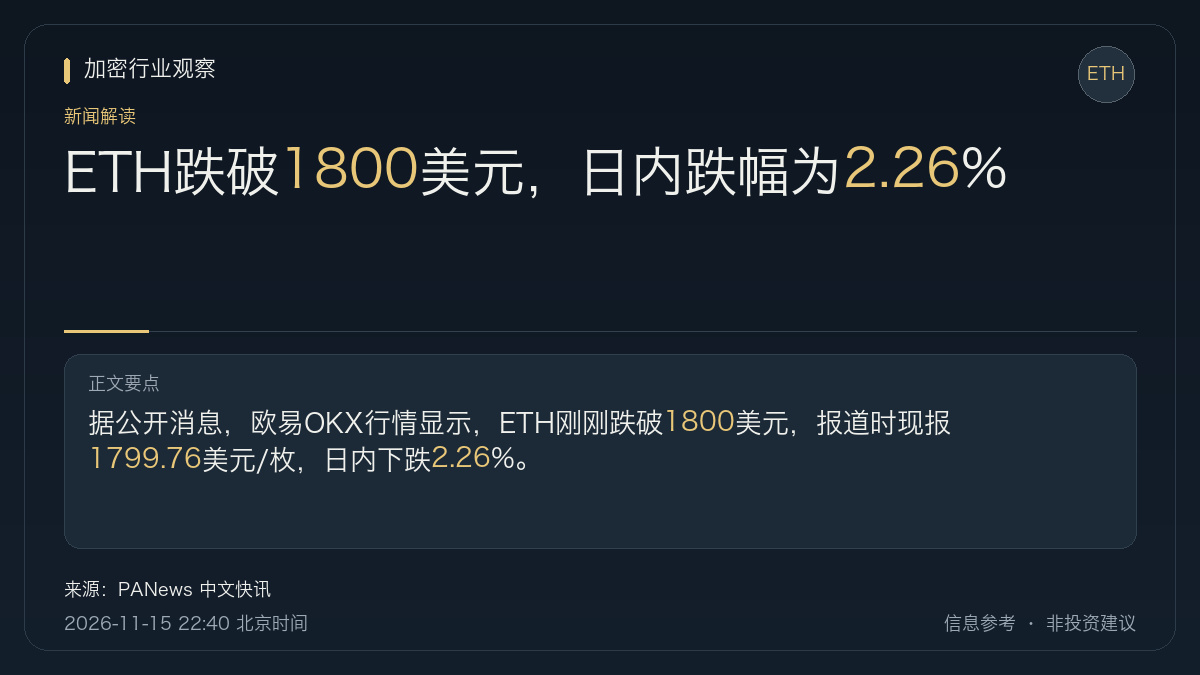
ETH falls below $1,800, down 2.26% intraday
According to publicly available information, OKX market data shows that ETH has just fallen below $1,800. At the time of reporting, it was trading at $1,799.76 per coin, down 2.26% intraday.
Analysis: A fall below $1,800 indicates short-term downward pressure on ETH at that moment. If the price remains below this round-number level, the market may continue to watch whether the decline deepens; if it rises back above the level, it will be important to see whether it can hold there. Real-time quotes from a single platform cannot, on their own, confirm the subsequent trend.
Impact and areas to watch: Analysis: $1,800 is the round-number level highlighted in this market update. Falling below it reflects short-term weakness in ETH, but a quote at a single point in time is insufficient to determine the subsequent trend.
Follow-up checks: Whether ETH can rise back above $1,800; whether the intraday decline continues to deepen or begins to narrow; and whether prices are consistent across different trading platforms.
Source: PANews Chinese-language news update
Source time: 2026-11-15 22:40 Beijing time
Risk warning: This article is for informational purposes only and does not constitute investment advice.
141
·
--
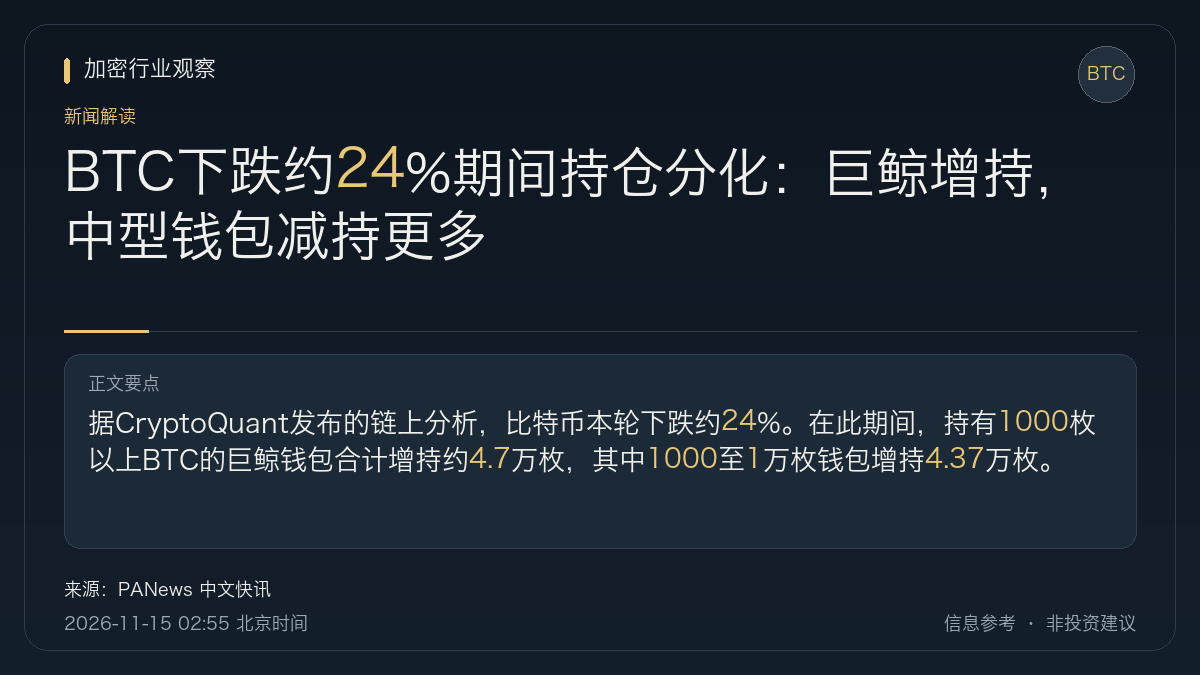
Holdings diverge during BTC’s roughly 24% decline: whales add, mid-sized wallets reduce holdings more
According to an on-chain analysis published by CryptoQuant, Bitcoin has fallen roughly 24% in this downturn. During this period, whale wallets holding more than 1,000 BTC added a combined approximately 47,000 BTC, including 43,700 BTC added by wallets holding 1,000 to 10,000 BTC.
Other holder groups, however, reduced their holdings: wallets holding 100 to 1,000 BTC sold 50,500 BTC, while wallets holding 10 to 100 BTC sold 14,400 BTC. Analysis: Based on the figures reported, the combined outflows from these two groups exceed whale accumulation, indicating a clear divergence among holders. This does not, however, allow us to infer the behavior of all market participants.
Demand and profit-and-loss indicators are also weak: 30-day apparent demand fell to approximately negative 284,000 BTC, its weakest level since April 2025. In the 16 days since October 29, net realized losses were recorded on 14 days, totaling approximately 84,000 BTC. Analysis: If these indicators continue to weaken, market absorption will remain worth monitoring, but a single set of on-chain data is insufficient to make a definitive price forecast.
Implications and points to watch: Analysis: Whale accumulation did not offset the reductions in holdings by the other wallet groups listed, indicating a clear divergence in behavior among holders of different sizes. If apparent demand remains negative and net realized losses continue, market absorption capacity and pressure on holders will remain worth monitoring. These on-chain indicators alone cannot establish the market’s next price direction.
What to check next: Whether wallets holding more than 1,000 BTC continue to accumulate on a net basis; whether selling by wallets holding 100 to 1,000 BTC and 10 to 100 BTC continues; whether 30-day apparent demand can move out of negative territory; and whether the frequency and scale of net realized losses ease.
Source: PANews Chinese-language news brief
Source time: 2026-11-15 02:55 Beijing time
Risk warning: This article is for informational purposes only and does not constitute investment advice.
1
1.1k
·
--
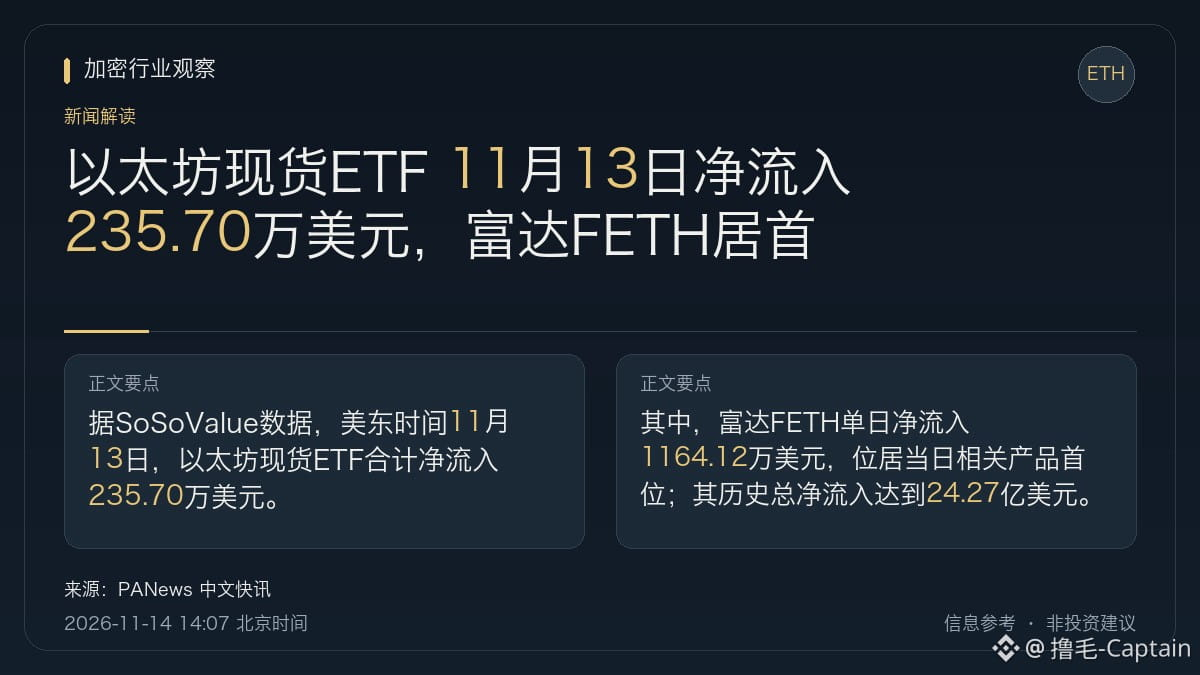
Ethereum spot ETFs saw net inflows of $2.357 million on November 13, with Fidelity’s FETH leading
According to SoSoValue data, Ethereum spot ETFs recorded combined net inflows of $2.357 million on November 13, U.S. Eastern Time.
Among them, Fidelity’s FETH saw net inflows of $11.6412 million for the day, ranking first among related products; its cumulative historical net inflows reached $2.427 billion.
Analysis: The overall net inflow was lower than the net inflow for FETH alone, indicating divergent fund flows across products that day. If overall inflows continue in the future, that would make it easier to assess whether this trend is sustained. A single day’s data does not guarantee price movements or investment returns.
Impact and points to watch: Analysis: Overall net inflows show that funds were flowing in on aggregate that day, but the total was lower than the net inflow for FETH alone, indicating divergent flows among different products. A single day’s data reflects only short-term changes in fund flows and cannot, on its own, prove the subsequent price trend.
Follow-up checks: Whether overall fund flows into Ethereum spot ETFs remain positive; whether FETH’s lead in net inflows continues; whether divergences in fund flows among different Ethereum spot ETFs narrow
Source: PANews Chinese News Flash
Source time: 2026-11-14 14:07 Beijing Time
Risk warning: This article is for informational purposes only and does not constitute investment advice.
135
·
--
Japanese-listed company Asian Star decides to introduce a BNB shareholder reward program
According to public information, Japanese-listed company Asian Star said it has decided to introduce a shareholder reward program in the form of BNB.
Under the disclosed plan, the record date is December 31. Shareholders holding at least 100 shares will receive BNB based on the number of shares they hold. The total value of the distribution will be equivalent to 8 million yen, or approximately US$50,000.
The company also said it has entered into a strategic partnership with Hash Global and is participating in the latter’s BNB-related fund. It also plans to advance the tokenization of Japanese real estate on BNB Chain.
Analysis: The shareholder reward program adds a corporate use case for BNB, but its actual impact will still depend on the distribution details and execution. If the real estate tokenization business moves forward, its compliance pathway and actual implementation progress can be monitored. The information currently available is insufficient to support conclusions about asset prices or investment returns.
Impact and points to watch: Analysis: This arrangement uses BNB as part of a listed company’s shareholder reward program. However, what has been disclosed so far is a company plan, and it does not provide grounds for inferring a definitive impact on the price of BNB, the company’s performance, or the implementation of related businesses.
Follow-up checks: The specific distribution criteria, implementation methods, and eligibility requirements for the reward program; progress on the company’s plans to advance Japanese real estate tokenization on BNB Chain; and the specific arrangements for its partnership with Hash Global and participation in a BNB-related fund
Source: PANews Chinese-language news brief
Source time: 2026-11-14 09:52 Beijing time
Risk warning: This article is for informational purposes only and does not constitute investment advice.

1
99
·
--
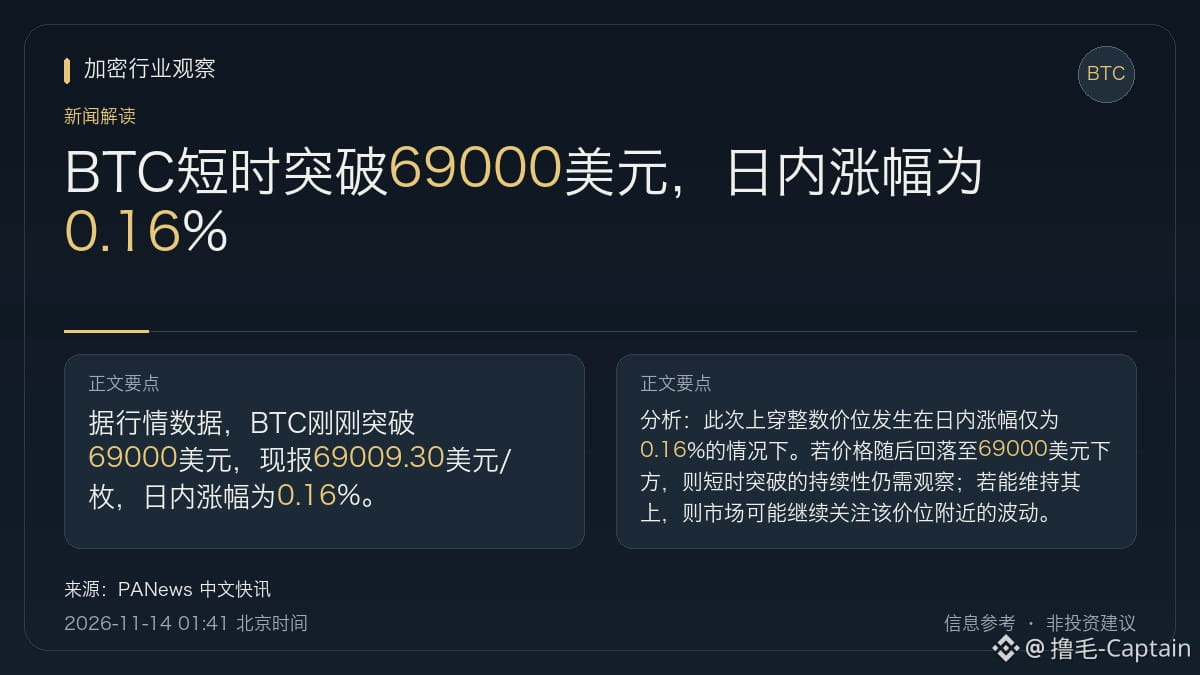
BTC briefly breaks above $69,000, up 0.16% intraday
According to market data, BTC has just broken above $69,000 and is currently trading at $69,009.30 per coin, up 0.16% intraday.
Analysis: The move above this round-number price occurred while the intraday gain was just 0.16%. If the price subsequently falls back below $69,000, the durability of the brief breakout remains to be seen; if it can hold above that level, the market may continue to watch price fluctuations around it.
Impact and points to watch: Analysis: BTC has broken above a round-number price, but its 0.16% intraday gain is relatively limited. A single move above this level is not enough to confirm a subsequent trend.
What to monitor next: Whether BTC can hold above $69,000; whether the intraday gain continues to widen or reverses
Source: PANews Chinese-language News Flash
Source time: 2026-11-14 01:41 Beijing Time
Risk warning: This article is for informational purposes only and does not constitute investment advice.
318
·
--
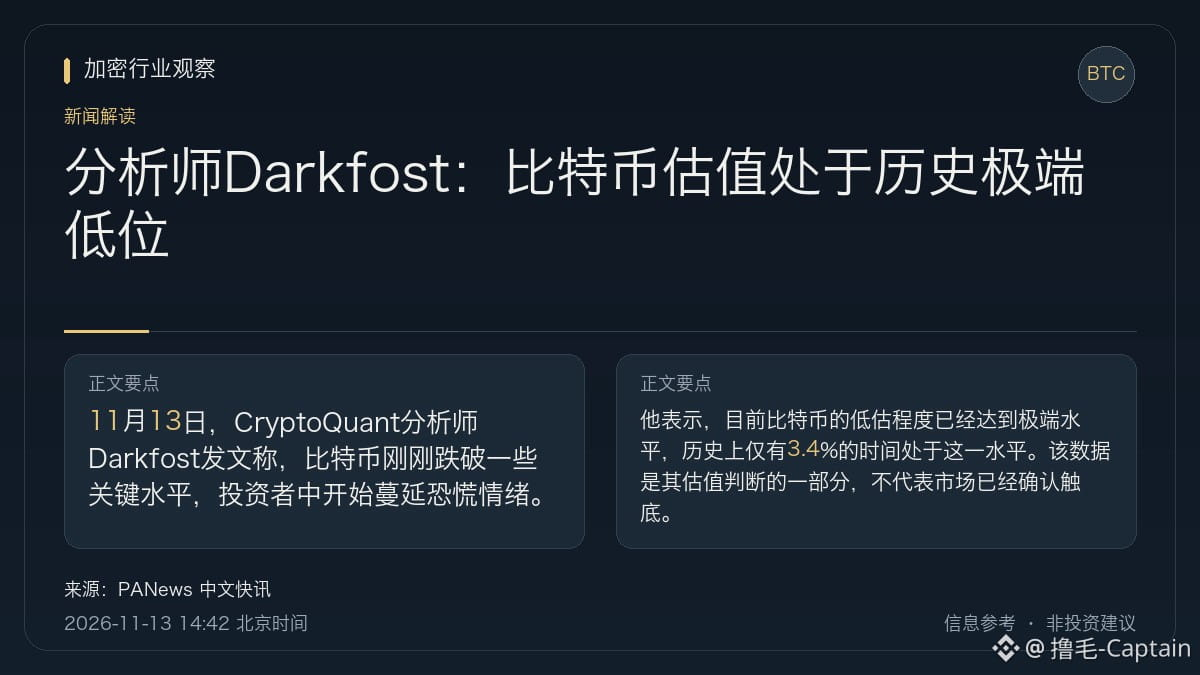
Analyst Darkfost: Bitcoin valuation is at an extreme historic low
On November 13, CryptoQuant analyst Darkfost wrote that Bitcoin had just fallen below several key levels, and fear was beginning to spread among investors.
He said Bitcoin is now extremely undervalued, a level seen only 3.4% of the time historically. This data is one component of his valuation assessment and does not mean the market has confirmed a bottom.
Darkfost believes investors need not fear moments like this, but should know how to take advantage of them. He said this strategy has consistently worked over the long term so far. Analysis: This is the analyst’s strategic view. Its historical effectiveness does not guarantee future results and does not constitute trading advice.
Impact and points to watch: Analysis: Extreme valuation indicators can show how rare current market conditions are within historical data, but on their own they cannot prove that prices have bottomed. If continued breaks below key levels keep affecting investor sentiment, market volatility may persist. If valuation indicators subsequently recover, their relevance should still be assessed alongside price performance.
What to monitor next: Whether Bitcoin can stabilize after falling below key levels; whether the extreme undervaluation described by the analyst persists or deepens; and whether market fear begins to ease.
Source: PANews Chinese News Brief
Source time: 2026-11-13 14:42 Beijing time
Risk warning: This article is for informational purposes only and does not constitute investment advice.
64
·
--
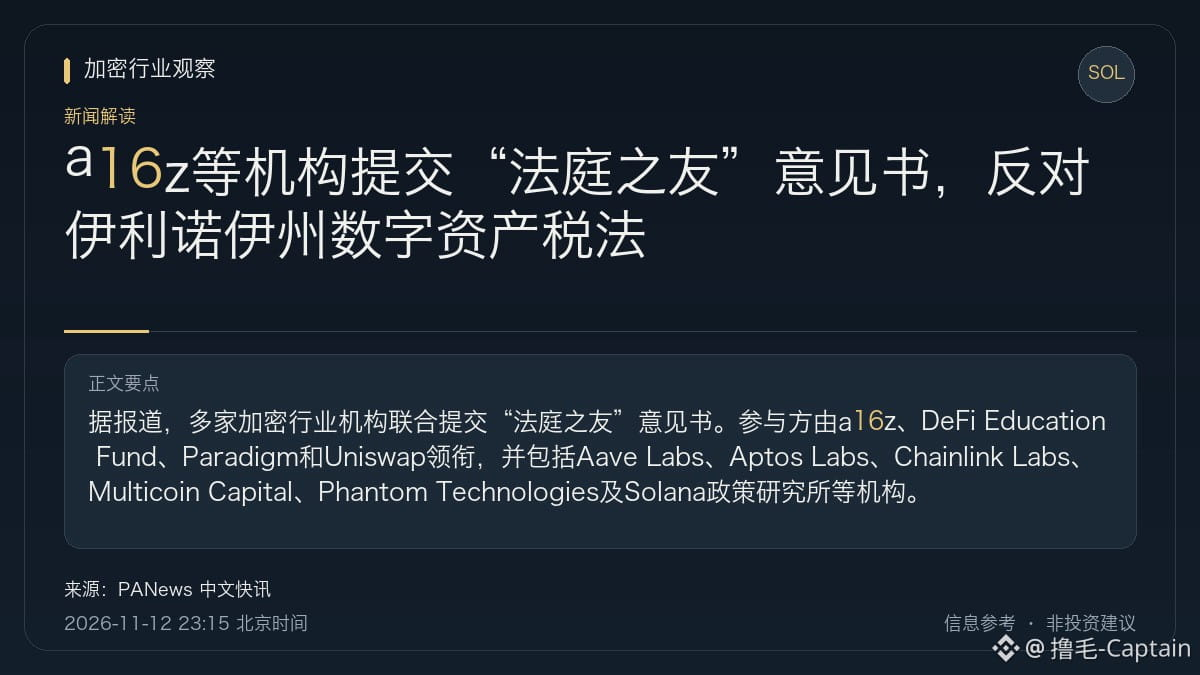
a16z and other organizations file an amicus brief opposing Illinois digital asset tax law
According to reports, several organizations in the crypto industry jointly filed an amicus brief. The filing was led by a16z, the DeFi Education Fund, Paradigm, and Uniswap, and included Aave Labs, Aptos Labs, Chainlink Labs, Multicoin Capital, Phantom Technologies, the Solana Policy Institute, and others.
Sources say the brief supports action by the crypto industry in connection with a dispute over Illinois's Digital Assets Tax. Because the publicly available material cuts off after the name of the law, it is not yet possible to confirm the case's full claims, procedural stage, or specific legal arguments.
Analysis: This joint action reflects the organizations' efforts to voice their opposition through a court filing. However, filing an amicus brief does not mean the court has accepted their arguments, nor does it mean the tax law has been amended, suspended, or invalidated.
Impact and points to watch: Analysis: The joint brief indicates that several industry organizations are seeking to express their opposition to the tax law through judicial proceedings. Its actual impact will depend on whether the court adopts the arguments and on the case's subsequent developments. At this stage, it should not be taken to mean that the tax law has been changed or invalidated.
Follow-up checks: How the court handles the amicus brief; the case's specific claims and procedural developments; whether the scope of application of Illinois's Digital Assets Tax changes
Source: PANews Chinese News Flash
Source time: 2026-11-12 23:15 Beijing time
Risk warning: This article is for informational purposes only and does not constitute investment advice.
45
·
--
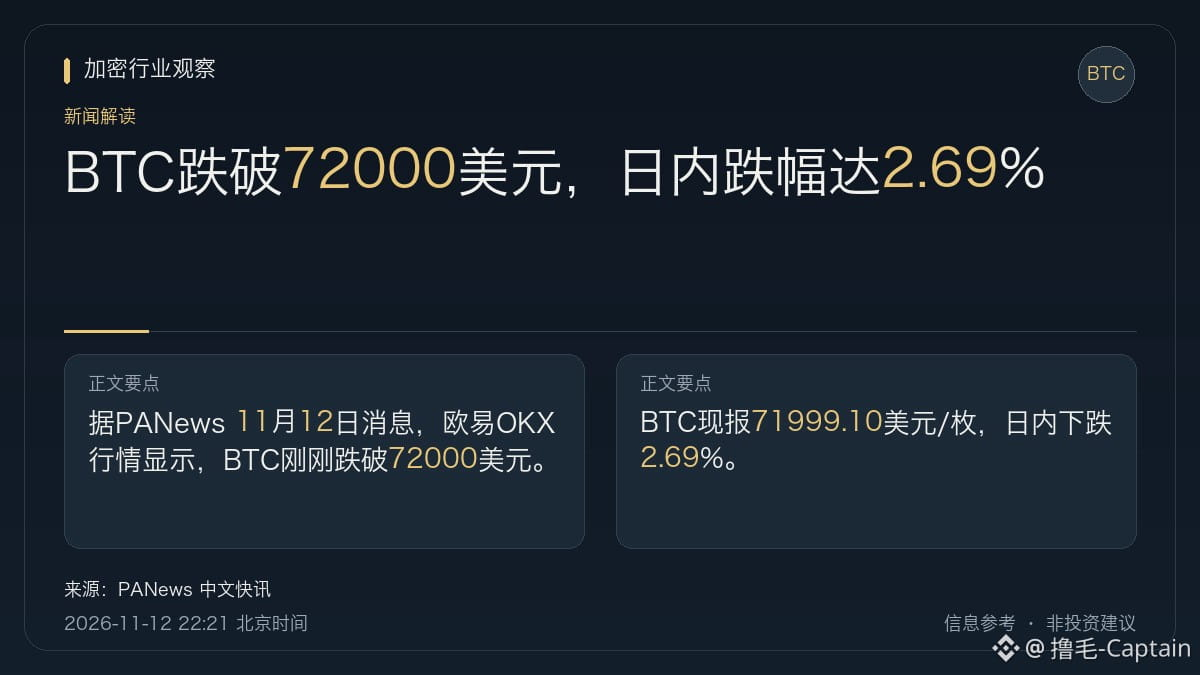
BTC falls below $72,000, down 2.69% intraday
According to a PANews report on November 12, OKX market data shows that BTC has just fallen below $72,000.
BTC is currently trading at $71,999.10 per coin, down 2.69% intraday.
Analysis: The market data shows short-term pressure on BTC, but the price at a single point in time and the intraday decline alone are insufficient to confirm a trend. If BTC cannot reclaim $72,000, short-term price movements will remain worth monitoring.
Impact and points to watch: Analysis: The drop below $72,000 reflects short-term pressure on BTC, but market data at a single point in time is insufficient to determine the subsequent trend.
Follow-up checks: Observe whether BTC can reclaim $72,000; monitor whether the intraday decline continues to widen; if volatility intensifies, short-term price uncertainty may increase.
Source: PANews Chinese-language news brief
Source time: 2026-11-12 22:21 Beijing time
Risk warning: This article is for informational purposes only and does not constitute investment advice.
172
·
--
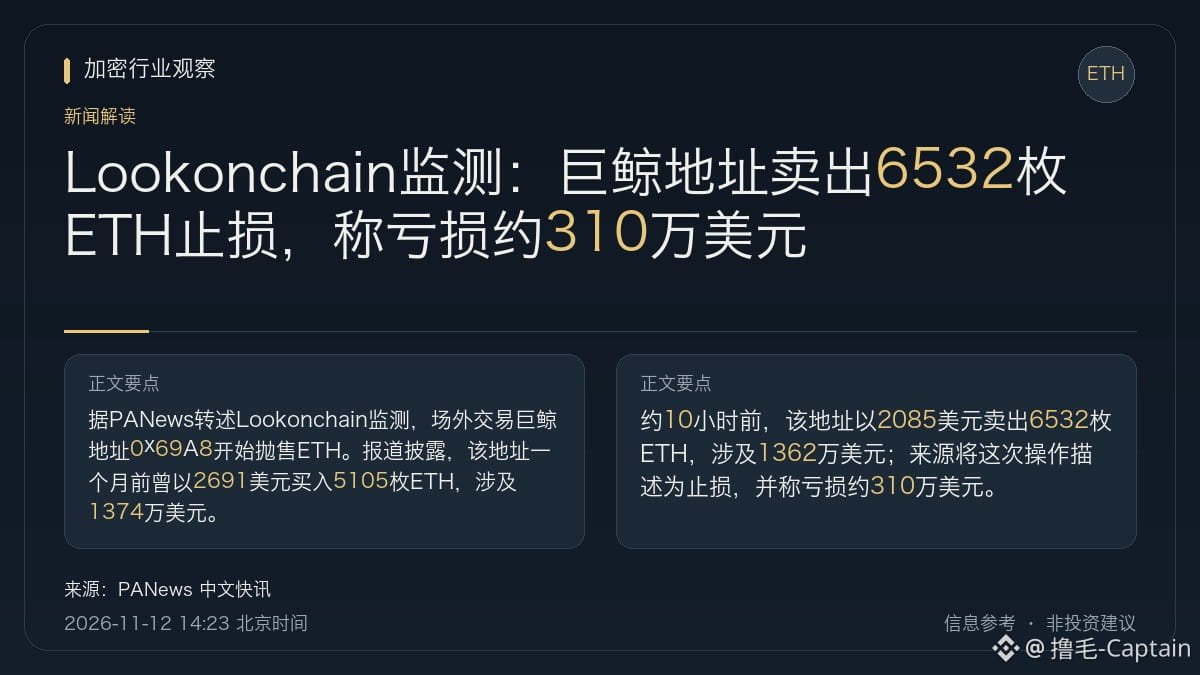
Lookonchain monitoring: Whale address sells 6,532 ETH to cut losses, reports a loss of about $3.1 million
According to monitoring by Lookonchain, as reported by PANews, the over-the-counter whale address 0x69A8 has started selling ETH. The report disclosed that the address bought 5,105 ETH a month ago at $2,691 per ETH, for a total of $13.74 million.
About 10 hours ago, the address sold 6,532 ETH at $2,085 per ETH, for a total of $13.62 million. The source described the transaction as a stop-loss sale and said the loss was about $3.1 million.
Analysis: The disclosed sale price was below the earlier purchase price, reflecting the address’s move to reduce its position after prices fell. However, the quantities in the two transactions do not match. The available information is insufficient to confirm that all 6,532 ETH sold came from the purchase of 5,105 ETH a month ago, or to determine the address’s full cost basis or predict ETH’s subsequent price movements.
Impact and points to watch: Analysis: The sale indicates that the address reduced its ETH position when the price was below its disclosed purchase price from a month ago. However, the purchase was for 5,105 ETH and the sale was for 6,532 ETH, so the quantities do not match. Based on this monitoring report alone, it is not possible to confirm whether all the assets sold came from that purchase, nor should it be used to infer the overall market trend.
Follow-up checks: Whether the address continues to sell ETH and whether it still holds a remaining position; whether on-chain monitoring can further clarify the source and full cost basis of the 6,532 ETH; whether the large address’s position reduction was an individual stop-loss or accompanied broader market selling pressure
Source: PANews Chinese-language news brief
Source time: 2026-11-12 14:23 Beijing time
Risk warning: This article is for informational purposes only and does not constitute investment advice.
52
·
--
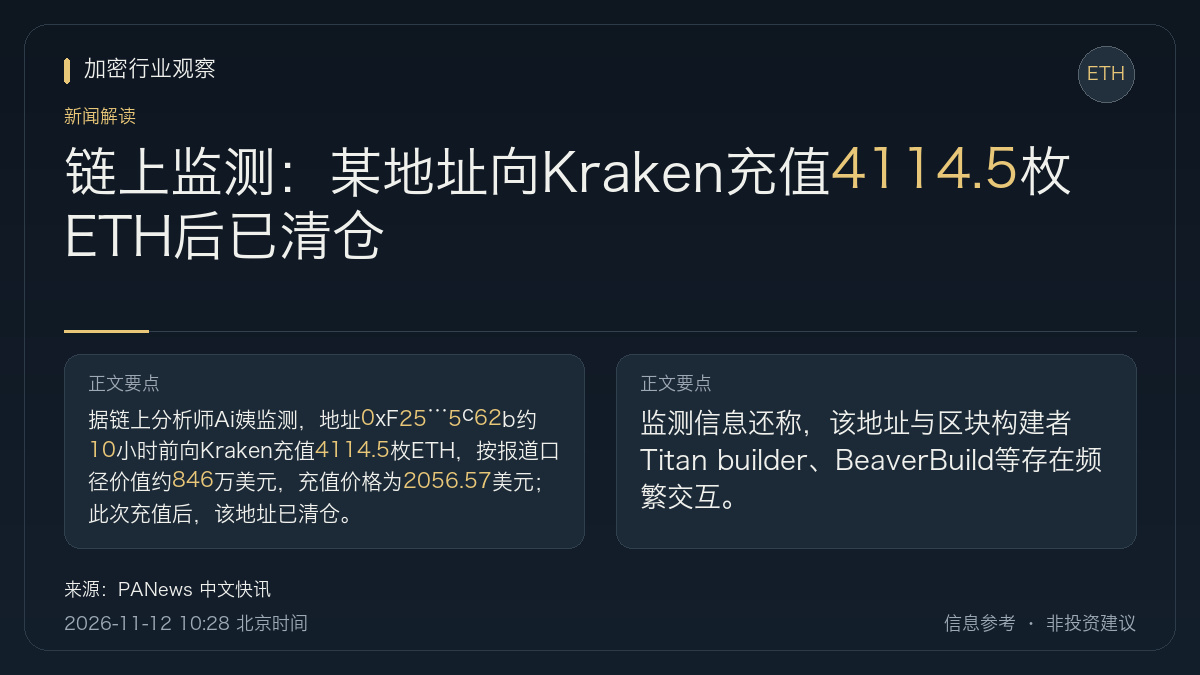
On-chain monitoring: Address empties holdings after depositing 4,114.5 ETH to Kraken
According to on-chain analyst Ai Yi, an address starting with 0xF25 and ending in 5c62b deposited 4,114.5 ETH to Kraken about 10 hours ago. The deposit was worth approximately $8.46 million based on the reported figures, at a price of $2,056.57 per ETH. The address has since emptied its holdings.
The monitoring data also indicates that the address has frequently interacted with block builders such as Titan builder and BeaverBuild.
Analysis: A large deposit and an emptied-holdings status can offer clues for tracking the fund movements of an individual address. However, the source does not provide the specific execution route, average execution price, or reason for emptying the holdings. If sustained transfers or new on-chain interactions emerge, the address’s fund flows can be monitored further. The information currently available is insufficient to make a definitive judgment about the direction of ETH prices.
Impact and points to watch: Analysis: A large ETH transfer to an exchange accompanied by an emptied-holdings status may indicate that the address has closed its related position. However, the public source does not disclose the specific execution route, average execution price, or reason for emptying the holdings, so this cannot be used to infer the broader market trend.
Follow-up checks: Whether the address continues to transfer funds to or from Kraken or other addresses; whether interactions with Titan builder, BeaverBuild, and others continue; whether a verifiable execution route or explanation for emptying the holdings emerges
Source: PANews Chinese-language news brief
Source time: 2026-11-12 10:28 Beijing time
Risk warning: This article is for informational purposes only and does not constitute investment advice.
74
Log in to explore more content
Join global crypto users on Binance Square
⚡️ Get latest and useful information about crypto.
💬 Trusted by the world’s largest crypto exchange.
👍 Discover real insights from verified creators.
Email / Phone number
Trending Topics
CanMarketsReboundAfterThanksgiving?
179,955 views
1,923 Discussing
Rate-Hike Bets Linger as US Markets Head Into Thanksgiving Closure
Binance News
·7 Likes
·5.5k views
CouldSpaceX’sOrbitalDataCentersBoostAIChipDemand?
88,170 views
1,162 Discussing
SouthKoreaProposesMandatoryDigitalAssetTransactionDisclosure
4,191 views
100 Discussing