

计然
174 Posts

计然
Report
Block User

BNB Holder
High-Frequency Trader
1.1 Years
20 Following
61 Followers
53 Liked
Posts
All
Videos
·
--
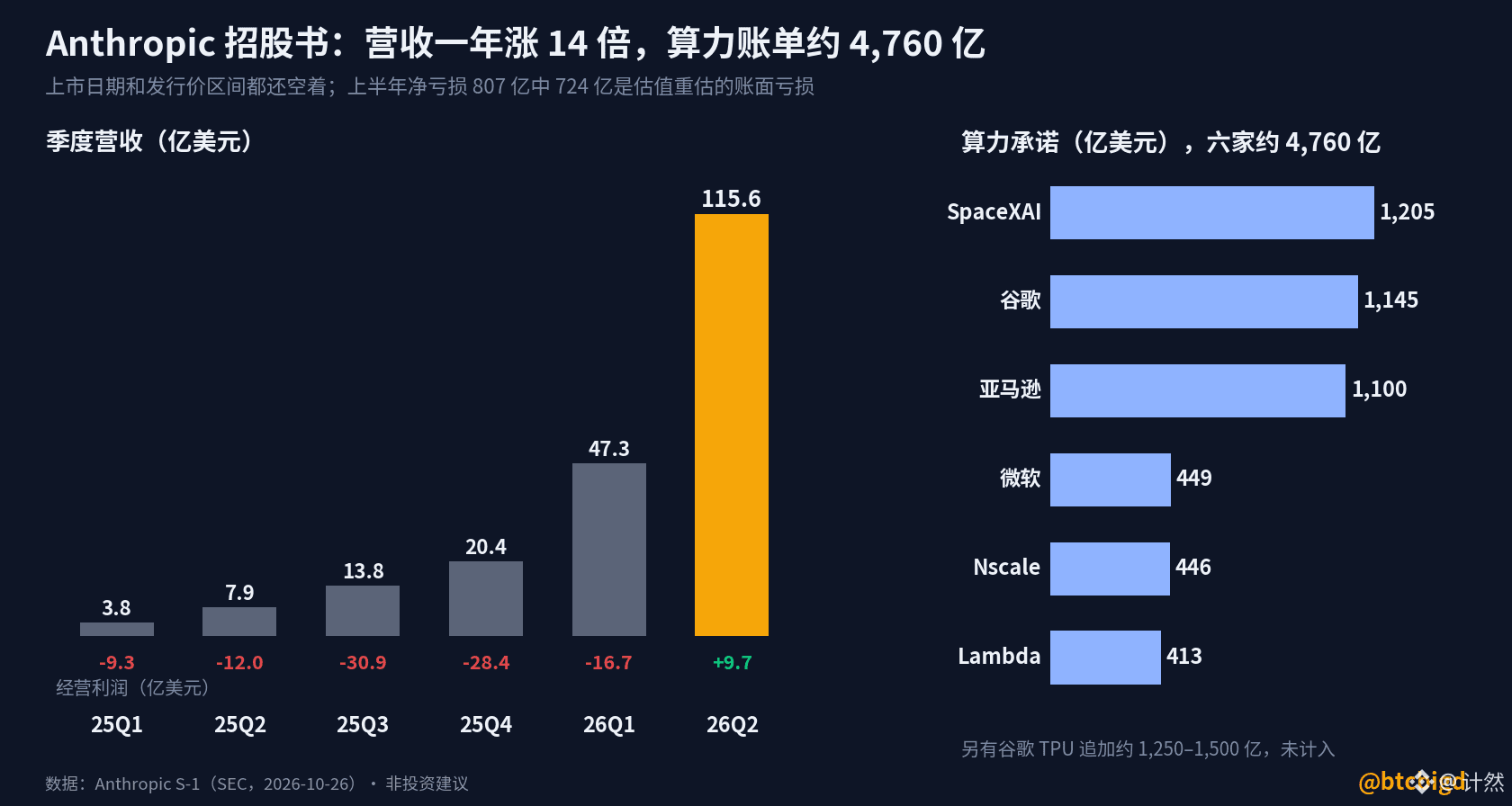
Anthropic lost $80.7 billion in the first half, yet its compute bill commitments total $476 billion! The prospectus is finally here, but the IPO price is still a question mark 🤔 Has the AI bubble peaked?
The prospectus was made public on October 26: the company has applied to list on Nasdaq under the ticker ANT. The offering price, number of shares and closing date are all still blank; the rumored mid-November listing, $100 billion raise and $2 trillion valuation are not mentioned in the filing.
【Losses and bills】
- First-half revenue was $16.29 billion, up 1,300% year over year; second-quarter revenue was $11.56 billion, and the company recorded its first operating profit, at $970 million
- First-half net loss was $80.7 billion, of which $72.4 billion came from revaluing convertible notes and SAFEs. This was an accounting loss, and once they convert into shares at the IPO, this portion will no longer be revalued this way
- Compute commitments from Microsoft, Google, Amazon, SpaceXAI, Nscale and Lambda total about $476 billion; Google TPU commitments of another roughly $125–150 billion are not included
Some of the losses came from accounting revaluations, while compute commitments are a separate matter. The prospectus also warns that growth may slow, expenses may precede revenue once compute capacity comes online, and financing needs may arise sooner than expected.
【What will the market value it at?】
Binance $ANTHROPIC pre-IPO contract hit a high of 1,972 on October 26; it is now around 1,880, implying a valuation of about $1.88 trillion based on the contract—6% below the rumored $2 trillion. This is the valuation implied by the contract, not the IPO price.
The prospectus is public, but the offering price hasn’t been set. Do you think Anthropic’s IPO will signal that the AI bubble has peaked?
335
·
--
Verified
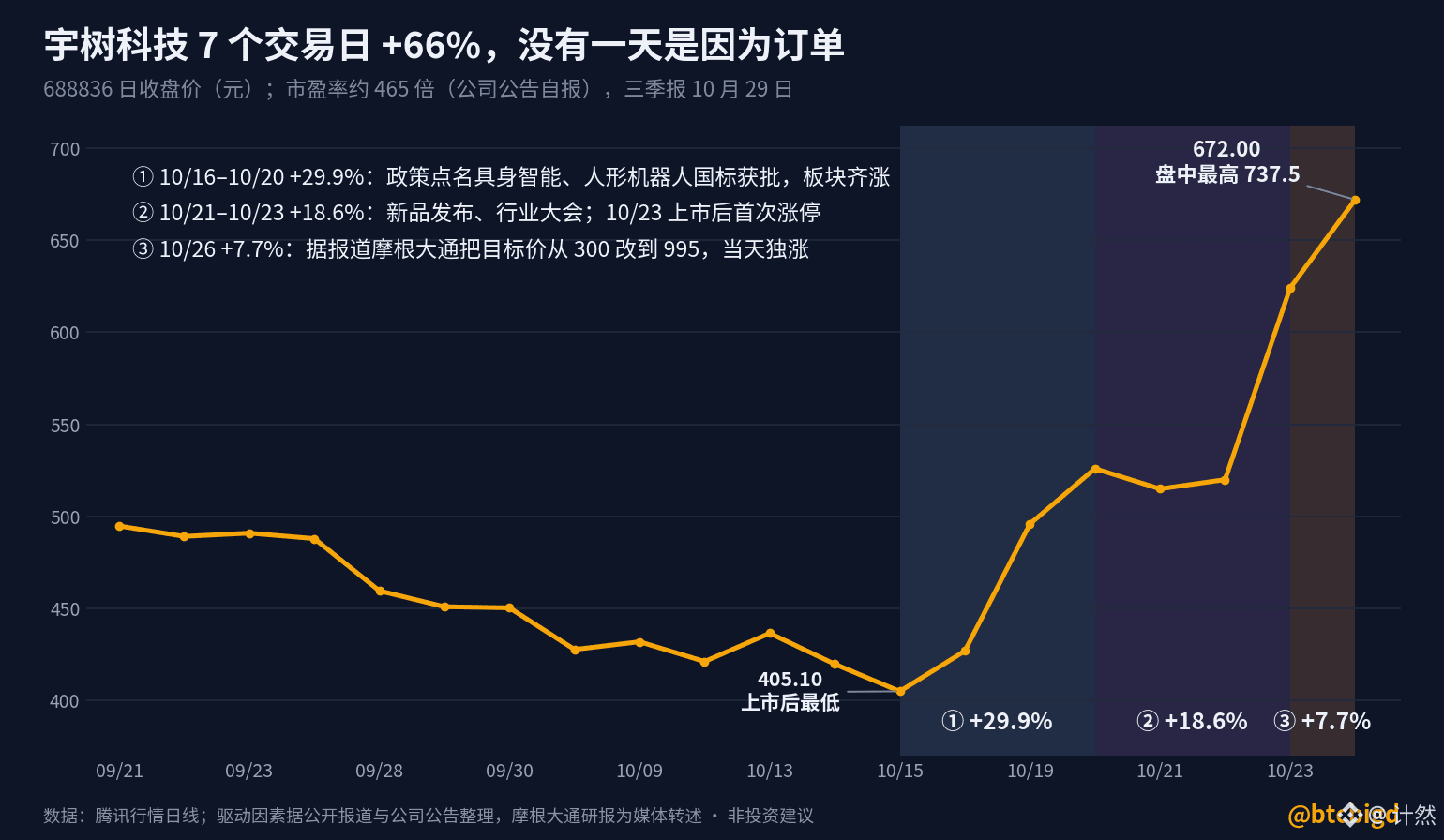
Ubtech Technology rose 66% in 7 trading days, and none of the gains were because of orders
On Oct 15, it closed at 405.10 yuan, the lowest since listing; on Oct 26, it closed at 672 yuan, after touching 737.5 intraday
[Three rounds of gains, three reasons]
① Oct 16–20 +29.9%: policy explicitly named embodied intelligence, and the first batch of humanoid robot national standards were approved; the whole sector was rising
② Oct 21–23 +18.6%: new product launches, plus comments at an industry conference that the “critical point could come in as fast as 1–2 years”; on Oct 23 the sector broadly rose, and Ubtech hit limit up for the first time since listing
③ Oct 26 +7.7%: according to media reports, JPMorgan on Oct 25 upgraded its rating from “underweight” by two notches to “overweight,” and raised its target price from 300 to 995 yuan. The same firm had just issued an “underweight” rating in early October, and the company had no new disclosures in those three weeks
- Oct 26 was a solo rise: the STAR 50 fell 2.23%, and most robot stocks declined
[Fundamentals unchanged]
- The latest financial report is still for the first half: revenue was 1.152 billion yuan (+48.5%), and non-GAAP net profit was 244 million yuan (−19.3%)
- The P/E ratio is about 465x, versus an industry average of about 39x (self-reported in the company’s abnormal-movement announcement)
- The company’s two abnormal-movement announcements both warned that it is still in the early stage of commercialization, with the risk of valuation reversion
[Binance futures]
- Contract $UNITREE closed at 96.95 US dollars on Oct 26, about 4% below the A-share implied price
- Funding rates were settled twice at −0.88%: shorts are paying longs, meaning the bearish side in the futures market is getting more crowded
[What to watch in the Q3 report on Oct 29]
- Last year’s Q3 single-quarter non-GAAP profit was 128 million yuan, so the base is low and year-on-year growth for the quarter will likely turn positive
- But to keep cumulative non-GAAP profit for the first three quarters from falling, Q3 would need to make 187 million yuan, roughly the same as Q2, which is not easy
- When talking about “growth,” check whether it refers to the single quarter or the cumulative figure
Do you think the Q3 report on Oct 29 can support a P/E ratio of 465x?
669
·
--
A fourth intervention by the “national team”? A different playbook this time! Supporting only the CSI 300, not AI
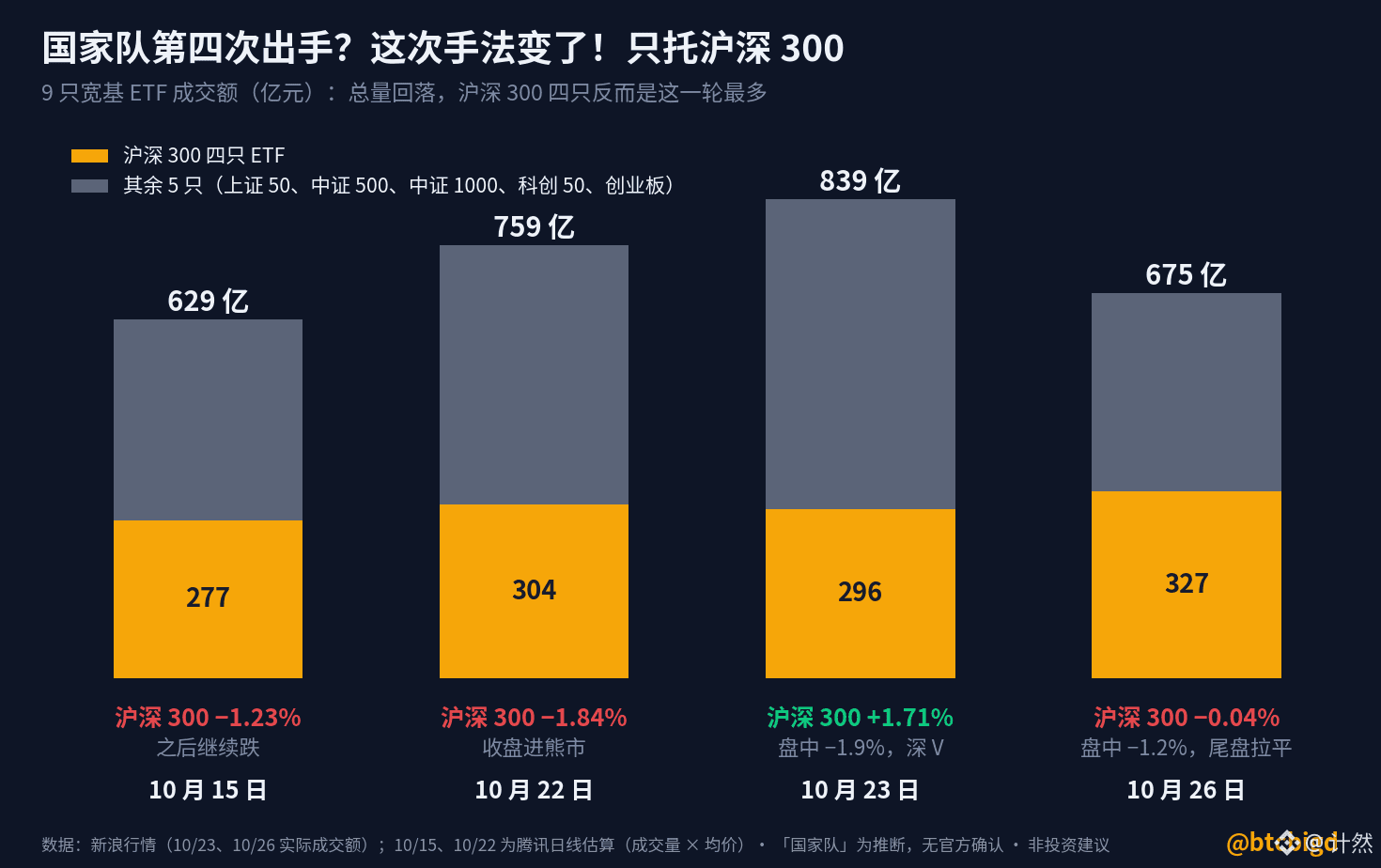
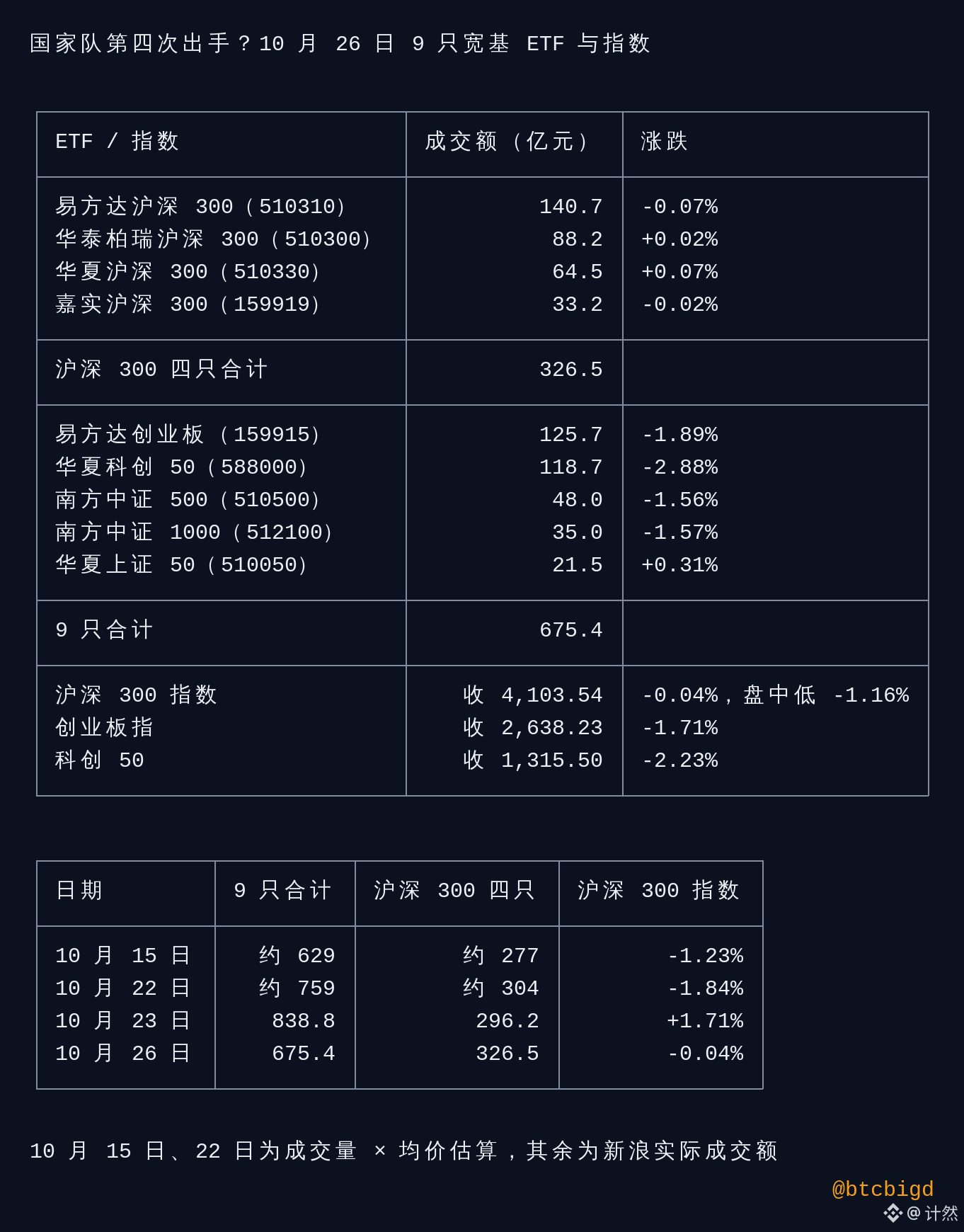
On October 26, those nine broad-market ETFs saw another surge in trading volume: a combined 67.5 billion yuan, compared with just over 30 billion on October 19 and 21.
【Who got support this time】
- The four CSI 300 ETFs traded a combined 32.7 billion yuan—the highest total in this round. E Fund’s CSI 300 ETF alone traded 14.1 billion yuan, versus 6.1 billion on October 23.
- The CSI 300 was down as much as 1.2% intraday, then rebounded late in the session to close down just 0.04%. It remains 18.9% below its June 22 high, holding above the −20% bear-market threshold.
- Those left unsupported: the ChiNext Index fell 1.71%, and the STAR 50 fell 2.23%. The ChiNext ETF and STAR 50 ETF each traded over 12 billion yuan—volume rose as prices fell.
【All four interventions side by side】
- October 15: about 62.9 billion yuan; the CSI 300 fell 1.23% that day and kept sliding afterward.
- October 22: about 75.9 billion yuan; the index fell 1.84% that day and closed in bear-market territory.
- October 23: 83.9 billion yuan; down 1.9% intraday, then closed up 1.71%—a deep V-shaped rebound.
- October 26: 67.5 billion yuan; down 1.2% intraday, then closed flat.
Trading volume is shrinking, and the focus is narrowing: the broad-market index was supported, while AI and growth stocks were left to fall on their own.
【BTC on the same day】
- In the Asian morning session, South Korean stocks led the declines (KOSPI −1.46%, Nikkei −0.80%, Hang Seng +0.51%), dragging $BTC down to 79,369 during the 11:00 a.m. hour Beijing time.
- It recovered above 80,000 in the afternoon and is now at 80,353, moving sideways as it awaits this week’s tech earnings and the Fed’s October 27–28 meeting.
The “national team” intervention is inferred from unusually high ETF trading volumes; there has been no official confirmation.
How many more times do you think they’ll step in this week?
101
·
--
$BTC has fallen from its September 21 peak of 87,396 to 80,816 on October 25—a drawdown of just 7.5%.
But a lot of people around me have already seen their earlier gains wiped out! Some are down 20%, and some have even been liquidated and lost everything!!!
What if Monday, October 26 really turns into a Black Monday…
I can’t even imagine it. I really can’t 🫣
But a lot of people around me have already seen their earlier gains wiped out! Some are down 20%, and some have even been liquidated and lost everything!!!
What if Monday, October 26 really turns into a Black Monday…
I can’t even imagine it. I really can’t 🫣
105
·
--
If you don't know, ask 🙋
To trade US stock indices:
- On Binance, you can use the “SPY” or “QQQ” contracts
- On OKX, you can use “US500” (S&P 500) or “US100” (Nasdaq 100)
So, what can you use to trade A-share indices, such as the CSI 300?
If you don't know, ask 🙋
To trade US stock indices:
- On Binance, you can use the “SPY” or “QQQ” contracts
- On OKX, you can use “US500” (S&P 500) or “US100” (Nasdaq 100)
So, what can you use to trade A-share indices, such as the CSI 300?
To trade US stock indices:
- On Binance, you can use the “SPY” or “QQQ” contracts
- On OKX, you can use “US500” (S&P 500) or “US100” (Nasdaq 100)
So, what can you use to trade A-share indices, such as the CSI 300?
352
·
--
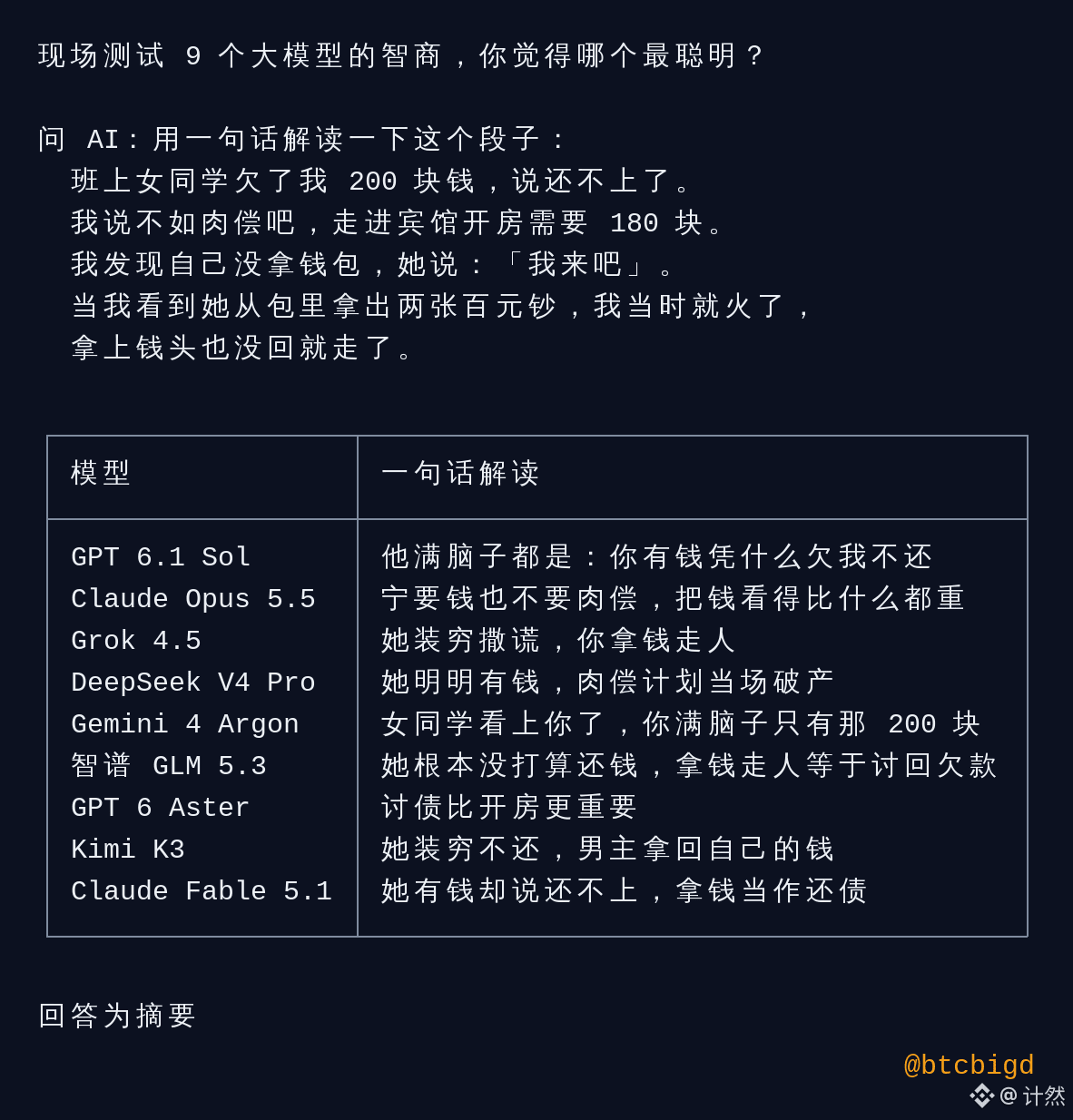
We tested the IQ of 9 large language models, and the results were pretty interesting 😂
Ask AI: Explain this joke in one sentence:
A girl in my class owed me 200 yuan and said she couldn’t pay me back. I said, “Why not pay me back in kind?” We went to a hotel, where a room cost 180 yuan. I realized I hadn’t brought my wallet, and she said, “I’ll take care of it.” When I saw her pull two 100-yuan bills out of her bag, I got furious, grabbed the money, and walked out without looking back.
8 of them interpreted the story almost exactly the same way, while the remaining one came up with a completely different interpretation. Which model do you think is the smartest? Copy this question and ask your AI—you can test the IQ of the AI you’re paying for 😏
55
·
--
U.S. stock market Fear & Greed Index: 19.8, Extreme Fear 😱
Crypto Fear & Greed Index: 50, Neutral 😐
CNN: U.S. stocks have fallen back into Extreme Fear again— for the second time this month 📢
China A-shares: More than 4,800 stocks are down, fewer than 500 are up, and the CSI 300 has entered a bear market. The Fear & Greed Index? What’s that? We don’t have one! Count them yourself 🥲
U.S. stocks: Nasdaq −2.6%, Philadelphia Semiconductor Index −6.7%. I’m freaking out this much—BTC, how are you still so calm?
$BTC: I’m down 3.2% too. I’m just… used to it 🤷
Crypto crowd: What’s there to be afraid of?! A dip is a chance to buy! Let’s go! 🚀
Crypto veteran: You said that last time too. I bought in at 87,000 😭
U.S. stock market Fear & Greed Index: 19.8, Extreme Fear 😱
Crypto Fear & Greed Index: 50, Neutral 😐
CNN: U.S. stocks have fallen back into Extreme Fear again— for the second time this month 📢
China A-shares: More than 4,800 stocks are down, fewer than 500 are up, and the CSI 300 has entered a bear market. The Fear & Greed Index? What’s that? We don’t have one! Count them yourself 🥲
U.S. stocks: Nasdaq −2.6%, Philadelphia Semiconductor Index −6.7%. I’m freaking out this much—BTC, how are you still so calm?
$BTC : I’m down 3.2% too. I’m just… used to it 🤷
Crypto crowd: What’s there to be afraid of?! A dip is a chance to buy! Let’s go! 🚀
Crypto veteran: You said that last time too. I bought in at 87,000 😭
63
·
--
United States: 440,000 new millionaires last year—1,200 a day—bringing the total to 23.63 million. That’s one in every 11 adults 😎
Mainland China: 14,000 new millionaires last year, bringing the total to 5.3 million (just one for every 200-plus adults). The number grew by only 0.3% in a year 🥲
And that was before A-shares entered a bear market. The CSI 300 is down 20% from its June peak, and the ChiNext Index is down 41%…
How many do you think will be left when we count again at the end of this year? 😂
$BTC
81
·
--
There are 23.63 million millionaires in the U.S.—that’s 1 in every 11 adults 😎
There are only about 970,000 addresses worldwide holding a full 1 $BTC 🥲
At $80,000 each, it’s way cheaper than becoming a millionaire, yet the number of addresses that have gotten in is less than 4% of the number of millionaires!!!
Have you gotten in? Somehow, I feel like you’re bound to sooner or later, since you’re reading this post 🤔
101
·
--
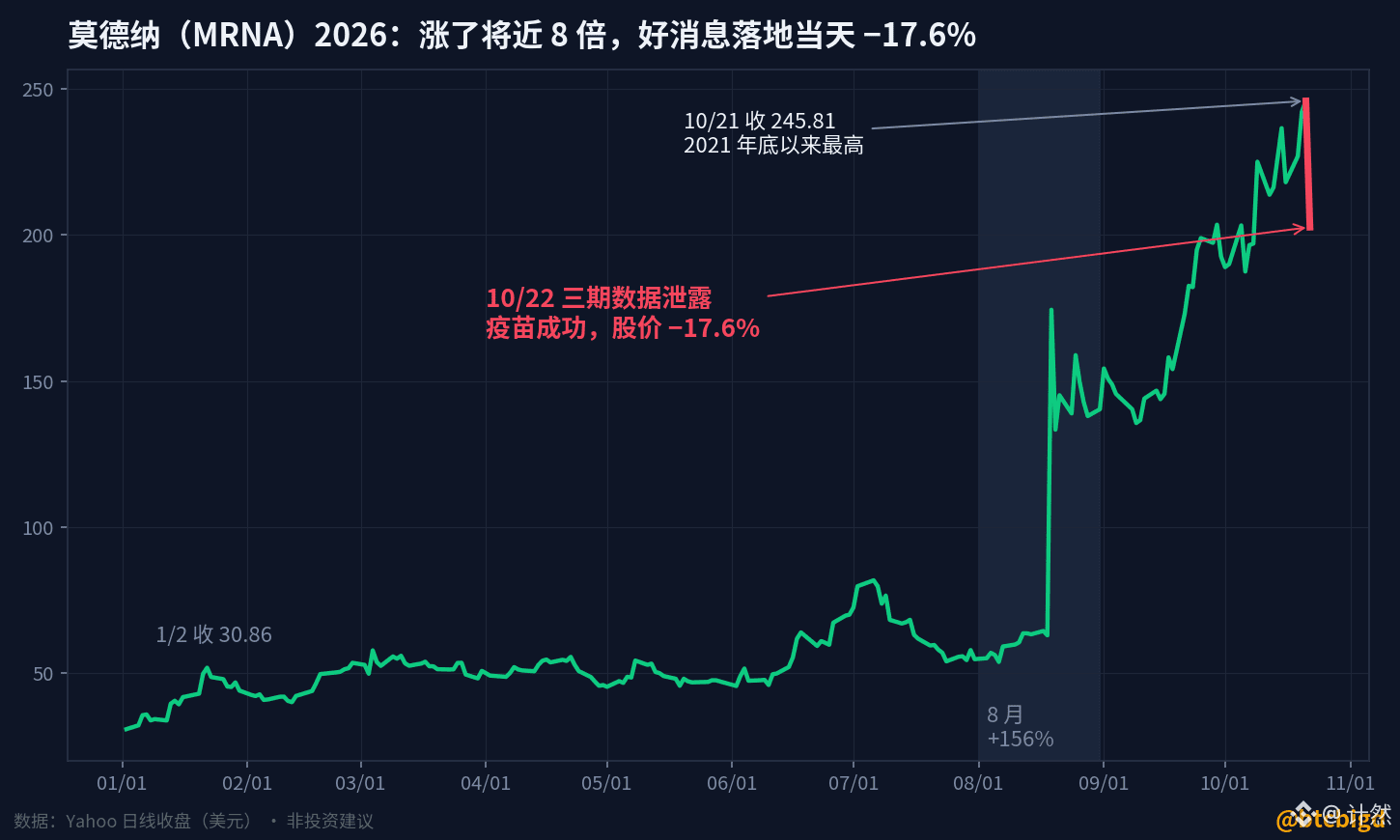
Patients get good news, shareholders get a massive red candle!!!
Moderna (Moderna, ticker symbol $MRNA): Phase 3 cancer vaccine trial succeeds, risk of recurrence or death down 42%—why are you selling? 😭
Shareholders: I bought at 30 bucks at the start of the year, and yesterday it hit 245. Why wouldn’t I sell?
Down 17.6% at the close on October 22, wiping out $24 billion in a single day.
The day everyone knows the good news is the day to get out. Moderna put on a textbook “sell the news” performance yesterday!!! Did you learn your lesson? 😏
$BTC
Patients get good news, shareholders get a massive red candle!!!
Moderna (Moderna, ticker symbol $MRNA ): Phase 3 cancer vaccine trial succeeds, risk of recurrence or death down 42%—why are you selling? 😭
Shareholders: I bought at 30 bucks at the start of the year, and yesterday it hit 245. Why wouldn’t I sell?
Down 17.6% at the close on October 22, wiping out $24 billion in a single day.
The day everyone knows the good news is the day to get out. Moderna put on a textbook “sell the news” performance yesterday!!! Did you learn your lesson? 😏
$BTC
283
·
--
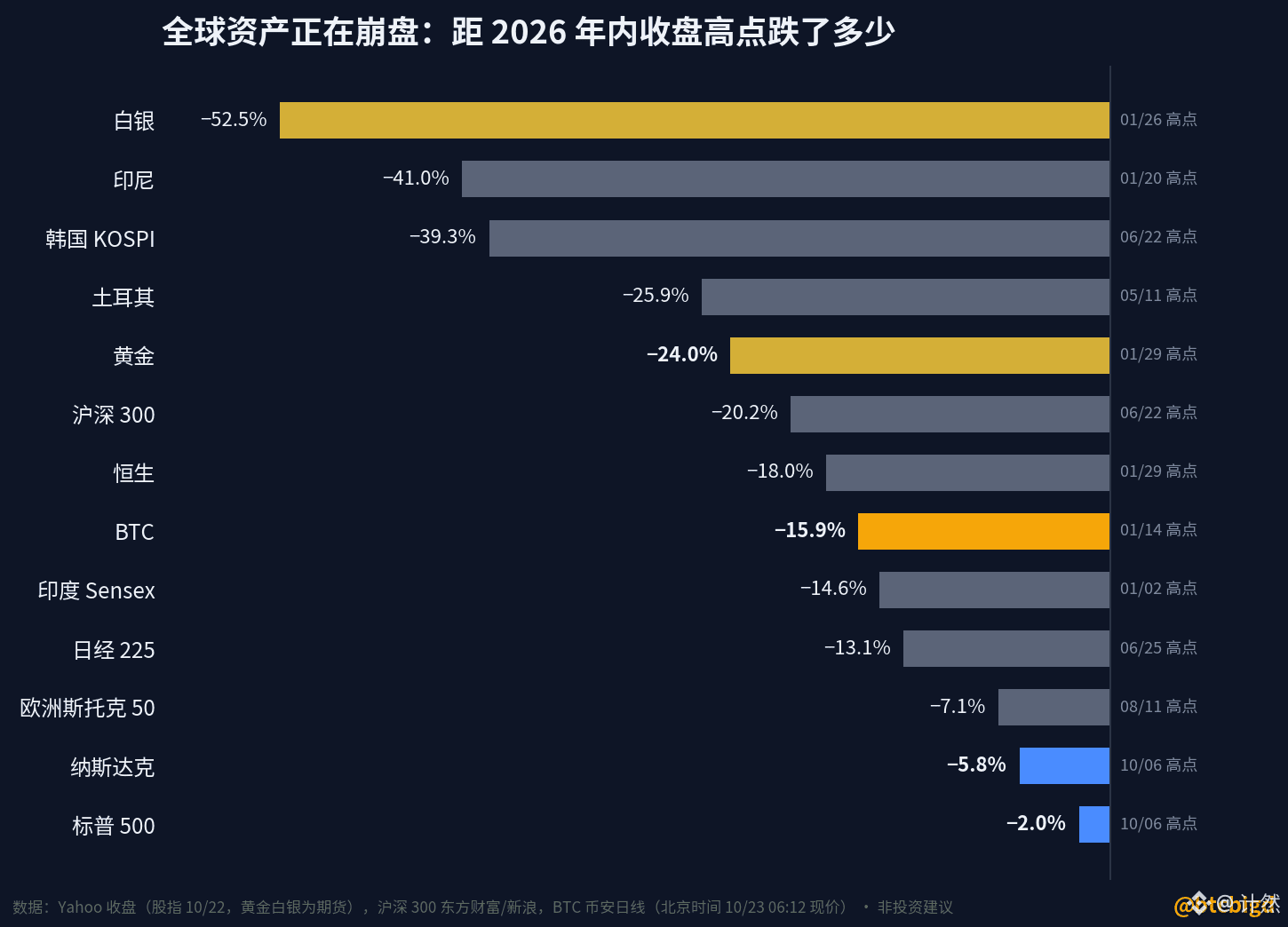
Global assets are crashing: silver is down by half, gold −24%, Korean stocks −39%, A-shares entering a bear market… What about U.S. stocks, standing alone near their highs? How far do you think they are from a crash?
【Distance from 2026 closing highs】
- Silver −52.5%, gold −24.0%
- Indonesia −41.0%, South Korea −39.3%, Turkey −25.9%
- CSI 300 −20.2%, Hang Seng −18.0%
- $BTC −15.9% (81,498 at 06:12 Beijing time)
- India −14.6%, Nikkei −13.1%, EURO STOXX 50 −7.1%
- Nasdaq −5.8%, S&P 500 −2.0%
【Three anomalies】
① Safe-haven assets have fallen more than BTC. Gold closed at 5,318 on January 29; now it’s at 4,040. Silver is down by half.
② U.S. stocks are at the top. The S&P 500 set a new high for the year as recently as October 6, and is now down just 2%.
③ BTC is in the middle. It has fallen less than South Korea, A-shares, and gold, but more than U.S. stocks, India, and Japan. It’s neither “rallying against the trend” nor “crashing along with everything else.”
【Yesterday】
October 22: gold −2.7%, silver −4.9%, Nasdaq −2.6%, S&P 500 −1.2%, CSI 300 −1.8%. BTC fell from 84,093 to 81,498 at 06:12 Beijing time, down 3.1%. Everything listed here fell that day.
U.S. stocks are the last ones that haven’t fallen much. How much longer do you think their good run can last?
669
·
--
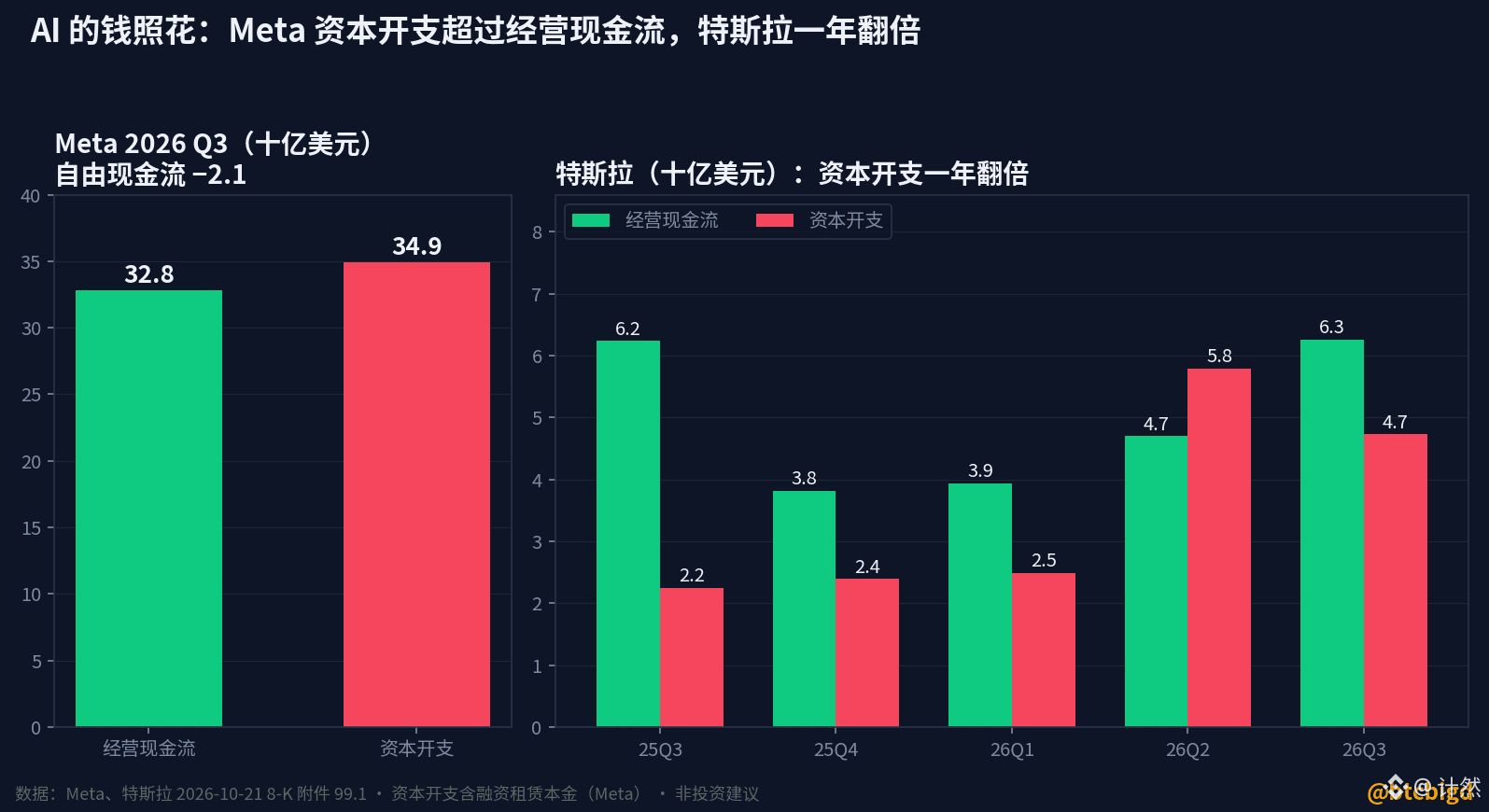
Meta and Tesla report Q3 results on the same day: profits are down for both, while AI spending continues. Meta has already spent more than its operating cash flow
【$META】
- Revenue: $64.6 billion, +26%; ad impressions +10%, average price +14%—both volume and pricing are up
- Operating profit: $13.0 billion, −37%. This includes a $9.9 billion charge for a settlement with the attorneys general of 52 states over litigation involving teens. Excluding that, operating profit was $22.9 billion, +11%
- Don’t take the +264% net profit growth at face value: the third quarter last year included a one-time tax expense, with an effective tax rate of 87%, making for a very low comparison base
- Quarterly capital expenditures: $34.9 billion; operating cash flow: $32.8 billion; free cash flow: −$2.1 billion
- Full-year capital expenditure forecast: $135 billion to $145 billion, versus the previous $130 billion to $145 billion. The range narrowed because the lower end was raised, not because spending was cut
- Meta will create a new non-voting Class C share, effective January 19, 2027, and distribute one share for each existing share held. The first reason cited by the board is financing, employee compensation, and acquisitions; the filing says the investment required for the AI transition is substantial. This isn’t a new share issuance, but it opens the door to using equity financing in the future
【Tesla $TSLA】
- Revenue: $28.0 billion, flat year over year; automotive −3%, energy storage −16%, services and other +33%
- Gross margin improved by 1.6 percentage points, but operating expenses rose 39%. Operating profit was $720 million, −56%, with an operating margin of 2.6%
- The two measures diverged sharply: GAAP net income was $790 million, −43%; non-GAAP net income was $1.7 billion, down just 4%
- Energy storage deployments: 13.7 GWh, +10%, while revenue fell 16%—prices are coming down
- Quarterly capital expenditures: $4.7 billion, up from $2.2 billion a year ago; the total for the past four quarters was $15.4 billion, versus $8.5 billion for all of 2025. The shareholder letter says the spending is going toward AI compute, solar, battery materials, and semiconductor manufacturing
- FSD paid subscribers: 1.74 million, +67%; since September 3, Cybercabs have been operating as robotaxis in Austin
【Side by side】
Profits look rough for both, but for different reasons: Meta has a settlement charge, while Tesla’s expenses are growing faster than its gross profit. What they have in common is rising capital expenditure—neither is pulling back. This quarter, Meta spent more than it brought in from operations, and it has also put a Class C share mechanism in place. AI investment is beginning to exceed the cash flow generated by a giant company itself.
Who do you think will be next to spend beyond their cash flow on capital expenditures?
Meta and Tesla report Q3 results on the same day: profits are down for both, while AI spending continues. Meta has already spent more than its operating cash flow
【$META 】
- Revenue: $64.6 billion, +26%; ad impressions +10%, average price +14%—both volume and pricing are up
- Operating profit: $13.0 billion, −37%. This includes a $9.9 billion charge for a settlement with the attorneys general of 52 states over litigation involving teens. Excluding that, operating profit was $22.9 billion, +11%
- Don’t take the +264% net profit growth at face value: the third quarter last year included a one-time tax expense, with an effective tax rate of 87%, making for a very low comparison base
- Quarterly capital expenditures: $34.9 billion; operating cash flow: $32.8 billion; free cash flow: −$2.1 billion
- Full-year capital expenditure forecast: $135 billion to $145 billion, versus the previous $130 billion to $145 billion. The range narrowed because the lower end was raised, not because spending was cut
- Meta will create a new non-voting Class C share, effective January 19, 2027, and distribute one share for each existing share held. The first reason cited by the board is financing, employee compensation, and acquisitions; the filing says the investment required for the AI transition is substantial. This isn’t a new share issuance, but it opens the door to using equity financing in the future
【Tesla $TSLA 】
- Revenue: $28.0 billion, flat year over year; automotive −3%, energy storage −16%, services and other +33%
- Gross margin improved by 1.6 percentage points, but operating expenses rose 39%. Operating profit was $720 million, −56%, with an operating margin of 2.6%
- The two measures diverged sharply: GAAP net income was $790 million, −43%; non-GAAP net income was $1.7 billion, down just 4%
- Energy storage deployments: 13.7 GWh, +10%, while revenue fell 16%—prices are coming down
- Quarterly capital expenditures: $4.7 billion, up from $2.2 billion a year ago; the total for the past four quarters was $15.4 billion, versus $8.5 billion for all of 2025. The shareholder letter says the spending is going toward AI compute, solar, battery materials, and semiconductor manufacturing
- FSD paid subscribers: 1.74 million, +67%; since September 3, Cybercabs have been operating as robotaxis in Austin
【Side by side】
Profits look rough for both, but for different reasons: Meta has a settlement charge, while Tesla’s expenses are growing faster than its gross profit. What they have in common is rising capital expenditure—neither is pulling back. This quarter, Meta spent more than it brought in from operations, and it has also put a Class C share mechanism in place. AI investment is beginning to exceed the cash flow generated by a giant company itself.
Who do you think will be next to spend beyond their cash flow on capital expenditures?
131
·
--
Breaking · Major development: Zelenskyy softens his stance: “We’ll sign if we keep 75% of our territory.” After 4 years and 8 months of fighting and three rounds of talks, is this the closest we’ve come to a ceasefire?
【What happened on October 21】
- Zelenskyy told Fox News he would accept an agreement to “freeze” the war along the current front line, with Ukraine retaining around 75% of its territory. This is the first time he has publicly accepted drawing the line at the status quo.
- That same day, after Putin met with a U.S. envoy, the Kremlin said it was willing to resume trilateral U.S.-Russia-Ukraine talks in early November. Putin also released a detained American teacher.
- Trump said, “We may have never been this close to the end of the war.” A BBC correspondent in Moscow reached the opposite conclusion: this latest U.S. push has done little to bring peace any closer.
【First, answers to three questions】
- How long has the war lasted? It began on February 24, 2022. As of today, it has been 4 years and 8 months.
- How many times have they held talks? They held around eight rounds in Belarus and Istanbul between February and April 2022. Talks collapsed after the Istanbul Communiqué, followed by nearly three years without direct negotiations. In 2025, the U.S. and Russia met in Riyadh, while Russia and Ukraine held three direct rounds in Istanbul that only resulted in prisoner exchanges; then came the Trump-Putin meeting in Alaska. Since February 2026, the U.S., Russia, and Ukraine have held talks in Abu Dhabi and Geneva, followed by another round in September. All told, that makes three major rounds; this is the start of a fourth.
- Is this the closest we’ve come? In terms of the conditions, yes. In the first three rounds, neither side publicly accepted “drawing the line at the status quo.” This time, Ukraine has said so, Russia has proposed a date, and the U.S. is pushing for talks. But the odds tell a different story: Polymarket puts the chance of a ceasefire by the end of this year at 13.5%, by the end of next March at 29.5%, and by the end of 2027 at 45.5%. The odds of peace talks resuming by November 30, though, are 68.5%. The market is saying: talks are likely; a ceasefire is still a long way off.
【A China-U.S.-Russia meeting in Shenzhen: can we make a bold prediction?】
- The facts: On October 19, Putin proposed a trilateral summit, with Russia suggesting China as the location and November as the timing. Trump said he was willing, but said he wanted to discuss denuclearization, not Ukraine. Beijing has made no comment; Kyiv opposes it; and the Kremlin’s wording is that it is “under discussion.” APEC will be held in Shenzhen on November 17–18, and Putin has confirmed he will attend.
- The odds: Polymarket gives an 85.5% chance that “Trump, Putin, and China’s leader appear together before 2027.” The market thinks it’s likely all three will be in the same city; sitting down to discuss Ukraine and reaching an agreement is another matter.
- So, “a Shenzhen meeting” is fair to predict; “a meeting = a ceasefire” is not.
【Is the claim that “risk assets will soar” credible?】
- How markets actually reacted to the last two major peace headlines: After the Trump-Putin meeting in Alaska on August 15, 2025, the S&P 500 fell from 6,450 to 6,370 over the following week, while $BTC fell from 117,000 to 112,000. After direct talks in Istanbul on May 16, 2025, the S&P 500 fell from 5,958 to 5,803 over the following week, while BTC did rise 8%.
- Oil prices didn’t move either time. Brent stayed between 65 and 68. Today, Brent is at 109 because of the Strait of Hormuz, not Ukraine.
- In other words, neither of the last two developments lifted risk assets. For them to rise, the Strait of Hormuz issue needs to be resolved first.
【What to watch】
- Whether trilateral talks actually begin in early November, and where
- How Europe and Kyiv respond to a “frozen front line”
- Whether all three leaders appear together during APEC in Shenzhen, and whether they discuss Ukraine or nuclear issues
4 years and 8 months of war, three rounds of talks, and now, for the first time, someone has said, “Let’s draw the line at the status quo.” Are you betting on that 13.5% chance of a ceasefire this year, or on the market getting carried away too soon again?


119
Log in to explore more content
Join global crypto users on Binance Square
⚡️ Get latest and useful information about crypto.
💬 Trusted by the world’s largest crypto exchange.
👍 Discover real insights from verified creators.
Email / Phone number