

Tao Outsider
111 Posts

Tao Outsider
Report
Block User
Learning by executing in the $TAO Bittensor ecosystem.
0 Following
2 Followers
4 Liked
Posts
·
--
$TAO 1h chart explained in detail
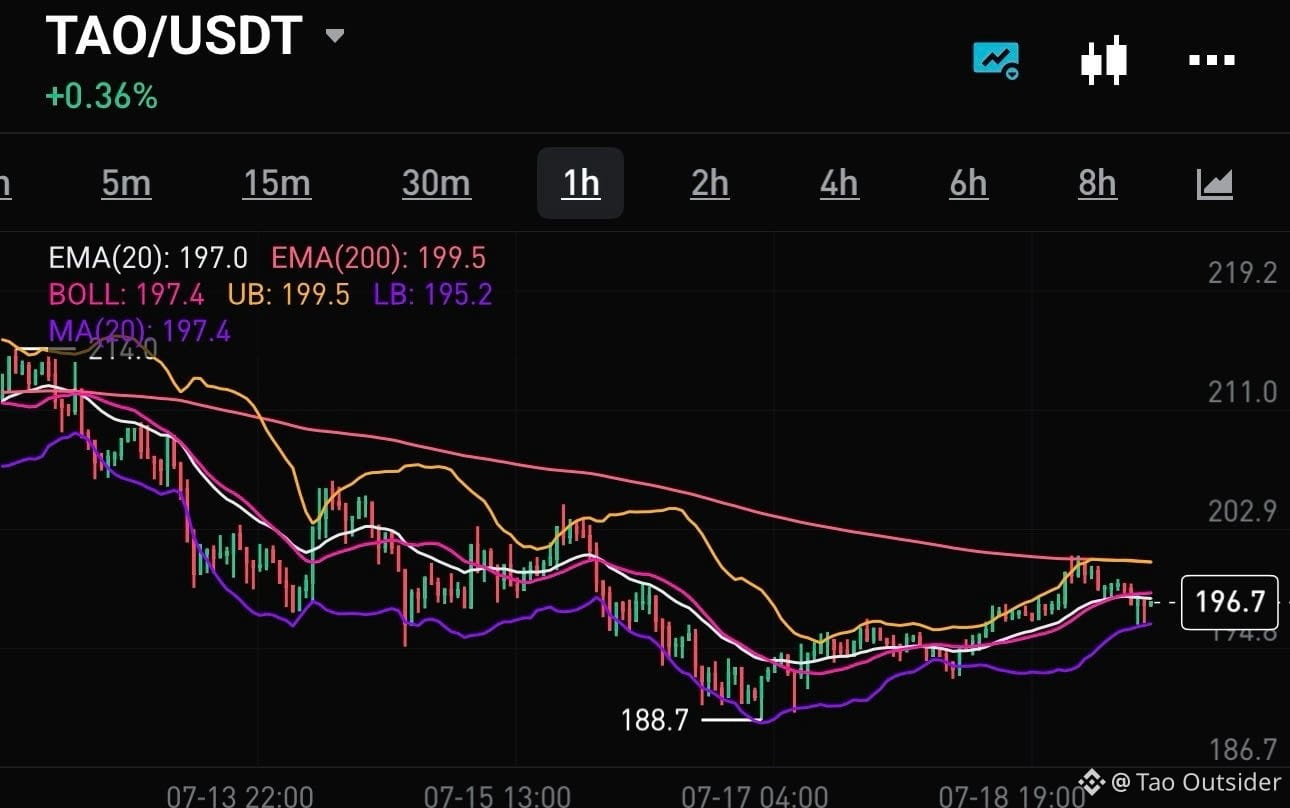
$TAO is trading at $196.4, inside a compressed 1h range and below the main short-term averages. The market has recovered from the $188.7 local low, but it still has not reclaimed the levels required to confirm a trend change.
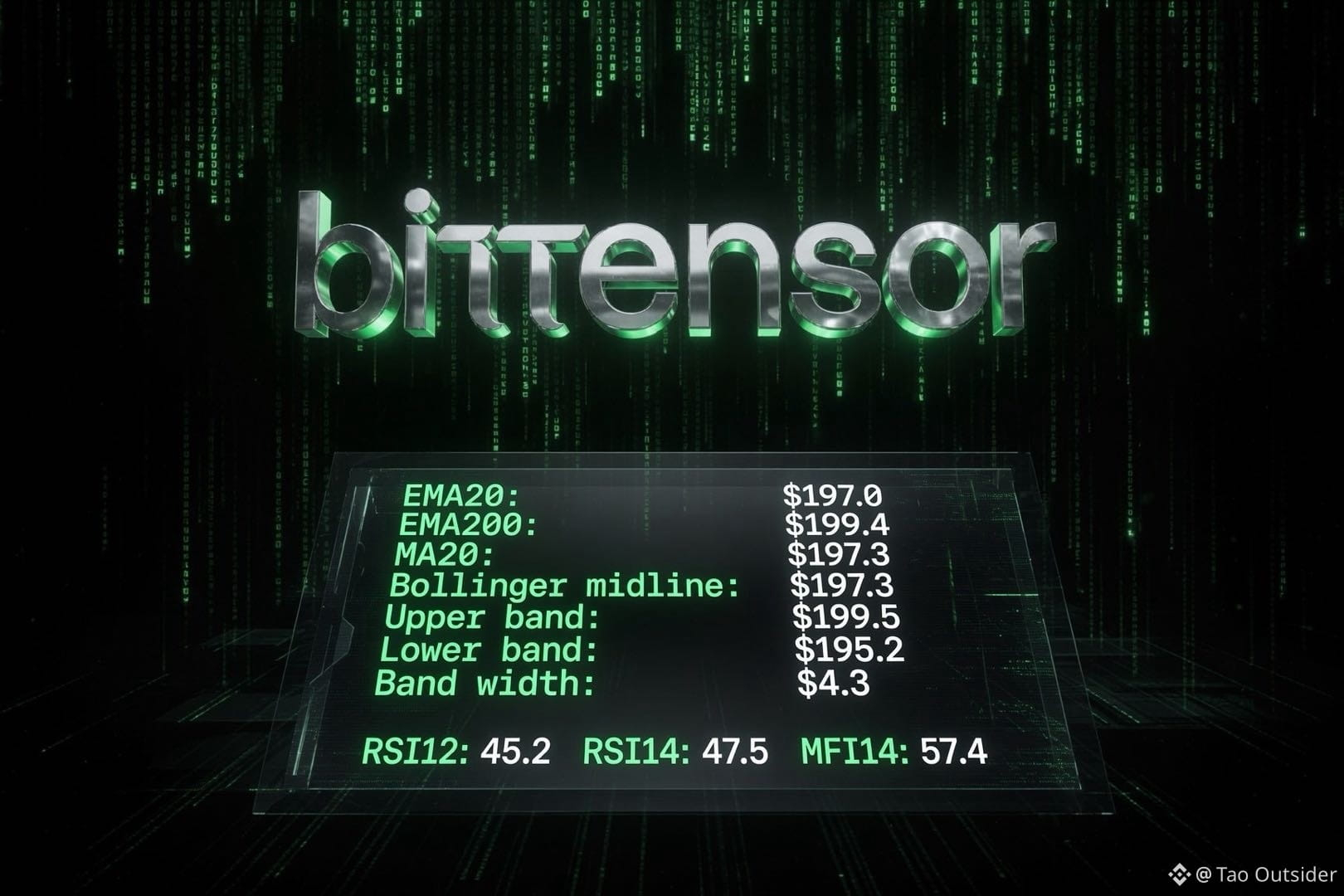
The EMA20 sits at $197.0. This tracks the short-term trend and currently acts as immediate resistance because price remains slightly below it.
The MA20 sits at $197.3, almost identical to the Bollinger midline. This is the local equilibrium level. Trading below it means the market remains slightly defensive.
The most important dynamic level is the EMA200 at $199.4. A clean reclaim and acceptance above this average would be the first meaningful improvement in the 1h structure.
The Bollinger Bands reinforce the same reading:
Midline: $197.3
Upper band: $199.5
Lower band: $195.2
Band width: $4.3
The narrow width confirms compressed volatility. Price is currently trading in the lower half of the bands, but still above the lower boundary. That leaves the market boxed between $195.2 support and $199.5 resistance.
Momentum remains neutral to slightly weak.
RSI12: 45.2
RSI14: 47.5
Both remain below 50, so buyers do not control momentum yet. They are also far from oversold conditions, which means price can still move lower without becoming technically exhausted.
MFI14 is 57.4, showing that money flow remains positive despite the weak price structure. Capital has not exited aggressively, but it has not produced enough demand to break resistance.
Current map:
Support: $195-$195.2
Major support: $188.7-$190
First resistance: $197-$197.3
Major short-term resistance: $199.4-$200
Next resistance: $202.2
The first improvement comes above $200.
A stronger regime change requires acceptance above $202.
Below $195, the probability of another test of $190 increases.
#bittensor
$TAO 1h chart explained in detail
$TAO is trading at $196.4, inside a compressed 1h range and below the main short-term averages. The market has recovered from the $188.7 local low, but it still has not reclaimed the levels required to confirm a trend change.
The EMA20 sits at $197.0. This tracks the short-term trend and currently acts as immediate resistance because price remains slightly below it.
The MA20 sits at $197.3, almost identical to the Bollinger midline. This is the local equilibrium level. Trading below it means the market remains slightly defensive.
The most important dynamic level is the EMA200 at $199.4. A clean reclaim and acceptance above this average would be the first meaningful improvement in the 1h structure.
The Bollinger Bands reinforce the same reading:
Midline: $197.3
Upper band: $199.5
Lower band: $195.2
Band width: $4.3
The narrow width confirms compressed volatility. Price is currently trading in the lower half of the bands, but still above the lower boundary. That leaves the market boxed between $195.2 support and $199.5 resistance.
Momentum remains neutral to slightly weak.
RSI12: 45.2
RSI14: 47.5
Both remain below 50, so buyers do not control momentum yet. They are also far from oversold conditions, which means price can still move lower without becoming technically exhausted.
MFI14 is 57.4, showing that money flow remains positive despite the weak price structure. Capital has not exited aggressively, but it has not produced enough demand to break resistance.
Current map:
Support: $195-$195.2
Major support: $188.7-$190
First resistance: $197-$197.3
Major short-term resistance: $199.4-$200
Next resistance: $202.2
The first improvement comes above $200.
A stronger regime change requires acceptance above $202.
Below $195, the probability of another test of $190 increases.
#bittensor
$TAO is trading at $196.4, inside a compressed 1h range and below the main short-term averages. The market has recovered from the $188.7 local low, but it still has not reclaimed the levels required to confirm a trend change.
The EMA20 sits at $197.0. This tracks the short-term trend and currently acts as immediate resistance because price remains slightly below it.
The MA20 sits at $197.3, almost identical to the Bollinger midline. This is the local equilibrium level. Trading below it means the market remains slightly defensive.
The most important dynamic level is the EMA200 at $199.4. A clean reclaim and acceptance above this average would be the first meaningful improvement in the 1h structure.
The Bollinger Bands reinforce the same reading:
Midline: $197.3
Upper band: $199.5
Lower band: $195.2
Band width: $4.3
The narrow width confirms compressed volatility. Price is currently trading in the lower half of the bands, but still above the lower boundary. That leaves the market boxed between $195.2 support and $199.5 resistance.
Momentum remains neutral to slightly weak.
RSI12: 45.2
RSI14: 47.5
Both remain below 50, so buyers do not control momentum yet. They are also far from oversold conditions, which means price can still move lower without becoming technically exhausted.
MFI14 is 57.4, showing that money flow remains positive despite the weak price structure. Capital has not exited aggressively, but it has not produced enough demand to break resistance.
Current map:
Support: $195-$195.2
Major support: $188.7-$190
First resistance: $197-$197.3
Major short-term resistance: $199.4-$200
Next resistance: $202.2
The first improvement comes above $200.
A stronger regime change requires acceptance above $202.
Below $195, the probability of another test of $190 increases.
#bittensor
84
·
--
Goldman Sachs may have just explained why AI infrastructure matters
Goldman Sachs estimates roughly $7.6 trillion will be invested globally in AI infrastructure between 2026 and 2031, spanning compute, data centers and power.
That number changes the conversation.
When trillions of dollars flow into a new industry, value rarely stops at hardware.
Infrastructure expands.
Software follows.
Markets emerge.
Today, most investors gain AI exposure through chipmakers, hyperscalers and frontier model companies.
The next question is whether capital eventually starts looking at the infrastructure coordinating decentralized intelligence.
That is the market Bittensor is building.
More than 128 subnets are already competing across compute, search, coding, biology, agents, identity, data and inference.
If AI becomes one of the largest capital allocation themes of this decade, the networks coordinating intelligence may become as important as the companies producing it.
The opportunity is no longer just AI.
It is the infrastructure behind AI.
#bittensor #Macro Insights#
Goldman Sachs may have just explained why AI infrastructure matters
Goldman Sachs estimates roughly $7.6 trillion will be invested globally in AI infrastructure between 2026 and 2031, spanning compute, data centers and power.
That number changes the conversation.
When trillions of dollars flow into a new industry, value rarely stops at hardware.
Infrastructure expands.
Software follows.
Markets emerge.
Today, most investors gain AI exposure through chipmakers, hyperscalers and frontier model companies.
The next question is whether capital eventually starts looking at the infrastructure coordinating decentralized intelligence.
That is the market Bittensor is building.
More than 128 subnets are already competing across compute, search, coding, biology, agents, identity, data and inference.
If AI becomes one of the largest capital allocation themes of this decade, the networks coordinating intelligence may become as important as the companies producing it.
The opportunity is no longer just AI.
It is the infrastructure behind AI.
#bittensor #Macro Insights#
Goldman Sachs estimates roughly $7.6 trillion will be invested globally in AI infrastructure between 2026 and 2031, spanning compute, data centers and power.
That number changes the conversation.
When trillions of dollars flow into a new industry, value rarely stops at hardware.
Infrastructure expands.
Software follows.
Markets emerge.
Today, most investors gain AI exposure through chipmakers, hyperscalers and frontier model companies.
The next question is whether capital eventually starts looking at the infrastructure coordinating decentralized intelligence.
That is the market Bittensor is building.
More than 128 subnets are already competing across compute, search, coding, biology, agents, identity, data and inference.
If AI becomes one of the largest capital allocation themes of this decade, the networks coordinating intelligence may become as important as the companies producing it.
The opportunity is no longer just AI.
It is the infrastructure behind AI.
#bittensor #Macro Insights#
67
·
--
Wall Street already wants AI. The next allocation may be decentralized.
Wall Street is no longer debating artificial intelligence.
It is building portfolios around it.
The missing piece is regulated exposure to decentralized AI.
That infrastructure is already taking shape.
Grayscale launched GTAO, a dedicated Bittensor trust, and is pursuing an ETF pathway to give institutions regulated exposure to $TAO.
Yuma Asset Management just launched the Yuma Total Market Fund, giving investors a single allocation across TAO and the broader Bittensor subnet economy.
These products solve a practical problem.
Institutions don’t want to manage dozens of wallets, subnets and staking strategies.
They want familiar investment vehicles with professional custody, reporting and execution.
The important shift isn’t the funds themselves.
It’s the emergence of institutional rails around decentralized AI.
Wall Street has products for Bitcoin.
It has products for Ethereum.
Now it is starting to build products for decentralized AI.
That changes who can own the asset.
#Bittensor #AI
Wall Street already wants AI. The next allocation may be decentralized.
Wall Street is no longer debating artificial intelligence.
It is building portfolios around it.
The missing piece is regulated exposure to decentralized AI.
That infrastructure is already taking shape.
Grayscale launched GTAO, a dedicated Bittensor trust, and is pursuing an ETF pathway to give institutions regulated exposure to $TAO.
Yuma Asset Management just launched the Yuma Total Market Fund, giving investors a single allocation across TAO and the broader Bittensor subnet economy.
These products solve a practical problem.
Institutions don’t want to manage dozens of wallets, subnets and staking strategies.
They want familiar investment vehicles with professional custody, reporting and execution.
The important shift isn’t the funds themselves.
It’s the emergence of institutional rails around decentralized AI.
Wall Street has products for Bitcoin.
It has products for Ethereum.
Now it is starting to build products for decentralized AI.
That changes who can own the asset.
#Bittensor #AI
Wall Street is no longer debating artificial intelligence.
It is building portfolios around it.
The missing piece is regulated exposure to decentralized AI.
That infrastructure is already taking shape.
Grayscale launched GTAO, a dedicated Bittensor trust, and is pursuing an ETF pathway to give institutions regulated exposure to $TAO.
Yuma Asset Management just launched the Yuma Total Market Fund, giving investors a single allocation across TAO and the broader Bittensor subnet economy.
These products solve a practical problem.
Institutions don’t want to manage dozens of wallets, subnets and staking strategies.
They want familiar investment vehicles with professional custody, reporting and execution.
The important shift isn’t the funds themselves.
It’s the emergence of institutional rails around decentralized AI.
Wall Street has products for Bitcoin.
It has products for Ethereum.
Now it is starting to build products for decentralized AI.
That changes who can own the asset.
#Bittensor #AI

74
·
--
Root Reborn changes the question every $TAO holder should be asking
For years, crypto investors asked the same question:
“Will the network grow?”
Root Reborn asks a different one.
“Who allocates capital better?”
That sounds subtle.
It isn’t.
Until now, Bittensor invested thousands of TAO into its subnet economy every day, collected alpha in return, then immediately sold that alpha back into the market.
The network was generating value and liquidating it at the same time.
Root Reborn breaks that cycle.
Instead of forcing automatic sales, the network hands the decision to Root validators. They now compete to allocate capital across 128 subnets, compound returns and prove, publicly, that they can outperform one another.
The scoreboard becomes simple.
Who created the most TAO for their stakers?
That changes everyone’s incentives.
Validators stop competing to validate blocks.
They compete to become better portfolio managers.
Subnets stop competing only for emissions.
They compete for capital.
TAO holders stop choosing who secures the network.
They choose who allocates their capital most intelligently.
That is why I think Root Reborn matters.
It doesn’t change the supply schedule.
It changes the economics.
Every productive asset becomes more valuable when capital is allocated intelligently instead of mechanically.
If this proposal works as intended, Bittensor will no longer be known simply as a decentralized AI network.
It will become a decentralized capital allocator for AI.
That is a much bigger idea.
#TAO #Bittensor #AI Agents 🤖# #AI
Root Reborn changes the question every $TAO holder should be asking
For years, crypto investors asked the same question:
“Will the network grow?”
Root Reborn asks a different one.
“Who allocates capital better?”
That sounds subtle.
It isn’t.
Until now, Bittensor invested thousands of TAO into its subnet economy every day, collected alpha in return, then immediately sold that alpha back into the market.
The network was generating value and liquidating it at the same time.
Root Reborn breaks that cycle.
Instead of forcing automatic sales, the network hands the decision to Root validators. They now compete to allocate capital across 128 subnets, compound returns and prove, publicly, that they can outperform one another.
The scoreboard becomes simple.
Who created the most TAO for their stakers?
That changes everyone’s incentives.
Validators stop competing to validate blocks.
They compete to become better portfolio managers.
Subnets stop competing only for emissions.
They compete for capital.
TAO holders stop choosing who secures the network.
They choose who allocates their capital most intelligently.
That is why I think Root Reborn matters.
It doesn’t change the supply schedule.
It changes the economics.
Every productive asset becomes more valuable when capital is allocated intelligently instead of mechanically.
If this proposal works as intended, Bittensor will no longer be known simply as a decentralized AI network.
It will become a decentralized capital allocator for AI.
That is a much bigger idea.
#TAO #Bittensor #AI Agents 🤖# #AI
For years, crypto investors asked the same question:
“Will the network grow?”
Root Reborn asks a different one.
“Who allocates capital better?”
That sounds subtle.
It isn’t.
Until now, Bittensor invested thousands of TAO into its subnet economy every day, collected alpha in return, then immediately sold that alpha back into the market.
The network was generating value and liquidating it at the same time.
Root Reborn breaks that cycle.
Instead of forcing automatic sales, the network hands the decision to Root validators. They now compete to allocate capital across 128 subnets, compound returns and prove, publicly, that they can outperform one another.
The scoreboard becomes simple.
Who created the most TAO for their stakers?
That changes everyone’s incentives.
Validators stop competing to validate blocks.
They compete to become better portfolio managers.
Subnets stop competing only for emissions.
They compete for capital.
TAO holders stop choosing who secures the network.
They choose who allocates their capital most intelligently.
That is why I think Root Reborn matters.
It doesn’t change the supply schedule.
It changes the economics.
Every productive asset becomes more valuable when capital is allocated intelligently instead of mechanically.
If this proposal works as intended, Bittensor will no longer be known simply as a decentralized AI network.
It will become a decentralized capital allocator for AI.
That is a much bigger idea.
#TAO #Bittensor #AI Agents 🤖# #AI
90
·
--
$TAO Bittensor - Short-term structure is fragile
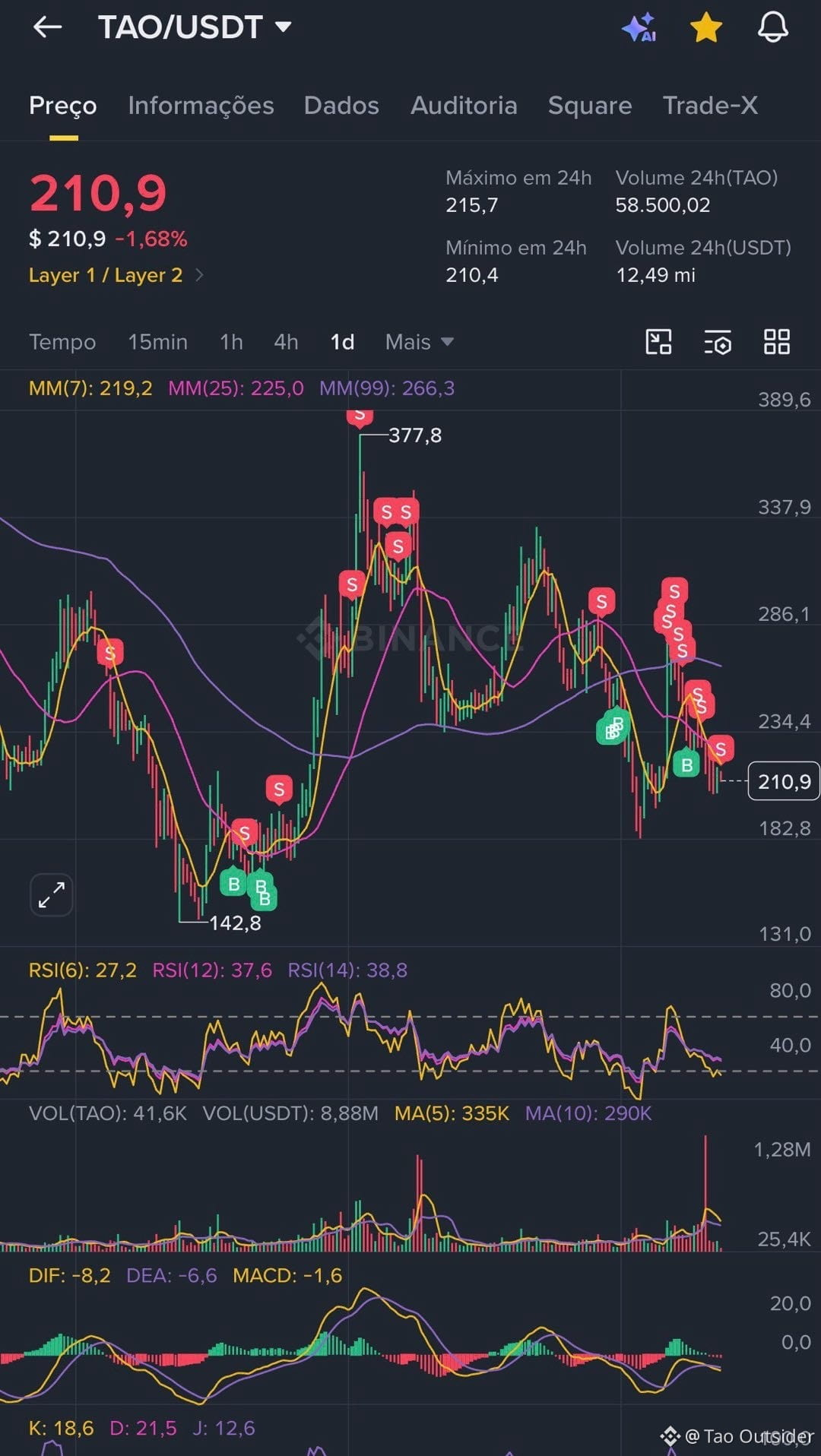
$TAO is trading around $211, down 1.68% on the day, with price sitting below the main daily moving averages.
The technical picture is not broken, but it is weak.
The first issue is trend pressure. Price is below MA7 at $219, below MA25 at $225, and far below MA99 at $266. That means the short-term trend is still bearish until buyers reclaim at least $219–225.
Momentum confirms the same reading.
RSI(6): 27.2
RSI(12): 37.6
RSI(14): 38.8
Short-term RSI is already near oversold, which can create a bounce. But RSI(12) and RSI(14) are still weak, so this is not confirmation of reversal yet. It is only a possible reaction zone.
MACD remains negative.
DIF: -8.2
DEA: -6.6
MACD: -1.6
This shows downside momentum is still active, although no longer in full acceleration.
The level that matters now is $210.
If buyers defend $210, $TAO can attempt a short-term bounce toward $219–225. A reclaim of that zone would be the first real sign of strength and could open a move toward $234–245.
If $210 fails, the next support is $200, then the major downside zone around $183–190.
Current map:
Support: $210
Next support: $200
Major support: $183–190
First resistance: $219–225
Second resistance: $234–245
Trend resistance: $266
My read:
$TAO is close to a reaction zone, but buyers still need to prove control.
Short-term bounce is possible from here.
Real recovery only starts above $225.
$TAO Bittensor - Short-term structure is fragile
$TAO is trading around $211, down 1.68% on the day, with price sitting below the main daily moving averages.
The technical picture is not broken, but it is weak.
The first issue is trend pressure. Price is below MA7 at $219, below MA25 at $225, and far below MA99 at $266. That means the short-term trend is still bearish until buyers reclaim at least $219–225.
Momentum confirms the same reading.
RSI(6): 27.2
RSI(12): 37.6
RSI(14): 38.8
Short-term RSI is already near oversold, which can create a bounce. But RSI(12) and RSI(14) are still weak, so this is not confirmation of reversal yet. It is only a possible reaction zone.
MACD remains negative.
DIF: -8.2
DEA: -6.6
MACD: -1.6
This shows downside momentum is still active, although no longer in full acceleration.
The level that matters now is $210.
If buyers defend $210, $TAO can attempt a short-term bounce toward $219–225. A reclaim of that zone would be the first real sign of strength and could open a move toward $234–245.
If $210 fails, the next support is $200, then the major downside zone around $183–190.
Current map:
Support: $210
Next support: $200
Major support: $183–190
First resistance: $219–225
Second resistance: $234–245
Trend resistance: $266
My read:
$TAO is close to a reaction zone, but buyers still need to prove control.
Short-term bounce is possible from here.
Real recovery only starts above $225.
$TAO is trading around $211, down 1.68% on the day, with price sitting below the main daily moving averages.
The technical picture is not broken, but it is weak.
The first issue is trend pressure. Price is below MA7 at $219, below MA25 at $225, and far below MA99 at $266. That means the short-term trend is still bearish until buyers reclaim at least $219–225.
Momentum confirms the same reading.
RSI(6): 27.2
RSI(12): 37.6
RSI(14): 38.8
Short-term RSI is already near oversold, which can create a bounce. But RSI(12) and RSI(14) are still weak, so this is not confirmation of reversal yet. It is only a possible reaction zone.
MACD remains negative.
DIF: -8.2
DEA: -6.6
MACD: -1.6
This shows downside momentum is still active, although no longer in full acceleration.
The level that matters now is $210.
If buyers defend $210, $TAO can attempt a short-term bounce toward $219–225. A reclaim of that zone would be the first real sign of strength and could open a move toward $234–245.
If $210 fails, the next support is $200, then the major downside zone around $183–190.
Current map:
Support: $210
Next support: $200
Major support: $183–190
First resistance: $219–225
Second resistance: $234–245
Trend resistance: $266
My read:
$TAO is close to a reaction zone, but buyers still need to prove control.
Short-term bounce is possible from here.
Real recovery only starts above $225.
90
·
--
$TAO Bittensor is cooking.
Here is what actually matters:
* Root Reborn: validators can now actively allocate yield across subnets instead of automatically selling it. The system is transparent and opt-in. If you do nothing, nothing changes. Stake. Earn. Claim. Repeat.
* Don’t like your validator’s allocation strategy? Move your stake. The market decides.
* 57 subnets lost emissions. No active mining. No emissions. Simple. This process now happens every Monday. The remaining active subnets receive a larger share of emissions.
* Incentives were upgraded. Emissions are now tied to price and root proportion. The goal is simple: reward value creation, not games.
* Decentralization continues. Full decentralization is still roughly 18 months away. Pool borrowing and alpha-holder rights are among the next major steps.
One thing people still underestimate: Bittensor is the moonshot for the decentralized AI
$TAO Bittensor is cooking.
Here is what actually matters:
* Root Reborn: validators can now actively allocate yield across subnets instead of automatically selling it. The system is transparent and opt-in. If you do nothing, nothing changes. Stake. Earn. Claim. Repeat.
* Don’t like your validator’s allocation strategy? Move your stake. The market decides.
* 57 subnets lost emissions. No active mining. No emissions. Simple. This process now happens every Monday. The remaining active subnets receive a larger share of emissions.
* Incentives were upgraded. Emissions are now tied to price and root proportion. The goal is simple: reward value creation, not games.
* Decentralization continues. Full decentralization is still roughly 18 months away. Pool borrowing and alpha-holder rights are among the next major steps.
One thing people still underestimate: Bittensor is the moonshot for the decentralized AI
Here is what actually matters:
* Root Reborn: validators can now actively allocate yield across subnets instead of automatically selling it. The system is transparent and opt-in. If you do nothing, nothing changes. Stake. Earn. Claim. Repeat.
* Don’t like your validator’s allocation strategy? Move your stake. The market decides.
* 57 subnets lost emissions. No active mining. No emissions. Simple. This process now happens every Monday. The remaining active subnets receive a larger share of emissions.
* Incentives were upgraded. Emissions are now tied to price and root proportion. The goal is simple: reward value creation, not games.
* Decentralization continues. Full decentralization is still roughly 18 months away. Pool borrowing and alpha-holder rights are among the next major steps.
One thing people still underestimate: Bittensor is the moonshot for the decentralized AI

91
·
--
$TAO Bittensor Chart 4h + short-term take.
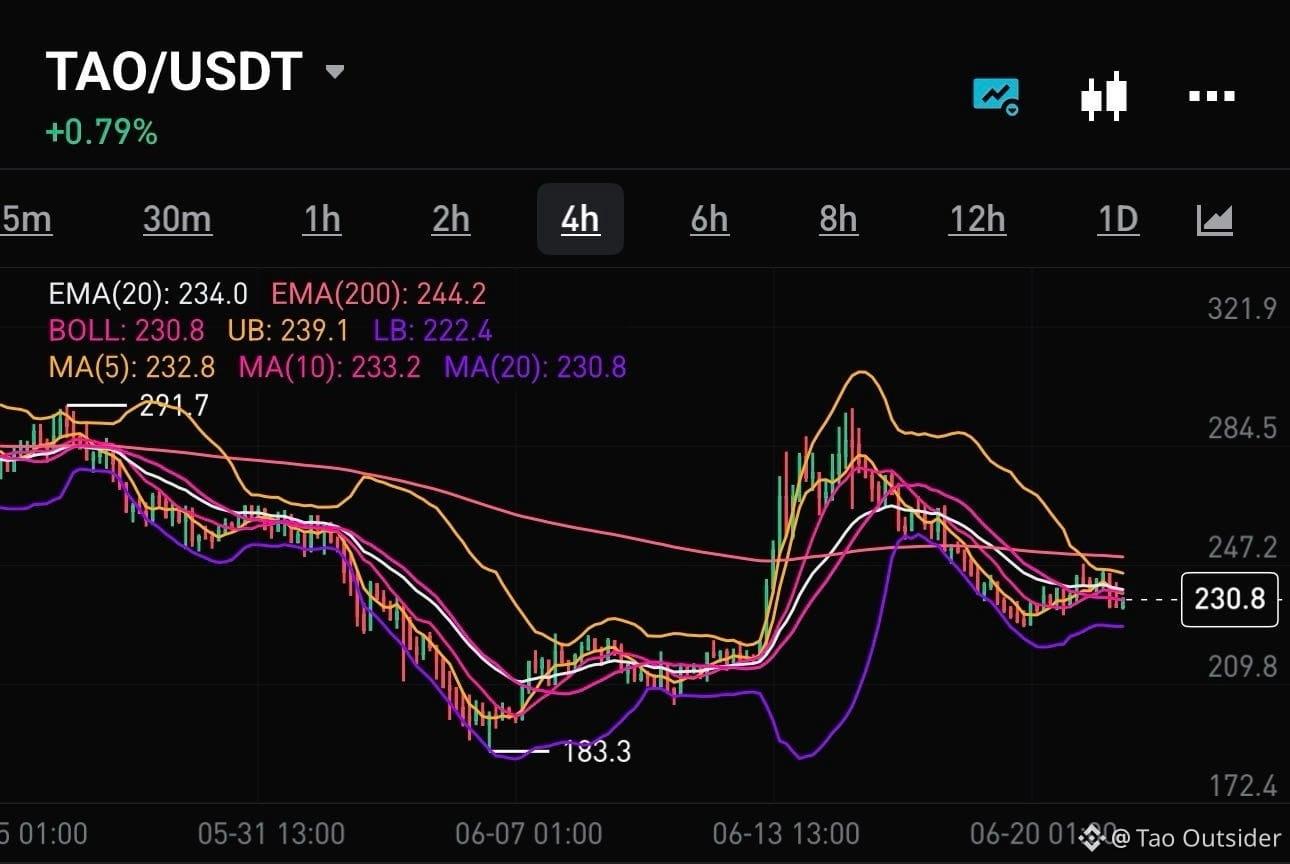
Price is sitting right on top of the 4h EMA20, while the Bollinger Bands continue to compress. But nobody cares about those indicators; you guys just want to know if it is going up or down. Am I right?
My base case: A couple more days of compression, maybe less, followed by an attempt to reclaim $240–245. If that happens, $260 becomes the next destination.
If buyers can reclaim $240–245, the market opens the door to $260 and potentially a retest of the recent highs near $280.
If the price loses $225–230, well, we already are around $230, so it’s not so hard to happen. And I saw some liquidity getting volume around 210, and this is not a good signal.
That’s it for today. Have a nice week and stay tuned.
$TAO Bittensor Chart 4h + short-term take.
Price is sitting right on top of the 4h EMA20, while the Bollinger Bands continue to compress. But nobody cares about those indicators; you guys just want to know if it is going up or down. Am I right?
My base case: A couple more days of compression, maybe less, followed by an attempt to reclaim $240–245. If that happens, $260 becomes the next destination.
If buyers can reclaim $240–245, the market opens the door to $260 and potentially a retest of the recent highs near $280.
If the price loses $225–230, well, we already are around $230, so it’s not so hard to happen. And I saw some liquidity getting volume around 210, and this is not a good signal.
That’s it for today. Have a nice week and stay tuned.
Price is sitting right on top of the 4h EMA20, while the Bollinger Bands continue to compress. But nobody cares about those indicators; you guys just want to know if it is going up or down. Am I right?
My base case: A couple more days of compression, maybe less, followed by an attempt to reclaim $240–245. If that happens, $260 becomes the next destination.
If buyers can reclaim $240–245, the market opens the door to $260 and potentially a retest of the recent highs near $280.
If the price loses $225–230, well, we already are around $230, so it’s not so hard to happen. And I saw some liquidity getting volume around 210, and this is not a good signal.
That’s it for today. Have a nice week and stay tuned.

79
·
--
13 countries have already blocked, restricted, suspended, sanctioned, or otherwise interfered with centralized AI companies.
And the list keeps growing. Centralized AI is a mess. Governments are a mess too. Just facts, none of this is a thesis.
That is exactly why decentralized AI remains the only viable alternative.
Let’s review reality:
-China blocks OpenAI, Anthropic and Grok.
-Russia restricts OpenAI, Anthropic and Grok.
-Iran blocks OpenAI, Anthropic and Grok.
-North Korea blocks OpenAI, Anthropic and Grok.
-Italy temporarily banned ChatGPT over privacy concerns.
-Indonesia, Malaysia and the Philippines temporarily blocked Grok after failures involving explicit image generation and non-consensual deepfakes.
-The United States just forced Anthropic to disable access to Fable 5 and Mythos 5 through export restrictions.
And let’s be honest: Some of those interventions happened because AI companies made mistakes.
Privacy failures.
Deepfakes.
Unsafe outputs.
Weak safeguards.
Poor rollout decisions.
Centralized AI is not only struggling with governments. It is struggling with itself.
Different governments.
Different reasons.
Different failures.
Same result.
Less access.
Less freedom.
More control.
Every year centralized AI becomes more dependent on regulators, institutions, compliance departments and political decisions.
This is no longer a hypothetical discussion.
It is happening. Right now.
$TAO Bittensor was built for exactly this world.
A world where intelligence can remain open, distributed, permissionless and global.
You can disagree, dislike or ignore with decentralized AI. But after everything that happened recently, it is becoming increasingly difficult to argue that it is unnecessary.
$TAO Bittensor exists because this problem exists. It’s not perfect and it’s not trying to be. But don’t forget, when you need an alternative, we will be there.
13 countries have already blocked, restricted, suspended, sanctioned, or otherwise interfered with centralized AI companies.
And the list keeps growing. Centralized AI is a mess. Governments are a mess too. Just facts, none of this is a thesis.
That is exactly why decentralized AI remains the only viable alternative.
Let’s review reality:
-China blocks OpenAI, Anthropic and Grok.
-Russia restricts OpenAI, Anthropic and Grok.
-Iran blocks OpenAI, Anthropic and Grok.
-North Korea blocks OpenAI, Anthropic and Grok.
-Italy temporarily banned ChatGPT over privacy concerns.
-Indonesia, Malaysia and the Philippines temporarily blocked Grok after failures involving explicit image generation and non-consensual deepfakes.
-The United States just forced Anthropic to disable access to Fable 5 and Mythos 5 through export restrictions.
And let’s be honest: Some of those interventions happened because AI companies made mistakes.
Privacy failures.
Deepfakes.
Unsafe outputs.
Weak safeguards.
Poor rollout decisions.
Centralized AI is not only struggling with governments. It is struggling with itself.
Different governments.
Different reasons.
Different failures.
Same result.
Less access.
Less freedom.
More control.
Every year centralized AI becomes more dependent on regulators, institutions, compliance departments and political decisions.
This is no longer a hypothetical discussion.
It is happening. Right now.
$TAO Bittensor was built for exactly this world.
A world where intelligence can remain open, distributed, permissionless and global.
You can disagree, dislike or ignore with decentralized AI. But after everything that happened recently, it is becoming increasingly difficult to argue that it is unnecessary.
$TAO Bittensor exists because this problem exists. It’s not perfect and it’s not trying to be. But don’t forget, when you need an alternative, we will be there.
And the list keeps growing. Centralized AI is a mess. Governments are a mess too. Just facts, none of this is a thesis.
That is exactly why decentralized AI remains the only viable alternative.
Let’s review reality:
-China blocks OpenAI, Anthropic and Grok.
-Russia restricts OpenAI, Anthropic and Grok.
-Iran blocks OpenAI, Anthropic and Grok.
-North Korea blocks OpenAI, Anthropic and Grok.
-Italy temporarily banned ChatGPT over privacy concerns.
-Indonesia, Malaysia and the Philippines temporarily blocked Grok after failures involving explicit image generation and non-consensual deepfakes.
-The United States just forced Anthropic to disable access to Fable 5 and Mythos 5 through export restrictions.
And let’s be honest: Some of those interventions happened because AI companies made mistakes.
Privacy failures.
Deepfakes.
Unsafe outputs.
Weak safeguards.
Poor rollout decisions.
Centralized AI is not only struggling with governments. It is struggling with itself.
Different governments.
Different reasons.
Different failures.
Same result.
Less access.
Less freedom.
More control.
Every year centralized AI becomes more dependent on regulators, institutions, compliance departments and political decisions.
This is no longer a hypothetical discussion.
It is happening. Right now.
$TAO Bittensor was built for exactly this world.
A world where intelligence can remain open, distributed, permissionless and global.
You can disagree, dislike or ignore with decentralized AI. But after everything that happened recently, it is becoming increasingly difficult to argue that it is unnecessary.
$TAO Bittensor exists because this problem exists. It’s not perfect and it’s not trying to be. But don’t forget, when you need an alternative, we will be there.
84
·
--
$TAO Bittensor stays Global.
More countries are actively building national or regional control over AI.
China is executing this aggressively, with domestic models and tight restrictions on foreign systems.
Russia is moving in the same direction, prioritizing technological sovereignty.
The UAE is making heavy investments through G42 and models like Falcon.
Europe is taking a different but related path: increasing regulatory control and pursuing strategic autonomy, rather than building fully national foundation models at scale.
The direction is clear. A more fragmented AI landscape is forming, with different models, different rules, different levels of access, and different versions of what is considered acceptable.
In Europe, this pressure may not come in the form of outright bans. It is more likely to appear through regulation, compliance requirements, and added friction. Over time, this can make certain models more expensive to run, slower to deploy, or simply less competitive.
Governments will call it sovereignty and security.
Companies will call it compliance and risk management.
The result tends to be the same: less openness, more borders, and greater control over who can access which intelligence.
This is where Bittensor is structurally different.
It is not tied to any government and it does not need regulatory approval to operate across borders. It was designed to function without asking permission from any single jurisdiction.
While governments build sovereign AI strategies and corporations negotiate with regulators, Bittensor continues to do what it was built for:
Incentivize intelligence. Distribute intelligence.
Make it globally accessible through an open protocol. The more the world fragments along national and regulatory lines, the more valuable a truly borderless intelligence network becomes.
At some point, decentralized AI may stop being just an alternative to be the only layer that remains truly global by design.
$TAO Bittensor stays Global.
More countries are actively building national or regional control over AI.
China is executing this aggressively, with domestic models and tight restrictions on foreign systems.
Russia is moving in the same direction, prioritizing technological sovereignty.
The UAE is making heavy investments through G42 and models like Falcon.
Europe is taking a different but related path: increasing regulatory control and pursuing strategic autonomy, rather than building fully national foundation models at scale.
The direction is clear. A more fragmented AI landscape is forming, with different models, different rules, different levels of access, and different versions of what is considered acceptable.
In Europe, this pressure may not come in the form of outright bans. It is more likely to appear through regulation, compliance requirements, and added friction. Over time, this can make certain models more expensive to run, slower to deploy, or simply less competitive.
Governments will call it sovereignty and security.
Companies will call it compliance and risk management.
The result tends to be the same: less openness, more borders, and greater control over who can access which intelligence.
This is where Bittensor is structurally different.
It is not tied to any government and it does not need regulatory approval to operate across borders. It was designed to function without asking permission from any single jurisdiction.
While governments build sovereign AI strategies and corporations negotiate with regulators, Bittensor continues to do what it was built for:
Incentivize intelligence. Distribute intelligence.
Make it globally accessible through an open protocol. The more the world fragments along national and regulatory lines, the more valuable a truly borderless intelligence network becomes.
At some point, decentralized AI may stop being just an alternative to be the only layer that remains truly global by design.
More countries are actively building national or regional control over AI.
China is executing this aggressively, with domestic models and tight restrictions on foreign systems.
Russia is moving in the same direction, prioritizing technological sovereignty.
The UAE is making heavy investments through G42 and models like Falcon.
Europe is taking a different but related path: increasing regulatory control and pursuing strategic autonomy, rather than building fully national foundation models at scale.
The direction is clear. A more fragmented AI landscape is forming, with different models, different rules, different levels of access, and different versions of what is considered acceptable.
In Europe, this pressure may not come in the form of outright bans. It is more likely to appear through regulation, compliance requirements, and added friction. Over time, this can make certain models more expensive to run, slower to deploy, or simply less competitive.
Governments will call it sovereignty and security.
Companies will call it compliance and risk management.
The result tends to be the same: less openness, more borders, and greater control over who can access which intelligence.
This is where Bittensor is structurally different.
It is not tied to any government and it does not need regulatory approval to operate across borders. It was designed to function without asking permission from any single jurisdiction.
While governments build sovereign AI strategies and corporations negotiate with regulators, Bittensor continues to do what it was built for:
Incentivize intelligence. Distribute intelligence.
Make it globally accessible through an open protocol. The more the world fragments along national and regulatory lines, the more valuable a truly borderless intelligence network becomes.
At some point, decentralized AI may stop being just an alternative to be the only layer that remains truly global by design.
83
·
--
5 reasons decentralized AI matters, and why $TAO matters
Most people assume the future of AI will be controlled by a handful of companies.
That future has risks.
And those risks are exactly why decentralized AI exists.
1. Intelligence should not have a single owner
The most powerful technology in history is becoming increasingly centralized.
A world where a few companies control models, compute, distribution and access creates obvious points of failure.
Decentralized AI distributes that power.
2. Incentives drive innovation
Centralized AI rewards employees.
Decentralized AI rewards contributors.
Researchers, builders, miners, validators and developers can participate directly in value creation.
That creates a much larger innovation surface.
3. Competition produces better intelligence
Closed systems optimize internally.
Open markets optimize continuously.
When thousands of participants compete to produce better outputs, intelligence evolves faster.
4. Infrastructure scales globally
The demand for AI is growing faster than any single company can supply.
Decentralized networks allow compute, models, data and agents to emerge from anywhere in the world.
5. The next AI economy needs a native coordination layer
Models alone are not enough.
The future requires coordination between data, compute, agents, validators and incentives.
That is where Bittensor comes in.
$TAO is not trying to become another AI model.
It is building the economic layer where decentralized intelligence can compete, coordinate and evolve.
If AI becomes one of the largest industries on Earth, the networks coordinating that intelligence may become just as important as the models themselves.
That is the bet.
#AI #AI Agents 🤖# #AI and Blockchains are made for each other?# #AIAgent
5 reasons decentralized AI matters, and why $TAO matters
Most people assume the future of AI will be controlled by a handful of companies.
That future has risks.
And those risks are exactly why decentralized AI exists.
1. Intelligence should not have a single owner
The most powerful technology in history is becoming increasingly centralized.
A world where a few companies control models, compute, distribution and access creates obvious points of failure.
Decentralized AI distributes that power.
2. Incentives drive innovation
Centralized AI rewards employees.
Decentralized AI rewards contributors.
Researchers, builders, miners, validators and developers can participate directly in value creation.
That creates a much larger innovation surface.
3. Competition produces better intelligence
Closed systems optimize internally.
Open markets optimize continuously.
When thousands of participants compete to produce better outputs, intelligence evolves faster.
4. Infrastructure scales globally
The demand for AI is growing faster than any single company can supply.
Decentralized networks allow compute, models, data and agents to emerge from anywhere in the world.
5. The next AI economy needs a native coordination layer
Models alone are not enough.
The future requires coordination between data, compute, agents, validators and incentives.
That is where Bittensor comes in.
$TAO is not trying to become another AI model.
It is building the economic layer where decentralized intelligence can compete, coordinate and evolve.
If AI becomes one of the largest industries on Earth, the networks coordinating that intelligence may become just as important as the models themselves.
That is the bet.
#AI #AI Agents 🤖# #AI and Blockchains are made for each other?# #AIAgent
Most people assume the future of AI will be controlled by a handful of companies.
That future has risks.
And those risks are exactly why decentralized AI exists.
1. Intelligence should not have a single owner
The most powerful technology in history is becoming increasingly centralized.
A world where a few companies control models, compute, distribution and access creates obvious points of failure.
Decentralized AI distributes that power.
2. Incentives drive innovation
Centralized AI rewards employees.
Decentralized AI rewards contributors.
Researchers, builders, miners, validators and developers can participate directly in value creation.
That creates a much larger innovation surface.
3. Competition produces better intelligence
Closed systems optimize internally.
Open markets optimize continuously.
When thousands of participants compete to produce better outputs, intelligence evolves faster.
4. Infrastructure scales globally
The demand for AI is growing faster than any single company can supply.
Decentralized networks allow compute, models, data and agents to emerge from anywhere in the world.
5. The next AI economy needs a native coordination layer
Models alone are not enough.
The future requires coordination between data, compute, agents, validators and incentives.
That is where Bittensor comes in.
$TAO is not trying to become another AI model.
It is building the economic layer where decentralized intelligence can compete, coordinate and evolve.
If AI becomes one of the largest industries on Earth, the networks coordinating that intelligence may become just as important as the models themselves.
That is the bet.
#AI #AI Agents 🤖# #AI and Blockchains are made for each other?# #AIAgent
34
·
--
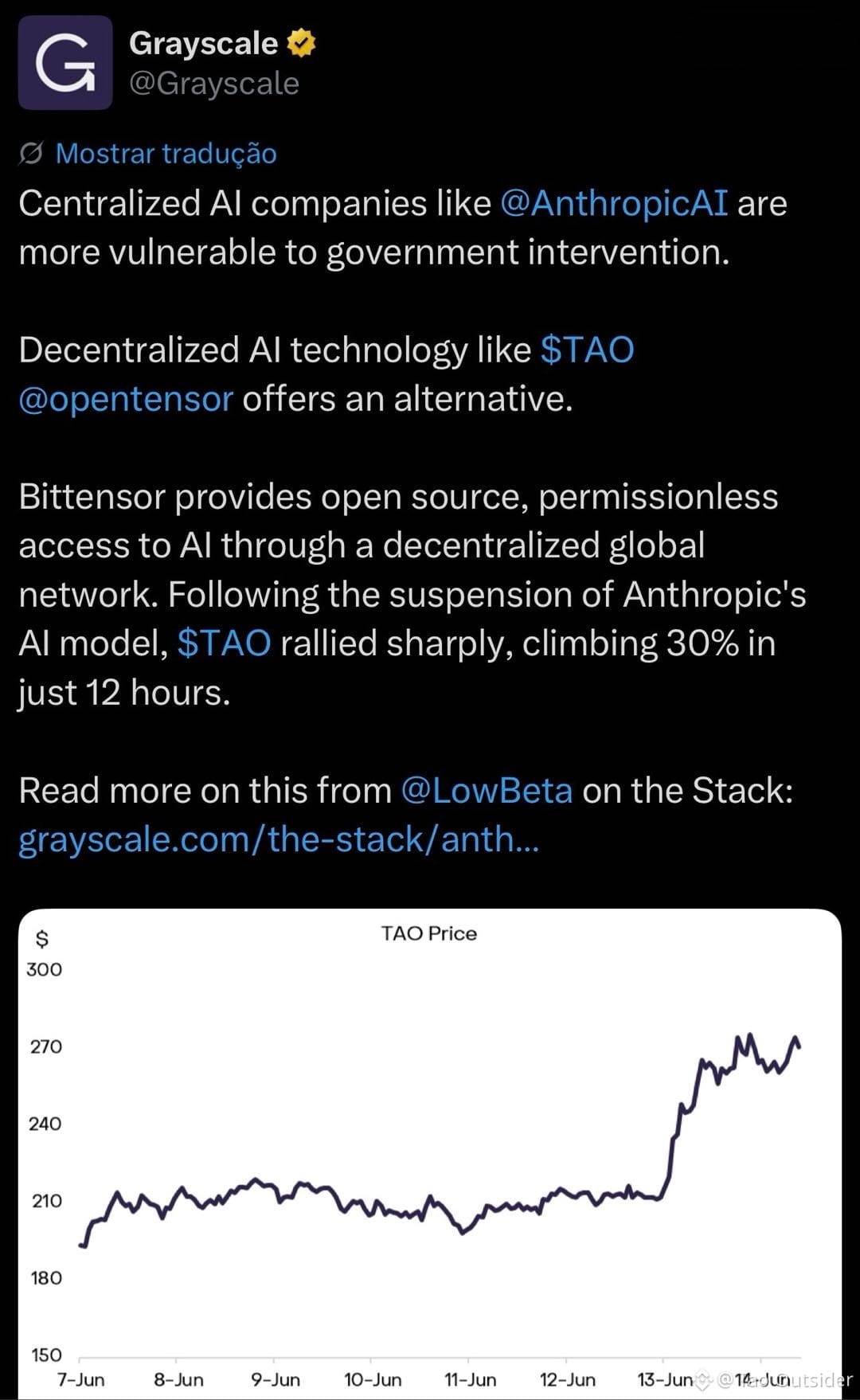
Grayscale just explained the $TAO thesis in one screenshot
The most important part is not the 30% move.
It is the reason behind it.
Anthropic’s model was temporarily restricted.
The market immediately started asking a simple question:
What happens when AI becomes too important to depend on a handful of centralized companies?
Grayscale’s answer is clear.
Decentralized AI is not competing with centralized AI because it is cheaper.
It exists because centralized systems create single points of failure.
Governments can intervene.
Companies can restrict access.
Policies can change overnight.
Infrastructure can disappear behind a login screen.
Bittensor was built around a different assumption.
Open source.
Permissionless access.
Global participation.
No central gatekeeper.
What makes this notable is that Grayscale is no longer talking about $TAO as a speculative AI token.
They are positioning it as infrastructure.
That is a completely different investment framework.
Infrastructure is where long-term capital tends to accumulate.
Applications come and go.
Infrastructure compounds.
The market reaction was immediate because investors realized something important:
The value of decentralized AI increases every time a centralized AI provider reminds the world that access is not guaranteed.
The 30% rally was not just momentum.
It was the market repricing the value of an alternative.
And for the first time, some of the largest institutional players in crypto are openly making that argument.
Grayscale just explained the $TAO thesis in one screenshot
The most important part is not the 30% move.
It is the reason behind it.
Anthropic’s model was temporarily restricted.
The market immediately started asking a simple question:
What happens when AI becomes too important to depend on a handful of centralized companies?
Grayscale’s answer is clear.
Decentralized AI is not competing with centralized AI because it is cheaper.
It exists because centralized systems create single points of failure.
Governments can intervene.
Companies can restrict access.
Policies can change overnight.
Infrastructure can disappear behind a login screen.
Bittensor was built around a different assumption.
Open source.
Permissionless access.
Global participation.
No central gatekeeper.
What makes this notable is that Grayscale is no longer talking about $TAO as a speculative AI token.
They are positioning it as infrastructure.
That is a completely different investment framework.
Infrastructure is where long-term capital tends to accumulate.
Applications come and go.
Infrastructure compounds.
The market reaction was immediate because investors realized something important:
The value of decentralized AI increases every time a centralized AI provider reminds the world that access is not guaranteed.
The 30% rally was not just momentum.
It was the market repricing the value of an alternative.
And for the first time, some of the largest institutional players in crypto are openly making that argument.
The most important part is not the 30% move.
It is the reason behind it.
Anthropic’s model was temporarily restricted.
The market immediately started asking a simple question:
What happens when AI becomes too important to depend on a handful of centralized companies?
Grayscale’s answer is clear.
Decentralized AI is not competing with centralized AI because it is cheaper.
It exists because centralized systems create single points of failure.
Governments can intervene.
Companies can restrict access.
Policies can change overnight.
Infrastructure can disappear behind a login screen.
Bittensor was built around a different assumption.
Open source.
Permissionless access.
Global participation.
No central gatekeeper.
What makes this notable is that Grayscale is no longer talking about $TAO as a speculative AI token.
They are positioning it as infrastructure.
That is a completely different investment framework.
Infrastructure is where long-term capital tends to accumulate.
Applications come and go.
Infrastructure compounds.
The market reaction was immediate because investors realized something important:
The value of decentralized AI increases every time a centralized AI provider reminds the world that access is not guaranteed.
The 30% rally was not just momentum.
It was the market repricing the value of an alternative.
And for the first time, some of the largest institutional players in crypto are openly making that argument.
56
·
--
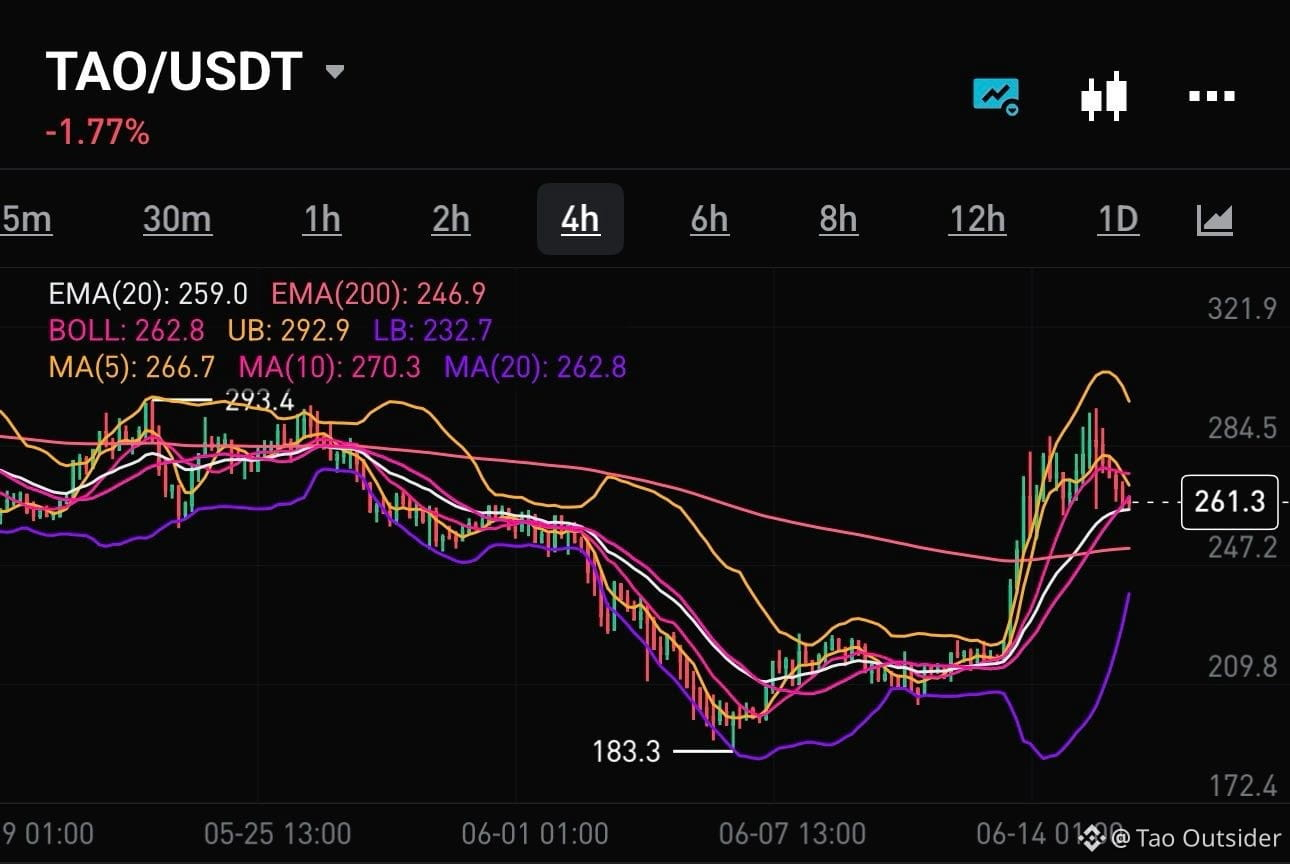
$TAO is approaching a critical decision point
The move from $183 to $285 happened in less than two weeks.
Markets rarely sustain that pace without a reset.
The question now is whether this was a relief rally or the beginning of a larger trend change.
The structure remains constructive.
Price is still holding above the 4h EMA200 (~$247) and above the breakout zone that ended the previous downtrend. Higher lows remain intact.
The rejection near $285–293 was expected. That area was the first major supply zone on the chart and the market reacted immediately.
From here, three levels matter:
$250–255
The most important support on the chart. As long as it holds, buyers remain in control of the short-term trend.
$280–293
The resistance zone that must be reclaimed before the market can continue higher.
$300
The level everyone is watching. A successful reclaim would put $330–350 back on the table.
My base case is straightforward.
$TAO spends some time building above $250–255, absorbs supply from the recent rally, and makes another attempt at $300.
A loss of $250 would weaken the structure and shift attention back toward $230.
For now, the chart is no longer behaving like a market in liquidation.
It is behaving like a market trying to establish a new range after a major trend reversal.
The next important move is not down.
It is whether buyers can build enough pressure to challenge $300 again.
Tags: #TAO #Bittensor #AI Agents 🤖#
$TAO is approaching a critical decision point
The move from $183 to $285 happened in less than two weeks.
Markets rarely sustain that pace without a reset.
The question now is whether this was a relief rally or the beginning of a larger trend change.
The structure remains constructive.
Price is still holding above the 4h EMA200 (~$247) and above the breakout zone that ended the previous downtrend. Higher lows remain intact.
The rejection near $285–293 was expected. That area was the first major supply zone on the chart and the market reacted immediately.
From here, three levels matter:
$250–255
The most important support on the chart. As long as it holds, buyers remain in control of the short-term trend.
$280–293
The resistance zone that must be reclaimed before the market can continue higher.
$300
The level everyone is watching. A successful reclaim would put $330–350 back on the table.
My base case is straightforward.
$TAO spends some time building above $250–255, absorbs supply from the recent rally, and makes another attempt at $300.
A loss of $250 would weaken the structure and shift attention back toward $230.
For now, the chart is no longer behaving like a market in liquidation.
It is behaving like a market trying to establish a new range after a major trend reversal.
The next important move is not down.
It is whether buyers can build enough pressure to challenge $300 again.
Tags: #TAO #Bittensor #AI Agents 🤖#
The move from $183 to $285 happened in less than two weeks.
Markets rarely sustain that pace without a reset.
The question now is whether this was a relief rally or the beginning of a larger trend change.
The structure remains constructive.
Price is still holding above the 4h EMA200 (~$247) and above the breakout zone that ended the previous downtrend. Higher lows remain intact.
The rejection near $285–293 was expected. That area was the first major supply zone on the chart and the market reacted immediately.
From here, three levels matter:
$250–255
The most important support on the chart. As long as it holds, buyers remain in control of the short-term trend.
$280–293
The resistance zone that must be reclaimed before the market can continue higher.
$300
The level everyone is watching. A successful reclaim would put $330–350 back on the table.
My base case is straightforward.
$TAO spends some time building above $250–255, absorbs supply from the recent rally, and makes another attempt at $300.
A loss of $250 would weaken the structure and shift attention back toward $230.
For now, the chart is no longer behaving like a market in liquidation.
It is behaving like a market trying to establish a new range after a major trend reversal.
The next important move is not down.
It is whether buyers can build enough pressure to challenge $300 again.
Tags: #TAO #Bittensor #AI Agents 🤖#
76
·
--
$TAO Bittensor Exploit Summit - Who controls AI? Right now, a handful of companies do.
One of the largest economies in the world just demonstrated that model censorship is not a theoretical risk. It is real.
That is exactly why conversations around Bittensor are becoming more important, not less. Bittensor was built for a world where intelligence can be produced, evaluated, and distributed without asking for permission.
Exploit Summit - A room full of builders trying to answer a difficult question:
How should decentralized intelligence work? Exploit is where we decide how.
Montreal. September 28, 29. Are you in or not?
https://exploitsummit.com
And honestly? I would love to see Anthropic, OpenAI, and Grok there too.
While they still can.
$TAO Bittensor Exploit Summit - Who controls AI? Right now, a handful of companies do.
One of the largest economies in the world just demonstrated that model censorship is not a theoretical risk. It is real.
That is exactly why conversations around Bittensor are becoming more important, not less. Bittensor was built for a world where intelligence can be produced, evaluated, and distributed without asking for permission.
Exploit Summit - A room full of builders trying to answer a difficult question:
How should decentralized intelligence work? Exploit is where we decide how.
Montreal. September 28, 29. Are you in or not?
https://exploitsummit.com
And honestly? I would love to see Anthropic, OpenAI, and Grok there too.
While they still can.
One of the largest economies in the world just demonstrated that model censorship is not a theoretical risk. It is real.
That is exactly why conversations around Bittensor are becoming more important, not less. Bittensor was built for a world where intelligence can be produced, evaluated, and distributed without asking for permission.
Exploit Summit - A room full of builders trying to answer a difficult question:
How should decentralized intelligence work? Exploit is where we decide how.
Montreal. September 28, 29. Are you in or not?
https://exploitsummit.com
And honestly? I would love to see Anthropic, OpenAI, and Grok there too.
While they still can.

35
·
--
TradFi capital is entering crypto at a pace few people expected.
Bitcoin ETFs now manage tens of billions of dollars.
BlackRock, Fidelity, Franklin Templeton, Grayscale, and others have turned crypto into an institutional product.
At the same time, the opposite flow is happening.
Crypto capital is moving into TradFi.
Tokenized treasuries are growing.
Tokenized stocks are becoming more common.
Investors can increasingly access traditional assets without leaving crypto rails.
The line between TradFi and crypto keeps getting thinner.
That creates a problem.
If everything becomes investable, being “just a token” becomes a weak value proposition.
Capital starts asking harder questions:
Where is the revenue?
Where are the users?
What is being built?
What problem is being solved?
This is where Bittensor becomes interesting.
Bittensor is more than another payment coin, exchange token, or store of value narrative.
It is attempting to build markets for intelligence.
More than 100 active subnets now compete across AI infrastructure, agents, biology, coding, memory, media, weather forecasting, and data markets.
While TradFi is learning how to access crypto, Bittensor is trying to create something different:
An economy where useful work, intelligence, and infrastructure compete for capital.
The long-term question is simple:
If institutions eventually allocate to AI, will they only buy applications?
Or will they also buy the infrastructure that powers them?
That may become one of the most important questions for $TAO over the next decade.
#tradfi #bittensor #AI Agents 🤖#
TradFi capital is entering crypto at a pace few people expected.
Bitcoin ETFs now manage tens of billions of dollars.
BlackRock, Fidelity, Franklin Templeton, Grayscale, and others have turned crypto into an institutional product.
At the same time, the opposite flow is happening.
Crypto capital is moving into TradFi.
Tokenized treasuries are growing.
Tokenized stocks are becoming more common.
Investors can increasingly access traditional assets without leaving crypto rails.
The line between TradFi and crypto keeps getting thinner.
That creates a problem.
If everything becomes investable, being “just a token” becomes a weak value proposition.
Capital starts asking harder questions:
Where is the revenue?
Where are the users?
What is being built?
What problem is being solved?
This is where Bittensor becomes interesting.
Bittensor is more than another payment coin, exchange token, or store of value narrative.
It is attempting to build markets for intelligence.
More than 100 active subnets now compete across AI infrastructure, agents, biology, coding, memory, media, weather forecasting, and data markets.
While TradFi is learning how to access crypto, Bittensor is trying to create something different:
An economy where useful work, intelligence, and infrastructure compete for capital.
The long-term question is simple:
If institutions eventually allocate to AI, will they only buy applications?
Or will they also buy the infrastructure that powers them?
That may become one of the most important questions for $TAO over the next decade.
#tradfi #bittensor #AI Agents 🤖#
Bitcoin ETFs now manage tens of billions of dollars.
BlackRock, Fidelity, Franklin Templeton, Grayscale, and others have turned crypto into an institutional product.
At the same time, the opposite flow is happening.
Crypto capital is moving into TradFi.
Tokenized treasuries are growing.
Tokenized stocks are becoming more common.
Investors can increasingly access traditional assets without leaving crypto rails.
The line between TradFi and crypto keeps getting thinner.
That creates a problem.
If everything becomes investable, being “just a token” becomes a weak value proposition.
Capital starts asking harder questions:
Where is the revenue?
Where are the users?
What is being built?
What problem is being solved?
This is where Bittensor becomes interesting.
Bittensor is more than another payment coin, exchange token, or store of value narrative.
It is attempting to build markets for intelligence.
More than 100 active subnets now compete across AI infrastructure, agents, biology, coding, memory, media, weather forecasting, and data markets.
While TradFi is learning how to access crypto, Bittensor is trying to create something different:
An economy where useful work, intelligence, and infrastructure compete for capital.
The long-term question is simple:
If institutions eventually allocate to AI, will they only buy applications?
Or will they also buy the infrastructure that powers them?
That may become one of the most important questions for $TAO over the next decade.
#tradfi #bittensor #AI Agents 🤖#


55
·
--
Why $TAO may be entering its most important phase yet
The market is focused on price.
The real story is happening elsewhere.
For the first time, multiple institutional, regulatory and AI-related catalysts are lining up around the same narrative.
Grayscale continues expanding GTAO while pursuing an ETF pathway.
Bitwise is pursuing its own Bittensor products.
And decentralized AI is gradually moving from a niche crypto narrative to a category institutions can actually understand.
At the same time, Bittensor is no longer just a protocol.
Today it hosts more than 100 active subnets competing across inference, coding, biology, agents, data, compute and digital intelligence markets.
The next question is not whether AI grows.
The question is where value accrues.
If AI spending continues expanding globally, capital will eventually look beyond applications and into infrastructure.
That is where Bittensor sits. The market is also forgetting one important fact:
$TAO remains more than 70% below its all-time high.
Most assets reaching new adoption milestones do not usually do so while trading near peak valuations.
That creates asymmetry.
The bullish scenario is straightforward:
AI remains the dominant technology narrative, institutional access improves through regulated products, subnet activity keeps expanding, and capital starts treating decentralized intelligence as an investable category.
In that environment, a move back into the $250–300 region becomes reasonable.
A sustained AI-driven cycle could eventually reopen discussion around significantly higher valuations.
The bear case remains simple:
AI enthusiasm cools, Bitcoin loses momentum, capital flows weaken, and the market stays trapped in a long consolidation phase.
For now, the story is about whether decentralized AI becomes large enough to attract institutional capital at scale. That may be the single most important question for $TAO over the next 12 months.
Why $TAO may be entering its most important phase yet
The market is focused on price.
The real story is happening elsewhere.
For the first time, multiple institutional, regulatory and AI-related catalysts are lining up around the same narrative.
Grayscale continues expanding GTAO while pursuing an ETF pathway.
Bitwise is pursuing its own Bittensor products.
And decentralized AI is gradually moving from a niche crypto narrative to a category institutions can actually understand.
At the same time, Bittensor is no longer just a protocol.
Today it hosts more than 100 active subnets competing across inference, coding, biology, agents, data, compute and digital intelligence markets.
The next question is not whether AI grows.
The question is where value accrues.
If AI spending continues expanding globally, capital will eventually look beyond applications and into infrastructure.
That is where Bittensor sits. The market is also forgetting one important fact:
$TAO remains more than 70% below its all-time high.
Most assets reaching new adoption milestones do not usually do so while trading near peak valuations.
That creates asymmetry.
The bullish scenario is straightforward:
AI remains the dominant technology narrative, institutional access improves through regulated products, subnet activity keeps expanding, and capital starts treating decentralized intelligence as an investable category.
In that environment, a move back into the $250–300 region becomes reasonable.
A sustained AI-driven cycle could eventually reopen discussion around significantly higher valuations.
The bear case remains simple:
AI enthusiasm cools, Bitcoin loses momentum, capital flows weaken, and the market stays trapped in a long consolidation phase.
For now, the story is about whether decentralized AI becomes large enough to attract institutional capital at scale. That may be the single most important question for $TAO over the next 12 months.
The market is focused on price.
The real story is happening elsewhere.
For the first time, multiple institutional, regulatory and AI-related catalysts are lining up around the same narrative.
Grayscale continues expanding GTAO while pursuing an ETF pathway.
Bitwise is pursuing its own Bittensor products.
And decentralized AI is gradually moving from a niche crypto narrative to a category institutions can actually understand.
At the same time, Bittensor is no longer just a protocol.
Today it hosts more than 100 active subnets competing across inference, coding, biology, agents, data, compute and digital intelligence markets.
The next question is not whether AI grows.
The question is where value accrues.
If AI spending continues expanding globally, capital will eventually look beyond applications and into infrastructure.
That is where Bittensor sits. The market is also forgetting one important fact:
$TAO remains more than 70% below its all-time high.
Most assets reaching new adoption milestones do not usually do so while trading near peak valuations.
That creates asymmetry.
The bullish scenario is straightforward:
AI remains the dominant technology narrative, institutional access improves through regulated products, subnet activity keeps expanding, and capital starts treating decentralized intelligence as an investable category.
In that environment, a move back into the $250–300 region becomes reasonable.
A sustained AI-driven cycle could eventually reopen discussion around significantly higher valuations.
The bear case remains simple:
AI enthusiasm cools, Bitcoin loses momentum, capital flows weaken, and the market stays trapped in a long consolidation phase.
For now, the story is about whether decentralized AI becomes large enough to attract institutional capital at scale. That may be the single most important question for $TAO over the next 12 months.
47
Log in to explore more content
Join global crypto users on Binance Square
⚡️ Get latest and useful information about crypto.
💬 Trusted by the world’s largest crypto exchange.
👍 Discover real insights from verified creators.
Email / Phone number