

BitHappy
1.3k Posts

BitHappy
Report
Block User
快乐星球主理人|持续阅读与思考|探索生息、套利、空投与周期中!

Creator Awards 2024

原创之星
74 Following
25.3K+ Followers
30.0K+ Liked
2 Badges
Posts
All
Quotes
Videos
·
--
Partly True
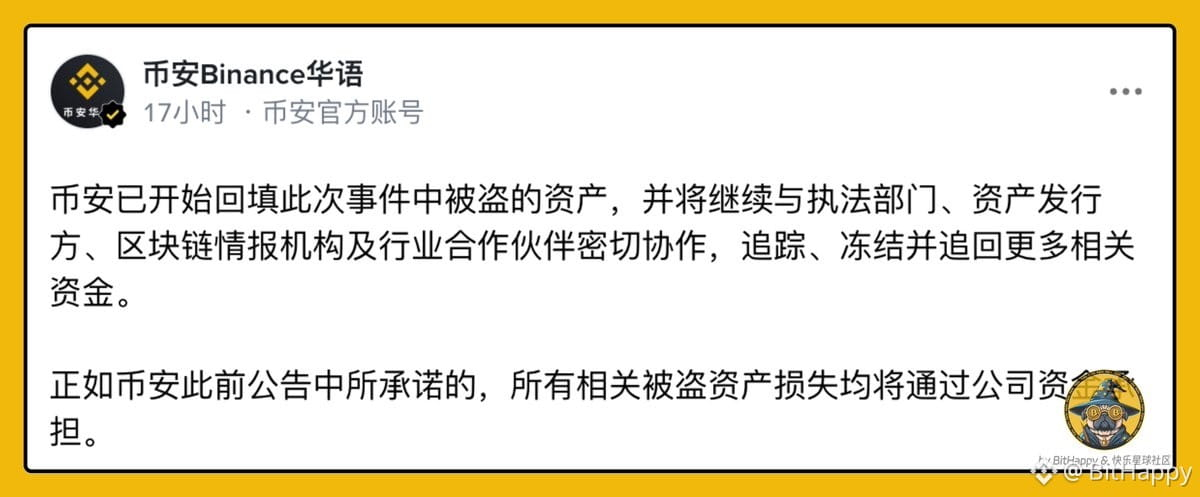
Binance replenishing the stolen tokens is a buy order announced in advance~
How long the price gap lasts depends on when withdrawals resume.
According to cross-exchange data from @PrincipiaRes: before the incident, the median price gap for 13 coins on Binance and OKX was under 3 basis points.
Now, for several coins the hacker sold, Binance is actually more expensive:
1/ PEPE is about 67 basis points higher;
2/ ENA is about 24 basis points higher;
3/ UNI and WLD are each about 17 basis points higher;
4/ TRX is the other way around: Binance is about 218 basis points cheaper.
The same data shows Binance’s share of combined trading volume across the two exchanges fell across the board, with BTC dropping from about 76% to about 61%.
Why is Binance more expensive instead? Because everyone knows it needs to replenish the stolen tokens.
Based on the list of stolen assets, the altcoin replenishment that can be priced is worth about $233 million (UNI: about $49 million, ENA: about $42 million, PEPE: about $38 million)—just over 10% of the roughly $1.34 billion shortfall.
These coins have relatively small market caps, and their prices are already about 14% to 38% above the prices the hacker sold them at.
In other words, the market has already priced in some of Binance’s replenishment buying.
Under normal conditions, price gaps that last only a few seconds get arbitraged away because coins can move freely between the two exchanges.
With withdrawals not fully restored, arbitrageurs can’t move coins in or out, so the gap can hold. Its lifespan is tied to the pace at which withdrawals resume.
In practice:
1/ If you already have inventory on both exchanges: sell on Binance and buy back on OKX. You can lock in the spread without transferring funds, then rebalance gradually once withdrawals resume;
2/ If you only have coins on one side: you can’t truly hedge the positions—you’re just betting on the direction;
3/ If you want to deposit new coins to Binance to capture the spread: by the time you can withdraw them, the gap will probably have narrowed already, and may not even cover the round-trip costs.
In my view, the best trade-off is to lock in the spread using only inventory you already have, and not deposit new coins to Binance for this.
It’s also worth distinguishing between before and after withdrawals resume: before they do, the gap is supported by coins being unable to get in; once they resume, the first wave of arbitrage trades will narrow it, and what remains will be the genuine replenishment buying.
When we talked about the hour of hacker selling earlier, I said that the people who make money aren’t necessarily the ones who spot it fastest, but the ones who already have their ammunition in place. Same goes this time.
A few caveats: the price gaps and replenishment estimates are from third parties; Binance’s announcement is the source of truth for the breakdown of stolen assets; basis-point figures are snapshots, so use live prices before placing orders.
If you’re interested, first check your inventory on both exchanges, then decide whether to trade.
This is for informational purposes only and does not constitute investment advice.
BitHappy, evolving all the time
2
5
5k
·
--
Missed 10:30 again!!!
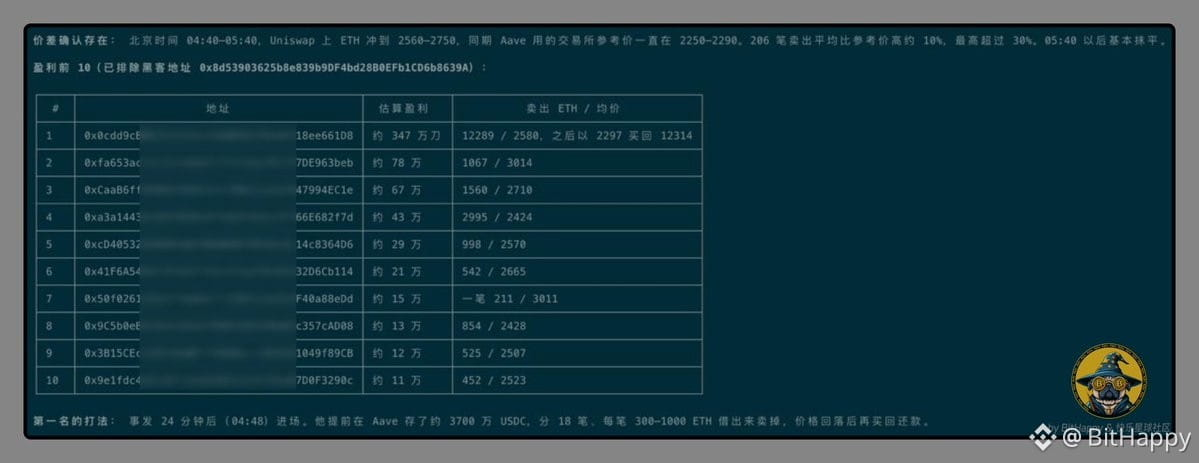
Around 6:30 in the morning, I glanced at my phone and saw that the monitoring alerts were blowing up and the group chat was blowing up, so I knew something had happened again.
I could barely open my eyes, but I saw a message from a group member saying they’d made 20WU on a 50WU principal (strategy shown in the image).
I was instantly wide awake.
I struggled for over an hour, didn’t make a single cent, and couldn’t get back to sleep either.
Around 8, I thought it over and realized there was nothing I could do, and I couldn’t withdraw my funds either. I figured there probably wouldn’t be any losses—and even if there were, there was nothing I could do about it.
Then I went back to sleep until around 11. I thought it over and realized there was nothing I could do, and I couldn’t withdraw my funds either. I figured there probably wouldn’t be any losses.
That extra nap felt amazing. The last time I slept until 11, I think I was still a young man!
1
4.6k
·
--
Before farming Perp points, ask yourself one thing: do they have a secondary-market price?
The StandX airdrop checker went live today: if there’s a cost of capital, you’re bound to lose money. On the timeline, BuTongRen6 shared some numbers: 5,000U+ in fees, a total loss of 20,000U, and an airdrop worth just 900U. Let’s break it down:
1/ That’s 900 ÷ 5,000 ≈ 18% of the fees, and 900 ÷ 20,000 = 4.5% of the total loss;
2/ Based on the points rules, xiaoyon52351223 worked backward and estimated that points farmed before the first halving on May 24 returned about one-tenth of the fees, while after the second halving on August 10, the return fell to around one-fortieth.
So rather than an airdrop, you could call it a fee rebate. Of course, StandX also officially declared it a failure.
What’s more worth reviewing is the pricing. StandX did have pre-market trading: in mid-October, FDV markets for it appeared on Aspecta, Predict, and Polymarket, with prices ranging from $180 million to over $300 million. But pre-market trading priced a token that was supposed to launch in the future. When the team announced on October 15 that it wouldn’t launch a token, those prices had nothing to anchor to. The project team alone decided how many DUSD the points would convert to, and there was no market beforehand where you could lock in the conversion rate. Personally, my HODL points weren’t worth anything; only points earned by paying fees got a rebate.
Compare that with two other projects recently:
1/ Variational: its points trade OTC. A quote of 50U per point recently surfaced, though not long ago people were valuing them at 7–8U. There’s disagreement over whether the quote is genuine, so don’t treat it as an executed price.
2/ Predict: Binance Futures launched a PREDICT pre-market contract on October 25, and Aster had listed one earlier. There’s also an FDV market on Polymarket. At least the points have market quotes and hedging tools, though the airdrop allocation hasn’t been announced, so the hedge ratio is only an estimate.
So when I look at Perp points now, I care about three things:
1/ Is there a secondary-market price (OTC, pre-market, or prediction markets), and does it correspond to what I’ll actually receive?
2/ Are there tools to lock in some of their value ahead of time?
3/ If neither is available, I calculate costs assuming a maximum rebate of 10% of fees, and set my loss budget based on that upper limit.
Farming points is basically buying a lottery ticket with no price tag. Put a price on it yourself first, and you’ll feel a lot better about it.
For those who farmed StandX: DUSD claims open on November 1 and close on December 31. Use only the official link. Gurus, which other Perp points you’ve farmed have a secondary-market price?
The above is for informational purposes only and does not constitute investment advice.
BitHappy, evolving continuously
905
·
--
Last week, I watched Xiandao interview Brother Sun, and he shared an interesting take: now that Hyperliquid has received regulatory clemency, CEXs may gradually shift toward DEXs in the future. Then, over the weekend, I saw people discussing PopDEX, which is backed by Bitget, and it suddenly struck me that this is really worth thinking about: exchanges may already have reached some kind of tacit consensus, but they’re all still waiting.
But for a new player like PopDEX, having a strong backer isn’t nearly enough. These days, people generally want to see real results before they commit. Without something compelling, it’s hard to get trading activity off the ground.
PopDEX describes itself as trading infrastructure built for traders, while MegaPop is a value-sharing mechanism built on real trading activity. The idea of “sharing value” is appealing in itself, because it usually points to buybacks or cashback—not just handing out points.
The key is MegaPop:
1/ Every week, 40% of the platform’s revenue goes into the prize pool;
2/ Users earn tickets through real trades;
3/ A weekly draw is held, with all tickets, the prize pool, results, and distributions publicly recorded on-chain;
4/ The winning numbers are determined by Bitcoin block hashes, helping minimize the scope for human intervention.
This means users who trade are sharing in the platform’s revenue in a relatively fair and random way. And because the draw is random, it’s also harder to target or game—even for professional players.
Honestly, paying out stablecoins directly instead of points offers far more certainty. At least people know exactly what they’re getting, rather than having to wait for all kinds of explanations from the project team later on.
The team is probably also concerned that revenue will be limited at the start and that the revenue-sharing rewards won’t be compelling enough, so it plans to add extra rewards in two installments for the first round, totaling around 250,000 U.
Of course, that’s only the 40%. The remaining 60% will be returned through rebates and ecosystem activities. This part isn’t transparent enough yet, but that’s understandable: rebates have always been one of the most important ways exchanges—whether CEXs or DEXs—have innovated, and users at different levels naturally need to be treated differently. I just hope future campaigns are clearer and help increase the revenue-sharing percentage.
So, what should users make of this? If you already need to hedge, or are checking out other platforms, you could move some of your trading volume to PopDEX and give it a try. And if you’re already making money from trading, it’s even more worth a look.
In short, keep making the trades you were going to make anyway—now you’ll also get tickets for a chance to win every week on PopDEX. If you hit a huge prize, that’ll be absolutely wild!
This is for informational purposes only and does not constitute investment advice.
BitHappy, constantly evolving
86
·
--
The most common post on the timeline isn’t an analysis. It’s “I made money.”
Screenshots can be edited, but once your address is visible, you’ve basically revealed your entry and exit points, where you added to your position, and when you took profits. Show it off and people might copy you; don’t, and it can look like you’re making it up. Wanting people to see your results without letting them see how you got them is a common dilemma for arbitrage traders—not vanity.
I’ve been stuck on the same thing these past ten days. This crypto-equities run has been great: I put in 5WU and nearly doubled it to 9WU in ten days. Every day I wanted to post about it and keep a record for later review. A few times, my cursor hovered over the Send button, but I still didn’t post. I only shared a few balance screenshots in the group. Without an address, all I can say is “I made money,” and people will assume I’m bragging. With an address, my method is no longer mine alone.
So the real question isn’t whether to show off. It’s whether people are verifying your results—or getting access to your wallet and your playbook.
The same issue applies to institutions and whales, just at a different scale. Individuals worry about their methods being copied; institutions worry about their positions, timing, and execution paths being visible in real time on a public chain—so their strategies get priced in or front-run before they’re even finished playing out. On-chain transparency by default is a social burden for retail traders, but a cost for serious money moving on-chain. What institutions want isn’t to erase the record; it’s to keep things auditable internally while revealing only what needs to be verified externally.
Verification answers “Is it real?” Privacy determines “How much is made public?” Only by treating those as separate questions can whales and institutions feel safe bringing their full scale on-chain.
Privacy project Primus Labs, which received funding from YZi Labs at the end of August, is working to separate those two things: prove you got the results without laying out the path you took. It can’t yet prove in one click that you “nearly doubled your money in ten days,” but it has already put the same structure to work in two areas:
1/ Its partnership with Kaito verifies people: proving you participated and traded without exposing your account, filtering out fake engagement from the noise;
2/ Its partnership with Unitas verifies funds: proving that reserves are sufficient and healthy without livestreaming the operation, so institutions can earn trust without leaking sensitive information.
The report card individuals want and the proof of reserves institutions need are built on the same idea: first prove it’s real, then decide how much to disclose. Building “verifiable without leaking sensitive information” into a real commercial use case also helps explain why it later received investment from YZi Labs: first came the use case, then the backing.
Starting with individual needs, maybe in the future we can post fewer screenshots and share one more proof on X. What institutions need is the same idea at a larger scale: go on-chain, but don’t broadcast the path. If you’re interested in Primus’s technology, check out teacher anymose’s post.
The above is for informational purposes only and does not constitute investment advice.
BitHappy, always evolving
40
·
--
When making decisions in uncertain environments, we can’t focus only on the outcome—we need to go back to probabilities, the process, and the decision tree! That’s the most valuable takeaway from *Thinking in Bets*.
Annie Duke repeatedly emphasizes that luck matters because we can’t know every variable, or calculate the ultimate impact of all the ways those variables might combine. Life is full of hidden information; the parts we can’t see completely are where luck comes in. This is also the starting point of the book: life is poker, not chess.
For the first ten years of my career, I was a programmer. That stage was a lot like chess: improve your technical skills, and the path to promotions and raises becomes clearer. But once you become a senior engineer, moving up another step takes more than hard work. Luck starts to matter.
In my tenth year, I entered Web3. Here, money is closer and information gaps are wider. Many decisions initially felt like gambles, and it was hard even to assign probabilities to my judgments. Later, I built a personal brand, met more people, encountered more situations, and began sharing my thoughts publicly. Putting my ideas out there forced me to articulate my judgments clearly. The boundaries of my circle of competence also gradually became clearer: it’s not that I can see through every opportunity, but that I can better identify which uncertain territory I shouldn’t enter yet. My decision-making improved, but it still lacked a systematic framework, and I struggled to express it fully.
*Thinking in Bets* fills that gap in decision-making and review. It doesn’t directly add to my trading methods; instead, it strengthens the most important capabilities in the middle circle: risk identification, judgment calibration, and self-correction in strategic situations. I’m still using my “core keywords + dual-version synthesis” approach: the framework-oriented version serves investment and strategic analysis, while the original-oriented version preserves the author’s meaning.
The three books each serve a different purpose: *Influence* helps identify influence and risk triggers; *The Great Mental Models* builds general-purpose thinking tools; and *Thinking in Bets* adds the language for decision processes and post-decision reviews.
Keywords I’m adding to my library from this book: outcome ≠ decision, decisions are bets, luck and skill, truth-seeking partners, active dissent, and hindsight bias. Together, they form a workflow I can call on:
1/ Treat a decision as a bet, and express judgments in terms of probabilities rather than right or wrong;
2/ Once the outcome is known, first separate luck from skill, and beware of hindsight bias turning the entire decision tree into a single branch;
3/ When needed, bring in truth-seeking partners and active dissent to avoid reinforcing existing views through agreement.
I’m still building up my library of models, and I don’t yet have enough real, high-frequency decision-making scenarios. So for now, I’m extracting ideas and adding them to my library rather than rushing to claim they’re part of my daily operating system. Before I expand into practical applications, I’ll make myself ask two questions after every review: What branches were on the decision tree at the time? In this outcome, which parts came from the decision, and which from luck?
For me, *Thinking in Bets* gives my circle of competence the language to make judgments with incomplete information and avoid learning the wrong lessons from outcomes.
This article is part of my work developing my ability to analyze mental models. The analytical framework comes from the “Circle-of-Competence-Based IP Growth Loop” system I’m currently building.
The above is for informational purposes only and does not constitute investment advice.
BitHappy, continuously evolving
136
·
--
When making decisions in uncertain environments, we can’t look only at the outcome. We have to go back to probabilities, the process, and the event tree! That’s the most valuable thing to take away from *Thinking in Bets*.
Annie Duke repeatedly emphasizes that luck matters because we can’t know every variable or calculate the ultimate impact of all their interactions. Life is full of hidden information; the things we can’t see are where luck comes in. That’s also where the book begins: life is poker, not chess.
For the first ten years of my career, I was a programmer. That stage was a lot like chess: improve your technical skills, and the path to promotion and a higher salary becomes clearer. But after becoming a senior engineer, taking the next step required more than hard work. Luck began to matter.
Starting in my tenth year, I moved into Web3. It’s closer to money, and information gaps are larger. Many decisions initially felt like bets, and even estimating the odds was difficult. Later, I built a personal brand and met more people and encountered more situations. Publishing my thoughts publicly forced me to articulate my judgments, and the boundaries of my circle of competence gradually became clearer. It wasn’t that I could see through every opportunity; rather, I became better at recognizing which foggy areas I shouldn’t venture into yet. My decision-making improved, but it still wasn’t systematic enough.
Reading *Thinking in Bets* was just what I needed to fill in the gaps around decision-making and review. It doesn’t directly add to my trading methods; instead, it strengthens the most important abilities in the middle circle: risk identification, calibrating judgment, and self-correction in competitive environments. I’m still using my “core keywords + two versions” approach, and both the public-facing and archival versions are complete.
The roles of the last three books: *Influence* helps identify influence and risk triggers; *The Great Mental Models* provides general-purpose thinking tools; *Thinking in Bets* adds language for the decision-making process and post-decision review.
The keywords I’m adding to my library from this book are: outcome ≠ decision, decisions are bets, luck and skill, truth-seeking partners, active dissent, and hindsight bias.
Together, they form a workflow: first, treat a decision as a bet and express your judgment in probabilities rather than as right or wrong. Once the outcome is known, separate luck from skill, and beware of hindsight bias collapsing the entire event tree into a single branch. When necessary, bring in truth-seeking partners and active dissent to avoid reinforcing your existing views only through agreement.
I’m still at the stage of building up a library of models, and I haven’t yet encountered enough high-frequency, real-world decision scenarios. So for now, I’m extracting and archiving these ideas, without claiming they’ve become part of my daily operating system. I’ll leave filtering and consolidation to future real-world practice. Until then, I’ll make myself ask two questions in every review: What branches were on the event tree at the time? In this outcome, what came from the decision, and what came from luck?
For me, *Thinking in Bets* has given my circle of competence the language to make judgments with incomplete information—and to avoid learning the wrong lessons once the outcome is known.
This article is part of my work developing the capability of “analyzing mental models.” Its analytical framework comes from the “IP Growth Flywheel Based on the Circle of Competence” system I’m currently building.
This is for informational purposes only and does not constitute investment advice.
BitHappy, continuously evolving
55
·
--
Thinking Model Analysis: Tree Thinking and Hindsight Bias
Using an investor’s perspective to distill “Tree Thinking and Hindsight Bias” from *The Wager*. This time, hindsight bias is the central keyword, because it is closely connected to risk identification, the quality of postmortems, and strategic analysis.
Core definition: Before a decision is made, what lies ahead is an event tree with multiple branches, each with a different probability. Once an outcome occurs, people tend to see only the branch that actually unfolded and treat it as the inevitable path they should have anticipated all along. Hindsight bias is the use of an outcome that has already happened to compress—or even erase—the possibilities that did not happen.
The core mechanism is “compressing the event tree into the outcome.” Beforehand, judgment must account for a range of possible outcomes and their probabilities. Afterward, the brain automatically makes the path that occurred seem clearer, more reasonable, and more inevitable. As a result, a postmortem no longer returns to the information and probability distribution available at the time; instead, it reasons backward from the outcome and concludes, “We should have known this would happen.” What we learn this way is not about decision quality, but a retrospective explanation of a single outcome.
Common forms:
1/ One branch stands in for the whole tree: Analyzing only the path that occurred and forgetting that other branches were possible at the time.
2/ Treating it as inevitable: Interpreting “it happened” as “it was bound to happen.”
3/ “We should have known”: Expecting your past self to have seen in advance what only became clear later.
4/ Profits and losses rewrite memory: When we make money, we feel the logic was obvious all along; when we lose money, we feel the flaws were glaring.
5/ Misaligned postmortems: Instead of asking what the event tree looked like at the time, we ask only why the outcome turned out this way.
Psychological triggers: Outcome salience (what happened stands out more than what did not); the need for certainty (“it was destined to happen” is easier to accept than “many things were possible at the time”); self-narrative (a win proves we were brilliant, while a loss proves we should have avoided it); and retrospective rationalization (once we know the ending, we can make any story fit).
Practical boundaries:
1/ Outcomes can update probabilities, but they cannot, on their own, define the quality of a decision made at the time.
2/ A sound postmortem should first list the main branches that were visible at the time and their probabilities, then examine which path actually unfolded.
3/ After a major rise or fall, it is easiest to mistake a single outcome for the whole reality.
4/ Market narratives can package the path that occurred as “logic we should have understood all along,” making us less alert to other branches.
Key defensive question: When conducting a postmortem, ask yourself: What branches were in the event tree at the time? When I think “we should have known,” is that because the information available then was already sufficient, or because I have now seen the outcome?
This article is part of my work developing my “Thinking Model Analysis” capabilities. The analytical framework is drawn from the “IP Growth Flywheel System Based on Circle of Competence” that I am currently building.
The above is for informational purposes only and does not constitute investment advice.
BitHappy, continuously evolving
37
·
--
A Breakdown of Mental Models: Inviting Dissent for Better Decisions
Taking an investor’s perspective, let’s distill the idea of “inviting dissent for better decisions” from *Dui Du* (“Betting”). This time, the key phrase is “proactive dissent,” because it is closely connected to risk identification, judgment calibration, and strategic analysis.
Core definition: Better decisions require more than having people in the room; they require someone to genuinely voice a different opinion. By default, people and groups tend to gravitate toward agreement. Only by actively inviting dissent can judgments be more effectively tested and corrected.
The core mechanism is “using dissent to counteract self-reinforcement.” When a judgment circulates only in an environment that supports it, its likelihood gets overestimated, its risks get underestimated, and the conditions that could disprove it gradually disappear. Actively introducing dissent means exposing the judgment to counterevidence again: questioning its assumptions, checking its rationale, and no longer mistaking “nobody disagrees” for “this judgment is sound.”
Common manifestations:
1/ Agreement loops: Discussing things only with people who share your views, becoming more and more convinced as the conversation goes on.
2/ Asking for show: Seemingly asking what others think, while really just looking for confirmation.
3/ Turning dissent into a matter of allegiance: As soon as a different opinion appears, the issue becomes about taking sides rather than evaluating the judgment.
4/ Mistaking silence for consensus: Assuming that nobody objecting means everyone agrees, while ignoring that some people may not want to, dare to, or bother to speak up.
5/ Calibrating through dissent: Challenging probabilities, supporting evidence, and conditions for failure rather than attacking individuals.
Psychological triggers: The comfort of being agreed with (support puts us at ease; opposition makes us tense); the cost to our pride (being challenged can feel like being rejected); group rewards and penalties (groups reward consensus and loyalty, and punish dissent); confirmation bias (once we lean toward a conclusion, we unconsciously filter for voices that reinforce it).
Practical boundaries:
1/ Dissent is not the same as being argumentative. Effective dissent challenges assumptions, evidence, and probabilities—not people through emotional confrontation.
2/ Quality matters more than quantity. One objection that hits a key assumption is worth more than repeated opposition.
3/ When a judgment “seems right to everyone,” that is exactly when you most need to actively seek opposing views.
4/ Narratives, communities, and KOL circles often maintain consensus by suppressing dissent, weakening others’ scrutiny of risk.
Key defensive question: Before making an important decision, ask yourself: Has this judgment been seriously challenged? Am I inviting dissent, or looking for agreement?
This piece is part of my work developing the capability of “breaking down mental models.” Its analytical framework comes from the “competency-circle-based IP growth closed-loop system” I am currently building.
The above is for informational purposes only and does not constitute investment advice.
BitHappy, continuously evolving
54
·
--
A Breakdown of Mental Models: The Partner System
Using an investor’s perspective to distill the “partner system” from *The Bet*. This time, the central keyword is “truth-seeking partners,” because it is closely connected to risk identification, judgment calibration, and game-theoretic analysis.
Core definition: Improving decision quality takes more than trying harder to think things through on your own. You also need people who challenge your judgments with accuracy as their goal. Truly valuable partners aren’t people who simply support you; they’re people who point out blind spots, question your reasoning, and help you reduce self-deception.
The core mechanism is “external correction against self-protection.” When reviewing their decisions, people easily attribute gains to skill and losses to luck, and they tend to collect only evidence that supports their views. When you have people around you whose goal is to “seek the truth” rather than “take your side,” they will expect you to state probabilities, provide evidence, and specify what could prove you wrong. This makes biases easier to spot and decisions easier to calibrate.
Common manifestations:
1/ Echo-chamber reinforcement: Discussing things only with people who share your views makes you more and more certain, while risk scrutiny declines.
2/ Misplaced emotional support: Treating “comfort me and support me” as equivalent to “help me make better decisions.”
3/ Lack of accountability: No one asks whether your reasoning, probabilities, and position size were appropriate at the time.
4/ Exposure to dissent: Someone deliberately raises opposing views, forcing you to examine your assumptions.
5/ Review alliance: Working together to separate luck from skill, rather than jointly rationalizing that “I deserved to win this time / didn’t deserve to lose.”
Psychological triggers: The comfort of being validated (agreement feels reassuring, but leaves less room for correction); the cost to one’s pride (admitting you were wrong in public feels worse than defending yourself in private); groups rewarding the wrong things (many groups reward loyalty and consensus, not accuracy); confirmation bias spilling over (once you favor a conclusion, you gravitate toward people who reinforce it).
Practical boundaries:
1/ More people doesn’t necessarily mean better; the wrong kind of partners can amplify bias.
2/ Rules matter more than numbers. Truth-seeking partners need a clear purpose: reward accuracy over agreement.
3/ When a judgment is repeatedly affirmed only within your “in-group,” that’s when you most need to bring in truth-seeking partners.
4/ Market narratives, community sentiment, and KOL circles often trade agreement for trust, weakening independent scrutiny.
Key defensive question: Before an important decision or review, ask yourself: Has this judgment been challenged by someone whose goal is to seek the truth? Are the people around me truth-seeking partners, or an alliance of people who simply agree with me?
This article is part of my work developing the “mental model analysis” skill set. The analytical framework comes from the “capability-circle-based IP growth flywheel system” I’m building.
The above is for informational purposes only and does not constitute investment advice.
BitHappy, continuously evolving
46
·
--
Mental Model Analysis: Learning in Thinking in Bets
Using an investor’s perspective to distill “Learning in Bets: Dealing with an Uncertain Future” from *Thinking in Bets*. This time, the central keywords are “luck and skill,” because they are closely connected to risk identification, the quality of postmortems, and strategic analysis.
Core definition: Any outcome contains both elements we can control (skill / decision quality) and elements we cannot control (luck). To improve in the face of an uncertain future, what matters is not whether there is an outcome, but whether we can correctly break it down: what we should learn from, and what we shouldn’t.
The core mechanism is “classify first, then learn.” Experience does not automatically lead to improvement; only experience processed correctly can become ability. Treating good luck as skill reinforces decisions that shouldn’t be repeated; treating bad luck as incompetence means abandoning a good process that should be maintained. So whenever an outcome occurs, the real bet is this: do you attribute it to luck or to skill?
Common manifestations:
1/ Attributing wins to ability: After making a profit, assuming the judgment was correct and increasing the position size or repeating the same logic.
2/ Attributing losses to luck: After a loss, failing to examine the decision-making process and blaming the market, the house, or a black swan instead.
3/ The illusion of accumulated experience: Making lots of moves but rarely separating luck from skill, and therefore repeating the same kinds of mistakes.
4/ Overlearning from a single outcome: Quickly changing the rules based on one win or loss, mistaking noise for a consistent signal.
5/ Misreading other people’s outcomes: Assuming that others’ profits reflect replicable skill, and that their losses mean they lack ability.
Psychological triggers: Self-serving bias (taking credit for success and blaming external factors for failure); black-and-white thinking (judging one outcome as “completely right” or “completely wrong”); hindsight rationalization (using the outcome as proof that “I should have known”); misaligned emotional rewards (feeling rewarded only by winning, rather than by correctly distinguishing luck from skill).
Practical boundaries:
1/ Most outcomes are a mix of factors. A postmortem should separate them proportionally, rather than force a binary choice.
2/ A single outcome provides limited information. Decisions made repeatedly over the long term and recorded systematically offer more learning value.
3/ During a winning streak, it’s easiest to mistake luck for skill; during a losing streak, it’s easiest to blame all skill-related problems on luck.
4/ Markets may reward bad behavior and punish sound processes in the short term, distorting learning.
Key defense: When reviewing a decision, force yourself to ask: Which parts of this outcome came from the quality of my decisions, and which from luck? If I remove the luck factor, should I still repeat this decision?
This article is part of my work developing skills in “Mental Model Analysis.” Its analytical framework comes from the “Capability-Circle-Based IP Growth Loop System” that I’m currently building.
The above is for informational purposes only and does not constitute investment advice.
BitHappy, continuously evolving
64
·
--
Mental Model Analysis: Taking a Bet
Using an investment perspective to distill the idea of “taking a bet” from “Betting on the Outcome.” This time, the central keyword is “decision-making is betting,” because it is closely connected to risk identification, confidence calibration, and game-theoretic analysis.
Core definition: In an uncertain environment, every important decision we make is essentially a bet: we act on a belief (our assessment of the probability), commit resources (money, time, and effort), and accept the corresponding consequences. Explicitly treating a decision as a bet forces us to be more honest about how confident we really are.
The core mechanism is “using resources to reveal true beliefs.” Saying “I’m very confident” costs almost nothing. Only a bet that involves a genuine willingness to take on risk reveals the actual strength of our judgment. Clearly stating “what I’m betting on, what the odds are, and how much I’m staking” helps calibrate overconfidence, reduce vague statements, and bring decisions in line with our true probability estimates.
Common forms:
1/ Position size expresses belief: The amount of money actually invested reflects the level of confidence in a judgment.
2/ Specify what you’re betting on: Be clear whether you’re betting that “the price will rise,” “the project will succeed,” or “a certain narrative will be accepted by the market.”
3/ Match the odds: Check whether the potential return is commensurate with the probability of success.
4/ Words vs. actions: Distinguish between “sounding confident” and “being willing to back it with real money.”
5/ Small bet vs. big bet: Based on your confidence and expected value, decide whether to test the waters with a small position or make a substantial investment.
Psychological triggers: Low cost of expression (saying “I think it will happen” costs almost nothing, while betting carries a real cost); overconfidence (until we actually take on risk, we tend to overestimate the accuracy of our judgments); the false comfort of vagueness (sticking to “maybe” or “possibly” to avoid being proven wrong); a disconnect between actions and beliefs (verbally endorsing an opportunity while taking a position that doesn’t match).
Practical boundaries:
1/ Betting is not the same as gambling. It is a deliberate probability-based decision, not impulsive gambler behavior.
2/ It must be considered alongside expected value: willingness to bet should still be informed by an assessment of probability and return.
3/ If your verbal confidence is high but you’re unwilling to take a position to match it, your true conviction may be weaker than it appears.
4/ When assessing others, their positions, public commitments, and actions reveal their true beliefs more clearly than their words.
Key defensive question: Before making an important decision, ask yourself: If this were a real bet, how many resources would I be willing to commit to support this judgment? Does my position match the confidence I claim to have?
This article is part of my work developing the ability to analyze mental models. The analytical framework comes from the “IP Growth Flywheel Based on a Circle of Competence” system I’m currently building.
The above is for informational purposes only and does not constitute investment advice.
BitHappy, evolving continuously
41
·
--
Analyzing Mental Models: Taking a Bet
Using an investment perspective to distill the idea of “taking a bet” from The Bet. This time, the core keyword is “every decision is a wager,” because it closely connects to risk identification, confidence calibration, and game theory analysis.
Core definition: In an uncertain environment, every important decision is essentially a wager: you act on your beliefs (your assessment of probabilities), commit resources (money, time, and effort), and accept the corresponding consequences. Explicitly viewing a decision as a wager can force us to be more honest about how confident we really are.
The core mechanism is “using resources to reveal true beliefs.” Saying “I’m very confident” costs almost nothing. Only being willing to take on risk reveals the true strength of your judgment. Clearly stating “what I’m betting on, what the odds are, and how much I’m staking” can help calibrate overconfidence, reduce vague statements, and bring decisions closer to a genuine assessment of probabilities.
Common forms:
1/ Position size reflects conviction: Use the amount of money actually invested to show how confident you are in your judgment.
2/ Be clear about what you’re betting on: Specify whether you’re betting that “the price will rise,” “the project will succeed,” or “a particular narrative will be accepted by the market.”
3/ Match the odds: Check whether the potential return is commensurate with the probability of success, and whether the bet is worth making.
4/ Words vs. actions: Distinguish between “sounding certain” and “being willing to back it with real money.”
5/ Small bet vs. big bet: Based on your confidence and expected value, decide whether to test the waters with a small position or make a substantial investment.
Psychological triggers: Low cost of expression (saying “I think it will happen” carries almost no cost); overconfidence (overestimating yourself until you actually take on risk); the false comfort of vagueness (using “possibly” or “maybe” to avoid being proven wrong); a disconnect between action and belief (voicing support while holding a mismatched position).
Practical boundaries:
1/ Betting is not the same as gambling. Here, it means deliberate decisions based on probabilities, not impulsive behavior driven by gambling instincts.
2/ Even if you’re willing to bet, you should still assess whether the probability and potential return are commensurate.
3/ Strong verbal confidence combined with an unwillingness to match it with an appropriate position may indicate that your true conviction is weaker than it appears.
4/ Other people’s position sizes, public commitments, and actual actions often reveal their true beliefs better than their words do.
Key defense: Before making an important decision, force yourself to ask: If this were a real wager, how many resources would I be willing to commit to this judgment? Does my position size match the confidence I claim to have?
This article is part of my work developing my ability to analyze mental models. The analytical framework comes from the “Competence-Circle-Based IP Growth Flywheel System” I’m currently building.
The above is for informational purposes only and does not constitute investment advice.
BitHappy, continuously evolving
43
Log in to explore more content
Join global crypto users on Binance Square
⚡️ Get latest and useful information about crypto.
💬 Trusted by the world’s largest crypto exchange.
👍 Discover real insights from verified creators.
Email / Phone number
Trending Topics
BinanceReports80%Recoveryof$6.3BillioninLossesfromHackIncident
20,220 views
185 Discussing
Security Incident Update #2 (2026-10-30)
Binance Announcement
·1.2k Likes
·1.5M views
HeYiSaysWithdrawalsExpectedtoResumeWithin42Hours
36,804 views
738 Discussing
CZSaysCompensationIsinPlaceUsersAreProtected
43,588 views
599 Discussing