
Shaminem 1
169 Posts
Shaminem 1
Report
Block User
Crypto insights | Market analysis | Real-time updates | Representing top exchanges in the Web3 space.
0 Following
5 Followers
17 Liked
Posts
·
--
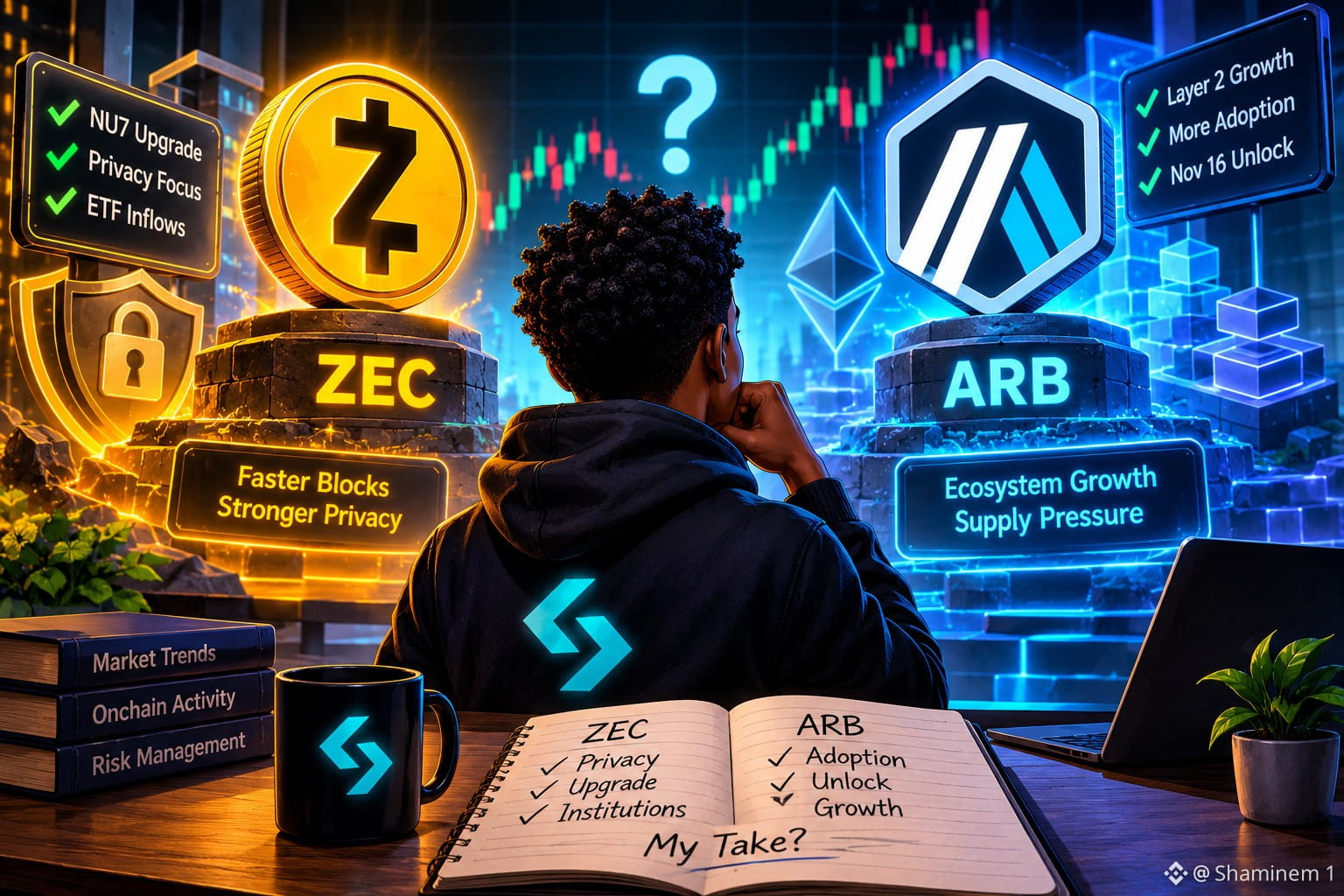
Two Different Catalysts. Two Very Different Setups. $ZEC and ARB are on my watchlist for different reasons. ZEC: NU7 is now live, reducing target block times from 75 to 25 seconds. That's a meaningful improvement for a privacy focused network where transaction friction has been a challenge. Institutional interest and Grayscale's growing ZEC exposure add another layer to the story. But faster blocks don't automatically mean higher token demand. I'm watching network activity, shielded adoption and how the market responds after the upgrade. Wallet compatibility and the transition risks also deserve attention. ARB: Arbitrum remains an important player in Ethereum's Layer 2 ecosystem, with adoption and institutional developments supporting its longer term case. However, the upcoming November 16 unlock is worth watching. Around 92.65M ARB, valued at approximately $16M, is scheduled for release. That's fresh supply entering circulation, which could create short term selling pressure if demand doesn't absorb it. My preference? #Zcash currently has the stronger immediate catalyst, while $ARB needs to prove that ecosystem growth can outweigh supply pressure. I'm keeping both on my Bitget watchlist. The Trading Club Championship and Trending Tokens Party Phase 3 also have opportunities worth exploring, but I'd rather trade a confirmed setup than chase a trending ticker. Which setup would you rather trade? NFA. DYOR.
Two Different Catalysts. Two Very Different Setups. $ZEC and ARB are on my watchlist for different reasons. ZEC: NU7 is now live, reducing target block times from 75 to 25 seconds. That's a meaningful improvement for a privacy focused network where transaction friction has been a challenge. Institutional interest and Grayscale's growing ZEC exposure add another layer to the story. But faster blocks don't automatically mean higher token demand. I'm watching network activity, shielded adoption and how the market responds after the upgrade. Wallet compatibility and the transition risks also deserve attention. ARB: Arbitrum remains an important player in Ethereum's Layer 2 ecosystem, with adoption and institutional developments supporting its longer term case. However, the upcoming November 16 unlock is worth watching. Around 92.65M ARB, valued at approximately $16M, is scheduled for release. That's fresh supply entering circulation, which could create short term selling pressure if demand doesn't absorb it. My preference? #Zcash currently has the stronger immediate catalyst, while $ARB needs to prove that ecosystem growth can outweigh supply pressure. I'm keeping both on my Bitget watchlist. The Trading Club Championship and Trending Tokens Party Phase 3 also have opportunities worth exploring, but I'd rather trade a confirmed setup than chase a trending ticker. Which setup would you rather trade? NFA. DYOR.
·
--
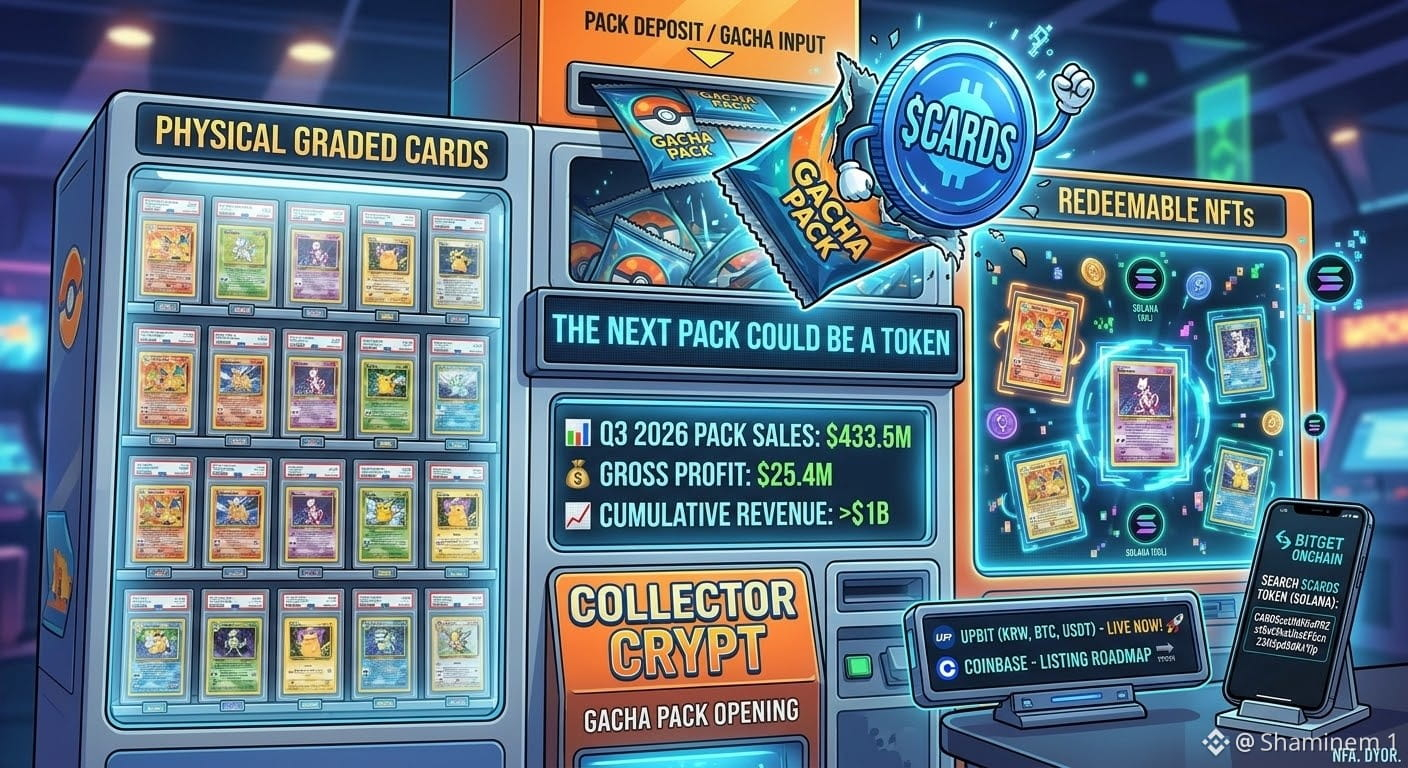
Pokémon Cards, NFTs and a $CARDS Market Opportunity? 🎴 Collector Crypt is an interesting RWA experiment on Solana. It takes physical graded collectibles, stores them in vaults and represents them as redeemable NFTs. Its Gacha packs let users open digital packs, receive collectible NFTs and either keep, trade or redeem the physical cards. Basically, Pokémon pack opening has entered the blockchain era! The business numbers are attracting attention: 📊 Q3 2026 pack sales: $433.5M 💰 Gross profit: $25.4M 📈 Cumulative platform revenue: Over $1B Exchange catalysts are adding fuel. Coinbase has placed CARDS on its listing roadmap, although trading is not live yet. Upbit has also announced KRW, $BTC and USDT markets for today. But here is where I get cautious. Strong business activity does not automatically translate into token value. Monthly token unlocks, supply pressure and the sustainability of pack demand deserve attention. I would rather watch how price reacts to the new liquidity than chase a listing candle. The opportunity may be interesting, but timing still matters. For those exploring CARDS, Bitget Onchain allows users to search for the Solana token directly through its contract address: "CARDSccUMFKoPRZxt5vt3ksUbxEFEcnZ3H2pd3dKxYjp" Would you rather collect the Pokémon cards or trade the token representing the ecosystem? NFA. DYOR.
Pokémon Cards, NFTs and a $CARDS Market Opportunity? 🎴 Collector Crypt is an interesting RWA experiment on Solana. It takes physical graded collectibles, stores them in vaults and represents them as redeemable NFTs. Its Gacha packs let users open digital packs, receive collectible NFTs and either keep, trade or redeem the physical cards. Basically, Pokémon pack opening has entered the blockchain era! The business numbers are attracting attention: 📊 Q3 2026 pack sales: $433.5M 💰 Gross profit: $25.4M 📈 Cumulative platform revenue: Over $1B Exchange catalysts are adding fuel. Coinbase has placed CARDS on its listing roadmap, although trading is not live yet. Upbit has also announced KRW, $BTC and USDT markets for today. But here is where I get cautious. Strong business activity does not automatically translate into token value. Monthly token unlocks, supply pressure and the sustainability of pack demand deserve attention. I would rather watch how price reacts to the new liquidity than chase a listing candle. The opportunity may be interesting, but timing still matters. For those exploring CARDS, Bitget Onchain allows users to search for the Solana token directly through its contract address: "CARDSccUMFKoPRZxt5vt3ksUbxEFEcnZ3H2pd3dKxYjp" Would you rather collect the Pokémon cards or trade the token representing the ecosystem? NFA. DYOR.
·
--
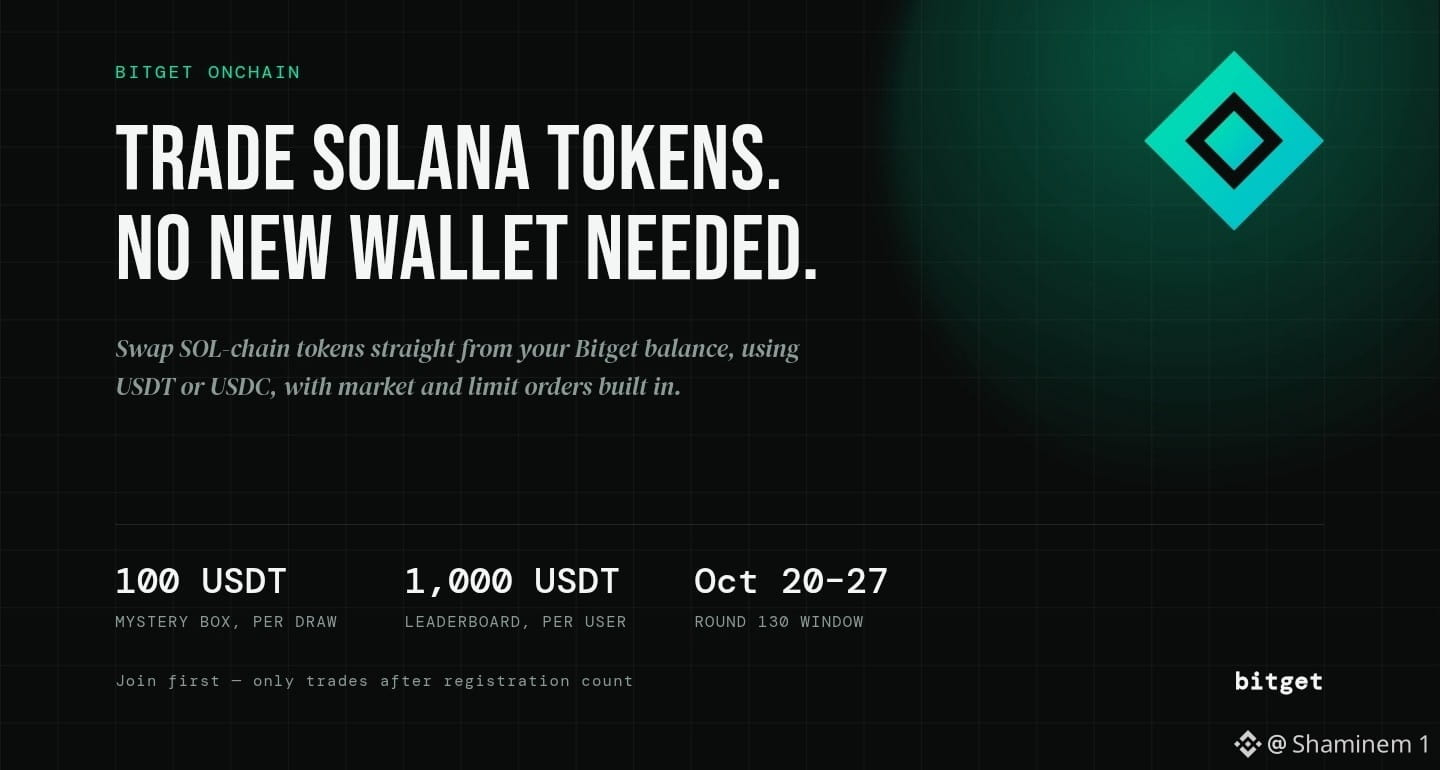
Most people still think you need a separate wallet to touch Solana tokens. You don't, not if you're already on Bitget. Bitget Onchain lets you trade $SOL chain tokens directly using USDT or USDC from your existing balance. No new wallet, no seed phrase to manage separately. Here's the honest comparison. A self-custody wallet like Phantom gives you full control of your private keys, which matters if that's your priority. Bitget Onchain trades that control for convenience instead. Market and limit orders, preset take-profit and stop-loss, all inside the same app you already use for everything else. Right now there's an onchain challenge running too. Every 50 USDT in daily SOL-chain volume unlocks a mystery box draw worth up to 100 USDT. Leaderboard rewards go up to 1,000 USDT per user. Runs October 20 to 27. Join first, then trade, only trades after registration count, so what's your take, self-custody or platform convenience?
Most people still think you need a separate wallet to touch Solana tokens. You don't, not if you're already on Bitget. Bitget Onchain lets you trade $SOL chain tokens directly using USDT or USDC from your existing balance. No new wallet, no seed phrase to manage separately. Here's the honest comparison. A self-custody wallet like Phantom gives you full control of your private keys, which matters if that's your priority. Bitget Onchain trades that control for convenience instead. Market and limit orders, preset take-profit and stop-loss, all inside the same app you already use for everything else. Right now there's an onchain challenge running too. Every 50 USDT in daily SOL-chain volume unlocks a mystery box draw worth up to 100 USDT. Leaderboard rewards go up to 1,000 USDT per user. Runs October 20 to 27. Join first, then trade, only trades after registration count, so what's your take, self-custody or platform convenience?
·
--
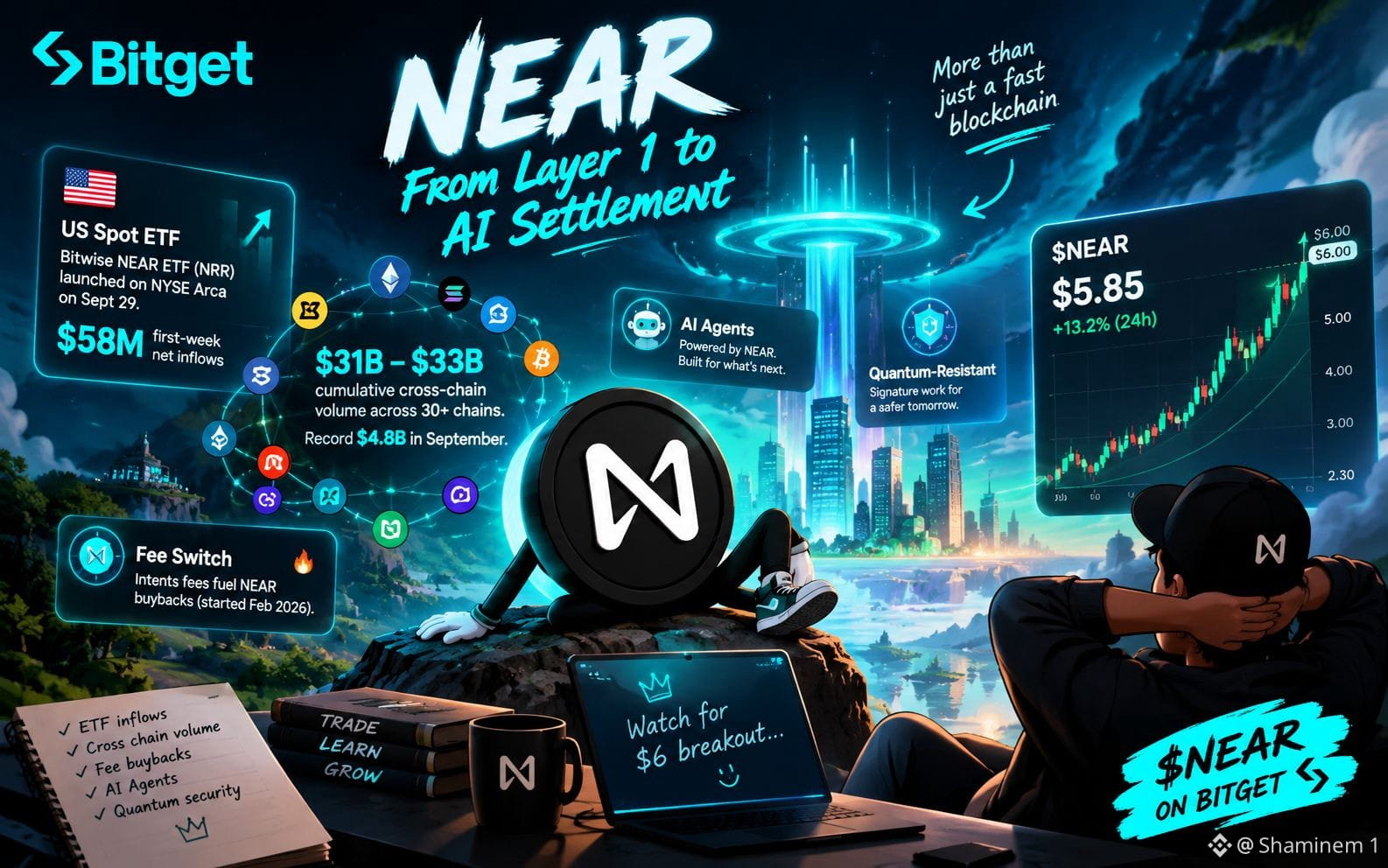
NEAR is becoming more than just another fast Layer 1 blockchain. 👀 The bigger story is cross chain settlement, AI Agents and how different ecosystems connect. The Bitwise NEAR ETF opens another route for traditional investors, while NEAR Intents is pushing cross chain activity. Its connection with $SOL is another development worth watching. But here's the part I find interesting: network activity and token demand aren't automatically the same thing. The fee switch aims to connect Intents usage with #NEAR buybacks, making actual fee generation an important metric to track. After a sharp rally towards $6, I'd watch whether volume supports a breakout or whether price needs time to consolidate. Strong narratives attract attention, but sustainable demand needs evidence. The Bitget $NEAR Trading Club Championship also puts trading decisions in focus. Competitions can highlight how traders approach volatility, position sizing and risk, although leaderboard pressure can encourage overtrading, you can join and speak through the event. Also will cross chain growth translate into lasting value for NEAR, or is the market pricing in the story too early? NFA. DYOR.
NEAR is becoming more than just another fast Layer 1 blockchain. 👀 The bigger story is cross chain settlement, AI Agents and how different ecosystems connect. The Bitwise NEAR ETF opens another route for traditional investors, while NEAR Intents is pushing cross chain activity. Its connection with $SOL is another development worth watching. But here's the part I find interesting: network activity and token demand aren't automatically the same thing. The fee switch aims to connect Intents usage with #NEAR buybacks, making actual fee generation an important metric to track. After a sharp rally towards $6, I'd watch whether volume supports a breakout or whether price needs time to consolidate. Strong narratives attract attention, but sustainable demand needs evidence. The Bitget $NEAR Trading Club Championship also puts trading decisions in focus. Competitions can highlight how traders approach volatility, position sizing and risk, although leaderboard pressure can encourage overtrading, you can join and speak through the event. Also will cross chain growth translate into lasting value for NEAR, or is the market pricing in the story too early? NFA. DYOR.
71
·
--
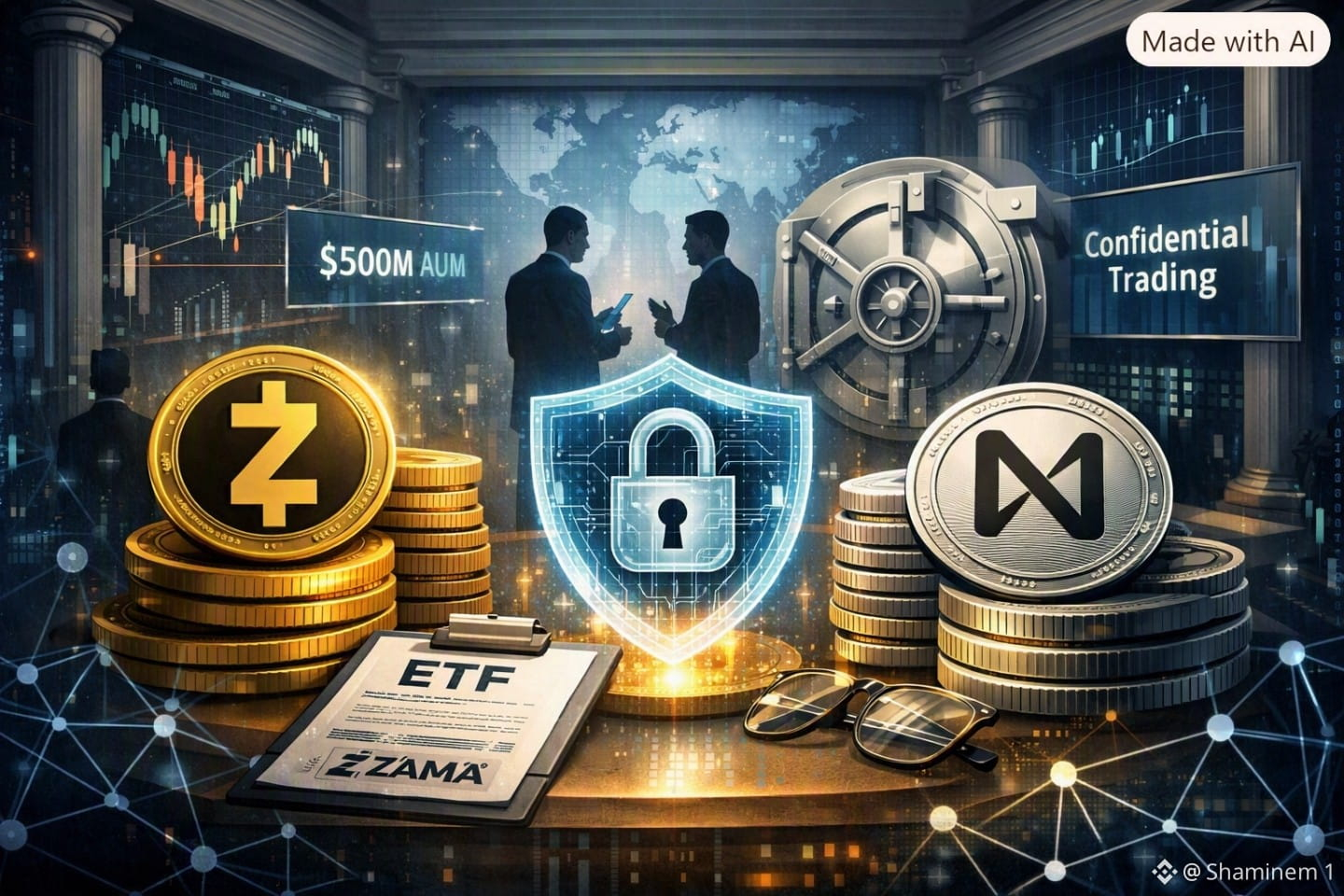
Privacy is no longer a niche crypto narrative, it's institutional infrastructure now, and $ZEC and #NEAR are the two assets making that shift most visible. ZEC completed its Ironwood emergency upgrade in July, retiring the vulnerable Orchard shielded pool and replacing it with a cryptographically corrected version. That fixed a real security overhang. Then NU7 passed with nearly 2.4 million ZEC voting and 99.9% support, cutting target block time from 75 to 25 seconds. Combine that with Grayscale's ZCSH ETF, which crossed $500 million in AUM within two weeks of its NYSE Arca launch, and you've got a privacy coin trading like an institutional product for the first time. ZEC is up over 200% since mid-August. $NEAR took a different route into the same narrative. It made perpetual futures confidential by default through its Hyperliquid integration, routing deposits through a confidential shard so trader identity and funding source stay hidden while trades still execute on Hyperliquid's public order book. That's privacy layered onto existing liquidity rather than built from scratch. NEAR jumped up to 80% in the week following the announcement, with Confidential Intents TVL crossing $70 million. What connects them is the shift in framing. This isn't regulatory evasion anymore. It's opt-in confidentiality with institutional rails attached, ETFs, TEEs, and compliance-aware architecture built in from the start. #Zama extends this further into smart contract confidentiality using FHE, worth watching as the third layer of this stack. All three privacy assets are tradeable on Bitget. NFA. DYOR. [link]
Privacy is no longer a niche crypto narrative, it's institutional infrastructure now, and $ZEC and #NEAR are the two assets making that shift most visible. ZEC completed its Ironwood emergency upgrade in July, retiring the vulnerable Orchard shielded pool and replacing it with a cryptographically corrected version. That fixed a real security overhang. Then NU7 passed with nearly 2.4 million ZEC voting and 99.9% support, cutting target block time from 75 to 25 seconds. Combine that with Grayscale's ZCSH ETF, which crossed $500 million in AUM within two weeks of its NYSE Arca launch, and you've got a privacy coin trading like an institutional product for the first time. ZEC is up over 200% since mid-August. $NEAR took a different route into the same narrative. It made perpetual futures confidential by default through its Hyperliquid integration, routing deposits through a confidential shard so trader identity and funding source stay hidden while trades still execute on Hyperliquid's public order book. That's privacy layered onto existing liquidity rather than built from scratch. NEAR jumped up to 80% in the week following the announcement, with Confidential Intents TVL crossing $70 million. What connects them is the shift in framing. This isn't regulatory evasion anymore. It's opt-in confidentiality with institutional rails attached, ETFs, TEEs, and compliance-aware architecture built in from the start. #Zama extends this further into smart contract confidentiality using FHE, worth watching as the third layer of this stack. All three privacy assets are tradeable on Bitget. NFA. DYOR. [link]
22
·
--
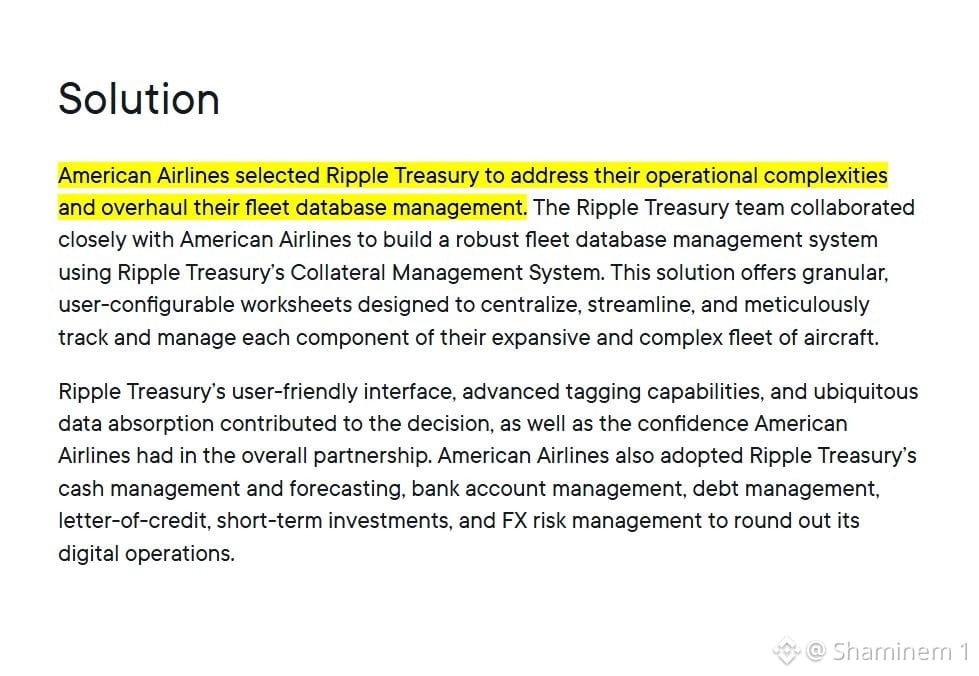
🚨AMERICAN AIRLINES IS USING RIPPLE TREASURY! The US airline GIANT is using #Ripple to help manage its massive global operation from fleet data to cash, debt and FX risk. Ripple embedding itself deeper into corporate finance as major companies, see the long term opportunity in using the $XRP ecosystem.
🚨AMERICAN AIRLINES IS USING RIPPLE TREASURY! The US airline GIANT is using #Ripple to help manage its massive global operation from fleet data to cash, debt and FX risk. Ripple embedding itself deeper into corporate finance as major companies, see the long term opportunity in using the $XRP ecosystem.

38
·
--
🚨THE BANK OF KOREA IS MOVING THE WON TOWARD 24 HOUR GLOBAL SETTLEMENT. The timing is fascinating: Korea already has HUGE major @Ripple links through banks like Kbank and Jeonbuk Bank, while KRW1 is live on Avax through BDACS/Woori Bank! No official $XRP or $AVAX involvement has been announced here but Korea is clearly building toward faster, always-on digital finance, and it is not crazy to think these two could be involved at some capacity!
🚨THE BANK OF KOREA IS MOVING THE WON TOWARD 24 HOUR GLOBAL SETTLEMENT. The timing is fascinating: Korea already has HUGE major @Ripple links through banks like Kbank and Jeonbuk Bank, while KRW1 is live on Avax through BDACS/Woori Bank! No official $XRP or $AVAX involvement has been announced here but Korea is clearly building toward faster, always-on digital finance, and it is not crazy to think these two could be involved at some capacity!

40
·
--
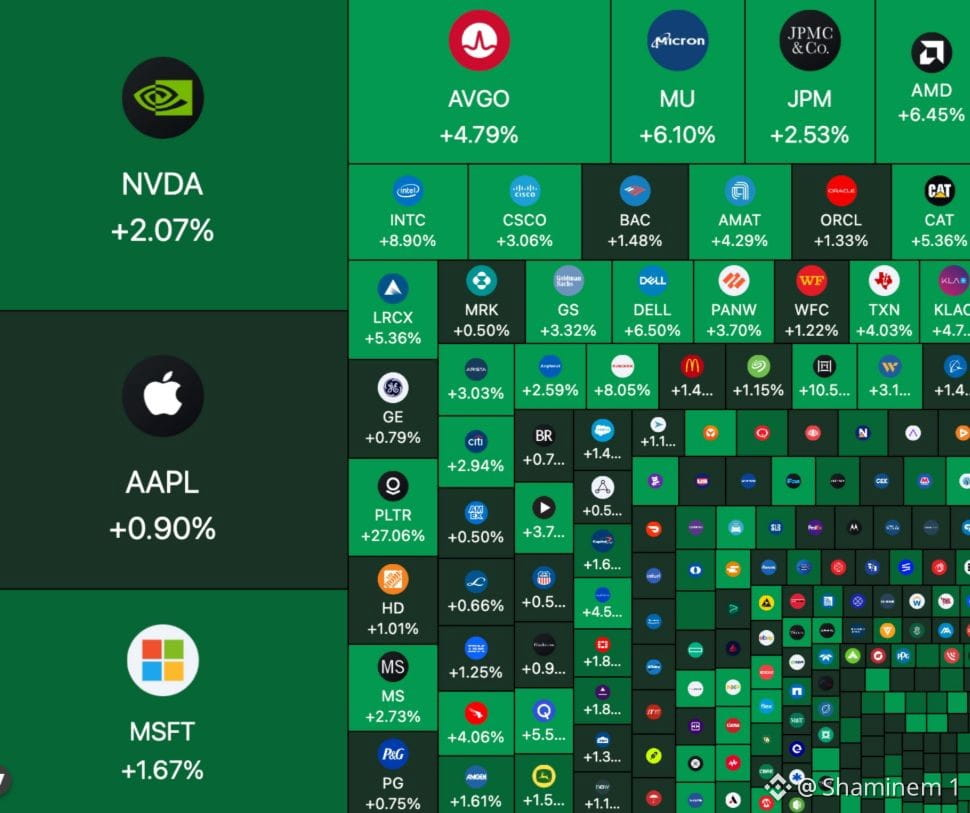
🚨THE U.S. STOCK MARKET ADDED OVER $500 BILLION AT THE OPEN, WHILE CRYPTO IS RIPPING TOO. $MUBARAK Risk appetite is flooding back across markets. When stocks and crypto start moving together like this, it looks like capital is switching back into risk-on mode. $MU
🚨THE U.S. STOCK MARKET ADDED OVER $500 BILLION AT THE OPEN, WHILE CRYPTO IS RIPPING TOO. $MUBARAK Risk appetite is flooding back across markets. When stocks and crypto start moving together like this, it looks like capital is switching back into risk-on mode. $MU
70
·
--
🚨NORTH KOREAN HACKERS ARE NOW POSING AS CRYPTO AND AI RECRUITERS TO TARGET JOB SEEKERS. $SOL WaterPlum reportedly infected 30,000+ devices worldwide and stole at least $10.7M. Crypto’s biggest threat isn’t always the market, sometimes it’s clicking the wrong “job offer.” $BTC
🚨NORTH KOREAN HACKERS ARE NOW POSING AS CRYPTO AND AI RECRUITERS TO TARGET JOB SEEKERS. $SOL WaterPlum reportedly infected 30,000+ devices worldwide and stole at least $10.7M. Crypto’s biggest threat isn’t always the market, sometimes it’s clicking the wrong “job offer.” $BTC

59
·
--
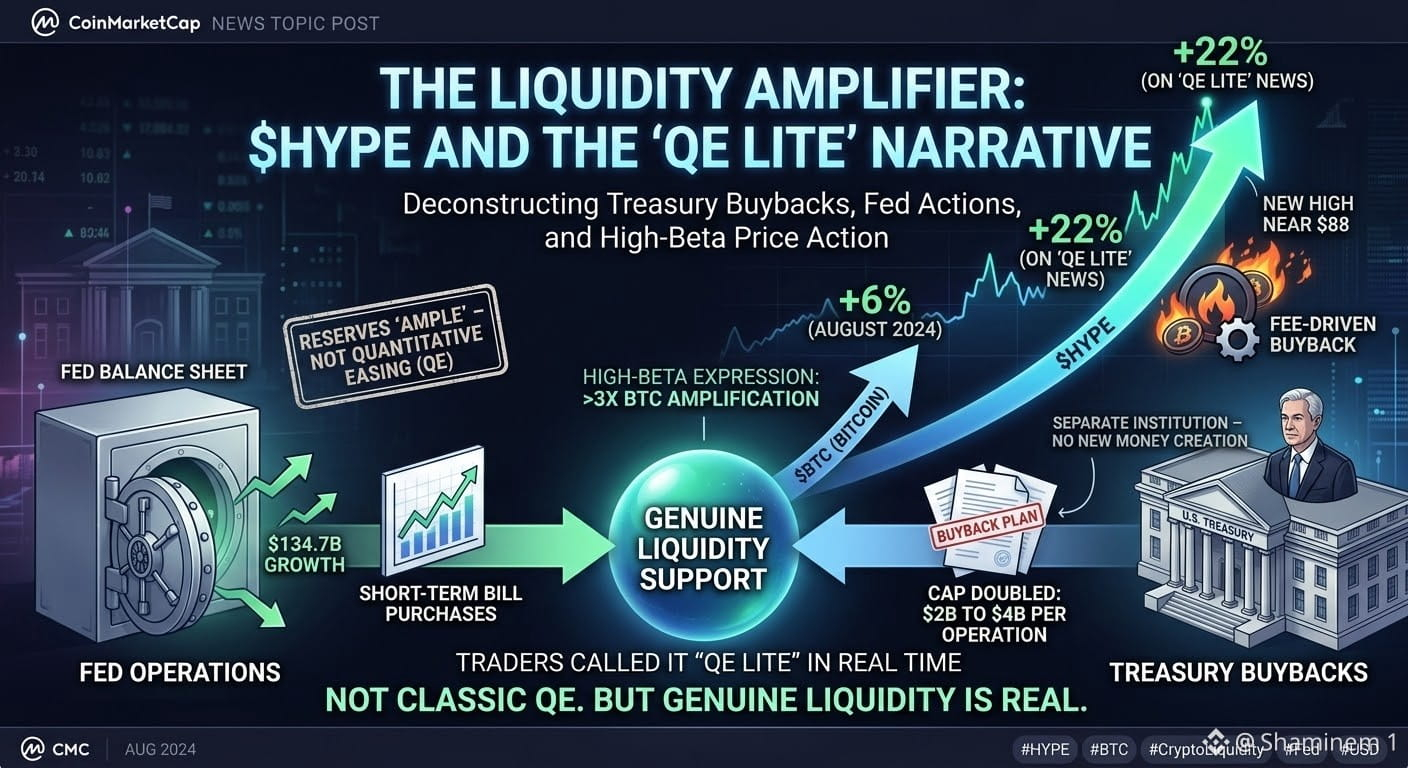
"Stealth QE" is doing more work than the mechanics support. Real QE is Fed-only, it creates new bank reserves and expands the balance sheet to ease conditions. What's actually happening is more tangled. Fed officials Jefferson and Perli have gone on record separating their reserve management purchases from QE entirely, calling them plumbing to keep reserves "ample," not stimulus, entirely in short-term bills rather than the longer-duration buying that actually eases conditions. The optics feed the theory anyway. No press conference, no dramatic headline, and the balance sheet is still up roughly $134.7 billion recently. $BTC ripped on exactly that kind of quiet growth. $HYPE is the clearest proof this liquidity story is real. When the original Treasury buyback news hit in August, traders nicknamed it "QE Lite" in real time, and HYPE ran 22% that day against Bitcoin's 6%, over three times the move on identical news. It's doing it again now, printing highs near $88 on the same easing Fed-hike expectations. High beta to this exact mechanism, not coincidence. The bigger driver isn't even the Fed though. It's Treasury, under Bessent, running buybacks since the original rally in August, when the cap doubled to $4 billion per operation. Separate institution, doesn't expand the money supply either, but the liquidity impact is real regardless of the label. So no, not classic stealth QE. Two agencies running technical operations that add up to genuine support without anyone saying "easing" out loud. HYPE moving three times harder than BTC on the same headline is the best evidence of that.
"Stealth QE" is doing more work than the mechanics support. Real QE is Fed-only, it creates new bank reserves and expands the balance sheet to ease conditions. What's actually happening is more tangled. Fed officials Jefferson and Perli have gone on record separating their reserve management purchases from QE entirely, calling them plumbing to keep reserves "ample," not stimulus, entirely in short-term bills rather than the longer-duration buying that actually eases conditions. The optics feed the theory anyway. No press conference, no dramatic headline, and the balance sheet is still up roughly $134.7 billion recently. $BTC ripped on exactly that kind of quiet growth. $HYPE is the clearest proof this liquidity story is real. When the original Treasury buyback news hit in August, traders nicknamed it "QE Lite" in real time, and HYPE ran 22% that day against Bitcoin's 6%, over three times the move on identical news. It's doing it again now, printing highs near $88 on the same easing Fed-hike expectations. High beta to this exact mechanism, not coincidence. The bigger driver isn't even the Fed though. It's Treasury, under Bessent, running buybacks since the original rally in August, when the cap doubled to $4 billion per operation. Separate institution, doesn't expand the money supply either, but the liquidity impact is real regardless of the label. So no, not classic stealth QE. Two agencies running technical operations that add up to genuine support without anyone saying "easing" out loud. HYPE moving three times harder than BTC on the same headline is the best evidence of that.
60
·
--
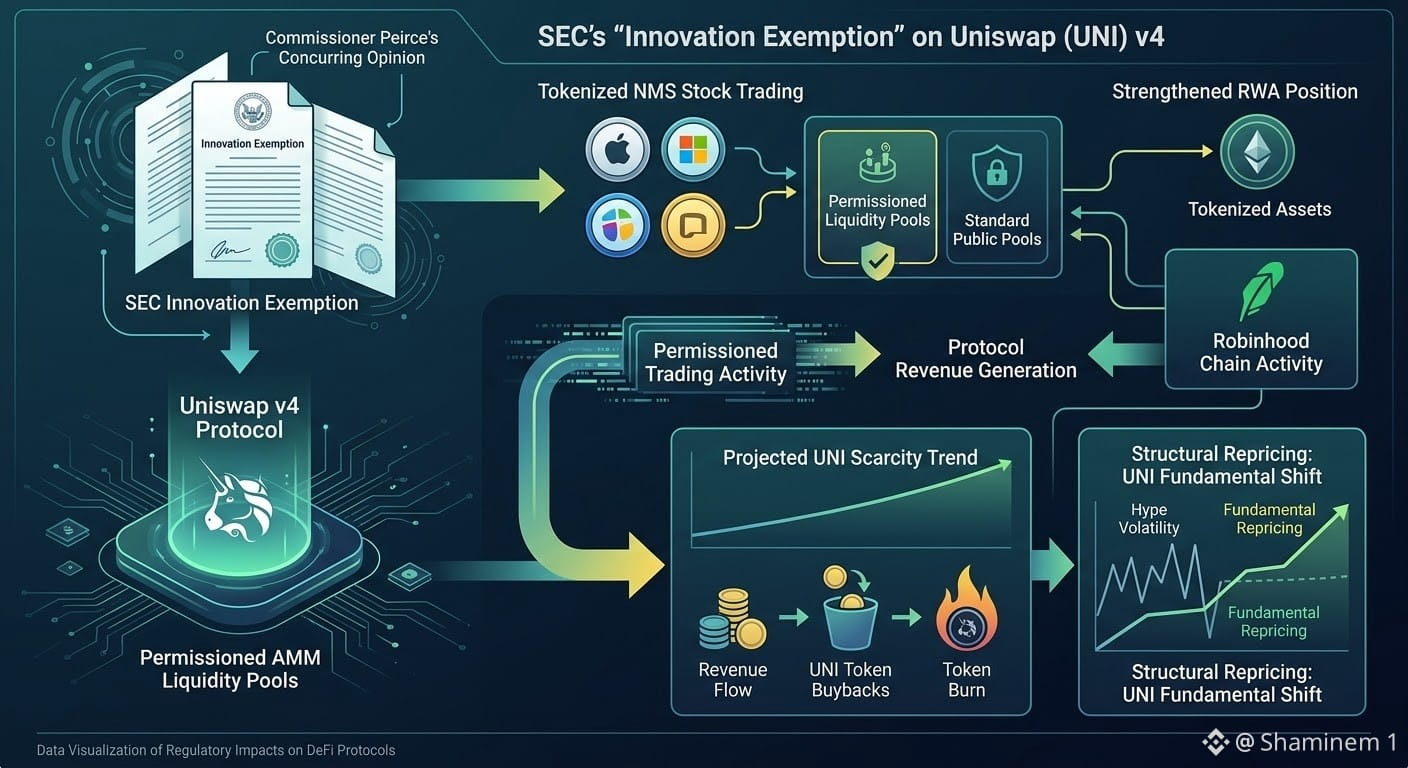
The SEC just handed Uniswap a real regulatory pathway, and $UNI is responding accordingly. On September 17, the SEC issued a five-year "Innovation Exemption" letting Tokenized Securities Venues trade tokenized NMS stock through permissioned AMM liquidity pools. Hayden Adams called Commissioner Peirce's concurring opinion the most important part of the order, cos it directly applies the exemption to permissioned pools on Uniswap v4. Uniswap is now positioned to submit comment letters shaping how this framework develops. Why does this matter for the fee switch narrative I've been tracking? Higher permissioned trading activity through v4 feeds directly into protocol revenue, which now routes toward UNI buybacks and burns. Robinhood Chain activity adds another leg, strengthening Uniswap's position across tokenised assets generally, not just crypto pairs. UNI is up 28% in 24 hours and 47% over the week. That's not hype-driven. That's a structural repricing around real regulatory clarity, the kind RWA has needed for a long time. I've got UNI on my watchlist for a breakout continuation setup, using the fee-switch mechanism as my core thesis rather than the price action alone. Trading $UNI on Bitget right now, and there's a Uni Trading Club championship running for anyone who wants to join in. NFA. DYOR.
The SEC just handed Uniswap a real regulatory pathway, and $UNI is responding accordingly. On September 17, the SEC issued a five-year "Innovation Exemption" letting Tokenized Securities Venues trade tokenized NMS stock through permissioned AMM liquidity pools. Hayden Adams called Commissioner Peirce's concurring opinion the most important part of the order, cos it directly applies the exemption to permissioned pools on Uniswap v4. Uniswap is now positioned to submit comment letters shaping how this framework develops. Why does this matter for the fee switch narrative I've been tracking? Higher permissioned trading activity through v4 feeds directly into protocol revenue, which now routes toward UNI buybacks and burns. Robinhood Chain activity adds another leg, strengthening Uniswap's position across tokenised assets generally, not just crypto pairs. UNI is up 28% in 24 hours and 47% over the week. That's not hype-driven. That's a structural repricing around real regulatory clarity, the kind RWA has needed for a long time. I've got UNI on my watchlist for a breakout continuation setup, using the fee-switch mechanism as my core thesis rather than the price action alone. Trading $UNI on Bitget right now, and there's a Uni Trading Club championship running for anyone who wants to join in. NFA. DYOR.
75
·
--
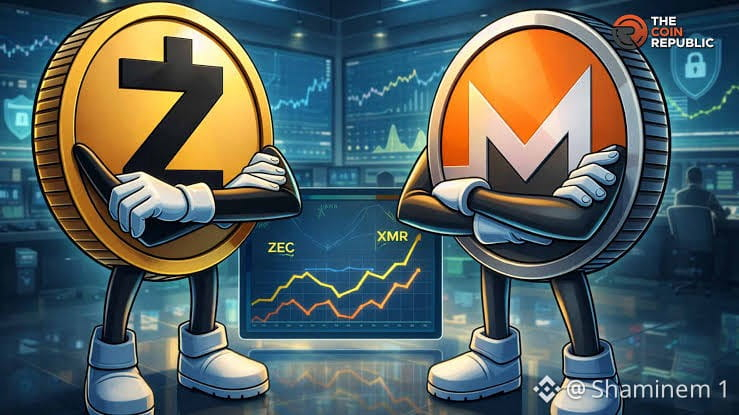
Monero's privacy is mandatory. Every transaction uses ring signatures and stealth addresses by default, so every user gets folded into the same anonymity set whether they think about it or not. That's exactly why ransomware operators and darknet markets lean on $XMR , there's no wrong setting to forget. Zcash's privacy is optional. Built on zk-SNARKs, arguably more advanced cryptography, but the anonymity set is only as strong as how many people actually use the shielded pool. Most $ZEC transactions historically have stayed transparent. Stronger maths, weaker practical privacy, that's the honest trade-off. Here's my take though, and it leans on Zcash, for a reason that has nothing to do with which one hides you better. Monero keeps getting delisted, Kraken pulled it for European users back in 2024, and that pattern isn't reversing. Zcash still trades on Coinbase and Robinhood, and the SEC even held a roundtable on it in 2025. Multicoin Capital disclosed a real position in May, framing it as protection against wealth taxes and government scrutiny, not hiding crimes. That access to regulated capital is the actual moat. The price action backs this up too. Monero hit a fresh high in January, then corrected hard, down from near $797 to around $343 by mid year. Zcash's run has been steadier and more recent, still climbing into the second half of the year. So it's Zcash for the trade specifically, not the tool itself but Monero's the more honest privacy coin, but an asset that keeps getting kicked off exchanges has a shrinking room to grow into.
Monero's privacy is mandatory. Every transaction uses ring signatures and stealth addresses by default, so every user gets folded into the same anonymity set whether they think about it or not. That's exactly why ransomware operators and darknet markets lean on $XMR , there's no wrong setting to forget. Zcash's privacy is optional. Built on zk-SNARKs, arguably more advanced cryptography, but the anonymity set is only as strong as how many people actually use the shielded pool. Most $ZEC transactions historically have stayed transparent. Stronger maths, weaker practical privacy, that's the honest trade-off. Here's my take though, and it leans on Zcash, for a reason that has nothing to do with which one hides you better. Monero keeps getting delisted, Kraken pulled it for European users back in 2024, and that pattern isn't reversing. Zcash still trades on Coinbase and Robinhood, and the SEC even held a roundtable on it in 2025. Multicoin Capital disclosed a real position in May, framing it as protection against wealth taxes and government scrutiny, not hiding crimes. That access to regulated capital is the actual moat. The price action backs this up too. Monero hit a fresh high in January, then corrected hard, down from near $797 to around $343 by mid year. Zcash's run has been steadier and more recent, still climbing into the second half of the year. So it's Zcash for the trade specifically, not the tool itself but Monero's the more honest privacy coin, but an asset that keeps getting kicked off exchanges has a shrinking room to grow into.
78
·
--
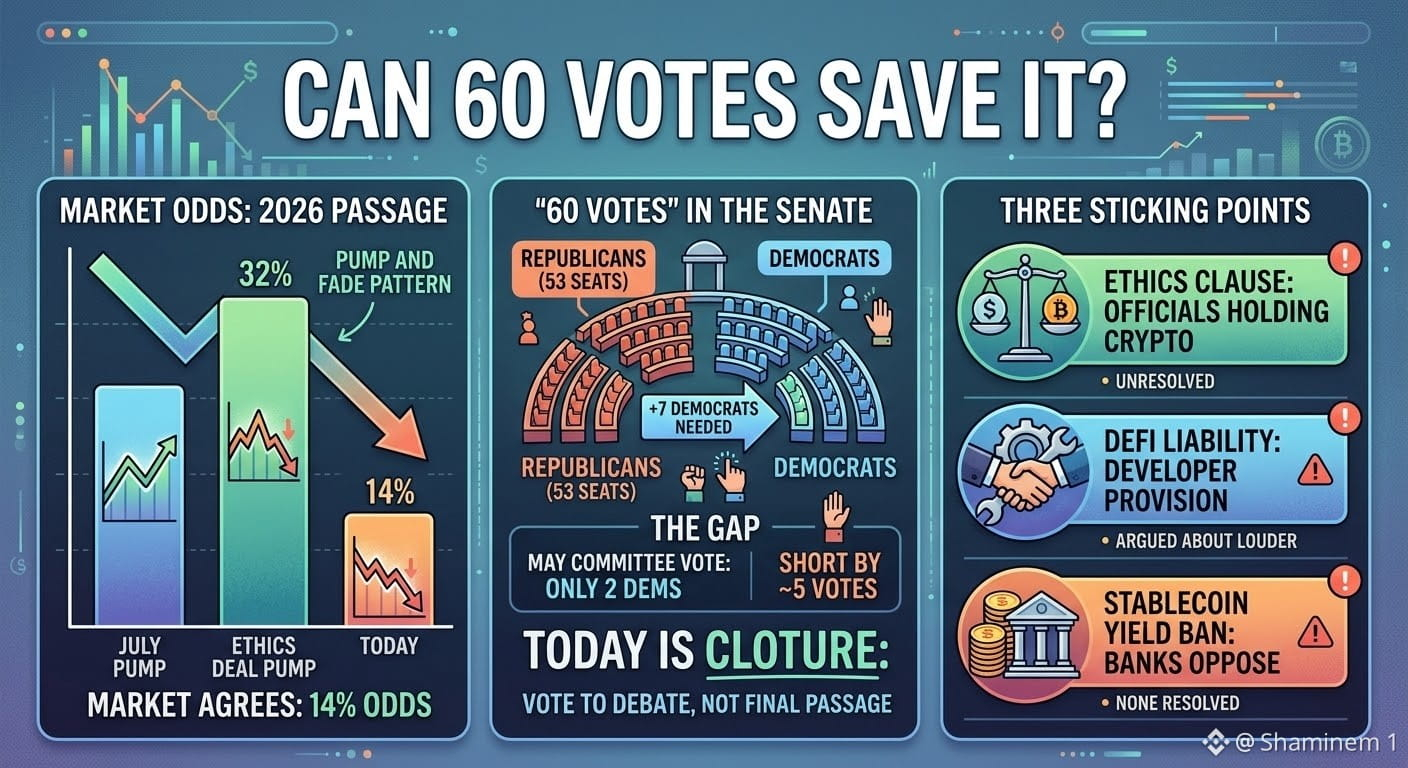
Third time's not been the charm so far, and this is the one post in this series I get to say "told you so" on. Back when the first Trump ethics deal pushed odds to 32%, I flagged that this exact pump had already happened once in July and faded hard. It's now happened again, this bump also crashed, odds sliding from roughly 30% down to 14% for full 2026 passage heading into today. $BTC Here's what "60 votes" actually means, since it trips people up. Today's vote isn't final passage, it's cloture, the procedural step just to start debating the bill. Republicans hold 53 Senate seats, so they need at least seven Democrats to cross over just to get that far. The committee vote back in May only pulled two. That's the real story, not the headline number, the coalition's short by roughly five votes and nothing this month has closed that gap. Three sticking points are why: An ethics clause on officials holding crypto, a DeFi developer liability provision, and a stablecoin yield ban banks don't want. None of those got resolved, they just got argued about louder. So can 60 votes save it? The math says probably not today, and the market agrees, pricing full year passage at just 14%. But this is genuinely different from the last two pumps I covered, those were pure sentiment on rumoured deals. This is an actual roll call, the first real, countable test all year instead of another headline that fades on its own. $ETH
Third time's not been the charm so far, and this is the one post in this series I get to say "told you so" on. Back when the first Trump ethics deal pushed odds to 32%, I flagged that this exact pump had already happened once in July and faded hard. It's now happened again, this bump also crashed, odds sliding from roughly 30% down to 14% for full 2026 passage heading into today. $BTC Here's what "60 votes" actually means, since it trips people up. Today's vote isn't final passage, it's cloture, the procedural step just to start debating the bill. Republicans hold 53 Senate seats, so they need at least seven Democrats to cross over just to get that far. The committee vote back in May only pulled two. That's the real story, not the headline number, the coalition's short by roughly five votes and nothing this month has closed that gap. Three sticking points are why: An ethics clause on officials holding crypto, a DeFi developer liability provision, and a stablecoin yield ban banks don't want. None of those got resolved, they just got argued about louder. So can 60 votes save it? The math says probably not today, and the market agrees, pricing full year passage at just 14%. But this is genuinely different from the last two pumps I covered, those were pure sentiment on rumoured deals. This is an actual roll call, the first real, countable test all year instead of another headline that fades on its own. $ETH
64
·
--
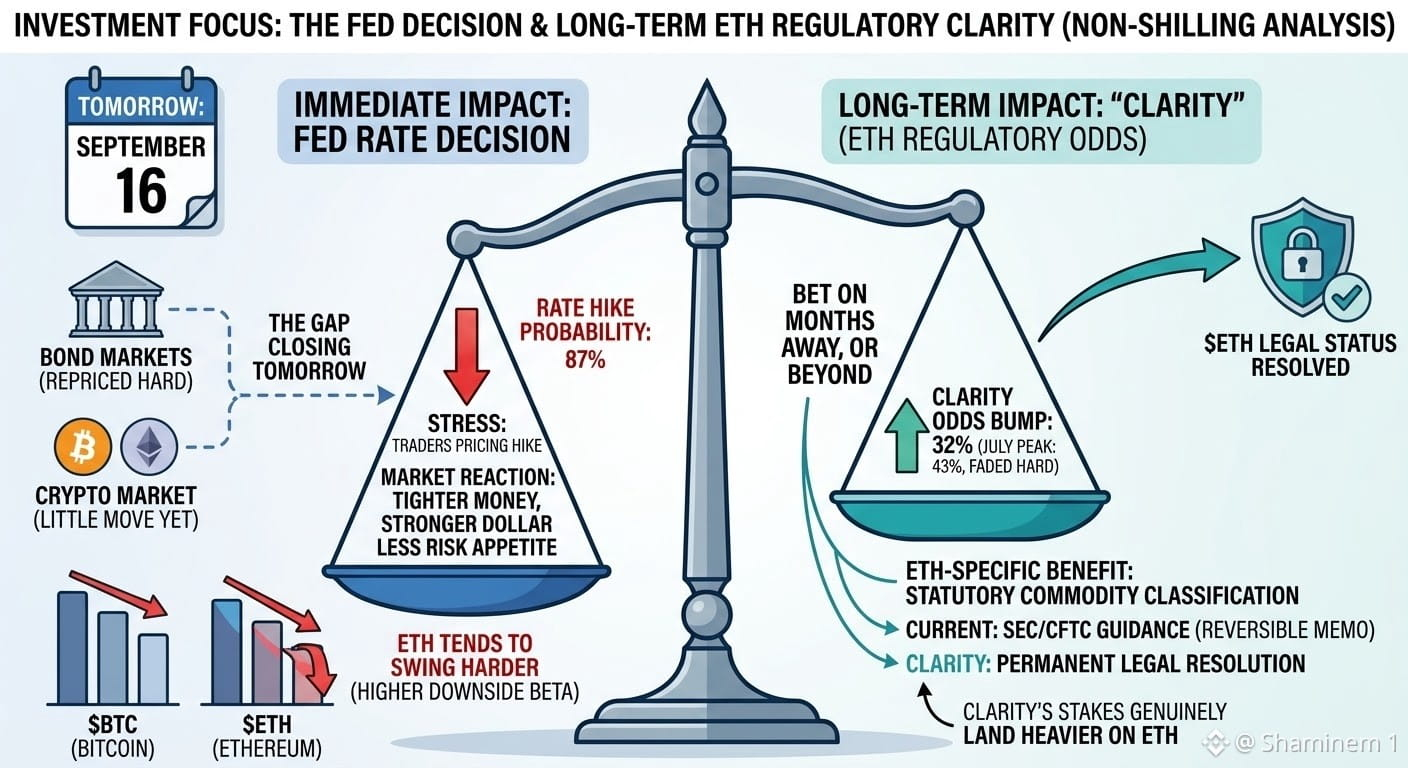
The Fed's decision lands on September 16, and traders now price an 87% chance of a hike, the first since July 2023. CLARITY's odds bump to 32% is real, but it's a bet on something that might not happen for months, if this year at all. We've watched this exact CLARITY movie before back in July, a similar Trump ethics deal pushed odds from 14% to 43% within days, then faded hard, crashing back toward 14-16% by early September. One good headline hasn't held yet this year. CLARITY would finally give Ethereum a legal, statutory commodity classification. Right now that status only exists as #SEC and CFTC administrative guidance from March, which a future SEC chair could undo with a memo. Bitcoin's commodity status has barely been in question. Ethereum's has been the single biggest unresolved fight in crypto regulation for years, so CLARITY's stakes land heavier on $ETH than on BTC. That's a legal outcome months away though. The Fed hike is tomorrow, and it hits both assets through the same channel, tighter money, stronger dollar, less appetite for risk. ETH tends to swing harder than $BTC in both directions, it gained close to 30% during the recent rally against BTC's 23%, so the downside beta cuts the same way if this goes badly. Bonds have already repriced hard for a hike, yet neither BTC nor ETH has moved much yet. That gap closes tomorrow, one way or another. So no, CLARITY doesn't beat the Fed for either coin on speed. It matters more for ETH long term, the Fed matters more for both right now.
The Fed's decision lands on September 16, and traders now price an 87% chance of a hike, the first since July 2023. CLARITY's odds bump to 32% is real, but it's a bet on something that might not happen for months, if this year at all. We've watched this exact CLARITY movie before back in July, a similar Trump ethics deal pushed odds from 14% to 43% within days, then faded hard, crashing back toward 14-16% by early September. One good headline hasn't held yet this year. CLARITY would finally give Ethereum a legal, statutory commodity classification. Right now that status only exists as #SEC and CFTC administrative guidance from March, which a future SEC chair could undo with a memo. Bitcoin's commodity status has barely been in question. Ethereum's has been the single biggest unresolved fight in crypto regulation for years, so CLARITY's stakes land heavier on $ETH than on BTC. That's a legal outcome months away though. The Fed hike is tomorrow, and it hits both assets through the same channel, tighter money, stronger dollar, less appetite for risk. ETH tends to swing harder than $BTC in both directions, it gained close to 30% during the recent rally against BTC's 23%, so the downside beta cuts the same way if this goes badly. Bonds have already repriced hard for a hike, yet neither BTC nor ETH has moved much yet. That gap closes tomorrow, one way or another. So no, CLARITY doesn't beat the Fed for either coin on speed. It matters more for ETH long term, the Fed matters more for both right now.
31
·
--
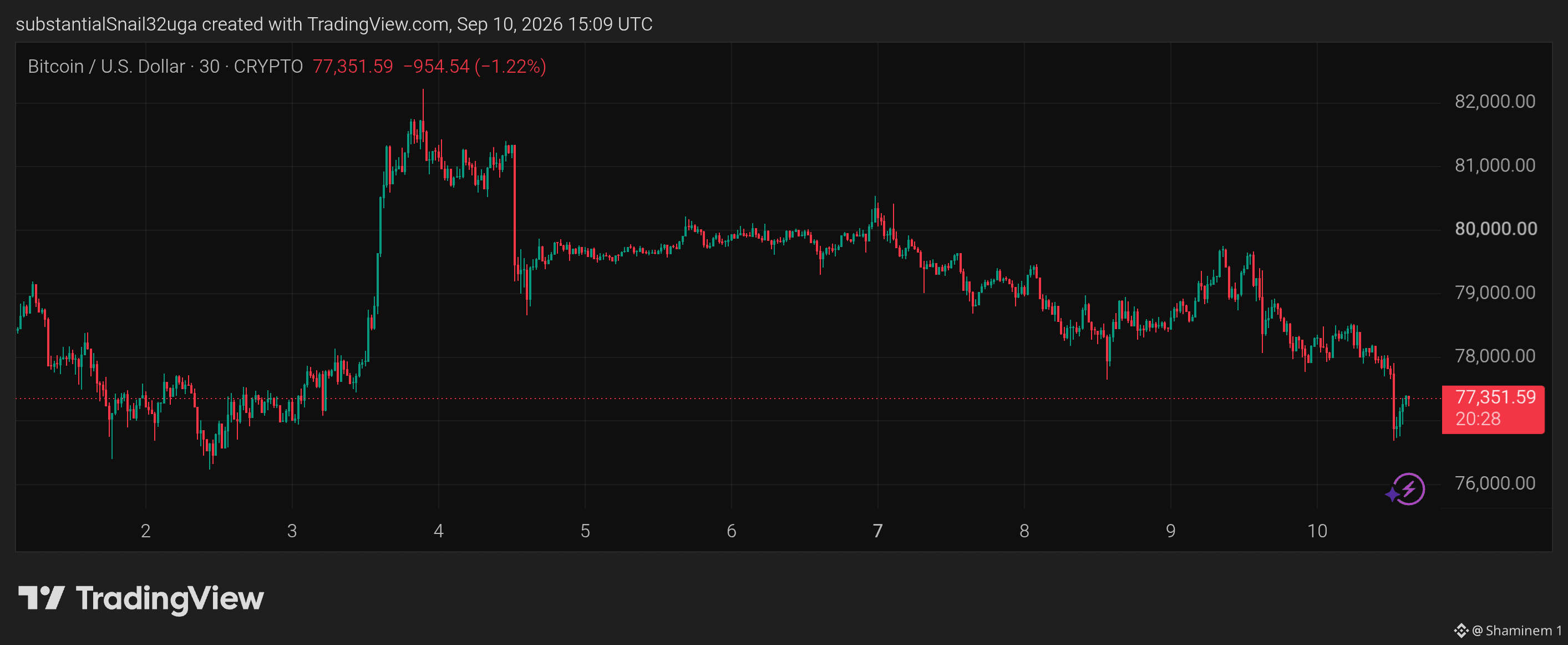
This one already has a real-world answer. Trump's newer $5,000 dividend plan, big enough to add up to roughly $1 trillion if it reaches all adult Americans, has already been announced. Bitcoin's reaction Muted, sideways, couldn't even push through $78,000. The test already ran. Here's why 2020 isn't repeating. Back then, Bitcoin had no spot ETFs, fragmented custody, and a genuinely tiny market by today's standards, so retail stimulus money buying in actually moved the needle. That's also why $1,200 invested in April 2020 at around $6,800 is worth over $21,000 today, $BTC was deeply discounted and the market was thin enough for new money to matter. Even back then though, the effect gets oversold. Cleveland Fed researchers who actually studied it found stimulus checks produced roughly a 0.07% permanent price bump, which they themselves called modest next to Bitcoin's normal 4.6% daily swings. The "stimmy money built the 2020 rally" story is a fun meme, the real driver was Bitcoin being cheap and small, not the checks themselves. Today's market has neither of those conditions. It's ETF-driven, institutionally dominated, with single days of fund flows worth more than a stimulus rollout spread over months. $1 trillion trickling into household budgets over time is a rounding error against that. So no, it doesn't repeat, and the market already told us that within hours of the announcement.
This one already has a real-world answer. Trump's newer $5,000 dividend plan, big enough to add up to roughly $1 trillion if it reaches all adult Americans, has already been announced. Bitcoin's reaction Muted, sideways, couldn't even push through $78,000. The test already ran. Here's why 2020 isn't repeating. Back then, Bitcoin had no spot ETFs, fragmented custody, and a genuinely tiny market by today's standards, so retail stimulus money buying in actually moved the needle. That's also why $1,200 invested in April 2020 at around $6,800 is worth over $21,000 today, $BTC was deeply discounted and the market was thin enough for new money to matter. Even back then though, the effect gets oversold. Cleveland Fed researchers who actually studied it found stimulus checks produced roughly a 0.07% permanent price bump, which they themselves called modest next to Bitcoin's normal 4.6% daily swings. The "stimmy money built the 2020 rally" story is a fun meme, the real driver was Bitcoin being cheap and small, not the checks themselves. Today's market has neither of those conditions. It's ETF-driven, institutionally dominated, with single days of fund flows worth more than a stimulus rollout spread over months. $1 trillion trickling into household budgets over time is a rounding error against that. So no, it doesn't repeat, and the market already told us that within hours of the announcement.
362
·
--
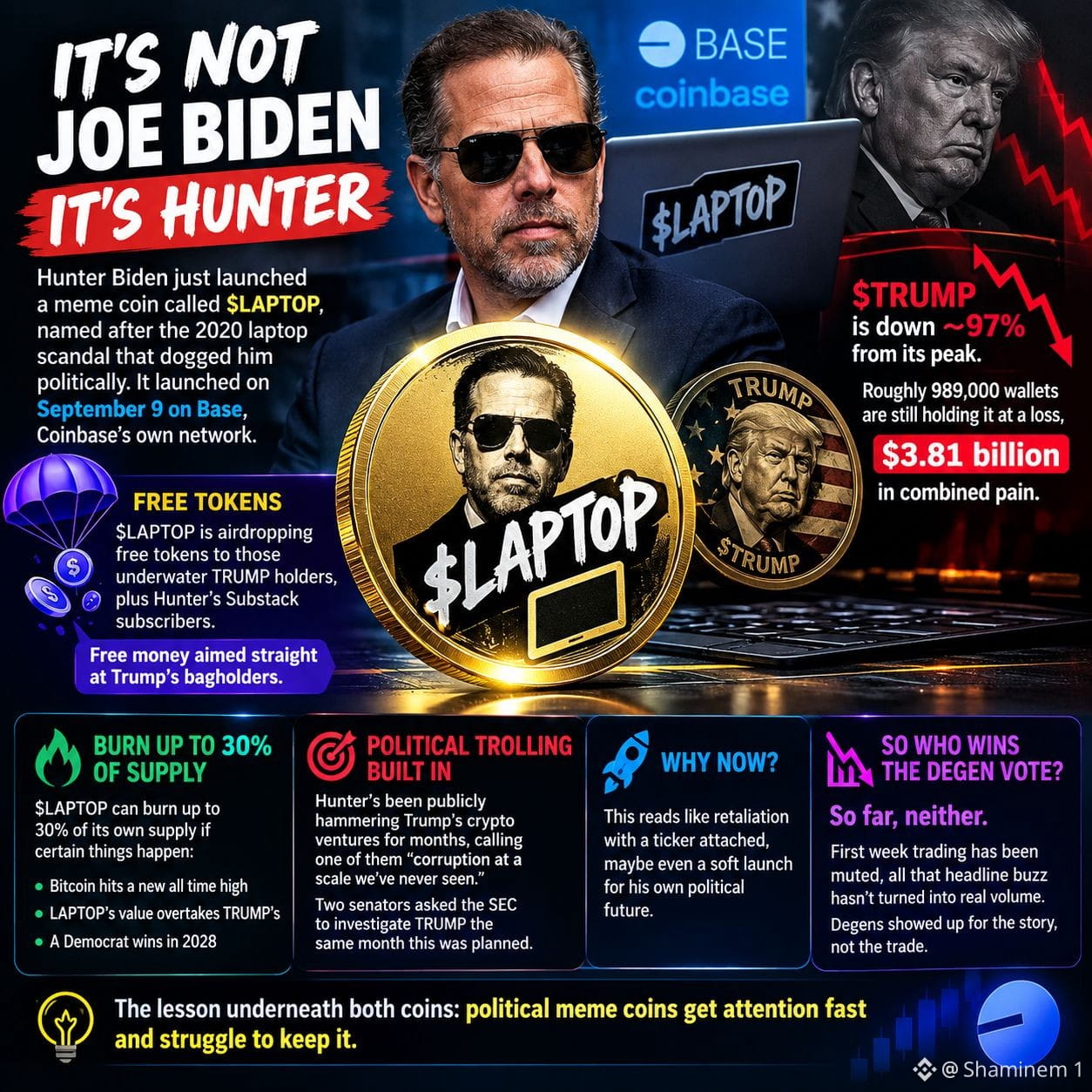
To clarify this isn't Joe Biden. It's his son, Hunter Biden, launching a meme coin called $LAPTOP , named after the 2020 laptop scandal that dogged him politically. It launched on September 9 on Base, Coinbase's own network. Here's the actual mechanic. #TRUMPOFFICIAL meme coin from January 2025, is down about 97% from its peak. Roughly 989,000 wallets are still holding it at a loss, $3.81 billion in combined pain. LAPTOP is airdropping free tokens specifically to those underwater TRUMP holders, plus Hunter's Substack subscribers. Free money aimed straight at Trump's bagholders. It doesn't stop there. LAPTOP can burn up to 30% of its own supply if certain things happen, $BTC hitting a new all time high, LAPTOP's value overtaking TRUMP's, or a Democrat winning in 2028. Political trolling built directly into the tokenomics. Why now? Hunter's been publicly hammering Trump's crypto ventures for months, called one of them "corruption at a scale we've never seen." Two senators asked the SEC to investigate #TRUMP the same month this was planned. This reads like retaliation with a ticker attached, maybe even a soft launch for his own political future. So who wins the degen vote? So far, neither. First week trading has been muted, all that headline buzz hasn't turned into real volume. Degens showed up for the story, not the trade. The lesson underneath both coins: political meme coins get attention fast and struggle to keep it.
To clarify this isn't Joe Biden. It's his son, Hunter Biden, launching a meme coin called $LAPTOP , named after the 2020 laptop scandal that dogged him politically. It launched on September 9 on Base, Coinbase's own network. Here's the actual mechanic. #TRUMPOFFICIAL meme coin from January 2025, is down about 97% from its peak. Roughly 989,000 wallets are still holding it at a loss, $3.81 billion in combined pain. LAPTOP is airdropping free tokens specifically to those underwater TRUMP holders, plus Hunter's Substack subscribers. Free money aimed straight at Trump's bagholders. It doesn't stop there. LAPTOP can burn up to 30% of its own supply if certain things happen, $BTC hitting a new all time high, LAPTOP's value overtaking TRUMP's, or a Democrat winning in 2028. Political trolling built directly into the tokenomics. Why now? Hunter's been publicly hammering Trump's crypto ventures for months, called one of them "corruption at a scale we've never seen." Two senators asked the SEC to investigate #TRUMP the same month this was planned. This reads like retaliation with a ticker attached, maybe even a soft launch for his own political future. So who wins the degen vote? So far, neither. First week trading has been muted, all that headline buzz hasn't turned into real volume. Degens showed up for the story, not the trade. The lesson underneath both coins: political meme coins get attention fast and struggle to keep it.
49
·
--
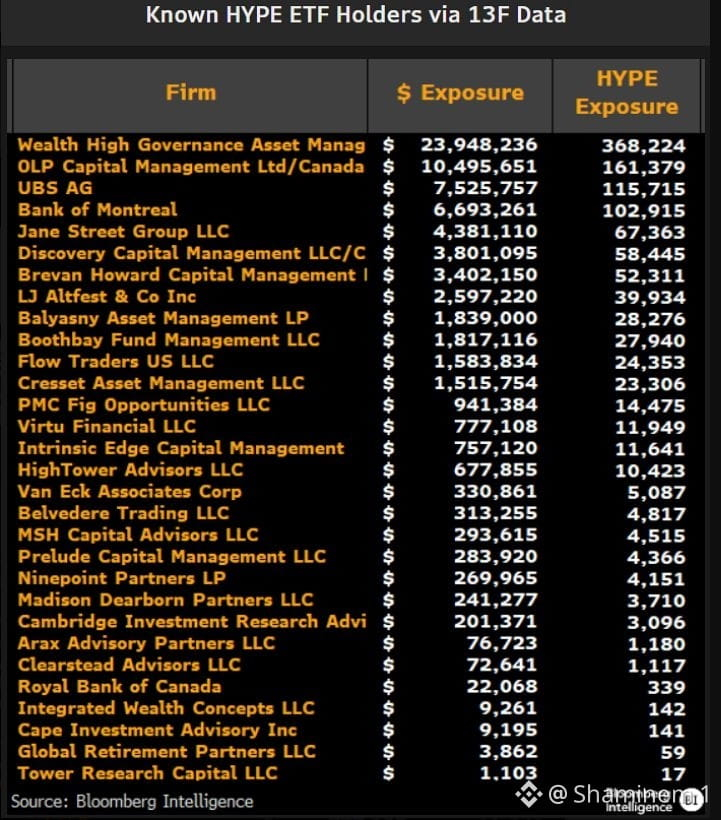
🚨Wall Street is loading up on HYPE! 13F filings show UBS, Bank of Montreal and Jane Street among confirmed $HYPE ETF holders. Institutional exposure to #HyperLiquid is becoming VERY real.
🚨Wall Street is loading up on HYPE! 13F filings show UBS, Bank of Montreal and Jane Street among confirmed $HYPE ETF holders. Institutional exposure to #HyperLiquid is becoming VERY real.
55
·
--
Bitcoin is trading more like GOLD and less like tech. $BTC 90-day correlation with gold just hit its highest level since 2020, while its link to the Nasdaq has plunged. The “digital gold” narrative isn’t just a narrative anymore the market is starting to price it.
Bitcoin is trading more like GOLD and less like tech. $BTC 90-day correlation with gold just hit its highest level since 2020, while its link to the Nasdaq has plunged. The “digital gold” narrative isn’t just a narrative anymore the market is starting to price it.

30
·
--
🚨North Korea linked hacking group Lazarus is back moving millions in crypto. After the $292M KelpDAO exploit in April linked by LayerZero to Lazarus and the record $1.4B exchange hack in 2025... Arkham now says Lazarus-linked wallets moved another $30M through $HYPE . Are they just laundering old funds… or lining up the next target?
🚨North Korea linked hacking group Lazarus is back moving millions in crypto. After the $292M KelpDAO exploit in April linked by LayerZero to Lazarus and the record $1.4B exchange hack in 2025... Arkham now says Lazarus-linked wallets moved another $30M through $HYPE . Are they just laundering old funds… or lining up the next target?

57
·
--
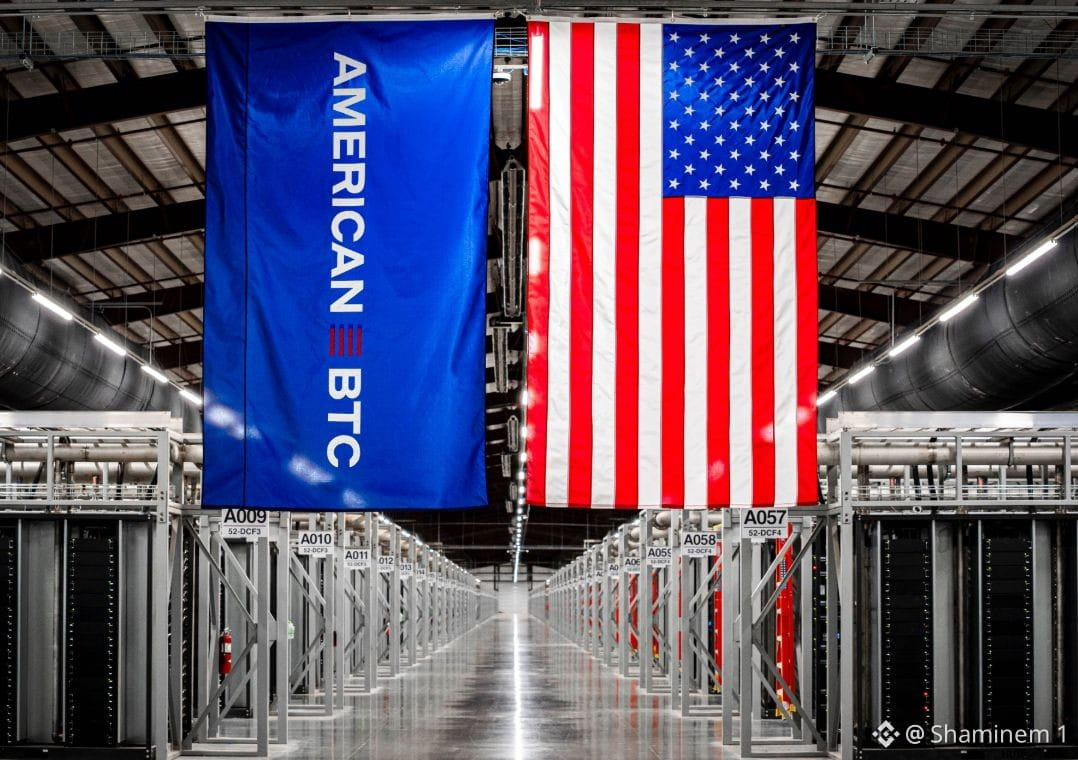
American Bitcoin marks ONE YEAR on Nasdaq with 8,300 $BTC on its balance sheet and nearly 90,000 miners. 🇺🇸 In just over a year, it has built one of the world’s largest public Bitcoin treasuries. Corporate Bitcoin accumulation is only getting bigger.
American Bitcoin marks ONE YEAR on Nasdaq with 8,300 $BTC on its balance sheet and nearly 90,000 miners. 🇺🇸 In just over a year, it has built one of the world’s largest public Bitcoin treasuries. Corporate Bitcoin accumulation is only getting bigger.
54
Log in to explore more content
Join global crypto users on Binance Square
⚡️ Get latest and useful information about crypto.
💬 Trusted by the world’s largest crypto exchange.
👍 Discover real insights from verified creators.
Email / Phone number
Trending Topics
A Packed Week of Earnings and Data Tests Markets
1,522 views
36 Discussing
🚨🇺🇸 BIG WEEK AHEAD FOR THE MARKETS!
Markets are pricing in a Fed rate hike in December and $BTC could see some big moves next week.
Here's what's coming:
• Monday: Fed Chair Warsh speaks
• Tuesday: US Retail Sales + $NVDA earnings
• Wednesday: FOMC Minutes
• Thursday: Jobless Claims + Philly Fed Index
• Friday: Consumer Sentiment + Fed speeches
All eyes on $BTC as another important week begins.
#bitcoin
Mookie
·6 Likes
·2.3k views
HuangReportedlyConsidersReturnToNvidia
11,111 views
186 Discussing
CryptoSelloffTriggersMultipleWhaleLiquidations
262,822 views
2,234 Discussing