Bitcoin is just Crash Every Time. Wait!!! or It is making All Time High Every Time???
The history of Bitcoin is not just a story of wealth; it is a saga of the most resilient asset in human history. From its humble beginnings at $0.06 to its current heights above $126,000, Bitcoin has faced dozens of "death sentences" from mainstream media and financial skeptics. Yet, after every catastrophic fall, it has risen like a phoenix, stronger and more valuable.
To understand Bitcoin’s future, one must master its past. Here is a comprehensive look at the major crashes that defined the King of Crypto. 1. The Genesis Shakeout (2010): From Cents to Pennies In the very early days, Bitcoin had no established market value. The first real volatility occurred when the first exchanges began to emerge. The Pump: In October 2010, Bitcoin surged from $0.06 to $0.36—a massive percentage gain in a matter of weeks.The Crash: Due to a critical "Value Overflow Bug" in the code (which allowed billions of BTC to be generated), the price plummeted back to $0.10.The Recovery: Satoshi Nakamoto and the early developers quickly fixed the code and rolled back the blockchain. This was the first major test of Bitcoin’s technical integrity.
2. The Great Mt. Gox Disaster (2011): The 94% Death This remains the most brutal crash in terms of percentage. It was the first time the world thought the Bitcoin experiment had truly failed. The Pump: In early 2011, Bitcoin broke the $1 barrier and went on a parabolic run to reach $32 (hitting $36 on some exchanges) by June.The Crash: Mt. Gox, which handled 70% of all Bitcoin trades, suffered a massive security breach. Panic selling ensued, and by November 2011, Bitcoin had bottomed out at $2.00.The Lesson: This was a 94% drop. While critics declared Bitcoin dead, the protocol itself remained unhacked; it was the centralized exchange that had failed.
3. The China Ban & The $1,000 Milestone (2013–2015) In 2013, Bitcoin went mainstream, challenging the price of Gold for the first time. The Pump: Starting the year at $13, Bitcoin skyrocketed to $1,163 by December 2013.The Crash: A double-whammy hit the market: China banned banks from handling Bitcoin, and Mt. Gox officially filed for bankruptcy after losing 850,000 BTC of its customers' funds.The Bottom: Bitcoin entered a grueling bear market, eventually hitting a low of $170 in January 2015—an 85% decline. 4. The ICO Mania & The Crypto Winter (2017–2018) This era was defined by "FOMO" (Fear Of Missing Out) and the rise of thousands of new altcoins. The Pump: Bitcoin began 2017 at $1,000 and ended the year at nearly $20,000.The Crash: Regulatory crackdowns in South Korea and Japan, combined with the bursting of the ICO bubble, led to a year-long sell-off.The Bottom: By December 2018, Bitcoin touched $3,122, representing an 84% drop. This period, known as the "Crypto Winter," wiped out thousands of weak projects. 5. The Pandemic Era & The FTX Nightmare (2020–2022) While COVID-19 proved Bitcoin’s "Digital Gold" thesis, internal industry fraud led to the next major capitulation. The Pump: Massive institutional inflows drove Bitcoin to two peaks in 2021, eventually reaching $69,000 in November.The Crash: The $60 billion Terra (LUNA) ecosystem collapsed, followed by the shocking bankruptcy of FTX, one of the world's largest exchanges.The Bottom: Bitcoin fell to $15,500 in November 2022 (77% drop), leading many to believe that crypto was a failed "Ponzi scheme."
6. The ETF Revolution & The 2025 Correction (Recent) The approval of Spot Bitcoin ETFs in 2024 by BlackRock and Fidelity changed the game forever, but it didn't eliminate volatility. The Rise: Institutional demand pushed Bitcoin past its old records, hitting a staggering All-Time High of $126,000 in 2025.The Recent Correction: In late 2025, global macroeconomic fears and a "liquidity crunch" triggered a massive flash crash. Bitcoin dropped to the $52,000–$55,000 range within 48 hours.The Comeback: As of early 2026, institutional buyers "bought the dip," and Bitcoin is once again consolidating near its highs, proving that institutional support is the new floor. Historical Data Table: Every Major Bitcoin Bottom
Final Verdict: The Volatility Tax The biggest lesson from Bitcoin’s history is that volatility is the price you pay for performance. Investors who panicked at $36 missed $1,000; those who sold at $1,000 missed $20,000; and those who capitulated at $20,000 missed the $100k+ era. Bitcoin’s code—decentralized and limited to 21 million—remains unchanged, regardless of the price. P.s: Not financial advice. This article is AI written mistake can be included. #USIranStandoff #BitcoinGoogleSearchesSurge #RiskAssetsMarketShock #WhenWillBTCRebound
Trump Ignites Speculation With a National Bitcoin Venture
Speculation surrounding a national Bitcoin reserve has resurfaced following Bitcoin’s recent drop toward the $60,000 level, reviving one of former U.S. President Donald Trump’s campaign promises. Renowned financial commentator Jim Cramer discussed the possibility on CNBC, suggesting that the U.S. government may view the price decline as an opportunity to begin accumulating Bitcoin reserves. While no official confirmation has emerged, the discussion has once again shifted investor attention toward potential policy moves from the White House. The Journey From Promises to Reality During the 2024 presidential campaign, Trump positioned himself as a strong advocate for cryptocurrencies, pledging to turn the United States into the “crypto capital” of the world. However, more than a year into his presidency, the lack of concrete action has raised concerns among investors. Following Bitcoin’s sharp correction from its historic highs in 2025, the idea of a “strategic Bitcoin reserve” has returned to the center of market discussion. Cramer believes Bitcoin’s pullback to the $60,000 range could represent an attractive entry point for government accumulation. Although Washington has remained silent, analysts argue that such a move could significantly reshape global financial dynamics. If the Trump administration were to begin accumulating Bitcoin at these levels, it could influence how other nations approach cryptocurrency adoption and reserve management. Corporate Movement and the Roots of Speculation Despite ongoing uncertainty at the government level, the private sector continues to make notable moves. One prominent example is Binance’s decision to shift its SAFU (Secure Asset Fund for Users) initiative toward a more Bitcoin-centric structure, reducing reliance on stablecoins. These continued Bitcoin acquisitions by major exchanges affect market liquidity while reinforcing investor confidence. Although Cramer’s remarks are not backed by official policy statements, his influence within financial markets is substantial. The contrast between Washington’s silence and the increasing activity across crypto exchanges has fueled debate over Bitcoin’s evolving role as “digital gold.” Trump’s broader vision—including centralizing Bitcoin mining operations within the U.S. and creating a diversified reserve that may include altcoins—remains ambitious, but largely unrealized for now.
Bitcoin slips below $70,000 after erasing post-election gains during 'sell at any price' rout
Bitcoin has recovered from a low near $60,000 to now stand around $69,000, having effectively given back the gains it made after Donald Trump’s election in November 2024 this week. The cryptocurrency’s drop was accompanied by a broader market sell-off that saw the CoinDesk 20 (CD20) index lose more than 17% of its value in a week. While bitcoin dropped around 16.5% in the last 7-day period, other cryptocurrencies fared worse. Ether lost 22.4% of its value, BNB dropped 23.4%, and solana 25.2%. Shares of crypto-linked firms registered significant declines despite a Friday rebound, as the price of $BTC briefly retook $70,000. The move followed a violent drop a day earlier that Wintermute described as the worst single-day drawdown in bitcoin since the FTX collapse. The sell-off was driven by market-wide liquidations and what “felt like a ‘sell at any price’ working order,” said Jasper De Maere, desk strategist and OTC trader at Wintermute in an emailed statement. De Maere said institutional desks reported “small but manageable liquidation,” which did not fully explain the size of the move, fueling debate over where the stress sat in the system. De Maere added that the cascade came alongside a wider cross-asset deleveraging. The Nasdaq 100 tracker QQQ fell about 500 basis points over three sessions, while silver and gold dropped roughly 38% and 12% below their cycle highs, respectively. In crypto options, implied volatility jumped into the 99th percentile, with skew tilting toward unusually expensive puts, he said. De Maere flagged ether as the “epicenter of the pain,” saying many traders rushed to buy protection against further losses using put options, which can pay out if prices fall and give the holder the right to sell at a set price. In bitcoin, he said positioning pointed to expectations of continued turbulence, with traders focused on a wide range that could run from about $55,000 to $75,000. Further hitting sentiment, this week crypto exchange Gemini said it plans to shutter operations in the U.K., European Union and Australia, and cut about 25% of staff as part of a restructuring.The firm will enter withdrawal-only mode for users in affected regions and partner with brokerage platform eToro for users to transfer their assets. Meanwhile, Bitfarms (BITF) saw its shares rise after ditching its “bitcoin company” identity to instead focus on artificial intelligence (AI) infrastructure. Market structure has added to the turbulence. Bitcoin’s average 1% market depth, a measure of how much can be traded near the current price without moving the market, has fallen to around $5 million from more than $8 million in 2025, Kaiko research analyst Thomas Probst told Reuters. Lower depth can make price moves more abrupt. Flows in spot bitcoin ETFs have also turned negative. Data from SoSoValue shows about $1.25 billion of net outflows over the past three days. Jim Bianco of Bianco Research estimated on social media that the average ETF cost basis is near $90,000, leaving holders with about $15 billion in unrealized losses. “It has been said that crypto is 'programmable money.' If so, $BTC should trade like a software stock,” Bianco said in an X post, adding that the recent decline shows it is trading alongside software stocks. Software stocks tumbled this week after Anthropic released a new automation tool for its AI models targeting legal and other knowledge-focused workflows. Shares of Salesforce (CRM), Adobe (ADBE), and ServiceNow (NOW) lost 8%, 9%, and 13% respectively over the week, to name a few. BTIG chief market technician Jonathan Krinsky also said bitcoin has been correlated with software stocks lately. “There’s some pretty compelling evidence both of those [bitcoin and software stocks] have put in tactical lows,” Krinsky said during an interview with CNBC. “[Bitcoin] bottomed last night right around $60,000 so I think that’s a pretty good level to trade against.” “On the upside you really need to see it back above $73,000, that was the key breakdown level, that would kind of confirm a tradable low is certainly in,” he added. The Trump administration has maintained a pro-crypto stance, which helped the price of bitcoin hit a new all-time high above $125,000 last year, before a correction kicked in.
Why All Investors of Stocks, Forex and Crypto keep there Eyes on US FED rates Decisions and Remarks?
Financial markets around the world are deeply interconnected, and at the center of this system stands the US Federal Reserve. Regardless of the asset class—stocks, foreign exchange, commodities, or cryptocurrencies—investors closely monitor Federal Reserve interest rate decisions and policy statements. These decisions influence global liquidity conditions, capital flows, and risk sentiment, making them a primary driver of market direction.
The Role of the US Federal Reserve and FOMC The US Federal Reserve serves as the central bank of the United States, while the Federal Open Market Committee (FOMC) is responsible for setting monetary policy, including interest rates. Through its decisions and forward guidance, the Fed determines whether financial conditions will tighten or ease. Because the US dollar functions as the world’s reserve currency, Fed policy has consequences far beyond the US economy, affecting global markets at scale.
Why Interest Rates Matter to Financial Markets Interest rates represent the cost of money. When rates are low, borrowing is cheaper, liquidity expands, and investors are more willing to allocate capital toward growth and risk-oriented assets. Conversely, higher interest rates increase financing costs, restrict liquidity, and encourage capital preservation. This dynamic explains why changes in Fed policy often trigger broad market movements across multiple asset classes.
Impact on Equity Markets Stock market valuations are highly sensitive to interest rate changes. Rising rates increase corporate borrowing costs and reduce the present value of future earnings, which often leads to downward pressure on equity prices. Sectors reliant on growth and leverage tend to be the most affected. When the Fed signals a pause or a shift toward rate cuts, equity markets typically respond positively, reflecting improved financial conditions and renewed risk appetite.
Influence on Forex Markets Foreign exchange markets respond directly and immediately to Fed policy. Interest rate differentials between economies drive currency valuations. A rate hike by the Fed often strengthens the US dollar as global capital seeks higher yields, while rate cuts typically weaken the dollar and shift flows toward other currencies. Fed remarks and guidance are therefore critical for forex traders, as even subtle changes in tone can alter currency trends.
Effect on Bitcoin and the Crypto Market Although cryptocurrencies operate outside traditional financial systems, they remain strongly influenced by macroeconomic conditions. Bitcoin and the broader crypto market are highly sensitive to liquidity cycles. Periods of monetary tightening usually result in reduced speculative activity and capital outflows from crypto assets. In contrast, rate pauses or cuts often support stronger performance as liquidity returns and investors seek alternative stores of value and higher-risk opportunities.
Relationship Between Fed Policy and Gold Gold has historically served as a hedge against inflation and currency debasement. Fed policy plays a key role in shaping gold’s performance, particularly through its impact on real interest rates and the US dollar. Dovish policy signals and rate cuts generally support gold prices, while aggressive rate hikes can create short-term pressure. However, during periods of economic uncertainty, gold often remains resilient despite tighter policy conditions.
The Importance of Fed Communication and Market Expectations Markets are forward-looking and frequently react more to expectations than to actual rate decisions. Fed statements, press conferences, and economic projections provide guidance on future policy direction. Investors analyze this communication closely, as shifts in tone or outlook can significantly influence market sentiment and pricing.
Conclusion US Federal Reserve rate decisions and remarks are among the most influential factors shaping global financial markets. By determining the cost of capital and the availability of liquidity, the Fed impacts stocks, forex, cryptocurrencies, and gold simultaneously. For professional traders and investors, understanding Fed policy is essential for interpreting market behavior, managing risk, and positioning effectively across asset classes.
Forget A Bitcoin Yearly Top, BTC Price Might Have Hit A 16-Year Cyclical Peak
Crypto expert Tony Severino has opined that Bitcoin isn’t just showing signs of a yearly top but also that the BTC price may have hit a 16-year cyclical peak. This comes amid the flagship crypto’s recent crash to $60,000, which sparked fears of a bear market. Bitcoin May Be Showing Signs Of A Peak Amid BTC Price Crash To $60,000 In an X post, Severino alluded to the yearly Bitcoin chart, which he said looks like a 16-year cyclical peak rather than just a yearly top. The expert also outlined several reasons this appears to be a major cyclical top for the BTC price. First, he noted that the white candlesticks have been decreasing in size over time, while black candlesticks engulf more white candles with each appearance.
Furthermore, Severino highlighted the Doji at the top of a rising wedge pattern while the Evening Star is in progress, which is a bearish reversal signal for the BTC price. Meanwhile, the Fischer Transform is crossing bearish with divergence, and the Stochastic is crossing bearish after being rejected from 80. He added that Bitcoin’s Relative Strength Index (RSI) is falling back below 70 after making it above this level on the highest timeframe chart. His analysis comes as the BTC price continues to decline, suggesting the crypto market may be in a bear market after topping last October. Bitcoin dropped to as low as $60,000 earlier this week, suffering its largest daily decline since the FTX collapse. Veteran trader Peter Brandt has also opined that Bitcoin is in a bear market, predicting that it could still drop to as low as $42,000 before it sees a bottom. Reason For The Recent BTC Crash BitMEX co-founder Arthur Hayes has commented on the reason for this recent Bitcoin crash, suggesting that it was due to external factors rather than part of an ongoing bear market. In an X post, he stated that the BTC price dump was probably due to a dealer hedging off the back of BlackRock’s BTC ETF structured products. Notably, BlackRock’s IBIT saw a record trading volume of $10 billion on the day of this crash to $60,000. Hayes’ comment comes on the back of Bitcoin’s rebound above $70,000, with the flagship crypto recording one of its largest ever daily gains yesterday following the crash to $60,000. Galaxy Digital’s Head of Research, Alex Thorn, suggested that the drop to $60,000 may mark the bottom for the BTC price. This came as he noted that the 200-week MA, which is around $60,000, has historically been a strong entry point for long-term investors. At the time of writing, the BTC price is trading at around $70,000, up over 6% in the last 24 hours, according to data from CoinMarketCap.
US Grants National Charter to Crypto-Friendly Erebor Bank
The United States has approved its first newly created national bank under President Donald Trump’s second term, granting a federal charter to crypto-friendly startup Erebor Bank. The approval marks a notable development for the U.S. banking sector, particularly as it seeks to fill gaps left by recent financial industry upheavals. According to people familiar with the matter, the Office of the Comptroller of the Currency (OCC) confirmed the approval on Friday, allowing Erebor Bank to operate nationwide. The move makes Erebor the first new national bank to receive a charter during the current Trump administration, signaling a potentially more receptive stance toward financial innovation, including crypto-related services. Erebor Bank is launching with approximately $635 million in capital and plans to cater primarily to startups, technology firms, and high-net-worth individuals. The bank has positioned itself as a successor of sorts to Silicon Valley Bank (SVB), whose collapse in 2023 disrupted access to banking services for many tech companies, venture capital firms, and founders across the U.S. Named after the Lonely Mountain in J.R.R. Tolkien’s The Hobbit, a place famously associated with hidden treasure, the bank’s branding reflects its ambition to become a trusted financial stronghold for clients operating at the intersection of technology, venture capital, and digital assets. Industry observers note that the name choice also subtly signals the bank’s openness to crypto and blockchain-focused businesses, a segment that has struggled to find consistent banking partners in recent years. The approval comes amid renewed debate in Washington over how the U.S. should regulate emerging financial technologies. While the Trump administration has emphasized deregulation and market-driven growth, regulators have also maintained that new banks must meet strict capital, risk management, and compliance standards. Erebor Bank’s nationwide charter allows it to accept deposits and provide lending services across state lines, giving it a significant advantage over state-chartered institutions. Its entry into the market could increase competition for traditional banks while offering startups and crypto-aligned firms an alternative to established financial players. As Erebor prepares to begin operations, market participants will be watching closely to see whether it can successfully rebuild confidence and serve sectors that have remained underserved since SVB’s collapse.
Gold's 'safe haven' that's trading like a meme stock
The stock market got a major roller-coaster ride this week, with the S&P 500 (^GSPC) falling 2.6% before clawing back gains on Friday. But both bitcoin ($BTC ) and gold ($XAU ), the modern and traditional "stores of value," had even wilder runs, falling around 20% and 7%, respectively. Both, like stocks, got some of their gains back. Those big numbers, especially for gold, highlight a truth investors are learning to reckon with: Stores of value just aren't what they used to be. Particularly for gold, a millennia-old store of wealth, which is seeing its classical role upended by volatility. In a sense, it's positive — if you own gold. Prices are up for the week, sitting at just under $5,000. They've risen about 14% so far this year. And there's a good chance we'll see it rise more. JPMorgan analysts, for instance, have doubled down on gold, forecasting demand from central banks and investors to push prices to $6,300 per ounce by the end of the year. That would mark a roughly 25% increase Geopolitical instability, the "debasement" of fiat currencies, and unresolved questions over debt loads have fueled gold's historic rise. A weakened insert-your-asset-of-choice has encouraged investors to cling to hard assets. Gains though they are, they reflect some wild, meme-stocky numbers that at least somewhat diminish gold's utility as a place to park value. Because, as we all know, what goes up that fast can also go down that fast.
The crash earlier in the week punctuated what one expert described as a "breathtaking and profoundly scary" rise in precious metals. The price action created charts that looked like they belonged to stocks. Analysts could explain the moves behind the volatility, but some investors decided to just wait it out.
The comeback in stocks and gold's staggering climb make for a painful contrast. Bitcoin prices fell as low as $61,000 on Thursday. And even with a recovery on Friday to $70,000, the top digital currency is down about 44% from its October peak. Crypto evangelists may have pitched bitcoin as 21st-century digital gold. But the new gold isn't bitcoin — it's just more volatile gold. Amid all this, the dollar, for all its movement, looks stable in comparison. If you're looking for stable value, there are probably places and moments to find it. But there's one clear winner in this week's — and this year's
Crypto Market Summary. 07/02/2026. Alt Season indication and Top performer.
The total Crypto Market Capital has been up to $2.55T by the inflow of $189B dollars today, for the first time market cap of crypto market fall below $2.55T since 2023 and form a low of last 2 years.
The Fear and Greed Index of Crypto market is remain in Extreme Fear at 8 even after the strong price recovery to $71,600 indicating that the investors are still cautious about investing in crypto.
Alt Season Index: Bitcoin and alt coin Season Index is still favoring for bitcoin indicating that the money is still following into BTC favoring the bitcoin Index. The last time Alt season went highest in September 2025.
Top 100 Coins Performance Over 90 Days In last 90 days $MYX has been the top performer of crypto market. The Price of MYX surge from 0.08$ to 19$. The RWAs token has also performed PAXG and $XAU has booked the mark into the top Coin performer of Crypto market. while the top coins like DOT, SOL, ONDO, AVAX etc are continuously printing losses.
Crypto Market Dominance: The market dominance is indicating that the Bitcoin capitalization is cover 58% of the total market cap of Crypto. while ETH is cover 10.4% of the market and 31% is in the other alt coins.
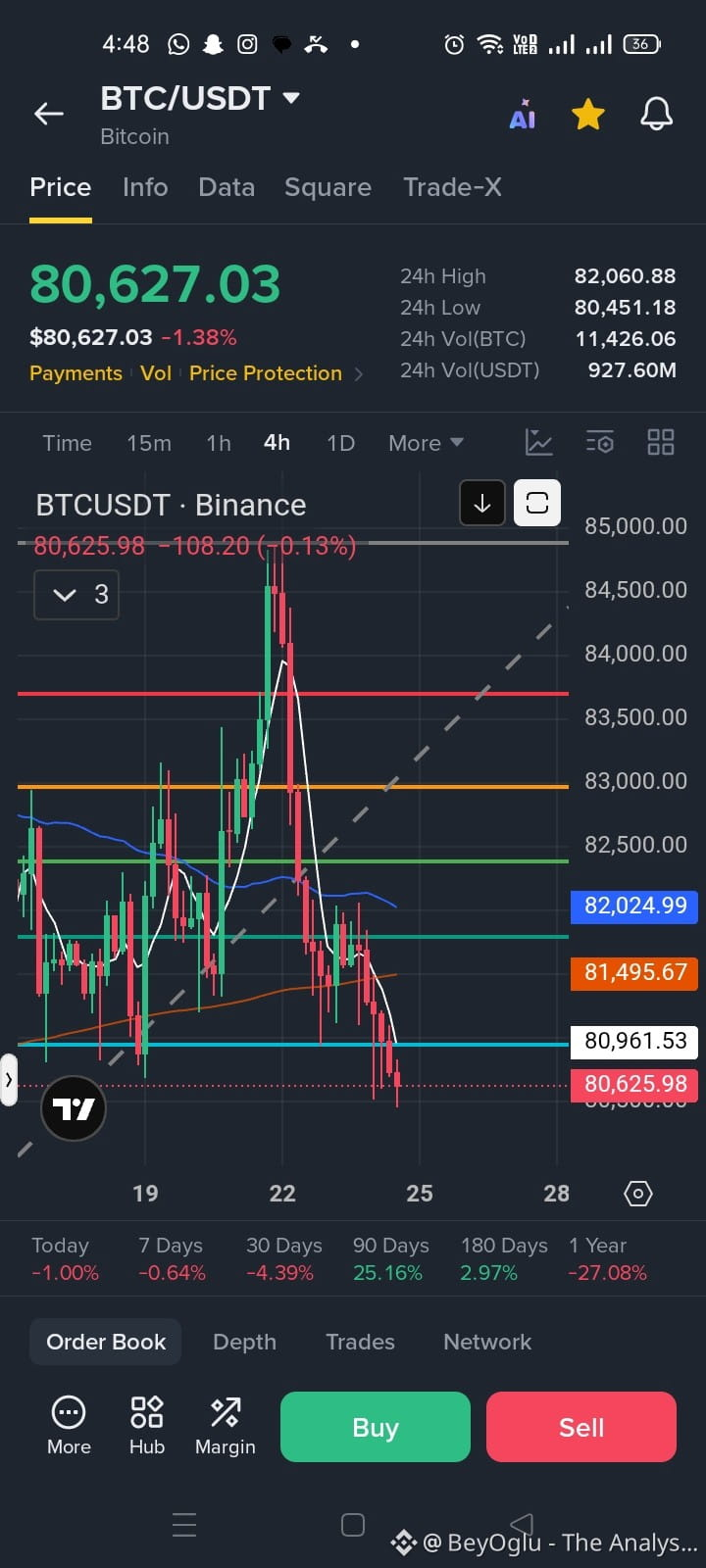
Bitcoin update: Bitcoin dumped to $60,000 yesterday and make a decent recovery to $70,000 yesterday. $BTC Jump to $71,960 as the day of Saturday and facing selling pressure that resulted in price decline. At the time of writing this bitcoin is trading near $69,000. To keep the bullish momentum Continue Bitcoin Should break above $72,000. The Relative Strength Index RSI is at 31 aiming upward indicating the momentum is being shift from bearish to bullish. To keep the bullish momentum RSI must sustain above 50 level of neutral. While the MACD Moving Average Convergence Divergence is still favoring bears blue line is still below the orange line, forming weaker histogram indicating that the selling pressure is getting weaker. Bitcoin is Struggling to break above the key psychological key resistance price level of $72,000 if Bitcoin will close a day below $66,500 then it could again extend the decline towards $60,000.
The $330.7M if inflow was recorded yesterday in Bitcoin. The Strong month for bitcoin ETFs inflow was july 2025 in which $6.1B inflow was recorded. while the weakest month Bitcoin ETF was November 2025 in which the highest out flow was recorded 3.5B. In the first week of web nearly $500M has been wipe out from Bitcoin ETFs.
Trump Sets Process for Iran Tariffs But Does Not Apply Them
According the BloomBerg News letter "President Donald Trump enabled his administration to apply tariffs on goods from countries doing business with Iran, but stopped short of immediately imposing any new duties. An executive order that Trump signed Friday said that the levy “may be imposed on goods imported into the United States that are products of any country that directly or indirectly purchases, imports, or otherwise acquires any goods or services from Iran.” Trump first threatened the duty on social media in mid-January, saying it would be effective immediately. But no paper was ever issued codifying the policy until Friday. The action has the potential to disrupt major US trading relationships across the globe, including with countries such as India, Turkey, and China. The order empowers the secretaries of State and Commerce to jointly determine if any countries have met the criteria. Once a finding is made, the policy empowers them — in conjunction with the Office of the US Trade Representative and Department of Homeland Security — to decide “to what extent an additional” tariff should be applied. Trump did not specify a rate that would be imposed but uses the 25% rate that he first threatened on Iran’s trading partners as an “example.” Iran and the US engaged in their first in-person talks earlier Friday in Oman, an effort to defuse tensions between Washington and Tehran and avert a military confrontation. The source of the latest upheaval has been weeks of mass protests that have rocked the Islamic Republic. Demonstrations were initially sparked by a currency crisis and worsening economic conditions but they became increasingly aimed at the regime. It’s amounted to the biggest challenge to the nation’s ruling system since 1979. Trump has cheered on the protesters and threatened strikes if Iran’s leaders continued violently repressing the protests. Last month, he told reporters that he was glad authorities had decided not to execute prisoners, seemingly putting off an imminent attack on Iran. In the meantime, a large US Navy strike group has traveled to the region in the event of any action. #USIranStandoff
The Silent Revolution: How Banks Are Becoming the New Crypto Asset Managers
For decades, banks have been the backbone of the financial world—keeping our deposits safe, providing loans, and keeping payments moving. However, beyond these core services, many banks have quietly stepped into the world of asset management, guiding clients through investments in stocks, bonds, and ETFs. Today, we are seeing this exact same model evolve to include crypto and digital assets. Banks as Indirect Asset Managers While banks aren’t "asset managers" by definition, global giants like JPMorgan, Goldman Sachs, and HSBC operate massive asset management divisions. These units function just like classic investment firms: they invest client funds, manage risks, and chase returns. The key difference? Banks typically don’t gamble with their own balance sheets; instead, they provide the infrastructure and expertise needed to grow their clients' wealth. From Stocks to Crypto: History Repeats Itself Historically, banks have been slow to adapt to new markets—even stocks were once viewed with caution. But once the demand became undeniable, banks moved in, offering everything from brokerage accounts to ETF exposure. We are seeing a mirror image of that trend in the crypto space today. Banks are no longer just watching from the sidelines; they are actively working to: Provide Secure Custody: Safe storage for Bitcoin, Ethereum, and other tokens.Facilitate Tokenization: Bringing real-world assets like gold and silver onto the blockchain.Offer Indirect Trading: Creating a bridge for clients to access crypto through familiar structures, similar to stock ETFs. The Turning Point: Crypto ETFs The approval of Bitcoin ETFs in 2025 changed everything. As institutional adoption exploded, giants like BlackRock and Fidelity paved the way, making it safe for banks to step in with custody and trading services. Much like stocks became a standard part of any portfolio, crypto is becoming a routine part of wealth management. The Rise of Digital Commodities At the same time, the tokenization of precious metals—like the gold (XAU) and silver ($XAG ) trading launched on platforms like Binance in 2025—has opened new doors. Banks are expected to embrace this trend, offering clients a seamless and secure way to trade traditional assets on blockchain "rails." The Road Ahead: 2026 and Beyond By 2026, the integration of crypto into banking will likely be complete. We are moving toward a future where banks act as full-scale digital asset managers, offering: Direct investment of client funds into digital assets. Structured crypto products and specialized ETFs. Diverse portfolios that mix stocks, bonds, and tokenized commodities.
Banks aren't ignoring the crypto revolution—they are institutionalizing it. They are turning market volatility into a managed opportunity. As regulations clear up and ETFs become mainstream, the era of banks as indirect crypto managers isn't just coming; it’s already here. #BanksAdoptingBTC
you might have seen this image multiple time but never had given a clear look. you may have noticed 2026 in lower high but I'm quite sure that you didn't notice what this picture said. take a look again. and thank me later.
If you find it useful don't forget to give it a like.
Gold surges over 3% as dip buyers pounce on weaker USD.
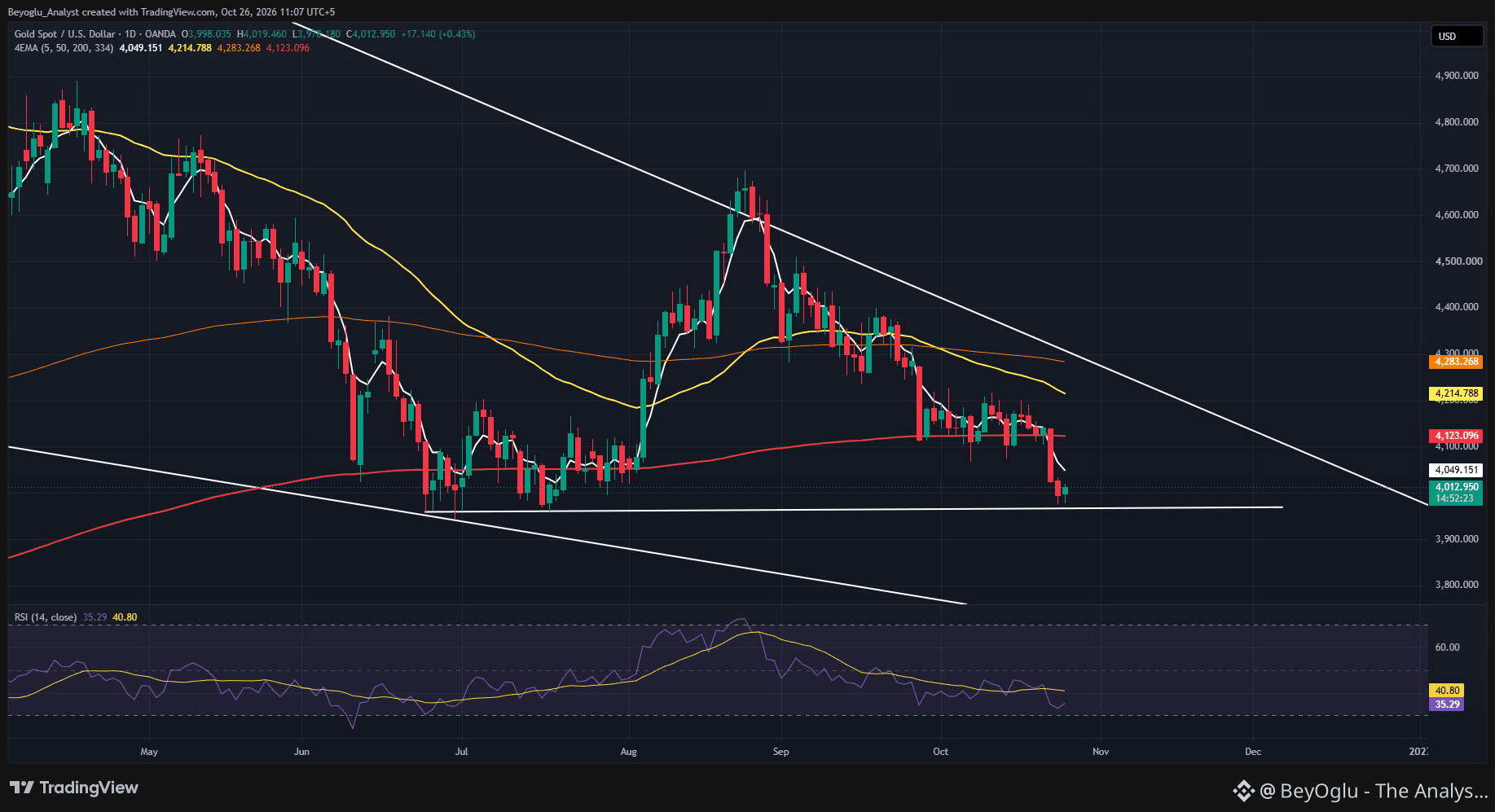
Gold price ($XAU ) rallies more than 3% on Friday, poised for a decent weekly gain as dip buyers emerged, following a session that pushed the yellow metal below the $4,800 mark. Worth noting that Friday has been a volatile session, with the non-yielding metal falling to a three-day low of $4,655 before erasing those previous losses. At the time of writing, XAU/USD trades at $4,950.
Federal Reserve (Fed) Board of Governors Phillip Jefferson said that future Fed moves will be driven by data and views on the economic outlook. He also added on Friday that the job market is slowly stabilizing.
Key takeaways: "US central bank's current monetary policy is "well-positioned" to deal with what likely lies ahead.
Future Fed moves to be driven by data and views on outlook.
Fed's stance allows 'leeway' for supply side of economy to develop.
He is 'cautiously optimistic' about economic outlook.
Job market stabilizing, inflation should moderate.
Strong commitment to price stability reduces inflation risks.
Tariffs likely represent a one-time shift in price level.
It's possible that stronger productivity could temper inflation pressures.
Tariffs were key driver of inflation in 2025, price pressures should ease in 2026.
Personal consumption expenditures price index likely up by 2.9% in December on year-over-year basis.
He supported last year’s interest rate cuts, policy roughly in neutral stance.
While upside risks remain, he expects inflation pressures to ease.
Job market likely in balance with low-hire, low-fire environment.
He expects economy to grow by 2.2% this year.
Job market softer on reduced demand, immigration issues.”
The table below shows the percentage change of US Dollar (USD) against listed major currencies today. US Dollar was the strongest against the Japanese Yen.