

bendigote
69 Posts

bendigote
Report
Block User
Análisis, lectura técnica y más.
Open Trade
Frequent Trader
5.4 Years
8 Following
44 Followers
33 Liked
Posts
Portfolio
·
--
Whale war at $77: who has more to lose? 🐋
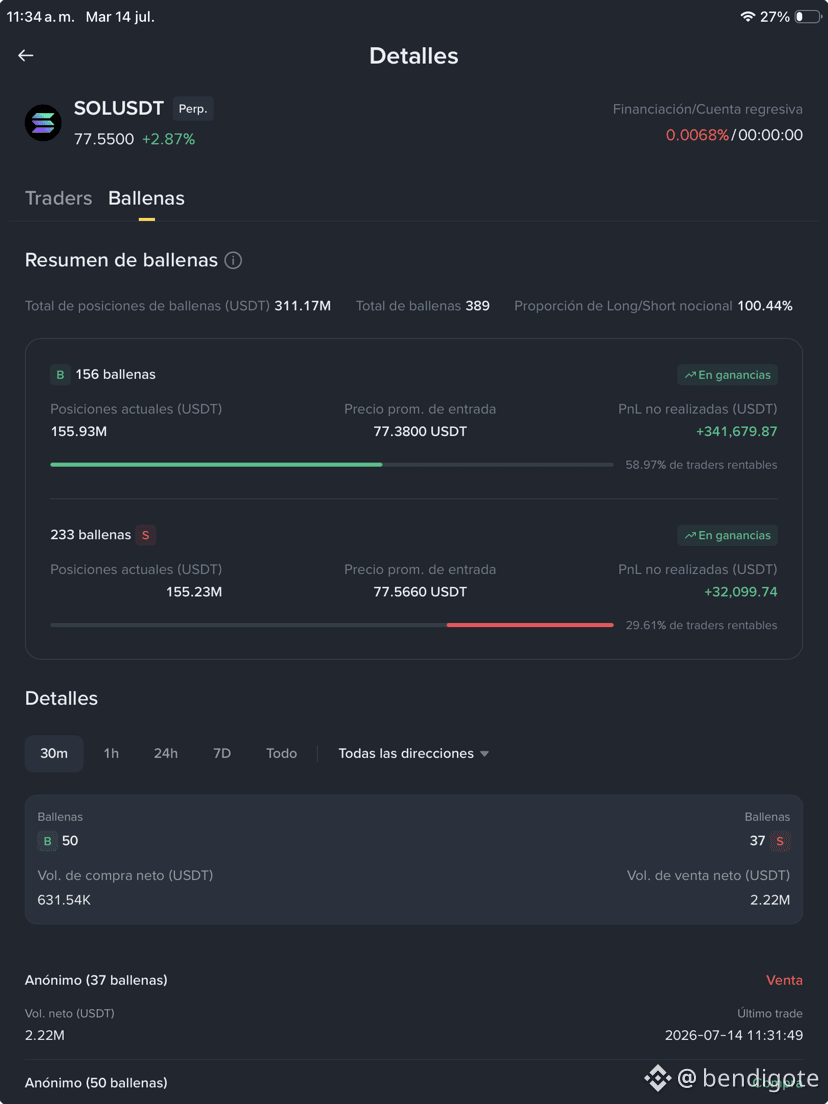
The latest updates to whale flow data at $SOL (Sol Perpetuo) have just been applied, and the position map leaves us with a high-tension scenario. With $311.17M USDT at stake, the battle to control the price is at a critical point.
What the data says:
Balance of power: The Long/Short ratio is practically even (100.44%), indicating we’re at a forced equilibrium.
The advantage of the Longs: There are 156 whales in long positions with an unrealized PnL of +$341k. Their average entry price is 77.38, which currently puts them "in the money."
Short pressure: We have 233 whales in short positions, but with a much tighter PnL (just +$32k). Their average price is 77.56. Here’s the key: many of these shorts are trading right at the edge of risk.
Short-position whales have a clear technical disadvantage: there are more of them (233 vs 156), but they’re far less profitable. This suggests there’s an accumulation of bearish positions that could be forced to close if the price holds steady or attempts a breakout to the upside. If the price rises a bit more, we could see a rather aggressive "Short Squeeze."
Possible outcomes:
1. Squeeze scenario: If the price breaks above $77.60 with volume, the 233 short whales will start liquidating positions to protect capital, accelerating the rise.
2. Capitulation scenario: If the price loses $77.30, it will be the long whales who have to decide whether to cut losses, which could send the price down quickly.
We’re at a level where whale profitability will determine the next move. Don’t trade on intuition—watch these entry levels (77.38 vs 77.56). That’s where the market direction will be decided over the next few hours.
Which side do you think will end up tipping the balance? I’m listening. 👇
{future}(SOLUSDT)
Whale war at $77: who has more to lose? 🐋
The latest updates to whale flow data at $SOL (Sol Perpetuo) have just been applied, and the position map leaves us with a high-tension scenario. With $311.17M USDT at stake, the battle to control the price is at a critical point.
What the data says:
Balance of power: The Long/Short ratio is practically even (100.44%), indicating we’re at a forced equilibrium.
The advantage of the Longs: There are 156 whales in long positions with an unrealized PnL of +$341k. Their average entry price is 77.38, which currently puts them "in the money."
Short pressure: We have 233 whales in short positions, but with a much tighter PnL (just +$32k). Their average price is 77.56. Here’s the key: many of these shorts are trading right at the edge of risk.
Short-position whales have a clear technical disadvantage: there are more of them (233 vs 156), but they’re far less profitable. This suggests there’s an accumulation of bearish positions that could be forced to close if the price holds steady or attempts a breakout to the upside. If the price rises a bit more, we could see a rather aggressive "Short Squeeze."
Possible outcomes:
1. Squeeze scenario: If the price breaks above $77.60 with volume, the 233 short whales will start liquidating positions to protect capital, accelerating the rise.
2. Capitulation scenario: If the price loses $77.30, it will be the long whales who have to decide whether to cut losses, which could send the price down quickly.
We’re at a level where whale profitability will determine the next move. Don’t trade on intuition—watch these entry levels (77.38 vs 77.56). That’s where the market direction will be decided over the next few hours.
Which side do you think will end up tipping the balance? I’m listening. 👇
The latest updates to whale flow data at $SOL (Sol Perpetuo) have just been applied, and the position map leaves us with a high-tension scenario. With $311.17M USDT at stake, the battle to control the price is at a critical point.
What the data says:
Balance of power: The Long/Short ratio is practically even (100.44%), indicating we’re at a forced equilibrium.
The advantage of the Longs: There are 156 whales in long positions with an unrealized PnL of +$341k. Their average entry price is 77.38, which currently puts them "in the money."
Short pressure: We have 233 whales in short positions, but with a much tighter PnL (just +$32k). Their average price is 77.56. Here’s the key: many of these shorts are trading right at the edge of risk.
Short-position whales have a clear technical disadvantage: there are more of them (233 vs 156), but they’re far less profitable. This suggests there’s an accumulation of bearish positions that could be forced to close if the price holds steady or attempts a breakout to the upside. If the price rises a bit more, we could see a rather aggressive "Short Squeeze."
Possible outcomes:
1. Squeeze scenario: If the price breaks above $77.60 with volume, the 233 short whales will start liquidating positions to protect capital, accelerating the rise.
2. Capitulation scenario: If the price loses $77.30, it will be the long whales who have to decide whether to cut losses, which could send the price down quickly.
We’re at a level where whale profitability will determine the next move. Don’t trade on intuition—watch these entry levels (77.38 vs 77.56). That’s where the market direction will be decided over the next few hours.
Which side do you think will end up tipping the balance? I’m listening. 👇
2
1
1.2k
·
--
Newton Protocol and the utopia of AI agents: Reality or marketing? 🧐
I’ve been analyzing the progress of Newton Protocol for days, and although the narrative of an onchain policy infrastructure for AI agents is compelling, we need to separate the noise from the technical reality.
My critical take:
The value proposition is clear: prevent autonomous agents from carrying out uncontrolled operations through a layer of prior authorization. On paper, it’s the “seatbelt” that DeFi needs so institutional capital feels comfortable. However, I have doubts about the implementation:
1. The bottleneck dilemma: Can the protocol handle complex policies without adding latency that kills the user experience? Verifiable security usually comes at the cost of speed, and in the world of AI agents, every millisecond counts.
2. Centralization risk: Beyond the marketing, the real test will be whether these policy validators can maintain a truly decentralized framework—or whether we’ll end up depending on a handful of decision-making nodes.
3. Adoption vs. Hype: It’s easy to promise security; the hard part is getting developers to integrate this layer at scale. If Newton’s SDK isn’t flawless, it will remain another interesting technical project with no real traction.
Don’t misunderstand me—I think the direction is right. Forensic security is a thing of the past; we need preventive authorization. But is Newton the ultimate solution, or just the first version of something that still needs to prove it can scale?
I’d rather be skeptical and wait to see how they handle network stress under real conditions before calling it a win. What do you think? Do you see Newton as a necessary standard, or do you believe the technical complexity will work against it? I’m reading your thoughts below. 👇
Disclaimer: Educational content and personal analysis. This is not financial advice. DYOR.
@NewtonProtocol $NEWT #Newt
Newton Protocol and the utopia of AI agents: Reality or marketing? 🧐
I’ve been analyzing the progress of Newton Protocol for days, and although the narrative of an onchain policy infrastructure for AI agents is compelling, we need to separate the noise from the technical reality.
My critical take:
The value proposition is clear: prevent autonomous agents from carrying out uncontrolled operations through a layer of prior authorization. On paper, it’s the “seatbelt” that DeFi needs so institutional capital feels comfortable. However, I have doubts about the implementation:
1. The bottleneck dilemma: Can the protocol handle complex policies without adding latency that kills the user experience? Verifiable security usually comes at the cost of speed, and in the world of AI agents, every millisecond counts.
2. Centralization risk: Beyond the marketing, the real test will be whether these policy validators can maintain a truly decentralized framework—or whether we’ll end up depending on a handful of decision-making nodes.
3. Adoption vs. Hype: It’s easy to promise security; the hard part is getting developers to integrate this layer at scale. If Newton’s SDK isn’t flawless, it will remain another interesting technical project with no real traction.
Don’t misunderstand me—I think the direction is right. Forensic security is a thing of the past; we need preventive authorization. But is Newton the ultimate solution, or just the first version of something that still needs to prove it can scale?
I’d rather be skeptical and wait to see how they handle network stress under real conditions before calling it a win. What do you think? Do you see Newton as a necessary standard, or do you believe the technical complexity will work against it? I’m reading your thoughts below. 👇
Disclaimer: Educational content and personal analysis. This is not financial advice. DYOR.
@NewtonProtocol $NEWT #Newt
I’ve been analyzing the progress of Newton Protocol for days, and although the narrative of an onchain policy infrastructure for AI agents is compelling, we need to separate the noise from the technical reality.
My critical take:
The value proposition is clear: prevent autonomous agents from carrying out uncontrolled operations through a layer of prior authorization. On paper, it’s the “seatbelt” that DeFi needs so institutional capital feels comfortable. However, I have doubts about the implementation:
1. The bottleneck dilemma: Can the protocol handle complex policies without adding latency that kills the user experience? Verifiable security usually comes at the cost of speed, and in the world of AI agents, every millisecond counts.
2. Centralization risk: Beyond the marketing, the real test will be whether these policy validators can maintain a truly decentralized framework—or whether we’ll end up depending on a handful of decision-making nodes.
3. Adoption vs. Hype: It’s easy to promise security; the hard part is getting developers to integrate this layer at scale. If Newton’s SDK isn’t flawless, it will remain another interesting technical project with no real traction.
Don’t misunderstand me—I think the direction is right. Forensic security is a thing of the past; we need preventive authorization. But is Newton the ultimate solution, or just the first version of something that still needs to prove it can scale?
I’d rather be skeptical and wait to see how they handle network stress under real conditions before calling it a win. What do you think? Do you see Newton as a necessary standard, or do you believe the technical complexity will work against it? I’m reading your thoughts below. 👇
Disclaimer: Educational content and personal analysis. This is not financial advice. DYOR.
@NewtonProtocol $NEWT #Newt
68
·
--

Article
Why transparency is the real bottleneck of financial AIIn the current debate about integrating autonomous agents into the crypto ecosystem, there is a near-religious fascination with execution speed. We are told that the future belongs to those agents capable of operating with minimal latency, reacting to fluctuations in Bitcoin or Solana in milliseconds. However, in this race for operational efficiency, we are overlooking a structural problem that will determine whether <c-9/> and similar technologies become the foundational layer of tomorrow’s finance—or whether they end up as a sophisticated but marginal technical experiment.
Why transparency is the real bottleneck of financial AI
In the current debate about integrating autonomous agents into the crypto ecosystem, there is a near-religious fascination with execution speed. We are told that the future belongs to those agents capable of operating with minimal latency, reacting to fluctuations in Bitcoin or Solana in milliseconds. However, in this race for operational efficiency, we are overlooking a structural problem that will determine whether <c-9/> and similar technologies become the foundational layer of tomorrow’s finance—or whether they end up as a sophisticated but marginal technical experiment.
2
103
·
--
I’ve been analyzing how the governance of @NewtonProtocol enables real-time adjustments, and I wonder whether the “flexibility” it offers is, in reality, a blind spot for operators.
The idea is often sold that dynamic rule configuration is a competitive advantage. However, there’s a fine line between operational agility and the erosion of baseline security. If we compare the robustness of networks like #BTC , where immutability is the rule, with the malleability of policies in DeFi environments, an uncomfortable question arises:
At what point does the protocol stop being a “default-deny” policy and instead become simply a pass filter for any transaction the operator considers “profitable”?
The security of a system based on Rego—especially when it interacts with the speed and liquidity of networks like #sol —should not depend on the good faith of whoever configures the policy, but on the quality of the logical constraints.
To what extent should we standardize the “exception parameters” to ensure that excessive customization doesn’t end up weakening the security fabric the protocol promises?
I believe trust should rest exclusively on the code, not on arbitrary configuration. What do you think? Should the ecosystem impose stricter limits on how far an “exception” can go, or is the operator’s sovereignty a non-negotiable principle?
What do you trust more when operating with access policies on #Newt?
Vote and leave your justification in the comments!
@NewtonProtocol #Newt $NEWT
I’ve been analyzing how the governance of @NewtonProtocol enables real-time adjustments, and I wonder whether the “flexibility” it offers is, in reality, a blind spot for operators.
The idea is often sold that dynamic rule configuration is a competitive advantage. However, there’s a fine line between operational agility and the erosion of baseline security. If we compare the robustness of networks like #BTC , where immutability is the rule, with the malleability of policies in DeFi environments, an uncomfortable question arises:
At what point does the protocol stop being a “default-deny” policy and instead become simply a pass filter for any transaction the operator considers “profitable”?
The security of a system based on Rego—especially when it interacts with the speed and liquidity of networks like #sol —should not depend on the good faith of whoever configures the policy, but on the quality of the logical constraints.
To what extent should we standardize the “exception parameters” to ensure that excessive customization doesn’t end up weakening the security fabric the protocol promises?
I believe trust should rest exclusively on the code, not on arbitrary configuration. What do you think? Should the ecosystem impose stricter limits on how far an “exception” can go, or is the operator’s sovereignty a non-negotiable principle?
What do you trust more when operating with access policies on #Newt?
Vote and leave your justification in the comments!
@NewtonProtocol #Newt $NEWT
The idea is often sold that dynamic rule configuration is a competitive advantage. However, there’s a fine line between operational agility and the erosion of baseline security. If we compare the robustness of networks like #BTC , where immutability is the rule, with the malleability of policies in DeFi environments, an uncomfortable question arises:
At what point does the protocol stop being a “default-deny” policy and instead become simply a pass filter for any transaction the operator considers “profitable”?
The security of a system based on Rego—especially when it interacts with the speed and liquidity of networks like #sol —should not depend on the good faith of whoever configures the policy, but on the quality of the logical constraints.
To what extent should we standardize the “exception parameters” to ensure that excessive customization doesn’t end up weakening the security fabric the protocol promises?
I believe trust should rest exclusively on the code, not on arbitrary configuration. What do you think? Should the ecosystem impose stricter limits on how far an “exception” can go, or is the operator’s sovereignty a non-negotiable principle?
What do you trust more when operating with access policies on #Newt?
Vote and leave your justification in the comments!
@NewtonProtocol #Newt $NEWT
Código estricto (Rego)
50%
Soberanía del operador
0%
Auditorías externas
50%
Consenso comunitario
0%
2 votes • Voting closed
140
·
--
Sol Perpetuo ($SOL ): Extreme strength and caution signals 📊
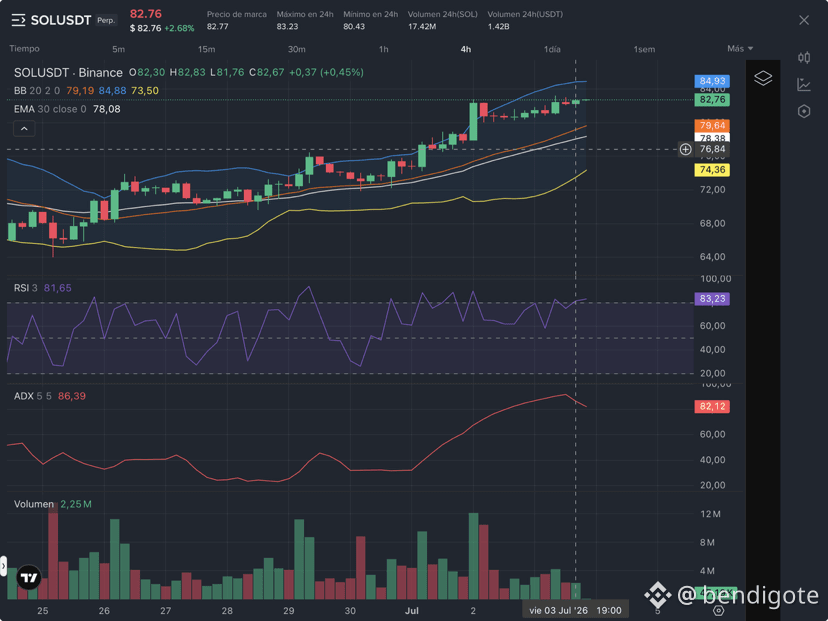
The Sol Perpetuo market is showing intense technical dynamics within the 4-hour timeframe. With a current price of 82.76, after the last candle closed at 82.67, it’s time to analyze the key indicators:
Technical Summary (4H):
Trend: Clearly bullish structure, trading above the 78.08 EMA and the Bollinger Bands’ midline (79.19).
RSI (81.65): We’re in a zone of extreme overbought. Historically, levels above 70 suggest the price has risen very quickly and a correction or imminent pullback could occur.
ADX (86.39): Such a high ADX level confirms that the uptrend is extremely strong, but it also often serves as a warning signal of potential trend exhaustion in the short term.
Structure Analysis:
The asset has managed to break upward with strength, but the momentum indicators (RSI) and trend strength (ADX) are at levels where caution is necessary.
What to watch?
1. Support: The Bollinger midline at 79.19 and the EMA at 78.08 are critical levels that should act as support in case of a pullback.
2. Volume: With 2.25M in volume, we’ll see whether buying interest manages to hold the price above the recent highs of 82.83 or if we see profit-taking.
Although the trend is dominant, the market is “hot.” It’s likely we’ll see a consolidation phase or a technical pullback before attempting new highs.
Disclaimer: This content is for educational purposes and does not constitute financial advice. Always do your own research (DYOR).
{future}(SOLUSDT)
Sol Perpetuo ($SOL ): Extreme strength and caution signals 📊
The Sol Perpetuo market is showing intense technical dynamics within the 4-hour timeframe. With a current price of 82.76, after the last candle closed at 82.67, it’s time to analyze the key indicators:
Technical Summary (4H):
Trend: Clearly bullish structure, trading above the 78.08 EMA and the Bollinger Bands’ midline (79.19).
RSI (81.65): We’re in a zone of extreme overbought. Historically, levels above 70 suggest the price has risen very quickly and a correction or imminent pullback could occur.
ADX (86.39): Such a high ADX level confirms that the uptrend is extremely strong, but it also often serves as a warning signal of potential trend exhaustion in the short term.
Structure Analysis:
The asset has managed to break upward with strength, but the momentum indicators (RSI) and trend strength (ADX) are at levels where caution is necessary.
What to watch?
1. Support: The Bollinger midline at 79.19 and the EMA at 78.08 are critical levels that should act as support in case of a pullback.
2. Volume: With 2.25M in volume, we’ll see whether buying interest manages to hold the price above the recent highs of 82.83 or if we see profit-taking.
Although the trend is dominant, the market is “hot.” It’s likely we’ll see a consolidation phase or a technical pullback before attempting new highs.
Disclaimer: This content is for educational purposes and does not constitute financial advice. Always do your own research (DYOR).
The Sol Perpetuo market is showing intense technical dynamics within the 4-hour timeframe. With a current price of 82.76, after the last candle closed at 82.67, it’s time to analyze the key indicators:
Technical Summary (4H):
Trend: Clearly bullish structure, trading above the 78.08 EMA and the Bollinger Bands’ midline (79.19).
RSI (81.65): We’re in a zone of extreme overbought. Historically, levels above 70 suggest the price has risen very quickly and a correction or imminent pullback could occur.
ADX (86.39): Such a high ADX level confirms that the uptrend is extremely strong, but it also often serves as a warning signal of potential trend exhaustion in the short term.
Structure Analysis:
The asset has managed to break upward with strength, but the momentum indicators (RSI) and trend strength (ADX) are at levels where caution is necessary.
What to watch?
1. Support: The Bollinger midline at 79.19 and the EMA at 78.08 are critical levels that should act as support in case of a pullback.
2. Volume: With 2.25M in volume, we’ll see whether buying interest manages to hold the price above the recent highs of 82.83 or if we see profit-taking.
Although the trend is dominant, the market is “hot.” It’s likely we’ll see a consolidation phase or a technical pullback before attempting new highs.
Disclaimer: This content is for educational purposes and does not constitute financial advice. Always do your own research (DYOR).
662
·
--
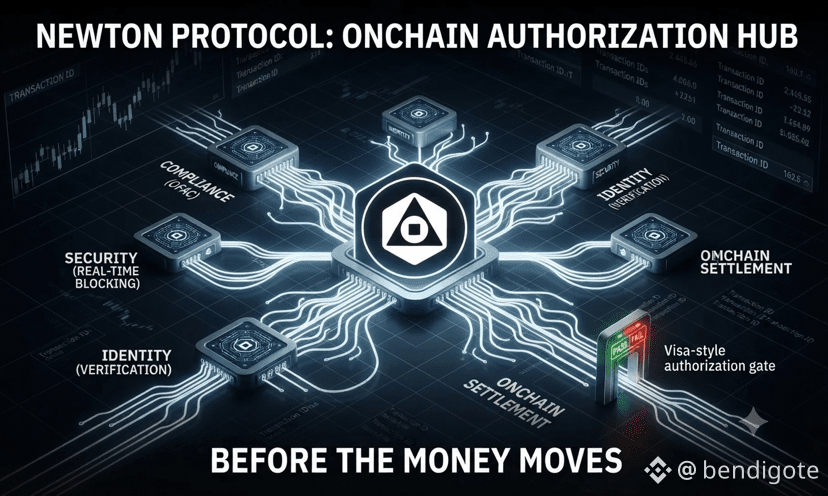
Newton Protocol is redefining onchain transaction infrastructure through "pre-authorization". Unlike other tools that only report events, Newton enforces policy validation (identity, APY, oracle health) before final settlement. It is the evolution toward a robust and scalable security policy market.
@NewtonProtocol $NEWT #Newt
{future}(NEWTUSDT)
Newton Protocol is redefining onchain transaction infrastructure through "pre-authorization". Unlike other tools that only report events, Newton enforces policy validation (identity, APY, oracle health) before final settlement. It is the evolution toward a robust and scalable security policy market.
@NewtonProtocol $NEWT #Newt
@NewtonProtocol $NEWT #Newt
2
62
·
--
Solana ($SOL ): The calm after the technical storm ⚡
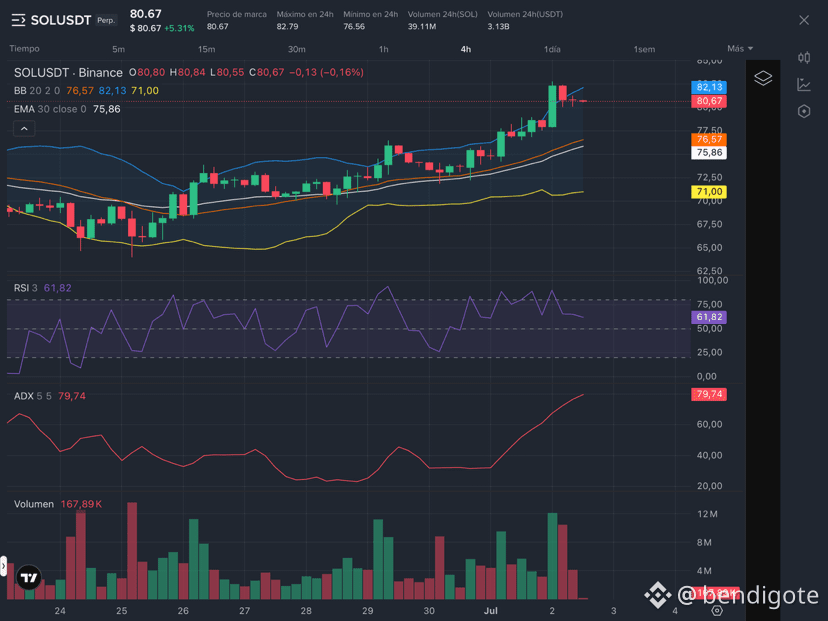
The last 4-hour candle close at $80.67 leaves us with a fascinating read on the current trend status of Solana. Even though it closed with a slight red candle, the technical structure reveals data we can’t ignore.
Key points of the analysis:
Trend Intensity (ADX): With a value of 79.74, the uptrend remains in a phase of maximum strength. This indicates that although the price is consolidating, the underlying momentum is still dominant and has not shown signs of structural exhaustion.
Consolidation Zone: We’re still trading near the moving average of the Bollinger Bands ($76.57), which is a key area. The current price of $80.67 suggests the market is absorbing selling pressure after the recent highs.
Falling RSI: The indicator has dropped to 61.82. This is a positive move: the asset is “cooling off” after the previous extreme overbought conditions, allowing room for new buyers to enter without the price being overextended.
Volume: With 167.89k in the last candle, we see stabilization in activity compared to earlier spikes, which is typical of a re-accumulation phase.
Conclusion:
Solana is in a phase of “technical waiting.” With such a high ADX, the likelihood of an explosive move remains high. The key for the next few hours will be to see whether technical support in the $76–$77 zone can hold. If we manage to consolidate here, the market will be setting the stage for the next bullish leg.
Do you think this is a necessary pause to continue the trend, or will we see a retest of lower levels? I’m reading your thoughts in the comments.
{future}(SOLUSDT)
Solana ($SOL ): The calm after the technical storm ⚡
The last 4-hour candle close at $80.67 leaves us with a fascinating read on the current trend status of Solana. Even though it closed with a slight red candle, the technical structure reveals data we can’t ignore.
Key points of the analysis:
Trend Intensity (ADX): With a value of 79.74, the uptrend remains in a phase of maximum strength. This indicates that although the price is consolidating, the underlying momentum is still dominant and has not shown signs of structural exhaustion.
Consolidation Zone: We’re still trading near the moving average of the Bollinger Bands ($76.57), which is a key area. The current price of $80.67 suggests the market is absorbing selling pressure after the recent highs.
Falling RSI: The indicator has dropped to 61.82. This is a positive move: the asset is “cooling off” after the previous extreme overbought conditions, allowing room for new buyers to enter without the price being overextended.
Volume: With 167.89k in the last candle, we see stabilization in activity compared to earlier spikes, which is typical of a re-accumulation phase.
Conclusion:
Solana is in a phase of “technical waiting.” With such a high ADX, the likelihood of an explosive move remains high. The key for the next few hours will be to see whether technical support in the $76–$77 zone can hold. If we manage to consolidate here, the market will be setting the stage for the next bullish leg.
Do you think this is a necessary pause to continue the trend, or will we see a retest of lower levels? I’m reading your thoughts in the comments.
The last 4-hour candle close at $80.67 leaves us with a fascinating read on the current trend status of Solana. Even though it closed with a slight red candle, the technical structure reveals data we can’t ignore.
Key points of the analysis:
Trend Intensity (ADX): With a value of 79.74, the uptrend remains in a phase of maximum strength. This indicates that although the price is consolidating, the underlying momentum is still dominant and has not shown signs of structural exhaustion.
Consolidation Zone: We’re still trading near the moving average of the Bollinger Bands ($76.57), which is a key area. The current price of $80.67 suggests the market is absorbing selling pressure after the recent highs.
Falling RSI: The indicator has dropped to 61.82. This is a positive move: the asset is “cooling off” after the previous extreme overbought conditions, allowing room for new buyers to enter without the price being overextended.
Volume: With 167.89k in the last candle, we see stabilization in activity compared to earlier spikes, which is typical of a re-accumulation phase.
Conclusion:
Solana is in a phase of “technical waiting.” With such a high ADX, the likelihood of an explosive move remains high. The key for the next few hours will be to see whether technical support in the $76–$77 zone can hold. If we manage to consolidate here, the market will be setting the stage for the next bullish leg.
Do you think this is a necessary pause to continue the trend, or will we see a retest of lower levels? I’m reading your thoughts in the comments.
113
·
--

Article
Newton Mainnet Beta: The new era of verifiable AI infrastructureThe landscape of Artificial Intelligence (AI) is constantly evolving, but the true revolution isn’t happening only in language models—it’s also in how that intelligence is executed, verified, and decentralized. With the launch of the Newton Mainnet Beta, @NewtonProtocol it positions itself as a foundational infrastructure for Web3.
What makes Newton different?
What really sets this protocol apart from the rest is its focus on verifiable computation. In a world where trust is scarce, Newton uses trusted execution environments (TEEs) and zero-knowledge proofs (ZK proofs) to ensure that AI models infer data accurately, without compromising user privacy or the integrity of the source.
Newton Mainnet Beta: The new era of verifiable AI infrastructure
The landscape of Artificial Intelligence (AI) is constantly evolving, but the true revolution isn’t happening only in language models—it’s also in how that intelligence is executed, verified, and decentralized. With the launch of the Newton Mainnet Beta, @NewtonProtocol it positions itself as a foundational infrastructure for Web3.
What makes Newton different?
What really sets this protocol apart from the rest is its focus on verifiable computation. In a world where trust is scarce, Newton uses trusted execution environments (TEEs) and zero-knowledge proofs (ZK proofs) to ensure that AI models infer data accurately, without compromising user privacy or the integrity of the source.
What makes Newton different?
What really sets this protocol apart from the rest is its focus on verifiable computation. In a world where trust is scarce, Newton uses trusted execution environments (TEEs) and zero-knowledge proofs (ZK proofs) to ensure that AI models infer data accurately, without compromising user privacy or the integrity of the source.
4
40
·
--
Bitcoin ($BTC ) breaks resistance: Technical analysis after the latest impulse 📈
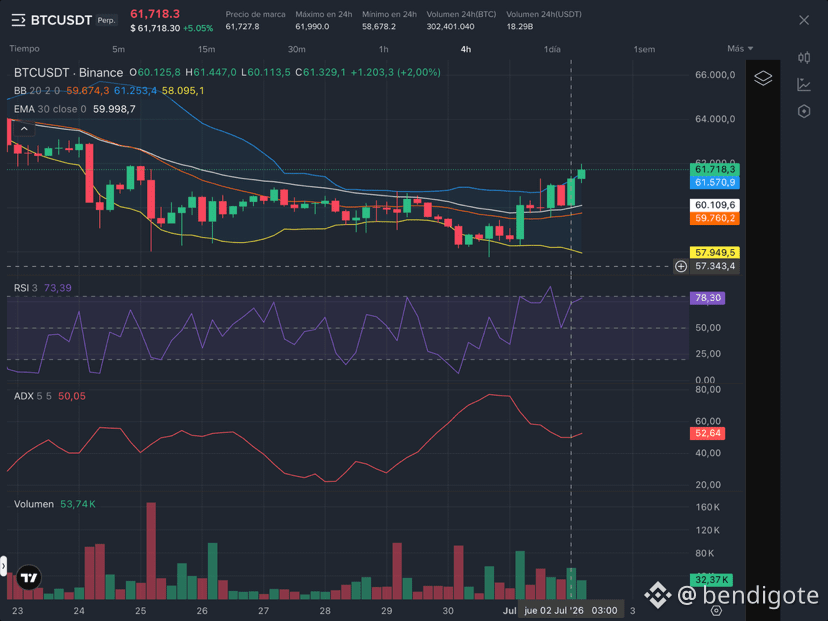
The last 4-hour candle for $BTC confirms that the bulls have full control of the market. With a close of $61.329,1, Bitcoin has not only surpassed the moving average, but is also challenging the upper limits of its current technical structure.
Key points of the technical analysis:
Bullish Impulse: The ADX at 50.05 confirms a strong uptrend with high directional strength. The market is not hesitating; there is a clear intent to keep seeking liquidity at higher levels.
Resistance Zone: The candle closed very close to the Upper Bollinger Band ($61.253,4). This is a critical indicator: breaking and holding above this band suggests a phase of “bullish volatility expansion.”
Overbought Condition: With an RSI at 73.39, Bitcoin has entered overbought territory. Although this indicates strength, it also warns us about the need for short-term consolidation before attempting new highs.
Volume: The 53.74k in volume supports this move, lending institutional validity to the breakout.
Conclusion:
Bitcoin is currently trading at $61.718,3, which confirms that the momentum following the candle close remains positive. The structure suggests that, as long as the price stays above the Bands’ median ($59.674,3), the bullish bias remains intact.
The question for the community is: Are we seeing the start of a new leg toward local highs, or will we see immediate profit-taking due to the elevated RSI?
{future}(BTCUSDT)
Bitcoin ($BTC ) breaks resistance: Technical analysis after the latest impulse 📈
The last 4-hour candle for $BTC confirms that the bulls have full control of the market. With a close of $61.329,1, Bitcoin has not only surpassed the moving average, but is also challenging the upper limits of its current technical structure.
Key points of the technical analysis:
Bullish Impulse: The ADX at 50.05 confirms a strong uptrend with high directional strength. The market is not hesitating; there is a clear intent to keep seeking liquidity at higher levels.
Resistance Zone: The candle closed very close to the Upper Bollinger Band ($61.253,4). This is a critical indicator: breaking and holding above this band suggests a phase of “bullish volatility expansion.”
Overbought Condition: With an RSI at 73.39, Bitcoin has entered overbought territory. Although this indicates strength, it also warns us about the need for short-term consolidation before attempting new highs.
Volume: The 53.74k in volume supports this move, lending institutional validity to the breakout.
Conclusion:
Bitcoin is currently trading at $61.718,3, which confirms that the momentum following the candle close remains positive. The structure suggests that, as long as the price stays above the Bands’ median ($59.674,3), the bullish bias remains intact.
The question for the community is: Are we seeing the start of a new leg toward local highs, or will we see immediate profit-taking due to the elevated RSI?
The last 4-hour candle for $BTC confirms that the bulls have full control of the market. With a close of $61.329,1, Bitcoin has not only surpassed the moving average, but is also challenging the upper limits of its current technical structure.
Key points of the technical analysis:
Bullish Impulse: The ADX at 50.05 confirms a strong uptrend with high directional strength. The market is not hesitating; there is a clear intent to keep seeking liquidity at higher levels.
Resistance Zone: The candle closed very close to the Upper Bollinger Band ($61.253,4). This is a critical indicator: breaking and holding above this band suggests a phase of “bullish volatility expansion.”
Overbought Condition: With an RSI at 73.39, Bitcoin has entered overbought territory. Although this indicates strength, it also warns us about the need for short-term consolidation before attempting new highs.
Volume: The 53.74k in volume supports this move, lending institutional validity to the breakout.
Conclusion:
Bitcoin is currently trading at $61.718,3, which confirms that the momentum following the candle close remains positive. The structure suggests that, as long as the price stays above the Bands’ median ($59.674,3), the bullish bias remains intact.
The question for the community is: Are we seeing the start of a new leg toward local highs, or will we see immediate profit-taking due to the elevated RSI?
22
·
--
Is Solana ($SOL ) at a turning point? Technical analysis after breaking above $80 🚀
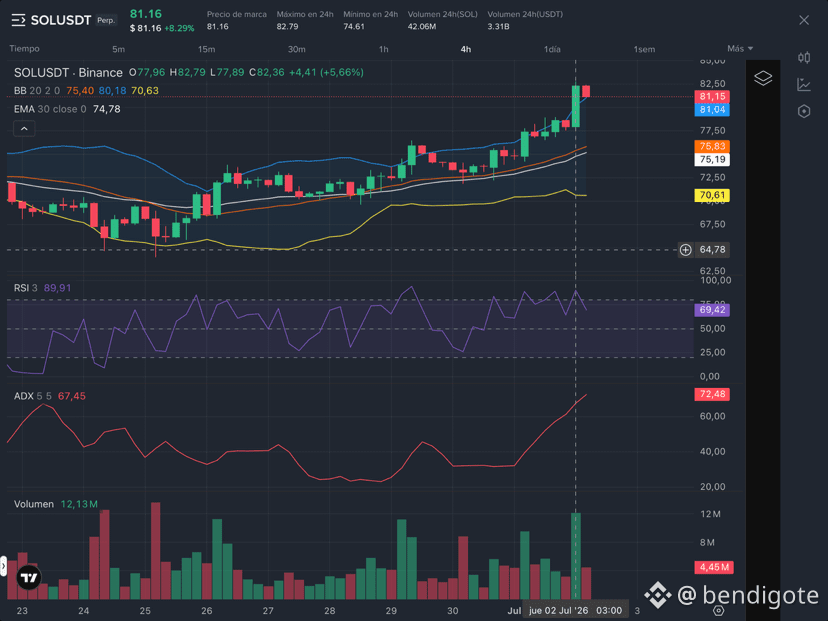
After the close of the latest 4-hour candle, the technical outlook for $SOL has become extremely interesting. With a closing price of $82.36, Solana has strongly broken through the upper Bollinger Band ($80.18), confirming a highly bullish range expansion.
Key points of the technical analysis:
Trend Strength: The ADX at 67.45 indicates an extremely solid and mature uptrend. This is not a simple bounce, but an impulse with conviction.
Technical Overbought: With an RSI at 89.91, we need maximum caution. The asset is at levels of extreme overbought, which often precedes consolidation or a technical pullback to cool down the indicator.
Volume: The 12.13M volume supports the move upward, validating buy-side interest and lending credibility to this breakout.
Levels to watch: The current price (81.16) stays above the Bollinger Bands average ($75.40), confirming that, in the short term, market control remains with the buyers.
Conclusion:
The break above $80 was the key obstacle to neutralize the bearish bias. If the volume holds up, the next technical target points to higher levels, but caution is needed given the RSI level.
Are we seeing the start of a sustained recovery, or will we get immediate profit-taking right after this volatility spike?
{future}(SOLUSDT)
Is Solana ($SOL ) at a turning point? Technical analysis after breaking above $80 🚀
After the close of the latest 4-hour candle, the technical outlook for $SOL has become extremely interesting. With a closing price of $82.36, Solana has strongly broken through the upper Bollinger Band ($80.18), confirming a highly bullish range expansion.
Key points of the technical analysis:
Trend Strength: The ADX at 67.45 indicates an extremely solid and mature uptrend. This is not a simple bounce, but an impulse with conviction.
Technical Overbought: With an RSI at 89.91, we need maximum caution. The asset is at levels of extreme overbought, which often precedes consolidation or a technical pullback to cool down the indicator.
Volume: The 12.13M volume supports the move upward, validating buy-side interest and lending credibility to this breakout.
Levels to watch: The current price (81.16) stays above the Bollinger Bands average ($75.40), confirming that, in the short term, market control remains with the buyers.
Conclusion:
The break above $80 was the key obstacle to neutralize the bearish bias. If the volume holds up, the next technical target points to higher levels, but caution is needed given the RSI level.
Are we seeing the start of a sustained recovery, or will we get immediate profit-taking right after this volatility spike?
After the close of the latest 4-hour candle, the technical outlook for $SOL has become extremely interesting. With a closing price of $82.36, Solana has strongly broken through the upper Bollinger Band ($80.18), confirming a highly bullish range expansion.
Key points of the technical analysis:
Trend Strength: The ADX at 67.45 indicates an extremely solid and mature uptrend. This is not a simple bounce, but an impulse with conviction.
Technical Overbought: With an RSI at 89.91, we need maximum caution. The asset is at levels of extreme overbought, which often precedes consolidation or a technical pullback to cool down the indicator.
Volume: The 12.13M volume supports the move upward, validating buy-side interest and lending credibility to this breakout.
Levels to watch: The current price (81.16) stays above the Bollinger Bands average ($75.40), confirming that, in the short term, market control remains with the buyers.
Conclusion:
The break above $80 was the key obstacle to neutralize the bearish bias. If the volume holds up, the next technical target points to higher levels, but caution is needed given the RSI level.
Are we seeing the start of a sustained recovery, or will we get immediate profit-taking right after this volatility spike?
1
1.3k
·
--
Why is Newton’s AI Marketplace the logical next step for developers?
After observing volatility and network demand in high-speed ecosystems, it becomes clear that AI infrastructure needs an immutable verification layer. This is where @NewtonProtocol makes the difference.
Your AI developer marketplace is not just a repository; it’s an environment designed to make model inference verifiable at scale. What stands out most about the Mainnet Beta is how they remove technical barriers to integrate autonomous agents, allowing trading logic to move from being "opaque" to being fully auditable through ZK proofs.
For developers of us who are looking for efficiency without sacrificing security, integrating tools in $NEWT is the logical path. It’s an infrastructure solution built for the future of verifiable automation.
Which marketplace feature from Newton do you find most disruptive for developing new AI agents? #Newt
{future}(NEWTUSDT)
Why is Newton’s AI Marketplace the logical next step for developers?
After observing volatility and network demand in high-speed ecosystems, it becomes clear that AI infrastructure needs an immutable verification layer. This is where @NewtonProtocol makes the difference.
Your AI developer marketplace is not just a repository; it’s an environment designed to make model inference verifiable at scale. What stands out most about the Mainnet Beta is how they remove technical barriers to integrate autonomous agents, allowing trading logic to move from being "opaque" to being fully auditable through ZK proofs.
For developers of us who are looking for efficiency without sacrificing security, integrating tools in $NEWT is the logical path. It’s an infrastructure solution built for the future of verifiable automation.
Which marketplace feature from Newton do you find most disruptive for developing new AI agents? #Newt
After observing volatility and network demand in high-speed ecosystems, it becomes clear that AI infrastructure needs an immutable verification layer. This is where @NewtonProtocol makes the difference.
Your AI developer marketplace is not just a repository; it’s an environment designed to make model inference verifiable at scale. What stands out most about the Mainnet Beta is how they remove technical barriers to integrate autonomous agents, allowing trading logic to move from being "opaque" to being fully auditable through ZK proofs.
For developers of us who are looking for efficiency without sacrificing security, integrating tools in $NEWT is the logical path. It’s an infrastructure solution built for the future of verifiable automation.
Which marketplace feature from Newton do you find most disruptive for developing new AI agents? #Newt

2
1
110
Log in to explore more content
Join global crypto users on Binance Square
⚡️ Get latest and useful information about crypto.
💬 Trusted by the world’s largest crypto exchange.
👍 Discover real insights from verified creators.
Email / Phone number