

Linus parker
131 Posts

Linus parker
Report
Block User
Crypto Visionary | Market Analyst | Community Builder | Empowering Investors, Educating the Masses
0 Following
1 Followers
3 Liked
Posts
·
--
Mass Adoption Won't Be Millions Of New Wallets 👀
Mass adoption will only happen when people don't see it. Web2 doesn't care what infrastructure their banking apps run on. They just want their money to move quickly and securely.
$NEAR makes dApps more accessible and $LINK connects TradFi to onchain infrastructure, but ZKsync is taking another approach.
With Prividium, banks can build blockchain-powered financial services with the privacy and controls they need, integrated into existing financial operations.
No crypto learning curve for customers. Just technology that could become part of everyday life without anyone even noticing.
And that's also why people might be sleeping on what ZKsync is building. If you've seen the Money20/20 announcement, you should have an idea 👀
#Altcoin Season#
Mass Adoption Won't Be Millions Of New Wallets 👀
Mass adoption will only happen when people don't see it. Web2 doesn't care what infrastructure their banking apps run on. They just want their money to move quickly and securely.
$NEAR makes dApps more accessible and $LINK connects TradFi to onchain infrastructure, but ZKsync is taking another approach.
With Prividium, banks can build blockchain-powered financial services with the privacy and controls they need, integrated into existing financial operations.
No crypto learning curve for customers. Just technology that could become part of everyday life without anyone even noticing.
And that's also why people might be sleeping on what ZKsync is building. If you've seen the Money20/20 announcement, you should have an idea 👀
#Altcoin Season#
Mass adoption will only happen when people don't see it. Web2 doesn't care what infrastructure their banking apps run on. They just want their money to move quickly and securely.
$NEAR makes dApps more accessible and $LINK connects TradFi to onchain infrastructure, but ZKsync is taking another approach.
With Prividium, banks can build blockchain-powered financial services with the privacy and controls they need, integrated into existing financial operations.
No crypto learning curve for customers. Just technology that could become part of everyday life without anyone even noticing.
And that's also why people might be sleeping on what ZKsync is building. If you've seen the Money20/20 announcement, you should have an idea 👀
#Altcoin Season#
66
·
--
AI Has Two Bottlenecks 🧠 Following $TAO and $RENDER makes one distinction in AI infrastructure increasingly obvious. Building more capable AI models is one challenge. Having enough computing power to run them reliably is another. Most projects focus on one side of that problem. $B3 is approaching both through two different products. B3OS focuses on reliable execution for LLM agents, integrating with existing systems to help agents complete tasks consistently. B3IQ addresses the physical side, allowing customers to finance NVIDIA GPU systems while B3 handles hosting and operations. The audiences are different, but their needs are connected. An AI developer needs agents that can execute reliably. A company deploying those agents also needs dependable access to the hardware running them. And as agents move beyond answering questions toward performing continuous tasks, demand for both could grow considerably. The challenge is that software reliability and GPU infrastructure are two very different businesses to scale. But I think that's also what makes B3 worth watching. Reliable agents and owned compute could become two of the most important pieces of the next AI cycle. 👀 #AI #DePIN
AI Has Two Bottlenecks 🧠 Following $TAO and $RENDER makes one distinction in AI infrastructure increasingly obvious. Building more capable AI models is one challenge. Having enough computing power to run them reliably is another. Most projects focus on one side of that problem. $B3 is approaching both through two different products. B3OS focuses on reliable execution for LLM agents, integrating with existing systems to help agents complete tasks consistently. B3IQ addresses the physical side, allowing customers to finance NVIDIA GPU systems while B3 handles hosting and operations. The audiences are different, but their needs are connected. An AI developer needs agents that can execute reliably. A company deploying those agents also needs dependable access to the hardware running them. And as agents move beyond answering questions toward performing continuous tasks, demand for both could grow considerably. The challenge is that software reliability and GPU infrastructure are two very different businesses to scale. But I think that's also what makes B3 worth watching. Reliable agents and owned compute could become two of the most important pieces of the next AI cycle. 👀 #AI #DePIN
52
·
--
Two Products, Two Audiences, One Box 🎚️
$CAKE and $SUI both learned how hard it is to serve builders and ordinary users with the same surface. Bankr's own framing is unusually direct about trying: best launchpad for builders, best crypto agent for everyone else.
Most teams pick one and quietly neglect the other. Serving both is where products usually get mushy.
What makes it survivable here is that the second audience is not a simplified version of the first. It is the same engine with a different sentence typed into it.
A builder deploys a token, sets pairing and fee behaviour, wires an agent to a skill file. Somebody else asks for a portfolio breakdown or a recurring buy. The system underneath does not change, only the request does.
That is the thing a natural language surface is genuinely good for, and it is close to the only way this combination works. A GUI serving both audiences becomes a settings maze. A text box does not.
The risk is positioning rather than engineering. A product that is two things is harder to explain than a product that is one thing, and explanation is most of adoption.
Which may be why plenty of people know the bot and almost nobody has opened the terminal.
#DeFi #AI
Two Products, Two Audiences, One Box 🎚️
$CAKE and $SUI both learned how hard it is to serve builders and ordinary users with the same surface. Bankr's own framing is unusually direct about trying: best launchpad for builders, best crypto agent for everyone else.
Most teams pick one and quietly neglect the other. Serving both is where products usually get mushy.
What makes it survivable here is that the second audience is not a simplified version of the first. It is the same engine with a different sentence typed into it.
A builder deploys a token, sets pairing and fee behaviour, wires an agent to a skill file. Somebody else asks for a portfolio breakdown or a recurring buy. The system underneath does not change, only the request does.
That is the thing a natural language surface is genuinely good for, and it is close to the only way this combination works. A GUI serving both audiences becomes a settings maze. A text box does not.
The risk is positioning rather than engineering. A product that is two things is harder to explain than a product that is one thing, and explanation is most of adoption.
Which may be why plenty of people know the bot and almost nobody has opened the terminal.
#DeFi #AI
$CAKE and $SUI both learned how hard it is to serve builders and ordinary users with the same surface. Bankr's own framing is unusually direct about trying: best launchpad for builders, best crypto agent for everyone else.
Most teams pick one and quietly neglect the other. Serving both is where products usually get mushy.
What makes it survivable here is that the second audience is not a simplified version of the first. It is the same engine with a different sentence typed into it.
A builder deploys a token, sets pairing and fee behaviour, wires an agent to a skill file. Somebody else asks for a portfolio breakdown or a recurring buy. The system underneath does not change, only the request does.
That is the thing a natural language surface is genuinely good for, and it is close to the only way this combination works. A GUI serving both audiences becomes a settings maze. A text box does not.
The risk is positioning rather than engineering. A product that is two things is harder to explain than a product that is one thing, and explanation is most of adoption.
Which may be why plenty of people know the bot and almost nobody has opened the terminal.
#DeFi #AI
67
·
--
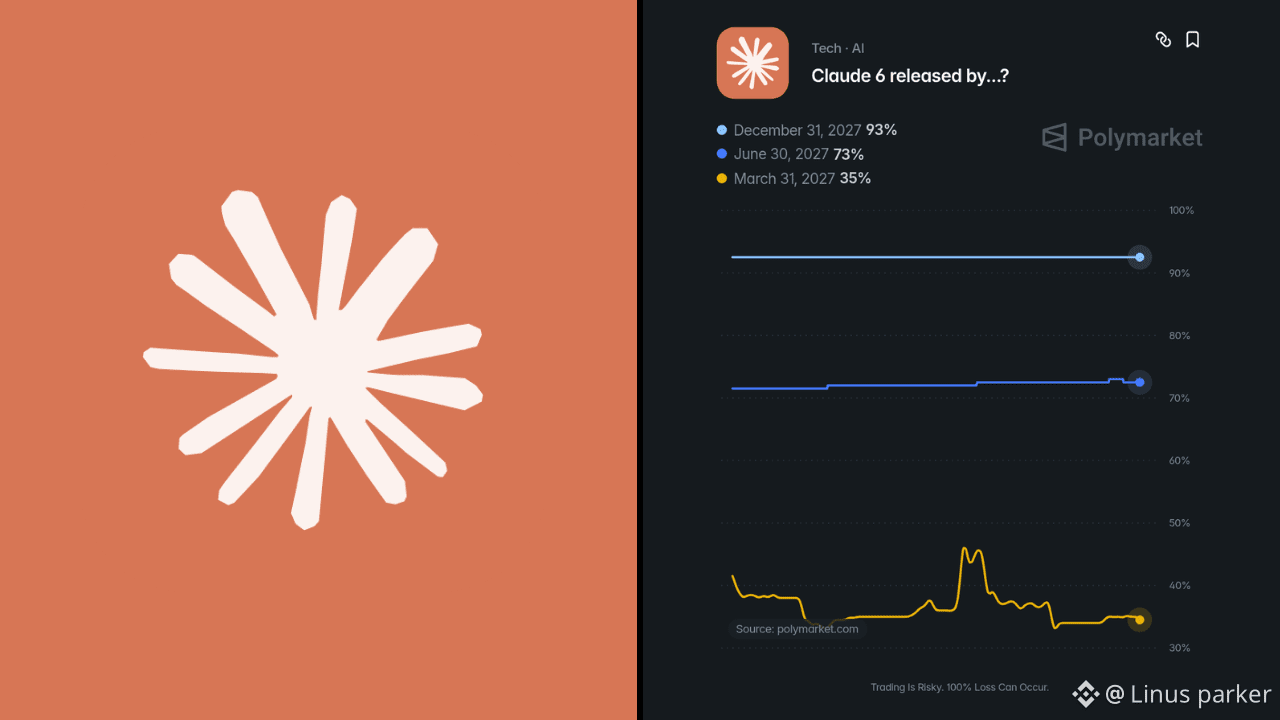
Claude 6 Has A Timeline 👀
When will Anthropic release its next major AI model?
Polymarket traders are already putting probabilities on different deadlines.
And the numbers tell an interesting story.
🟡 March 31, 2027 → 35% probability.
🔵 June 30, 2027 → 73% probability.
🟢 December 31, 2027 → 93% probability.
The market clearly expects Claude 6 to arrive during 2027, but there's much less confidence about an early release.
Personally, I'm watching the March deadline.
At 35%, a YES position offers approximately 2.86x if the release qualifies before that date.
But suppose Anthropic announces a major development that pushes the probability toward 55%.
That would represent approximately a 57% increase in the implied value of YES shares.
And traders could potentially exit before the model actually launches.
The type of profits you would see with giants like $NEAR , however with multiple layers of analysis instead of a single technical one.
One announcement could change the entire probability curve.
#Altcoin Season#
Claude 6 Has A Timeline 👀
When will Anthropic release its next major AI model?
Polymarket traders are already putting probabilities on different deadlines.
And the numbers tell an interesting story.
🟡 March 31, 2027 → 35% probability.
🔵 June 30, 2027 → 73% probability.
🟢 December 31, 2027 → 93% probability.
The market clearly expects Claude 6 to arrive during 2027, but there's much less confidence about an early release.
Personally, I'm watching the March deadline.
At 35%, a YES position offers approximately 2.86x if the release qualifies before that date.
But suppose Anthropic announces a major development that pushes the probability toward 55%.
That would represent approximately a 57% increase in the implied value of YES shares.
And traders could potentially exit before the model actually launches.
The type of profits you would see with giants like $NEAR , however with multiple layers of analysis instead of a single technical one.
One announcement could change the entire probability curve.
#Altcoin Season#
When will Anthropic release its next major AI model?
Polymarket traders are already putting probabilities on different deadlines.
And the numbers tell an interesting story.
🟡 March 31, 2027 → 35% probability.
🔵 June 30, 2027 → 73% probability.
🟢 December 31, 2027 → 93% probability.
The market clearly expects Claude 6 to arrive during 2027, but there's much less confidence about an early release.
Personally, I'm watching the March deadline.
At 35%, a YES position offers approximately 2.86x if the release qualifies before that date.
But suppose Anthropic announces a major development that pushes the probability toward 55%.
That would represent approximately a 57% increase in the implied value of YES shares.
And traders could potentially exit before the model actually launches.
The type of profits you would see with giants like $NEAR , however with multiple layers of analysis instead of a single technical one.
One announcement could change the entire probability curve.
#Altcoin Season#
81
·
--
This is what events should look like ⚡
$PENGU and $AVAX show how quickly culture can build when a community maintains momentum as in crypto, execution speed is normally measured through releases, integrations or product updates.
I think IRL communities reveal it differently.
Announcements create attention, but delivering experiences across several cities creates continuity.
The recent $Trump Coin Club run across Korea and Singapore shows what that cadence can look like.
Its activity included:
• 2,000 watches and 500 gold sneakers distributed
• Keynote speeches at KBW and TOKEN2049
• An invite-only Seoul gathering featuring Mike Tyson and Korean Zombie
• A completed Singapore weekend spanning private race-viewing hospitality, yacht gatherings and nightlife
• A November gala dinner and a Los Angeles Super Bowl weekend added to the upcoming calendar
That is a significant amount of IRL activity packed into one regional run 🔥
#Altcoin Season#
This is what events should look like ⚡
$PENGU and $AVAX show how quickly culture can build when a community maintains momentum as in crypto, execution speed is normally measured through releases, integrations or product updates.
I think IRL communities reveal it differently.
Announcements create attention, but delivering experiences across several cities creates continuity.
The recent $Trump Coin Club run across Korea and Singapore shows what that cadence can look like.
Its activity included:
• 2,000 watches and 500 gold sneakers distributed
• Keynote speeches at KBW and TOKEN2049
• An invite-only Seoul gathering featuring Mike Tyson and Korean Zombie
• A completed Singapore weekend spanning private race-viewing hospitality, yacht gatherings and nightlife
• A November gala dinner and a Los Angeles Super Bowl weekend added to the upcoming calendar
That is a significant amount of IRL activity packed into one regional run 🔥
#Altcoin Season#
$PENGU and $AVAX show how quickly culture can build when a community maintains momentum as in crypto, execution speed is normally measured through releases, integrations or product updates.
I think IRL communities reveal it differently.
Announcements create attention, but delivering experiences across several cities creates continuity.
The recent $Trump Coin Club run across Korea and Singapore shows what that cadence can look like.
Its activity included:
• 2,000 watches and 500 gold sneakers distributed
• Keynote speeches at KBW and TOKEN2049
• An invite-only Seoul gathering featuring Mike Tyson and Korean Zombie
• A completed Singapore weekend spanning private race-viewing hospitality, yacht gatherings and nightlife
• A November gala dinner and a Los Angeles Super Bowl weekend added to the upcoming calendar
That is a significant amount of IRL activity packed into one regional run 🔥
#Altcoin Season#

69
·
--
Six Tabs, Or One Sentence 🗂️
$AERO handles liquidity, $LINK handles data, and between them sits a stack of venues most people manage through a browser with eleven tabs open.
The Bankr terminal addresses several of them from the same conversation. Spot swaps, perps through supported venues, prediction markets, bridges, yield on idle USDC.
The point is not the list. It is what maintaining that list normally costs you.
Every venue is its own account, its own connection flow, its own quirks about networks and gas and approvals. The mental overhead of keeping six of them straight is why most people use two and ignore the rest, even when the ignored ones are where the thing they wanted actually lives.
Consolidating the instruction layer does not consolidate the risk. Each venue underneath still has its own contracts, its own liquidity and its own failure modes, and a single interface can make unlike things look alike.
That is the part to stay awake for. A uniform text box over non-uniform venues is convenient, and convenience is how people end up somewhere they did not intend to be.
Used deliberately though, it collapses an afternoon of tab management into a sentence. Most people reading this have never checked whether their workflow survives that comparison.
#DeFi #DEX
Six Tabs, Or One Sentence 🗂️
$AERO handles liquidity, $LINK handles data, and between them sits a stack of venues most people manage through a browser with eleven tabs open.
The Bankr terminal addresses several of them from the same conversation. Spot swaps, perps through supported venues, prediction markets, bridges, yield on idle USDC.
The point is not the list. It is what maintaining that list normally costs you.
Every venue is its own account, its own connection flow, its own quirks about networks and gas and approvals. The mental overhead of keeping six of them straight is why most people use two and ignore the rest, even when the ignored ones are where the thing they wanted actually lives.
Consolidating the instruction layer does not consolidate the risk. Each venue underneath still has its own contracts, its own liquidity and its own failure modes, and a single interface can make unlike things look alike.
That is the part to stay awake for. A uniform text box over non-uniform venues is convenient, and convenience is how people end up somewhere they did not intend to be.
Used deliberately though, it collapses an afternoon of tab management into a sentence. Most people reading this have never checked whether their workflow survives that comparison.
#DeFi #DEX
$AERO handles liquidity, $LINK handles data, and between them sits a stack of venues most people manage through a browser with eleven tabs open.
The Bankr terminal addresses several of them from the same conversation. Spot swaps, perps through supported venues, prediction markets, bridges, yield on idle USDC.
The point is not the list. It is what maintaining that list normally costs you.
Every venue is its own account, its own connection flow, its own quirks about networks and gas and approvals. The mental overhead of keeping six of them straight is why most people use two and ignore the rest, even when the ignored ones are where the thing they wanted actually lives.
Consolidating the instruction layer does not consolidate the risk. Each venue underneath still has its own contracts, its own liquidity and its own failure modes, and a single interface can make unlike things look alike.
That is the part to stay awake for. A uniform text box over non-uniform venues is convenient, and convenience is how people end up somewhere they did not intend to be.
Used deliberately though, it collapses an afternoon of tab management into a sentence. Most people reading this have never checked whether their workflow survives that comparison.
#DeFi #DEX
77
·
--
Degens Don’t Want Another Launchpad 🎰
The $BONK crowd understands how quickly culture can become liquidity.
$JUP traders understand that liquidity becomes more valuable when it can move freely.
Most launchpads still force every new idea into the same quote asset and the same predictable structure.
That works until the market wants something new.
The next wave belongs to platforms that let creators decide what their market trades against.
Zora’s Custom Pairs turns that freedom into a product.
A token can be paired with a meme, major crypto asset or tokenized stock.
Every launch can express two narratives at once.
I think that creates a much larger creative surface than another conveyor belt of identical coins.
Zora can absorb whatever CT becomes obsessed with next without rebuilding the platform around each new meta.
Degens chase low hanging fruit.
Zora is putting more of it inside the launch itself.
#Meme Alpha# #Altcoin Season#
Degens Don’t Want Another Launchpad 🎰
The $BONK crowd understands how quickly culture can become liquidity.
$JUP traders understand that liquidity becomes more valuable when it can move freely.
Most launchpads still force every new idea into the same quote asset and the same predictable structure.
That works until the market wants something new.
The next wave belongs to platforms that let creators decide what their market trades against.
Zora’s Custom Pairs turns that freedom into a product.
A token can be paired with a meme, major crypto asset or tokenized stock.
Every launch can express two narratives at once.
I think that creates a much larger creative surface than another conveyor belt of identical coins.
Zora can absorb whatever CT becomes obsessed with next without rebuilding the platform around each new meta.
Degens chase low hanging fruit.
Zora is putting more of it inside the launch itself.
#Meme Alpha# #Altcoin Season#
The $BONK crowd understands how quickly culture can become liquidity.
$JUP traders understand that liquidity becomes more valuable when it can move freely.
Most launchpads still force every new idea into the same quote asset and the same predictable structure.
That works until the market wants something new.
The next wave belongs to platforms that let creators decide what their market trades against.
Zora’s Custom Pairs turns that freedom into a product.
A token can be paired with a meme, major crypto asset or tokenized stock.
Every launch can express two narratives at once.
I think that creates a much larger creative surface than another conveyor belt of identical coins.
Zora can absorb whatever CT becomes obsessed with next without rebuilding the platform around each new meta.
Degens chase low hanging fruit.
Zora is putting more of it inside the launch itself.
#Meme Alpha# #Altcoin Season#
62
·
--
Sometimes The Best Trade Goes Against The Crowd 📉
When everyone piles into the same side of a trade, the opportunity is sometimes on the other side.
That's the thesis Pear Protocol's Agent Pear uncovered when analyzing a potential Long $ZEC / Short $NEAR pair.
Only 38% of traders were positioned long ZEC, while 61% were long NEAR. Meanwhile, $436K in ZEC shorts had been liquidated, compared with $559K in NEAR long liquidations.
The potential setup? ZEC could benefit from a short squeeze if buying pressure returns, while NEAR could face further selling pressure as crowded longs unwind.
But here's where Agent Pear adds real value.
It also tested the pair's statistical relationship and found no cointegration across the 1-hour, 4-hour or daily timeframes. In other words, the crowding thesis had merit, but the data didn't support treating this as a high-conviction, mean-reverting hedge.
That's the kind of analysis traders need before putting capital to work.
With Agent Pear, you can explore contrarian opportunities, understand the positioning behind them, and see where the risks challenge your thesis, all for free and without spending hours piecing together the data yourself.
Sometimes the edge isn't following the crowd. It's knowing when the crowd might be wrong, and having the tools to assess that possibility.
Get Agent Pear's trade analysis for free at pear.garden/trade
#Altcoin Season#
Sometimes The Best Trade Goes Against The Crowd 📉
When everyone piles into the same side of a trade, the opportunity is sometimes on the other side.
That's the thesis Pear Protocol's Agent Pear uncovered when analyzing a potential Long $ZEC / Short $NEAR pair.
Only 38% of traders were positioned long ZEC, while 61% were long NEAR. Meanwhile, $436K in ZEC shorts had been liquidated, compared with $559K in NEAR long liquidations.
The potential setup? ZEC could benefit from a short squeeze if buying pressure returns, while NEAR could face further selling pressure as crowded longs unwind.
But here's where Agent Pear adds real value.
It also tested the pair's statistical relationship and found no cointegration across the 1-hour, 4-hour or daily timeframes. In other words, the crowding thesis had merit, but the data didn't support treating this as a high-conviction, mean-reverting hedge.
That's the kind of analysis traders need before putting capital to work.
With Agent Pear, you can explore contrarian opportunities, understand the positioning behind them, and see where the risks challenge your thesis, all for free and without spending hours piecing together the data yourself.
Sometimes the edge isn't following the crowd. It's knowing when the crowd might be wrong, and having the tools to assess that possibility.
Get Agent Pear's trade analysis for free at pear.garden/trade
#Altcoin Season#
When everyone piles into the same side of a trade, the opportunity is sometimes on the other side.
That's the thesis Pear Protocol's Agent Pear uncovered when analyzing a potential Long $ZEC / Short $NEAR pair.
Only 38% of traders were positioned long ZEC, while 61% were long NEAR. Meanwhile, $436K in ZEC shorts had been liquidated, compared with $559K in NEAR long liquidations.
The potential setup? ZEC could benefit from a short squeeze if buying pressure returns, while NEAR could face further selling pressure as crowded longs unwind.
But here's where Agent Pear adds real value.
It also tested the pair's statistical relationship and found no cointegration across the 1-hour, 4-hour or daily timeframes. In other words, the crowding thesis had merit, but the data didn't support treating this as a high-conviction, mean-reverting hedge.
That's the kind of analysis traders need before putting capital to work.
With Agent Pear, you can explore contrarian opportunities, understand the positioning behind them, and see where the risks challenge your thesis, all for free and without spending hours piecing together the data yourself.
Sometimes the edge isn't following the crowd. It's knowing when the crowd might be wrong, and having the tools to assess that possibility.
Get Agent Pear's trade analysis for free at pear.garden/trade
#Altcoin Season#
60
·
--
Bull Markets Put Infrastructure To Work 📈
$2Z benefits from a simple trend: more crypto activity means more information needs to move. $AVAX is one example of an ecosystem built around increasingly high-performance applications.
When markets accelerate, infrastructure has more work to do.
More trades.
More messages.
More data.
More systems competing to react.
DoubleZero gives distributed systems purpose-built networking instead of forcing all critical traffic through general-purpose internet infrastructure.
The busier New Finance becomes, the more important its underlying rails become.
#Altcoin Season# #DeFi
Bull Markets Put Infrastructure To Work 📈
$2Z benefits from a simple trend: more crypto activity means more information needs to move. $AVAX is one example of an ecosystem built around increasingly high-performance applications.
When markets accelerate, infrastructure has more work to do.
More trades.
More messages.
More data.
More systems competing to react.
DoubleZero gives distributed systems purpose-built networking instead of forcing all critical traffic through general-purpose internet infrastructure.
The busier New Finance becomes, the more important its underlying rails become.
#Altcoin Season# #DeFi
$2Z benefits from a simple trend: more crypto activity means more information needs to move. $AVAX is one example of an ecosystem built around increasingly high-performance applications.
When markets accelerate, infrastructure has more work to do.
More trades.
More messages.
More data.
More systems competing to react.
DoubleZero gives distributed systems purpose-built networking instead of forcing all critical traffic through general-purpose internet infrastructure.
The busier New Finance becomes, the more important its underlying rails become.
#Altcoin Season# #DeFi
75
·
--
Sealed Assets Do Not Trade Together 🧊
Here is the problem nobody wants to say out loud about this category. Assets sealed by one system are not usable with assets sealed by another, so every new approach splits the pool it is trying to protect.
$ZAMA has raised more than $130M building its own version of that on Ethereum, and the moment two systems exist, a user has to pick which one their balance lives inside.
Depth is the whole product here. A thin pool is easy to analyse and a deep one is not, so fragmenting DeFi users across competing systems weakens all of them at once.
On $SOL that argument lands differently, because the apps, the liquidity and the users are already in one place, and nothing has to leave for any of this to work.
Arcium is a compute layer a Solana program calls rather than a chain or an asset. A job is split into fragments across a cluster of nodes, no single node holds a readable copy, and the result settles on Solana as an ordinary public transaction.
Nothing bridges, nothing wraps, and fifteen teams are building against the same layer rather than fifteen separate pools.
Network effects for sealed assets are liquidity network effects, and the version that wins is the one that never asked anyone to move.
#DeFi #Solana
Sealed Assets Do Not Trade Together 🧊
Here is the problem nobody wants to say out loud about this category. Assets sealed by one system are not usable with assets sealed by another, so every new approach splits the pool it is trying to protect.
$ZAMA has raised more than $130M building its own version of that on Ethereum, and the moment two systems exist, a user has to pick which one their balance lives inside.
Depth is the whole product here. A thin pool is easy to analyse and a deep one is not, so fragmenting DeFi users across competing systems weakens all of them at once.
On $SOL that argument lands differently, because the apps, the liquidity and the users are already in one place, and nothing has to leave for any of this to work.
Arcium is a compute layer a Solana program calls rather than a chain or an asset. A job is split into fragments across a cluster of nodes, no single node holds a readable copy, and the result settles on Solana as an ordinary public transaction.
Nothing bridges, nothing wraps, and fifteen teams are building against the same layer rather than fifteen separate pools.
Network effects for sealed assets are liquidity network effects, and the version that wins is the one that never asked anyone to move.
#DeFi #Solana
Here is the problem nobody wants to say out loud about this category. Assets sealed by one system are not usable with assets sealed by another, so every new approach splits the pool it is trying to protect.
$ZAMA has raised more than $130M building its own version of that on Ethereum, and the moment two systems exist, a user has to pick which one their balance lives inside.
Depth is the whole product here. A thin pool is easy to analyse and a deep one is not, so fragmenting DeFi users across competing systems weakens all of them at once.
On $SOL that argument lands differently, because the apps, the liquidity and the users are already in one place, and nothing has to leave for any of this to work.
Arcium is a compute layer a Solana program calls rather than a chain or an asset. A job is split into fragments across a cluster of nodes, no single node holds a readable copy, and the result settles on Solana as an ordinary public transaction.
Nothing bridges, nothing wraps, and fifteen teams are building against the same layer rather than fifteen separate pools.
Network effects for sealed assets are liquidity network effects, and the version that wins is the one that never asked anyone to move.
#DeFi #Solana
69
·
--
The Names Around A Network Tell You What It's Being Built For 🏢
$LINK became critical infrastructure by connecting blockchain applications to systems outside crypto. The ecosystem forming around $NIGHT tells a similarly important story about where Midnight is aiming.
Look at some of the organizations involved around the network:
- Google Cloud.
- MoneyGram.
- Pairpoint by Vodafone.
- eToro.
- Bullish.
- Worldpay.
- Blockdaemon.
That's a very different roster from a privacy project built exclusively around anonymous payments.
And that's the point.
Midnight's thesis is that privacy and verifiability don't have to sit on opposite sides of the spectrum.
Businesses need confidentiality, financial institutions need compliance, users need control over their information, and applications still need facts they can verify.
Programmable privacy is about satisfying those requirements at the same time.
For me, the institutional names around Midnight are interesting because they show where that thesis is being tested:not outside the existing financial system, but increasingly inside it.
#Privacy #DeFi
The Names Around A Network Tell You What It's Being Built For 🏢
$LINK became critical infrastructure by connecting blockchain applications to systems outside crypto. The ecosystem forming around $NIGHT tells a similarly important story about where Midnight is aiming.
Look at some of the organizations involved around the network:
- Google Cloud.
- MoneyGram.
- Pairpoint by Vodafone.
- eToro.
- Bullish.
- Worldpay.
- Blockdaemon.
That's a very different roster from a privacy project built exclusively around anonymous payments.
And that's the point.
Midnight's thesis is that privacy and verifiability don't have to sit on opposite sides of the spectrum.
Businesses need confidentiality, financial institutions need compliance, users need control over their information, and applications still need facts they can verify.
Programmable privacy is about satisfying those requirements at the same time.
For me, the institutional names around Midnight are interesting because they show where that thesis is being tested:not outside the existing financial system, but increasingly inside it.
#Privacy #DeFi
$LINK became critical infrastructure by connecting blockchain applications to systems outside crypto. The ecosystem forming around $NIGHT tells a similarly important story about where Midnight is aiming.
Look at some of the organizations involved around the network:
- Google Cloud.
- MoneyGram.
- Pairpoint by Vodafone.
- eToro.
- Bullish.
- Worldpay.
- Blockdaemon.
That's a very different roster from a privacy project built exclusively around anonymous payments.
And that's the point.
Midnight's thesis is that privacy and verifiability don't have to sit on opposite sides of the spectrum.
Businesses need confidentiality, financial institutions need compliance, users need control over their information, and applications still need facts they can verify.
Programmable privacy is about satisfying those requirements at the same time.
For me, the institutional names around Midnight are interesting because they show where that thesis is being tested:not outside the existing financial system, but increasingly inside it.
#Privacy #DeFi
74
·
--
RWAs Aren't Finished Yet 🌍
For a while, the crypto RWA thesis was basically:
"Put traditional assets onchain."
I think we're already moving past that.
Once the asset is tokenized, a much bigger question appears:
What can actually be done with it?
$RENDER showed how crypto networks can turn previously isolated resources into something digitally coordinated.
The RWA opportunity has a different version of that problem.
Theoriq is building around what happens after traditional assets become programmable.
Gold can become collateral.
Collateral can access carefully selected strategies.
Yield can be monitored and attributed.
Risk can be actively managed.
And eventually the same curator infrastructure can extend across more tokenized assets.
Issuance gets an asset onchain.
The interesting part starts when that asset becomes productive.
#Altcoin Season#
RWAs Aren't Finished Yet 🌍
For a while, the crypto RWA thesis was basically:
"Put traditional assets onchain."
I think we're already moving past that.
Once the asset is tokenized, a much bigger question appears:
What can actually be done with it?
$RENDER showed how crypto networks can turn previously isolated resources into something digitally coordinated.
The RWA opportunity has a different version of that problem.
Theoriq is building around what happens after traditional assets become programmable.
Gold can become collateral.
Collateral can access carefully selected strategies.
Yield can be monitored and attributed.
Risk can be actively managed.
And eventually the same curator infrastructure can extend across more tokenized assets.
Issuance gets an asset onchain.
The interesting part starts when that asset becomes productive.
#Altcoin Season#
For a while, the crypto RWA thesis was basically:
"Put traditional assets onchain."
I think we're already moving past that.
Once the asset is tokenized, a much bigger question appears:
What can actually be done with it?
$RENDER showed how crypto networks can turn previously isolated resources into something digitally coordinated.
The RWA opportunity has a different version of that problem.
Theoriq is building around what happens after traditional assets become programmable.
Gold can become collateral.
Collateral can access carefully selected strategies.
Yield can be monitored and attributed.
Risk can be actively managed.
And eventually the same curator infrastructure can extend across more tokenized assets.
Issuance gets an asset onchain.
The interesting part starts when that asset becomes productive.
#Altcoin Season#
77
·
--
AI Growth Needs New Owners 🔥
AI has become very good at selling access to intelligence.
The bigger opportunity, in our view, is expanding who gets to own the infrastructure producing it.
$VVV is already pushing that idea at the inference layer.
VVV can be staked for recurring Venice API capacity, while DIEM turns that capacity into something transferable between users, apps and agents.
Intelligence stops being purely pay-per-request and starts behaving more like a resource you can hold. We think the same shift happens one layer lower with $B3 .
B3IQ is a customer-owned neocloud. Instead of permanently renting GPUs from someone else's balance sheet, customers can own the actual NVIDIA machines while B3IQ builds, hosts and operates them.
And when that machine is not needed internally, the owner can choose to sell its spare capacity rather than leave it idle.
VVV is making AI capacity ownable.
B3IQ is making the infrastructure behind that capacity ownable.
We believe ownership becomes a much bigger part of the AI stack as usage moves from occasional prompts to always-on agents, inference and workloads.
That is a much larger thesis than simply selling more GPU hours.
#AI #Altcoin Season#
AI Growth Needs New Owners 🔥
AI has become very good at selling access to intelligence.
The bigger opportunity, in our view, is expanding who gets to own the infrastructure producing it.
$VVV is already pushing that idea at the inference layer.
VVV can be staked for recurring Venice API capacity, while DIEM turns that capacity into something transferable between users, apps and agents.
Intelligence stops being purely pay-per-request and starts behaving more like a resource you can hold. We think the same shift happens one layer lower with $B3 .
B3IQ is a customer-owned neocloud. Instead of permanently renting GPUs from someone else's balance sheet, customers can own the actual NVIDIA machines while B3IQ builds, hosts and operates them.
And when that machine is not needed internally, the owner can choose to sell its spare capacity rather than leave it idle.
VVV is making AI capacity ownable.
B3IQ is making the infrastructure behind that capacity ownable.
We believe ownership becomes a much bigger part of the AI stack as usage moves from occasional prompts to always-on agents, inference and workloads.
That is a much larger thesis than simply selling more GPU hours.
#AI #Altcoin Season#
AI has become very good at selling access to intelligence.
The bigger opportunity, in our view, is expanding who gets to own the infrastructure producing it.
$VVV is already pushing that idea at the inference layer.
VVV can be staked for recurring Venice API capacity, while DIEM turns that capacity into something transferable between users, apps and agents.
Intelligence stops being purely pay-per-request and starts behaving more like a resource you can hold. We think the same shift happens one layer lower with $B3 .
B3IQ is a customer-owned neocloud. Instead of permanently renting GPUs from someone else's balance sheet, customers can own the actual NVIDIA machines while B3IQ builds, hosts and operates them.
And when that machine is not needed internally, the owner can choose to sell its spare capacity rather than leave it idle.
VVV is making AI capacity ownable.
B3IQ is making the infrastructure behind that capacity ownable.
We believe ownership becomes a much bigger part of the AI stack as usage moves from occasional prompts to always-on agents, inference and workloads.
That is a much larger thesis than simply selling more GPU hours.
#AI #Altcoin Season#
44
·
--
276 paying accounts, 86% ARR growth, and PYTH buying 🔥🚀
$PYTH has a business update that looks much stronger when you stop treating it like a normal oracle token. $AVAX traders already understand the RWA lane, and this is the kind of infrastructure data point that matters when real assets start trading 24/7.
Pyth closed Q3 with $11.49M in active ARR, up 86% from Q2, and the business now has 276 paying accounts across the product stack.
That customer count is what caught my attention.
A lot of crypto infra can show integrations, but paying accounts are harder to fake because somebody has to keep deciding the data is worth paying for.
The DAO also approved the rule that sends 100% of the funds it receives from Pyth products into PYTH bought on the open market.
So the holder story is getting easier to understand at the exact same time the business story is getting stronger.
Pyth Pro ended September at $9.68M ARR, while Pyth Indices reached $1.81M ARR, which tells me the growth is not coming from one narrow product line.
My take is simple: if Pyth keeps turning market-data demand into paying accounts, the 100% rule makes those product receipts much harder for $PYTH holders to ignore.
This is the kind of setup people usually call obvious only after the chart has already moved.
#Altcoin Season# #PYTH
276 paying accounts, 86% ARR growth, and PYTH buying 🔥🚀
$PYTH has a business update that looks much stronger when you stop treating it like a normal oracle token. $AVAX traders already understand the RWA lane, and this is the kind of infrastructure data point that matters when real assets start trading 24/7.
Pyth closed Q3 with $11.49M in active ARR, up 86% from Q2, and the business now has 276 paying accounts across the product stack.
That customer count is what caught my attention.
A lot of crypto infra can show integrations, but paying accounts are harder to fake because somebody has to keep deciding the data is worth paying for.
The DAO also approved the rule that sends 100% of the funds it receives from Pyth products into PYTH bought on the open market.
So the holder story is getting easier to understand at the exact same time the business story is getting stronger.
Pyth Pro ended September at $9.68M ARR, while Pyth Indices reached $1.81M ARR, which tells me the growth is not coming from one narrow product line.
My take is simple: if Pyth keeps turning market-data demand into paying accounts, the 100% rule makes those product receipts much harder for $PYTH holders to ignore.
This is the kind of setup people usually call obvious only after the chart has already moved.
#Altcoin Season# #PYTH
$PYTH has a business update that looks much stronger when you stop treating it like a normal oracle token. $AVAX traders already understand the RWA lane, and this is the kind of infrastructure data point that matters when real assets start trading 24/7.
Pyth closed Q3 with $11.49M in active ARR, up 86% from Q2, and the business now has 276 paying accounts across the product stack.
That customer count is what caught my attention.
A lot of crypto infra can show integrations, but paying accounts are harder to fake because somebody has to keep deciding the data is worth paying for.
The DAO also approved the rule that sends 100% of the funds it receives from Pyth products into PYTH bought on the open market.
So the holder story is getting easier to understand at the exact same time the business story is getting stronger.
Pyth Pro ended September at $9.68M ARR, while Pyth Indices reached $1.81M ARR, which tells me the growth is not coming from one narrow product line.
My take is simple: if Pyth keeps turning market-data demand into paying accounts, the 100% rule makes those product receipts much harder for $PYTH holders to ignore.
This is the kind of setup people usually call obvious only after the chart has already moved.
#Altcoin Season# #PYTH
50
·
--
Crypto Growth Needs New Market Creators 🔥
Crypto has become highly efficient at circulating capital among existing users. The larger opportunity is expanding who can create markets in the first place. RWA infrastructure around $XLM is broadening the universe of assets that can exist onchain.
But the industry still needs consumer products that make those assets understandable, discoverable and social.
I believe creation will become one of the strongest onboarding mechanisms this cycle.
Give people something personal to build around and participation becomes far more natural.
$ZORA is pursuing exactly that opportunity.
Creators can launch ideas into markets while traders can pair them against crypto assets, memes and tokenized equities. Every Pair can attract its own community, liquidity and conversation.
That gives Zora room to grow beyond its original creator coin identity.
It can become the launchpad for people and ideas that conventional platforms were never designed to serve.
I see a platform positioned to expand participation across creators, traders and entirely new users.
That is a much bigger thesis than simply capturing existing volume.
#RWA #Altcoin Season#
Crypto Growth Needs New Market Creators 🔥
Crypto has become highly efficient at circulating capital among existing users. The larger opportunity is expanding who can create markets in the first place. RWA infrastructure around $XLM is broadening the universe of assets that can exist onchain.
But the industry still needs consumer products that make those assets understandable, discoverable and social.
I believe creation will become one of the strongest onboarding mechanisms this cycle.
Give people something personal to build around and participation becomes far more natural.
$ZORA is pursuing exactly that opportunity.
Creators can launch ideas into markets while traders can pair them against crypto assets, memes and tokenized equities. Every Pair can attract its own community, liquidity and conversation.
That gives Zora room to grow beyond its original creator coin identity.
It can become the launchpad for people and ideas that conventional platforms were never designed to serve.
I see a platform positioned to expand participation across creators, traders and entirely new users.
That is a much bigger thesis than simply capturing existing volume.
#RWA #Altcoin Season#
Crypto has become highly efficient at circulating capital among existing users. The larger opportunity is expanding who can create markets in the first place. RWA infrastructure around $XLM is broadening the universe of assets that can exist onchain.
But the industry still needs consumer products that make those assets understandable, discoverable and social.
I believe creation will become one of the strongest onboarding mechanisms this cycle.
Give people something personal to build around and participation becomes far more natural.
$ZORA is pursuing exactly that opportunity.
Creators can launch ideas into markets while traders can pair them against crypto assets, memes and tokenized equities. Every Pair can attract its own community, liquidity and conversation.
That gives Zora room to grow beyond its original creator coin identity.
It can become the launchpad for people and ideas that conventional platforms were never designed to serve.
I see a platform positioned to expand participation across creators, traders and entirely new users.
That is a much bigger thesis than simply capturing existing volume.
#RWA #Altcoin Season#
65
·
--
One Connection Gets More Valuable As The Catalog Grows 📡
$2Z gives traders access to a growing set of market-data sources through shared infrastructure. $HYPE shows why that matters when desks need to follow multiple fast-moving markets at once.
The traditional model is fragmented. One venue means one integration. Another venue means another.
Then another…
DoubleZero Edge changes that by bringing multiple feeds into the same connection and format.
That means every new source can increase the usefulness of infrastructure already in place.
More feeds. Same connection. More value from the same setup.
#MarketData #DeFi
One Connection Gets More Valuable As The Catalog Grows 📡
$2Z gives traders access to a growing set of market-data sources through shared infrastructure. $HYPE shows why that matters when desks need to follow multiple fast-moving markets at once.
The traditional model is fragmented. One venue means one integration. Another venue means another.
Then another…
DoubleZero Edge changes that by bringing multiple feeds into the same connection and format.
That means every new source can increase the usefulness of infrastructure already in place.
More feeds. Same connection. More value from the same setup.
#MarketData #DeFi
$2Z gives traders access to a growing set of market-data sources through shared infrastructure. $HYPE shows why that matters when desks need to follow multiple fast-moving markets at once.
The traditional model is fragmented. One venue means one integration. Another venue means another.
Then another…
DoubleZero Edge changes that by bringing multiple feeds into the same connection and format.
That means every new source can increase the usefulness of infrastructure already in place.
More feeds. Same connection. More value from the same setup.
#MarketData #DeFi

60
·
--
$11.5M ARR changes the tone 📈
$PYTH market-data infra is now showing the kind of paid traction crypto usually begs for, while $HYPE perps and Hyperliquid-style 24/7 markets explain why real-time pricing keeps becoming more valuable.
September was not a quiet product month.
Pyth ARR reached $11.5M, up 10.6% MoM. Pyth Terminal MAU hit 129,265, up 44.1% MoM. The Pyth Pro catalog expanded to 3,811+ symbols.
That is a clean jump across revenue, usage and coverage at the same time.
The most interesting detail is that nearly half of the revenue added in September came from touchless signups through Pyth Terminal.
That means users are not only hearing the story. They are searching feeds, comparing data, generating credentials and moving toward integration inside the product.
Pyth Indices also grew from 45 to 50, while Nasdaq Basic was added to the Data Marketplace story after Pyth was approved as an external distributor.
This is where $PYTH starts looking underpriced from a narrative perspective.
The market still groups it with oracle tokens.
The product is behaving like a self-serve market-data business with institutional distribution, RWA perp dominance, Pyth Pro, Indices and Nasdaq Basic access layered into one stack.
A chart can wake up late.
A business with numbers like this usually gives the market less room to ignore it 🟢
#Altcoin Season# #RWA
$11.5M ARR changes the tone 📈
$PYTH market-data infra is now showing the kind of paid traction crypto usually begs for, while $HYPE perps and Hyperliquid-style 24/7 markets explain why real-time pricing keeps becoming more valuable.
September was not a quiet product month.
Pyth ARR reached $11.5M, up 10.6% MoM. Pyth Terminal MAU hit 129,265, up 44.1% MoM. The Pyth Pro catalog expanded to 3,811+ symbols.
That is a clean jump across revenue, usage and coverage at the same time.
The most interesting detail is that nearly half of the revenue added in September came from touchless signups through Pyth Terminal.
That means users are not only hearing the story. They are searching feeds, comparing data, generating credentials and moving toward integration inside the product.
Pyth Indices also grew from 45 to 50, while Nasdaq Basic was added to the Data Marketplace story after Pyth was approved as an external distributor.
This is where $PYTH starts looking underpriced from a narrative perspective.
The market still groups it with oracle tokens.
The product is behaving like a self-serve market-data business with institutional distribution, RWA perp dominance, Pyth Pro, Indices and Nasdaq Basic access layered into one stack.
A chart can wake up late.
A business with numbers like this usually gives the market less room to ignore it 🟢
#Altcoin Season# #RWA
$PYTH market-data infra is now showing the kind of paid traction crypto usually begs for, while $HYPE perps and Hyperliquid-style 24/7 markets explain why real-time pricing keeps becoming more valuable.
September was not a quiet product month.
Pyth ARR reached $11.5M, up 10.6% MoM. Pyth Terminal MAU hit 129,265, up 44.1% MoM. The Pyth Pro catalog expanded to 3,811+ symbols.
That is a clean jump across revenue, usage and coverage at the same time.
The most interesting detail is that nearly half of the revenue added in September came from touchless signups through Pyth Terminal.
That means users are not only hearing the story. They are searching feeds, comparing data, generating credentials and moving toward integration inside the product.
Pyth Indices also grew from 45 to 50, while Nasdaq Basic was added to the Data Marketplace story after Pyth was approved as an external distributor.
This is where $PYTH starts looking underpriced from a narrative perspective.
The market still groups it with oracle tokens.
The product is behaving like a self-serve market-data business with institutional distribution, RWA perp dominance, Pyth Pro, Indices and Nasdaq Basic access layered into one stack.
A chart can wake up late.
A business with numbers like this usually gives the market less room to ignore it 🟢
#Altcoin Season# #RWA
71
·
--
IRL makes reputation more human 🧠
Communities around $BONK and $BRETT can build strong identities online, but a feed mostly shows what someone chooses to publish.
It reveals much less about how that person interacts once the audience is smaller and the conversation is no longer public.
I think repeated in-person interaction adds a layer that digital profiles cannot capture.
This is an overlooked part of the planned $Trump Coin Club Singapore experience.
Its three-day format is expected to give members several opportunities to interact across shared settings rather than relying on a single introduction.
Over that time, a username gains a personality and real context.
That can change how people understand one another long after the experience has ended.
For me, one of the strongest outcomes of an event-led community is making reputation feel human.
#Macro Insights#
IRL makes reputation more human 🧠
Communities around $BONK and $BRETT can build strong identities online, but a feed mostly shows what someone chooses to publish.
It reveals much less about how that person interacts once the audience is smaller and the conversation is no longer public.
I think repeated in-person interaction adds a layer that digital profiles cannot capture.
This is an overlooked part of the planned $Trump Coin Club Singapore experience.
Its three-day format is expected to give members several opportunities to interact across shared settings rather than relying on a single introduction.
Over that time, a username gains a personality and real context.
That can change how people understand one another long after the experience has ended.
For me, one of the strongest outcomes of an event-led community is making reputation feel human.
#Macro Insights#
Communities around $BONK and $BRETT can build strong identities online, but a feed mostly shows what someone chooses to publish.
It reveals much less about how that person interacts once the audience is smaller and the conversation is no longer public.
I think repeated in-person interaction adds a layer that digital profiles cannot capture.
This is an overlooked part of the planned $Trump Coin Club Singapore experience.
Its three-day format is expected to give members several opportunities to interact across shared settings rather than relying on a single introduction.
Over that time, a username gains a personality and real context.
That can change how people understand one another long after the experience has ended.
For me, one of the strongest outcomes of an event-led community is making reputation feel human.
#Macro Insights#
69
·
--
You Don't Need Big Money For Pro Strategies Anymore💰
Professional crypto asset management has traditionally come with a pretty big barrier to entry.
Like Bitwise's private $UNI fund gives accredited investors professionally managed crypto exposure, but comes with a $10K minimum investment.
Pear Protocol's vaults, however, give traders access to specialist managers and strategies starting with just 10$.
Instead of needing enough capital to qualify for traditional professional management, you can choose which strategy gets your money.
Statistical arbitrage. Quality long/short. And eventually momentum, sentiment, liquidation capture, thematic strategies and more, with different specialists running the approaches they're actually good at.
And with every Vault currently executing through $HYPE , those professional strategies can run directly onchain while you decide how your capital gets allocated.
Access to professional strategies just got a lot easier.
Explore Pear Vaults at vaults.pear.garden
#Altcoin Season#
You Don't Need Big Money For Pro Strategies Anymore💰
Professional crypto asset management has traditionally come with a pretty big barrier to entry.
Like Bitwise's private $UNI fund gives accredited investors professionally managed crypto exposure, but comes with a $10K minimum investment.
Pear Protocol's vaults, however, give traders access to specialist managers and strategies starting with just 10$.
Instead of needing enough capital to qualify for traditional professional management, you can choose which strategy gets your money.
Statistical arbitrage. Quality long/short. And eventually momentum, sentiment, liquidation capture, thematic strategies and more, with different specialists running the approaches they're actually good at.
And with every Vault currently executing through $HYPE , those professional strategies can run directly onchain while you decide how your capital gets allocated.
Access to professional strategies just got a lot easier.
Explore Pear Vaults at vaults.pear.garden
#Altcoin Season#
Professional crypto asset management has traditionally come with a pretty big barrier to entry.
Like Bitwise's private $UNI fund gives accredited investors professionally managed crypto exposure, but comes with a $10K minimum investment.
Pear Protocol's vaults, however, give traders access to specialist managers and strategies starting with just 10$.
Instead of needing enough capital to qualify for traditional professional management, you can choose which strategy gets your money.
Statistical arbitrage. Quality long/short. And eventually momentum, sentiment, liquidation capture, thematic strategies and more, with different specialists running the approaches they're actually good at.
And with every Vault currently executing through $HYPE , those professional strategies can run directly onchain while you decide how your capital gets allocated.
Access to professional strategies just got a lot easier.
Explore Pear Vaults at vaults.pear.garden
#Altcoin Season#
70
·
--
This Team Is Truly Killing It 👇
The first DeFi era around $UNI normalised onchain execution.
The next consumer battle will be fought over speed, simplicity and whether teams can improve before users lose interest.
Shipping once creates attention. Shipping every week creates confidence - See $ZORA .
I watch how quickly a team moves from community complaint to released product.
That cadence tells me far more than another ambitious roadmap. Zora has recently shipped or begun testing improvements across the entire app experience.
Recent updates include:
- Easier batch cancellation for auto-sell positions
- Improved search across four networks
- Usernames throughout Custom Pairs and crosschain activity
- Comments and expression attached to trades
- Custom Pairs displayed directly on profiles
These are practical responses to how people already use the product.
Zora’s team is listening, building and returning with visible improvements while the conversation is still happening.
That level of urgency is a major reason I’m becoming increasingly bullish on what Zora can grow into.
#DeFi #Altcoin Season#
This Team Is Truly Killing It 👇
The first DeFi era around $UNI normalised onchain execution.
The next consumer battle will be fought over speed, simplicity and whether teams can improve before users lose interest.
Shipping once creates attention. Shipping every week creates confidence - See $ZORA .
I watch how quickly a team moves from community complaint to released product.
That cadence tells me far more than another ambitious roadmap. Zora has recently shipped or begun testing improvements across the entire app experience.
Recent updates include:
- Easier batch cancellation for auto-sell positions
- Improved search across four networks
- Usernames throughout Custom Pairs and crosschain activity
- Comments and expression attached to trades
- Custom Pairs displayed directly on profiles
These are practical responses to how people already use the product.
Zora’s team is listening, building and returning with visible improvements while the conversation is still happening.
That level of urgency is a major reason I’m becoming increasingly bullish on what Zora can grow into.
#DeFi #Altcoin Season#
The first DeFi era around $UNI normalised onchain execution.
The next consumer battle will be fought over speed, simplicity and whether teams can improve before users lose interest.
Shipping once creates attention. Shipping every week creates confidence - See $ZORA .
I watch how quickly a team moves from community complaint to released product.
That cadence tells me far more than another ambitious roadmap. Zora has recently shipped or begun testing improvements across the entire app experience.
Recent updates include:
- Easier batch cancellation for auto-sell positions
- Improved search across four networks
- Usernames throughout Custom Pairs and crosschain activity
- Comments and expression attached to trades
- Custom Pairs displayed directly on profiles
These are practical responses to how people already use the product.
Zora’s team is listening, building and returning with visible improvements while the conversation is still happening.
That level of urgency is a major reason I’m becoming increasingly bullish on what Zora can grow into.
#DeFi #Altcoin Season#
71
Log in to explore more content
Join global crypto users on Binance Square
⚡️ Get latest and useful information about crypto.
💬 Trusted by the world’s largest crypto exchange.
👍 Discover real insights from verified creators.
Email / Phone number