
概率鹿梦Pro DeerOdds
310 Posts

概率鹿梦Pro DeerOdds
 Square Verified
Report
Block User
梓哲爱分享,喜欢用概率思维拆解财富与人性。
14 Following
73 Followers
107 Liked
Posts
All
Videos
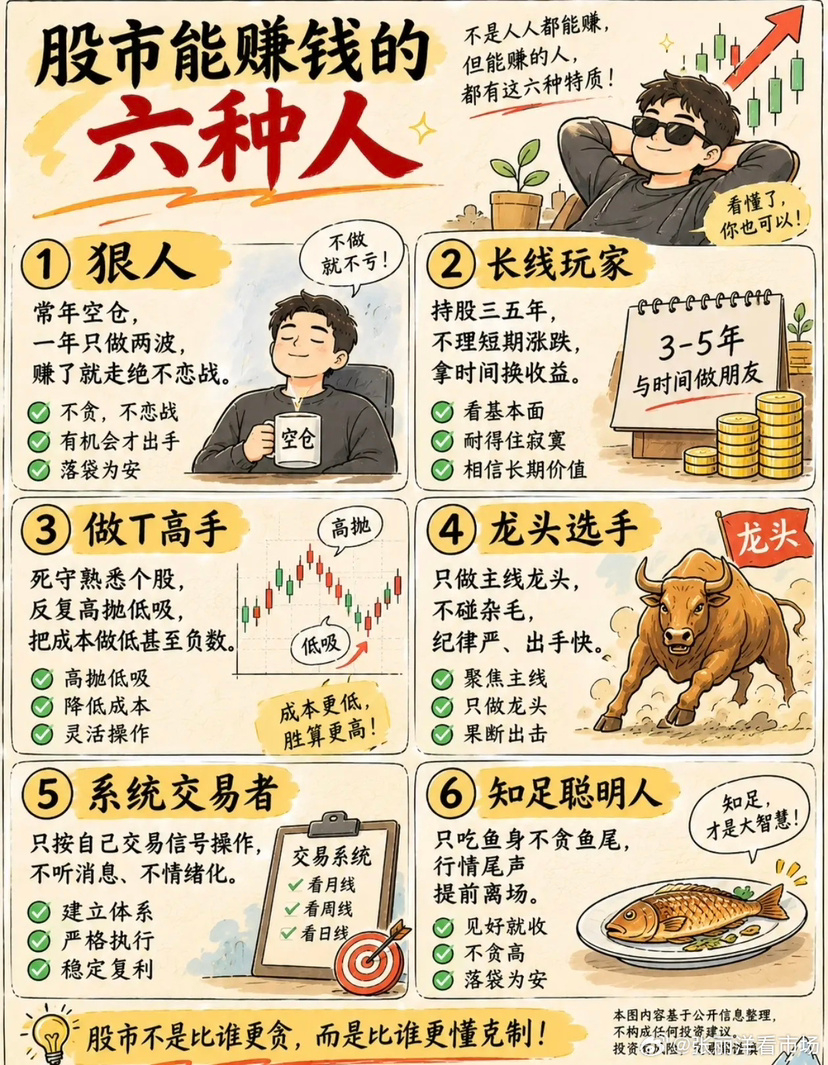
People who make money in the stock market don’t win because of their technical skills, but because they have something many people lack: self-restraint.
These six types of investors have completely different approaches—some stay in cash and wait for opportunities, some hold stocks for three to five years, some trade in and out every day, some chase market leaders, some follow signals, and some take profits while they can—but their underlying principle is remarkably consistent: discipline.
Retail investors lose money not because they don’t understand selling high and buying low, or because they don’t know when to cut their losses. It’s because they can’t keep their hands off their portfolios when they should be sitting in cash, or they get scared out by a 5% swing in a single day when they should be waiting three years.
The most powerful line in the image is the last one: the stock market isn’t about who’s greedier, but who knows how to exercise restraint.
These six ways of making money are, at their core, six different versions of the ability to “know what kind of money you’re making.” The danger is using a long-term strategy while thinking like a short-term trader.
Which one do you think you’re most like?
60
15 Counterintuitive Truths About Trading:
1. The more you want to make money, the more likely you are to trade too often.
2. The more afraid you are of losing money, the more likely you are to cut winning trades short.
3. The more reluctant you are to cut your losses, the more likely you are to end up accepting even bigger losses.
4. The more indicators you study, the more accurate your judgments are not necessarily going to be.
5. Bull markets are the easiest time to make money—and the easiest time to overestimate yourself.
6. Bear markets are the hardest to endure, but they also put your risk awareness to the test.
7. Many people don't struggle with knowing what to buy; they simply have no idea when to sell.
8. After losing 50%, you need a 100% gain just to break even.
9. Ten consecutive winning trades don't mean the eleventh one won't wipe out all your profits.
10. Being right about the direction of the market doesn't mean you'll make money. Position size and timing matter just as much.
11. The gains people show off aren't necessarily their actual overall returns.
12. The market won't give you a chance to win it all back just because you've lost a lot of money.
13. Most of the time, not trading is also a choice.
14. The strategy that's right for you isn't necessarily the one with the highest returns, but the one you can stick to over the long term.
15. The hardest truth to accept about trading: even if you've prepared perfectly, random market fluctuations can still leave you with a loss.
110
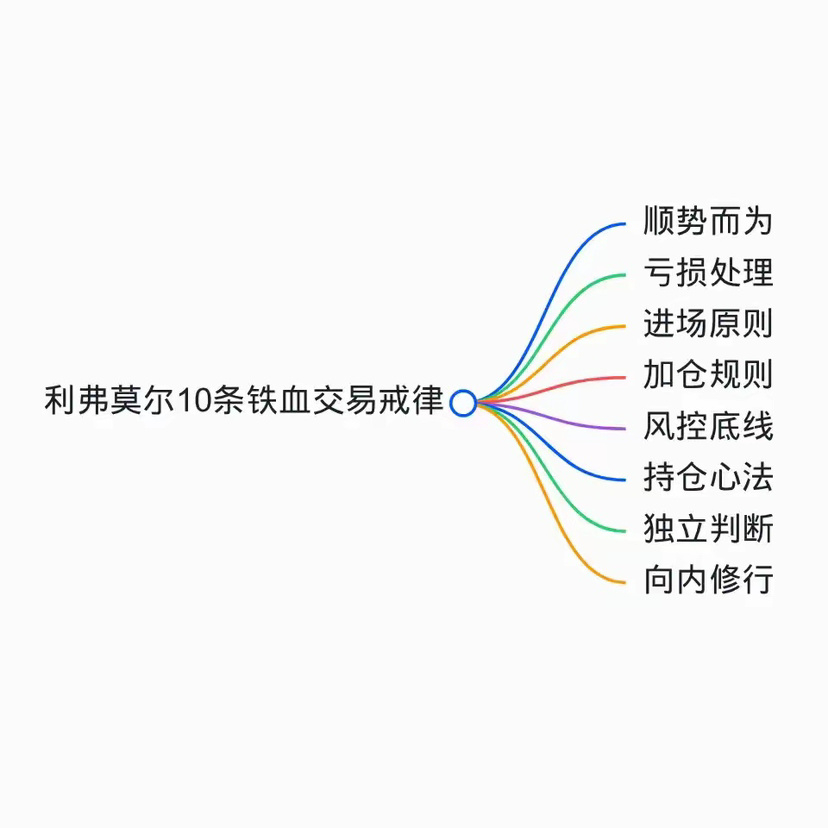
Livermore’s 10 Ironclad Trading Rules
1. Always follow the prevailing trend. Never try to call tops or bottoms against a clear trend.
2. Never average down on losing positions. If you’re wrong, consider only cutting your losses and exiting—never add to a losing position.
3. Wait for clear signals at key turning points. Don’t enter early or blindly trade on gut feelings.
4. Add to winning positions only when the trend is in your favor. Use a pyramid approach to amplify your gains when you’re right.
5. Set strict stop-losses and keep losses on any single trade within your tolerance. Protecting your capital comes first.
6. When the market is choppy or direction is unclear, stay out and watch. Don’t trade just for the sake of trading.
7. Big money comes from holding patiently. Don’t rush to exit at the first sign of a profit—let your winners run.
8. Don’t let short-term news or market fluctuations sway your judgment. Follow only the signals the market itself provides.
9. Don’t bet everything on a single trade. Always leave yourself room to maneuver, and reject the urge to gamble.
10. Trading is a discipline of self-mastery. Only by overcoming greed and fear can you hope to survive in the market over the long term.
⚠️ Risk warning: This is a summary of classic trading principles and does not constitute investment advice. Futures trading involves extremely high risk.
61
9 Stock Market Rules of Thumb, Explained in Plain Language
1. U.S. rate hikes, weaker stocks
When the Federal Reserve raises interest rates, borrowing costs rise and money becomes tighter in the market. Funds flow out, putting downward pressure on stocks.
2. U.S. rate cuts, stronger stocks
When the Federal Reserve cuts interest rates, the cost of capital falls and liquidity becomes more abundant. More money can make it easier for stock prices to rise.
3. Strong dollar, weak gold
When the dollar is valuable, people are more willing to hold it, making gold less attractive and putting downward pressure on gold prices.
4. Geopolitical turmoil, rising commodities
During international conflicts and periods of instability, investors may buy safe-haven commodities such as crude oil and gold, driving up commodity prices.
5. Falling inflation, rising tech stocks
When inflation eases, markets have less reason to worry about continued rate hikes, making high-valuation technology and growth stocks more attractive to investors.
6. Moderate inflation, rising bank stocks
When inflation is moderate and stable, interest rates tend to remain steady, helping banks maintain stable spreads between lending and deposit rates and supporting bank stocks.
7. Rising profits, stronger U.S. stocks
Sustained profit growth at listed companies and solid fundamentals can support gains in U.S. stocks.
8. Weaker dollar, stronger tech stocks
When the dollar depreciates, funds may flow out of dollar-denominated assets and into growth assets and emerging markets, benefiting technology stocks.
9. End of war, falling energy prices
When conflicts ease and risks decline, safe-haven demand fades, making energy prices such as crude oil more likely to fall.
71
PANews, November 12 — UK bank Griffin has completed a $20 million Series B round led by Octagon Partners, valuing the company at more than $100 million. Existing investors, including Notion Capital, A+ Ventures, Nordic Ninja and Breega, also participated. The funds will be used to expand its card issuance and stablecoin-related services.
Griffin previously raised $24 million in March 2024 in a round led by MassMutual Ventures, Nordic Ninja and Breega. At the time, Griffin also officially obtained a full banking license. It now provides bank accounts and Uber Pro Card services to Uber drivers and couriers in the UK, serving more than 80 platform clients and over 300,000 users, and processing approximately 10 million payments annually.
Griffin previously raised $24 million in March 2024 in a round led by MassMutual Ventures, Nordic Ninja and Breega. At the time, Griffin also officially obtained a full banking license. It now provides bank accounts and Uber Pro Card services to Uber drivers and couriers in the UK, serving more than 80 platform clients and over 300,000 users, and processing approximately 10 million payments annually.
61
Assess your own abilities and buy low, sell high. Some people may not have that ability, so you can use a target-based profit-taking method instead.
For example, suppose you bought in at the bottom this time, investing 100,000 yuan.
Once you’re up 5%, sell 20,000 yuan.
Once you’re up 10%, sell another 20,000 yuan.
Once you’re up 15%, sell another 30,000 yuan.
Once you’re up 20%, sell the final 30,000 yuan.
That’s roughly how the method works.
Sometimes discipline is much more effective and simpler than so-called technical analysis.
138
This is how most people blow up their accounts:
1. FOMO-buy at the absolute top
2. Watch it crash
3. Call it a generational buying opportunity
4. Double down because “it can’t go any lower”
5. But the pullback keeps pulling back
6. Panic-sell at the absolute bottom
7. Repeat
This is how most people blow up their accounts:
1. FOMO-buy at the absolute top
2. Watch it crash
3. Call it a generational buying opportunity
4. Double down because “it can’t go any lower”
5. But the pullback keeps pulling back
6. Panic-sell at the absolute bottom
7. Repeat
1. FOMO-buy at the absolute top
2. Watch it crash
3. Call it a generational buying opportunity
4. Double down because “it can’t go any lower”
5. But the pullback keeps pulling back
6. Panic-sell at the absolute bottom
7. Repeat
77
🚨【Top 5 Crypto Headlines for November 11】Bitcoin falls to around $73,000, MARA sells 13,600 BTC, and the NYSE makes moves into AVAX!Several important signals emerged in the crypto market today: U.S. inflationary pressures are mounting and institutional funds continue to flow out, but traditional finance giants are still accelerating their blockchain investments.
① U.S. inflation exceeds expectations; BTC and ETH remain under pressure
U.S. CPI rose 0.4% month over month in October, above market expectations. Bitcoin briefly fell to around $72,700, while Ethereum dropped to around $2,050. Expectations for Fed rate cuts weakened, putting risk assets under liquidity pressure.
② U.S. Bitcoin ETFs see continued net outflows
On November 9, U.S. spot Bitcoin ETFs saw net outflows of about $201 million, while Ethereum ETFs saw net outflows of about $163.4 million. Bitcoin ETFs recorded cumulative net outflows of about $2.13 billion over the past seven days, as institutional investors’ short-term risk aversion rose noticeably.
🚨【Top 5 Crypto Headlines for November 11】Bitcoin falls to around $73,000, MARA sells 13,600 BTC, and the NYSE makes moves into AVAX!
Several important signals emerged in the crypto market today: U.S. inflationary pressures are mounting and institutional funds continue to flow out, but traditional finance giants are still accelerating their blockchain investments.
① U.S. inflation exceeds expectations; BTC and ETH remain under pressure
U.S. CPI rose 0.4% month over month in October, above market expectations. Bitcoin briefly fell to around $72,700, while Ethereum dropped to around $2,050. Expectations for Fed rate cuts weakened, putting risk assets under liquidity pressure.
② U.S. Bitcoin ETFs see continued net outflows
On November 9, U.S. spot Bitcoin ETFs saw net outflows of about $201 million, while Ethereum ETFs saw net outflows of about $163.4 million. Bitcoin ETFs recorded cumulative net outflows of about $2.13 billion over the past seven days, as institutional investors’ short-term risk aversion rose noticeably.
358
Investing is a solitary journey of self-cultivation.
It is a battle with yourself, demanding emotional stability, comfort with solitude, exceptional insight, and the courage to let go of your attachments.
Only those who can master human nature can walk this path.
Investing is one of the hardest professions in which to succeed, and one of the most seductive ways to lose yourself.
Those who lack emotional steadiness, crave quick success, have never been humbled by the market, cannot face their greed and fear, or refuse to reflect should steer clear.
At its core, investing is a journey of self-cultivation.
Every gain reflects the value of your understanding; every loss is the price of human nature.
A true trader appears calm and unruffled, yet is decisive within. They focus on refining their system and seek spiritual growth.
May the ups and downs of the candlesticks help you cultivate a calm and even mind.
73
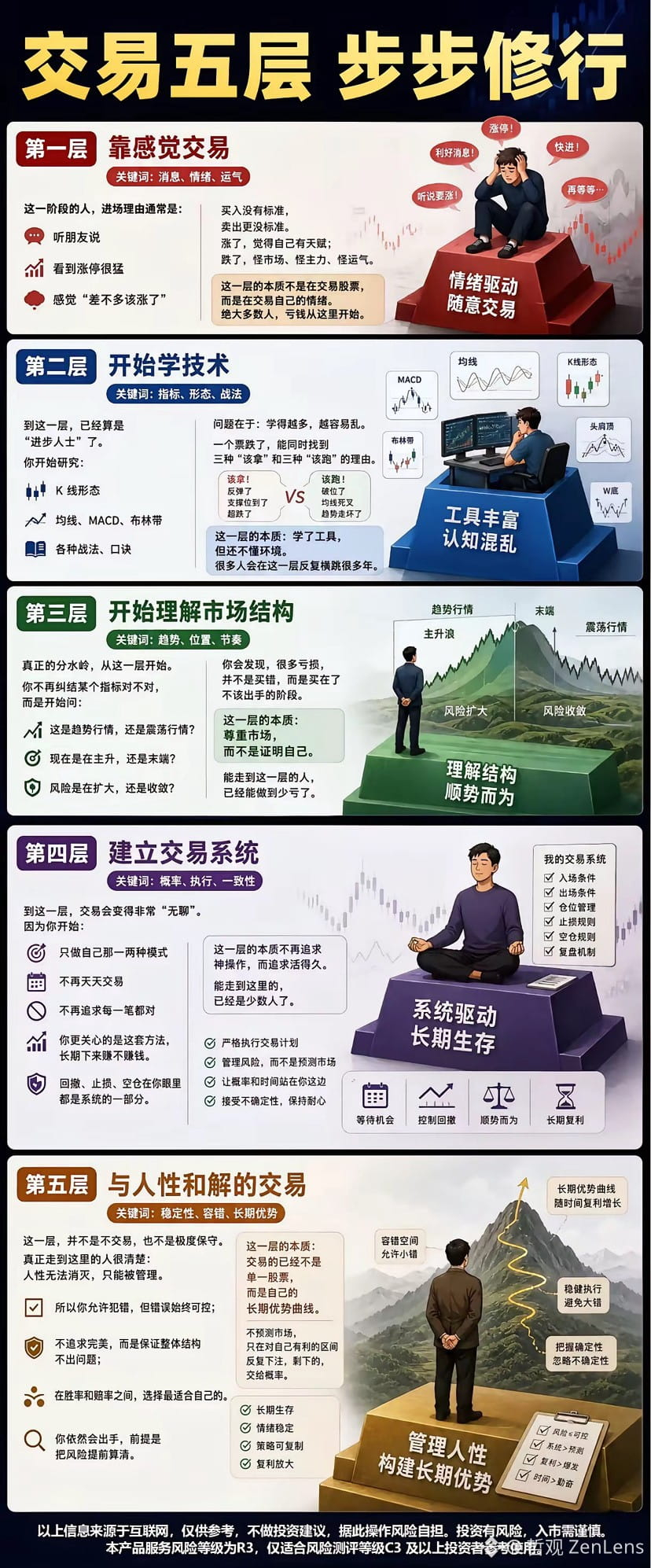
The five levels of stock trading,
which level are you at?
The five levels of stock trading,
which level are you at?
which level are you at?
1
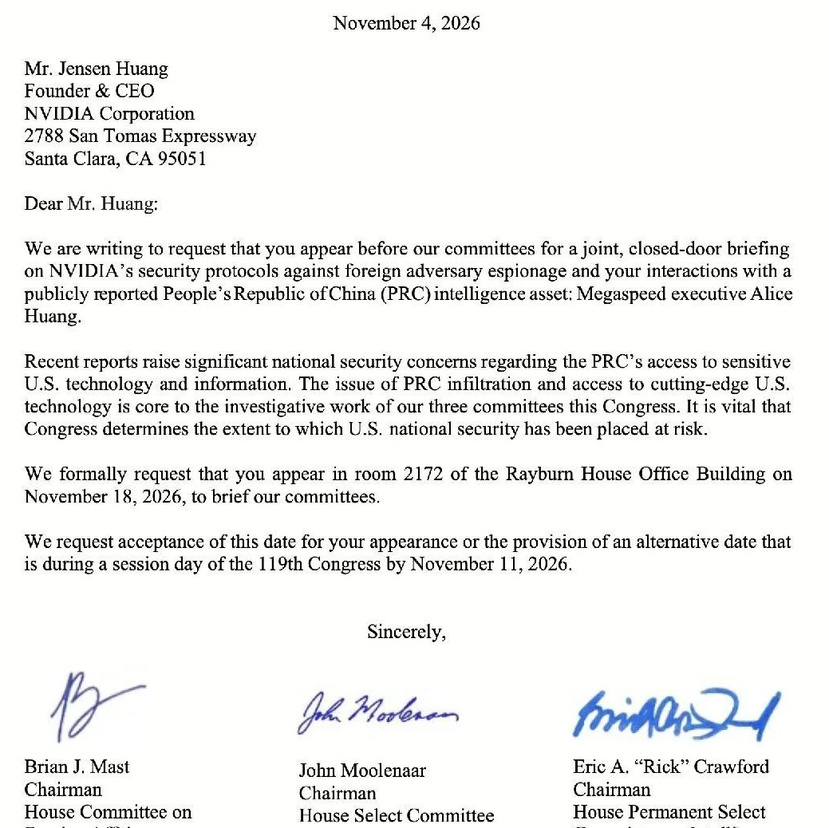
I never expected the first person Congress would “call on for extra credit” to be Jensen Huang. The chairs of three House committees jointly sent the Nvidia boss a letter asking him to attend a closed-door hearing on Capitol Hill—quite the honor, with an invitation as solid as a graphics card’s heatsink.
The main thing they want is for Huang to clarify his relationship with Alice Huang. The reason is pretty dramatic, too: this businesswoman, whom he had previously been in close contact with, was identified by intelligence agencies as a “beautiful spy.” Well, that escalated quickly—from a product launch straight into a Washington thriller.
The main thing they want is for Huang to clarify his relationship with Alice Huang. The reason is pretty dramatic, too: this businesswoman, whom he had previously been in close contact with, was identified by intelligence agencies as a “beautiful spy.” Well, that escalated quickly—from a product launch straight into a Washington thriller.


483
The stock market is human nature; it is a form of personal cultivation.
Chasing highs comes from greed,
panic selling comes from fear,
going all in comes from a gambler’s instinct,
and being deeply underwater comes from refusing to admit defeat.
Every trade reveals the core of your character,
and every gain or loss is part of fate’s cause and effect.
When you stop trading in and out so often and patiently wait for certainty to emerge, you leave restlessness behind.
As long as you’re grateful, not greedy or impatient, and have the patience to wait and the courage to admit your mistakes, you’ll understand: trading stocks isn’t a talent—it’s a form of personal cultivation.
57
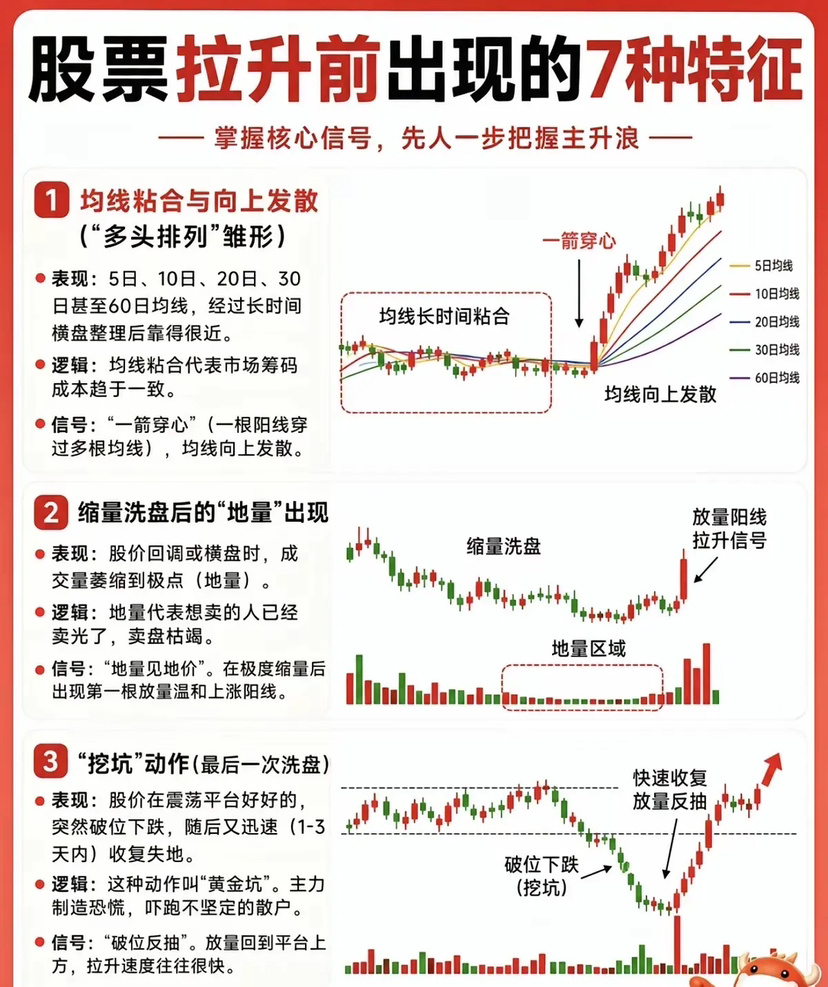
The “ignition point” in moving average systems: Understand the three underlying characteristics that precede a rally
The “ignition point” in moving average systems: Understand the three underlying characteristics that precede a rally
68
Article
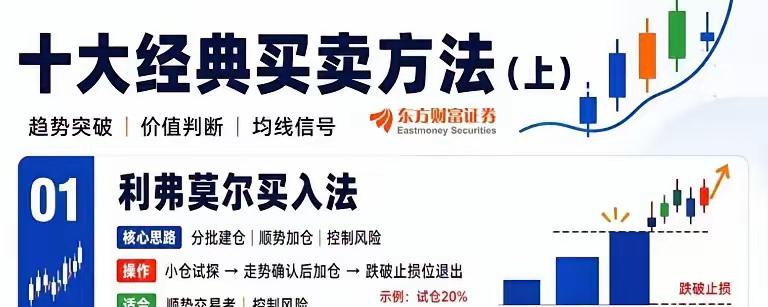
Ten Classic Trading Methods | A Complete Trading Framework from Short-Term to Long-Term⚠️Risk disclaimer: This article is for learning about and reviewing trading concepts only and does not constitute investment advice. Stock market investing involves risk; please invest with caution.
Preface
There are countless ways to trade the markets. This collection of ten classic trading methods covers short-term speculation, trend breakouts, swing reversals, and long-term value investing—catering to traders with different styles. It brings together five methods in Part 1 and five in Part 2 for a complete overview, making them easier to study and review.
[Part 1]
① Livermore Buying Method | Build Positions in Stages with the Trend
Core principles: build positions in stages, add to positions in the direction of the trend, and manage risk.
Ten Classic Trading Methods | A Complete Trading Framework from Short-Term to Long-Term
⚠️Risk disclaimer: This article is for learning about and reviewing trading concepts only and does not constitute investment advice. Stock market investing involves risk; please invest with caution.
Preface
There are countless ways to trade the markets. This collection of ten classic trading methods covers short-term speculation, trend breakouts, swing reversals, and long-term value investing—catering to traders with different styles. It brings together five methods in Part 1 and five in Part 2 for a complete overview, making them easier to study and review.
[Part 1]
① Livermore Buying Method | Build Positions in Stages with the Trend
Core principles: build positions in stages, add to positions in the direction of the trend, and manage risk.
66

Article
Were Binance’s engineers really that easy to fool? Someone just had to accept an interview assignment to wreck the company’s wallet?Binance has released a full postmortem on the theft of $6.34 billion (about 45 billion yuan) on October 30.
Binance stated that it would use its reserve funds to cover all financial losses in full, so users wouldn’t have to pay. According to the FBI, the perpetrators were a state-sponsored hacking group from North Korea.
Many people’s first reaction after reading the report was to scoff: “Were Binance’s engineers really that easy to fool? Someone just had to accept an interview assignment to wreck the company’s wallet?”
But this was no ordinary phishing attack—it was a meticulously planned, top-tier APT (advanced persistent threat) operation that unfolded over nearly six months.
Were Binance’s engineers really that easy to fool? Someone just had to accept an interview assignment to wreck the company’s wallet?
Binance has released a full postmortem on the theft of $6.34 billion (about 45 billion yuan) on October 30.
Binance stated that it would use its reserve funds to cover all financial losses in full, so users wouldn’t have to pay. According to the FBI, the perpetrators were a state-sponsored hacking group from North Korea.
Many people’s first reaction after reading the report was to scoff: “Were Binance’s engineers really that easy to fool? Someone just had to accept an interview assignment to wreck the company’s wallet?”
But this was no ordinary phishing attack—it was a meticulously planned, top-tier APT (advanced persistent threat) operation that unfolded over nearly six months.
1
3
Some simple rules for stock market beginners:
📌 1. If the price drops 5% → Hold
📌 2. If the price drops 15% → Buy 10%
📌 3. If the price drops 25% → Buy 25%
📌 4. If the price rises 5% → Keep holding
📌 5. If the price rises 15% → Keep holding
📌 6. If the price rises 25% → Sell 10%
📌 7. If the price rises 35% → Sell 20%
📌 8. If the price rises 45% → Sell 30%
📌 9. If the price rises 60% → Sell 40%
📌 10. If the price rises 100% → Sell everything
Just my personal opinion, for reference only.
Wishing you good luck and prosperity in November 👍💐
Reply 666 if you received this 👍💐

1
49
If you get a call from the local police station, don't panic.A lot of guys hear “come in to assist with an investigation” and their knees go weak, so they obediently pay the fine and sit in detention.
Actually, once you understand a bit about how investigations work at the local level, you'll see why you shouldn't use any of the following tricks to try to be a “law-abiding, honest person”—otherwise, you'll make the local police's job much harder:
1: Whatever you do, don't lie to the police and say you're out of town and can't come back for six months.
Soliciting prostitution is a public security administrative offense, not a serious criminal offense. Police resources at the local level are extremely stretched, and making an out-of-province trip to arrest someone over an ordinary public security case would involve enormous travel and approval costs. Basically, no local police station would be willing to do it. What's more, the Public Security Administration Punishments Law sets a limitation period of just six months: if no punishment is imposed within six months, the matter can no longer be pursued. By dragging this out and refusing to come back, you're simply creating a dead-end case file for the police.
If you get a call from the local police station, don't panic.
A lot of guys hear “come in to assist with an investigation” and their knees go weak, so they obediently pay the fine and sit in detention.
Actually, once you understand a bit about how investigations work at the local level, you'll see why you shouldn't use any of the following tricks to try to be a “law-abiding, honest person”—otherwise, you'll make the local police's job much harder:
1: Whatever you do, don't lie to the police and say you're out of town and can't come back for six months.
Soliciting prostitution is a public security administrative offense, not a serious criminal offense. Police resources at the local level are extremely stretched, and making an out-of-province trip to arrest someone over an ordinary public security case would involve enormous travel and approval costs. Basically, no local police station would be willing to do it. What's more, the Public Security Administration Punishments Law sets a limitation period of just six months: if no punishment is imposed within six months, the matter can no longer be pursued. By dragging this out and refusing to come back, you're simply creating a dead-end case file for the police.
3
2.9k
The final hurdle to truly understanding trading is understanding human nature,
For the Way to emerge, the ego must die.
What it means for the ego to die is not to lose hope, but to let go of attachments and embrace objectivity.
The Way emerging doesn’t mean you’ve learned some magical secret. It means you’ve become an executor free from subjective assumptions.
The Way of survival, the Way of following the trend, the Way of choosing what to keep and what to let go.
86
Log in to explore more content
Join global crypto users on Binance Square
⚡️ Get latest and useful information about crypto.
💬 Trusted by the world’s largest crypto exchange.
👍 Discover real insights from verified creators.
Email / Phone number
Trending Topics
A Packed Week of Earnings and Data Tests Markets
1,290 views
35 Discussing
🚨🇺🇸 BIG WEEK AHEAD FOR THE MARKETS!
Markets are pricing in a Fed rate hike in December and $BTC could see some big moves next week.
Here's what's coming:
• Monday: Fed Chair Warsh speaks
• Tuesday: US Retail Sales + $NVDA earnings
• Wednesday: FOMC Minutes
• Thursday: Jobless Claims + Philly Fed Index
• Friday: Consumer Sentiment + Fed speeches
All eyes on $BTC as another important week begins.
#bitcoin
Mookie
·6 Likes
·2.2k views
HuangReportedlyConsidersReturnToNvidia
10,351 views
181 Discussing
CryptoSelloffTriggersMultipleWhaleLiquidations
262,822 views
2,227 Discussing