
K总说币
683 Posts

K总说币
Report
Block User
✅公众号:《行情分析室》。🏆25年交易大赛第三名🏅币圈投资引领者,汇集顶级资源,长期胜率保持在80%以上,只做高确定性交易,用结果说话
0 Following
4.0K+ Followers
2.3K Liked
Posts
All
Videos
·
--
A friend asked me: “I only have 3,000 RMB in hand. Is it still suitable to enter the crypto market?”#BTC触及80000美元
I said: having little money was never the biggest problem. The real danger is having a small principal but always wanting to turn it around with one lucky move$SUPER
Many small-capital accounts end up wiped out not because the market is too bad, but because people are too impatient$ETH
When you first enter, you want to go all in. You make a bit and think you’ve got it figured out. You lose a bit and rush to get it back immediately. In the end, what you often really lose isn’t your direction—it’s your own timing
If you only have 3,000 RMB, I’d actually suggest treating it as “practice money” first. Don’t put the pressure of turning it around on that little principal$BTC
Split the 400+ USDT into 4 parts. Each time, take only 100 USDT to test. Learn first: how to enter, how to wait, when to exit, and after profits come in, how to take them
What’s most valuable with small capital isn’t really those few hundred USDT—it’s your opportunities to test and learn
If you make a wrong call once, as long as your position is small, you can still review and come back again. But if you put all your principal in from the start, one mistake may leave you with no room to adjust
So don’t rush to chase pumps, and don’t get upset just because you missed a segment of the market
Join when the structure is stable. Follow when the trend starts. When profits reach your target, take them in batches—don’t fantasize that you’ll catch every single part of the move
3,000 RMB might not change your life right now, but it’s enough for you to build a set of trading habits you can use long-term
First protect your principal, then protect your rules
As long as your account is still there, opportunities will keep coming
What really matters in the crypto market is never who can run the fastest at the beginning—it’s who can keep their timing and discipline the whole way through
If you still don’t know how to split that 400+ USDT or how much to move each time, go find Mr. K. I’ll lay out the main traps that small-capital traders are most likely to step into for you
A friend asked me: “I only have 3,000 RMB in hand. Is it still suitable to enter the crypto market?”#BTC触及80000美元
I said: having little money was never the biggest problem. The real danger is having a small principal but always wanting to turn it around with one lucky move$SUPER
Many small-capital accounts end up wiped out not because the market is too bad, but because people are too impatient$ETH
When you first enter, you want to go all in. You make a bit and think you’ve got it figured out. You lose a bit and rush to get it back immediately. In the end, what you often really lose isn’t your direction—it’s your own timing
If you only have 3,000 RMB, I’d actually suggest treating it as “practice money” first. Don’t put the pressure of turning it around on that little principal$BTC
Split the 400+ USDT into 4 parts. Each time, take only 100 USDT to test. Learn first: how to enter, how to wait, when to exit, and after profits come in, how to take them
What’s most valuable with small capital isn’t really those few hundred USDT—it’s your opportunities to test and learn
If you make a wrong call once, as long as your position is small, you can still review and come back again. But if you put all your principal in from the start, one mistake may leave you with no room to adjust
So don’t rush to chase pumps, and don’t get upset just because you missed a segment of the market
Join when the structure is stable. Follow when the trend starts. When profits reach your target, take them in batches—don’t fantasize that you’ll catch every single part of the move
3,000 RMB might not change your life right now, but it’s enough for you to build a set of trading habits you can use long-term
First protect your principal, then protect your rules
As long as your account is still there, opportunities will keep coming
What really matters in the crypto market is never who can run the fastest at the beginning—it’s who can keep their timing and discipline the whole way through
If you still don’t know how to split that 400+ USDT or how much to move each time, go find Mr. K. I’ll lay out the main traps that small-capital traders are most likely to step into for you
I said: having little money was never the biggest problem. The real danger is having a small principal but always wanting to turn it around with one lucky move$SUPER
Many small-capital accounts end up wiped out not because the market is too bad, but because people are too impatient$ETH
When you first enter, you want to go all in. You make a bit and think you’ve got it figured out. You lose a bit and rush to get it back immediately. In the end, what you often really lose isn’t your direction—it’s your own timing
If you only have 3,000 RMB, I’d actually suggest treating it as “practice money” first. Don’t put the pressure of turning it around on that little principal$BTC
Split the 400+ USDT into 4 parts. Each time, take only 100 USDT to test. Learn first: how to enter, how to wait, when to exit, and after profits come in, how to take them
What’s most valuable with small capital isn’t really those few hundred USDT—it’s your opportunities to test and learn
If you make a wrong call once, as long as your position is small, you can still review and come back again. But if you put all your principal in from the start, one mistake may leave you with no room to adjust
So don’t rush to chase pumps, and don’t get upset just because you missed a segment of the market
Join when the structure is stable. Follow when the trend starts. When profits reach your target, take them in batches—don’t fantasize that you’ll catch every single part of the move
3,000 RMB might not change your life right now, but it’s enough for you to build a set of trading habits you can use long-term
First protect your principal, then protect your rules
As long as your account is still there, opportunities will keep coming
What really matters in the crypto market is never who can run the fastest at the beginning—it’s who can keep their timing and discipline the whole way through
If you still don’t know how to split that 400+ USDT or how much to move each time, go find Mr. K. I’ll lay out the main traps that small-capital traders are most likely to step into for you

73
·
--
In the crypto world, “earning 1 million” is a goal for many people, but few truly achieve it$SPK
The issue usually isn’t that the market lacks opportunities—it’s whether the path you choose fits you, and whether you can stick with it$BTC
For ordinary people, there are roughly three paths$MORPHO
First: long-term accumulation
Use spare money that doesn’t affect your daily life. Allocate to mainstream assets like BTC and ETH in batches, stretch the timeline to 3–5 years, trade less, avoid chasing pumps, and earn from trends and time
This route is the most boring, but also the most worry-free
Second: earn money through your ability
If your principal isn’t much, spend time learning Python, on-chain data, project research, and wallet security, then participate in ecosystem tasks and airdrops that meet the rules
What’s truly valuable isn’t opening many accounts—it’s your ability to screen projects and spot opportunities
Third: bet on early trends
This route can have huge upside, but the risk is also the highest
Don’t just listen to “100x coin” stories. Focus on real user base, developer activity, funding background, and project data. Even if you pick right, you still need to understand how to take profit in batches
So don’t always ask which path is fastest. First, look at how much principal you have, how much time you have, and how much volatility you can tolerate
If you have more capital and less time, lean toward long-term allocation
If you have less capital but more time, improve your skills
If you want early opportunities, only use a small position to experiment
What the market truly fears isn’t moving slowly—it’s trying to do everything and, in the end, not sticking with anything
If you still don’t know which path suits you, go find K Mr. I’ll help you sort out your principal, time, and pace first#币圈暴富
In the crypto world, “earning 1 million” is a goal for many people, but few truly achieve it$SPK
The issue usually isn’t that the market lacks opportunities—it’s whether the path you choose fits you, and whether you can stick with it$BTC
For ordinary people, there are roughly three paths$MORPHO
First: long-term accumulation
Use spare money that doesn’t affect your daily life. Allocate to mainstream assets like BTC and ETH in batches, stretch the timeline to 3–5 years, trade less, avoid chasing pumps, and earn from trends and time
This route is the most boring, but also the most worry-free
Second: earn money through your ability
If your principal isn’t much, spend time learning Python, on-chain data, project research, and wallet security, then participate in ecosystem tasks and airdrops that meet the rules
What’s truly valuable isn’t opening many accounts—it’s your ability to screen projects and spot opportunities
Third: bet on early trends
This route can have huge upside, but the risk is also the highest
Don’t just listen to “100x coin” stories. Focus on real user base, developer activity, funding background, and project data. Even if you pick right, you still need to understand how to take profit in batches
So don’t always ask which path is fastest. First, look at how much principal you have, how much time you have, and how much volatility you can tolerate
If you have more capital and less time, lean toward long-term allocation
If you have less capital but more time, improve your skills
If you want early opportunities, only use a small position to experiment
What the market truly fears isn’t moving slowly—it’s trying to do everything and, in the end, not sticking with anything
If you still don’t know which path suits you, go find K Mr. I’ll help you sort out your principal, time, and pace first#币圈暴富
The issue usually isn’t that the market lacks opportunities—it’s whether the path you choose fits you, and whether you can stick with it$BTC
For ordinary people, there are roughly three paths$MORPHO
First: long-term accumulation
Use spare money that doesn’t affect your daily life. Allocate to mainstream assets like BTC and ETH in batches, stretch the timeline to 3–5 years, trade less, avoid chasing pumps, and earn from trends and time
This route is the most boring, but also the most worry-free
Second: earn money through your ability
If your principal isn’t much, spend time learning Python, on-chain data, project research, and wallet security, then participate in ecosystem tasks and airdrops that meet the rules
What’s truly valuable isn’t opening many accounts—it’s your ability to screen projects and spot opportunities
Third: bet on early trends
This route can have huge upside, but the risk is also the highest
Don’t just listen to “100x coin” stories. Focus on real user base, developer activity, funding background, and project data. Even if you pick right, you still need to understand how to take profit in batches
So don’t always ask which path is fastest. First, look at how much principal you have, how much time you have, and how much volatility you can tolerate
If you have more capital and less time, lean toward long-term allocation
If you have less capital but more time, improve your skills
If you want early opportunities, only use a small position to experiment
What the market truly fears isn’t moving slowly—it’s trying to do everything and, in the end, not sticking with anything
If you still don’t know which path suits you, go find K Mr. I’ll help you sort out your principal, time, and pace first#币圈暴富

328
·
--
Last year someone came to me with 900U, and the first thing they asked was how to quickly turn things around. I didn’t teach them how to seize quick “surge” opportunities. The first thing I told them to do was to quit three bad habits: $SPK
First: quit gambling it all in (hitting the “all-in” button). $BTC
Even if 900U is small, you still can’t put it all into one trade.
I had them split their funds into three parts: one for short-term trades, one specifically to wait for and trade the trend, and the last one to stay out of the market at all times.
The biggest fear with a small account isn’t making money slowly—it’s making one mistake and then losing the next chance as well.
Second: quit random trading. $MORPHO
Back then, whenever they saw the candlestick move, they wanted to place an order. They traded in ranging markets, traded during consolidation, and traded whenever it looked like they were “missing opportunities” if they didn’t act.
I only told them one sentence: most of the time, the market simply isn’t worth your effort.
If there’s no structure, wait. Only act when the trend truly shows itself. Doing ten trades a day doesn’t mean you’re good—real clarity, at the right levels, only needs one or two good entries.
Third: quit stubbornly holding losses.
When price reaches the level in your plan, exit. Take partial profits when you’re in profit. If your direction is wrong, don’t keep adding to “solve” the problem.
Many people can’t get their account going for a long time—not because they’ve never caught opportunities, but because when they’re winning they’re too greedy, and when they’re losing they can hold on for too long.
You might do things right ten times at the front, but on the last one you lose control emotionally—and you could give it all back.
So if you want to build up gradually with a small amount of capital, there really aren’t that many secrets.
Split the capital, touch “junk” market conditions less, and recognize mistakes in time.
You don’t need to get every single trade right, but you must never let one trade ruin your entire account.
Small capital isn’t scary. Being in a rush is.
If you’re still carrying a few hundred U and charging around everywhere, come find K—first change the three habits: all-in gambling, random trading, and stubborn holding. Then your account’s rhythm really has a chance to line up. #币圈暴富
Last year someone came to me with 900U, and the first thing they asked was how to quickly turn things around. I didn’t teach them how to seize quick “surge” opportunities. The first thing I told them to do was to quit three bad habits: $SPK
First: quit gambling it all in (hitting the “all-in” button). $BTC
Even if 900U is small, you still can’t put it all into one trade.
I had them split their funds into three parts: one for short-term trades, one specifically to wait for and trade the trend, and the last one to stay out of the market at all times.
The biggest fear with a small account isn’t making money slowly—it’s making one mistake and then losing the next chance as well.
Second: quit random trading. $MORPHO
Back then, whenever they saw the candlestick move, they wanted to place an order. They traded in ranging markets, traded during consolidation, and traded whenever it looked like they were “missing opportunities” if they didn’t act.
I only told them one sentence: most of the time, the market simply isn’t worth your effort.
If there’s no structure, wait. Only act when the trend truly shows itself. Doing ten trades a day doesn’t mean you’re good—real clarity, at the right levels, only needs one or two good entries.
Third: quit stubbornly holding losses.
When price reaches the level in your plan, exit. Take partial profits when you’re in profit. If your direction is wrong, don’t keep adding to “solve” the problem.
Many people can’t get their account going for a long time—not because they’ve never caught opportunities, but because when they’re winning they’re too greedy, and when they’re losing they can hold on for too long.
You might do things right ten times at the front, but on the last one you lose control emotionally—and you could give it all back.
So if you want to build up gradually with a small amount of capital, there really aren’t that many secrets.
Split the capital, touch “junk” market conditions less, and recognize mistakes in time.
You don’t need to get every single trade right, but you must never let one trade ruin your entire account.
Small capital isn’t scary. Being in a rush is.
If you’re still carrying a few hundred U and charging around everywhere, come find K—first change the three habits: all-in gambling, random trading, and stubborn holding. Then your account’s rhythm really has a chance to line up. #币圈暴富
First: quit gambling it all in (hitting the “all-in” button). $BTC
Even if 900U is small, you still can’t put it all into one trade.
I had them split their funds into three parts: one for short-term trades, one specifically to wait for and trade the trend, and the last one to stay out of the market at all times.
The biggest fear with a small account isn’t making money slowly—it’s making one mistake and then losing the next chance as well.
Second: quit random trading. $MORPHO
Back then, whenever they saw the candlestick move, they wanted to place an order. They traded in ranging markets, traded during consolidation, and traded whenever it looked like they were “missing opportunities” if they didn’t act.
I only told them one sentence: most of the time, the market simply isn’t worth your effort.
If there’s no structure, wait. Only act when the trend truly shows itself. Doing ten trades a day doesn’t mean you’re good—real clarity, at the right levels, only needs one or two good entries.
Third: quit stubbornly holding losses.
When price reaches the level in your plan, exit. Take partial profits when you’re in profit. If your direction is wrong, don’t keep adding to “solve” the problem.
Many people can’t get their account going for a long time—not because they’ve never caught opportunities, but because when they’re winning they’re too greedy, and when they’re losing they can hold on for too long.
You might do things right ten times at the front, but on the last one you lose control emotionally—and you could give it all back.
So if you want to build up gradually with a small amount of capital, there really aren’t that many secrets.
Split the capital, touch “junk” market conditions less, and recognize mistakes in time.
You don’t need to get every single trade right, but you must never let one trade ruin your entire account.
Small capital isn’t scary. Being in a rush is.
If you’re still carrying a few hundred U and charging around everywhere, come find K—first change the three habits: all-in gambling, random trading, and stubborn holding. Then your account’s rhythm really has a chance to line up. #币圈暴富

102
·
--
Many people get the market direction right but still can’t make real big money. I used to be the same—until I fully figured out two actions: how to add to profits, and when to take profits. Only then did my 3,000U slowly grow to 100,000U.
At the beginning, my biggest problem was that as soon as I made a little, I was eager to run; when I lost, I actually couldn’t bear to leave.
Once, when the market was just starting to move, I caught about 15% and exited. I thought I did pretty well—until later the uptrend kept going nonstop. I could only stand outside watching #币圈暴富 .
After that, I realized: getting the direction right is only step one. What truly creates the gap is this—how you handle profit after you get it right.
Later, I changed my method to #币圈生存法则 .
For the first trade, you always test first. Don’t add recklessly before the market proves itself. Only if the trend keeps strengthening and the pullback doesn’t break the structure, will I consider gradually increasing my position using the profits already generated.
In other words, don’t stubbornly push with principal. Let profits amplify profits.
What truly made my account show a clear change was a later period of one-way market.
At the time, many people thought it had already risen enough and were eager to exit. But the three conditions I was watching still hadn’t changed: the trend strength is still there, the pullback magnitude is normal, and the position size is still within what it can handle.
If all three conditions are met, I continue following the plan. If even one is missing, I immediately reduce my position.
It was those times when I handled things correctly that gradually helped my account cross from a few thousand U to six figures—and then later to 100,000U.
So for the journey from 3,000U to 100,000U, what’s truly worth paying attention to isn’t the final number. It’s these two actions:
If your direction is wrong, don’t stubbornly hold on $ONG .
If your direction is right, don’t give up your advantage too early.
The market is never short of opportunities. What’s truly scarce are the people who can be light when they should, take profits when they should, and be able to stop when they should.
If you often get the direction right but only end up taking a little bit of profit, come find K—I'll help you sort out this whole routine: how to manage your position after you’re in profit.
Many people get the market direction right but still can’t make real big money. I used to be the same—until I fully figured out two actions: how to add to profits, and when to take profits. Only then did my 3,000U slowly grow to 100,000U.
At the beginning, my biggest problem was that as soon as I made a little, I was eager to run; when I lost, I actually couldn’t bear to leave.
Once, when the market was just starting to move, I caught about 15% and exited. I thought I did pretty well—until later the uptrend kept going nonstop. I could only stand outside watching #币圈暴富 .
After that, I realized: getting the direction right is only step one. What truly creates the gap is this—how you handle profit after you get it right.
Later, I changed my method to #币圈生存法则 .
For the first trade, you always test first. Don’t add recklessly before the market proves itself. Only if the trend keeps strengthening and the pullback doesn’t break the structure, will I consider gradually increasing my position using the profits already generated.
In other words, don’t stubbornly push with principal. Let profits amplify profits.
What truly made my account show a clear change was a later period of one-way market.
At the time, many people thought it had already risen enough and were eager to exit. But the three conditions I was watching still hadn’t changed: the trend strength is still there, the pullback magnitude is normal, and the position size is still within what it can handle.
If all three conditions are met, I continue following the plan. If even one is missing, I immediately reduce my position.
It was those times when I handled things correctly that gradually helped my account cross from a few thousand U to six figures—and then later to 100,000U.
So for the journey from 3,000U to 100,000U, what’s truly worth paying attention to isn’t the final number. It’s these two actions:
If your direction is wrong, don’t stubbornly hold on $ONG .
If your direction is right, don’t give up your advantage too early.
The market is never short of opportunities. What’s truly scarce are the people who can be light when they should, take profits when they should, and be able to stop when they should.
If you often get the direction right but only end up taking a little bit of profit, come find K—I'll help you sort out this whole routine: how to manage your position after you’re in profit.
At the beginning, my biggest problem was that as soon as I made a little, I was eager to run; when I lost, I actually couldn’t bear to leave.
Once, when the market was just starting to move, I caught about 15% and exited. I thought I did pretty well—until later the uptrend kept going nonstop. I could only stand outside watching #币圈暴富 .
After that, I realized: getting the direction right is only step one. What truly creates the gap is this—how you handle profit after you get it right.
Later, I changed my method to #币圈生存法则 .
For the first trade, you always test first. Don’t add recklessly before the market proves itself. Only if the trend keeps strengthening and the pullback doesn’t break the structure, will I consider gradually increasing my position using the profits already generated.
In other words, don’t stubbornly push with principal. Let profits amplify profits.
What truly made my account show a clear change was a later period of one-way market.
At the time, many people thought it had already risen enough and were eager to exit. But the three conditions I was watching still hadn’t changed: the trend strength is still there, the pullback magnitude is normal, and the position size is still within what it can handle.
If all three conditions are met, I continue following the plan. If even one is missing, I immediately reduce my position.
It was those times when I handled things correctly that gradually helped my account cross from a few thousand U to six figures—and then later to 100,000U.
So for the journey from 3,000U to 100,000U, what’s truly worth paying attention to isn’t the final number. It’s these two actions:
If your direction is wrong, don’t stubbornly hold on $ONG .
If your direction is right, don’t give up your advantage too early.
The market is never short of opportunities. What’s truly scarce are the people who can be light when they should, take profits when they should, and be able to stop when they should.
If you often get the direction right but only end up taking a little bit of profit, come find K—I'll help you sort out this whole routine: how to manage your position after you’re in profit.
375
·
--
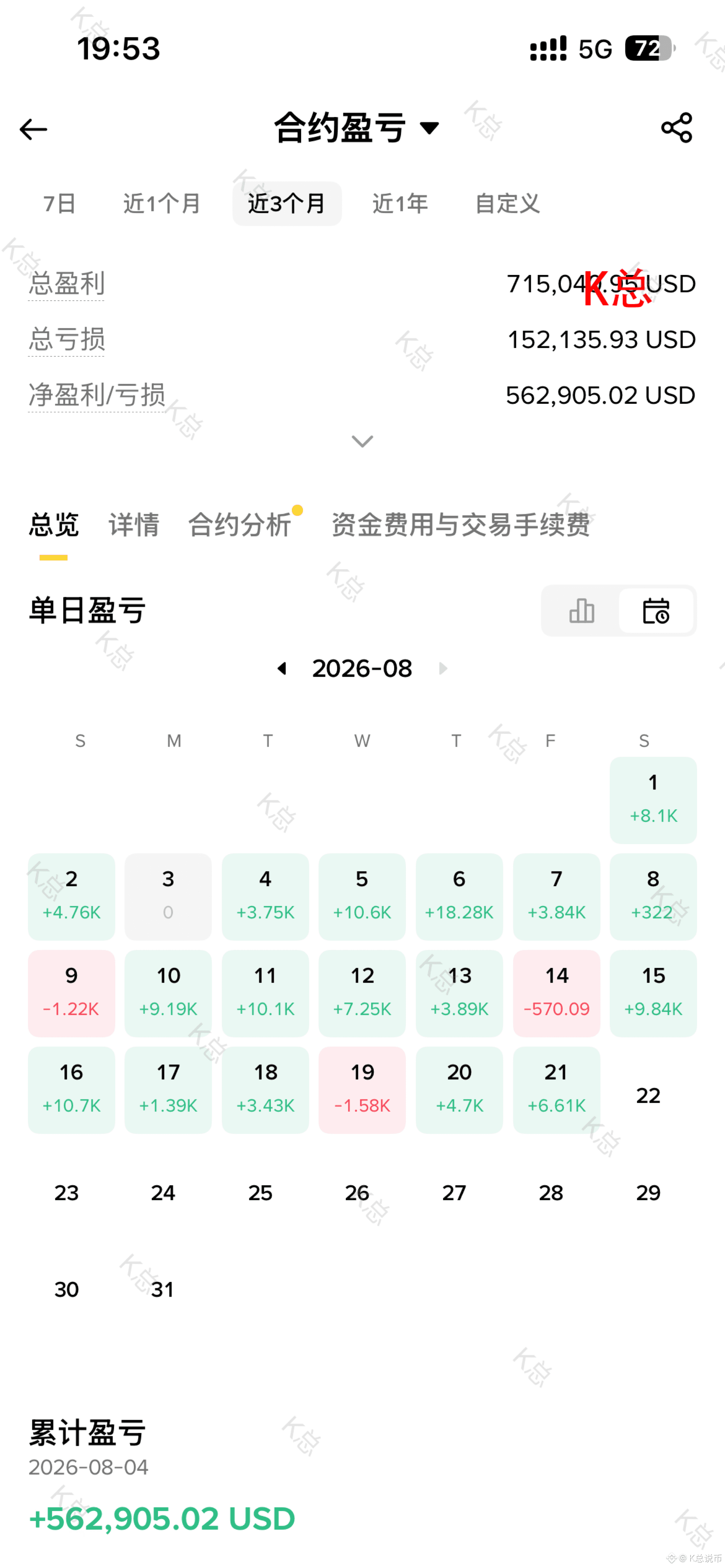
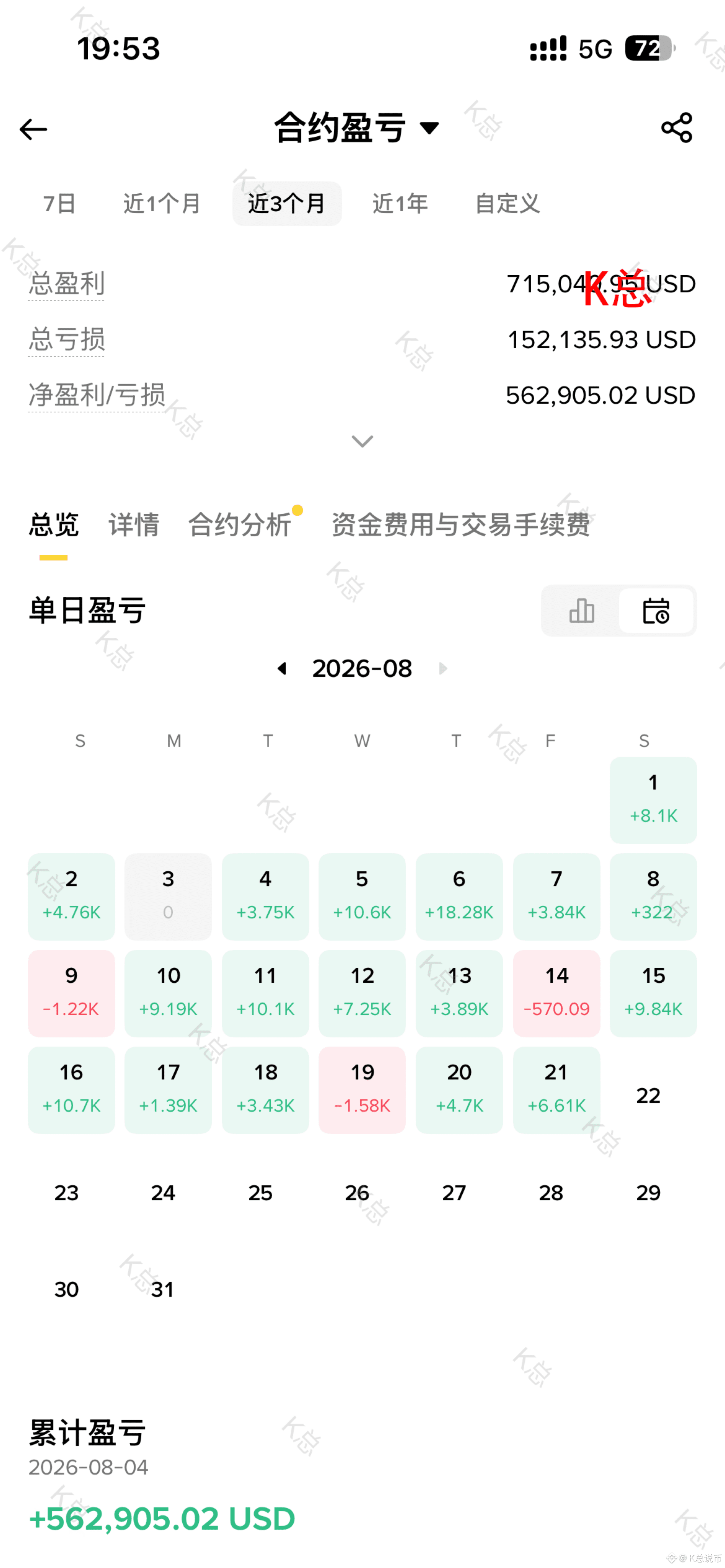
Many people ask me: “K, now that you can travel everywhere and live relatively freely, you must have had a decent amount of principal at the very beginning, right?”
I usually just smile and say: “No, not at all. I started with only 2,000 yuan. And at one point in the middle, I even lost so much that I was down to just 1,000.”
When I first entered this market, like many new traders, I was all about making things grow quickly. Chasing pumps, going in with heavy positions, and hitting high-volatility targets. In the end, my account almost got wiped out by me fiddling with it.
It wasn’t until one night when I couldn’t sleep while staring at the charts that I finally understood: if you want to stay for the long run, it’s not about nerve—it’s about rules.
Later, I summed up the six pitfalls I stepped into. And it was precisely these simplest things that helped me restart from the remaining 1,000 yuan.
① A rapid rise and slow decline—watch the support at $ETH
After a sudden surge, if the pullback is slow and the volume clearly contracts again, it suggests there may still be buyers/support below. As long as the trend hasn’t broken, don’t let small fluctuations easily scare you off #币圈生存法则
② A sharp drop and weak rebound—be cautious with $BTC
After a wave of fast selling, if the rebound never manages to reclaim the key levels, it means the support is weak. In that case, don’t rush to fantasize about a reversal $ETH
③ High-volume at the top doesn’t necessarily mean it’s over
What really matters is whether price can continue moving after the increased volume. When price at high levels has both volume and “price action,” the trend may still be intact. The more it rises without volume, the more you should be on guard $BTC
④ For breakouts at the bottom, look for continuity
One occasional big volume candlestick doesn’t prove much. The reference value is much greater when it appears continuously—support keeps showing up and volume gradually lifts $SNDK
⑤ Volume is more honest than emotion $SNDK
Indicators can help, but whether capital is willing to enter ultimately will still be reflected in volume and liquidity.
⑥ In the end, it’s all about mindset
Don’t be in a rush, don’t chase, and don’t fear missing out. If you don’t understand, wait. People who can truly do this for the long term usually know when not to act.
In the small-capital stage, I’ve always followed one principle: split your money up—use only a small portion each time to test. Once the direction is correct, then accumulate slowly. When profits come in, take them first. Don’t let one impulsive move ruin the results you built earlier.
After doing this for long enough, you’ll realize the hardest thing to deal with is never a single piece of news or any one fluctuation—it’s your own greed and impatience.
I’m K. I won’t hype up myths—I’ll just talk about the real experience I gained the hard way over these years.
If you’re still making random moves and haven’t found your rhythm, come find K. Some detours can actually be avoided by saving yourself years of effort #加密市场观察
Many people ask me: “K, now that you can travel everywhere and live relatively freely, you must have had a decent amount of principal at the very beginning, right?”
I usually just smile and say: “No, not at all. I started with only 2,000 yuan. And at one point in the middle, I even lost so much that I was down to just 1,000.”
When I first entered this market, like many new traders, I was all about making things grow quickly. Chasing pumps, going in with heavy positions, and hitting high-volatility targets. In the end, my account almost got wiped out by me fiddling with it.
It wasn’t until one night when I couldn’t sleep while staring at the charts that I finally understood: if you want to stay for the long run, it’s not about nerve—it’s about rules.
Later, I summed up the six pitfalls I stepped into. And it was precisely these simplest things that helped me restart from the remaining 1,000 yuan.
① A rapid rise and slow decline—watch the support at $ETH
After a sudden surge, if the pullback is slow and the volume clearly contracts again, it suggests there may still be buyers/support below. As long as the trend hasn’t broken, don’t let small fluctuations easily scare you off #币圈生存法则
② A sharp drop and weak rebound—be cautious with $BTC
After a wave of fast selling, if the rebound never manages to reclaim the key levels, it means the support is weak. In that case, don’t rush to fantasize about a reversal $ETH
③ High-volume at the top doesn’t necessarily mean it’s over
What really matters is whether price can continue moving after the increased volume. When price at high levels has both volume and “price action,” the trend may still be intact. The more it rises without volume, the more you should be on guard $BTC
④ For breakouts at the bottom, look for continuity
One occasional big volume candlestick doesn’t prove much. The reference value is much greater when it appears continuously—support keeps showing up and volume gradually lifts $SNDK
⑤ Volume is more honest than emotion $SNDK
Indicators can help, but whether capital is willing to enter ultimately will still be reflected in volume and liquidity.
⑥ In the end, it’s all about mindset
Don’t be in a rush, don’t chase, and don’t fear missing out. If you don’t understand, wait. People who can truly do this for the long term usually know when not to act.
In the small-capital stage, I’ve always followed one principle: split your money up—use only a small portion each time to test. Once the direction is correct, then accumulate slowly. When profits come in, take them first. Don’t let one impulsive move ruin the results you built earlier.
After doing this for long enough, you’ll realize the hardest thing to deal with is never a single piece of news or any one fluctuation—it’s your own greed and impatience.
I’m K. I won’t hype up myths—I’ll just talk about the real experience I gained the hard way over these years.
If you’re still making random moves and haven’t found your rhythm, come find K. Some detours can actually be avoided by saving yourself years of effort #加密市场观察
I usually just smile and say: “No, not at all. I started with only 2,000 yuan. And at one point in the middle, I even lost so much that I was down to just 1,000.”
When I first entered this market, like many new traders, I was all about making things grow quickly. Chasing pumps, going in with heavy positions, and hitting high-volatility targets. In the end, my account almost got wiped out by me fiddling with it.
It wasn’t until one night when I couldn’t sleep while staring at the charts that I finally understood: if you want to stay for the long run, it’s not about nerve—it’s about rules.
Later, I summed up the six pitfalls I stepped into. And it was precisely these simplest things that helped me restart from the remaining 1,000 yuan.
① A rapid rise and slow decline—watch the support at $ETH
After a sudden surge, if the pullback is slow and the volume clearly contracts again, it suggests there may still be buyers/support below. As long as the trend hasn’t broken, don’t let small fluctuations easily scare you off #币圈生存法则
② A sharp drop and weak rebound—be cautious with $BTC
After a wave of fast selling, if the rebound never manages to reclaim the key levels, it means the support is weak. In that case, don’t rush to fantasize about a reversal $ETH
③ High-volume at the top doesn’t necessarily mean it’s over
What really matters is whether price can continue moving after the increased volume. When price at high levels has both volume and “price action,” the trend may still be intact. The more it rises without volume, the more you should be on guard $BTC
④ For breakouts at the bottom, look for continuity
One occasional big volume candlestick doesn’t prove much. The reference value is much greater when it appears continuously—support keeps showing up and volume gradually lifts $SNDK
⑤ Volume is more honest than emotion $SNDK
Indicators can help, but whether capital is willing to enter ultimately will still be reflected in volume and liquidity.
⑥ In the end, it’s all about mindset
Don’t be in a rush, don’t chase, and don’t fear missing out. If you don’t understand, wait. People who can truly do this for the long term usually know when not to act.
In the small-capital stage, I’ve always followed one principle: split your money up—use only a small portion each time to test. Once the direction is correct, then accumulate slowly. When profits come in, take them first. Don’t let one impulsive move ruin the results you built earlier.
After doing this for long enough, you’ll realize the hardest thing to deal with is never a single piece of news or any one fluctuation—it’s your own greed and impatience.
I’m K. I won’t hype up myths—I’ll just talk about the real experience I gained the hard way over these years.
If you’re still making random moves and haven’t found your rhythm, come find K. Some detours can actually be avoided by saving yourself years of effort #加密市场观察
114
·
--
A few years ago, I met a friend in Chengdu who did trading. He was a little over 30, and he’d been grinding in the crypto market for many years.
Later, when we talked more deeply, I found out he didn’t rely on insider information, and it wasn’t just luck either. He did it by using six very “stupid” (simple) methods to turn 330,000 step by step into over 3 million.
Now he has eight properties under his name—one he lives in, one for his parents, and the rest are rentals.
I asked him exactly what he relied on. He summarized it into six points:
First, watch the pullback rhythm $BTC
When it rises quickly but the pullbacks are slow, it suggests there may be more support below. Don’t get scared off by a few small bearish candles.
Second, gauge the strength of the rebound $SNDK
After a sharp drop, if the rebound lacks power and repeatedly fails to reclaim key levels, don’t rush to bottom-fish.
Third, heavy volume at high levels doesn’t necessarily mean the top
The key is to see whether the price can continue to strengthen after the surge in volume. If there’s volume and price movement together, the trend might not be over yet $ETH
Fourth, bottom breakout volume must be assessed for continuity
One burst of high volume means nothing on its own. It’s more worth paying attention when there is continuous support and the volume keeps increasing.
Fifth, don’t just stare at the candlestick chart
Behind the chart, what you’re really seeing is capital and sentiment. Often, volume is more informative than any single candlestick.
Sixth—and most important of all: endure and wait
If you can’t understand it, wait. If the structure hasn’t formed, don’t act. Only move when the real opportunity that truly belongs to you arrives.
He went from 330,000 to over 3 million slowly, not by hitting one bet, but by repeating these six simple actions for many years.
The method doesn’t have to be complicated. What’s truly hard is long-term execution.
Come find K—later, I’ll break down the details of these six points that are easiest to misread and explain them again #比特币创2023年3月来最佳周表现 #美光拟投100亿美元建研究实验室
A few years ago, I met a friend in Chengdu who did trading. He was a little over 30, and he’d been grinding in the crypto market for many years.
Later, when we talked more deeply, I found out he didn’t rely on insider information, and it wasn’t just luck either. He did it by using six very “stupid” (simple) methods to turn 330,000 step by step into over 3 million.
Now he has eight properties under his name—one he lives in, one for his parents, and the rest are rentals.
I asked him exactly what he relied on. He summarized it into six points:
First, watch the pullback rhythm $BTC
When it rises quickly but the pullbacks are slow, it suggests there may be more support below. Don’t get scared off by a few small bearish candles.
Second, gauge the strength of the rebound $SNDK
After a sharp drop, if the rebound lacks power and repeatedly fails to reclaim key levels, don’t rush to bottom-fish.
Third, heavy volume at high levels doesn’t necessarily mean the top
The key is to see whether the price can continue to strengthen after the surge in volume. If there’s volume and price movement together, the trend might not be over yet $ETH
Fourth, bottom breakout volume must be assessed for continuity
One burst of high volume means nothing on its own. It’s more worth paying attention when there is continuous support and the volume keeps increasing.
Fifth, don’t just stare at the candlestick chart
Behind the chart, what you’re really seeing is capital and sentiment. Often, volume is more informative than any single candlestick.
Sixth—and most important of all: endure and wait
If you can’t understand it, wait. If the structure hasn’t formed, don’t act. Only move when the real opportunity that truly belongs to you arrives.
He went from 330,000 to over 3 million slowly, not by hitting one bet, but by repeating these six simple actions for many years.
The method doesn’t have to be complicated. What’s truly hard is long-term execution.
Come find K—later, I’ll break down the details of these six points that are easiest to misread and explain them again #比特币创2023年3月来最佳周表现 #美光拟投100亿美元建研究实验室
Later, when we talked more deeply, I found out he didn’t rely on insider information, and it wasn’t just luck either. He did it by using six very “stupid” (simple) methods to turn 330,000 step by step into over 3 million.
Now he has eight properties under his name—one he lives in, one for his parents, and the rest are rentals.
I asked him exactly what he relied on. He summarized it into six points:
First, watch the pullback rhythm $BTC
When it rises quickly but the pullbacks are slow, it suggests there may be more support below. Don’t get scared off by a few small bearish candles.
Second, gauge the strength of the rebound $SNDK
After a sharp drop, if the rebound lacks power and repeatedly fails to reclaim key levels, don’t rush to bottom-fish.
Third, heavy volume at high levels doesn’t necessarily mean the top
The key is to see whether the price can continue to strengthen after the surge in volume. If there’s volume and price movement together, the trend might not be over yet $ETH
Fourth, bottom breakout volume must be assessed for continuity
One burst of high volume means nothing on its own. It’s more worth paying attention when there is continuous support and the volume keeps increasing.
Fifth, don’t just stare at the candlestick chart
Behind the chart, what you’re really seeing is capital and sentiment. Often, volume is more informative than any single candlestick.
Sixth—and most important of all: endure and wait
If you can’t understand it, wait. If the structure hasn’t formed, don’t act. Only move when the real opportunity that truly belongs to you arrives.
He went from 330,000 to over 3 million slowly, not by hitting one bet, but by repeating these six simple actions for many years.
The method doesn’t have to be complicated. What’s truly hard is long-term execution.
Come find K—later, I’ll break down the details of these six points that are easiest to misread and explain them again #比特币创2023年3月来最佳周表现 #美光拟投100亿美元建研究实验室
460
Log in to explore more content
Join global crypto users on Binance Square
⚡️ Get latest and useful information about crypto.
💬 Trusted by the world’s largest crypto exchange.
👍 Discover real insights from verified creators.
Email / Phone number
Trending Topics
AppleDebutsFoldablePhone
34,043 views
714 Discussing
Apple just dropped the foldable iPhone — and the market is paying attention. This isn't just another product cycle; it's a new product category, a new CEO on stage, and a $1,999 price tag that pushes $AAPL further into ultra-premium territory. Foldables are the narrative, and Apple is now the headline.
#appledebutsfoldablephone #EUExtendsCentralContactPointToCASPs #US10YTreasuryYieldHitsHighestSinceNov2023 #BrentCrudeTops$100 #USTreasuryToBuyBackUpTo$6BLongDatedDebt
KimHotbae
·2 Likes
·2.8k views
TSMCAugustRevenueUp53.3%YoY
4,521 views
173 Discussing
IranSaysReadyToEscalateWarWithUS
8,061 views
204 Discussing