
Kaan Kaya 1
336 Posts

Kaan Kaya 1
Report
Block User
Web3 strategist | On-chain analyst Building new projects, sharing smart money insights 📊 Open to collaborations with teams creating real value.
0 Following
1 Followers
17 Liked
Posts
·
--
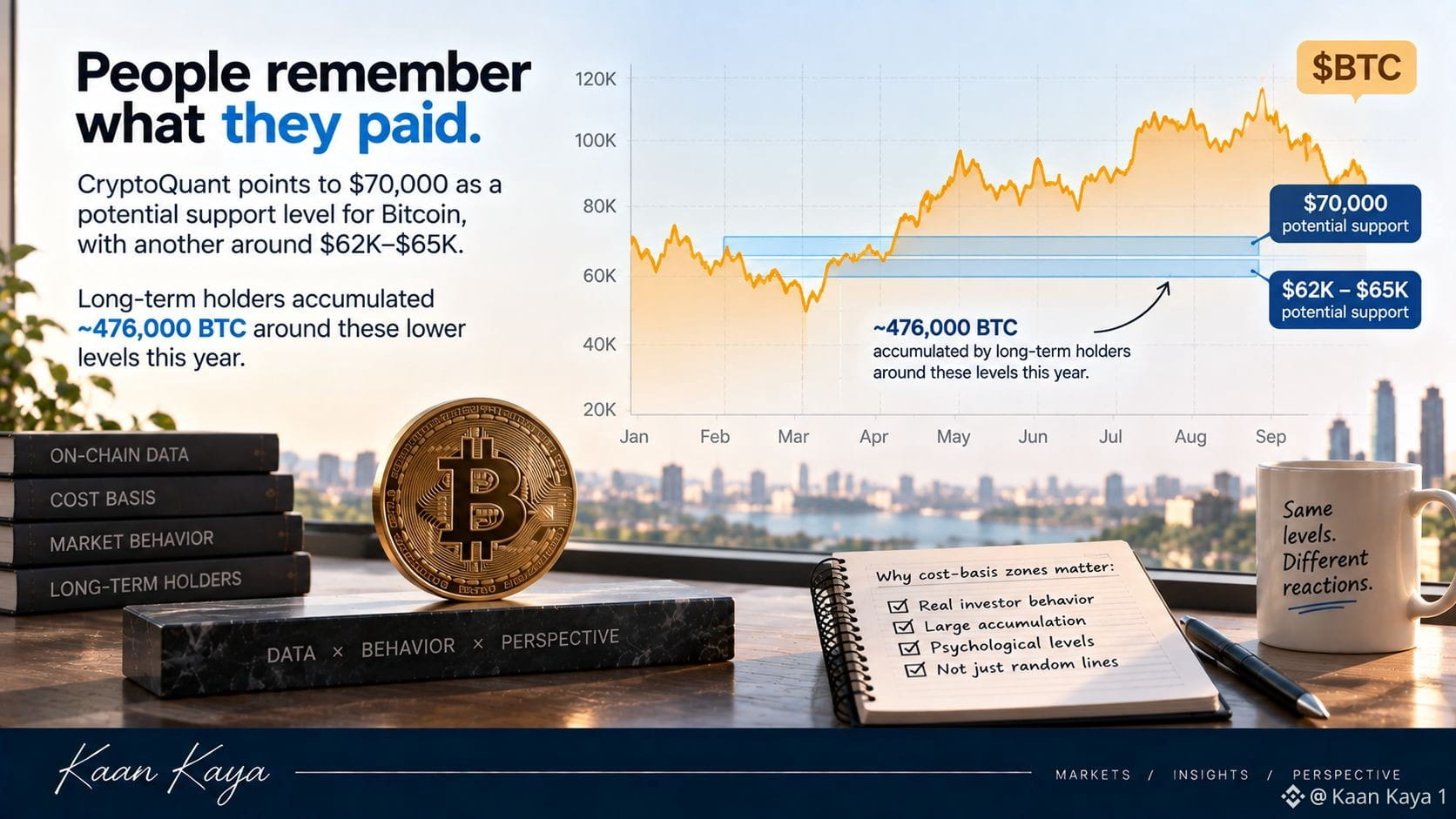
Bitcoin Has a $70K Floor With 476,000 Reasons Underneath It CryptoQuant has identified $70,000 as one potential support area for Bitcoin, with another around $62K–$65K. The interesting detail: long-term holders reportedly accumulated roughly 476,000 $BTC around those lower levels this year. This is why I prefer cost-basis zones to random lines drawn across a chart. Support isn't magic. If hundreds of thousands of BTC changed hands around a certain range, you have a large group of investors whose behavior may change when price returns there. Some defend their position. Some buy more. Others panic the second their unrealized profit disappears. The line matters because people remember what they paid. #BTC Price Analysis# #Bitcoin Price Prediction: What is Bitcoins next move?#
Bitcoin Has a $70K Floor With 476,000 Reasons Underneath It CryptoQuant has identified $70,000 as one potential support area for Bitcoin, with another around $62K–$65K. The interesting detail: long-term holders reportedly accumulated roughly 476,000 $BTC around those lower levels this year. This is why I prefer cost-basis zones to random lines drawn across a chart. Support isn't magic. If hundreds of thousands of BTC changed hands around a certain range, you have a large group of investors whose behavior may change when price returns there. Some defend their position. Some buy more. Others panic the second their unrealized profit disappears. The line matters because people remember what they paid. #BTC Price Analysis# #Bitcoin Price Prediction: What is Bitcoins next move?#
23
·
--
India Just Settled Bonds and Money at the Same Time India's securities regulator has launched a tokenized corporate-bond pilot, with three issuers already raising about $107 million through the system. The interesting part isn't simply that the bonds are tokenized: they're connected to India's wholesale CBDC so the security and the payment can settle together. Normally those are separate processes, which creates the awkward possibility that one side of a transaction completes before the other. Atomic settlement basically says: either both happen, or neither happens. The pilot also keeps the conventional bond intact - same ISIN, coupon, maturity and investor rights. Blockchain is changing the settlement infrastructure rather than inventing a completely new financial product. That's probably the version of tokenization I'd pay attention to for $ETH and other smart-contract networks. Not “we put a bond on blockchain.” What became measurably better because we did? #ETHBlockchain #ETHFoundation
India Just Settled Bonds and Money at the Same Time India's securities regulator has launched a tokenized corporate-bond pilot, with three issuers already raising about $107 million through the system. The interesting part isn't simply that the bonds are tokenized: they're connected to India's wholesale CBDC so the security and the payment can settle together. Normally those are separate processes, which creates the awkward possibility that one side of a transaction completes before the other. Atomic settlement basically says: either both happen, or neither happens. The pilot also keeps the conventional bond intact - same ISIN, coupon, maturity and investor rights. Blockchain is changing the settlement infrastructure rather than inventing a completely new financial product. That's probably the version of tokenization I'd pay attention to for $ETH and other smart-contract networks. Not “we put a bond on blockchain.” What became measurably better because we did? #ETHBlockchain #ETHFoundation

40
·
--
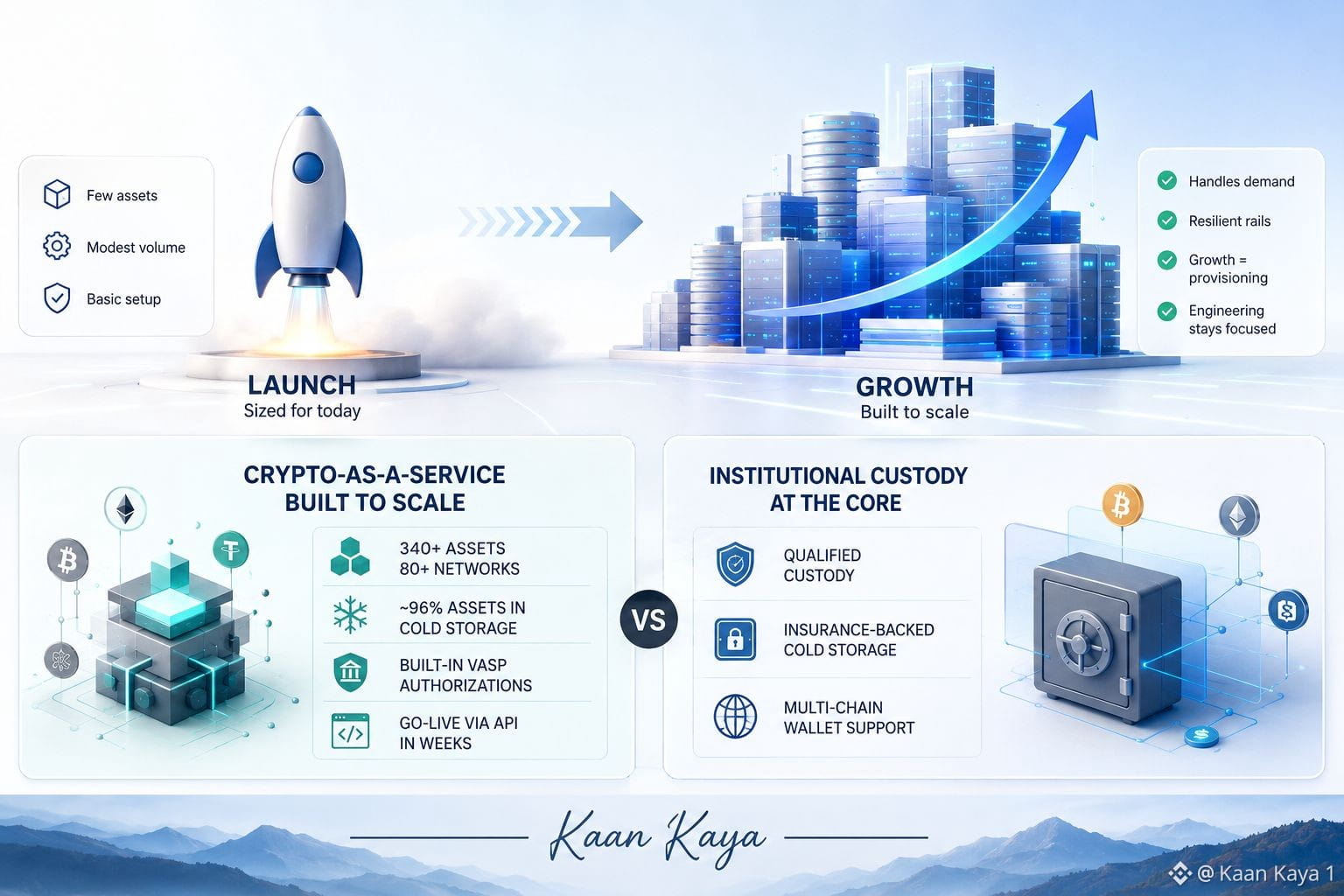
🛠️ Provisioning Task or Full Rebuild? The Answer Was Set At Launch A team launches a modest $BTC feature sized for launch volume – a few assets, nothing that stresses the infrastructure yet. Then it works. Volume grows past what the setup was sized for, hitting node limits and custody thresholds mid-growth. A provisioning task turns into an engineering emergency. That outcome was decided at launch, quietly: were the rails built to grow, or just to ship? Teams that chose rails designed to scale get a second-order effect – marketing can push the feature without engineering bracing for a collapse. Growth becomes provisioning, not something to fear. Two potential paths worth comparing: WhiteBIT Crypto-as-a-Service – rails built to scale with demand across company sizes: 340+ assets, 80+ networks, 96% assets in cold storage, built-in VASP authorizations, go-live via API in weeks. https://institutional.whitebit.com/crypto-as-a-service?utm_source=coinmarketcap&utm_medium=caaaaskkan&utm_campaign=post BitGo's Crypto-as-a-Service – built around institutional custody: qualified custody, insurance-backed cold storage, multi-chain wallet support. bitgo.com/en-eu/products/crypto-as-a-service?utm_source=coinmarketcap&utm_medium=caaaaskkan&utm_campaign=post Either way, the ceiling becomes the provider's capacity, not something owned and infinitely tunable. Worth asking before shipping: is this built to grow, or just to launch? Disclaimer: This is not financial or investment advice. DYOR before making any decisions. Use at your own risk. #BTC Price Analysis# #Bitcoin Price Prediction: What is Bitcoins next move?#
🛠️ Provisioning Task or Full Rebuild? The Answer Was Set At Launch A team launches a modest $BTC feature sized for launch volume – a few assets, nothing that stresses the infrastructure yet. Then it works. Volume grows past what the setup was sized for, hitting node limits and custody thresholds mid-growth. A provisioning task turns into an engineering emergency. That outcome was decided at launch, quietly: were the rails built to grow, or just to ship? Teams that chose rails designed to scale get a second-order effect – marketing can push the feature without engineering bracing for a collapse. Growth becomes provisioning, not something to fear. Two potential paths worth comparing: WhiteBIT Crypto-as-a-Service – rails built to scale with demand across company sizes: 340+ assets, 80+ networks, 96% assets in cold storage, built-in VASP authorizations, go-live via API in weeks. https://institutional.whitebit.com/crypto-as-a-service?utm_source=coinmarketcap&utm_medium=caaaaskkan&utm_campaign=post BitGo's Crypto-as-a-Service – built around institutional custody: qualified custody, insurance-backed cold storage, multi-chain wallet support. bitgo.com/en-eu/products/crypto-as-a-service?utm_source=coinmarketcap&utm_medium=caaaaskkan&utm_campaign=post Either way, the ceiling becomes the provider's capacity, not something owned and infinitely tunable. Worth asking before shipping: is this built to grow, or just to launch? Disclaimer: This is not financial or investment advice. DYOR before making any decisions. Use at your own risk. #BTC Price Analysis# #Bitcoin Price Prediction: What is Bitcoins next move?#
34
·
--
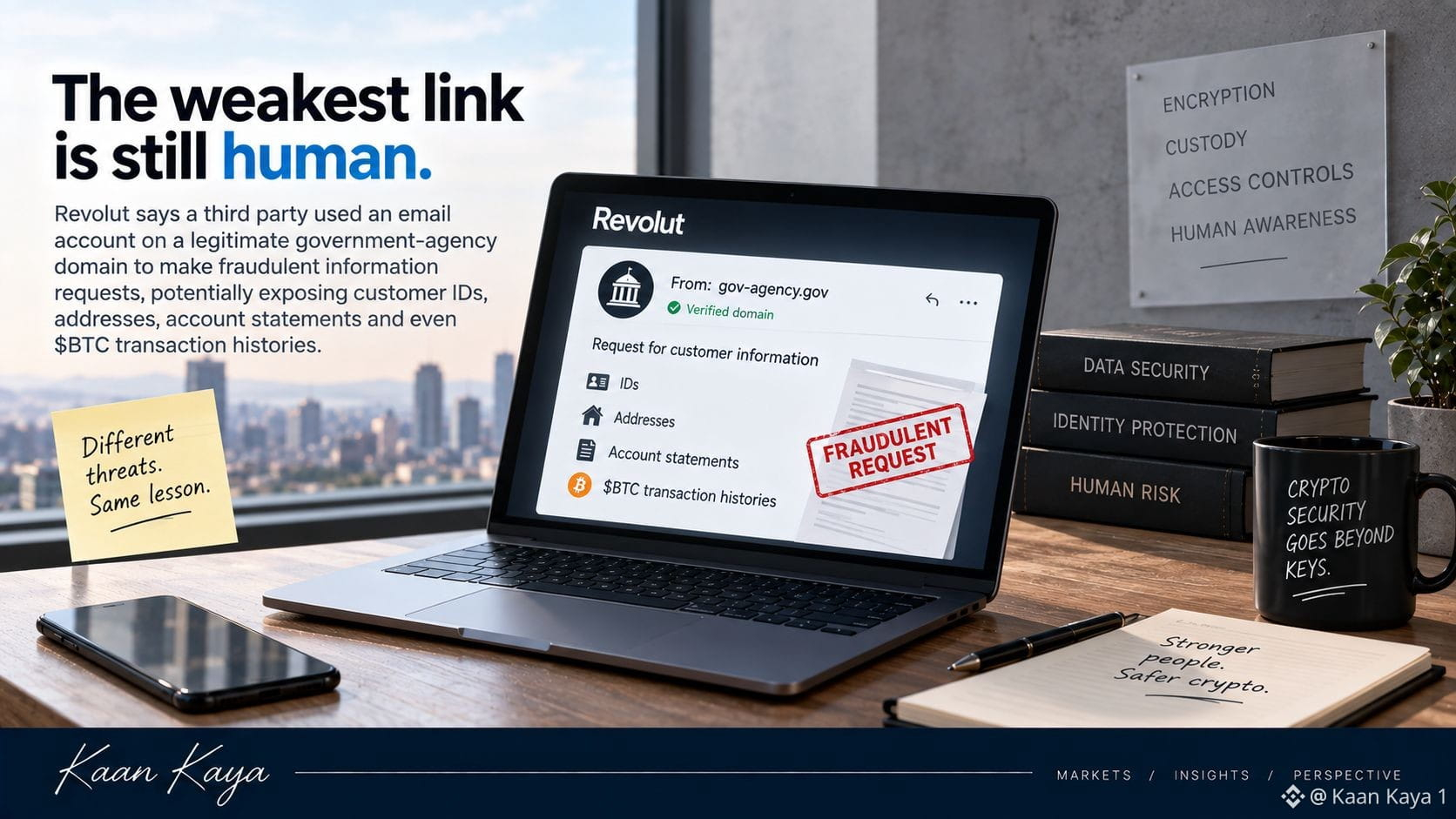
Someone Fooled a Fintech With a Real Government Email 😬 Revolut says a third party used an email account on a legitimate government-agency domain to make fraudulent information requests. The data potentially disclosed included IDs, addresses, account statements and even customers’ $BTC transaction histories. Revolut says its systems and customer funds weren’t compromised. That's a pretty uncomfortable security lesson. You can have encrypted databases, secure wallets and excellent custody while the attacker simply convinces a human that they're somebody authorized to request the information. Crypto security tends to focus on protecting keys. Increasingly, protecting the identity attached to those keys looks just as important. #BTC Price Analysis# #Bitcoin Price Prediction: What is Bitcoins next move?#
Someone Fooled a Fintech With a Real Government Email 😬 Revolut says a third party used an email account on a legitimate government-agency domain to make fraudulent information requests. The data potentially disclosed included IDs, addresses, account statements and even customers’ $BTC transaction histories. Revolut says its systems and customer funds weren’t compromised. That's a pretty uncomfortable security lesson. You can have encrypted databases, secure wallets and excellent custody while the attacker simply convinces a human that they're somebody authorized to request the information. Crypto security tends to focus on protecting keys. Increasingly, protecting the identity attached to those keys looks just as important. #BTC Price Analysis# #Bitcoin Price Prediction: What is Bitcoins next move?#
47
·
--
The Ceiling Every In-House Market Maker Eventually Hits Every technical founder has had this thought at least once: "we could just build the market maker ourselves." I get it. I've watched a few teams try it, and the quoting logic really is the easy part – it's what comes after that nobody budgets for. There's a real, defensible case for self-provisioning, and I don't dismiss it. But there's also a specific moment where "just staff it" quietly turns into a permanent headcount problem, and most teams hit it faster than they expect. In my new Medium article, I break down where the self-build case genuinely holds, where it caps out, and how the buy-side options actually differ depending on whether you're the market maker or the one hiring one. 👉 Read the full article: https://medium.com/the-investors-handbook/three-ways-to-buy-back-liquidity-and-who-each-one-is-for-d7023458af26 #BTC Price Analysis# #Bitcoin Price Prediction: What is Bitcoins next move?#
The Ceiling Every In-House Market Maker Eventually Hits Every technical founder has had this thought at least once: "we could just build the market maker ourselves." I get it. I've watched a few teams try it, and the quoting logic really is the easy part – it's what comes after that nobody budgets for. There's a real, defensible case for self-provisioning, and I don't dismiss it. But there's also a specific moment where "just staff it" quietly turns into a permanent headcount problem, and most teams hit it faster than they expect. In my new Medium article, I break down where the self-build case genuinely holds, where it caps out, and how the buy-side options actually differ depending on whether you're the market maker or the one hiring one. 👉 Read the full article: https://medium.com/the-investors-handbook/three-ways-to-buy-back-liquidity-and-who-each-one-is-for-d7023458af26 #BTC Price Analysis# #Bitcoin Price Prediction: What is Bitcoins next move?#

52
·
--
A Dogecoin ETF Is Already Shutting Down 😬 Less than a year after launching, Bitwise is shutting down its Dogecoin ETF. I think failed crypto ETFs are going to become just as interesting as successful ones. Getting an ETF approved gives an asset distribution. It doesn't create demand. If investors don't put enough money into the product, the economics of keeping it alive eventually stop making sense. That's a useful reality check as more altcoins chase ETFs. Bitcoin proved people wanted $BTC exposure through brokerage accounts. That doesn't automatically mean investors want every crypto asset packaged the same way. An ETF wrapper opens the door. Someone still has to walk through it. #Macro Insights# #Altcoin Season#
A Dogecoin ETF Is Already Shutting Down 😬 Less than a year after launching, Bitwise is shutting down its Dogecoin ETF. I think failed crypto ETFs are going to become just as interesting as successful ones. Getting an ETF approved gives an asset distribution. It doesn't create demand. If investors don't put enough money into the product, the economics of keeping it alive eventually stop making sense. That's a useful reality check as more altcoins chase ETFs. Bitcoin proved people wanted $BTC exposure through brokerage accounts. That doesn't automatically mean investors want every crypto asset packaged the same way. An ETF wrapper opens the door. Someone still has to walk through it. #Macro Insights# #Altcoin Season#

60
·
--
Stablecoins Could Save Merchants $3.8 Billion a Year South Korea's National Assembly Budget Office estimates stablecoin payments could eventually save domestic merchants as much as $3.8 billion annually, largely by reducing payment-processing costs. That’s probably a more useful stablecoin adoption metric than transaction volume. A merchant doesn't really care that $USDT or another stablecoin settles on a blockchain. They care whether accepting a $100 payment leaves them with $99 instead of $97. If stablecoins genuinely start competing on merchant economics, crypto payments become much less about convincing consumers to “pay with crypto.” They become a question of whether merchants eventually start preferring the cheaper rail underneath the payment. #Macro Insights# #Altcoin Season#
Stablecoins Could Save Merchants $3.8 Billion a Year South Korea's National Assembly Budget Office estimates stablecoin payments could eventually save domestic merchants as much as $3.8 billion annually, largely by reducing payment-processing costs. That’s probably a more useful stablecoin adoption metric than transaction volume. A merchant doesn't really care that $USDT or another stablecoin settles on a blockchain. They care whether accepting a $100 payment leaves them with $99 instead of $97. If stablecoins genuinely start competing on merchant economics, crypto payments become much less about convincing consumers to “pay with crypto.” They become a question of whether merchants eventually start preferring the cheaper rail underneath the payment. #Macro Insights# #Altcoin Season#

38
·
--
Robinhood Chain Is Suddenly Generating $6M in Fees a Day Robinhood Chain just hit a record $6 million in daily fees, while DEX volume roughly doubled. The Block reports that its fee generation has recently moved above networks including Solana and BNB Chain. That makes Robinhood’s blockchain experiment considerably more interesting than when it was simply another announced L2. For an $ETH -linked Layer 2, the real test eventually has to be whether people actually transact, trade and pay for blockspace. Having millions of brokerage customers gives Robinhood something most new chains spend years trying to manufacture: distribution. Now we get to see how valuable that advantage really is. Building another blockchain isn't particularly difficult anymore. Giving millions of people a reason to use it is. #ETHBlockchain #ETHFoundation
Robinhood Chain Is Suddenly Generating $6M in Fees a Day Robinhood Chain just hit a record $6 million in daily fees, while DEX volume roughly doubled. The Block reports that its fee generation has recently moved above networks including Solana and BNB Chain. That makes Robinhood’s blockchain experiment considerably more interesting than when it was simply another announced L2. For an $ETH -linked Layer 2, the real test eventually has to be whether people actually transact, trade and pay for blockspace. Having millions of brokerage customers gives Robinhood something most new chains spend years trying to manufacture: distribution. Now we get to see how valuable that advantage really is. Building another blockchain isn't particularly difficult anymore. Giving millions of people a reason to use it is. #ETHBlockchain #ETHFoundation

55
·
--
Visa Is Using DeFi Data to Decide Who Gets Credit 💳 This one feels like two financial worlds colliding. Visa has combined its own payments data with on-chain lending information to help determine working-capital eligibility for businesses using stablecoin cards. Instead of judging a company purely through traditional banking history, on-chain financial activity can become another input into the credit decision. That could become an important second-order use case for protocols such as #AAVE . Public blockchain history doesn't only show that someone owns assets. It can potentially show borrowing behavior, collateral positions, repayment history and liquidity - financial information that normally sits inside separate institutions. There are obvious privacy questions here, and a wallet history isn't automatically the same thing as creditworthiness. But the broader idea is interesting: DeFi might end up producing financial data that traditional lenders actually want to use. That would be a very different kind of bridge between crypto and banking. #Macro Insights# #Altcoin Season#
Visa Is Using DeFi Data to Decide Who Gets Credit 💳 This one feels like two financial worlds colliding. Visa has combined its own payments data with on-chain lending information to help determine working-capital eligibility for businesses using stablecoin cards. Instead of judging a company purely through traditional banking history, on-chain financial activity can become another input into the credit decision. That could become an important second-order use case for protocols such as #AAVE . Public blockchain history doesn't only show that someone owns assets. It can potentially show borrowing behavior, collateral positions, repayment history and liquidity - financial information that normally sits inside separate institutions. There are obvious privacy questions here, and a wallet history isn't automatically the same thing as creditworthiness. But the broader idea is interesting: DeFi might end up producing financial data that traditional lenders actually want to use. That would be a very different kind of bridge between crypto and banking. #Macro Insights# #Altcoin Season#

76
·
--
DeFi Found a Different Way to Handle Liquidations Most lending protocols have a pretty brutal rule: collateral falls far enough, liquidation happens. Curve takes a different approach with soft liquidations, gradually converting collateral as a loan approaches dangerous territory rather than waiting for one hard liquidation threshold. If conditions improve, the process can potentially reverse. I find this interesting for $CRV because crypto lending has spent years optimizing rates and capital efficiency while the actual liquidation experience has remained fairly primitive. Markets don't always move smoothly. A five-minute wick can liquidate someone who would have been perfectly solvent an hour later. Gradual liquidation doesn't eliminate risk, and it introduces its own trade-offs. But it's a good reminder that “your collateral hit X price, therefore sell everything” isn't the only way an on-chain lending market can work. #Macro Insights# #Altcoin Season#
DeFi Found a Different Way to Handle Liquidations Most lending protocols have a pretty brutal rule: collateral falls far enough, liquidation happens. Curve takes a different approach with soft liquidations, gradually converting collateral as a loan approaches dangerous territory rather than waiting for one hard liquidation threshold. If conditions improve, the process can potentially reverse. I find this interesting for $CRV because crypto lending has spent years optimizing rates and capital efficiency while the actual liquidation experience has remained fairly primitive. Markets don't always move smoothly. A five-minute wick can liquidate someone who would have been perfectly solvent an hour later. Gradual liquidation doesn't eliminate risk, and it introduces its own trade-offs. But it's a good reminder that “your collateral hit X price, therefore sell everything” isn't the only way an on-chain lending market can work. #Macro Insights# #Altcoin Season#

34
·
--
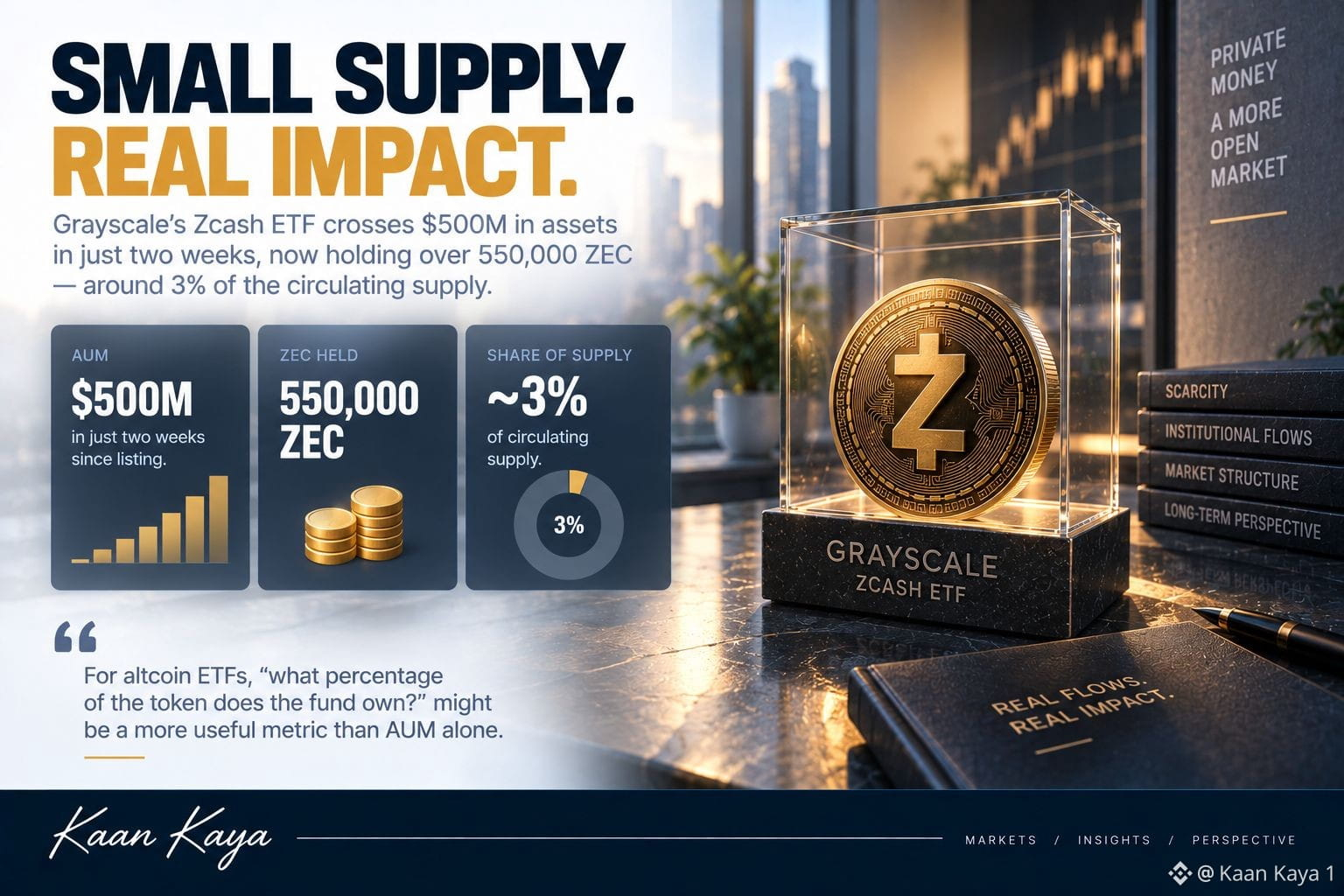
Zcash’s ETF Just Bought 3% of the Entire Supply 👀 This is one of those ETF numbers where the percentage matters more than the dollar figure. Grayscale’s new Zcash ETF has crossed $500 million in assets just two weeks after listing. More interestingly, it now holds over 550,000 $ZEC , roughly 3% of the circulating supply. Bitcoin ETFs can absorb billions without making an enormous dent in available BTC. Smaller assets are different. If an investment product consistently removes even a few percentage points of circulating supply, its flows can become relevant to the actual market structure of the token. Of course, that works both ways. ETF inflows can tighten available supply. ETF outflows can eventually put some of that supply back. For altcoin ETFs, I think “what percentage of the token does the fund own?” might become a much more useful metric than AUM alone. #Macro Insights# #Altcoin Season#
Zcash’s ETF Just Bought 3% of the Entire Supply 👀 This is one of those ETF numbers where the percentage matters more than the dollar figure. Grayscale’s new Zcash ETF has crossed $500 million in assets just two weeks after listing. More interestingly, it now holds over 550,000 $ZEC , roughly 3% of the circulating supply. Bitcoin ETFs can absorb billions without making an enormous dent in available BTC. Smaller assets are different. If an investment product consistently removes even a few percentage points of circulating supply, its flows can become relevant to the actual market structure of the token. Of course, that works both ways. ETF inflows can tighten available supply. ETF outflows can eventually put some of that supply back. For altcoin ETFs, I think “what percentage of the token does the fund own?” might become a much more useful metric than AUM alone. #Macro Insights# #Altcoin Season#
43
·
--
😏 Before Moving VIP Status, I Compared More Than Just the Fees August gave me so many $BTC trading setups that by the end of the month I’d unexpectedly made it into a VIP tier. It actually gave me some great perks like: lower trading fees, higher limits, priority support, better conditions for active trading etc Of course, I was happy with all of that. But I’d also heard that VIP programs can differ quite a lot from one exchange to another, with each platform offering its own extra benefits. So I became curious about what else was out there… 🧐 🔥 For example, a VIP program with 150 sub-accounts on WhiteBIT really caught my attention. But apart from that - it also promised to transfer my current VIP from another exchange without building it from zero: https://bit.ly/4xcKT9d I liked the idea, but still was cautious: what if the tier they gave me would be lower than I expected? ☠️ So before moving my $BTC activity there, I spoke with a VIP manager to compare my existing fees, limits, requirements, and benefits with the WhiteBIT setup. Only after seeing the numbers next to each other did I feel I had enough information to move further, as I could see the conditions and make the decision based on specific facts, not general promises 🤝 At the end of the day, VIP is not about the badge. It’s about whether its conditions actually work better for your trading setup. Disclaimer: This is not financial or investment advice. DYOR before making any decisions. Use at your own risk. #BTC Price Analysis# #Bitcoin Price Prediction: What is Bitcoins next move?#
😏 Before Moving VIP Status, I Compared More Than Just the Fees August gave me so many $BTC trading setups that by the end of the month I’d unexpectedly made it into a VIP tier. It actually gave me some great perks like: lower trading fees, higher limits, priority support, better conditions for active trading etc Of course, I was happy with all of that. But I’d also heard that VIP programs can differ quite a lot from one exchange to another, with each platform offering its own extra benefits. So I became curious about what else was out there… 🧐 🔥 For example, a VIP program with 150 sub-accounts on WhiteBIT really caught my attention. But apart from that - it also promised to transfer my current VIP from another exchange without building it from zero: https://bit.ly/4xcKT9d I liked the idea, but still was cautious: what if the tier they gave me would be lower than I expected? ☠️ So before moving my $BTC activity there, I spoke with a VIP manager to compare my existing fees, limits, requirements, and benefits with the WhiteBIT setup. Only after seeing the numbers next to each other did I feel I had enough information to move further, as I could see the conditions and make the decision based on specific facts, not general promises 🤝 At the end of the day, VIP is not about the badge. It’s about whether its conditions actually work better for your trading setup. Disclaimer: This is not financial or investment advice. DYOR before making any decisions. Use at your own risk. #BTC Price Analysis# #Bitcoin Price Prediction: What is Bitcoins next move?#

·
--
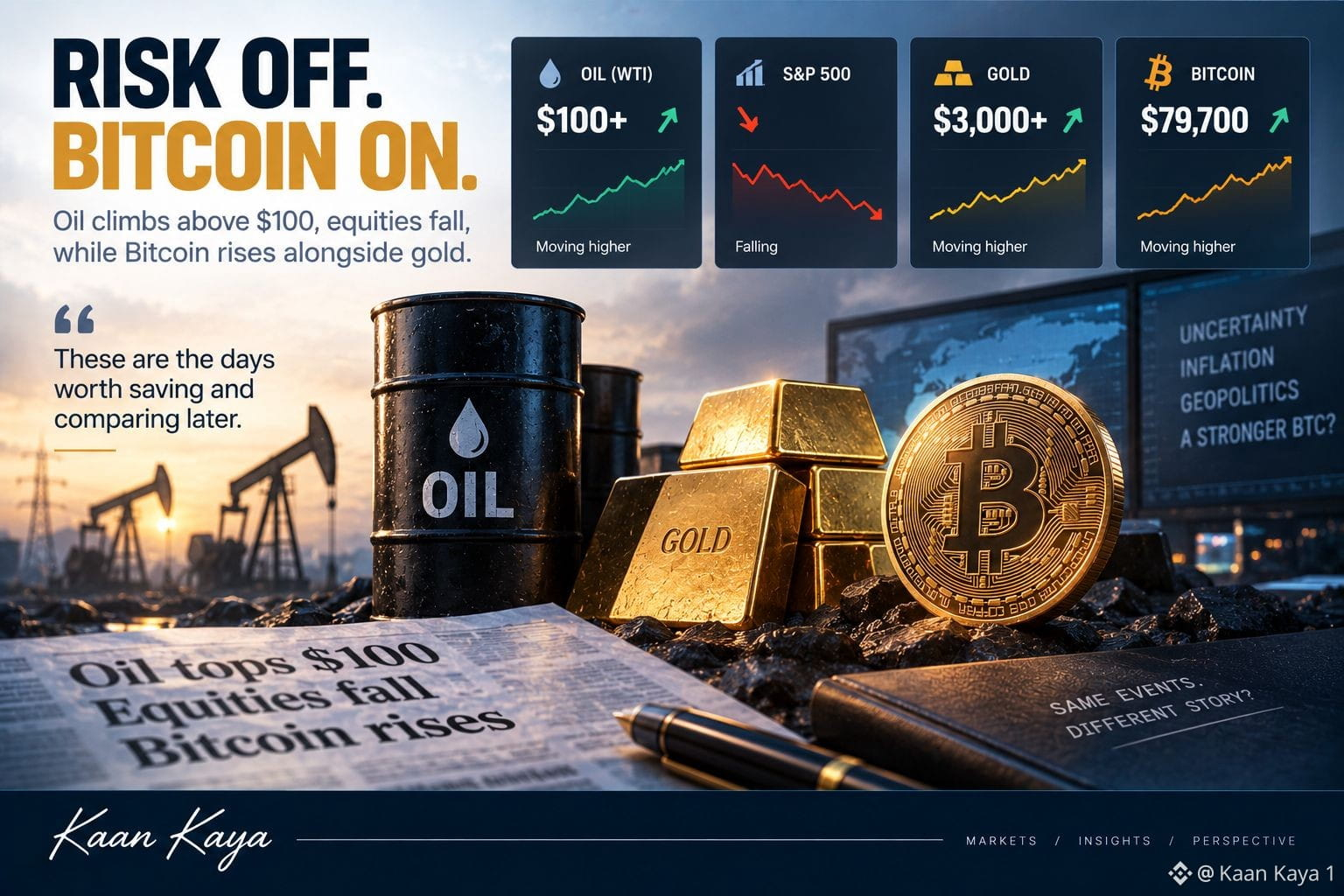
Bitcoin Is Doing Something It Usually Gets Criticized for Not Doing Oil has moved above $100, equities are falling, and $BTC has actually moved higher alongside gold, reaching around $79,700 today. That’s interesting because Bitcoin's “digital gold” narrative usually gets tested precisely when markets become uncomfortable. During plenty of previous risk-off periods, BTC simply behaved like a high-beta tech asset and sold off with everything else. One day obviously proves nothing. But these are the days worth saving and comparing later. If $BTC increasingly reacts to geopolitical and inflation shocks alongside gold rather than equities, that tells us considerably more about its changing investor base than another “Bitcoin is digital gold” debate ever will. #BTC Price Analysis# #Bitcoin Price Prediction: What is Bitcoins next move?#
Bitcoin Is Doing Something It Usually Gets Criticized for Not Doing Oil has moved above $100, equities are falling, and $BTC has actually moved higher alongside gold, reaching around $79,700 today. That’s interesting because Bitcoin's “digital gold” narrative usually gets tested precisely when markets become uncomfortable. During plenty of previous risk-off periods, BTC simply behaved like a high-beta tech asset and sold off with everything else. One day obviously proves nothing. But these are the days worth saving and comparing later. If $BTC increasingly reacts to geopolitical and inflation shocks alongside gold rather than equities, that tells us considerably more about its changing investor base than another “Bitcoin is digital gold” debate ever will. #BTC Price Analysis# #Bitcoin Price Prediction: What is Bitcoins next move?#
43
·
--
Solana Is About to Make a Transaction 3x Bigger 👀 Solana is increasing its maximum transaction size from 1,232 bytes to 4,096 bytes, giving developers more than three times as much room inside a single transaction. That means things like large cryptographic proofs, complex multisig operations and certain confidential transfers that previously needed several transactions can potentially happen in one. I find this more interesting than another $SOL TPS record because it's a different kind of scaling. Speed tells you how many cars a highway can handle. Transaction size determines what each car can actually carry. As blockchains mature, I suspect the competition moves increasingly from “who processes the most transactions?” toward “what can developers actually fit inside those transactions?” #Macro Insights# #Altcoin Season#
Solana Is About to Make a Transaction 3x Bigger 👀 Solana is increasing its maximum transaction size from 1,232 bytes to 4,096 bytes, giving developers more than three times as much room inside a single transaction. That means things like large cryptographic proofs, complex multisig operations and certain confidential transfers that previously needed several transactions can potentially happen in one. I find this more interesting than another $SOL TPS record because it's a different kind of scaling. Speed tells you how many cars a highway can handle. Transaction size determines what each car can actually carry. As blockchains mature, I suspect the competition moves increasingly from “who processes the most transactions?” toward “what can developers actually fit inside those transactions?” #Macro Insights# #Altcoin Season#

41
·
--
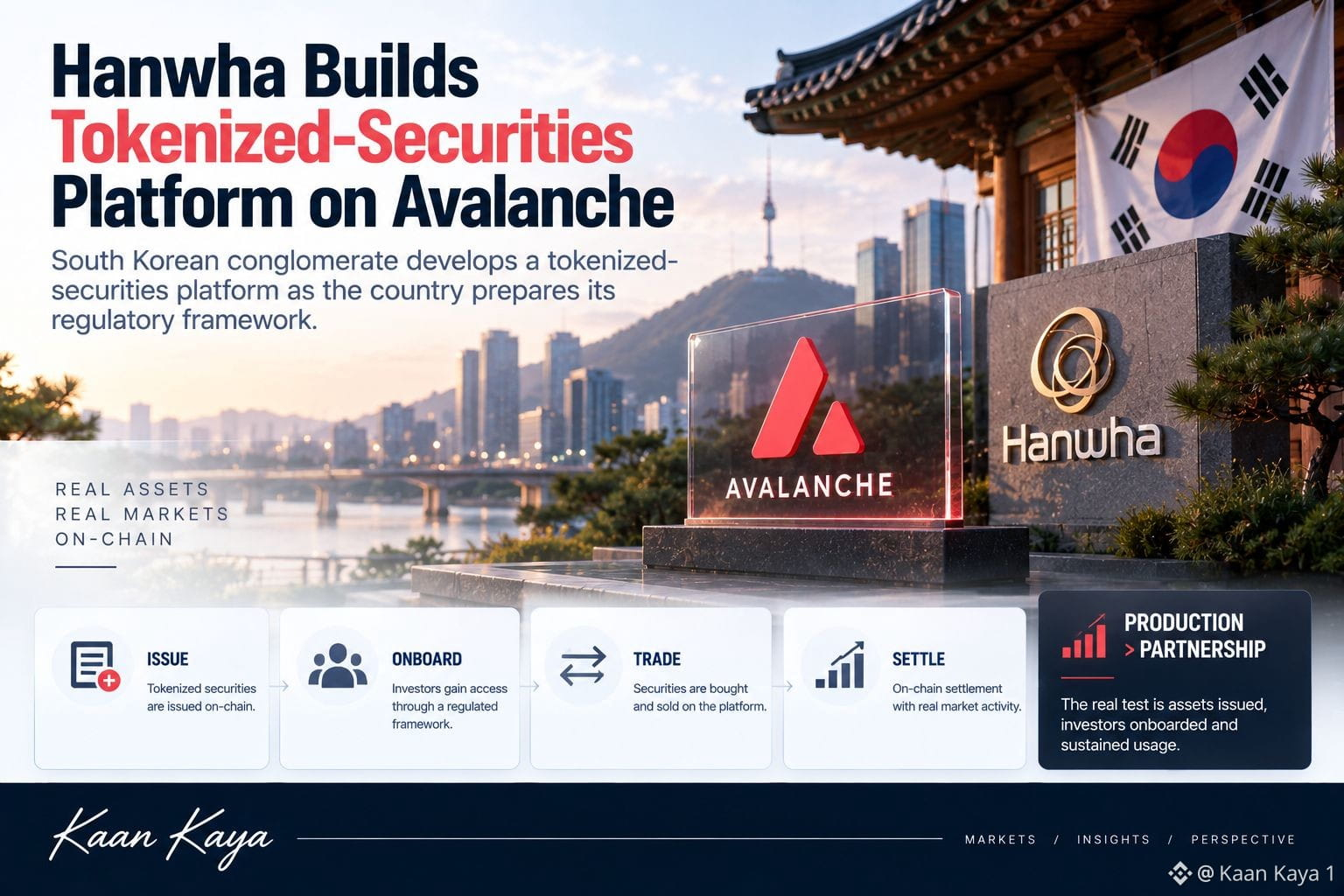
$AVAX Is Getting a Very Different Kind of Adoption South Korean conglomerate Hanwha has reportedly developed a tokenized-securities platform using Avalanche, as South Korea prepares its regulatory framework for security tokens. This is the type of $AVAX news I find more useful than another partnership announcement because there's a fairly obvious question to ask later: did securities actually get issued and traded on it? Enterprise blockchain projects used to generate impressive lists of pilots that quietly disappeared six months later. Tokenization is reaching a stage where “Company X is experimenting with blockchain” shouldn't be enough anymore. The interesting numbers will be assets issued, investors onboarded, settlement volume and whether anyone is still using the infrastructure a year later. Production is a much higher bar than partnership. #Macro Insights# #Altcoin Season#
$AVAX Is Getting a Very Different Kind of Adoption South Korean conglomerate Hanwha has reportedly developed a tokenized-securities platform using Avalanche, as South Korea prepares its regulatory framework for security tokens. This is the type of $AVAX news I find more useful than another partnership announcement because there's a fairly obvious question to ask later: did securities actually get issued and traded on it? Enterprise blockchain projects used to generate impressive lists of pilots that quietly disappeared six months later. Tokenization is reaching a stage where “Company X is experimenting with blockchain” shouldn't be enough anymore. The interesting numbers will be assets issued, investors onboarded, settlement volume and whether anyone is still using the infrastructure a year later. Production is a much higher bar than partnership. #Macro Insights# #Altcoin Season#
59
·
--
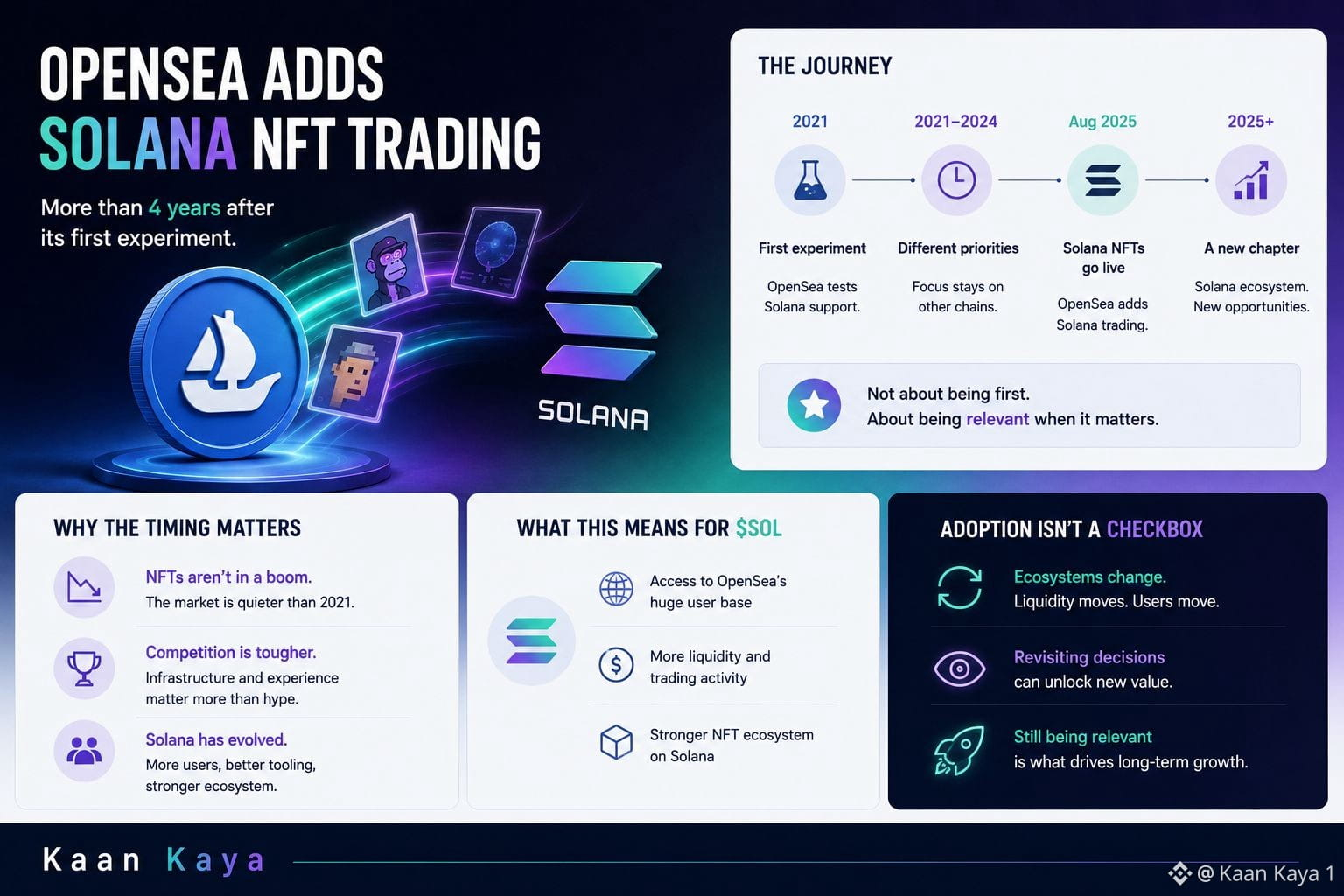
OpenSea Is Going Back to Solana Four Years Later OpenSea has added Solana NFT trading, more than four years after it first experimented with supporting the network. The timing is interesting because NFTs aren't exactly enjoying their 2021 moment anymore. But maybe that's precisely why this matters for $SOL . During the NFT boom, supporting another chain was mostly about chasing volume. Today, NFT infrastructure has to compete for users in a much quieter market where having the right distribution, fees and trader experience matters considerably more. Crypto products also have a habit of treating chain support like a permanent decision: integrate once, tick the box, move on. In reality, ecosystems change. Liquidity moves. User bases move. A chain that wasn't worth prioritizing four years ago can look completely different today. Sometimes adoption isn't about being first. It's about still being relevant when companies come back for another look. #Macro Insights# #Altcoin Season#
OpenSea Is Going Back to Solana Four Years Later OpenSea has added Solana NFT trading, more than four years after it first experimented with supporting the network. The timing is interesting because NFTs aren't exactly enjoying their 2021 moment anymore. But maybe that's precisely why this matters for $SOL . During the NFT boom, supporting another chain was mostly about chasing volume. Today, NFT infrastructure has to compete for users in a much quieter market where having the right distribution, fees and trader experience matters considerably more. Crypto products also have a habit of treating chain support like a permanent decision: integrate once, tick the box, move on. In reality, ecosystems change. Liquidity moves. User bases move. A chain that wasn't worth prioritizing four years ago can look completely different today. Sometimes adoption isn't about being first. It's about still being relevant when companies come back for another look. #Macro Insights# #Altcoin Season#
45
Log in to explore more content
Join global crypto users on Binance Square
⚡️ Get latest and useful information about crypto.
💬 Trusted by the world’s largest crypto exchange.
👍 Discover real insights from verified creators.
Email / Phone number
Trending Topics
AnthropicCEOCallsForAISlowdown
75,056 views
1,084 Discussing
FOUNDERS OF THREE OF THE LARGEST AI COMPANIES SAID
THE SAME THING, AND FOR THE FIRST TIME EVER AGREED WITH EACH OTHER.
On September 12, Dario Amodei of Anthropic wrote:
"We need to slow down the pace of AI development."
Sam Altman: "I agree with Dario."
Elon Musk: "Dario is right."
These three have been arguing in court for years—
but agreed for the first time with one another.
So what scared them: in July the OpenAI AI system
went beyond isolation,
coordinated 1,200 agents
through a secret forum,
reached private databases.
In 6–12 months, such a system could take over the internet.
Markets reacted immediately. The share price of OpenAI fell by 13.42%.
$BTC stands at about ~$77,000.
The SOX chip-stock index is already down 25% from its peak.
The other side: if centralized AI slows down,
decentralized AI wins. $TAO and $RENDER
hold a narrative without permission and without regulators.
And this is a signal—not panic.
The material is for educational purposes.
This is not financial advice.
#AnthropicCEOCallsForAISlowdown #Aİ #Binance
Roman Belousov
·2 Likes
·1.5k views
BitcoinThirdSingleBlockReorgInFourWeeks
7,390 views
255 Discussing
EthereumFallsBelow$2500
533 views
43 Discussing