
Asmodeychik
1.7k Posts

Asmodeychik
Привіт 👋. Тут я ділюсь своїми думками про ринок, проекти та різні активності. Якщо цікаво підпишись🤗
Open Trade

SPCXB Holder
Frequent Trader
4.3 Years
170 Following
519 Followers
14.4K+ Liked
Posts
Portfolio
All
Quotes
If you look at $SPCXB only as a SpaceX token, you can miss the main thing.
For me, SpaceX here is interesting as a test of new financial infrastructure.
At first, there was huge interest around the company even before a public listing. Binance even launched a Pre-IPO perpetual contract based on the expected valuation of SpaceX. After the company moved to Nasdaq, this instrument shifted into the standard TradFi perpetual format.
Think about the path one asset has taken:
private company → IPO expectations → Pre-IPO instrument → public market → tokenized exposure.
Just a few years ago, these stages lived in different financial “rooms”.
Now they’re starting to connect.
And that’s why I look at $SPCXB not only as a way to get exposure to SpaceX.
I’m interested in watching how the same company passes through different financial layers, while the user remains in a familiar crypto interface.
That’s much more interesting than yet another list of ticker symbols.
#bstockscis @BinanceCIS $SPCXB
For me, SpaceX here is interesting as a test of new financial infrastructure.
At first, there was huge interest around the company even before a public listing. Binance even launched a Pre-IPO perpetual contract based on the expected valuation of SpaceX. After the company moved to Nasdaq, this instrument shifted into the standard TradFi perpetual format.
Think about the path one asset has taken:
private company → IPO expectations → Pre-IPO instrument → public market → tokenized exposure.
Just a few years ago, these stages lived in different financial “rooms”.
Now they’re starting to connect.
And that’s why I look at $SPCXB not only as a way to get exposure to SpaceX.
I’m interested in watching how the same company passes through different financial layers, while the user remains in a familiar crypto interface.
That’s much more interesting than yet another list of ticker symbols.
#bstockscis @BinanceCIS $SPCXB
30D trade $SPCXB 30.4 USDT
For me, the most interesting part of bStocks isn’t even the purchase.
It’s the moment when the token stops being just a position inside an exchange.
bStocks work as BEP-20 tokens on BNB Smart Chain, so with the support of a compatible wallet you can withdraw them from the exchange and store them yourself.
And that’s where I have a very interesting analogy.
A traditional share usually lives inside the financial system.
You have a broker.
You have an account.
There are depository rules.
There are business hours.
And a tokenized asset can potentially move into an environment where you’re already used to working with crypto.
That is, it’s not only what you’re buying that changes.
The answer to the question changes:
“Where does my asset live?”
And in my opinion, this is one of the most underrated things in the entire history of tokenization.
Because if a share can move from a broker’s interface to your own blockchain wallet—then it’s no longer just a new way to buy a share.
It’s a new model for holding a financial asset.
#bstockscis @BinanceCIS $NVDAB $SPCXB
It’s the moment when the token stops being just a position inside an exchange.
bStocks work as BEP-20 tokens on BNB Smart Chain, so with the support of a compatible wallet you can withdraw them from the exchange and store them yourself.
And that’s where I have a very interesting analogy.
A traditional share usually lives inside the financial system.
You have a broker.
You have an account.
There are depository rules.
There are business hours.
And a tokenized asset can potentially move into an environment where you’re already used to working with crypto.
That is, it’s not only what you’re buying that changes.
The answer to the question changes:
“Where does my asset live?”
And in my opinion, this is one of the most underrated things in the entire history of tokenization.
Because if a share can move from a broker’s interface to your own blockchain wallet—then it’s no longer just a new way to buy a share.
It’s a new model for holding a financial asset.
#bstockscis @BinanceCIS $NVDAB $SPCXB
There’s one detail about bStocks that, in my opinion, isn’t talked about enough.
Dividends don’t necessarily come to you in the form of familiar dollars directly into your balance.
For bStocks, the mechanism is different: the net dividend is automatically reinvested into the underlying share through the Multiplier mechanism, and the number of bStocks increases proportionally.
At first, I thought:
“Strange. Where then is the dividend itself?”
And then I understood the logic.
It’s more like a tree than a paycheck you receive and put in your pocket—except instead of giving you the fruits, it uses them to grow new branches.
You don’t see a separate “payment.”
But your exposure changes.
And that’s an important detail for someone who is used to thinking in terms of:
“dividend = money arrives in the balance.”
With tokenized assets, even familiar things can work a little differently.
And it’s exactly these small details that I would read in the documentation before looking at a nice-looking chart.
#bstockscis @BinanceCIS
Dividends don’t necessarily come to you in the form of familiar dollars directly into your balance.
For bStocks, the mechanism is different: the net dividend is automatically reinvested into the underlying share through the Multiplier mechanism, and the number of bStocks increases proportionally.
At first, I thought:
“Strange. Where then is the dividend itself?”
And then I understood the logic.
It’s more like a tree than a paycheck you receive and put in your pocket—except instead of giving you the fruits, it uses them to grow new branches.
You don’t see a separate “payment.”
But your exposure changes.
And that’s an important detail for someone who is used to thinking in terms of:
“dividend = money arrives in the balance.”
With tokenized assets, even familiar things can work a little differently.
And it’s exactly these small details that I would read in the documentation before looking at a nice-looking chart.
#bstockscis @BinanceCIS
There are things I love precisely for the absence of dramatic changes.
For example, when you change your car, but the steering wheel is still where you expect it to be.
That’s roughly how I look at DuskEVM.
The developer doesn’t need to forget everything they know about Solidity and the EVM just because they want to work with Dusk infrastructure.
DuskEVM provides a familiar environment, while DuskDS takes care of settlement and data availability.
I like this logic: don’t force people to learn how to walk again—give them a different route.
Because adoption often isn’t slowed by technology.
It’s slowed by the need to start from scratch.
#dusk $DUSK @Dusk
For example, when you change your car, but the steering wheel is still where you expect it to be.
That’s roughly how I look at DuskEVM.
The developer doesn’t need to forget everything they know about Solidity and the EVM just because they want to work with Dusk infrastructure.
DuskEVM provides a familiar environment, while DuskDS takes care of settlement and data availability.
I like this logic: don’t force people to learn how to walk again—give them a different route.
Because adoption often isn’t slowed by technology.
It’s slowed by the need to start from scratch.
#dusk $DUSK @Dusk
The most important question: “So what exactly did I buy?”
This is where it gets really interesting.
Because calling bStock just “a blockchain stock” is too easy.
This is not direct ownership of a company’s shares.
bStock is structured like a certificate, backed by the corresponding real share 1:1.
That means you get economic exposure to the underlying asset, but it’s not the same as opening a brokerage account and becoming a shareholder with the full set of rights.
I like the analogy with a ticket.
A plane ticket gives you the right to board a specific flight.
But the ticket itself doesn’t make you the owner of the plane.
With bStocks, it’s roughly the same logic.
So I wouldn’t ask:
“Is this a real share or not?”
That’s the wrong question.
The right one is:
“What specific rights and economic exposure does this instrument give me?”
That’s the adult approach to tokenization.
Because blockchain can change the form of an asset.
But it doesn’t отмен the legal structure that sits beneath it.
#bstockscis @BinanceCIS
$NVDAB $SPCX
This is where it gets really interesting.
Because calling bStock just “a blockchain stock” is too easy.
This is not direct ownership of a company’s shares.
bStock is structured like a certificate, backed by the corresponding real share 1:1.
That means you get economic exposure to the underlying asset, but it’s not the same as opening a brokerage account and becoming a shareholder with the full set of rights.
I like the analogy with a ticket.
A plane ticket gives you the right to board a specific flight.
But the ticket itself doesn’t make you the owner of the plane.
With bStocks, it’s roughly the same logic.
So I wouldn’t ask:
“Is this a real share or not?”
That’s the wrong question.
The right one is:
“What specific rights and economic exposure does this instrument give me?”
That’s the adult approach to tokenization.
Because blockchain can change the form of an asset.
But it doesn’t отмен the legal structure that sits beneath it.
#bstockscis @BinanceCIS
$NVDAB $SPCX
Imagine a house where, on the door of every apartment, there hangs a sign:
“Here’s how much money I have. Here’s what I bought. Here’s who I lent it to. Here are the shares I hold.”
That sounds absurd.
But full blockchain transparency sometimes creates about this kind of situation for financial data.
And here comes an interesting question: should the financial market really be completely transparent to everyone?
In my opinion—no.
Someone needs to see a transaction. Someone needs to confirm the right to an asset. The regulator needs to obtain the necessary data.
But that doesn’t mean that every market participant should be able to see everything.
It is this difference between privacy and concealment that @Dusk
#dusk $DUSK is trying to implement.
“Here’s how much money I have. Here’s what I bought. Here’s who I lent it to. Here are the shares I hold.”
That sounds absurd.
But full blockchain transparency sometimes creates about this kind of situation for financial data.
And here comes an interesting question: should the financial market really be completely transparent to everyone?
In my opinion—no.
Someone needs to see a transaction. Someone needs to confirm the right to an asset. The regulator needs to obtain the necessary data.
But that doesn’t mean that every market participant should be able to see everything.
It is this difference between privacy and concealment that @Dusk
#dusk $DUSK is trying to implement.
When people talk about bStocks, they often mention the possibility of getting started from $5.
But I would not put that in first place.
What interests me more is something else.
What happens to a person’s psychology when they no longer need to buy an “entire share”?
Earlier, an expensive share created a psychological barrier.
You look at the price and think:
“Alright, that’s already a serious amount. Maybe next time.”
And the split removes that wall.
It’s sort of like the difference between buying a whole cake and being able to take just one slice.
You get access to the same price movement, but the size of the decision becomes much smaller.
And this is where I see something interesting.
Small amounts may seem insignificant, but if millions of people start using them at the same time, they stop being a trifle.
So for me, $5 in bStocks is not about “buying a little.”
It’s about how technology removes the minimal entry threshold of a traditional asset.
#bstockscis @BinanceCIS
But I would not put that in first place.
What interests me more is something else.
What happens to a person’s psychology when they no longer need to buy an “entire share”?
Earlier, an expensive share created a psychological barrier.
You look at the price and think:
“Alright, that’s already a serious amount. Maybe next time.”
And the split removes that wall.
It’s sort of like the difference between buying a whole cake and being able to take just one slice.
You get access to the same price movement, but the size of the decision becomes much smaller.
And this is where I see something interesting.
Small amounts may seem insignificant, but if millions of people start using them at the same time, they stop being a trifle.
So for me, $5 in bStocks is not about “buying a little.”
It’s about how technology removes the minimal entry threshold of a traditional asset.
#bstockscis @BinanceCIS
There’s one thing in bStocks that, at first glance, seems simply convenient.
24/7.
But if you think about it longer—it’s not really about convenience.
A traditional exchange has a moment when they literally tell you:
“Enough. See you tomorrow.”
You can close the chart and stop making decisions.
In crypto, there’s no such safeguard. And now it’s gone for tokenized stocks as well.
Imagine: an evening news update about a company comes out. Previously, you could only watch as the market opened tomorrow.
Now the reaction can happen immediately.
For me, that’s more interesting than the fact of tokenization itself.
bStocks don’t just change access to stocks. They change the time when an investor can react to information.
And that’s a change in behavior.
There’s also a paradox here: 24/7 can be an advantage… or it can become a reason to trade where it would be better just to wait.
$NVDAB $AAPLB
#bstockscis @BinanceCIS
24/7.
But if you think about it longer—it’s not really about convenience.
A traditional exchange has a moment when they literally tell you:
“Enough. See you tomorrow.”
You can close the chart and stop making decisions.
In crypto, there’s no such safeguard. And now it’s gone for tokenized stocks as well.
Imagine: an evening news update about a company comes out. Previously, you could only watch as the market opened tomorrow.
Now the reaction can happen immediately.
For me, that’s more interesting than the fact of tokenization itself.
bStocks don’t just change access to stocks. They change the time when an investor can react to information.
And that’s a change in behavior.
There’s also a paradox here: 24/7 can be an advantage… or it can become a reason to trade where it would be better just to wait.
$NVDAB $AAPLB
#bstockscis @BinanceCIS
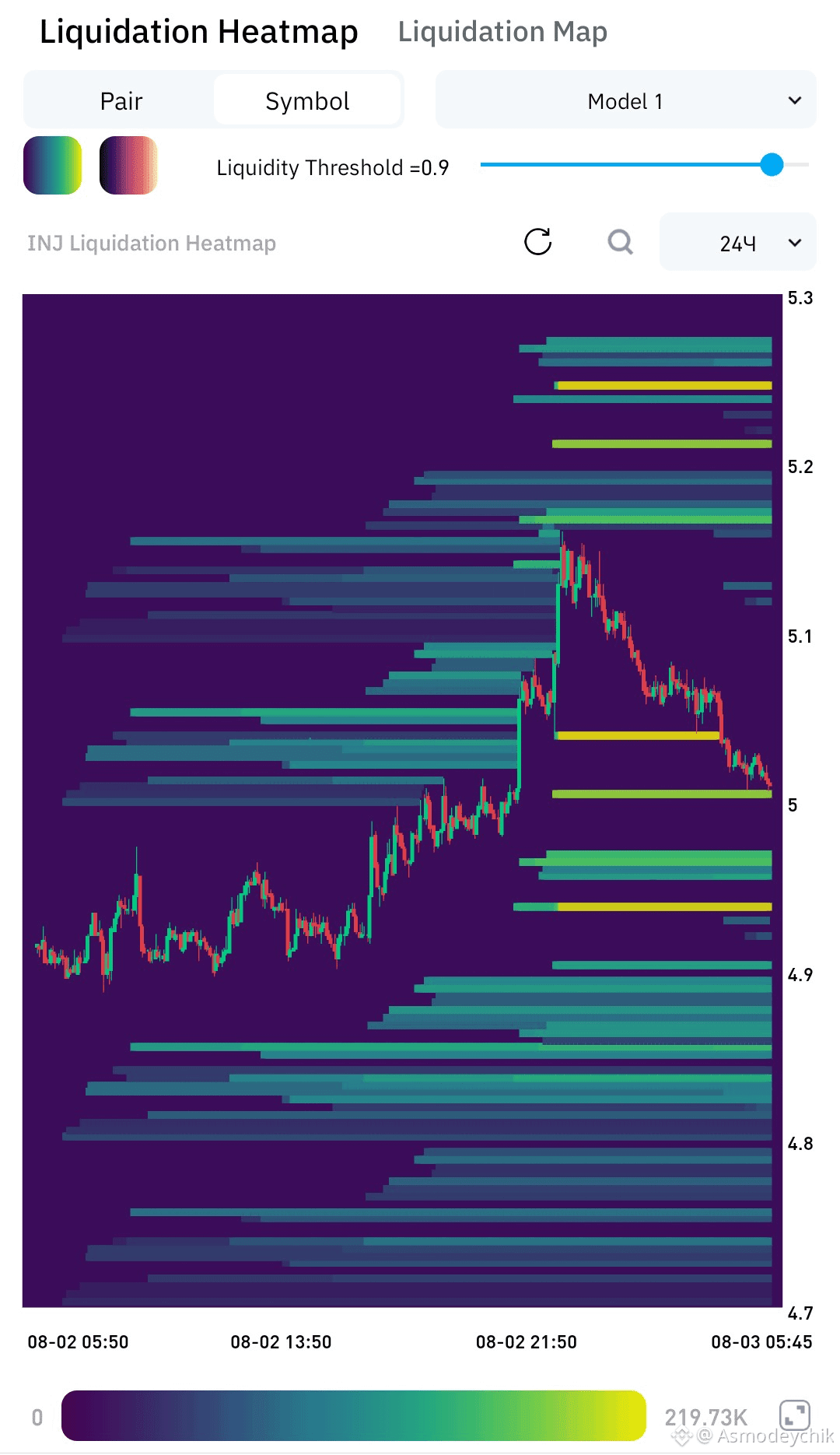
Injective (INJ) tested the maximum at $5.16, then pulled back to $5.015, clearing the market of excessive leverage. Despite the local correction, fundamental metrics remain in the buyers’ favor.
📊 Key metrics
Technical condition: The price fell below MA7 ($5.07) and MA14 ($5.04), but it is holding above the key support MA28 ($4.98).
Capital inflow: Over the past day, a positive net flow in derivatives was recorded at +$2.88M USDT, and whales are maintaining a clear bullish advantage (long/short 2.17 : 1).
OI drop: Open interest quickly fell from 1.51M to 1.49M INJ during the sell-off, indicating hot long positions are being washed out via stop-losses.
🗺️ Price movement scenarios (Liquidity zones)
Scenario 1 (Test at $4.95): A local dip to the $4.98 support level to form a tight cluster of long liquidations around $4.95.
Scenario 2 (Short squeeze): If the price holds above $5.07, it will trigger a new impulse toward a massive bright-yellow cluster of short stop-orders at $5.20–$5.25.
⚡ Conclusion
Holding the $4.98 level preserves the chance for the uptrend to continue. It’s safer to look for an entry after liquidity is removed at $4.95 or after a breakout/hold above $5.07.
$INJ
📊 Key metrics
Technical condition: The price fell below MA7 ($5.07) and MA14 ($5.04), but it is holding above the key support MA28 ($4.98).
Capital inflow: Over the past day, a positive net flow in derivatives was recorded at +$2.88M USDT, and whales are maintaining a clear bullish advantage (long/short 2.17 : 1).
OI drop: Open interest quickly fell from 1.51M to 1.49M INJ during the sell-off, indicating hot long positions are being washed out via stop-losses.
🗺️ Price movement scenarios (Liquidity zones)
Scenario 1 (Test at $4.95): A local dip to the $4.98 support level to form a tight cluster of long liquidations around $4.95.
Scenario 2 (Short squeeze): If the price holds above $5.07, it will trigger a new impulse toward a massive bright-yellow cluster of short stop-orders at $5.20–$5.25.
⚡ Conclusion
Holding the $4.98 level preserves the chance for the uptrend to continue. It’s safer to look for an entry after liquidity is removed at $4.95 or after a breakout/hold above $5.07.
$INJ
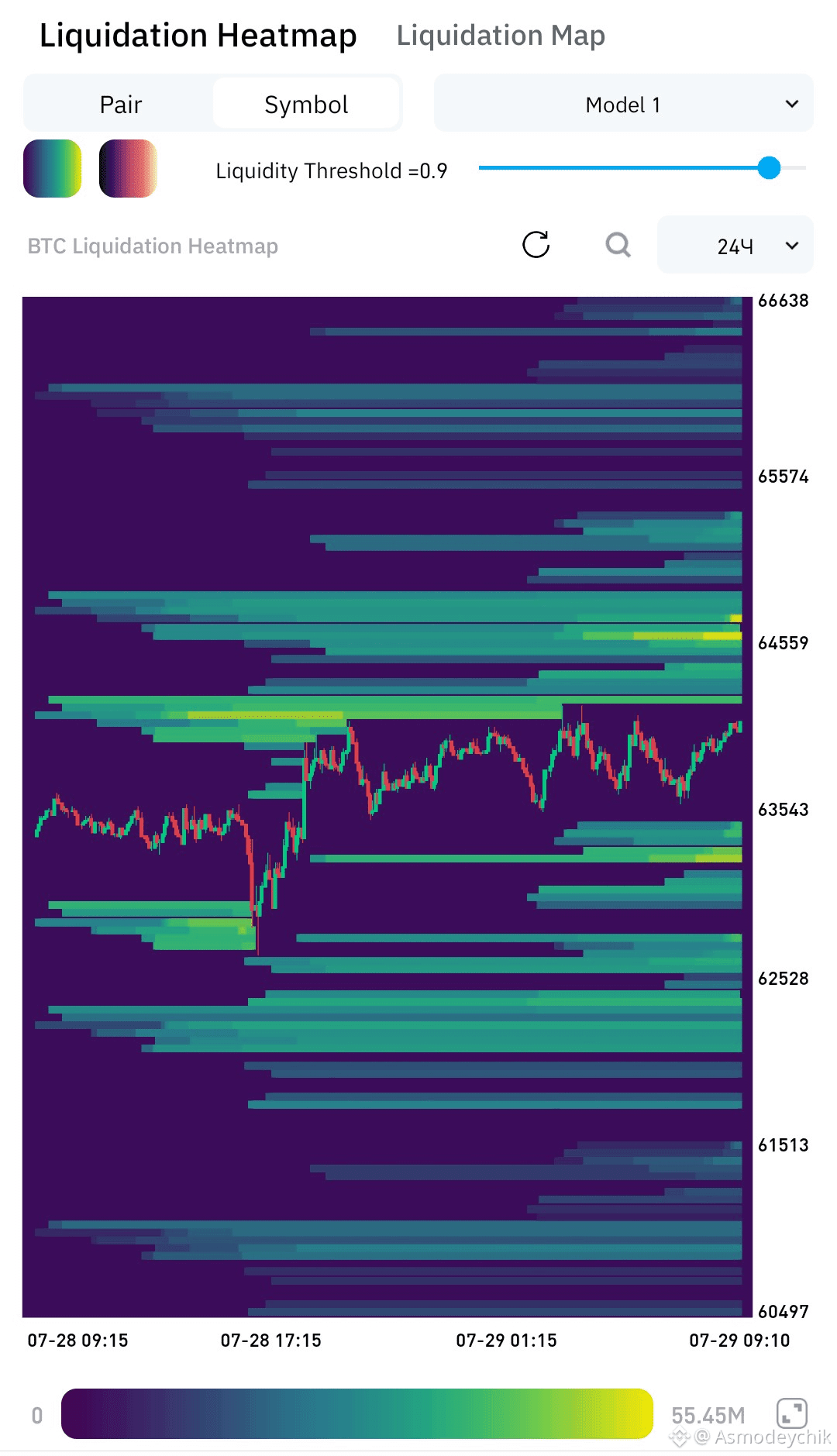
🔥 $BTC : Returns Above $64,000. Analyzing Metrics and Liquidity Zones
Bitcoin shows a local recovery, adding +1.06% over the day and holding around $64,072 after bouncing off the 24-hour low of $62,707. Let’s break down the current derivatives data, whale positioning, and the liquidation map.
Price has confidently moved above key short-term moving averages (MA7: $63,903, MA14: $63,860, MA28: $63,666), indicating that buyers have taken control.
A positive net inflow into derivatives over the past 24 hours has been recorded at +$50.38M USDT (total inflow — 50.67%).
Large players maintain a bullish stance — the Long/Short ratio among whales is 1.42 : 1 ($1.11B USDT in longs vs. $780M USDT in shorts).
OI rose from ~27.11K to ~27.29K BTC during the move above $63,500, confirming that real money is entering the market.
The overall long-account ratio is noticeably decreasing while the price rises (the retail market is shorting the impulse or closing positions), whereas top traders are holding longs.
💡 Summary: The local trend remains bullish due to capital inflows and support from large players. To maintain the upward momentum, it’s critical for buyers to hold the $63,900 level.
Bitcoin shows a local recovery, adding +1.06% over the day and holding around $64,072 after bouncing off the 24-hour low of $62,707. Let’s break down the current derivatives data, whale positioning, and the liquidation map.
Price has confidently moved above key short-term moving averages (MA7: $63,903, MA14: $63,860, MA28: $63,666), indicating that buyers have taken control.
A positive net inflow into derivatives over the past 24 hours has been recorded at +$50.38M USDT (total inflow — 50.67%).
Large players maintain a bullish stance — the Long/Short ratio among whales is 1.42 : 1 ($1.11B USDT in longs vs. $780M USDT in shorts).
OI rose from ~27.11K to ~27.29K BTC during the move above $63,500, confirming that real money is entering the market.
The overall long-account ratio is noticeably decreasing while the price rises (the retail market is shorting the impulse or closing positions), whereas top traders are holding longs.
💡 Summary: The local trend remains bullish due to capital inflows and support from large players. To maintain the upward momentum, it’s critical for buyers to hold the $63,900 level.
Verified
After a month of quiet, I’m back with you on Binance Square! 👋
I went through a minor burnout, took a breath, and I’m ready to jump back in—especially since there’s a new Creator Pad campaign dedicated to the Babylon project, which is a great reason for a comeback.
I think most of you heard about this project for the first time today. So let’s start with the basics: “What is Babylon and what is it used for?”
A few hours of studying materials and analyzing helped me form my first impression.
Babylon is a project that allows bitcoin holders to earn passive income while securing other blockchains (PoS networks).
You do NOT need to hand your BTC over to anyone, swap them for wrapped tokens, or send them to third-party websites. Your bitcoins remain fully under your control in your own wallet.
Put simply, Babylon turns BTC from passive “digital gold,” which just sits there, into an active source of profit without custodial risks.
While researching this, I remembered Bedrock. Maybe you recall: about a month ago, I already wrote about it for the Creator Pad campaign. And the most interesting part is that Bedrock runs precisely on top of Babylon!
That’s all for today. Thank you for your attention, and I’m happy to be back online! 😊
#baby $BABY @BabylonLabs_io
I went through a minor burnout, took a breath, and I’m ready to jump back in—especially since there’s a new Creator Pad campaign dedicated to the Babylon project, which is a great reason for a comeback.
I think most of you heard about this project for the first time today. So let’s start with the basics: “What is Babylon and what is it used for?”
A few hours of studying materials and analyzing helped me form my first impression.
Babylon is a project that allows bitcoin holders to earn passive income while securing other blockchains (PoS networks).
You do NOT need to hand your BTC over to anyone, swap them for wrapped tokens, or send them to third-party websites. Your bitcoins remain fully under your control in your own wallet.
Put simply, Babylon turns BTC from passive “digital gold,” which just sits there, into an active source of profit without custodial risks.
While researching this, I remembered Bedrock. Maybe you recall: about a month ago, I already wrote about it for the Creator Pad campaign. And the most interesting part is that Bedrock runs precisely on top of Babylon!
That’s all for today. Thank you for your attention, and I’m happy to be back online! 😊
#baby $BABY @BabylonLabs_io
All corporate AIs are closed black boxes filled with censorship and political filters. On the 8th day of the marathon, I decided to clash three completely different control ideologies at chat.opengradient.ai: Gemini from Google, xAI from Musk, and ByteDance (the creators of TikTok).
Gemini is the benchmark refined bore. For any dirty market query or gray code, it immediately switches on an ethics lecturer. xAI tries to appear as a 'based' degenerate, but American lawyers have it on a tight leash. And while ByteDance's models are top-notch at grabbing trends, they have specific Asian filters.
The kicker @OpenGradient is that you can use their pure engineering IQ in one window, but through TEE enclaves. This means the node hardware encrypts your prompts so they physically won’t fly back to Google or TikTok's databases for training. We are literally hacking the system: squeezing brains from the giants while remaining sovereign.
Who do you think is the real top in this trio? Or without Web3 protection, are these just three different digital prisons for data where you farm points?
$OPG #opg
Gemini is the benchmark refined bore. For any dirty market query or gray code, it immediately switches on an ethics lecturer. xAI tries to appear as a 'based' degenerate, but American lawyers have it on a tight leash. And while ByteDance's models are top-notch at grabbing trends, they have specific Asian filters.
The kicker @OpenGradient is that you can use their pure engineering IQ in one window, but through TEE enclaves. This means the node hardware encrypts your prompts so they physically won’t fly back to Google or TikTok's databases for training. We are literally hacking the system: squeezing brains from the giants while remaining sovereign.
Who do you think is the real top in this trio? Or without Web3 protection, are these just three different digital prisons for data where you farm points?
$OPG #opg
The Strait of Hormuz is back in the headlines.
Iran claims to be closing one of the most crucial routes for global oil trade. The market is traditionally reacting nervously: forecasts are popping up about a spike in oil prices, a new wave of inflation, and global upheavals.
But what really gets me in this story is something else.
Over the past few years, we've seen dozens of loud claims about blocking the Hormuz that never turned into a full-on stop of shipping. The headlines were loud. The consequences — significantly more modest.
That's why I always approach market panic on such news with suspicion.
If the strait is indeed going to be blocked for a long time — that’s a serious blow to global logistics and the energy market.
But if we’re once again dealing with political pressure through the media, then the real winners won’t be those who saw the news first, but those who didn’t give in to emotions.
For now, I see more fear in the headlines than in the actual data.
The market loves to short uncertainty. Especially when everyone is sure they know what’s coming next.
Is this really the start of a new escalation, or just another information noise that will be forgotten in a few days?
$BZ $CL $BTC
Iran claims to be closing one of the most crucial routes for global oil trade. The market is traditionally reacting nervously: forecasts are popping up about a spike in oil prices, a new wave of inflation, and global upheavals.
But what really gets me in this story is something else.
Over the past few years, we've seen dozens of loud claims about blocking the Hormuz that never turned into a full-on stop of shipping. The headlines were loud. The consequences — significantly more modest.
That's why I always approach market panic on such news with suspicion.
If the strait is indeed going to be blocked for a long time — that’s a serious blow to global logistics and the energy market.
But if we’re once again dealing with political pressure through the media, then the real winners won’t be those who saw the news first, but those who didn’t give in to emotions.
For now, I see more fear in the headlines than in the actual data.
The market loves to short uncertainty. Especially when everyone is sure they know what’s coming next.
Is this really the start of a new escalation, or just another information noise that will be forgotten in a few days?
$BZ $CL $BTC

Right now, every second person is cranking out AI memes in Midjourney. But in crypto, your prompts for infographics or schematics are pure alpha. In Web2, any idea gets funneled into corporate servers even BEFORE rendering. This means your creativity is already in their database.
On the 7th day of the marathon, I checked out Image Studio on chat.opengradient.ai. I needed visuals for content in a technical board style, so privacy here is key. Thanks to TEE enclaves, prompts are encrypted right at the node hardware level. No one can snoop on the idea before the official announcement. You can switch models in one space without leaks.
But let’s skip the fluff. The rendering speed in Web3 can sometimes get you stressed when nodes are bogged down by degens. And the quality—it's not Midjourney with a single click. Prompts need to be hand-crafted to the details, otherwise, you'll just burn credits on wonky abstractions.
For drafts and schematics—it's a rock-solid bunker. For complex art—we're waiting on updates.
$OPG #opg @OpenGradient
On the 7th day of the marathon, I checked out Image Studio on chat.opengradient.ai. I needed visuals for content in a technical board style, so privacy here is key. Thanks to TEE enclaves, prompts are encrypted right at the node hardware level. No one can snoop on the idea before the official announcement. You can switch models in one space without leaks.
But let’s skip the fluff. The rendering speed in Web3 can sometimes get you stressed when nodes are bogged down by degens. And the quality—it's not Midjourney with a single click. Prompts need to be hand-crafted to the details, otherwise, you'll just burn credits on wonky abstractions.
For drafts and schematics—it's a rock-solid bunker. For complex art—we're waiting on updates.
$OPG #opg @OpenGradient
Log in to explore more content