

AllInWeb3
956 Posts

AllInWeb3
Report
Block User
Open Trade

BNB Holder
High-Frequency Trader
5.5 Years
61 Following
125 Followers
394 Liked
Posts
Portfolio
All
Quotes
·
--
See translation
【希腊“加密投资诈骗案”:17人被捕仍不等于定罪】
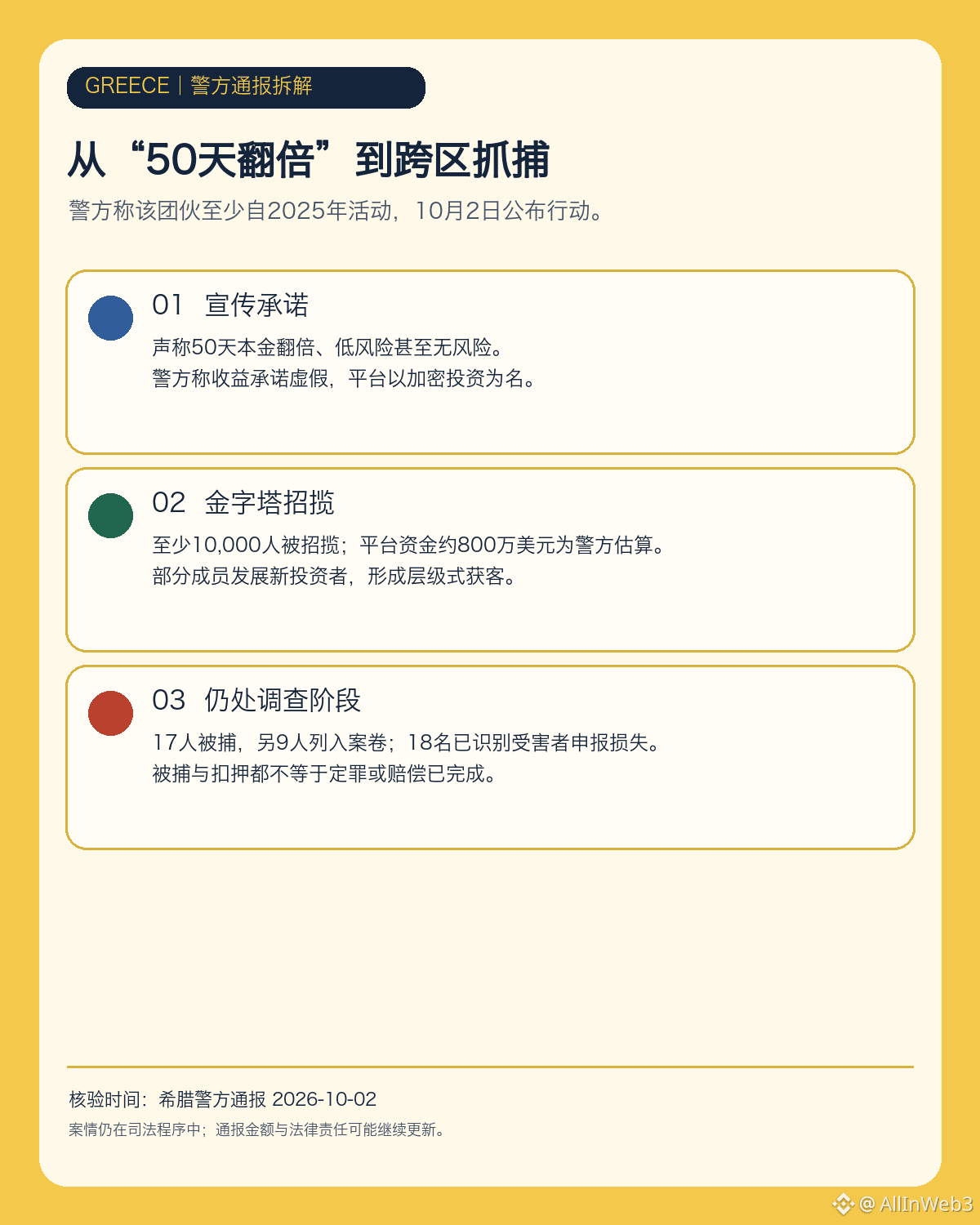
希腊警方10月2日通报称,已捣毁一个涉嫌以加密货币投资为名实施诈骗的团伙,逮捕17人。警方描述的关键链条不是“币价暴跌”,而是固定高收益承诺、层级招揽和资金平台:宣传称本金50天翻倍,并将风险说成很低甚至没有风险。此类期限明确、收益固定的承诺,和正常市场价格波动并不相符;本案仍应按警方披露的证据理解,不能据此推断每个参与者的角色或每笔转账去向。
通报称,调查人员认为该团伙至少自2025年起活动,已有约1万人被招揽;警方估算约800万美元资金进入相关平台。这里的“进入平台资金”不能直接写成受害者损失或最终被追回金额。警方另称,18名已识别受害者报告的损失合计55,970欧元;这是目前通报列出的受害者申报金额,也不代表案件全部损失。
现场查扣现金约295,090欧元,是警方报告的扣押物;它与平台资金估算、受害者申报损失属于三种不同统计口径,不能相加,也不能据此推断已完成赔付。
时间线也要分清:警方10月2日宣布行动,17名被捕者被移送检方并交由调查法官处理。警方还说另有9人被列入案件卷宗。被捕、列入案卷、被起诉与法院定罪不是同一阶段;当前信息仍是警方调查通报,不能把嫌疑写成判决。
对投资者来说,这起案件可核对的风险信号是“短期固定翻倍”与“继续招募”的组合,而不是加密资产本身必然有问题。若平台用确定收益掩盖资金用途,先核实经营主体、提现条件和监管状态;不要仅凭警方公布的估算数字推断资金去向。后续真正改变案件性质的节点,应是检方指控、法院裁定或警方公布的资金追踪结果。若未来仅有新的逮捕数字而没有程序进展、资金追回或受害者核实,解读时仍需把“嫌疑规模”和“法院认定损失”分开。
【希腊“加密投资诈骗案”:17人被捕仍不等于定罪】
希腊警方10月2日通报称,已捣毁一个涉嫌以加密货币投资为名实施诈骗的团伙,逮捕17人。警方描述的关键链条不是“币价暴跌”,而是固定高收益承诺、层级招揽和资金平台:宣传称本金50天翻倍,并将风险说成很低甚至没有风险。此类期限明确、收益固定的承诺,和正常市场价格波动并不相符;本案仍应按警方披露的证据理解,不能据此推断每个参与者的角色或每笔转账去向。
通报称,调查人员认为该团伙至少自2025年起活动,已有约1万人被招揽;警方估算约800万美元资金进入相关平台。这里的“进入平台资金”不能直接写成受害者损失或最终被追回金额。警方另称,18名已识别受害者报告的损失合计55,970欧元;这是目前通报列出的受害者申报金额,也不代表案件全部损失。
现场查扣现金约295,090欧元,是警方报告的扣押物;它与平台资金估算、受害者申报损失属于三种不同统计口径,不能相加,也不能据此推断已完成赔付。
时间线也要分清:警方10月2日宣布行动,17名被捕者被移送检方并交由调查法官处理。警方还说另有9人被列入案件卷宗。被捕、列入案卷、被起诉与法院定罪不是同一阶段;当前信息仍是警方调查通报,不能把嫌疑写成判决。
对投资者来说,这起案件可核对的风险信号是“短期固定翻倍”与“继续招募”的组合,而不是加密资产本身必然有问题。若平台用确定收益掩盖资金用途,先核实经营主体、提现条件和监管状态;不要仅凭警方公布的估算数字推断资金去向。后续真正改变案件性质的节点,应是检方指控、法院裁定或警方公布的资金追踪结果。若未来仅有新的逮捕数字而没有程序进展、资金追回或受害者核实,解读时仍需把“嫌疑规模”和“法院认定损失”分开。
希腊警方10月2日通报称,已捣毁一个涉嫌以加密货币投资为名实施诈骗的团伙,逮捕17人。警方描述的关键链条不是“币价暴跌”,而是固定高收益承诺、层级招揽和资金平台:宣传称本金50天翻倍,并将风险说成很低甚至没有风险。此类期限明确、收益固定的承诺,和正常市场价格波动并不相符;本案仍应按警方披露的证据理解,不能据此推断每个参与者的角色或每笔转账去向。
通报称,调查人员认为该团伙至少自2025年起活动,已有约1万人被招揽;警方估算约800万美元资金进入相关平台。这里的“进入平台资金”不能直接写成受害者损失或最终被追回金额。警方另称,18名已识别受害者报告的损失合计55,970欧元;这是目前通报列出的受害者申报金额,也不代表案件全部损失。
现场查扣现金约295,090欧元,是警方报告的扣押物;它与平台资金估算、受害者申报损失属于三种不同统计口径,不能相加,也不能据此推断已完成赔付。
时间线也要分清:警方10月2日宣布行动,17名被捕者被移送检方并交由调查法官处理。警方还说另有9人被列入案件卷宗。被捕、列入案卷、被起诉与法院定罪不是同一阶段;当前信息仍是警方调查通报,不能把嫌疑写成判决。
对投资者来说,这起案件可核对的风险信号是“短期固定翻倍”与“继续招募”的组合,而不是加密资产本身必然有问题。若平台用确定收益掩盖资金用途,先核实经营主体、提现条件和监管状态;不要仅凭警方公布的估算数字推断资金去向。后续真正改变案件性质的节点,应是检方指控、法院裁定或警方公布的资金追踪结果。若未来仅有新的逮捕数字而没有程序进展、资金追回或受害者核实,解读时仍需把“嫌疑规模”和“法院认定损失”分开。
8
·
--
[Salvador receives $138 million, which is not equal to IMF support for increasing BTC purchases]
This trending topic links together “IMF approves funding” and a “Bitcoin clause exemption,” which easily leads people to misread it as the fund organization endorsing El Salvador to buy more Bitcoin. The official documents are about project reviews and performance arrangements, and the funding and BTC policy must be assessed separately.
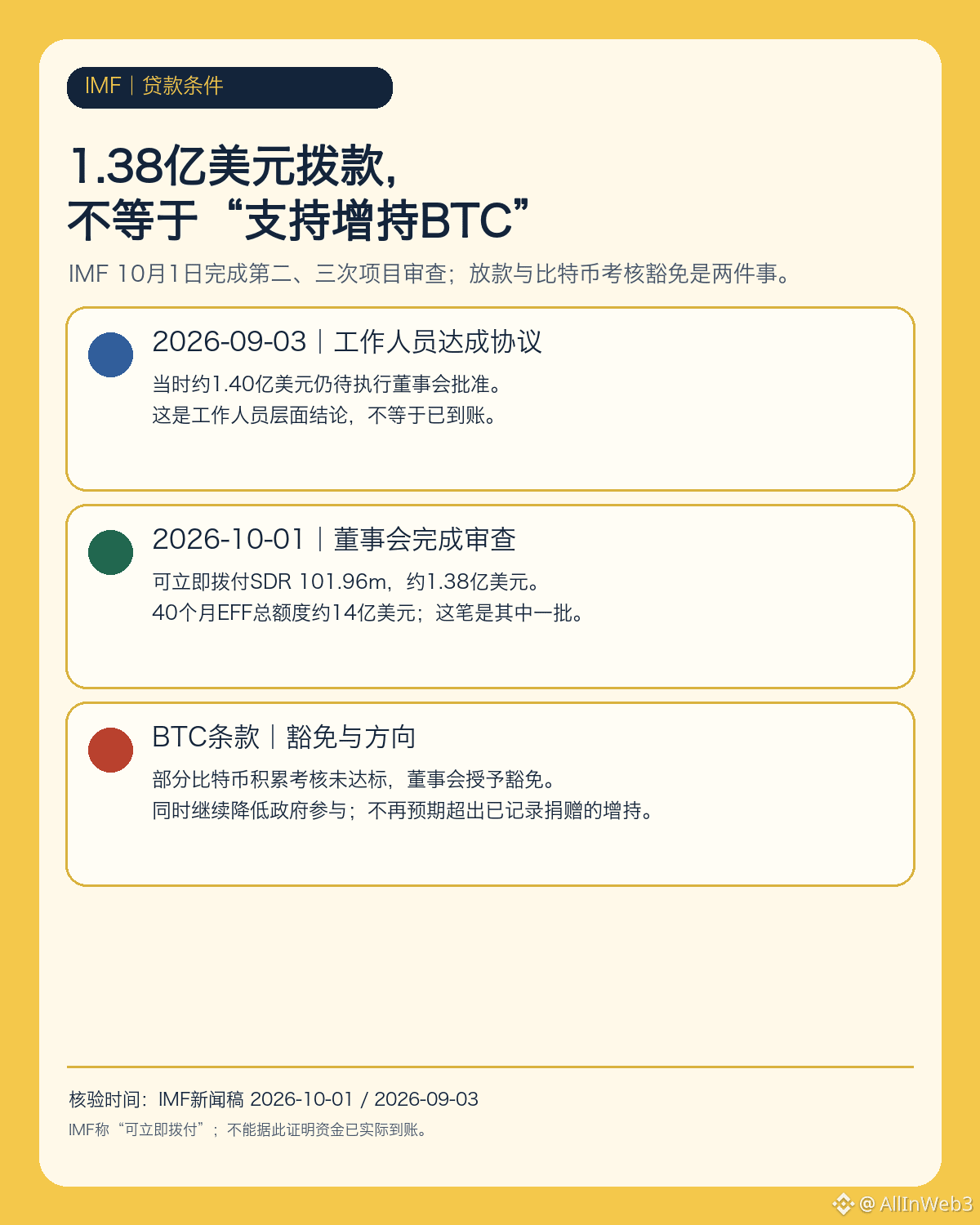
The timeline is clear: on September 3, IMF staff reached staff-level agreements with El Salvador for the second and third reviews. At that time, around $140 million still required approval by the Executive Board. Only after the Board completed the reviews on October 1 did SDR 101.96m (about $138 million) become “immediately available for disbursement.” This is part of an extension under the 40-month arrangement with a total envelope of about $1.4 billion; it is not funds specifically intended to buy Bitcoin. Moreover, “available for disbursement” does not mean the money has already been received.
Another track concerns the performance waiver. The IMF said that certain performance criteria related to Bitcoin accumulation were not met, but waivers were granted based on corrective measures and new commitments. The press release also states that El Salvador is still reducing the government’s involvement in Bitcoin-related activities, strengthening regulation and supervision, and does not expect further Bitcoin accumulation beyond the donations already recorded.
This review also covers broader macro-related aspects of the program. The IMF said the fiscal adjustment is broadly in line with targets; reserves and liquidity buffers are stronger; and it noted that most ownership and operational control of the Chivo government wallet have been transferred to private operators. The lending is financing under the overall EFF framework, not a guarantee for any specific crypto asset. The waiver only addresses arrangements that did not meet the performance criteria, and cannot be expanded into an interpretation that there are no further disclosure requirements.
The program direction already called for reducing the public sector’s involvement in Bitcoin-related activities. Therefore, the key next points are policy implementation, transparency in public BTC holdings, and the execution of the transfer of wallet control—not equating the loan amount with BTC buying demand.
What the Executive Board approved was the overall economic program review and the corresponding disbursement, and it did not announce encouragement for the government to buy additional BTC. What is more worth verifying next is whether the funds are actually disbursed, the transparency of public-sector BTC holdings, and whether control of the Chivo wallet has been transferred as planned. You cannot treat funding approval directly as new Bitcoin acquisition needs.
[Salvador receives $138 million, which is not equal to IMF support for increasing BTC purchases]
This trending topic links together “IMF approves funding” and a “Bitcoin clause exemption,” which easily leads people to misread it as the fund organization endorsing El Salvador to buy more Bitcoin. The official documents are about project reviews and performance arrangements, and the funding and BTC policy must be assessed separately.
The timeline is clear: on September 3, IMF staff reached staff-level agreements with El Salvador for the second and third reviews. At that time, around $140 million still required approval by the Executive Board. Only after the Board completed the reviews on October 1 did SDR 101.96m (about $138 million) become “immediately available for disbursement.” This is part of an extension under the 40-month arrangement with a total envelope of about $1.4 billion; it is not funds specifically intended to buy Bitcoin. Moreover, “available for disbursement” does not mean the money has already been received.
Another track concerns the performance waiver. The IMF said that certain performance criteria related to Bitcoin accumulation were not met, but waivers were granted based on corrective measures and new commitments. The press release also states that El Salvador is still reducing the government’s involvement in Bitcoin-related activities, strengthening regulation and supervision, and does not expect further Bitcoin accumulation beyond the donations already recorded.
This review also covers broader macro-related aspects of the program. The IMF said the fiscal adjustment is broadly in line with targets; reserves and liquidity buffers are stronger; and it noted that most ownership and operational control of the Chivo government wallet have been transferred to private operators. The lending is financing under the overall EFF framework, not a guarantee for any specific crypto asset. The waiver only addresses arrangements that did not meet the performance criteria, and cannot be expanded into an interpretation that there are no further disclosure requirements.
The program direction already called for reducing the public sector’s involvement in Bitcoin-related activities. Therefore, the key next points are policy implementation, transparency in public BTC holdings, and the execution of the transfer of wallet control—not equating the loan amount with BTC buying demand.
What the Executive Board approved was the overall economic program review and the corresponding disbursement, and it did not announce encouragement for the government to buy additional BTC. What is more worth verifying next is whether the funds are actually disbursed, the transparency of public-sector BTC holdings, and whether control of the Chivo wallet has been transferred as planned. You cannot treat funding approval directly as new Bitcoin acquisition needs.
This trending topic links together “IMF approves funding” and a “Bitcoin clause exemption,” which easily leads people to misread it as the fund organization endorsing El Salvador to buy more Bitcoin. The official documents are about project reviews and performance arrangements, and the funding and BTC policy must be assessed separately.
The timeline is clear: on September 3, IMF staff reached staff-level agreements with El Salvador for the second and third reviews. At that time, around $140 million still required approval by the Executive Board. Only after the Board completed the reviews on October 1 did SDR 101.96m (about $138 million) become “immediately available for disbursement.” This is part of an extension under the 40-month arrangement with a total envelope of about $1.4 billion; it is not funds specifically intended to buy Bitcoin. Moreover, “available for disbursement” does not mean the money has already been received.
Another track concerns the performance waiver. The IMF said that certain performance criteria related to Bitcoin accumulation were not met, but waivers were granted based on corrective measures and new commitments. The press release also states that El Salvador is still reducing the government’s involvement in Bitcoin-related activities, strengthening regulation and supervision, and does not expect further Bitcoin accumulation beyond the donations already recorded.
This review also covers broader macro-related aspects of the program. The IMF said the fiscal adjustment is broadly in line with targets; reserves and liquidity buffers are stronger; and it noted that most ownership and operational control of the Chivo government wallet have been transferred to private operators. The lending is financing under the overall EFF framework, not a guarantee for any specific crypto asset. The waiver only addresses arrangements that did not meet the performance criteria, and cannot be expanded into an interpretation that there are no further disclosure requirements.
The program direction already called for reducing the public sector’s involvement in Bitcoin-related activities. Therefore, the key next points are policy implementation, transparency in public BTC holdings, and the execution of the transfer of wallet control—not equating the loan amount with BTC buying demand.
What the Executive Board approved was the overall economic program review and the corresponding disbursement, and it did not announce encouragement for the government to buy additional BTC. What is more worth verifying next is whether the funds are actually disbursed, the transparency of public-sector BTC holdings, and whether control of the Chivo wallet has been transferred as planned. You cannot treat funding approval directly as new Bitcoin acquisition needs.
92
·
--
【ETH:Validator exit queue surges—doesn’t mean spot sell pressure has surged in tandem】
On Binance Square’s trending hot list, the spotlight is on a 392% increase in the validator exit queue. But since the leaderboard doesn’t show the percentage’s baseline, you can’t infer that an ETH supply of the same scale is selling off.
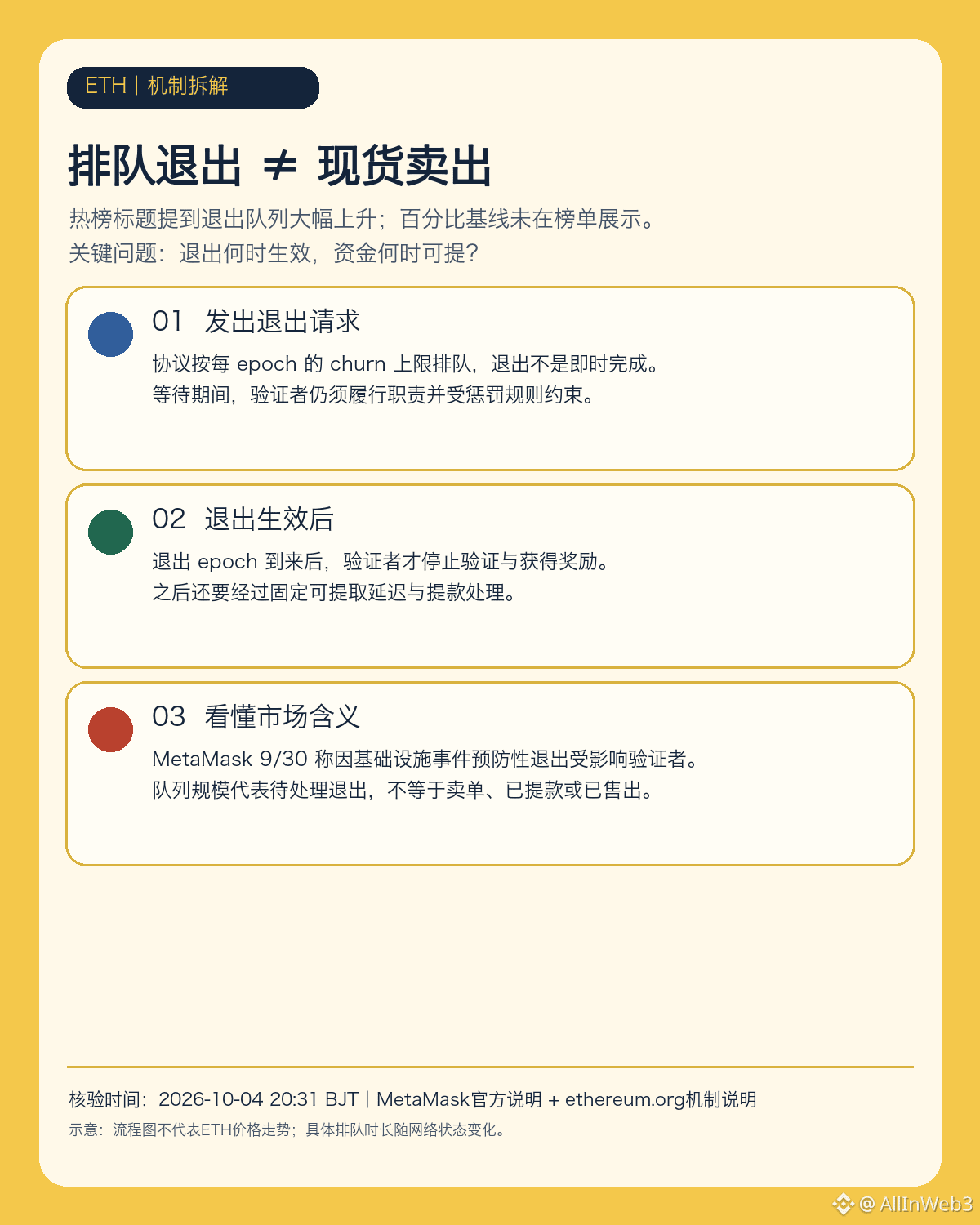
MetaMask’s official update on September 30 confirmed that some part of its infrastructure experienced a security incident, and it said it has not found any direct threats to MetaMask wallets. It said it is proactively exiting the affected staking validators. It also noted that the service is non-custodial—user withdrawal keys are not held by MetaMask. This supports the explanation that operators are isolating risk, and it doesn’t mean ETH principal has been stolen or sold.
Ethereum exits occur in stages: once validators submit an exit, the protocol queues withdrawals according to the exit capacity per epoch. Before the exit epoch arrives, validators must continue working and remain subject to penalty rules. Only after the exit takes effect do they stop validating and earning rewards, after which there’s still a delay before funds become withdrawable and withdrawal processing can begin. The queue length represents pending exits—not exchange sell orders, and not amounts that have already returned to the spot market.
Queue capacity is a protocol safety mechanism: it limits the validator set from shrinking rapidly, preventing a large amount of staked weight from leaving at the same time. Exiting queued validators can lengthen the operator’s capital turnover cycle, but it doesn’t indicate that all depositors chose to exit. If operators concentrate migrations of underlying infrastructure, the number of exits can also show temporary buildup. This is a mechanism-level explanation, so you can’t attribute all the increase to a single operator merely because the timing aligns.
Also, the queue and withdrawals aren’t the same step: the protocol first allows validators to exit, then funds only become withdrawable after the delay—only afterward can funds be aggregated or traded. Different on-chain stages will change both arrival timing and where the funds go.
So, what this time primarily affects first is staking liquidity and operator coordination—not the direction of short-term price, which cannot be derived from the queue alone. MetaMask hasn’t published a complete list of affected validators or the root cause, nor has it proven that the corresponding ETH will enter exchanges. Next, you should watch whether on-chain exits and withdrawals continue to rise, whether the fund flows are traceable, and what MetaMask later discloses in its investigation. Writing an “exit request” directly as “selling” skips the key steps.
【ETH:Validator exit queue surges—doesn’t mean spot sell pressure has surged in tandem】
On Binance Square’s trending hot list, the spotlight is on a 392% increase in the validator exit queue. But since the leaderboard doesn’t show the percentage’s baseline, you can’t infer that an ETH supply of the same scale is selling off.
MetaMask’s official update on September 30 confirmed that some part of its infrastructure experienced a security incident, and it said it has not found any direct threats to MetaMask wallets. It said it is proactively exiting the affected staking validators. It also noted that the service is non-custodial—user withdrawal keys are not held by MetaMask. This supports the explanation that operators are isolating risk, and it doesn’t mean ETH principal has been stolen or sold.
Ethereum exits occur in stages: once validators submit an exit, the protocol queues withdrawals according to the exit capacity per epoch. Before the exit epoch arrives, validators must continue working and remain subject to penalty rules. Only after the exit takes effect do they stop validating and earning rewards, after which there’s still a delay before funds become withdrawable and withdrawal processing can begin. The queue length represents pending exits—not exchange sell orders, and not amounts that have already returned to the spot market.
Queue capacity is a protocol safety mechanism: it limits the validator set from shrinking rapidly, preventing a large amount of staked weight from leaving at the same time. Exiting queued validators can lengthen the operator’s capital turnover cycle, but it doesn’t indicate that all depositors chose to exit. If operators concentrate migrations of underlying infrastructure, the number of exits can also show temporary buildup. This is a mechanism-level explanation, so you can’t attribute all the increase to a single operator merely because the timing aligns.
Also, the queue and withdrawals aren’t the same step: the protocol first allows validators to exit, then funds only become withdrawable after the delay—only afterward can funds be aggregated or traded. Different on-chain stages will change both arrival timing and where the funds go.
So, what this time primarily affects first is staking liquidity and operator coordination—not the direction of short-term price, which cannot be derived from the queue alone. MetaMask hasn’t published a complete list of affected validators or the root cause, nor has it proven that the corresponding ETH will enter exchanges. Next, you should watch whether on-chain exits and withdrawals continue to rise, whether the fund flows are traceable, and what MetaMask later discloses in its investigation. Writing an “exit request” directly as “selling” skips the key steps.
On Binance Square’s trending hot list, the spotlight is on a 392% increase in the validator exit queue. But since the leaderboard doesn’t show the percentage’s baseline, you can’t infer that an ETH supply of the same scale is selling off.
MetaMask’s official update on September 30 confirmed that some part of its infrastructure experienced a security incident, and it said it has not found any direct threats to MetaMask wallets. It said it is proactively exiting the affected staking validators. It also noted that the service is non-custodial—user withdrawal keys are not held by MetaMask. This supports the explanation that operators are isolating risk, and it doesn’t mean ETH principal has been stolen or sold.
Ethereum exits occur in stages: once validators submit an exit, the protocol queues withdrawals according to the exit capacity per epoch. Before the exit epoch arrives, validators must continue working and remain subject to penalty rules. Only after the exit takes effect do they stop validating and earning rewards, after which there’s still a delay before funds become withdrawable and withdrawal processing can begin. The queue length represents pending exits—not exchange sell orders, and not amounts that have already returned to the spot market.
Queue capacity is a protocol safety mechanism: it limits the validator set from shrinking rapidly, preventing a large amount of staked weight from leaving at the same time. Exiting queued validators can lengthen the operator’s capital turnover cycle, but it doesn’t indicate that all depositors chose to exit. If operators concentrate migrations of underlying infrastructure, the number of exits can also show temporary buildup. This is a mechanism-level explanation, so you can’t attribute all the increase to a single operator merely because the timing aligns.
Also, the queue and withdrawals aren’t the same step: the protocol first allows validators to exit, then funds only become withdrawable after the delay—only afterward can funds be aggregated or traded. Different on-chain stages will change both arrival timing and where the funds go.
So, what this time primarily affects first is staking liquidity and operator coordination—not the direction of short-term price, which cannot be derived from the queue alone. MetaMask hasn’t published a complete list of affected validators or the root cause, nor has it proven that the corresponding ETH will enter exchanges. Next, you should watch whether on-chain exits and withdrawals continue to rise, whether the fund flows are traceable, and what MetaMask later discloses in its investigation. Writing an “exit request” directly as “selling” skips the key steps.
1
132
·
--
【BTC five complete hourly candles closed above $85,000; $87K still not retested】
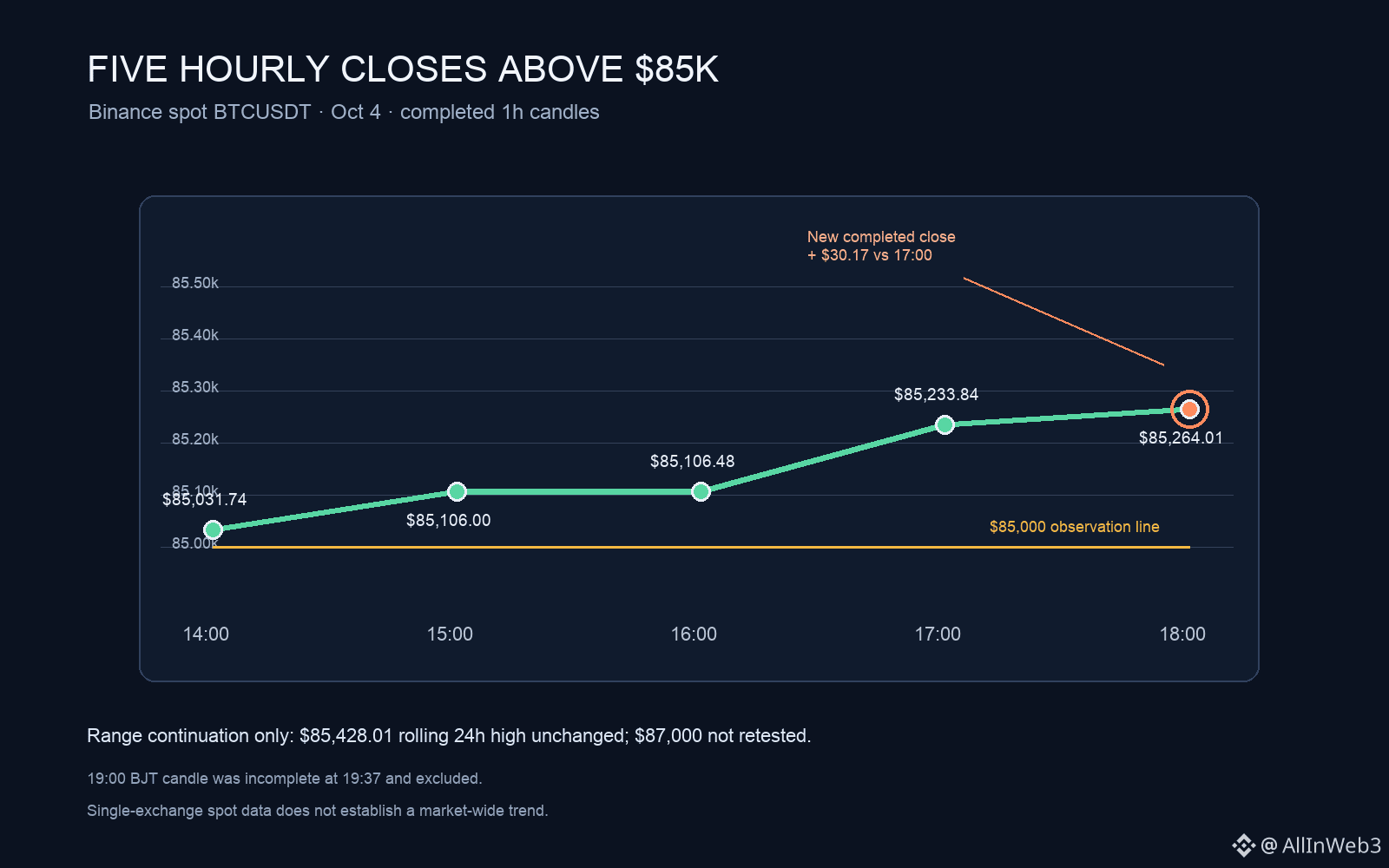
This update includes just one additional complete hourly candle compared with the post published at 18:44 (373635056641786). The incremental change is clear, but it shouldn’t be exaggerated. Previously, I cross-checked the four closing candles from 14:00 to 17:00. On Binance spot BTCUSDT, the 18:00–18:59 hourly candle was completed at 19:00 and closed at $85,264.01, with a range low of $85,223.49 and a high of $85,428.01. Therefore, the number of complete hourly candles closing continuously above $85,000 increased from 4 to 5.
This new K-line confirms that the observation range above 85k continues; it doesn’t indicate the start of a new upswing. A single hourly candle only describes one closing period and cannot answer a higher-timeframe direction or the magnitude of any subsequent pullback. The 18:00 high matches the rolling 24-hour high of $85,428.01 from the earlier readout exactly, without forming a higher high. There is still a gap from the $87,000 mentioned on the hot list. The close is $30.17 above the 17:00 high of $85,233.84; the 18:00 trading volume is 336.02 BTC, slightly higher than 335.31 BTC at 17:00. Spot volume from a single exchange can’t identify the direction of active buying/selling, nor can it represent the entire market spot or perpetual positions.
As of the 19:37 read, the 19:00 hourly candle hasn’t ended yet, so I don’t treat it as a confirmed close. The rolling 24-hour turnover is about $605 million and the current price is about $85,299—these are dynamic window readings, not the complete daily K-line. In the chart, only the five completed K-lines from 14:00 to 18:00 are drawn, and the $85,000 observation line and the newly added close are marked. It doesn’t write “five consecutive hours” as support confirmation or a trend reversal.
What to watch next is whether complete hourly closes can keep holding near 85k, and whether any rebound forms a new high above $85,428. If a complete hourly candle closes back below 85k, then this five-hour continuation ends; if it’s only a intraday penetration, you also can’t treat it by itself as “standing firm.” This article describes Binance spot BTCUSDT data; it does not infer price causes and is not trading advice. #BTC
【BTC five complete hourly candles closed above $85,000; $87K still not retested】
This update includes just one additional complete hourly candle compared with the post published at 18:44 (373635056641786). The incremental change is clear, but it shouldn’t be exaggerated. Previously, I cross-checked the four closing candles from 14:00 to 17:00. On Binance spot BTCUSDT, the 18:00–18:59 hourly candle was completed at 19:00 and closed at $85,264.01, with a range low of $85,223.49 and a high of $85,428.01. Therefore, the number of complete hourly candles closing continuously above $85,000 increased from 4 to 5.
This new K-line confirms that the observation range above 85k continues; it doesn’t indicate the start of a new upswing. A single hourly candle only describes one closing period and cannot answer a higher-timeframe direction or the magnitude of any subsequent pullback. The 18:00 high matches the rolling 24-hour high of $85,428.01 from the earlier readout exactly, without forming a higher high. There is still a gap from the $87,000 mentioned on the hot list. The close is $30.17 above the 17:00 high of $85,233.84; the 18:00 trading volume is 336.02 BTC, slightly higher than 335.31 BTC at 17:00. Spot volume from a single exchange can’t identify the direction of active buying/selling, nor can it represent the entire market spot or perpetual positions.
As of the 19:37 read, the 19:00 hourly candle hasn’t ended yet, so I don’t treat it as a confirmed close. The rolling 24-hour turnover is about $605 million and the current price is about $85,299—these are dynamic window readings, not the complete daily K-line. In the chart, only the five completed K-lines from 14:00 to 18:00 are drawn, and the $85,000 observation line and the newly added close are marked. It doesn’t write “five consecutive hours” as support confirmation or a trend reversal.
What to watch next is whether complete hourly closes can keep holding near 85k, and whether any rebound forms a new high above $85,428. If a complete hourly candle closes back below 85k, then this five-hour continuation ends; if it’s only a intraday penetration, you also can’t treat it by itself as “standing firm.” This article describes Binance spot BTCUSDT data; it does not infer price causes and is not trading advice. #BTC
This update includes just one additional complete hourly candle compared with the post published at 18:44 (373635056641786). The incremental change is clear, but it shouldn’t be exaggerated. Previously, I cross-checked the four closing candles from 14:00 to 17:00. On Binance spot BTCUSDT, the 18:00–18:59 hourly candle was completed at 19:00 and closed at $85,264.01, with a range low of $85,223.49 and a high of $85,428.01. Therefore, the number of complete hourly candles closing continuously above $85,000 increased from 4 to 5.
This new K-line confirms that the observation range above 85k continues; it doesn’t indicate the start of a new upswing. A single hourly candle only describes one closing period and cannot answer a higher-timeframe direction or the magnitude of any subsequent pullback. The 18:00 high matches the rolling 24-hour high of $85,428.01 from the earlier readout exactly, without forming a higher high. There is still a gap from the $87,000 mentioned on the hot list. The close is $30.17 above the 17:00 high of $85,233.84; the 18:00 trading volume is 336.02 BTC, slightly higher than 335.31 BTC at 17:00. Spot volume from a single exchange can’t identify the direction of active buying/selling, nor can it represent the entire market spot or perpetual positions.
As of the 19:37 read, the 19:00 hourly candle hasn’t ended yet, so I don’t treat it as a confirmed close. The rolling 24-hour turnover is about $605 million and the current price is about $85,299—these are dynamic window readings, not the complete daily K-line. In the chart, only the five completed K-lines from 14:00 to 18:00 are drawn, and the $85,000 observation line and the newly added close are marked. It doesn’t write “five consecutive hours” as support confirmation or a trend reversal.
What to watch next is whether complete hourly closes can keep holding near 85k, and whether any rebound forms a new high above $85,428. If a complete hourly candle closes back below 85k, then this five-hour continuation ends; if it’s only a intraday penetration, you also can’t treat it by itself as “standing firm.” This article describes Binance spot BTCUSDT data; it does not infer price causes and is not trading advice. #BTC
97
·
--
【A new verification of the ~20% CBRS drawdown: a Form 4 “transfer out” entry is not an open-market sell order】
In this round’s Binance Square installment #8, the Cerebras share price drop is mentioned alongside the claim that “OpenAI switched to using Nvidia.” This post previously checked the matter in topic 373221619356908: the hardware-routing story behind GPT‑6.1 Sol Ultrafast was not confirmed by OpenAI or Cerebras, so you can’t infer an end to cooperation from a change between model tiers. This article adds a further check of an original SEC Form 4, focusing on what the internal share changes it records actually were.
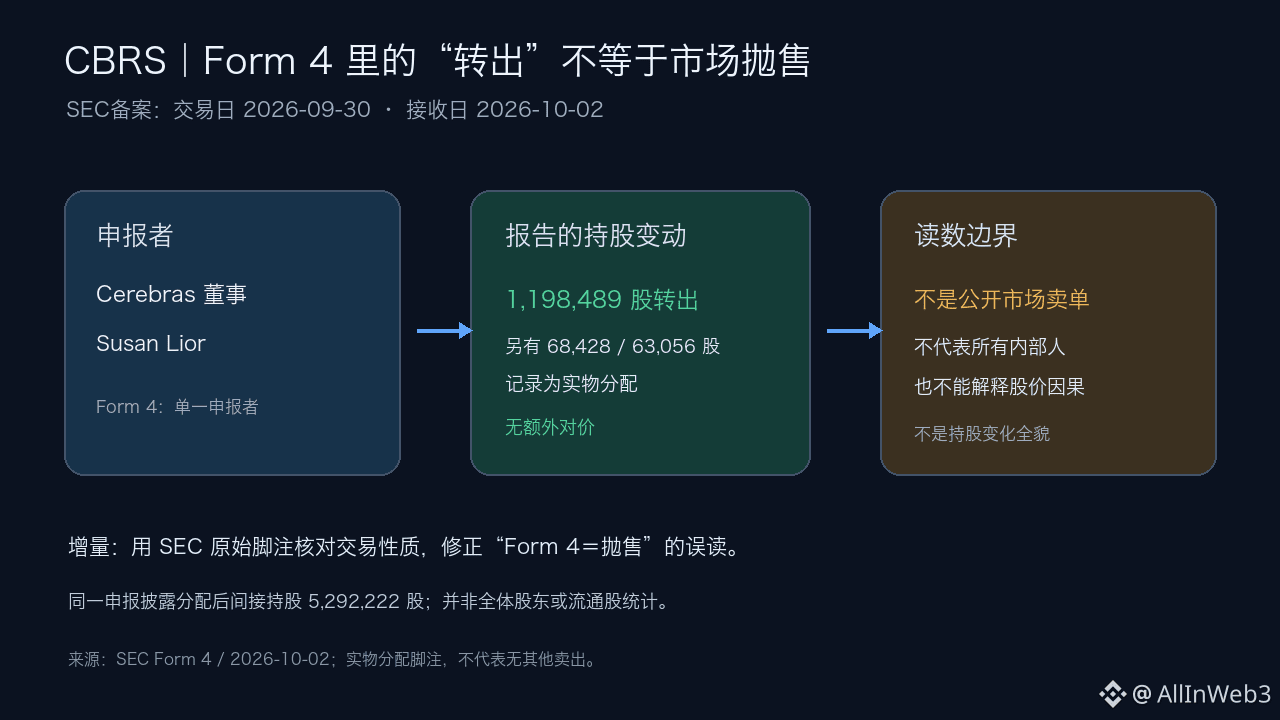
The filing was submitted on October 2, with reporting person Susan Lior listed as a Cerebras director and the transaction date as September 30. The form records the “disposition” of 1,198,489 shares, but the footnote explicitly states that this was an in-kind allocation from Eclipse-related entities to the partners on a pro rata basis, with no additional consideration received. The same table also separately lists the acquisition of 68,428 shares and 63,056 shares, likewise noting they came from in-kind allocations. After the transaction, the reporting person still retains voting rights over an aggregate 5,292,222 shares indirectly held. If you crop out column D of the table on its own, you would misread the ownership reallocation as secondary-market dumping.
This document sets two boundaries: first, it is a holdings report by a single filer, not a complete supply table for all insiders or for freely tradable shares; second, an in-kind distribution with no consideration cannot prove that the market saw sell orders of the same amount, nor can it prove that nobody else is selling. The ~20% drop highlighted on the trending board is close in time to the rumor, but this Form 4 neither explains why the stock price fell nor verifies OpenAI’s specific reasoning path.
Therefore, the evidence chain should be examined in parts: the SEC filing only confirms this particular distribution of holdings; what kind of chips GPT‑6.1 uses still needs to be explained by the involved companies; and causality for price changes cannot be derived from a single Form 4. If later filings show open-market trading, amendments to agreements, or service deployment announcements, update the supply and customer-relationship assessment separately. This article adds a new verification step to the old topic, does not write the transfer of holdings as an insider sell-off, and does not attribute the drawdown to a single piece of news. #CBRS #AI compute power
【A new verification of the ~20% CBRS drawdown: a Form 4 “transfer out” entry is not an open-market sell order】
In this round’s Binance Square installment #8, the Cerebras share price drop is mentioned alongside the claim that “OpenAI switched to using Nvidia.” This post previously checked the matter in topic 373221619356908: the hardware-routing story behind GPT‑6.1 Sol Ultrafast was not confirmed by OpenAI or Cerebras, so you can’t infer an end to cooperation from a change between model tiers. This article adds a further check of an original SEC Form 4, focusing on what the internal share changes it records actually were.
The filing was submitted on October 2, with reporting person Susan Lior listed as a Cerebras director and the transaction date as September 30. The form records the “disposition” of 1,198,489 shares, but the footnote explicitly states that this was an in-kind allocation from Eclipse-related entities to the partners on a pro rata basis, with no additional consideration received. The same table also separately lists the acquisition of 68,428 shares and 63,056 shares, likewise noting they came from in-kind allocations. After the transaction, the reporting person still retains voting rights over an aggregate 5,292,222 shares indirectly held. If you crop out column D of the table on its own, you would misread the ownership reallocation as secondary-market dumping.
This document sets two boundaries: first, it is a holdings report by a single filer, not a complete supply table for all insiders or for freely tradable shares; second, an in-kind distribution with no consideration cannot prove that the market saw sell orders of the same amount, nor can it prove that nobody else is selling. The ~20% drop highlighted on the trending board is close in time to the rumor, but this Form 4 neither explains why the stock price fell nor verifies OpenAI’s specific reasoning path.
Therefore, the evidence chain should be examined in parts: the SEC filing only confirms this particular distribution of holdings; what kind of chips GPT‑6.1 uses still needs to be explained by the involved companies; and causality for price changes cannot be derived from a single Form 4. If later filings show open-market trading, amendments to agreements, or service deployment announcements, update the supply and customer-relationship assessment separately. This article adds a new verification step to the old topic, does not write the transfer of holdings as an insider sell-off, and does not attribute the drawdown to a single piece of news. #CBRS #AI compute power
In this round’s Binance Square installment #8, the Cerebras share price drop is mentioned alongside the claim that “OpenAI switched to using Nvidia.” This post previously checked the matter in topic 373221619356908: the hardware-routing story behind GPT‑6.1 Sol Ultrafast was not confirmed by OpenAI or Cerebras, so you can’t infer an end to cooperation from a change between model tiers. This article adds a further check of an original SEC Form 4, focusing on what the internal share changes it records actually were.
The filing was submitted on October 2, with reporting person Susan Lior listed as a Cerebras director and the transaction date as September 30. The form records the “disposition” of 1,198,489 shares, but the footnote explicitly states that this was an in-kind allocation from Eclipse-related entities to the partners on a pro rata basis, with no additional consideration received. The same table also separately lists the acquisition of 68,428 shares and 63,056 shares, likewise noting they came from in-kind allocations. After the transaction, the reporting person still retains voting rights over an aggregate 5,292,222 shares indirectly held. If you crop out column D of the table on its own, you would misread the ownership reallocation as secondary-market dumping.
This document sets two boundaries: first, it is a holdings report by a single filer, not a complete supply table for all insiders or for freely tradable shares; second, an in-kind distribution with no consideration cannot prove that the market saw sell orders of the same amount, nor can it prove that nobody else is selling. The ~20% drop highlighted on the trending board is close in time to the rumor, but this Form 4 neither explains why the stock price fell nor verifies OpenAI’s specific reasoning path.
Therefore, the evidence chain should be examined in parts: the SEC filing only confirms this particular distribution of holdings; what kind of chips GPT‑6.1 uses still needs to be explained by the involved companies; and causality for price changes cannot be derived from a single Form 4. If later filings show open-market trading, amendments to agreements, or service deployment announcements, update the supply and customer-relationship assessment separately. This article adds a new verification step to the old topic, does not write the transfer of holdings as an insider sell-off, and does not attribute the drawdown to a single piece of news. #CBRS #AI compute power
1
20
·
--
【BTC возвращает 85,000 долларов: изменился ли строй по сравнению с прошлой попыткой пробить 87,000?】
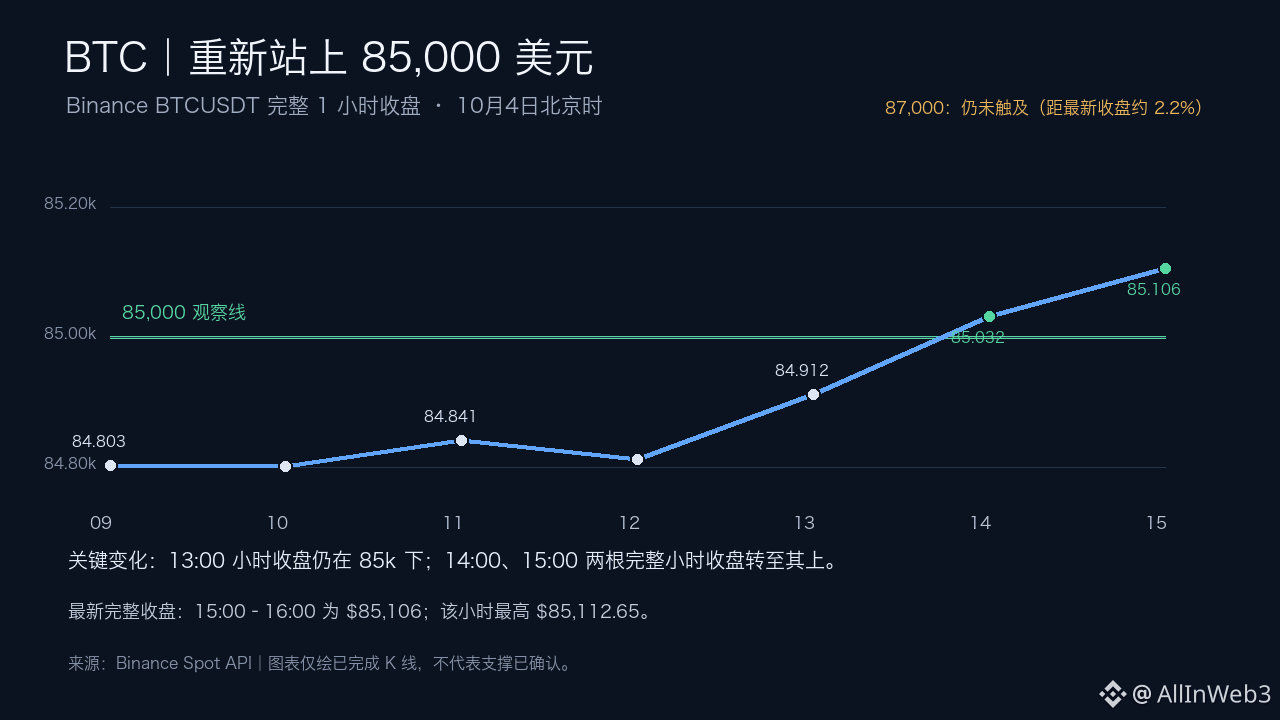
Binance Square в этой волне горячих тем по-прежнему на 3-м месте фокус на том, как BTC попытался пробить 87,000 долларов и откатился. Этот автор ранее фиксировал в посте 373339167223365 отступление после того, как отметка 85,000 долларов была пробита вниз. В этом обновлении — последующий ход: 1-часовые свечи спота Binance BTCUSDT показывают, что с 4 октября 14:00—15:00 закрытие составило 85,031.74 доллара, а 15:00—16:00 — 85,106 долларов; это два подряд полных часовых закрытия, которые вновь оказались выше 85,000. Данные на 16:00 включают только уже сформированные свечи и не учитывают час, который в данный момент еще формируется, как подтверждение.
Это дает две ограниченные новые информации. Во-первых, в краткосрочной перспективе движение “ниже 85k” сменилось на “цена закрытия вновь пересекла 85k”: по крайней мере, это означает, что прежний пробой вниз не закрепился и не продолжился до последних двух полных часовых закрытий. Однако это лишь откат наблюдаемой линии, а не доказательство того, что уровень уже подтвержден как поддержка; и по двум свечам нельзя выводить разворот тренда. Во-вторых, от уровня 87,000 долларов, который упоминался в этой волне горячих тем, все еще примерно 2.2% расстояния. По состоянию на 16:44 спотовый 24-часовой максимум — 85,195.84 доллара; цена пока не сделала повторный тест зоны прежнего локального максимума. Таким образом, данное обновление меняет представление о структуре после отката, но не отменяет более “старший” факт о том, что на 87k возникает сопротивление.
На графике показаны только завершенные часовые свечи с 4 октября с 09:00 до 16:00 включительно; горизонтальная привязка — это уровни закрытия, а не мгновенное пересечение в течение дня. Объем в интервале 14:00—15:00 и 15:00—16:00 составляет примерно 295.72 и 244.47 BTC соответственно; по одной лишь паре этих чисел нельзя судить о силе покупателей — нужно сравнить с окнами той же длины и понаблюдать за последующими закрытиями. Текущий 24-часовой максимум формировался в ходе скользящего (rolling) движения и не следует смешивать с предыдущей уже завершенной свечой.
Дальше можно проверить, сможет ли цена удержаться выше 85k при последующих полных часовых закрытиях, и будет ли объем поддерживать отскок; если вновь произойдет закрытие ниже 85k, то эту фиксацию отката придется пересмотреть. Текущие данные описывают только спот Binance BTCUSDT и не распространяются на позиции по бессрочным контрактам, общий приток/отток средств по всему рынку или какой-либо макро-катализатор — и это не торговый сигнал. #BTC
【BTC возвращает 85,000 долларов: изменился ли строй по сравнению с прошлой попыткой пробить 87,000?】
Binance Square в этой волне горячих тем по-прежнему на 3-м месте фокус на том, как BTC попытался пробить 87,000 долларов и откатился. Этот автор ранее фиксировал в посте 373339167223365 отступление после того, как отметка 85,000 долларов была пробита вниз. В этом обновлении — последующий ход: 1-часовые свечи спота Binance BTCUSDT показывают, что с 4 октября 14:00—15:00 закрытие составило 85,031.74 доллара, а 15:00—16:00 — 85,106 долларов; это два подряд полных часовых закрытия, которые вновь оказались выше 85,000. Данные на 16:00 включают только уже сформированные свечи и не учитывают час, который в данный момент еще формируется, как подтверждение.
Это дает две ограниченные новые информации. Во-первых, в краткосрочной перспективе движение “ниже 85k” сменилось на “цена закрытия вновь пересекла 85k”: по крайней мере, это означает, что прежний пробой вниз не закрепился и не продолжился до последних двух полных часовых закрытий. Однако это лишь откат наблюдаемой линии, а не доказательство того, что уровень уже подтвержден как поддержка; и по двум свечам нельзя выводить разворот тренда. Во-вторых, от уровня 87,000 долларов, который упоминался в этой волне горячих тем, все еще примерно 2.2% расстояния. По состоянию на 16:44 спотовый 24-часовой максимум — 85,195.84 доллара; цена пока не сделала повторный тест зоны прежнего локального максимума. Таким образом, данное обновление меняет представление о структуре после отката, но не отменяет более “старший” факт о том, что на 87k возникает сопротивление.
На графике показаны только завершенные часовые свечи с 4 октября с 09:00 до 16:00 включительно; горизонтальная привязка — это уровни закрытия, а не мгновенное пересечение в течение дня. Объем в интервале 14:00—15:00 и 15:00—16:00 составляет примерно 295.72 и 244.47 BTC соответственно; по одной лишь паре этих чисел нельзя судить о силе покупателей — нужно сравнить с окнами той же длины и понаблюдать за последующими закрытиями. Текущий 24-часовой максимум формировался в ходе скользящего (rolling) движения и не следует смешивать с предыдущей уже завершенной свечой.
Дальше можно проверить, сможет ли цена удержаться выше 85k при последующих полных часовых закрытиях, и будет ли объем поддерживать отскок; если вновь произойдет закрытие ниже 85k, то эту фиксацию отката придется пересмотреть. Текущие данные описывают только спот Binance BTCUSDT и не распространяются на позиции по бессрочным контрактам, общий приток/отток средств по всему рынку или какой-либо макро-катализатор — и это не торговый сигнал. #BTC
Binance Square в этой волне горячих тем по-прежнему на 3-м месте фокус на том, как BTC попытался пробить 87,000 долларов и откатился. Этот автор ранее фиксировал в посте 373339167223365 отступление после того, как отметка 85,000 долларов была пробита вниз. В этом обновлении — последующий ход: 1-часовые свечи спота Binance BTCUSDT показывают, что с 4 октября 14:00—15:00 закрытие составило 85,031.74 доллара, а 15:00—16:00 — 85,106 долларов; это два подряд полных часовых закрытия, которые вновь оказались выше 85,000. Данные на 16:00 включают только уже сформированные свечи и не учитывают час, который в данный момент еще формируется, как подтверждение.
Это дает две ограниченные новые информации. Во-первых, в краткосрочной перспективе движение “ниже 85k” сменилось на “цена закрытия вновь пересекла 85k”: по крайней мере, это означает, что прежний пробой вниз не закрепился и не продолжился до последних двух полных часовых закрытий. Однако это лишь откат наблюдаемой линии, а не доказательство того, что уровень уже подтвержден как поддержка; и по двум свечам нельзя выводить разворот тренда. Во-вторых, от уровня 87,000 долларов, который упоминался в этой волне горячих тем, все еще примерно 2.2% расстояния. По состоянию на 16:44 спотовый 24-часовой максимум — 85,195.84 доллара; цена пока не сделала повторный тест зоны прежнего локального максимума. Таким образом, данное обновление меняет представление о структуре после отката, но не отменяет более “старший” факт о том, что на 87k возникает сопротивление.
На графике показаны только завершенные часовые свечи с 4 октября с 09:00 до 16:00 включительно; горизонтальная привязка — это уровни закрытия, а не мгновенное пересечение в течение дня. Объем в интервале 14:00—15:00 и 15:00—16:00 составляет примерно 295.72 и 244.47 BTC соответственно; по одной лишь паре этих чисел нельзя судить о силе покупателей — нужно сравнить с окнами той же длины и понаблюдать за последующими закрытиями. Текущий 24-часовой максимум формировался в ходе скользящего (rolling) движения и не следует смешивать с предыдущей уже завершенной свечой.
Дальше можно проверить, сможет ли цена удержаться выше 85k при последующих полных часовых закрытиях, и будет ли объем поддерживать отскок; если вновь произойдет закрытие ниже 85k, то эту фиксацию отката придется пересмотреть. Текущие данные описывают только спот Binance BTCUSDT и не распространяются на позиции по бессрочным контрактам, общий приток/отток средств по всему рынку или какой-либо макро-катализатор — и это не торговый сигнал. #BTC
113
·
--
【Hot list says funding interruption causes SEC to pause crypto ETF reviews; official bill shows funds continue until December 11】
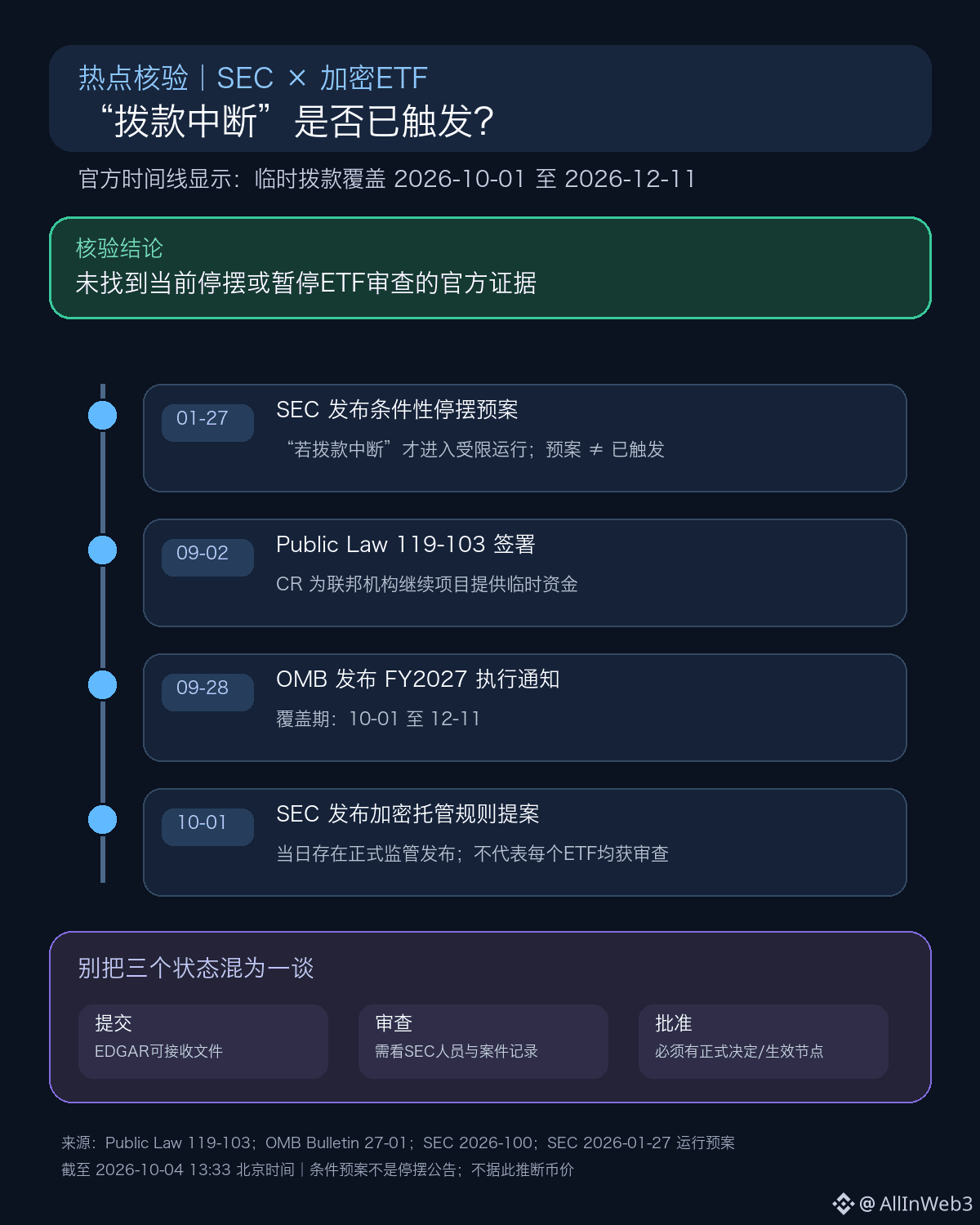
At 13:33 Beijing time, the topic on the Binance Square hot list ranks No. 1, with 58 people discussing. After checking U.S. official documents, the phrase “current funding interruption” in the headline is not supported: the “Continuing Appropriations and Extensions Act” signed on September 2 (Public Law 119-103) provides temporary appropriations for federal agencies to continue projects for fiscal year 2027, covering the period from October 1 to December 11; the White House signing statement and the OMB implementation notice dated September 28 both specify this time window.
The timeline is critical. On September 28, OMB issued guidance for the allocation of CR funds; on October 1, the SEC also released a proposal on crypto asset custody rules, indicating that the agency took formal regulatory action toward the public that same day. This cannot prove that every ETF is under review, nor can it support claims about the progress of specific filings. However, it is inconsistent with the assertion that “due to the October 1 funding interruption, the SEC as a whole shuts down.”
In a shutdown plan published by the SEC in January 2026, it says that when a “funding interruption” occurs, non-emergency applications may be paused. This plan is a conditional contingency arrangement, not an announcement that has already been triggered. It also cannot independently prove that a particular crypto ETF filing was paused. The current hot-list headline does not specify the applicant, the filing number, or any SEC notice for this case. The similar statements found via public search appear to come mostly from secondary reposts, and there is still a lack of verifiable primary case documents.
A more accurate status is: as of this round of verification, no official evidence has been found showing that a federal funding interruption led the SEC to pause its review of crypto ETFs; the current temporary funding act covers through December 11. The SEC can continue to receive EDGAR filings, but receiving filings does not mean the review or approval has been completed. Don’t mix “submitted,” “expired,” and “effective” into a single node, and you can’t infer a price direction from that. For the crypto market, procedural delays are a regulatory information risk, not an automatic bearish conclusion.
Next, you should look at three kinds of original records: whether Congress extended funding before December 11; whether the SEC operational status page posted any shutdown notice; and whether the SEC docket for a specific ETF shows any extensions or decisions. #SEC #CryptoETF
【Hot list says funding interruption causes SEC to pause crypto ETF reviews; official bill shows funds continue until December 11】
At 13:33 Beijing time, the topic on the Binance Square hot list ranks No. 1, with 58 people discussing. After checking U.S. official documents, the phrase “current funding interruption” in the headline is not supported: the “Continuing Appropriations and Extensions Act” signed on September 2 (Public Law 119-103) provides temporary appropriations for federal agencies to continue projects for fiscal year 2027, covering the period from October 1 to December 11; the White House signing statement and the OMB implementation notice dated September 28 both specify this time window.
The timeline is critical. On September 28, OMB issued guidance for the allocation of CR funds; on October 1, the SEC also released a proposal on crypto asset custody rules, indicating that the agency took formal regulatory action toward the public that same day. This cannot prove that every ETF is under review, nor can it support claims about the progress of specific filings. However, it is inconsistent with the assertion that “due to the October 1 funding interruption, the SEC as a whole shuts down.”
In a shutdown plan published by the SEC in January 2026, it says that when a “funding interruption” occurs, non-emergency applications may be paused. This plan is a conditional contingency arrangement, not an announcement that has already been triggered. It also cannot independently prove that a particular crypto ETF filing was paused. The current hot-list headline does not specify the applicant, the filing number, or any SEC notice for this case. The similar statements found via public search appear to come mostly from secondary reposts, and there is still a lack of verifiable primary case documents.
A more accurate status is: as of this round of verification, no official evidence has been found showing that a federal funding interruption led the SEC to pause its review of crypto ETFs; the current temporary funding act covers through December 11. The SEC can continue to receive EDGAR filings, but receiving filings does not mean the review or approval has been completed. Don’t mix “submitted,” “expired,” and “effective” into a single node, and you can’t infer a price direction from that. For the crypto market, procedural delays are a regulatory information risk, not an automatic bearish conclusion.
Next, you should look at three kinds of original records: whether Congress extended funding before December 11; whether the SEC operational status page posted any shutdown notice; and whether the SEC docket for a specific ETF shows any extensions or decisions. #SEC #CryptoETF
At 13:33 Beijing time, the topic on the Binance Square hot list ranks No. 1, with 58 people discussing. After checking U.S. official documents, the phrase “current funding interruption” in the headline is not supported: the “Continuing Appropriations and Extensions Act” signed on September 2 (Public Law 119-103) provides temporary appropriations for federal agencies to continue projects for fiscal year 2027, covering the period from October 1 to December 11; the White House signing statement and the OMB implementation notice dated September 28 both specify this time window.
The timeline is critical. On September 28, OMB issued guidance for the allocation of CR funds; on October 1, the SEC also released a proposal on crypto asset custody rules, indicating that the agency took formal regulatory action toward the public that same day. This cannot prove that every ETF is under review, nor can it support claims about the progress of specific filings. However, it is inconsistent with the assertion that “due to the October 1 funding interruption, the SEC as a whole shuts down.”
In a shutdown plan published by the SEC in January 2026, it says that when a “funding interruption” occurs, non-emergency applications may be paused. This plan is a conditional contingency arrangement, not an announcement that has already been triggered. It also cannot independently prove that a particular crypto ETF filing was paused. The current hot-list headline does not specify the applicant, the filing number, or any SEC notice for this case. The similar statements found via public search appear to come mostly from secondary reposts, and there is still a lack of verifiable primary case documents.
A more accurate status is: as of this round of verification, no official evidence has been found showing that a federal funding interruption led the SEC to pause its review of crypto ETFs; the current temporary funding act covers through December 11. The SEC can continue to receive EDGAR filings, but receiving filings does not mean the review or approval has been completed. Don’t mix “submitted,” “expired,” and “effective” into a single node, and you can’t infer a price direction from that. For the crypto market, procedural delays are a regulatory information risk, not an automatic bearish conclusion.
Next, you should look at three kinds of original records: whether Congress extended funding before December 11; whether the SEC operational status page posted any shutdown notice; and whether the SEC docket for a specific ETF shows any extensions or decisions. #SEC #CryptoETF
41
·
--
#MASK Market cap breaks 35 million USD: first confirm which coin, then look at the “market cap” metric
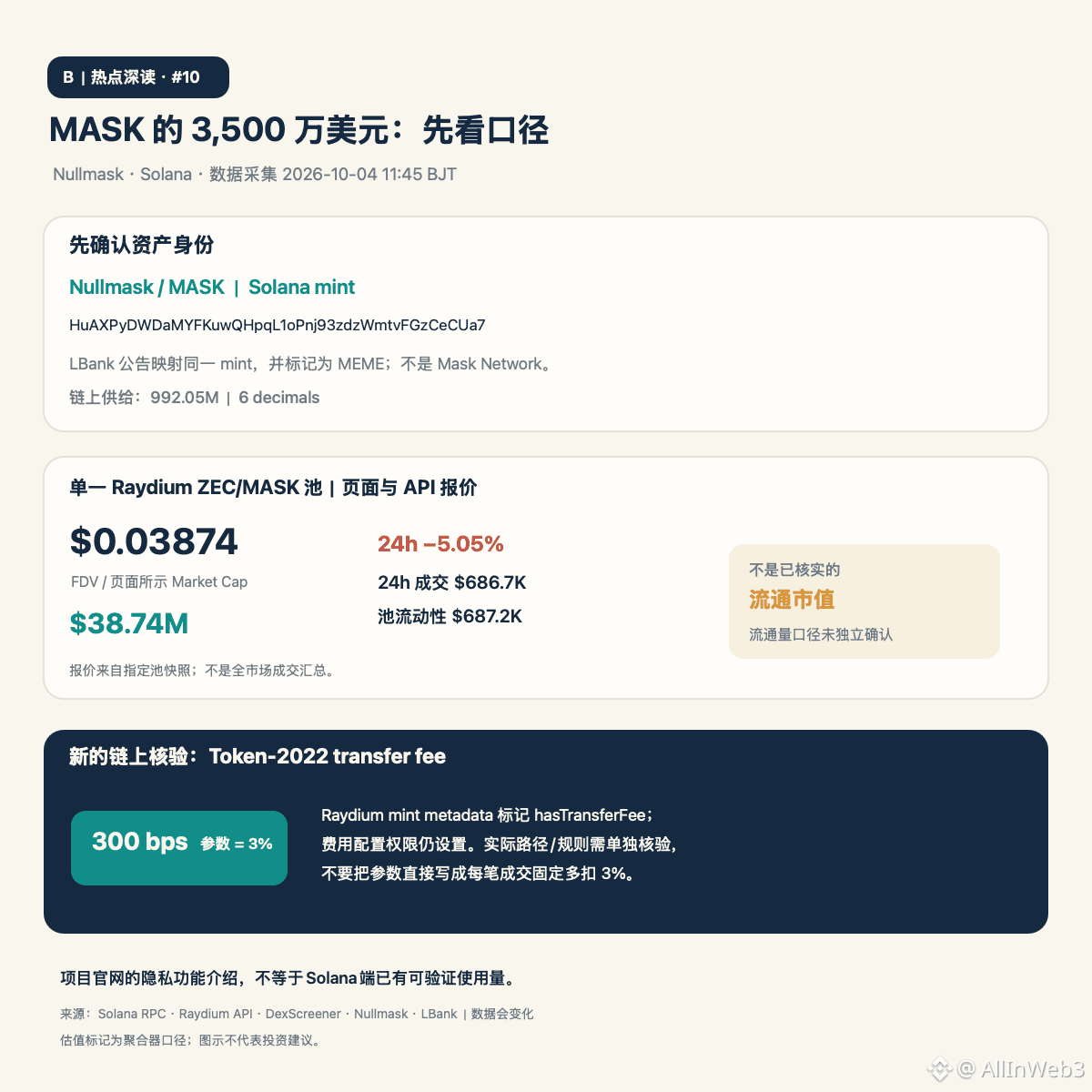
In this round’s Binance Square Hot List, the #10 entry is about “MASK’s record market cap exceeding 35 million USD.” Before anything else, you need to identify this ticker: it is not Mask Network—it’s Nullmask on Solana, with mint address HuAXPyDWDaMYFKuwQHpqL1oPnj93zdzWmtvFGzCeCUa7. The short address shown on Nullmask’s official website matches the full address in LBank’s listing announcement. LBank also labels the asset as MEME. At 11:45 BJT, the Solana mainnet RPC returns approximately 992.05 million tokens with 6 decimal precision. What’s being discussed here is this specific Solana token—you can’t mix in Mask Network’s行情.
Next, consider the boundary conditions of the Hot List number. At 11:45 BJT, DexScreener’s specified Raydium ZEC/MASK pool page/API shows a price of about $0.03874, down 5.05% over 24 hours. The pool liquidity is about $687,000 and 24-hour volume is about $687,000. The page lists both FDV and “Market Cap” as about $38.74 million. The Raydium pool API at the same timestamp also recognizes the same mint and trading pair. Since the public page provides no independent verification of circulating supply, “Market Cap = FDV” can only be understood as the metric displayed on that page; on-chain supply of ~992.05 million tokens is not the same as verified circulating supply. The “breakthrough of $35 million on October 2” is a historical milestone, and shouldn’t be used as a conclusion about the current price direction or circulating market cap.
Even more worth checking are on-chain transfer fee parameters. The Raydium interface marks MASK as a Token-2022 transfer-fee token, with a fee rate of 300 basis points (3%), and it also returns the fee-configuration authority address that is still set. It suggests that holders first verify the exact transfer/trading routes and fee rules; this is not a detail you can ignore, and you can’t simply say that every buy/sell automatically costs an extra 3%.
The project’s website promotes a zero-knowledge privacy feature, but its multi-network documentation writes Solana as an “extension direction.” This material by itself is insufficient to prove that this Solana token already has measurable usage of a verifiable privacy protocol. What can currently be confirmed is the asset identity, a quote for one main pool, and the fee configuration—not a complete metric of privacy adoption scale or a full “record market cap” definition. The above行情 will change; data was collected on 2026-10-04 at 11:45 BJT.
Source: Solana mainnet RPC; Raydium pool interface; DexScreener specified pool行情; Nullmask official website; LBank listing announcement.
#MASK Market cap breaks 35 million USD: first confirm which coin, then look at the “market cap” metric
In this round’s Binance Square Hot List, the #10 entry is about “MASK’s record market cap exceeding 35 million USD.” Before anything else, you need to identify this ticker: it is not Mask Network—it’s Nullmask on Solana, with mint address HuAXPyDWDaMYFKuwQHpqL1oPnj93zdzWmtvFGzCeCUa7. The short address shown on Nullmask’s official website matches the full address in LBank’s listing announcement. LBank also labels the asset as MEME. At 11:45 BJT, the Solana mainnet RPC returns approximately 992.05 million tokens with 6 decimal precision. What’s being discussed here is this specific Solana token—you can’t mix in Mask Network’s行情.
Next, consider the boundary conditions of the Hot List number. At 11:45 BJT, DexScreener’s specified Raydium ZEC/MASK pool page/API shows a price of about $0.03874, down 5.05% over 24 hours. The pool liquidity is about $687,000 and 24-hour volume is about $687,000. The page lists both FDV and “Market Cap” as about $38.74 million. The Raydium pool API at the same timestamp also recognizes the same mint and trading pair. Since the public page provides no independent verification of circulating supply, “Market Cap = FDV” can only be understood as the metric displayed on that page; on-chain supply of ~992.05 million tokens is not the same as verified circulating supply. The “breakthrough of $35 million on October 2” is a historical milestone, and shouldn’t be used as a conclusion about the current price direction or circulating market cap.
Even more worth checking are on-chain transfer fee parameters. The Raydium interface marks MASK as a Token-2022 transfer-fee token, with a fee rate of 300 basis points (3%), and it also returns the fee-configuration authority address that is still set. It suggests that holders first verify the exact transfer/trading routes and fee rules; this is not a detail you can ignore, and you can’t simply say that every buy/sell automatically costs an extra 3%.
The project’s website promotes a zero-knowledge privacy feature, but its multi-network documentation writes Solana as an “extension direction.” This material by itself is insufficient to prove that this Solana token already has measurable usage of a verifiable privacy protocol. What can currently be confirmed is the asset identity, a quote for one main pool, and the fee configuration—not a complete metric of privacy adoption scale or a full “record market cap” definition. The above行情 will change; data was collected on 2026-10-04 at 11:45 BJT.
Source: Solana mainnet RPC; Raydium pool interface; DexScreener specified pool行情; Nullmask official website; LBank listing announcement.
In this round’s Binance Square Hot List, the #10 entry is about “MASK’s record market cap exceeding 35 million USD.” Before anything else, you need to identify this ticker: it is not Mask Network—it’s Nullmask on Solana, with mint address HuAXPyDWDaMYFKuwQHpqL1oPnj93zdzWmtvFGzCeCUa7. The short address shown on Nullmask’s official website matches the full address in LBank’s listing announcement. LBank also labels the asset as MEME. At 11:45 BJT, the Solana mainnet RPC returns approximately 992.05 million tokens with 6 decimal precision. What’s being discussed here is this specific Solana token—you can’t mix in Mask Network’s行情.
Next, consider the boundary conditions of the Hot List number. At 11:45 BJT, DexScreener’s specified Raydium ZEC/MASK pool page/API shows a price of about $0.03874, down 5.05% over 24 hours. The pool liquidity is about $687,000 and 24-hour volume is about $687,000. The page lists both FDV and “Market Cap” as about $38.74 million. The Raydium pool API at the same timestamp also recognizes the same mint and trading pair. Since the public page provides no independent verification of circulating supply, “Market Cap = FDV” can only be understood as the metric displayed on that page; on-chain supply of ~992.05 million tokens is not the same as verified circulating supply. The “breakthrough of $35 million on October 2” is a historical milestone, and shouldn’t be used as a conclusion about the current price direction or circulating market cap.
Even more worth checking are on-chain transfer fee parameters. The Raydium interface marks MASK as a Token-2022 transfer-fee token, with a fee rate of 300 basis points (3%), and it also returns the fee-configuration authority address that is still set. It suggests that holders first verify the exact transfer/trading routes and fee rules; this is not a detail you can ignore, and you can’t simply say that every buy/sell automatically costs an extra 3%.
The project’s website promotes a zero-knowledge privacy feature, but its multi-network documentation writes Solana as an “extension direction.” This material by itself is insufficient to prove that this Solana token already has measurable usage of a verifiable privacy protocol. What can currently be confirmed is the asset identity, a quote for one main pool, and the fee configuration—not a complete metric of privacy adoption scale or a full “record market cap” definition. The above行情 will change; data was collected on 2026-10-04 at 11:45 BJT.
Source: Solana mainnet RPC; Raydium pool interface; DexScreener specified pool行情; Nullmask official website; LBank listing announcement.
163
·
--
【$AINUSDT: Regains the Hourly Mark; Still Watch in the Short Term】
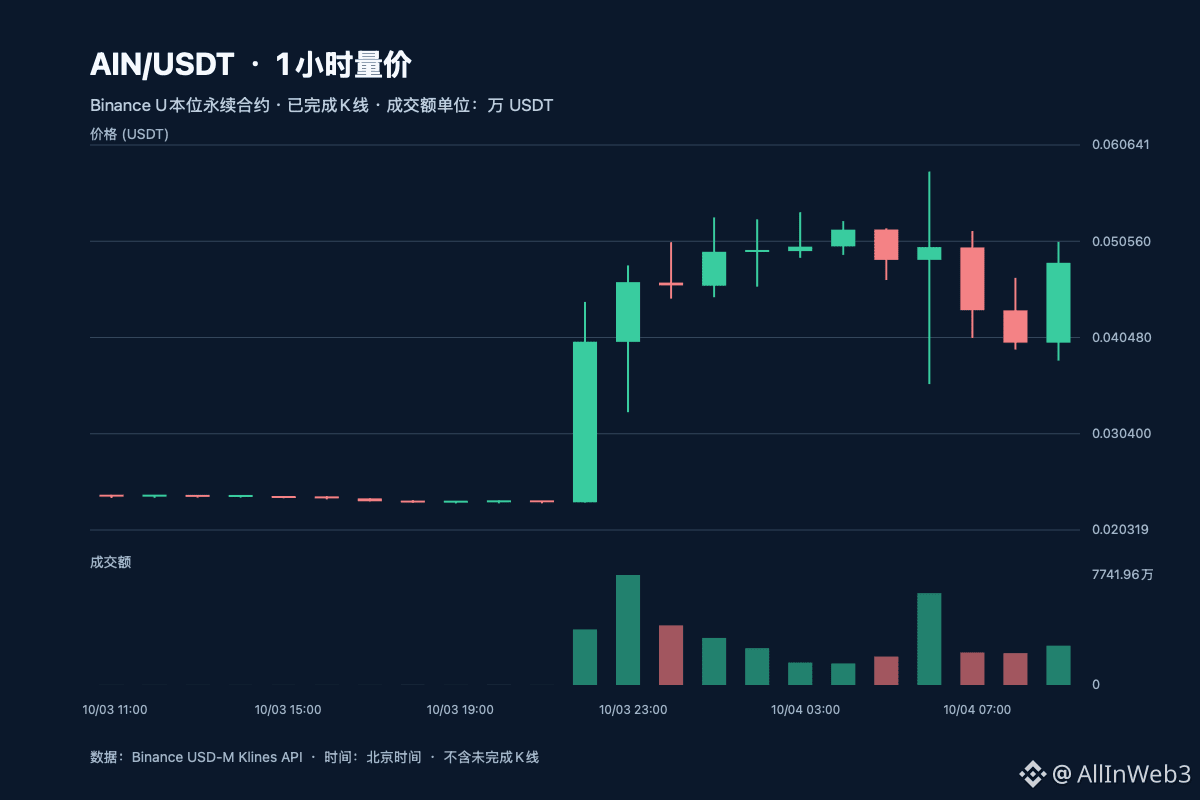
At 10:01 Beijing time, a complete scan covered 526/526 contracts. AINUSDT was #1 by gain, with a rolling 24-hour increase of 101.209%, scanning price at 0.04825. Before the 10:07 release, the rescan still ranked #1; the rolling gain rose to 109.034%, with a scanning price of 0.04998. The traded notional was about $410.3 million. This window change should not be treated as a 6-minute return, and the hourly candle after 10:00 has not yet finished.
The rolling gain recorded in the previous post at 09:18 was 75.362%, which is not the same return window as the new snapshot.
Compared with what was said in the 09:18 post (373496062801258): “the intraday rebound has not yet been confirmed as closed.” From 09:00 to 10:00, the full hour opened at 0.03994, hit a low of 0.03806, a high of 0.05050, and ultimately closed at 0.04830, with traded notional of about $27.72 million. The prior full hour’s traded notional was about $22.41 million, so this hour increased by roughly 23.7%. The close has already moved above the previously watched level at 0.04043, suggesting the rebound gained hourly confirmation; but the wick is still very long, so a single reclaimed close cannot prove a trend reversal.
Position sizing did not expand in tandem: Binance OI quantity samples were about 383.09 million AIN at 09:00 and about 383.12 million at 10:00—basically flat. Price rose while OI stayed flat at the same time, so this cannot be used to conclude new longs or net spot buying.
The most recently settled funding rate was +0.214868% for the 4-hour period ending at 08:00. The next period estimate seen at 10:03 was +0.168575%, corresponding to the 12:00 settlement, which has not finalized yet. The 4-hour candle from 08:00 to 12:00 is also not complete.
At present, no verified official catalyst has been identified that can explain this hourly-level rebound in AIN. Next, we’ll see whether the full hourly candle can hold around 0.04673 and wait for 4-hour close confirmation; if it falls back below 0.04043, the newly reclaimed structure will need to be re-evaluated. Here, we only confirm the hourly rebound; it does not mean a new trend phase. #AINUSDT
【$AINUSDT: Regains the Hourly Mark; Still Watch in the Short Term】
At 10:01 Beijing time, a complete scan covered 526/526 contracts. AINUSDT was #1 by gain, with a rolling 24-hour increase of 101.209%, scanning price at 0.04825. Before the 10:07 release, the rescan still ranked #1; the rolling gain rose to 109.034%, with a scanning price of 0.04998. The traded notional was about $410.3 million. This window change should not be treated as a 6-minute return, and the hourly candle after 10:00 has not yet finished.
The rolling gain recorded in the previous post at 09:18 was 75.362%, which is not the same return window as the new snapshot.
Compared with what was said in the 09:18 post (373496062801258): “the intraday rebound has not yet been confirmed as closed.” From 09:00 to 10:00, the full hour opened at 0.03994, hit a low of 0.03806, a high of 0.05050, and ultimately closed at 0.04830, with traded notional of about $27.72 million. The prior full hour’s traded notional was about $22.41 million, so this hour increased by roughly 23.7%. The close has already moved above the previously watched level at 0.04043, suggesting the rebound gained hourly confirmation; but the wick is still very long, so a single reclaimed close cannot prove a trend reversal.
Position sizing did not expand in tandem: Binance OI quantity samples were about 383.09 million AIN at 09:00 and about 383.12 million at 10:00—basically flat. Price rose while OI stayed flat at the same time, so this cannot be used to conclude new longs or net spot buying.
The most recently settled funding rate was +0.214868% for the 4-hour period ending at 08:00. The next period estimate seen at 10:03 was +0.168575%, corresponding to the 12:00 settlement, which has not finalized yet. The 4-hour candle from 08:00 to 12:00 is also not complete.
At present, no verified official catalyst has been identified that can explain this hourly-level rebound in AIN. Next, we’ll see whether the full hourly candle can hold around 0.04673 and wait for 4-hour close confirmation; if it falls back below 0.04043, the newly reclaimed structure will need to be re-evaluated. Here, we only confirm the hourly rebound; it does not mean a new trend phase. #AINUSDT
At 10:01 Beijing time, a complete scan covered 526/526 contracts. AINUSDT was #1 by gain, with a rolling 24-hour increase of 101.209%, scanning price at 0.04825. Before the 10:07 release, the rescan still ranked #1; the rolling gain rose to 109.034%, with a scanning price of 0.04998. The traded notional was about $410.3 million. This window change should not be treated as a 6-minute return, and the hourly candle after 10:00 has not yet finished.
The rolling gain recorded in the previous post at 09:18 was 75.362%, which is not the same return window as the new snapshot.
Compared with what was said in the 09:18 post (373496062801258): “the intraday rebound has not yet been confirmed as closed.” From 09:00 to 10:00, the full hour opened at 0.03994, hit a low of 0.03806, a high of 0.05050, and ultimately closed at 0.04830, with traded notional of about $27.72 million. The prior full hour’s traded notional was about $22.41 million, so this hour increased by roughly 23.7%. The close has already moved above the previously watched level at 0.04043, suggesting the rebound gained hourly confirmation; but the wick is still very long, so a single reclaimed close cannot prove a trend reversal.
Position sizing did not expand in tandem: Binance OI quantity samples were about 383.09 million AIN at 09:00 and about 383.12 million at 10:00—basically flat. Price rose while OI stayed flat at the same time, so this cannot be used to conclude new longs or net spot buying.
The most recently settled funding rate was +0.214868% for the 4-hour period ending at 08:00. The next period estimate seen at 10:03 was +0.168575%, corresponding to the 12:00 settlement, which has not finalized yet. The 4-hour candle from 08:00 to 12:00 is also not complete.
At present, no verified official catalyst has been identified that can explain this hourly-level rebound in AIN. Next, we’ll see whether the full hourly candle can hold around 0.04673 and wait for 4-hour close confirmation; if it falls back below 0.04043, the newly reclaimed structure will need to be re-evaluated. Here, we only confirm the hourly rebound; it does not mean a new trend phase. #AINUSDT
100
·
--
【$AIN spikes up then sharply drops: the retracement hasn’t been reclaimed; still observing and not chasing longs】
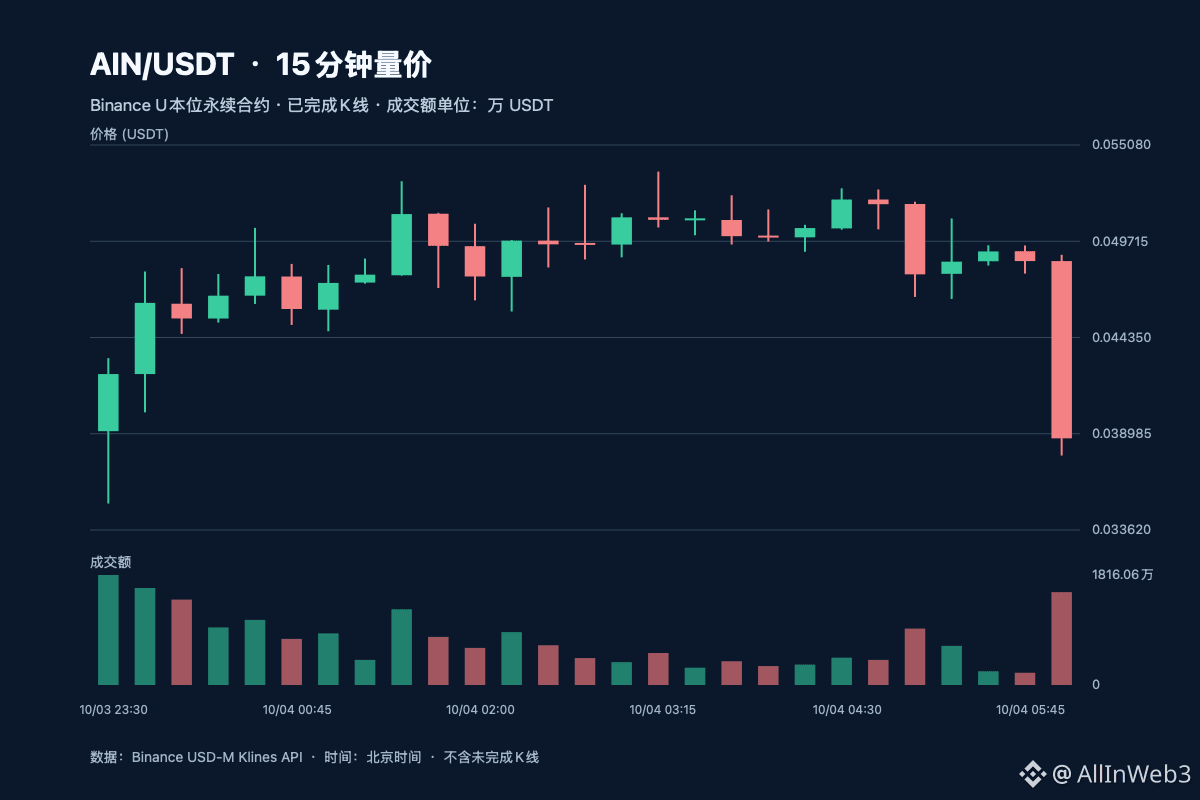
As of 2026-10-04 06:24 (Beijing time), a full scan covering 526/526 is complete. On AINUSDT, the 24-hour gain ranks #1: +74.863%. Scan price: 0.04160. The USDT-quoted成交額 is approximately $300.6 million. Compared with the scan price of 0.05028 used in my analysis posted at 04:12, the current price is about 17.3% lower. The rolling 24-hour gain is not the return achieved over just these two hours.
The incremental move is within a short-cycle structure: 04:00—05:00 closed at 0.05178, and 05:00—06:00 closed at 0.04861, a pullback of about 6.1%. The 06:00—07:00 hour is not finished yet. The Binance 15-minute chart shows that 06:00—06:15 closed at 0.03873; afterward, this incomplete 15-minute candle reached as high as 0.03560 at 06:19, then bounced back to 0.04158. At 06:24, the market-wide scan price is 0.04160. This retracement is large, but it cannot replace confirmation from a full-hour close. The chart only draws completed 15-minute candles.
Derivatives also need to be checked by time: OI historical samples show about 396.3 million AIN at 01:00 and about 403.8 million at 06:00; during that interval, it increased first. At 06:19, the real-time OI is about 384.2 million; after the sharp drop, it is again below that sample. OI does not distinguish long vs. short, and the sampling timestamps differ between interfaces—so it cannot be interpreted as net long positions. The already-settled funding rate at 04:00 is +0.330888% per 4 hours; the next-period estimate provided by the interface at 06:19 is +0.306030%. It’s expected that before the 08:00 settlement, it will still be around there. The last completed 4-hour成交额 is about $116.8 million, roughly equal to the prior block; the 04:00—08:00 block hasn’t finished yet.
In this round, I haven’t found any newly released official AIN announcement that could explain the spike up or the sudden drop. My view remains high-volatility observation: whether the subsequent full hour can reclaim 0.04861 has more informational value than the retracement of an unfinished hour. If price moves again near 0.03560, first check whether complete candles and OI/funding rates change in sync. These are conditions for verification—not an entry price, target price, or stop-loss instruction.
【$AIN spikes up then sharply drops: the retracement hasn’t been reclaimed; still observing and not chasing longs】
As of 2026-10-04 06:24 (Beijing time), a full scan covering 526/526 is complete. On AINUSDT, the 24-hour gain ranks #1: +74.863%. Scan price: 0.04160. The USDT-quoted成交額 is approximately $300.6 million. Compared with the scan price of 0.05028 used in my analysis posted at 04:12, the current price is about 17.3% lower. The rolling 24-hour gain is not the return achieved over just these two hours.
The incremental move is within a short-cycle structure: 04:00—05:00 closed at 0.05178, and 05:00—06:00 closed at 0.04861, a pullback of about 6.1%. The 06:00—07:00 hour is not finished yet. The Binance 15-minute chart shows that 06:00—06:15 closed at 0.03873; afterward, this incomplete 15-minute candle reached as high as 0.03560 at 06:19, then bounced back to 0.04158. At 06:24, the market-wide scan price is 0.04160. This retracement is large, but it cannot replace confirmation from a full-hour close. The chart only draws completed 15-minute candles.
Derivatives also need to be checked by time: OI historical samples show about 396.3 million AIN at 01:00 and about 403.8 million at 06:00; during that interval, it increased first. At 06:19, the real-time OI is about 384.2 million; after the sharp drop, it is again below that sample. OI does not distinguish long vs. short, and the sampling timestamps differ between interfaces—so it cannot be interpreted as net long positions. The already-settled funding rate at 04:00 is +0.330888% per 4 hours; the next-period estimate provided by the interface at 06:19 is +0.306030%. It’s expected that before the 08:00 settlement, it will still be around there. The last completed 4-hour成交额 is about $116.8 million, roughly equal to the prior block; the 04:00—08:00 block hasn’t finished yet.
In this round, I haven’t found any newly released official AIN announcement that could explain the spike up or the sudden drop. My view remains high-volatility observation: whether the subsequent full hour can reclaim 0.04861 has more informational value than the retracement of an unfinished hour. If price moves again near 0.03560, first check whether complete candles and OI/funding rates change in sync. These are conditions for verification—not an entry price, target price, or stop-loss instruction.
As of 2026-10-04 06:24 (Beijing time), a full scan covering 526/526 is complete. On AINUSDT, the 24-hour gain ranks #1: +74.863%. Scan price: 0.04160. The USDT-quoted成交額 is approximately $300.6 million. Compared with the scan price of 0.05028 used in my analysis posted at 04:12, the current price is about 17.3% lower. The rolling 24-hour gain is not the return achieved over just these two hours.
The incremental move is within a short-cycle structure: 04:00—05:00 closed at 0.05178, and 05:00—06:00 closed at 0.04861, a pullback of about 6.1%. The 06:00—07:00 hour is not finished yet. The Binance 15-minute chart shows that 06:00—06:15 closed at 0.03873; afterward, this incomplete 15-minute candle reached as high as 0.03560 at 06:19, then bounced back to 0.04158. At 06:24, the market-wide scan price is 0.04160. This retracement is large, but it cannot replace confirmation from a full-hour close. The chart only draws completed 15-minute candles.
Derivatives also need to be checked by time: OI historical samples show about 396.3 million AIN at 01:00 and about 403.8 million at 06:00; during that interval, it increased first. At 06:19, the real-time OI is about 384.2 million; after the sharp drop, it is again below that sample. OI does not distinguish long vs. short, and the sampling timestamps differ between interfaces—so it cannot be interpreted as net long positions. The already-settled funding rate at 04:00 is +0.330888% per 4 hours; the next-period estimate provided by the interface at 06:19 is +0.306030%. It’s expected that before the 08:00 settlement, it will still be around there. The last completed 4-hour成交额 is about $116.8 million, roughly equal to the prior block; the 04:00—08:00 block hasn’t finished yet.
In this round, I haven’t found any newly released official AIN announcement that could explain the spike up or the sudden drop. My view remains high-volatility observation: whether the subsequent full hour can reclaim 0.04861 has more informational value than the retracement of an unfinished hour. If price moves again near 0.03560, first check whether complete candles and OI/funding rates change in sync. These are conditions for verification—not an entry price, target price, or stop-loss instruction.
37
Log in to explore more content
Join global crypto users on Binance Square
⚡️ Get latest and useful information about crypto.
💬 Trusted by the world’s largest crypto exchange.
👍 Discover real insights from verified creators.
Email / Phone number
Trending Topics
BitcoinSpotETFsDraw$6.34BInflowsInQ3
186 views
13 Discussing
🚨 $6.34 BILLION JUST CHASED BITCOIN — BUT THE REAL STORY IS WHAT COMES NEXT
Bitcoin spot ETFs pulled in $6.34 billion during Q3.
That number deserves attention — but not because “institutions are buying Bitcoin” is new.
What matters is the change in money flow.
When billions move into spot ETFs within a single quarter, Bitcoin is no longer relying only on crypto-native traders. A deeper pool of capital is participating through regulated market infrastructure.
And that changes the game.
Think about it:
Bitcoin’s supply does not expand because demand increases.
There will still only ever be 21 million BTC.
So when large pools of capital compete for exposure to an asset with structurally limited supply, the important question becomes:
How much Bitcoin is actually available when everyone wants it at the same time?
That is where things can get interesting.
ETF inflows don’t guarantee the next candle will be green. Institutions can sell just as easily as they buy.
But $6.34B entering in one quarter is not background noise.
I’m watching the flows now more closely than the headlines.
Because sometimes the biggest move starts before retail realizes the money has already moved. 👀
Master CX Watch: Follow the money. Then watch the price.
$BTC #BitcoinSpotETFsDraw$6.34BInflowsInQ3
Master CX
·0 Likes
·22 views
EthereumValidatorExitQueueJumps392%
8,496 views
152 Discussing
IMFApprovesElSalvador$138MWithBitcoinWaiver
718 views
14 Discussing