

Abhiweb3crypro
12 Posts
Abhiweb3crypro
Report
Block User
2 Following
1 Followers
0 Liked
Posts
Article
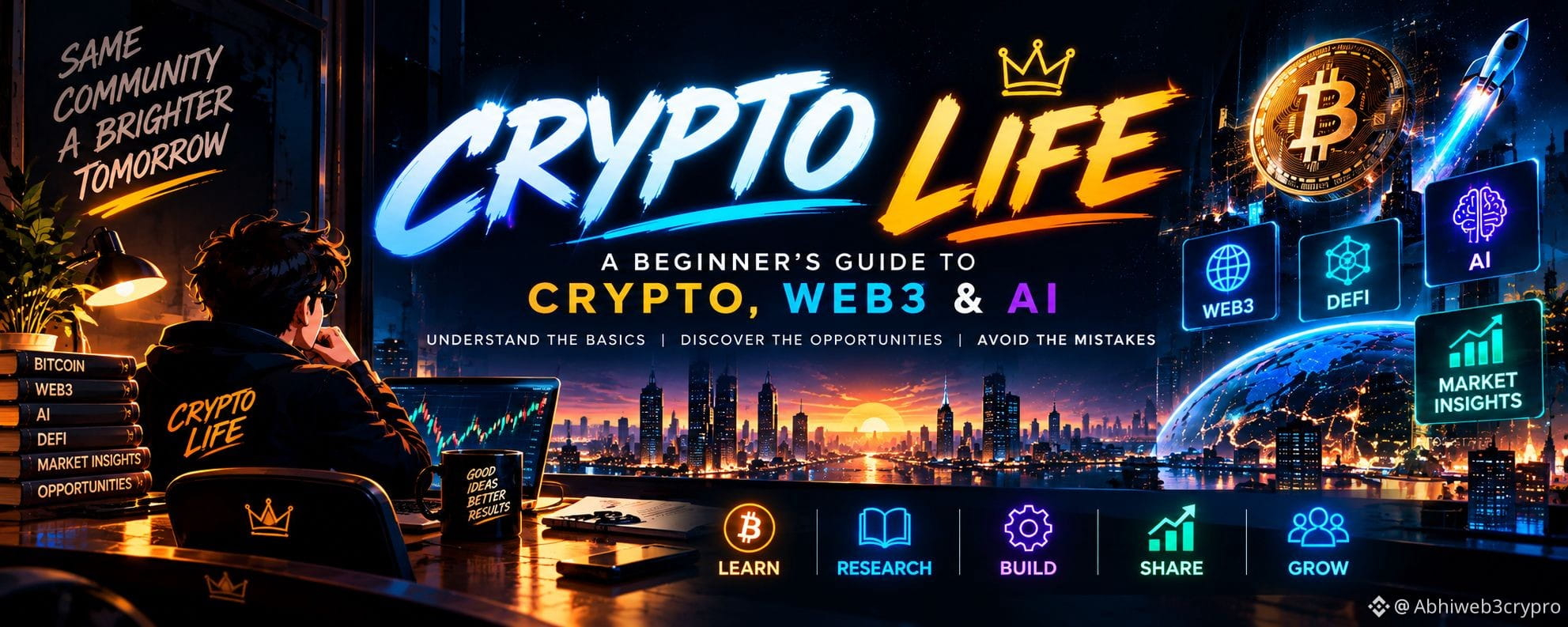
🌐 CRYPTO LIFEA Beginner’s Guide to Crypto, Web3 & AI
Understand the basics. Discover the opportunities. Avoid the mistakes.
LEARN • RESEARCH • BUILD • GROW
👋 Welcome to Crypto Life
Crypto can look complicated from the outside.
Bitcoin. Blockchain. DeFi. Web3. AI agents. Tokenomics. Wallets. Smart contracts.
Thousands of projects.
New narratives every week.
New technology moving faster than most people can follow.
So where do you start?
That's what this guide is about.
You don't need to know everything.
You need to understand the fundamentals, learn how to research, recognize the risks, and develop your own way of thinking.
🧠 Our philosophy
Learn → Research → Build → Share → Grow
Crypto is bigger than price charts.
It's about technology, digital ownership, open networks, financial infrastructure, communities, and the people building what comes next.
This isn't a guide telling you what to buy.
It's a starting point to help you understand the ecosystem and make better-informed decisions for yourself.
Stay curious.
Do your own research.
Never stop learning. 🚀
🟠 1. What Is Bitcoin?
Bitcoin is a digital asset that operates on a decentralized network.
Unlike traditional money, Bitcoin isn't controlled by a single bank or company. Transactions are recorded on a public blockchain and verified by participants across the network.
At its core, Bitcoin introduced a powerful idea:
Digital value can be transferred directly between people without requiring a central intermediary.
Why does Bitcoin matter?
Three concepts help explain it:
🔹 Scarcity
Bitcoin's protocol limits the total supply to 21 million coins.
🔹 Decentralization
The network is maintained by participants distributed across the world rather than one central authority.
🔹 Self-custody
Users can hold their own Bitcoin through wallets and control access to their assets through private keys.
But Bitcoin also comes with risks.
Its price can be highly volatile, transactions can be irreversible, and losing access to your private keys can mean losing access to your funds.
Understanding the technology comes before understanding the investment case.
⛓️ 2. What Is Blockchain?
Think of a blockchain as a shared digital ledger.
Instead of one company maintaining the database, transactions are recorded and verified across a network according to predefined rules.
A simplified process looks like this:
Transaction → Verification → Block → Network Consensus → Blockchain
Blockchains can be used for much more than cryptocurrency.
They can support:
Digital assets
Smart contracts
Decentralized applications
Stablecoins
DeFi
Tokenized assets
Digital identity
Gaming
AI infrastructure
The important idea is that blockchain technology allows multiple participants to coordinate around a shared state without relying entirely on a single database owner.
🌐 3. What Is Web3?
Web3 is a broad term for internet applications and systems that use blockchain technology to enable things such as digital ownership, decentralized coordination and user-controlled assets.
Web2 largely revolves around platforms.
Web3 experiments with giving users a greater role in the ownership and operation of digital networks.
You may encounter:
Wallets → Tokens → DAOs → DeFi → NFTs → dApps → Smart Contracts
Web3 is still evolving.
Some ideas will succeed. Others won't.
That's why learning how to evaluate projects is more important than simply following the latest narrative.
💰 4. How Do Crypto Tokens Work?
Not every token is the same.
A token can have different purposes depending on its design.
For example:
Utility — access to a product or service.
Governance — participation in protocol decisions.
Payments — transferring value.
Rewards — incentives within an ecosystem.
Stablecoins — tokens designed to maintain a relatively stable value against a reference asset.
Before looking at a token's price, understand its purpose and economics.
Ask:
What problem does it solve?
Why does the token need to exist?
Who uses it?
How is supply distributed?
Are more tokens entering circulation?
What creates demand?
That's where tokenomics becomes important.
🧠 5. AI + Crypto
One of the most interesting areas emerging around crypto is the intersection of AI and blockchain.
AI agents can potentially interact with digital assets, smart contracts and decentralized infrastructure.
Imagine software that can:
Understand → Decide → Execute → Verify
This creates interesting possibilities around autonomous agents, decentralized computing, data ownership and machine-to-machine payments.
But the technology is still developing.
The biggest opportunities may come from applications that solve real problems rather than simply attaching “AI” to an existing token.
📊 6. Understanding Crypto Markets
Crypto markets move quickly.
Prices can react to:
Liquidity
Market sentiment
Bitcoin movements
Macro conditions
Regulation
Technology developments
Token unlocks
Exchange activity
Narratives
On-chain activity
But one principle matters:
Price is not the same as value.
A token going up doesn't automatically mean the underlying project is becoming stronger.
Likewise, a falling price doesn't tell you everything about a project's fundamentals.
Learn to separate:
Price → Narrative → Fundamentals → Risk
🔍 7. How to DYOR
DYOR = Do Your Own Research.
Before putting money into a crypto project, investigate it yourself.
A simple framework:
TEAM
Who is building it?
PRODUCT
Does something actually exist?
TOKENOMICS
What's the supply, distribution and unlock schedule?
LIQUIDITY
Can the token actually be traded with reasonable liquidity?
COMMUNITY
Is there genuine usage or only promotional activity?
ON-CHAIN DATA
What does the blockchain activity show?
COMPETITION
What alternatives already exist?
RISKS
What could go wrong?
Never let a viral post replace research.
🛡️ 8. Crypto Security
The crypto ecosystem gives users more control—but that control comes with responsibility.
Protect:
🔐 Your seed phrase
🔐 Your private keys
🔐 Your wallet
🔐 Your exchange account
🔐 Your device
Be extremely cautious with:
Unknown links
Fake airdrops
Impersonation accounts
Suspicious DMs
Fake support accounts
Unlimited token approvals
Guaranteed-return promises
Remember:
If someone asks for your seed phrase, stop.
You don't need to give your seed phrase to receive legitimate support.
🚀 9. Crypto Isn't Only About Trading
One of the biggest misconceptions about crypto is that the only way to participate is by buying and selling tokens.
There are many other paths.
You can:
Learn → Build → Create → Contribute → Educate → Research
Developers build protocols.
Researchers analyze ecosystems.
Designers create products.
Writers explain complicated ideas.
Community members help projects grow.
Founders create businesses.
Creators educate millions of people.
The ecosystem needs more than traders.
🌎 10. Building a Crypto Community
Technology becomes powerful when people use it.
A strong community isn't simply a follower count.
It's people who:
Ask questions.
Share knowledge.
Challenge ideas.
Help each other.
Build together.
That's the kind of community we want to create here.
Not:
“Buy this.”
But:
“Let's understand this.”
Not:
“Trust me.”
But:
“Here's the information. Do your own research.”
🧭 The Crypto Life Framework
When you discover something new, don't immediately ask:
“How much can I make?”
Ask:
1️⃣ What is it?
Understand the technology.
2️⃣ Why does it matter?
Identify the problem being solved.
3️⃣ Who is using it?
Look for actual adoption.
4️⃣ How does it work?
Study the mechanics.
5️⃣ What are the risks?
Look for weaknesses.
6️⃣ What does the data say?
Separate facts from hype.
7️⃣ What's my own conclusion?
Think independently.
🚀 Final Thoughts
Crypto is still being built.
Some projects will disappear.
Some technologies will evolve.
Some narratives will prove wrong.
And new opportunities will continue to emerge.
You don't need to chase everything.
You don't need to understand everything today.
Start with the fundamentals.
Learn something.
Research something.
Build something.
Share something.
Then repeat.
Learn. Research. Build. Share. Grow.
Same community. A brighter tomorrow. 🌐🚀
👋 Welcome to Crypto Life.
Let's learn what's next—together.
https://x.com/Abhishe63260353/status/2104165815872573874
🌐 CRYPTO LIFE
A Beginner’s Guide to Crypto, Web3 & AI
Understand the basics. Discover the opportunities. Avoid the mistakes.
LEARN • RESEARCH • BUILD • GROW
👋 Welcome to Crypto Life
Crypto can look complicated from the outside.
Bitcoin. Blockchain. DeFi. Web3. AI agents. Tokenomics. Wallets. Smart contracts.
Thousands of projects.
New narratives every week.
New technology moving faster than most people can follow.
So where do you start?
That's what this guide is about.
You don't need to know everything.
You need to understand the fundamentals, learn how to research, recognize the risks, and develop your own way of thinking.
🧠 Our philosophy
Learn → Research → Build → Share → Grow
Crypto is bigger than price charts.
It's about technology, digital ownership, open networks, financial infrastructure, communities, and the people building what comes next.
This isn't a guide telling you what to buy.
It's a starting point to help you understand the ecosystem and make better-informed decisions for yourself.
Stay curious.
Do your own research.
Never stop learning. 🚀
🟠 1. What Is Bitcoin?
Bitcoin is a digital asset that operates on a decentralized network.
Unlike traditional money, Bitcoin isn't controlled by a single bank or company. Transactions are recorded on a public blockchain and verified by participants across the network.
At its core, Bitcoin introduced a powerful idea:
Digital value can be transferred directly between people without requiring a central intermediary.
Why does Bitcoin matter?
Three concepts help explain it:
🔹 Scarcity
Bitcoin's protocol limits the total supply to 21 million coins.
🔹 Decentralization
The network is maintained by participants distributed across the world rather than one central authority.
🔹 Self-custody
Users can hold their own Bitcoin through wallets and control access to their assets through private keys.
But Bitcoin also comes with risks.
Its price can be highly volatile, transactions can be irreversible, and losing access to your private keys can mean losing access to your funds.
Understanding the technology comes before understanding the investment case.
⛓️ 2. What Is Blockchain?
Think of a blockchain as a shared digital ledger.
Instead of one company maintaining the database, transactions are recorded and verified across a network according to predefined rules.
A simplified process looks like this:
Transaction → Verification → Block → Network Consensus → Blockchain
Blockchains can be used for much more than cryptocurrency.
They can support:
Digital assets
Smart contracts
Decentralized applications
Stablecoins
DeFi
Tokenized assets
Digital identity
Gaming
AI infrastructure
The important idea is that blockchain technology allows multiple participants to coordinate around a shared state without relying entirely on a single database owner.
🌐 3. What Is Web3?
Web3 is a broad term for internet applications and systems that use blockchain technology to enable things such as digital ownership, decentralized coordination and user-controlled assets.
Web2 largely revolves around platforms.
Web3 experiments with giving users a greater role in the ownership and operation of digital networks.
You may encounter:
Wallets → Tokens → DAOs → DeFi → NFTs → dApps → Smart Contracts
Web3 is still evolving.
Some ideas will succeed. Others won't.
That's why learning how to evaluate projects is more important than simply following the latest narrative.
💰 4. How Do Crypto Tokens Work?
Not every token is the same.
A token can have different purposes depending on its design.
For example:
Utility — access to a product or service.
Governance — participation in protocol decisions.
Payments — transferring value.
Rewards — incentives within an ecosystem.
Stablecoins — tokens designed to maintain a relatively stable value against a reference asset.
Before looking at a token's price, understand its purpose and economics.
Ask:
What problem does it solve?
Why does the token need to exist?
Who uses it?
How is supply distributed?
Are more tokens entering circulation?
What creates demand?
That's where tokenomics becomes important.
🧠 5. AI + Crypto
One of the most interesting areas emerging around crypto is the intersection of AI and blockchain.
AI agents can potentially interact with digital assets, smart contracts and decentralized infrastructure.
Imagine software that can:
Understand → Decide → Execute → Verify
This creates interesting possibilities around autonomous agents, decentralized computing, data ownership and machine-to-machine payments.
But the technology is still developing.
The biggest opportunities may come from applications that solve real problems rather than simply attaching “AI” to an existing token.
📊 6. Understanding Crypto Markets
Crypto markets move quickly.
Prices can react to:
Liquidity
Market sentiment
Bitcoin movements
Macro conditions
Regulation
Technology developments
Token unlocks
Exchange activity
Narratives
On-chain activity
But one principle matters:
Price is not the same as value.
A token going up doesn't automatically mean the underlying project is becoming stronger.
Likewise, a falling price doesn't tell you everything about a project's fundamentals.
Learn to separate:
Price → Narrative → Fundamentals → Risk
🔍 7. How to DYOR
DYOR = Do Your Own Research.
Before putting money into a crypto project, investigate it yourself.
A simple framework:
TEAM
Who is building it?
PRODUCT
Does something actually exist?
TOKENOMICS
What's the supply, distribution and unlock schedule?
LIQUIDITY
Can the token actually be traded with reasonable liquidity?
COMMUNITY
Is there genuine usage or only promotional activity?
ON-CHAIN DATA
What does the blockchain activity show?
COMPETITION
What alternatives already exist?
RISKS
What could go wrong?
Never let a viral post replace research.
🛡️ 8. Crypto Security
The crypto ecosystem gives users more control—but that control comes with responsibility.
Protect:
🔐 Your seed phrase
🔐 Your private keys
🔐 Your wallet
🔐 Your exchange account
🔐 Your device
Be extremely cautious with:
Unknown links
Fake airdrops
Impersonation accounts
Suspicious DMs
Fake support accounts
Unlimited token approvals
Guaranteed-return promises
Remember:
If someone asks for your seed phrase, stop.
You don't need to give your seed phrase to receive legitimate support.
🚀 9. Crypto Isn't Only About Trading
One of the biggest misconceptions about crypto is that the only way to participate is by buying and selling tokens.
There are many other paths.
You can:
Learn → Build → Create → Contribute → Educate → Research
Developers build protocols.
Researchers analyze ecosystems.
Designers create products.
Writers explain complicated ideas.
Community members help projects grow.
Founders create businesses.
Creators educate millions of people.
The ecosystem needs more than traders.
🌎 10. Building a Crypto Community
Technology becomes powerful when people use it.
A strong community isn't simply a follower count.
It's people who:
Ask questions.
Share knowledge.
Challenge ideas.
Help each other.
Build together.
That's the kind of community we want to create here.
Not:
“Buy this.”
But:
“Let's understand this.”
Not:
“Trust me.”
But:
“Here's the information. Do your own research.”
🧭 The Crypto Life Framework
When you discover something new, don't immediately ask:
“How much can I make?”
Ask:
1️⃣ What is it?
Understand the technology.
2️⃣ Why does it matter?
Identify the problem being solved.
3️⃣ Who is using it?
Look for actual adoption.
4️⃣ How does it work?
Study the mechanics.
5️⃣ What are the risks?
Look for weaknesses.
6️⃣ What does the data say?
Separate facts from hype.
7️⃣ What's my own conclusion?
Think independently.
🚀 Final Thoughts
Crypto is still being built.
Some projects will disappear.
Some technologies will evolve.
Some narratives will prove wrong.
And new opportunities will continue to emerge.
You don't need to chase everything.
You don't need to understand everything today.
Start with the fundamentals.
Learn something.
Research something.
Build something.
Share something.
Then repeat.
Learn. Research. Build. Share. Grow.
Same community. A brighter tomorrow. 🌐🚀
👋 Welcome to Crypto Life.
Let's learn what's next—together.
https://x.com/Abhishe63260353/status/2104165815872573874
Understand the basics. Discover the opportunities. Avoid the mistakes.
LEARN • RESEARCH • BUILD • GROW
👋 Welcome to Crypto Life
Crypto can look complicated from the outside.
Bitcoin. Blockchain. DeFi. Web3. AI agents. Tokenomics. Wallets. Smart contracts.
Thousands of projects.
New narratives every week.
New technology moving faster than most people can follow.
So where do you start?
That's what this guide is about.
You don't need to know everything.
You need to understand the fundamentals, learn how to research, recognize the risks, and develop your own way of thinking.
🧠 Our philosophy
Learn → Research → Build → Share → Grow
Crypto is bigger than price charts.
It's about technology, digital ownership, open networks, financial infrastructure, communities, and the people building what comes next.
This isn't a guide telling you what to buy.
It's a starting point to help you understand the ecosystem and make better-informed decisions for yourself.
Stay curious.
Do your own research.
Never stop learning. 🚀
🟠 1. What Is Bitcoin?
Bitcoin is a digital asset that operates on a decentralized network.
Unlike traditional money, Bitcoin isn't controlled by a single bank or company. Transactions are recorded on a public blockchain and verified by participants across the network.
At its core, Bitcoin introduced a powerful idea:
Digital value can be transferred directly between people without requiring a central intermediary.
Why does Bitcoin matter?
Three concepts help explain it:
🔹 Scarcity
Bitcoin's protocol limits the total supply to 21 million coins.
🔹 Decentralization
The network is maintained by participants distributed across the world rather than one central authority.
🔹 Self-custody
Users can hold their own Bitcoin through wallets and control access to their assets through private keys.
But Bitcoin also comes with risks.
Its price can be highly volatile, transactions can be irreversible, and losing access to your private keys can mean losing access to your funds.
Understanding the technology comes before understanding the investment case.
⛓️ 2. What Is Blockchain?
Think of a blockchain as a shared digital ledger.
Instead of one company maintaining the database, transactions are recorded and verified across a network according to predefined rules.
A simplified process looks like this:
Transaction → Verification → Block → Network Consensus → Blockchain
Blockchains can be used for much more than cryptocurrency.
They can support:
Digital assets
Smart contracts
Decentralized applications
Stablecoins
DeFi
Tokenized assets
Digital identity
Gaming
AI infrastructure
The important idea is that blockchain technology allows multiple participants to coordinate around a shared state without relying entirely on a single database owner.
🌐 3. What Is Web3?
Web3 is a broad term for internet applications and systems that use blockchain technology to enable things such as digital ownership, decentralized coordination and user-controlled assets.
Web2 largely revolves around platforms.
Web3 experiments with giving users a greater role in the ownership and operation of digital networks.
You may encounter:
Wallets → Tokens → DAOs → DeFi → NFTs → dApps → Smart Contracts
Web3 is still evolving.
Some ideas will succeed. Others won't.
That's why learning how to evaluate projects is more important than simply following the latest narrative.
💰 4. How Do Crypto Tokens Work?
Not every token is the same.
A token can have different purposes depending on its design.
For example:
Utility — access to a product or service.
Governance — participation in protocol decisions.
Payments — transferring value.
Rewards — incentives within an ecosystem.
Stablecoins — tokens designed to maintain a relatively stable value against a reference asset.
Before looking at a token's price, understand its purpose and economics.
Ask:
What problem does it solve?
Why does the token need to exist?
Who uses it?
How is supply distributed?
Are more tokens entering circulation?
What creates demand?
That's where tokenomics becomes important.
🧠 5. AI + Crypto
One of the most interesting areas emerging around crypto is the intersection of AI and blockchain.
AI agents can potentially interact with digital assets, smart contracts and decentralized infrastructure.
Imagine software that can:
Understand → Decide → Execute → Verify
This creates interesting possibilities around autonomous agents, decentralized computing, data ownership and machine-to-machine payments.
But the technology is still developing.
The biggest opportunities may come from applications that solve real problems rather than simply attaching “AI” to an existing token.
📊 6. Understanding Crypto Markets
Crypto markets move quickly.
Prices can react to:
Liquidity
Market sentiment
Bitcoin movements
Macro conditions
Regulation
Technology developments
Token unlocks
Exchange activity
Narratives
On-chain activity
But one principle matters:
Price is not the same as value.
A token going up doesn't automatically mean the underlying project is becoming stronger.
Likewise, a falling price doesn't tell you everything about a project's fundamentals.
Learn to separate:
Price → Narrative → Fundamentals → Risk
🔍 7. How to DYOR
DYOR = Do Your Own Research.
Before putting money into a crypto project, investigate it yourself.
A simple framework:
TEAM
Who is building it?
PRODUCT
Does something actually exist?
TOKENOMICS
What's the supply, distribution and unlock schedule?
LIQUIDITY
Can the token actually be traded with reasonable liquidity?
COMMUNITY
Is there genuine usage or only promotional activity?
ON-CHAIN DATA
What does the blockchain activity show?
COMPETITION
What alternatives already exist?
RISKS
What could go wrong?
Never let a viral post replace research.
🛡️ 8. Crypto Security
The crypto ecosystem gives users more control—but that control comes with responsibility.
Protect:
🔐 Your seed phrase
🔐 Your private keys
🔐 Your wallet
🔐 Your exchange account
🔐 Your device
Be extremely cautious with:
Unknown links
Fake airdrops
Impersonation accounts
Suspicious DMs
Fake support accounts
Unlimited token approvals
Guaranteed-return promises
Remember:
If someone asks for your seed phrase, stop.
You don't need to give your seed phrase to receive legitimate support.
🚀 9. Crypto Isn't Only About Trading
One of the biggest misconceptions about crypto is that the only way to participate is by buying and selling tokens.
There are many other paths.
You can:
Learn → Build → Create → Contribute → Educate → Research
Developers build protocols.
Researchers analyze ecosystems.
Designers create products.
Writers explain complicated ideas.
Community members help projects grow.
Founders create businesses.
Creators educate millions of people.
The ecosystem needs more than traders.
🌎 10. Building a Crypto Community
Technology becomes powerful when people use it.
A strong community isn't simply a follower count.
It's people who:
Ask questions.
Share knowledge.
Challenge ideas.
Help each other.
Build together.
That's the kind of community we want to create here.
Not:
“Buy this.”
But:
“Let's understand this.”
Not:
“Trust me.”
But:
“Here's the information. Do your own research.”
🧭 The Crypto Life Framework
When you discover something new, don't immediately ask:
“How much can I make?”
Ask:
1️⃣ What is it?
Understand the technology.
2️⃣ Why does it matter?
Identify the problem being solved.
3️⃣ Who is using it?
Look for actual adoption.
4️⃣ How does it work?
Study the mechanics.
5️⃣ What are the risks?
Look for weaknesses.
6️⃣ What does the data say?
Separate facts from hype.
7️⃣ What's my own conclusion?
Think independently.
🚀 Final Thoughts
Crypto is still being built.
Some projects will disappear.
Some technologies will evolve.
Some narratives will prove wrong.
And new opportunities will continue to emerge.
You don't need to chase everything.
You don't need to understand everything today.
Start with the fundamentals.
Learn something.
Research something.
Build something.
Share something.
Then repeat.
Learn. Research. Build. Share. Grow.
Same community. A brighter tomorrow. 🌐🚀
👋 Welcome to Crypto Life.
Let's learn what's next—together.
https://x.com/Abhishe63260353/status/2104165815872573874
1
55
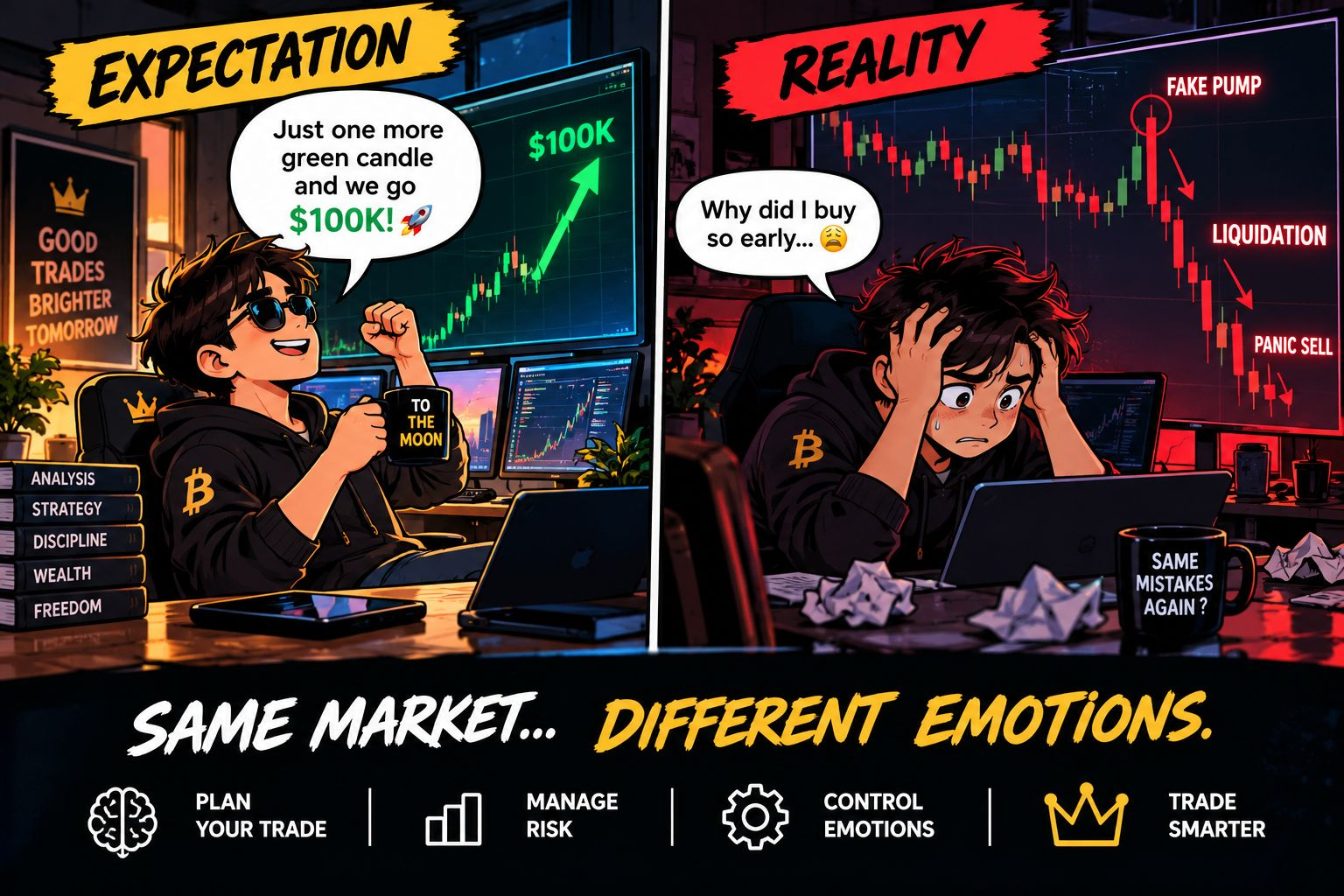
😂 Crypto expectations vs reality.
One green candle: “$100K is coming! 🚀”
One red candle: “Why did I buy so early? 😭”
The market doesn't care about our emotions.
Have a plan.
Manage risk.
Control emotions.
Trade smarter. 🧠📊
Same market. Different emotions.
#Bitcoin #Crypto #BTC #web3兼职
😂 Crypto expectations vs reality.
One green candle: “$100K is coming! 🚀”
One red candle: “Why did I buy so early? 😭”
The market doesn't care about our emotions.
Have a plan.
Manage risk.
Control emotions.
Trade smarter. 🧠📊
Same market. Different emotions.
#Bitcoin #Crypto #BTC #web3兼职
One green candle: “$100K is coming! 🚀”
One red candle: “Why did I buy so early? 😭”
The market doesn't care about our emotions.
Have a plan.
Manage risk.
Control emotions.
Trade smarter. 🧠📊
Same market. Different emotions.
#Bitcoin #Crypto #BTC #web3兼职
75
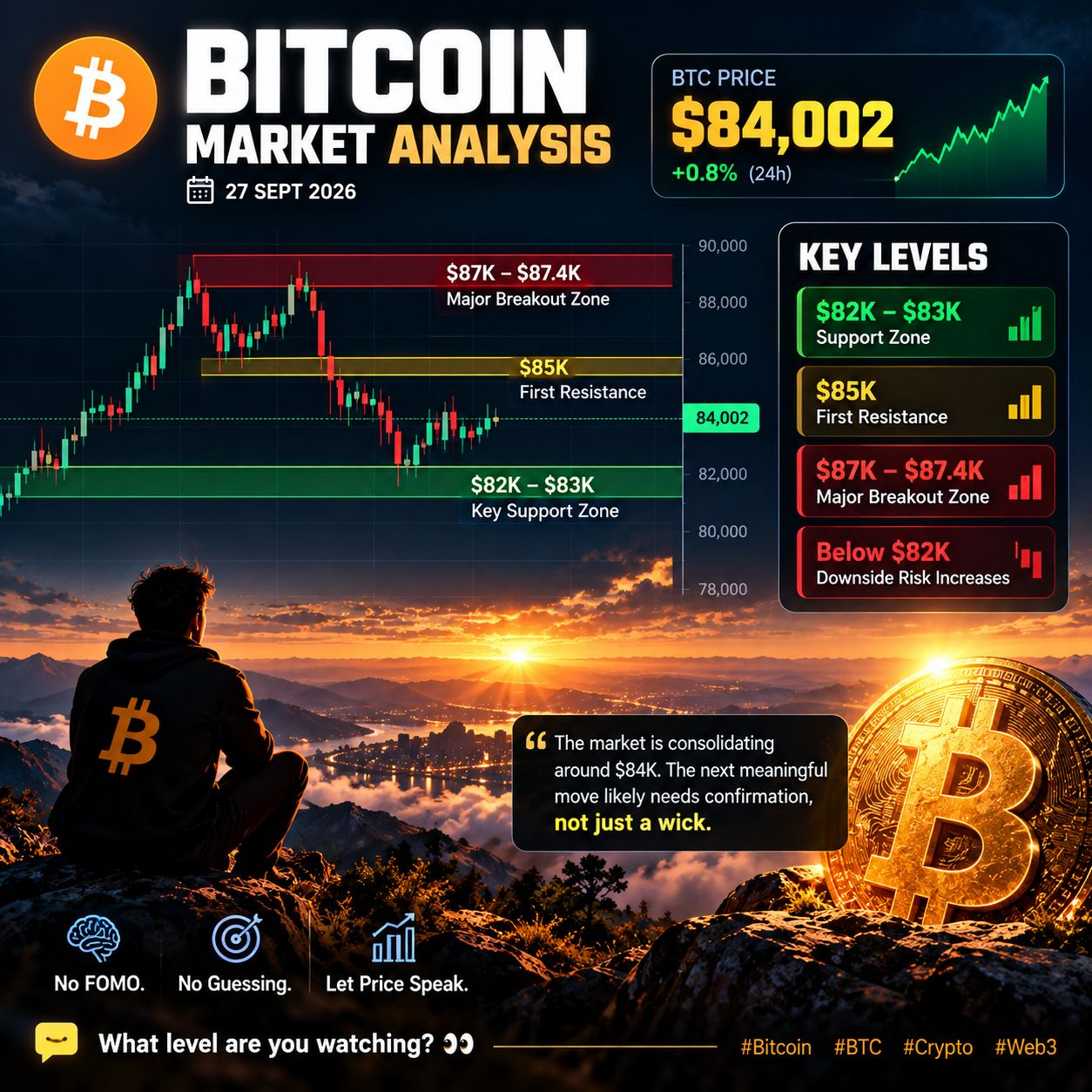
🚨 BTC MARKET ANALYSIS — SEPT 27
$BTC is currently around $84K, consolidating after the sharp move toward $87.3K earlier this week. �
Investing.com +1
Key levels 👇
🟢 $82K–$83K → key support zone
🟡 $85K → first resistance
🔴 $87K–$87.4K → major breakout zone
⚠️ Below $82K → downside risk increases
The market is tightening around $84K. The next meaningful move likely needs confirmation, not just a wick.
No FOMO. No guessing.
Let price speak. 🧠📊
What level are you watching? 👀
#Bitcoin #BTC #Crypto #Web3
🚨 BTC MARKET ANALYSIS — SEPT 27
$BTC is currently around $84K, consolidating after the sharp move toward $87.3K earlier this week. �
Investing.com +1
Key levels 👇
🟢 $82K–$83K → key support zone
🟡 $85K → first resistance
🔴 $87K–$87.4K → major breakout zone
⚠️ Below $82K → downside risk increases
The market is tightening around $84K. The next meaningful move likely needs confirmation, not just a wick.
No FOMO. No guessing.
Let price speak. 🧠📊
What level are you watching? 👀
#Bitcoin #BTC #Crypto #Web3
$BTC is currently around $84K, consolidating after the sharp move toward $87.3K earlier this week. �
Investing.com +1
Key levels 👇
🟢 $82K–$83K → key support zone
🟡 $85K → first resistance
🔴 $87K–$87.4K → major breakout zone
⚠️ Below $82K → downside risk increases
The market is tightening around $84K. The next meaningful move likely needs confirmation, not just a wick.
No FOMO. No guessing.
Let price speak. 🧠📊
What level are you watching? 👀
#Bitcoin #BTC #Crypto #Web3
60
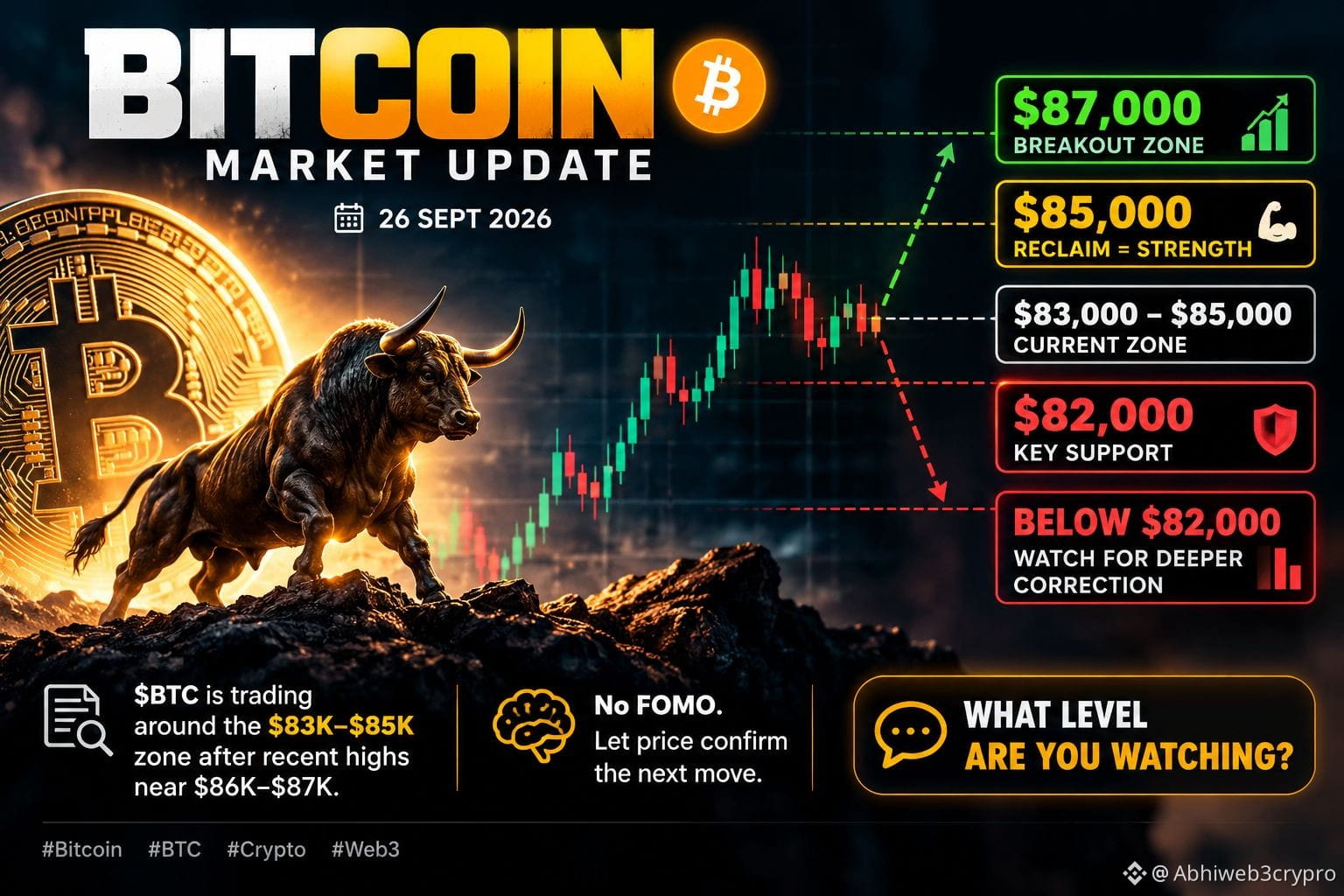
🚨 BTC MARKET UPDATE — SEPT 26
$BTC is still trading around the $83K–$85K zone after recently reaching the $86K–$87K area.
Key levels to watch 👇
🟢 $87K → breakout zone
🟡 $85K → reclaim = strength
🔴 $82K → key support
⚠️ Below $82K → watch for deeper correction
No FOMO.
Let price confirm the next move. 🧠📊
What level are you watching? 👀
#Bitcoin #BTC #Crypto #Web3
🚨 BTC MARKET UPDATE — SEPT 26
$BTC is still trading around the $83K–$85K zone after recently reaching the $86K–$87K area.
Key levels to watch 👇
🟢 $87K → breakout zone
🟡 $85K → reclaim = strength
🔴 $82K → key support
⚠️ Below $82K → watch for deeper correction
No FOMO.
Let price confirm the next move. 🧠📊
What level are you watching? 👀
#Bitcoin #BTC #Crypto #Web3
$BTC is still trading around the $83K–$85K zone after recently reaching the $86K–$87K area.
Key levels to watch 👇
🟢 $87K → breakout zone
🟡 $85K → reclaim = strength
🔴 $82K → key support
⚠️ Below $82K → watch for deeper correction
No FOMO.
Let price confirm the next move. 🧠📊
What level are you watching? 👀
#Bitcoin #BTC #Crypto #Web3
69
Good morning, CT ☀️
New day. New energy. New opportunities. 🚀
Don’t worry about yesterday’s chart. Don’t chase every pump. Just keep learning, building, and showing up.
Small steps every day. Big results over time. 💪
Stay focused. Stay positive.
Let’s make today count. 🫡🔥
#Crypto #Web3 #GoodMorning
Good morning, CT ☀️
New day. New energy. New opportunities. 🚀
Don’t worry about yesterday’s chart. Don’t chase every pump. Just keep learning, building, and showing up.
Small steps every day. Big results over time. 💪
Stay focused. Stay positive.
Let’s make today count. 🫡🔥
#Crypto #Web3 #GoodMorning
New day. New energy. New opportunities. 🚀
Don’t worry about yesterday’s chart. Don’t chase every pump. Just keep learning, building, and showing up.
Small steps every day. Big results over time. 💪
Stay focused. Stay positive.
Let’s make today count. 🫡🔥
#Crypto #Web3 #GoodMorning
56
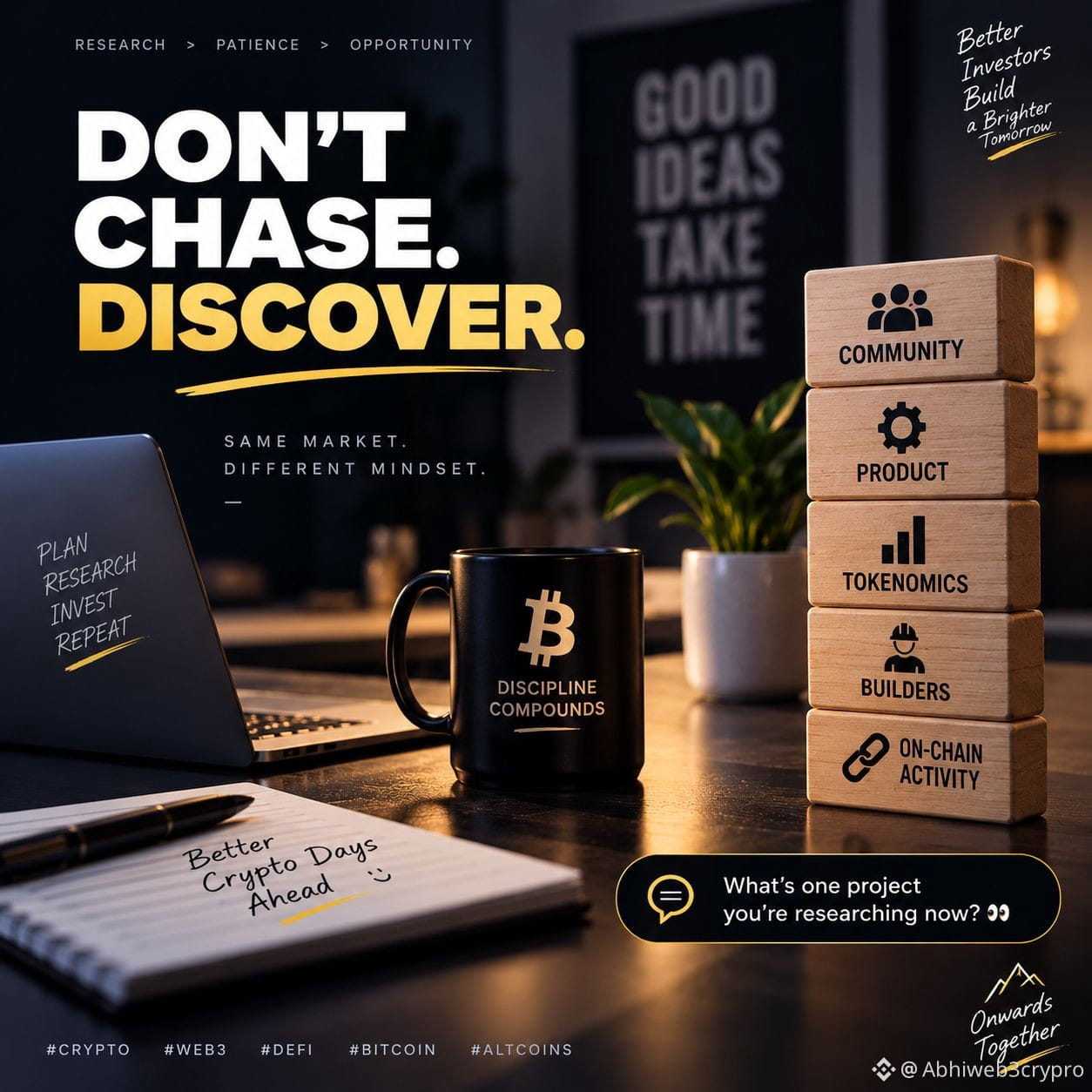
The biggest mistake in crypto?
Chasing the token that already pumped. 🧠
Instead, watch for:
→ Strong communities
→ Real product development
→ Sustainable tokenomics
→ Consistent builders
→ Growing on-chain activity
Price gets attention.
Fundamentals create the story.
What’s ONE project you’re researching right now? 👀
#Crypto #Web3 #DeFi #Bitcoin #Altcoins
The biggest mistake in crypto?
Chasing the token that already pumped. 🧠
Instead, watch for:
→ Strong communities
→ Real product development
→ Sustainable tokenomics
→ Consistent builders
→ Growing on-chain activity
Price gets attention.
Fundamentals create the story.
What’s ONE project you’re researching right now? 👀
#Crypto #Web3 #DeFi #Bitcoin #Altcoins
Chasing the token that already pumped. 🧠
Instead, watch for:
→ Strong communities
→ Real product development
→ Sustainable tokenomics
→ Consistent builders
→ Growing on-chain activity
Price gets attention.
Fundamentals create the story.
What’s ONE project you’re researching right now? 👀
#Crypto #Web3 #DeFi #Bitcoin #Altcoins
67
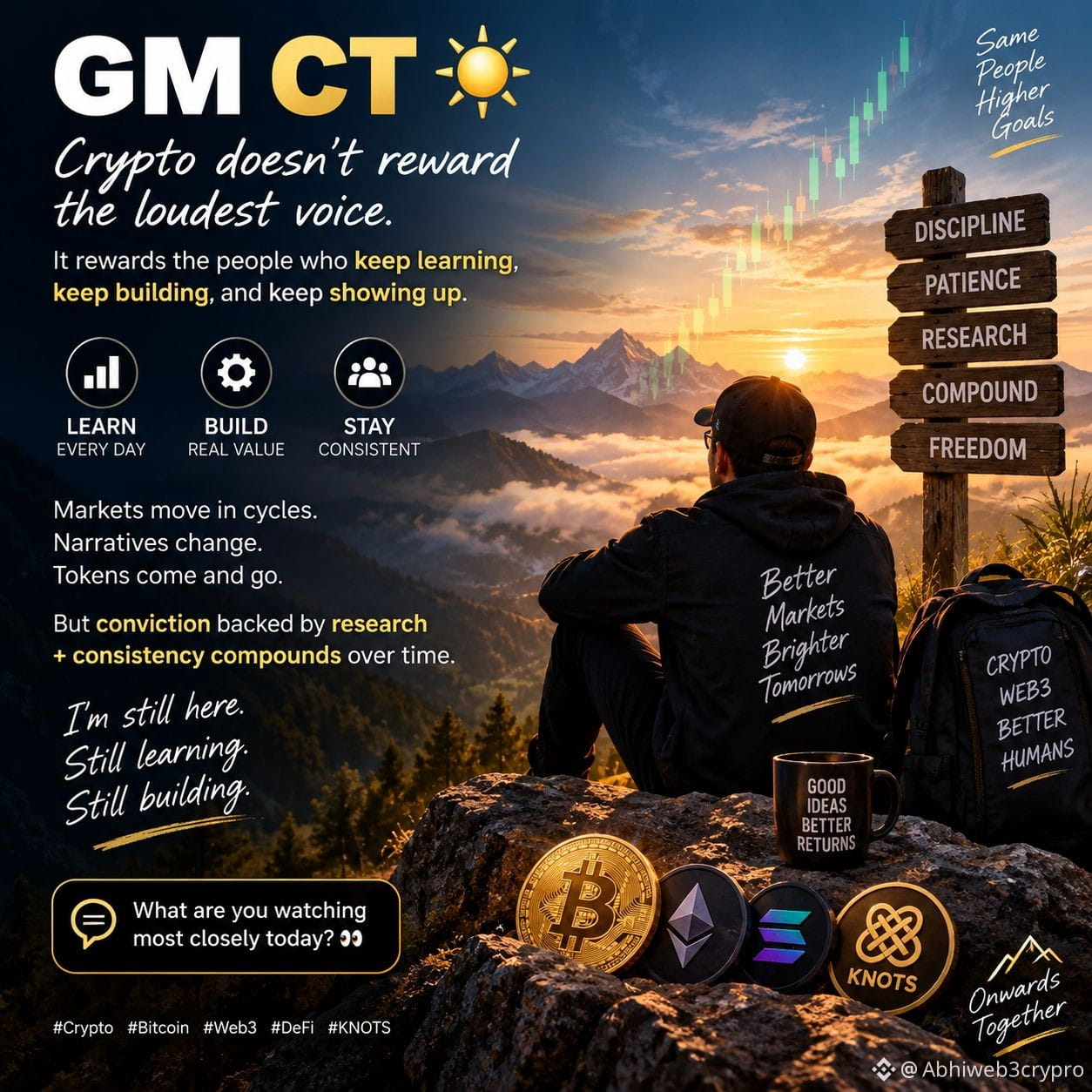
GM CT ☀️
Crypto doesn’t reward the loudest voice.
It rewards the people who keep learning, keep building, and keep showing up.
Markets move in cycles. Narratives change. Tokens come and go.
But conviction backed by research + consistency compounds over time.
I’m still here. Still learning. Still building. 🫡
What are you watching most closely today? 👀
#Crypto #Bitcoin #Web3 #DeFi #KNOTS
GM CT ☀️
Crypto doesn’t reward the loudest voice.
It rewards the people who keep learning, keep building, and keep showing up.
Markets move in cycles. Narratives change. Tokens come and go.
But conviction backed by research + consistency compounds over time.
I’m still here. Still learning. Still building. 🫡
What are you watching most closely today? 👀
#Crypto #Bitcoin #Web3 #DeFi #KNOTS
Crypto doesn’t reward the loudest voice.
It rewards the people who keep learning, keep building, and keep showing up.
Markets move in cycles. Narratives change. Tokens come and go.
But conviction backed by research + consistency compounds over time.
I’m still here. Still learning. Still building. 🫡
What are you watching most closely today? 👀
#Crypto #Bitcoin #Web3 #DeFi #KNOTS
69
Market insight
The crypto market is teaching the same lesson again. 👀
Everyone watches price.
But when I'm researching a narrative, I watch 4 things:
📊 Volume
👥 Holder growth
🧠 Community activity
🏗️ Actual product/building
Price can create attention. Activity creates a reason to keep watching.
What metric do you check first? 👇
#Crypto #Web3 #Bitcoin
Market insight
The crypto market is teaching the same lesson again. 👀
Everyone watches price.
But when I'm researching a narrative, I watch 4 things:
📊 Volume
👥 Holder growth
🧠 Community activity
🏗️ Actual product/building
Price can create attention. Activity creates a reason to keep watching.
What metric do you check first? 👇
#Crypto #Web3 #Bitcoin
The crypto market is teaching the same lesson again. 👀
Everyone watches price.
But when I'm researching a narrative, I watch 4 things:
📊 Volume
👥 Holder growth
🧠 Community activity
🏗️ Actual product/building
Price can create attention. Activity creates a reason to keep watching.
What metric do you check first? 👇
#Crypto #Web3 #Bitcoin
47
CRYPTO MARKET CHECK 🧵
BTC reclaimed $80K. Now comes the important part. 👀
🟠 BTC: holding the $80K zone
🔵 ETH: ~$2.6K, watching ETF flows
🟣 SOL: cooling after a strong rally
💰 BTC ETFs: +$433M on Friday
The market isn't giving a clear “easy trade” here.
Breakout → consolidation → confirmation.
I’m watching BTC $80K first.
If bulls defend it, attention could rotate back toward ETH, SOL and high-beta alts.
If BTC loses it, expect volatility.
No predictions. Just levels + data. 📊
What are you watching today?
BTC / ETH / SOL / ALTS?
#Bitcoin #BTC #Ethereum #Solana #Crypto #Web3
CRYPTO MARKET CHECK 🧵
BTC reclaimed $80K. Now comes the important part. 👀
🟠 BTC: holding the $80K zone
🔵 ETH: ~$2.6K, watching ETF flows
🟣 SOL: cooling after a strong rally
💰 BTC ETFs: +$433M on Friday
The market isn't giving a clear “easy trade” here.
Breakout → consolidation → confirmation.
I’m watching BTC $80K first.
If bulls defend it, attention could rotate back toward ETH, SOL and high-beta alts.
If BTC loses it, expect volatility.
No predictions. Just levels + data. 📊
What are you watching today?
BTC / ETH / SOL / ALTS?
#Bitcoin #BTC #Ethereum #Solana #Crypto #Web3
BTC reclaimed $80K. Now comes the important part. 👀
🟠 BTC: holding the $80K zone
🔵 ETH: ~$2.6K, watching ETF flows
🟣 SOL: cooling after a strong rally
💰 BTC ETFs: +$433M on Friday
The market isn't giving a clear “easy trade” here.
Breakout → consolidation → confirmation.
I’m watching BTC $80K first.
If bulls defend it, attention could rotate back toward ETH, SOL and high-beta alts.
If BTC loses it, expect volatility.
No predictions. Just levels + data. 📊
What are you watching today?
BTC / ETH / SOL / ALTS?
#Bitcoin #BTC #Ethereum #Solana #Crypto #Web3
203
Log in to explore more content
Join global crypto users on Binance Square
⚡️ Get latest and useful information about crypto.
💬 Trusted by the world’s largest crypto exchange.
👍 Discover real insights from verified creators.
Email / Phone number
Trending Topics
BitwiseFilesFinalNEARSpotETFProspectus
64,292 views
1,229 Discussing
#bitwisefilesfinalnearspotetfprospectus
Can $NEAR REALLY reach $562 with an ETF approval? 🚀
The crypto market is buzzing as Bitwise files its final prospectus for a Spot NEAR ETF (Ticker: NRR on NYSE Arca)! 📊🔥
Is institutional money about to unleash the biggest pump in NEAR’s history? Analysts are throwing around mind-blowing price targets:
🎯 Intermediate Target: $155
🎯 2030 Long-Term Target: $562
💡 Let's do the math:
At $562, $NEAR would sit at roughly a $680 Billion market cap—putting it right up there with Ethereum's potential valuation. With NEAR leading the Chain Abstraction & AI crypto narrative, this might not be as crazy as it sounds!
With SEC regulations turning more crypto-friendly and Wall Street knocking on the door, are you Accumulating or Holding?
👇 Drop your realistic price prediction for $NEAR in the comments! 👇
#BitwiseFilesFinalNEARSpotETFProspectus #Altcoins #CryptoNews #ETF
Doomsday-Trader
·6 Likes
·3.5k views
BitgetHackerMoves$83MStolenXRP
27,934 views
155 Discussing
SOLSpotETFWeeklyInflow$188M
17,210 views
122 Discussing