

Max-Biaa
13.7k Posts

Max-Biaa
Report
Block User
Still learning💻 Still growing💸
622 Following
5.6K+ Followers
7.2K+ Liked
Posts
·
--
🧧🎁 Lucky Time...Binance Family! 💛
🎁🧧 Red Packet Is Here!
#BinanceSquareFamily
#RedPacketMission
#REWARDS
🧧🎁 Lucky Time...Binance Family! 💛
🎁🧧 Red Packet Is Here!
#BinanceSquareFamily
#RedPacketMission
#REWARDS
🎁🧧 Red Packet Is Here!
#BinanceSquareFamily
#RedPacketMission
#REWARDS

15
1
83

·
--
Bullish
ALGO POWER: TOP 4 BULLISH SIGNALS ON OUR RADAR!
The latest AI Market Signals have triggered high-probability 3-hour setups! Huge momentum is building across these 4 key tokens:
THE SIGNAL BREAKDOWN:
1. $EPIC- High Momentum Leader
• Expected Move (3H): +6.63%
• AI Confidence: 73.91%
👉 Leading the entire leaderboard in immediate upside potential!
2. $AMP - Solid Upward Continuation
• Expected Move (3H): +5.90%
• AI Confidence: 64.00%
👉 Gaining strong buying pressure for a short-term breakout
3. $BMT - Top Reliability Pick
• Expected Move (3H): +4.30%
• AI Confidence: 80.65%
👉 The highest
algorithmic confidence score among the top movers!
4. $GTC - High Volatility Surge
• Expected Move (3H): +4.01%
• AI Confidence: 0.00%
👉 Massive speculative momentum unfolding - watch the volume closely!
TRADING TAKEAWAY:
Whether you are scaling into high-confidence setups like BMT or riding high-growth momentum on EPIC, risk management is key!
Which of these 4 setups are you trading right now? Drop your entries and targets below! 👇
#AISignals #CryptoTrading #Binance #Altcoins #bullish
EPIC
44%
AMp
19%
BMT
26%
GTC
11%
81 votes • Voting closed
4
5k
·
--
PEPE IS ON THE MOVE! 🐸🔥
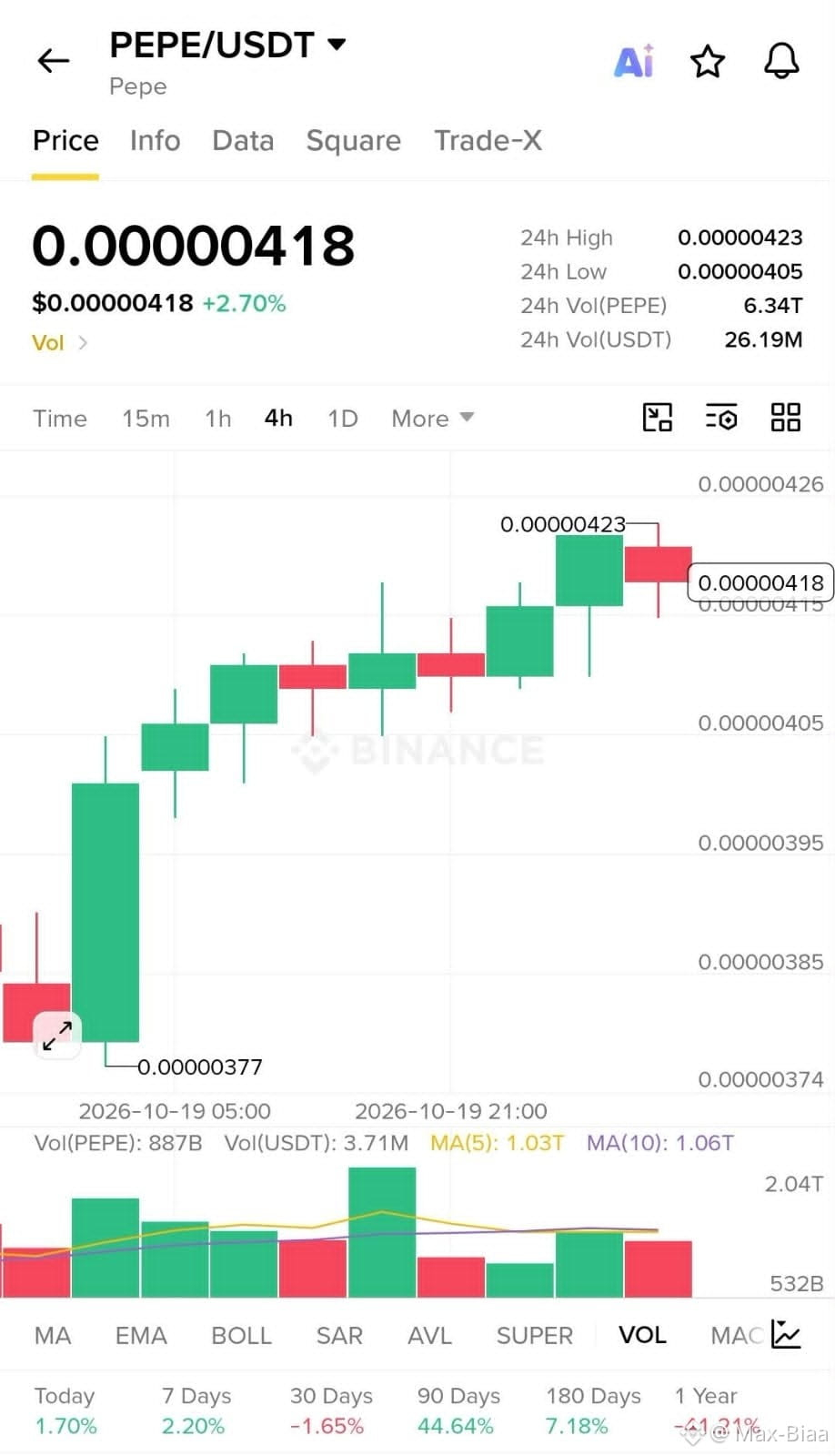
$PEPE is showing strong bullish momentum once again! Consecutive green candles on the 4H chart and rising trading volume signal that the meme coin giant is gearing up for a big breakout.
Key Market Highlights:
Current Price: $0.00000418
24h High: $0.00000423
24h Low: $0.00000405
24h Volume: 6.34T PEPE ($26.19M USDT)
Are you riding this bullish wave, or watching from the sidelines? Drop your price predictions in the comments below
#pepe #crypto #Binancesquare #memecoin #altcoins $PEPE
5
2
44
·
--
MSTR Faces Massive MSCI Index Test After 9.56% Drop!
Strategy (MSTR) just took a sharp 9.56% hit down to $136.83 following MSCI's announcement that non-operating companies could be ineligible for its Global Investable Market Indexes.
Here is why this matters:
The Index Risk: With Bitcoin holding strong near $82,000 (up about 2%), this selloff is driven by index-methodology risk rather than BTC price action.
Passive Funds on the Line: Strategy believes MSCI-linked funds hold roughly 13 million shares, making index deletion a major factor for traders. Management is actively fighting the "non-operating" label, pointing out that its Bitcoin business is reported as an operating segment under U.S. GAAP.
Key Dates Ahead: Keep October 28–29 and November 11 (MSCI's final list) on your radar. Any removal would take effect at the November 30 close.
Are you treating this MSTR dip as a massive opportunity, or staying sidelined amid index risks? Drop your thoughts!
MSTRBTC $BTC #BİNANCESQUARE #MSTR #cryptotrading
2
128
·
--
$3H Momentum Board Exploding: Heavy Volatility Unlocked!
Fresh volume scanners have locked in a brand-new leaderboard update. No coins skipped, all raw structural data for the next 3 hours is ready:
The 100% Max-Confidence Elite:
GLMR: +6.03% with absolute 100% CONFIDENCE! 🔥 (Max Conviction Lock)
The High-Surge & Top Gainers:
QUICK: +8.25% with 70.83% Confidence (Top Percentage Gainer)
WAL: +6.85% backed by 74.29% Confidence ⚡
EPIC: +6.64% with 58.82% Confidence
NXPC: +6.48% with 53.33% Confidence
SOLV: +3.99% with heavy 96% Confidence
The Active Rotation Watchlist:
STRK: +5.82% (75% Conf)
BLUR: +5.24% (85% Conf)
GNS: +4.47% (63.64% Conf)
KORUB: +4.34% (75% Conf)
Market Takeaway:
When top movers like QUICK (+8.25%) and WAL (+6.85%) lead the percentage surge while locks down absolute 100% confidence, liquidity rotates rapidly across the board. Protect your entries, watch the structural pullbacks, and ride the momentum!
Which of these setups are you tracking for the next push? Drop your pick below
QUICKWAL GLMRSOLV #BinanceSquareBTC #CryptoTradingTip #BullishMomentum #ALTCOİNS
LITEB
14%
ASMLB
43%
QQQB
29%
PLTRB
14%
7 votes • Voting closed
2
3k
·
--
Bullish
Something I noticed while digging through Dusk's core architecture today:
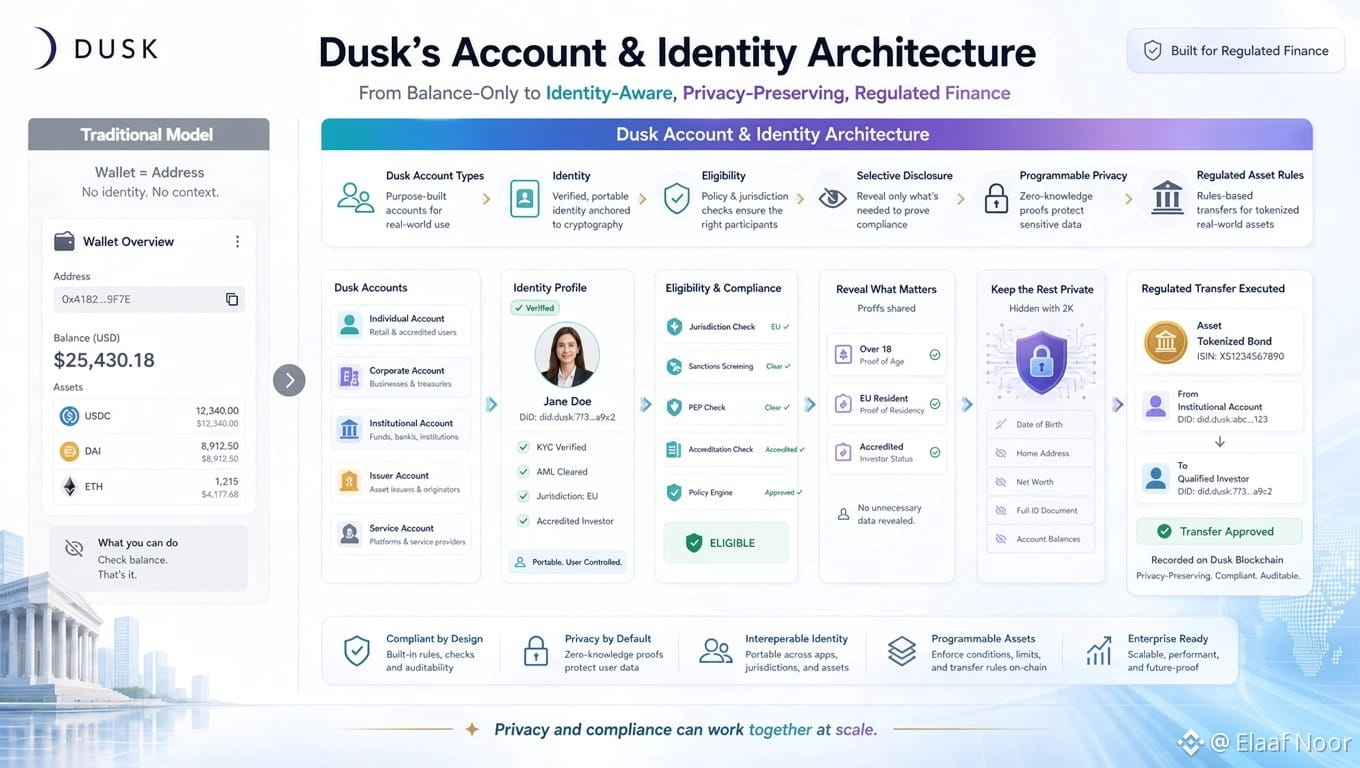
Dusk doesn't treat an account as simply an address holding coins.
Its account model is much more deliberate.
There are account types designed around different transaction requirements including public and privacy-preserving flows.
Do you think selective disclosure and programmable privacy are the ultimate keys to institutional adoption?
And that becomes particularly interesting when you think about regulated assets.
In a normal token transfer the main question is:
Does this address have enough balance?
A regulated security needs more questions answered.
Who is behind the account?
Is the holder eligible?
Is this transfer permitted?
What information should be revealed?
What information should remain private?
And can an authorized party verify the required attributes without exposing everything else?
That's where I think Dusk's account and identity architecture starts becoming more relevant than the usual wallet-address model.
The blockchain isnot just tracking balances.
It can become part of a rules-based financial identity and transfer workflow.
And there is an important distinction here:
privacy doesnot necessarily mean hiding the existence of everything.
It can mean exposing exactly what needs to be verified while keeping unrelated information confidential.
That's a much more useful model for regulated finance.
So the question I am asking about Dusk now isn't:
Does it have private transactions?
That's too basic.
It's:
Can account, identity, eligibility and transaction rules work together without forcing every financial application to expose the user's entire identity?
If that works at scale that's where programmable privacy becomes genuinely useful.
#dusk $DUSK @Dusk_Foundation
Something I noticed while digging through Dusk's core architecture today:
Dusk doesn't treat an account as simply an address holding coins.
Its account model is much more deliberate.
There are account types designed around different transaction requirements including public and privacy-preserving flows.
Do you think selective disclosure and programmable privacy are the ultimate keys to institutional adoption?
And that becomes particularly interesting when you think about regulated assets.
In a normal token transfer the main question is:
Does this address have enough balance?
A regulated security needs more questions answered.
Who is behind the account?
Is the holder eligible?
Is this transfer permitted?
What information should be revealed?
What information should remain private?
And can an authorized party verify the required attributes without exposing everything else?
That's where I think Dusk's account and identity architecture starts becoming more relevant than the usual wallet-address model.
The blockchain isnot just tracking balances.
It can become part of a rules-based financial identity and transfer workflow.
And there is an important distinction here:
privacy doesnot necessarily mean hiding the existence of everything.
It can mean exposing exactly what needs to be verified while keeping unrelated information confidential.
That's a much more useful model for regulated finance.
So the question I am asking about Dusk now isn't:
Does it have private transactions?
That's too basic.
It's:
Can account, identity, eligibility and transaction rules work together without forcing every financial application to expose the user's entire identity?
If that works at scale that's where programmable privacy becomes genuinely useful.
#dusk $DUSK @Dusk
4
3
359
·
--
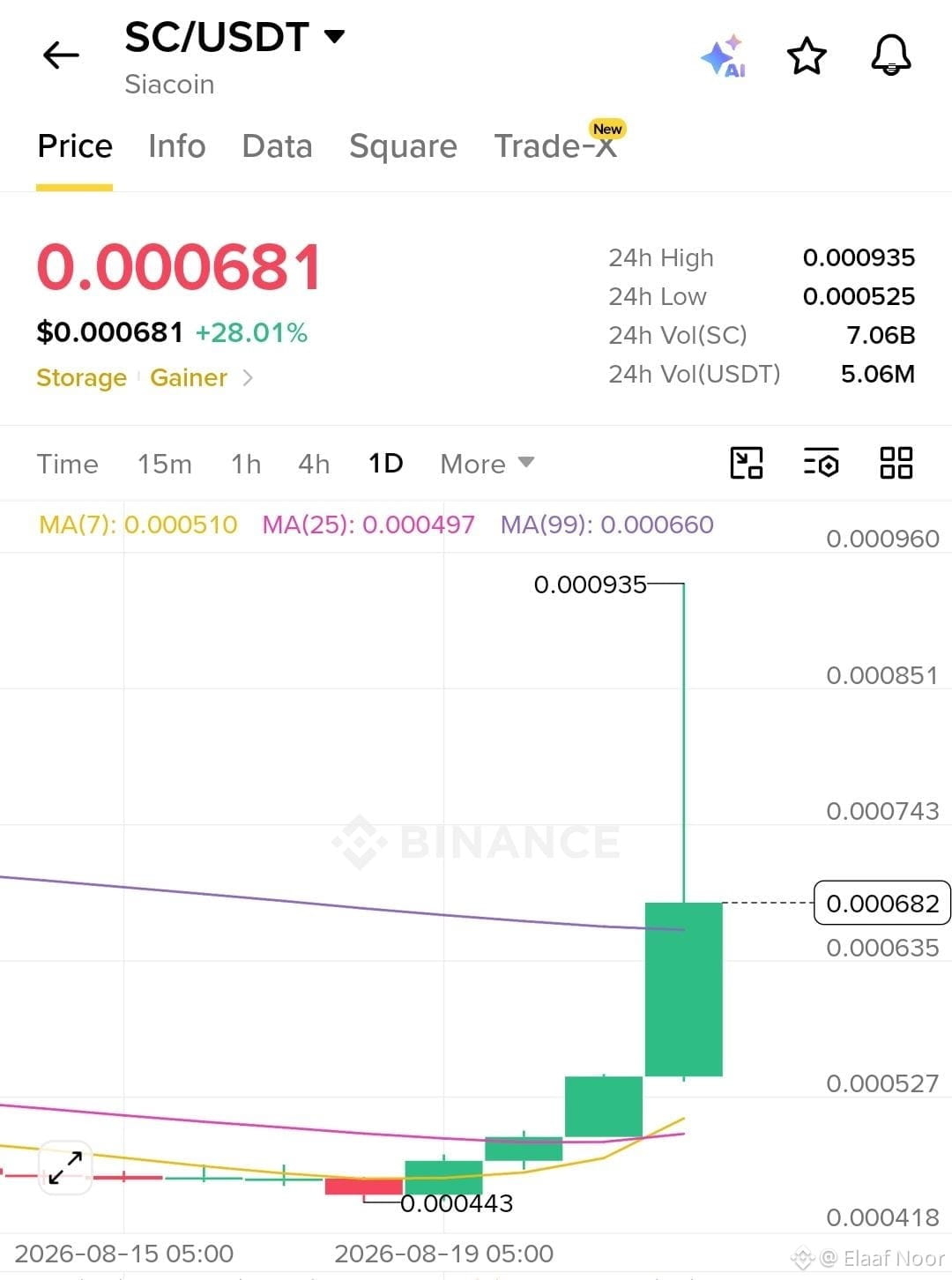
Massive volume expansion on $SC today!
Currently trading around 0.000681 USDT (+28%) pushing off strong moving averages with over 7B volume flowing in.
Key Test: The 24h high sits near 0.000935 & order books are leaning green with 53.94% buy pressure.
The Play: Momentum is here but chasing green candles blindly can be risky. Watching how it holds above local support is key before the next leg.
Are you riding this pump on Siacoin, or waiting for a dip? Let me know below! 👇
#SC #Siacoin #CryptoTrading #BinanceSquare $SC
2
3
360
·
--
RWA lending has a problem I find more interesting than the tokenization itself:
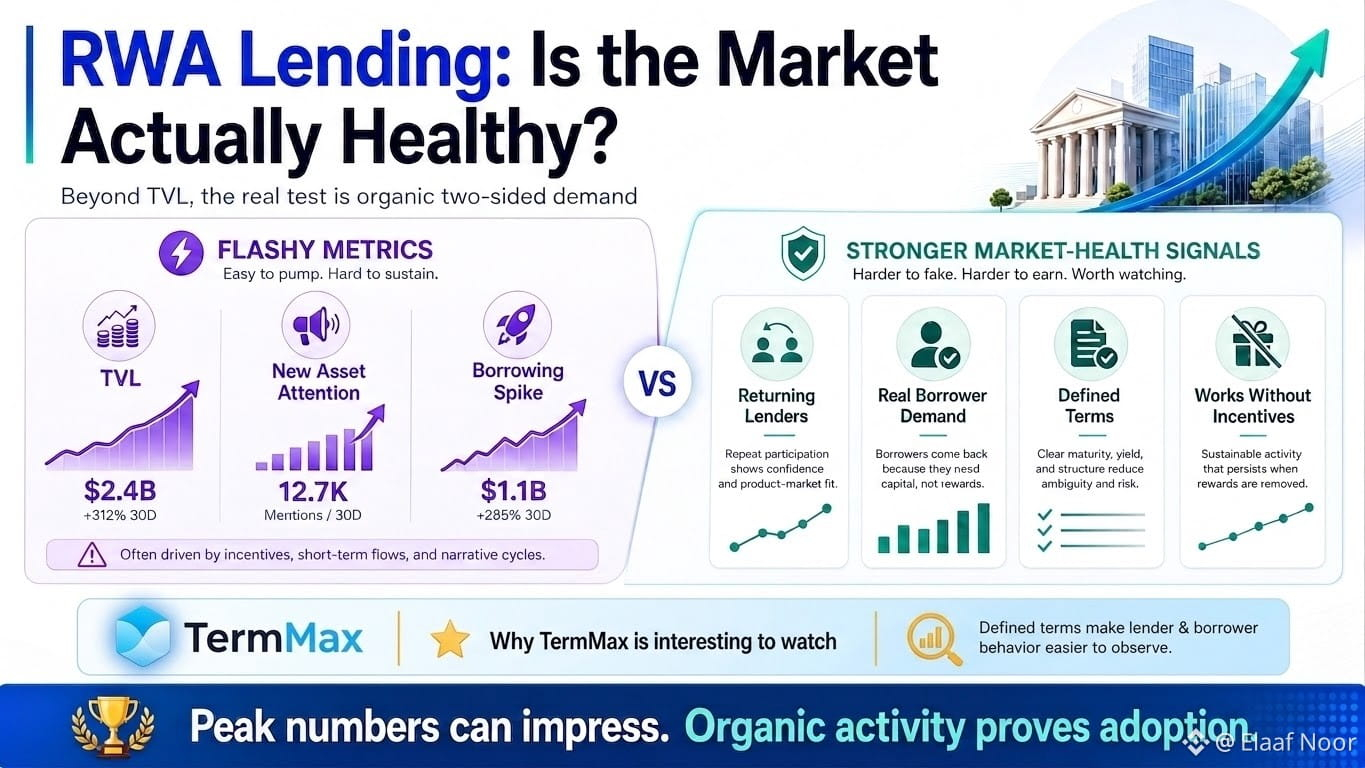
how do you know a collateral market is actually healthy?
TVL can look impressive.
A new asset can attract attention.
Borrowing volume can spike.
None of those tells me whether the market has developed real two-sided demand.
That is where I think @termmax has an interesting setup to observe.
When financing is arranged around defined terms instead of one constantly changing pool rate the behaviour of lenders & borrowers becomes easier to examine.
Who is willing to provide capital?
Who is willing to pay for it?
How long are they willing to commit?
And what happens when the easy liquidity disappears?
Those questions matter even more for tokenized assets because liquidity conditions can vary dramatically from one asset to another.
I did rather see a smaller market where participants keep returning under normal conditions than a huge number that only looks active while incentives are doing the heavy lifting.
So if TermMax expands deeper into RWA credit I would not be watching the headline TVL first.
I will be watching whether the market keeps functioning when nobody is being heavily paid to participate.
That to me is a much harder - & much more useful - test of real adoption.
Do you judge protocols by their peak TVL or do you look at organic activity without incentives?
#termmax
RWA lending has a problem I find more interesting than the tokenization itself:
how do you know a collateral market is actually healthy?
TVL can look impressive.
A new asset can attract attention.
Borrowing volume can spike.
None of those tells me whether the market has developed real two-sided demand.
That is where I think @TermMax has an interesting setup to observe.
When financing is arranged around defined terms instead of one constantly changing pool rate the behaviour of lenders & borrowers becomes easier to examine.
Who is willing to provide capital?
Who is willing to pay for it?
How long are they willing to commit?
And what happens when the easy liquidity disappears?
Those questions matter even more for tokenized assets because liquidity conditions can vary dramatically from one asset to another.
I did rather see a smaller market where participants keep returning under normal conditions than a huge number that only looks active while incentives are doing the heavy lifting.
So if TermMax expands deeper into RWA credit I would not be watching the headline TVL first.
I will be watching whether the market keeps functioning when nobody is being heavily paid to participate.
That to me is a much harder - & much more useful - test of real adoption.
Do you judge protocols by their peak TVL or do you look at organic activity without incentives?
#termmax
12
12
672
·
--
Bullish
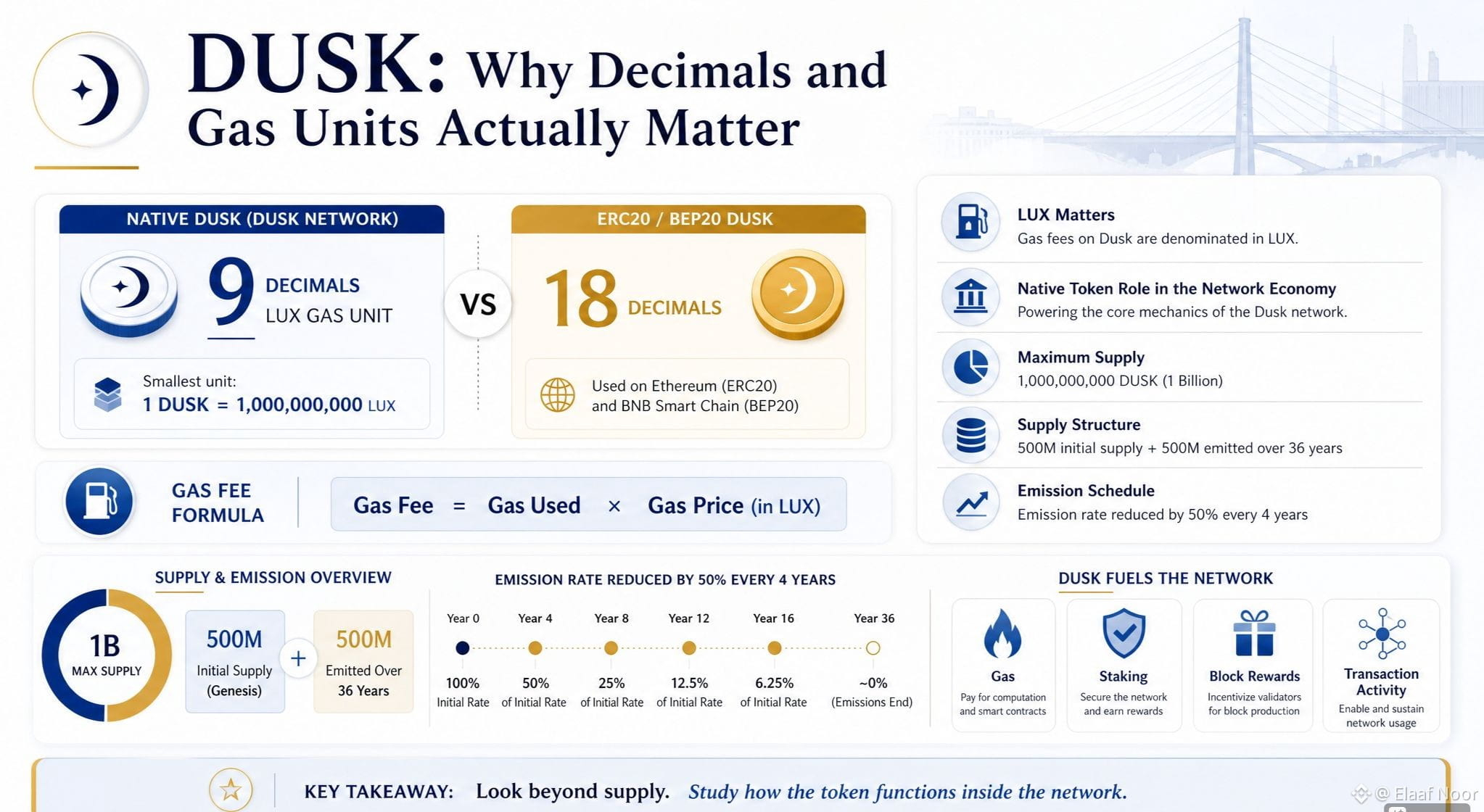
I found a small Dusk detail that I completely overlooked before.
DUSK on the native Dusk network doesn't actually use 18 decimals.
It uses 9 decimals.
The smallest unit is called LUX:
1 DUSK = 1,000,000,000 LUX.
ERC20 & BEP20 DUSK in the otherhand used 18 decimals.
At first I thought:
Okay… that is just a technical implementation detail
But then I realized why this actually matters.
DUSK is the native gas token on Dusk.
Every transaction consumes gas, and fees are calculated using gas used × gas price, with the gas price denominated in LUX.
So the token isn't just an asset being transferred around the network.
Its smallest unit is directly part of how Dusk's execution economics work.
And there is another part I found interesting.
The network's maximum supply is 1 billion DUSK:
500M initial supply
+
500M emitted over 36 years.
Those emissions don't stay flat either.
The emission rate is reduced by 50% every four years.
So the network's security economics are designed to change over time as transaction-fee activity becomes more important.
This made me look at DUSK differently.
Instead of only asking:
What is the token supply?
I am more interested in:
How does the native token actually function inside the network's economic machinery?
Gas.
Staking.
Block rewards.
And eventually transaction activity.
That is a much more useful way to understand a network token than just looking at the maximum supply number.
Have you ever looked deep into a tokens decimal structure or gas units, or do you usually just track the price and supply? Let me know below...
#dusk $DUSK @Dusk_Foundation
I found a small Dusk detail that I completely overlooked before.
DUSK on the native Dusk network doesn't actually use 18 decimals.
It uses 9 decimals.
The smallest unit is called LUX:
1 DUSK = 1,000,000,000 LUX.
ERC20 & BEP20 DUSK in the otherhand used 18 decimals.
At first I thought:
Okay… that is just a technical implementation detail
But then I realized why this actually matters.
DUSK is the native gas token on Dusk.
Every transaction consumes gas, and fees are calculated using gas used × gas price, with the gas price denominated in LUX.
So the token isn't just an asset being transferred around the network.
Its smallest unit is directly part of how Dusk's execution economics work.
And there is another part I found interesting.
The network's maximum supply is 1 billion DUSK:
500M initial supply
+
500M emitted over 36 years.
Those emissions don't stay flat either.
The emission rate is reduced by 50% every four years.
So the network's security economics are designed to change over time as transaction-fee activity becomes more important.
This made me look at DUSK differently.
Instead of only asking:
What is the token supply?
I am more interested in:
How does the native token actually function inside the network's economic machinery?
Gas.
Staking.
Block rewards.
And eventually transaction activity.
That is a much more useful way to understand a network token than just looking at the maximum supply number.
Have you ever looked deep into a tokens decimal structure or gas units, or do you usually just track the price and supply? Let me know below...
#dusk $DUSK @Dusk
39
25
912
·
--
Something I did watch closely if @termmax starts bringing more RWA collateral onchain:
who is actually willing to pay the rate?
A fixed rate by itself doesnot tell me much. The interesting signal is whether different assets start attracting different financing costs based on their liquidity volatility & collateral quality.
That is where I think TermMax could get genuinely interesting.
Imagine two markets with the same maturity but very different collateral. If borrowers consistently accept different rates without incentives forcing the outcome those rates start carrying information.
Not just APY.
Information about how the market values the risk of financing that asset.
But I did be careful about reading too much into an early rate curve.
A pool can look busy because rewards is paying people to be there. A market can show a clean rate while having barely enough liquidity to make that rate meaningful.
So I did personally track three things:
Do borrowers come back after the first trade?
Does liquidity remain when incentives cool off?
Do rates actually move when collateral risk changes?
If those patterns start appearing across multiple maturities and assets then the rates become much more interesting to me.
Because the real signal isnot the curve itself.
It is the participants who keep coming back to price it.
#termmax
What would make you trust TermMax’s RWA credit markets?
Something I did watch closely if @TermMax starts bringing more RWA collateral onchain:
who is actually willing to pay the rate?
A fixed rate by itself doesnot tell me much. The interesting signal is whether different assets start attracting different financing costs based on their liquidity volatility & collateral quality.
That is where I think TermMax could get genuinely interesting.
Imagine two markets with the same maturity but very different collateral. If borrowers consistently accept different rates without incentives forcing the outcome those rates start carrying information.
Not just APY.
Information about how the market values the risk of financing that asset.
But I did be careful about reading too much into an early rate curve.
A pool can look busy because rewards is paying people to be there. A market can show a clean rate while having barely enough liquidity to make that rate meaningful.
So I did personally track three things:
Do borrowers come back after the first trade?
Does liquidity remain when incentives cool off?
Do rates actually move when collateral risk changes?
If those patterns start appearing across multiple maturities and assets then the rates become much more interesting to me.
Because the real signal isnot the curve itself.
It is the participants who keep coming back to price it.
#termmax
What would make you trust TermMax’s RWA credit markets?
🟢 Repeat borrowers
100%
🔵 Deep liquidity
0%
🟡 Organic rates
0%
🔴 Less incentives
0%
2 votes • Voting closed
27
13
6.1k
·
--
Verified
August 25 is the date everyone will watch for $TMX.
I am more interested in what happens after it.
A token can create attention overnight. It canot create durable credit demand that quickly.
That why I am looking at TermMax less from the TGE angle & more from the product-market-fit test that comes with it.
The protocol already has a more defined credit model than a basic variable-rate money market. Fixed maturities give both sides something they can actually plan around while isolated markets let risk be separated instead of treating every collateral type the same.
There is another piece I think deserves more attention: capital efficiency.
Liquidity waiting to enter a fixed-rate position didnot necessarily have to remain completely unproductive. The ability to put that capital to work elsewhere until a match is available changes the economics of sitting on the sidelines.
But here is the part I am watching most closely:
What happens when incentives become less important?
If borrowers still want predictable financing lenders still find the risk/reward attractive & curators continue creating useful markets then the TGE becomes more than a token event.
It becomes a transition point for an already-running credit system.
That is the test I care about.
Not how loud August 25 is.
How much real activity remains after the launch-day attention fades.
#termmax @termmax
What matters most after the $TMX TGE?
August 25 is the date everyone will watch for $TMX.
I am more interested in what happens after it.
A token can create attention overnight. It canot create durable credit demand that quickly.
That why I am looking at TermMax less from the TGE angle & more from the product-market-fit test that comes with it.
The protocol already has a more defined credit model than a basic variable-rate money market. Fixed maturities give both sides something they can actually plan around while isolated markets let risk be separated instead of treating every collateral type the same.
There is another piece I think deserves more attention: capital efficiency.
Liquidity waiting to enter a fixed-rate position didnot necessarily have to remain completely unproductive. The ability to put that capital to work elsewhere until a match is available changes the economics of sitting on the sidelines.
But here is the part I am watching most closely:
What happens when incentives become less important?
If borrowers still want predictable financing lenders still find the risk/reward attractive & curators continue creating useful markets then the TGE becomes more than a token event.
It becomes a transition point for an already-running credit system.
That is the test I care about.
Not how loud August 25 is.
How much real activity remains after the launch-day attention fades.
#termmax @TermMax
What matters most after the $TMX TGE?
🟢 Real borrowing
67%
🔵 Lender demand
0%
🟡 Curator growth
0%
🔴 Rewards
33%
3 votes • Voting closed
25
11
3.8k
·
--
Bullish
Verified
@Dusk_Foundation isn't trying to make regulated finance more crypto.
It's trying to make regulated finance programmable without making everything public.
That's why DuskEVM is interesting to me.
The upcoming DuskEVM mainnet gives Solidity developers a familiar EVM path into Dusk, while the underlying Dusk stack provides deterministic settlement and data availability.
But the more unusual part is Hedger.
Hedger is the privacy path for EVM applications, combining homomorphic encryption and zero-knowledge proofs so financial workflows can keep sensitive information confidential while still producing verifiable execution.
Think about what that means for an institution.
A fund may need to prove that a transaction is valid without broadcasting every position.
An investor may need to prove eligibility without exposing unnecessary personal information.
A regulated venue may need auditability without turning its entire order flow into public data.
That is a very different privacy thesis from simply hiding everything.
Dusk is aiming for privacy where needed, transparency where useful, and selective disclosure when an authorized party needs to review something.
And $DUSK is the native gas and staking asset securing this infrastructure.
That's why I'm watching DuskEVM closely.
The real test isn't whether Solidity can run on another chain.
It's whether familiar EVM development can be combined with the privacy and settlement requirements of real financial markets.
#dusk
What matters more for institutional EVM apps?
@Dusk isn't trying to make regulated finance more crypto.
It's trying to make regulated finance programmable without making everything public.
That's why DuskEVM is interesting to me.
The upcoming DuskEVM mainnet gives Solidity developers a familiar EVM path into Dusk, while the underlying Dusk stack provides deterministic settlement and data availability.
But the more unusual part is Hedger.
Hedger is the privacy path for EVM applications, combining homomorphic encryption and zero-knowledge proofs so financial workflows can keep sensitive information confidential while still producing verifiable execution.
Think about what that means for an institution.
A fund may need to prove that a transaction is valid without broadcasting every position.
An investor may need to prove eligibility without exposing unnecessary personal information.
A regulated venue may need auditability without turning its entire order flow into public data.
That is a very different privacy thesis from simply hiding everything.
Dusk is aiming for privacy where needed, transparency where useful, and selective disclosure when an authorized party needs to review something.
And $DUSK is the native gas and staking asset securing this infrastructure.
That's why I'm watching DuskEVM closely.
The real test isn't whether Solidity can run on another chain.
It's whether familiar EVM development can be combined with the privacy and settlement requirements of real financial markets.
#dusk
What matters more for institutional EVM apps?
Privacy
80%
Settlement
20%
5 votes • Voting closed
85
35
1.2k
·
--
🚨 The CLARITY Act just hit a critical point.
Senate Majority Leader Thune has moved the bill toward a procedural vote after the September 15 recess - potentially one of the last realistic windows for crypto legislation to move in 2026.
But here's the problem:
Getting a vote ≠ getting enough votes to pass.
XRP has already felt the uncertainty, sliding toward the $1 area, while analysts remain cautious about the bill's chances amid election-year politics.
If CLARITY passes → major regulatory clarity for crypto.
If it stalls → the market may have to wait until 2027.
This isn't just another Senate vote. It's a deadline. 👀
#crypto #CLARITYAct #XRP
Do you think the CLARITY Act can pass in 2026?
The next procedural move could decide whether 2026 becomes a breakthrough year for U.S. crypto regulation. 👀
🟢 YES — Crypto gets clarity
92%
🔴 NO — Politics will delay it
8%
24 votes • Voting closed
3
764
Log in to explore more content
Join global crypto users on Binance Square
⚡️ Get latest and useful information about crypto.
💬 Trusted by the world’s largest crypto exchange.
👍 Discover real insights from verified creators.
Email / Phone number