
樱花舞伴
14 Posts

樱花舞伴
Report
Block User
Open Trade
Frequent Trader
9.2 Years
9 Following
32 Followers
15 Liked
Posts
Portfolio
·
--
Article
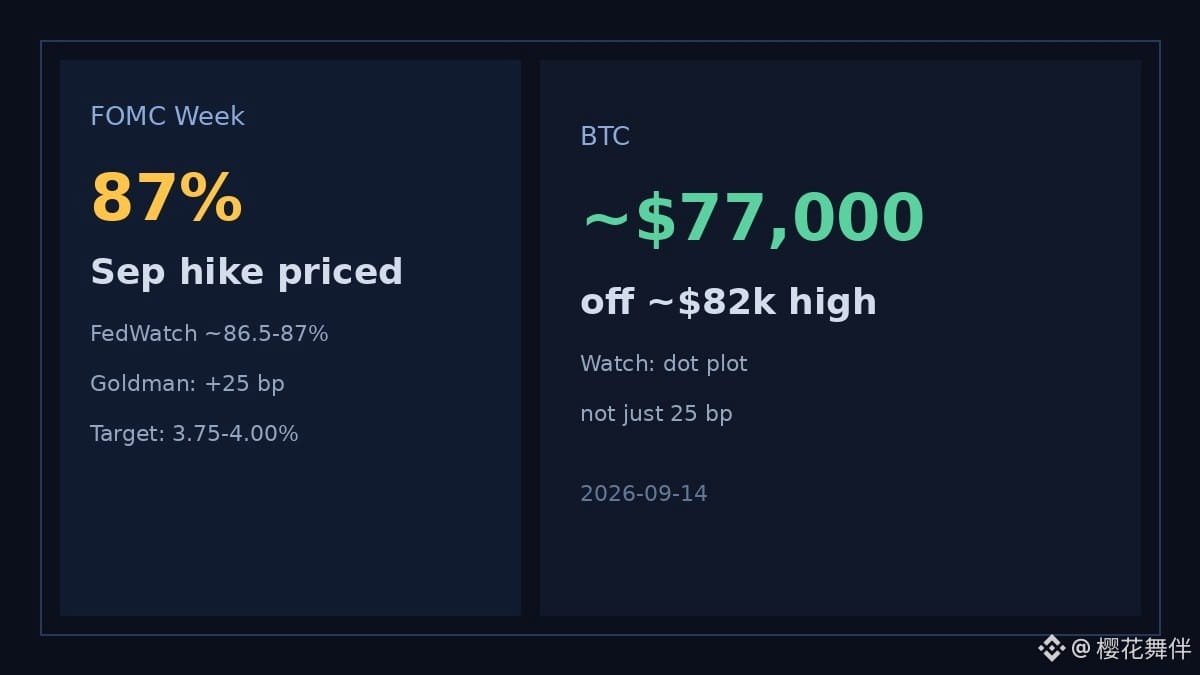
Rate-hike odds hit 87%: Goldman changes its stance; BTC returns to 77,000This week’s main storyline has changed. It’s no longer about guessing whether there will be a rate hike—it’s about guessing whether they will hike again after the hike.
The CME FedWatch has raised the probability of a 25-basis-point rate hike on September 16 to around 86.5%–87%. If the federal funds target range is raised, it would move from the current 3.50%–3.75% to 3.75%–4.00%. Before the inflation data comes out, this probability is still roughly around 70%. Goldman Sachs has also changed its tune: it is no longer betting on a hold in September, but instead expects a 25-basis-point hike. JPMorgan has gone a step further, putting a second hike in December into its forecast as well.
Here, Bitcoin after rallying and breaking through about $82,000 in early September, pulled back. Today it has been hovering around roughly $77,000, sometimes dipping to about $76.7k. Over the week, it’s down about 5%. It is falling, but it hasn’t crashed another leg the way it did after 87%—suggesting that in this September move, many positions had already priced it in in advance.
Rate-hike odds hit 87%: Goldman changes its stance; BTC returns to 77,000
This week’s main storyline has changed. It’s no longer about guessing whether there will be a rate hike—it’s about guessing whether they will hike again after the hike.
The CME FedWatch has raised the probability of a 25-basis-point rate hike on September 16 to around 86.5%–87%. If the federal funds target range is raised, it would move from the current 3.50%–3.75% to 3.75%–4.00%. Before the inflation data comes out, this probability is still roughly around 70%. Goldman Sachs has also changed its tune: it is no longer betting on a hold in September, but instead expects a 25-basis-point hike. JPMorgan has gone a step further, putting a second hike in December into its forecast as well.
Here, Bitcoin after rallying and breaking through about $82,000 in early September, pulled back. Today it has been hovering around roughly $77,000, sometimes dipping to about $76.7k. Over the week, it’s down about 5%. It is falling, but it hasn’t crashed another leg the way it did after 87%—suggesting that in this September move, many positions had already priced it in in advance.
The CME FedWatch has raised the probability of a 25-basis-point rate hike on September 16 to around 86.5%–87%. If the federal funds target range is raised, it would move from the current 3.50%–3.75% to 3.75%–4.00%. Before the inflation data comes out, this probability is still roughly around 70%. Goldman Sachs has also changed its tune: it is no longer betting on a hold in September, but instead expects a 25-basis-point hike. JPMorgan has gone a step further, putting a second hike in December into its forecast as well.
Here, Bitcoin after rallying and breaking through about $82,000 in early September, pulled back. Today it has been hovering around roughly $77,000, sometimes dipping to about $76.7k. Over the week, it’s down about 5%. It is falling, but it hasn’t crashed another leg the way it did after 87%—suggesting that in this September move, many positions had already priced it in in advance.
74
·
--
Article
Key Vote on Monday: CLARITY Crypto Regulatory Bill—Senate First Clears the 60-Vote HurdleNext week at 2:15 PM Eastern on September 15, the U.S. Senate will hold a procedural vote on the (Digital Asset Market Clarity Act) (CLARITY Act, H.R. 3633). Plainly put: it’s not direct legislation—first it’s about deciding whether to open debate.
The threshold is 60 votes. The Republicans have about 53 seats, so they still need to pull at least 7 members of the Democratic Party or independents. The sticking points mainly come in three areas: an official’s conflict-of-interest provision regarding crypto asset holdings; whether stablecoins can earn yield (banks strongly oppose this); and the boundaries of liability for DeFi developers.
If it can’t pass, it will be basically very difficult to get scheduled again within 2026; the market structure still depends on the SEC and the CFTC each making their own rules. Even if it does pass, there’s still debate, a second round of debate to formally end it, House alignment, and it’s still a long way from becoming law. My estimate is that the probability of the bill being signed into law this year is currently around 20%.
Key Vote on Monday: CLARITY Crypto Regulatory Bill—Senate First Clears the 60-Vote Hurdle
Next week at 2:15 PM Eastern on September 15, the U.S. Senate will hold a procedural vote on the (Digital Asset Market Clarity Act) (CLARITY Act, H.R. 3633). Plainly put: it’s not direct legislation—first it’s about deciding whether to open debate.
The threshold is 60 votes. The Republicans have about 53 seats, so they still need to pull at least 7 members of the Democratic Party or independents. The sticking points mainly come in three areas: an official’s conflict-of-interest provision regarding crypto asset holdings; whether stablecoins can earn yield (banks strongly oppose this); and the boundaries of liability for DeFi developers.
If it can’t pass, it will be basically very difficult to get scheduled again within 2026; the market structure still depends on the SEC and the CFTC each making their own rules. Even if it does pass, there’s still debate, a second round of debate to formally end it, House alignment, and it’s still a long way from becoming law. My estimate is that the probability of the bill being signed into law this year is currently around 20%.
The threshold is 60 votes. The Republicans have about 53 seats, so they still need to pull at least 7 members of the Democratic Party or independents. The sticking points mainly come in three areas: an official’s conflict-of-interest provision regarding crypto asset holdings; whether stablecoins can earn yield (banks strongly oppose this); and the boundaries of liability for DeFi developers.
If it can’t pass, it will be basically very difficult to get scheduled again within 2026; the market structure still depends on the SEC and the CFTC each making their own rules. Even if it does pass, there’s still debate, a second round of debate to formally end it, House alignment, and it’s still a long way from becoming law. My estimate is that the probability of the bill being signed into law this year is currently around 20%.
1
1
1.4k
·
--
Article
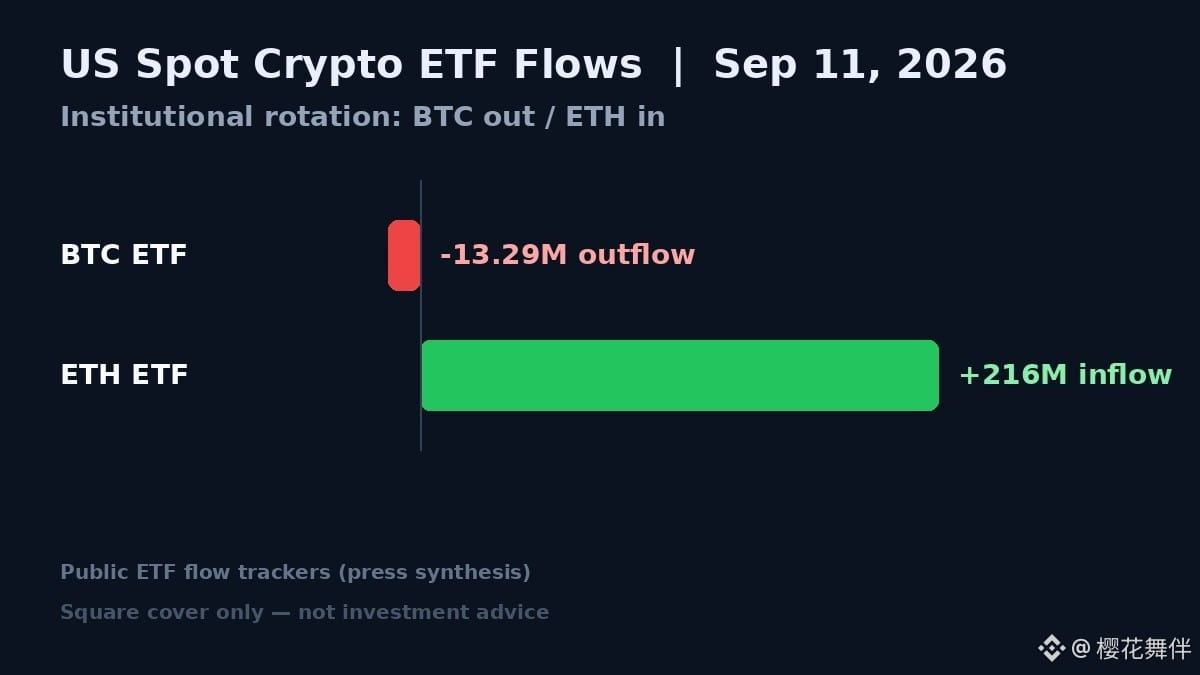
Institutional money is rotating: BTC ETF outflows, ETH ETF pulls in $216 million in a single dayOn September 11, this set of ETF flows says more than the price action.
Based on publicly tracked data: on that day, the U.S. spot Bitcoin ETF saw net outflows of about $13.29 million. On the same day, the Ethereum spot ETF saw net inflows of about $216 million. One side is reducing while the other is adding—more like “rotation within crypto,” not an overall pullout of capital.
Take another look at the price: BTC is still hovering around the $770,000 area; ETH is up more than about 2%, trading above roughly $2,510–$2,520. Short-term sentiment has also warmed up a bit.
A few plain-language key points:
1) The cumulative outflows from BTC ETFs in the past few days are already quite significant. On the 11th, the outflows narrowed—more like “bleeding slows down,” not an immediate reversal.
Institutional money is rotating: BTC ETF outflows, ETH ETF pulls in $216 million in a single day
On September 11, this set of ETF flows says more than the price action.
Based on publicly tracked data: on that day, the U.S. spot Bitcoin ETF saw net outflows of about $13.29 million. On the same day, the Ethereum spot ETF saw net inflows of about $216 million. One side is reducing while the other is adding—more like “rotation within crypto,” not an overall pullout of capital.
Take another look at the price: BTC is still hovering around the $770,000 area; ETH is up more than about 2%, trading above roughly $2,510–$2,520. Short-term sentiment has also warmed up a bit.
A few plain-language key points:
1) The cumulative outflows from BTC ETFs in the past few days are already quite significant. On the 11th, the outflows narrowed—more like “bleeding slows down,” not an immediate reversal.
Based on publicly tracked data: on that day, the U.S. spot Bitcoin ETF saw net outflows of about $13.29 million. On the same day, the Ethereum spot ETF saw net inflows of about $216 million. One side is reducing while the other is adding—more like “rotation within crypto,” not an overall pullout of capital.
Take another look at the price: BTC is still hovering around the $770,000 area; ETH is up more than about 2%, trading above roughly $2,510–$2,520. Short-term sentiment has also warmed up a bit.
A few plain-language key points:
1) The cumulative outflows from BTC ETFs in the past few days are already quite significant. On the 11th, the outflows narrowed—more like “bleeding slows down,” not an immediate reversal.
52
·
--
Article
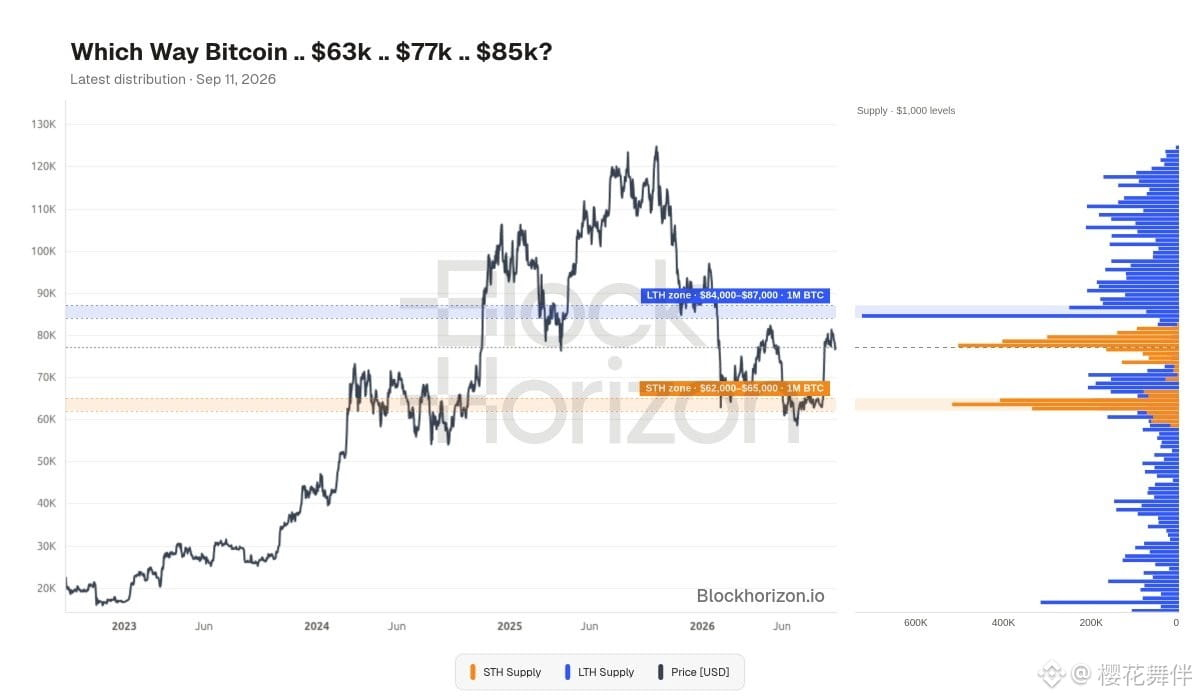
BTC stuck at $77k: 1 million BTC walls both above and below—what to watch before the FOMCBitcoin is currently stuck around $77,000. On both sides there are “thick walls.”
On-chain cost distribution charts show: about 1 million BTC are clustered in the $62,000–$65,000 range below, and about 1 million BTC are also clustered in the $84,000–$87,000 range above. The current price is squeezed in between—either breaking down or pushing up, and market views are sharply split.
At the same time, everyone is still watching next week’s FOMC. In public discussion, the probability of a September rate hike has been mentioned as being above 80%; U.S. stocks and risk assets will also price around this statement. On top of that, in recent days there have still been reports of net outflows from spot Bitcoin ETFs, so liquidity conditions are not exactly comfortable.
BTC stuck at $77k: 1 million BTC walls both above and below—what to watch before the FOMC
Bitcoin is currently stuck around $77,000. On both sides there are “thick walls.”
On-chain cost distribution charts show: about 1 million BTC are clustered in the $62,000–$65,000 range below, and about 1 million BTC are also clustered in the $84,000–$87,000 range above. The current price is squeezed in between—either breaking down or pushing up, and market views are sharply split.
At the same time, everyone is still watching next week’s FOMC. In public discussion, the probability of a September rate hike has been mentioned as being above 80%; U.S. stocks and risk assets will also price around this statement. On top of that, in recent days there have still been reports of net outflows from spot Bitcoin ETFs, so liquidity conditions are not exactly comfortable.
On-chain cost distribution charts show: about 1 million BTC are clustered in the $62,000–$65,000 range below, and about 1 million BTC are also clustered in the $84,000–$87,000 range above. The current price is squeezed in between—either breaking down or pushing up, and market views are sharply split.
At the same time, everyone is still watching next week’s FOMC. In public discussion, the probability of a September rate hike has been mentioned as being above 80%; U.S. stocks and risk assets will also price around this statement. On top of that, in recent days there have still been reports of net outflows from spot Bitcoin ETFs, so liquidity conditions are not exactly comfortable.
103
·
--
BTC is a bit more bullish right now, but I won’t rush until we’ve broken through the 68,400 support level.
This move up—OI is being added, but not extremely aggressively. It feels more like a gradual build-up rather than a sudden, direct launch.
This is how I see it:
If we break above 68,400, then I’ll consider going in,
if it drops back below 67,000, then it turns more bearish,
as for the middle range, I’m still not really inclined to make a move.
BTC is a bit more bullish right now, but I won’t rush until we’ve broken through the 68,400 support level.
This move up—OI is being added, but not extremely aggressively. It feels more like a gradual build-up rather than a sudden, direct launch.
This is how I see it:
If we break above 68,400, then I’ll consider going in,
if it drops back below 67,000, then it turns more bearish,
as for the middle range, I’m still not really inclined to make a move.
This move up—OI is being added, but not extremely aggressively. It feels more like a gradual build-up rather than a sudden, direct launch.
This is how I see it:
If we break above 68,400, then I’ll consider going in,
if it drops back below 67,000, then it turns more bearish,
as for the middle range, I’m still not really inclined to make a move.
46
·
--
BTC is still ranging. The 67,500 area is holding, but above that 68,300 has been pressing down continuously.
The longs are getting a bit crowded: OI is rising, but price hasn’t moved up much. In that kind of setup, it’s easy to get whipsawed back and forth.
So I’ll be a bit cautious:
Hold around 67,500 first, then consider going long lightly,
If it pushes toward 68,300, treat it as resistance,
In the middle range, just observe first.
BTC is still ranging. The 67,500 area is holding, but above that 68,300 has been pressing down continuously.
The longs are getting a bit crowded: OI is rising, but price hasn’t moved up much. In that kind of setup, it’s easy to get whipsawed back and forth.
So I’ll be a bit cautious:
Hold around 67,500 first, then consider going long lightly,
If it pushes toward 68,300, treat it as resistance,
In the middle range, just observe first.
The longs are getting a bit crowded: OI is rising, but price hasn’t moved up much. In that kind of setup, it’s easy to get whipsawed back and forth.
So I’ll be a bit cautious:
Hold around 67,500 first, then consider going long lightly,
If it pushes toward 68,300, treat it as resistance,
In the middle range, just observe first.
·
--
This wave of BTC is slightly bullish, but the pressure around 68,500 is still very obvious. Don't rush if it hasn't passed.
The price is bouncing, but the OI is shrinking, and the funding rate isn't cooperating. This feeling is more like a pressure test rather than a true breakthrough.
So here's how I see it:
If it rises above 68,600, continue to be bullish;
If it surges and falls back, treat it as a false breakout;
In the range between 68,000 and 68,600, it's better to take less action.
This wave of BTC is slightly bullish, but the pressure around 68,500 is still very obvious. Don't rush if it hasn't passed.
The price is bouncing, but the OI is shrinking, and the funding rate isn't cooperating. This feeling is more like a pressure test rather than a true breakthrough.
So here's how I see it:
If it rises above 68,600, continue to be bullish;
If it surges and falls back, treat it as a false breakout;
In the range between 68,000 and 68,600, it's better to take less action.
The price is bouncing, but the OI is shrinking, and the funding rate isn't cooperating. This feeling is more like a pressure test rather than a true breakthrough.
So here's how I see it:
If it rises above 68,600, continue to be bullish;
If it surges and falls back, treat it as a false breakout;
In the range between 68,000 and 68,600, it's better to take less action.
2
268
·
--
🔐 Quantum computing is coming—are cryptocurrencies still safe?
Recently, a team from Google quantum computing claimed that in the future, quantum computers might only need 9 minutes to crack Bitcoin private keys!
This news instantly set off a frenzy across the crypto community:
• BTC: Social buzz exceeded 13 million, and market worries are heating up
• ETH: BlackRock deposited a large amount the same day—institutions are still continuously positioning
• XRP Ledger has already kicked off quantum-resistant algorithm upgrade
But don’t panic! Quantum threats still have a long way to go before becoming reality, and major public chains are actively working on post-quantum cryptography solutions.
The real question isn’t whether encryption will be broken, but who completes the upgrade first—and therefore wins the future.
The crypto world never lacks panic, and it never lacks believers.
What do you think about how quantum computing will impact crypto assets? Leave a comment 👇
#BTC #ETH #XRP #QuantumComputing #CryptoSecurity #Binance
🔐 Quantum computing is coming—are cryptocurrencies still safe?
Recently, a team from Google quantum computing claimed that in the future, quantum computers might only need 9 minutes to crack Bitcoin private keys!
This news instantly set off a frenzy across the crypto community:
• BTC: Social buzz exceeded 13 million, and market worries are heating up
• ETH: BlackRock deposited a large amount the same day—institutions are still continuously positioning
• XRP Ledger has already kicked off quantum-resistant algorithm upgrade
But don’t panic! Quantum threats still have a long way to go before becoming reality, and major public chains are actively working on post-quantum cryptography solutions.
The real question isn’t whether encryption will be broken, but who completes the upgrade first—and therefore wins the future.
The crypto world never lacks panic, and it never lacks believers.
What do you think about how quantum computing will impact crypto assets? Leave a comment 👇
#BTC #ETH #XRP #QuantumComputing #CryptoSecurity #Binance
Recently, a team from Google quantum computing claimed that in the future, quantum computers might only need 9 minutes to crack Bitcoin private keys!
This news instantly set off a frenzy across the crypto community:
• BTC: Social buzz exceeded 13 million, and market worries are heating up
• ETH: BlackRock deposited a large amount the same day—institutions are still continuously positioning
• XRP Ledger has already kicked off quantum-resistant algorithm upgrade
But don’t panic! Quantum threats still have a long way to go before becoming reality, and major public chains are actively working on post-quantum cryptography solutions.
The real question isn’t whether encryption will be broken, but who completes the upgrade first—and therefore wins the future.
The crypto world never lacks panic, and it never lacks believers.
What do you think about how quantum computing will impact crypto assets? Leave a comment 👇
#BTC #ETH #XRP #QuantumComputing #CryptoSecurity #Binance
5
5
Log in to explore more content
Join global crypto users on Binance Square
⚡️ Get latest and useful information about crypto.
💬 Trusted by the world’s largest crypto exchange.
👍 Discover real insights from verified creators.
Email / Phone number