
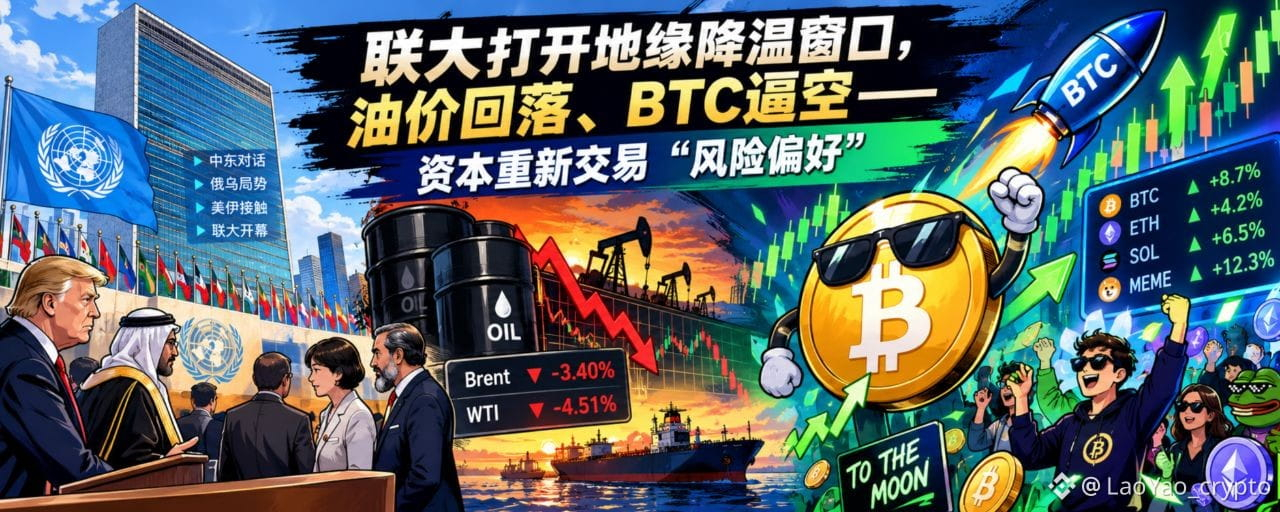
— Capital re-trades the “risk appetite”
Over the past 24 hours, there has been a notable shift in the trading logic of global financial markets:
High interest rates continue to suppress valuations, but the geopolitical risk premium begins to ease at the margin, giving risk assets room to breathe again.
Technology and AI once again become the main drivers of market sentiment. Oil prices fall from their highs, and US stock market risk appetite shows a clear recovery;
Meanwhile, the crypto market sees a rebound in macro risk appetite × short covering × leveraged funds synchronization, with BTC breaking upward on increased volume and making a phased breakout across several key integer levels.
The market is gradually shifting from “Will the war escalate?” to:
Is there a path to end the war?
🧱 Geopolitical maneuvering:
① The Middle East remains an important variable in global asset pricing
Iranian President Pezeshkian and Foreign Minister Aragchi travel to New York to attend the UN General Assembly. Whether the U.S. and Iran are able to have contact becomes the core variable the market is watching.
Meanwhile, the Strait of Hormuz, Saudi energy transportation, and Houthi activities still affect global expectations for energy supply.
But compared with the earlier period, the market has started to trade again the possibility of diplomatic contacts and conflict easing.
The recent clear pullback in oil prices is itself a direct reflection of this risk-pricing change.
Brent crude fell to $100.34, and the WTI near-month contract dropped 4.51%;
The market will regard potential U.S.-Iran diplomatic progress during the UN General Assembly as one of the important factors behind the oil price pullback.
② Opening of the UN General Assembly: the Middle East and Russia-Ukraine become the two main storylines
The 81st UN General Assembly’s high-level week officially gets underway.
The Middle East situation and the Russia-Ukraine war have become key topics. Potential U.S.-Iran contacts, the high-profile “earlier than expected” hints, the arrangements for Trump’s meeting with Zelensky, and Zelensky’s diplomatic activities with the U.S. have all made New York one of the places with the highest information density on global geopolitics right now.
For capital markets, the significance of the UN General Assembly is not just “diplomatic news.”
More importantly:
It provides a window to shift from military maneuvering to diplomatic maneuvering.
③ Trump vs. the media: the White House “ban controversy” continues to simmer
CNN, MS NOW, and Politico have filed lawsuits against the Trump administration in the U.S. federal district court in Washington, seeking to restore press access to the White House, and arguing that the related measures violate the freedom of the press protected by the First Amendment of the U.S. Constitution.
Meanwhile, the joint broadcast pool for presidential activities formed by TV networks such as ABC, CBS, Fox News, and NBC has been paused; this directly affects the regular dissemination of official presidential activity footage.
The case has been heard by U.S. District Judge Timothy Kelly, and the hearing for the related temporary restraining orders is scheduled for Wednesday.
This means the contest among U.S. politics, the media, and the White House is shifting from the realm of public opinion into the realm of law and institutions.
As the U.S. midterm elections approach, these political variables themselves may gradually enter the risk-pricing framework of capital markets.
💹 Capital mapping:
Earlier rate hikes and fiscal financing pressures pushed up U.S. Treasury yields, leaving the long-term cost of capital still elevated.
But the market is not continuing to trade unilaterally under “rate suppression.”
When oil prices pull back and expectations for geopolitical risk ease at the margin, capital begins to search again for growth and technology assets.
This is the market’s most important change today:
It’s not that interest rates suddenly dropped; it’s that the risk premium has started to decline.
📊 Bond market
U.S. 10-year Treasury: about 4.96%
U.S. 30-year Treasury: about 5.30%
U.S. 2-year Treasury: about 4.42%
Japan 10-year government bond: about 2.99%
Long-term interest rates remain high, indicating that the broader environment of rising global capital costs has not changed.
📈 U.S. stocks
Nasdaq: +2.8%
S&P 500: +1.5%
Dow Jones: +0.4%
Technology growth stocks once again led the market, while the energy sector performed relatively weakly due to the pullback in oil prices.
This is essentially a very typical signal of a shift in risk appetite:
The energy risk premium declines → growth technology regains attention from capital.
🛢️ Oil: the war premium begins to loosen
WTI: around $92
Brent: around $100
Crude oil has clearly fallen from its earlier highs. The key is not that the market has confirmed that the Middle East conflict has ended, but rather:
The market starts trading the possibility that “the conflict has a diplomatic resolution path.”
The probability of future facts occurring × the impact on the economy and cash flows.
💸 Web3 roundup
Over the past 24 hours, the crypto market saw an upswing driven by macro risk appetite plus a short-squeeze resonance: BTC broke through multiple major integer levels with increased volume; MEMEs and small-cap coins significantly outperformed the mainstream coins; and speculative sentiment heated up.
- Total market capitalization: $3.01 trillion, up by about $160 billion over the past 24 hours
- Total trading value across the entire market over the past 24 hours: $160.7 billion, with a clear increase in volume
$BTC : Holding steady around the 85K level; the intraday high is shown as 87K, setting a new stage high since January this year. After rallying to highs, it pulled back slightly and entered consolidation;
$ETH : Volatility around the 2,750 line, with a rise that is weaker than BTC. For now, capital is prioritizing Bitcoin, and funds are being diverted away from the ETH ecosystem.
🧘 Crypto circle mindset: an appreciation of hearts
Global financial markets have entered the post-rate-hike repricing phase.
As the UN General Assembly is convened and the U.S. midterm elections approach, the focus is gradually converging toward the U.S. mainland.
Iranian delegates enter the UN General Assembly with their stated demands. Face-to-face communication is reducing the market’s expectations of geopolitical risk.
In the next phase, the core of asset prices still lies in the recombination of four variables:
Inflation × Growth × Geopolitics × Liquidity
What truly determines the trend is what kind of new pricing logic emerges after these four variables are recombined.
📌 LaoYao(@LaoYao_crypto )
Observe capital through heart-mind principles, and discern trends through cycles;
Seek certainty amid uncertainty, and anchor value amid volatility.