
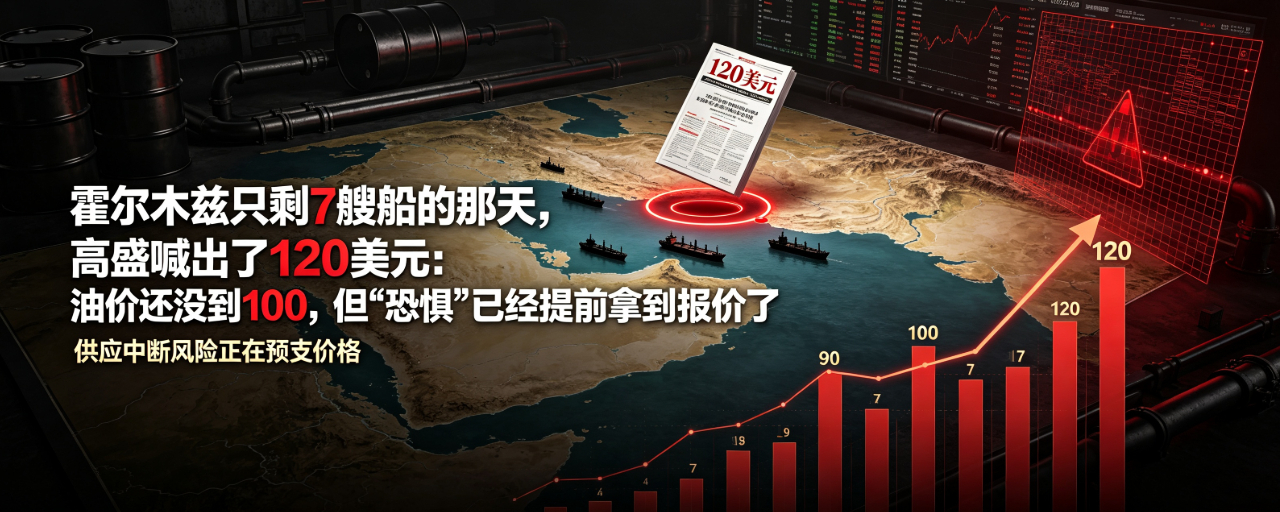

On September 7, only 7 bulk cargo ships passed through the Strait of Hormuz. The day before, there were 8. Over the past 10 days, the daily average was about 10 ships— the lowest since May.
Then Goldman said that in extreme cases, the oil price could surge toward $120.
Please note this combination: the strait has not been shut, the ships have not been stopped, and the oil price hasn’t yet risen above $100—but $120 has already been shouted out. The market isn’t pricing reality; it’s pricing the “terminal price of fear.”
And fear has a particular feature: it doesn’t need Hormuz to actually be closed. It only needs enough people to believe that Hormuz might be closed, and fear will grow into the shape of a $120 price tag all on its own.
Change the subject to “those seven ships.”
If the subject is “Iran,” the story is “military escalation.” If the subject is oil prices, the story is “supply risk.” But if you change the subject to those seven ships that are still passing through Hormuz on September 7, the whole narrative shows a crack.
Why are those seven ships still going? The shipowners aren’t crazy. The crew aren’t crazy. Insurance companies aren’t crazy. They’ve done the math—risk premiums can cover it—so they go. Those seven ships aren’t evidence that “Hormuz is closing.” They’re evidence that “Hormuz isn’t dangerous enough to make it impossible to pass.”
But the market chose another reading: seven ships are low, and low means fear—fear deserves an even higher price. Nobody asks why those seven ships are still moving; they just see “less.”
And the word “less” is translated by Goldman into a number: $120.
Bab al-Mandab traffic is rising: ships haven’t disappeared; they’re just rerouting.
In the material, there’s a detail that gets brushed past: while Hormuz’s throughput declines, traffic through the Bab al-Mandab strait actually increases.
Translate it into plain speech: Ships haven’t stopped. They’re rerouting. Crude oil isn’t stopping its flow—it’s flowing more slowly, at higher cost, and along a more circuitous path.
This is fundamentally different from the horror narrative of “Hormuz being held up.” The cost of rerouting is real—longer voyages, higher fuel bills, more expensive insurance, and less effective capacity. But the other side of rerouting is this: global supply chains are looking for alternatives, not just sitting there waiting to die.
And “Hormuz fear” is precisely exploiting that difference: it packages “rerouting” as a prelude to supply cuts, packages “rising costs” as “supply disappearing,” and packages “seven ships” as the beginning of a total zero.
But between seven ships and zero ships there’s a huge gap. And the $120 quote is calculated using a fear slope from “7 ships → 0 ships,” not from the real slope of “7 ships → rerouting.”
Who is really holding up Hormuz? Is it Iran—or is it those who suggest you should pay for the idea that “Iran will hold up Hormuz”?
The question this news should be asking is not “Will Hormuz close?” It’s “Fear about Hormuz, and Hormuz itself, have become two separate tradable assets.”
In the real world: ships are still moving, oil is still being shipped. Saudi Arabia and Iraq are using pipelines to route around. Non-OPEC countries are increasing production. China has inventories. This is reality. It’s worth $95 to $100.
Another thing happening in the narrative: Iran wants to build a “maritime exclusion zone,” the U.S. targets oil tankers, a shipping organization of 18 countries warns that the rules are being impacted, and Goldman calls for 120. That is fear. How much is it worth? It is worth “whatever you’re willing to pay for it.”
And the wonderful thing about fear is this: every dollar you pay for it becomes evidence that it’s real. Oil prices rise because of fear, then the higher oil prices are written up as “the market believes the risk of supply disruption is increasing,” and then more fear is produced. Then Goldman calls 120 again.
Goldman doesn’t need Hormuz to close. It only needs to call out 120, then wait for the market to push the price there on its own. When everyone is staring at the same number, that number becomes a magnet.
“Ships don’t want to leave” and “there are fewer ships” are two different things.
The most core sentence in the material is: “Real danger has never been a single oil tanker being attacked. It’s that more and more ships start to feel: this route isn’t worth the risk.”
This sentence is only half right. It gets right the importance of “the psychology.” But it doesn’t get the other half: it isn’t that ships don’t want to leave—ships are waiting. Waiting for insurance premiums to fall. Waiting for escort arrangements to be in place. Waiting to confirm the detour routes. Waiting for the first wave of panic to pass.
The difference between “waiting” and “not wanting to leave” is this: waiting is temporary, while not wanting to leave is structural. Now, the data for Hormuz supports “waiting,” not “not wanting to leave.” And those seven ships that are still moving are the best evidence for that “waiting” judgment.
The market turns “waiting” into “not wanting to leave,” because “not wanting to leave” sounds more like a disaster movie and sells better. But between disaster movies and documentaries is a distance of $120 versus $95.
The thing that keeps people up the most
Hormuz handles about one-fifth of the world’s oil transport. It is the lifeline of global energy supply. Every slowdown it experiences deserves to be taken seriously.
But the real danger may not be Iran’s “maritime exclusion zone.” It may not be the U.S.’s military actions. It may not be that there are fewer ships.
is that “risk itself” is becoming a commodity. And the pricing logic for commodities is: the scarcer it is, the higher the price. The thicker the fear of Hormuz, the higher the fear’s price. When Goldman calls for 120, it’s giving a price quote for this commodity. Energy bulls betting on higher prices are stockpiling this commodity. And those seven ships still moving are the only “inverse indicator” for this commodity.
What really keeps people up at night is: when “Hormuz might close” becomes an expectation that can be traded, priced, and taken long, who is really holding up Hormuz? Is it Iran, or is it those who tell you to pay for the idea that “Iran will hold up Hormuz”?
Oil prices haven’t reached 100 yet. But fear has already secured a quote of 120. And that quote is waiting for more ships to leave the strait—to prove it is right.