


Written by: Bixin Ventures
Where are we now on the Ethereum roadmap?

Ethereum mergers have been going on throughout 2022. Ethereum has passed the Paris upgrade, transitioning from proof of work (PoW) to proof of stake (PoS). On April 12, Ethereum will undergo the Shanghai and Shapella upgrades, staked ether can be withdrawn, and Ethereum will be completely transformed into a blockchain with a proof of stake mechanism.
In the following article, we will share the background of the "Shapella" upgrade, its impact on $ETH price, who the beneficiaries are, and what the next steps are for the Ethereum roadmap.
Background of Shapella Upgrade
Although Shapella appears to be a single change to Ethereum, it is actually a merger of the names of two simultaneous upgrades — Shanghai and Capella. Ethereum’s execution layer will undergo the Shanghai upgrade, while its consensus layer will undergo the Shapella upgrade.
While the Shanghai upgrade consists of five EIPs, the most important of these is EIP-4895, which enables all ether staked and locked by validators in Ethereum’s consensus layer (the beacon chain) since its launch in December 2020 to be withdrawn. Shapella, the third major upgrade to the consensus layer, is designed to facilitate this process, not only allowing blocks to process withdrawal requests, but also implementing an account cleanup function, which we will explain in detail later.
Once the Shanghai and Shapella upgrades are complete, ETH withdrawals will be available in full or partial amounts.
Partial Withdrawal
Partial withdrawals involve only the portion of the amount that exceeds the 32 ETH required to run a validator. This account cleanup (or "scraping") happens automatically and periodically for any active validator that has updated to the new withdrawal credentials.
This feature is extremely useful for two main reasons:
Since validator rewards are not automatically reinvested, this mechanism can improve the capital efficiency of stakers' funds. Stakers will be allowed to reallocate their excess ETH to obtain other benefits without having to pay any gas fees.
Additionally, partial withdrawals can prevent long exit queues and excessive validator rotation, which would otherwise require validators to exit the beacon chain entirely to access their rewards, which would potentially destabilize the network.
Since only 16 partial withdrawals can occur per epoch, the frequency of slashing withdrawals depends heavily on the total number of eligible validators. Validators should expect the interval between partial withdrawals to be between 2 and 5 days.
Full withdrawal
If a validator chooses to completely "exit" as an active validator of the network, they will take back 32 ETH and all rewards accumulated since their creation, and a full withdrawal will occur during this process.
Similar to other PoS blockchains, validators will have a vesting period during which they will wait until their full stake and reward balance is received. The length of this vesting period is determined by the sum of two variables, the time it takes for the validator to exit the Ethereum consensus layer and the time it takes for the entire withdrawal process to complete. Therefore, validators seeking to perform a full withdrawal should expect at least 261 epochs or 28 hours.
Another factor to consider is the circulation limit. This defines the maximum number of validators that can exit the consensus layer per epoch, a number that increases with the total number of active validators. Currently there are about 525,000 validators, and 8 exits are allowed per epoch, which equates to a maximum of 1,800 validator exits per day. Consensys explains in detail how these estimates are achieved in the post.
What does this mean for the price of $ETH?
With over 18 million ETH staked on the beacon chain so far, it’s easy to see why investors were apprehensive in the months leading up to the Shapella upgrade. On the surface, enabling withdrawals should result in a supply shock that would put significant downward pressure on the price of ETH. But what will the real impact be?
Current ETH stakers
To estimate the potential price impact, we need to first assess the state of existing stakers and the decisions they might make. We believe these decisions are largely driven by the staker’s financial situation. In other words, are ETH stakers making a profit or a loss?
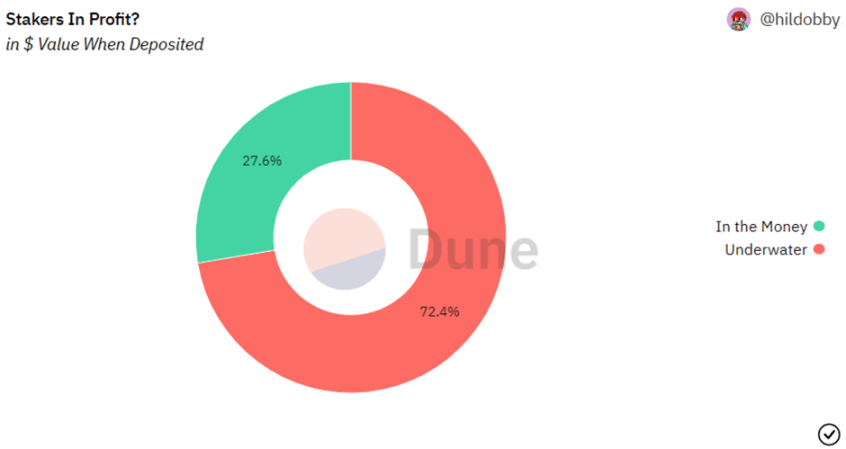
The data provided by hildobby shows that based on the value of ETH stakers’ assets, only 27% of them are actually profitable, while the remaining 73% are at a loss. Based on this data, stakers are aware of the loss of selling their current ETH, so they will re-stake their rewards to maximize future returns.
 The amount of pledged liquidity in the pledge agreement
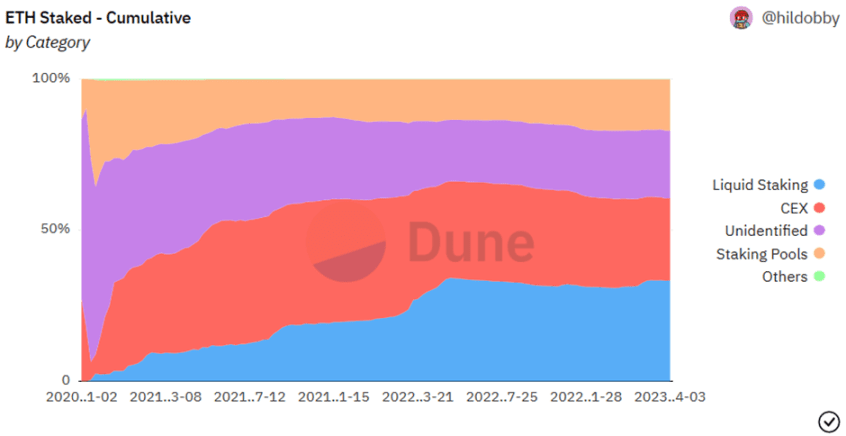
Another factor is to consider how much ETH has been staked through Liquid Staking Protocols (LSPs). At the time of writing, according to DefiLlama, that number is over 30% (closer to 45% if you include the amount staked on Coinbase), with the majority of ETH being staked on Lido.
In the case of Lido, stETH is automatically readjusted to take into account the cumulative rewards earned from liquidity staking. This means that users who choose to stake in Lido can "get" ETH rewards by selling them on the secondary market. Therefore, for the validators behind Lido, the pressure of direct withdrawals is relatively small, and they can handle excess rewards more flexibly.
We believe that these validators would be better served using these excess rewards by expanding their validator count rather than selling them, thus further alleviating the overall downward pressure on ETH price from withdrawals and inflows.
 $ETH Price
Now that we’ve considered the key factors that determine the potential sale of ETH rewards, what does this mean for the $ETH price?
If we assume validators will sell 50% of their staked ETH rewards (as opposed to their primary staked ETH), we estimate that 553,650 ETH will be sold. Amortized over 7 days, this equates to selling ~1% of daily ETH volume (including spot and perpetual futures volume) per day. Based on the overall risk environment and overall liquidity conditions for ETH during the expected Shanghai upgrade in early April, we believe the impact of this amount will taper off to a slightly lower ETHUSD. An alternative view is that a smooth Shanghai upgrade is an overall bullish factor for Ethereum as a technology, and therefore ETHUSD will rise. — Galaxy
While we cannot provide a price prediction, we would like to share the perspective of Galaxy, who wrote an article exploring possible outcomes based on partial and full withdrawal execution volume, which we highly recommend reading.
Regardless of where the price ends up, we believe Shapella will bring new opportunities to Ethereum, as we’ll share below.
Beneficiaries of Shapella Upgrade
Liquidity Staking Protocol
The Shapella upgrade could be a bull catalyst for the Liquidity Staking Protocol (LSP) from many perspectives.
With ETH available for withdrawal, it should be easier and more economical for LSPs to maintain the price peg between their respective Liquid Staking Derivatives (LSD) and ETH. This allows LSD to better borrow collateral, as a tighter peg helps limit price volatility, thereby reducing liquidation risk. Coupled with the growing adoption trend of LSD in the Ethereum DeFi ecosystem, this will become an opportunity for investors seeking more capital-efficient returns.
Tighter pegs also facilitate liquidity staking of ETH, which is more like a "risk-free" or benchmark rate for investors. They used to be cautious about being able to peg for a long time, because the peg depends heavily on the balance of supply and demand in various liquidity pools. And there have been recent failures (stETH depreciated due to a massive sell-off on the curve), which is impressive.
For these reasons, we expect that most of the extracted ETH and idle ETH will flow into LSPs, and their adoption rate will increase further. But which LSPs are better prepared than others? We will introduce some different LSPs below, including what they do, their flywheel effect and feedback path, and how these LSPs give users more control over their withdrawal keys, NFT utilization, and MEV strategies to obtain additional returns.
Lido Finance (LDO, stETH)
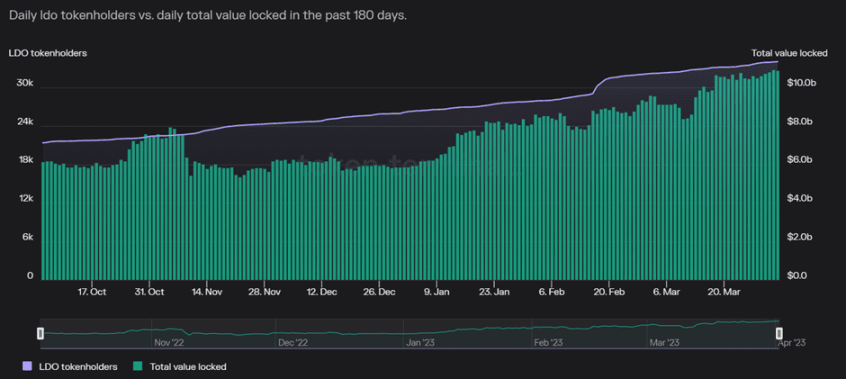
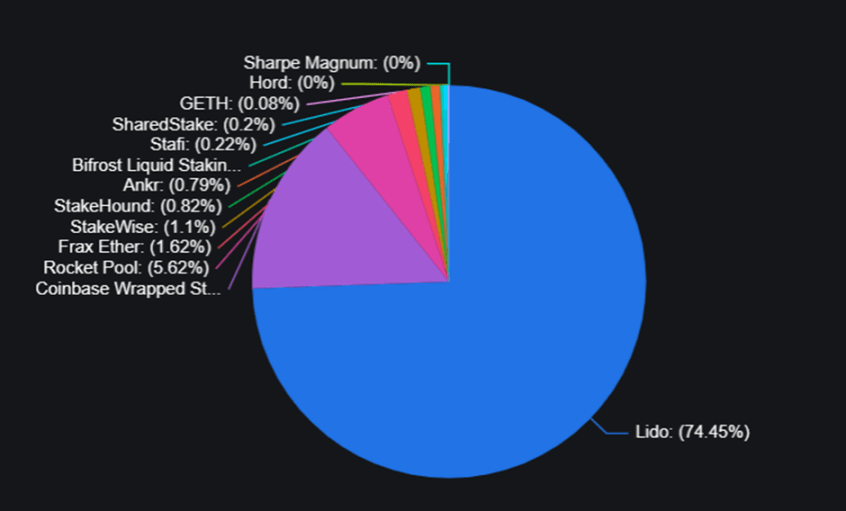
After the upgrade, it is clear that Lido's TVL will grow significantly, making it a leader in the LSP space. With a strong reputation, deeper liquidity, and a large number of DeFi integrations, users looking for liquid staking projects have good reasons to choose Lido. Since November, Lido's number of token holders and TVL have been on an upward trend, accounting for nearly 75% of the total ETH staked to date.
With concerns about centralization arising from Lido’s growing position in the LSP race, coupled with increased scrutiny on governance following the Arbitrum incident, governance systems will be more important than before. While they have taken steps to include stETH holders as part of the LDO holder governance system, which is commendable, users who want to help decentralize the ETH token can also consider the other alternatives we list below. Lido also recently announced that its upcoming v2 will take a step towards further decentralization and revolve around two major upgrades: withdrawal and staking routing.
Swell Network
Swell Network is also an upcoming LSP that aims to provide users with higher staking returns. Currently, their latest version Seawolf is already running on the Goerli testnet, and Swell is preparing to launch on the Ethereum mainnet in late April after the Shapella upgrade. Although it will initially still need to work with a group of authorized professional node operators to provide users with large-scale, reliable returns in a competitive environment, subsequent iterations will see the expansion of the operator set and eventually become permissionless, with sufficient liquidity, stability, and risk mitigation technologies such as DVT, which are consistent with the value orientation of the protocol.
Swell's liquid staking token, swETH, will be a yield-bearing token whose value increases as on-chain rewards accumulate. Users can earn rewards through consensus layer rewards (such as staking yield) and execution layer rewards (such as priority fees and MEV). Users who stake in the Swell Network will also have access to a vault that runs yield-enhancing strategies, all within their dApp. Swell will serve as the lowest-cost staking project on the market, with no protocol staking fees.
Rocket Pool (RPL, rETH)
Rocket Pool appears to have some advantages over more dominant players like LDO, such as a more decentralized network of node operators and lower capital requirements for node operation (only 16 ETH). However, it also has its own disadvantages. These disadvantages include higher performance fees compared to competitors and the fact that node operators must lock a certain percentage of the value of their staked ETH in RPL as collateral for protocol insurance.
Despite this higher friction for users looking to operate a node from Rocket Pool, the benefits of the upcoming Atlas upgrade may be enough to offset it. Scheduled for release on April 18, the Atlas upgrade brings several improvements, including improved protocol efficiency, increased node operator rewards, and a significant increase in rETH capacity, while maintaining the fully permissionless nature of the protocol. One of the most important features is the introduction of 8-ETH mini-pools, which will further reduce minimum capital requirements. At the same time, this feature can bring higher returns to node operators and rETH stakers, providing up to 18% additional returns when users run two 8-ETH mini-pools instead of one 16-ETH mini-pool. While this is good for Rocket Pool's future development, we still need to observe whether the update is truly effective in attracting TVL and market share from its competitors.
Frax Finance (FXS, frxETH/sfrxETH)
This year, Frax has grown rapidly in market share and has become a strong competitor, and the future is still promising. This growth can easily be related to the highest annualized staking yield of around 5.6% offered by Frax, as well as its dual-token model. In this context, frxETH acts as a stablecoin loosely pegged to ETH, and sfrxETH is a staking version of frxETH that can earn staking rewards. With this design, Frax enables frxETH holders to earn returns in multiple ways, namely staking to earn sfrxETH and validator rewards, or providing frxETH-ETH liquidity on Curve. Together, these two options not only create deeper liquidity for frxETH, but also increase the annualized yield in sfrxETH and Curve liquidity pools.
Like Rocket Pool, Frax is also planning to upgrade after Shapella, which could be a strong catalyst for its adoption. The frxETH v2 upgrade is planned to increase decentralization by enabling tokens that are not restricted to validators (run by the protocol itself). In addition to this, a proposal was recently passed to use FXS bribes and incentives to kickstart liquidity for future frxETH trading pairs, creating a powerful flywheel that theoretically will eventually lead to an increase in the value of FXS and frxETH, as well as generating higher yields and attracting more liquidity for LSD. ZhouYeMen from DWF Labs explains this topic in great detail here.
Ether.fi (eETH)
Ether.fi is another decentralized LSP entering the market, but it has some important differentiating features. Ether.fi uses a non-custodial delegated staking protocol where users generate and hold their own ETH keys. Another feature is that it utilizes NFTs, minted for each validator launched through the protocol. These NFTs control a stake of 32 ETH and store metadata related to the validator, such as the client, geographic location, node operator, and any node services. Ether.fi's eETH is then minted from the liquidity pool of these NFTs.
The combination of these two mechanisms enables users to submit exit commands themselves, rather than the usual node operators. The reclaimed collateralized ETH will be deposited into a withdrawal-safe safe, where users will be able to net their ETH back by destroying their NFTs. This successfully reduces the significant and opaque counterparty risk that users have in other LSPs, while ensuring that there will always be enough ETH liquidity for eETH holders to redeem. As a result, we expect Ether.fi to be one of the LSPs that sees a surge in users and TVL after Shapella.
In the future, Ether.fi plans to use EigenLayer to create a node service market where users and node operators can register their minted NFTs, provide node infrastructure services, and share the revenue from these services with users and node operators. Currently, Ether.fi already provides institutional equity delegation services, customized investment structure services, and develops early user programs for retail liquidity equity. With the enablement of ETH withdrawals, institutions may also view ETH equity delegation as a viable investment, and Ether.fi is positioned as one of many beneficiaries.
Manifold Finance (FOLD, mevETH)
Manifold is also a new player in the LSP space, having launched its MEV-optimized, multi-chain LSP less than a week ago. mevETH is implemented as an all-chain universal token (OFT) that can be directly bridged between chains without a wrapper, making it the most composable LSD to date. At the same time, mevETH is designed around MEV capture, using Manifold LSP’s unique, novel MEV approach to provide users with additional yields in addition to staking yields. One of these approaches is through arbitrage of the peg between ETH and mevETH, which not only provides a means of additional yield, but also helps to strengthen the peg relationship.
Manifold has stated that their goal is to accumulate 100K ETH by the end of this year, which is about one-sixth of the ETH currently staked by Lido. As LSD is gradually integrated into existing DeFi protocols, mevETH's high composability may drive it to become a leader in adoption and carve out a strong market share for itself.
Opinions on LSD
Regardless of which protocol ultimately benefits the most from the Shapella upgrade, ETH staking participation will almost certainly increase due to the increased attractiveness of liquid staking, either due to natural accumulation or protocol-driven development. Based on the staking ratios of other PoS chains, such as Polygon and Solana, it seems possible that the ETH staking ratio could increase to the 40–70% range, at least 2x higher than the current 15%. While this may raise concerns about eventual declines in staking returns and greater supply inflation, it also opens up a number of other opportunities and possibilities, which we will explore below.
DeFi
Pendle Finance (PENDLE)
Pendle is a yield trading protocol that allows users to execute various yield management strategies by wrapping a yield token and splitting it into two tokens — PT representing the principal and YT representing the yield, both of which can be traded through their custom AMM. 1 PT gives users the right to redeem the underlying asset at maturity, with the expiration date determined by the initial token holders, while 1 YT gives users the right to receive the yield on the underlying asset before the expiration date. This allows Pendle to essentially create a yield market, enabling users to adopt a variety of strategies, including holding assets for the long term at a discount, targeting an annualized rate of return, and even obtaining fixed income with low risk and stable growth.
Similarly, locked ETH users can use Pendle to split their stETH into 1 PT stETH and 1 YT stETH, and then use Pendle's custom AMM to trade either token and make directional bets on the returns. With the upcoming Shapella upgrade and the expected decrease in staking yields over time, one possible trade stETH holders can take is to use the current price to sell YT stETH to obtain the difference based on their existing returns.
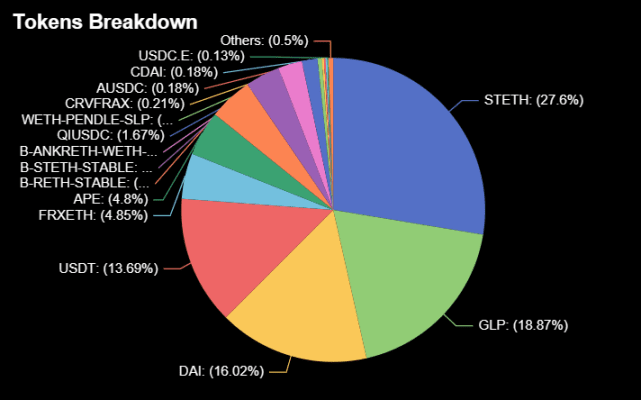
Since December, Pendle’s TVL has experienced a 7x surge as more and more users discover its potential. According to DefiLlama’s token TVL breakdown, more than a third of it can be attributed to LSD, including stETH and frxETH. With Pendle’s latest integration of sfrxETH, we may see LSD’s share of Pendle’s TVL increase.
Gearbox (GEAR)
On the topic of leverage, the tighter connection between LSD and ETH after the aforementioned Shapella upgrade reduces liquidity risk and unlocks the feasibility of leveraged ETH staking. Gearbox is a two-way lending market that connects users seeking to provide their assets through passive and safe APY with leverage enthusiasts seeking additional capital. The protocol introduces leveraged liquid staking derivatives, or LLSD, as a single-click strategy that allows users to natively stake up to 10 times the value of their ETH collateral to obtain higher staking returns, up to 12% or more, compared to the 4.3% APR currently offered by Lido.
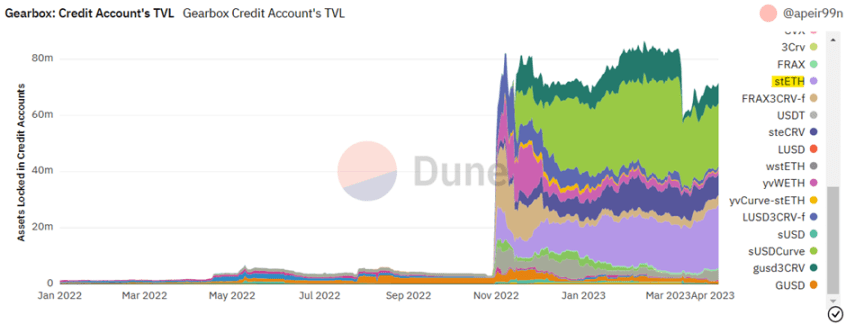
So far, the strategy has been enabled for Lido's stETH and Coinbase's cbETH (pending DAO vote), with plans to integrate Frax and Rocket Pool's frxETH and rETH once they have mainnet Chainlink oracles, respectively. As a leveraged base layer, Gearbox is positioned to indirectly benefit from the projected increase in ETH staked and the growth and adoption of LSP and LSD as more ETH stakers look for relatively low-risk ways to increase their staking returns. Over the past few months, stETH has accounted for more than a third of Gearbox's total credit account TVL, about $22 million.
With the launch of Gearbox v3 just around the corner, one can expect new features such as automated portfolio management and health factor maintenance, further incentivizing LSD token holders to take advantage of Gearbox’s leverage capabilities, pushing it to the forefront of DeFi.
Flashstake (FLASH)
Flashstake is another novel protocol that introduces a unique mechanism to increase the capital efficiency of user assets. Users deposit and stake their assets, lock in the current yield APY, and mint time-based derivatives (TBDs) corresponding to their holdings. Users can then burn or exchange these TBDs to receive an upfront yield on their assets, getting their principal deposit back after the chosen lock-up period. This is especially interesting, considering that ETH’s staking yield is expected to decrease over time. Flashstake enables early users to not only secure and fix the current (supposedly highest) ETH staking yield for up to 1 year, but also continue to generate yield elsewhere.
Understandably, this may raise some concerns. Where exactly do these prepaid yields come from? In order to provide this yield to users, Flashstake uses a three-pool approach consisting of a yield pool, a liquidity pool, and an acceleration pool.
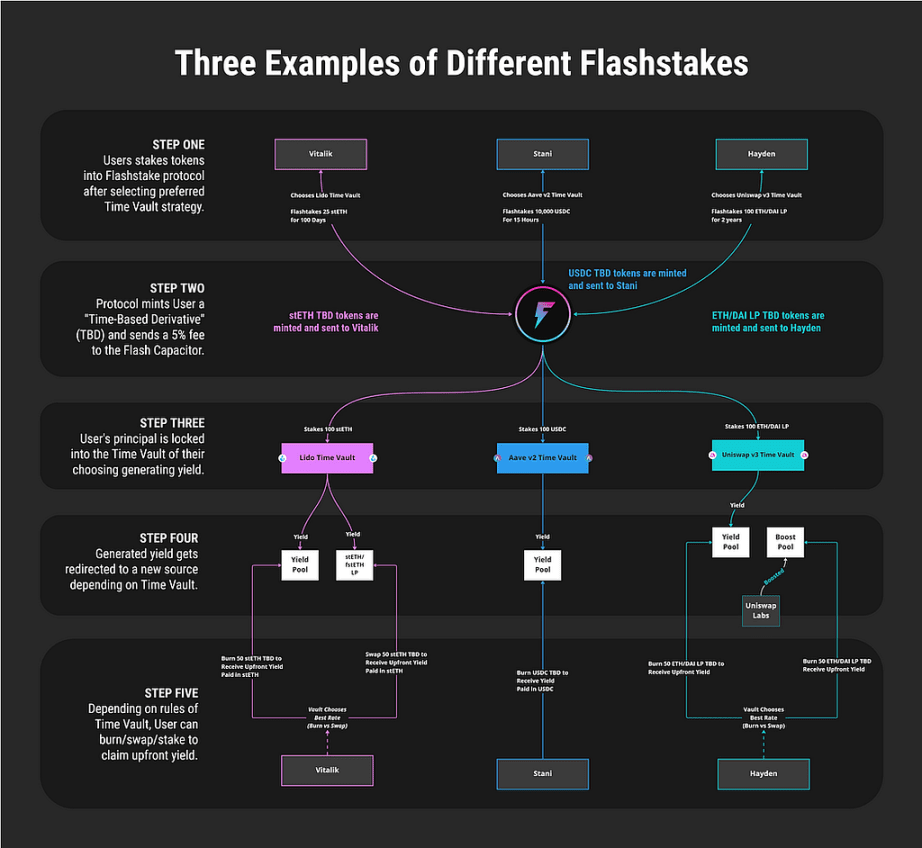
Unlike lending, Flashstake’s pool-based approach also ensures that users’ deposited assets are always 100% collateralized and are not subject to any liquidation risk. The isolation of each vault’s strategy also provides an additional layer of security for users, as the impact of any potential attack is limited to the affected vault. With its strong value proposition and innovative mechanisms coupled with strong security, Flashstake’s total locked value seems well positioned to benefit from the influx of liquid ETH and the increase in liquid proof-of-stake.
Re-pledge
OwnLayer
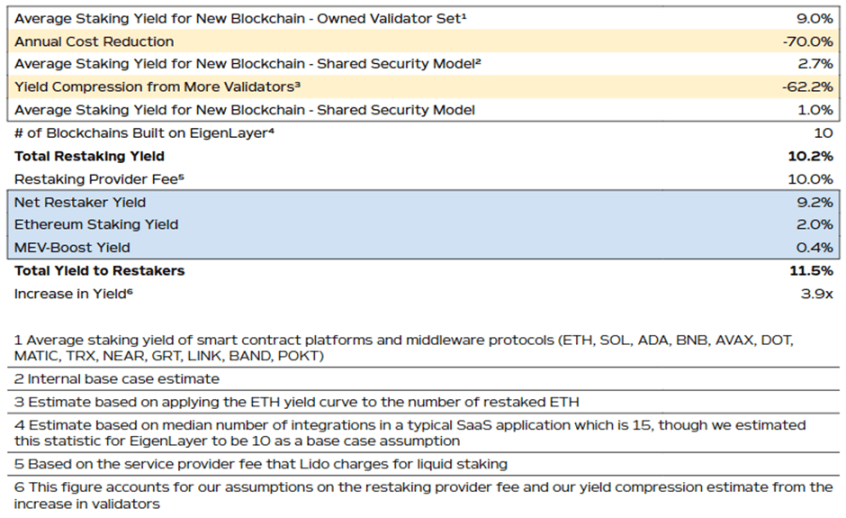
With the Shapella upgrade enabling withdrawals of Ethereum, ETH locked using EigenLayer contracts can be withdrawn and reduced if malicious intent is detected. This paves the way for EigenLayer to become a decentralized trust layer built on applications where existing ETH holders can choose to use their stake to secure new applications on EigenLayer. EigenLayer’s re-hypothecation mechanism provides users with an incremental yield opportunity beyond what they would earn by simply staking ETH and earning MEV-related rewards, while achieving its primary purpose of modularizing Ethereum’s trust layer and enabling a broad design space for new middleware and adjacent chains.
Finality Capital Partners expects ETH re-mortgagers to earn up to 11.5% APY by 2028, with a base ETH staking yield of around 2.0% in 2028. This 2.0% staking yield is based on their expectation that the ETH staking ratio will reach 60%, rather than the current 15%. Therefore, we see that re-mortgaging through EigenLayer will become a common practice for ETH holders, especially those who are looking for relatively low-risk methods to increase their returns.
 New innovations
Ion Protocol
Despite some success in increasing LSD adoption in DeFi, significant friction remains today. With multiple different LSD and liquidity staking designs, DeFi protocols that want to integrate each of them will require multiple custom and novel solutions. For example, Uniswap cannot accept rebased LSDs like stETH from Lido, and blue-chip protocols like Aave and Maker need to create separate vaults and pools for different LSD tokens. This results in fragmented and shallow liquidity for LSD, leading to increased slippage and inefficient price discovery, defeating their original purpose of representing staked ETH and distributing staking rewards.
Among its many goals, Ion Protocol aims to provide a solution to the above problems by aggregating deposits of various existing LSD tokens into a common unit of account using a dual-token model. This common unit of account will allow for better frictionless integration into DeFi, leveraging the full potential of LSD as a low-risk, yield-generating collateral, and even improving capital efficiency through leverage.
UnshETH (USH)
UnshETH promotes decentralization of validators through incentives, directing more revenue to LSPs with less dominance. This is done through a new class of primitives called LSDfi, including Validator Decentralized Mining (vdMining) and Validator Domination Option (VDO).
vdMining is a token distribution mechanism that rewards users the more they stake on LSPs that meet a predefined optimal decentralization ratio, while VDO is a mechanism that allows holders of a dominant LSD to sell “put options” on their validator dominance percentage, with a strike price set at a percentage below their current dominance. If dominance is below the strike price at expiration, VDO holders lose a portion of the proceeds, which are distributed to holders of other LSDs. These two mechanisms combine to incentivize new stakeholders to do so with less dominant LSPs, and incentivize more existing dominant LSD holders to diversify their capital across a variety of LSPs.
Plans for new features after the Shapella upgrade are also in place, including routers for staking ETH liquidity and others that help increase the utility of UnshETH's native token USH. Next, we will see how much TVL UnshETH will eventually capture and whether staking can become the de facto yield solution for ETH holders.
Zero Liquid (ZERO)
Zero Liquid is another new protocol that may be a new track for LSDfi, issuing self-repaying loans for users’ LSD. Similar to more traditional money market protocols such as Aave and Euler, users first deposit assets as collateral and are then able to obtain loans for a portion of their collateral value.
In the case of Zero Liquid, users are able to deposit LSD and protogenesis tokens (ETH, MATIC, etc.) as collateral and receive synthetic versions of the assets as loans. However, the characteristics of these loans are their 0% interest and self-repaying nature, which combined with the use of synthetic assets allows the protocol to provide a zero-liquidation model. Zero Liquid achieves this goal by automatically repaying debt using the returns generated by users' deposited collateral.
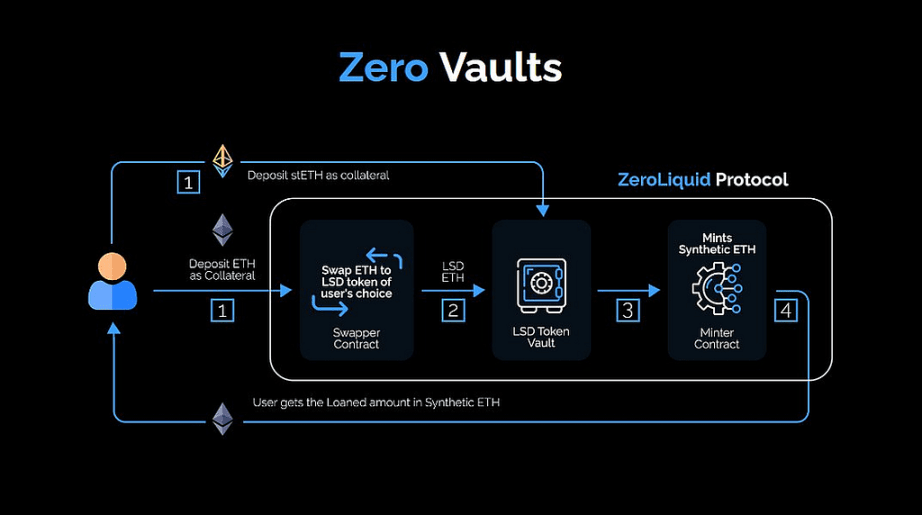
While the protocol has yet to officially launch its product, one can already foresee many unique use cases beyond maximizing user assets, where it comes in very handy. With Zero Liquidity, users can essentially invest and make purchases without requiring any upfront capital. With some similarities to the real-world “buy now, pay later” model, payments through Zero Liquid’s product will allow users to buy or “spend” instantly and only pay with the future yield (or time, depending on how you look at it) of their deposited collateral.
Just like UnshETH, Zero Liquid introduces entirely new models and mechanisms to solve existing problems faced by users, while unlocking potential and increasing the use cases of LSD. Still in their early stages, both protocols still have a lot to prove in terms of PMF and their actual ability to attract users to achieve their set goals, but there is no doubt that these new developments provide more reason for optimism for LSD.
What happens after Shapella?
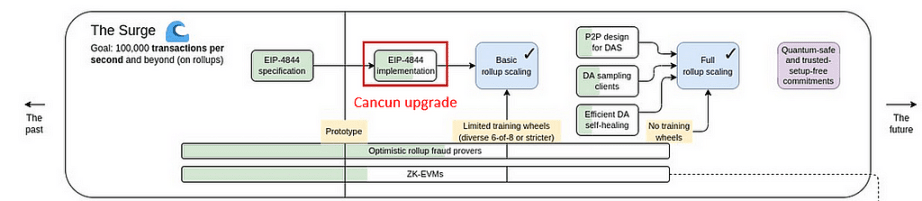
After Shapella, the next much-anticipated Ethereum upgrade will be the Cancun upgrade, which is part of the scaling roadmap. While second-layer scaling solutions like Optimism and Arbitrum have reduced costs by more than 8 times, data storage fees are still high, accounting for more than 90% of transaction costs.
EIP-4844 aims to reduce the cost of L2 rollups by 10–100x and usher in a new era of low-cost on-chain activities by introducing proto-danksharding to Ethereum. It provides support for implementing the Danksharding scheme (e.g. transaction format, validation rules). EIP-4844 introduces temporary "blob" storage that can be deleted from Ethereum when it is not needed. Ethereum is expected to provide more than 100x throughput and reduce transaction costs to less than $0.001.
Other improvements that may be in the Cancun upgrade include six EIPs in the EVM Object Format (EOF) group that have been accumulated for many years. They are aimed at better structuring bytecode, or computer object code, so that interpreters can convert it into binary machine code for computer hardware processors to read, making systems faster, more efficient, cheaper and more secure. One of them has been included in the previous London upgrade, some may be in the upcoming Shanghai upgrade, and the rest may come with the Cancun upgrade. EOF2 is a new EOF extension that can completely change the control flow, and these EIPs will provide support for the implementation of EOF2.
The direct beneficiaries of the Cancun upgrade will be rollups and users that can be directly deployed by Dapps. New applications will also be able to benefit from this upgrade due to the significant reduction in transaction costs, such as lower costs for on-chain order books, and decentralized physical infrastructure networks will be able to take advantage of faster L2 transactions while settling to the trusted Ethereum base layer. We will further explore these opportunities as the Cancun upgrade approaches.