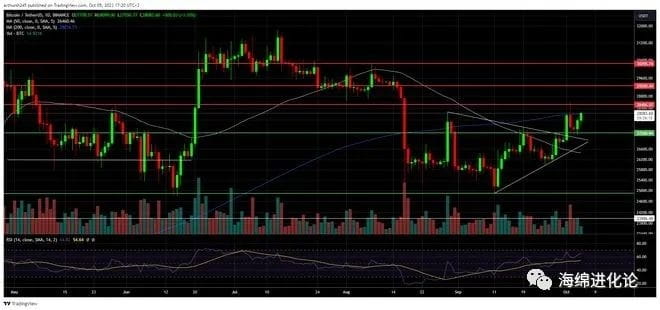
In early Asian trading on Friday (October 6), the US dollar index fell below 106.50, dropping to as low as 106.33. Safe-haven funds did not flow into precious metals, and gold continued to be under selling pressure at $1,820. The collapse of US Treasury bonds has strengthened the view of suspending interest rate hikes. Mary Daly, president of the Federal Reserve Bank of San Francisco, agrees that there is no need to make any hasty decisions on interest rates as the labor market shows signs of recovery. Bitcoin ushered in the century trial of FTX founder Sam Bankman-Fried (SBF). American whale investors flashed positive signals at $27,500 and began to adjust their interest in Bitcoin.

Two major dovish events in the United States: U.S. Treasury bonds are collapsing and Federal Reserve officials are signaling a "pause in interest rate hikes"
A surge in U.S. borrowing costs has bolstered investors’ confidence that the Federal Reserve is done raising interest rates after months of aggressive hikes in its historic fight against inflation. Treasury yields hit their highest in more than a decade this week, raising funding costs for businesses and consumers, which could slow the economy and push down prices if the Fed doesn’t take further action.
The latest senior official to espouse that view is Daly, who said Thursday the central bank doesn't need to "make any hasty decisions" about interest rates as the labor market shows signs of recovery. The economy has cooled, price pressures have eased and Treasury yields have risen sharply. "If financial conditions, which have tightened substantially over the past 90 days, remain tight, then the need for us to take further action will diminish," she said in prepared remarks.
Daly, who will not be a voting member of the rate-setting Federal Open Market Committee until next year, added: "If we continue to see a cooling in the labor market and inflation moving back toward our objective, we can hold rates steady and allow policy to continue to work."
She made the comments a day before the release of the U.S. nonfarm payrolls report, which is expected to show a modest slowdown in hiring. Goldman Sachs' financial conditions index, which measures corporate borrowing costs, has reached its highest level in a year. This week, the benchmark 10-year Treasury yield hit a level last seen in August 2007, at 4.9%. The 30-year Treasury yield also hit a nearly 16-year high, rising above 5%. Yields retreated from their peak on Thursday.
Bond yields rise when prices fall. Treasury yields climbed after the market plunged after Federal Reserve officials adopted a "longer-higher" approach to rate-setting in September, signaled support for another quarter-point rate hike and slashed expectations for future rate cuts.
However, investors now think a new rally is unlikely. Futures markets are pricing in about a 30% chance of a 25 basis point increase in December, down from 40% on Friday and more than 50% two weeks ago. "The bond market has heard clearly that they are long higher and effectively tightening monetary policy," said Priya Misra, portfolio manager at JPMorgan Asset Management. "The goal of monetary policy is to tighten financial conditions, and they just did that last week."
Misra said that offsets the need for further rate hikes this year, suggesting the central bank has squeezed the economy enough to sustain price pressures with the federal funds rate at a 22-year high of 5.25-5.5%.
Mike Cudzil, senior bond portfolio manager at PIMCO, added that the recent rise in Treasury yields "means the Fed needs to do less."
The bond sell-off occurred because the U.S. Treasury has increased borrowing in recent months to cover a widening budget deficit and make up for falling tax revenues, increasing supply.
“If yields continue to rise as quickly as we’ve seen, the likelihood of problems and dysfunction increases,” said Marc Gianninoni, chief U.S. economist at Barclays, who previously worked at the Fed’s regional banks. He said that could deter the central bank from further action, though for now he still expects the Fed to raise rates again this year.
The US dollar fell below 106.50 in the face of dovish sentiment, and gold continued to sell at 1820
The dollar fell for a second day in a row, but the move was still seen as a correction with no major fundamental changes. U.S. economic data showed that initial jobless claims remained near monthly lows and below expectations, suggesting that labor market conditions remain tight.
The key event on Friday that will determine the direction of the dollar will be the US non-farm payrolls report (NFP), with the market expecting an increase of 170,000 and the unemployment rate expected to fall from 3.8% to 3.7%. A positive report could strengthen the dollar's gains, while a weak reading in line with the "small non-farm" ADP data could trigger a correction and rebound in US Treasury yields.
The dollar index fell for a second day, falling below 106.50 and retreating further from its monthly high. The decline was driven by a drop in U.S. Treasury yields, with the 10-year yield falling to 4.71% and the 2-year yield retreating to 5.02%.
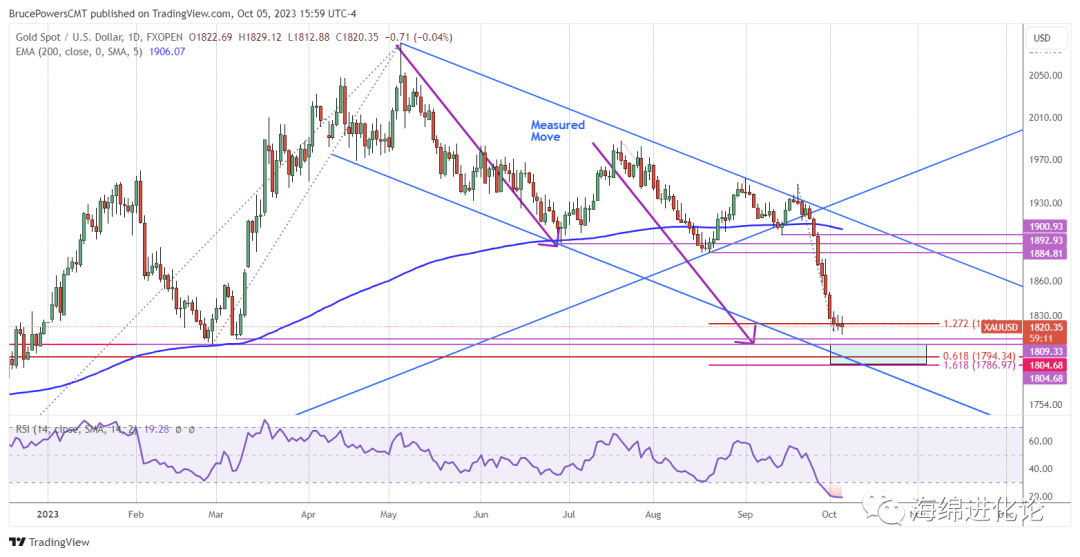
Bruce Powers, an analyst at FXEmpire, said that gold prices triggered an inside line and fell, but there was no overwhelming selling pressure because support appeared relatively quickly at the intraday low of $1,813. This is a new low for the adjustment, but it is only $2 lower than the trend low of $1,815 two days ago.
Friday's price action continues the overall bearish pattern of lower daily highs and lower lows, and will likely see a minimum daily close on the correction. However, a close would complete above the $1,815 low, which is stronger than the actual level. The past few days of price action suggest that the bearish momentum has slowed as the relative strength index (RSI) continues to become more oversold. The current reading is 19.27, and the last time the RSI was oversold was in 2018.
As downward pressure remains and continues to dominate gold sentiment, the continuation of the bearish trend may win. A break below Friday’s low of $1813 signals a potential bearish continuation. Because as seen today, the initial trigger may not immediately follow through or may reverse. Therefore, price action should be observed after the signal appears.
The next lower target area is $1809 to $1787, which is based on the February swing low of $1805. In addition, the measured move was completed at $1807. Other price levels within the potential support zone are derived from Fibonacci levels, including the 61.8% Fibonacci retracement level at $1794.
Gold prices have fallen for 11 consecutive days without a significant rebound, which proves the extent of selling pressure during the decline, and it may also increase the chances of testing lower support areas before the selling pressure is relieved. A break below the $1,805 swing low may bring more panic to the gold market than it has so far. In addition, it may also eliminate weak holders by triggering stops located below this swing low. However, the recent sharp sell-off may bring a sharp rebound once the market sentiment turns from bearish to bullish.
Bitcoin faces SBF century trial, and American whale investors are ready to move
SBF’s trial of the century in New York appears to have given institutional investors confidence in Bitcoin, and a key on-chain indicator shows that U.S. whales have begun to increase buying pressure this week. The Coinbase Exchange Premium Index, tracked by CryptoQuant, shows the percentage difference between the Bitcoin price on the Binance spot market and the Coinbase Pro trading platform.
It is worth noting that Binance dominates the global retail trading market. Meanwhile, trading activity on Coinbase Pro is dominated by US corporate entities and high-net-worth traders who want to trade in a more regulated environment. Therefore, when Bitcoin's Coinbase Premium Index enters positive territory, it indicates that buying pressure from US investors is increasing.
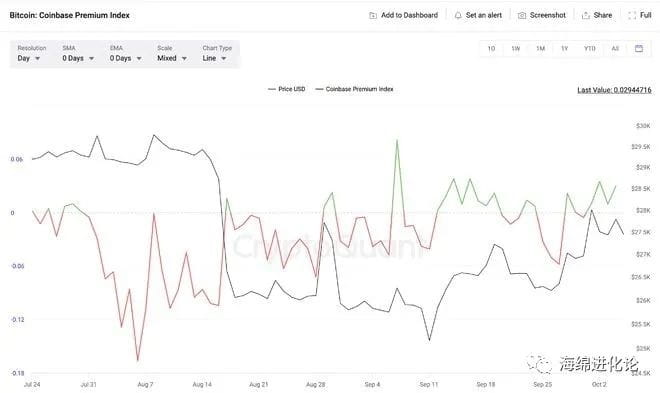
On October 2, the Bitcoin Coinbase Premium Index hit 0.35, the highest level since September 7. Historically, Bitcoin prices usually rise within a few days of entering positive territory, a phenomenon that can be observed on August 29 and September 20, respectively.
In both cases, Bitcoin prices saw significant gains within days of the U.S. whales starting taking action on Coinbase Pro. However, it remains to be seen whether the Bitcoin Coinbase Premium Index will continue to rise in the coming days. If this happens, the bullish signal could also stimulate increased market demand for Bitcoin on other retail-dominated exchanges.
FXEmpire analyst Ibrahim Ajibade said that based on the on-chain data points analyzed above, if whales continue to buy, the price of Bitcoin may rise to $30,000.
From a technical perspective, Bitcoin may initially struggle to break through the important resistance level around $28,500. But if the bulls can break through the selling wall, the Bitcoin price could reach $30,000 for the first time since July 2023.