

We recently found a wallet that only had $500 a week ago, but now had $47,000 in it. In just one week, the assets increased 94 times. Next, we will tell you how this wallet was discovered and briefly analyze this wallet. Now, let us take a look at how he did it.
The first step is to use the Dexscreener tool to query the tokens with the fastest transaction growth on the Ethereum chain, as shown in the figure below.
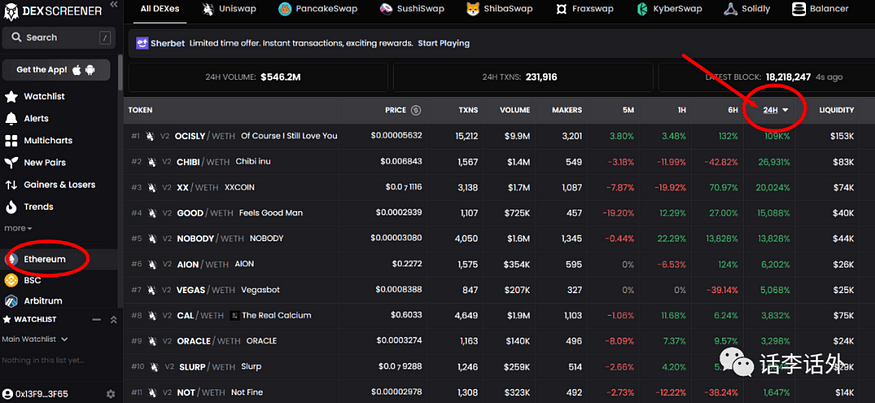
The specific steps are: enter the Dexscreener platform, click the "Ethereum" button on the left navigation bar, and then sort by time on the right, you can automatically list the currencies with the highest increases recently (such as 24H).
The second step is to find a token that has a higher price increase and looks more interesting to you, and then click on the details page to see all the transaction records and currency holder addresses of the token. As shown below.
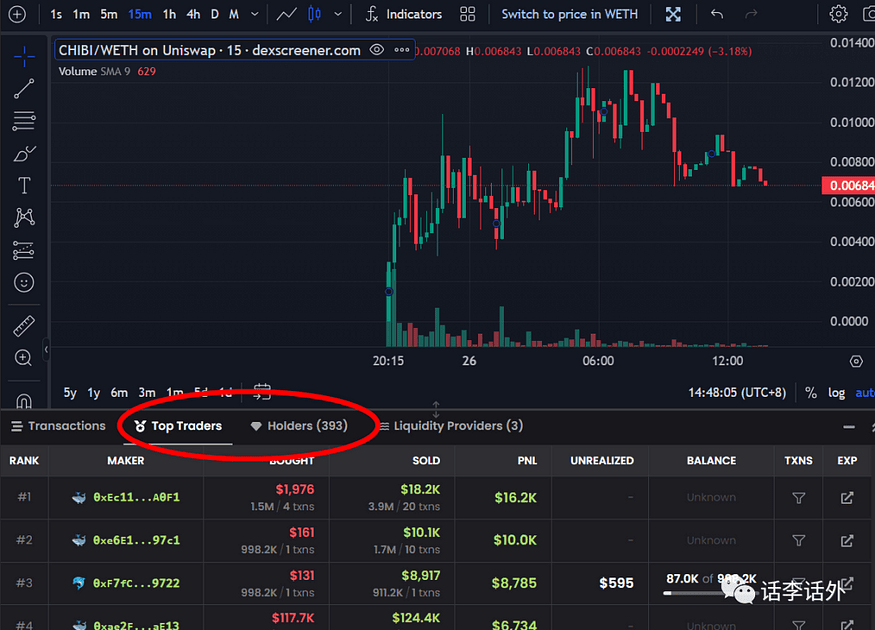
The specific steps are: directly click on Top Traders (top trading wallets, that is, the addresses holding the most tokens) and Holders (number of currency holders and currency holding addresses) below the K-line chart, and then directly click on the EXP corresponding to the back Click the button to open the Ethereum browser and see the full address of the wallet.
Step 3: Because the Ethereum browser may be a little complicated to use and may not be friendly to newcomers, after we copy the corresponding wallet address, we can use the wallet tracking tool Arkham to further analyze the corresponding wallet.
Arkham is a tool we have introduced in our previous article. It is a relatively powerful wallet analysis platform that can help you query the historical balance, transaction records, income, etc. of a specified wallet.
For example, through the first and second steps above, we found a wallet starting with 0xf61 that caught our attention. Next, we will use the Arkham tool to further query some of this wallet address. As shown below.
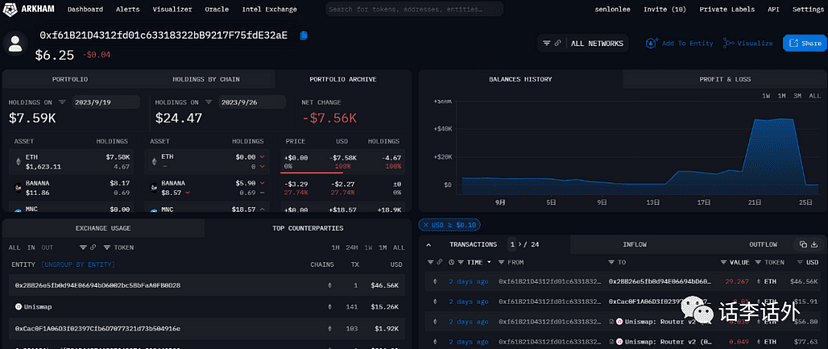
On September 14, the wallet only had $495, and on September 21, it reached $47,000, achieving a profit of 94 times. Of course, at the time of writing this article, the owner of the wallet has withdrawn all assets and transferred all assets to another wallet starting with 0x2BB (the current total funds of this wallet have accumulated to 210,000 US dollars). As shown below.
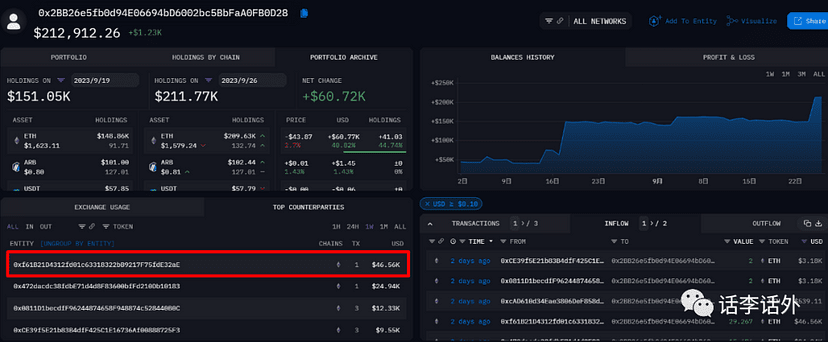
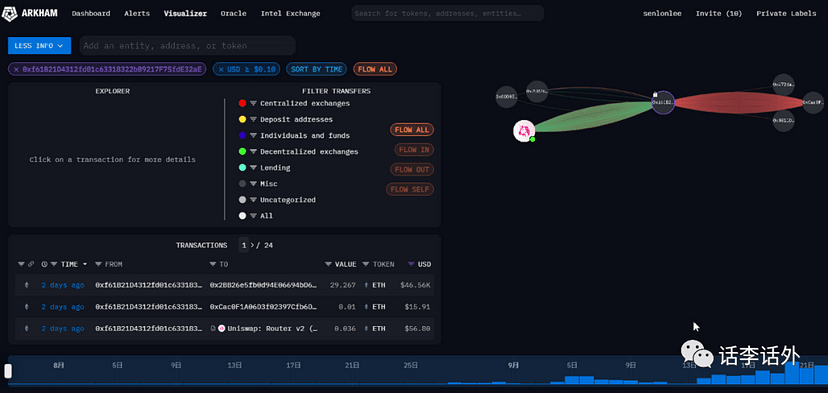
Step 4: Next, we can continue to use Arkham Visualizer to explore the associations between the wallet and different projects and other wallets, so as to analyze the transactions made by the wallet in these projects. At the same time, we can also further verify some transaction details of the wallet, including the specific transaction amount, the specific tokens traded, and the transaction details, as shown in the figure below.
Step 5: Of course, if you feel that the Arkham tool is still a bit complicated to use, you can also choose to use Debank or Zerion tools. Here we take Zerion as an example. Zerion itself is also a wallet tool. We can also use this tool to query the historical transaction records of any wallet, and the query interface is very simple, which is very suitable for newcomers. As shown in the figure below.
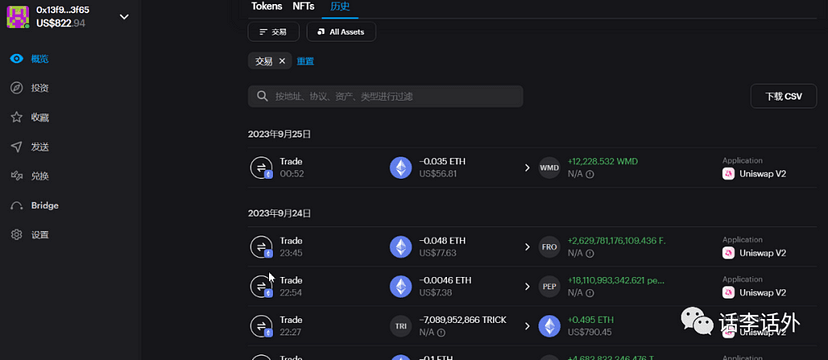
Through the Zerion tool, you can easily check what currencies were transferred to the wallet during what time period, as well as the transaction amount. From the transaction records, it is not difficult to find that the wallet is mainly used for trading various junk coins, and then the proceeds from the transaction are converted into ETH, and then transferred to other wallets. It can be said that this wallet should be just a small account among the many wallets of its owner that is specifically used to trade junk coins.
Step 6: So, which junk coins did the wallet buy specifically?
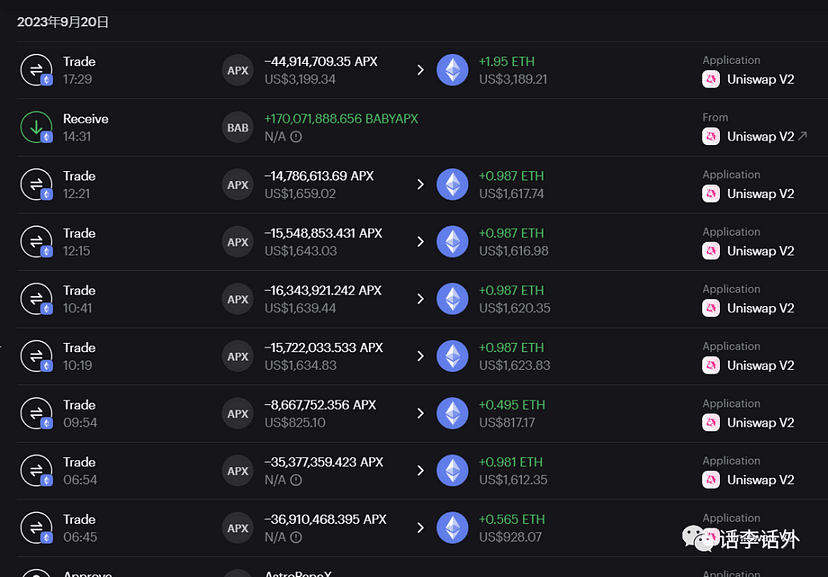
Through Zerion’s historical transaction records, we will find that the wallet’s first transaction directly earned $33,918. In this transaction, he bought a total of 634,726,834 APX and spent a total of $4,885. The earliest time I bought it was around 6:00 on September 20, and then I sold it all the way. I made $33,918 from this junk coin alone. As shown below.
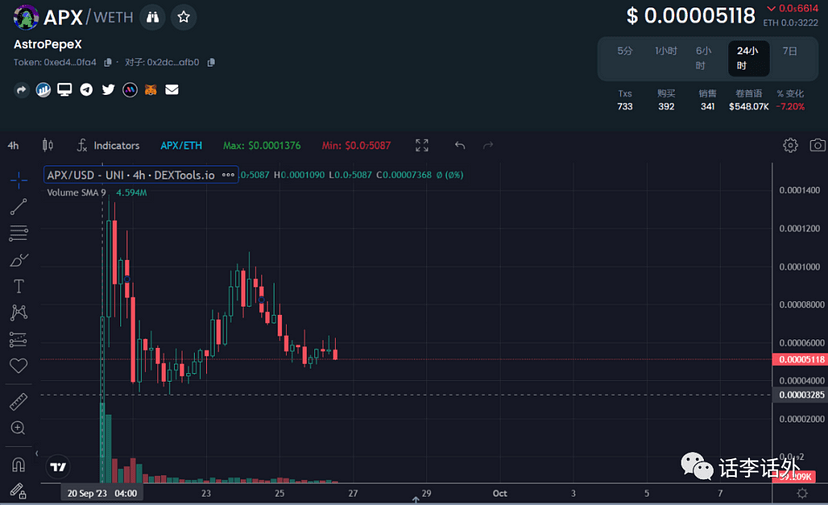
We can use Dextools to compare APX's K-line. It can be clearly seen that APX was launched on September 20, and it soared all the way on the same day. As shown in the figure below.
In addition to APX, the wallet also holds some other junk coins. Interested parties can check it out through Zerion.
Well, that’s all for today’s post on “Hua Li Hua Wai”. Let’s summarize and review it together. This article is one of the series of articles on Hua Li Hua Wai’s analysis of on-chain tools. It mainly briefly introduces the usage of several tools such as Dexscreener, Arkham, and Zerion.
I hope today's sharing can be helpful to everyone. If you have any questions related to the blockchain field, you can leave a message or ask a question on the planet, and we can discuss it together.
Special thanks to: 0xChainMind, 0xTHades, Senka (cover design)
Disclaimer: The above content is only a personal perspective and analysis. It is only for science learning and communication among enthusiasts and does not constitute any investment advice. Investment is risky, please treat it rationally, increase risk awareness, and abide by the relevant laws and regulations of the country and region where you are located!