

#saylor
saylor
1.5M views
3,228 Discussing
Hot
Latest

·
--
Saylor reposted the latest report by Alex Thorn, head of research at Galaxy Research, putting Thorn’s assessment in front of his followers: Bitcoin’s bear market ended in June, and it has now entered an accumulation phase. A bottom is in, and selling pressure is easing.
The report cited several pieces of evidence: Bitcoin has closed above its 50-week moving average for five consecutive weeks; the monthly average transfers from addresses that have been dormant for more than five years fell from 67,000 BTC in 2024 to 34,000 BTC this year; and U.S. spot ETFs have continued buying at lower prices. Thorn’s view is that the crowd has left, while the debasement-hedge thesis is growing stronger.
This time, Saylor didn’t write a long post of his own—he simply reposted a fellow researcher’s work.
$BTC
#Saylor #比特币 #Galaxy
Saylor reposted the latest report by Alex Thorn, head of research at Galaxy Research, putting Thorn’s assessment in front of his followers: Bitcoin’s bear market ended in June, and it has now entered an accumulation phase. A bottom is in, and selling pressure is easing.
The report cited several pieces of evidence: Bitcoin has closed above its 50-week moving average for five consecutive weeks; the monthly average transfers from addresses that have been dormant for more than five years fell from 67,000 BTC in 2024 to 34,000 BTC this year; and U.S. spot ETFs have continued buying at lower prices. Thorn’s view is that the crowd has left, while the debasement-hedge thesis is growing stronger.
This time, Saylor didn’t write a long post of his own—he simply reposted a fellow researcher’s work.
$BTC
#Saylor #比特币 #Galaxy
The report cited several pieces of evidence: Bitcoin has closed above its 50-week moving average for five consecutive weeks; the monthly average transfers from addresses that have been dormant for more than five years fell from 67,000 BTC in 2024 to 34,000 BTC this year; and U.S. spot ETFs have continued buying at lower prices. Thorn’s view is that the crowd has left, while the debasement-hedge thesis is growing stronger.
This time, Saylor didn’t write a long post of his own—he simply reposted a fellow researcher’s work.
$BTC
#Saylor #比特币 #Galaxy

148

·
--
Saylor has paused Bitcoin purchases, holding firm at 840,000 coins.
This is clearly a hard landing after high-volume stagnation. The whales have shown their hand: they don’t want to buy and may even want to sell.
Without this anchor, the market is likely to thrash around like a headless chicken in the short term.
Don’t rush to buy the dip. Wait until these whales start moving again.
#比特币 #Saylor #MarketAnalysis
Saylor has paused Bitcoin purchases, holding firm at 840,000 coins.
This is clearly a hard landing after high-volume stagnation. The whales have shown their hand: they don’t want to buy and may even want to sell.
Without this anchor, the market is likely to thrash around like a headless chicken in the short term.
Don’t rush to buy the dip. Wait until these whales start moving again.
#比特币 #Saylor #MarketAnalysis
This is clearly a hard landing after high-volume stagnation. The whales have shown their hand: they don’t want to buy and may even want to sell.
Without this anchor, the market is likely to thrash around like a headless chicken in the short term.
Don’t rush to buy the dip. Wait until these whales start moving again.
#比特币 #Saylor #MarketAnalysis

81
·
--
Michael Saylor’s two moves on X over the past couple of days are more intriguing than any research report.
In his reply to Jack Dorsey, he called Bitcoin a “moat,” recasting the company’s rationale for buying it from “hoarding” to building a “defense.”
Even more unusual, his customary Sunday $BTC chart was missing. That chart had become almost a prelude to buying more, and the market had grown used to looking at it to guess how much he had bought. When he didn’t post it this week, some wondered whether he had hit pause.
The Bitcoin treasury company he leads is the world’s largest corporate $BTC holder, and its Q3 earnings are due after market close this Thursday (10/29). The market is watching to see whether it can keep the flywheel spinning—raising money at a premium to buy more Bitcoin. The scale of its profits isn’t the focus.
Right now, $BTC is hovering around the $80,000 mark, at about $80,400. We’ll know on Thursday whether the flywheel is still turning.
#比特币 #Saylor
Michael Saylor’s two moves on X over the past couple of days are more intriguing than any research report.
In his reply to Jack Dorsey, he called Bitcoin a “moat,” recasting the company’s rationale for buying it from “hoarding” to building a “defense.”
Even more unusual, his customary Sunday $BTC chart was missing. That chart had become almost a prelude to buying more, and the market had grown used to looking at it to guess how much he had bought. When he didn’t post it this week, some wondered whether he had hit pause.
The Bitcoin treasury company he leads is the world’s largest corporate $BTC holder, and its Q3 earnings are due after market close this Thursday (10/29). The market is watching to see whether it can keep the flywheel spinning—raising money at a premium to buy more Bitcoin. The scale of its profits isn’t the focus.
Right now, $BTC is hovering around the $80,000 mark, at about $80,400. We’ll know on Thursday whether the flywheel is still turning.
#比特币 #Saylor
In his reply to Jack Dorsey, he called Bitcoin a “moat,” recasting the company’s rationale for buying it from “hoarding” to building a “defense.”
Even more unusual, his customary Sunday $BTC chart was missing. That chart had become almost a prelude to buying more, and the market had grown used to looking at it to guess how much he had bought. When he didn’t post it this week, some wondered whether he had hit pause.
The Bitcoin treasury company he leads is the world’s largest corporate $BTC holder, and its Q3 earnings are due after market close this Thursday (10/29). The market is watching to see whether it can keep the flywheel spinning—raising money at a premium to buy more Bitcoin. The scale of its profits isn’t the focus.
Right now, $BTC is hovering around the $80,000 mark, at about $80,400. We’ll know on Thursday whether the flywheel is still turning.
#比特币 #Saylor

46
·
--
Saylor’s treasury company is caught up in MSCI’s new index rules. The company, known for raising money by issuing shares to buy crypto, currently holds 848,517 $BTC—about 4% of the total supply. MSCI classifies these crypto-holding treasury companies as non-operating entities. The final list will be announced on November 11, and the new rules take effect after the market closes on November 30. The company is also due to report earnings on Thursday. If its index eligibility changes, the engine of issuing shares to raise funds for buying bitcoin could stall. $BTC #Saylor #MSCI #Macro
Saylor’s treasury company is caught up in MSCI’s new index rules. The company, known for raising money by issuing shares to buy crypto, currently holds 848,517 $BTC —about 4% of the total supply. MSCI classifies these crypto-holding treasury companies as non-operating entities. The final list will be announced on November 11, and the new rules take effect after the market closes on November 30. The company is also due to report earnings on Thursday. If its index eligibility changes, the engine of issuing shares to raise funds for buying bitcoin could stall. $BTC #Saylor #MSCI #Macro

136

Saylor says a new four-year bull market has begun.
Honestly, coming from him, that statement contains almost no information.
What he basically said was: We’ve bounced $20,000 off the 200-week moving average, and we’re at the starting point of the next bull market. The media put its own spin on it, and suddenly it became “BTC to $100K within 12 months.”
The problem is that Strategy is sitting on more than 840,000 BTC, and the company keeps buying by issuing shares and preferred stock. This whole model depends on the story that “the bull market is still on.” You ask the biggest bull whether we’re in a bull market? When has he ever said we weren’t?
Now look at the data itself. BTC is hovering around $82,000, having just fallen from $85,000 a few days ago. It’s dropped below the 50-day moving average, and ETFs saw net outflows of more than $600 million in a single day. It’s true that BTC has bounced $20,000 off the 200-week moving average, but that only suggests buyers are probably stepping in near the bottom. It doesn’t prove anything about a four-year cycle.
The funniest part is the wall of “BREAKING: SAYLOR CONFIRMED” posts on X. Dozens of accounts copy-pasting the same line, while memecoin projects jump into the replies to shill their coins. “Confirmed”? He’s not a central bank.
My take is simple: Treat Saylor’s words as a gauge of sentiment, not as a basis for your position. His cost basis, financing channels, and holding period have nothing to do with you. He can handle a 50% drop—but can you? You know the answer.
#BTC #Saylor
Saylor says a new four-year bull market has begun.
Honestly, coming from him, that statement contains almost no information.
What he basically said was: We’ve bounced $20,000 off the 200-week moving average, and we’re at the starting point of the next bull market. The media put its own spin on it, and suddenly it became “BTC to $100K within 12 months.”
The problem is that Strategy is sitting on more than 840,000 BTC, and the company keeps buying by issuing shares and preferred stock. This whole model depends on the story that “the bull market is still on.” You ask the biggest bull whether we’re in a bull market? When has he ever said we weren’t?
Now look at the data itself. BTC is hovering around $82,000, having just fallen from $85,000 a few days ago. It’s dropped below the 50-day moving average, and ETFs saw net outflows of more than $600 million in a single day. It’s true that BTC has bounced $20,000 off the 200-week moving average, but that only suggests buyers are probably stepping in near the bottom. It doesn’t prove anything about a four-year cycle.
The funniest part is the wall of “BREAKING: SAYLOR CONFIRMED” posts on X. Dozens of accounts copy-pasting the same line, while memecoin projects jump into the replies to shill their coins. “Confirmed”? He’s not a central bank.
My take is simple: Treat Saylor’s words as a gauge of sentiment, not as a basis for your position. His cost basis, financing channels, and holding period have nothing to do with you. He can handle a 50% drop—but can you? You know the answer.
#BTC #Saylor
Honestly, coming from him, that statement contains almost no information.
What he basically said was: We’ve bounced $20,000 off the 200-week moving average, and we’re at the starting point of the next bull market. The media put its own spin on it, and suddenly it became “BTC to $100K within 12 months.”
The problem is that Strategy is sitting on more than 840,000 BTC, and the company keeps buying by issuing shares and preferred stock. This whole model depends on the story that “the bull market is still on.” You ask the biggest bull whether we’re in a bull market? When has he ever said we weren’t?
Now look at the data itself. BTC is hovering around $82,000, having just fallen from $85,000 a few days ago. It’s dropped below the 50-day moving average, and ETFs saw net outflows of more than $600 million in a single day. It’s true that BTC has bounced $20,000 off the 200-week moving average, but that only suggests buyers are probably stepping in near the bottom. It doesn’t prove anything about a four-year cycle.
The funniest part is the wall of “BREAKING: SAYLOR CONFIRMED” posts on X. Dozens of accounts copy-pasting the same line, while memecoin projects jump into the replies to shill their coins. “Confirmed”? He’s not a central bank.
My take is simple: Treat Saylor’s words as a gauge of sentiment, not as a basis for your position. His cost basis, financing channels, and holding period have nothing to do with you. He can handle a 50% drop—but can you? You know the answer.
#BTC #Saylor
9

·
--
Michael Saylor (Strategy) once again said that $BTC will rise above $100,000. Meanwhile, the price is around $82,000, and the all-time high of around $126,000 was exactly a year ago, in October 2025. Saylor’s company continues to accumulate bitcoin, and that’s what keeps $MSTR in the market’s spotlight. But a forecast is no guarantee.
Do you believe $100K is possible by the end of the year? Yes or no? 👇
$MSTR #Saylor
Michael Saylor (Strategy) once again said that $BTC will rise above $100,000. Meanwhile, the price is around $82,000, and the all-time high of around $126,000 was exactly a year ago, in October 2025. Saylor’s company continues to accumulate bitcoin, and that’s what keeps $MSTR in the market’s spotlight. But a forecast is no guarantee.
Do you believe $100K is possible by the end of the year? Yes or no? 👇
$MSTR #Saylor
Do you believe $100K is possible by the end of the year? Yes or no? 👇
$MSTR #Saylor
116


·
--
Bullish
$BTC
{spot}(BTCUSDT)
🚨🚨 Michael Saylor, one of the most prominent Bitcoin advocates, reckons the next step in the evolution of the financial system is “digital money”
He proposes a Bitcoin-backed stablecoin pegged to the US dollar, combining price stability with a yield ranging between 6% and 8% without any volatility
$MSTR
{future}(MSTRUSDT)
This currency differs fundamentally from traditional stablecoins, which don't yield a single penny
As Saylor puts it: “If you’ve got a stablecoin paying you 8%, why on earth would you hold $350 billion in one that pays you nowt?”
The idea relies on using Bitcoin as a reserve asset that generates a genuine return, whilst maintaining the dollar peg to ensure trust and stability
In this manner, idle liquidity can be turned into a productive asset, reshaping the very concept of holding cash in the digital age and opening up new prospects for investors and institutions alike
$BTC
#Market_Update #bitcoin #Saylor
$BTC
🚨🚨 Michael Saylor, one of the most prominent Bitcoin advocates, reckons the next step in the evolution of the financial system is “digital money”
He proposes a Bitcoin-backed stablecoin pegged to the US dollar, combining price stability with a yield ranging between 6% and 8% without any volatility
$MSTR
This currency differs fundamentally from traditional stablecoins, which don't yield a single penny
As Saylor puts it: “If you’ve got a stablecoin paying you 8%, why on earth would you hold $350 billion in one that pays you nowt?”
The idea relies on using Bitcoin as a reserve asset that generates a genuine return, whilst maintaining the dollar peg to ensure trust and stability
In this manner, idle liquidity can be turned into a productive asset, reshaping the very concept of holding cash in the digital age and opening up new prospects for investors and institutions alike
$BTC
#Market_Update #bitcoin #Saylor
🚨🚨 Michael Saylor, one of the most prominent Bitcoin advocates, reckons the next step in the evolution of the financial system is “digital money”
He proposes a Bitcoin-backed stablecoin pegged to the US dollar, combining price stability with a yield ranging between 6% and 8% without any volatility
$MSTR
This currency differs fundamentally from traditional stablecoins, which don't yield a single penny
As Saylor puts it: “If you’ve got a stablecoin paying you 8%, why on earth would you hold $350 billion in one that pays you nowt?”
The idea relies on using Bitcoin as a reserve asset that generates a genuine return, whilst maintaining the dollar peg to ensure trust and stability
In this manner, idle liquidity can be turned into a productive asset, reshaping the very concept of holding cash in the digital age and opening up new prospects for investors and institutions alike
$BTC
#Market_Update #bitcoin #Saylor

208

·
--
Saylor is back with good news: Bitcoin is back in a bull market
At the ParaFi Investor Day on October 17, here are Strategy’s Saylor’s exact words:
He said Bitcoin bounced off its 200-week moving average three months ago and is now barely holding above it.
That’s called “being in line with the long-term trend,” not a call to buy.
Then he did the math: every $10 billion in new credit is equivalent to a year’s supply of Bitcoin.
$100 billion in credit flowing into a $1 trillion asset is “enormously bullish.”
In other words: the real bull-market money comes in when banks are willing to accept Bitcoin as collateral.
He expects bank custody and lending to roll out over the next 12 to 24 months.
He also floated a vision for dollar stablecoins: a target annual yield of 6%–8%, but nothing has been decided on issuance, reserves, or redemptions.
Don’t mistake the pie for a meal.
Today, October 19, Bitcoin is back around $82,555, up about 0.9% in 24 hours.
But it’s still about 35% below its October 2025 peak of $126,080.
Saylor himself also acknowledged three headwinds right now: trade, monetary policy, and AI competing for capital.
If bank custody really takes off, the money in ETFs might just be an appetizer.
Do you believe this story about banks entering the market?
Just my personal opinion; not investment advice.
#Saylor $BTC
Saylor is back with good news: Bitcoin is back in a bull market
At the ParaFi Investor Day on October 17, here are Strategy’s Saylor’s exact words:
He said Bitcoin bounced off its 200-week moving average three months ago and is now barely holding above it.
That’s called “being in line with the long-term trend,” not a call to buy.
Then he did the math: every $10 billion in new credit is equivalent to a year’s supply of Bitcoin.
$100 billion in credit flowing into a $1 trillion asset is “enormously bullish.”
In other words: the real bull-market money comes in when banks are willing to accept Bitcoin as collateral.
He expects bank custody and lending to roll out over the next 12 to 24 months.
He also floated a vision for dollar stablecoins: a target annual yield of 6%–8%, but nothing has been decided on issuance, reserves, or redemptions.
Don’t mistake the pie for a meal.
Today, October 19, Bitcoin is back around $82,555, up about 0.9% in 24 hours.
But it’s still about 35% below its October 2025 peak of $126,080.
Saylor himself also acknowledged three headwinds right now: trade, monetary policy, and AI competing for capital.
If bank custody really takes off, the money in ETFs might just be an appetizer.
Do you believe this story about banks entering the market?
Just my personal opinion; not investment advice.
#Saylor $BTC
At the ParaFi Investor Day on October 17, here are Strategy’s Saylor’s exact words:
He said Bitcoin bounced off its 200-week moving average three months ago and is now barely holding above it.
That’s called “being in line with the long-term trend,” not a call to buy.
Then he did the math: every $10 billion in new credit is equivalent to a year’s supply of Bitcoin.
$100 billion in credit flowing into a $1 trillion asset is “enormously bullish.”
In other words: the real bull-market money comes in when banks are willing to accept Bitcoin as collateral.
He expects bank custody and lending to roll out over the next 12 to 24 months.
He also floated a vision for dollar stablecoins: a target annual yield of 6%–8%, but nothing has been decided on issuance, reserves, or redemptions.
Don’t mistake the pie for a meal.
Today, October 19, Bitcoin is back around $82,555, up about 0.9% in 24 hours.
But it’s still about 35% below its October 2025 peak of $126,080.
Saylor himself also acknowledged three headwinds right now: trade, monetary policy, and AI competing for capital.
If bank custody really takes off, the money in ETFs might just be an appetizer.
Do you believe this story about banks entering the market?
Just my personal opinion; not investment advice.
#Saylor $BTC

4

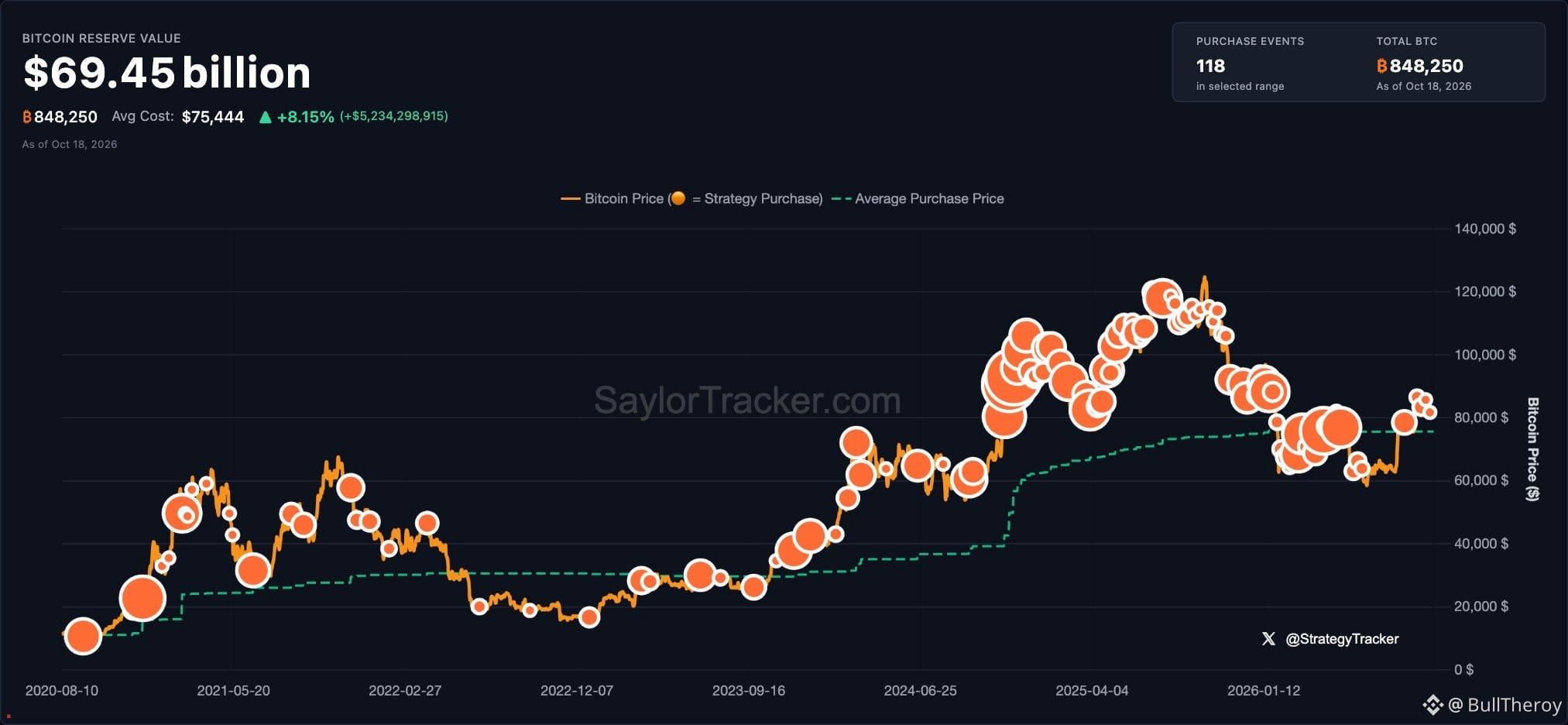
Michael Saylor just posted "We found room for more orange" with a fresh Strategy purchase chart
That is his classic teaser move orange dots mark every buy and the filing usually drops the next day
Strategy already sits on 848250 BTC worth roughly 69 billion dollars at an average cost of 75444 per coin
Last week's buy was tiny though just 250 BTC for 21.5 million while the company spent 192.4 million buying back its STRC preferred stock
So the signal is loud but the actual spending is shifting toward shoring up the balance sheet
A fifth straight week of buys would still be a statement
$BTC
#Bitcoin #Saylor #MSTR #Crypto
Michael Saylor just posted "We found room for more orange" with a fresh Strategy purchase chart
That is his classic teaser move orange dots mark every buy and the filing usually drops the next day
Strategy already sits on 848250 BTC worth roughly 69 billion dollars at an average cost of 75444 per coin
Last week's buy was tiny though just 250 BTC for 21.5 million while the company spent 192.4 million buying back its STRC preferred stock
So the signal is loud but the actual spending is shifting toward shoring up the balance sheet
A fifth straight week of buys would still be a statement
$BTC
#Bitcoin #Saylor #MSTR #Crypto
That is his classic teaser move orange dots mark every buy and the filing usually drops the next day
Strategy already sits on 848250 BTC worth roughly 69 billion dollars at an average cost of 75444 per coin
Last week's buy was tiny though just 250 BTC for 21.5 million while the company spent 192.4 million buying back its STRC preferred stock
So the signal is loud but the actual spending is shifting toward shoring up the balance sheet
A fifth straight week of buys would still be a statement
$BTC
#Bitcoin #Saylor #MSTR #Crypto


148

·
--
Saylor paints a rosy picture: a “Bitcoin stablecoin” yielding 6%–8%? 🤔
📍 At ParaFi’s Investor Day, Strategy’s Saylor described his idea of the “perfect digital currency”: pegged to the dollar, low-volatility, backed by Bitcoin, and yielding around 6%–8%. He asked: if there’s an interest-bearing option, why hold stablecoins that don’t pay a penny in interest?
🧐 My take:
1️⃣ The direction is clear: use $BTC as collateral, then build “digital credit” products on top of it.
2️⃣ But BeInCrypto also noted that Saylor acknowledged that Bitcoin backing alone isn’t enough: Strategy’s 12% dividend-paying preferred stock still needs a cash buffer to bring credit buyers back.
3️⃣ Where will the 6%–8% yield come from? That’s the key. Without a clear answer, it’s just a vision.
📊 Current market: BTC around $82,640 (24h +1.1%), ETH around $2,424, Fear & Greed Index at 59 (Greed).
Do you think an “interest-bearing stablecoin backed by Bitcoin” can work?
👉 A. Yes. B. It’s just hype. Let me know in the comments 👇
$BTC $ETH
#Strategy #Saylor #Stablecoin
Personal opinion only; not investment advice
Saylor paints a rosy picture: a “Bitcoin stablecoin” yielding 6%–8%? 🤔
📍 At ParaFi’s Investor Day, Strategy’s Saylor described his idea of the “perfect digital currency”: pegged to the dollar, low-volatility, backed by Bitcoin, and yielding around 6%–8%. He asked: if there’s an interest-bearing option, why hold stablecoins that don’t pay a penny in interest?
🧐 My take:
1️⃣ The direction is clear: use $BTC as collateral, then build “digital credit” products on top of it.
2️⃣ But BeInCrypto also noted that Saylor acknowledged that Bitcoin backing alone isn’t enough: Strategy’s 12% dividend-paying preferred stock still needs a cash buffer to bring credit buyers back.
3️⃣ Where will the 6%–8% yield come from? That’s the key. Without a clear answer, it’s just a vision.
📊 Current market: BTC around $82,640 (24h +1.1%), ETH around $2,424, Fear & Greed Index at 59 (Greed).
Do you think an “interest-bearing stablecoin backed by Bitcoin” can work?
👉 A. Yes. B. It’s just hype. Let me know in the comments 👇
$BTC $ETH
#Strategy #Saylor #Stablecoin
Personal opinion only; not investment advice
📍 At ParaFi’s Investor Day, Strategy’s Saylor described his idea of the “perfect digital currency”: pegged to the dollar, low-volatility, backed by Bitcoin, and yielding around 6%–8%. He asked: if there’s an interest-bearing option, why hold stablecoins that don’t pay a penny in interest?
🧐 My take:
1️⃣ The direction is clear: use $BTC as collateral, then build “digital credit” products on top of it.
2️⃣ But BeInCrypto also noted that Saylor acknowledged that Bitcoin backing alone isn’t enough: Strategy’s 12% dividend-paying preferred stock still needs a cash buffer to bring credit buyers back.
3️⃣ Where will the 6%–8% yield come from? That’s the key. Without a clear answer, it’s just a vision.
📊 Current market: BTC around $82,640 (24h +1.1%), ETH around $2,424, Fear & Greed Index at 59 (Greed).
Do you think an “interest-bearing stablecoin backed by Bitcoin” can work?
👉 A. Yes. B. It’s just hype. Let me know in the comments 👇
$BTC $ETH
#Strategy #Saylor #Stablecoin
Personal opinion only; not investment advice

2

·
--
Bullish
30D trade $BTC 399.4 USDT
🟠 Michael Saylor Hints at More Bitcoin Buying
Michael Saylor shared a message saying, “We found room for more orange.” 🟠
The orange color is often associated with Bitcoin, and his message suggests that Strategy may have room to buy more BTC.
Strategy is already one of the largest corporate Bitcoin holders. Saylor’s statement has caught investors’ attention, but he has not confirmed a new purchase in this post.
Will Strategy add more Bitcoin to its holdings? 👀
$BTC
#btc #Saylor
🟠 Michael Saylor Hints at More Bitcoin Buying
Michael Saylor shared a message saying, “We found room for more orange.” 🟠
The orange color is often associated with Bitcoin, and his message suggests that Strategy may have room to buy more BTC.
Strategy is already one of the largest corporate Bitcoin holders. Saylor’s statement has caught investors’ attention, but he has not confirmed a new purchase in this post.
Will Strategy add more Bitcoin to its holdings? 👀
$BTC
#btc #Saylor
Michael Saylor shared a message saying, “We found room for more orange.” 🟠
The orange color is often associated with Bitcoin, and his message suggests that Strategy may have room to buy more BTC.
Strategy is already one of the largest corporate Bitcoin holders. Saylor’s statement has caught investors’ attention, but he has not confirmed a new purchase in this post.
Will Strategy add more Bitcoin to its holdings? 👀
$BTC
#btc #Saylor
79

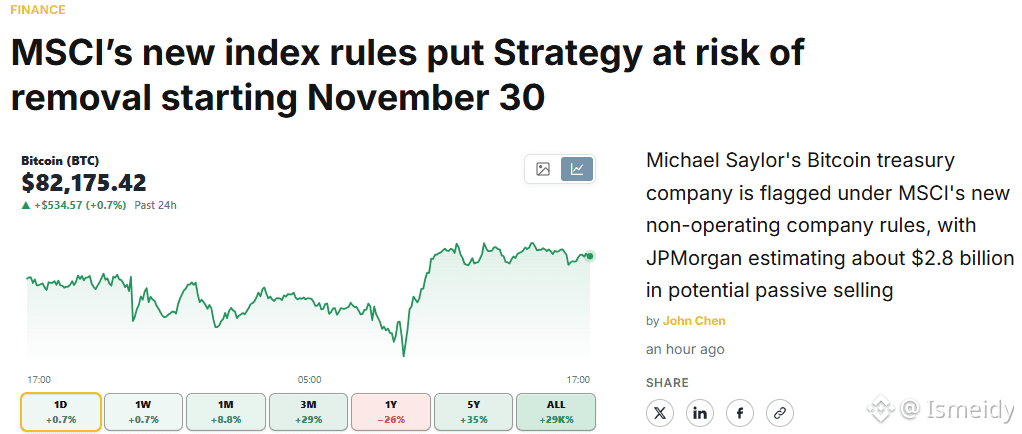
Crypto is up 1%, while the stock is down 3%. Who is crypto’s biggest bull really afraid of—the shorts or the index provider? MSCI made its decision official on Thursday: starting November 30, “non-operating companies” will be kicked out of global indexes. Strategy and Japan’s Metaplanet are on the removal list, with the final list to be announced on November 11. JPMorgan estimates $2.8 billion in passive selling pressure. Saylor fired back officially today, calling it “a purge targeting crypto treasury companies,” and stubbornly insisting that funds tracking MSCI hold just 3.1% of the shares—“less than one day’s trading volume.” The million-dollar question: Is that $2.8 billion in selling pressure a real dump, or just the paper tiger Saylor says it is? Vote in the comments.
$BTC #Strategy #Saylor #MSCI
Crypto is up 1%, while the stock is down 3%. Who is crypto’s biggest bull really afraid of—the shorts or the index provider? MSCI made its decision official on Thursday: starting November 30, “non-operating companies” will be kicked out of global indexes. Strategy and Japan’s Metaplanet are on the removal list, with the final list to be announced on November 11. JPMorgan estimates $2.8 billion in passive selling pressure. Saylor fired back officially today, calling it “a purge targeting crypto treasury companies,” and stubbornly insisting that funds tracking MSCI hold just 3.1% of the shares—“less than one day’s trading volume.” The million-dollar question: Is that $2.8 billion in selling pressure a real dump, or just the paper tiger Saylor says it is? Vote in the comments.
$BTC #Strategy #Saylor #MSCI
$BTC #Strategy #Saylor #MSCI
3

·
--
Checkmate to #Saylor !
MSCI’s new rules put 2.8 billion dollars of #strategy in jeopardy
The battle between global index giants and the treasury of #BTC
The treasury company #bitcoin , led by #MichaelSaylor , Strategy, faces the imminent threat of exclusion from MSCI’s influential global indexes due to a drastic change in eligibility rules for non-operating companies.
MSCI’s reform: The new rules establish a rigorous two-stage filter (first assessing substantial operating assets and then applying five financial ratios) to identify and exclude passive holding vehicles.
The specter of 2.8 billion dollars: JPMorgan estimates warn that if Strategy is officially removed, index funds tracking MSCI benchmarks would be forced to make massive, price-insensitive sales worth approximately 2.8 billion dollars.
International reach: The measure affects more than just the U.S. company; preliminary data has also flagged firms such as Metaplanet (Japan) and Yellow Cake (United Kingdom).
Michael Saylor’s defiant response: The executive chairman has publicly downplayed the regulatory pressure, arguing that indexes should simply reflect the market and emphatically declaring, “Bitcoin doesn’t need you.”
Decisive timeline: The final list of affected companies will be published on November 11, 2026, and the new regulatory framework will take effect at the close of November 30, 2026. However, the rules provide safeguards requiring companies to fail to meet the criteria for two consecutive reviews before exclusion takes effect.
$MSTRB
{spot}(MSTRBUSDT)
$MSTR
{future}(MSTRUSDT)
$BTC
{future}(BTCUSDT)
Checkmate to #Saylor !
MSCI’s new rules put 2.8 billion dollars of #strategy in jeopardy
The battle between global index giants and the treasury of #BTC
The treasury company #bitcoin , led by #MichaelSaylor , Strategy, faces the imminent threat of exclusion from MSCI’s influential global indexes due to a drastic change in eligibility rules for non-operating companies.
MSCI’s reform: The new rules establish a rigorous two-stage filter (first assessing substantial operating assets and then applying five financial ratios) to identify and exclude passive holding vehicles.
The specter of 2.8 billion dollars: JPMorgan estimates warn that if Strategy is officially removed, index funds tracking MSCI benchmarks would be forced to make massive, price-insensitive sales worth approximately 2.8 billion dollars.
International reach: The measure affects more than just the U.S. company; preliminary data has also flagged firms such as Metaplanet (Japan) and Yellow Cake (United Kingdom).
Michael Saylor’s defiant response: The executive chairman has publicly downplayed the regulatory pressure, arguing that indexes should simply reflect the market and emphatically declaring, “Bitcoin doesn’t need you.”
Decisive timeline: The final list of affected companies will be published on November 11, 2026, and the new regulatory framework will take effect at the close of November 30, 2026. However, the rules provide safeguards requiring companies to fail to meet the criteria for two consecutive reviews before exclusion takes effect.
$MSTRB
$MSTR
$BTC
MSCI’s new rules put 2.8 billion dollars of #strategy in jeopardy
The battle between global index giants and the treasury of #BTC
The treasury company #bitcoin , led by #MichaelSaylor , Strategy, faces the imminent threat of exclusion from MSCI’s influential global indexes due to a drastic change in eligibility rules for non-operating companies.
MSCI’s reform: The new rules establish a rigorous two-stage filter (first assessing substantial operating assets and then applying five financial ratios) to identify and exclude passive holding vehicles.
The specter of 2.8 billion dollars: JPMorgan estimates warn that if Strategy is officially removed, index funds tracking MSCI benchmarks would be forced to make massive, price-insensitive sales worth approximately 2.8 billion dollars.
International reach: The measure affects more than just the U.S. company; preliminary data has also flagged firms such as Metaplanet (Japan) and Yellow Cake (United Kingdom).
Michael Saylor’s defiant response: The executive chairman has publicly downplayed the regulatory pressure, arguing that indexes should simply reflect the market and emphatically declaring, “Bitcoin doesn’t need you.”
Decisive timeline: The final list of affected companies will be published on November 11, 2026, and the new regulatory framework will take effect at the close of November 30, 2026. However, the rules provide safeguards requiring companies to fail to meet the criteria for two consecutive reviews before exclusion takes effect.
$MSTRB
$MSTR
$BTC
1
3
546

⚡ BITCOIN BULL RUN HAS JUST BEGUN - SAYLOR
Michael Saylor, CEO of Strategy (largest Bitcoin holder), just went nuclear:
"Bitcoin bull run has JUST begun."
Why?
1. Institutional demand via ETFs picking up
2. Corporations adding $BTC to their treasury reserves
3. Coming supply shock - only 21M $BTC in existence; 19.9M already mined
4. Liquidity is increasing worldwide - investors moving into hard assets
Strategy owns over 636,000 BTC. They aren't selling. They are hoarding.
If Saylor is correct, we are far from the peak. This is just the start of the real rally.
$BTC is currently ranging between $83K. Breakout above $88K would set the stage for the next leg higher.
What do you think of Saylor's view? Is the bull run just beginning? 👇
#BTC #Saylor #Bullrun
{spot}(BTCUSDT)
⚡ BITCOIN BULL RUN HAS JUST BEGUN - SAYLOR
Michael Saylor, CEO of Strategy (largest Bitcoin holder), just went nuclear:
"Bitcoin bull run has JUST begun."
Why?
1. Institutional demand via ETFs picking up
2. Corporations adding $BTC to their treasury reserves
3. Coming supply shock - only 21M $BTC in existence; 19.9M already mined
4. Liquidity is increasing worldwide - investors moving into hard assets
Strategy owns over 636,000 BTC. They aren't selling. They are hoarding.
If Saylor is correct, we are far from the peak. This is just the start of the real rally.
$BTC is currently ranging between $83K. Breakout above $88K would set the stage for the next leg higher.
What do you think of Saylor's view? Is the bull run just beginning? 👇
#BTC #Saylor #Bullrun
Michael Saylor, CEO of Strategy (largest Bitcoin holder), just went nuclear:
"Bitcoin bull run has JUST begun."
Why?
1. Institutional demand via ETFs picking up
2. Corporations adding $BTC to their treasury reserves
3. Coming supply shock - only 21M $BTC in existence; 19.9M already mined
4. Liquidity is increasing worldwide - investors moving into hard assets
Strategy owns over 636,000 BTC. They aren't selling. They are hoarding.
If Saylor is correct, we are far from the peak. This is just the start of the real rally.
$BTC is currently ranging between $83K. Breakout above $88K would set the stage for the next leg higher.
What do you think of Saylor's view? Is the bull run just beginning? 👇
#BTC #Saylor #Bullrun

1
144
Yesterday on Bloomberg, Saylor declared the bear market over and the bull market underway, said the bottom was below $60,000, and insisted Bitcoin would definitely hit $100,000 again. Before he’d even finished speaking, CPI came in at 3.7%, worse than expected, and Bitcoin plunged straight to $81,500. Liquidations hit $331 million across the market in 24 hours, with Binance accounting for nearly half. The scene: Saylor is sitting tight on 848,000 coins; prediction markets are rolling their eyes (they don’t believe Bitcoin will be back in six figures in 2026); and those who bought the dip last night still have shaky hands this morning. Words versus candlesticks—which one do you bet will admit they were wrong first? #Saylor #BullMarket
Yesterday on Bloomberg, Saylor declared the bear market over and the bull market underway, said the bottom was below $60,000, and insisted Bitcoin would definitely hit $100,000 again. Before he’d even finished speaking, CPI came in at 3.7%, worse than expected, and Bitcoin plunged straight to $81,500. Liquidations hit $331 million across the market in 24 hours, with Binance accounting for nearly half. The scene: Saylor is sitting tight on 848,000 coins; prediction markets are rolling their eyes (they don’t believe Bitcoin will be back in six figures in 2026); and those who bought the dip last night still have shaky hands this morning. Words versus candlesticks—which one do you bet will admit they were wrong first? #Saylor #BullMarket
161

·
--
【Saylor Announces BTC Has Bottomed! Is the $100,000 Target Back? 🔥】
[❤ 加入X先生的粉丝群聊跟进](https://app.binance.com/uni-qr/MwYFhLo4)
Another wave of bullish sentiment is sweeping over Bitcoin!
In a recent interview with Bloomberg, Strategy Executive Chairman Michael Saylor said he believes BTC bottomed near $60,000 and could break back above $100,000.
Why is he so bullish?
Saylor believes the forces driving BTC higher are growing, including:
📌 A gradually improving U.S. crypto regulatory environment
📌 Traditional banks accelerating their adoption of crypto assets
📌 Continued growth in tokenized securities
📌 Expanding digital credit products related to Bitcoin
Put simply, he believes more money will flow into the Bitcoin market through banks, financial products, and institutional channels.
Saylor also expects BTC to achieve an average annual growth rate of 20% to 30% over the next 20 years. However, this is his long-term outlook and does not mean actual returns will necessarily reach that level.
But here’s the question: Does Saylor’s bullish outlook mean BTC is guaranteed to break above $100,000?
Of course not.
At the time the report was published, BTC was trading around $84,000, and prediction markets put the odds of it breaking above $100,000 at only about 27%. In addition, Strategy faces the risk of potential outflows resulting from changes to MSCI index inclusion rules.
📌 What really matters isn’t what price a prominent investor predicts, but whether bank adoption, institutional investment, and the regulatory environment continue to improve.
Saylor’s view offers a bullish case, but how far the market ultimately goes will depend on actual capital inflows and the macroeconomic environment.
#Saylor #strategy
【Saylor Announces BTC Has Bottomed! Is the $100,000 Target Back? 🔥】
❤ 加入X先生的粉丝群聊跟进
Another wave of bullish sentiment is sweeping over Bitcoin!
In a recent interview with Bloomberg, Strategy Executive Chairman Michael Saylor said he believes BTC bottomed near $60,000 and could break back above $100,000.
Why is he so bullish?
Saylor believes the forces driving BTC higher are growing, including:
📌 A gradually improving U.S. crypto regulatory environment
📌 Traditional banks accelerating their adoption of crypto assets
📌 Continued growth in tokenized securities
📌 Expanding digital credit products related to Bitcoin
Put simply, he believes more money will flow into the Bitcoin market through banks, financial products, and institutional channels.
Saylor also expects BTC to achieve an average annual growth rate of 20% to 30% over the next 20 years. However, this is his long-term outlook and does not mean actual returns will necessarily reach that level.
But here’s the question: Does Saylor’s bullish outlook mean BTC is guaranteed to break above $100,000?
Of course not.
At the time the report was published, BTC was trading around $84,000, and prediction markets put the odds of it breaking above $100,000 at only about 27%. In addition, Strategy faces the risk of potential outflows resulting from changes to MSCI index inclusion rules.
📌 What really matters isn’t what price a prominent investor predicts, but whether bank adoption, institutional investment, and the regulatory environment continue to improve.
Saylor’s view offers a bullish case, but how far the market ultimately goes will depend on actual capital inflows and the macroeconomic environment.
#Saylor #strategy
❤ 加入X先生的粉丝群聊跟进
Another wave of bullish sentiment is sweeping over Bitcoin!
In a recent interview with Bloomberg, Strategy Executive Chairman Michael Saylor said he believes BTC bottomed near $60,000 and could break back above $100,000.
Why is he so bullish?
Saylor believes the forces driving BTC higher are growing, including:
📌 A gradually improving U.S. crypto regulatory environment
📌 Traditional banks accelerating their adoption of crypto assets
📌 Continued growth in tokenized securities
📌 Expanding digital credit products related to Bitcoin
Put simply, he believes more money will flow into the Bitcoin market through banks, financial products, and institutional channels.
Saylor also expects BTC to achieve an average annual growth rate of 20% to 30% over the next 20 years. However, this is his long-term outlook and does not mean actual returns will necessarily reach that level.
But here’s the question: Does Saylor’s bullish outlook mean BTC is guaranteed to break above $100,000?
Of course not.
At the time the report was published, BTC was trading around $84,000, and prediction markets put the odds of it breaking above $100,000 at only about 27%. In addition, Strategy faces the risk of potential outflows resulting from changes to MSCI index inclusion rules.
📌 What really matters isn’t what price a prominent investor predicts, but whether bank adoption, institutional investment, and the regulatory environment continue to improve.
Saylor’s view offers a bullish case, but how far the market ultimately goes will depend on actual capital inflows and the macroeconomic environment.
#Saylor #strategy

157

·
--
📰 Saylor made a bold call this time: he believes Bitcoin has bottomed out just below $60,000, the bull market is getting underway, and it will definitely climb back above $100,000.
🔥 This isn’t just ordinary cheerleading. The Strategy co-founder and executive chairman also said Bitcoin is now heading above $80,000, and could see annual growth of 20% to 30% over the next few years. Honestly, that’s a pretty aggressive forecast, but it’s consistent with his long-held bullish views.
💡 What’s even more interesting is that Strategy expects to keep accumulating Bitcoin during the bull market, and may issue more debt securities to raise money for purchases. In other words, Saylor hasn’t backed down just because the market has gone through a correction—instead, he’s preparing to use even more leverage to expand the company’s holdings.
⚠️ But there’s pressure on the other side, too. MSCI is considering changing its index rules, which could lead to Strategy being removed from global equity benchmark indexes. A decision is expected this Friday. Saylor said he was disappointed and hopes MSCI will reconsider.
🤔 On one hand, the company is continuing to borrow money to buy Bitcoin; on the other, it could be dropped from the indexes. The road ahead for Strategy won’t be smooth. Do you think Saylor has called it right at the start of a bull market, or is he getting carried away with his predictions?
#比特币 #Strategy #Saylor #CryptoMarket
📰 Saylor made a bold call this time: he believes Bitcoin has bottomed out just below $60,000, the bull market is getting underway, and it will definitely climb back above $100,000.
🔥 This isn’t just ordinary cheerleading. The Strategy co-founder and executive chairman also said Bitcoin is now heading above $80,000, and could see annual growth of 20% to 30% over the next few years. Honestly, that’s a pretty aggressive forecast, but it’s consistent with his long-held bullish views.
💡 What’s even more interesting is that Strategy expects to keep accumulating Bitcoin during the bull market, and may issue more debt securities to raise money for purchases. In other words, Saylor hasn’t backed down just because the market has gone through a correction—instead, he’s preparing to use even more leverage to expand the company’s holdings.
⚠️ But there’s pressure on the other side, too. MSCI is considering changing its index rules, which could lead to Strategy being removed from global equity benchmark indexes. A decision is expected this Friday. Saylor said he was disappointed and hopes MSCI will reconsider.
🤔 On one hand, the company is continuing to borrow money to buy Bitcoin; on the other, it could be dropped from the indexes. The road ahead for Strategy won’t be smooth. Do you think Saylor has called it right at the start of a bull market, or is he getting carried away with his predictions?
#比特币 #Strategy #Saylor #CryptoMarket
🔥 This isn’t just ordinary cheerleading. The Strategy co-founder and executive chairman also said Bitcoin is now heading above $80,000, and could see annual growth of 20% to 30% over the next few years. Honestly, that’s a pretty aggressive forecast, but it’s consistent with his long-held bullish views.
💡 What’s even more interesting is that Strategy expects to keep accumulating Bitcoin during the bull market, and may issue more debt securities to raise money for purchases. In other words, Saylor hasn’t backed down just because the market has gone through a correction—instead, he’s preparing to use even more leverage to expand the company’s holdings.
⚠️ But there’s pressure on the other side, too. MSCI is considering changing its index rules, which could lead to Strategy being removed from global equity benchmark indexes. A decision is expected this Friday. Saylor said he was disappointed and hopes MSCI will reconsider.
🤔 On one hand, the company is continuing to borrow money to buy Bitcoin; on the other, it could be dropped from the indexes. The road ahead for Strategy won’t be smooth. Do you think Saylor has called it right at the start of a bull market, or is he getting carried away with his predictions?
#比特币 #Strategy #Saylor #CryptoMarket

5
Saylor’s oranges are back: "There’s always room for more oranges."
He talks about adding to the position, but his wallet tells the truth: last week, Strategy spent $176 million buying back its own preferred shares. It took just $28.7 million in cold, hard cash to buy $BTC —not even a rounding error. They’re sitting on 848,000 bitcoins, and the price is still stuck at $83,000.
Place your bets in the comments: A) They really add to their position this week, and BTC hits $85,000; B) The usual Monday promises, and BTC keeps grinding around $83,000.
$BTC
#比特币 #Saylor #Strategy
Saylor’s oranges are back: "There’s always room for more oranges."
He talks about adding to the position, but his wallet tells the truth: last week, Strategy spent $176 million buying back its own preferred shares. It took just $28.7 million in cold, hard cash to buy $BTC —not even a rounding error. They’re sitting on 848,000 bitcoins, and the price is still stuck at $83,000.
Place your bets in the comments: A) They really add to their position this week, and BTC hits $85,000; B) The usual Monday promises, and BTC keeps grinding around $83,000.
$BTC
#比特币 #Saylor #Strategy
He talks about adding to the position, but his wallet tells the truth: last week, Strategy spent $176 million buying back its own preferred shares. It took just $28.7 million in cold, hard cash to buy $BTC —not even a rounding error. They’re sitting on 848,000 bitcoins, and the price is still stuck at $83,000.
Place your bets in the comments: A) They really add to their position this week, and BTC hits $85,000; B) The usual Monday promises, and BTC keeps grinding around $83,000.
$BTC
#比特币 #Saylor #Strategy
73

·
--
Guys! I just saw Saylor post again: “There’s always room for more orange.” Isn’t he basically saying there’s still room to buy more orange (BTC)?? I got so excited instantly! The signal couldn’t be clearer—historically, when he drops hints like this about orange, it’s usually a prelude to announcing more purchases the following Monday.
The market has been a bit gloomy over the past few days. BTC has pulled back from a high of around 87k, hit a low near 80k, and has now climbed back to around 83k. A lot of people are too scared to even look at the charts, thinking it’s about to crash, but I think this looks more like a healthy shakeout. Funds are changing hands amid the volatility, and once the weak sentiment gets flushed out, we’ll be in a better position to climb again.
Look, the whales are already making moves! A big player placed a buy order worth $22.89 million directly on Binance spot, right at $82,975. Isn’t that an obvious buy-the-dip move? Big money isn’t afraid of short-term volatility—they’re waiting to load up at this price. On-chain data also shows that institutional inflows are continuing, with no large-scale selling.
And with Saylor’s signal on top of that, Strategy already holds hundreds of thousands of coins and is still adding to its position. That shows institutions remain extremely bullish on the long term. They see BTC as digital gold and a reserve asset, not a speculative play. That kind of conviction is what real belief looks like.
Here’s my personal take: Around 83k, there’s pretty solid support between 80k and 82k. If it holds, there’s a good chance we’ll see another rally later on. There may be more choppy trading in the short term, and volatility is inevitable, but the long-term trend hasn’t changed. ETH’s trading volume has recently surpassed BTC’s, which suggests some capital rotation—there may be opportunities in altcoins, but BTC is still the main story. BNB is holding steady too, and its ecosystem continues to expand.
How should you trade it? For spot, you can build a position in batches at this level—don’t go all in at once, so you can add more if it drops. Futures traders, take note: there have been plenty of liquidations lately, with both longs and shorts getting wiped out. Keep leverage under 3–5x, set your stop-loss, and don’t get stopped out by a sudden move. I mainly trade spot and add on dips; I only use futures for short-term swings.
At the end of the day, markets always go up and down. Buy when sentiment is high, sell when it’s time. Following the big players’ lead is much better than blindly guessing. Saylor’s talking orange again, and whales are placing buy orders—doesn’t this price get you excited?
What do you think? How much is Saylor going to buy this time? Let’s talk in the comments!
$BTC $ETH $BNB
#内容挖矿 #比特币 #Saylor #CryptoMarket
Guys! I just saw Saylor post again: “There’s always room for more orange.” Isn’t he basically saying there’s still room to buy more orange (BTC)?? I got so excited instantly! The signal couldn’t be clearer—historically, when he drops hints like this about orange, it’s usually a prelude to announcing more purchases the following Monday.
The market has been a bit gloomy over the past few days. BTC has pulled back from a high of around 87k, hit a low near 80k, and has now climbed back to around 83k. A lot of people are too scared to even look at the charts, thinking it’s about to crash, but I think this looks more like a healthy shakeout. Funds are changing hands amid the volatility, and once the weak sentiment gets flushed out, we’ll be in a better position to climb again.
Look, the whales are already making moves! A big player placed a buy order worth $22.89 million directly on Binance spot, right at $82,975. Isn’t that an obvious buy-the-dip move? Big money isn’t afraid of short-term volatility—they’re waiting to load up at this price. On-chain data also shows that institutional inflows are continuing, with no large-scale selling.
And with Saylor’s signal on top of that, Strategy already holds hundreds of thousands of coins and is still adding to its position. That shows institutions remain extremely bullish on the long term. They see BTC as digital gold and a reserve asset, not a speculative play. That kind of conviction is what real belief looks like.
Here’s my personal take: Around 83k, there’s pretty solid support between 80k and 82k. If it holds, there’s a good chance we’ll see another rally later on. There may be more choppy trading in the short term, and volatility is inevitable, but the long-term trend hasn’t changed. ETH’s trading volume has recently surpassed BTC’s, which suggests some capital rotation—there may be opportunities in altcoins, but BTC is still the main story. BNB is holding steady too, and its ecosystem continues to expand.
How should you trade it? For spot, you can build a position in batches at this level—don’t go all in at once, so you can add more if it drops. Futures traders, take note: there have been plenty of liquidations lately, with both longs and shorts getting wiped out. Keep leverage under 3–5x, set your stop-loss, and don’t get stopped out by a sudden move. I mainly trade spot and add on dips; I only use futures for short-term swings.
At the end of the day, markets always go up and down. Buy when sentiment is high, sell when it’s time. Following the big players’ lead is much better than blindly guessing. Saylor’s talking orange again, and whales are placing buy orders—doesn’t this price get you excited?
What do you think? How much is Saylor going to buy this time? Let’s talk in the comments!
$BTC $ETH $BNB
#内容挖矿 #比特币 #Saylor #CryptoMarket
The market has been a bit gloomy over the past few days. BTC has pulled back from a high of around 87k, hit a low near 80k, and has now climbed back to around 83k. A lot of people are too scared to even look at the charts, thinking it’s about to crash, but I think this looks more like a healthy shakeout. Funds are changing hands amid the volatility, and once the weak sentiment gets flushed out, we’ll be in a better position to climb again.
Look, the whales are already making moves! A big player placed a buy order worth $22.89 million directly on Binance spot, right at $82,975. Isn’t that an obvious buy-the-dip move? Big money isn’t afraid of short-term volatility—they’re waiting to load up at this price. On-chain data also shows that institutional inflows are continuing, with no large-scale selling.
And with Saylor’s signal on top of that, Strategy already holds hundreds of thousands of coins and is still adding to its position. That shows institutions remain extremely bullish on the long term. They see BTC as digital gold and a reserve asset, not a speculative play. That kind of conviction is what real belief looks like.
Here’s my personal take: Around 83k, there’s pretty solid support between 80k and 82k. If it holds, there’s a good chance we’ll see another rally later on. There may be more choppy trading in the short term, and volatility is inevitable, but the long-term trend hasn’t changed. ETH’s trading volume has recently surpassed BTC’s, which suggests some capital rotation—there may be opportunities in altcoins, but BTC is still the main story. BNB is holding steady too, and its ecosystem continues to expand.
How should you trade it? For spot, you can build a position in batches at this level—don’t go all in at once, so you can add more if it drops. Futures traders, take note: there have been plenty of liquidations lately, with both longs and shorts getting wiped out. Keep leverage under 3–5x, set your stop-loss, and don’t get stopped out by a sudden move. I mainly trade spot and add on dips; I only use futures for short-term swings.
At the end of the day, markets always go up and down. Buy when sentiment is high, sell when it’s time. Following the big players’ lead is much better than blindly guessing. Saylor’s talking orange again, and whales are placing buy orders—doesn’t this price get you excited?
What do you think? How much is Saylor going to buy this time? Let’s talk in the comments!
$BTC $ETH $BNB
#内容挖矿 #比特币 #Saylor #CryptoMarket

145
·
--
Bullish
$BTC
{spot}(BTCUSDT)
Saylor didn't beat about the bush this time, did he? Reckons buying Bitcoin at 80k is still an absolute steal compared to where it's heading
Says it's gonna touch 10 million nicker a coin before the high-street banks even bother pitching it to their punters
$BTC
He goes on, proper confident: 'When the banks finally pull their finger out, the price will be way over ten mill. We're getting it proper cheap today—99% off its real value
$MSTR
{future}(MSTRUSDT)
Ain't just pie in the sky, innit? It's the word of a geezer who's put everything on Bitcoin
#Saylor #Market_Update #bitcoin
$BTC
Saylor didn't beat about the bush this time, did he? Reckons buying Bitcoin at 80k is still an absolute steal compared to where it's heading
Says it's gonna touch 10 million nicker a coin before the high-street banks even bother pitching it to their punters
$BTC
He goes on, proper confident: 'When the banks finally pull their finger out, the price will be way over ten mill. We're getting it proper cheap today—99% off its real value
$MSTR
Ain't just pie in the sky, innit? It's the word of a geezer who's put everything on Bitcoin
#Saylor #Market_Update #bitcoin
Saylor didn't beat about the bush this time, did he? Reckons buying Bitcoin at 80k is still an absolute steal compared to where it's heading
Says it's gonna touch 10 million nicker a coin before the high-street banks even bother pitching it to their punters
$BTC
He goes on, proper confident: 'When the banks finally pull their finger out, the price will be way over ten mill. We're getting it proper cheap today—99% off its real value
$MSTR
Ain't just pie in the sky, innit? It's the word of a geezer who's put everything on Bitcoin
#Saylor #Market_Update #bitcoin

455
Log in to explore more content
Join global crypto users on Binance Square
⚡️ Get latest and useful information about crypto.
💬 Trusted by the world’s largest crypto exchange.
👍 Discover real insights from verified creators.
Email / Phone number
Trending Topics
1
#BinancePick
3.1M views
153,299 Discussing
2
#EarningsSeason
5.3M views
26,065 Discussing
3
#AnthropicTTMRevenueGrewAbout1200%
36,046 views
445 Discussing
4
#AnthropicS1ExpectedToday
29,677 views
361 Discussing
5
#SouthKoreaReportedlyWeighsFourthCryptoTaxDelay
33,033 views
493 Discussing
6
#FranklinTempletonFilesForTwoDividendToBitcoinETFs
43,939 views
559 Discussing
7
#StrategyMSTRSurpassesNasdaqInMarketCap
33,758 views
399 Discussing
8
#CanadaProposesStablecoinRedemptionWithin3BusinessDays
1,412 views
36 Discussing
9
#ElectrumWalletBugLetRogueServersStealFunds
33,054 views
480 Discussing
10
#ArgentineCourtDismissesLIBRACaseAgainstMilei
49,315 views
601 Discussing