
#datacenters
datacenters
41,865 views
363 Discussing
Hot
Latest

·
--
Article
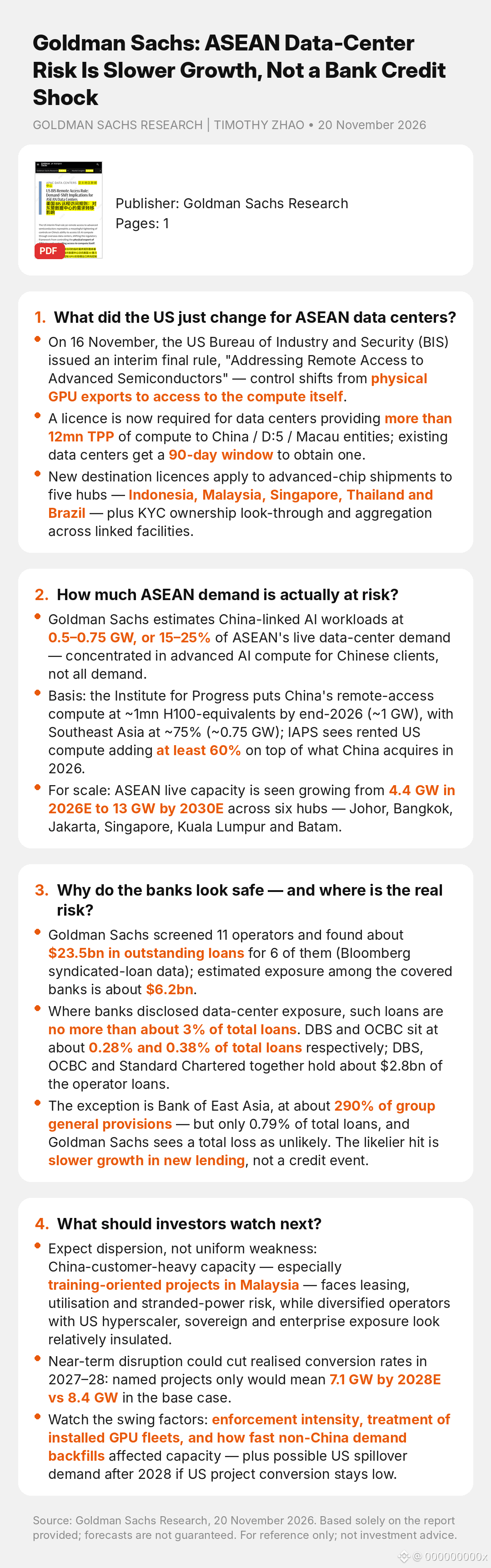
Goldman Sachs: ASEAN Data-Center Risk Is Slower Growth, Not a Bank Credit ShockGoldman Sachs: ASEAN Data-Center Risk Is Slower Growth, Not a Bank Credit Shock
$DBS $OCBC $BTC
GOLDMAN SACHS RESEARCH | TIMOTHY ZHAO • 20 November 2026
1. What did the US just change for ASEAN data centers?
• On 16 November, the US Bureau of Industry and Security (BIS) issued an interim final rule, "Addressing Remote Access to Advanced Semiconductors" — control shifts from physical GPU exports to access to the compute itself.
• A licence is now required for data centers providing more than 12mn TPP of compute to China / D:5 / Macau entities; existing data centers get a 90-day window to obtain one.
• New destination licences apply to advanced-chip shipments to five hubs — Indonesia, Malaysia, Singapore, Thailand and Brazil — plus KYC ownership look-through and aggregation across linked facilities.
2. How much ASEAN demand is actually at risk?
• Goldman Sachs estimates China-linked AI workloads at 0.5–0.75 GW, or 15–25% of ASEAN's live data-center demand — concentrated in advanced AI compute for Chinese clients, not all demand.
• Basis: the Institute for Progress puts China's remote-access compute at ~1mn H100-equivalents by end-2026 (~1 GW), with Southeast Asia at ~75% (~0.75 GW); IAPS sees rented US compute adding at least 60% on top of what China acquires in 2026.
• For scale: ASEAN live capacity is seen growing from 4.4 GW in 2026E to 13 GW by 2030E across six hubs — Johor, Bangkok, Jakarta, Singapore, Kuala Lumpur and Batam.
3. Why do the banks look safe — and where is the real risk?
• Goldman Sachs screened 11 operators and found about $23.5bn in outstanding loans for 6 of them (Bloomberg syndicated-loan data); estimated exposure among the covered banks is about $6.2bn.
• Where banks disclosed data-center exposure, such loans are no more than about 3% of total loans. DBS and OCBC sit at about 0.28% and 0.38% of total loans respectively; DBS, OCBC and Standard Chartered together hold about $2.8bn of the operator loans.
• The exception is Bank of East Asia, at about 290% of group general provisions — but only 0.79% of total loans, and Goldman Sachs sees a total loss as unlikely. The likelier hit is slower growth in new lending, not a credit event.
4. What should investors watch next?
• Expect dispersion, not uniform weakness: China-customer-heavy capacity — especially training-oriented projects in Malaysia — faces leasing, utilisation and stranded-power risk, while diversified operators with US hyperscaler, sovereign and enterprise exposure look relatively insulated.
• Near-term disruption could cut realised conversion rates in 2027–28: named projects only would mean 7.1 GW by 2028E vs 8.4 GW in the base case.
• Watch the swing factors: enforcement intensity, treatment of installed GPU fleets, and how fast non-China demand backfills affected capacity — plus possible US spillover demand after 2028 if US project conversion stays low.
Since the report: the AI-led selloff deepened on Fri 20 Nov — the S&P 500 fell 3.70% on the day, the Nasdaq 5.28%, and Nvidia 14% after reports of an SEC investigation; futures rebounded on Mon 23 Nov, with the Nasdaq 100 up ~2.8% in early trading. (XTB / moneycontrol, 23 Nov.)
#DataCenters #AI #ASEAN #Singapore #Banks
Source: Goldman Sachs Research, 20 November 2026. Based solely on the report provided; forecasts are not guaranteed. For reference only; not investment advice.
Read the full breakdown on Unhidea: https://unhidea.com/en/articles/research-cb2f3e314c8b4d61b8899bf9cc028398-en
Visit unhidea.com for more of the latest sell-side research interpretations.
Goldman Sachs: ASEAN Data-Center Risk Is Slower Growth, Not a Bank Credit Shock
Goldman Sachs: ASEAN Data-Center Risk Is Slower Growth, Not a Bank Credit Shock
$DBS $OCBC $BTC
GOLDMAN SACHS RESEARCH | TIMOTHY ZHAO • 20 November 2026
1. What did the US just change for ASEAN data centers?
• On 16 November, the US Bureau of Industry and Security (BIS) issued an interim final rule, "Addressing Remote Access to Advanced Semiconductors" — control shifts from physical GPU exports to access to the compute itself.
• A licence is now required for data centers providing more than 12mn TPP of compute to China / D:5 / Macau entities; existing data centers get a 90-day window to obtain one.
• New destination licences apply to advanced-chip shipments to five hubs — Indonesia, Malaysia, Singapore, Thailand and Brazil — plus KYC ownership look-through and aggregation across linked facilities.
2. How much ASEAN demand is actually at risk?
• Goldman Sachs estimates China-linked AI workloads at 0.5–0.75 GW, or 15–25% of ASEAN's live data-center demand — concentrated in advanced AI compute for Chinese clients, not all demand.
• Basis: the Institute for Progress puts China's remote-access compute at ~1mn H100-equivalents by end-2026 (~1 GW), with Southeast Asia at ~75% (~0.75 GW); IAPS sees rented US compute adding at least 60% on top of what China acquires in 2026.
• For scale: ASEAN live capacity is seen growing from 4.4 GW in 2026E to 13 GW by 2030E across six hubs — Johor, Bangkok, Jakarta, Singapore, Kuala Lumpur and Batam.
3. Why do the banks look safe — and where is the real risk?
• Goldman Sachs screened 11 operators and found about $23.5bn in outstanding loans for 6 of them (Bloomberg syndicated-loan data); estimated exposure among the covered banks is about $6.2bn.
• Where banks disclosed data-center exposure, such loans are no more than about 3% of total loans. DBS and OCBC sit at about 0.28% and 0.38% of total loans respectively; DBS, OCBC and Standard Chartered together hold about $2.8bn of the operator loans.
• The exception is Bank of East Asia, at about 290% of group general provisions — but only 0.79% of total loans, and Goldman Sachs sees a total loss as unlikely. The likelier hit is slower growth in new lending, not a credit event.
4. What should investors watch next?
• Expect dispersion, not uniform weakness: China-customer-heavy capacity — especially training-oriented projects in Malaysia — faces leasing, utilisation and stranded-power risk, while diversified operators with US hyperscaler, sovereign and enterprise exposure look relatively insulated.
• Near-term disruption could cut realised conversion rates in 2027–28: named projects only would mean 7.1 GW by 2028E vs 8.4 GW in the base case.
• Watch the swing factors: enforcement intensity, treatment of installed GPU fleets, and how fast non-China demand backfills affected capacity — plus possible US spillover demand after 2028 if US project conversion stays low.
Since the report: the AI-led selloff deepened on Fri 20 Nov — the S&P 500 fell 3.70% on the day, the Nasdaq 5.28%, and Nvidia 14% after reports of an SEC investigation; futures rebounded on Mon 23 Nov, with the Nasdaq 100 up ~2.8% in early trading. (XTB / moneycontrol, 23 Nov.)
#DataCenters #AI #ASEAN #Singapore #Banks
Source: Goldman Sachs Research, 20 November 2026. Based solely on the report provided; forecasts are not guaranteed. For reference only; not investment advice.
Read the full breakdown on Unhidea: https://unhidea.com/en/articles/research-cb2f3e314c8b4d61b8899bf9cc028398-en
Visit unhidea.com for more of the latest sell-side research interpretations.
140
·
--
Article
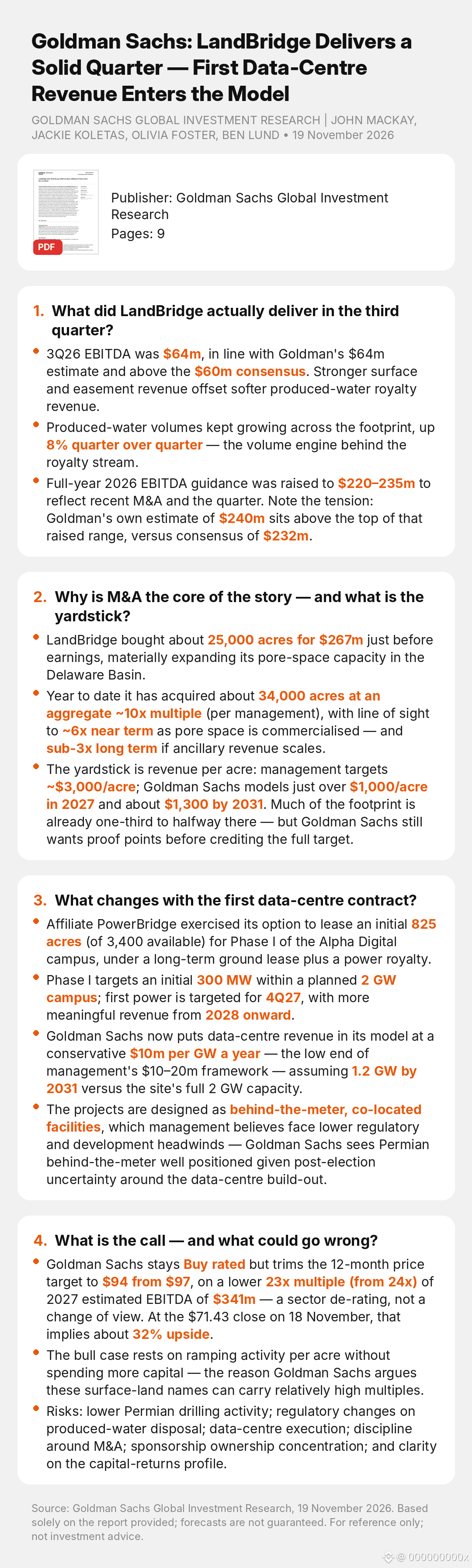
Goldman Sachs: LandBridge Delivers a Solid Quarter — First Data-Centre Revenue Enters the ModelGoldman Sachs: LandBridge Delivers a Solid Quarter — First Data-Centre Revenue Enters the Model
$LB
GOLDMAN SACHS GLOBAL INVESTMENT RESEARCH | JOHN MACKAY, JACKIE KOLETAS, OLIVIA FOSTER, BEN LUND • 19 November 2026
1. What did LandBridge actually deliver in the third quarter?
• 3Q26 EBITDA was $64m, in line with Goldman's $64m estimate and above the $60m consensus. Stronger surface and easement revenue offset softer produced-water royalty revenue.
• Produced-water volumes kept growing across the footprint, up 8% quarter over quarter — the volume engine behind the royalty stream.
• Full-year 2026 EBITDA guidance was raised to $220–235m to reflect recent M&A and the quarter. Note the tension: Goldman's own estimate of $240m sits above the top of that raised range, versus consensus of $232m.
2. Why is M&A the core of the story — and what is the yardstick?
• LandBridge bought about 25,000 acres for $267m just before earnings, materially expanding its pore-space capacity in the Delaware Basin.
• Year to date it has acquired about 34,000 acres at an aggregate ~10x multiple (per management), with line of sight to ~6x near term as pore space is commercialised — and sub-3x long term if ancillary revenue scales.
• The yardstick is revenue per acre: management targets ~$3,000/acre; Goldman Sachs models just over $1,000/acre in 2027 and about $1,300 by 2031. Much of the footprint is already one-third to halfway there — but Goldman Sachs still wants proof points before crediting the full target.
3. What changes with the first data-centre contract?
• Affiliate PowerBridge exercised its option to lease an initial 825 acres (of 3,400 available) for Phase I of the Alpha Digital campus, under a long-term ground lease plus a power royalty.
• Phase I targets an initial 300 MW within a planned 2 GW campus; first power is targeted for 4Q27, with more meaningful revenue from 2028 onward.
• Goldman Sachs now puts data-centre revenue in its model at a conservative $10m per GW a year — the low end of management's $10–20m framework — assuming 1.2 GW by 2031 versus the site's full 2 GW capacity.
• The projects are designed as behind-the-meter, co-located facilities, which management believes face lower regulatory and development headwinds — Goldman Sachs sees Permian behind-the-meter well positioned given post-election uncertainty around the data-centre build-out.
4. What is the call — and what could go wrong?
• Goldman Sachs stays Buy rated but trims the 12-month price target to $94 from $97, on a lower 23x multiple (from 24x) of 2027 estimated EBITDA of $341m — a sector de-rating, not a change of view. At the $71.43 close on 18 November, that implies about 32% upside.
• The bull case rests on ramping activity per acre without spending more capital — the reason Goldman Sachs argues these surface-land names can carry relatively high multiples.
• Risks: lower Permian drilling activity; regulatory changes on produced-water disposal; data-centre execution; discipline around M&A; sponsorship ownership concentration; and clarity on the capital-returns profile.
#DataCenters #AI #Permian #Energy #Land
Source: Goldman Sachs Global Investment Research, 19 November 2026. Based solely on the report provided; forecasts are not guaranteed. For reference only; not investment advice.
Read the full breakdown on Unhidea: https://unhidea.com/en/articles/research-bf3094fc45ad4c0ab9ef1eb7a5e799af-en
Visit unhidea.com for more of the latest sell-side research interpretations.
Goldman Sachs: LandBridge Delivers a Solid Quarter — First Data-Centre Revenue Enters the Model
Goldman Sachs: LandBridge Delivers a Solid Quarter — First Data-Centre Revenue Enters the Model
$LB
GOLDMAN SACHS GLOBAL INVESTMENT RESEARCH | JOHN MACKAY, JACKIE KOLETAS, OLIVIA FOSTER, BEN LUND • 19 November 2026
1. What did LandBridge actually deliver in the third quarter?
• 3Q26 EBITDA was $64m, in line with Goldman's $64m estimate and above the $60m consensus. Stronger surface and easement revenue offset softer produced-water royalty revenue.
• Produced-water volumes kept growing across the footprint, up 8% quarter over quarter — the volume engine behind the royalty stream.
• Full-year 2026 EBITDA guidance was raised to $220–235m to reflect recent M&A and the quarter. Note the tension: Goldman's own estimate of $240m sits above the top of that raised range, versus consensus of $232m.
2. Why is M&A the core of the story — and what is the yardstick?
• LandBridge bought about 25,000 acres for $267m just before earnings, materially expanding its pore-space capacity in the Delaware Basin.
• Year to date it has acquired about 34,000 acres at an aggregate ~10x multiple (per management), with line of sight to ~6x near term as pore space is commercialised — and sub-3x long term if ancillary revenue scales.
• The yardstick is revenue per acre: management targets ~$3,000/acre; Goldman Sachs models just over $1,000/acre in 2027 and about $1,300 by 2031. Much of the footprint is already one-third to halfway there — but Goldman Sachs still wants proof points before crediting the full target.
3. What changes with the first data-centre contract?
• Affiliate PowerBridge exercised its option to lease an initial 825 acres (of 3,400 available) for Phase I of the Alpha Digital campus, under a long-term ground lease plus a power royalty.
• Phase I targets an initial 300 MW within a planned 2 GW campus; first power is targeted for 4Q27, with more meaningful revenue from 2028 onward.
• Goldman Sachs now puts data-centre revenue in its model at a conservative $10m per GW a year — the low end of management's $10–20m framework — assuming 1.2 GW by 2031 versus the site's full 2 GW capacity.
• The projects are designed as behind-the-meter, co-located facilities, which management believes face lower regulatory and development headwinds — Goldman Sachs sees Permian behind-the-meter well positioned given post-election uncertainty around the data-centre build-out.
4. What is the call — and what could go wrong?
• Goldman Sachs stays Buy rated but trims the 12-month price target to $94 from $97, on a lower 23x multiple (from 24x) of 2027 estimated EBITDA of $341m — a sector de-rating, not a change of view. At the $71.43 close on 18 November, that implies about 32% upside.
• The bull case rests on ramping activity per acre without spending more capital — the reason Goldman Sachs argues these surface-land names can carry relatively high multiples.
• Risks: lower Permian drilling activity; regulatory changes on produced-water disposal; data-centre execution; discipline around M&A; sponsorship ownership concentration; and clarity on the capital-returns profile.
#DataCenters #AI #Permian #Energy #Land
Source: Goldman Sachs Global Investment Research, 19 November 2026. Based solely on the report provided; forecasts are not guaranteed. For reference only; not investment advice.
Read the full breakdown on Unhidea: https://unhidea.com/en/articles/research-bf3094fc45ad4c0ab9ef1eb7a5e799af-en
Visit unhidea.com for more of the latest sell-side research interpretations.
40
·
--
Article
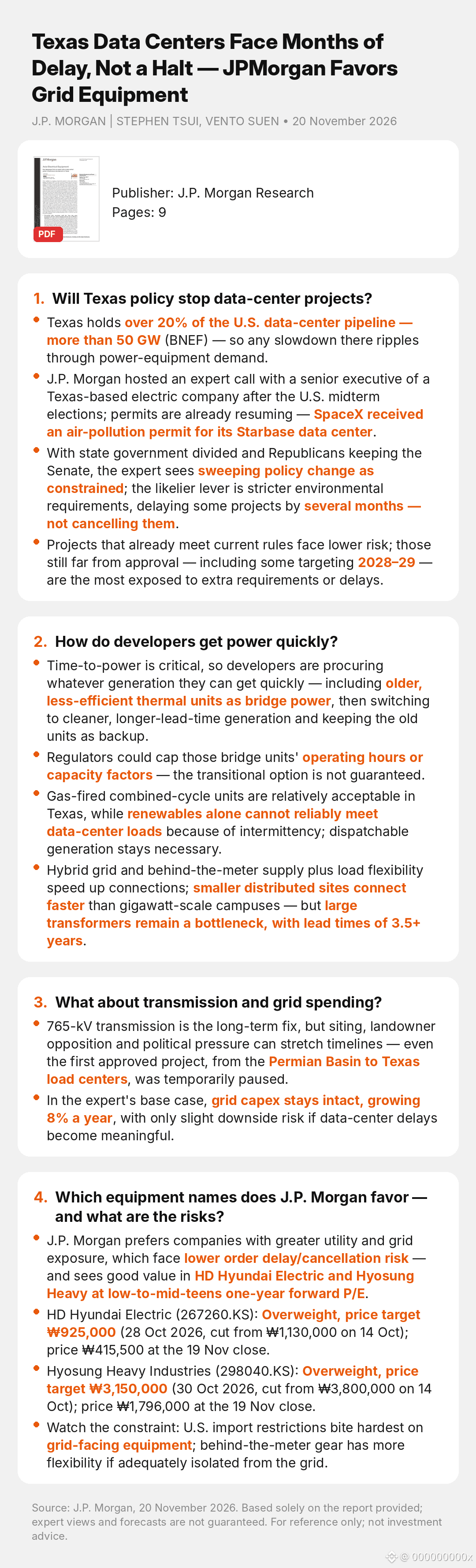
Texas Data Centers Face Months of Delay, Not a Halt — JPMorgan Favors Grid EquipmentTexas Data Centers Face Months of Delay, Not a Halt — JPMorgan Favors Grid Equipment
$267260.KS $298040.KS $BTC
J.P. MORGAN | STEPHEN TSUI, VENTO SUEN • 20 November 2026
1. Will Texas policy stop data-center projects?
• Texas holds over 20% of the U.S. data-center pipeline — more than 50 GW (BNEF) — so a slowdown there hits power-equipment demand.
• After the U.S. midterms, J.P. Morgan's expert call was with a senior executive of a Texas-based electric company; permits are already resuming — SpaceX received an air-pollution permit for its Starbase data center.
• With divided state government and Republicans keeping the Senate, sweeping policy change looks constrained; the likelier lever is stricter environmental requirements, delaying some projects by several months — not cancelling them.
• Projects that already meet current rules face lower risk; those still far from approval — including some targeting 2028–29 — are the most exposed to extra requirements or delays.
2. How do developers get power quickly?
• Time-to-power is critical, so developers procure whatever generation they can get quickly — including older, less-efficient thermal units as bridge power, then switch to cleaner generation and keep the old units as backup.
• Regulators could cap those bridge units' operating hours or capacity factors — the transitional option is not guaranteed.
• Gas-fired combined-cycle units are relatively acceptable in Texas, while renewables alone cannot reliably meet data-center loads; dispatchable generation stays necessary.
• Hybrid grid and behind-the-meter supply plus load flexibility speed connections; smaller distributed sites connect faster than gigawatt-scale campuses — but large transformers remain a bottleneck, with lead times of 3.5+ years.
3. What about transmission and grid spending?
• 765-kV transmission is the long-term fix, but siting, landowner opposition and political pressure stretch timelines — even the first approved project, from the Permian Basin to Texas load centers, was temporarily paused.
• In the expert's base case, grid capex stays intact, growing 8% a year, with only slight downside if data-center delays become meaningful.
4. Which equipment names does J.P. Morgan favor — and what are the risks?
• J.P. Morgan prefers companies with greater utility and grid exposure, which face lower order delay/cancellation risk — and sees good value in HD Hyundai Electric and Hyosung Heavy at low-to-mid-teens one-year forward P/E.
• HD Hyundai Electric (267260.KS): Overweight, price target ₩925,000 (28 Oct 2026, cut from ₩1,130,000 on 14 Oct); price ₩415,500 at the 19 Nov close.
• Hyosung Heavy Industries (298040.KS): Overweight, price target ₩3,150,000 (30 Oct 2026, cut from ₩3,800,000 on 14 Oct); price ₩1,796,000 at the 19 Nov close.
• Watch the constraint: U.S. import restrictions bite hardest on grid-facing equipment; behind-the-meter gear has more flexibility if adequately isolated from the grid.
#DataCenters #Texas #PowerGrid #AIInfrastructure #Energy
Source: J.P. Morgan, 20 November 2026. Based solely on the report provided; expert views and forecasts are not guaranteed. For reference only; not investment advice.
Read the full breakdown on Unhidea: https://unhidea.com/en/articles/research-1c9aff7cd15b4d7b856d642e3791d3ea-en
Visit unhidea.com for more of the latest sell-side research interpretations.
Texas Data Centers Face Months of Delay, Not a Halt — JPMorgan Favors Grid Equipment
Texas Data Centers Face Months of Delay, Not a Halt — JPMorgan Favors Grid Equipment
$267260.KS $298040.KS $BTC
J.P. MORGAN | STEPHEN TSUI, VENTO SUEN • 20 November 2026
1. Will Texas policy stop data-center projects?
• Texas holds over 20% of the U.S. data-center pipeline — more than 50 GW (BNEF) — so a slowdown there hits power-equipment demand.
• After the U.S. midterms, J.P. Morgan's expert call was with a senior executive of a Texas-based electric company; permits are already resuming — SpaceX received an air-pollution permit for its Starbase data center.
• With divided state government and Republicans keeping the Senate, sweeping policy change looks constrained; the likelier lever is stricter environmental requirements, delaying some projects by several months — not cancelling them.
• Projects that already meet current rules face lower risk; those still far from approval — including some targeting 2028–29 — are the most exposed to extra requirements or delays.
2. How do developers get power quickly?
• Time-to-power is critical, so developers procure whatever generation they can get quickly — including older, less-efficient thermal units as bridge power, then switch to cleaner generation and keep the old units as backup.
• Regulators could cap those bridge units' operating hours or capacity factors — the transitional option is not guaranteed.
• Gas-fired combined-cycle units are relatively acceptable in Texas, while renewables alone cannot reliably meet data-center loads; dispatchable generation stays necessary.
• Hybrid grid and behind-the-meter supply plus load flexibility speed connections; smaller distributed sites connect faster than gigawatt-scale campuses — but large transformers remain a bottleneck, with lead times of 3.5+ years.
3. What about transmission and grid spending?
• 765-kV transmission is the long-term fix, but siting, landowner opposition and political pressure stretch timelines — even the first approved project, from the Permian Basin to Texas load centers, was temporarily paused.
• In the expert's base case, grid capex stays intact, growing 8% a year, with only slight downside if data-center delays become meaningful.
4. Which equipment names does J.P. Morgan favor — and what are the risks?
• J.P. Morgan prefers companies with greater utility and grid exposure, which face lower order delay/cancellation risk — and sees good value in HD Hyundai Electric and Hyosung Heavy at low-to-mid-teens one-year forward P/E.
• HD Hyundai Electric (267260.KS): Overweight, price target ₩925,000 (28 Oct 2026, cut from ₩1,130,000 on 14 Oct); price ₩415,500 at the 19 Nov close.
• Hyosung Heavy Industries (298040.KS): Overweight, price target ₩3,150,000 (30 Oct 2026, cut from ₩3,800,000 on 14 Oct); price ₩1,796,000 at the 19 Nov close.
• Watch the constraint: U.S. import restrictions bite hardest on grid-facing equipment; behind-the-meter gear has more flexibility if adequately isolated from the grid.
#DataCenters #Texas #PowerGrid #AIInfrastructure #Energy
Source: J.P. Morgan, 20 November 2026. Based solely on the report provided; expert views and forecasts are not guaranteed. For reference only; not investment advice.
Read the full breakdown on Unhidea: https://unhidea.com/en/articles/research-1c9aff7cd15b4d7b856d642e3791d3ea-en
Visit unhidea.com for more of the latest sell-side research interpretations.
57
·
--
Article
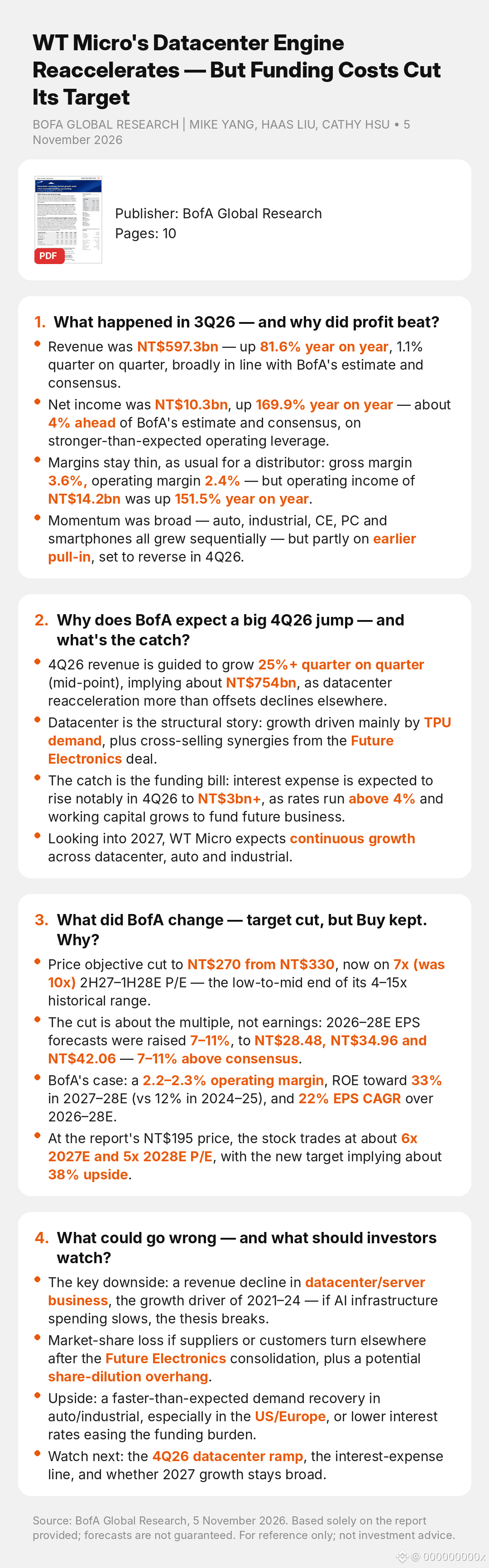
WT Micro's Datacenter Engine Reaccelerates — But Funding Costs Cut Its TargetWT Micro's Datacenter Engine Reaccelerates — But Funding Costs Cut Its Target
$3036.TW
BOFA GLOBAL RESEARCH | MIKE YANG, HAAS LIU, CATHY HSU • 5 November 2026
1. What happened in 3Q26 — and why did profit beat?
• Revenue was NT$597.3bn — up 81.6% year on year, 1.1% quarter on quarter, broadly in line with BofA's estimate and consensus.
• Net income was NT$10.3bn, up 169.9% year on year — about 4% ahead of BofA's estimate and consensus, on stronger-than-expected operating leverage.
• Margins stay thin, as usual for a distributor: gross margin 3.6%, operating margin 2.4% — but operating income of NT$14.2bn was up 151.5% year on year.
• Momentum was broad — auto, industrial, CE, PC and smartphones all grew sequentially — but partly on earlier pull-in, set to reverse in 4Q26.
2. Why does BofA expect a big 4Q26 jump — and what's the catch?
• 4Q26 revenue is guided to grow 25%+ quarter on quarter (mid-point), implying about NT$754bn, as datacenter reacceleration more than offsets declines elsewhere.
• Datacenter is the structural story: growth driven mainly by TPU demand, plus cross-selling synergies from the Future Electronics deal.
• The catch is the funding bill: interest expense is expected to rise notably in 4Q26 to NT$3bn+, as rates run above 4% and working capital grows to fund future business.
• Looking into 2027, WT Micro expects continuous growth across datacenter, auto and industrial.
3. What did BofA change — target cut, but Buy kept. Why?
• Price objective cut to NT$270 from NT$330, now on 7x (was 10x) 2H27–1H28E P/E — the low-to-mid end of its 4–15x historical range.
• The cut is about the multiple, not earnings: 2026–28E EPS forecasts were raised 7–11%, to NT$28.48, NT$34.96 and NT$42.06 — 7–11% above consensus.
• BofA's case: a 2.2–2.3% operating margin, ROE toward 33% in 2027–28E (vs 12% in 2024–25), and 22% EPS CAGR over 2026–28E.
• At the report's NT$195 price, the stock trades at about 6x 2027E and 5x 2028E P/E, with the new target implying about 38% upside.
4. What could go wrong — and what should investors watch?
• The key downside: a revenue decline in datacenter/server business, the growth driver of 2021–24 — if AI infrastructure spending slows, the thesis breaks.
• Market-share loss if suppliers or customers turn elsewhere after the Future Electronics consolidation, plus a potential share-dilution overhang.
• Upside: a faster-than-expected demand recovery in auto/industrial, especially in the US/Europe, or lower interest rates easing the funding burden.
• Watch next: the 4Q26 datacenter ramp, the interest-expense line, and whether 2027 growth stays broad.
Since the report (20 Nov): AI hardware sold off sharply — Nvidia -14%, Nasdaq -5.3% in a day — a reminder that the datacenter chain is not immune to valuation resets. (Market reports, 21 Nov 2026.)
#DataCenters #Semiconductors #AI #Taiwan #TPU
Source: BofA Global Research, 5 November 2026. Based solely on the report provided; forecasts are not guaranteed. For reference only; not investment advice.
Read the full breakdown on Unhidea: https://unhidea.com/en/articles/research-6567fd40fc4e4224941a1c18332915fc-en
Visit unhidea.com for more of the latest sell-side research interpretations.
WT Micro's Datacenter Engine Reaccelerates — But Funding Costs Cut Its Target
WT Micro's Datacenter Engine Reaccelerates — But Funding Costs Cut Its Target
$3036.TW
BOFA GLOBAL RESEARCH | MIKE YANG, HAAS LIU, CATHY HSU • 5 November 2026
1. What happened in 3Q26 — and why did profit beat?
• Revenue was NT$597.3bn — up 81.6% year on year, 1.1% quarter on quarter, broadly in line with BofA's estimate and consensus.
• Net income was NT$10.3bn, up 169.9% year on year — about 4% ahead of BofA's estimate and consensus, on stronger-than-expected operating leverage.
• Margins stay thin, as usual for a distributor: gross margin 3.6%, operating margin 2.4% — but operating income of NT$14.2bn was up 151.5% year on year.
• Momentum was broad — auto, industrial, CE, PC and smartphones all grew sequentially — but partly on earlier pull-in, set to reverse in 4Q26.
2. Why does BofA expect a big 4Q26 jump — and what's the catch?
• 4Q26 revenue is guided to grow 25%+ quarter on quarter (mid-point), implying about NT$754bn, as datacenter reacceleration more than offsets declines elsewhere.
• Datacenter is the structural story: growth driven mainly by TPU demand, plus cross-selling synergies from the Future Electronics deal.
• The catch is the funding bill: interest expense is expected to rise notably in 4Q26 to NT$3bn+, as rates run above 4% and working capital grows to fund future business.
• Looking into 2027, WT Micro expects continuous growth across datacenter, auto and industrial.
3. What did BofA change — target cut, but Buy kept. Why?
• Price objective cut to NT$270 from NT$330, now on 7x (was 10x) 2H27–1H28E P/E — the low-to-mid end of its 4–15x historical range.
• The cut is about the multiple, not earnings: 2026–28E EPS forecasts were raised 7–11%, to NT$28.48, NT$34.96 and NT$42.06 — 7–11% above consensus.
• BofA's case: a 2.2–2.3% operating margin, ROE toward 33% in 2027–28E (vs 12% in 2024–25), and 22% EPS CAGR over 2026–28E.
• At the report's NT$195 price, the stock trades at about 6x 2027E and 5x 2028E P/E, with the new target implying about 38% upside.
4. What could go wrong — and what should investors watch?
• The key downside: a revenue decline in datacenter/server business, the growth driver of 2021–24 — if AI infrastructure spending slows, the thesis breaks.
• Market-share loss if suppliers or customers turn elsewhere after the Future Electronics consolidation, plus a potential share-dilution overhang.
• Upside: a faster-than-expected demand recovery in auto/industrial, especially in the US/Europe, or lower interest rates easing the funding burden.
• Watch next: the 4Q26 datacenter ramp, the interest-expense line, and whether 2027 growth stays broad.
Since the report (20 Nov): AI hardware sold off sharply — Nvidia -14%, Nasdaq -5.3% in a day — a reminder that the datacenter chain is not immune to valuation resets. (Market reports, 21 Nov 2026.)
#DataCenters #Semiconductors #AI #Taiwan #TPU
Source: BofA Global Research, 5 November 2026. Based solely on the report provided; forecasts are not guaranteed. For reference only; not investment advice.
Read the full breakdown on Unhidea: https://unhidea.com/en/articles/research-6567fd40fc4e4224941a1c18332915fc-en
Visit unhidea.com for more of the latest sell-side research interpretations.
48

Riot and TeraWulf: The discount Bernstein sees in AI data centersThe discount at which Riot and TeraWulf trade applies not only to $BTC mining itself, but also to the value of the AI data centers associated with them ⚖️
This is the point Bernstein believes is worth paying attention to in the two stocks.
First, Bernstein sees room for upside in Riot and TeraWulf, because the market values them below the implied value of their data centers.
Riot and TeraWulf: The discount Bernstein sees in AI data centers
The discount at which Riot and TeraWulf trade applies not only to $BTC mining itself, but also to the value of the AI data centers associated with them ⚖️
This is the point Bernstein believes is worth paying attention to in the two stocks.
First, Bernstein sees room for upside in Riot and TeraWulf, because the market values them below the implied value of their data centers.
This is the point Bernstein believes is worth paying attention to in the two stocks.
First, Bernstein sees room for upside in Riot and TeraWulf, because the market values them below the implied value of their data centers.
17

🚨 JUST 400 US DATA CENTERS USE MORE ELECTRICITY THAN MICHIGAN
📰 WHAT HAPPENED?
New Harvard research shows that data-center power demand is outstripping states—and that doesn’t even include facilities with off-grid gas plants.
📊 IMPACT ON TECHNOLOGY
The news highlights the growing demand for computing capacity and the importance of chips and data centers in sustaining the expansion of new technologies.
🔎 Source: WIRED
🤔 💬 Will computing capacity be one of the main limits to the growth of these technologies?
#Semiconductors #DataCenters #Crypto_Marker #News
13

#CoreWeave : AI Demand Is Strong, Financing Is the Question 💸
CoreWeave fell about 6% as investors focused less on AI demand and more on whether independent data-center operators can keep funding an expensive buildout. Unlike hyperscalers, CoreWeave must continually raise capital for GPUs, land, power, and data centers—making it highly sensitive to credit conditions and investor confidence.
The company reported $3.66 billion in Q3 revenue, up 168% year over year, and a $132.5 billion backlog. But its debt rose to roughly $47 billion by September 30, while Q3 interest expense reached $846 million; management now expects $37–39 billion of 2026 capex.
CoreWeave’s bull case rests on long-term customer contracts, prepayments, and secured financing -not merely GPU demand. If those commitments keep funding expansion, the growth story can hold; if borrowing costs stay elevated or utilization disappoints, the market may keep discounting its aggressive capacity plans.
$CRWDB $CRWD $NVDAB #CRWV #AIStocks #DataCenters #CoinVahini
76

·
--
Bearish
AI crypto crowd, keep an eye on this one.
A Republican senator wants to hit PAUSE on new AI data centers while lawmakers in Congress are pushing to build more. If that fight slows down investment, AI tokens could catch some heat too. I’d watch the projects that actually sell GPU power and see whether demand holds up.
#CoreWeaveJumps10%On168%RevenueGrowth #AICrypto #DataCenters

1
394

·
--
#US Data Center Rules May Constrain AI Expansion
🚨 **AI BOOM UNDER PRESSURE? US DATA CENTER RULES COULD CHANGE THE GAME!**
The AI revolution needs more than powerful chips. It needs enormous amounts of electricity, land, water, and infrastructure.
And now, the US is facing growing pressure to regulate data center expansion.
Here's why this matters:
⚡ **1. Electricity Crisis**
AI data centers are consuming massive amounts of power, raising concerns about electricity prices for ordinary households.
🏛️ **2. Government Pressure**
New political momentum is building behind stricter AI and data center regulations.
💰 **3. Rising Costs**
Developers may face additional expenses for electricity, grid infrastructure, environmental compliance, and permits.
🤖 **4. AI Expansion at Risk?**
More restrictions could delay new facilities and increase the cost of building AI infrastructure.
📈 **5. The Bigger Opportunity**
Energy companies, power infrastructure providers, chipmakers, and data center developers could all be affected.
🔥 **MY TAKE:**
The next big AI bottleneck might not be computing power or software.
It might be ELECTRICITY.
The companies that can secure affordable, reliable energy may have a major competitive advantage.
💬 **What do you think?**
Will stricter US regulations slow down the AI revolution, or will they create a more sustainable industry?
#AI #artificialintelligence #Bitcoin #Crypto #DataCenters
76

·
--
Bearish
🚨 A BITCOIN MINER IS NOW MAKING 7 TIMES MORE REVENUE FROM AI THAN FROM BITCOIN MINING! 🤯
The crypto industry is changing, and one company is showing just how big that change could become.
IREN, a company known for Bitcoin mining, has reported a major increase in its AI Cloud business.
According to its latest quarterly results released on November 5, the numbers are surprising.
📊 HERE ARE THE NUMBERS:
🔹 AI Cloud Revenue: $200 MILLION, up 182% from the previous quarter.
🔹 Bitcoin Mining Revenue: $28 MILLION, down from $67 million in the previous quarter.
🔹 Total Revenue: $228 MILLION, up 66% from the previous quarter.
🔹 Net Loss: $263 MILLION.
That means IREN generated around 7 times more revenue from AI Cloud than from Bitcoin mining during the latest quarter.
BUT THERE IS A CATCH...
IREN is investing heavily in AI infrastructure.
The company plans around $15 BILLION in additional capital expenditure during the rest of its financial year.
It also delayed its target of reaching more than $4 billion in annualized revenue capacity to January 2027, with a possible extension into February, following requested network design changes for its Microsoft project and supplier delays.
🌍 WHY SHOULD CRYPTO INVESTORS CARE?
Bitcoin mining companies already have important resources:
🔸 Large data centers.
🔸 Access to electricity.
🔸 Land and computing infrastructure.
🔸 Experience operating large-scale hardware.
These resources can also support AI computing.
This could create a new business opportunity for some mining companies, but it also requires huge investment and comes with execution risks.
MY TAKE:
The competition for computing power is becoming bigger than just cryptocurrency.
AI companies need computing infrastructure, and some Bitcoin miners are trying to become part of that market.
👀 HERE IS THE BIG QUESTION:
Will Bitcoin mining companies eventually make more money from AI than from mining Bitcoin?
will Bitcoin mining remain their main business?
#CryptoNews #AICloud #DataCenters #NVIDIA
$BTC
117


#US Data Center Rules May Constrain AI Expansion
🏗️ ⚡ US Data Center Rules May Constrain AI Expansion: Is the AI Boom Hitting a Wall?
Building smarter AI is one challenge. Finding enough electricity, water and public support to run it is becoming another.
Across the United States, data center developers are facing growing regulatory pressure. Local communities and policymakers are demanding greater transparency, environmental safeguards and protection against rising electricity costs.
The November midterm results have added momentum to this debate. Several newly elected state leaders support tighter oversight, while local voters have increasingly backed restrictions on data center projects.
The real bottleneck may not be advanced chips. It could be grid connections, energy infrastructure, water availability and construction approvals.
My take: AI expansion is entering a new phase. Companies must prove not only that they can build powerful computing facilities, but that communities can afford and support them.
Watch electricity prices, permitting decisions, grid capacity and hyperscaler capital spending. These could reveal whether AI infrastructure growth is slowing or simply becoming more expensive.
The next AI race may be decided by power availability, not computing power alone.
Can AI grow fast enough without overwhelming local infrastructure?
Educational purposes only. Not financial advice.
#ArtificialIntelligence #DataCenters #GrowWithSAC $CYBER $IRENB $ACT

2
371

·
--
🤖 New regulations for data centers in the U.S. could become a challenge for the rapid expansion of AI.
The growth of artificial intelligence depends on enormous computing, energy, and semiconductor infrastructure. If regulations on energy consumption, environmental impact, or the development of new data centers become stricter, the pace of AI companies’ expansion could slow down.
⚡ Data centers are consuming more and more energy
🏗️ New regulations could delay expansion projects
🖥️ Companies like Microsoft, Google, Amazon, and Meta depend on this infrastructure
📈 Demand for AI continues to grow globally
However, some analysts believe these rules could drive more efficient and sustainable technologies, strengthening the sector in the long term.
💬 Do you think regulations on data centers will limit AI growth or drive more innovative and efficient infrastructure?
#AI #ArtificialIntelligence #DataCenters #Technology #Microsoft #Google #Amazon #Meta #Innovation #BinanceSquare #TechNews #Investing 🚀
11

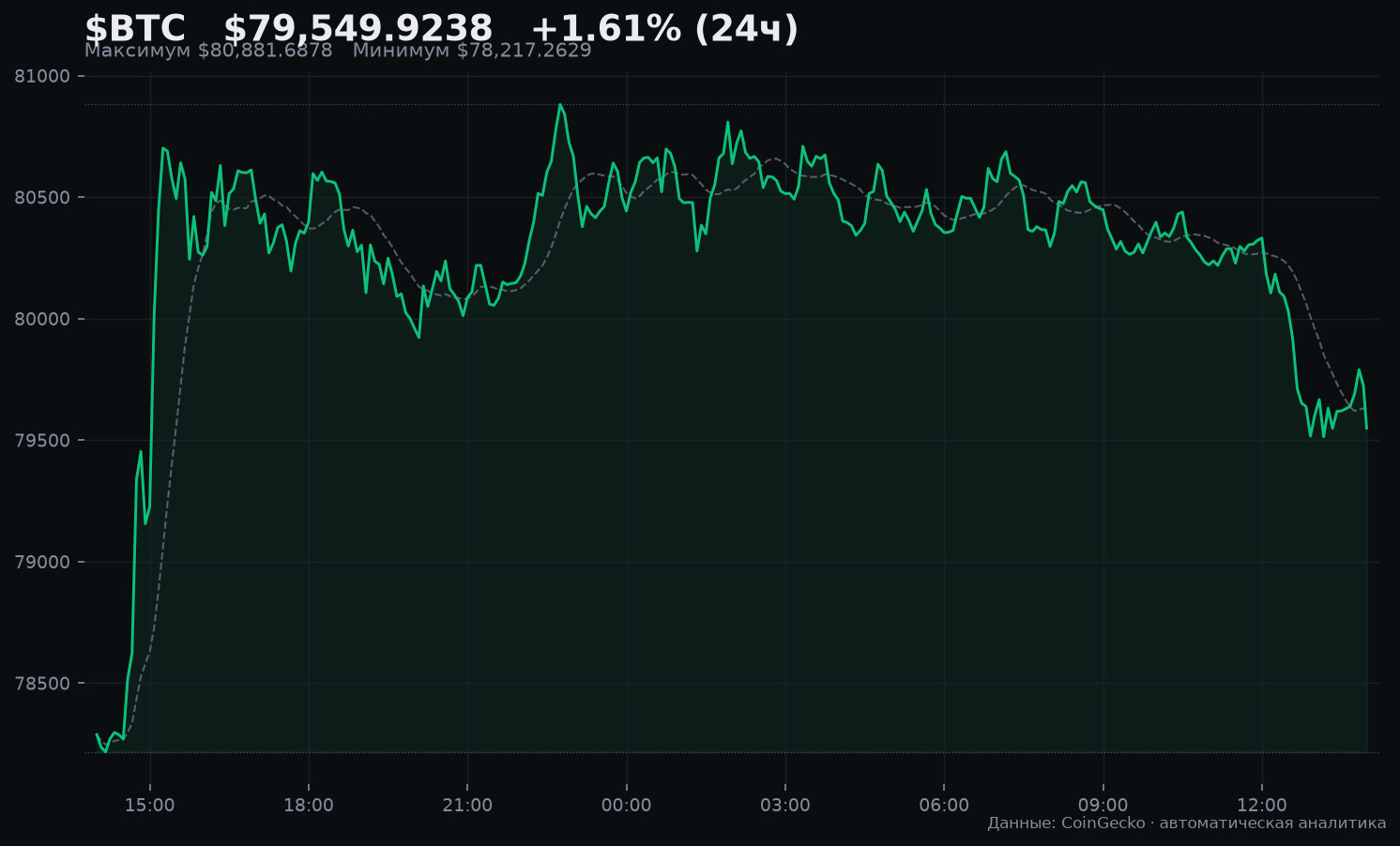
Texas was the epicenter of AI data center construction—but now that’s in question. Regulatory and infrastructure constraints are slowing expansion, and the market is taking notice: pressure on AI tokens is intensifying. Less computing capacity means weaker demand for decentralized rendering and training networks. BTC $79,593 (+1.69%).
$BTC $RENDER #AI #DataCenters
$BTC $RENDER #AI #DataCenters
85

·
--
Article
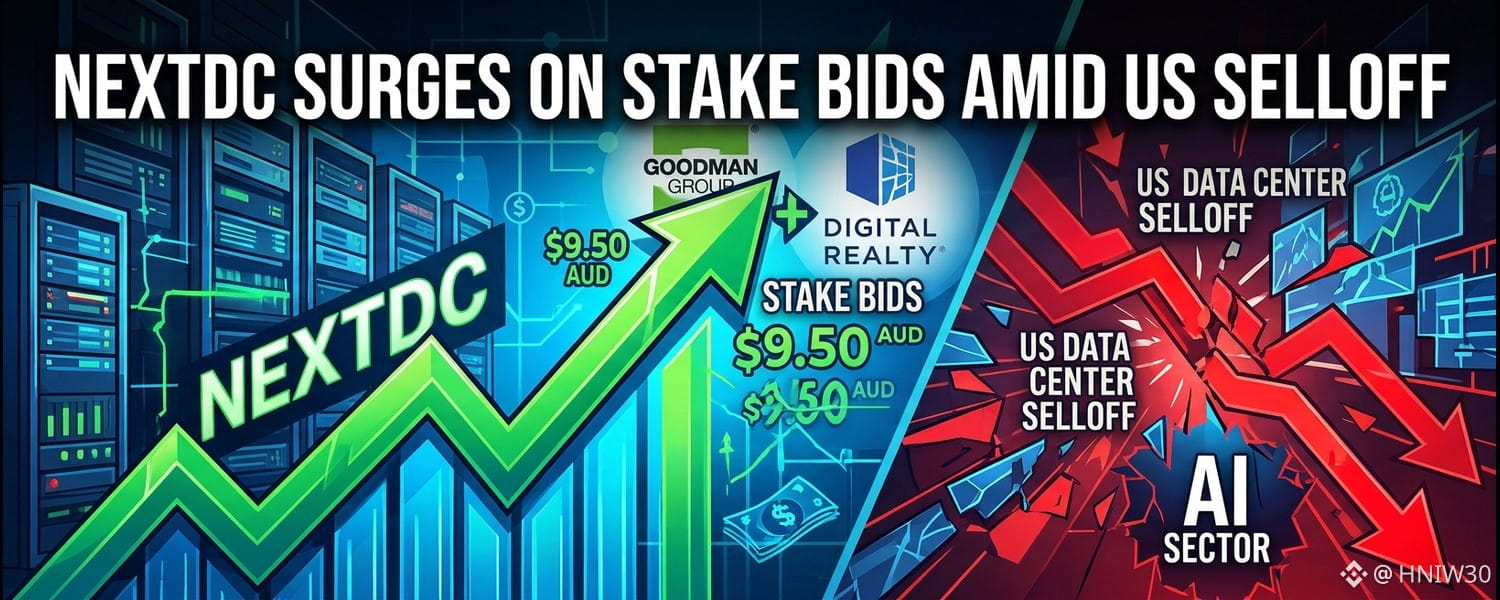
NextDC Surges on Stake Bids Amid US SelloffShares of Australian data center operator NextDC surged more than 40 percent Thursday morning after Goodman Group and Digital Realty moved to acquire stakes in the company. The two entities sought to purchase equity of up to 9.9 percent through an aftermarket bookbuild conducted Wednesday. NextDC confirmed the details in a regulatory filing, noting that the proposed share purchase was priced at 9.50 Australian dollars apiece following the initial approach from the prospective buyers.
The board of NextDC officially labeled the acquisition attempt opportunistic, according to the regulatory filing released on the same day. Leadership pointed out that the move arrived two weeks after the company disclosed an operational setback involving a power supply delay at its M3 Melbourne data center. Following that delay, NextDC had revised its fiscal 2027 guidance, creating the specific operational backdrop against which Goodman Group and Digital Realty launched their share purchase.
NextDC stated in its filing that it remained unaware of the outcome of the aftermarket share purchase. Meanwhile, Goodman Group and Digital Realty informed investors that they held no current intention of making a formal takeover bid for the Australian data center operator. However, both companies explicitly reserved the right to pursue a takeover bid in the future, maintaining their strategic flexibility after seeking the initial stakes of up to 9.9 percent at 9.50 Australian dollars per share.
The substantial rally in NextDC shares stood in sharp contrast to the performance of United States data center equities overnight. While the Australian operator experienced significant share price gains Thursday, American data center stocks endured a notable sell-off during the Wednesday trading session. That overnight weakness across United States markets highlighted a diverging performance pattern between the Australian company and its North American digital infrastructure peers.
Market losses in the United States were led by notable declines among key data center operators during the Wednesday session. Shares of CoreWeave dropped by about 9 percent, while shares of Iren fell roughly 11.2 percent over the same trading period. Those steep share price declines reflected broader selling pressure across the United States data center sector, contrasting sharply with the buying interest that lifted NextDC shares by more than 42 percent in Australia on Thursday.
The sell-off in United States data center stocks followed sweeping Democratic victories in the U.S. midterm elections. Those political results heightened market concerns over tighter oversight and potential restrictions on data center development. Investors feared that increased regulatory scrutiny following the election victories could slow down the artificial intelligence infrastructure buildout, driving the overnight retreat in American stocks even as NextDC surged on takeover interest.
#DataCenters
#MergersAndAcquisitions
NextDC Surges on Stake Bids Amid US Selloff
Shares of Australian data center operator NextDC surged more than 40 percent Thursday morning after Goodman Group and Digital Realty moved to acquire stakes in the company. The two entities sought to purchase equity of up to 9.9 percent through an aftermarket bookbuild conducted Wednesday. NextDC confirmed the details in a regulatory filing, noting that the proposed share purchase was priced at 9.50 Australian dollars apiece following the initial approach from the prospective buyers.
The board of NextDC officially labeled the acquisition attempt opportunistic, according to the regulatory filing released on the same day. Leadership pointed out that the move arrived two weeks after the company disclosed an operational setback involving a power supply delay at its M3 Melbourne data center. Following that delay, NextDC had revised its fiscal 2027 guidance, creating the specific operational backdrop against which Goodman Group and Digital Realty launched their share purchase.
NextDC stated in its filing that it remained unaware of the outcome of the aftermarket share purchase. Meanwhile, Goodman Group and Digital Realty informed investors that they held no current intention of making a formal takeover bid for the Australian data center operator. However, both companies explicitly reserved the right to pursue a takeover bid in the future, maintaining their strategic flexibility after seeking the initial stakes of up to 9.9 percent at 9.50 Australian dollars per share.
The substantial rally in NextDC shares stood in sharp contrast to the performance of United States data center equities overnight. While the Australian operator experienced significant share price gains Thursday, American data center stocks endured a notable sell-off during the Wednesday trading session. That overnight weakness across United States markets highlighted a diverging performance pattern between the Australian company and its North American digital infrastructure peers.
Market losses in the United States were led by notable declines among key data center operators during the Wednesday session. Shares of CoreWeave dropped by about 9 percent, while shares of Iren fell roughly 11.2 percent over the same trading period. Those steep share price declines reflected broader selling pressure across the United States data center sector, contrasting sharply with the buying interest that lifted NextDC shares by more than 42 percent in Australia on Thursday.
The sell-off in United States data center stocks followed sweeping Democratic victories in the U.S. midterm elections. Those political results heightened market concerns over tighter oversight and potential restrictions on data center development. Investors feared that increased regulatory scrutiny following the election victories could slow down the artificial intelligence infrastructure buildout, driving the overnight retreat in American stocks even as NextDC surged on takeover interest.
#DataCenters
#MergersAndAcquisitions
165

·
--
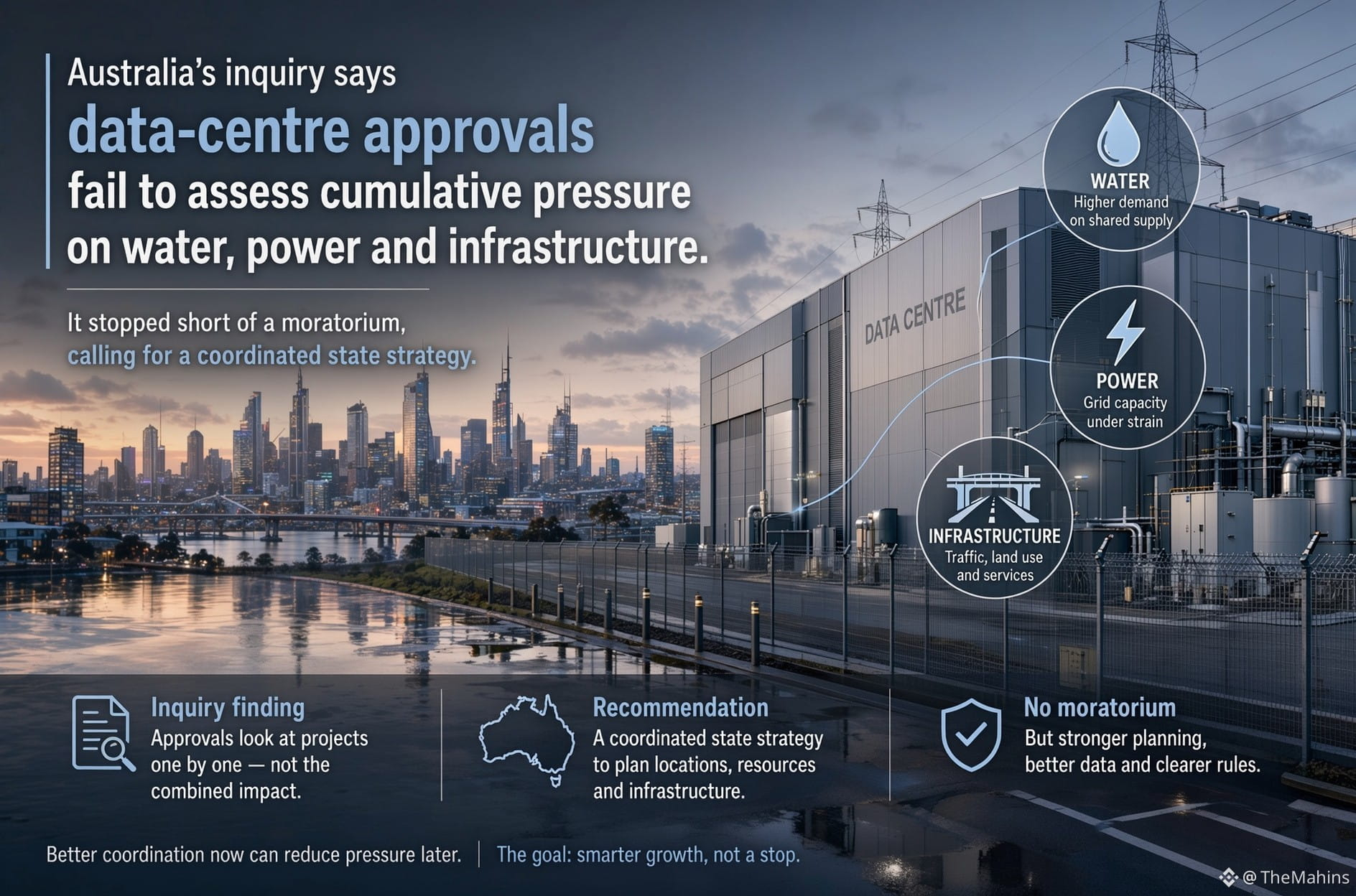
Australia’s inquiry says data-centre approvals fail to assess cumulative pressure on water, power and infrastructure. It stopped short of a moratorium, calling for a coordinated state strategy. $NVDA $AMD $MSFT #Tech #DataCenters #AI #Cloud #Energy Plan needed
Australia’s inquiry says data-centre approvals fail to assess cumulative pressure on water, power and infrastructure. It stopped short of a moratorium, calling for a coordinated state strategy. $NVDA $AMD $MSFT #Tech #DataCenters #AI #Cloud #Energy Plan needed
239

Article
The AI boom and data centers in the United States: Economic driver or threat to the traditional market? 🏗️⚡
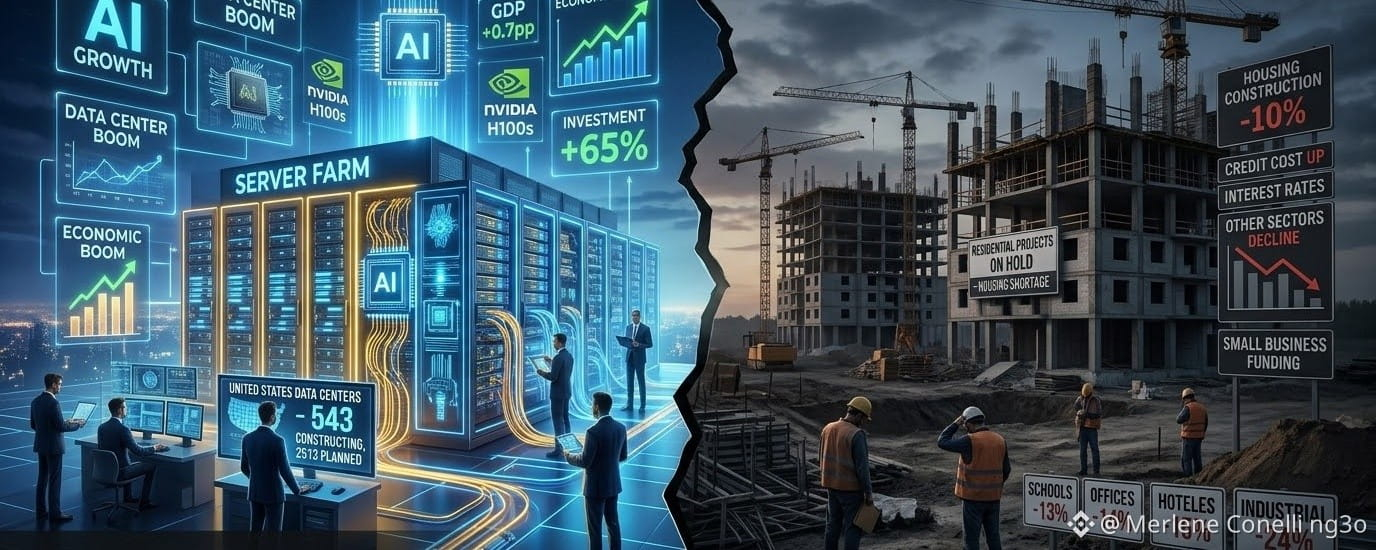
Data center construction in the United States has reached unprecedented levels. In 2026 alone, tech giants (Oracle, Microsoft, Amazon, Meta, Alphabet) planned to spend around $800 billion on capital expenditures. According to The Atlantic, 543 facilities are already under construction in the country, with another 2,513 in the planning stages.
But in macroeconomics, every rapid expansion comes at a cost. Analysts are increasingly talking about the crowding-out effect.
But in macroeconomics, every rapid expansion comes at a cost. Analysts are increasingly talking about the crowding-out effect.
5
390

·
--
🏗️ AI is consuming the US economy: what do crypto and mining have to do with it?
The Atlantic published an interesting analysis: the AI infrastructure boom in the US is boosting the economy, but creating a massive “crowding-out effect.”
The scale:
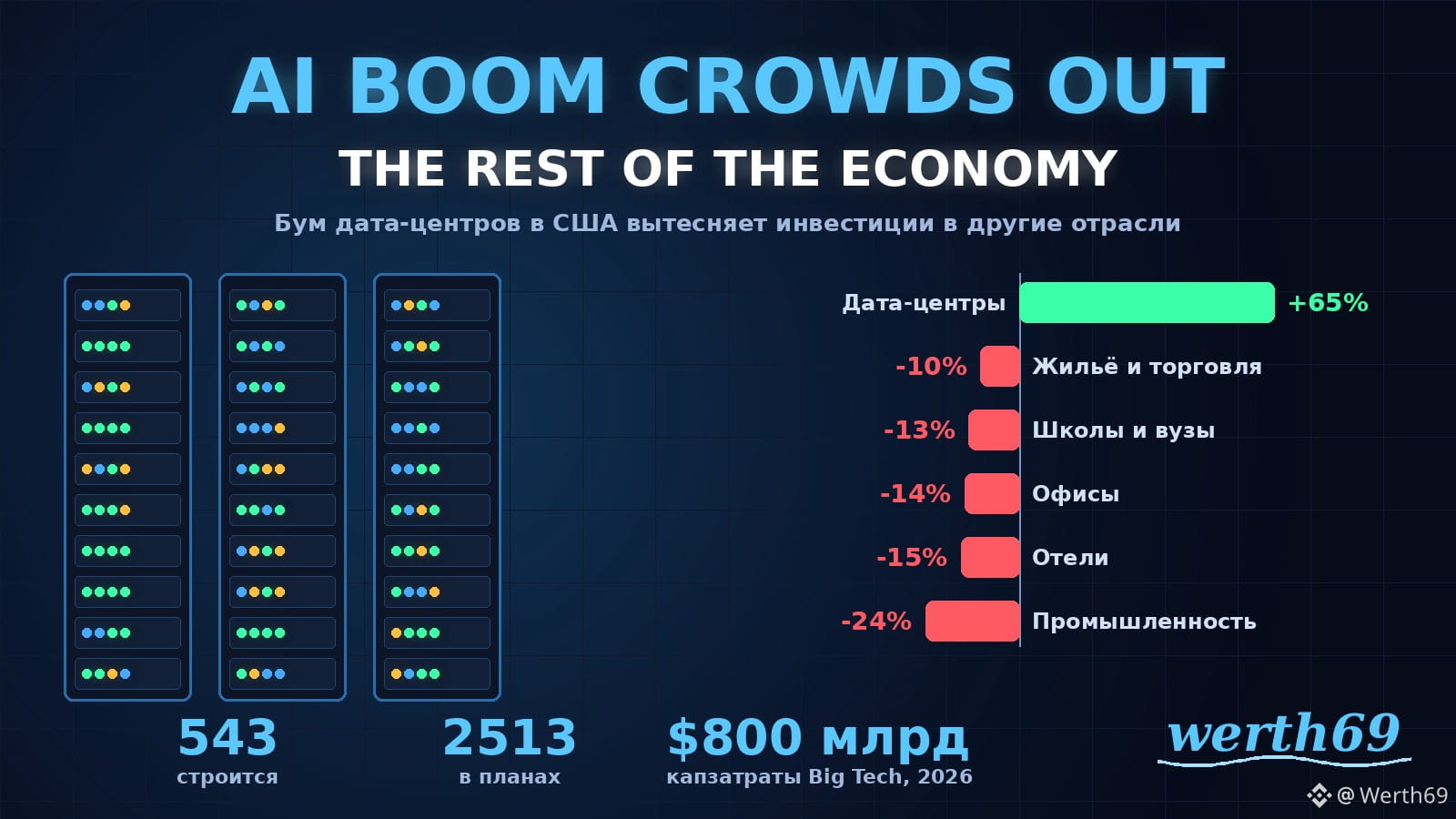
543 data centers are being built in the US, with another 2,513 planned. Oracle, Microsoft, Amazon, Meta, and Alphabet are ready to spend around $800 billion in capital expenditures in 2026 (8 times more than 10 years ago).
The flip side (year over year):
Data center construction grew by +65%. But at the same time:
🔻 Manufacturing: -24%
🔻 Hotels and resorts: -15%
🔻 Offices: -14%
🔻 Housing and retail: -10%
AI infrastructure is consuming credit, land, and materials.
What does crypto have to do with it?
Economist Ryan Cummings sees the displacement of mining businesses, driven by rising costs, as a positive effect. Competition for electricity and resources is increasing.
If AI fails to deliver the expected productivity boost, this bubble could burst. For now, capital is flowing into data centers rather than risky assets.
Are we in for a stock market correction, or will AI save the economy? 👇
#Aİ #Macro #cryptotrading #DataCenters
$BTC
{future}(BTCUSDT)
🏗️ AI is consuming the US economy: what do crypto and mining have to do with it?
The Atlantic published an interesting analysis: the AI infrastructure boom in the US is boosting the economy, but creating a massive “crowding-out effect.”
The scale:
543 data centers are being built in the US, with another 2,513 planned. Oracle, Microsoft, Amazon, Meta, and Alphabet are ready to spend around $800 billion in capital expenditures in 2026 (8 times more than 10 years ago).
The flip side (year over year):
Data center construction grew by +65%. But at the same time:
🔻 Manufacturing: -24%
🔻 Hotels and resorts: -15%
🔻 Offices: -14%
🔻 Housing and retail: -10%
AI infrastructure is consuming credit, land, and materials.
What does crypto have to do with it?
Economist Ryan Cummings sees the displacement of mining businesses, driven by rising costs, as a positive effect. Competition for electricity and resources is increasing.
If AI fails to deliver the expected productivity boost, this bubble could burst. For now, capital is flowing into data centers rather than risky assets.
Are we in for a stock market correction, or will AI save the economy? 👇
#Aİ #Macro #cryptotrading #DataCenters
$BTC
793

Verified
#earningsseason
🚨 Celestica Faces $5.4 Billion Revenue Test as AI Infrastructure Demand Takes Center Stage!
Celestica ($CLS), a major supplier of advanced hardware and manufacturing solutions, is scheduled to report its third-quarter 2026 earnings after today's market close.
Analysts expect approximately $5.39 billion in quarterly revenue and earnings of $2.94 per share.
🚀 The biggest story is artificial intelligence.
Celestica provides hardware and technology solutions used in data centers and networking infrastructure, making its performance particularly relevant as major technology companies continue expanding AI computing capacity.
Investors will closely examine demand for high-performance networking equipment, profitability and management's expectations for the coming quarters.
⚠️ The key challenge is whether strong AI infrastructure demand can continue supporting growth while companies manage rising costs and increasingly demanding valuations.
Celestica's earnings could offer another important signal about spending across the AI hardware supply chain.
#artificialintelligence #DataCenters #TechStocks

2.7k
🚨 JENSEN HUANG’S VISION FOR EUROPE RUNS ON PLUG-IN DATA CENTERS
📰 WHAT HAPPENED?
At Nvidia’s GTC in Berlin, Huang unveiled the company’s new plug-in data center—the DSX Pod—as the key to unlocking Europe’s AI infrastructure lag. Oh, and autonomous humanoid robotics.
📊 TECHNOLOGY IMPACT
The news highlights the growing demand for computing capacity and the importance of chips and data centers in supporting the expansion of new technologies.
🔎 Source: WIRED AI
🤔 💬 Will computing capacity be one of the main limits to the growth of these technologies?
#Semiconductors #DataCenters #Crypto_Marker #News

81
Verified
#earningsseason
🚨 Western Digital Beats Wall Street Estimates as AI Storage Demand Surges!
Western Digital ($WDCB ) reported strong fiscal first-quarter results, with revenue jumping 55% year over year to approximately $4.4 billion.
Adjusted earnings reached $4.64 per share, beating analysts' expectations of approximately $4.11.
The company also reported a major improvement in profitability, with adjusted gross margins reaching 58.1%, compared with 43.9% a year earlier.
🚀 The biggest growth driver: AI data centers.
As artificial intelligence applications generate enormous amounts of information, demand for high-capacity data storage continues to expand.
Western Digital expects approximately $5.1 billion in revenue next quarter, with gross margins between 60% and 61%.
However, despite strong earnings and optimistic guidance, $WDC shares declined approximately 2.5% on Friday.
Investors remain concerned about production costs, competition and whether the AI-driven storage boom can sustain its current pace.
Strong results are no longer enough. Wall Street wants proof that AI demand can support long-term profitability.
#AI #TechStocks #DataCenters

1.1k
Log in to explore more content
Join global crypto users on Binance Square
⚡️ Get latest and useful information about crypto.
💬 Trusted by the world’s largest crypto exchange.
👍 Discover real insights from verified creators.
Email / Phone number
Trending Topics
1
#CorePCEBeatLiftsFedHikeOdds
57,214 views
711 Discussing
2
#BitcoinAndStocksSlipAgainAmidTrump’sTariffPlans
138,106 views
1,632 Discussing
3
#JensenHuangSaysNvidiaDoesn’tNeedASuccessionPlan
69,469 views
978 Discussing
4
#NasdaqFuturesSlideMoreThan3%
13,381 views
210 Discussing
5
#USOctoberPCEPriceIndexAt0.3%MoM
15,456 views
214 Discussing
6
#BitcoinETFsPostRecord$4.94BNovemberOutflows
1,004 views
27 Discussing
7
#TetherInvestsInArgentinasLemon
6,509 views
110 Discussing
8
#AnthropicBreaksBelowIPOPriceAmidAISlump
197,723 views
1,638 Discussing
9
#SouthKoreaProposesCryptoExchangeStaffUseOwnPlatform
1,079 views
27 Discussing
10
#UkraineParliamentPassesVirtualAssetLegalizationBill
8,269 views
29 Discussing