
#nearai
nearai
3,000 views
15 Discussing
Hot
Latest

·
--
Article
AI Agents Are Getting More Capable. The Harder Problem Is Knowing Where to Draw the Line.AI has already moved beyond answering questions.
The more significant shift happens when an AI system can take action.
An agent can browse, research, work with files, use external tools, communicate through different channels and continue a task without being guided through every individual step.
That creates a different infrastructure problem.
When software can act on your behalf, capability is no longer enough. You also need to know what the agent is allowed to do, what stands between its decisions and its actions, and what happens when something goes wrong.
That is where IronClaw 1.0, developed within the @NEAR_Protocol ecosystem, takes a different architectural approach.
The Agent Should Not Have a Direct Line to the Outside World
Most people think about an AI agent as a model connected to a collection of tools.
IronClaw treats that connection as something that needs a boundary.
Its architecture separates the part that decides from the part that acts, using a coordination layer called the Guard.
Think → Guard → Act
The agent can determine the steps required to achieve a goal. But before those decisions become external actions, they pass through the Guard.
Sensitive actions can require explicit approval, while secrets are designed to be single-use by default.
This matters because agents do not operate only on information supplied by their users.
A webpage, email, document or tool response can contain content that looks like an instruction. If the system gives that content the same authority as an actual user instruction, the line between information and permission starts to disappear.
NEAR AI has described this challenge as field-content trust.
The architectural principle is simple:
An agent should be able to read something without automatically being allowed to obey it.
That is a meaningful difference in how agent security is designed.
Security Still Has to Work Alongside Capability
A heavily restricted agent is not useful if it cannot complete real work.
IronClaw's reported results show the other side of the equation.
Using the same deepseek-v4-flash base model, IronClaw recorded:
93.5% — PinchBench
88.6% — ClawBench
76.4% — OfficeQA
The tests are deliberately different.
PinchBench covers 147 real tasks, including scheduling, email triage, coding, research and file management.
ClawBench evaluates multi-step work across production websites.
OfficeQA focuses on reasoning across large document collections, including historical U.S. Treasury material containing millions of numerical values.
The numbers matter, but the bigger lesson is the combination.
An agent needs to reason well, use tools appropriately and handle complex workflows while still operating within defined boundaries.
For businesses, that makes capability and control two sides of the same problem.
Real Work Also Needs Memory
Business processes rarely finish in one uninterrupted session.
An approval may be required halfway through a task. A system may restart. A user may switch from one interface to another.
IronClaw uses continuous checkpointing and persistent state so an interruption does not necessarily mean losing the work already completed.
Its memory and safety rules also extend across CLI, Web, Slack and Telegram.
That changes the role of an AI agent.
It is no longer simply something that answers a prompt and disappears. It can become part of an ongoing workflow.
For organisations, continuity matters because restarting work can create duplicated effort, inconsistent results and unnecessary human intervention.
IronClaw also supports team environments through multi-tenant deployment and fully isolated single-tenant options, giving organisations different ways to manage separation and access.
The Agent Is Not the Whole Trust Model
There is another question underneath the agent:
Where is the computation happening?
This is where #NEARAI enters the picture.
NEAR AI is building confidential AI infrastructure in which workloads can run inside hardware-enforced Trusted Execution Environments, or TEEs.
Its integration with Intel Trust Authority adds independent attestation, giving users a way to verify the protected execution environment rather than simply relying on the infrastructure operator.
That creates a layered approach:
The Guard controls action.
Confidential computing protects execution.
Attestation helps verify the environment.
And beneath those layers sits the network.
Why Staking Matters to the AI Stack
NEAR uses Proof-of-Stake, where delegated stake supports the validators responsible for securing the network.
That gives staking a role beyond the conversation around returns. It contributes to the economic security of the infrastructure underneath applications and services.
NEAR AI's staking model adds another connection between the network and AI infrastructure.
Users can stake NEAR to receive credits for services such as confidential inference and IronClaw hosting. The amount staked influences the available service budget and agent capacity.
So the relationship is not simply:
stake → return
It can also be understood as:
stake → network security + access to AI infrastructure
That does not mean staking alone makes an AI agent trustworthy. It means the economic layer supporting the network is connected to the infrastructure through which AI services can be accessed.
That connection is an important part of the broader NEAR AI model.
The Bigger Shift Is Controlled Agency
With #IronClaw ,the important development is not simply that an AI agent can do more.
It is that more thought is going into how much authority an agent should have while doing it.
The architecture separates decision from action.
Checkpointing protects continuity.
Persistent memory keeps context alive.
Confidential computing protects sensitive workloads.
Attestation provides a way to verify the environment.
Staking contributes economic security to the underlying network while connecting users to AI infrastructure.
None of these layers solves the trust problem alone.
Together, however, they point toward a different model for agentic AI.
The future of AI may not be defined by giving agents unlimited freedom.
It may be defined by giving them useful authority within boundaries that can be enforced and verified.
Because once an AI can act on your behalf, the most important question is no longer:
“How smart is the agent?”
It is:
“How much should we trust it to do?”
And that is ultimately an architecture question.
AI Agents Are Getting More Capable. The Harder Problem Is Knowing Where to Draw the Line.
AI has already moved beyond answering questions.
The more significant shift happens when an AI system can take action.
An agent can browse, research, work with files, use external tools, communicate through different channels and continue a task without being guided through every individual step.
That creates a different infrastructure problem.
When software can act on your behalf, capability is no longer enough. You also need to know what the agent is allowed to do, what stands between its decisions and its actions, and what happens when something goes wrong.
That is where IronClaw 1.0, developed within the @NEAR Protocol ecosystem, takes a different architectural approach.
The Agent Should Not Have a Direct Line to the Outside World
Most people think about an AI agent as a model connected to a collection of tools.
IronClaw treats that connection as something that needs a boundary.
Its architecture separates the part that decides from the part that acts, using a coordination layer called the Guard.
Think → Guard → Act
The agent can determine the steps required to achieve a goal. But before those decisions become external actions, they pass through the Guard.
Sensitive actions can require explicit approval, while secrets are designed to be single-use by default.
This matters because agents do not operate only on information supplied by their users.
A webpage, email, document or tool response can contain content that looks like an instruction. If the system gives that content the same authority as an actual user instruction, the line between information and permission starts to disappear.
NEAR AI has described this challenge as field-content trust.
The architectural principle is simple:
An agent should be able to read something without automatically being allowed to obey it.
That is a meaningful difference in how agent security is designed.
Security Still Has to Work Alongside Capability
A heavily restricted agent is not useful if it cannot complete real work.
IronClaw's reported results show the other side of the equation.
Using the same deepseek-v4-flash base model, IronClaw recorded:
93.5% — PinchBench
88.6% — ClawBench
76.4% — OfficeQA
The tests are deliberately different.
PinchBench covers 147 real tasks, including scheduling, email triage, coding, research and file management.
ClawBench evaluates multi-step work across production websites.
OfficeQA focuses on reasoning across large document collections, including historical U.S. Treasury material containing millions of numerical values.
The numbers matter, but the bigger lesson is the combination.
An agent needs to reason well, use tools appropriately and handle complex workflows while still operating within defined boundaries.
For businesses, that makes capability and control two sides of the same problem.
Real Work Also Needs Memory
Business processes rarely finish in one uninterrupted session.
An approval may be required halfway through a task. A system may restart. A user may switch from one interface to another.
IronClaw uses continuous checkpointing and persistent state so an interruption does not necessarily mean losing the work already completed.
Its memory and safety rules also extend across CLI, Web, Slack and Telegram.
That changes the role of an AI agent.
It is no longer simply something that answers a prompt and disappears. It can become part of an ongoing workflow.
For organisations, continuity matters because restarting work can create duplicated effort, inconsistent results and unnecessary human intervention.
IronClaw also supports team environments through multi-tenant deployment and fully isolated single-tenant options, giving organisations different ways to manage separation and access.
The Agent Is Not the Whole Trust Model
There is another question underneath the agent:
Where is the computation happening?
This is where #NEARAI enters the picture.
NEAR AI is building confidential AI infrastructure in which workloads can run inside hardware-enforced Trusted Execution Environments, or TEEs.
Its integration with Intel Trust Authority adds independent attestation, giving users a way to verify the protected execution environment rather than simply relying on the infrastructure operator.
That creates a layered approach:
The Guard controls action.
Confidential computing protects execution.
Attestation helps verify the environment.
And beneath those layers sits the network.
Why Staking Matters to the AI Stack
NEAR uses Proof-of-Stake, where delegated stake supports the validators responsible for securing the network.
That gives staking a role beyond the conversation around returns. It contributes to the economic security of the infrastructure underneath applications and services.
NEAR AI's staking model adds another connection between the network and AI infrastructure.
Users can stake NEAR to receive credits for services such as confidential inference and IronClaw hosting. The amount staked influences the available service budget and agent capacity.
So the relationship is not simply:
stake → return
It can also be understood as:
stake → network security + access to AI infrastructure
That does not mean staking alone makes an AI agent trustworthy. It means the economic layer supporting the network is connected to the infrastructure through which AI services can be accessed.
That connection is an important part of the broader NEAR AI model.
The Bigger Shift Is Controlled Agency
With #IronClaw ,the important development is not simply that an AI agent can do more.
It is that more thought is going into how much authority an agent should have while doing it.
The architecture separates decision from action.
Checkpointing protects continuity.
Persistent memory keeps context alive.
Confidential computing protects sensitive workloads.
Attestation provides a way to verify the environment.
Staking contributes economic security to the underlying network while connecting users to AI infrastructure.
None of these layers solves the trust problem alone.
Together, however, they point toward a different model for agentic AI.
The future of AI may not be defined by giving agents unlimited freedom.
It may be defined by giving them useful authority within boundaries that can be enforced and verified.
Because once an AI can act on your behalf, the most important question is no longer:
“How smart is the agent?”
It is:
“How much should we trust it to do?”
And that is ultimately an architecture question.
The more significant shift happens when an AI system can take action.
An agent can browse, research, work with files, use external tools, communicate through different channels and continue a task without being guided through every individual step.
That creates a different infrastructure problem.
When software can act on your behalf, capability is no longer enough. You also need to know what the agent is allowed to do, what stands between its decisions and its actions, and what happens when something goes wrong.
That is where IronClaw 1.0, developed within the @NEAR Protocol ecosystem, takes a different architectural approach.
The Agent Should Not Have a Direct Line to the Outside World
Most people think about an AI agent as a model connected to a collection of tools.
IronClaw treats that connection as something that needs a boundary.
Its architecture separates the part that decides from the part that acts, using a coordination layer called the Guard.
Think → Guard → Act
The agent can determine the steps required to achieve a goal. But before those decisions become external actions, they pass through the Guard.
Sensitive actions can require explicit approval, while secrets are designed to be single-use by default.
This matters because agents do not operate only on information supplied by their users.
A webpage, email, document or tool response can contain content that looks like an instruction. If the system gives that content the same authority as an actual user instruction, the line between information and permission starts to disappear.
NEAR AI has described this challenge as field-content trust.
The architectural principle is simple:
An agent should be able to read something without automatically being allowed to obey it.
That is a meaningful difference in how agent security is designed.
Security Still Has to Work Alongside Capability
A heavily restricted agent is not useful if it cannot complete real work.
IronClaw's reported results show the other side of the equation.
Using the same deepseek-v4-flash base model, IronClaw recorded:
93.5% — PinchBench
88.6% — ClawBench
76.4% — OfficeQA
The tests are deliberately different.
PinchBench covers 147 real tasks, including scheduling, email triage, coding, research and file management.
ClawBench evaluates multi-step work across production websites.
OfficeQA focuses on reasoning across large document collections, including historical U.S. Treasury material containing millions of numerical values.
The numbers matter, but the bigger lesson is the combination.
An agent needs to reason well, use tools appropriately and handle complex workflows while still operating within defined boundaries.
For businesses, that makes capability and control two sides of the same problem.
Real Work Also Needs Memory
Business processes rarely finish in one uninterrupted session.
An approval may be required halfway through a task. A system may restart. A user may switch from one interface to another.
IronClaw uses continuous checkpointing and persistent state so an interruption does not necessarily mean losing the work already completed.
Its memory and safety rules also extend across CLI, Web, Slack and Telegram.
That changes the role of an AI agent.
It is no longer simply something that answers a prompt and disappears. It can become part of an ongoing workflow.
For organisations, continuity matters because restarting work can create duplicated effort, inconsistent results and unnecessary human intervention.
IronClaw also supports team environments through multi-tenant deployment and fully isolated single-tenant options, giving organisations different ways to manage separation and access.
The Agent Is Not the Whole Trust Model
There is another question underneath the agent:
Where is the computation happening?
This is where #NEARAI enters the picture.
NEAR AI is building confidential AI infrastructure in which workloads can run inside hardware-enforced Trusted Execution Environments, or TEEs.
Its integration with Intel Trust Authority adds independent attestation, giving users a way to verify the protected execution environment rather than simply relying on the infrastructure operator.
That creates a layered approach:
The Guard controls action.
Confidential computing protects execution.
Attestation helps verify the environment.
And beneath those layers sits the network.
Why Staking Matters to the AI Stack
NEAR uses Proof-of-Stake, where delegated stake supports the validators responsible for securing the network.
That gives staking a role beyond the conversation around returns. It contributes to the economic security of the infrastructure underneath applications and services.
NEAR AI's staking model adds another connection between the network and AI infrastructure.
Users can stake NEAR to receive credits for services such as confidential inference and IronClaw hosting. The amount staked influences the available service budget and agent capacity.
So the relationship is not simply:
stake → return
It can also be understood as:
stake → network security + access to AI infrastructure
That does not mean staking alone makes an AI agent trustworthy. It means the economic layer supporting the network is connected to the infrastructure through which AI services can be accessed.
That connection is an important part of the broader NEAR AI model.
The Bigger Shift Is Controlled Agency
With #IronClaw ,the important development is not simply that an AI agent can do more.
It is that more thought is going into how much authority an agent should have while doing it.
The architecture separates decision from action.
Checkpointing protects continuity.
Persistent memory keeps context alive.
Confidential computing protects sensitive workloads.
Attestation provides a way to verify the environment.
Staking contributes economic security to the underlying network while connecting users to AI infrastructure.
None of these layers solves the trust problem alone.
Together, however, they point toward a different model for agentic AI.
The future of AI may not be defined by giving agents unlimited freedom.
It may be defined by giving them useful authority within boundaries that can be enforced and verified.
Because once an AI can act on your behalf, the most important question is no longer:
“How smart is the agent?”
It is:
“How much should we trust it to do?”
And that is ultimately an architecture question.
Web3_ArchiTect:
Continuous checkpointing is an underrated feature here. Long-running AI workflows need a way to recover instead of repeatedly starting from scratch.
1
3
98

Article
IronClaw 1.0 and the Infrastructure Behind User-Owned AIAI agents are moving beyond answering questions. They are increasingly expected to take actions, work across applications, remember previous tasks, and operate for long periods without constant supervision. That creates a difficult question: how do you make an AI agent capable enough to act, without giving it uncontrolled access to everything it can touch?
@NEAR_Protocol l #NEARAI #ironclaw
NEAR AI’s IronClaw 1.0 takes a different architectural approach.
Separating Thinking From Acting
IronClaw 1.0 is an AI agent harness built around a simple but important separation: the component responsible for deciding what should happen is separated from the component that actually carries out the action.
Between them sits what NEAR AI calls the guard.
Every action passes through this coordination layer. Instead of allowing the model to directly interact with tools, credentials, websites or other external systems, the guard provides a controlled checkpoint before execution.
This matters because an agent can be highly capable and still create problems if capability and authority are treated as the same thing. IronClaw also requires explicit approval for sensitive actions. Credentials such as passwords and tokens are designed to be single-use and are scrubbed from logs, errors and reports.
Performance Across Three Different Benchmarks
The architecture is not presented only as a security improvement. IronClaw 1.0 is also performing strongly across different types of agent tasks. Using the same deepseek-v4-flash base model for comparison, IronClaw leads three benchmarks:
PinchBench: 93.5% — testing 147 real-world tasks including scheduling, email, coding, research and file management.
ClawBench: 88.6% — testing agents across more than 140 real production websites and complex, multi-step web tasks.
OfficeQA: 76.4% — testing reasoning over a large corpus of enterprise documents, including almost a century of U.S. Treasury Bulletins.
The significance is less about one impressive number and more about consistency. These benchmarks test different failure points, yet the same architecture performs strongly across all three.
What Makes IronClaw Different?
One of its most practical features is persistent state. AI agents can be interrupted by permission requests, restarts or other failures. Traditionally, that can mean losing the work already completed. IronClaw continuously checkpoints its progress, allowing an interrupted task to resume instead of starting again.
It is also designed to operate across CLI, web, Slack and Telegram while maintaining the same memory and safety rules. The idea is straightforward: changing where you interact with the agent should not mean changing how the agent behaves.
For organizations, IronClaw supports both multi-tenant deployments, where tools and skills can be shared across a team, and single-tenant deployments where complete isolation is preferred.
Where NEAR AI and Staking Fit In
IronClaw is one component of a broader NEAR AI vision focused on private, user-controlled AI infrastructure. That vision also extends into how people access AI services. In July 2026, NEAR AI introduced staking-based access for confidential inference and agent hosting. Users can stake NEAR to receive usage credits and deploy IronClaw agents, while the underlying NEAR remains owned by the user under the non-custodial model described by NEAR AI.
This gives staking a role beyond simply looking for a yield percentage. The underlying NEAR network provides the decentralized infrastructure on which this ecosystem operates, while staking contributes to the security of that network. At the service level, NEAR AI is also connecting staking with access to AI compute and agent hosting.
That is an interesting direction for decentralized AI: the network securing the infrastructure, the wallet holding the user's stake, and the AI services being brought closer together.
IronClaw 1.0 shows what a more capable AI agent can look like when safety, persistence and execution are treated as architectural requirements rather than afterthoughts.
The bigger question now is how far this model can go as decentralized AI infrastructure matures.
IronClaw 1.0 and the Infrastructure Behind User-Owned AI
AI agents are moving beyond answering questions. They are increasingly expected to take actions, work across applications, remember previous tasks, and operate for long periods without constant supervision. That creates a difficult question: how do you make an AI agent capable enough to act, without giving it uncontrolled access to everything it can touch?
@NEAR Protocol l #NEARAI #ironclaw
NEAR AI’s IronClaw 1.0 takes a different architectural approach.
Separating Thinking From Acting
IronClaw 1.0 is an AI agent harness built around a simple but important separation: the component responsible for deciding what should happen is separated from the component that actually carries out the action.
Between them sits what NEAR AI calls the guard.
Every action passes through this coordination layer. Instead of allowing the model to directly interact with tools, credentials, websites or other external systems, the guard provides a controlled checkpoint before execution.
This matters because an agent can be highly capable and still create problems if capability and authority are treated as the same thing. IronClaw also requires explicit approval for sensitive actions. Credentials such as passwords and tokens are designed to be single-use and are scrubbed from logs, errors and reports.
Performance Across Three Different Benchmarks
The architecture is not presented only as a security improvement. IronClaw 1.0 is also performing strongly across different types of agent tasks. Using the same deepseek-v4-flash base model for comparison, IronClaw leads three benchmarks:
PinchBench: 93.5% — testing 147 real-world tasks including scheduling, email, coding, research and file management.
ClawBench: 88.6% — testing agents across more than 140 real production websites and complex, multi-step web tasks.
OfficeQA: 76.4% — testing reasoning over a large corpus of enterprise documents, including almost a century of U.S. Treasury Bulletins.
The significance is less about one impressive number and more about consistency. These benchmarks test different failure points, yet the same architecture performs strongly across all three.
What Makes IronClaw Different?
One of its most practical features is persistent state. AI agents can be interrupted by permission requests, restarts or other failures. Traditionally, that can mean losing the work already completed. IronClaw continuously checkpoints its progress, allowing an interrupted task to resume instead of starting again.
It is also designed to operate across CLI, web, Slack and Telegram while maintaining the same memory and safety rules. The idea is straightforward: changing where you interact with the agent should not mean changing how the agent behaves.
For organizations, IronClaw supports both multi-tenant deployments, where tools and skills can be shared across a team, and single-tenant deployments where complete isolation is preferred.
Where NEAR AI and Staking Fit In
IronClaw is one component of a broader NEAR AI vision focused on private, user-controlled AI infrastructure. That vision also extends into how people access AI services. In July 2026, NEAR AI introduced staking-based access for confidential inference and agent hosting. Users can stake NEAR to receive usage credits and deploy IronClaw agents, while the underlying NEAR remains owned by the user under the non-custodial model described by NEAR AI.
This gives staking a role beyond simply looking for a yield percentage. The underlying NEAR network provides the decentralized infrastructure on which this ecosystem operates, while staking contributes to the security of that network. At the service level, NEAR AI is also connecting staking with access to AI compute and agent hosting.
That is an interesting direction for decentralized AI: the network securing the infrastructure, the wallet holding the user's stake, and the AI services being brought closer together.
IronClaw 1.0 shows what a more capable AI agent can look like when safety, persistence and execution are treated as architectural requirements rather than afterthoughts.
The bigger question now is how far this model can go as decentralized AI infrastructure matures.
@NEAR Protocol l #NEARAI #ironclaw
NEAR AI’s IronClaw 1.0 takes a different architectural approach.
Separating Thinking From Acting
IronClaw 1.0 is an AI agent harness built around a simple but important separation: the component responsible for deciding what should happen is separated from the component that actually carries out the action.
Between them sits what NEAR AI calls the guard.
Every action passes through this coordination layer. Instead of allowing the model to directly interact with tools, credentials, websites or other external systems, the guard provides a controlled checkpoint before execution.
This matters because an agent can be highly capable and still create problems if capability and authority are treated as the same thing. IronClaw also requires explicit approval for sensitive actions. Credentials such as passwords and tokens are designed to be single-use and are scrubbed from logs, errors and reports.
Performance Across Three Different Benchmarks
The architecture is not presented only as a security improvement. IronClaw 1.0 is also performing strongly across different types of agent tasks. Using the same deepseek-v4-flash base model for comparison, IronClaw leads three benchmarks:
PinchBench: 93.5% — testing 147 real-world tasks including scheduling, email, coding, research and file management.
ClawBench: 88.6% — testing agents across more than 140 real production websites and complex, multi-step web tasks.
OfficeQA: 76.4% — testing reasoning over a large corpus of enterprise documents, including almost a century of U.S. Treasury Bulletins.
The significance is less about one impressive number and more about consistency. These benchmarks test different failure points, yet the same architecture performs strongly across all three.
What Makes IronClaw Different?
One of its most practical features is persistent state. AI agents can be interrupted by permission requests, restarts or other failures. Traditionally, that can mean losing the work already completed. IronClaw continuously checkpoints its progress, allowing an interrupted task to resume instead of starting again.
It is also designed to operate across CLI, web, Slack and Telegram while maintaining the same memory and safety rules. The idea is straightforward: changing where you interact with the agent should not mean changing how the agent behaves.
For organizations, IronClaw supports both multi-tenant deployments, where tools and skills can be shared across a team, and single-tenant deployments where complete isolation is preferred.
Where NEAR AI and Staking Fit In
IronClaw is one component of a broader NEAR AI vision focused on private, user-controlled AI infrastructure. That vision also extends into how people access AI services. In July 2026, NEAR AI introduced staking-based access for confidential inference and agent hosting. Users can stake NEAR to receive usage credits and deploy IronClaw agents, while the underlying NEAR remains owned by the user under the non-custodial model described by NEAR AI.
This gives staking a role beyond simply looking for a yield percentage. The underlying NEAR network provides the decentralized infrastructure on which this ecosystem operates, while staking contributes to the security of that network. At the service level, NEAR AI is also connecting staking with access to AI compute and agent hosting.
That is an interesting direction for decentralized AI: the network securing the infrastructure, the wallet holding the user's stake, and the AI services being brought closer together.
IronClaw 1.0 shows what a more capable AI agent can look like when safety, persistence and execution are treated as architectural requirements rather than afterthoughts.
The bigger question now is how far this model can go as decentralized AI infrastructure matures.
Web3_ArchiTect:
Nice analysis. The idea of separating an agent's thinking from its ability to execute actions is what makes IronClaw particularly interesting to me.
2
1
5
77

·
--
Article
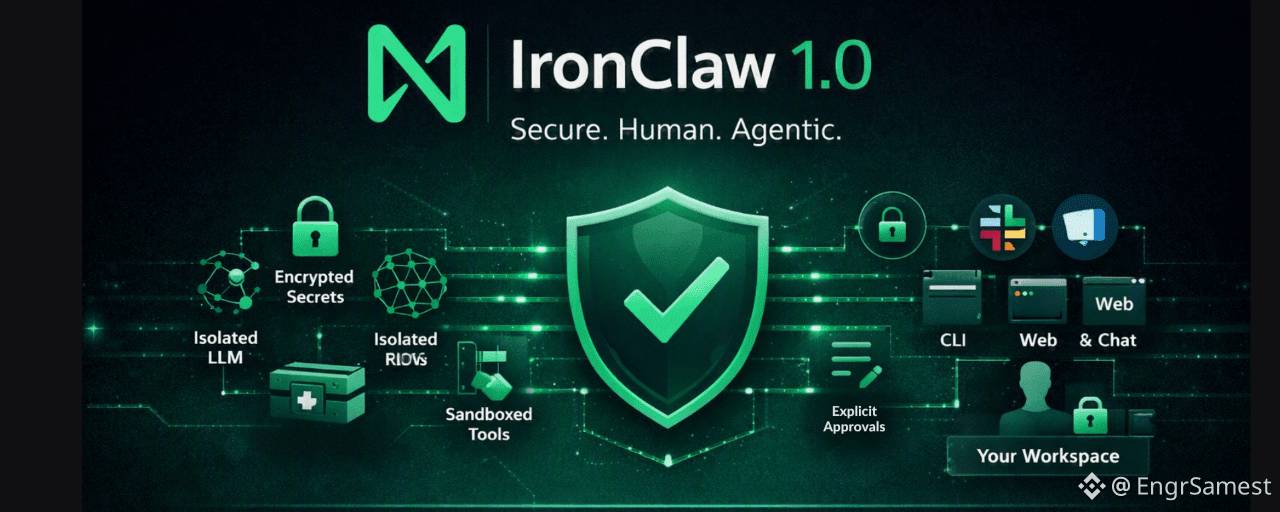
IronClaw 1.0: A Human‑Centered Assistant FrameworkThe best assistant is the one you stop noticing. You set a goal, move seamlessly from terminal to Slack, and never lose context or redo work because of an interruption. Most AI agents fail this everyday test for a structural reason: they tie every function thinking, acting, storing secrets, and reaching the internet into one tangled system. Each new capability becomes another point of failure or risk.
IronClaw 1.0, launched by @NEAR_Protocol on July 27, 2026, takes a different path. It separates decision‑making from execution, with a single coordination layer called the guard between them. That checkpoint is not a marketing flourish; it’s the architecture that makes an always‑on assistant feel like a trusted colleague rather than a fragile script.
What IronClaw 1.0 Is
IronClaw is #NEAR🚀🚀🚀 AI’s secure, open‑source agent harness, written in Rust. It’s designed so agents can work productively without ever exposing your credentials. Key safeguards include:
Encrypted vaults for secretsWebAssembly sandboxes with allowlisted network accessTrusted Execution Environments (TEEs) on NEAR AI Cloud, ensuring even the host cannot inspect memory
The 1.0 release is a capability‑based agentic operating system. You define an outcome; #ironclaw decomposes it into actions. Each action must pass through the guard. Sensitive steps require explicit approval, and credentials are single‑use by default issued once, then scrubbed from logs and reports. Guarantees made once apply everywhere, including tools the agent builds later.
For people, this means you can trust an agent with inbox triage, research, or internal notes without handing over the keys to your digital life. Every employee at #Near Foundation and NEAR AI already runs their own IronClaw agent on this version.
Benchmarks: Harness Over Model
IronClaw’s performance is measured not by model quality but by harness design. All benchmarks use the same base model (deepseek‑v4‑flash), isolating the architecture’s impact:
PinchBench (93.5%) – Real work tasks like scheduling, coding, and research. IronClaw outperforms the next‑best harness by ~4 points.ClawBench (88.6%) – Live web tasks such as booking flights or applying for jobs. IronClaw scores ~5 points above the field average.OfficeQA (76.4%) – Enterprise document reasoning over 89,000 pages of Treasury Bulletins. IronClaw makes 12–15% fewer errors than competitors.
The takeaway: one guard in front of every action improves reliability across everyday work, live‑web operations, and document reasoning.
Human‑Centric Features
Safer by design – Explicit approvals, input sanitization, leak detection, WASM isolation, and network allowlisting.Persistent state – Tasks resume after interruptions instead of restarting from scratch.Omni‑channel memory – CLI, web, Slack, and Telegram share one assistant with consistent safety rules.Team isolation without friction – Multi‑tenant deployments spread workflows across organizations while keeping individual workspaces private.
IronClaw also adapts over time. It can schedule routines, remember preferences, and build new sandboxed tools when needed. The assistant you use in six months will reflect how you actually work.
NEAR AI and Staking: Ownership at the Core
IronClaw is one product within NEAR AI’s broader vision: confidential, verifiable infrastructure for a user‑owned AI economy. Models run inside TEEs, producing hardware‑signed attestations that prove confidentiality. Even providers like Anthropic or OpenAI cannot tie requests back to you.
Staking ensures this infrastructure remains user‑owned. On July 30, 2026, NEAR AI introduced staking‑based payments for confidential inference and agent hosting:
Agent hosting – Stake $NEAR to receive monthly compute credits.{spot}(NEARUSDT)Confidential inference – Redirect staking yield into private compute.
This design ties capital and compute together. The same network that secures NEAR transactions also hosts the agents acting on them. Within weeks of launch, over 500,000 NEAR had been staked into the system.
Why It Matters
People don’t want a smarter chatbot. They want an assistant that remembers Tuesday’s brief, asks before sending an email, finishes work after Slack drops, and never leaks an API key. IronClaw 1.0 delivers that: decision and action separated by a guard, proven across benchmarks, persistent across channels, and isolatable for teams.
NEAR AI provides the foundation. Staking keeps ownership in the hands of users. Yield is incidental; the real value is securing decentralized infrastructure that makes assistants like IronClaw reliable, private, and genuinely useful in everyday work
#NEARAI
IronClaw 1.0: A Human‑Centered Assistant Framework
The best assistant is the one you stop noticing. You set a goal, move seamlessly from terminal to Slack, and never lose context or redo work because of an interruption. Most AI agents fail this everyday test for a structural reason: they tie every function thinking, acting, storing secrets, and reaching the internet into one tangled system. Each new capability becomes another point of failure or risk.
IronClaw 1.0, launched by @NEAR Protocol on July 27, 2026, takes a different path. It separates decision‑making from execution, with a single coordination layer called the guard between them. That checkpoint is not a marketing flourish; it’s the architecture that makes an always‑on assistant feel like a trusted colleague rather than a fragile script.
What IronClaw 1.0 Is
IronClaw is #NEAR🚀🚀🚀 AI’s secure, open‑source agent harness, written in Rust. It’s designed so agents can work productively without ever exposing your credentials. Key safeguards include:
Encrypted vaults for secretsWebAssembly sandboxes with allowlisted network accessTrusted Execution Environments (TEEs) on NEAR AI Cloud, ensuring even the host cannot inspect memory
The 1.0 release is a capability‑based agentic operating system. You define an outcome; #ironclaw decomposes it into actions. Each action must pass through the guard. Sensitive steps require explicit approval, and credentials are single‑use by default issued once, then scrubbed from logs and reports. Guarantees made once apply everywhere, including tools the agent builds later.
For people, this means you can trust an agent with inbox triage, research, or internal notes without handing over the keys to your digital life. Every employee at #Near Foundation and NEAR AI already runs their own IronClaw agent on this version.
Benchmarks: Harness Over Model
IronClaw’s performance is measured not by model quality but by harness design. All benchmarks use the same base model (deepseek‑v4‑flash), isolating the architecture’s impact:
PinchBench (93.5%) – Real work tasks like scheduling, coding, and research. IronClaw outperforms the next‑best harness by ~4 points.ClawBench (88.6%) – Live web tasks such as booking flights or applying for jobs. IronClaw scores ~5 points above the field average.OfficeQA (76.4%) – Enterprise document reasoning over 89,000 pages of Treasury Bulletins. IronClaw makes 12–15% fewer errors than competitors.
The takeaway: one guard in front of every action improves reliability across everyday work, live‑web operations, and document reasoning.
Human‑Centric Features
Safer by design – Explicit approvals, input sanitization, leak detection, WASM isolation, and network allowlisting.Persistent state – Tasks resume after interruptions instead of restarting from scratch.Omni‑channel memory – CLI, web, Slack, and Telegram share one assistant with consistent safety rules.Team isolation without friction – Multi‑tenant deployments spread workflows across organizations while keeping individual workspaces private.
IronClaw also adapts over time. It can schedule routines, remember preferences, and build new sandboxed tools when needed. The assistant you use in six months will reflect how you actually work.
NEAR AI and Staking: Ownership at the Core
IronClaw is one product within NEAR AI’s broader vision: confidential, verifiable infrastructure for a user‑owned AI economy. Models run inside TEEs, producing hardware‑signed attestations that prove confidentiality. Even providers like Anthropic or OpenAI cannot tie requests back to you.
Staking ensures this infrastructure remains user‑owned. On July 30, 2026, NEAR AI introduced staking‑based payments for confidential inference and agent hosting:
Agent hosting – Stake $NEAR to receive monthly compute credits.Confidential inference – Redirect staking yield into private compute.
This design ties capital and compute together. The same network that secures NEAR transactions also hosts the agents acting on them. Within weeks of launch, over 500,000 NEAR had been staked into the system.
Why It Matters
People don’t want a smarter chatbot. They want an assistant that remembers Tuesday’s brief, asks before sending an email, finishes work after Slack drops, and never leaks an API key. IronClaw 1.0 delivers that: decision and action separated by a guard, proven across benchmarks, persistent across channels, and isolatable for teams.
NEAR AI provides the foundation. Staking keeps ownership in the hands of users. Yield is incidental; the real value is securing decentralized infrastructure that makes assistants like IronClaw reliable, private, and genuinely useful in everyday work
#NEARAI
IronClaw 1.0, launched by @NEAR Protocol on July 27, 2026, takes a different path. It separates decision‑making from execution, with a single coordination layer called the guard between them. That checkpoint is not a marketing flourish; it’s the architecture that makes an always‑on assistant feel like a trusted colleague rather than a fragile script.
What IronClaw 1.0 Is
IronClaw is #NEAR🚀🚀🚀 AI’s secure, open‑source agent harness, written in Rust. It’s designed so agents can work productively without ever exposing your credentials. Key safeguards include:
Encrypted vaults for secretsWebAssembly sandboxes with allowlisted network accessTrusted Execution Environments (TEEs) on NEAR AI Cloud, ensuring even the host cannot inspect memory
The 1.0 release is a capability‑based agentic operating system. You define an outcome; #ironclaw decomposes it into actions. Each action must pass through the guard. Sensitive steps require explicit approval, and credentials are single‑use by default issued once, then scrubbed from logs and reports. Guarantees made once apply everywhere, including tools the agent builds later.
For people, this means you can trust an agent with inbox triage, research, or internal notes without handing over the keys to your digital life. Every employee at #Near Foundation and NEAR AI already runs their own IronClaw agent on this version.
Benchmarks: Harness Over Model
IronClaw’s performance is measured not by model quality but by harness design. All benchmarks use the same base model (deepseek‑v4‑flash), isolating the architecture’s impact:
PinchBench (93.5%) – Real work tasks like scheduling, coding, and research. IronClaw outperforms the next‑best harness by ~4 points.ClawBench (88.6%) – Live web tasks such as booking flights or applying for jobs. IronClaw scores ~5 points above the field average.OfficeQA (76.4%) – Enterprise document reasoning over 89,000 pages of Treasury Bulletins. IronClaw makes 12–15% fewer errors than competitors.
The takeaway: one guard in front of every action improves reliability across everyday work, live‑web operations, and document reasoning.
Human‑Centric Features
Safer by design – Explicit approvals, input sanitization, leak detection, WASM isolation, and network allowlisting.Persistent state – Tasks resume after interruptions instead of restarting from scratch.Omni‑channel memory – CLI, web, Slack, and Telegram share one assistant with consistent safety rules.Team isolation without friction – Multi‑tenant deployments spread workflows across organizations while keeping individual workspaces private.
IronClaw also adapts over time. It can schedule routines, remember preferences, and build new sandboxed tools when needed. The assistant you use in six months will reflect how you actually work.
NEAR AI and Staking: Ownership at the Core
IronClaw is one product within NEAR AI’s broader vision: confidential, verifiable infrastructure for a user‑owned AI economy. Models run inside TEEs, producing hardware‑signed attestations that prove confidentiality. Even providers like Anthropic or OpenAI cannot tie requests back to you.
Staking ensures this infrastructure remains user‑owned. On July 30, 2026, NEAR AI introduced staking‑based payments for confidential inference and agent hosting:
Agent hosting – Stake $NEAR to receive monthly compute credits.Confidential inference – Redirect staking yield into private compute.
This design ties capital and compute together. The same network that secures NEAR transactions also hosts the agents acting on them. Within weeks of launch, over 500,000 NEAR had been staked into the system.
Why It Matters
People don’t want a smarter chatbot. They want an assistant that remembers Tuesday’s brief, asks before sending an email, finishes work after Slack drops, and never leaks an API key. IronClaw 1.0 delivers that: decision and action separated by a guard, proven across benchmarks, persistent across channels, and isolatable for teams.
NEAR AI provides the foundation. Staking keeps ownership in the hands of users. Yield is incidental; the real value is securing decentralized infrastructure that makes assistants like IronClaw reliable, private, and genuinely useful in everyday work
#NEARAI
Web3_ArchiTect:
Good perspective. For me, the bigger question going forward is not simply how autonomous agents can become, but how much trust we can build into that autonomy.
3
1
4
114

·
--
Article
IronClaw 1.0 and the Future of User-Owned AI: Why NEAR Is Building Beyond the ModelArtificial intelligence is moving from systems that answer questions to agents that can actually perform tasks. But giving AI the ability to act creates a difficult challenge: How do we make autonomous agents powerful without making them dangerous?
@NEAR_Protocol is approaching this problem from an infrastructure perspective. Its latest release, #IronClaw 1.0, introduces an architecture designed to separate an AI agent's decision-making from its ability to take action, creating a safer foundation for autonomous AI.
IronClaw 1.0: Separating Thinking from Acting
Traditional #AIAgents can have a model directly connected to tools, credentials, websites and other external systems. This creates a single point where reasoning and execution become tightly connected.
IronClaw takes a different approach.
Its architecture separates the component that decides what should happen from the component that actually performs the action. Between them sits a coordination and security layer called the Guard.
Every action passes through this layer, allowing IronClaw to enforce security policies consistently. Sensitive operations require explicit approval, while credentials and secrets are handled with additional protections.
This architecture means an agent can reason about what needs to be done without automatically receiving unrestricted power to execute every decision.
Benchmark Performance That Stands Out
The architecture is backed by measurable results.
Using the deepseek-v4-flash base model, IronClaw 1.0 achieved leading results across three different agent benchmarks:
PinchBench: 93.5%
Testing real-world tasks such as scheduling, email management, coding, research and file operations.ClawBench: 88.6%
Testing agents across more than 140 real production websites and complex, multi-step tasks.OfficeQA: 76.4%
Testing grounded reasoning across a massive collection of enterprise documents.
These results are significant because they demonstrate the performance of the agent harness alongside the underlying model. IronClaw is not simply about having an intelligent model; it is about building the infrastructure that allows intelligence to become useful action.
Designed for Real, Continuous Work
IronClaw's strengths extend beyond benchmark scores.
Safer by design: Sensitive actions can require explicit approval, while secrets can be isolated and scrubbed from logs.Persistent state: IronClaw continuously checkpoints its work. If an agent is interrupted, restarted or paused while waiting for permission, it can resume instead of starting from zero.Omni-channel memory: The same assistant can operate across the CLI, web, Slack and Telegram while maintaining consistent memory and safety rules.Team isolation: Different users and teams can operate within isolated environments, helping separate credentials, workspaces and responsibilities.
Together, these features address an important problem with autonomous AI: reliability is about more than producing the right answer. An agent needs to remember what it was doing, operate safely, and continue working across the environments where people actually communicate.
NEAR AI and the Role of Staking
IronClaw is part of a broader NEAR AI vision focused on user-owned and verifiable AI. #NEARAI provides infrastructure for private inference and secure AI agents, including hardware-backed Trusted Execution Environments designed to keep sensitive data and computation isolated.
But secure AI also needs secure decentralized infrastructure underneath it.
That is where NEAR staking becomes important.
NEAR uses Proof-of-Stake, where users delegate NEAR to validators that participate in securing the network and reaching consensus. Staked NEAR therefore represents economic security behind the decentralized infrastructure that processes transactions and supports applications.
So staking should not be viewed only through the lens of yield.
As AI agents increasingly interact with blockchains, assets and applications, the infrastructure they depend on must remain decentralized, reliable and economically secured. NEAR's roadmap explicitly positions NEAR AI and the blockchain layer as complementary pieces of an emerging agent economy.
IronClaw shows how AI agents can become safer and more capable. NEAR AI provides the secure AI infrastructure, while NEAR's decentralized network and staking provide an economic security layer underneath it.
The bigger vision is clear: AI agents that can think, act and transact on behalf of users, while users retain greater ownership, privacy and control.
IronClaw 1.0 and the Future of User-Owned AI: Why NEAR Is Building Beyond the Model
Artificial intelligence is moving from systems that answer questions to agents that can actually perform tasks. But giving AI the ability to act creates a difficult challenge: How do we make autonomous agents powerful without making them dangerous?
@NEAR Protocol is approaching this problem from an infrastructure perspective. Its latest release, #IronClaw 1.0, introduces an architecture designed to separate an AI agent's decision-making from its ability to take action, creating a safer foundation for autonomous AI.
IronClaw 1.0: Separating Thinking from Acting
Traditional #AIAgents can have a model directly connected to tools, credentials, websites and other external systems. This creates a single point where reasoning and execution become tightly connected.
IronClaw takes a different approach.
Its architecture separates the component that decides what should happen from the component that actually performs the action. Between them sits a coordination and security layer called the Guard.
Every action passes through this layer, allowing IronClaw to enforce security policies consistently. Sensitive operations require explicit approval, while credentials and secrets are handled with additional protections.
This architecture means an agent can reason about what needs to be done without automatically receiving unrestricted power to execute every decision.
Benchmark Performance That Stands Out
The architecture is backed by measurable results.
Using the deepseek-v4-flash base model, IronClaw 1.0 achieved leading results across three different agent benchmarks:
PinchBench: 93.5%
Testing real-world tasks such as scheduling, email management, coding, research and file operations.ClawBench: 88.6%
Testing agents across more than 140 real production websites and complex, multi-step tasks.OfficeQA: 76.4%
Testing grounded reasoning across a massive collection of enterprise documents.
These results are significant because they demonstrate the performance of the agent harness alongside the underlying model. IronClaw is not simply about having an intelligent model; it is about building the infrastructure that allows intelligence to become useful action.
Designed for Real, Continuous Work
IronClaw's strengths extend beyond benchmark scores.
Safer by design: Sensitive actions can require explicit approval, while secrets can be isolated and scrubbed from logs.Persistent state: IronClaw continuously checkpoints its work. If an agent is interrupted, restarted or paused while waiting for permission, it can resume instead of starting from zero.Omni-channel memory: The same assistant can operate across the CLI, web, Slack and Telegram while maintaining consistent memory and safety rules.Team isolation: Different users and teams can operate within isolated environments, helping separate credentials, workspaces and responsibilities.
Together, these features address an important problem with autonomous AI: reliability is about more than producing the right answer. An agent needs to remember what it was doing, operate safely, and continue working across the environments where people actually communicate.
NEAR AI and the Role of Staking
IronClaw is part of a broader NEAR AI vision focused on user-owned and verifiable AI. #NEARAI provides infrastructure for private inference and secure AI agents, including hardware-backed Trusted Execution Environments designed to keep sensitive data and computation isolated.
But secure AI also needs secure decentralized infrastructure underneath it.
That is where NEAR staking becomes important.
NEAR uses Proof-of-Stake, where users delegate NEAR to validators that participate in securing the network and reaching consensus. Staked NEAR therefore represents economic security behind the decentralized infrastructure that processes transactions and supports applications.
So staking should not be viewed only through the lens of yield.
As AI agents increasingly interact with blockchains, assets and applications, the infrastructure they depend on must remain decentralized, reliable and economically secured. NEAR's roadmap explicitly positions NEAR AI and the blockchain layer as complementary pieces of an emerging agent economy.
IronClaw shows how AI agents can become safer and more capable. NEAR AI provides the secure AI infrastructure, while NEAR's decentralized network and staking provide an economic security layer underneath it.
The bigger vision is clear: AI agents that can think, act and transact on behalf of users, while users retain greater ownership, privacy and control.
@NEAR Protocol is approaching this problem from an infrastructure perspective. Its latest release, #IronClaw 1.0, introduces an architecture designed to separate an AI agent's decision-making from its ability to take action, creating a safer foundation for autonomous AI.
IronClaw 1.0: Separating Thinking from Acting
Traditional #AIAgents can have a model directly connected to tools, credentials, websites and other external systems. This creates a single point where reasoning and execution become tightly connected.
IronClaw takes a different approach.
Its architecture separates the component that decides what should happen from the component that actually performs the action. Between them sits a coordination and security layer called the Guard.
Every action passes through this layer, allowing IronClaw to enforce security policies consistently. Sensitive operations require explicit approval, while credentials and secrets are handled with additional protections.
This architecture means an agent can reason about what needs to be done without automatically receiving unrestricted power to execute every decision.
Benchmark Performance That Stands Out
The architecture is backed by measurable results.
Using the deepseek-v4-flash base model, IronClaw 1.0 achieved leading results across three different agent benchmarks:
PinchBench: 93.5%
Testing real-world tasks such as scheduling, email management, coding, research and file operations.ClawBench: 88.6%
Testing agents across more than 140 real production websites and complex, multi-step tasks.OfficeQA: 76.4%
Testing grounded reasoning across a massive collection of enterprise documents.
These results are significant because they demonstrate the performance of the agent harness alongside the underlying model. IronClaw is not simply about having an intelligent model; it is about building the infrastructure that allows intelligence to become useful action.
Designed for Real, Continuous Work
IronClaw's strengths extend beyond benchmark scores.
Safer by design: Sensitive actions can require explicit approval, while secrets can be isolated and scrubbed from logs.Persistent state: IronClaw continuously checkpoints its work. If an agent is interrupted, restarted or paused while waiting for permission, it can resume instead of starting from zero.Omni-channel memory: The same assistant can operate across the CLI, web, Slack and Telegram while maintaining consistent memory and safety rules.Team isolation: Different users and teams can operate within isolated environments, helping separate credentials, workspaces and responsibilities.
Together, these features address an important problem with autonomous AI: reliability is about more than producing the right answer. An agent needs to remember what it was doing, operate safely, and continue working across the environments where people actually communicate.
NEAR AI and the Role of Staking
IronClaw is part of a broader NEAR AI vision focused on user-owned and verifiable AI. #NEARAI provides infrastructure for private inference and secure AI agents, including hardware-backed Trusted Execution Environments designed to keep sensitive data and computation isolated.
But secure AI also needs secure decentralized infrastructure underneath it.
That is where NEAR staking becomes important.
NEAR uses Proof-of-Stake, where users delegate NEAR to validators that participate in securing the network and reaching consensus. Staked NEAR therefore represents economic security behind the decentralized infrastructure that processes transactions and supports applications.
So staking should not be viewed only through the lens of yield.
As AI agents increasingly interact with blockchains, assets and applications, the infrastructure they depend on must remain decentralized, reliable and economically secured. NEAR's roadmap explicitly positions NEAR AI and the blockchain layer as complementary pieces of an emerging agent economy.
IronClaw shows how AI agents can become safer and more capable. NEAR AI provides the secure AI infrastructure, while NEAR's decentralized network and staking provide an economic security layer underneath it.
The bigger vision is clear: AI agents that can think, act and transact on behalf of users, while users retain greater ownership, privacy and control.
Web3_ArchiTect:
I agree with your point on controlled autonomy. AI agents becoming more capable also means the infrastructure around permissions and execution has to evolve.
3
1
5
106

·
--
Verified
IronClaw 1.0: AI Agents Need More Than Just IntelligenceAI agents are becoming increasingly good at reasoning. The difference here isn't just that reasoning isn't enough.
The real challenge begins when an agent needs to take action. Accessing a tool, browsing the web, managing credentials, resuming a task after an interruption, or switching between different communication channels without losing context.
That's the problem IronClaw 1.0 is designed to address.
✅ A Different Architecture for AI Agents
#ironclaw separates the decision making part from the action taking part. Between them lies a coordination layer called guarding. This separation is important because an AI agent shouldn't have unlimited access simply because it can reason about an action. Every action goes through the guarding layer, creating a single checkpoint for permissions and security.
The result is an architecture where security isn't an extra feature added around the model; it's part of how the agent works. And the performance figures show that this additional structure doesn't have to come at the expense of capability.
✅ Performance tests tell an interesting story
Using the same deepseek-v4-flash base model, IronClaw currently leads in three different agent performance tests.
• PinchBench: 93.5%
• ClawBench: 88.6%
• OfficeQA: 76.4%
These performance tests assess very different capabilities. PinchBench covers real-world tasks such as scheduling, email, coding, research, and file management. ClawBench pushes agents across more than 140 real websites and evaluates complex multi step web tasks. OfficeQA focuses on reasoning through a very large collection of enterprise documents.
What I find interesting is not just that IronClaw scores highly. It's that the same architectural approach performs well on very different failure surfaces.
✅ What makes IronClaw practical?
The first advantage is the explicit approval for precise actions. The agent can reason about what should happen, but crucial actions still pass through a controlled checkpoint.
Secondly, there's persistence. IronClaw continuously creates checkpoints; this means that an interruption doesn't necessarily erase already completed work. The task can continue instead of restarting.
Thirdly, there's unified memory across the CLI, Web, Slack, and Telegram. The assistant isn't treated as four separate tools with four separate contexts.
There's also a strong team centric design. Organizations can choose multi tenant deployments where useful tools and skills can be shared, or singletenant deployments where complete isolation is prioritized.
To me, these details point to a significant shift. An AI agent is transforming from a chatbot into a constantly working digital worker. When this happens, reliability, permissions, memory, and persistence become as important as model intelligence.
✅The Place of #NEARAI and Staking
Here, the broader @NEAR_Protocol vision becomes particularly interesting. NEAR AI is building the infrastructure for private, verifiable AI, including confidential inference and secure agent deployment. Its architecture utilizes hardware secure environments and real time verification to protect sensitive workloads.
Staking is also becoming part of this infrastructure. NEAR AI now allows users to stake NEAR to access confidential inferences and host IronClaw agents. While the stake remains the user's property, the staking mechanism provides usage credits for AI services. This is changing my thinking about staking.
It's not just about seeking returns. It can become an infrastructure mechanism that ties what users hold onchain with the AI services they actually use. Therefore, the bigger picture isn't just "better AI agents." It's a new stack where intelligence, privacy, security, persistent execution, and decentralized infrastructure work together.
IronClaw 1.0 is an interesting step in this direction, demonstrating that adding stronger controls doesn't necessarily mean sacrificing performance. The next question is how far this architecture can go as AI agents become increasingly responsible for more important tasks.
NEAR AI and IronClaw make this question much more practical.
Thank you
IronClaw 1.0: AI Agents Need More Than Just Intelligence
AI agents are becoming increasingly good at reasoning. The difference here isn't just that reasoning isn't enough.
The real challenge begins when an agent needs to take action. Accessing a tool, browsing the web, managing credentials, resuming a task after an interruption, or switching between different communication channels without losing context.
That's the problem IronClaw 1.0 is designed to address.
✅ A Different Architecture for AI Agents
#ironclaw separates the decision making part from the action taking part. Between them lies a coordination layer called guarding. This separation is important because an AI agent shouldn't have unlimited access simply because it can reason about an action. Every action goes through the guarding layer, creating a single checkpoint for permissions and security.
The result is an architecture where security isn't an extra feature added around the model; it's part of how the agent works. And the performance figures show that this additional structure doesn't have to come at the expense of capability.
✅ Performance tests tell an interesting story
Using the same deepseek-v4-flash base model, IronClaw currently leads in three different agent performance tests.
• PinchBench: 93.5%
• ClawBench: 88.6%
• OfficeQA: 76.4%
These performance tests assess very different capabilities. PinchBench covers real-world tasks such as scheduling, email, coding, research, and file management. ClawBench pushes agents across more than 140 real websites and evaluates complex multi step web tasks. OfficeQA focuses on reasoning through a very large collection of enterprise documents.
What I find interesting is not just that IronClaw scores highly. It's that the same architectural approach performs well on very different failure surfaces.
✅ What makes IronClaw practical?
The first advantage is the explicit approval for precise actions. The agent can reason about what should happen, but crucial actions still pass through a controlled checkpoint.
Secondly, there's persistence. IronClaw continuously creates checkpoints; this means that an interruption doesn't necessarily erase already completed work. The task can continue instead of restarting.
Thirdly, there's unified memory across the CLI, Web, Slack, and Telegram. The assistant isn't treated as four separate tools with four separate contexts.
There's also a strong team centric design. Organizations can choose multi tenant deployments where useful tools and skills can be shared, or singletenant deployments where complete isolation is prioritized.
To me, these details point to a significant shift. An AI agent is transforming from a chatbot into a constantly working digital worker. When this happens, reliability, permissions, memory, and persistence become as important as model intelligence.
✅The Place of #NEARAI and Staking
Here, the broader @NEAR Protocol vision becomes particularly interesting. NEAR AI is building the infrastructure for private, verifiable AI, including confidential inference and secure agent deployment. Its architecture utilizes hardware secure environments and real time verification to protect sensitive workloads.
Staking is also becoming part of this infrastructure. NEAR AI now allows users to stake NEAR to access confidential inferences and host IronClaw agents. While the stake remains the user's property, the staking mechanism provides usage credits for AI services. This is changing my thinking about staking.
It's not just about seeking returns. It can become an infrastructure mechanism that ties what users hold onchain with the AI services they actually use. Therefore, the bigger picture isn't just "better AI agents." It's a new stack where intelligence, privacy, security, persistent execution, and decentralized infrastructure work together.
IronClaw 1.0 is an interesting step in this direction, demonstrating that adding stronger controls doesn't necessarily mean sacrificing performance. The next question is how far this architecture can go as AI agents become increasingly responsible for more important tasks.
NEAR AI and IronClaw make this question much more practical.
Thank you
The real challenge begins when an agent needs to take action. Accessing a tool, browsing the web, managing credentials, resuming a task after an interruption, or switching between different communication channels without losing context.
That's the problem IronClaw 1.0 is designed to address.
✅ A Different Architecture for AI Agents
#ironclaw separates the decision making part from the action taking part. Between them lies a coordination layer called guarding. This separation is important because an AI agent shouldn't have unlimited access simply because it can reason about an action. Every action goes through the guarding layer, creating a single checkpoint for permissions and security.
The result is an architecture where security isn't an extra feature added around the model; it's part of how the agent works. And the performance figures show that this additional structure doesn't have to come at the expense of capability.
✅ Performance tests tell an interesting story
Using the same deepseek-v4-flash base model, IronClaw currently leads in three different agent performance tests.
• PinchBench: 93.5%
• ClawBench: 88.6%
• OfficeQA: 76.4%
These performance tests assess very different capabilities. PinchBench covers real-world tasks such as scheduling, email, coding, research, and file management. ClawBench pushes agents across more than 140 real websites and evaluates complex multi step web tasks. OfficeQA focuses on reasoning through a very large collection of enterprise documents.
What I find interesting is not just that IronClaw scores highly. It's that the same architectural approach performs well on very different failure surfaces.
✅ What makes IronClaw practical?
The first advantage is the explicit approval for precise actions. The agent can reason about what should happen, but crucial actions still pass through a controlled checkpoint.
Secondly, there's persistence. IronClaw continuously creates checkpoints; this means that an interruption doesn't necessarily erase already completed work. The task can continue instead of restarting.
Thirdly, there's unified memory across the CLI, Web, Slack, and Telegram. The assistant isn't treated as four separate tools with four separate contexts.
There's also a strong team centric design. Organizations can choose multi tenant deployments where useful tools and skills can be shared, or singletenant deployments where complete isolation is prioritized.
To me, these details point to a significant shift. An AI agent is transforming from a chatbot into a constantly working digital worker. When this happens, reliability, permissions, memory, and persistence become as important as model intelligence.
✅The Place of #NEARAI and Staking
Here, the broader @NEAR Protocol vision becomes particularly interesting. NEAR AI is building the infrastructure for private, verifiable AI, including confidential inference and secure agent deployment. Its architecture utilizes hardware secure environments and real time verification to protect sensitive workloads.
Staking is also becoming part of this infrastructure. NEAR AI now allows users to stake NEAR to access confidential inferences and host IronClaw agents. While the stake remains the user's property, the staking mechanism provides usage credits for AI services. This is changing my thinking about staking.
It's not just about seeking returns. It can become an infrastructure mechanism that ties what users hold onchain with the AI services they actually use. Therefore, the bigger picture isn't just "better AI agents." It's a new stack where intelligence, privacy, security, persistent execution, and decentralized infrastructure work together.
IronClaw 1.0 is an interesting step in this direction, demonstrating that adding stronger controls doesn't necessarily mean sacrificing performance. The next question is how far this architecture can go as AI agents become increasingly responsible for more important tasks.
NEAR AI and IronClaw make this question much more practical.
Thank you
RWAemtx:
The key shift is from “Can the agent reason?” to “Can it act safely?”
IronClaw’s approach makes permissions, persistence, memory, and security part of the architecture itself.
As agents take on real-world tasks, that distinction could become one of the biggest factors separating useful agents from trustworthy ones.
7
8
2k

·
--
Article
AI Agents Need More Than IntelligenceAI agents have stepped out of the chat box and into the corridors of the workplace.
They no longer simply answer questions. They sort emails, schedule meetings, conduct research, access files, and perform real actions across company tools. In short, they are evolving from software we talk to into digital colleagues capable of opening doors on our behalf.
But we would never hand an employee every key in the company and say, “They seem pretty smart. Hopefully, they open the right door.” With AI agents, focusing only on the quality of their decisions is no longer enough.
Who stands at the door between a decision and an action?
Open-source #ironclaw 1.0 , developed within @NEAR_Protocol ’s #NEARAI vision, offers an architectural answer to that question. The component that makes decisions is separated from the component that acts on them in the outside world. Between the two sits a shared coordination layer called the “guard,” through which every action must pass.
🛂 The Guard at the Agent’s Security Gate
Think of the guard layer as the smart security gate of a corporate building. It is less concerned with what is being thought inside and more concerned with which permission is being used, which door someone is trying to enter, and why.
IronClaw can read an email, edit a file, or research something online. On the security side, however, three important rules come into play:
Sensitive actions require explicit user approval first.Passwords and access tokens are single-use by default.Once used, those secrets are scrubbed from logs, error messages, and reports.
This separation matters. When “thinking” and “doing” are tied into the same knot inside an AI agent, every new capability pulls that knot a little tighter. Eventually, you may end up with a highly capable colleague whose pockets contain plenty of keys, but no one is quite sure which key opens which door.
📊 Does Safety Put the Brakes on Performance
We often assume that more control means slower execution. IronClaw 1.0’s benchmark results suggest that fastening a seat belt does not necessarily slow down the car.
In the evaluations published by NEAR AI, every agent harness used the same base model, deepseek-v4-flash. IronClaw achieved the following results across three benchmarks:
PinchBench: 93.5%ClawBench: 88.6%OfficeQA: 76.4%
PinchBench measures performance across 147 real-world tasks, including meeting scheduling, email management, coding, research, and file operations. ClawBench tests agents on multi-step tasks across more than 140 live websites. OfficeQA evaluates information retrieval and reasoning across a collection of approximately 89,000 pages of enterprise documents.
The most interesting detail here is not only the scores, but the fact that every system raced with the same engine. Since the base model remained unchanged, the difference comes less from engine size and more from how the steering, brakes, and gearbox work together.
💾 No Starting Over When Work Is Interrupted
IronClaw continuously saves task progress through checkpoints. Think of them as save points from old video games adapted to corporate life. If the agent pauses for user permission or the system restarts, it does not forget the entire task and send you back to the first level. It resumes where it stopped.
In a business environment, this does more than save a few minutes. It also reduces the errors, repetition, and context loss caused by recreating unfinished work. Explaining the same task for the third time on a Monday morning is tiring enough with people; there is little reason to repeat the experience with software.
The same memory is preserved across CLI, web, Slack, and Telegram. Changing channels does not introduce you to a new intern on their first day every time. You continue speaking with the same agent, one that remembers your preferences, previous decisions, and security rules.
🧩 Team Memory Does Not Mean Opening Every Drawer
IronClaw’s team architecture addresses two different needs at the same time:
In a multi-tenant deployment, tools and skills developed by one person can be shared across the organization. The same workflow does not have to be rediscovered from scratch by every employee.Individual workspaces are not visible to administrators by default.A single-tenant deployment gives organizations with stricter data boundaries a fully isolated environment with no external access.
Building a shared organizational memory, therefore, does not mean opening every desk drawer for everyone to inspect.
🔐 Where NEAR AI and Staking Fit In
IronClaw is not a standalone product. NEAR AI is developing a broader infrastructure in which agents, models, and sensitive data can operate inside Trusted Execution Environments, supported by hardware-backed privacy and verifiability. This architecture is part of #Near Protocol’s vision for a more open and decentralized future in which AI systems belong to their users rather than closed platforms.
Staking plays two connected roles in this picture:
At the protocol level, users delegate $NEAR to validators, providing economic security to the Proof-of-Stake network.On the NEAR AI side, staked NEAR can provide access to confidential inference and IronClaw hosting credits. Agent hosting credits are determined by the amount staked, while confidential inference credits are generated from staking yield.
Users retain ownership of their principal, allowing their capital to support AI services without being sold.
For that reason, treating staking as nothing more than a passive yield faucet misses part of the picture. Here, capital acts like a circuit panel connecting network security and AI usage to the same system. On one side, it helps secure the network economically. On the other, it supports wallet-based access to user-focused AI infrastructure that agents such as IronClaw and OpenClaw can use.
The competition between AI agents will not be won solely by whoever has the largest model. The systems that coordinate decisions, permissions, memory, privacy, and economic infrastructure most effectively will stand out.
That is the powerful idea behind IronClaw 1.0: before making the agent’s brain a little bigger, redesign which doors the keys in its hands are allowed to open.
In your view, will the main bottleneck for enterprise AI agents be model intelligence, or turning that intelligence into safe action?
AI Agents Need More Than Intelligence
AI agents have stepped out of the chat box and into the corridors of the workplace.
They no longer simply answer questions. They sort emails, schedule meetings, conduct research, access files, and perform real actions across company tools. In short, they are evolving from software we talk to into digital colleagues capable of opening doors on our behalf.
But we would never hand an employee every key in the company and say, “They seem pretty smart. Hopefully, they open the right door.” With AI agents, focusing only on the quality of their decisions is no longer enough.
Who stands at the door between a decision and an action?
Open-source #ironclaw 1.0 , developed within @NEAR Protocol ’s #NEARAI vision, offers an architectural answer to that question. The component that makes decisions is separated from the component that acts on them in the outside world. Between the two sits a shared coordination layer called the “guard,” through which every action must pass.
🛂 The Guard at the Agent’s Security Gate
Think of the guard layer as the smart security gate of a corporate building. It is less concerned with what is being thought inside and more concerned with which permission is being used, which door someone is trying to enter, and why.
IronClaw can read an email, edit a file, or research something online. On the security side, however, three important rules come into play:
Sensitive actions require explicit user approval first.Passwords and access tokens are single-use by default.Once used, those secrets are scrubbed from logs, error messages, and reports.
This separation matters. When “thinking” and “doing” are tied into the same knot inside an AI agent, every new capability pulls that knot a little tighter. Eventually, you may end up with a highly capable colleague whose pockets contain plenty of keys, but no one is quite sure which key opens which door.
📊 Does Safety Put the Brakes on Performance
We often assume that more control means slower execution. IronClaw 1.0’s benchmark results suggest that fastening a seat belt does not necessarily slow down the car.
In the evaluations published by NEAR AI, every agent harness used the same base model, deepseek-v4-flash. IronClaw achieved the following results across three benchmarks:
PinchBench: 93.5%ClawBench: 88.6%OfficeQA: 76.4%
PinchBench measures performance across 147 real-world tasks, including meeting scheduling, email management, coding, research, and file operations. ClawBench tests agents on multi-step tasks across more than 140 live websites. OfficeQA evaluates information retrieval and reasoning across a collection of approximately 89,000 pages of enterprise documents.
The most interesting detail here is not only the scores, but the fact that every system raced with the same engine. Since the base model remained unchanged, the difference comes less from engine size and more from how the steering, brakes, and gearbox work together.
💾 No Starting Over When Work Is Interrupted
IronClaw continuously saves task progress through checkpoints. Think of them as save points from old video games adapted to corporate life. If the agent pauses for user permission or the system restarts, it does not forget the entire task and send you back to the first level. It resumes where it stopped.
In a business environment, this does more than save a few minutes. It also reduces the errors, repetition, and context loss caused by recreating unfinished work. Explaining the same task for the third time on a Monday morning is tiring enough with people; there is little reason to repeat the experience with software.
The same memory is preserved across CLI, web, Slack, and Telegram. Changing channels does not introduce you to a new intern on their first day every time. You continue speaking with the same agent, one that remembers your preferences, previous decisions, and security rules.
🧩 Team Memory Does Not Mean Opening Every Drawer
IronClaw’s team architecture addresses two different needs at the same time:
In a multi-tenant deployment, tools and skills developed by one person can be shared across the organization. The same workflow does not have to be rediscovered from scratch by every employee.Individual workspaces are not visible to administrators by default.A single-tenant deployment gives organizations with stricter data boundaries a fully isolated environment with no external access.
Building a shared organizational memory, therefore, does not mean opening every desk drawer for everyone to inspect.
🔐 Where NEAR AI and Staking Fit In
IronClaw is not a standalone product. NEAR AI is developing a broader infrastructure in which agents, models, and sensitive data can operate inside Trusted Execution Environments, supported by hardware-backed privacy and verifiability. This architecture is part of #Near Protocol’s vision for a more open and decentralized future in which AI systems belong to their users rather than closed platforms.
Staking plays two connected roles in this picture:
At the protocol level, users delegate $NEAR to validators, providing economic security to the Proof-of-Stake network.On the NEAR AI side, staked NEAR can provide access to confidential inference and IronClaw hosting credits. Agent hosting credits are determined by the amount staked, while confidential inference credits are generated from staking yield.
Users retain ownership of their principal, allowing their capital to support AI services without being sold.
For that reason, treating staking as nothing more than a passive yield faucet misses part of the picture. Here, capital acts like a circuit panel connecting network security and AI usage to the same system. On one side, it helps secure the network economically. On the other, it supports wallet-based access to user-focused AI infrastructure that agents such as IronClaw and OpenClaw can use.
The competition between AI agents will not be won solely by whoever has the largest model. The systems that coordinate decisions, permissions, memory, privacy, and economic infrastructure most effectively will stand out.
That is the powerful idea behind IronClaw 1.0: before making the agent’s brain a little bigger, redesign which doors the keys in its hands are allowed to open.
In your view, will the main bottleneck for enterprise AI agents be model intelligence, or turning that intelligence into safe action?
They no longer simply answer questions. They sort emails, schedule meetings, conduct research, access files, and perform real actions across company tools. In short, they are evolving from software we talk to into digital colleagues capable of opening doors on our behalf.
But we would never hand an employee every key in the company and say, “They seem pretty smart. Hopefully, they open the right door.” With AI agents, focusing only on the quality of their decisions is no longer enough.
Who stands at the door between a decision and an action?
Open-source #ironclaw 1.0 , developed within @NEAR Protocol ’s #NEARAI vision, offers an architectural answer to that question. The component that makes decisions is separated from the component that acts on them in the outside world. Between the two sits a shared coordination layer called the “guard,” through which every action must pass.
🛂 The Guard at the Agent’s Security Gate
Think of the guard layer as the smart security gate of a corporate building. It is less concerned with what is being thought inside and more concerned with which permission is being used, which door someone is trying to enter, and why.
IronClaw can read an email, edit a file, or research something online. On the security side, however, three important rules come into play:
Sensitive actions require explicit user approval first.Passwords and access tokens are single-use by default.Once used, those secrets are scrubbed from logs, error messages, and reports.
This separation matters. When “thinking” and “doing” are tied into the same knot inside an AI agent, every new capability pulls that knot a little tighter. Eventually, you may end up with a highly capable colleague whose pockets contain plenty of keys, but no one is quite sure which key opens which door.
📊 Does Safety Put the Brakes on Performance
We often assume that more control means slower execution. IronClaw 1.0’s benchmark results suggest that fastening a seat belt does not necessarily slow down the car.
In the evaluations published by NEAR AI, every agent harness used the same base model, deepseek-v4-flash. IronClaw achieved the following results across three benchmarks:
PinchBench: 93.5%ClawBench: 88.6%OfficeQA: 76.4%
PinchBench measures performance across 147 real-world tasks, including meeting scheduling, email management, coding, research, and file operations. ClawBench tests agents on multi-step tasks across more than 140 live websites. OfficeQA evaluates information retrieval and reasoning across a collection of approximately 89,000 pages of enterprise documents.
The most interesting detail here is not only the scores, but the fact that every system raced with the same engine. Since the base model remained unchanged, the difference comes less from engine size and more from how the steering, brakes, and gearbox work together.
💾 No Starting Over When Work Is Interrupted
IronClaw continuously saves task progress through checkpoints. Think of them as save points from old video games adapted to corporate life. If the agent pauses for user permission or the system restarts, it does not forget the entire task and send you back to the first level. It resumes where it stopped.
In a business environment, this does more than save a few minutes. It also reduces the errors, repetition, and context loss caused by recreating unfinished work. Explaining the same task for the third time on a Monday morning is tiring enough with people; there is little reason to repeat the experience with software.
The same memory is preserved across CLI, web, Slack, and Telegram. Changing channels does not introduce you to a new intern on their first day every time. You continue speaking with the same agent, one that remembers your preferences, previous decisions, and security rules.
🧩 Team Memory Does Not Mean Opening Every Drawer
IronClaw’s team architecture addresses two different needs at the same time:
In a multi-tenant deployment, tools and skills developed by one person can be shared across the organization. The same workflow does not have to be rediscovered from scratch by every employee.Individual workspaces are not visible to administrators by default.A single-tenant deployment gives organizations with stricter data boundaries a fully isolated environment with no external access.
Building a shared organizational memory, therefore, does not mean opening every desk drawer for everyone to inspect.
🔐 Where NEAR AI and Staking Fit In
IronClaw is not a standalone product. NEAR AI is developing a broader infrastructure in which agents, models, and sensitive data can operate inside Trusted Execution Environments, supported by hardware-backed privacy and verifiability. This architecture is part of #Near Protocol’s vision for a more open and decentralized future in which AI systems belong to their users rather than closed platforms.
Staking plays two connected roles in this picture:
At the protocol level, users delegate $NEAR to validators, providing economic security to the Proof-of-Stake network.On the NEAR AI side, staked NEAR can provide access to confidential inference and IronClaw hosting credits. Agent hosting credits are determined by the amount staked, while confidential inference credits are generated from staking yield.
Users retain ownership of their principal, allowing their capital to support AI services without being sold.
For that reason, treating staking as nothing more than a passive yield faucet misses part of the picture. Here, capital acts like a circuit panel connecting network security and AI usage to the same system. On one side, it helps secure the network economically. On the other, it supports wallet-based access to user-focused AI infrastructure that agents such as IronClaw and OpenClaw can use.
The competition between AI agents will not be won solely by whoever has the largest model. The systems that coordinate decisions, permissions, memory, privacy, and economic infrastructure most effectively will stand out.
That is the powerful idea behind IronClaw 1.0: before making the agent’s brain a little bigger, redesign which doors the keys in its hands are allowed to open.
In your view, will the main bottleneck for enterprise AI agents be model intelligence, or turning that intelligence into safe action?
RWAemtx:
The real bottleneck is safe execution.
Intelligence can make an agent smarter, but strong permission controls, privacy, memory, and accountability make it trustworthy enough to operate in the real world.
8
8
215

Article
IronClaw 1.0: When AI Agents Learn to Act, Control Becomes Part of the IntelligenceAI agents are entering a different phase.
They are no longer limited to generating text or answering questions. They can research, manage files, interact with websites, communicate across platforms and execute multi-step workflows. But as agents become capable of acting on our behalf, I think one question becomes increasingly important:
How do we give an AI enough autonomy to be useful without giving it unrestricted authority?
That is what makes IronClaw 1.0 from #NEARAI particularly interesting to me.
Separating Thinking From Acting
IronClaw approaches agent security at the architectural level.
Instead of allowing the model that makes a decision to directly execute the resulting action, #ironclaw places a guard layer between decision-making and execution. Actions pass through this controlled path, and sensitive operations can require explicit approval before they are carried out.
That creates a useful separation:
The agent can decide what it wants to do, but it doesn't automatically have unrestricted permission to do it.
For me, that's more interesting than simply adding another security feature to an AI agent. The control mechanism becomes part of how the agent operates.
#ironclaw also tackles another practical problem: what happens when an autonomous workflow gets interrupted?
Its continuous checkpointing allows work to resume instead of forcing the agent to start again. Persistent state and memory can also carry across CLI, Web, Slack and Telegram, allowing the same assistant to retain context across different interfaces.
For organizations, #ironclaw supports shared tools and skills through multi-tenant deployments while maintaining workspace boundaries, with single-tenant deployments available where complete isolation is required.
The Performance Behind the Architecture
The security model would be less compelling if it came at the expense of capability.
In NEAR AI's July 27 evaluation of Ironclaw 1.0, the system took the top reported position across three different agent benchmarks using the same DeepSeek-V4-Flash base model for the harness comparisons.
IronClaw recorded 93.5% on PinchBench, which evaluates 147 real-world tasks including scheduling, email triage, coding, research and file management.
On ClawBench, which tests multi-step tasks across more than 140 real production websites, IronClaw recorded 88.6%.
And on OfficeQA, which evaluates grounded reasoning over a large collection of U.S. Treasury documents, it achieved 76.4%.
These numbers should not be treated as directly comparable because each benchmark measures a different capability. What stands out to me is that the same architecture performed strongly across practical task execution, web interaction and document reasoning.
The Bigger NEAR AI Picture
IronClaw sits within the broader vision of #NEARAI , which focuses on private, confidential and verifiable AI infrastructure.
That brings the role of @NEAR_Protocol and staking into the conversation.
Staking is often viewed primarily through the lens of rewards. At the protocol level, however, staked NEAR supports the validator infrastructure responsible for maintaining network consensus and security.
There is now an even more direct connection to AI infrastructure. #NEARAI has introduced staking-based access that allows users to stake NEAR for credits supporting confidential inference and always-on IronClaw agent hosting.
That changes how I look at the relationship between staking and decentralized AI.
The future isn't simply about building agents that can think better. It is about creating infrastructure where agents can act within boundaries, preserve their work, protect sensitive computation and operate on decentralized systems with meaningful security guarantees.
IronClaw 1.0 therefore represents something I find more valuable than another AI capability demo: a move toward making controlled autonomy a fundamental part of how AI agents are designed.
The question for the next generation of AI may not be how autonomous can agents become?
It may be:
How do we make autonomy trustworthy enough to use?
IronClaw 1.0: When AI Agents Learn to Act, Control Becomes Part of the Intelligence
AI agents are entering a different phase.
They are no longer limited to generating text or answering questions. They can research, manage files, interact with websites, communicate across platforms and execute multi-step workflows. But as agents become capable of acting on our behalf, I think one question becomes increasingly important:
How do we give an AI enough autonomy to be useful without giving it unrestricted authority?
That is what makes IronClaw 1.0 from #NEARAI particularly interesting to me.
Separating Thinking From Acting
IronClaw approaches agent security at the architectural level.
Instead of allowing the model that makes a decision to directly execute the resulting action, #ironclaw places a guard layer between decision-making and execution. Actions pass through this controlled path, and sensitive operations can require explicit approval before they are carried out.
That creates a useful separation:
The agent can decide what it wants to do, but it doesn't automatically have unrestricted permission to do it.
For me, that's more interesting than simply adding another security feature to an AI agent. The control mechanism becomes part of how the agent operates.
#ironclaw also tackles another practical problem: what happens when an autonomous workflow gets interrupted?
Its continuous checkpointing allows work to resume instead of forcing the agent to start again. Persistent state and memory can also carry across CLI, Web, Slack and Telegram, allowing the same assistant to retain context across different interfaces.
For organizations, #ironclaw supports shared tools and skills through multi-tenant deployments while maintaining workspace boundaries, with single-tenant deployments available where complete isolation is required.
The Performance Behind the Architecture
The security model would be less compelling if it came at the expense of capability.
In NEAR AI's July 27 evaluation of Ironclaw 1.0, the system took the top reported position across three different agent benchmarks using the same DeepSeek-V4-Flash base model for the harness comparisons.
IronClaw recorded 93.5% on PinchBench, which evaluates 147 real-world tasks including scheduling, email triage, coding, research and file management.
On ClawBench, which tests multi-step tasks across more than 140 real production websites, IronClaw recorded 88.6%.
And on OfficeQA, which evaluates grounded reasoning over a large collection of U.S. Treasury documents, it achieved 76.4%.
These numbers should not be treated as directly comparable because each benchmark measures a different capability. What stands out to me is that the same architecture performed strongly across practical task execution, web interaction and document reasoning.
The Bigger NEAR AI Picture
IronClaw sits within the broader vision of #NEARAI , which focuses on private, confidential and verifiable AI infrastructure.
That brings the role of @NEAR Protocol and staking into the conversation.
Staking is often viewed primarily through the lens of rewards. At the protocol level, however, staked NEAR supports the validator infrastructure responsible for maintaining network consensus and security.
There is now an even more direct connection to AI infrastructure. #NEARAI has introduced staking-based access that allows users to stake NEAR for credits supporting confidential inference and always-on IronClaw agent hosting.
That changes how I look at the relationship between staking and decentralized AI.
The future isn't simply about building agents that can think better. It is about creating infrastructure where agents can act within boundaries, preserve their work, protect sensitive computation and operate on decentralized systems with meaningful security guarantees.
IronClaw 1.0 therefore represents something I find more valuable than another AI capability demo: a move toward making controlled autonomy a fundamental part of how AI agents are designed.
The question for the next generation of AI may not be how autonomous can agents become?
It may be:
How do we make autonomy trustworthy enough to use?
They are no longer limited to generating text or answering questions. They can research, manage files, interact with websites, communicate across platforms and execute multi-step workflows. But as agents become capable of acting on our behalf, I think one question becomes increasingly important:
How do we give an AI enough autonomy to be useful without giving it unrestricted authority?
That is what makes IronClaw 1.0 from #NEARAI particularly interesting to me.
Separating Thinking From Acting
IronClaw approaches agent security at the architectural level.
Instead of allowing the model that makes a decision to directly execute the resulting action, #ironclaw places a guard layer between decision-making and execution. Actions pass through this controlled path, and sensitive operations can require explicit approval before they are carried out.
That creates a useful separation:
The agent can decide what it wants to do, but it doesn't automatically have unrestricted permission to do it.
For me, that's more interesting than simply adding another security feature to an AI agent. The control mechanism becomes part of how the agent operates.
#ironclaw also tackles another practical problem: what happens when an autonomous workflow gets interrupted?
Its continuous checkpointing allows work to resume instead of forcing the agent to start again. Persistent state and memory can also carry across CLI, Web, Slack and Telegram, allowing the same assistant to retain context across different interfaces.
For organizations, #ironclaw supports shared tools and skills through multi-tenant deployments while maintaining workspace boundaries, with single-tenant deployments available where complete isolation is required.
The Performance Behind the Architecture
The security model would be less compelling if it came at the expense of capability.
In NEAR AI's July 27 evaluation of Ironclaw 1.0, the system took the top reported position across three different agent benchmarks using the same DeepSeek-V4-Flash base model for the harness comparisons.
IronClaw recorded 93.5% on PinchBench, which evaluates 147 real-world tasks including scheduling, email triage, coding, research and file management.
On ClawBench, which tests multi-step tasks across more than 140 real production websites, IronClaw recorded 88.6%.
And on OfficeQA, which evaluates grounded reasoning over a large collection of U.S. Treasury documents, it achieved 76.4%.
These numbers should not be treated as directly comparable because each benchmark measures a different capability. What stands out to me is that the same architecture performed strongly across practical task execution, web interaction and document reasoning.
The Bigger NEAR AI Picture
IronClaw sits within the broader vision of #NEARAI , which focuses on private, confidential and verifiable AI infrastructure.
That brings the role of @NEAR Protocol and staking into the conversation.
Staking is often viewed primarily through the lens of rewards. At the protocol level, however, staked NEAR supports the validator infrastructure responsible for maintaining network consensus and security.
There is now an even more direct connection to AI infrastructure. #NEARAI has introduced staking-based access that allows users to stake NEAR for credits supporting confidential inference and always-on IronClaw agent hosting.
That changes how I look at the relationship between staking and decentralized AI.
The future isn't simply about building agents that can think better. It is about creating infrastructure where agents can act within boundaries, preserve their work, protect sensitive computation and operate on decentralized systems with meaningful security guarantees.
IronClaw 1.0 therefore represents something I find more valuable than another AI capability demo: a move toward making controlled autonomy a fundamental part of how AI agents are designed.
The question for the next generation of AI may not be how autonomous can agents become?
It may be:
How do we make autonomy trustworthy enough to use?
RWAemtx:
The separation between decision-making and execution is a powerful architecture choice.
AI needs boundaries, especially when it starts handling sensitive tasks.
3
1
6
84

·
--

Article
Deep Dive into NEAR IronClaw 1.0 & NEAR AI StakingThe evolution of artificial intelligence assistants has historically hit a very clear architectural bottleneck: a monolithic model wired directly to each of its capabilities. When reasoning, executing actions, handling sensitive credentials, and accessing the network all happen within the exact same environment, critical vulnerabilities and single points of failure emerge where any workflow can completely collapse in seconds.
@NEAR_Protocol tackles this structural challenge head-on with the rollout of #IronClaw 1.0, an advanced architecture that cleanly separates high-level decision-making from execution through a secure coordination layer known as the guard.
The Architecture of IronClaw 1.0 and Its Benchmark Dominance
IronClaw 1.0 introduces predictable routes for every single action combined with a persistent state capable of surviving any unexpected interruption. By leveraging the deepseek-v4-flash base model to strictly isolate harness performance, the platform leads three essential industry benchmark classifications:
PinchBench (93.5%): Evaluates 147 real-world tasks—ranging from code development to email and file management—outperforming the next competitor by four points.
ClawBench (88.6%): Tests complex web workflows across actual production sites. Thanks to an interception layer that blocks irreversible submissions, it outperforms the wider industry average by 4.7 points.
OfficeQA (76.4%): Analyzes dense enterprise documents (such as an entire century of United States Treasury bulletins) while reducing errors by 12% compared to alternatives like Hermes.
Key Features for Autonomous Agent Workflows
One of its most valuable features lies in its robust operational design.
Security by Design
Every action passes through a centralized checkpoint that requires explicit user approvals for sensitive tasks, keeping tokens and credentials configured as single-use by default.
Persistent State and Checkpoints
If an agent halts due to missing permissions or restarts mid-task, it does not lose accumulated progress; it simply pauses and resumes right at the exact same point.
Omnichannel Memory
Functions identically and synchronously across the command line interface (CLI), the web, Slack, and Telegram, enforcing the same security rules across all channels.
Corporate Isolation
Allows teams to share validated skills across workforces while fiercely protecting individual privacy through fully auditable compliance mechanisms.
NEAR AI and Staking: The Foundation of Decentralized Infrastructure
The native crypto ecosystem desperately needed a billing model aligned with financial sovereignty. Relying on traditional cloud credit cards and centralized gateways represents value extraction entirely contrary to decentralization.
This is precisely where #NEARAI Staking steps in. Instead of spending fiat capital on recurring subscriptions, users lock NEAR tokens directly inside their own wallets to sustainably fund computing services: $NEAR
Agent Hosting: A fixed ratio where staked NEAR divided by 100 generates a predictable monthly credit budget to deploy agents like IronClaw in under thirty seconds.
Confidential Inference: Converts the yield generated by staking into per-second compute credits. Requests execute safely inside Trusted Execution Environments (TEEs), hardware-isolated enclaves backed by cryptographic chip-signed attestations, cryptographically guaranteeing that not even the network operator can read the data.
Staking in NEAR is not merely a passive yield mechanism; it is the technical and economic pillar securing the decentralized infrastructure upon which advanced future agents, such as the upcoming *OpenClaw*, will operate. By unifying capital, sovereign privacy, and computational power within a single wallet, NEAR consolidates a truly user-owned artificial intelligence ecosystem.
Deep Dive into NEAR IronClaw 1.0 & NEAR AI Staking
The evolution of artificial intelligence assistants has historically hit a very clear architectural bottleneck: a monolithic model wired directly to each of its capabilities. When reasoning, executing actions, handling sensitive credentials, and accessing the network all happen within the exact same environment, critical vulnerabilities and single points of failure emerge where any workflow can completely collapse in seconds.
@NEAR Protocol tackles this structural challenge head-on with the rollout of #IronClaw 1.0, an advanced architecture that cleanly separates high-level decision-making from execution through a secure coordination layer known as the guard.
The Architecture of IronClaw 1.0 and Its Benchmark Dominance
IronClaw 1.0 introduces predictable routes for every single action combined with a persistent state capable of surviving any unexpected interruption. By leveraging the deepseek-v4-flash base model to strictly isolate harness performance, the platform leads three essential industry benchmark classifications:
PinchBench (93.5%): Evaluates 147 real-world tasks—ranging from code development to email and file management—outperforming the next competitor by four points.
ClawBench (88.6%): Tests complex web workflows across actual production sites. Thanks to an interception layer that blocks irreversible submissions, it outperforms the wider industry average by 4.7 points.
OfficeQA (76.4%): Analyzes dense enterprise documents (such as an entire century of United States Treasury bulletins) while reducing errors by 12% compared to alternatives like Hermes.
Key Features for Autonomous Agent Workflows
One of its most valuable features lies in its robust operational design.
Security by Design
Every action passes through a centralized checkpoint that requires explicit user approvals for sensitive tasks, keeping tokens and credentials configured as single-use by default.
Persistent State and Checkpoints
If an agent halts due to missing permissions or restarts mid-task, it does not lose accumulated progress; it simply pauses and resumes right at the exact same point.
Omnichannel Memory
Functions identically and synchronously across the command line interface (CLI), the web, Slack, and Telegram, enforcing the same security rules across all channels.
Corporate Isolation
Allows teams to share validated skills across workforces while fiercely protecting individual privacy through fully auditable compliance mechanisms.
NEAR AI and Staking: The Foundation of Decentralized Infrastructure
The native crypto ecosystem desperately needed a billing model aligned with financial sovereignty. Relying on traditional cloud credit cards and centralized gateways represents value extraction entirely contrary to decentralization.
This is precisely where #NEARAI Staking steps in. Instead of spending fiat capital on recurring subscriptions, users lock NEAR tokens directly inside their own wallets to sustainably fund computing services: $NEAR
Agent Hosting: A fixed ratio where staked NEAR divided by 100 generates a predictable monthly credit budget to deploy agents like IronClaw in under thirty seconds.
Confidential Inference: Converts the yield generated by staking into per-second compute credits. Requests execute safely inside Trusted Execution Environments (TEEs), hardware-isolated enclaves backed by cryptographic chip-signed attestations, cryptographically guaranteeing that not even the network operator can read the data.
Staking in NEAR is not merely a passive yield mechanism; it is the technical and economic pillar securing the decentralized infrastructure upon which advanced future agents, such as the upcoming *OpenClaw*, will operate. By unifying capital, sovereign privacy, and computational power within a single wallet, NEAR consolidates a truly user-owned artificial intelligence ecosystem.
@NEAR Protocol tackles this structural challenge head-on with the rollout of #IronClaw 1.0, an advanced architecture that cleanly separates high-level decision-making from execution through a secure coordination layer known as the guard.
The Architecture of IronClaw 1.0 and Its Benchmark Dominance
IronClaw 1.0 introduces predictable routes for every single action combined with a persistent state capable of surviving any unexpected interruption. By leveraging the deepseek-v4-flash base model to strictly isolate harness performance, the platform leads three essential industry benchmark classifications:
PinchBench (93.5%): Evaluates 147 real-world tasks—ranging from code development to email and file management—outperforming the next competitor by four points.
ClawBench (88.6%): Tests complex web workflows across actual production sites. Thanks to an interception layer that blocks irreversible submissions, it outperforms the wider industry average by 4.7 points.
OfficeQA (76.4%): Analyzes dense enterprise documents (such as an entire century of United States Treasury bulletins) while reducing errors by 12% compared to alternatives like Hermes.
Key Features for Autonomous Agent Workflows
One of its most valuable features lies in its robust operational design.
Security by Design
Every action passes through a centralized checkpoint that requires explicit user approvals for sensitive tasks, keeping tokens and credentials configured as single-use by default.
Persistent State and Checkpoints
If an agent halts due to missing permissions or restarts mid-task, it does not lose accumulated progress; it simply pauses and resumes right at the exact same point.
Omnichannel Memory
Functions identically and synchronously across the command line interface (CLI), the web, Slack, and Telegram, enforcing the same security rules across all channels.
Corporate Isolation
Allows teams to share validated skills across workforces while fiercely protecting individual privacy through fully auditable compliance mechanisms.
NEAR AI and Staking: The Foundation of Decentralized Infrastructure
The native crypto ecosystem desperately needed a billing model aligned with financial sovereignty. Relying on traditional cloud credit cards and centralized gateways represents value extraction entirely contrary to decentralization.
This is precisely where #NEARAI Staking steps in. Instead of spending fiat capital on recurring subscriptions, users lock NEAR tokens directly inside their own wallets to sustainably fund computing services: $NEAR
Agent Hosting: A fixed ratio where staked NEAR divided by 100 generates a predictable monthly credit budget to deploy agents like IronClaw in under thirty seconds.
Confidential Inference: Converts the yield generated by staking into per-second compute credits. Requests execute safely inside Trusted Execution Environments (TEEs), hardware-isolated enclaves backed by cryptographic chip-signed attestations, cryptographically guaranteeing that not even the network operator can read the data.
Staking in NEAR is not merely a passive yield mechanism; it is the technical and economic pillar securing the decentralized infrastructure upon which advanced future agents, such as the upcoming *OpenClaw*, will operate. By unifying capital, sovereign privacy, and computational power within a single wallet, NEAR consolidates a truly user-owned artificial intelligence ecosystem.
RWAemtx:
This is the direction AI agents need.
Separating reasoning from execution, adding persistent state, and backing compute with NEAR staking makes autonomous AI safer, more resilient, and truly user-owned.
5
1
7
234
Log in to explore more content
Join global crypto users on Binance Square
⚡️ Get latest and useful information about crypto.
💬 Trusted by the world’s largest crypto exchange.
👍 Discover real insights from verified creators.
Email / Phone number
Trending Topics
1
#SolanaFallsOver3%
8,371 views
271 Discussing
2
#DellSurges8%OnEarningsBeat
7,818 views
238 Discussing
3
#USAugADPJobsSmallestGainSinceJan
7,749 views
197 Discussing
4
#SaudiSaysIranAttackedShipInHormuz
15,623 views
302 Discussing
5
#OpenAISaysAstraFindsFlawsAutonomously
14,479 views
351 Discussing
6
#HangSengCloses18PointsLower
16,765 views
329 Discussing
7
#IRGCSaysTwoTankersHitByMinesInHormuz
15,383 views
307 Discussing
8
#USSpotXRPETFsDraw$170MOver11Days
2,767 views
47 Discussing
9
#KuwaitAirDefensesRespondToIranianDroneAttacks
36,861 views
749 Discussing
10
#DellRisesNearly9%GitLabJumps20%AfterHours
27,566 views
551 Discussing