
candyAlpha
3.6k Posts

candyAlpha
Report
Block User
所有的帖子只是我自言自语,不构成任何投资建议。祝愿大家今天都赚大钱!财神到!
Frequent Trader
5.2 Years
137 Following
19.9K+ Followers
28.0K+ Liked
Posts
All
Quotes

·
--
You can't possibly drop any further, can you?
Guys, how low do you think it'll go?
You can't possibly drop any further, can you?
Guys, how low do you think it'll go?
Guys, how low do you think it'll go?

3
2
1.7k
·
--
We made it, we made it—2,100, we made it.
I leveled them all.
We made it, we made it—2,100, we made it.
I leveled them all.
I leveled them all.

1
2.7k
·
--
I’ve taken profits on most of my ETH for now. Next, we’ll see if BTC can reach my target level.
Given the current economic climate, there’s still a chance it could dip lower.
I’ve taken profits on most of my ETH for now. Next, we’ll see if BTC can reach my target level.
Given the current economic climate, there’s still a chance it could dip lower.
Given the current economic climate, there’s still a chance it could dip lower.

1
3
989
·
--
Will this be a bull trap again?
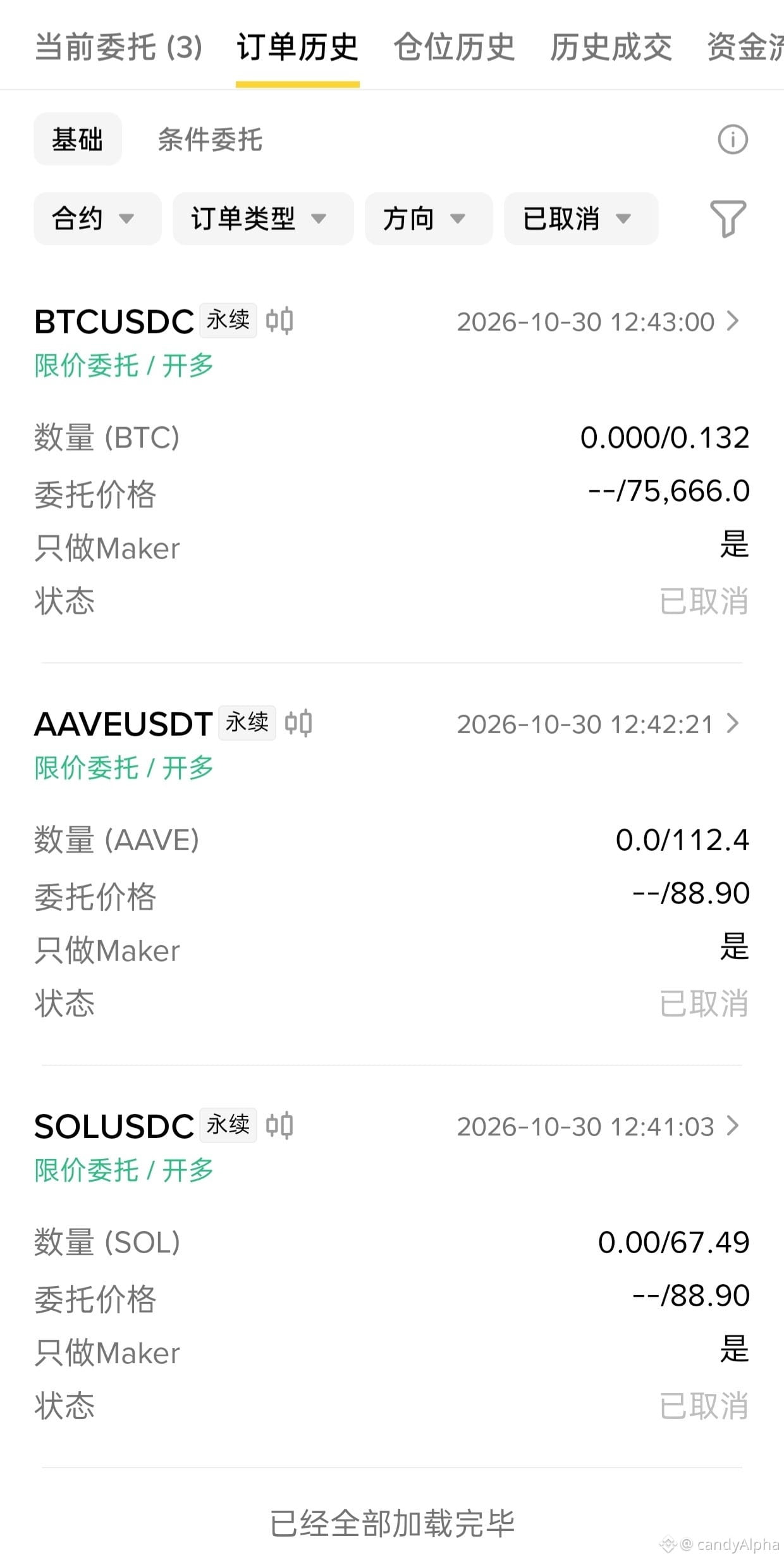
Damn, I canceled the 75,666 order I placed on the 30th. The low today was 75,600.
Same with SOL—I really played myself with this move.
Given the situation from here, I can't think of any reason for prices to rise. It should still pull back, so I'll keep holding.
Will this be a bull trap again?
Damn, I canceled the 75,666 order I placed on the 30th. The low today was 75,600.
Same with SOL—I really played myself with this move.
Given the situation from here, I can't think of any reason for prices to rise. It should still pull back, so I'll keep holding.
Damn, I canceled the 75,666 order I placed on the 30th. The low today was 75,600.
Same with SOL—I really played myself with this move.
Given the situation from here, I can't think of any reason for prices to rise. It should still pull back, so I'll keep holding.

1
3
1.4k

·
--
It broke through the 76,100 support level twice, but didn't drop any further?
Could it be turning bullish now?
But I still want to hold it and see if it reaches 75,000.
I've been holding this position for over a month, and the funding fees have already added up to 400.
It broke through the 76,100 support level twice, but didn't drop any further?
Could it be turning bullish now?
But I still want to hold it and see if it reaches 75,000.
I've been holding this position for over a month, and the funding fees have already added up to 400.
Could it be turning bullish now?
But I still want to hold it and see if it reaches 75,000.
I've been holding this position for over a month, and the funding fees have already added up to 400.

5
2
3.4k
·
--
Could it really keep falling all the way this time?
How many of you had Intel hitting 40 as your first target?
Could it really keep falling all the way this time?
How many of you had Intel hitting 40 as your first target?
How many of you had Intel hitting 40 as your first target?

16
4
5.3k
·
--
Is it okay to start buying a little SOL gradually now?
Is it okay to start buying a little SOL gradually now?

1
4
5.6k
·
--
Target price 75000
Guys, do you think it can reach that?
Target price 75000
Guys, do you think it can reach that?
Guys, do you think it can reach that?
1
2
1.9k
·
--
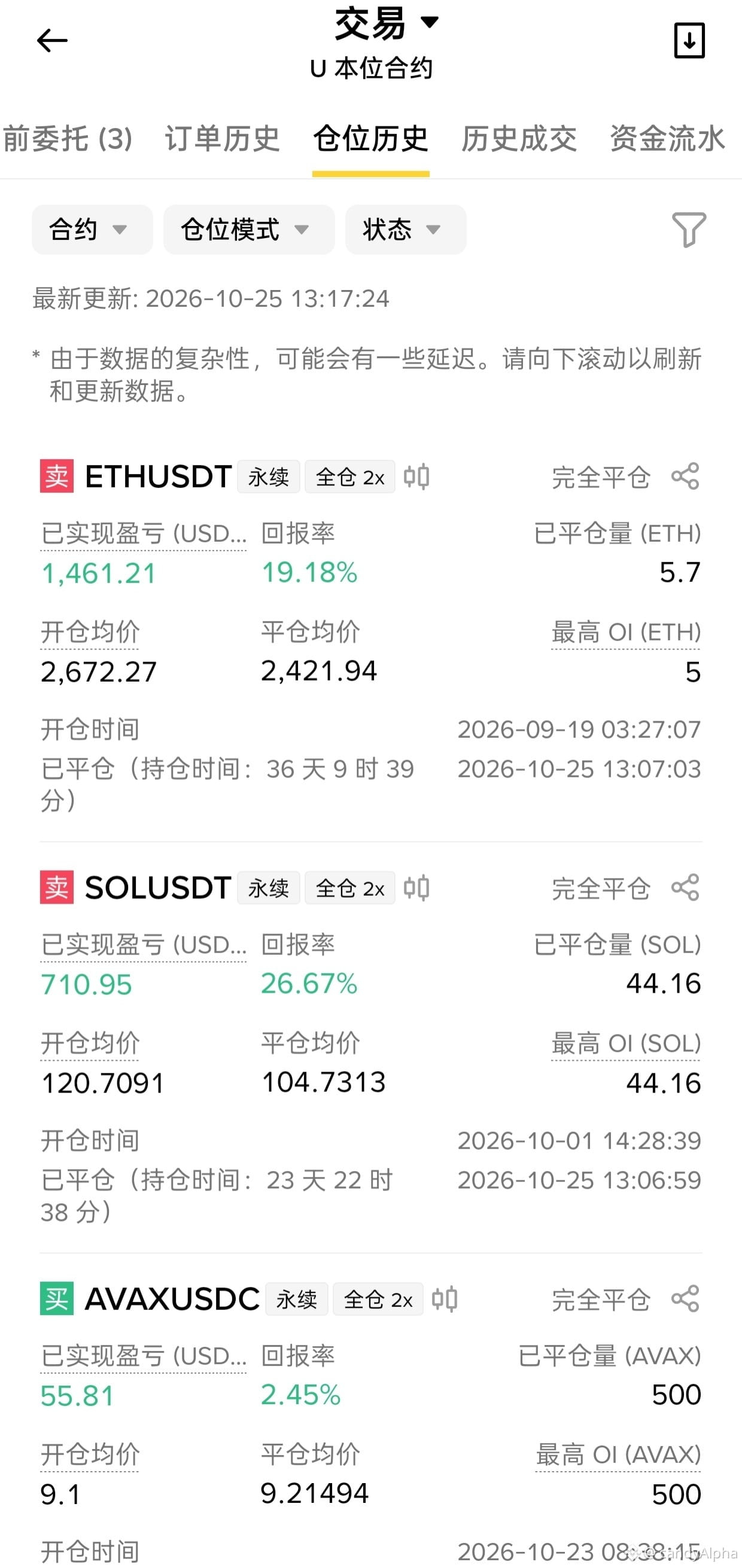
Better close the position for now.
When you're in profit, you should take it and get out. The upcoming rate decision could still cause a reversal, so play it safe.
Better close the position for now.
When you're in profit, you should take it and get out. The upcoming rate decision could still cause a reversal, so play it safe.
When you're in profit, you should take it and get out. The upcoming rate decision could still cause a reversal, so play it safe.
2
802
·
--
Has it started?
I'm about to break even. I feel like it's coming.
Has it started?
I'm about to break even. I feel like it's coming.
I'm about to break even. I feel like it's coming.

2
2.9k
·
--
My pending order from last night actually got triggered
Woke up to collect the profits 😁😁
My pending order from last night actually got triggered
Woke up to collect the profits 😁😁
Woke up to collect the profits 😁😁
825
·
--
Can we break 80K this round?
Can the Air Force win one more time?
Can we break 80K this round?
Can the Air Force win one more time?
Can the Air Force win one more time?

10
4
4.6k
·
--
It should be possible to leave it empty until 2150, right?
It should be possible to leave it empty until 2150, right?
1
3
1.9k
·
--
Maybe I’ll just take one lick and leave.
$BTW I have a feeling something big is coming later.
Maybe I’ll just take one lick and leave.
$BTW I have a feeling something big is coming later.
$BTW I have a feeling something big is coming later.
3
1.2k
·
--
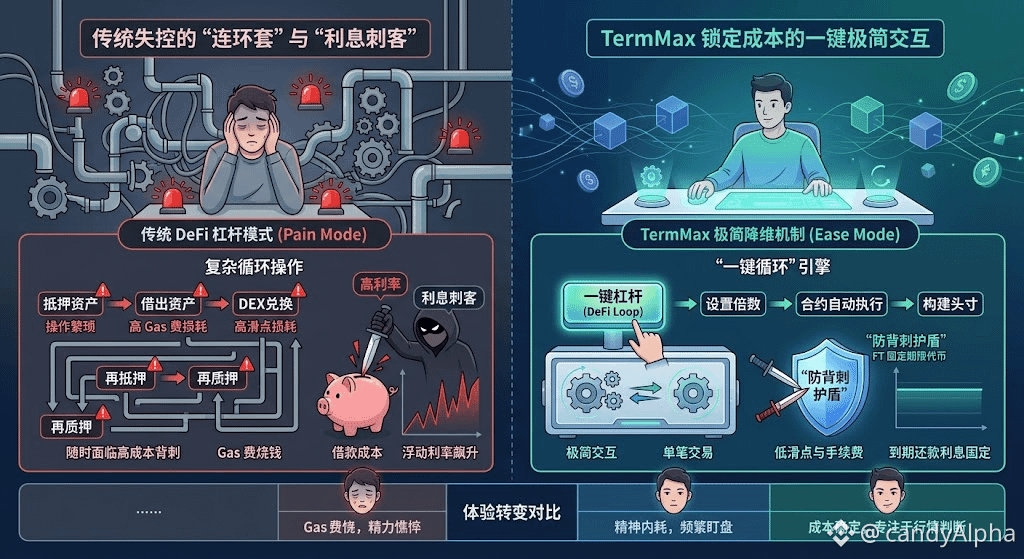
Friends who have played on-chain leveraged loop strategies all feel the same: if you want to amplify returns, you first need to lock up collateral, borrow assets, go to an exchange to convert to cash, and then deposit back to collateral—toggling back and forth for several rounds. Not only does the Gas fee burn your heart, but if you just happen to run into network congestion or market volatility, slippage can bite off a big chunk of your profit. Even worse, you may run into “interest assassins.” For example, a loan’s annualized rate might start at just 4%, then suddenly spike to 40% in the middle of the night, instantly breaking the strategy.
Say goodbye to the cumbersome “one-click loop” execution engine. Each trade completes in seconds: the TermMax protocol includes a one-click leverage (DeFi Loop) execution module that packages into smart contracts the entire borrow–swap–re-collateralization route that previously required repeated manual steps. Users only set the target leverage multiple, and the underlying layer automatically handles the calls and position construction, greatly reducing slippage losses and network fees throughout the interaction process.
A “anti-backstab shield” that locks in costs: a fixed interest rate blocks funding-rate mismanagement. In traditional lending pools, borrowing costs fluctuate continuously with the market. In TermMax, however, borrowing operations are priced and discounted through underlying FT (Fixed-Term tokens). From the very first second you open a position, the repayment interest due at maturity is fully locked in—no matter how future market liquidity gets squeezed, the borrowing cost remains fixed the whole time.
Turn high-threshold strategies into standardized tools: encapsulate complex loop-arbitrage paths that are exclusive to quantitative institutions into a simple workflow, lowering the on-chain interaction barrier for ordinary users.
Eliminate the mental strain of constant chart-watching: once costs are determined, you only need to focus on market analysis—no more worrying and trembling over dramatic swings in floating borrowing rates.
#termmax @termmax
Friends who have played on-chain leveraged loop strategies all feel the same: if you want to amplify returns, you first need to lock up collateral, borrow assets, go to an exchange to convert to cash, and then deposit back to collateral—toggling back and forth for several rounds. Not only does the Gas fee burn your heart, but if you just happen to run into network congestion or market volatility, slippage can bite off a big chunk of your profit. Even worse, you may run into “interest assassins.” For example, a loan’s annualized rate might start at just 4%, then suddenly spike to 40% in the middle of the night, instantly breaking the strategy.
Say goodbye to the cumbersome “one-click loop” execution engine. Each trade completes in seconds: the TermMax protocol includes a one-click leverage (DeFi Loop) execution module that packages into smart contracts the entire borrow–swap–re-collateralization route that previously required repeated manual steps. Users only set the target leverage multiple, and the underlying layer automatically handles the calls and position construction, greatly reducing slippage losses and network fees throughout the interaction process.
A “anti-backstab shield” that locks in costs: a fixed interest rate blocks funding-rate mismanagement. In traditional lending pools, borrowing costs fluctuate continuously with the market. In TermMax, however, borrowing operations are priced and discounted through underlying FT (Fixed-Term tokens). From the very first second you open a position, the repayment interest due at maturity is fully locked in—no matter how future market liquidity gets squeezed, the borrowing cost remains fixed the whole time.
Turn high-threshold strategies into standardized tools: encapsulate complex loop-arbitrage paths that are exclusive to quantitative institutions into a simple workflow, lowering the on-chain interaction barrier for ordinary users.
Eliminate the mental strain of constant chart-watching: once costs are determined, you only need to focus on market analysis—no more worrying and trembling over dramatic swings in floating borrowing rates.
#termmax @TermMax
3
397
·
--
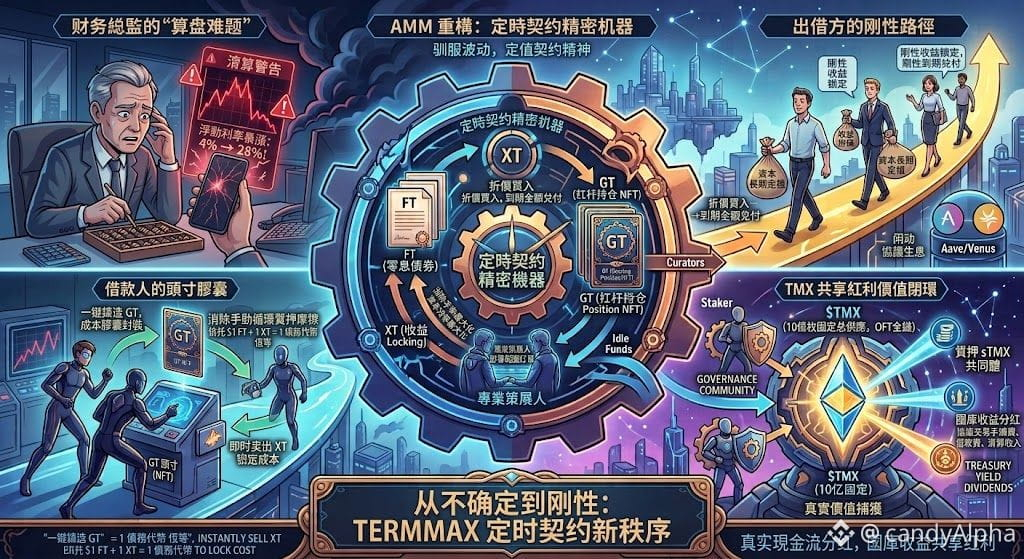
Every month-end, one of the biggest headaches for the “Finance Laozhang” behind a certain Web3 project is dealing with the ever-changing “capital weather” when it comes to the lending pool—last week the borrowing cost was 4%, but with market volatility it suddenly jumped to 28% this week. The six-month capital budget that was originally planned instantly became useless paper. In an on-chain world saturated with speculative sentiment, capital often drifts in a state of long-term uncertainty.
TermMax addresses the uncertainty of traditional lending by implementing a customized upgrade to the underlying structure of Uniswap V3. It transforms borrowing and leveraged trading into modular token interactions:
Zero-interest bond mechanism: Lenders buy FT (Fixed-rate Token) at a discount (zero-interest bonds). On the maturity date, the debt assets are redeemed in full, allowing them to lock in fixed, rigid returns in advance.
Position capsules & cost lock-in: Borrowers can mint GT (Gearing Token) (ERC-721 NFT positions) with a single click to deploy leverage. Then, relying on the identity logic of $1\text{ FT} + 1\text{ XT} = 1\text{ debt token}$ , they can instantly sell XT (Yield Token) to lock the borrowing cost—eliminating the costly friction of manual cyclical borrowing.
Maximizing capital efficiency: A professional Curator deploys range orders. Through Atomic Orders and Idle Fund Deployment, idle capital is routed into protocols such as Aave and Morpho to earn yield, eliminating “funds standing by” idle conditions.
Fixed supply & cross-chain interoperability: TMX sets a fixed total supply of 1 billion tokens (no inflation). The initial circulating supply is 20% (200 million tokens). It uses the LayerZero OFT standard to enable seamless transfers across multiple chains.
Capturing real yield: Token holders can stake to receive sTMX. This not only grants governance voting rights over protocol parameters and the curator whitelist, but also lets them directly capture treasury cash-flow distributions from protocol transaction fees, borrowing fees, liquidation proceeds, and more.
Traditional floating-rate mechanisms turn lending into a short-term game of give-and-take between lenders and borrowers. TermMax’s AMM redesign instead injects a “time-pledge” mindset into liquidity provision, enabling capital to be safely rooted over time. Backed by genuine protocol revenue, the TMX token economy binds market makers, curators, and long-term holders into a community—pushing on-chain lending away from high-risk speculation toward mature, deterministic asset allocation.
#termmax @termmax
Every month-end, one of the biggest headaches for the “Finance Laozhang” behind a certain Web3 project is dealing with the ever-changing “capital weather” when it comes to the lending pool—last week the borrowing cost was 4%, but with market volatility it suddenly jumped to 28% this week. The six-month capital budget that was originally planned instantly became useless paper. In an on-chain world saturated with speculative sentiment, capital often drifts in a state of long-term uncertainty.
TermMax addresses the uncertainty of traditional lending by implementing a customized upgrade to the underlying structure of Uniswap V3. It transforms borrowing and leveraged trading into modular token interactions:
Zero-interest bond mechanism: Lenders buy FT (Fixed-rate Token) at a discount (zero-interest bonds). On the maturity date, the debt assets are redeemed in full, allowing them to lock in fixed, rigid returns in advance.
Position capsules & cost lock-in: Borrowers can mint GT (Gearing Token) (ERC-721 NFT positions) with a single click to deploy leverage. Then, relying on the identity logic of $1\text{ FT} + 1\text{ XT} = 1\text{ debt token}$ , they can instantly sell XT (Yield Token) to lock the borrowing cost—eliminating the costly friction of manual cyclical borrowing.
Maximizing capital efficiency: A professional Curator deploys range orders. Through Atomic Orders and Idle Fund Deployment, idle capital is routed into protocols such as Aave and Morpho to earn yield, eliminating “funds standing by” idle conditions.
Fixed supply & cross-chain interoperability: TMX sets a fixed total supply of 1 billion tokens (no inflation). The initial circulating supply is 20% (200 million tokens). It uses the LayerZero OFT standard to enable seamless transfers across multiple chains.
Capturing real yield: Token holders can stake to receive sTMX. This not only grants governance voting rights over protocol parameters and the curator whitelist, but also lets them directly capture treasury cash-flow distributions from protocol transaction fees, borrowing fees, liquidation proceeds, and more.
Traditional floating-rate mechanisms turn lending into a short-term game of give-and-take between lenders and borrowers. TermMax’s AMM redesign instead injects a “time-pledge” mindset into liquidity provision, enabling capital to be safely rooted over time. Backed by genuine protocol revenue, the TMX token economy binds market makers, curators, and long-term holders into a community—pushing on-chain lending away from high-risk speculation toward mature, deterministic asset allocation.
#termmax @TermMax
4
1k
·
--
Verified
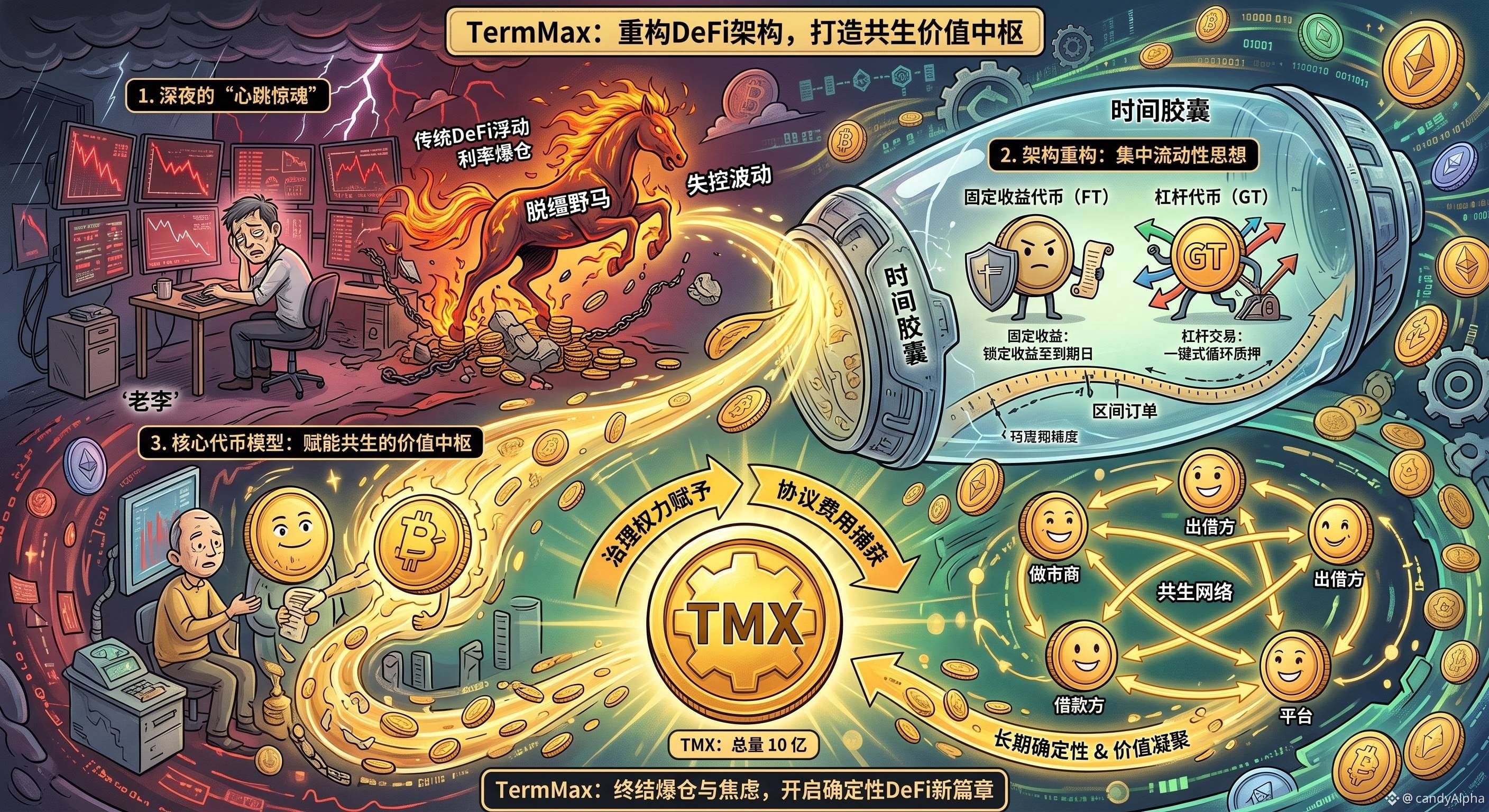
Old Li was awakened one stormy night by a liquidation warning:
On-chain lending rates suddenly surged like a runaway horse, forcing him to frantically shuffle between multiple protocols, repeatedly borrowing, closing positions, and trying to keep up. The exhaustion and anxiety—being ruled by “uncontrolled volatility”—are precisely the profound pain points that variable interest rates in traditional DeFi bring to human players.
Architectural Rework: Put the Wild Horse into a Precise “Time Capsule”
To address the problems of interest-rate runaway and multi-step operations, @termmax draws on and reimagines the concentrated liquidity concept of Uniswap V3, helping disordered roaming capital find an exact destination:
Fixed-Term Tokens (FT): Act as a steady “performance gatekeeper,” enabling lenders to buy at a discount and redeem the full face value on the maturity date—locking in returns the moment they enter.
Leveraged Tokens (GT): Become an agile “composite operator,” encapsulating the traditionally cumbersome looping of collateral staking into a one-click transaction.
Range Orders: Give market-making capital the right to breathe on its own—by precisely anchoring interest rates within a specified range through a customizable curve.
Core Token Model: Empower the Shared Value Nexus
As the ecosystem’s bloodstream that sustains system operation, TMX (a fixed total supply of 1 billion tokens) carries the mission of consolidating consensus among all parties.
By empowering participation through governance rights and protocol fee capture mechanisms, it deeply ties together market makers, borrowers and lenders, and the platform itself—turning what used to be a one-way, cold financial game of speculation into a symbiotic network with long-term, deterministic prospects.
#termmax @termmax
Old Li was awakened one stormy night by a liquidation warning:
On-chain lending rates suddenly surged like a runaway horse, forcing him to frantically shuffle between multiple protocols, repeatedly borrowing, closing positions, and trying to keep up. The exhaustion and anxiety—being ruled by “uncontrolled volatility”—are precisely the profound pain points that variable interest rates in traditional DeFi bring to human players.
Architectural Rework: Put the Wild Horse into a Precise “Time Capsule”
To address the problems of interest-rate runaway and multi-step operations, @TermMax draws on and reimagines the concentrated liquidity concept of Uniswap V3, helping disordered roaming capital find an exact destination:
Fixed-Term Tokens (FT): Act as a steady “performance gatekeeper,” enabling lenders to buy at a discount and redeem the full face value on the maturity date—locking in returns the moment they enter.
Leveraged Tokens (GT): Become an agile “composite operator,” encapsulating the traditionally cumbersome looping of collateral staking into a one-click transaction.
Range Orders: Give market-making capital the right to breathe on its own—by precisely anchoring interest rates within a specified range through a customizable curve.
Core Token Model: Empower the Shared Value Nexus
As the ecosystem’s bloodstream that sustains system operation, TMX (a fixed total supply of 1 billion tokens) carries the mission of consolidating consensus among all parties.
By empowering participation through governance rights and protocol fee capture mechanisms, it deeply ties together market makers, borrowers and lenders, and the platform itself—turning what used to be a one-way, cold financial game of speculation into a symbiotic network with long-term, deterministic prospects.
#termmax @TermMax
2
365
Log in to explore more content
Join global crypto users on Binance Square
⚡️ Get latest and useful information about crypto.
💬 Trusted by the world’s largest crypto exchange.
👍 Discover real insights from verified creators.
Email / Phone number
Trending Topics
USPPIMissMayEaseBTCPressure
57,984 views
870 Discussing
US PPI Rises 6.5% a Year in October, Slightly Below 6.6% Forecast
Binance News
·17 Likes
·18.9k views
BitcoinCoreDisclosesTorTrafficVulnerability
24,474 views
473 Discussing
WhatWillDriveCryptoandStocks’NextRebound?
177,994 views
1,694 Discussing