

交易员刺客
127 Posts

交易员刺客
Report
Block User
刺客社区创始人,绿洲大学联合创始人,香港web3协会会员,新加坡区块链中文大使,推特华语区块链头部KOL,bilibili的up主“飞哥定投策略”老师,2024年币安交易嘉年华第一名,2016年开始布道区块链。推特:@TraderCIKE

BNB Holder
Frequent Trader
5.5 Years
5 Following
803 Followers
432 Liked
Posts
All
Videos
Live
·
--
Verified
I woke up to Bitcoin crashing straight through the $80,000 mark. It’s now at 77,184, down nearly 5%. This isn’t a simple pullback—it’s a brutal shakeout.
Why the crash? The clues are all in the macro data. U.S. Q3 GDP grew at an annualized rate of 3.4%, beating expectations, while September core PCE rose 3.1% year over year and remains stubbornly high. A red-hot economy plus sticky inflation—what does that mean? It means hopes for Fed rate cuts have been completely dashed, and the high-rate “meat cleaver” will keep swinging. That’s the fundamental reason stocks and crypto both got hammered last night.
Tech stocks fared even worse: the AI story’s cover has been pulled away. Google’s cloud revenue surged 103%, which looks impressive, but free cash flow came in more than $9 billion in the red, and the stock plunged 12.64%. Amazon beat revenue expectations, but its free cash flow saw a net outflow of $42.4 billion over the past year. This sends an extremely dangerous signal: the market is no longer buying AI stories built on reckless spending. Once the Nasdaq collapsed, Bitcoin’s liquidity got drained right along with it.
Looking at the market now, the 76,100–76,800 zone below BTC is the bulls’ last liquidation minefield. If it breaks, cascading liquidations could get very ugly. The bears’ danger zone is 79,200–79,900, which is a long way off. More importantly, at 16:00 today, nearly $11.18 billion in options on Deribit will expire, with BTC’s max pain at 78,000. Around expiration, the big players are highly likely to push the price sharply in both directions, sweeping up both longs and shorts.
My trading strategy is brutally simple:
First, absolutely do not blindly buy the dip here. Catching a falling knife can be fatal. If you’re holding a position, cut it immediately if price breaks below 76,800 on strong volume—no hesitation.
Second, if price can hold around 76,800 on lower volume, or if it briefly breaks below support after expiration and quickly rebounds to 78,000, I’ll try a long with a tiny position—just 10%—to catch the post-expiration bounce.
Third, if price rebounds toward 79,200 and shows weakness, I’ll go short.
Also, keep an eye on the Binance security rumors. Although the official line is that funds are safe, in this kind of panic, any little tremor can be blown out of proportion.
Hold onto your cash and ride out tonight’s major options-expiration shakeout. We can get back in afterward. Don’t get carried away. $BTC #btc #FirstDigital blacklists attacker address holding around 3.4 million FDUSD
5
13
2k
·
--
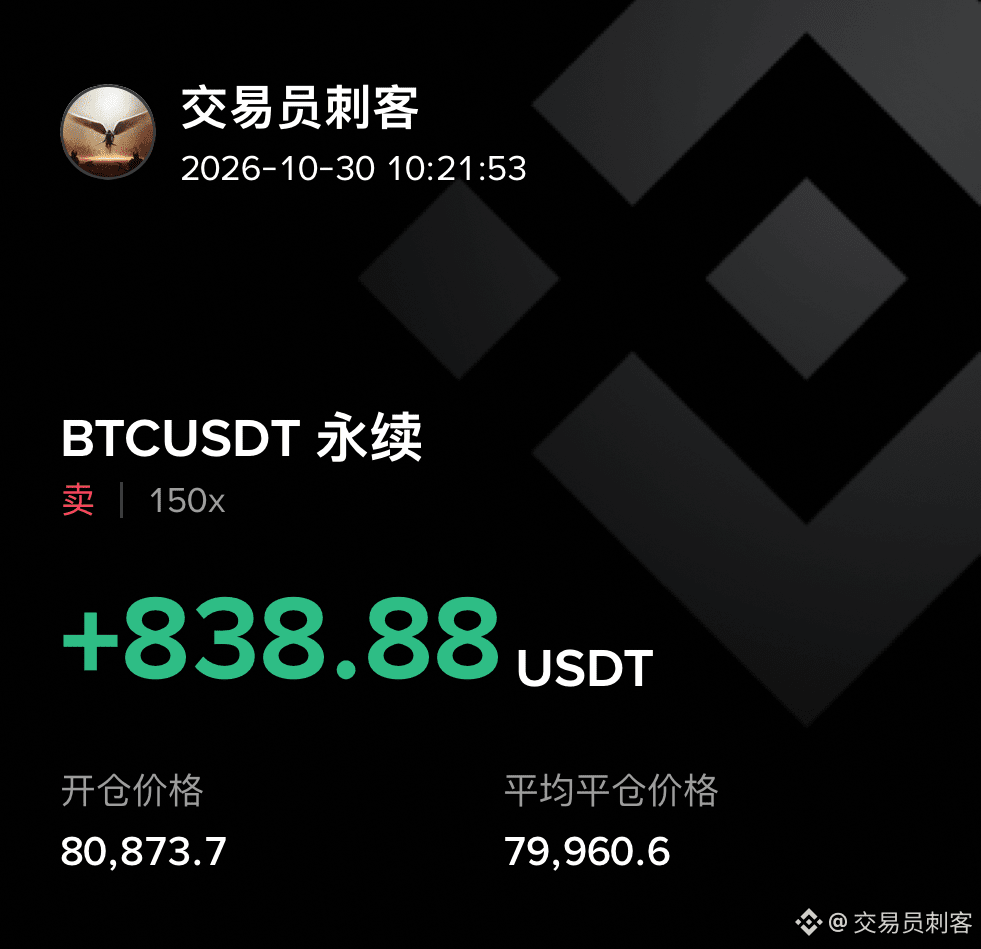
$BTC
Wake up
First, earn a little U and have some fun
$BTC
Wake up
First, earn a little U and have some fun
Wake up
First, earn a little U and have some fun
4
11
1k
·
--
Bullish
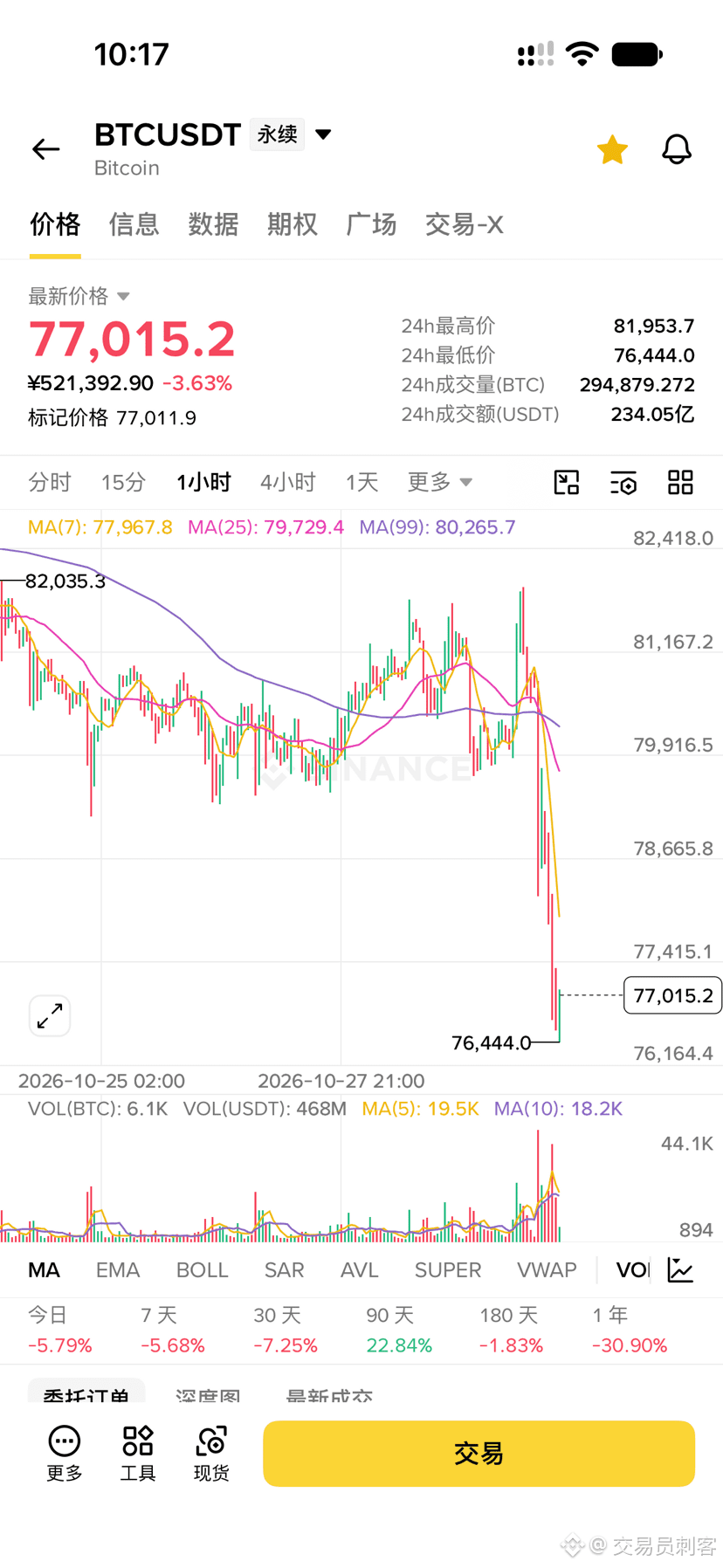
$BTC The fourth-wave decline arrived as expected!
Wait for the decline to bottom, then look for a sharp wave-five rally!
Fourth-wave decline support: 74000-75000
Resistance: 79000-80000
#BTC $
$BTC The fourth-wave decline arrived as expected!
Wait for the decline to bottom, then look for a sharp wave-five rally!
Fourth-wave decline support: 74000-75000
Resistance: 79000-80000
#BTC $
Wait for the decline to bottom, then look for a sharp wave-five rally!
Fourth-wave decline support: 74000-75000
Resistance: 79000-80000
#BTC $
19
12
5.8k
·
--
Verified
SanDisk is about to announce earnings! A look at possible price moves!
Possible price moves
Scenario 1: Gross margin guidance holds above 83%, and LTA volumes continue to grow. The stock will probably spike after hours, but the key is how it performs the next day. If it opens higher and holds those gains, that suggests the market buys the long-term story, with the previous highs as a target. If it opens higher but then falls, that’s a classic “sell the news” move, and late buyers will be left holding the bag.
Scenario 2: Gross margin guidance comes in below 80%, or the midpoint of next quarter’s revenue guidance is below $10.5 billion. There’s a very high chance the stock will sell off sharply after hours. The market has already priced in concerns that the price-hike cycle is peaking, so if guidance confirms those concerns, selling pressure could be intense.
Scenario 3: Earnings and guidance are both about in line. The stock will probably trade in a wide range, with bulls and bears battling it out after hours. This is the most frustrating scenario, since both long and short traders can easily get stopped out by sharp price swings.
My trading plan
I won’t bet on direction before earnings. The options market has already priced in a nearly 10% move in either direction after the report. With those odds, making a big one-way bet means a win would be luck, while a loss could cut your principal in half.
If the stock spikes after earnings but stalls on heavy volume, I may consider taking a small short position to play a “sell the news” pullback. If it sells off right away, I’ll wait for panic selling to run its course and for the stock to stabilize on lower volume at a key support level before considering a long position. SanDisk’s long-term story (AI storage demand and LTA commitments) is still intact, but short-term valuation compression could be severe.
Keep the position size below 10% and set a hard stop-loss. With an earnings report like this, where anything could happen, staying in the game matters more than anything.#闪迪 $SNDK
5
9
5.9k
·
--
$ETH ETH is at 2335 now, and I plan to place a short order at 2368. This is a very seasoned approach: a classic strategy of waiting for a rebound to confirm resistance before taking a shot.
First, the technical picture. The 2368 level is definitely not arbitrary. It coincides with a dense trapped-buyer zone from the previous consolidation during the decline, and it also sits right at the lower edge of the short-term moving-average resistance band. ETH is moving sideways with a weak bias at 2335, and if it rallies to 2368, it will inevitably face heavy selling pressure. If you short directly at 2335 now, you could easily get shaken out by the market makers’ whipsaw moves. But if you wait for a rebound to 2368, bullish momentum should be exhausted by then. Entering a short at that point gives you a tight risk limit and an excellent risk-to-reward ratio.
Now, the fundamentals. The Fed didn’t raise rates last night, but that was a thoroughly “hawkish pause”: two officials remained adamant about raising rates, and the threat of a December hike is still hanging over the market. Rising long-term Treasury yields are weighing on markets, and liquidity is extremely tight. More importantly, spot Ethereum ETFs have been seeing persistent outflows lately, with funds flocking to BTC instead. As a high-beta asset, ETH is likely to fall faster than anything else if the broader market gets even the slightest shock.
The trade setup is simple. Place a short order directly at 2368, with a firm stop-loss just above 2425. If the price breaks above 2425 on strong volume and holds there, that means the bearish structure has been invalidated—accept the loss and exit; absolutely do not hold on. The first target is 2280, then 2220 if that level breaks. At 2280, close more than half the position and pocket some real profits. Use a trailing stop for the remainder: for every 30-point drop in price, move the stop down by 15 points.
Keep the position size between 10% and 15%, and don’t use more than 3x leverage. If it doesn’t reach 2368, sit tight and watch with your cash on hand. If it gets there, follow the plan—don’t chase the short. #eth
{future}(ETHUSDT)
$ETH ETH is at 2335 now, and I plan to place a short order at 2368. This is a very seasoned approach: a classic strategy of waiting for a rebound to confirm resistance before taking a shot.
First, the technical picture. The 2368 level is definitely not arbitrary. It coincides with a dense trapped-buyer zone from the previous consolidation during the decline, and it also sits right at the lower edge of the short-term moving-average resistance band. ETH is moving sideways with a weak bias at 2335, and if it rallies to 2368, it will inevitably face heavy selling pressure. If you short directly at 2335 now, you could easily get shaken out by the market makers’ whipsaw moves. But if you wait for a rebound to 2368, bullish momentum should be exhausted by then. Entering a short at that point gives you a tight risk limit and an excellent risk-to-reward ratio.
Now, the fundamentals. The Fed didn’t raise rates last night, but that was a thoroughly “hawkish pause”: two officials remained adamant about raising rates, and the threat of a December hike is still hanging over the market. Rising long-term Treasury yields are weighing on markets, and liquidity is extremely tight. More importantly, spot Ethereum ETFs have been seeing persistent outflows lately, with funds flocking to BTC instead. As a high-beta asset, ETH is likely to fall faster than anything else if the broader market gets even the slightest shock.
The trade setup is simple. Place a short order directly at 2368, with a firm stop-loss just above 2425. If the price breaks above 2425 on strong volume and holds there, that means the bearish structure has been invalidated—accept the loss and exit; absolutely do not hold on. The first target is 2280, then 2220 if that level breaks. At 2280, close more than half the position and pocket some real profits. Use a trailing stop for the remainder: for every 30-point drop in price, move the stop down by 15 points.
Keep the position size between 10% and 15%, and don’t use more than 3x leverage. If it doesn’t reach 2368, sit tight and watch with your cash on hand. If it gets there, follow the plan—don’t chase the short. #eth
5
12
2.5k
·
--
#FOMC会议
Last night’s FOMC meeting ended with the Fed holding its benchmark interest rate steady at 3.75% to 4.00%. But don’t see the words “no rate hike” and assume it’s time to go all-in on longs. This wasn’t a liquidity boost—in fact, it was a thoroughly “hawkish pause.” For BTC, the uncertainty has been lifted in the short term, but the medium-term pressure is immense.
The impact of this meeting on BTC needs to be examined from three angles.
First, expectations have been priced in, making a short-term “buy the rumor, sell the news” move highly likely. The market had long treated no rate hike in October as a foregone conclusion, and prices had already moved in anticipation. Once the decision was announced, there was no upside surprise to provide a fresh catalyst, and the market lost momentum. With capital merely changing hands, bulls could easily take profits, sending prices higher before pulling back.
Second, the threat of a December rate hike is still very much on the table. The 10–2 vote saw Cook and Hammack dissent, insisting on a 25-basis-point hike. The policy statement was also crystal clear: the committee will continue to assess conditions to ensure inflation returns to its 2% target. This means the Fed remains deeply concerned about inflation, and the burden of high interest rates is still here to stay. As long as long-term Treasury yields don’t come down, the valuation ceiling for non-yielding assets like BTC will remain firmly in place, making big investors reluctant to enter the market without restraint.
Third, the drain on liquidity is continuing. In a high-interest-rate environment, investors would rather earn steady returns in the bond market. Look at the market now: BTC is barely holding around 80,200, while total market capitalization keeps shrinking. ETF inflows have appeared from time to time, but they haven’t been sustained. The crypto market as a whole lacks fresh liquidity and is relying on existing capital being passed around. What could possibly support a one-way surge in these conditions?
Here’s a clear trading plan based on current market conditions. The 80,800–81,500 range above is both a reference point for ETF cost bases and a major resistance zone where previous buyers are trapped, making a rally into this range an ideal opportunity to open short positions. The 78,700–79,300 range below is a liquidation danger zone for bulls. If BTC breaks below the 80,000 mark on strong volume, a cascade of liquidations will be unavoidable.
2
11
2.9k
·
--
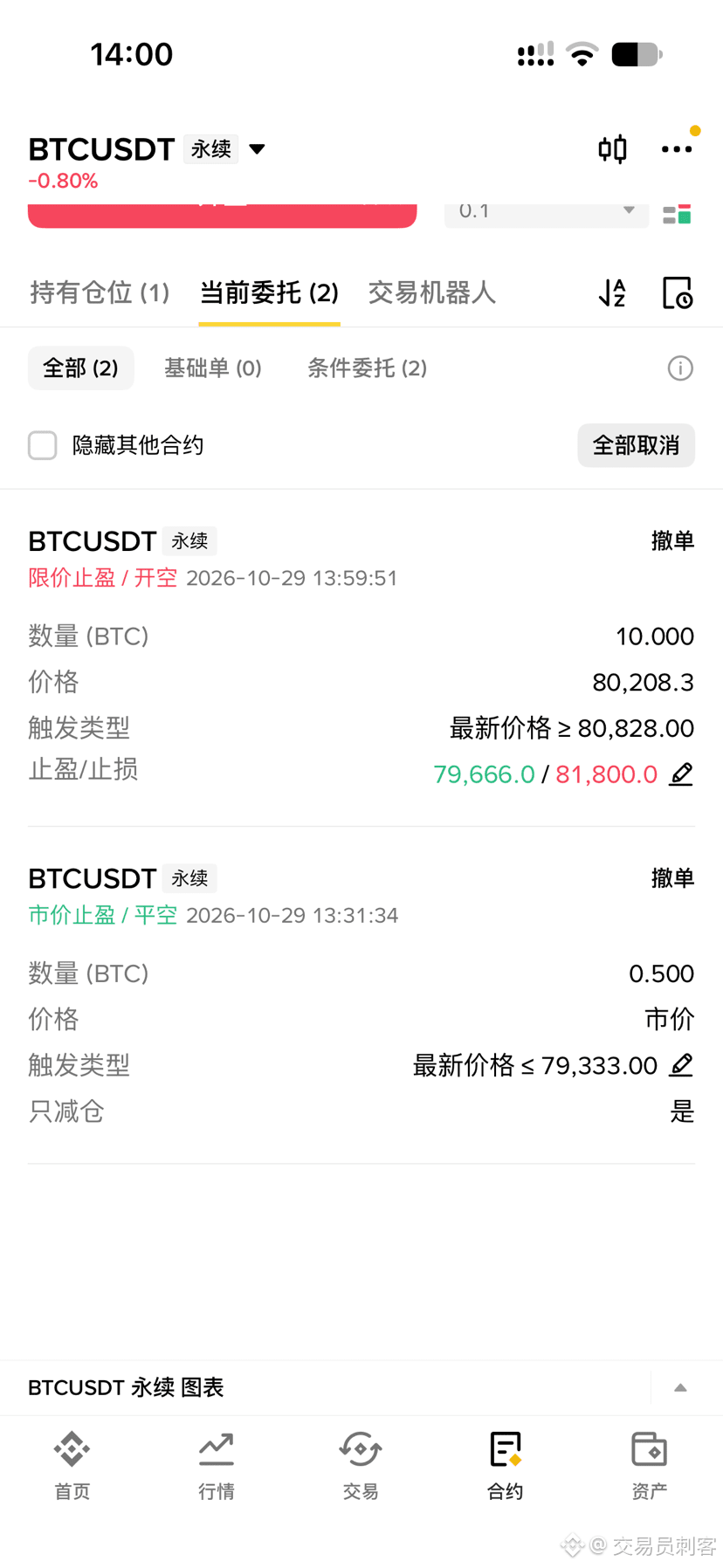
$BTC The rebound is almost over! Publicly opening a BTC short! Let's capture the entire fourth leg down!
First, let's look at the technicals. The 80,828 level sits just above the key 80,000 mark. It's a retest of the former consolidation platform that broke down, and it's also where the short-term moving averages are firmly capping price. BTC is barely holding around 80,200, but overhead selling pressure is extremely heavy. From 80,828, it's less than 400 points to the 81,200–81,700 zone, a major short-liquidation hotspot. Without an enormous amount of capital, the bulls simply won't be able to push through. If the rebound reaches this level on fading volume, or forms a long upper wick, that would be a classic bull trap—and the risk-reward would be very attractive.
Now let's look at the news. The Fed didn't raise rates last night, but the 10–2 vote—with two members insisting on a hike—was undeniably a hawkish pause. The threat of a rate hike in December is still hanging over us. U.S. GDP and PCE data are due tonight as well. If inflation remains stubborn, the high-rate environment will keep applying pressure. The macro backdrop simply doesn't support a sustained bull run in risk assets.
There's no need to say much about flows. Glassnode data shows the ETF aggregate cost basis is at 81,500. The price hasn't even reclaimed that level, leaving overhead packed with underwater holders. Over in tech stocks, Google's earnings have disappointed, and concerns about the cash burn from AI are still spreading. Capital is flowing out, and the market is just existing funds fighting among themselves. Without fresh inflows, what could possibly break through the resistance above?
Here's the trade plan, set in stone. Place a short at 80,828, with a stop-loss above 81,600. If price breaks above 81,600 on strong volume and holds, the bearish thesis is invalidated—take the loss and exit. Do not hold and hope. The first target is 79,500; if that breaks, look toward the 78,700–79,300 long-liquidation zone below. At 79,500, close most of the position and lock in profits, then trail the stop on the remainder downward.
Limit your position to 10–15% of total capital, with leverage capped at 3x. Don't get carried away before tonight's macro data comes out. Wait for price to reach the level, follow the plan, and take the profit from the pullback. Keep your cash in hand and wait until the dust settles. #btc
6
8
3.9k
·
--
Verified
#微软财报能否兑现ai红利
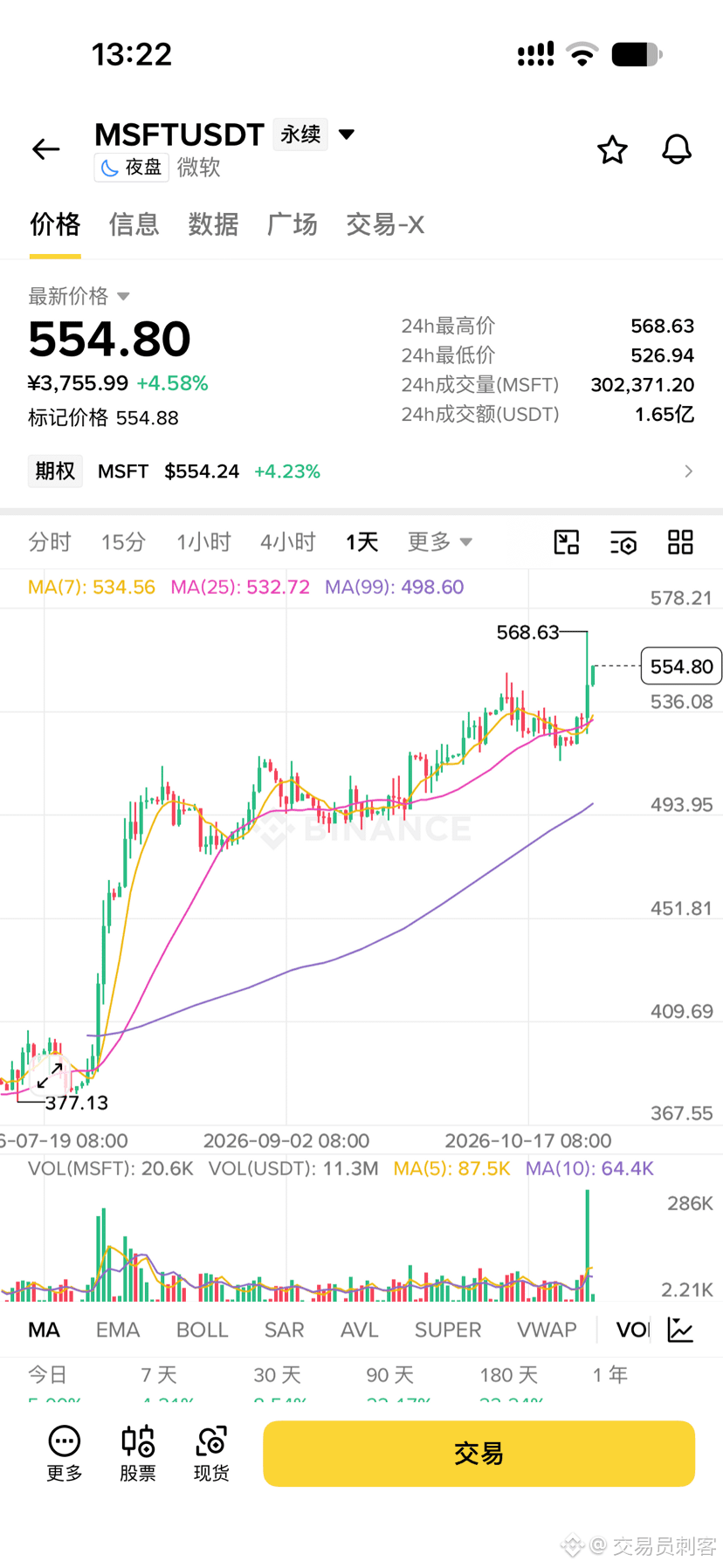
At 554, Microsoft is a classic case of “strong fundamentals, awkward positioning.” Its earnings were undeniably stellar, but the stock has already rallied in the short term. Chasing it higher now risks a pullback, while shorting it risks going against the trend. Here’s a breakdown of the bull and bear strategies for this setup.
Bullish case: Strong earnings, but don’t rush to chase
The standout feature of Microsoft’s latest earnings is its cash flow. Azure grew 48%, and the company generated a whopping $18.6 billion in free cash flow in a single quarter—that’s real cash-generating power. The stock surged at one point after hours, showing that investors are buying into Microsoft’s “spend and earn at the same time” model. As long as Microsoft continues to deliver on the commercialization of AI, it remains the strongest defensive play among the Magnificent Seven tech stocks. However, 554 is no longer where the stock was before earnings were announced, and some of the good news has already been priced in. On top of that, the Fed held rates steady, but two officials called for a hike, while rising long-term Treasury yields are weighing on stocks. Chasing the stock here offers an unattractive risk-reward.
Bearish case: Macro headwinds put short-term pressure on the stock
The bear case is not about fundamentals; it’s about macroeconomic conditions and flows. The Fed remains concerned about inflation, and expectations for a rate hike in December haven’t disappeared. That is capping valuations for tech stocks. As a mega-cap stock, Microsoft won’t be immune if the Nasdaq pulls back on disappointing after-hours earnings from companies like Amazon and Coinbase. Also, the 555–560 range above 554 is a dense area of overhead supply from previous buyers who are underwater. Without sustained high volume, it will be difficult to break through in one move.
Specific strategies
Strategy 1: Buy the pullback (primary strategy)
Don’t chase the price higher; wait for a pullback. If the stock retraces to the 545–548 range and stabilizes on lower volume, consider opening a small long position. Set a stop-loss below 540, with an initial target of 560 and a potential target of 570 if it breaks through. Strong earnings provide a fundamental backstop, making a pullback a buying opportunity.
Strategy 2: Try a small short at resistance (secondary strategy)
If the stock bounces back to 558–560 and shows heavy volume without further gains or forms a long upper wick, consider a small short position. Set a stop-loss above 565, with an initial target of 548 and a second target of 540. This is a short-term trade against trapped buyers and macro pressure, not a bet against the fundamentals.
Strategy 3: Follow a breakout (right-side entry)
If the stock breaks above 560 on strong volume and holds there, it would suggest the market has fully absorbed the earnings news and is positioning for further upside. Consider entering a small long position, with a stop-loss at 555 and a target of 575.
2
13
13.7k
·
--
#谷歌财报能否守住基本盘
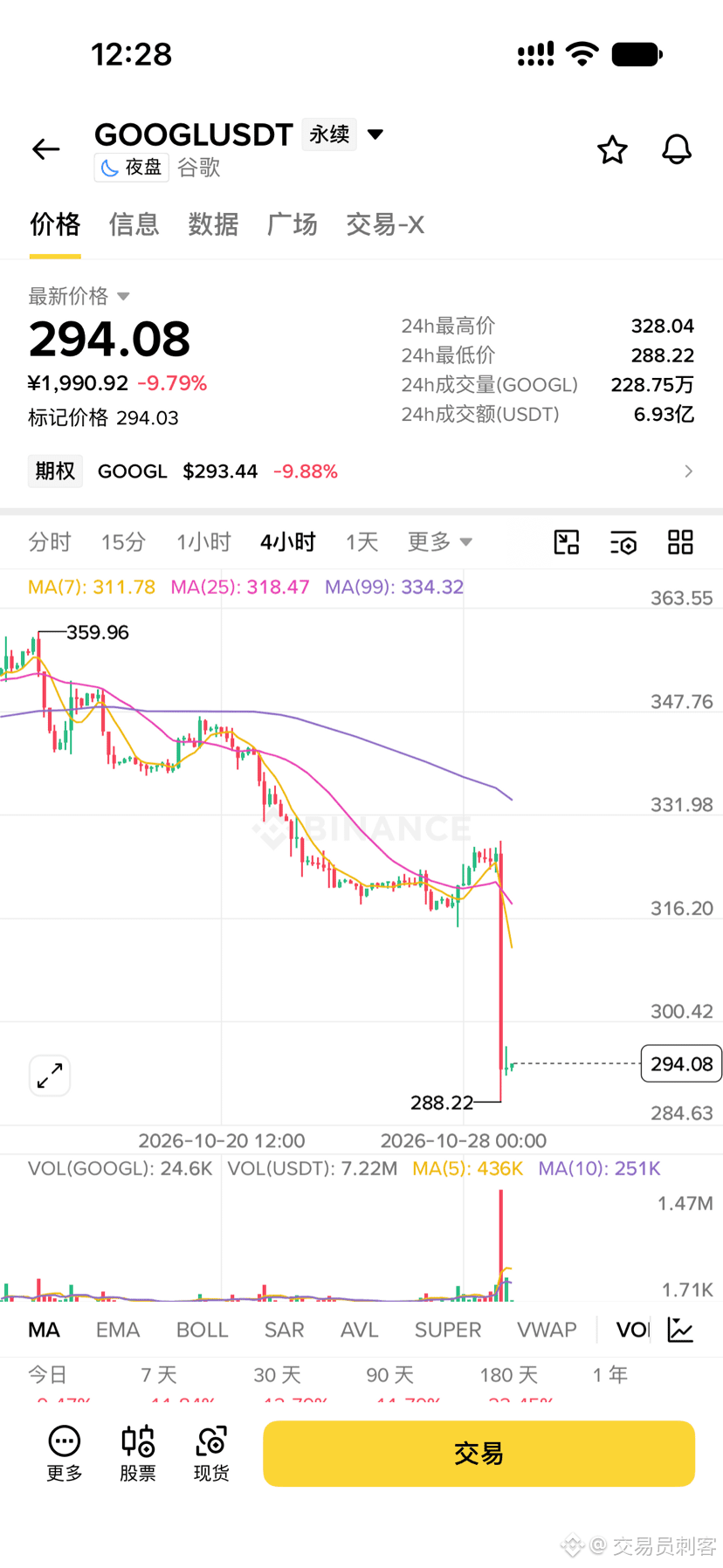
Google is now at 294, right on the key short-term dividing line between bulls and bears. After its earnings shock, the stock broke below the heavy-volume base at 300, turning 294 from support into the first layer of resistance.
Bearish case: Deteriorating cash flow is a serious flaw
The core problem in the earnings report wasn’t the cloud business (revenue rose 103%), but out-of-control spending. Quarterly capital expenditures came in at $51.3 billion, far above expectations, while free cash flow plunged to negative $9.065 billion, marking a second consecutive quarter in the red and a $33.5 billion year-over-year decline. More damaging still, buybacks are set to drop to zero in 2026, removing the biggest buyer that had been supporting the stock. Management itself acknowledged that AI search ads are temporarily monetizing at a lower rate than traditional search. Heavy investment isn’t yet generating commensurate returns, and concerns are spreading that the payback period for AI investment is getting longer.
Technically, the breakdown below 300 is clear, with the 7-day, 20-day, 50-day, and 200-day moving averages all hanging overhead as resistance. The next level with genuinely strong support is the year-to-date low of $270. That’s where shares accumulated from active fund buying early in the year, and it also marks an extreme valuation discount at 17.5 to 18 times forward earnings.
Bullish case: Deeply oversold, with room for a rebound
Based on the after-hours price, the 14-day RSI has already plunged to 24.58, deep in oversold territory, so a short-term technical bounce could come at any time. The cloud business fundamentals remain intact, and AI demand is still strong. But a trend reversal won’t be credible unless the stock gets back above 301.20. Until then, any move up should be treated only as an oversold bounce.
Specific strategies
Short: Enter short if a rebound into the 294–298 range meets resistance. Set a stop above 302. First target: 281 to 271.77; if that breaks, look for 270. The risk-reward ratio works out to roughly 2:1 or better, making this the path of least resistance right now.
Long: Play only a short oversold bounce. Probe near 295 with a small position, stop at 290, target 305 to retest the lower Bollinger Band, and reduce the position at 313. Keep the position below 10% of your portfolio, and don’t mistake the first bullish candle for a reversal.
Overall, the bearish trend isn’t over, and 270 is the next level to watch closely. Long positions are only for catching a bounce; shorts are aligned with the prevailing trend. GDP and PCE data are due tonight, so avoid taking a large one-way bet before the data is released.
4
3
19
14.1k
·
--
Verified

Article
Last night’s market action laid bare Wall Street’s true colors. The Fed held rates steady, with a 10–2 vote; Cook and Hammack dissented, calling for a rate hike.Last night’s market action laid bare Wall Street’s true colors. The Fed held rates steady, with a 10–2 vote; Cook and Hammack dissented, calling for a rate hike. What does that tell us? That fears of inflation inside the Fed haven’t gone away at all, and the December rate-hike guillotine is still hanging over our heads. A pause in rate hikes absolutely does not mean the end of tightening.
But what really sent a chill down my spine was the tech giants’ earnings. Microsoft and Google, on the same AI theme, were worlds apart.
Microsoft Azure grew 48%, and for the first time the company disclosed quarterly revenue of $33.1 billion. It managed to generate a whopping $18.6 billion in free cash flow, and its shares briefly surged after hours. Google Cloud revenue grew 103%, but its free cash flow was negative $9.065 billion, marking its second consecutive quarter in the red. Its shares plunged more than 7% after hours. Investors’ standards are now brutally unforgiving: you can burn cash, but you have to prove you can keep generating it while you do. Microsoft proved it could. Google didn’t.
Last night’s market action laid bare Wall Street’s true colors. The Fed held rates steady, with a 10–2 vote; Cook and Hammack dissented, calling for a rate hike.
Last night’s market action laid bare Wall Street’s true colors. The Fed held rates steady, with a 10–2 vote; Cook and Hammack dissented, calling for a rate hike. What does that tell us? That fears of inflation inside the Fed haven’t gone away at all, and the December rate-hike guillotine is still hanging over our heads. A pause in rate hikes absolutely does not mean the end of tightening.
But what really sent a chill down my spine was the tech giants’ earnings. Microsoft and Google, on the same AI theme, were worlds apart.
Microsoft Azure grew 48%, and for the first time the company disclosed quarterly revenue of $33.1 billion. It managed to generate a whopping $18.6 billion in free cash flow, and its shares briefly surged after hours. Google Cloud revenue grew 103%, but its free cash flow was negative $9.065 billion, marking its second consecutive quarter in the red. Its shares plunged more than 7% after hours. Investors’ standards are now brutally unforgiving: you can burn cash, but you have to prove you can keep generating it while you do. Microsoft proved it could. Google didn’t.

大吉大利!
From 交易员刺客
4
11
831
·
--
Partly True
#微软财报能否兑现ai红利
I'm Brother Ci.
Microsoft is about to report earnings, and the data in this chart is especially interesting. Ahead of earnings, Microsoft edged up 1.97%, while Google plunged 8.56%. What does that tell us? It tells us that the tech giants have completely diverged, and investors are now only backing certainty.
There are two key things to watch with Microsoft: the growth rate of its Azure cloud business, and whether its Copilot AI products can actually turn into real money. Microsoft has poured so much money into computing power and data centers. If earnings show revenue just scraping a pass, while capital spending heavily weighs on margins and free cash flow, the stock will get hammered after hours. Meta and Tesla have already made the lesson crystal clear: when spending exceeds expectations and returns are nowhere in sight, investors head for the exits.
Google’s 8.56% plunge is a case in point—the market’s patience with the AI bubble has run out.
For our markets, Microsoft’s earnings are a barometer of sentiment toward U.S. tech stocks. If Microsoft delivers a perfect report—making money without spending recklessly—sentiment toward tech could recover, and BTC will likely catch a tailwind and get some breathing room around the $80,000 mark. If Microsoft also disappoints and the Nasdaq tumbles, Bitcoin’s $80,000 support will face a make-or-break test as liquidity gets drained.
As for trading, don’t go heavily leveraged in one direction before earnings are out. Whoever wants to gamble on this mystery box can do so—we’ll stick to the sure thing. If earnings are great and the market surges but then stalls on heavy volume, we’ll short near the highs and catch the pullback after the good news is priced in. If earnings send the market crashing, we’ll wait for panic selling to run its course and for liquidation levels below to flush out forced sellers, then cautiously open a small long position.
Keep your cash firmly in hand. Tonight, we watch—no trades.
1
9
1.2k
·
--
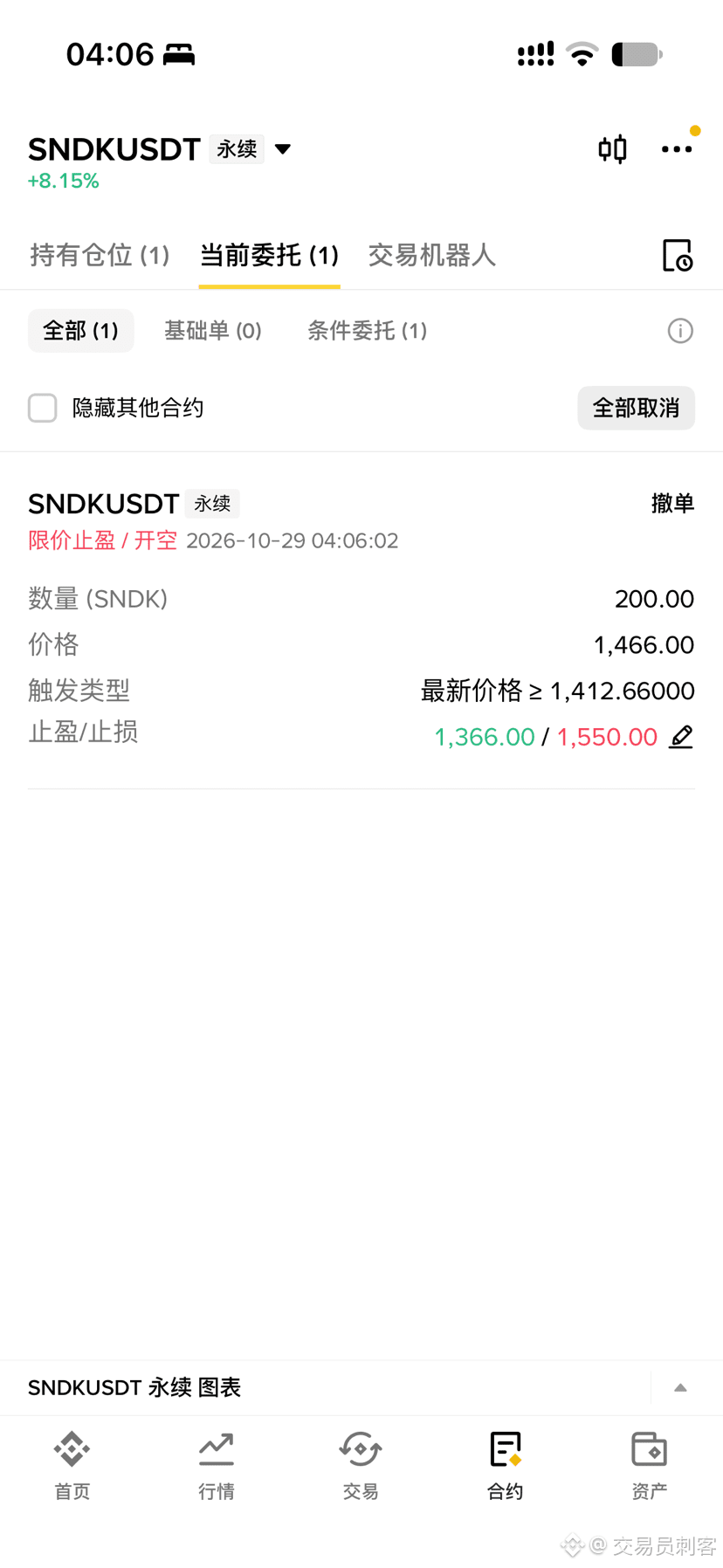
SanDisk has rebounded to 1466, and I’m absolutely going short at this level. The logic is rock-solid—there’s no room for debate.
First, let’s look at the technicals. 1466 is right at the consolidation platform during this downtrend, as well as a high-volume price zone that was broken earlier. The rally from the bottom has run straight into overhead supply, and the moving averages are pressing down hard. At this level, trading volume is clearly failing to keep up with the rebound. Any sign of stalling or a long upper wick would be a textbook case of a rebound hitting resistance, with an excellent risk-reward ratio.
Now for the fundamentals: the storage sector’s weaknesses have been exposed for a while. ChangXin Memory Technologies’ technological breakthroughs in DRAM have triggered fears of intensifying competition across the global memory supply chain. SanDisk makes NAND, but when one part of the sector suffers, the rest can feel the effects too. And SanDisk’s own latest earnings report showed that, despite strong revenue, its guidance for next quarter fell short of expectations. Institutional investors have already voted with their feet. This rally is purely a sentiment-driven bounce after an oversold decline; the fundamentals simply can’t support it.
The macro picture isn’t helping either. The Fed didn’t raise rates last night, but it was a classic “hawkish pause,” with the threat of a December rate hike still hanging over the market. With high interest rates persisting, U.S. tech and hardware stocks are bearing the brunt. Money is flowing out—who’s going to prop up SanDisk at this level?
Here’s exactly how I’d enter the trade. Place a short order around 1466, with a hard stop just above 1520. If the price breaks above 1520 on strong volume and holds there, that means the bearish structure has been invalidated. I’ll admit I’m wrong and get out—no holding and hoping. The first target is 1380, then 1300 if that level breaks. At 1380, close most of the position to lock in profits. For the remainder, every time the price falls 30 points, move the stop down by 20 points.
Keep the position to 10%–15% of your total capital, and don’t use more than 3x leverage. In this market, the money is in betting that the rebound will run out of steam. Stick to the plan and don’t get carried away. $SNDK #SanDisk
6
12
7.6k
·
--
Partly True
The decision finally dropped in the middle of the night. Looking at those bright red words, “Interest rates unchanged,” don’t assume the bad news is over and it’s time to happily buy the dip. Every word in this chart reeks of menace.
A rate cut on the surface, but a hawkish pause in reality.
The 10–2 vote tells the story: Cook and Hammack both voted against it, firmly calling for a 25-basis-point hike. That shows the Fed is already deeply divided, with fears of inflation outweighing the so-called “soft landing.” The statement below laid all its cards on the table, openly acknowledging that “rising energy costs and the AI construction boom” are spreading into broader inflation. What does that mean? It means the burden of high interest rates will keep weighing heavily on risk assets.
The December blade is still hanging overhead.
The most brutal part was the final line of the statement: “The Committee will assess the appropriate stance of monetary policy to ensure inflation returns to 2%.” How did Wall Street interpret it? They haven’t changed their expectations at all—in other words, there’s a very high chance of another hike in December! Powell (or rather, Warsh) and the rest are clearly trying to buy time, but the market will pay for that time in blood.
The impact on BTC price action is very direct:
Don’t blindly go long just because there was “no rate hike.” A “hawkish pause” can often do more damage than an outright hike. Expectations were already sky-high, and BTC is still struggling around the 80,000 level, clinging to the institutional cost basis at 80,200. Below that, 78,700 is a liquidation minefield for longs. If the market pops on tonight’s decision under the pretext of “no hike,” that’s absolutely a bull trap. From 81,200 to 81,700, the area is packed with short liquidations; any move up there could get knocked right back down.
What’s the play?
Absolutely do not chase longs. If the market bounces overnight into resistance and shows rising volume without making progress, or prints a long upper wick, go straight for a short.
Defend and counterattack. If BTC can’t withstand this hawkish pressure and breaks below 80,000 on strong volume, follow the move short and scoop up the longs’ bloodied positions below.
Stop-loss rule.
In this market, it all comes down to who can keep their head. The Fed has made its position clear, and the December rate-hike guillotine is still hanging overhead. Hold onto your cash and wait for it to carve out a deep trough; then we can pick up bargains. Don’t be cannon fodder.$SNDK $BTC #比特币突破8.1万美元
大吉大利!
From 交易员刺客
Fully Claimed
4
12
1.7k
·
--
Verified
SK Hynix’s earnings report was a veritable nuclear bomb that blew expectations out of the water. Just look at the numbers: revenue of 104.62 trillion and operating profit of 83.33 trillion, both record highs. But net profit came in at 39.78 trillion—below analysts’ expectations. The strange thing is, the stock didn’t tank; it surged more than 5% instead.
That’s because the capital markets trade on the future. The report’s biggest ace in the hole: more than half of its capacity for 2027–2028 is already locked in by long-term contracts, and tight memory supply is expected to persist through 2030.
That means Hynix’s money-printing machine is effectively locked in ahead of time, insulated from macroeconomic swings. But the ripple effects of this aren’t good news for us.
Tech giants are pouring money into expanding capacity to secure computing power. Add Meta’s recent $100 billion financing and the $6.3 billion SPV set up by Blackstone and other institutions to buy equipment, and you can see global liquidity being sucked into AI infrastructure at a furious pace. That’s also the key reason BTC is stuck around the $80,000 mark, desperately defending institutions’ $80,200 cost basis: there’s an extreme shortage of cash in the market. As long as hardware costs stay high, inflation won’t come down, and expectations of Fed rate cuts will remain firmly pinned down.
But take a step back, and this is precisely Bitcoin’s strongest endorsement. The giants are borrowing at high interest rates to maintain their tech dominance, spending down the credibility of the entire fiat system. As debt keeps piling up, capital will inevitably flow back into the absolutely scarce Bitcoin.
As for trading, absolutely don’t chase semiconductor-themed coins—their surges can easily lure you into a bull trap. Keep your eyes on Bitcoin’s key levels: $78,700–$79,300 below is a liquidation danger zone for bulls; if it breaks below on heavy volume, follow the move and go short. If it holds sideways above $80,000 on light volume, try a small position. Macro danger zones are everywhere. Cash is king; staying in the game matters most. $SKHY $SKHYNIX #SKHynix
4
8
4.8k
·
--
Verified
I'm Brother Ci.
To see through tonight's drama, it boils down to one thing: the rate decision is already known, but Powell's words are the real weapon. There are no dot plots this time, so markets will price everything based on his choice of words. I've laid out the scenarios and strategies for all three possible outcomes. Just follow the plan.
Scenario 1: No change, Powell strikes a hawkish tone.
This is the most painful outcome. Rates stay unchanged, as expected, but Powell continues to stress inflation risks at the press conference, hinting that December will depend on the data—or even leaving the door open to another hike. That's a hawkish pause.
BTC outlook: It spikes, then reverses, plunging straight through the $80,000 mark to test the liquidation zone below.
Strategy: Go short decisively. Enter when a rebound loses steam, targeting the long liquidation zone around $78,700–$79,300. A high-volume break below $80,000 is a signal to add to shorts. Do not try to buy the dip near $80,000.
Scenario 2: No change, Powell strikes a dovish tone.
If he softens his stance at the press conference, acknowledges downside risks to the economy, and hints that the tightening cycle is effectively over:
BTC outlook: The positive news is priced in, and BTC breaks through overhead resistance, triggering a short squeeze.
Strategy: Buy the dips. Wait for price to retest and hold above $80,000, or go long with a small position if it breaks above $81,200 on high volume. Target the short liquidation zone around $81,700. Take the short-squeeze profits and get out—don't hold on stubbornly.
Scenario 3: Surprise rate hike (extremely unlikely, but we have to be prepared).
If the Fed really goes crazy and raises rates by 25 basis points:
BTC outlook: A total meltdown. It instantly crashes through $80,000, $79,000, or even lower, triggering a cascade of liquidations.
Strategy: Follow the move and go short, or stay out and watch. Absolutely do not try to catch a falling knife. After the liquidation cascade ends, wait until price has been moving sideways near the bottom on declining volume for more than half a day before considering a small position to pick up distressed coins.
My hard-and-fast rules:
The press conference at 2:30 a.m. can be extremely volatile; sharp wicks in either direction can instantly take out your stop-loss. Absolutely do not bet heavily on one direction before the decision is announced. Keep leverage to a minimum and always use a hard stop. The Fed gives us the direction—we don't guess it. Survive tonight, and come back tomorrow morning to pick up the bodies. $BTC #议息会议
4
1
7
2.7k
·
--
🎙️ Live coverage of the interest rate decision announcement, with trade signals shared publicly

End
05 h 25 m 44 s
6.3k

SNDKUSDT
Perp
Position
+263.83
3
0
·
--
🎙️ Live coverage of the interest rate decision announcement, with trade signals shared publicly

End
18 m 16 s
801
3
0
·
--
Verified
Robinhood’s earnings report just exposed the ugly truth about U.S. retail investors. The stock plunged 10% in premarket trading—and it was fully deserved.
On the surface, revenue hit a quarterly record of $1.424 billion, up 12%. But look at the profits and the picture changes: net income fell 14% year over year, and earnings per share came in below expectations. The biggest blow was crypto trading revenue, which plunged 55% year over year to just $120 million.
What does that tell us? Retail traders have basically checked out, and there’s no fresh money flowing into the market. Bitcoin is struggling to hold the $80,000 mark, trading activity is painfully subdued, and these figures tell the story better than anything else.
So how did revenue hold up? Event contracts—prediction markets. Revenue from that segment reached $173 million, 6.4 times what it was a year ago. When one door closes, another opens: retail traders have stopped trading crypto and flocked to betting on elections and sports. But the margins on this new business clearly can’t match crypto, dragging down overall profits.
This matters a lot for our markets. Robinhood is a barometer of retail sentiment worldwide. The plunge in crypto revenue confirms that the market is extremely short on cash, with no new wave of retail traders coming in. Without fresh money, dreaming of Bitcoin taking off on its own is just wishful thinking.
The Fed decision is also looming tonight, so macro risks are extremely high. My strategy is clear: keep a close eye on the $80,000 level. If Bitcoin breaks below it on strong volume, follow the move and go short; if it holds on low volume, cautiously test the waters with a small position. Don’t get carried away. If you’re sitting on profits, take them off the table—cash is king. Let’s get through this cash-starved stretch and wait for retail sentiment to recover.$HOOD
28
23
3.5k
Log in to explore more content
Join global crypto users on Binance Square
⚡️ Get latest and useful information about crypto.
💬 Trusted by the world’s largest crypto exchange.
👍 Discover real insights from verified creators.
Email / Phone number
Trending Topics
$1.5BInLeveragedCryptoBetsLiquidated
5,153 views
73 Discussing
#$1.5BInLeveragedCryptoBetsLiquidated
📉 When crypto prices fell, positions of those betting on a rise with leverage were automatically closed. A total of $1.53 billion in trades was liquidated in 24 hours; about 83.8% of these were “long” positions betting that prices would rise. This figure measures the total value of closed positions, not the cash taken out of investors’ pockets. 💸
⚙️ Leverage is like opening a larger trade with a small amount of money. When the price moves far enough in the opposite direction, the collateral is no longer sufficient and the exchange forcibly closes the position. These sales can accelerate the decline further. The report links the wave of selling to the aftermath of a security breach at Binance
🔄 When prices recovered, some “short” positions betting on a decline were liquidated in turn; buying to close them can fuel the rise.$LSK $IDOL $Q
Sat_Stacker
·0 Likes
·955 views
KOSPIFalls3.53%BackBelow6000
10,119 views
316 Discussing
AmazonSharesFallAbout7%InPremarketTrading
1 views
12 Discussing