

TOXIC BYTE
11.8k Posts

TOXIC BYTE
 Square Verified+
Report
Block User
Crypto believer | Market survivor | Web3 mind | Bull & Bear both welcome |
Open Trade
Frequent Trader
1.1 Years
178 Following
39.0K+ Followers
19.3K+ Liked
Posts
Portfolio
All
Live
·
--
🎙️ 🎉2026 Rampant Bull Market, the Trumpet Has Sounded—Markets Are Right Here on the BSC Chain!! On November 1, Musk will celebrate the birthday of Marvin the Martian dog. This on-chain market move—be sure to catch it!
End
03 h 41 m 53 s
13.1k
20
66
·
--
#CPIWatch
CPI could be one of the biggest market catalysts today.
With the September Fed meeting approaching, the inflation data may influence the next move in Bitcoin, equities, gold, the DXY and Treasury yields.
Expectations are around 0.4% MoM for headline CPI and 0.2% MoM for core CPI.
But I’m not looking at the headline number alone.
The real focus is on Core CPI, Shelter, Services and Energy — especially whether rising oil and gas prices are starting to feed into broader inflation.
A softer-than-expected report could bring down rate expectations, pressure yields lower and improve liquidity conditions, creating a stronger environment for BTC and stocks.
A hotter core reading could do the opposite: higher yields, stronger DXY, fewer expectations for Fed easing and more pressure across risk assets.
For me, the setup is simple:
CPI surprise → Fed expectations → Treasury yields → DXY → Liquidity → BTC & Equities.
Watch the reaction, not just the release.
The first move can be emotional.
The real signal comes after the market has had time to digest the data.
$BTC
#BTC #Inflation #Macro #Markets
#CPIWatch
CPI could be one of the biggest market catalysts today.
With the September Fed meeting approaching, the inflation data may influence the next move in Bitcoin, equities, gold, the DXY and Treasury yields.
Expectations are around 0.4% MoM for headline CPI and 0.2% MoM for core CPI.
But I’m not looking at the headline number alone.
The real focus is on Core CPI, Shelter, Services and Energy — especially whether rising oil and gas prices are starting to feed into broader inflation.
A softer-than-expected report could bring down rate expectations, pressure yields lower and improve liquidity conditions, creating a stronger environment for BTC and stocks.
A hotter core reading could do the opposite: higher yields, stronger DXY, fewer expectations for Fed easing and more pressure across risk assets.
For me, the setup is simple:
CPI surprise → Fed expectations → Treasury yields → DXY → Liquidity → BTC & Equities.
Watch the reaction, not just the release.
The first move can be emotional.
The real signal comes after the market has had time to digest the data.
$BTC
#BTC #Inflation #Macro #Markets
CPI could be one of the biggest market catalysts today.
With the September Fed meeting approaching, the inflation data may influence the next move in Bitcoin, equities, gold, the DXY and Treasury yields.
Expectations are around 0.4% MoM for headline CPI and 0.2% MoM for core CPI.
But I’m not looking at the headline number alone.
The real focus is on Core CPI, Shelter, Services and Energy — especially whether rising oil and gas prices are starting to feed into broader inflation.
A softer-than-expected report could bring down rate expectations, pressure yields lower and improve liquidity conditions, creating a stronger environment for BTC and stocks.
A hotter core reading could do the opposite: higher yields, stronger DXY, fewer expectations for Fed easing and more pressure across risk assets.
For me, the setup is simple:
CPI surprise → Fed expectations → Treasury yields → DXY → Liquidity → BTC & Equities.
Watch the reaction, not just the release.
The first move can be emotional.
The real signal comes after the market has had time to digest the data.
$BTC
#BTC #Inflation #Macro #Markets

17
10
261


·
--
Bullish
$SOL
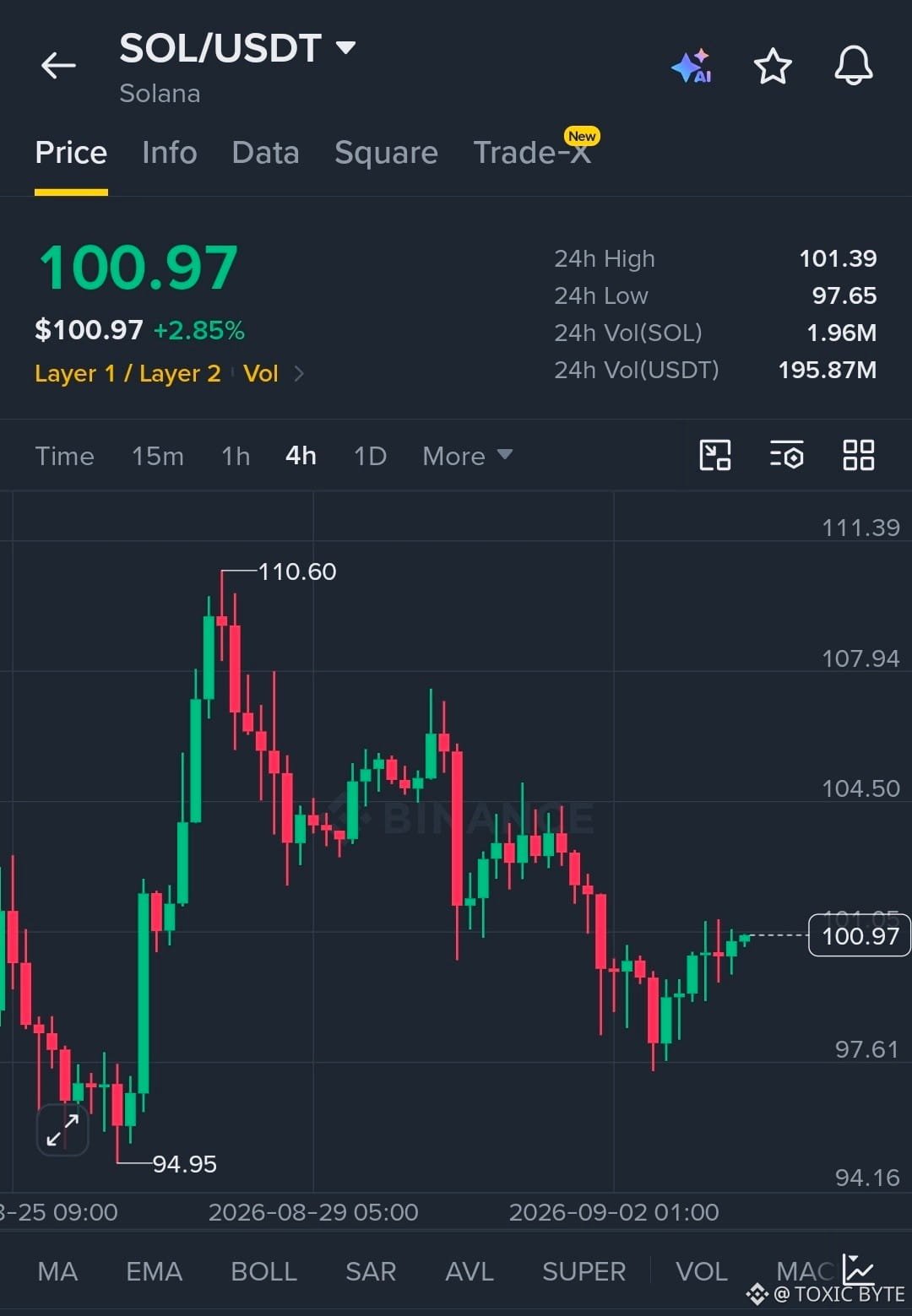
SOL is showing a strong recovery from 97.65 and is now pressing the 101.40 resistance zone. A clean breakout can accelerate the move toward 104.50 and beyond. Buyers have the momentum, but 99.00 is the key support to protect.
Trade Setup — LONG
EP: 100.70–101.20
TP1: 102.80
TP2: 104.50
TP3: 107.00
SL: 98.80
Key level: 101.40
Break & hold above = bullish continuation.
Below 98.80 = setup invalidated.
Let's go.
#CFTCSeeksToDismissCMEMotionInPerpFutures
#US10YearTreasuryYieldHitsHighestSinceNov2023
{spot}(SOLUSDT)
$SOL
SOL is showing a strong recovery from 97.65 and is now pressing the 101.40 resistance zone. A clean breakout can accelerate the move toward 104.50 and beyond. Buyers have the momentum, but 99.00 is the key support to protect.
Trade Setup — LONG
EP: 100.70–101.20
TP1: 102.80
TP2: 104.50
TP3: 107.00
SL: 98.80
Key level: 101.40
Break & hold above = bullish continuation.
Below 98.80 = setup invalidated.
Let's go.
#CFTCSeeksToDismissCMEMotionInPerpFutures
#US10YearTreasuryYieldHitsHighestSinceNov2023
SOL is showing a strong recovery from 97.65 and is now pressing the 101.40 resistance zone. A clean breakout can accelerate the move toward 104.50 and beyond. Buyers have the momentum, but 99.00 is the key support to protect.
Trade Setup — LONG
EP: 100.70–101.20
TP1: 102.80
TP2: 104.50
TP3: 107.00
SL: 98.80
Key level: 101.40
Break & hold above = bullish continuation.
Below 98.80 = setup invalidated.
Let's go.
#CFTCSeeksToDismissCMEMotionInPerpFutures
#US10YearTreasuryYieldHitsHighestSinceNov2023
108
·
--
Bullish
$ETH
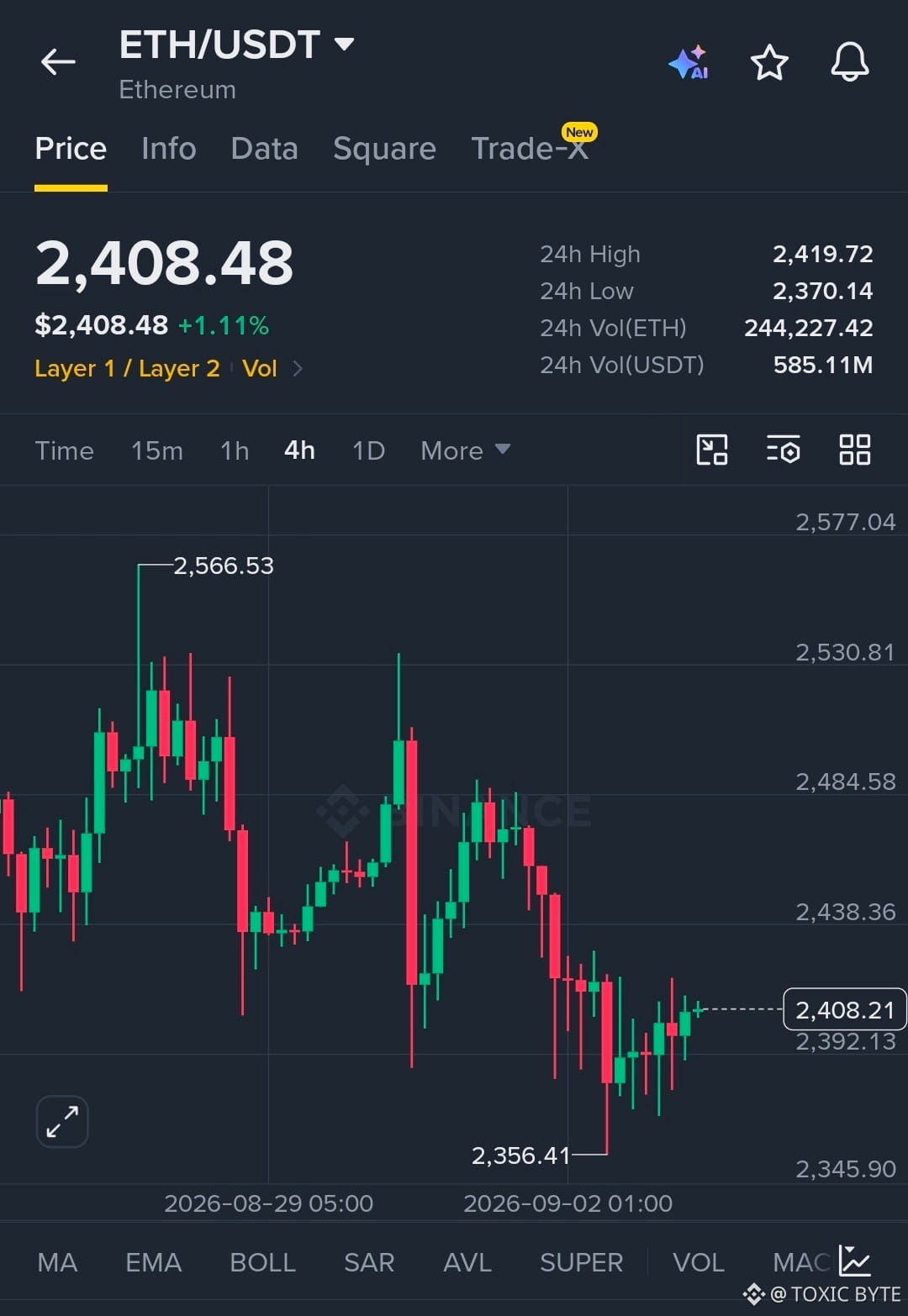
ETH is holding the 2,400 zone after bouncing hard from 2,356.41. Buyers are trying to build momentum, but 2,438 is the key resistance to break. A clean move above it could open the path toward 2,484.
Trade Setup — LONG
EP: 2,405–2,420
TP1: 2,438
TP2: 2,480
TP3: 2,520
SL: 2,375
Key level: 2,438
Above it = bullish continuation.
Below 2,375 = setup invalidated.
Let's go.
#SolanaFallsOver3%
#EtherXRPETFInflowStreaksEnd
#PredictionMarketsPutCLARITYAct2026OddsAt15%
#IranStrikesUSBaseInKuwait
#USGainsControlOfVenezuelanOilFields
{spot}(ETHUSDT)
$ETH
ETH is holding the 2,400 zone after bouncing hard from 2,356.41. Buyers are trying to build momentum, but 2,438 is the key resistance to break. A clean move above it could open the path toward 2,484.
Trade Setup — LONG
EP: 2,405–2,420
TP1: 2,438
TP2: 2,480
TP3: 2,520
SL: 2,375
Key level: 2,438
Above it = bullish continuation.
Below 2,375 = setup invalidated.
Let's go.
#SolanaFallsOver3%
#EtherXRPETFInflowStreaksEnd
#PredictionMarketsPutCLARITYAct2026OddsAt15%
#IranStrikesUSBaseInKuwait
#USGainsControlOfVenezuelanOilFields
ETH is holding the 2,400 zone after bouncing hard from 2,356.41. Buyers are trying to build momentum, but 2,438 is the key resistance to break. A clean move above it could open the path toward 2,484.
Trade Setup — LONG
EP: 2,405–2,420
TP1: 2,438
TP2: 2,480
TP3: 2,520
SL: 2,375
Key level: 2,438
Above it = bullish continuation.
Below 2,375 = setup invalidated.
Let's go.
#SolanaFallsOver3%
#EtherXRPETFInflowStreaksEnd
#PredictionMarketsPutCLARITYAct2026OddsAt15%
#IranStrikesUSBaseInKuwait
#USGainsControlOfVenezuelanOilFields
97
·
--
Bullish
$BTC — BREAKOUT WATCH
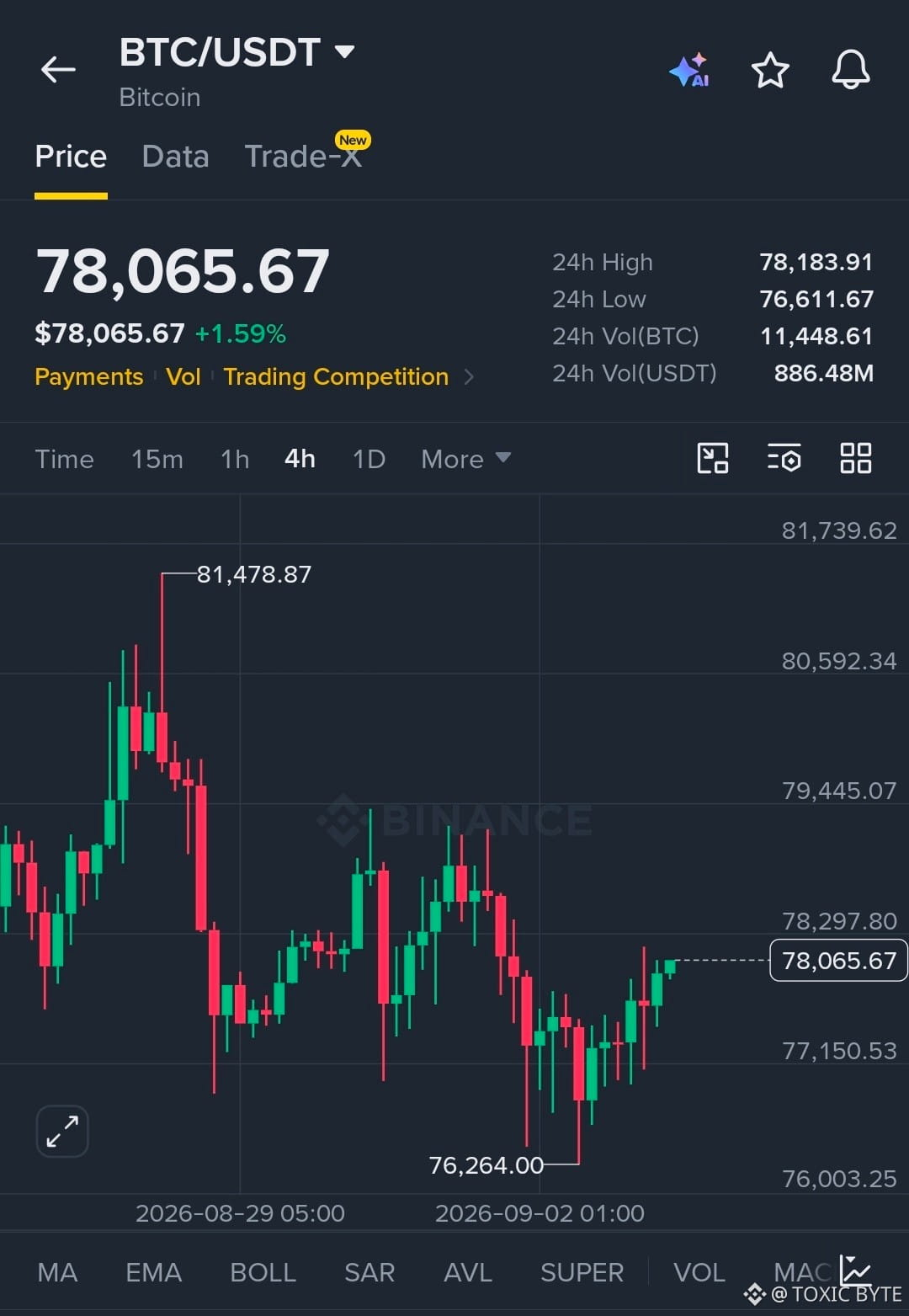
BTC is recovering strongly from $76,264 and pushing toward the $78,300 resistance. A clean break could trigger the next move higher.
EP: 78,050–78,250
TP: 78,800 / 79,400
SL: 77,450
Let’s go. Wait for confirmation and manage risk.
#CFTCSeeksToDismissCMEMotionInPerpFutures
#OilSteadiesAfterThreeDayRally
{spot}(BTCUSDT)
$BTC — BREAKOUT WATCH
BTC is recovering strongly from $76,264 and pushing toward the $78,300 resistance. A clean break could trigger the next move higher.
EP: 78,050–78,250
TP: 78,800 / 79,400
SL: 77,450
Let’s go. Wait for confirmation and manage risk.
#CFTCSeeksToDismissCMEMotionInPerpFutures
#OilSteadiesAfterThreeDayRally
BTC is recovering strongly from $76,264 and pushing toward the $78,300 resistance. A clean break could trigger the next move higher.
EP: 78,050–78,250
TP: 78,800 / 79,400
SL: 77,450
Let’s go. Wait for confirmation and manage risk.
#CFTCSeeksToDismissCMEMotionInPerpFutures
#OilSteadiesAfterThreeDayRally
103
·
--
Bullish
$BNB — BREAKOUT SETUP
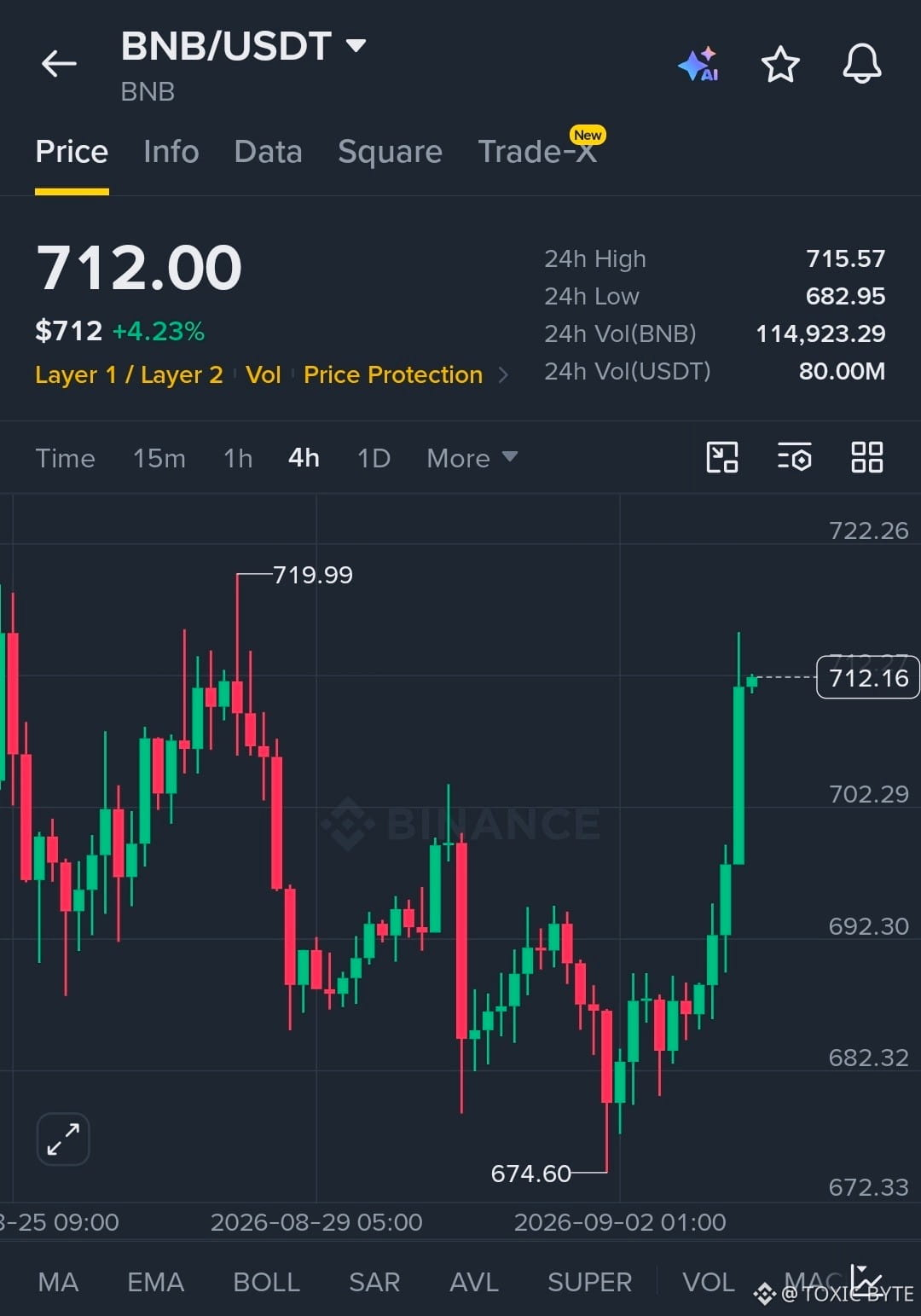
BNB is pushing hard toward the 715–720 resistance zone. A clean breakout could open the way higher.
EP: 712–714
TP: 719.5 / 725
SL: 707
Let’s go. Keep risk controlled and wait for confirmation.
#EtherXRPETFInflowStreaksEnd
#US10YearTreasuryYieldHitsHighestSinceNov2023
{spot}(BNBUSDT)
$BNB — BREAKOUT SETUP
BNB is pushing hard toward the 715–720 resistance zone. A clean breakout could open the way higher.
EP: 712–714
TP: 719.5 / 725
SL: 707
Let’s go. Keep risk controlled and wait for confirmation.
#EtherXRPETFInflowStreaksEnd
#US10YearTreasuryYieldHitsHighestSinceNov2023
BNB is pushing hard toward the 715–720 resistance zone. A clean breakout could open the way higher.
EP: 712–714
TP: 719.5 / 725
SL: 707
Let’s go. Keep risk controlled and wait for confirmation.
#EtherXRPETFInflowStreaksEnd
#US10YearTreasuryYieldHitsHighestSinceNov2023
99
·
--
Bullish
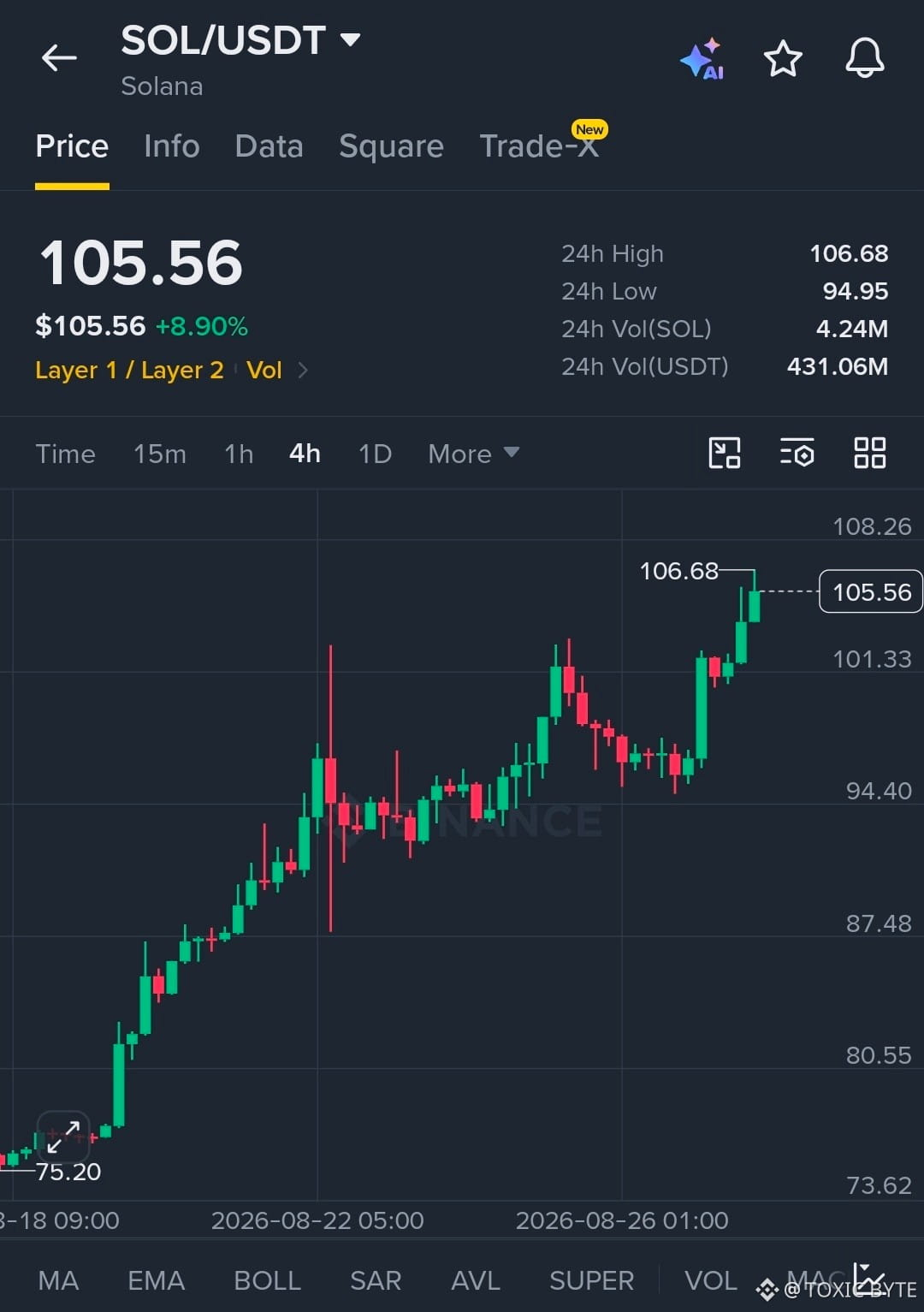
$SOL is showing strong momentum on the 4H chart, holding above the 101–103 zone and pushing toward the 106.68 resistance. A clean breakout and hold above 106.68 could open the way for the next move.
Trade Setup
EP: 104.80–105.80 TP1: 108.00 TP2: 110.00 SL: 102.20
Let’s go
#NvidiaRises4%OnRevenueBeat
#DollarPostsBiggestGainInNearlyFourWeeks
$SOL is showing strong momentum on the 4H chart, holding above the 101–103 zone and pushing toward the 106.68 resistance. A clean breakout and hold above 106.68 could open the way for the next move.
Trade Setup
EP: 104.80–105.80 TP1: 108.00 TP2: 110.00 SL: 102.20
Let’s go
#NvidiaRises4%OnRevenueBeat
#DollarPostsBiggestGainInNearlyFourWeeks
Trade Setup
EP: 104.80–105.80 TP1: 108.00 TP2: 110.00 SL: 102.20
Let’s go
#NvidiaRises4%OnRevenueBeat
#DollarPostsBiggestGainInNearlyFourWeeks
143
·
--
Bullish
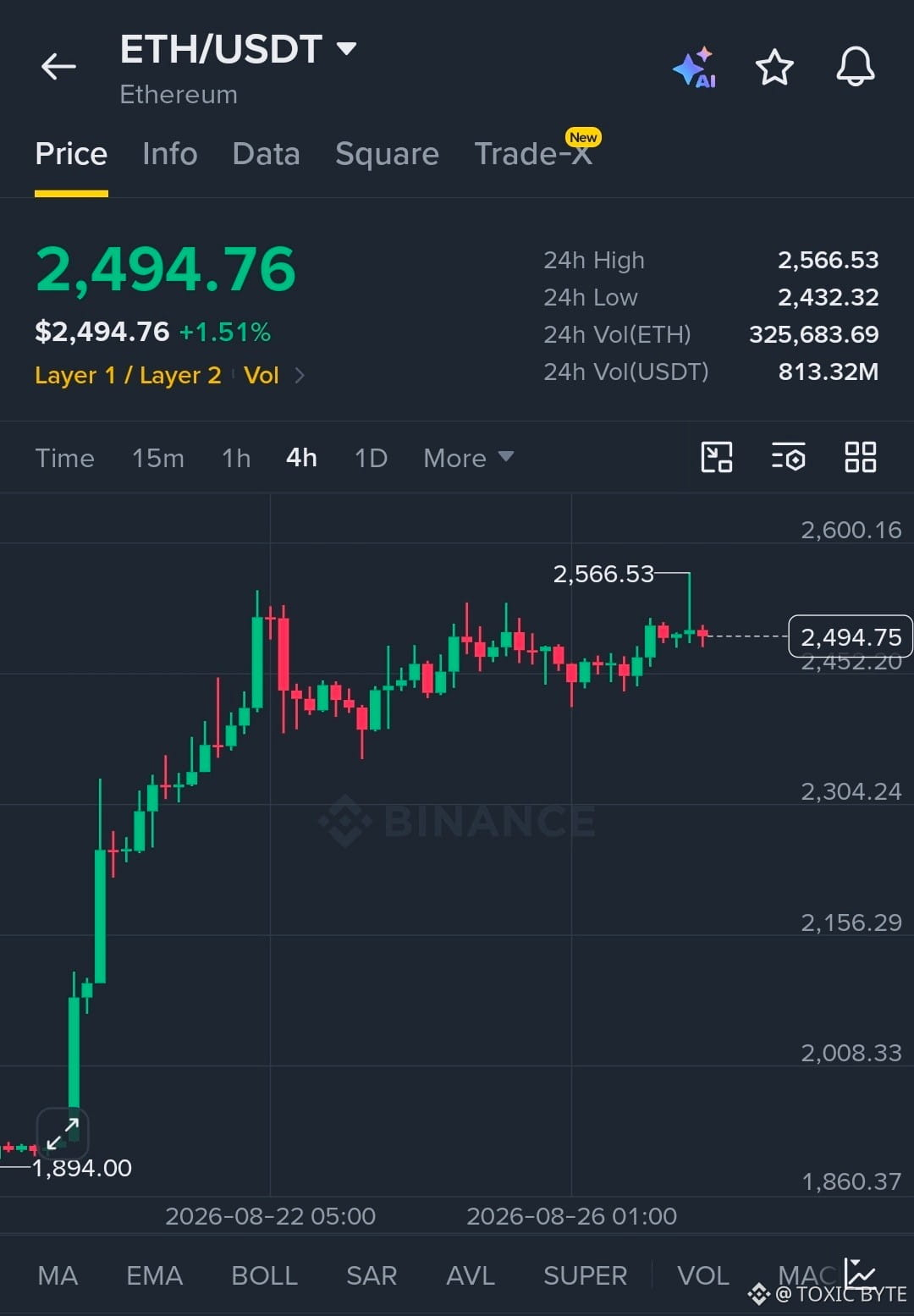
$ETH is holding around $2,495 on the 4H chart, but the real battle is near $2,566 resistance.
The structure remains bullish after the move from $1,894, with price consolidating above the $2,450 area. A clean 4H breakout above $2,566 could trigger the next expansion toward $2,650 and $2,750.
If $2,450 breaks decisively, momentum can weaken and a deeper pullback becomes likely.
The setup is simple: defend $2,450, break $2,566, and ETH can accelerate.
Trade Setup
EP: $2,470–$2,510 TP1: $2,566 TP2: $2,650 TP3: $2,750 SL: $2,415
Wait for confirmation around resistance rather than chasing a breakout.
#BestBuyQ2RevenueTopsEstimatesLiftsOutlook
#ChinaOpposesUSProposed7.5%Tariff
$ETH is holding around $2,495 on the 4H chart, but the real battle is near $2,566 resistance.
The structure remains bullish after the move from $1,894, with price consolidating above the $2,450 area. A clean 4H breakout above $2,566 could trigger the next expansion toward $2,650 and $2,750.
If $2,450 breaks decisively, momentum can weaken and a deeper pullback becomes likely.
The setup is simple: defend $2,450, break $2,566, and ETH can accelerate.
Trade Setup
EP: $2,470–$2,510 TP1: $2,566 TP2: $2,650 TP3: $2,750 SL: $2,415
Wait for confirmation around resistance rather than chasing a breakout.
#BestBuyQ2RevenueTopsEstimatesLiftsOutlook
#ChinaOpposesUSProposed7.5%Tariff
The structure remains bullish after the move from $1,894, with price consolidating above the $2,450 area. A clean 4H breakout above $2,566 could trigger the next expansion toward $2,650 and $2,750.
If $2,450 breaks decisively, momentum can weaken and a deeper pullback becomes likely.
The setup is simple: defend $2,450, break $2,566, and ETH can accelerate.
Trade Setup
EP: $2,470–$2,510 TP1: $2,566 TP2: $2,650 TP3: $2,750 SL: $2,415
Wait for confirmation around resistance rather than chasing a breakout.
#BestBuyQ2RevenueTopsEstimatesLiftsOutlook
#ChinaOpposesUSProposed7.5%Tariff
98
·
--
Bullish
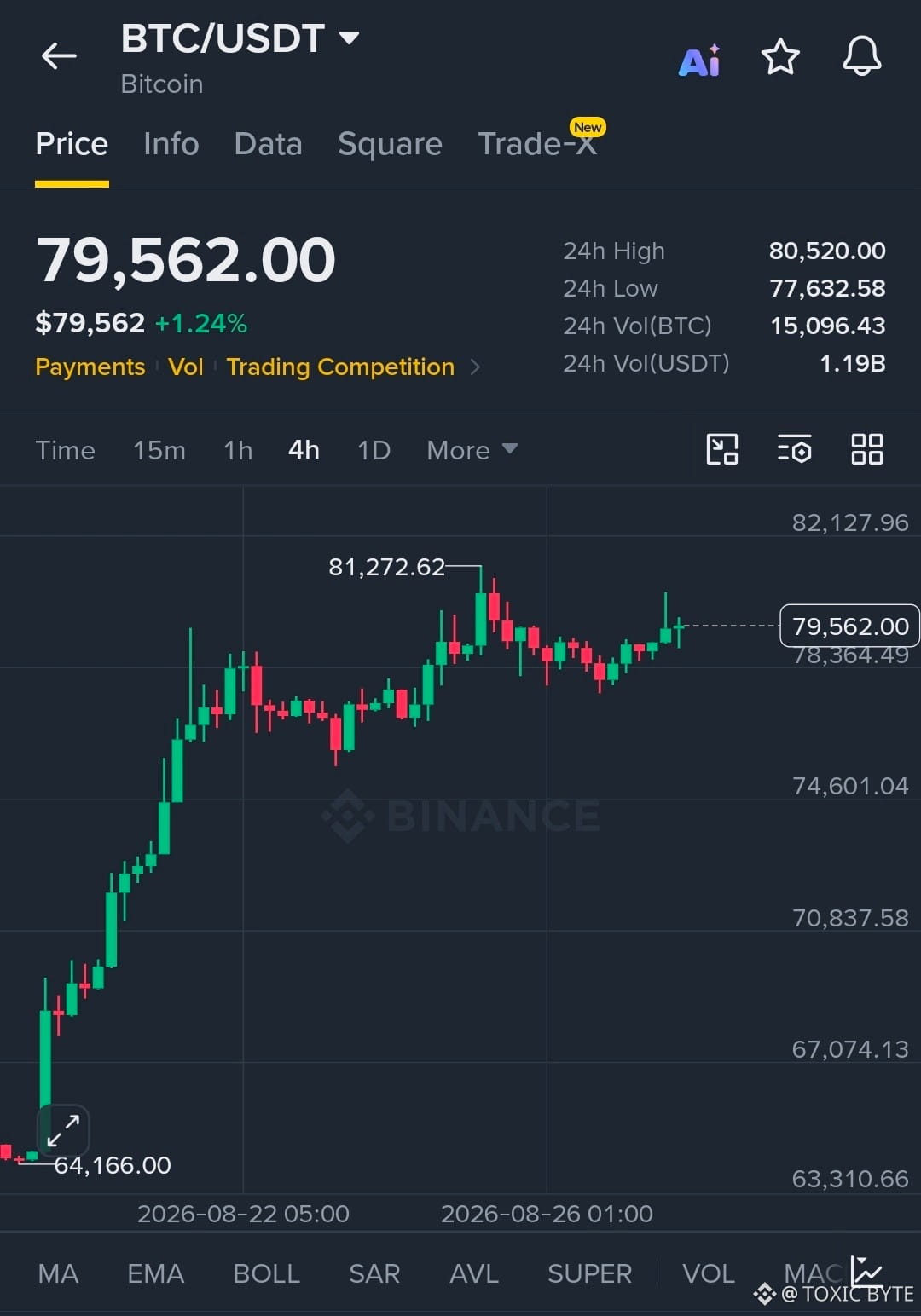
$BTC is holding strong around $79,562 on the 4H chart after a powerful move from the $64K zone.
Price is consolidating above $78,364 support while momentum remains bullish. The key breakout level is $80,520, with the previous swing high near $81,272 acting as major resistance.
A clean 4H breakout above $80,520 could open the door toward $81,272+.
The setup remains bullish as long as BTC holds the $78,300 area. Lose that level, and the bullish structure starts weakening.
The next move is simple: reclaim the highs or defend support.
#DollarPostsBiggestGainInNearlyFourWeeks
#NvidiaRises4%OnRevenueBeat
$BTC is holding strong around $79,562 on the 4H chart after a powerful move from the $64K zone.
Price is consolidating above $78,364 support while momentum remains bullish. The key breakout level is $80,520, with the previous swing high near $81,272 acting as major resistance.
A clean 4H breakout above $80,520 could open the door toward $81,272+.
The setup remains bullish as long as BTC holds the $78,300 area. Lose that level, and the bullish structure starts weakening.
The next move is simple: reclaim the highs or defend support.
#DollarPostsBiggestGainInNearlyFourWeeks
#NvidiaRises4%OnRevenueBeat
Price is consolidating above $78,364 support while momentum remains bullish. The key breakout level is $80,520, with the previous swing high near $81,272 acting as major resistance.
A clean 4H breakout above $80,520 could open the door toward $81,272+.
The setup remains bullish as long as BTC holds the $78,300 area. Lose that level, and the bullish structure starts weakening.
The next move is simple: reclaim the highs or defend support.
#DollarPostsBiggestGainInNearlyFourWeeks
#NvidiaRises4%OnRevenueBeat
108
·
--
Bullish
$BNB is holding strong around $708 after a solid recovery. Bulls are pressing toward the $716 resistance, and a breakout could open the path to $726.
Trade Setup EP: $704–709 TP1: $716 TP2: $726 SL: $694
Bullish above $704. Let’s go.
#ChinaOpposesUSProposed7.5%Tariff
#DollarPostsBiggestGainInNearlyFourWeeks
$BNB is holding strong around $708 after a solid recovery. Bulls are pressing toward the $716 resistance, and a breakout could open the path to $726.
Trade Setup EP: $704–709 TP1: $716 TP2: $726 SL: $694
Bullish above $704. Let’s go.
#ChinaOpposesUSProposed7.5%Tariff
#DollarPostsBiggestGainInNearlyFourWeeks
Trade Setup EP: $704–709 TP1: $716 TP2: $726 SL: $694
Bullish above $704. Let’s go.
#ChinaOpposesUSProposed7.5%Tariff
#DollarPostsBiggestGainInNearlyFourWeeks
113
·
--
$PORTAL
{spot}(PORTALUSDT)
is moving with +15.81% gains. Momentum traders are watching closely as price approaches the next breakout zone.
EP: 0.01690–0.01720
TP: 0.01850 / 0.02000 / 0.02200
SL: 0.01600
$PORTAL
is moving with +15.81% gains. Momentum traders are watching closely as price approaches the next breakout zone.
EP: 0.01690–0.01720
TP: 0.01850 / 0.02000 / 0.02200
SL: 0.01600
is moving with +15.81% gains. Momentum traders are watching closely as price approaches the next breakout zone.
EP: 0.01690–0.01720
TP: 0.01850 / 0.02000 / 0.02200
SL: 0.01600
128
·
--
Bullish
$LSK
{spot}(LSKUSDT)
is up +16.34% and showing strong bullish momentum. If buyers defend the current zone, another leg higher could follow.
EP: 0.10050–0.10200
TP: 0.10800 / 0.11500 / 0.12200
SL: 0.09600
$LSK
is up +16.34% and showing strong bullish momentum. If buyers defend the current zone, another leg higher could follow.
EP: 0.10050–0.10200
TP: 0.10800 / 0.11500 / 0.12200
SL: 0.09600
is up +16.34% and showing strong bullish momentum. If buyers defend the current zone, another leg higher could follow.
EP: 0.10050–0.10200
TP: 0.10800 / 0.11500 / 0.12200
SL: 0.09600
96
·
--
Bullish
$EDEN
{spot}(EDENUSDT)
is gaining +17.67% and buyers are stepping in aggressively. Watch the 0.057 area for continuation.
EP: 0.05680–0.05750
TP: 0.06100 / 0.06500 / 0.07000
SL: 0.05400
$EDEN
is gaining +17.67% and buyers are stepping in aggressively. Watch the 0.057 area for continuation.
EP: 0.05680–0.05750
TP: 0.06100 / 0.06500 / 0.07000
SL: 0.05400
is gaining +17.67% and buyers are stepping in aggressively. Watch the 0.057 area for continuation.
EP: 0.05680–0.05750
TP: 0.06100 / 0.06500 / 0.07000
SL: 0.05400
102
·
--
Bullish
$BICO
{spot}(BICOUSDT)
is pushing hard with +26.31% and momentum is building fast. A breakout continuation could send price toward the next resistance zones.
EP: 0.02380–0.02440
TP: 0.02600 / 0.02800 / 0.03050
SL: 0.02260
$BICO
is pushing hard with +26.31% and momentum is building fast. A breakout continuation could send price toward the next resistance zones.
EP: 0.02380–0.02440
TP: 0.02600 / 0.02800 / 0.03050
SL: 0.02260
is pushing hard with +26.31% and momentum is building fast. A breakout continuation could send price toward the next resistance zones.
EP: 0.02380–0.02440
TP: 0.02600 / 0.02800 / 0.03050
SL: 0.02260
82
·
--
$ONG
{spot}(ONGUSDT)
is showing strong momentum with +42.96%. Bulls are clearly active, but avoid chasing the candle. A retest could offer the cleaner setup.
EP: 0.14700–0.15000
TP: 0.16000 / 0.17000 / 0.18500
SL: 0.14000
$ONG
is showing strong momentum with +42.96%. Bulls are clearly active, but avoid chasing the candle. A retest could offer the cleaner setup.
EP: 0.14700–0.15000
TP: 0.16000 / 0.17000 / 0.18500
SL: 0.14000
is showing strong momentum with +42.96%. Bulls are clearly active, but avoid chasing the candle. A retest could offer the cleaner setup.
EP: 0.14700–0.15000
TP: 0.16000 / 0.17000 / 0.18500
SL: 0.14000
249
·
--
$BMT
{spot}(BMTUSDT)
is exploding with +60.23% gains and momentum is clearly aggressive. After this move, watch for a controlled pullback before entry.
EP: 0.02450–0.02500
TP: 0.02750 / 0.03000 / 0.03300
SL: 0.02280
$BMT
is exploding with +60.23% gains and momentum is clearly aggressive. After this move, watch for a controlled pullback before entry.
EP: 0.02450–0.02500
TP: 0.02750 / 0.03000 / 0.03300
SL: 0.02280
is exploding with +60.23% gains and momentum is clearly aggressive. After this move, watch for a controlled pullback before entry.
EP: 0.02450–0.02500
TP: 0.02750 / 0.03000 / 0.03300
SL: 0.02280
143
·
--
$ADA
{spot}(ADAUSDT)
is trading near $0.2253 with sellers currently in control.
Trade Setup
EP: $0.223–0.226
TP: $0.232 / $0.240
SL: $0.217
A reclaim of $0.23 would strengthen the bullish setup.
$ADA
is trading near $0.2253 with sellers currently in control.
Trade Setup
EP: $0.223–0.226
TP: $0.232 / $0.240
SL: $0.217
A reclaim of $0.23 would strengthen the bullish setup.
is trading near $0.2253 with sellers currently in control.
Trade Setup
EP: $0.223–0.226
TP: $0.232 / $0.240
SL: $0.217
A reclaim of $0.23 would strengthen the bullish setup.
2
63
·
--
$SUI
{spot}(SUIUSDT)
is sitting around $0.8226 after a decline.
Trade Setup
EP: $0.815–0.825
TP: $0.850 / $0.880
SL: $0.790
Need a strong reclaim above $0.83 for confirmation.
$SUI
is sitting around $0.8226 after a decline.
Trade Setup
EP: $0.815–0.825
TP: $0.850 / $0.880
SL: $0.790
Need a strong reclaim above $0.83 for confirmation.
is sitting around $0.8226 after a decline.
Trade Setup
EP: $0.815–0.825
TP: $0.850 / $0.880
SL: $0.790
Need a strong reclaim above $0.83 for confirmation.
1
91
Log in to explore more content
Join global crypto users on Binance Square
⚡️ Get latest and useful information about crypto.
💬 Trusted by the world’s largest crypto exchange.
👍 Discover real insights from verified creators.
Email / Phone number
Trending Topics
ZcashETFPostsFirstWeeklyOutflow$93.6M
20,272 views
62 Discussing
#ZcashETFPostsFirstWeeklyOutflow$93.6M 📊 Grayscale’s Spot Zcash (ZEC) ETF Records $93.6M in Weekly Outflows
Institutional capital flows are showing a new dynamic. Grayscale’s spot Zcash ETF has just posted its first major weekly net outflow, marking a notable shift from its strong initial launch momentum.
🔹The Numbers Grayscale’s spot ZEC ETF (ticker: ZCSH) recorded approximately $93.6 million in net outflows over the past week, with notable withdrawals occurring at the end of September and early October.
🔹 The Context This follows a robust initial period. After converting from the Grayscale Zcash Trust and listing on NYSE Arca in late August, the fund previously saw cumulative net inflows reach $271 million by mid-September.
💡 Market Impact Analysis
•Short-Term Dynamics Large ETF outflows can introduce temporary selling pressure on the underlying asset as the fund adjusts its holdings to meet redemption requests.
• Sentiment & Rebalancing This pullback may reflect routine profit-taking or portfolio rebalancing by early institutional investors, rather than a fundamental change in Zcash’s long-term utility or privacy-focused value proposition.
• Ecosystem Watch Market participants will be monitoring whether this is an isolated event for ZCSH or indicative of a broader cooling in institutional appetite for privacy-centric digital assets.
💬 What’s your take? Do you view this weekly outflow as a healthy market correction after a strong launch, or a signal of changing institutional sentiment toward privacy coins? Share your thoughts in the comments below!
#Zcash #ZEC #CryptoETF #InstitutionalCrypto #MarketUpdate
This is for educational purposes only. Not Financial Advice (NFA). Always Do Your Own Research (DYOR).
$GLMR $QI $ONE
piknkkk
·0 Likes
·37 views
GreekPoliceBustCryptoScamRingArrest17
28,198 views
333 Discussing
BitcoinRejectedAt$87K
96,782 views
123 Discussing