
Tomas RADA
247 Posts

Tomas RADA
Report
Block User
#Binance Angel Program | Volunteer | Binance Lover 💛 | Community builder | Web3 *NFA
https://x.com/tomasradacrypto
Frequent Trader
5.7 Years
46 Following
40 Followers
59 Liked
Posts
·
--
Ethereum is testing support levels that have held since the transition to proof of stake. The immediate risk is a lack of new capital after the spot $ETH ETF launch failed to sustain the premium. If these levels break, the next structural floor sits near 1,000 dollars, leaving long positions exposed to significant liquidation risk. The gap between current prices and that four-figure psychological level is mostly air, meaning volatility can spike if sellers take control.
My read: I think the market is currently repricing the utility of the network against the high cost of mainnet transactions while Layer 2s capture the actual volume.
Are you holding your spot positions through this volatility or moving to stables until the floor is confirmed?
#CryptoNews #EvolveAtBinanceBlockchainWeek
8
·
--
Nvidia's board unanimously voted to reinstate Jensen Huang as CEO immediately, sending shares up 29.86% to $163 premarket and reversing Friday's 14% drop. At the same time, $BTC gained 5% on the return after dropping 3.5% on his exit, though it remains 19.2% below its pre-resignation price. The board also formed a committee to investigate an alleged foreign intelligence operation targeting Huang, while lawmakers from both parties demand details on White House security assurances.
My read: markets care less about governance drama when macro liquidity reacts this fast to a single seat. Are you trading tech headlines with your crypto stack or keeping them separate?
#NVIDIAReinstatesJensenHuangasCEO
My read: markets care less about governance drama when macro liquidity reacts this fast to a single seat. Are you trading tech headlines with your crypto stack or keeping them separate?
#NVIDIAReinstatesJensenHuangasCEO
·
--
Arthur Hayes identifies a 50,000 floor for $BTC if the Nasdaq continues its current slide. The consequence for holders is that the decoupling narrative remains a myth during periods of high macro volatility. When tech stocks sell off, the same institutional desks often liquidate crypto positions to meet margin calls or reduce overall risk exposure. This leaves the spot holder carrying the risk for a macro shift they did not trigger. My read is that as long as the same large institutions trade both asset classes, crypto will remain a high beta version of the stock market rather than a true safe haven. Did you buy this dip because you trust the long term math or are you waiting for the Nasdaq to find its bottom first?
#CryptoNews #NVIDIAReinstatesJensenHuangasCEO
#CryptoNews #NVIDIAReinstatesJensenHuangasCEO
41
·
--
The joint venture between OKX and the owner of the New York Stock Exchange, ICE, launched its tokenized stock venue this Monday. Trading began at 12 p.m. Eastern time with 113 confirmed assets including stocks and ETFs. The platform uses $ETH layer-2 technology via X Layer and Uniswap v4 pools to allow 24/7 trading for verified US users.
While Fidelity and eToro joined the lineup, 67 companies like Apple and JPMorgan Chase filed formal objections to keep their shares off the platform. These firms used a 30-day notice period under the SEC innovation exemption to opt out. My read: the friction here isn't just about tech, but about control. Issuers are terrified of losing oversight of their shares to an automated market maker they don't manage.
The venue plans to roll out the remaining 107 assets in stages, including 59 ETFs from Direxion. Each token is backed one-to-one with an underlying share and carries dividend rights.
Full piece: https://app.binance.com/uni-qr/cart/391676075353148?r=KU1Z4N85&l=en-TR

82
·
--
Article
Institutional Friction: The Launch of OKX-ICE Tokenized StocksThe joint venture between crypto exchange OKX and Intercontinental Exchange, the owner of the New York Stock Exchange, began trading tokenized securities at 12 p.m. Eastern time on Monday. This new marketplace, known as OKXICE, launched with a commitment to list 113 assets on a rolling basis, though the rollout has been marked by significant friction with the very companies whose shares are being traded. The platform operates under a specific five year trial period granted by the Securities and Exchange Commission called the innovation exemption. This allows the venue to test blockchain based stock trading without the standard requirements of a traditional exchange, provided certain conditions are met [1].
The launch represents a rare bridge between the infrastructure of the legacy financial world and the decentralized mechanics of crypto. While Intercontinental Exchange provides the institutional backing, the technical heavy lifting happens on X Layer, which is an Ethereum layer-2 network developed by OKX. The trading itself does not happen on a traditional order book. Instead, it uses automated market maker pools on Uniswap v4. Every token on the platform is designed to represent a security entitlement that is backed one to one by an underlying share. These tokens are intended to carry the same economic benefits as the physical stocks, including rights to dividends and participation in corporate voting where applicable [3].
THE REGULATORY SANDBOX
The SEC innovation exemption is the legal foundation for this venture. It is a temporary window that allows eligible platforms to experiment with onchain trading. Under this framework, OKXICE is not the only player in the field. It follows a firm called TSV LLC, which is based in Canton and began trading tokenized shares earlier this month. Other competitors are also preparing to enter the space, including Formation Securities on the Solana blockchain and Fairmint, which plans to launch on the Canton network before moving to Ethereum [1].
For investors to access these tokenized stocks, the requirements are strict. The venue is limited to eligible United States customers of OKX Inc. who must complete a full identity verification process. These users are required to activate a self-custodial wallet and finish an onboarding sequence before they can trade through the OKX mobile application. To ensure compliance, smart contracts are used to restrict liquidity provision and trading to only those wallets that have been verified and cleared for the platform [3].
CORPORATE RESISTANCE
Despite the institutional pedigree of the Intercontinental Exchange, the majority of the companies initially tapped for the platform declined to participate. Out of 62 companies originally selected for inclusion, 56 of them, or roughly 90 percent, filed formal objections. This list of holdouts included some of the largest names in the global economy, such as Apple, Microsoft, Nvidia, and JPMorgan Chase [1]. By the time the platform went live on Monday, the total number of objecting companies had risen to 67. Other notable firms that sought to keep their shares off the venue included Meta, Tesla, Netflix, McDonald’s, SpaceX, and Coca-Cola [2][3].
The mechanism for these objections is built into the SEC innovation exemption rules. Issuers are given a 30 day notice period during which they can object to having their shares tokenized by an unaffiliated third party. Andrew Cuomo, the former Governor of New York who now serves as the co-chair of OKXICE, addressed these objections during a press briefing on Monday. He suggested that the 30 day deadline was simply too short for many corporate legal teams and boards of directors to fully grasp the technology. According to Cuomo, many companies chose to say no because it was the safest immediate path, even if they expressed interest in learning more about the platform for future participation [2].
COMPETITIVE DYNAMICS
Cuomo also leveled accusations at other financial institutions, claiming that competitors encouraged companies to opt out of the OKXICE launch. He argued that rival trading platforms wanted issuers to wait until their own proprietary systems were ready for market. While Cuomo did not provide specific evidence or name the competitors involved, several major firms are known to be developing their own tokenized stock services. This list includes Nasdaq, Kraken, Robinhood, Coinbase, and Ondo Finance [2].
The tension highlights a fundamental shift in how stocks are handled. In a traditional setting, a company has a high degree of control over where its shares are listed and traded. In the crypto environment, especially under the innovation exemption, third parties can facilitate trading of those same shares as long as they provide the one to one backing. This has created a divide between issuers who view tokenization as a risk to their brand or share price stability and those who see it as a necessary evolution of market liquidity.
THE CONFIRMED LINEUP
While many blue chip tech stocks opted out, OKXICE managed to secure participation from several high profile asset managers and digital firms. Fidelity Investments, eToro, and Strive joined the venue to bring their own products and securities to the onchain market. The initial rollout focused on six specific securities: Coinbase, Circle Internet, Robinhood Markets, Strategy, BitGo, and Securitize. The latter, Securitize, is also the firm providing the underlying tokenization infrastructure for the entire platform [1][2].
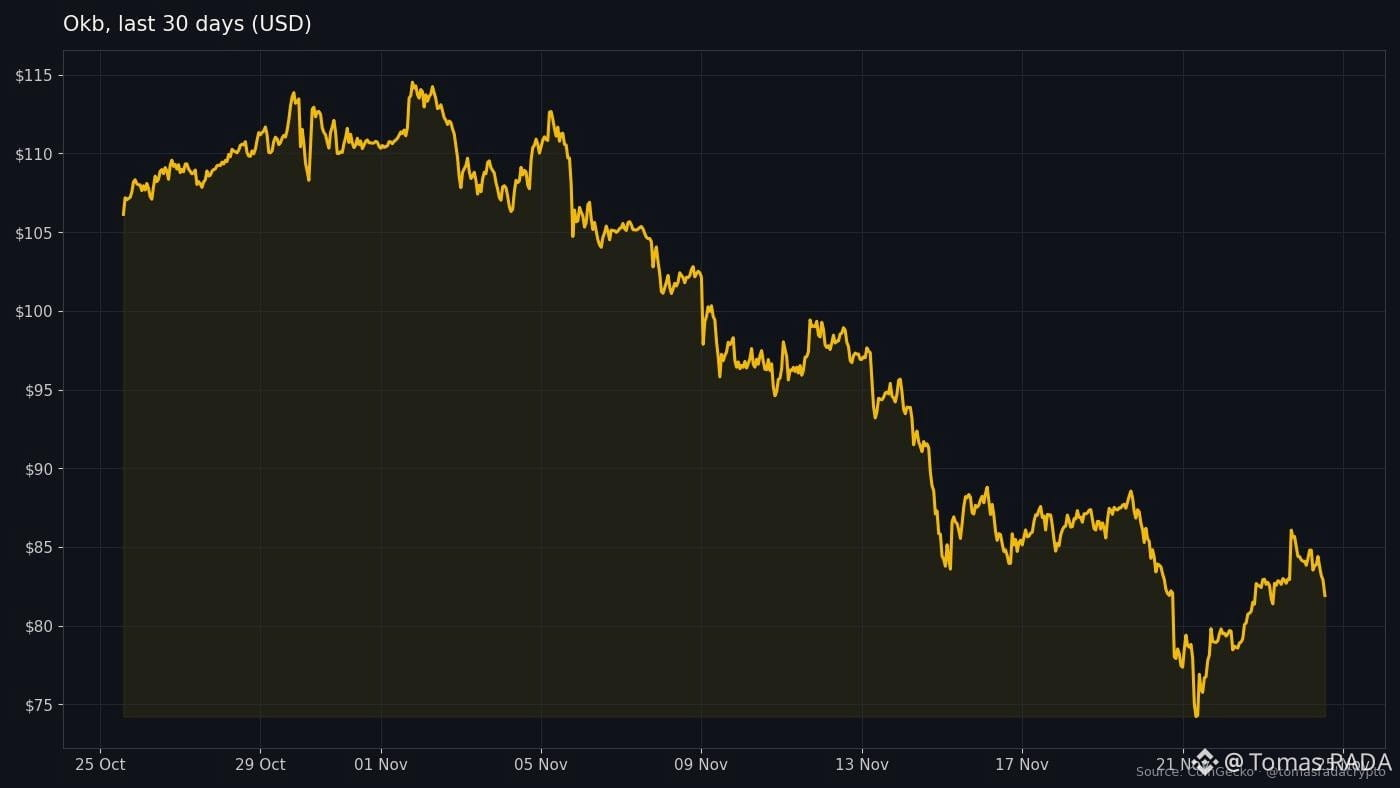
[Chart: Okb price, last 30 days. Source: CoinGecko, 24 November 2026. The chart is in the amk.news version linked at the end.]
The diversity of the assets is expected to grow as the phased rollout continues. Asset manager Direxion has plans to bring 59 exchange traded funds to the venue. Other participants include Vida Global and the digital broker Better.com. The inclusion of these firms broadens a lineup that was initially very concentrated in crypto native businesses. The goal for the venture is to reach the full 113 confirmed assets, which include a mix of individual stocks, ETFs, and other exchange traded products [1][3].
TECHNICAL MECHANICS
The use of Uniswap v4 on the X Layer network is a significant technical choice for a venture backed by the owner of the New York Stock Exchange. Automated market makers rely on mathematical formulas to price assets rather than the matching of buy and sell orders from a central book. This allows for round the clock trading, a feature that OKXICE is heavily promoting to United States investors. It removes the constraints of the standard 9:30 a.m. to 4:00 p.m. trading day that governs traditional exchanges [2][3].
The infrastructure provided by Securitize ensures that the digital tokens remain synchronized with the physical shares held in custody. This one to one backing is what allows the platform to pass through dividends to token holders. If a company like Coinbase or Robinhood issues a dividend, the smart contracts are designed to ensure that the holders of the tokenized versions receive their proportional share. This technical layer is what the SEC is monitoring during the five year exemption period to determine if blockchain trading can maintain the same level of investor protection as legacy systems [3].
The next major milestone for the platform will be the expansion of the asset list beyond the initial six securities. OKXICE has stated that the remaining 107 confirmed assets will be introduced in stages. The marketplace is currently operational for eligible users, and the five year clock on its innovation exemption is now running. The venture will continue its phased rollout of the remaining 107 assets throughout the coming weeks [2].
SOURCES
1. CoinDesk, Fidelity Investments, Strive, Etoro join OKX-ICE tokenized securities venue, https://www.coindesk.com/business/2026/11/23/fidelity-investments-strive-etoro-join-okx-ice-tokenized-securities-venue
2. Cointelegraph, Cuomo says rivals urged companies to opt out of OKXICE tokenized stocks, https://cointelegraph.com/news/cuomo-rivals-urged-companies-reject-okx-ice-tokenized-stocks
3. Cointelegraph, OKX, ICE launch 113 tokenized assets despite issuer objections, https://cointelegraph.com/news/okxice-launch-113-tokenized-assets-objections
The version with the chart, the photos and clickable sources is on amk.news: https://amk.news/article/institutional-friction-the-launch-of-okx-ice-tokenized-stocks
Institutional Friction: The Launch of OKX-ICE Tokenized Stocks
The joint venture between crypto exchange OKX and Intercontinental Exchange, the owner of the New York Stock Exchange, began trading tokenized securities at 12 p.m. Eastern time on Monday. This new marketplace, known as OKXICE, launched with a commitment to list 113 assets on a rolling basis, though the rollout has been marked by significant friction with the very companies whose shares are being traded. The platform operates under a specific five year trial period granted by the Securities and Exchange Commission called the innovation exemption. This allows the venue to test blockchain based stock trading without the standard requirements of a traditional exchange, provided certain conditions are met [1].
The launch represents a rare bridge between the infrastructure of the legacy financial world and the decentralized mechanics of crypto. While Intercontinental Exchange provides the institutional backing, the technical heavy lifting happens on X Layer, which is an Ethereum layer-2 network developed by OKX. The trading itself does not happen on a traditional order book. Instead, it uses automated market maker pools on Uniswap v4. Every token on the platform is designed to represent a security entitlement that is backed one to one by an underlying share. These tokens are intended to carry the same economic benefits as the physical stocks, including rights to dividends and participation in corporate voting where applicable [3].
THE REGULATORY SANDBOX
The SEC innovation exemption is the legal foundation for this venture. It is a temporary window that allows eligible platforms to experiment with onchain trading. Under this framework, OKXICE is not the only player in the field. It follows a firm called TSV LLC, which is based in Canton and began trading tokenized shares earlier this month. Other competitors are also preparing to enter the space, including Formation Securities on the Solana blockchain and Fairmint, which plans to launch on the Canton network before moving to Ethereum [1].
For investors to access these tokenized stocks, the requirements are strict. The venue is limited to eligible United States customers of OKX Inc. who must complete a full identity verification process. These users are required to activate a self-custodial wallet and finish an onboarding sequence before they can trade through the OKX mobile application. To ensure compliance, smart contracts are used to restrict liquidity provision and trading to only those wallets that have been verified and cleared for the platform [3].
CORPORATE RESISTANCE
Despite the institutional pedigree of the Intercontinental Exchange, the majority of the companies initially tapped for the platform declined to participate. Out of 62 companies originally selected for inclusion, 56 of them, or roughly 90 percent, filed formal objections. This list of holdouts included some of the largest names in the global economy, such as Apple, Microsoft, Nvidia, and JPMorgan Chase [1]. By the time the platform went live on Monday, the total number of objecting companies had risen to 67. Other notable firms that sought to keep their shares off the venue included Meta, Tesla, Netflix, McDonald’s, SpaceX, and Coca-Cola [2][3].
The mechanism for these objections is built into the SEC innovation exemption rules. Issuers are given a 30 day notice period during which they can object to having their shares tokenized by an unaffiliated third party. Andrew Cuomo, the former Governor of New York who now serves as the co-chair of OKXICE, addressed these objections during a press briefing on Monday. He suggested that the 30 day deadline was simply too short for many corporate legal teams and boards of directors to fully grasp the technology. According to Cuomo, many companies chose to say no because it was the safest immediate path, even if they expressed interest in learning more about the platform for future participation [2].
COMPETITIVE DYNAMICS
Cuomo also leveled accusations at other financial institutions, claiming that competitors encouraged companies to opt out of the OKXICE launch. He argued that rival trading platforms wanted issuers to wait until their own proprietary systems were ready for market. While Cuomo did not provide specific evidence or name the competitors involved, several major firms are known to be developing their own tokenized stock services. This list includes Nasdaq, Kraken, Robinhood, Coinbase, and Ondo Finance [2].
The tension highlights a fundamental shift in how stocks are handled. In a traditional setting, a company has a high degree of control over where its shares are listed and traded. In the crypto environment, especially under the innovation exemption, third parties can facilitate trading of those same shares as long as they provide the one to one backing. This has created a divide between issuers who view tokenization as a risk to their brand or share price stability and those who see it as a necessary evolution of market liquidity.
THE CONFIRMED LINEUP
While many blue chip tech stocks opted out, OKXICE managed to secure participation from several high profile asset managers and digital firms. Fidelity Investments, eToro, and Strive joined the venue to bring their own products and securities to the onchain market. The initial rollout focused on six specific securities: Coinbase, Circle Internet, Robinhood Markets, Strategy, BitGo, and Securitize. The latter, Securitize, is also the firm providing the underlying tokenization infrastructure for the entire platform [1][2].
[Chart: Okb price, last 30 days. Source: CoinGecko, 24 November 2026. The chart is in the amk.news version linked at the end.]
The diversity of the assets is expected to grow as the phased rollout continues. Asset manager Direxion has plans to bring 59 exchange traded funds to the venue. Other participants include Vida Global and the digital broker Better.com. The inclusion of these firms broadens a lineup that was initially very concentrated in crypto native businesses. The goal for the venture is to reach the full 113 confirmed assets, which include a mix of individual stocks, ETFs, and other exchange traded products [1][3].
TECHNICAL MECHANICS
The use of Uniswap v4 on the X Layer network is a significant technical choice for a venture backed by the owner of the New York Stock Exchange. Automated market makers rely on mathematical formulas to price assets rather than the matching of buy and sell orders from a central book. This allows for round the clock trading, a feature that OKXICE is heavily promoting to United States investors. It removes the constraints of the standard 9:30 a.m. to 4:00 p.m. trading day that governs traditional exchanges [2][3].
The infrastructure provided by Securitize ensures that the digital tokens remain synchronized with the physical shares held in custody. This one to one backing is what allows the platform to pass through dividends to token holders. If a company like Coinbase or Robinhood issues a dividend, the smart contracts are designed to ensure that the holders of the tokenized versions receive their proportional share. This technical layer is what the SEC is monitoring during the five year exemption period to determine if blockchain trading can maintain the same level of investor protection as legacy systems [3].
The next major milestone for the platform will be the expansion of the asset list beyond the initial six securities. OKXICE has stated that the remaining 107 confirmed assets will be introduced in stages. The marketplace is currently operational for eligible users, and the five year clock on its innovation exemption is now running. The venture will continue its phased rollout of the remaining 107 assets throughout the coming weeks [2].
SOURCES
1. CoinDesk, Fidelity Investments, Strive, Etoro join OKX-ICE tokenized securities venue, https://www.coindesk.com/business/2026/11/23/fidelity-investments-strive-etoro-join-okx-ice-tokenized-securities-venue
2. Cointelegraph, Cuomo says rivals urged companies to opt out of OKXICE tokenized stocks, https://cointelegraph.com/news/cuomo-rivals-urged-companies-reject-okx-ice-tokenized-stocks
3. Cointelegraph, OKX, ICE launch 113 tokenized assets despite issuer objections, https://cointelegraph.com/news/okxice-launch-113-tokenized-assets-objections
The version with the chart, the photos and clickable sources is on amk.news: https://amk.news/article/institutional-friction-the-launch-of-okx-ice-tokenized-stocks
·
--
Starting 2026-11-23 at 14:30 UTC, eligible users can trade stock options for Anthropic. This is not a synthetic product. It involves physical settlement of the underlying shares, meaning you are dealing with actual equity through a clearing broker. Trading is strictly limited to US market hours from 09:30 to 16:00 ET. If you hold a position, you are responsible for monitoring the expiration. If you do not manually exercise an option, it triggers an auto-liquidation process where the position is sold on a best-efforts basis.
I think the reliance on a third-party broker for custody shows how carefully the platform is separating its crypto operations from regulated US securities trading.
Will you use $ANT options for hedging or do you prefer to stick to the 24/7 crypto markets?
#Binance #WillMarketsStageAThanksgivingReliefRally?
513
·
--
The discussion around whether markets will stage a Thanksgiving relief rally is picking up, but the macro numbers tell a more complicated story. While $BTC attempts to recover from a 10% one-day drop, the US Federal Reserve is widely expected to raise interest rates by 25 basis points in December. Further out, the UK has set a deadline of October 25, 2027, for crypto platforms to stop acting as market makers on their own exchanges. This rule forces a separation of duties that shifts liquidity risk entirely to third-party providers. My read is that the 25 basis point hike expectation is currently weighing heavier on sentiment than any seasonal holiday pattern. Did you buy the Friday dip or are you waiting for the Fed to act first?
#WillMarketsStageAThanksgivingReliefRally?
#WillMarketsStageAThanksgivingReliefRally?
60
·
--
The Fusionist team is calling for an immediate halt on $ACE trading and bridging after a security exploit drained roughly 1.04 million in $USDT. If you use the bridge on the Binance Smart Chain, the rule is to stop all activity until the team confirms the vulnerability is fixed. The risk sits entirely with those who didn't see the alert, as smart contracts cannot pull back funds once a bridge is emptied.
My read: Bridge exploits are still the biggest threat to gaming ecosystems because these protocols often prioritize fast transactions over the multi-layer security checks used by larger chains.
Do you keep your gaming tokens in a hot wallet for convenience or move them to cold storage as soon as you finish playing?
#CryptoNews #ACE
334
·
--
The $ETH spot market on Binance saw 2,641,972 trades over the last 24 hours. While the net price change was only 0.27 percent, the actual trading range spanned from a low of 1696.50 to a high of 1845.07. This 148 dollar spread occurred alongside 717.8 million USDT in quote volume. Traders are moving significant capital even when the final price movement stays nearly neutral.
My read: The high trade count relative to the small net change indicates a lot of back and forth fighting at these specific levels. It shows that liquidity is deep enough to absorb over 700 million in volume without the price breaking significantly in either direction for the day.
Did you trade the intraday swings or did you keep your position exactly where it was?
#ETH #EvolveAtBinanceBlockchainWeek
15
·
--
Chainalysis reports a 55 percent surge in China-linked stablecoin payments since the launch of major US AI models. Users are moving $USDT through decentralized channels to pay for high-end compute power and GPU access that local banks currently block under strict capital controls. The consequence is a shift in settlement risk away from the regulated banking system and onto individual wallet addresses and offshore providers. My read: This shows that stablecoins have become the primary workaround for the hardware gap, acting as a shadow payment rail for the global AI race. Does this volume prove that utility drives adoption, or is the regulatory risk of bypassing banks getting too high for users?
#CryptoNews #EvolveAtBinanceBlockchainWeek
#CryptoNews #EvolveAtBinanceBlockchainWeek
2
·
--
South Korea is set to publish a draft of its comprehensive crypto legal framework this week. This move introduces a mandatory licensing regime for all crypto businesses and a bank-centered issuance system for local stablecoins. The specific rule to watch is the restriction of stablecoin issuance to banks, which effectively moves the risk from private startups to the established financial sector. While $BTC trades around 61277 USDT, the real shift here is structural rather than just market movement.
My read: Forcing stablecoins through banks suggests the government wants to treat crypto liquidity as a direct extension of the traditional monetary system.
Do you prefer the safety of a bank-backed stablecoin or the independence of a decentralized one?
#EvolveAtBinanceBlockchainWeek
My read: Forcing stablecoins through banks suggests the government wants to treat crypto liquidity as a direct extension of the traditional monetary system.
Do you prefer the safety of a bank-backed stablecoin or the independence of a decentralized one?
#EvolveAtBinanceBlockchainWeek
15
·
--
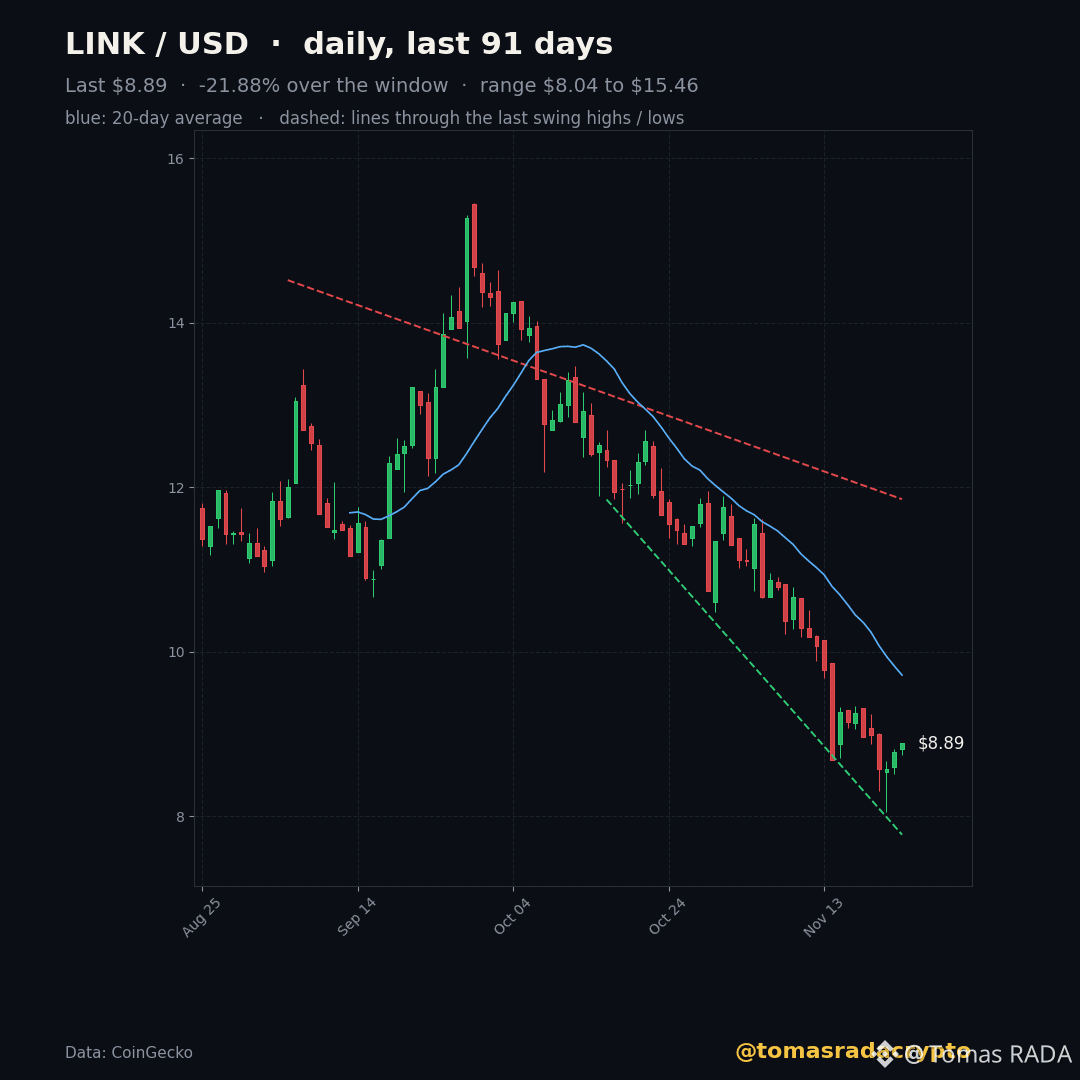
$LINK is trading at 8.965 USDT, which is roughly 7.7 percent below its 20-day moving average of 9.715. Looking at the last 90 days, the price has formed a clear pattern of falling tops and falling bottoms. The asset sits in the lower portion of its three-month range, between the high of 15.458 and the low of 8.044. Daily volume sits at 11.7M USDT with over 130,000 trades, but the price remains stuck under that short-term average.
My read: The market is currently testing the strength of the 8.044 floor as the 90-day trend continues its downward slope.
Are you looking for a bounce at the recent low or waiting for the price to reclaim the 20-day average first?
#LINK #BessentSoftensStanceOnHuang’sNvidiaReturn
My read: The market is currently testing the strength of the 8.044 floor as the 90-day trend continues its downward slope.
Are you looking for a bounce at the recent low or waiting for the price to reclaim the 20-day average first?
#LINK #BessentSoftensStanceOnHuang’sNvidiaReturn
63
·
--
If you are heading to Bangkok on November 28 and 29, the presence of Kite, Plasma, and $TRX as top sponsors means these projects will occupy most of the technical stages and networking sessions. For a regular user, this is the date when the roadmap for these specific ecosystems gets its biggest public push.
My read is that the platinum status for these projects indicates where the marketing spend is shifting toward infrastructure and scaling solutions rather than just consumer apps. It puts the risk of delivery squarely on these teams to prove their tech is ready for the next wave of users.
Are you traveling to conferences to meet developers in person or do you find all the information you need from the livestreams?
#Binance #EvolveAtBinanceBlockchainWeek
69
·
--
People are asking if markets will see a Thanksgiving relief rally while $BTC sits near 61,500 USDT. The actual date to watch is the December Fed meeting where a 25 basis point rate hike is widely expected. Bill Ackman is warning that another hike would be a mistake. The consequence is that liquidity remains tight and the risk stays with those holding assets that need lower rates to thrive. My read: The market is currently trying to balance a 3 percent daily gain against the reality of a central bank that is still pulling the brakes. Are you betting on a holiday bounce or keeping your capital on the sidelines until the December rate decision?
#WillMarketsStageAThanksgivingReliefRally?
#WillMarketsStageAThanksgivingReliefRally?
48
·
--
Bitcoin fell to C$24,250 on Kraken early Saturday, roughly $17,000 in U.S. terms. This was 70 percent below global prices. The crash hit the Canadian dollar order book while the U.S. dollar market stayed near $57,700. Other assets like $BTC and $ETH also saw massive local drops. Tether’s USDT fell to 56 Canadian cents, meaning one Canadian dollar briefly bought two dollars worth of stablecoins.
Kraken says it found no security breach and all orders executed properly. The exchange will not reverse the 976 trades that happened during the bottom. Market markers for the CAD pair likely ran out of funds, leaving stop-loss orders to fill against empty books. My read: isolated fiat pools create a dangerous illusion of liquidity that evaporates exactly when volatility makes it most necessary.
Do you prefer trading in your local currency for convenience or do you stick to U.S.
Full piece: https://app.binance.com/uni-qr/cart/391285382226975?r=KU1Z4N85&l=en-TR

79
·
--
Article
Kraken's $17,000 Bitcoin Flash Crash: Why the Trades StandBitcoin was trading near C$83,800 on Kraken’s Canadian dollar book on Friday afternoon. At the same time, the U.S. dollar pair for the same asset sat at roughly $58,300. This tracked the foreign exchange rate of about 70 U.S. cents per Canadian dollar. By early Saturday morning, however, the Canadian market decoupled from the rest of the world. Bitcoin prices on that specific book fell nearly 70 percent, bottoming at C$24,250. This is the equivalent of about $17,000.
The selling pressure began around 3 p.m. ET on Friday. Within an hour, the price of Bitcoin in Canadian dollars dragged below C$70,000. By 7 p.m. ET, it was under C$50,000. The absolute bottom occurred in the 15 minutes after 3 a.m. ET on Saturday. During this window, 976 separate trades were executed at the heavily discounted price. While this was happening, Bitcoin on Kraken’s U.S. dollar book remained near $57,700, having touched a separate two year low of $55,100 earlier that night.
ISOLATED LIQUIDITY RISKS
The primary reason for this massive price gap is how Kraken structures its trading environment. The exchange runs isolated order books for each fiat currency it supports. This means that a trader buying or selling Bitcoin with Canadian dollars is only matching against the liquidity available in that specific Canadian dollar pool. They are not tapping into the much deeper U.S. dollar liquidity pool that handles the bulk of global volume.
When a single fiat book loses its market makers, the results can be catastrophic for those with open positions. Market makers are participants who continuously post buy and sell quotes to keep the order book liquid. If these participants vanish or stop providing quotes, the order book becomes thin. Blockstream CEO Adam Back suggested that the market maker for Kraken’s U.S. dollar against Canadian dollar pair simply ran out of money. Without that backstop, thin resting bids dictated the prices.
THE STOP LOSS CASCADE
The breakdown in the CAD order book triggered a chain reaction. Automated stop loss orders are designed to sell an asset once it hits a certain price to prevent further losses. However, in a market with no liquidity, these orders fire into empty air. They fill at whatever price is available, even if that price is pennies on the dollar compared to global spot rates. Adam Back noted that this dislocation liquidated people whose orders fired based on a local false price.
The data shows the scale of the activity during the crash. Roughly 245 BTC changed hands between 1:30 a.m. and 4:45 a.m. ET on Saturday during 15 minute intervals where average prices stayed below C$50,000. Because the USD and CAD books were not linked, the arbitrage that usually keeps prices in line failed to happen fast enough to prevent the slide.
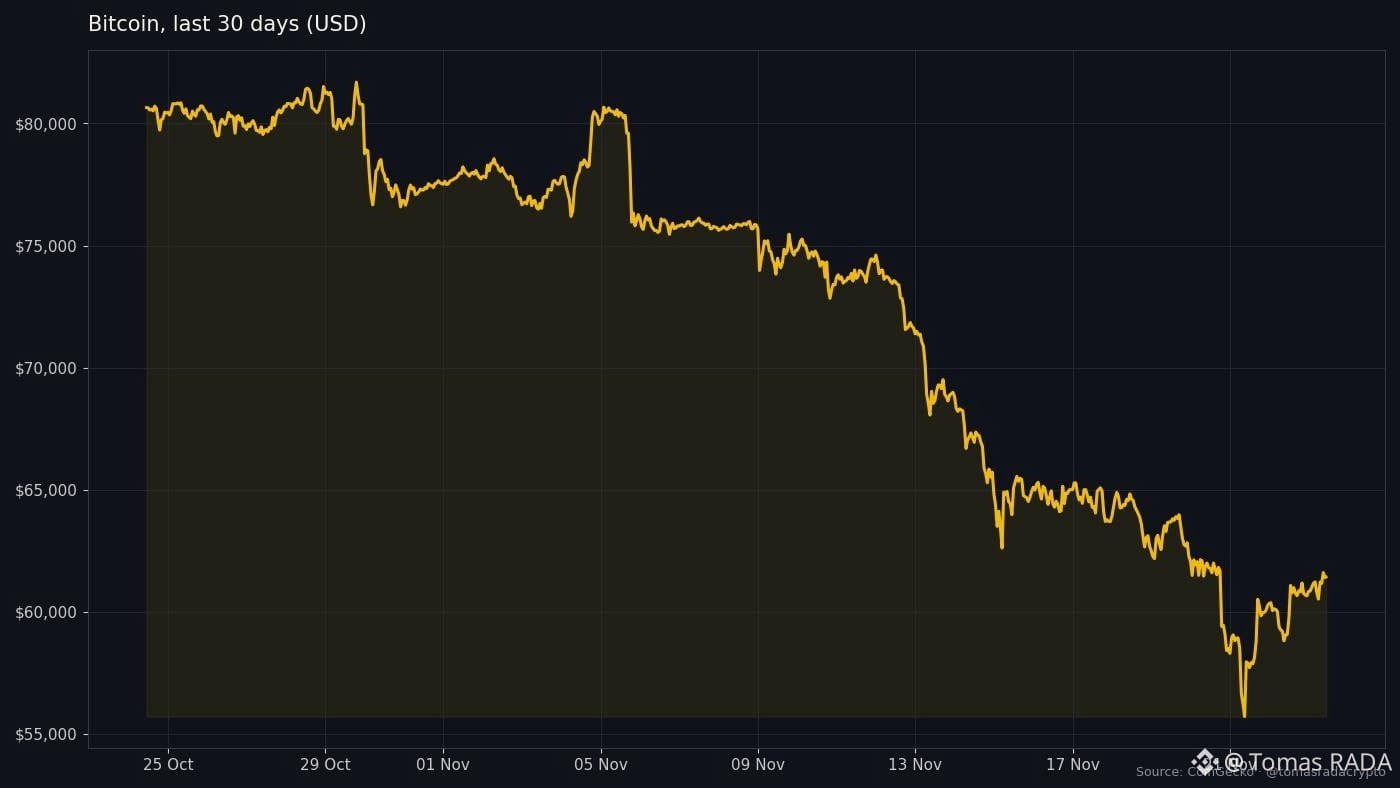
[Chart: Bitcoin price, last 30 days. Source: CoinGecko, 23 November 2026. The chart is in the amk.news version linked at the end.]
MULTI ASSET COLLAPSE
Bitcoin was not the only asset affected by the breakdown in the Canadian dollar market. A review of Kraken’s API data shows that several assets quoted in Canadian dollars collapsed simultaneously. Ether sank from about C$2,296 on Friday afternoon to a low of C$796. XRP shed more than 60 percent of its value to hit 41 Canadian cents.
Even Tether, a stablecoin pegged to the U.S. dollar, saw its CAD pair break. Normally worth roughly 143 Canadian cents, USDT dropped to 56 cents by 3 a.m. ET on Saturday. For a brief period, one Canadian dollar on Kraken could buy nearly two U.S. dollars worth of stablecoins. This represented more than double the real world value of the Canadian currency at the time.
EXCHANGE RESPONSE AND HISTORY
Despite the 70 percent deviation from global prices, Kraken has confirmed that it will not reverse the trades. The exchange's support account stated on X that every order had executed properly. Security teams conducted a review and found no evidence of a security breach or account compromise. Because the system functioned as intended, the executed trades stand.
This event echoes a previous breakdown on the same exchange. In June 2019, Kraken’s Canadian dollar Bitcoin pair briefly printed a price of C$101. In the most recent case, the exchange did not log an official incident on its status page. Prices on the Canadian book eventually recovered, climbing above C$79,000 by 5 a.m. ET on Saturday. By Monday, the markets were back in alignment with global rates, with Bitcoin trading at C$87,700 against $61,350 in U.S. dollars.
SOURCES
1. Coindesk, Bitcoin sold for $17,000 on Kraken's Canadian dollar market, and the trades stand, https://www.coindesk.com/markets/2026/11/23/bitcoin-sold-for-usd17-000-on-kraken-s-canadian-dollar-market-and-the-trades-stand
2. Cointelegraph, Bitcoin briefly drops to $17K on Kraken, exchange upholds trades, https://cointelegraph.com/news/bitcoin-17k-kraken-canadian-dollar-market-trades-stand
The version with the chart, the photos and clickable sources is on amk.news: https://amk.news/article/kraken-s-17-000-bitcoin-flash-crash-why-the-trades-stand
Kraken's $17,000 Bitcoin Flash Crash: Why the Trades Stand
Bitcoin was trading near C$83,800 on Kraken’s Canadian dollar book on Friday afternoon. At the same time, the U.S. dollar pair for the same asset sat at roughly $58,300. This tracked the foreign exchange rate of about 70 U.S. cents per Canadian dollar. By early Saturday morning, however, the Canadian market decoupled from the rest of the world. Bitcoin prices on that specific book fell nearly 70 percent, bottoming at C$24,250. This is the equivalent of about $17,000.
The selling pressure began around 3 p.m. ET on Friday. Within an hour, the price of Bitcoin in Canadian dollars dragged below C$70,000. By 7 p.m. ET, it was under C$50,000. The absolute bottom occurred in the 15 minutes after 3 a.m. ET on Saturday. During this window, 976 separate trades were executed at the heavily discounted price. While this was happening, Bitcoin on Kraken’s U.S. dollar book remained near $57,700, having touched a separate two year low of $55,100 earlier that night.
ISOLATED LIQUIDITY RISKS
The primary reason for this massive price gap is how Kraken structures its trading environment. The exchange runs isolated order books for each fiat currency it supports. This means that a trader buying or selling Bitcoin with Canadian dollars is only matching against the liquidity available in that specific Canadian dollar pool. They are not tapping into the much deeper U.S. dollar liquidity pool that handles the bulk of global volume.
When a single fiat book loses its market makers, the results can be catastrophic for those with open positions. Market makers are participants who continuously post buy and sell quotes to keep the order book liquid. If these participants vanish or stop providing quotes, the order book becomes thin. Blockstream CEO Adam Back suggested that the market maker for Kraken’s U.S. dollar against Canadian dollar pair simply ran out of money. Without that backstop, thin resting bids dictated the prices.
THE STOP LOSS CASCADE
The breakdown in the CAD order book triggered a chain reaction. Automated stop loss orders are designed to sell an asset once it hits a certain price to prevent further losses. However, in a market with no liquidity, these orders fire into empty air. They fill at whatever price is available, even if that price is pennies on the dollar compared to global spot rates. Adam Back noted that this dislocation liquidated people whose orders fired based on a local false price.
The data shows the scale of the activity during the crash. Roughly 245 BTC changed hands between 1:30 a.m. and 4:45 a.m. ET on Saturday during 15 minute intervals where average prices stayed below C$50,000. Because the USD and CAD books were not linked, the arbitrage that usually keeps prices in line failed to happen fast enough to prevent the slide.
[Chart: Bitcoin price, last 30 days. Source: CoinGecko, 23 November 2026. The chart is in the amk.news version linked at the end.]
MULTI ASSET COLLAPSE
Bitcoin was not the only asset affected by the breakdown in the Canadian dollar market. A review of Kraken’s API data shows that several assets quoted in Canadian dollars collapsed simultaneously. Ether sank from about C$2,296 on Friday afternoon to a low of C$796. XRP shed more than 60 percent of its value to hit 41 Canadian cents.
Even Tether, a stablecoin pegged to the U.S. dollar, saw its CAD pair break. Normally worth roughly 143 Canadian cents, USDT dropped to 56 cents by 3 a.m. ET on Saturday. For a brief period, one Canadian dollar on Kraken could buy nearly two U.S. dollars worth of stablecoins. This represented more than double the real world value of the Canadian currency at the time.
EXCHANGE RESPONSE AND HISTORY
Despite the 70 percent deviation from global prices, Kraken has confirmed that it will not reverse the trades. The exchange's support account stated on X that every order had executed properly. Security teams conducted a review and found no evidence of a security breach or account compromise. Because the system functioned as intended, the executed trades stand.
This event echoes a previous breakdown on the same exchange. In June 2019, Kraken’s Canadian dollar Bitcoin pair briefly printed a price of C$101. In the most recent case, the exchange did not log an official incident on its status page. Prices on the Canadian book eventually recovered, climbing above C$79,000 by 5 a.m. ET on Saturday. By Monday, the markets were back in alignment with global rates, with Bitcoin trading at C$87,700 against $61,350 in U.S. dollars.
SOURCES
1. Coindesk, Bitcoin sold for $17,000 on Kraken's Canadian dollar market, and the trades stand, https://www.coindesk.com/markets/2026/11/23/bitcoin-sold-for-usd17-000-on-kraken-s-canadian-dollar-market-and-the-trades-stand
2. Cointelegraph, Bitcoin briefly drops to $17K on Kraken, exchange upholds trades, https://cointelegraph.com/news/bitcoin-17k-kraken-canadian-dollar-market-trades-stand
The version with the chart, the photos and clickable sources is on amk.news: https://amk.news/article/kraken-s-17-000-bitcoin-flash-crash-why-the-trades-stand
64
·
--
If $BTC drops toward the $53,000 level, smart contracts will automatically trigger the seizure of $240 million in collateral from over-leveraged borrowers. These liquidations happen in seconds as the code sells off assets to cover loans, often regardless of the available market depth. The risk is concentrated in decentralized lending protocols where the buffer between current prices and liquidation thresholds has narrowed significantly.
My read: This creates a feedback loop where forced selling drives the price into the next cluster of liquidation triggers.
When volatility spikes like this, do you set tight stop losses or do you prefer to keep your collateral levels high enough to ignore the noise?
#CryptoNews #BTCReboundsAbove$60KAmidWhaleDipBuying
80
·
--
$ETH saw heavy activity on Binance spot over the last 24 hours with 1,888,987 trades completed. The price fluctuated between a low of 1648.35 and a high of 1732.52 USDT, while the total quote volume hit 389.7 million USDT. This 1.64 percent move happened across a nearly 84 USDT range, putting the immediate risk on short-term traders managing tight stops within that window.
My read: The high number of individual trades compared to the total volume suggests that retail activity or automated small-cap rebalancing is driving this turnover rather than a few large institutional blocks.
Did you trade this price range today or are you waiting for a wider move before acting?
#ETH #BTCReboundsAbove$60KAmidWhaleDipBuying
16
·
--
November $BTC ETF outflows hit $3.5 billion as traditional funds pull capital before the end of the year. This shift moves the risk from institutional balance sheets back to spot holders. Much of this volume comes from fund managers who need to lock in performance metrics or manage tax liabilities before the December 31 deadline. It represents a significant test of how the market absorbs large scale selling without the buffer of institutional buy walls. My read: This looks like a mechanical year-end rotation where managers prioritize their annual reporting over long-term positioning. Did you hold through the $3.5 billion exit or did you trim your position to match them?
#CryptoNews #GlobalStocksFaceLongestLosingStreakSince2023
#CryptoNews #GlobalStocksFaceLongestLosingStreakSince2023
28
·
--
Anthropic is losing its IPO premium on day two, with the market pushing back against the initial valuation after a 93.5 billion dollar raise. The consequence is a sudden squeeze on liquidity that has already seen $BTC dip under the 60,000 mark before recovering to 60,817 USDT. When the biggest AI names face a 48 percent correction, the risk shifts entirely to those who bought the top of the hype cycle.
My read: This looks like a classic deleveraging event where investors sell what they can, not what they want, to cover losses in traditional tech.
Did you use this dip to add to your position or are you waiting for more clarity on the AI bubble?
#AnthropicPlungesTowardIPOPriceonDay2
My read: This looks like a classic deleveraging event where investors sell what they can, not what they want, to cover losses in traditional tech.
Did you use this dip to add to your position or are you waiting for more clarity on the AI bubble?
#AnthropicPlungesTowardIPOPriceonDay2
27
Log in to explore more content
Join global crypto users on Binance Square
⚡️ Get latest and useful information about crypto.
💬 Trusted by the world’s largest crypto exchange.
👍 Discover real insights from verified creators.
Email / Phone number
Trending Topics
AnthropicBreaksBelowIPOPriceAmidAISlump
11,276 views
203 Discussing
TradFi News | Micron, Nvidia Lead AI Stock Slide as VIX Jumps Above 32 and Anthropic Falls Below IPO Price
Binance News
·13 Likes
·4.5k views
Bitcoin'sReboundFadesBelow$60K
54,750 views
294 Discussing
WillMarketsStageAThanksgivingReliefRally?
472,854 views
3,193 Discussing