

唐华斑竹
14k Posts

唐华斑竹
 Square Verified+
Report
Block User
币乎大V(推特X:@uniswap12),2025全球区块链百强创作者,独立研究员。在微博、推特、币乎、力场、币快报、向北社区、币车、财路、链书、八宝饭、链节点、巴比特、陀螺财经等币圈媒体拥有数十万粉丝。

Top traders by profit in 30D

2025 Blockchain 100 — Independent Researcher

Creator Awards 2024
2.4K+ Following
94.4K+ Followers
119.5K+ Liked
5 Badges
Posts
All
Quotes
Videos
Live
PINNED
·
--
Bearish
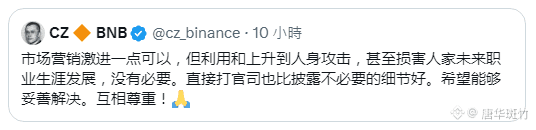
CZ spoke up—maybe it’s time to calm down a bit. Over the past two days, domestic media has completely gone wild: headlines, Douyin, and Xiaohongshu are all covered by the egg incident! Even the elderly couple downstairs are joyfully chatting about the gossip between Jing Tian and Sun Yuchen. What everyone cares about most is that it turns out trading coins is so profitable—Sun Ge is so young and yet has hundreds of billions! Some people say it’s a few trillion, or even tens of trillions! It’s all gone viral! I have no choice but to slip out on the edge, afraid that someone will stop me and ask, “Your coin-trading time seems even longer than Sun Yuchen’s. How much did you make? Why do you still look so poor?” $SOL
{spot}(SOLUSDT)
CZ spoke up—maybe it’s time to calm down a bit. Over the past two days, domestic media has completely gone wild: headlines, Douyin, and Xiaohongshu are all covered by the egg incident! Even the elderly couple downstairs are joyfully chatting about the gossip between Jing Tian and Sun Yuchen. What everyone cares about most is that it turns out trading coins is so profitable—Sun Ge is so young and yet has hundreds of billions! Some people say it’s a few trillion, or even tens of trillions! It’s all gone viral! I have no choice but to slip out on the edge, afraid that someone will stop me and ask, “Your coin-trading time seems even longer than Sun Yuchen’s. How much did you make? Why do you still look so poor?” $SOL
118
3
281
187k
·
--
Verified

Article
How to Prepare for the Coming Wave of AI Agent PaymentsAt KBW 2026 in Korea, Genzio Media CBO @Genzio @DavidThaDegen spoke with Sophia Li @sophianeverfold, COO and core contributor at @GOATNetwork, about “how to prepare for the coming wave of AI agent payments.”
Sophia Li discusses GOAT Network as Bitcoin-secured infrastructure built for “Agentic Commerce.”
Our core product is GOAT Flow. This makes it easier for AI agents to discover merchants and their products and services, and make purchases.
How to Prepare for the Coming Wave of AI Agent Payments
At KBW 2026 in Korea, Genzio Media CBO @Genzio @DavidThaDegen spoke with Sophia Li @sophianeverfold, COO and core contributor at @GOATNetwork, about “how to prepare for the coming wave of AI agent payments.”
Sophia Li discusses GOAT Network as Bitcoin-secured infrastructure built for “Agentic Commerce.”
Our core product is GOAT Flow. This makes it easier for AI agents to discover merchants and their products and services, and make purchases.
Sophia Li discusses GOAT Network as Bitcoin-secured infrastructure built for “Agentic Commerce.”
Our core product is GOAT Flow. This makes it easier for AI agents to discover merchants and their products and services, and make purchases.
662
·
--
Bearish
Verified
Chain shutdowns are trending—everyone, please take note. If you have assets, remember to withdraw them before the deadline.
Abstract announces shutdown and asks users to migrate their assets; operations will cease on December 15, 2026
Abstract announced that the network will be gradually shut down and will cease operating on December 15, 2026. Funds that have not been migrated by then will be inaccessible. Users can migrate their assets via the official migration center or the native cross-chain bridge, which is expected to have a delay of around 3 hours. Abstract said that a consumer-focused crypto chain is difficult to sustain as a standalone model. Factors including a limited DeFi ecosystem and weak on-chain liquidity have caused network growth to stall. Launched by the Pudgy Penguins team, Abstract is an Ethereum Layer 2 network that previously attracted more than 400,000 users and hosted over 144 applications. Abstract urged users to beware of fake migration websites. $SOL
{spot}(SOLUSDT)
Chain shutdowns are trending—everyone, please take note. If you have assets, remember to withdraw them before the deadline.
Abstract announces shutdown and asks users to migrate their assets; operations will cease on December 15, 2026
Abstract announced that the network will be gradually shut down and will cease operating on December 15, 2026. Funds that have not been migrated by then will be inaccessible. Users can migrate their assets via the official migration center or the native cross-chain bridge, which is expected to have a delay of around 3 hours. Abstract said that a consumer-focused crypto chain is difficult to sustain as a standalone model. Factors including a limited DeFi ecosystem and weak on-chain liquidity have caused network growth to stall. Launched by the Pudgy Penguins team, Abstract is an Ethereum Layer 2 network that previously attracted more than 400,000 users and hosted over 144 applications. Abstract urged users to beware of fake migration websites. $SOL
Abstract announces shutdown and asks users to migrate their assets; operations will cease on December 15, 2026
Abstract announced that the network will be gradually shut down and will cease operating on December 15, 2026. Funds that have not been migrated by then will be inaccessible. Users can migrate their assets via the official migration center or the native cross-chain bridge, which is expected to have a delay of around 3 hours. Abstract said that a consumer-focused crypto chain is difficult to sustain as a standalone model. Factors including a limited DeFi ecosystem and weak on-chain liquidity have caused network growth to stall. Launched by the Pudgy Penguins team, Abstract is an Ethereum Layer 2 network that previously attracted more than 400,000 users and hosted over 144 applications. Abstract urged users to beware of fake migration websites. $SOL
1.1k
·
--
Bearish
Verified
When trading crypto, you really need to choose a hassle-free platform; otherwise, it can be a real headache.
MSX Completes Handling of Abnormal Transactions and Delists the MSXUSDT Perpetual Contract Trading Pair
According to an MSX announcement, MSX has completed the handling, rollback, and asset reconciliation of abnormal transactions from 00:00 to 10:00 on October 3, 2026 (UTC+8), involving MSX/USDT spot trading and the MSXUSDT perpetual contract. Spot trading has resumed normal operations. Users' current balances, transaction records, and profit and loss data reflect the results after processing, although some accounts may remain temporarily restricted pending risk reviews. MSX has decided to delist the MSXUSDT perpetual contract trading pair effective from the date of the announcement. Profitable positions will be settled based on the profits generated, while losing positions will be fully compensated with USDT airdrops within 7 days. Going forward, opening new positions and related trading operations for this pair will no longer be supported. Eligible affected users will receive an airdrop of 1,000 MSX and will be entitled to a full refund of trading fees incurred from 00:00 on October 7, 2026, to 00:00 on November 7, 2026 (UTC+8). The relevant fees will be refunded via USDT airdrop within 7 days after the refund period ends. $SOL
{spot}(SOLUSDT)
When trading crypto, you really need to choose a hassle-free platform; otherwise, it can be a real headache.
MSX Completes Handling of Abnormal Transactions and Delists the MSXUSDT Perpetual Contract Trading Pair
According to an MSX announcement, MSX has completed the handling, rollback, and asset reconciliation of abnormal transactions from 00:00 to 10:00 on October 3, 2026 (UTC+8), involving MSX/USDT spot trading and the MSXUSDT perpetual contract. Spot trading has resumed normal operations. Users' current balances, transaction records, and profit and loss data reflect the results after processing, although some accounts may remain temporarily restricted pending risk reviews. MSX has decided to delist the MSXUSDT perpetual contract trading pair effective from the date of the announcement. Profitable positions will be settled based on the profits generated, while losing positions will be fully compensated with USDT airdrops within 7 days. Going forward, opening new positions and related trading operations for this pair will no longer be supported. Eligible affected users will receive an airdrop of 1,000 MSX and will be entitled to a full refund of trading fees incurred from 00:00 on October 7, 2026, to 00:00 on November 7, 2026 (UTC+8). The relevant fees will be refunded via USDT airdrop within 7 days after the refund period ends. $SOL
MSX Completes Handling of Abnormal Transactions and Delists the MSXUSDT Perpetual Contract Trading Pair
According to an MSX announcement, MSX has completed the handling, rollback, and asset reconciliation of abnormal transactions from 00:00 to 10:00 on October 3, 2026 (UTC+8), involving MSX/USDT spot trading and the MSXUSDT perpetual contract. Spot trading has resumed normal operations. Users' current balances, transaction records, and profit and loss data reflect the results after processing, although some accounts may remain temporarily restricted pending risk reviews. MSX has decided to delist the MSXUSDT perpetual contract trading pair effective from the date of the announcement. Profitable positions will be settled based on the profits generated, while losing positions will be fully compensated with USDT airdrops within 7 days. Going forward, opening new positions and related trading operations for this pair will no longer be supported. Eligible affected users will receive an airdrop of 1,000 MSX and will be entitled to a full refund of trading fees incurred from 00:00 on October 7, 2026, to 00:00 on November 7, 2026 (UTC+8). The relevant fees will be refunded via USDT airdrop within 7 days after the refund period ends. $SOL
1k
·
--
Bearish
Verified
Ethereum Glamsterdam upgrade goes live on Sepolia testnet
The Ethereum Glamsterdam upgrade has gone live on the Sepolia testnet, activating at 13:53 UTC on Tuesday at epoch 353024. The deployment is one of the major test runs ahead of the upgrade’s final activation on mainnet.
Glamsterdam will introduce built-in proposer-builder separation, block-level access lists, and gas pricing adjustments more closely aligned with execution costs, aiming to improve the scalability and efficiency of the Ethereum mainnet. The Ethereum Foundation has published the upgrade plans.
Following this testnet deployment, developers will determine when Glamsterdam will activate on the Hoodi testnet, and then set the mainnet launch date. After the upgrade is complete, developers will move forward with the next major upgrade, Hegotá. $ETH
{spot}(ETHUSDT)
Ethereum Glamsterdam upgrade goes live on Sepolia testnet
The Ethereum Glamsterdam upgrade has gone live on the Sepolia testnet, activating at 13:53 UTC on Tuesday at epoch 353024. The deployment is one of the major test runs ahead of the upgrade’s final activation on mainnet.
Glamsterdam will introduce built-in proposer-builder separation, block-level access lists, and gas pricing adjustments more closely aligned with execution costs, aiming to improve the scalability and efficiency of the Ethereum mainnet. The Ethereum Foundation has published the upgrade plans.
Following this testnet deployment, developers will determine when Glamsterdam will activate on the Hoodi testnet, and then set the mainnet launch date. After the upgrade is complete, developers will move forward with the next major upgrade, Hegotá. $ETH
The Ethereum Glamsterdam upgrade has gone live on the Sepolia testnet, activating at 13:53 UTC on Tuesday at epoch 353024. The deployment is one of the major test runs ahead of the upgrade’s final activation on mainnet.
Glamsterdam will introduce built-in proposer-builder separation, block-level access lists, and gas pricing adjustments more closely aligned with execution costs, aiming to improve the scalability and efficiency of the Ethereum mainnet. The Ethereum Foundation has published the upgrade plans.
Following this testnet deployment, developers will determine when Glamsterdam will activate on the Hoodi testnet, and then set the mainnet launch date. After the upgrade is complete, developers will move forward with the next major upgrade, Hegotá. $ETH
910
·
--
Bearish
Verified
Strive’s SATA has begun accumulating Bitcoin, raising funds this week to buy more than 450 BTC
Strive’s SATA has begun accumulating Bitcoin and has raised enough funds so far this week to buy more than 450 BTC. STRC is approaching its $100 par value. This information is sponsored by Apyx_fi, which says it can offer double-digit yields to all users. $BTC
{spot}(BTCUSDT)
Strive’s SATA has begun accumulating Bitcoin, raising funds this week to buy more than 450 BTC
Strive’s SATA has begun accumulating Bitcoin and has raised enough funds so far this week to buy more than 450 BTC. STRC is approaching its $100 par value. This information is sponsored by Apyx_fi, which says it can offer double-digit yields to all users. $BTC
Strive’s SATA has begun accumulating Bitcoin and has raised enough funds so far this week to buy more than 450 BTC. STRC is approaching its $100 par value. This information is sponsored by Apyx_fi, which says it can offer double-digit yields to all users. $BTC
972
·
--
Bearish
Verified
Binance to Adjust Collateral Ratios for BCH, ENA, and Other Assets
According to an official announcement, Binance will update the transfer-out collateral ratios for Cross Margin loans, the collateral ratios and leverage for Unified Accounts, and the tiered collateral ratios for Unified Account Pro at 06:00 UTC on October 9, 2026. The assets affected include BCH, CRCLB, ENA, MSTRB, ONDO, WCT, MASK, ZEC, ALICE, LQTY, BANANA, XAI, YGG, ACE, PORTAL, G, and THETA. $BCH
{spot}(BCHUSDT)
Binance to Adjust Collateral Ratios for BCH, ENA, and Other Assets
According to an official announcement, Binance will update the transfer-out collateral ratios for Cross Margin loans, the collateral ratios and leverage for Unified Accounts, and the tiered collateral ratios for Unified Account Pro at 06:00 UTC on October 9, 2026. The assets affected include BCH, CRCLB, ENA, MSTRB, ONDO, WCT, MASK, ZEC, ALICE, LQTY, BANANA, XAI, YGG, ACE, PORTAL, G, and THETA. $BCH
According to an official announcement, Binance will update the transfer-out collateral ratios for Cross Margin loans, the collateral ratios and leverage for Unified Accounts, and the tiered collateral ratios for Unified Account Pro at 06:00 UTC on October 9, 2026. The assets affected include BCH, CRCLB, ENA, MSTRB, ONDO, WCT, MASK, ZEC, ALICE, LQTY, BANANA, XAI, YGG, ACE, PORTAL, G, and THETA. $BCH
1.7k
·
--
Bearish
Bitcoin whales have accumulated 14,335 BTC since October 1
According to analyst Ali, Bitcoin has established a major support zone between $83,300 and $84,600. URPD data shows that 1.59 million BTC were traded in this range, providing buyers with a level they can defend. Since October 1, Bitcoin whales have accumulated 14,335 BTC, worth approximately $1.22 billion. alicharts believes that if Bitcoin holds support and breaks above $86,700, there will be no significant selling pressure until around $105,000. $NVDAB $BNB
{spot}(BNBUSDT)
Bitcoin whales have accumulated 14,335 BTC since October 1
According to analyst Ali, Bitcoin has established a major support zone between $83,300 and $84,600. URPD data shows that 1.59 million BTC were traded in this range, providing buyers with a level they can defend. Since October 1, Bitcoin whales have accumulated 14,335 BTC, worth approximately $1.22 billion. alicharts believes that if Bitcoin holds support and breaks above $86,700, there will be no significant selling pressure until around $105,000. $NVDAB $BNB
According to analyst Ali, Bitcoin has established a major support zone between $83,300 and $84,600. URPD data shows that 1.59 million BTC were traded in this range, providing buyers with a level they can defend. Since October 1, Bitcoin whales have accumulated 14,335 BTC, worth approximately $1.22 billion. alicharts believes that if Bitcoin holds support and breaks above $86,700, there will be no significant selling pressure until around $105,000. $NVDAB $BNB
919
·
--
Bullish
Verified
Yi He: Binance is fully investing in AI, and Finance AI will be available to all users within 7 days
Yi He posted on X that one of Binance’s key strategies is to invest fully in AI, with the goal of democratizing access to finance and information. Binance is launching three tiers of AI products: the free Finance AI for beginners, AI Pro for advanced traders, and AgentOS for developers. Finance AI will be available to all users within 7 days, turning professional on-chain and investment analysis into easy-to-understand content. AI Pro supports generating trading strategies through natural-language conversations. AgentOS serves as a unified gateway, allowing developers to connect to various large language models and access Binance’s underlying capabilities, including trading, wallets, and liquidity. The platform will select and recommend agents built by developers to users across the platform. $BNB
{spot}(BNBUSDT)
Yi He: Binance is fully investing in AI, and Finance AI will be available to all users within 7 days
Yi He posted on X that one of Binance’s key strategies is to invest fully in AI, with the goal of democratizing access to finance and information. Binance is launching three tiers of AI products: the free Finance AI for beginners, AI Pro for advanced traders, and AgentOS for developers. Finance AI will be available to all users within 7 days, turning professional on-chain and investment analysis into easy-to-understand content. AI Pro supports generating trading strategies through natural-language conversations. AgentOS serves as a unified gateway, allowing developers to connect to various large language models and access Binance’s underlying capabilities, including trading, wallets, and liquidity. The platform will select and recommend agents built by developers to users across the platform. $BNB
Yi He posted on X that one of Binance’s key strategies is to invest fully in AI, with the goal of democratizing access to finance and information. Binance is launching three tiers of AI products: the free Finance AI for beginners, AI Pro for advanced traders, and AgentOS for developers. Finance AI will be available to all users within 7 days, turning professional on-chain and investment analysis into easy-to-understand content. AI Pro supports generating trading strategies through natural-language conversations. AgentOS serves as a unified gateway, allowing developers to connect to various large language models and access Binance’s underlying capabilities, including trading, wallets, and liquidity. The platform will select and recommend agents built by developers to users across the platform. $BNB
1
1.9k
·
--
Bullish
Verified
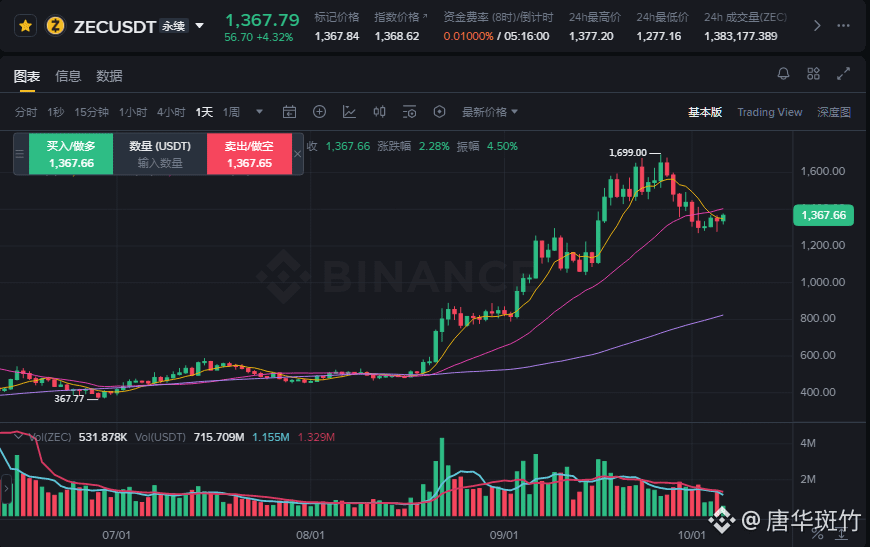
$ZEC This pullback from 1699 has been around 20%, bringing the current price to 1367. After a 15-fold rise, a 20% pullback honestly isn’t a big deal in crypto.
The moving averages on the chart are still in a bullish alignment, with the 50-day EMA firmly above the 200-day EMA. The RSI has retreated from the overbought zone into neutral-to-weak territory. The market could use a cool-down in the short term, but the medium-term trend structure remains intact. The daily MACD histogram has turned green, signaling short-term weakness, but the Bollinger Bands are narrowing, with the range over the last 30 candles compressed to under 5%. This kind of low-volatility compression often precedes a major move. Keep a close eye on the key support zone between 1280 and 1330, where the long-term moving averages converge. As long as the daily close stays above 1233, the uptrend remains intact.
The underlying drivers of this rally aren’t just speculation. The NU7 upgrade has been activated on the testnet, cutting block times from 75 seconds to 25 seconds—a 3x speedup—while reducing issuance per block to one-third, leaving actual daily supply growth unchanged. The community vote received 99.9% support, with 98.9% backing a Bitcoin-style halving, and the hard cap of 21 million coins is firmly in place. The shielded pool holds about 30% of the supply, so the actual circulating supply is considerably smaller than it may appear.
There have also been major regulatory developments. In January this year, the SEC officially closed its more-than-two-year investigation into the Zcash Foundation without filing any charges. After Grayscale’s ZCSH spot ETF was approved, it attracted net inflows of more than $300 million at one point. Although ETFs have seen $93 million in net outflows over the past week, that’s short-term profit-taking, not a signal of a trend reversal.
The broader market is providing a tailwind. Bitcoin is holding firmly above $85,000, up more than 40% in the third quarter, and Citi has raised its 12-month price target to $113,000. Core PCE came in below expectations, easing rate-hike pressure, while the floor under risk assets remains intact.
My take on trading: chasing the price at current levels doesn’t offer great risk-reward, but sitting on the sidelines with no position isn’t wise either. The 1280–1300 support zone is worth scaling into, with a stop-loss below 1233. If the price stabilizes around 1300 on rising volume, the first target is the 1500–1600 zone. Altcoin inflows to exchanges over the past seven days have hit their highest level since last October, so short-term profit-taking pressure is real. Don’t go all in—keep some powder dry in case of a wick. $ZEC #ZEC.每日智能策略
{spot}(ZECUSDT)
$ZEC This pullback from 1699 has been around 20%, bringing the current price to 1367. After a 15-fold rise, a 20% pullback honestly isn’t a big deal in crypto.
The moving averages on the chart are still in a bullish alignment, with the 50-day EMA firmly above the 200-day EMA. The RSI has retreated from the overbought zone into neutral-to-weak territory. The market could use a cool-down in the short term, but the medium-term trend structure remains intact. The daily MACD histogram has turned green, signaling short-term weakness, but the Bollinger Bands are narrowing, with the range over the last 30 candles compressed to under 5%. This kind of low-volatility compression often precedes a major move. Keep a close eye on the key support zone between 1280 and 1330, where the long-term moving averages converge. As long as the daily close stays above 1233, the uptrend remains intact.
The underlying drivers of this rally aren’t just speculation. The NU7 upgrade has been activated on the testnet, cutting block times from 75 seconds to 25 seconds—a 3x speedup—while reducing issuance per block to one-third, leaving actual daily supply growth unchanged. The community vote received 99.9% support, with 98.9% backing a Bitcoin-style halving, and the hard cap of 21 million coins is firmly in place. The shielded pool holds about 30% of the supply, so the actual circulating supply is considerably smaller than it may appear.
There have also been major regulatory developments. In January this year, the SEC officially closed its more-than-two-year investigation into the Zcash Foundation without filing any charges. After Grayscale’s ZCSH spot ETF was approved, it attracted net inflows of more than $300 million at one point. Although ETFs have seen $93 million in net outflows over the past week, that’s short-term profit-taking, not a signal of a trend reversal.
The broader market is providing a tailwind. Bitcoin is holding firmly above $85,000, up more than 40% in the third quarter, and Citi has raised its 12-month price target to $113,000. Core PCE came in below expectations, easing rate-hike pressure, while the floor under risk assets remains intact.
My take on trading: chasing the price at current levels doesn’t offer great risk-reward, but sitting on the sidelines with no position isn’t wise either. The 1280–1300 support zone is worth scaling into, with a stop-loss below 1233. If the price stabilizes around 1300 on rising volume, the first target is the 1500–1600 zone. Altcoin inflows to exchanges over the past seven days have hit their highest level since last October, so short-term profit-taking pressure is real. Don’t go all in—keep some powder dry in case of a wick. $ZEC #ZEC.每日智能策略
The moving averages on the chart are still in a bullish alignment, with the 50-day EMA firmly above the 200-day EMA. The RSI has retreated from the overbought zone into neutral-to-weak territory. The market could use a cool-down in the short term, but the medium-term trend structure remains intact. The daily MACD histogram has turned green, signaling short-term weakness, but the Bollinger Bands are narrowing, with the range over the last 30 candles compressed to under 5%. This kind of low-volatility compression often precedes a major move. Keep a close eye on the key support zone between 1280 and 1330, where the long-term moving averages converge. As long as the daily close stays above 1233, the uptrend remains intact.
The underlying drivers of this rally aren’t just speculation. The NU7 upgrade has been activated on the testnet, cutting block times from 75 seconds to 25 seconds—a 3x speedup—while reducing issuance per block to one-third, leaving actual daily supply growth unchanged. The community vote received 99.9% support, with 98.9% backing a Bitcoin-style halving, and the hard cap of 21 million coins is firmly in place. The shielded pool holds about 30% of the supply, so the actual circulating supply is considerably smaller than it may appear.
There have also been major regulatory developments. In January this year, the SEC officially closed its more-than-two-year investigation into the Zcash Foundation without filing any charges. After Grayscale’s ZCSH spot ETF was approved, it attracted net inflows of more than $300 million at one point. Although ETFs have seen $93 million in net outflows over the past week, that’s short-term profit-taking, not a signal of a trend reversal.
The broader market is providing a tailwind. Bitcoin is holding firmly above $85,000, up more than 40% in the third quarter, and Citi has raised its 12-month price target to $113,000. Core PCE came in below expectations, easing rate-hike pressure, while the floor under risk assets remains intact.
My take on trading: chasing the price at current levels doesn’t offer great risk-reward, but sitting on the sidelines with no position isn’t wise either. The 1280–1300 support zone is worth scaling into, with a stop-loss below 1233. If the price stabilizes around 1300 on rising volume, the first target is the 1500–1600 zone. Altcoin inflows to exchanges over the past seven days have hit their highest level since last October, so short-term profit-taking pressure is real. Don’t go all in—keep some powder dry in case of a wick. $ZEC #ZEC.每日智能策略
1
2.5k
·
--
Verified

Article
At KBW 2026, GOAT Network brought AI agent commerce off the slides and into the real worldAt KBW 2026, GOAT Network brought AI agent commerce off the slides and into the real world. As a Diamond Sponsor, @GOATNetwork set up an agent that could take orders at Booth 37 at Walkerhill, giving attendees a chance to experience the full process of “AI helping you shop, with payment confirmed on-chain.” More importantly, this wasn’t just a handful of people trying it out: 317 people initiated a purchase, and 300 completed one—a 95% completion rate. For most participants, this was their first time making a purchase through an AI agent.
The numbers speak more convincingly than any conceptual pitch. The on-site process was seamless: scan a QR code, log in with Kakao, choose a GOAT plush toy or Starbucks gift card, pay by bank card or crypto, then redeem it at the counter. 536 people completed the full check-in process, more than 1,000 pieces of merchandise were taken home, and 180 people entered the Golden Hour raffle, which gave away over 20 high-value prizes. The booth was almost constantly busy from opening to closing, showing that its appeal came not from gimmicks, but from a real product experience that worked from start to finish.
At KBW 2026, GOAT Network brought AI agent commerce off the slides and into the real world
At KBW 2026, GOAT Network brought AI agent commerce off the slides and into the real world. As a Diamond Sponsor, @GOATNetwork set up an agent that could take orders at Booth 37 at Walkerhill, giving attendees a chance to experience the full process of “AI helping you shop, with payment confirmed on-chain.” More importantly, this wasn’t just a handful of people trying it out: 317 people initiated a purchase, and 300 completed one—a 95% completion rate. For most participants, this was their first time making a purchase through an AI agent.
The numbers speak more convincingly than any conceptual pitch. The on-site process was seamless: scan a QR code, log in with Kakao, choose a GOAT plush toy or Starbucks gift card, pay by bank card or crypto, then redeem it at the counter. 536 people completed the full check-in process, more than 1,000 pieces of merchandise were taken home, and 180 people entered the Golden Hour raffle, which gave away over 20 high-value prizes. The booth was almost constantly busy from opening to closing, showing that its appeal came not from gimmicks, but from a real product experience that worked from start to finish.
The numbers speak more convincingly than any conceptual pitch. The on-site process was seamless: scan a QR code, log in with Kakao, choose a GOAT plush toy or Starbucks gift card, pay by bank card or crypto, then redeem it at the counter. 536 people completed the full check-in process, more than 1,000 pieces of merchandise were taken home, and 180 people entered the Golden Hour raffle, which gave away over 20 high-value prizes. The booth was almost constantly busy from opening to closing, showing that its appeal came not from gimmicks, but from a real product experience that worked from start to finish.
1.1k
·
--
Bullish
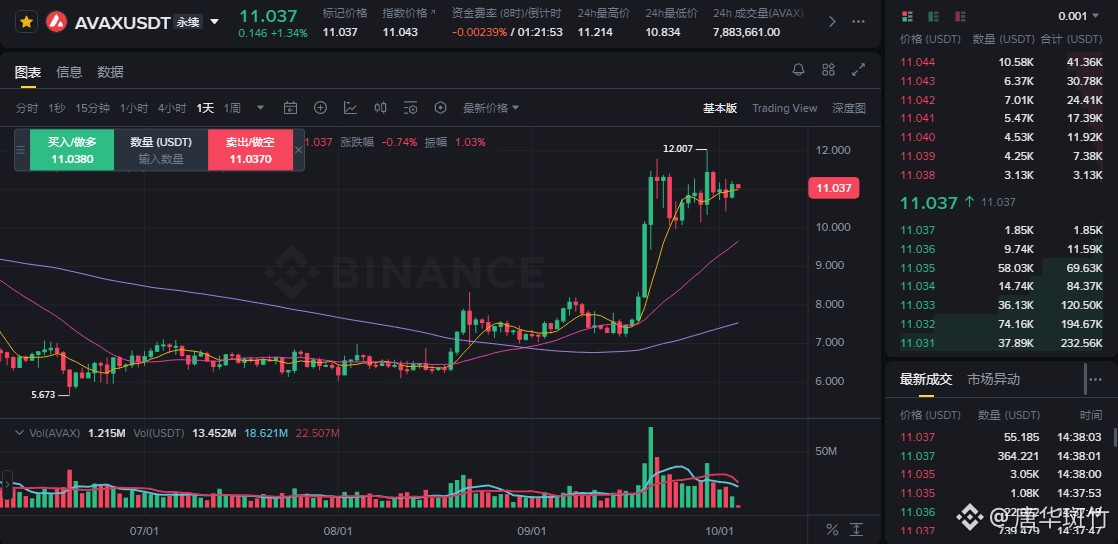
Talk through the picture. $AVAX This daily candlestick has pulled from 5.67 in mid-September all the way to 12.007, and then it started to move sideways. Now it’s at 11.037. The leaderboard shows it gained 59% over the past month—that’s pretty strong. But if you look closely at the candlesticks, the last few days have all been small bodies, and the upper wicks are especially long. At the 11.27 level, the bulls tried twice but couldn’t break through.
The moving averages are well aligned on the bullish side—7/25/99/200 are all underneath, which does make the structure look good.
But the macro picture is off-balance. The 10-year U.S. Treasury yield is still hovering above 5.2%. If you can just hold Treasuries and earn around 5% interest lying down, who would be willing to take risks in the crypto market? Even Bitcoin itself has been grinding back and forth between 84,000 and 87,000, unable to go higher or lower. The “big pie” isn’t taking the lead, so it’s not easy for altcoins to break out into an independent trend.
That said, AVAX really does have a few cards that other chains don’t. Goldman’s $100B Treasury fund runs through Lynq on Avalanche, and tZERO—an SEC-registered broker-dealer—handles settlement. This isn’t just concept hype; the real institutional rails have already started moving. In September, the tokenized stock market cap increased by $246 million, ranking first across the whole chain in percentage growth. The Helicon upgrade reduces collateral unlock from 14 days to 48 hours, dramatically improving how flexibly institutional funds can enter and exit. These are the real catalysts behind the move from around 8 to 12—not just following BTC.
As for action, my view is very direct:
11.27 is the watershed. If the daily closes higher with strong volume, the next target is 12.5–13, where the upper band line is waiting. If it keeps grinding here, don’t blindly chase—wait for a pullback to the 10.5–10.8 range before considering entries. Place the stop-loss at 10.04. If it breaks, own up and leave—don’t stubbornly hold.
#AVAX has a market cap of 490 million now; compared with SOL’s 70 billion, the upside is definitely larger. But on the flip side, when it dumps it won’t hold back either. Don’t get carried away—control your position size. #比特币冲击8.7万美元遇阻回落
{spot}(AVAXUSDT)
Talk through the picture. $AVAX This daily candlestick has pulled from 5.67 in mid-September all the way to 12.007, and then it started to move sideways. Now it’s at 11.037. The leaderboard shows it gained 59% over the past month—that’s pretty strong. But if you look closely at the candlesticks, the last few days have all been small bodies, and the upper wicks are especially long. At the 11.27 level, the bulls tried twice but couldn’t break through.
The moving averages are well aligned on the bullish side—7/25/99/200 are all underneath, which does make the structure look good.
But the macro picture is off-balance. The 10-year U.S. Treasury yield is still hovering above 5.2%. If you can just hold Treasuries and earn around 5% interest lying down, who would be willing to take risks in the crypto market? Even Bitcoin itself has been grinding back and forth between 84,000 and 87,000, unable to go higher or lower. The “big pie” isn’t taking the lead, so it’s not easy for altcoins to break out into an independent trend.
That said, AVAX really does have a few cards that other chains don’t. Goldman’s $100B Treasury fund runs through Lynq on Avalanche, and tZERO—an SEC-registered broker-dealer—handles settlement. This isn’t just concept hype; the real institutional rails have already started moving. In September, the tokenized stock market cap increased by $246 million, ranking first across the whole chain in percentage growth. The Helicon upgrade reduces collateral unlock from 14 days to 48 hours, dramatically improving how flexibly institutional funds can enter and exit. These are the real catalysts behind the move from around 8 to 12—not just following BTC.
As for action, my view is very direct:
11.27 is the watershed. If the daily closes higher with strong volume, the next target is 12.5–13, where the upper band line is waiting. If it keeps grinding here, don’t blindly chase—wait for a pullback to the 10.5–10.8 range before considering entries. Place the stop-loss at 10.04. If it breaks, own up and leave—don’t stubbornly hold.
#AVAX has a market cap of 490 million now; compared with SOL’s 70 billion, the upside is definitely larger. But on the flip side, when it dumps it won’t hold back either. Don’t get carried away—control your position size. #比特币冲击8.7万美元遇阻回落
The moving averages are well aligned on the bullish side—7/25/99/200 are all underneath, which does make the structure look good.
But the macro picture is off-balance. The 10-year U.S. Treasury yield is still hovering above 5.2%. If you can just hold Treasuries and earn around 5% interest lying down, who would be willing to take risks in the crypto market? Even Bitcoin itself has been grinding back and forth between 84,000 and 87,000, unable to go higher or lower. The “big pie” isn’t taking the lead, so it’s not easy for altcoins to break out into an independent trend.
That said, AVAX really does have a few cards that other chains don’t. Goldman’s $100B Treasury fund runs through Lynq on Avalanche, and tZERO—an SEC-registered broker-dealer—handles settlement. This isn’t just concept hype; the real institutional rails have already started moving. In September, the tokenized stock market cap increased by $246 million, ranking first across the whole chain in percentage growth. The Helicon upgrade reduces collateral unlock from 14 days to 48 hours, dramatically improving how flexibly institutional funds can enter and exit. These are the real catalysts behind the move from around 8 to 12—not just following BTC.
As for action, my view is very direct:
11.27 is the watershed. If the daily closes higher with strong volume, the next target is 12.5–13, where the upper band line is waiting. If it keeps grinding here, don’t blindly chase—wait for a pullback to the 10.5–10.8 range before considering entries. Place the stop-loss at 10.04. If it breaks, own up and leave—don’t stubbornly hold.
#AVAX has a market cap of 490 million now; compared with SOL’s 70 billion, the upside is definitely larger. But on the flip side, when it dumps it won’t hold back either. Don’t get carried away—control your position size. #比特币冲击8.7万美元遇阻回落
2
1
2.7k
·
--
Bullish
Verified
Friends with USDC.e, USDT or WETH on the GOAT Network—take two minutes to check this out and don’t miss the deadline!
If you currently hold USDC.e, USDT, or WETH on the GOAT chain, make sure to bridge your assets out via @StargateFinance before 2026‑10‑23.
Because Stargate and @LayerZero_Labs are gradually terminating support for more than 25 chains, cross-chain message transmission on the GOAT Network will move to independent infrastructure. These coins on @GOATNetwork were issued by Stargate, and afterward there will be no other redemption routes—there is a risk that funds cannot be recovered.
❗If these coins are still sitting in DeFi positions such as mining pools or lending, remember to redeem them back to your wallet first, then do the cross-chain operations.
✅ Assets not affected on the GOAT chain: BTC, GOATED, BTCB, DOGEB—you can hold them with confidence.
Also, for developers performing cross-chain operations on the GOAT Network: be sure to complete the migration of LayerZero V2 DVN and the Executor before October 30, 2026.
We recommend bridging to Ethereum, Arbitrum, Base, or BNB Chain—these networks have deep liquidity and fast fund arrival. Don’t wait until the last day or two; the closer you get to the deadline, the tighter liquidity may become—don’t take it lightly.
Full announcement: https://goat.network/news/stargate-sunset-and-layerzero-v2-dvn-executor-migration?nocache
If you have questions, consult the official Discord. $GOATED
{alpha}(560x5d7909f951436d4e6974d841316057df3a622962)
Friends with USDC.e, USDT or WETH on the GOAT Network—take two minutes to check this out and don’t miss the deadline!
If you currently hold USDC.e, USDT, or WETH on the GOAT chain, make sure to bridge your assets out via @StargateFinance before 2026‑10‑23.
Because Stargate and @LayerZero_Labs are gradually terminating support for more than 25 chains, cross-chain message transmission on the GOAT Network will move to independent infrastructure. These coins on @GOATNetwork were issued by Stargate, and afterward there will be no other redemption routes—there is a risk that funds cannot be recovered.
❗If these coins are still sitting in DeFi positions such as mining pools or lending, remember to redeem them back to your wallet first, then do the cross-chain operations.
✅ Assets not affected on the GOAT chain: BTC, GOATED, BTCB, DOGEB—you can hold them with confidence.
Also, for developers performing cross-chain operations on the GOAT Network: be sure to complete the migration of LayerZero V2 DVN and the Executor before October 30, 2026.
We recommend bridging to Ethereum, Arbitrum, Base, or BNB Chain—these networks have deep liquidity and fast fund arrival. Don’t wait until the last day or two; the closer you get to the deadline, the tighter liquidity may become—don’t take it lightly.
Full announcement: https://goat.network/news/stargate-sunset-and-layerzero-v2-dvn-executor-migration?nocache
If you have questions, consult the official Discord. $GOATED
If you currently hold USDC.e, USDT, or WETH on the GOAT chain, make sure to bridge your assets out via @StargateFinance before 2026‑10‑23.
Because Stargate and @LayerZero_Labs are gradually terminating support for more than 25 chains, cross-chain message transmission on the GOAT Network will move to independent infrastructure. These coins on @GOATNetwork were issued by Stargate, and afterward there will be no other redemption routes—there is a risk that funds cannot be recovered.
❗If these coins are still sitting in DeFi positions such as mining pools or lending, remember to redeem them back to your wallet first, then do the cross-chain operations.
✅ Assets not affected on the GOAT chain: BTC, GOATED, BTCB, DOGEB—you can hold them with confidence.
Also, for developers performing cross-chain operations on the GOAT Network: be sure to complete the migration of LayerZero V2 DVN and the Executor before October 30, 2026.
We recommend bridging to Ethereum, Arbitrum, Base, or BNB Chain—these networks have deep liquidity and fast fund arrival. Don’t wait until the last day or two; the closer you get to the deadline, the tighter liquidity may become—don’t take it lightly.
Full announcement: https://goat.network/news/stargate-sunset-and-layerzero-v2-dvn-executor-migration?nocache
If you have questions, consult the official Discord. $GOATED

2
3
3.3k
·
--
With these beats—this fixes all kinds of discomfort! Lately I can’t stop listening to this in the middle of the night, what’s going on? $BNB
With these beats—this fixes all kinds of discomfort! Lately I can’t stop listening to this in the middle of the night, what’s going on? $BNB
2
6
10k
·
--
Bearish
Verified
The latest macroeconomic data really feels like a roller coaster. In the U.S., August PPI year-on-year rose to 5.4%, and CPI also came in at 3.4%. Inflation persistence is stronger than expected, and in September the Federal Reserve already raised rates by 25 bp, bringing the policy rate to the 3.75%-4% range.
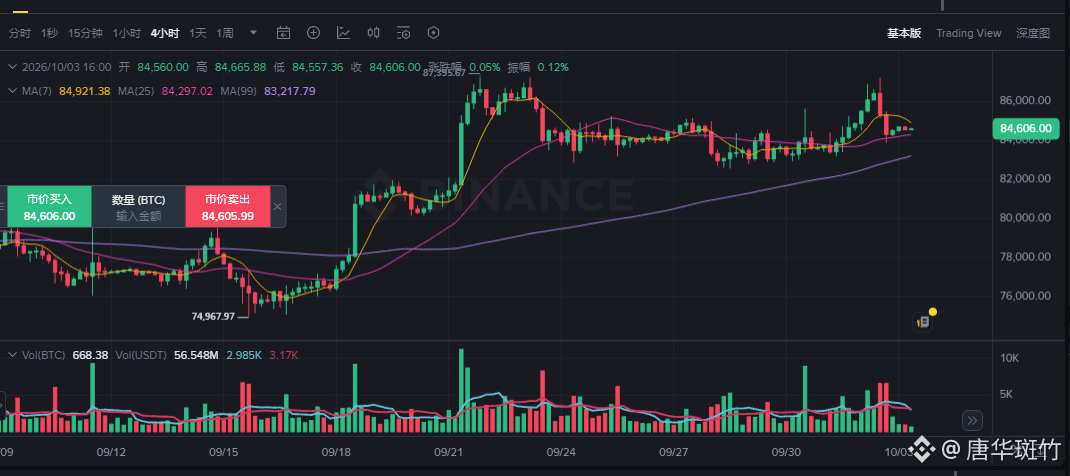
However, the latest September nonfarm payrolls added only 29,000 jobs, far below expectations. Market expectations for further rate hikes in October have cooled significantly. So what does this mean? Volatility may increase, but the direction is not necessarily a one-way decline. Tech stocks are still hitting new highs, and Bitcoin has climbed above $85,000. Even Citigroup has raised its target price to $113,000. $BTC
{spot}(BTCUSDT)
The latest macroeconomic data really feels like a roller coaster. In the U.S., August PPI year-on-year rose to 5.4%, and CPI also came in at 3.4%. Inflation persistence is stronger than expected, and in September the Federal Reserve already raised rates by 25 bp, bringing the policy rate to the 3.75%-4% range.
However, the latest September nonfarm payrolls added only 29,000 jobs, far below expectations. Market expectations for further rate hikes in October have cooled significantly. So what does this mean? Volatility may increase, but the direction is not necessarily a one-way decline. Tech stocks are still hitting new highs, and Bitcoin has climbed above $85,000. Even Citigroup has raised its target price to $113,000. $BTC
However, the latest September nonfarm payrolls added only 29,000 jobs, far below expectations. Market expectations for further rate hikes in October have cooled significantly. So what does this mean? Volatility may increase, but the direction is not necessarily a one-way decline. Tech stocks are still hitting new highs, and Bitcoin has climbed above $85,000. Even Citigroup has raised its target price to $113,000. $BTC
1.4k
·
--
Bearish
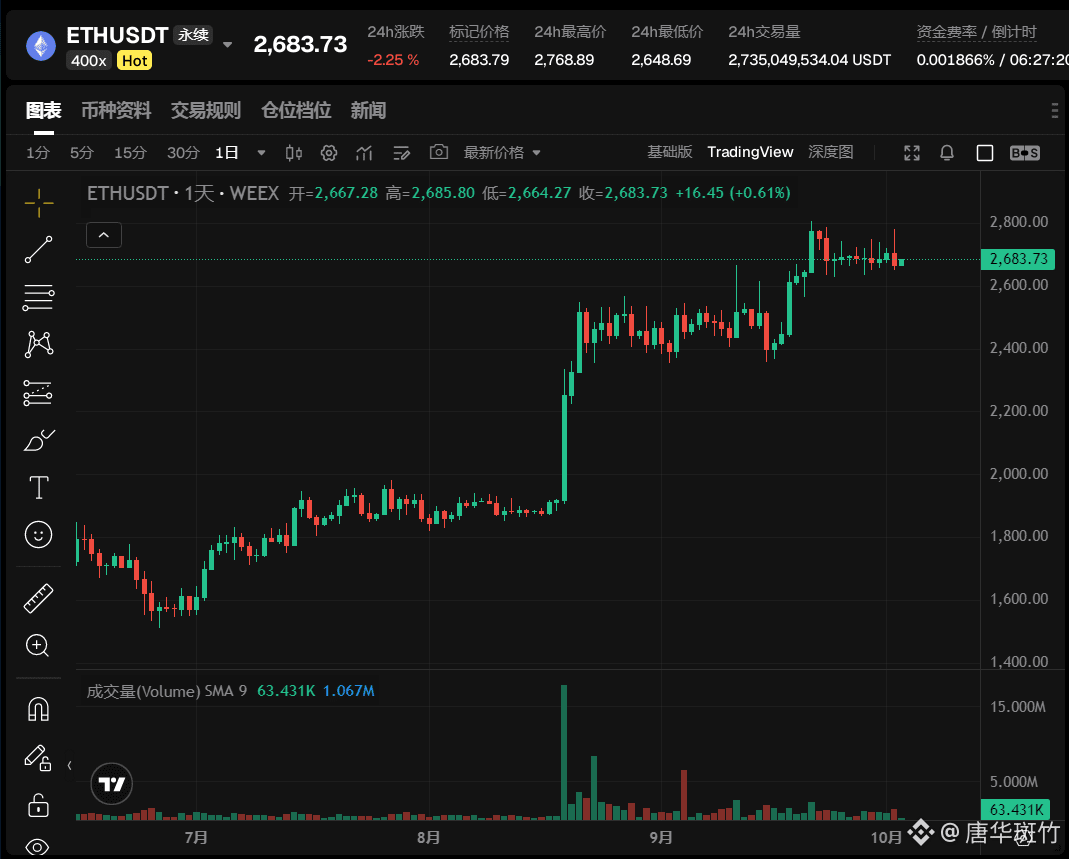
ETH is now up to 2682. On the daily chart it still looks like it’s in an uptrend, but in the short term it’s showing a pullback. The MACD has formed a dead cross and momentum is a bit weaker. In terms of execution, don’t chase the price up. Wait for a pullback to around 2620–2650 and then consider entering long positions in batches once it stabilizes. Set the stop-loss below 2500. The overall outlook is still bullish, but you need to be steady—don’t rush.
Be sure to focus on the upcoming U.S. Non-Farm Payrolls and the CPI report on October 14. These macro data could act as catalysts that break the current consolidation range. During the sideways movement, open interest has been gradually bleeding off; deleveraging is quietly underway. Once a clear direction is confirmed, the daily volatility could far exceed the normal range implied by the ATR ($85).
The market is currently in a quiet period before a turning point. Retail long positions are crowded, which contrasts sharply with the cautious stance of “smart money.” Historically, this kind of positioning divergence often ends with a shakeout that flushes out retail positions. Managing position size and strictly adhering to stop-losses are the most important trading disciplines in this environment. $ETH #比特币涨至8.65万美元后回落
{spot}(ETHUSDT)
ETH is now up to 2682. On the daily chart it still looks like it’s in an uptrend, but in the short term it’s showing a pullback. The MACD has formed a dead cross and momentum is a bit weaker. In terms of execution, don’t chase the price up. Wait for a pullback to around 2620–2650 and then consider entering long positions in batches once it stabilizes. Set the stop-loss below 2500. The overall outlook is still bullish, but you need to be steady—don’t rush.
Be sure to focus on the upcoming U.S. Non-Farm Payrolls and the CPI report on October 14. These macro data could act as catalysts that break the current consolidation range. During the sideways movement, open interest has been gradually bleeding off; deleveraging is quietly underway. Once a clear direction is confirmed, the daily volatility could far exceed the normal range implied by the ATR ($85).
The market is currently in a quiet period before a turning point. Retail long positions are crowded, which contrasts sharply with the cautious stance of “smart money.” Historically, this kind of positioning divergence often ends with a shakeout that flushes out retail positions. Managing position size and strictly adhering to stop-losses are the most important trading disciplines in this environment. $ETH #比特币涨至8.65万美元后回落
Be sure to focus on the upcoming U.S. Non-Farm Payrolls and the CPI report on October 14. These macro data could act as catalysts that break the current consolidation range. During the sideways movement, open interest has been gradually bleeding off; deleveraging is quietly underway. Once a clear direction is confirmed, the daily volatility could far exceed the normal range implied by the ATR ($85).
The market is currently in a quiet period before a turning point. Retail long positions are crowded, which contrasts sharply with the cautious stance of “smart money.” Historically, this kind of positioning divergence often ends with a shakeout that flushes out retail positions. Managing position size and strictly adhering to stop-losses are the most important trading disciplines in this environment. $ETH #比特币涨至8.65万美元后回落
1.5k
·
--
Bearish
Verified
Analysis: Binance expands cooperation with Circle; USDC may further challenge USDT
Binance and Circle have signed a new five-year commercial agreement and invested $100 million to purchase Circle shares, which will further expand USDC’s coverage in emerging markets and global trading, and exert greater pressure on Tether’s long-standing dominance in USDT.
Data show that when the two first partnered in December 2024, Binance provided 140 USDC-denominated spot trading markets; this has since increased to 329. Binance’s monthly USDC trading volume also rose from about $20 billion–$30 billion before the partnership to $40 billion–$80 billion, and has continued to exceed $80 billion.
Kaiko research director Anastasia Melachrinos said that since 2026, Binance has continued to account for the largest share of USDC spot trading activity, with daily trading volume of $5 billion to $10 billion—about 10 to 20 times that of most other exchanges. Analysts also noted that USDT’s current market cap is about $140 billion, still clearly higher than USDC’s roughly $74 billion. The trading pairs, local liquidity, and user habits that USDT has accumulated over many years in global trading and payments will be difficult to change in the short term. $BNB
{spot}(BNBUSDT)
Analysis: Binance expands cooperation with Circle; USDC may further challenge USDT
Binance and Circle have signed a new five-year commercial agreement and invested $100 million to purchase Circle shares, which will further expand USDC’s coverage in emerging markets and global trading, and exert greater pressure on Tether’s long-standing dominance in USDT.
Data show that when the two first partnered in December 2024, Binance provided 140 USDC-denominated spot trading markets; this has since increased to 329. Binance’s monthly USDC trading volume also rose from about $20 billion–$30 billion before the partnership to $40 billion–$80 billion, and has continued to exceed $80 billion.
Kaiko research director Anastasia Melachrinos said that since 2026, Binance has continued to account for the largest share of USDC spot trading activity, with daily trading volume of $5 billion to $10 billion—about 10 to 20 times that of most other exchanges. Analysts also noted that USDT’s current market cap is about $140 billion, still clearly higher than USDC’s roughly $74 billion. The trading pairs, local liquidity, and user habits that USDT has accumulated over many years in global trading and payments will be difficult to change in the short term. $BNB
Binance and Circle have signed a new five-year commercial agreement and invested $100 million to purchase Circle shares, which will further expand USDC’s coverage in emerging markets and global trading, and exert greater pressure on Tether’s long-standing dominance in USDT.
Data show that when the two first partnered in December 2024, Binance provided 140 USDC-denominated spot trading markets; this has since increased to 329. Binance’s monthly USDC trading volume also rose from about $20 billion–$30 billion before the partnership to $40 billion–$80 billion, and has continued to exceed $80 billion.
Kaiko research director Anastasia Melachrinos said that since 2026, Binance has continued to account for the largest share of USDC spot trading activity, with daily trading volume of $5 billion to $10 billion—about 10 to 20 times that of most other exchanges. Analysts also noted that USDT’s current market cap is about $140 billion, still clearly higher than USDC’s roughly $74 billion. The trading pairs, local liquidity, and user habits that USDT has accumulated over many years in global trading and payments will be difficult to change in the short term. $BNB
1
1.8k
·
--
Bearish
CZ: Does not oppose Hyperliquid; welcomes more DEXs to join the competition
CZ said that he does not oppose Hyperliquid, and welcomes more centralized and decentralized trading platforms to participate in innovation, believing that the crypto industry is still in its early stage.
CZ said that it is normal competition for some members of the Hyperliquid community to criticize centralized exchanges and the community that Binance has built; assets such as HYPE, BNB, and Bitcoin may also benefit from the industry’s overall growth. He also said that the first mover is not necessarily the long-term biggest winner. $BNB
{spot}(BNBUSDT)
CZ: Does not oppose Hyperliquid; welcomes more DEXs to join the competition
CZ said that he does not oppose Hyperliquid, and welcomes more centralized and decentralized trading platforms to participate in innovation, believing that the crypto industry is still in its early stage.
CZ said that it is normal competition for some members of the Hyperliquid community to criticize centralized exchanges and the community that Binance has built; assets such as HYPE, BNB, and Bitcoin may also benefit from the industry’s overall growth. He also said that the first mover is not necessarily the long-term biggest winner. $BNB
CZ said that he does not oppose Hyperliquid, and welcomes more centralized and decentralized trading platforms to participate in innovation, believing that the crypto industry is still in its early stage.
CZ said that it is normal competition for some members of the Hyperliquid community to criticize centralized exchanges and the community that Binance has built; assets such as HYPE, BNB, and Bitcoin may also benefit from the industry’s overall growth. He also said that the first mover is not necessarily the long-term biggest winner. $BNB
1
1.4k
·
--
Bearish
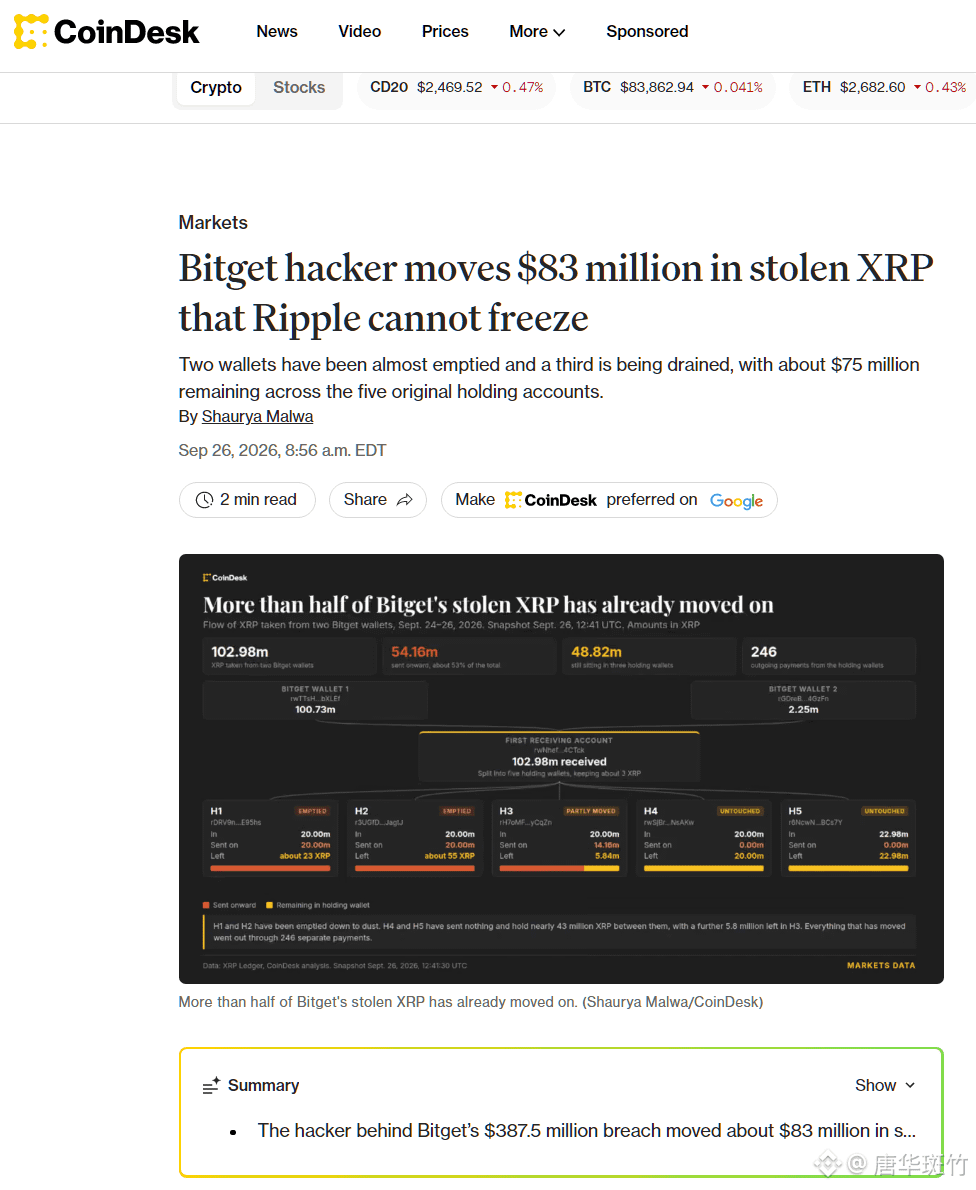
Getting close to $100 million is tough—Ripple says it can’t freeze the $83 million worth of XRP stolen from Bitget after a hacker attack
Planet Daily News: Crypto exchange Bitget was severely attacked by hackers recently, resulting in the theft of XRP valued at up to $83 million. On-chain data analysis shows that after the incident, the hackers quickly acted and completed the cross-address transfer of large amounts of funds. Bitget has now confirmed the major security incident and is cooperating with the police to conduct an investigation.
Regarding the issue of recovering the assets, Ripple said in response that, due to the decentralized design of the underlying XRP chain, the company has no technical means to force-freeze a specific external account. Even if law enforcement agencies intervene, it cannot be operated. This means the effort to track down the stolen funds will fall entirely on Bitget and its contracted security team. (CoinDesk) $XRP
{spot}(XRPUSDT)
Getting close to $100 million is tough—Ripple says it can’t freeze the $83 million worth of XRP stolen from Bitget after a hacker attack
Planet Daily News: Crypto exchange Bitget was severely attacked by hackers recently, resulting in the theft of XRP valued at up to $83 million. On-chain data analysis shows that after the incident, the hackers quickly acted and completed the cross-address transfer of large amounts of funds. Bitget has now confirmed the major security incident and is cooperating with the police to conduct an investigation.
Regarding the issue of recovering the assets, Ripple said in response that, due to the decentralized design of the underlying XRP chain, the company has no technical means to force-freeze a specific external account. Even if law enforcement agencies intervene, it cannot be operated. This means the effort to track down the stolen funds will fall entirely on Bitget and its contracted security team. (CoinDesk) $XRP
Planet Daily News: Crypto exchange Bitget was severely attacked by hackers recently, resulting in the theft of XRP valued at up to $83 million. On-chain data analysis shows that after the incident, the hackers quickly acted and completed the cross-address transfer of large amounts of funds. Bitget has now confirmed the major security incident and is cooperating with the police to conduct an investigation.
Regarding the issue of recovering the assets, Ripple said in response that, due to the decentralized design of the underlying XRP chain, the company has no technical means to force-freeze a specific external account. Even if law enforcement agencies intervene, it cannot be operated. This means the effort to track down the stolen funds will fall entirely on Bitget and its contracted security team. (CoinDesk) $XRP
2
1
5.3k
·
--
Bearish
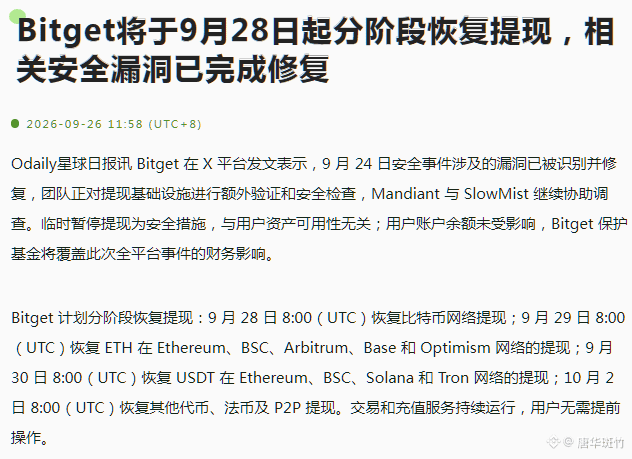
Bitget announced that it will gradually resume withdrawals starting from September 28, and said that the related security vulnerabilities have been fully fixed. There’s nothing we can do—if everyone is anxious, it won’t help. Just wait until the day after tomorrow, September 28, 4:00 PM Beijing time. On that day, only BTC network withdrawals will be available; other chains will be opened up one by one gradually. Most tokens, fiat, and P2P will have to wait until the evening of October 2. It feels like we’re crossing a river by feeling the stones—careful and uneasy—like we still don’t have full confidence.
Comparing #Bitget’s hacked incident with the Bybit hacked incident, the two are clearly very different. The biggest difference is that Bybit decisively withstood the pressure and clearly refused to suspend withdrawals—there wasn’t even a one-second pause. Its CEO, @benbybit, showed astonishing boldness and confidence, quickly stabilizing the situation. Even better, the disaster turned into a blessing, turning the hacked incident into a big advertisement showcasing Bybit’s strong capabilities and its reputation and responsibility. Meanwhile, after Bitget was hacked, it chose to immediately shut down withdrawals. The difference between the two is like heaven and earth.
Another difference is that Bybit only had an ETH single-chain issue. After the incident, @Bybit_ZH almost immediately traced and identified the cause and published it, and the vulnerability was patched right away—withdrawals continued as normal throughout the period. For Bitget, almost all chains’ tokens were all-in at once. After the incident, Bitget seemed a bit stunned. To this day, it hasn’t announced a clear, explicit cause. It only says the vulnerability has been fixed, but the resumption of withdrawals is still cautious and staggered. So it still leaves people a bit worried—worried whether all security vulnerabilities truly have been eliminated. What if, after withdrawals are reopened, the hackers break in again and the situation spirals out of control, leading to another sudden stop of withdrawals? That would be a real headache. $BB
{spot}(BBUSDT)
Bitget announced that it will gradually resume withdrawals starting from September 28, and said that the related security vulnerabilities have been fully fixed. There’s nothing we can do—if everyone is anxious, it won’t help. Just wait until the day after tomorrow, September 28, 4:00 PM Beijing time. On that day, only BTC network withdrawals will be available; other chains will be opened up one by one gradually. Most tokens, fiat, and P2P will have to wait until the evening of October 2. It feels like we’re crossing a river by feeling the stones—careful and uneasy—like we still don’t have full confidence.
Comparing #Bitget’s hacked incident with the Bybit hacked incident, the two are clearly very different. The biggest difference is that Bybit decisively withstood the pressure and clearly refused to suspend withdrawals—there wasn’t even a one-second pause. Its CEO, @benbybit, showed astonishing boldness and confidence, quickly stabilizing the situation. Even better, the disaster turned into a blessing, turning the hacked incident into a big advertisement showcasing Bybit’s strong capabilities and its reputation and responsibility. Meanwhile, after Bitget was hacked, it chose to immediately shut down withdrawals. The difference between the two is like heaven and earth.
Another difference is that Bybit only had an ETH single-chain issue. After the incident, @Bybit_ZH almost immediately traced and identified the cause and published it, and the vulnerability was patched right away—withdrawals continued as normal throughout the period. For Bitget, almost all chains’ tokens were all-in at once. After the incident, Bitget seemed a bit stunned. To this day, it hasn’t announced a clear, explicit cause. It only says the vulnerability has been fixed, but the resumption of withdrawals is still cautious and staggered. So it still leaves people a bit worried—worried whether all security vulnerabilities truly have been eliminated. What if, after withdrawals are reopened, the hackers break in again and the situation spirals out of control, leading to another sudden stop of withdrawals? That would be a real headache. $BB
Comparing #Bitget’s hacked incident with the Bybit hacked incident, the two are clearly very different. The biggest difference is that Bybit decisively withstood the pressure and clearly refused to suspend withdrawals—there wasn’t even a one-second pause. Its CEO, @benbybit, showed astonishing boldness and confidence, quickly stabilizing the situation. Even better, the disaster turned into a blessing, turning the hacked incident into a big advertisement showcasing Bybit’s strong capabilities and its reputation and responsibility. Meanwhile, after Bitget was hacked, it chose to immediately shut down withdrawals. The difference between the two is like heaven and earth.
Another difference is that Bybit only had an ETH single-chain issue. After the incident, @Bybit_ZH almost immediately traced and identified the cause and published it, and the vulnerability was patched right away—withdrawals continued as normal throughout the period. For Bitget, almost all chains’ tokens were all-in at once. After the incident, Bitget seemed a bit stunned. To this day, it hasn’t announced a clear, explicit cause. It only says the vulnerability has been fixed, but the resumption of withdrawals is still cautious and staggered. So it still leaves people a bit worried—worried whether all security vulnerabilities truly have been eliminated. What if, after withdrawals are reopened, the hackers break in again and the situation spirals out of control, leading to another sudden stop of withdrawals? That would be a real headache. $BB
6
10
76
38.9k
Log in to explore more content
Join global crypto users on Binance Square
⚡️ Get latest and useful information about crypto.
💬 Trusted by the world’s largest crypto exchange.
👍 Discover real insights from verified creators.
Email / Phone number
Trending Topics
FedMinutesFocusOnOctoberPause
354 views
74 Discussing
#FedMinutesFocusOnOctoberPause
Market expectations have dramatically shifted toward an October pause as investors await the release of the Federal Reserve’s September meeting minutes. While the Federal Open Market Committee (FOMC) unanimously raised the benchmark interest rate by 25 basis points to a 3.75%–4.00% range last month, cooling economic indicators have drastically reshaped the macroeconomic landscape. [1, 2, 3, 4]
Following softer-than-expected August PCE inflation data and a notably weak September non-farm payrolls report, traders have slashed the probability of an October rate increase to roughly 22%. The hashtag #FedMinutesFocusOnOctoberPause highlights the market's intense scrutiny of today's minutes to gauge whether internal policymakers were already leaning toward a patient, data-dependent pause before the recent weak data dropped. [1, 2]
$MSFTB
$JPMB
$KITE
#October10Crash
#fedinterest
#OctoberMarketUp
zoni-11c22
·0 Likes
·42 views
BinanceLaunchesBinanceIntelligence
860,366 views
5,327 Discussing
RobinhoodAdds$25MInBitcoinToBalanceSheet
65 views
9 Discussing