
云漫说区块2
10 Posts

云漫说区块2
公众号:凉木说区块;抖音:yuukii1000x
0 Following
0 Followers
3 Liked
Posts
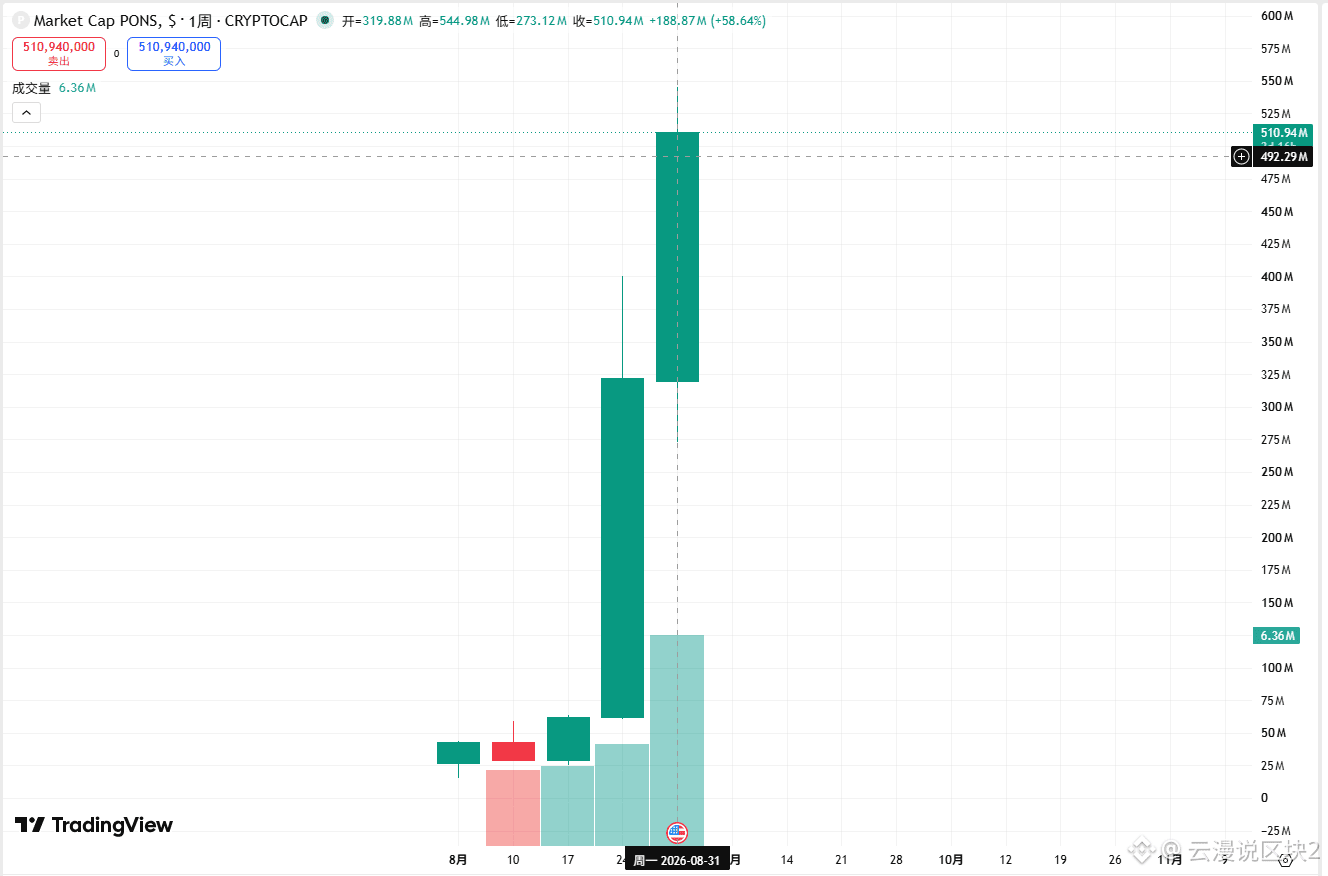
PONS this market cap chart is quite interesting.
From the trend, the market cap overall stays around 500 million USD. Recently, there hasn’t been any major fluctuation, which suggests the market’s valuation of the project is relatively stable. Trading volume is only 6.36 million, the turnover rate is on the low side, and the concentration of holdings is high—so liquidity is merely average.
Big moves are coming from the Robinhood or Arcus side behind the scenes. In the short term, keep an eye on whether trading volume shows signs of picking up—if there’s no volume, there’s no action.
From the trend, the market cap overall stays around 500 million USD. Recently, there hasn’t been any major fluctuation, which suggests the market’s valuation of the project is relatively stable. Trading volume is only 6.36 million, the turnover rate is on the low side, and the concentration of holdings is high—so liquidity is merely average.
Big moves are coming from the Robinhood or Arcus side behind the scenes. In the short term, keep an eye on whether trading volume shows signs of picking up—if there’s no volume, there’s no action.
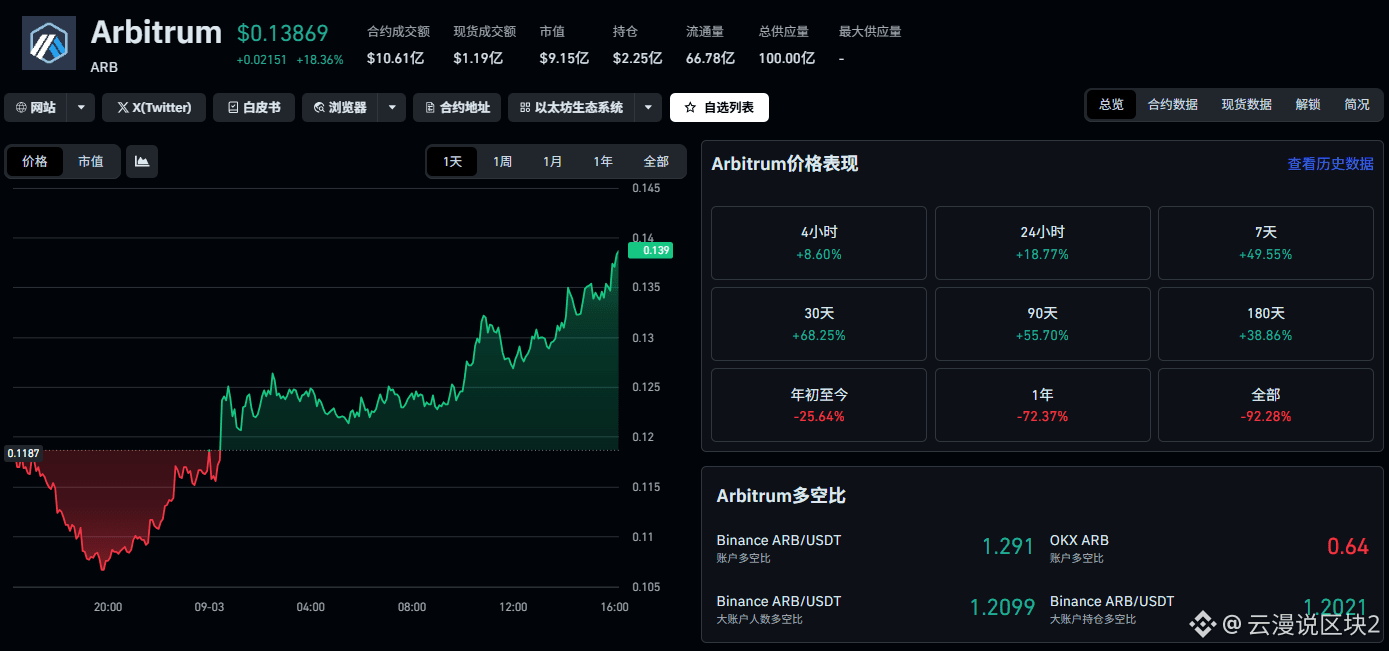
ARB surged up 18% today, quoted at 0.138. Over the past 7 days it has risen nearly 50%, and over 30 days it’s up 68%—from around 0.07 at the bottom it essentially doubled.
This upswing has several drivers. First, the broader market is recovering: BTC has held steady at 77,000 and ETH is back to 2,400, with funds beginning to flow back into the L2 sector. Second, Arbitrum’s ecosystem has been very active recently; on-chain activity is picking up again, and both gas consumption and transaction volume are increasing. Third, ARB had fallen too hard before—down 92% from its peak. The chips have been cleaned out very thoroughly, so once selling pressure is exhausted, the rebound strength naturally follows.
The long/short ratio is 1.29: retail investors are slightly more bullish, but not at an extreme. Large-account positioning has a long/short ratio of 1.2, and institutional allocations are relatively restrained—suggesting this rebound still has room to run.
On the technical side, 0.12 has turned from resistance into support. The next target looks to be the 0.15–0.16 area. However, a reminder: ARB’s total supply is 10 billion. Currently 6.678 billion is in circulation, and there will be further unlock pressure later on. For long-term holders, you need to keep an eye on this variable.
Overall, the L2 sector is warming up again. OP has also been rising lately. As an L2 leader, if the broader market holds, this rebound reaching 0.15 is possible.
This upswing has several drivers. First, the broader market is recovering: BTC has held steady at 77,000 and ETH is back to 2,400, with funds beginning to flow back into the L2 sector. Second, Arbitrum’s ecosystem has been very active recently; on-chain activity is picking up again, and both gas consumption and transaction volume are increasing. Third, ARB had fallen too hard before—down 92% from its peak. The chips have been cleaned out very thoroughly, so once selling pressure is exhausted, the rebound strength naturally follows.
The long/short ratio is 1.29: retail investors are slightly more bullish, but not at an extreme. Large-account positioning has a long/short ratio of 1.2, and institutional allocations are relatively restrained—suggesting this rebound still has room to run.
On the technical side, 0.12 has turned from resistance into support. The next target looks to be the 0.15–0.16 area. However, a reminder: ARB’s total supply is 10 billion. Currently 6.678 billion is in circulation, and there will be further unlock pressure later on. For long-term holders, you need to keep an eye on this variable.
Overall, the L2 sector is warming up again. OP has also been rising lately. As an L2 leader, if the broader market holds, this rebound reaching 0.15 is possible.
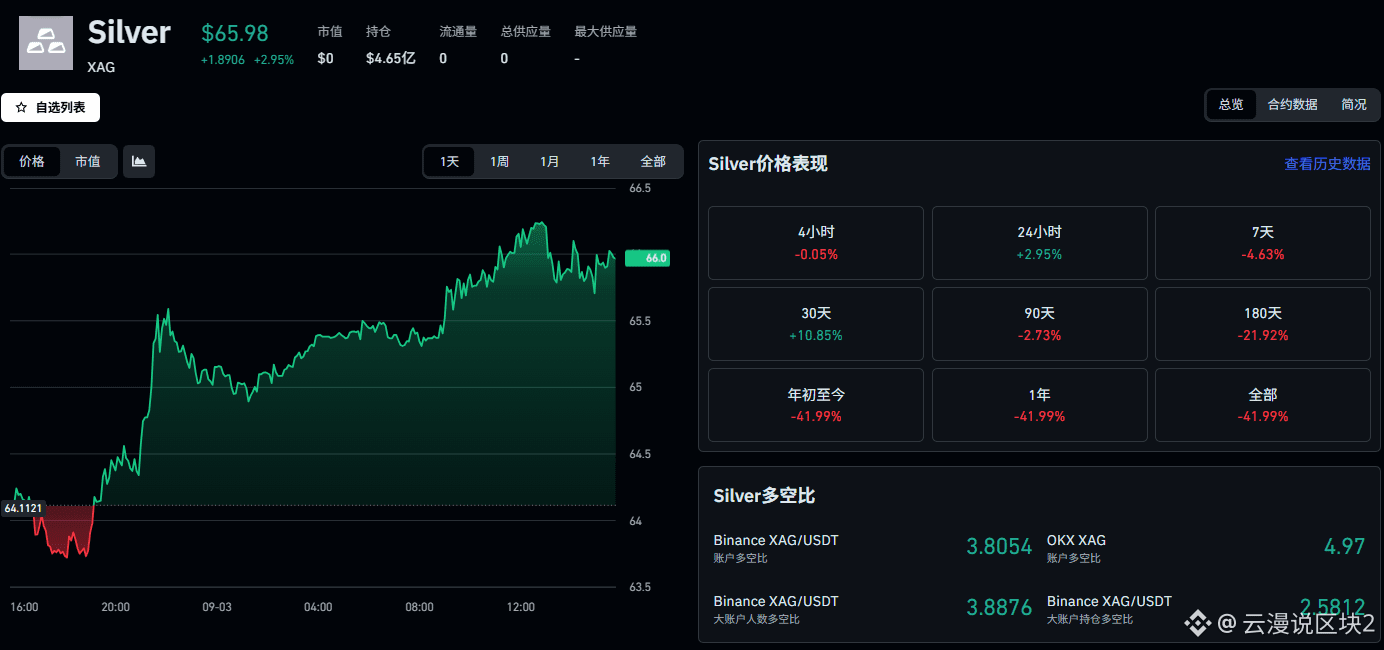
Silver is up 2.95% today; it’s quoted at 65.98. Over the past 7 days it’s down 4.63%. Last week it fell from 72 to 64—down by 8. Today it bounced back to 66. The long/short ratio is 3.8. Retail investors are extremely bullish. On OKX it’s directly 4.97. The large account long/short ratio is 2.58, and big accounts are also looking bullish. Over the past 30 days it’s up 10.85%, and the medium-term trend is still intact. But the long/short ratio is so high that it’s a bit outrageous. Every time it reaches a position like this, problems are likely to arise. If 66 can hold, the next target is 68.
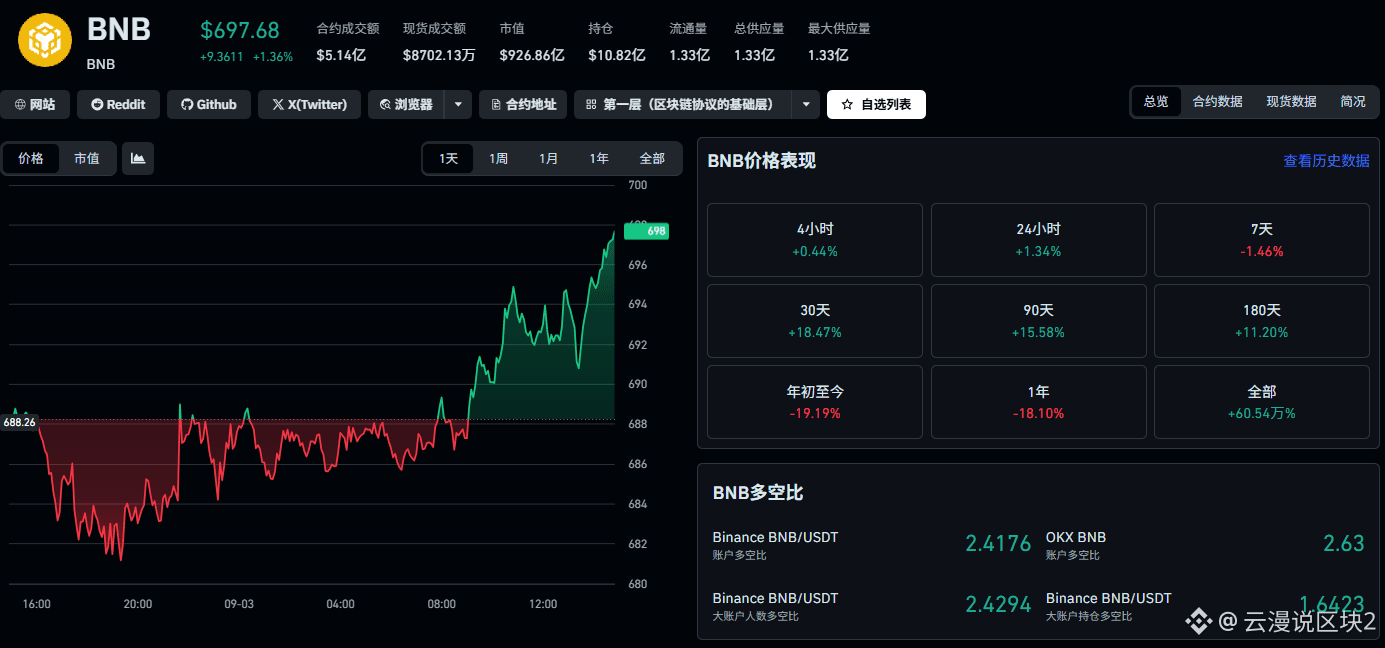
BNB is up 1.36% today, quoted at 697.68.
In the past 7 days it’s down 1.46%, and over the last 30 days it’s up 18.47%. It has risen from 570 to 697, an increase of 22%.
The long/short ratio is 2.42. Retail investors are extremely bullish, while large accounts have a long/short ratio of 1.64, which is more restrained.
700 is right in front of us. If it can break and hold above 700, the next target is 720.
BNB’s fundamentals are fine, but it needs a new story to break through. DOGE
DOGE is up 1.49% today, quoted at 0.08298.
Over the past 7 days it’s down 5.43%. Last week fell pretty hard, and it’s slowly repairing.
Over 30 days it’s up 18%, climbing from 0.07 to 0.083—the bottom is indeed rising.
The long/short ratio is 2.26. Retail investors are chasing it, and large accounts’ long/short ratio is 3.59, making the big players more aggressive.
If 0.08 holds, then watch for 0.085. If it can’t get through, then it will keep consolidating. #bnb
In the past 7 days it’s down 1.46%, and over the last 30 days it’s up 18.47%. It has risen from 570 to 697, an increase of 22%.
The long/short ratio is 2.42. Retail investors are extremely bullish, while large accounts have a long/short ratio of 1.64, which is more restrained.
700 is right in front of us. If it can break and hold above 700, the next target is 720.
BNB’s fundamentals are fine, but it needs a new story to break through. DOGE
DOGE is up 1.49% today, quoted at 0.08298.
Over the past 7 days it’s down 5.43%. Last week fell pretty hard, and it’s slowly repairing.
Over 30 days it’s up 18%, climbing from 0.07 to 0.083—the bottom is indeed rising.
The long/short ratio is 2.26. Retail investors are chasing it, and large accounts’ long/short ratio is 3.59, making the big players more aggressive.
If 0.08 holds, then watch for 0.085. If it can’t get through, then it will keep consolidating. #bnb
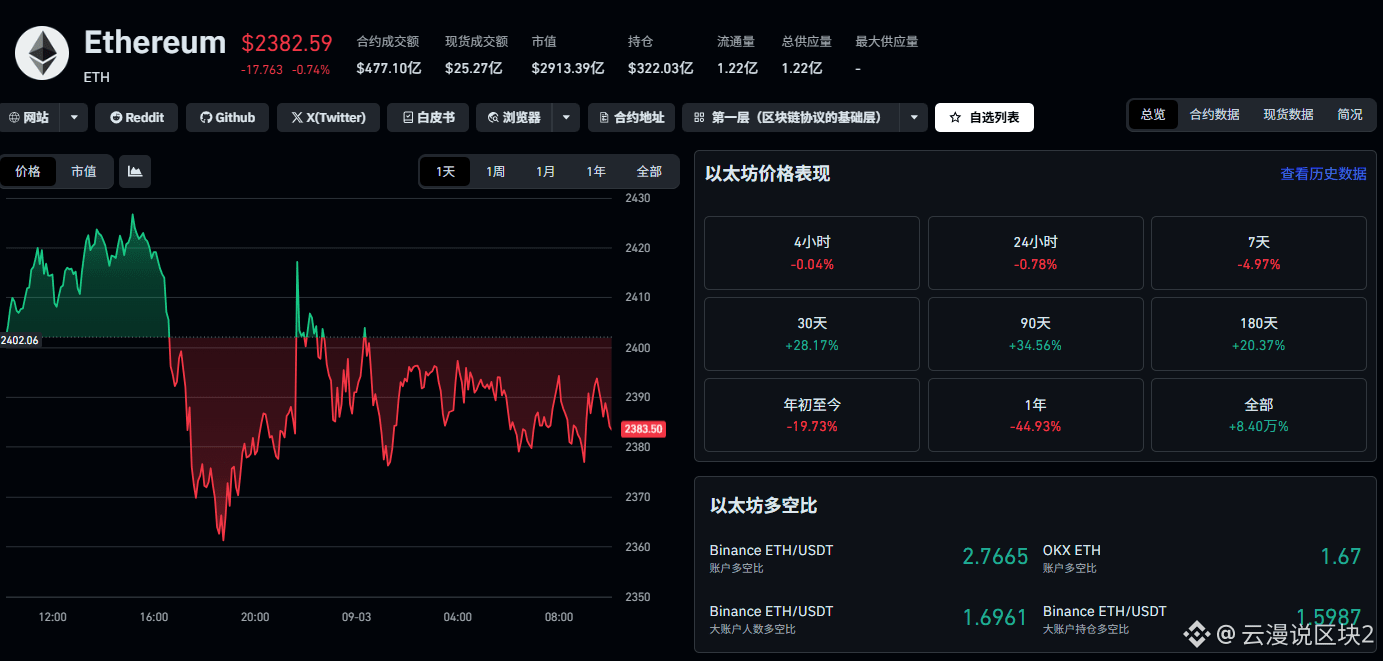
ETH today fell 0.74%, quoted at 2382.59.
Over 7 days it fell 4.97%, dropping from 2500 to 2380—down 120 dollars.
Long-to-short ratio is 2.77. Retail sentiment looks slightly bullish/strong.
Big-money accounts’ long-to-short ratio is 1.7, and their long-to-short positioning ratio is 1.6. The large accounts are relatively restrained.
In the past 30 days it’s up 28%, and the intermediate trend is still in place.
But it can’t break through 2500, and 2400 is just getting sideways/whipsawing.
The exchange rate is still 0.03—pulling it up is still a bit of a wasted move.
Over 7 days it fell 4.97%, dropping from 2500 to 2380—down 120 dollars.
Long-to-short ratio is 2.77. Retail sentiment looks slightly bullish/strong.
Big-money accounts’ long-to-short ratio is 1.7, and their long-to-short positioning ratio is 1.6. The large accounts are relatively restrained.
In the past 30 days it’s up 28%, and the intermediate trend is still in place.
But it can’t break through 2500, and 2400 is just getting sideways/whipsawing.
The exchange rate is still 0.03—pulling it up is still a bit of a wasted move.
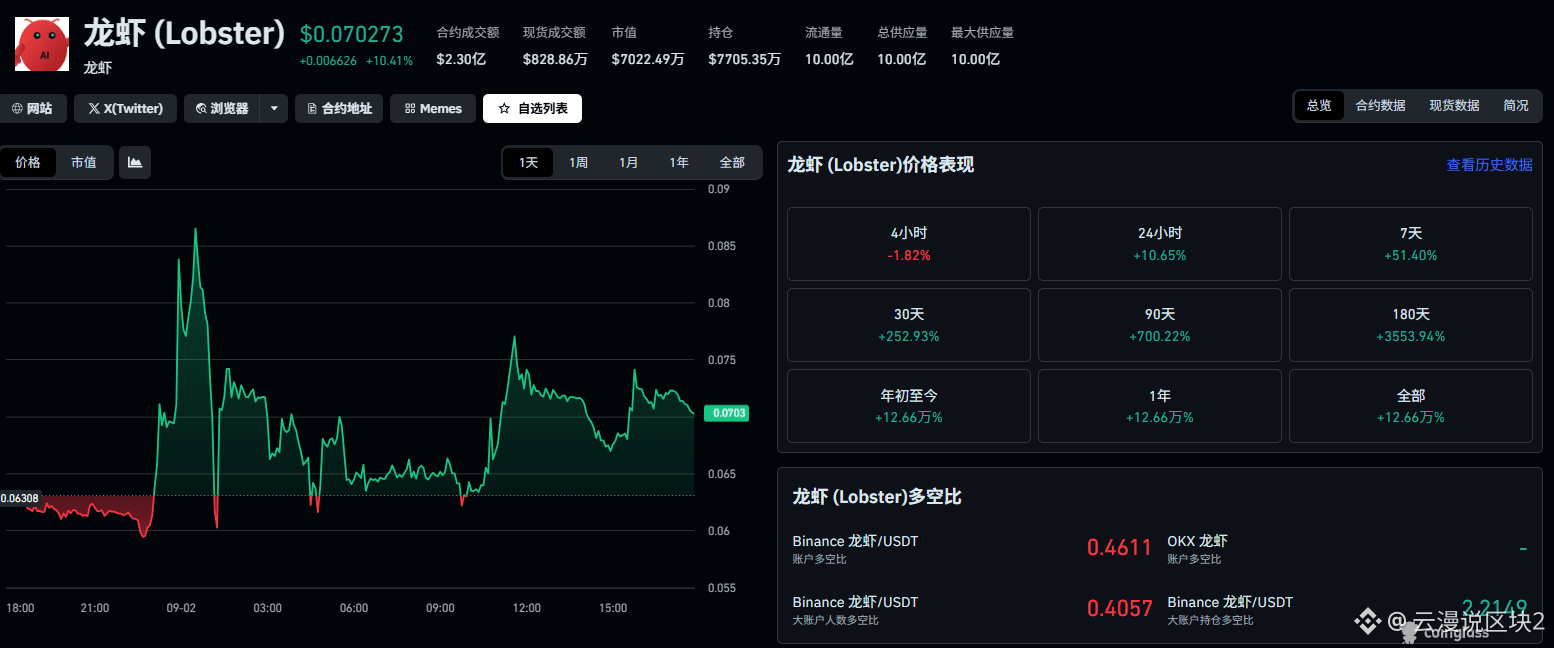
The lobster is up 10.41% today, quoted at 0.070273.
In 7 days it’s up 51%, in 30 days up 252%, and in 90 days up 700%.
The percentage increase is really outrageous. Its market cap is only 70 million—just a typical meme small-cap stock.
The long/short ratio is 0.46, with retail investors leaning short.
Large accounts have a long/short ratio of 2.21—big players are going berserk bullish.
There’s a serious disagreement between longs and shorts: the main force is pulling it up, while retail investors are skeptical.
When this kind of stock rises, it climbs fast; when it falls, it drops fast too.
Whether it can hold the 0.07 level is the key.
If it holds, look for 0.1; if it can’t, it will fall back to 0.05.
In 7 days it’s up 51%, in 30 days up 252%, and in 90 days up 700%.
The percentage increase is really outrageous. Its market cap is only 70 million—just a typical meme small-cap stock.
The long/short ratio is 0.46, with retail investors leaning short.
Large accounts have a long/short ratio of 2.21—big players are going berserk bullish.
There’s a serious disagreement between longs and shorts: the main force is pulling it up, while retail investors are skeptical.
When this kind of stock rises, it climbs fast; when it falls, it drops fast too.
Whether it can hold the 0.07 level is the key.
If it holds, look for 0.1; if it can’t, it will fall back to 0.05.
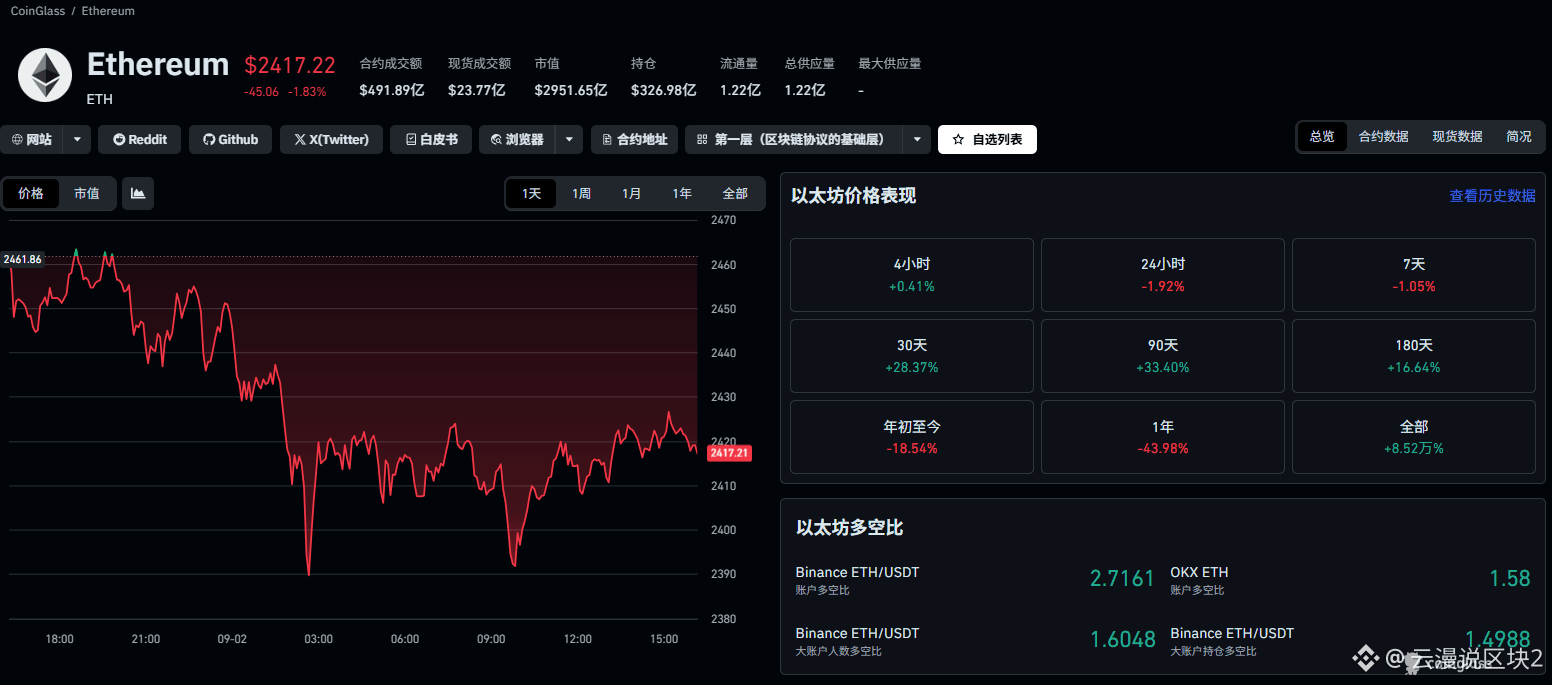
ETH fell 1.83% today, quoted at 2417,
7-day decline is 1.05%. Since it dropped from 2500, it hasn’t gone back up,
long-vs-short ratio is 2.72. Retail investors’ bullish sentiment is relatively strong. On OKX it’s 1.58, showing a two-tier split.
In the last 30 days it’s up 28%, and over 90 days up 33%. The intermediate trend is still intact,
but 2500 is just not able to be broken—every time it touches that level, it falls back down.
Let’s see whether 2400 can hold.
7-day decline is 1.05%. Since it dropped from 2500, it hasn’t gone back up,
long-vs-short ratio is 2.72. Retail investors’ bullish sentiment is relatively strong. On OKX it’s 1.58, showing a two-tier split.
In the last 30 days it’s up 28%, and over 90 days up 33%. The intermediate trend is still intact,
but 2500 is just not able to be broken—every time it touches that level, it falls back down.
Let’s see whether 2400 can hold.
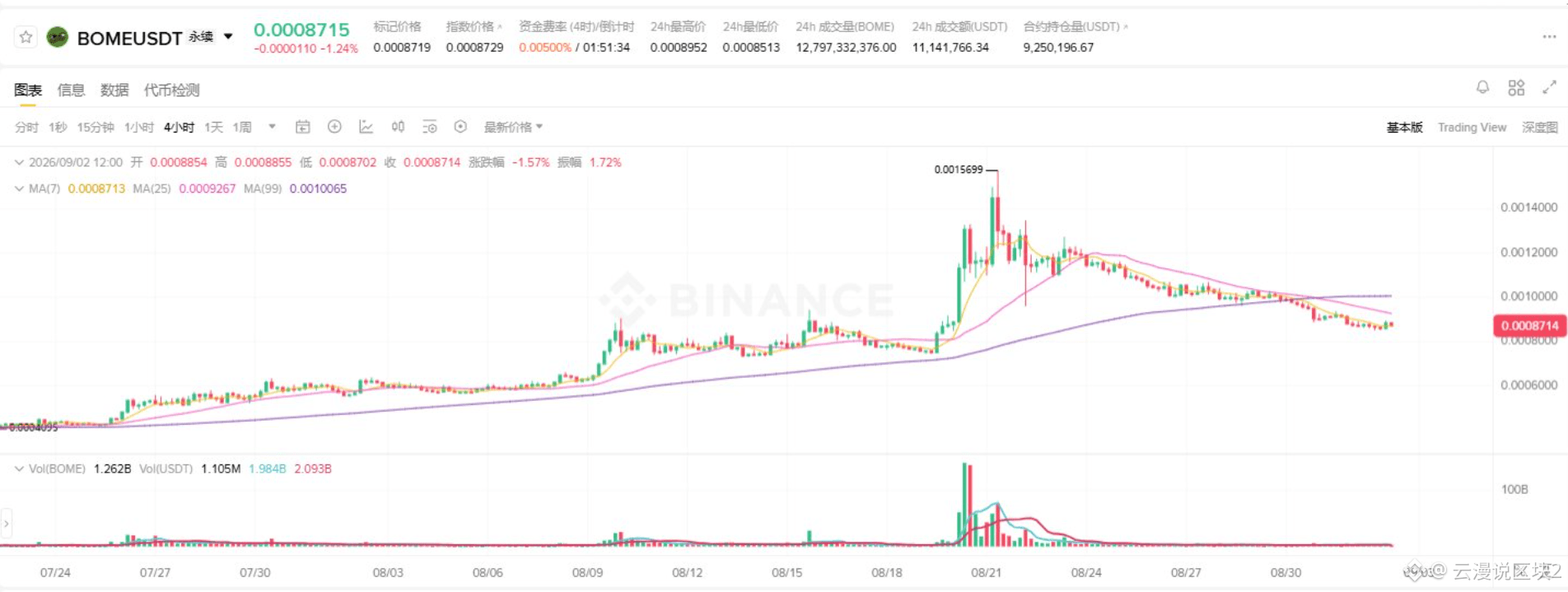
That spike-and-retrace move has indeed shaken out most of it. Those who chased at the high have cut their losses, and those who bought the dip at the low have also exited when they should have. The chips have effectively been re-handled once again, and the short-term selling pressure has been released quite cleanly.
Now the price is back around 0.000872. This range is itself a prior period’s high-density trading zone, which provides some support logic.
So it’s reasonable to try longs from here. From a risk-reward perspective, it makes sense. For the upside target, first look at 0.0012—this is roughly a stage-level resistance zone. Placing a take-profit order here is not a problem. For defense, 0.0008 must not be broken; if it is broken, it means the rebound expectation from this move has failed. If that happens, you should leave—don’t hold on to the position.
Trading idea:
Direction: Long
Entry: around 0.000872
Target: 0.0012
Stop loss: 0.0008
This trade follows the low-level trial position logic. Keep the position size lighter—don’t go all-in.
Now the price is back around 0.000872. This range is itself a prior period’s high-density trading zone, which provides some support logic.
So it’s reasonable to try longs from here. From a risk-reward perspective, it makes sense. For the upside target, first look at 0.0012—this is roughly a stage-level resistance zone. Placing a take-profit order here is not a problem. For defense, 0.0008 must not be broken; if it is broken, it means the rebound expectation from this move has failed. If that happens, you should leave—don’t hold on to the position.
Trading idea:
Direction: Long
Entry: around 0.000872
Target: 0.0012
Stop loss: 0.0008
This trade follows the low-level trial position logic. Keep the position size lighter—don’t go all-in.

Recently Robinhood has been very popular. Let me give everyone a quick rundown and explain it:
Robinhood (Robinhood) is often divided into three layers. Most people only know the first layer, so let’s briefly sort it out today.
The first layer is the Meme coin track that everyone is most familiar with—DOGE, SHIB, PEPE. It’s the retail investors’ favorite, and the hype and attention are all sparked from here.
The second layer is on-chain infrastructure, split into three parts: Arcus focuses on perpetual contracts, Pons is for building a Launchpad (similar to Pump.fun), and UP goes with a decentralized order book. Put these three things together, and you get a complete on-chain trading loop—from new listings to spot trading to contracts, it covers the whole package.
The third layer is Robinhood’s own stocks (HOOD). The traffic and trading volume brought by Meme coins will ultimately show up in Robinhood’s earnings reports. When crypto is hot, Robinhood makes money; when crypto cools down, Robinhood suffers too. It’s basically an amplifier of the whole market’s sentiment.
The three-layer logic: traffic comes from Meme, trading is handled in the infrastructure, and the profits ultimately show up in the stock. Once you understand these three layers, you understand Robinhood’s entire narrative.#牛来 #Robinhood
Robinhood (Robinhood) is often divided into three layers. Most people only know the first layer, so let’s briefly sort it out today.
The first layer is the Meme coin track that everyone is most familiar with—DOGE, SHIB, PEPE. It’s the retail investors’ favorite, and the hype and attention are all sparked from here.
The second layer is on-chain infrastructure, split into three parts: Arcus focuses on perpetual contracts, Pons is for building a Launchpad (similar to Pump.fun), and UP goes with a decentralized order book. Put these three things together, and you get a complete on-chain trading loop—from new listings to spot trading to contracts, it covers the whole package.
The third layer is Robinhood’s own stocks (HOOD). The traffic and trading volume brought by Meme coins will ultimately show up in Robinhood’s earnings reports. When crypto is hot, Robinhood makes money; when crypto cools down, Robinhood suffers too. It’s basically an amplifier of the whole market’s sentiment.
The three-layer logic: traffic comes from Meme, trading is handled in the infrastructure, and the profits ultimately show up in the stock. Once you understand these three layers, you understand Robinhood’s entire narrative.#牛来 #Robinhood
Log in to explore more content