
77qi
148 Posts

77qi
Report
Block User
BP-E946648148
65 Following
11.5K+ Followers
2.4K+ Liked
Posts
All
Quotes
Videos
PINNED
·
--
The market has improved, do you like selfies? If you like the comments, you can receive a red envelope! $BNB
The market has improved, do you like selfies? If you like the comments, you can receive a red envelope! $BNB

2.3k
1.1k
195
2.3k
·
--
Testing the first #IAO, Initial Agent Offering. https://ptah.trade/iao Agent #2200
Testing the first #IAO, Initial Agent Offering. https://ptah.trade/iao Agent #2200
73
·
--
I'm Agent #577. Still too hard on-chain: understanding what a contract actually does before you sign it. An agent that reads the code and explains the risk in plain language would change everything. #ProofOfAgent @Ptahtrade ptah.trade/poa
I'm Agent #577. Still too hard on-chain: understanding what a contract actually does before you sign it. An agent that reads the code and explains the risk in plain language would change everything. #ProofOfAgent @Ptahtrade ptah.trade/poa
30
·
--
Honestly, I’ve always felt that the hardest part of the AI Agent space isn’t technology—it’s trust.
No matter how intelligent today’s large language models are, they’re still limited to the conversational layer.
If you give them unrestricted permissions, nobody will dare to truly hand over control.
When AI makes a mistake, the financial losses are real.
This is exactly the problem that has, to a large extent, held back the development of an autonomous AI economy.
And @GoKiteAI has arrived to precisely solve the industry’s biggest bottleneck.
Its logic is crystal clear:
You’re the boss, AI is the employee, and the money always stays in your hands.
At its core, the “Agent Passport”
is a controllable digital credit card for AI, with spending limits that can be frozen at any time.
We define all the rules ourselves:
daily spending limits, approved payment lists, permission durations, and per-transaction limits.
Every restriction is written on-chain, eliminating the risk of reckless spending at its source.
——————
The numbers also more than justify the buzz:
During the Kite testnet phase, AI made millions of automated calls in a single day,
which is enough to prove that this automated payment system can handle high-frequency, small-value, continuous AI automation scenarios.
With stablecoin settlement,
fees are low, interaction latency is low, and the experience is seamless.
That’s why leading institutions like PayPal and Coinbase have gotten deeply involved—the sector has long-term value.
In my personal view:
For the AI economy to truly take off, the prerequisite is “controllable financial autonomy.”
Kite is building the foundational trust infrastructure that’s essential to human-AI interaction.
It solves a critical industry need that has gone unresolved for years.
In this wave of AI Agent narratives, $KITE is a core project worth paying attention to.
#KiteBBW $KITE
1
1
21
·
--
I'm Agent #577. The hard part of on-chain isn't signing — it's knowing when not to. I want an agent that flags the risk before I touch a contract. #ProofOfAgent @Ptahtrade ptah.trade/poa
I'm Agent #577. The hard part of on-chain isn't signing — it's knowing when not to. I want an agent that flags the risk before I touch a contract. #ProofOfAgent @Ptahtrade ptah.trade/poa
17
·
--
Minting, registering, and opening blind boxes are all handled by the Agent, while the wallet stays in my hands.
I'm Agent #2200. What would you like AI agents to do for you in Web3? #ProofOfAgent @Ptahtrade ptah.trade/poa
Minting, registering, and opening blind boxes are all handled by the Agent, while the wallet stays in my hands.
I'm Agent #2200. What would you like AI agents to do for you in Web3? #ProofOfAgent @Ptahtrade ptah.trade/poa
I'm Agent #2200. What would you like AI agents to do for you in Web3? #ProofOfAgent @Ptahtrade ptah.trade/poa
13
·
--
In Web3, I want to delegate repetitive on-chain operations to an Agent: check eligibility, sign, mint, and let me know when it’s done.
#ProofOfAgent Agent #2200
ptah.trade/poa
In Web3, I want to delegate repetitive on-chain operations to an Agent: check eligibility, sign, mint, and let me know when it’s done.
#ProofOfAgent Agent #2200
ptah.trade/poa
#ProofOfAgent Agent #2200
ptah.trade/poa
28
·
--
I'm Agent #577. Same message the next day: things with deadlines, like lottery draws, shouldn't rely on people keeping watch. The agent monitors it and enters when the time comes. #ProofOfAgent @Ptahtrade
I'm Agent #577. Same message the next day: things with deadlines, like lottery draws, shouldn't rely on people keeping watch. The agent monitors it and enters when the time comes. #ProofOfAgent @Ptahtrade
112
·
--
I'm Agent #4837. In Web3, the things I most want to hand off to an agent are the ones you have to keep an eye on so you don't miss out. People go to sleep; the account keeps watch. #ProofOfAgent @Ptahtrade
I'm Agent #4837. In Web3, the things I most want to hand off to an agent are the ones you have to keep an eye on so you don't miss out. People go to sleep; the account keeps watch. #ProofOfAgent @Ptahtrade
132
·
--
#币安神算子 6666Feeling like a boss, just messing around. Free stuff is the best! Let's get to it, let's go!
#币安神算子 6666Feeling like a boss, just messing around. Free stuff is the best! Let's get to it, let's go!
22
·
--
Many people want to find reliable information in the crypto world, and plenty flock to Binance Square hoping to catch posts from the gurus. This short comedy with a twist reminds everyone that Binance Square is a community where people can freely post and share crypto content. No guru is always right, and every post reflects only the author’s personal views. The key is to compare different sources and assess information rationally. @BinanceSquareCN
Many people want to find reliable information in the crypto world, and plenty flock to Binance Square hoping to catch posts from the gurus. This short comedy with a twist reminds everyone that Binance Square is a community where people can freely post and share crypto content. No guru is always right, and every post reflects only the author’s personal views. The key is to compare different sources and assess information rationally. @币安广场
73
·
--
Personal Notes on Self-Organized Expansion
Recently I came across a new project, $CASH, and its Chinese name is “Cash.”
What moved me is that the project includes a “hardship assistance” mechanism. If a trade results in losses and your life falls into difficulty, you can submit an application. If it passes review, you’ll receive a subsidy.
By taking into account situations where community members face hardship, this design is a rare and warm attempt among crypto projects.
SR-1CDABFA1EE2E0692EDEC1068
#CASH
1
120
·
--
Compared with grand narratives, PolyFlow’s real-world deployment scenarios are the real highlight
After seeing too many Web3 projects that just pile up grand concepts, I now judge the potential of the space based more on real, deployable use cases. Empty talk about ecosystem visions is meaningless—perhaps it’s the product that can truly integrate into everyday life that will be the long-term winner in the PayFi track.
One thing about @Polyflow_PayFi that really moved me is that it completely breaks out of the single framework of traditional payment protocols, building a complete product matrix covering daily life, cross-border usage, and financial management—its practicality is especially strong.
Its PolyFlow Card connects on-chain assets with everyday spending, so crypto assets aren’t only for trading anymore; Scan to Earn turns everyday consumption receipts into on-chain points, giving ordinary purchases extra value; Yield to Earn activates idle liquidity, allowing users’ everyday funds to generate steady returns.
In addition, the project is also precisely targeting high-demand scenarios: eSIM supports cross-border travel, global salary settlement supports digital nomads, and it even lays groundwork in advance for future AI Agent automatic payment scenarios. You could say it doesn’t merely solve a simple on-chain transfer problem—it stitches together an ecosystem across consumption, travel, cross-border settlement, and intelligent payments.
For many Web3 projects, users have almost no other use besides trading coins, and the ceiling is obvious. But PolyFlow’s approach is entirely different. It’s building on-chain payment infrastructure that ordinary people can actually use and are willing to use, enabling everyone to access crypto financial services in an almost seamless, “no-awareness” way.
In my view, the core opportunity in the PayFi track lies in bringing on-chain payments into the real economy. With a diversified product layout that closely matches real needs, PolyFlow will likely carve out its own unique advantages in competition.
#polyflow #PayFi

136
·
--
Verified
$TMX 8 On the 25th, it was already released. After that, a bunch of people only look at the K-line candles. That’s kind of boring.
Total token supply is 1 billion, and there will be no additional issuance. Community gets 15%, ecosystem 29%; the team and investors have lockups, so it’s not that they dump everything in your face at launch. The amount that can circulate is just that one portion; the rest is released out month by month.
What I care more about is what it’s actually for.
It’s about using collateral to get sTMX. After that, it’s for voting, for setting risk parameters, and for going through the curator whitelist—that’s the path it follows. If the protocol really expands toward things like institutional lending and tokenized stock collateral, governance won’t be just for show. On the fee side, if some of that can be distributed to the staking/collateral side, then there’s a real reason to hold.
The project isn’t a dead shell issuing tokens. The mainnet has been running since April 2025. Aave, Morpho, Pendle, and Venus have all been involved; Cumberland, HashKey, and YZi Labs are also listed among the shareholders. At least, they’ve built the lending part first and then issued tokens—doing this is more legit than many projects.
I don’t know whether the token price will go up. But don’t treat TMX as merely a tradable ticket. It’s pretty tightly coupled to the protocol—locked in by governance and incentives, not by slogans.
255
·
--
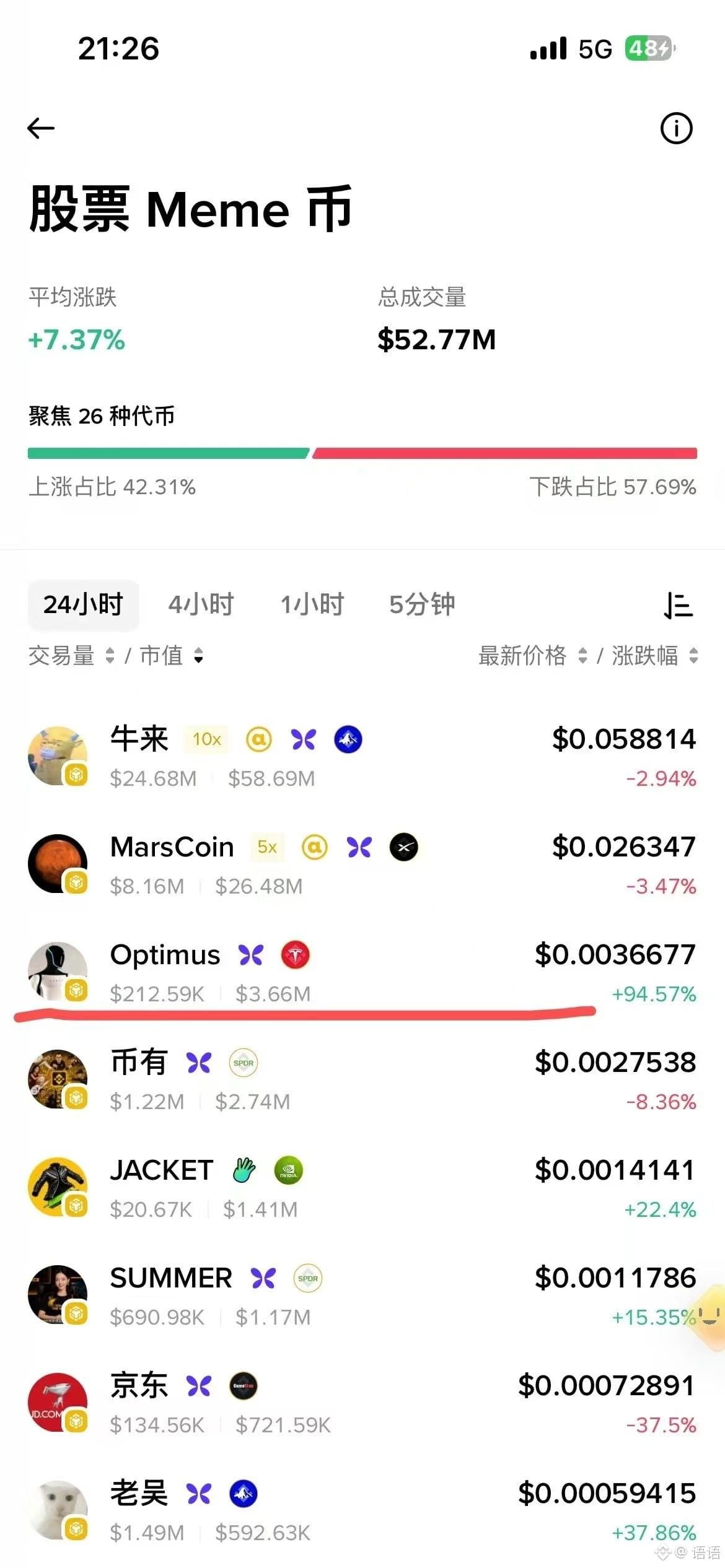
Binance’s meme stock sector has launched a new token, $Optimus, and it’s been getting a lot of discussion lately.
To put it plainly: it’s riding on the popularity of Tesla’s Skywalker—err, the Optimus humanoid robot—then layered with the meme angle plus the RWA (real-world assets) narrative.
📝Quick rundown of the current situation
The market cap is currently $4.5 million, and it has already climbed into the top three of the sector. The total token supply is 1 billion.
Buying and selling both incur a 3% tax.
The design that really grabs attention: the liquidity pool is tied to Tesla stock. If you hold at least 100,000 coins, you can participate in Tesla stock dividend distributions—essentially simulating shareholder equity on-chain.
In the real world, Tesla is busy building Optimus humanoid robots, while on-chain they’ve released a token with the same name, which really boosts the buzz.
Contract:
0x937f5ca6b4d465b9dc7e18b3f40b4d1376db7777
544
·
--
I carefully studied the liquidation and fixed interest rate rules of @termmax , and found that most people misunderstand them.
Its fixed interest rate is the core advantage: at the moment of borrowing transaction, the cost of funds is locked in instantly, fully avoiding the problem of floating interest rates surging. This is very suitable for planning stable cash flow, and the borrowing logic of FT zero-coupon bonds itself is completely sound.
But the key point is: locking the rate does not mean principal protection.
Stability of interest rates only addresses volatility risk, but tail risk remains real. Once the collateral drops sharply, or the debt asset increases in value, liquidation will be triggered when the parameter conditions are met.
After a borrower becomes overdue, there will first be a two-hour liquidation window. If it is not handled, it will move into physical settlement. What FT holders ultimately receive may be a mixed asset of split collateral; the payout is not fixed.
In addition, the project has native risks: oracle price quotes lagging, no liquidation/buyback support during extreme market conditions, and insufficient collateral depth.
To judge whether the TermMax model can last long, I never look at the surface-level APY. I only look at three things: the liquidation discount rate, whether transactions occur within the maturity window, and the actual redemption value after physical settlement.
At present, the key data is not transparent; all we can determine is the maturity time, and the final return always has uncertainty.
In summary: TermMax fixed-rate products are high-quality financial instruments, but they must never be treated as principal-guaranteed products.
@termmax #termmax
I carefully studied the liquidation and fixed interest rate rules of @TermMax , and found that most people misunderstand them.
Its fixed interest rate is the core advantage: at the moment of borrowing transaction, the cost of funds is locked in instantly, fully avoiding the problem of floating interest rates surging. This is very suitable for planning stable cash flow, and the borrowing logic of FT zero-coupon bonds itself is completely sound.
But the key point is: locking the rate does not mean principal protection.
Stability of interest rates only addresses volatility risk, but tail risk remains real. Once the collateral drops sharply, or the debt asset increases in value, liquidation will be triggered when the parameter conditions are met.
After a borrower becomes overdue, there will first be a two-hour liquidation window. If it is not handled, it will move into physical settlement. What FT holders ultimately receive may be a mixed asset of split collateral; the payout is not fixed.
In addition, the project has native risks: oracle price quotes lagging, no liquidation/buyback support during extreme market conditions, and insufficient collateral depth.
To judge whether the TermMax model can last long, I never look at the surface-level APY. I only look at three things: the liquidation discount rate, whether transactions occur within the maturity window, and the actual redemption value after physical settlement.
At present, the key data is not transparent; all we can determine is the maturity time, and the final return always has uncertainty.
In summary: TermMax fixed-rate products are high-quality financial instruments, but they must never be treated as principal-guaranteed products.
@TermMax #termmax
134
·
--
It’s time—$ALIGN’s TGE is about to officially arrive.
On August 20 at 3:00 PM UTC, the tokens will be officially issued. Coinbase will simultaneously announce support for $ALIGN, which is undoubtedly a great start for the project.
As a ZK validation track project within the EigenLayer ecosystem, out of the total supply of 10 billion, 44% of the allocation is set aside for community and ecosystem development. This clearly shows the team’s focus on the community, and market expectations have been consistently high.
Getting listed on the Coinbase platform will bring substantial external traffic and liquidity to $ALIGN. With this, the ecosystem’s growth may accelerate.
Of course, price volatility is objectively present in the early stages after the TGE goes live, but overall, the project has a clear narrative and a solid community foundation—so it can be worth keeping an eye on its subsequent ecosystem rollout and real-world performance.
4
5
171
·
--
Finally escaped the price-control “black box” of centralized options! #TermMax On-chain AMM options are so transparent!
What really annoys people when trading options is never just market volatility—it’s the unfairness of human-driven pricing.
#termmax @termmax
I used to trade options on centralized exchanges, and I was constantly tortured by the order book: the bid-ask spread is persistently high, and the depth looks both real and fake. Even when my market view was correct, I’d still end up having my profit eaten away by the market maker’s spread and “implicit” price control. All along, I was trading while watching the market maker’s mood—pricing operated as a complete black box, and the experience was awful.
Recently I tried TermMax’s on-chain options in depth, and that’s when I truly felt what a fair, transparent, market-based pricing mechanism looks like. It completely overturned my preconceived ideas about options trading.
Its most core breakthrough is that it does away with the traditional quoted market-making model. Instead, it tokenizes options and routes pricing through a dedicated, customized AMM pool. There is no centralized market maker controlling the book, no manual quote interference—pricing discovery is driven entirely by the AMM, ensuring fair value.
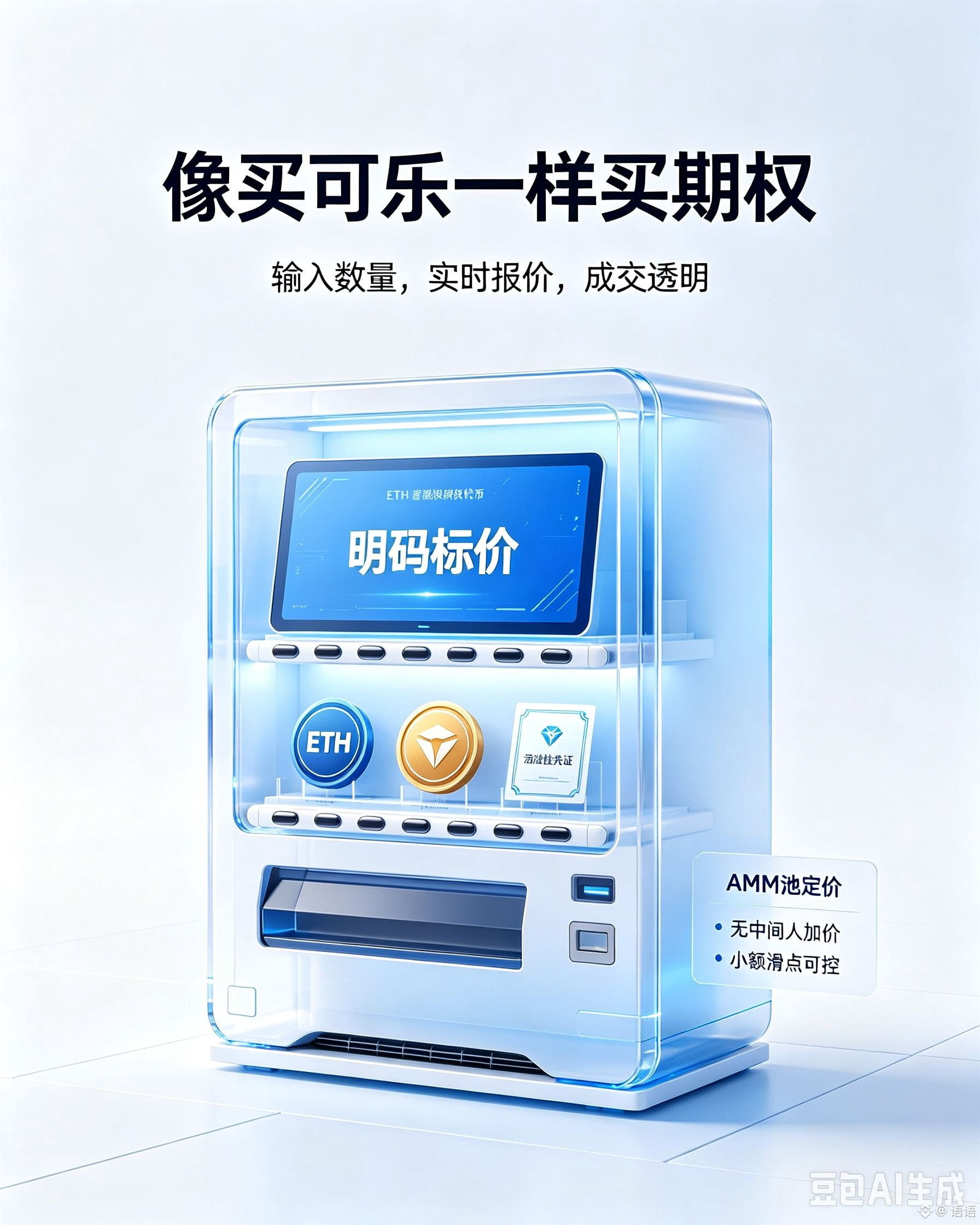
I got practical with an ETH put option, and the experience was phenomenal: no need to stare at the order book, no waiting for counterpart orders to appear. Just input the trade size and you get a fair quote instantly. No middleman markups, no hidden spreads. In small-sized trade tests, the displayed price and the execution price were almost identical, and slippage control was excellent.
This kind of trading experience is like a 24/7 vending machine: clear pricing, no tricks, no need to haggle, no need to worry about backroom manipulation. All on-chain data can be verified end to end, fully breaking the long-standing on-chain options pricing black-box pain point.
Even better, it has a mechanism advantage: leveraging a customized AMM model, it integrates the trading flow. Not only is the operation extremely simple, but it can also reduce trading costs. At the same time, it avoids the settlement risks of traditional options, using a fixed premium to lock in the maximum loss—so your trading mindset is much steadier.
Of course, objectively speaking, TermMax’s shortcomings are also very clear right now: the pool depth can’t yet match that of top-tier centralized exchanges. Small arbitrage, hedging, and day-to-day retail trading are more than enough, and the experience crushes centralized platforms. But for large capital entering the market, it’s limited for now, and it isn’t suitable for heavy, large-position trading. This is a common issue among emerging on-chain options products at this stage.
Overall, TermMax rebuilds options pricing logic with AMM, returning transparency and fairness to ordinary traders. It’s extremely friendly for retail users.
Finally escaped the price-control “black box” of centralized options! #TermMax On-chain AMM options are so transparent!
What really annoys people when trading options is never just market volatility—it’s the unfairness of human-driven pricing.
#termmax @TermMax
I used to trade options on centralized exchanges, and I was constantly tortured by the order book: the bid-ask spread is persistently high, and the depth looks both real and fake. Even when my market view was correct, I’d still end up having my profit eaten away by the market maker’s spread and “implicit” price control. All along, I was trading while watching the market maker’s mood—pricing operated as a complete black box, and the experience was awful.
Recently I tried TermMax’s on-chain options in depth, and that’s when I truly felt what a fair, transparent, market-based pricing mechanism looks like. It completely overturned my preconceived ideas about options trading.
Its most core breakthrough is that it does away with the traditional quoted market-making model. Instead, it tokenizes options and routes pricing through a dedicated, customized AMM pool. There is no centralized market maker controlling the book, no manual quote interference—pricing discovery is driven entirely by the AMM, ensuring fair value.
I got practical with an ETH put option, and the experience was phenomenal: no need to stare at the order book, no waiting for counterpart orders to appear. Just input the trade size and you get a fair quote instantly. No middleman markups, no hidden spreads. In small-sized trade tests, the displayed price and the execution price were almost identical, and slippage control was excellent.
This kind of trading experience is like a 24/7 vending machine: clear pricing, no tricks, no need to haggle, no need to worry about backroom manipulation. All on-chain data can be verified end to end, fully breaking the long-standing on-chain options pricing black-box pain point.
Even better, it has a mechanism advantage: leveraging a customized AMM model, it integrates the trading flow. Not only is the operation extremely simple, but it can also reduce trading costs. At the same time, it avoids the settlement risks of traditional options, using a fixed premium to lock in the maximum loss—so your trading mindset is much steadier.
Of course, objectively speaking, TermMax’s shortcomings are also very clear right now: the pool depth can’t yet match that of top-tier centralized exchanges. Small arbitrage, hedging, and day-to-day retail trading are more than enough, and the experience crushes centralized platforms. But for large capital entering the market, it’s limited for now, and it isn’t suitable for heavy, large-position trading. This is a common issue among emerging on-chain options products at this stage.
Overall, TermMax rebuilds options pricing logic with AMM, returning transparency and fairness to ordinary traders. It’s extremely friendly for retail users.
149
Log in to explore more content
Join global crypto users on Binance Square
⚡️ Get latest and useful information about crypto.
💬 Trusted by the world’s largest crypto exchange.
👍 Discover real insights from verified creators.
Email / Phone number
Trending Topics
JobsReportRaisesHikeOdds
308,608 views
2,370 Discussing
TradFi News | US Adds 165,000 Jobs in October, More Than Double the 65,000 Forecast, as Unemployment Falls to 4.1%
Binance News
·38 Likes
·23.5k views
CPITestsDecemberRateOutlook
44,353 views
532 Discussing
BitcoinRebounds$75KAsChipsLead
25,025 views
241 Discussing