

SollyCrypto Onchain
602 Posts
SollyCrypto Onchain
Report
Block User
I track crypto in real time, technicals, onchain data, fundamentals, all in one place. Actionable setups, not just opinions. Follow, read, decide, trade.
Frequent Trader
2.8 Years
39 Following
218 Followers
336 Liked
Posts
All
Quotes
Videos
PINNED

Article
BREAKING: Binance Square Just Leveled Up Write to Earn — Engagement Bonuses Are LIVE!Guys… this is one of the biggest upgrades for creators on Binance Square in a long time.
Starting October 19, 2026 (00:00 UTC), Binance has officially added weekly Engagement Bonuses to the Write to Earn program.
This means you’re no longer only earning from trading commissions. Now your likes, comments, follows, and genuine engagement can also put money in your pocket every single week.
What’s New?
Previously, Write to Earn mainly rewarded you when people traded through your posts (cashtags, charts, trade widgets, etc.).
Now there’s a second income stream:
20% Basic Commission still applies when readers trade via your content (Spot, Margin, Futures excluding copy trading, and Convert Instant).
Plus a share of a weekly Engagement Bonus pool based on the quality and volume of real engagement your text posts, articles, and videos generate (comments, likes, follows, etc.).
Livestream creators keep the 20% basic + ranking bonuses (up to 50% total for top 30).
Chats also earn the 20% basic commission.
KYC-verified users are automatically eligible after posting their first piece of content. No separate registration needed.
Rewards are calculated weekly (Monday 00:00 UTC – Sunday 23:59 UTC) and paid in USDC to your Spot Account by the following Thursday.
Why This Changes Everything
Quality content finally gets properly rewarded.
You no longer have to spam just to chase trades. Real discussions, useful analysis, good questions, and valuable insights can now generate consistent weekly income through the Engagement Bonus.
This is perfect for:
New creators just starting out
Mid-tier creators who already have engaged audiences
Anyone who consistently posts thoughtful content instead of pure hype
How to Maximize Your Earnings
Post original, useful content (market analysis, educational threads, trade ideas with reasoning, honest opinions).
Use relevant cashtags ($BTC, $ETH, $BNB, $SOL, etc.) and widgets naturally.
Encourage real discussion — ask questions, reply to comments, build community.
Stay consistent. The algorithm and the Engagement Bonus both love steady, genuine activity.
Focus on quality over quantity. One strong post that sparks conversation can outperform ten low-effort ones.
The old rewards for the previous week (Oct 12–18) will still follow the previous rules and drop on Oct 21. Everything from Oct 19 onward uses the new structure.
This is the moment to start (or double down)
Binance Square is becoming one of the best places in crypto to actually get paid for creating value. The combination of trading commissions + engagement bonuses is powerful.
Who’s already posting under the new system?
Drop your best tip for getting real engagement below 👇
And if you haven’t posted yet — what are you waiting for? Your first post could be the start of a new income stream.
Let’s make Square even better together.
Like if you’re hyped.
Comment your thoughts.
Share this so more creators see it.
$BNB $BTC #WriteToEarn #BinanceSquare #CryptoCreators
BREAKING: Binance Square Just Leveled Up Write to Earn — Engagement Bonuses Are LIVE!
Guys… this is one of the biggest upgrades for creators on Binance Square in a long time.
Starting October 19, 2026 (00:00 UTC), Binance has officially added weekly Engagement Bonuses to the Write to Earn program.
This means you’re no longer only earning from trading commissions. Now your likes, comments, follows, and genuine engagement can also put money in your pocket every single week.
What’s New?
Previously, Write to Earn mainly rewarded you when people traded through your posts (cashtags, charts, trade widgets, etc.).
Now there’s a second income stream:
20% Basic Commission still applies when readers trade via your content (Spot, Margin, Futures excluding copy trading, and Convert Instant).
Plus a share of a weekly Engagement Bonus pool based on the quality and volume of real engagement your text posts, articles, and videos generate (comments, likes, follows, etc.).
Livestream creators keep the 20% basic + ranking bonuses (up to 50% total for top 30).
Chats also earn the 20% basic commission.
KYC-verified users are automatically eligible after posting their first piece of content. No separate registration needed.
Rewards are calculated weekly (Monday 00:00 UTC – Sunday 23:59 UTC) and paid in USDC to your Spot Account by the following Thursday.
Why This Changes Everything
Quality content finally gets properly rewarded.
You no longer have to spam just to chase trades. Real discussions, useful analysis, good questions, and valuable insights can now generate consistent weekly income through the Engagement Bonus.
This is perfect for:
New creators just starting out
Mid-tier creators who already have engaged audiences
Anyone who consistently posts thoughtful content instead of pure hype
How to Maximize Your Earnings
Post original, useful content (market analysis, educational threads, trade ideas with reasoning, honest opinions).
Use relevant cashtags ($BTC, $ETH, $BNB, $SOL, etc.) and widgets naturally.
Encourage real discussion — ask questions, reply to comments, build community.
Stay consistent. The algorithm and the Engagement Bonus both love steady, genuine activity.
Focus on quality over quantity. One strong post that sparks conversation can outperform ten low-effort ones.
The old rewards for the previous week (Oct 12–18) will still follow the previous rules and drop on Oct 21. Everything from Oct 19 onward uses the new structure.
This is the moment to start (or double down)
Binance Square is becoming one of the best places in crypto to actually get paid for creating value. The combination of trading commissions + engagement bonuses is powerful.
Who’s already posting under the new system?
Drop your best tip for getting real engagement below 👇
And if you haven’t posted yet — what are you waiting for? Your first post could be the start of a new income stream.
Let’s make Square even better together.
Like if you’re hyped.
Comment your thoughts.
Share this so more creators see it.
$BNB $BTC #WriteToEarn #BinanceSquare #CryptoCreators
3
97
·
--
Bearish
📉 $ZRO -6.0% as Market Slips -1.0%
$ZRO has dropped 6.0% in 24h, significantly underperforming the market's -1.0% move. There's no clear driver for this sharper decline.
Why it matters: This affects $ZRO holders who may want to watch for any new developments or unexplained trading patterns.
📉 $ZRO -6.0% as Market Slips -1.0%
$ZRO has dropped 6.0% in 24h, significantly underperforming the market's -1.0% move. There's no clear driver for this sharper decline.
Why it matters: This affects $ZRO holders who may want to watch for any new developments or unexplained trading patterns.
$ZRO has dropped 6.0% in 24h, significantly underperforming the market's -1.0% move. There's no clear driver for this sharper decline.
Why it matters: This affects $ZRO holders who may want to watch for any new developments or unexplained trading patterns.
1
262
·
--
Bullish
📈 $QNT +20.7% while market moves -0.0%
$QNT surged +20.7% with no obvious driver, while the market stayed flat. A classic case of a pump without a clear catalyst.
Why it matters: QNT holders should watch for any follow-up news or unusual on-chain activity. Sudden moves often correct swiftly without a clear cause.
$QNT surged +20.7% with no obvious driver, while the market stayed flat. A classic case of a pump without a clear catalyst.
Why it matters: QNT holders should watch for any follow-up news or unusual on-chain activity. Sudden moves often correct swiftly without a clear cause.
1
197
·
--
Bearish
Oil pulled back from near six-month highs, with US crude futures down about 2% near $101 and Brent around $114, even as Houthi attacks on Saudi Arabia keep supply fears alive.
Why this happened
Oil had already run hard on Middle East supply risk. When price stretches, partial profit-taking can hit even if the geopolitical story is not fully gone. Weekend attack headlines kept the risk premium on the table, but the immediate tape is a dip from the highs, not a clean risk-off collapse.
Why it matters
For crypto, oil is a macro input, not a direct token catalyst. Sticky energy prices can feed inflation and risk-premium nerves, which sometimes pressures $BTC and alts. A cooling oil print can ease that channel a bit, but ongoing Saudi-related attack risk means the macro overhang is not fully cleared.
How it can benefit you
If oil cools without a full supply shock, risk assets can get a temporary relief window. Knowing the driver is energy geopolitics also stops you from blaming random on-chain noise for every $BTC wiggle.
How it can harm you
Another attack spike can send oil back up fast and drag risk assets with it. People who treat one red oil candle as “all clear” can get trapped if supply headlines return.
SollyCrypto opinion
Mixed for oil and mixed-to-cautious for crypto risk. Dip from the highs, but Houthi supply fear is still in the story.
You treating the oil dip as relief for $BTC, or still pricing in Middle East risk?
Follow me, or you may not see the next one.

1
493
·
--
Bearish
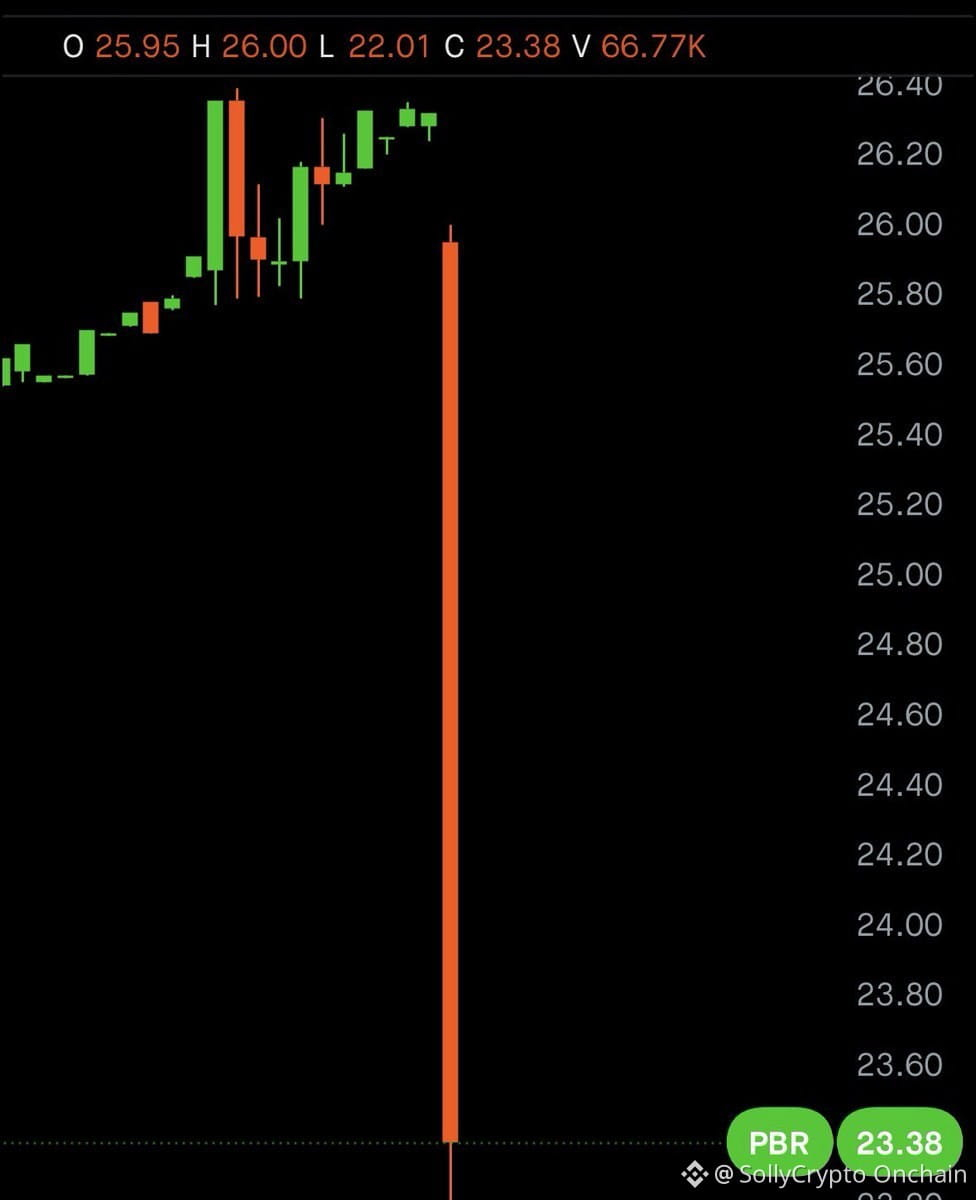
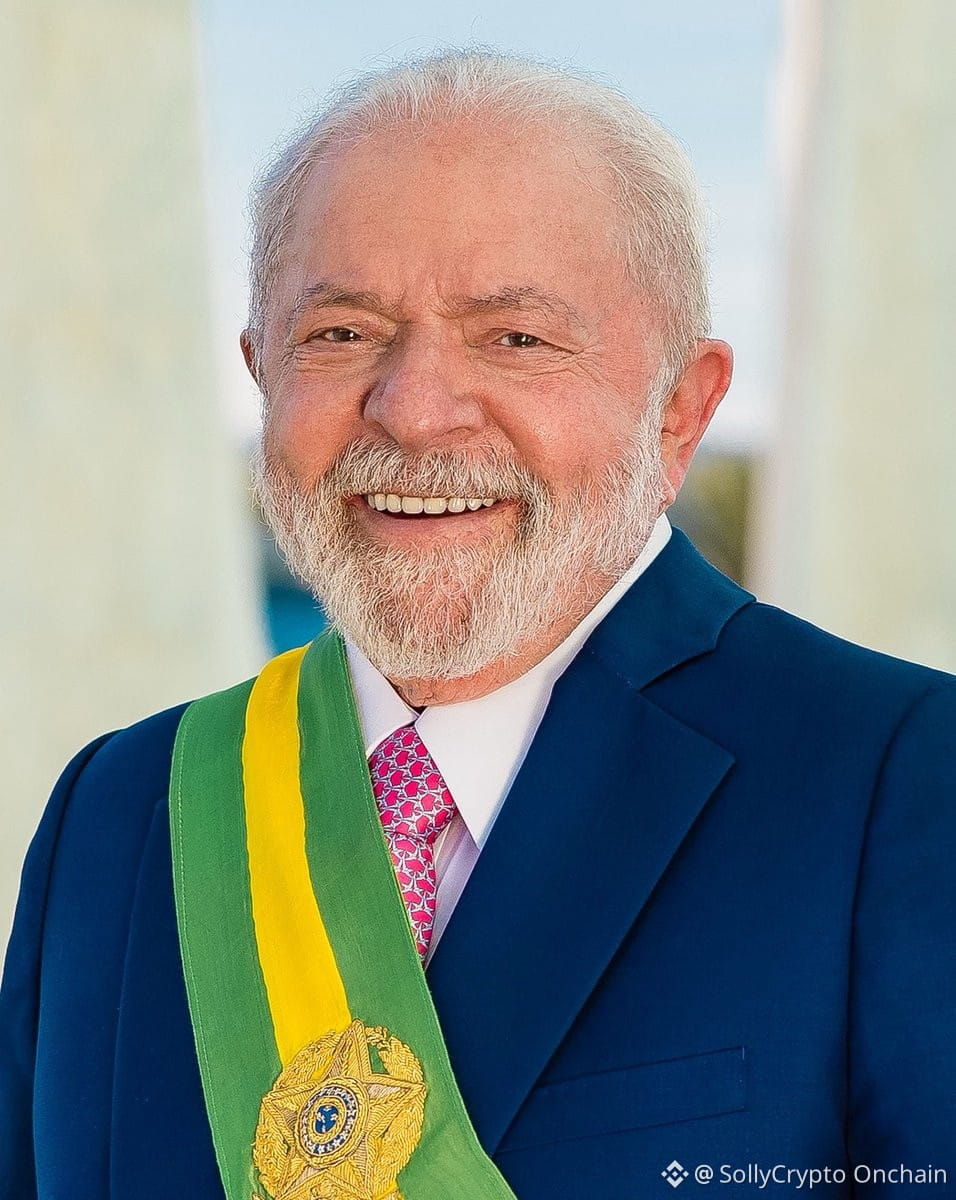
Brazil’s largest oil company Petrobras $PBR fell over 10% after Luiz Inácio Lula da Silva won Brazil’s presidential election, defeating Flávio Bolsonaro.
Why this happened
Markets priced a policy-risk reset. Investors often treat a Lula win as higher intervention risk around state-linked energy names, fiscal path uncertainty, and Brazil risk premium. $PBR is the clearest pure-play punchbag for that reaction.
Why it matters
This is an equity event first, not a crypto protocol story. For traders who touch $PBR through stocks, CFDs, or tokenized equity rails, the election outcome is the catalyst. Brazil risk can also spill into broader EM sentiment, but the direct hit is on Petrobras and local equities.
How it can benefit you
If you are flat, the gap lower is a clear risk signal. Forced election dumps sometimes create later mean-reversion trades only after the first panic clears.
How it can harm you
Longs into the vote can get wrecked by the open. People who buy the first bounce can still get trapped if Brazil risk premium stays elevated.
SollyCrypto opinion
Near-term dump lean for $PBR. Election policy-risk is driving the selloff.
You fading $PBR on the Lula win, or waiting for the first bounce to fail?
Follow me, or you may not see the next one.
1
92
·
--
Bullish
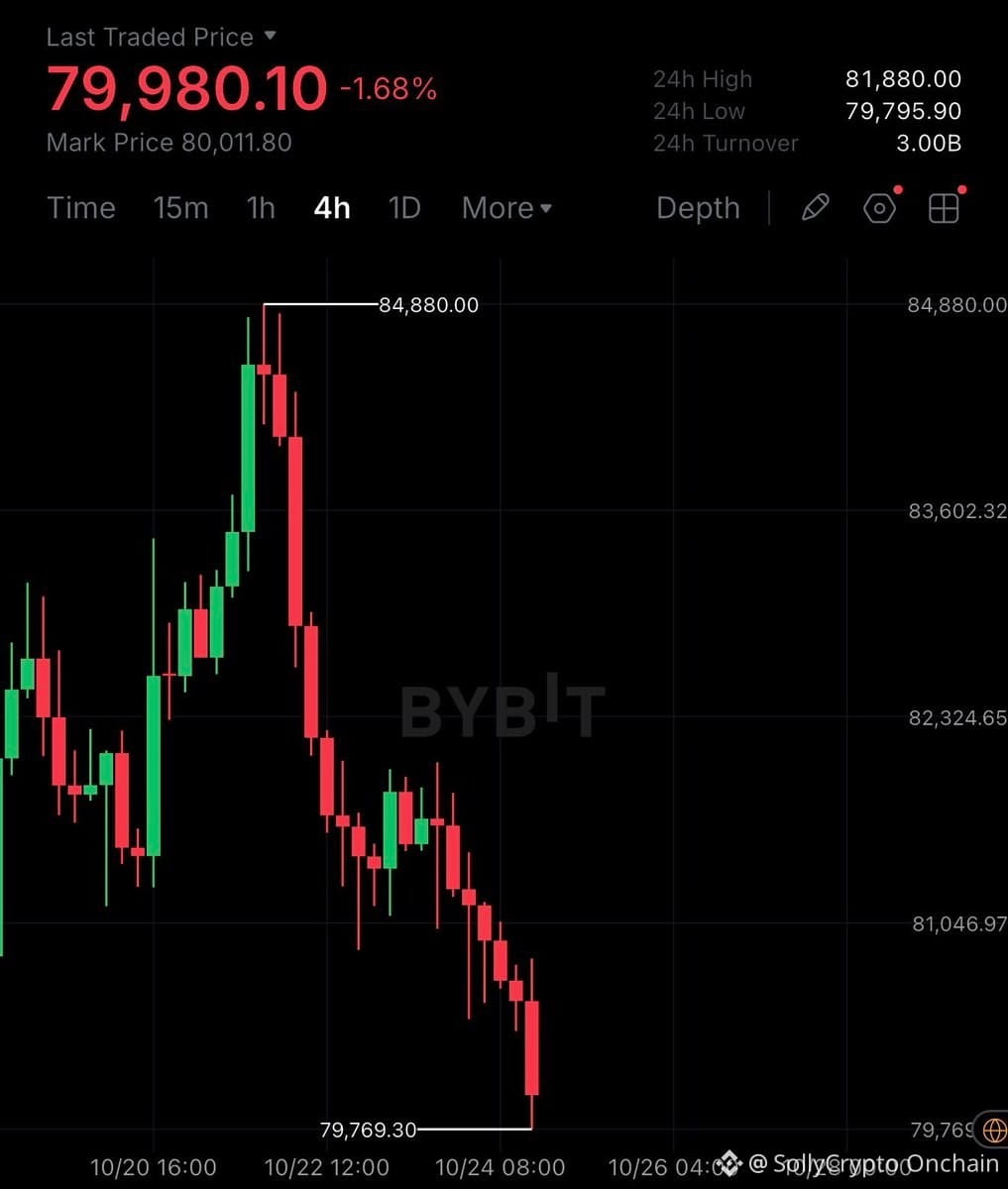
Bitcoin dropped below $80,000 as reports circulated that the US military had reached full readiness for a potential strike on Iran.
Why this happened
Geopolitical risk is hitting risk assets hard. When markets price a higher chance of escalation in the Middle East, traders cut leverage and rotate out of crypto. $BTC is trading like a high-beta risk asset here, not a pure safe-haven bid.
Why it matters
A break under a round number like $80K is psychological and liquidational. Fear headlines around Iran can keep volatility elevated across $BTC and alts until the military risk premium cools. Important limit: “reportedly” means the readiness claim is still source-dependent, but markets are already reacting to the risk narrative.
How it can benefit you
If you are patient, forced risk-off dumps can create cleaner later entries once the headline panic fades. Knowing the driver is geopolitics also stops you from inventing a fake on-chain reason for the drop.
How it can harm you
Longs into war-risk headlines can get wrecked by cascading liquidations. People who buy the first bounce can still get trapped if escalation news keeps coming.
SollyCrypto opinion
Near-term dump lean for $BTC and broad crypto risk. Geopolitical fear is in control until the headline risk cools.
You fading $BTC under $80K, or waiting for the war-risk premium to clear?
Follow me, or you may not see the next one.
1
278
·
--
Bullish
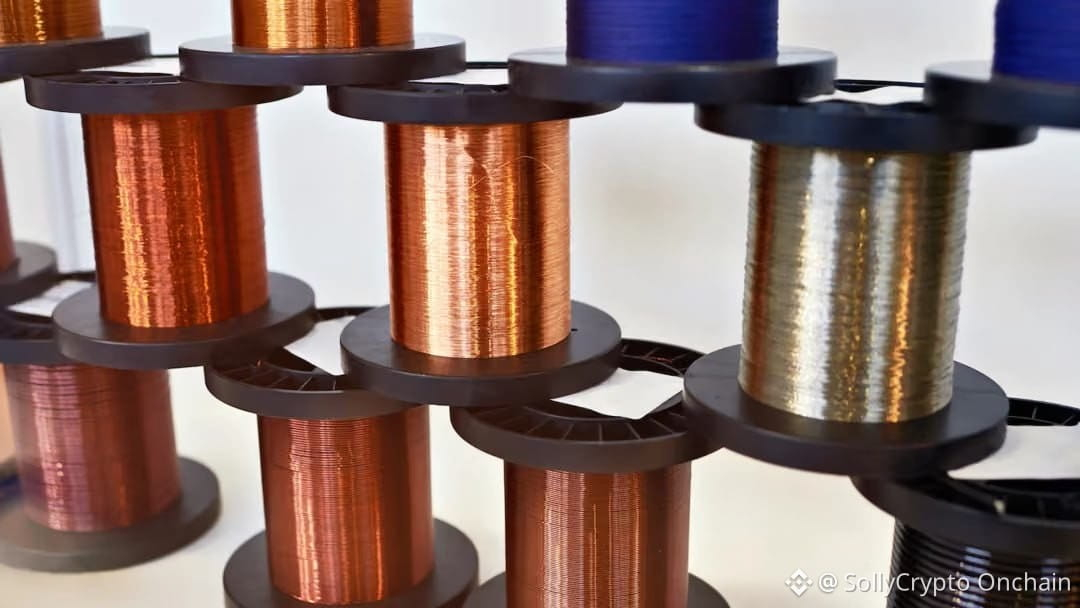
Toto Finance is seeking 22 million $ADA from the Cardano treasury to buy tokenized copper.
Why this happened
The pitch is an RWA play: use treasury $ADA to acquire physical copper, store it, tokenize it on Cardano, then later return sale proceeds to the treasury. It is governance asking holders to fund a commodity bet through the chain’s own treasury.
Why it matters
This puts $ADA in the middle of a real treasury allocation debate. Supporters will call it creative RWA usage. Critics will call it a commodity gamble with a high break-even hurdle for copper. Important limit: this is a request, not approved capital deployed yet.
How it can benefit you
If the proposal passes and ships cleanly, Cardano gets another tangible RWA narrative and onchain commodity product. That can support attention around $ADA’s ecosystem usefulness.
How it can harm you
Treasury spend that underperforms is a direct hit to community capital. People who buy $ADA only on “tokenized copper is coming” can get trapped if voters reject it or if the economics look weak.
SollyCrypto opinion
Mixed for $ADA. Interesting RWA experiment, but still a proposal with real treasury risk, not a clean free pump.
You buying $ADA on the copper treasury pitch, or waiting for the vote?
Follow me, or you may not see the next one.
1
481
·
--
Bullish
Grayscale says $HYPE, $LIT, and $CAKE top its ranking of crypto assets by tokenholder yield, with $AERO and $UNI rounding out the top five. On adjusted earnings yield, $CAKE, $LIT, and $HYPE keep the top three, followed by $RAY and $AAVE.
Why this happened
Grayscale is sorting tokens by how much economic value actually accrues to holders after accounting for things like rewards, buybacks, and dilution. That framework favors protocols that return value instead of just printing emissions.
Why it matters
A Grayscale yield ranking is high-quality narrative validation for productive tokens. For $HYPE, $LIT, and $CAKE, it reinforces the “holders get paid” story. Important limit: this is research ranking, not Grayscale buying those tokens with fund capital.
How it can benefit you
If you hold the top names, institutional framing around tokenholder yield supports the long-term product thesis. Markets often reward clear cash-flow narratives when risk appetite is open.
How it can harm you
Yield rankings do not stop short-term dumps. People who buy only because Grayscale put a ticker in a table can get trapped if price already priced the report.
SollyCrypto opinion
Mild pump lean for $HYPE, $LIT, and $CAKE. Strong yield narrative from Grayscale, still not the same as live institutional buying.
You buying the Grayscale top three, or treating it as research only?
Follow me, or you may not see the next one.
2
728
·
--
Bearish
A hacker infinite-minted tokens on Initia Chain and has withdrawn about $2.6M so far, with more funds reportedly still moving.
Why this happened
An “infinimint” style exploit lets an attacker create tokens with no real cap, then dump them for assets that hold value. Security researchers flagged the activity on Initia, and the cash-out path is what turns a mint bug into real dollar losses for the market.
Why it matters
Unauthorized minting is pure trust and supply shock. Even if the flaw sits in an app layer rather than every core system, the headline hits $INIT hard because users price chain-level safety first. With funds still moving, the final loss number may not be locked yet.
How it can benefit you
If you are flat, this is a clear risk-off signal until the exploit path is patched and residual sell pressure cools. Forced dumps after mint exploits sometimes create later entries only after the bleeding stops.
How it can harm you
Holders can eat the first panic wave while the attacker keeps converting minted tokens. People who buy the first “contained” message can still get trapped if more of the stack hits markets.
SollyCrypto opinion
Dump lean for $INIT. Infinite-mint cash-outs are a near-term negative until the full fund path and patch status are clear.
You fading $INIT on the exploit, or waiting for a full post-mortem?
Follow me, or you may not see the next one.
2
2
287
·
--
Bearish
🛠️ Ethereum update delayed over security concerns
Ethereum's Glamsterdam update delay raises security flags, but it's routine ops. $ETH is down -1.4% to $2,404 amid broader market pressures.
Why it matters: Glamsterdam's delay affects developers and node operators who need to review the security patches. Watch for a new update timeline from the dev team.
1
86
·
--
Bullish
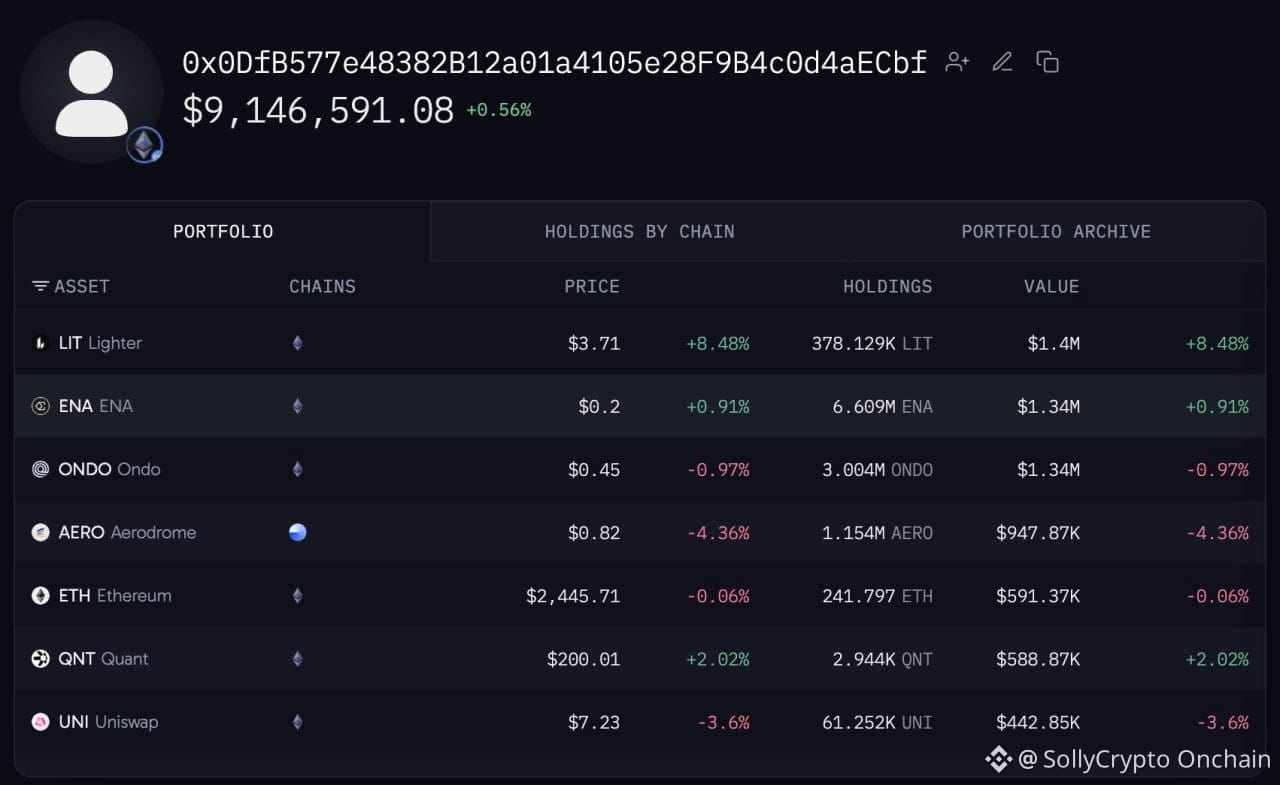
A whale bought about $7.22M in tokens over the past 24 hours, led by $LIT (~$1.4M), $ENA (~$1.34M), and $ONDO (~$1.34M), with more size in $AERO, $ETH, $QNT, $UNI, $TAO, and a smaller $PEPE clip.
Why this happened
This is a diversified alt basket, not a single-name all-in. The top of the book leans DeFi, RWA, and liquid large-caps, with a meme sprinkle at the bottom. When one wallet sprays that much capital across several names in a day, it is usually desk-style accumulation or a high-conviction rotation, not random noise.
Why it matters
Flow of this size can lift short-term attention across the whole basket. $LIT, $ENA, and $ONDO take the cleanest signal because they got the biggest checks. The rest get secondary narrative lift from riding the same ticket.
How it can benefit you
If you already like those names, a multi-million whale basket supports near-term sentiment. Broad buying also reduces the chance this was just one thin-book spoof print.
How it can harm you
Copy-trading after the buys print is late. Baskets can be flipped just as fast as they are built. People who chase every line item can get trapped in the weaker names inside the list.
SollyCrypto opinion
Mild pump lean for $LIT, $ENA, and $ONDO first. Respect the flow, do not blindly mirror the full basket.
You buying the top three with the whale, or waiting to see if more size lands?
Follow me, or you may not see the next one.
1
39
·
--
Bearish
Verified
SSV Labs, core developer of SSV Network, submitted DIP-59 seeking major development cutbacks as the DAO faces funding strain.
Why this happened
Tough market plus tight DAO finances forced a reset. Instead of pushing new products, SSV Labs wants to focus on network maintenance, security, and Ethereum upgrade compatibility, with engagement extended through June 2027. The proposal also flags that a previously approved payment of about 1.74M $SSV under DIP-31 is still unpaid.
Why it matters
When a core team shifts from expansion to maintenance, markets often read it as growth slowdown. For $SSV, unpaid prior funding plus a thinner roadmap is a confidence hit, even if keeping the network secure is the responsible move under budget pressure.
How it can benefit you
If the DAO stabilizes finances and keeps the network solid through Ethereum upgrades, the maintenance path can protect long-term protocol value. Forced clarity on runway is better than silent overspending.
How it can harm you
Token holders can face a narrative dump when “new product” optionality gets cut. People who bought pure growth stories can get trapped if governance friction and funding stress linger.
SollyCrypto opinion
Near-term dump lean for $SSV. Roadmap cutbacks plus unpaid DAO payment is a negative funding signal until the vote and payment path clear up.
You fading $SSV on DIP-59, or waiting for the DAO vote outcome?
Follow me, or you may not see the next one.
1
584
·
--
Bullish
🐋 Evernorth to Buy $132M in XRP
Evernorth's $132M authorization for $XRP shows serious institutional interest. Despite market stability, XRP's +3.8% move suggests this could be a big catalyst.
Why it matters: XRP holders should watch for further upward momentum and potential institutional follow-through from this purchase plan.
Evernorth's $132M authorization for $XRP shows serious institutional interest. Despite market stability, XRP's +3.8% move suggests this could be a big catalyst.
Why it matters: XRP holders should watch for further upward momentum and potential institutional follow-through from this purchase plan.
1
150
·
--
Bearish
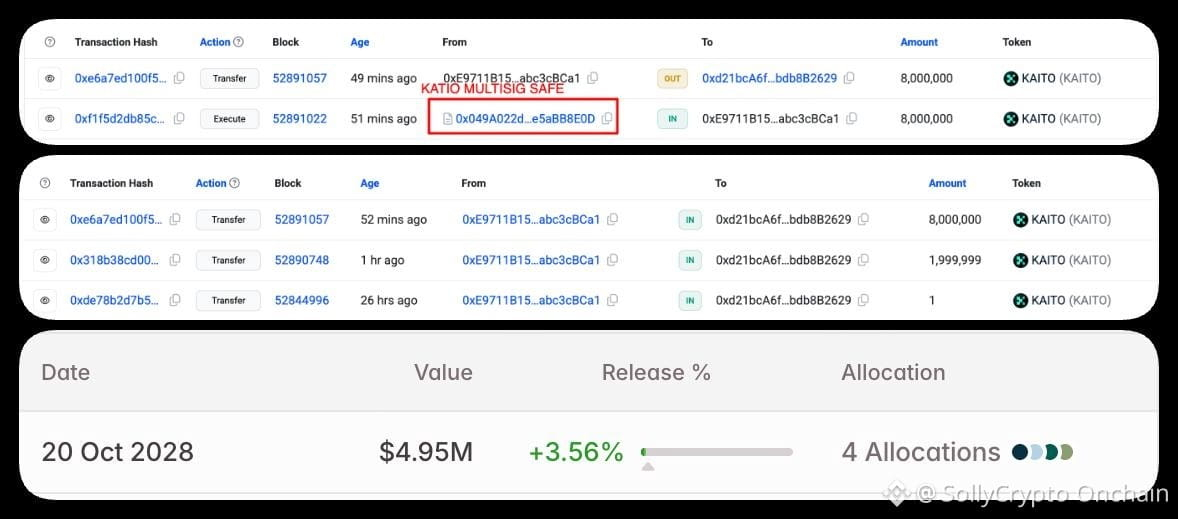
A wallet received unlocked $KAITO from the Kaito multisig and moved it on, with total related inflows around 10M $KAITO. Next unlock is set for November 20, 2026, worth about $4.9M or roughly 7.29% of circulating supply.
Why this happened
Unlock schedules free tokens. Multisig outflows after unlock windows often mean distribution prep, custody shifts, or sell-side staging. Moving 10M unlocked $KAITO into fresh flow is exactly the kind of supply signal traders watch.
Why it matters
Unlocked tokens can hit the market. Even if not every token sells immediately, visible multisig-to-wallet movement raises near-term float risk. The November 20 unlock adds a second supply date on the calendar, so this is not a one-and-done overhang story.
How it can benefit you
If you are patient, unlock and distribution flow can create better entries after forced selling clears. Knowing the next unlock date also stops you from chasing strength into known supply.
How it can harm you
Holders can eat the first wave if recipients sell into thin books. People who treat every transfer as “already priced” can still get trapped when the second unlock lands.
SollyCrypto opinion
Near-term dump lean for $KAITO. Unlocked multisig flow plus another November unlock is a supply caution setup.
You fading $KAITO into unlock flow, or waiting for the November print?
Follow me, or you may not see the next one.
1
300
·
--
Bullish
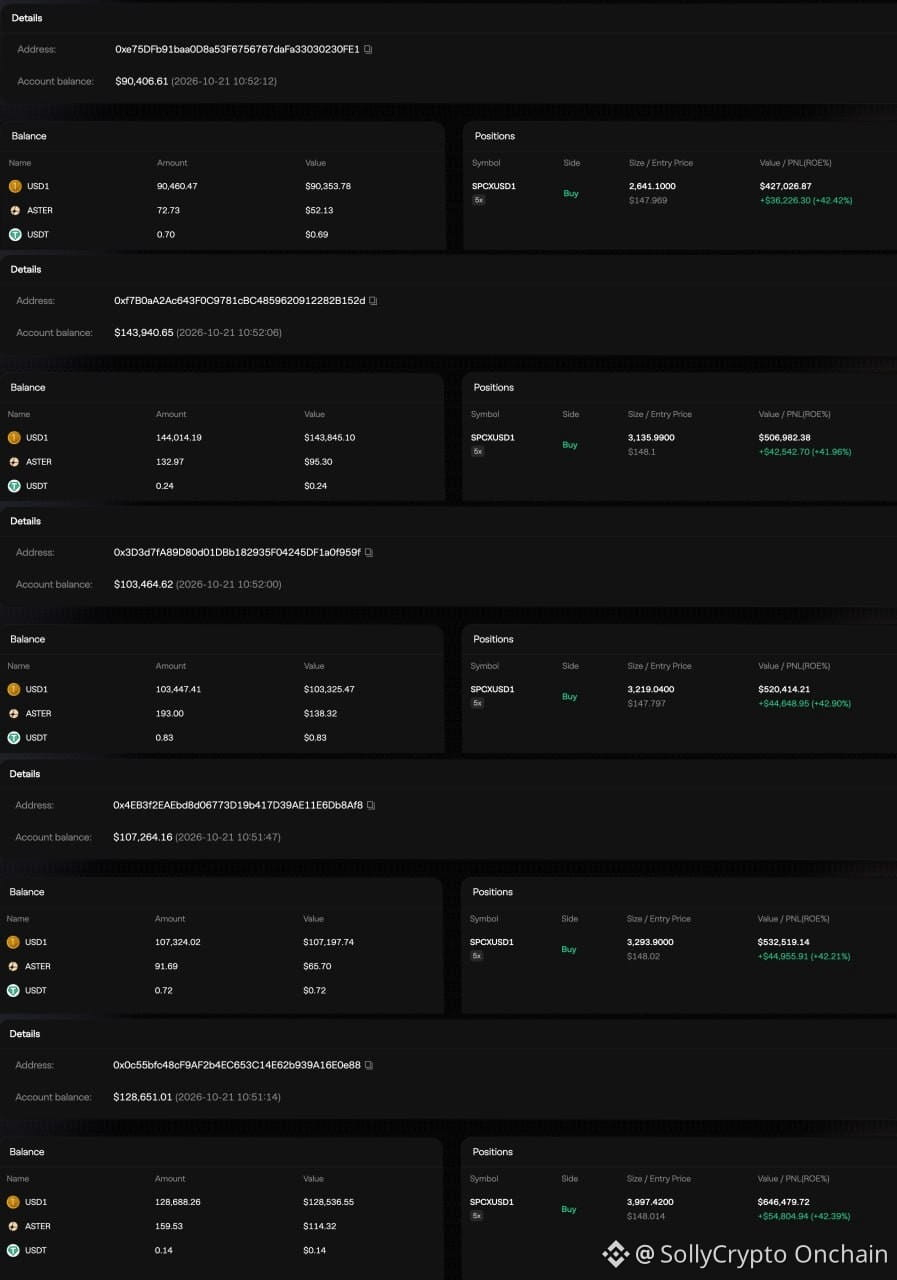
Five wallets deposited USD1 into Aster DEX and opened 5x longs on about 16,287 $SPCX (~$2.63M). The cluster is now sitting on roughly $223K in unrealized profit.
Why this happened
Stablecoin-funded wallets are taking leveraged directional risk on $SPCX through Aster. Multiple wallets opening the same side usually means coordinated conviction or the same desk spreading risk. They are already in profit, so the bid is working so far.
Why it matters
$2.63M notional at 5x is real leverage flow for $SPCX. It supports a near-term bullish bias while those longs stay open and green. The risk is mechanical: leveraged profits can reverse fast if $SPCX dumps and liquidations cascade.
How it can benefit you
If you are bullish $SPCX, visible leveraged demand shows somebody is willing to pay to stay long. Profit already on the books can also keep those wallets from panic-closing too early.
How it can harm you
Copy-trading open leveraged longs is late by design. If the cluster takes profit or gets squeezed, late buyers become exit liquidity. 5x cuts both ways.
SollyCrypto opinion
Mild pump lean for $SPCX while this long cluster holds. Respect the flow, respect the leverage risk.
You riding $SPCX with the Aster longs, or waiting for them to add or exit?
Follow me, or you may not see the next one.
2
628
·
--
Bullish
Morpho is bringing receivable-backed credit markets onchain with Morpho Midnight.
Why this happened
Businesses often deliver goods or services before they get paid. Those unpaid invoices are receivables, and offchain lenders already finance them at huge scale. Morpho is using Morpho Midnight to package that credit style onchain so capital can compete for fixed-rate, programmable receivable-backed markets.
Why it matters
This expands Morpho beyond crypto collateral into real working-capital credit. For $MORPHO, receivable markets are a serious RWA credit vertical if they ship with institutional controls and real borrower demand. First markets are expected soon, so this is product path more than finished volume.
How it can benefit you
If you hold $MORPHO, new credit primitives support the long-term “onchain capital markets” thesis. More collateral types can mean more relevance for Morpho’s lending stack.
How it can harm you
Receivable credit has underwriting, legal, and default risk. People who buy only on the RWA headline can get trapped if early markets stay thin or launch slowly.
SollyCrypto opinion
Mild pump lean for $MORPHO. Real product expansion into receivable-backed credit, still early until live markets prove demand.
You buying $MORPHO on Midnight receivables, or waiting for live market volume?
Follow me, or you may not see the next one.

65
Log in to explore more content
Join global crypto users on Binance Square
⚡️ Get latest and useful information about crypto.
💬 Trusted by the world’s largest crypto exchange.
👍 Discover real insights from verified creators.
Email / Phone number
Trending Topics
BitcoinSlipsBelow$80KAgain
1,427 views
30 Discussing
BTC Is Bleeding While the Whale W Move Out — Stacked Against a Corporate Bid
Seven days of downside, and it wasn't retail that drove.
The: BTC closed ~79,796 on Oct27, down ~2.6% over 7 days and ~5.2% over 30 days. Daily RSI(12) sits at 39.8. The week's range: high ~84,377 (Oct 22), low ~79,220 (Oct 24). No capitulation candle. No reclaim of 84K. Just grind.
The supply side is doing the talking. Dormant wallets moved 2,571 BTC (~$206.5M) toward institutional exchanges. That is supply arriving at the venue, not leaving it. Treasury appetite also cooled — Strategy redirected $204.9M into share buybacks instead of BTC.
The bid underneath is corporate, not speculative. Strive acquired 6,182 BTC (~$511.4M); public firms added 6,200+ BTC combined. That is a real floor argument near $79.7K — but it is a floor, not a breakout catalyst.
Momentum is not on the bulls' side. MACD histogram at −23.99, price under the 99 EMA. Upside is capped below ~$80.5K until that structure fl.
Positioning is mildly bullish, not euphoric. Square community poll: 2,116 bullish vs 1,714 bearish of 3,830 votes A limited sample — worth knowing, not worth trading on alone.
My read: this is distribution into a corporate bid. The floor is real; the momentum is not there. Watching whether the 79.2K–79.7K zone absorbs the exchange inflow is the whole story this week.
#BitcoinSlipsBelow$80KAgain
_Mr_Singh_
·0 Likes
·484 views
ThailandLaunchesWORPTStablecoinToQRPaymentApp
1,604 views
83 Discussing
StrategySkipsBitcoinPurchasesSpends$205MOnSTRCBuybacks
3,079 views
69 Discussing