

SanAndreas
399 Posts

SanAndreas
Report
Block User
BP-68872ACF8969
High-Frequency Trader
5.7 Years
44 Following
102 Followers
150 Liked
Posts
All
Quotes
·
--
@Dusk_Foundation #dusk $DUSK
DuskEVM
DuskEVM brings Solidity, EVM wallets, and Ethereum tooling to Dusk. Existing EVM applications can target DuskEVM with familiar contracts and workflows while using DUSK for gas and DuskDS for settlement and data availability.Why DuskEVMStart with the EVM stack. Use Solidity or Vyper with Foundry, Hardhat, viem, ethers, and standard EVM wallets.Use DUSK throughout.
DUSK pays for execution and moves between the Dusk L1 and DuskEVM through the bridge.Settle on DuskDS. Batches and state commitments anchor DuskEVM activity to Dusk’s consensus and data-availability layer.Reach the wider Dusk stack. EVM applications can connect to Dusk L1 assets, infrastructure, and privacy-oriented workflows as those integrations require.
A DuskEVM transaction follows a rollup lifecycle:
The transaction is submitted to the DuskEVM sequencer.
The execution layer includes it in an L2 block.
The batcher publishes the transaction data to DuskDS.
State commitments and fault proofs connect the resulting state to DuskDS settlement.
Transaction inclusion is fast, but inclusion and settlement are different stages. Applications that move value between DuskEVM and the Dusk L1 should use protocol or wallet status rather than infer finality from elapsed time.
Choose an execution environment
Choose DuskEVM for Solidity applications, EVM wallets, existing Ethereum libraries, and EVM infrastructure.
Choose DuskVM for Rust/WASM contracts that should execute directly on the Dusk L1 or integrate closely with its transaction models, protocol assets, privacy, or zero-knowledge capabilities.
@Dusk #dusk $DUSK
DuskEVM
DuskEVM brings Solidity, EVM wallets, and Ethereum tooling to Dusk. Existing EVM applications can target DuskEVM with familiar contracts and workflows while using DUSK for gas and DuskDS for settlement and data availability.Why DuskEVMStart with the EVM stack. Use Solidity or Vyper with Foundry, Hardhat, viem, ethers, and standard EVM wallets.Use DUSK throughout.
DUSK pays for execution and moves between the Dusk L1 and DuskEVM through the bridge.Settle on DuskDS. Batches and state commitments anchor DuskEVM activity to Dusk’s consensus and data-availability layer.Reach the wider Dusk stack. EVM applications can connect to Dusk L1 assets, infrastructure, and privacy-oriented workflows as those integrations require.
A DuskEVM transaction follows a rollup lifecycle:
The transaction is submitted to the DuskEVM sequencer.
The execution layer includes it in an L2 block.
The batcher publishes the transaction data to DuskDS.
State commitments and fault proofs connect the resulting state to DuskDS settlement.
Transaction inclusion is fast, but inclusion and settlement are different stages. Applications that move value between DuskEVM and the Dusk L1 should use protocol or wallet status rather than infer finality from elapsed time.
Choose an execution environment
Choose DuskEVM for Solidity applications, EVM wallets, existing Ethereum libraries, and EVM infrastructure.
Choose DuskVM for Rust/WASM contracts that should execute directly on the Dusk L1 or integrate closely with its transaction models, protocol assets, privacy, or zero-knowledge capabilities.
DuskEVM
DuskEVM brings Solidity, EVM wallets, and Ethereum tooling to Dusk. Existing EVM applications can target DuskEVM with familiar contracts and workflows while using DUSK for gas and DuskDS for settlement and data availability.Why DuskEVMStart with the EVM stack. Use Solidity or Vyper with Foundry, Hardhat, viem, ethers, and standard EVM wallets.Use DUSK throughout.
DUSK pays for execution and moves between the Dusk L1 and DuskEVM through the bridge.Settle on DuskDS. Batches and state commitments anchor DuskEVM activity to Dusk’s consensus and data-availability layer.Reach the wider Dusk stack. EVM applications can connect to Dusk L1 assets, infrastructure, and privacy-oriented workflows as those integrations require.
A DuskEVM transaction follows a rollup lifecycle:
The transaction is submitted to the DuskEVM sequencer.
The execution layer includes it in an L2 block.
The batcher publishes the transaction data to DuskDS.
State commitments and fault proofs connect the resulting state to DuskDS settlement.
Transaction inclusion is fast, but inclusion and settlement are different stages. Applications that move value between DuskEVM and the Dusk L1 should use protocol or wallet status rather than infer finality from elapsed time.
Choose an execution environment
Choose DuskEVM for Solidity applications, EVM wallets, existing Ethereum libraries, and EVM infrastructure.
Choose DuskVM for Rust/WASM contracts that should execute directly on the Dusk L1 or integrate closely with its transaction models, protocol assets, privacy, or zero-knowledge capabilities.
79
·
--
@Dusk_Foundation #dusk $DUSK
{spot}(DUSKUSDT)
DuskVM
DuskVM is the Wasmtime-based execution environment for Rust/WASM contracts that run directly on the Dusk L1. It is the path for contracts that need direct access to L1 assets, transaction models, privacy, or zero-knowledge capabilities.
DuskEVM
DuskEVM is an OP Stack-based EVM-equivalent execution environment. It lets you deploy Solidity contracts using standard EVM tooling while using DuskDS for settlement and data availability.
Network Layer: Kadcast
Kadcast is Dusk’s P2P networking layer. It uses a structured overlay (instead of random gossip) to reduce bandwidth and improve latency predictability.
Genesis Contracts
Dusk ships with two genesis contracts:
Stake: tracks provisioners, stakes, rewards, and validator set management. (source)
Transfer: transfers DUSK and is the entry point for transaction execution and gas payment. (source)
For node operators: Run a provisioner node.
Applications
On top of the base protocol, Dusk supports application-layer protocols and tools for regulated markets.
Dusk Trade
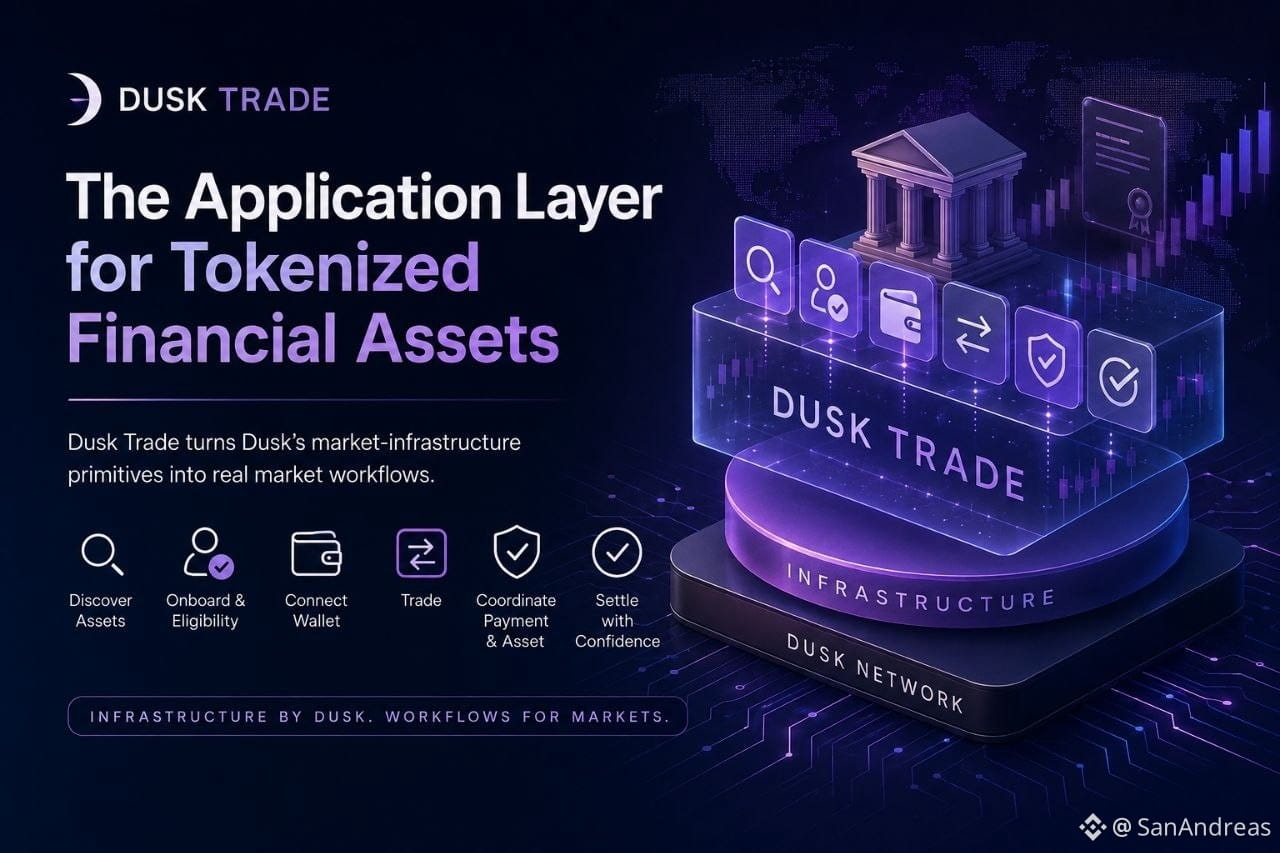
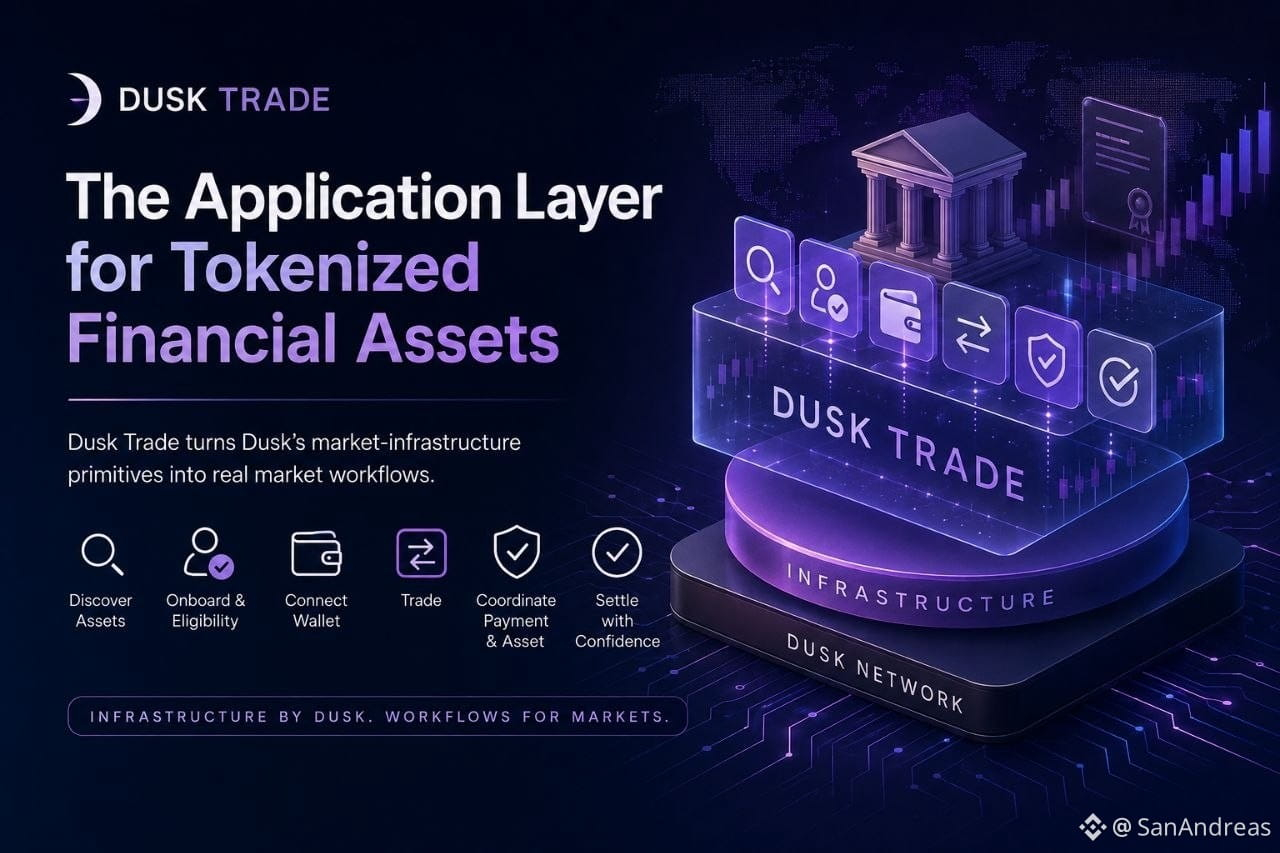
Dusk Trade is the application layer for tokenized financial assets on Dusk. It is being built around real market workflows: investor onboarding, wallet binding, controlled transfers, payment coordination, and compliant settlement.
Zedger / Hedger
Zedger and Hedger are protocols for issuing and managing regulated assets with built-in compliance and privacy constraints.
Zedger uses DuskVM contracts on the Dusk L1.
Hedger runs on DuskEVM to offer an EVM-first developer experience.
Citadel
Citadel
Citadel is Dusk’s identity and access layer. It supports selective disclosure so users can prove attributes (e.g. residency, age bracket, accreditation) without revealing more than necessary.
@Dusk #dusk $DUSK
DuskVM
DuskVM is the Wasmtime-based execution environment for Rust/WASM contracts that run directly on the Dusk L1. It is the path for contracts that need direct access to L1 assets, transaction models, privacy, or zero-knowledge capabilities.
DuskEVM
DuskEVM is an OP Stack-based EVM-equivalent execution environment. It lets you deploy Solidity contracts using standard EVM tooling while using DuskDS for settlement and data availability.
Network Layer: Kadcast
Kadcast is Dusk’s P2P networking layer. It uses a structured overlay (instead of random gossip) to reduce bandwidth and improve latency predictability.
Genesis Contracts
Dusk ships with two genesis contracts:
Stake: tracks provisioners, stakes, rewards, and validator set management. (source)
Transfer: transfers DUSK and is the entry point for transaction execution and gas payment. (source)
For node operators: Run a provisioner node.
Applications
On top of the base protocol, Dusk supports application-layer protocols and tools for regulated markets.
Dusk Trade
Dusk Trade is the application layer for tokenized financial assets on Dusk. It is being built around real market workflows: investor onboarding, wallet binding, controlled transfers, payment coordination, and compliant settlement.
Zedger / Hedger
Zedger and Hedger are protocols for issuing and managing regulated assets with built-in compliance and privacy constraints.
Zedger uses DuskVM contracts on the Dusk L1.
Hedger runs on DuskEVM to offer an EVM-first developer experience.
Citadel
Citadel
Citadel is Dusk’s identity and access layer. It supports selective disclosure so users can prove attributes (e.g. residency, age bracket, accreditation) without revealing more than necessary.
DuskVM
DuskVM is the Wasmtime-based execution environment for Rust/WASM contracts that run directly on the Dusk L1. It is the path for contracts that need direct access to L1 assets, transaction models, privacy, or zero-knowledge capabilities.
DuskEVM
DuskEVM is an OP Stack-based EVM-equivalent execution environment. It lets you deploy Solidity contracts using standard EVM tooling while using DuskDS for settlement and data availability.
Network Layer: Kadcast
Kadcast is Dusk’s P2P networking layer. It uses a structured overlay (instead of random gossip) to reduce bandwidth and improve latency predictability.
Genesis Contracts
Dusk ships with two genesis contracts:
Stake: tracks provisioners, stakes, rewards, and validator set management. (source)
Transfer: transfers DUSK and is the entry point for transaction execution and gas payment. (source)
For node operators: Run a provisioner node.
Applications
On top of the base protocol, Dusk supports application-layer protocols and tools for regulated markets.
Dusk Trade
Dusk Trade is the application layer for tokenized financial assets on Dusk. It is being built around real market workflows: investor onboarding, wallet binding, controlled transfers, payment coordination, and compliant settlement.
Zedger / Hedger
Zedger and Hedger are protocols for issuing and managing regulated assets with built-in compliance and privacy constraints.
Zedger uses DuskVM contracts on the Dusk L1.
Hedger runs on DuskEVM to offer an EVM-first developer experience.
Citadel
Citadel
Citadel is Dusk’s identity and access layer. It supports selective disclosure so users can prove attributes (e.g. residency, age bracket, accreditation) without revealing more than necessary.
89
·
--
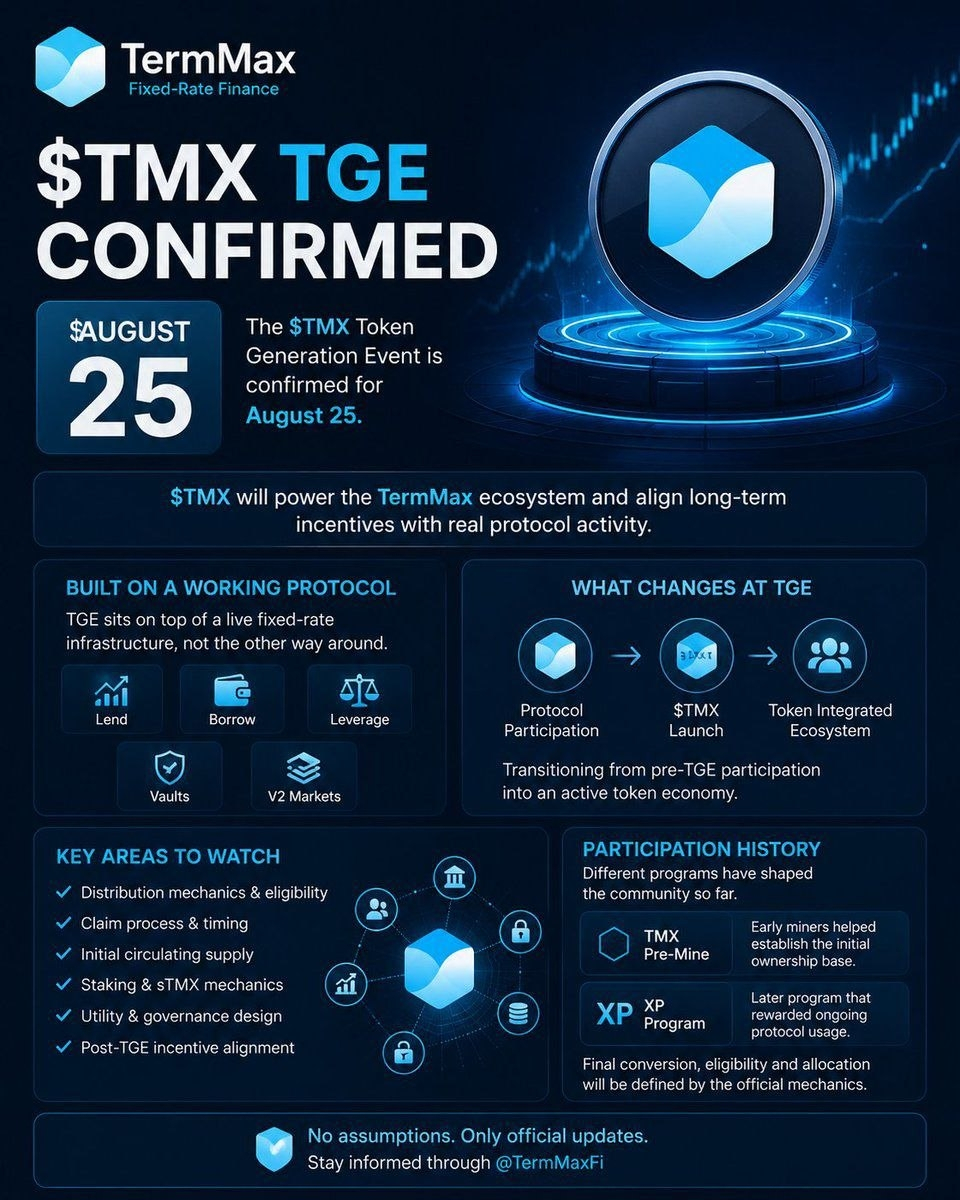
#termmax @termmax
3. TMX Utility
TMX holders can participate in governance and guide the product features and parameters of the protocol.
TMX holders can also provide liquidity to a DEX pool like PancakeSwap or stake their $TMX tokens to receive sTMX (protocol FT tokens in TMX), which enables the holders to receive the following benefits:
Staking rewards, including TMX emissions which may be sourced from Community allocation (in Tokenomics) and/or a portion of tokens from TermMax Treasury's funds
Enhanced governance rights to adjust protocol parameters, including market risk parameters, and curator whitelisting
Treasury’s funds may be generated from:
Trading fees on TermMax FT/XT product tokens across all markets
Protocol fees collected on borrowing activity
Liquidation fees
Other sources
This mechanism aligns the interests of long-term holders with protocol sustainability and growth.
#termmax @TermMax
3. TMX Utility
TMX holders can participate in governance and guide the product features and parameters of the protocol.
TMX holders can also provide liquidity to a DEX pool like PancakeSwap or stake their $TMX tokens to receive sTMX (protocol FT tokens in TMX), which enables the holders to receive the following benefits:
Staking rewards, including TMX emissions which may be sourced from Community allocation (in Tokenomics) and/or a portion of tokens from TermMax Treasury's funds
Enhanced governance rights to adjust protocol parameters, including market risk parameters, and curator whitelisting
Treasury’s funds may be generated from:
Trading fees on TermMax FT/XT product tokens across all markets
Protocol fees collected on borrowing activity
Liquidation fees
Other sources
This mechanism aligns the interests of long-term holders with protocol sustainability and growth.
3. TMX Utility
TMX holders can participate in governance and guide the product features and parameters of the protocol.
TMX holders can also provide liquidity to a DEX pool like PancakeSwap or stake their $TMX tokens to receive sTMX (protocol FT tokens in TMX), which enables the holders to receive the following benefits:
Staking rewards, including TMX emissions which may be sourced from Community allocation (in Tokenomics) and/or a portion of tokens from TermMax Treasury's funds
Enhanced governance rights to adjust protocol parameters, including market risk parameters, and curator whitelisting
Treasury’s funds may be generated from:
Trading fees on TermMax FT/XT product tokens across all markets
Protocol fees collected on borrowing activity
Liquidation fees
Other sources
This mechanism aligns the interests of long-term holders with protocol sustainability and growth.
69
·
--
@Dusk_Foundation #dusk $DUSK
{spot}(DUSKUSDT)
DuskDS is the Dusk Data Availability and Settlement layer. It is the consensus, finality, and data-availability foundation of the Dusk L1, and includes the Moonlight and Phoenix transaction models used to transfer DUSK and pay for execution.
DuskDS is not a name for the complete Dusk network. The Dusk L1 also includes DuskVM smart-contract execution, while DuskEVM is an EVM-compatible execution layer that settles and publishes data through DuskDS.
DuskDS supports two transaction models: Moonlight for transparent public accounts and Phoenix for confidential shielded transfers. See: Transaction Models on Dusk.
Rusk
Rusk is the Rust node implementation for the Dusk L1. It runs DuskDS consensus, maintains chain state, executes DuskVM contracts, and exposes the HTTP API and RUES event system used by wallets, indexers, and integrators.
Succinct Attestation
Succinct Attestation (SA) is DuskDS’s permissionless, committee-based proof-of-stake consensus protocol. It uses randomly selected provisioners to propose, validate, and ratify blocks, providing fast, deterministic finality suitable for financial markets.
At a high level, each round goes through three steps:
Proposal – a provisioner creates and broadcasts a candidate block.
Validation – a committee checks the block’s validity.
Ratification – another committee confirms the validation outcome and finalizes the block.
For the full protocol specification and security analysis (including committee selection, finality, and slashing), see Section 3 “Consensus mechanism” of the Dusk Whitepaper (2024).
Transactions in DuskDS
Transactions in DuskDS are managed by the Transfer contract, which supports both public and shielded transfers.
Moonlight is account-based and public. Phoenix is UTXO-based and shielded. Both are used to transfer DUSK, pay gas, and act as the entry point for contract execution.
@Dusk #dusk $DUSK
DuskDS is the Dusk Data Availability and Settlement layer. It is the consensus, finality, and data-availability foundation of the Dusk L1, and includes the Moonlight and Phoenix transaction models used to transfer DUSK and pay for execution.
DuskDS is not a name for the complete Dusk network. The Dusk L1 also includes DuskVM smart-contract execution, while DuskEVM is an EVM-compatible execution layer that settles and publishes data through DuskDS.
DuskDS supports two transaction models: Moonlight for transparent public accounts and Phoenix for confidential shielded transfers. See: Transaction Models on Dusk.
Rusk
Rusk is the Rust node implementation for the Dusk L1. It runs DuskDS consensus, maintains chain state, executes DuskVM contracts, and exposes the HTTP API and RUES event system used by wallets, indexers, and integrators.
Succinct Attestation
Succinct Attestation (SA) is DuskDS’s permissionless, committee-based proof-of-stake consensus protocol. It uses randomly selected provisioners to propose, validate, and ratify blocks, providing fast, deterministic finality suitable for financial markets.
At a high level, each round goes through three steps:
Proposal – a provisioner creates and broadcasts a candidate block.
Validation – a committee checks the block’s validity.
Ratification – another committee confirms the validation outcome and finalizes the block.
For the full protocol specification and security analysis (including committee selection, finality, and slashing), see Section 3 “Consensus mechanism” of the Dusk Whitepaper (2024).
Transactions in DuskDS
Transactions in DuskDS are managed by the Transfer contract, which supports both public and shielded transfers.
Moonlight is account-based and public. Phoenix is UTXO-based and shielded. Both are used to transfer DUSK, pay gas, and act as the entry point for contract execution.
DuskDS is the Dusk Data Availability and Settlement layer. It is the consensus, finality, and data-availability foundation of the Dusk L1, and includes the Moonlight and Phoenix transaction models used to transfer DUSK and pay for execution.
DuskDS is not a name for the complete Dusk network. The Dusk L1 also includes DuskVM smart-contract execution, while DuskEVM is an EVM-compatible execution layer that settles and publishes data through DuskDS.
DuskDS supports two transaction models: Moonlight for transparent public accounts and Phoenix for confidential shielded transfers. See: Transaction Models on Dusk.
Rusk
Rusk is the Rust node implementation for the Dusk L1. It runs DuskDS consensus, maintains chain state, executes DuskVM contracts, and exposes the HTTP API and RUES event system used by wallets, indexers, and integrators.
Succinct Attestation
Succinct Attestation (SA) is DuskDS’s permissionless, committee-based proof-of-stake consensus protocol. It uses randomly selected provisioners to propose, validate, and ratify blocks, providing fast, deterministic finality suitable for financial markets.
At a high level, each round goes through three steps:
Proposal – a provisioner creates and broadcasts a candidate block.
Validation – a committee checks the block’s validity.
Ratification – another committee confirms the validation outcome and finalizes the block.
For the full protocol specification and security analysis (including committee selection, finality, and slashing), see Section 3 “Consensus mechanism” of the Dusk Whitepaper (2024).
Transactions in DuskDS
Transactions in DuskDS are managed by the Transfer contract, which supports both public and shielded transfers.
Moonlight is account-based and public. Phoenix is UTXO-based and shielded. Both are used to transfer DUSK, pay gas, and act as the entry point for contract execution.
1
93
·
--
2. Introduction to TermMax
2.1 The Problem
DeFi markets operate predominantly on variable interest rates, creating uncertainty for both borrowers and lenders. Traditional institutions and professional traders require rate predictability to:
Plan capital deployment strategies
Hedge interest rate exposure
Optimize leverage costs and returns
Manage cash flow with certainty
2.2 The Solution
TermMax provides decentralized fixed-rate and fixed-term borrowing and lending infrastructure through a three-token system and a custom AMM:
FT (Fixed-rate Token) — A zero-coupon bond style token representing the right to redeem the face value of a debt position at maturity. Lenders buy FT at a discount and redeem at par, locking in a fixed yield from the moment they enter.
XT (Yield Token) — The complementary component to FT, where 1 FT + 1 XT = 1 debt token. Borrowers receive XT when they take out a loan and can sell it immediately to obtain liquidity, fixing their borrowing cost at entry. XT also functions as an options-premium-like token representing the options instrument in TermMax Alpha markets.
GT (Gearing Token) — An NFT that encapsulates a leveraged position, recording its associated collateral and debt information on-chain. Rather than manually looping collateral and borrowing multiple times, users can mint a GT in a single transaction to achieve target leverage with significantly lower gas costs.
Curators & Capital Efficiency
TermMax markets are managed by professional curators — specialized liquidity managers who set pricing curves, manage risk parameters, and optimize capital deployment. The current curators include Keyrock, Hardcoded Lab, Edge Capital, AlphaPing, and Origami Crypto.
Two mechanisms ensure curator capital works at maximum efficiency:
Atomic Orders: Before funds are borrowed, virtual liquidity can be spread across multiple orders simultaneously, ensuring capital is always positioned where it's most needed without fragmentation.
@termmax #TermMax
2. Introduction to TermMax
2.1 The Problem
DeFi markets operate predominantly on variable interest rates, creating uncertainty for both borrowers and lenders. Traditional institutions and professional traders require rate predictability to:
Plan capital deployment strategies
Hedge interest rate exposure
Optimize leverage costs and returns
Manage cash flow with certainty
2.2 The Solution
TermMax provides decentralized fixed-rate and fixed-term borrowing and lending infrastructure through a three-token system and a custom AMM:
FT (Fixed-rate Token) — A zero-coupon bond style token representing the right to redeem the face value of a debt position at maturity. Lenders buy FT at a discount and redeem at par, locking in a fixed yield from the moment they enter.
XT (Yield Token) — The complementary component to FT, where 1 FT + 1 XT = 1 debt token. Borrowers receive XT when they take out a loan and can sell it immediately to obtain liquidity, fixing their borrowing cost at entry. XT also functions as an options-premium-like token representing the options instrument in TermMax Alpha markets.
GT (Gearing Token) — An NFT that encapsulates a leveraged position, recording its associated collateral and debt information on-chain. Rather than manually looping collateral and borrowing multiple times, users can mint a GT in a single transaction to achieve target leverage with significantly lower gas costs.
Curators & Capital Efficiency
TermMax markets are managed by professional curators — specialized liquidity managers who set pricing curves, manage risk parameters, and optimize capital deployment. The current curators include Keyrock, Hardcoded Lab, Edge Capital, AlphaPing, and Origami Crypto.
Two mechanisms ensure curator capital works at maximum efficiency:
Atomic Orders: Before funds are borrowed, virtual liquidity can be spread across multiple orders simultaneously, ensuring capital is always positioned where it's most needed without fragmentation.
@TermMax #TermMax
2.1 The Problem
DeFi markets operate predominantly on variable interest rates, creating uncertainty for both borrowers and lenders. Traditional institutions and professional traders require rate predictability to:
Plan capital deployment strategies
Hedge interest rate exposure
Optimize leverage costs and returns
Manage cash flow with certainty
2.2 The Solution
TermMax provides decentralized fixed-rate and fixed-term borrowing and lending infrastructure through a three-token system and a custom AMM:
FT (Fixed-rate Token) — A zero-coupon bond style token representing the right to redeem the face value of a debt position at maturity. Lenders buy FT at a discount and redeem at par, locking in a fixed yield from the moment they enter.
XT (Yield Token) — The complementary component to FT, where 1 FT + 1 XT = 1 debt token. Borrowers receive XT when they take out a loan and can sell it immediately to obtain liquidity, fixing their borrowing cost at entry. XT also functions as an options-premium-like token representing the options instrument in TermMax Alpha markets.
GT (Gearing Token) — An NFT that encapsulates a leveraged position, recording its associated collateral and debt information on-chain. Rather than manually looping collateral and borrowing multiple times, users can mint a GT in a single transaction to achieve target leverage with significantly lower gas costs.
Curators & Capital Efficiency
TermMax markets are managed by professional curators — specialized liquidity managers who set pricing curves, manage risk parameters, and optimize capital deployment. The current curators include Keyrock, Hardcoded Lab, Edge Capital, AlphaPing, and Origami Crypto.
Two mechanisms ensure curator capital works at maximum efficiency:
Atomic Orders: Before funds are borrowed, virtual liquidity can be spread across multiple orders simultaneously, ensuring capital is always positioned where it's most needed without fragmentation.
@TermMax #TermMax
14
·
--
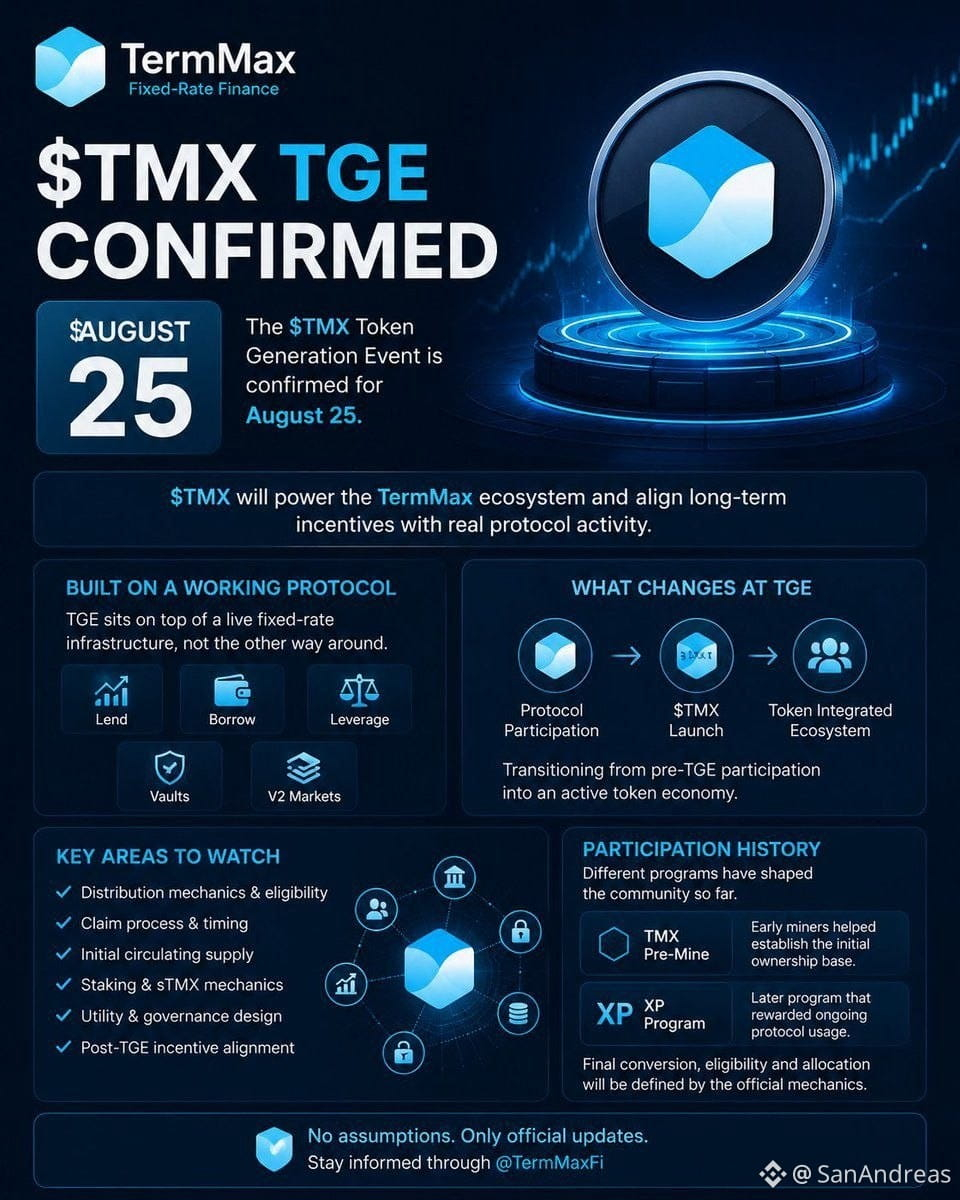
#termmax @termmax
TMX Token Whitepaper
Version 1.0 | March 2026
Disclaimer:
This whitepaper is for informational purposes only and does not constitute financial, legal, or investment advice. The information contained herein may be subject to change without prior notice. Term Structure Labs and its affiliated entities make no representations or warranties regarding the accuracy or completeness of this document. Prospective participants should conduct their own due diligence and consult with professional advisors before making any decisions.
1. Executive Summary
TMX is the utility and governance token for TermMax, a decentralized fixed-rate borrowing and lending protocol that delivers predictable interest rates in DeFi through innovative tokenization and automated market maker (AMM) technology.
Key Highlights:
Total Supply: 1,000,000,000 TMX (fixed, no inflation)
Token Standard: ERC20 (OFT on multiple blockchains)
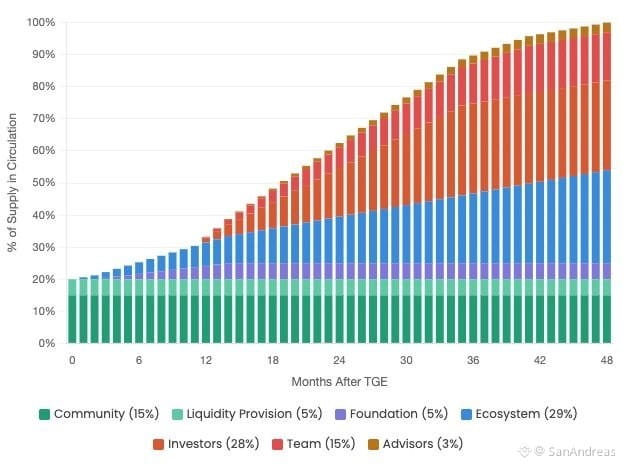
TGE Date: To Be AnnouncedInitial Circulation: ~20% at TGE
Core Function: Protocol governance, staking rewards, and ecosystem incentives
#termmax @TermMax
TMX Token Whitepaper
Version 1.0 | March 2026
Disclaimer:
This whitepaper is for informational purposes only and does not constitute financial, legal, or investment advice. The information contained herein may be subject to change without prior notice. Term Structure Labs and its affiliated entities make no representations or warranties regarding the accuracy or completeness of this document. Prospective participants should conduct their own due diligence and consult with professional advisors before making any decisions.
1. Executive Summary
TMX is the utility and governance token for TermMax, a decentralized fixed-rate borrowing and lending protocol that delivers predictable interest rates in DeFi through innovative tokenization and automated market maker (AMM) technology.
Key Highlights:
Total Supply: 1,000,000,000 TMX (fixed, no inflation)
Token Standard: ERC20 (OFT on multiple blockchains)
TGE Date: To Be AnnouncedInitial Circulation: ~20% at TGE
Core Function: Protocol governance, staking rewards, and ecosystem incentives
TMX Token Whitepaper
Version 1.0 | March 2026
Disclaimer:
This whitepaper is for informational purposes only and does not constitute financial, legal, or investment advice. The information contained herein may be subject to change without prior notice. Term Structure Labs and its affiliated entities make no representations or warranties regarding the accuracy or completeness of this document. Prospective participants should conduct their own due diligence and consult with professional advisors before making any decisions.
1. Executive Summary
TMX is the utility and governance token for TermMax, a decentralized fixed-rate borrowing and lending protocol that delivers predictable interest rates in DeFi through innovative tokenization and automated market maker (AMM) technology.
Key Highlights:
Total Supply: 1,000,000,000 TMX (fixed, no inflation)
Token Standard: ERC20 (OFT on multiple blockchains)
TGE Date: To Be AnnouncedInitial Circulation: ~20% at TGE
Core Function: Protocol governance, staking rewards, and ecosystem incentives
27
·
--
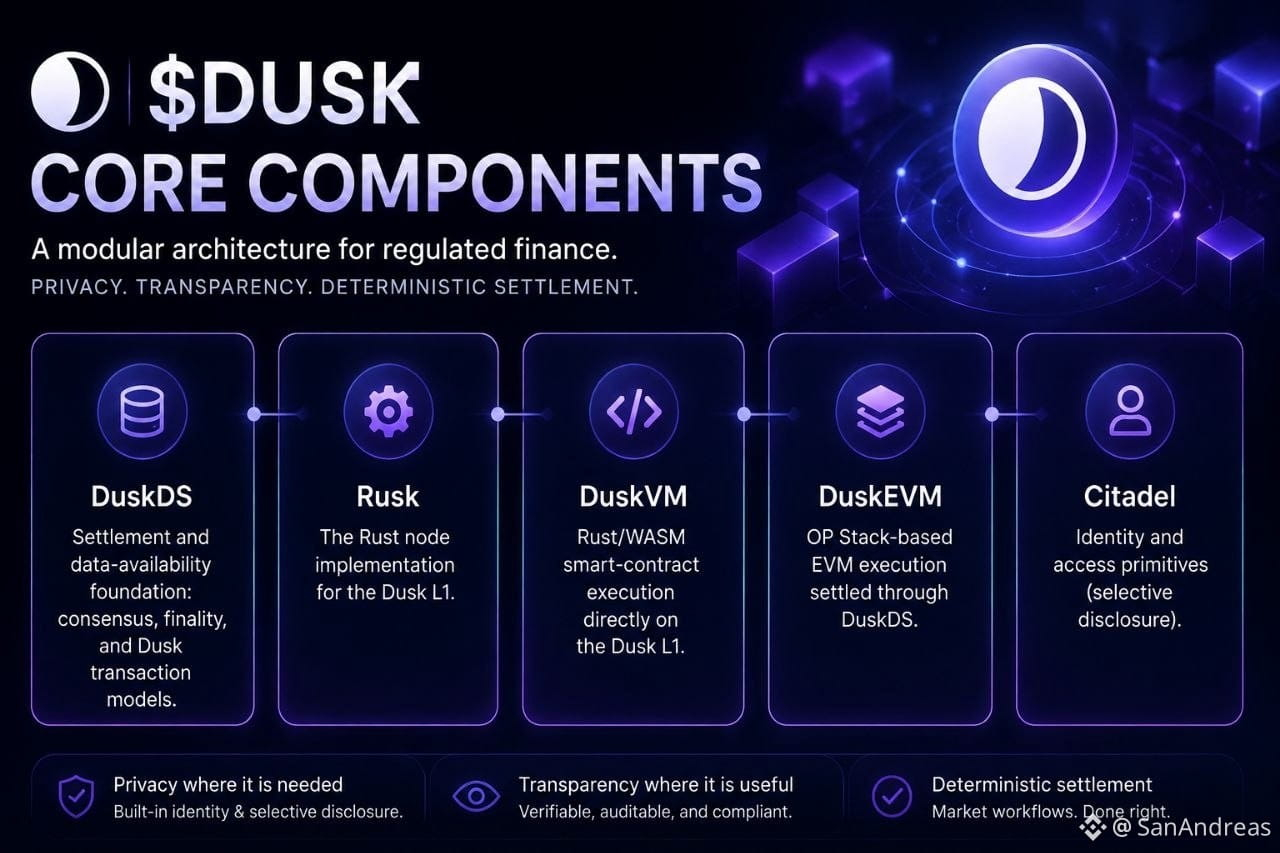
@Dusk_Foundation #dusk
$DUSK Core Component:
5.Citadel
Role : Identity and access primitives (selective disclosure)
Where to go next :
Citadel 2
Citadel 2 is an enhanced version of Dusk’s self-sovereign identity protocol. It lets someone prove they hold a valid credential, called a license, without putting their personal details or the exact license they used on-chain.
The core idea
Think of a Citadel license as a private credential.
A User asks a trusted License Provider (LP) for a license.
The LP checks the user off-chain, signs the relevant attribute data, publishes an encrypted license, and registers that license in a Citadel contract.
Later, the user wants access to a service. They generate a zero-knowledge proof showing that they own a registered LP-signed license, without revealing which license is being used.
The Citadel contract verifies the proof and records a public session.
The user sends a session cookie to the Service Provider (SP), and the SP decides whether to grant access.
That last point matters: Citadel proves that the session is cryptographically valid, but it does not decide service policy. The SP still decides which LPs it trusts, which attributes are accepted, whether the session is expired or revoked, and whether the cookie can be reused.
What stays private
Citadel 2 is designed so that personal attributes are not written to the blockchain. The on-chain session does not reveal the user’s wallet key, the license used, the LP key, the SP key, the signed attributes, or the Merkle proof path. If a service needs to learn or verify an attribute, the user discloses or proves only what that service’s policy requires.
Using Citadel 2
Developers can deploy their own Citadel license contract on Dusk. The Citadel repository includes the Rust core library, the license contract, and zk-citadel-wallet, a wallet-backed CLI/TUI for deploying a contract, requesting and issuing licenses, using a license, listing saved session cookies, and verifying sessions.
@Dusk #dusk
$DUSK Core Component:
5.Citadel
Role : Identity and access primitives (selective disclosure)
Where to go next :
Citadel 2
Citadel 2 is an enhanced version of Dusk’s self-sovereign identity protocol. It lets someone prove they hold a valid credential, called a license, without putting their personal details or the exact license they used on-chain.
The core idea
Think of a Citadel license as a private credential.
A User asks a trusted License Provider (LP) for a license.
The LP checks the user off-chain, signs the relevant attribute data, publishes an encrypted license, and registers that license in a Citadel contract.
Later, the user wants access to a service. They generate a zero-knowledge proof showing that they own a registered LP-signed license, without revealing which license is being used.
The Citadel contract verifies the proof and records a public session.
The user sends a session cookie to the Service Provider (SP), and the SP decides whether to grant access.
That last point matters: Citadel proves that the session is cryptographically valid, but it does not decide service policy. The SP still decides which LPs it trusts, which attributes are accepted, whether the session is expired or revoked, and whether the cookie can be reused.
What stays private
Citadel 2 is designed so that personal attributes are not written to the blockchain. The on-chain session does not reveal the user’s wallet key, the license used, the LP key, the SP key, the signed attributes, or the Merkle proof path. If a service needs to learn or verify an attribute, the user discloses or proves only what that service’s policy requires.
Using Citadel 2
Developers can deploy their own Citadel license contract on Dusk. The Citadel repository includes the Rust core library, the license contract, and zk-citadel-wallet, a wallet-backed CLI/TUI for deploying a contract, requesting and issuing licenses, using a license, listing saved session cookies, and verifying sessions.
$DUSK Core Component:
5.Citadel
Role : Identity and access primitives (selective disclosure)
Where to go next :
Citadel 2
Citadel 2 is an enhanced version of Dusk’s self-sovereign identity protocol. It lets someone prove they hold a valid credential, called a license, without putting their personal details or the exact license they used on-chain.
The core idea
Think of a Citadel license as a private credential.
A User asks a trusted License Provider (LP) for a license.
The LP checks the user off-chain, signs the relevant attribute data, publishes an encrypted license, and registers that license in a Citadel contract.
Later, the user wants access to a service. They generate a zero-knowledge proof showing that they own a registered LP-signed license, without revealing which license is being used.
The Citadel contract verifies the proof and records a public session.
The user sends a session cookie to the Service Provider (SP), and the SP decides whether to grant access.
That last point matters: Citadel proves that the session is cryptographically valid, but it does not decide service policy. The SP still decides which LPs it trusts, which attributes are accepted, whether the session is expired or revoked, and whether the cookie can be reused.
What stays private
Citadel 2 is designed so that personal attributes are not written to the blockchain. The on-chain session does not reveal the user’s wallet key, the license used, the LP key, the SP key, the signed attributes, or the Merkle proof path. If a service needs to learn or verify an attribute, the user discloses or proves only what that service’s policy requires.
Using Citadel 2
Developers can deploy their own Citadel license contract on Dusk. The Citadel repository includes the Rust core library, the license contract, and zk-citadel-wallet, a wallet-backed CLI/TUI for deploying a contract, requesting and issuing licenses, using a license, listing saved session cookies, and verifying sessions.
33
·
--
Article
DUSK Core Component:5. Citadel
Role : Identity and access primitives (selective disclosure)
Where to go next :
Citadel 2
Citadel 2 is an enhanced version of Dusk’s self-sovereign identity protocol. It lets someone prove they hold a valid credential, called a license, without putting their personal details or the exact license they used on-chain.
The core idea
Think of a Citadel license as a private credential.
A User asks a trusted License Provider (LP) for a license.
The LP checks the user off-chain, signs the relevant attribute data, publishes an encrypted license, and registers that license in a Citadel contract.
Later, the user wants access to a service. They generate a zero-knowledge proof showing that they own a registered LP-signed license, without revealing which license is being used.
The Citadel contract verifies the proof and records a public session.
The user sends a session cookie to the Service Provider (SP), and the SP decides whether to grant access.
That last point matters: Citadel proves that the session is cryptographically valid, but it does not decide service policy. The SP still decides which LPs it trusts, which attributes are accepted, whether the session is expired or revoked, and whether the cookie can be reused.
What stays private
Citadel 2 is designed so that personal attributes are not written to the blockchain. The on-chain session does not reveal the user’s wallet key, the license used, the LP key, the SP key, the signed attributes, or the Merkle proof path. If a service needs to learn or verify an attribute, the user discloses or proves only what that service’s policy requires.
Using Citadel 2
Developers can deploy their own Citadel license contract on $DUSK
The Citadel repository includes the Rust core library, the license contract, and zk-citadel-wallet, a wallet-backed CLI/TUI for deploying a contract, requesting and issuing licenses, using a license, listing saved session cookies, and verifying sessions.
@Dusk_Foundation #dusk
DUSK Core Component:
5. Citadel
Role : Identity and access primitives (selective disclosure)
Where to go next :
Citadel 2
Citadel 2 is an enhanced version of Dusk’s self-sovereign identity protocol. It lets someone prove they hold a valid credential, called a license, without putting their personal details or the exact license they used on-chain.
The core idea
Think of a Citadel license as a private credential.
A User asks a trusted License Provider (LP) for a license.
The LP checks the user off-chain, signs the relevant attribute data, publishes an encrypted license, and registers that license in a Citadel contract.
Later, the user wants access to a service. They generate a zero-knowledge proof showing that they own a registered LP-signed license, without revealing which license is being used.
The Citadel contract verifies the proof and records a public session.
The user sends a session cookie to the Service Provider (SP), and the SP decides whether to grant access.
That last point matters: Citadel proves that the session is cryptographically valid, but it does not decide service policy. The SP still decides which LPs it trusts, which attributes are accepted, whether the session is expired or revoked, and whether the cookie can be reused.
What stays private
Citadel 2 is designed so that personal attributes are not written to the blockchain. The on-chain session does not reveal the user’s wallet key, the license used, the LP key, the SP key, the signed attributes, or the Merkle proof path. If a service needs to learn or verify an attribute, the user discloses or proves only what that service’s policy requires.
Using Citadel 2
Developers can deploy their own Citadel license contract on $DUSK
The Citadel repository includes the Rust core library, the license contract, and zk-citadel-wallet, a wallet-backed CLI/TUI for deploying a contract, requesting and issuing licenses, using a license, listing saved session cookies, and verifying sessions.
@Dusk #dusk
Role : Identity and access primitives (selective disclosure)
Where to go next :
Citadel 2
Citadel 2 is an enhanced version of Dusk’s self-sovereign identity protocol. It lets someone prove they hold a valid credential, called a license, without putting their personal details or the exact license they used on-chain.
The core idea
Think of a Citadel license as a private credential.
A User asks a trusted License Provider (LP) for a license.
The LP checks the user off-chain, signs the relevant attribute data, publishes an encrypted license, and registers that license in a Citadel contract.
Later, the user wants access to a service. They generate a zero-knowledge proof showing that they own a registered LP-signed license, without revealing which license is being used.
The Citadel contract verifies the proof and records a public session.
The user sends a session cookie to the Service Provider (SP), and the SP decides whether to grant access.
That last point matters: Citadel proves that the session is cryptographically valid, but it does not decide service policy. The SP still decides which LPs it trusts, which attributes are accepted, whether the session is expired or revoked, and whether the cookie can be reused.
What stays private
Citadel 2 is designed so that personal attributes are not written to the blockchain. The on-chain session does not reveal the user’s wallet key, the license used, the LP key, the SP key, the signed attributes, or the Merkle proof path. If a service needs to learn or verify an attribute, the user discloses or proves only what that service’s policy requires.
Using Citadel 2
Developers can deploy their own Citadel license contract on $DUSK
The Citadel repository includes the Rust core library, the license contract, and zk-citadel-wallet, a wallet-backed CLI/TUI for deploying a contract, requesting and issuing licenses, using a license, listing saved session cookies, and verifying sessions.
@Dusk #dusk
54
·
--
$DUSK Core Component:
4. DuskEVM
Role : OP Stack-based EVM execution settled through DuskDS
Where to go next :
DuskEVM
DuskEVM brings Solidity, EVM wallets, and Ethereum tooling to Dusk. Existing EVM applications can target DuskEVM with familiar contracts and workflows while using DUSK for gas and DuskDS for settlement and data availability.
Why DuskEVM
Start with the EVM stack. Use Solidity or Vyper with Foundry, Hardhat, viem, ethers, and standard EVM wallets.
Use DUSK throughout. DUSK pays for execution and moves between the Dusk L1 and DuskEVM through the bridge.
Settle on DuskDS. Batches and state commitments anchor DuskEVM activity to Dusk’s consensus and data-availability layer.
Reach the wider Dusk stack. EVM applications can connect to Dusk L1 assets, infrastructure, and privacy-oriented workflows as those integrations require.
A DuskEVM transaction follows a rollup lifecycle:
The transaction is submitted to the DuskEVM sequencer.
The execution layer includes it in an L2 block.
The batcher publishes the transaction data to DuskDS.
State commitments and fault proofs connect the resulting state to DuskDS settlement.
Transaction inclusion is fast, but inclusion and settlement are different stages. Applications that move value between DuskEVM and the Dusk L1 should use protocol or wallet status rather than infer finality from elapsed time.
Choose an execution environment
Choose DuskEVM for Solidity applications, EVM wallets, existing Ethereum libraries, and EVM infrastructure.
Choose DuskVM for Rust/WASM contracts that should execute directly on the Dusk L1 or integrate closely with its transaction models, protocol assets, privacy, or zero-knowledge capabilities.
@Dusk_Foundation #dusk
$DUSK Core Component:
4. DuskEVM
Role : OP Stack-based EVM execution settled through DuskDS
Where to go next :
DuskEVM
DuskEVM brings Solidity, EVM wallets, and Ethereum tooling to Dusk. Existing EVM applications can target DuskEVM with familiar contracts and workflows while using DUSK for gas and DuskDS for settlement and data availability.
Why DuskEVM
Start with the EVM stack. Use Solidity or Vyper with Foundry, Hardhat, viem, ethers, and standard EVM wallets.
Use DUSK throughout. DUSK pays for execution and moves between the Dusk L1 and DuskEVM through the bridge.
Settle on DuskDS. Batches and state commitments anchor DuskEVM activity to Dusk’s consensus and data-availability layer.
Reach the wider Dusk stack. EVM applications can connect to Dusk L1 assets, infrastructure, and privacy-oriented workflows as those integrations require.
A DuskEVM transaction follows a rollup lifecycle:
The transaction is submitted to the DuskEVM sequencer.
The execution layer includes it in an L2 block.
The batcher publishes the transaction data to DuskDS.
State commitments and fault proofs connect the resulting state to DuskDS settlement.
Transaction inclusion is fast, but inclusion and settlement are different stages. Applications that move value between DuskEVM and the Dusk L1 should use protocol or wallet status rather than infer finality from elapsed time.
Choose an execution environment
Choose DuskEVM for Solidity applications, EVM wallets, existing Ethereum libraries, and EVM infrastructure.
Choose DuskVM for Rust/WASM contracts that should execute directly on the Dusk L1 or integrate closely with its transaction models, protocol assets, privacy, or zero-knowledge capabilities.
@Dusk #dusk
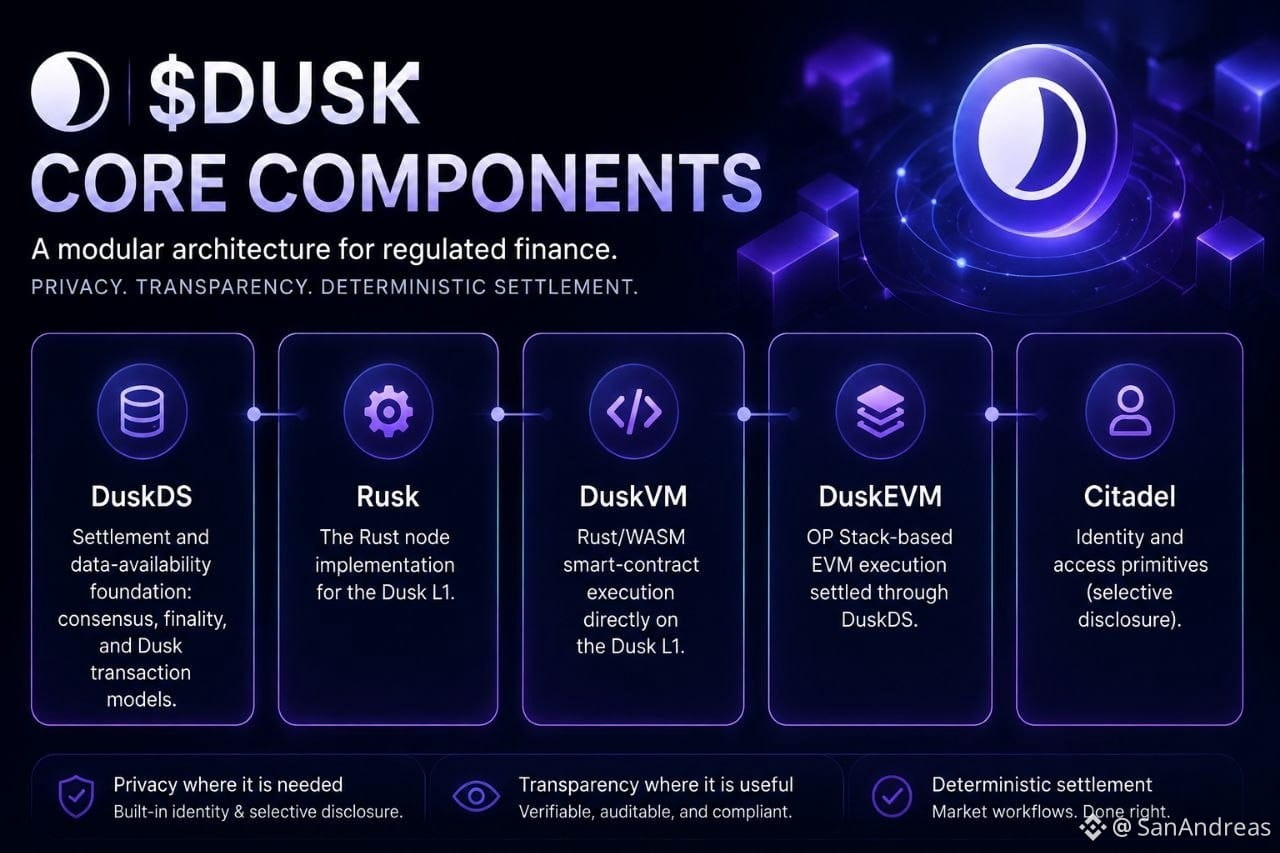
4. DuskEVM
Role : OP Stack-based EVM execution settled through DuskDS
Where to go next :
DuskEVM
DuskEVM brings Solidity, EVM wallets, and Ethereum tooling to Dusk. Existing EVM applications can target DuskEVM with familiar contracts and workflows while using DUSK for gas and DuskDS for settlement and data availability.
Why DuskEVM
Start with the EVM stack. Use Solidity or Vyper with Foundry, Hardhat, viem, ethers, and standard EVM wallets.
Use DUSK throughout. DUSK pays for execution and moves between the Dusk L1 and DuskEVM through the bridge.
Settle on DuskDS. Batches and state commitments anchor DuskEVM activity to Dusk’s consensus and data-availability layer.
Reach the wider Dusk stack. EVM applications can connect to Dusk L1 assets, infrastructure, and privacy-oriented workflows as those integrations require.
A DuskEVM transaction follows a rollup lifecycle:
The transaction is submitted to the DuskEVM sequencer.
The execution layer includes it in an L2 block.
The batcher publishes the transaction data to DuskDS.
State commitments and fault proofs connect the resulting state to DuskDS settlement.
Transaction inclusion is fast, but inclusion and settlement are different stages. Applications that move value between DuskEVM and the Dusk L1 should use protocol or wallet status rather than infer finality from elapsed time.
Choose an execution environment
Choose DuskEVM for Solidity applications, EVM wallets, existing Ethereum libraries, and EVM infrastructure.
Choose DuskVM for Rust/WASM contracts that should execute directly on the Dusk L1 or integrate closely with its transaction models, protocol assets, privacy, or zero-knowledge capabilities.
@Dusk #dusk
65
·
--
@Dusk_Foundation #dusk
$DUSK Core Component:
3. DuskVM
Role : Rust/WASM smart-contract execution directly on the Dusk L1
Where to go next :
DuskVM is the WASM virtual machine for smart contracts that execute directly on the Dusk L1. It is based on the Wasmtime runtime, with custom support for Dusk’s execution model.
Use DuskVM for Rust/WASM contracts, protocol-level assets, custom execution, market logic, privacy-aware flows, or zero-knowledge capabilities that should run directly on the L1.
Use DuskEVM instead when your application is designed around Solidity, EVM wallets, and Ethereum-compatible tooling. See DuskEVM.
Where DuskVM fits
DuskVM is the smart-contract execution component of the Dusk L1. DuskVM executes contract code, while DuskDS provides the consensus, settlement, and data-availability foundation that finalizes the resulting state.
At a high level, DuskVM provides:
Specific memory management mechanism
Support for Dusk’s ABI
Support for inter-contract calls
DuskVM functions as the host-side interface, handling the execution environment and system-level operations.
Compiling contracts to WASM
DuskVM expects WASM as bytecode, meaning that smart contracts must be compiled into WASM bytecode in order for DuskVM to execute them. Smart contracts are entirely responsible for validating their inputs, processing them according to the contract’s logic, and returning the appropriate outputs. This ensures that smart contracts operate predictably and securely within the standardized execution environment provided by DuskVM.
Contracts compiled to WASM can be executed by DuskVM, with the following caveats:
The contract needs to expose the “argument buffer” (argbuf), which is a special region of 64KB in the contract’s memory
Each exposed function complies with the following calling convention: fn foo(u32) -> u32
The received u32 value indicates the length of the input data, which has been placed in the argbuf by the caller. This input length specifies how many bytes of data the contract should read from the argbuf.
{spot}(DUSKUSDT)
@Dusk #dusk
$DUSK Core Component:
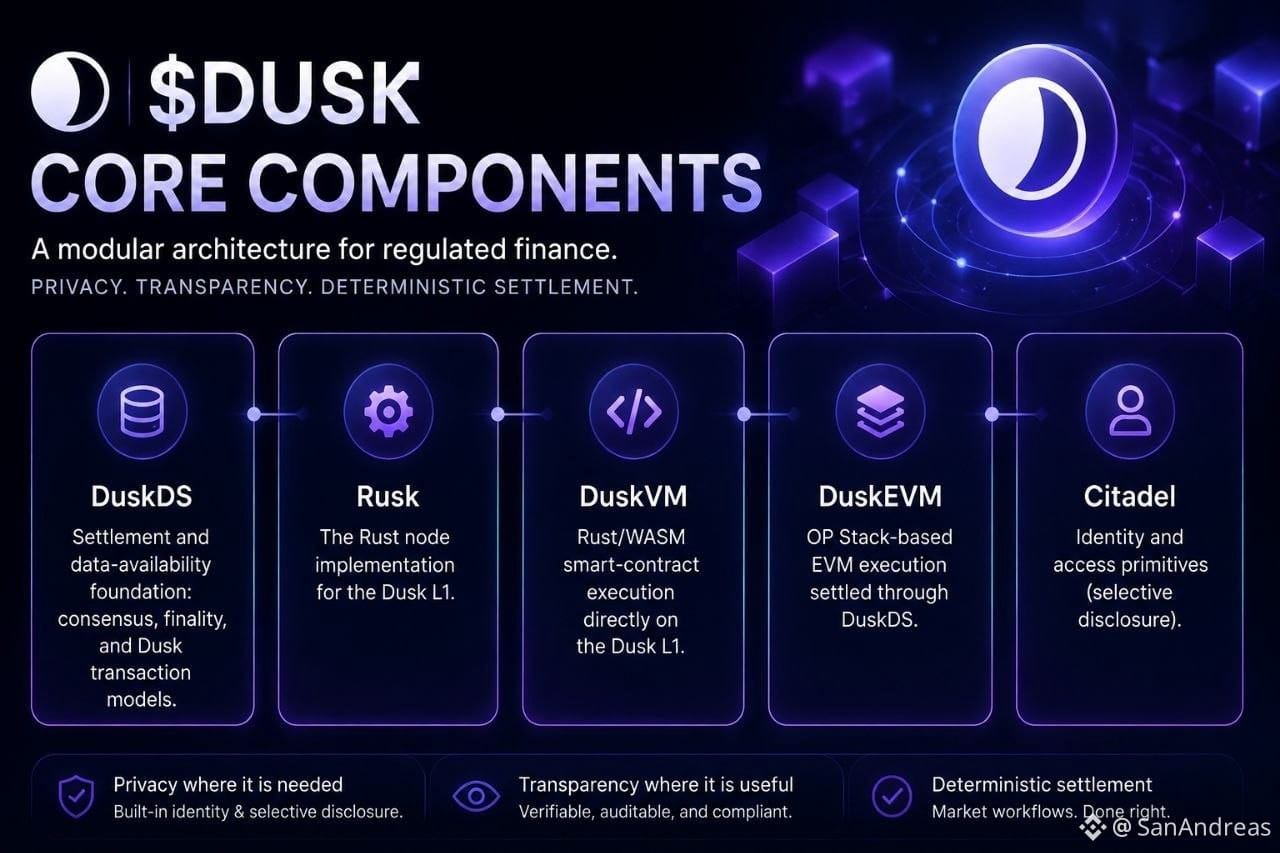
3. DuskVM
Role : Rust/WASM smart-contract execution directly on the Dusk L1
Where to go next :
DuskVM is the WASM virtual machine for smart contracts that execute directly on the Dusk L1. It is based on the Wasmtime runtime, with custom support for Dusk’s execution model.
Use DuskVM for Rust/WASM contracts, protocol-level assets, custom execution, market logic, privacy-aware flows, or zero-knowledge capabilities that should run directly on the L1.
Use DuskEVM instead when your application is designed around Solidity, EVM wallets, and Ethereum-compatible tooling. See DuskEVM.
Where DuskVM fits
DuskVM is the smart-contract execution component of the Dusk L1. DuskVM executes contract code, while DuskDS provides the consensus, settlement, and data-availability foundation that finalizes the resulting state.
At a high level, DuskVM provides:
Specific memory management mechanism
Support for Dusk’s ABI
Support for inter-contract calls
DuskVM functions as the host-side interface, handling the execution environment and system-level operations.
Compiling contracts to WASM
DuskVM expects WASM as bytecode, meaning that smart contracts must be compiled into WASM bytecode in order for DuskVM to execute them. Smart contracts are entirely responsible for validating their inputs, processing them according to the contract’s logic, and returning the appropriate outputs. This ensures that smart contracts operate predictably and securely within the standardized execution environment provided by DuskVM.
Contracts compiled to WASM can be executed by DuskVM, with the following caveats:
The contract needs to expose the “argument buffer” (argbuf), which is a special region of 64KB in the contract’s memory
Each exposed function complies with the following calling convention: fn foo(u32) -> u32
The received u32 value indicates the length of the input data, which has been placed in the argbuf by the caller. This input length specifies how many bytes of data the contract should read from the argbuf.
$DUSK Core Component:
3. DuskVM
Role : Rust/WASM smart-contract execution directly on the Dusk L1
Where to go next :
DuskVM is the WASM virtual machine for smart contracts that execute directly on the Dusk L1. It is based on the Wasmtime runtime, with custom support for Dusk’s execution model.
Use DuskVM for Rust/WASM contracts, protocol-level assets, custom execution, market logic, privacy-aware flows, or zero-knowledge capabilities that should run directly on the L1.
Use DuskEVM instead when your application is designed around Solidity, EVM wallets, and Ethereum-compatible tooling. See DuskEVM.
Where DuskVM fits
DuskVM is the smart-contract execution component of the Dusk L1. DuskVM executes contract code, while DuskDS provides the consensus, settlement, and data-availability foundation that finalizes the resulting state.
At a high level, DuskVM provides:
Specific memory management mechanism
Support for Dusk’s ABI
Support for inter-contract calls
DuskVM functions as the host-side interface, handling the execution environment and system-level operations.
Compiling contracts to WASM
DuskVM expects WASM as bytecode, meaning that smart contracts must be compiled into WASM bytecode in order for DuskVM to execute them. Smart contracts are entirely responsible for validating their inputs, processing them according to the contract’s logic, and returning the appropriate outputs. This ensures that smart contracts operate predictably and securely within the standardized execution environment provided by DuskVM.
Contracts compiled to WASM can be executed by DuskVM, with the following caveats:
The contract needs to expose the “argument buffer” (argbuf), which is a special region of 64KB in the contract’s memory
Each exposed function complies with the following calling convention: fn foo(u32) -> u32
The received u32 value indicates the length of the input data, which has been placed in the argbuf by the caller. This input length specifies how many bytes of data the contract should read from the argbuf.
71
·
--
@Dusk_Foundation #dusk
$DUSK Core Components :
2. Rusk
Role : The Rust node implementation for the Dusk L1
Where to go next :
Dusk nodes expose two main low-level HTTP surfaces:
GraphQL for chain, block, transaction, mempool, archive, and other node-indexed queries.
RUES-style /on/... routes for transaction submission, contract calls, node operations, proof generation, driver management, and event subscriptions.
Use this page as an implementation guide for direct node integrations. Application code should normally use W3sper or another SDK layer unless it needs low-level node access.
Base URLsMainnet: https://nodes.dusk.networkTestnet: https://testnet.nodes.dusk.network
Choosing the Right Surface
Use GraphQL when you need chain, block, transaction, mempool, archive, or other node-indexed data that is not part of a contract ABI.
Use /on/contracts:<contract_id>/<method> when you are querying a method exposed by a contract ABI.Use other /on/... routes for node operations such as transaction submission, proof generation, driver management, and event subscriptions.
Some legacy /on/... shortcut routes still work for compatibility, but are deprecated.
{spot}(DUSKUSDT)
@Dusk #dusk
$DUSK Core Components :
2. Rusk
Role : The Rust node implementation for the Dusk L1
Where to go next :
Dusk nodes expose two main low-level HTTP surfaces:
GraphQL for chain, block, transaction, mempool, archive, and other node-indexed queries.
RUES-style /on/... routes for transaction submission, contract calls, node operations, proof generation, driver management, and event subscriptions.
Use this page as an implementation guide for direct node integrations. Application code should normally use W3sper or another SDK layer unless it needs low-level node access.
Base URLsMainnet: https://nodes.dusk.networkTestnet: https://testnet.nodes.dusk.network
Choosing the Right Surface
Use GraphQL when you need chain, block, transaction, mempool, archive, or other node-indexed data that is not part of a contract ABI.
Use /on/contracts:<contract_id>/<method> when you are querying a method exposed by a contract ABI.Use other /on/... routes for node operations such as transaction submission, proof generation, driver management, and event subscriptions.
Some legacy /on/... shortcut routes still work for compatibility, but are deprecated.
$DUSK Core Components :
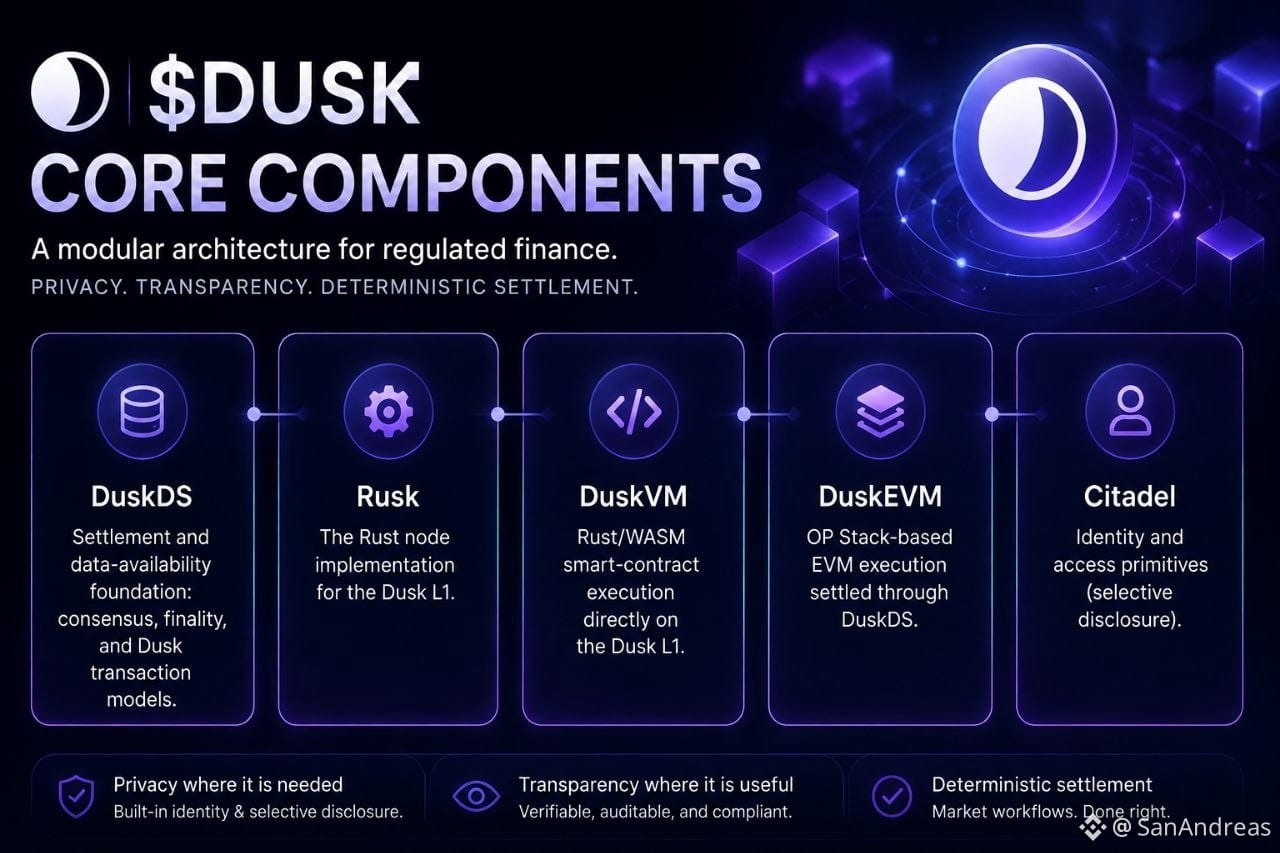
2. Rusk
Role : The Rust node implementation for the Dusk L1
Where to go next :
Dusk nodes expose two main low-level HTTP surfaces:
GraphQL for chain, block, transaction, mempool, archive, and other node-indexed queries.
RUES-style /on/... routes for transaction submission, contract calls, node operations, proof generation, driver management, and event subscriptions.
Use this page as an implementation guide for direct node integrations. Application code should normally use W3sper or another SDK layer unless it needs low-level node access.
Base URLsMainnet: https://nodes.dusk.networkTestnet: https://testnet.nodes.dusk.network
Choosing the Right Surface
Use GraphQL when you need chain, block, transaction, mempool, archive, or other node-indexed data that is not part of a contract ABI.
Use /on/contracts:<contract_id>/<method> when you are querying a method exposed by a contract ABI.Use other /on/... routes for node operations such as transaction submission, proof generation, driver management, and event subscriptions.
Some legacy /on/... shortcut routes still work for compatibility, but are deprecated.
72
·
--
@Dusk_Foundation #dusk
$DUSK Core Components
The Dusk network uses a modular architecture built for regulated finance: privacy where it is needed, transparency where it is useful, and deterministic settlement where market workflows require it. At a high level:
Component :
1. DuskDS
Role :
Settlement and data-availability foundation: consensus, finality, and Dusk transaction models
Where to go next :
Dusk has a two-layer architecture:
DuskDS – the settlement and data layer (consensus, data availability, transaction models)
DuskEVM – the EVM execution layer where smart contracts run and where Hedger lives
This page describes the transaction models on DuskDS. It’s background for people who want to understand how settlement and privacy work under the hood. If you are building dApps on DuskEVM, you’ll mostly interact with Hedger and EVM contracts instead.
Phoenix vs Moonlight (on DuskDS)On DuskDS, value can move in two native ways:
Moonlight – public, account-based transfers
Phoenix – shielded, note-based transfers using zero-knowledge proofs
Both ultimately settle on the same chain, but they expose different information to observers.
For the complete implementation details you can refer to the Whitepaper.
Moonlight – public balances
Moonlight is the transparent transaction model:
Accounts have visible balances.
Transfers show sender, recipient, and amount.
It’s suited to flows that must be observable (e.g. some treasury or reporting scenarios).
Conceptually it behaves like a standard account model.
For most users, this is “just the transparent way to move DUSK” at the protocol layer.
Phoenix – shielded balances
Phoenix is the privacy-preserving model:
Funds live as encrypted “notes” rather than explicit balances.
Transactions prove correctness (no double spends, enough funds) with zero-knowledge proofs without revealing:how much is being moved,who sent the note, except to the receiver,between which specific notes.
Users can selectively reveal information via viewing keys where regulation or auditing requires it.
{spot}(DUSKUSDT)
@Dusk #dusk
$DUSK Core Components
The Dusk network uses a modular architecture built for regulated finance: privacy where it is needed, transparency where it is useful, and deterministic settlement where market workflows require it. At a high level:
Component :
1. DuskDS
Role :
Settlement and data-availability foundation: consensus, finality, and Dusk transaction models
Where to go next :
Dusk has a two-layer architecture:
DuskDS – the settlement and data layer (consensus, data availability, transaction models)
DuskEVM – the EVM execution layer where smart contracts run and where Hedger lives
This page describes the transaction models on DuskDS. It’s background for people who want to understand how settlement and privacy work under the hood. If you are building dApps on DuskEVM, you’ll mostly interact with Hedger and EVM contracts instead.
Phoenix vs Moonlight (on DuskDS)On DuskDS, value can move in two native ways:
Moonlight – public, account-based transfers
Phoenix – shielded, note-based transfers using zero-knowledge proofs
Both ultimately settle on the same chain, but they expose different information to observers.
For the complete implementation details you can refer to the Whitepaper.
Moonlight – public balances
Moonlight is the transparent transaction model:
Accounts have visible balances.
Transfers show sender, recipient, and amount.
It’s suited to flows that must be observable (e.g. some treasury or reporting scenarios).
Conceptually it behaves like a standard account model.
For most users, this is “just the transparent way to move DUSK” at the protocol layer.
Phoenix – shielded balances
Phoenix is the privacy-preserving model:
Funds live as encrypted “notes” rather than explicit balances.
Transactions prove correctness (no double spends, enough funds) with zero-knowledge proofs without revealing:how much is being moved,who sent the note, except to the receiver,between which specific notes.
Users can selectively reveal information via viewing keys where regulation or auditing requires it.
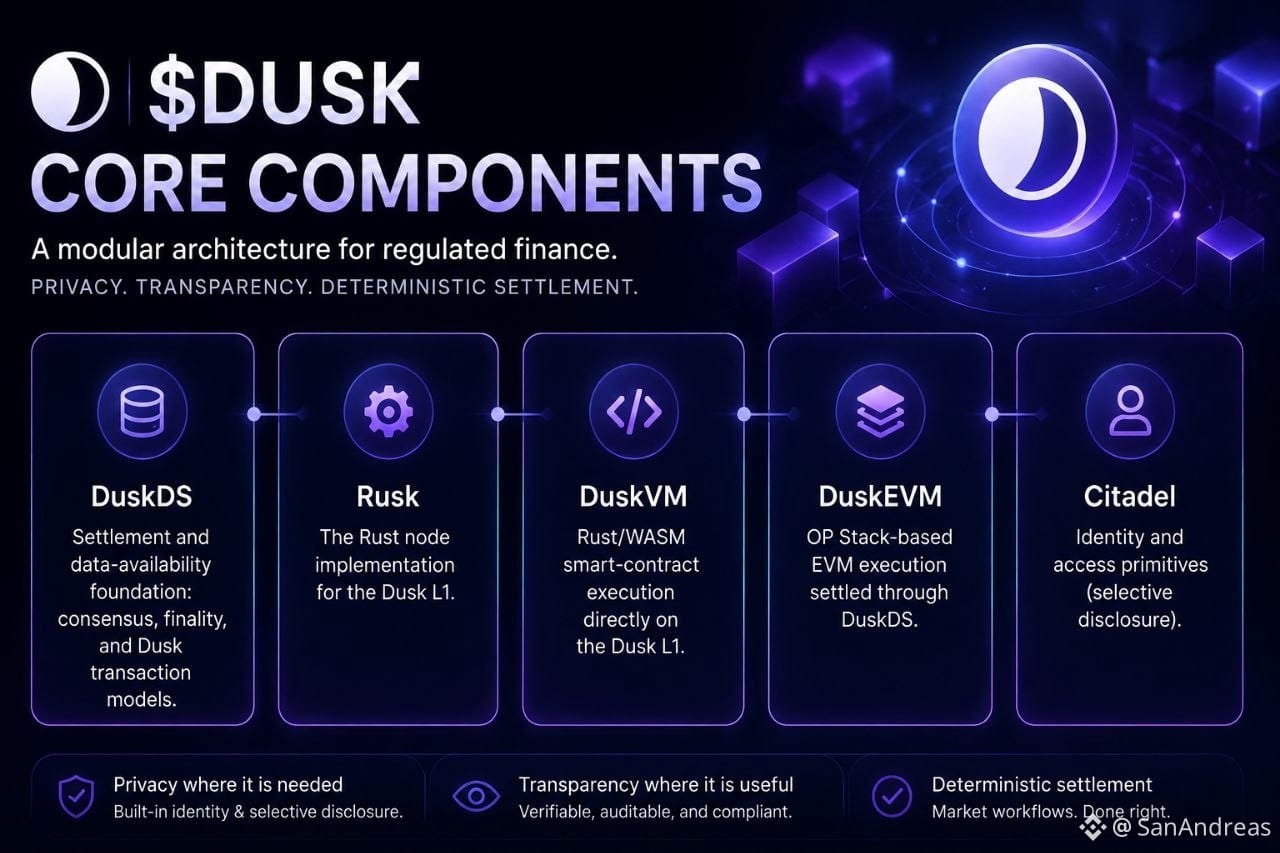
$DUSK Core Components
The Dusk network uses a modular architecture built for regulated finance: privacy where it is needed, transparency where it is useful, and deterministic settlement where market workflows require it. At a high level:
Component :
1. DuskDS
Role :
Settlement and data-availability foundation: consensus, finality, and Dusk transaction models
Where to go next :
Dusk has a two-layer architecture:
DuskDS – the settlement and data layer (consensus, data availability, transaction models)
DuskEVM – the EVM execution layer where smart contracts run and where Hedger lives
This page describes the transaction models on DuskDS. It’s background for people who want to understand how settlement and privacy work under the hood. If you are building dApps on DuskEVM, you’ll mostly interact with Hedger and EVM contracts instead.
Phoenix vs Moonlight (on DuskDS)On DuskDS, value can move in two native ways:
Moonlight – public, account-based transfers
Phoenix – shielded, note-based transfers using zero-knowledge proofs
Both ultimately settle on the same chain, but they expose different information to observers.
For the complete implementation details you can refer to the Whitepaper.
Moonlight – public balances
Moonlight is the transparent transaction model:
Accounts have visible balances.
Transfers show sender, recipient, and amount.
It’s suited to flows that must be observable (e.g. some treasury or reporting scenarios).
Conceptually it behaves like a standard account model.
For most users, this is “just the transparent way to move DUSK” at the protocol layer.
Phoenix – shielded balances
Phoenix is the privacy-preserving model:
Funds live as encrypted “notes” rather than explicit balances.
Transactions prove correctness (no double spends, enough funds) with zero-knowledge proofs without revealing:how much is being moved,who sent the note, except to the receiver,between which specific notes.
Users can selectively reveal information via viewing keys where regulation or auditing requires it.
93
·
--
@Dusk_Foundation #dusk
continuing from the previous discussion on $DUSK Trade.
Part 4
The Bigger Picture
Tokenization is often discussed in terms of what can be put on-chain.
But the more important question may be:
What happens after the asset is on-chain?
How does an investor discover it?
How is eligibility determined?
How are disclosures presented?
How does a trade happen?
How are payment and asset movements coordinated?
How is the transaction settled?
And how do issuers, venues, investors, and authorized participants interact with the same infrastructure?
These are application-layer questions.
Dusk Trade is designed to address them.
If tokenization is going to move beyond experimentation and become part of real financial markets, blockchain infrastructure will need to work together with applications that understand the complexity of regulated assets.
Dusk Trade is positioned at that intersection: turning Dusk's underlying market infrastructure into practical workflows for tokenized financial assets.
The ultimate goal is not simply to make financial assets transferable on-chain.
It is to make the entire journey—from discovery to eligibility, trading, payment, and settlement—work as a coherent digital financial-market experience.
$DUSK
{spot}(DUSKUSDT)
@Dusk #dusk
continuing from the previous discussion on $DUSK Trade.
Part 4
The Bigger Picture
Tokenization is often discussed in terms of what can be put on-chain.
But the more important question may be:
What happens after the asset is on-chain?
How does an investor discover it?
How is eligibility determined?
How are disclosures presented?
How does a trade happen?
How are payment and asset movements coordinated?
How is the transaction settled?
And how do issuers, venues, investors, and authorized participants interact with the same infrastructure?
These are application-layer questions.
Dusk Trade is designed to address them.
If tokenization is going to move beyond experimentation and become part of real financial markets, blockchain infrastructure will need to work together with applications that understand the complexity of regulated assets.
Dusk Trade is positioned at that intersection: turning Dusk's underlying market infrastructure into practical workflows for tokenized financial assets.
The ultimate goal is not simply to make financial assets transferable on-chain.
It is to make the entire journey—from discovery to eligibility, trading, payment, and settlement—work as a coherent digital financial-market experience.
$DUSK
continuing from the previous discussion on $DUSK Trade.
Part 4
The Bigger Picture
Tokenization is often discussed in terms of what can be put on-chain.
But the more important question may be:
What happens after the asset is on-chain?
How does an investor discover it?
How is eligibility determined?
How are disclosures presented?
How does a trade happen?
How are payment and asset movements coordinated?
How is the transaction settled?
And how do issuers, venues, investors, and authorized participants interact with the same infrastructure?
These are application-layer questions.
Dusk Trade is designed to address them.
If tokenization is going to move beyond experimentation and become part of real financial markets, blockchain infrastructure will need to work together with applications that understand the complexity of regulated assets.
Dusk Trade is positioned at that intersection: turning Dusk's underlying market infrastructure into practical workflows for tokenized financial assets.
The ultimate goal is not simply to make financial assets transferable on-chain.
It is to make the entire journey—from discovery to eligibility, trading, payment, and settlement—work as a coherent digital financial-market experience.
$DUSK
2
65
·
--
continuing from the previous discussion on $DUSK Trade.
Part 3
This separation can be important because infrastructure and user applications have different responsibilities.
The protocol can focus on providing reliable blockchain and financial-market primitives, while applications can focus on how those primitives are used in specific workflows.
Why This Matters for Tokenization
The long-term promise of tokenization is not simply putting traditional assets onto a blockchain.
The bigger opportunity is creating financial markets where issuance, ownership, trading, compliance, and settlement can interact with programmable infrastructure.
That requires more than tokens.
It requires market infrastructure and applications that understand financial workflows.
Dusk Trade represents the application side of that equation.
Its role is to connect blockchain infrastructure with the practical activities that participants perform when interacting with tokenized financial assets.
A Different Way to Think About Dusk Trade
It may be tempting to think of Dusk Trade simply as another trading interface.
But its broader purpose is more interesting.
It can be viewed as a bridge between blockchain infrastructure and regulated financial-market workflows.
The difference is subtle but important.
A typical crypto application might primarily focus on:
Wallet → Token → Trade
A regulated tokenized-asset workflow can be much more involved:
Asset Discovery → Investor Onboarding → Eligibility → Disclosure → Wallet → Trade → Payment Coordination → Settlement
Dusk Trade is designed around the second model.
@Dusk_Foundation #dusk
continuing from the previous discussion on $DUSK Trade.
Part 3
This separation can be important because infrastructure and user applications have different responsibilities.
The protocol can focus on providing reliable blockchain and financial-market primitives, while applications can focus on how those primitives are used in specific workflows.
Why This Matters for Tokenization
The long-term promise of tokenization is not simply putting traditional assets onto a blockchain.
The bigger opportunity is creating financial markets where issuance, ownership, trading, compliance, and settlement can interact with programmable infrastructure.
That requires more than tokens.
It requires market infrastructure and applications that understand financial workflows.
Dusk Trade represents the application side of that equation.
Its role is to connect blockchain infrastructure with the practical activities that participants perform when interacting with tokenized financial assets.
A Different Way to Think About Dusk Trade
It may be tempting to think of Dusk Trade simply as another trading interface.
But its broader purpose is more interesting.
It can be viewed as a bridge between blockchain infrastructure and regulated financial-market workflows.
The difference is subtle but important.
A typical crypto application might primarily focus on:
Wallet → Token → Trade
A regulated tokenized-asset workflow can be much more involved:
Asset Discovery → Investor Onboarding → Eligibility → Disclosure → Wallet → Trade → Payment Coordination → Settlement
Dusk Trade is designed around the second model.
@Dusk #dusk
Part 3
This separation can be important because infrastructure and user applications have different responsibilities.
The protocol can focus on providing reliable blockchain and financial-market primitives, while applications can focus on how those primitives are used in specific workflows.
Why This Matters for Tokenization
The long-term promise of tokenization is not simply putting traditional assets onto a blockchain.
The bigger opportunity is creating financial markets where issuance, ownership, trading, compliance, and settlement can interact with programmable infrastructure.
That requires more than tokens.
It requires market infrastructure and applications that understand financial workflows.
Dusk Trade represents the application side of that equation.
Its role is to connect blockchain infrastructure with the practical activities that participants perform when interacting with tokenized financial assets.
A Different Way to Think About Dusk Trade
It may be tempting to think of Dusk Trade simply as another trading interface.
But its broader purpose is more interesting.
It can be viewed as a bridge between blockchain infrastructure and regulated financial-market workflows.
The difference is subtle but important.
A typical crypto application might primarily focus on:
Wallet → Token → Trade
A regulated tokenized-asset workflow can be much more involved:
Asset Discovery → Investor Onboarding → Eligibility → Disclosure → Wallet → Trade → Payment Coordination → Settlement
Dusk Trade is designed around the second model.
@Dusk #dusk
75
·
--
continuing from the previous discussion on $DUSK Trade.
Part 2
6. Settlement
The final step is settlement.
This is where the transaction becomes more than a trading intention.
The relevant asset and payment movements need to be completed according to the rules governing the transaction.
By integrating trading and settlement workflows, the application layer can help turn an on-chain transaction into something closer to a complete financial-market process.
The Importance of Eligibility and Disclosure
One of the most interesting aspects of Dusk Trade is that it is designed around the requirements of regulated markets.
In traditional finance, not every financial product is available to every investor.
There can be restrictions based on jurisdiction, investor status, asset type, or other regulatory requirements.
Information can also matter just as much as the transaction itself.
Investors may need access to disclosures and other relevant information before participating.
This means a tokenized financial market needs to answer questions such as:
Who can buy this asset?
What information should the investor receive?
Who is authorized to access certain information?
Under what conditions can the asset be transferred?
Dusk Trade's application-layer approach is intended to make these considerations part of the workflow rather than treating them as something separate from blockchain activity.
Dusk Trade and the Dusk Ecosystem
It is useful to distinguish between the base protocol and the application layer.
The Dusk network provides the underlying infrastructure and market-oriented primitives.
Dusk Trade operates above that infrastructure.
A simple way to visualize the relationship is:
Dusk Network → Market Infrastructure → Dusk Trade → Users & Market Participants
The base layer provides the foundation.
The application layer turns that foundation into experiences that issuers, investors, venues, and other authorized participants can actually use.
@Dusk_Foundation #dusk
continuing from the previous discussion on $DUSK Trade.
Part 2
6. Settlement
The final step is settlement.
This is where the transaction becomes more than a trading intention.
The relevant asset and payment movements need to be completed according to the rules governing the transaction.
By integrating trading and settlement workflows, the application layer can help turn an on-chain transaction into something closer to a complete financial-market process.
The Importance of Eligibility and Disclosure
One of the most interesting aspects of Dusk Trade is that it is designed around the requirements of regulated markets.
In traditional finance, not every financial product is available to every investor.
There can be restrictions based on jurisdiction, investor status, asset type, or other regulatory requirements.
Information can also matter just as much as the transaction itself.
Investors may need access to disclosures and other relevant information before participating.
This means a tokenized financial market needs to answer questions such as:
Who can buy this asset?
What information should the investor receive?
Who is authorized to access certain information?
Under what conditions can the asset be transferred?
Dusk Trade's application-layer approach is intended to make these considerations part of the workflow rather than treating them as something separate from blockchain activity.
Dusk Trade and the Dusk Ecosystem
It is useful to distinguish between the base protocol and the application layer.
The Dusk network provides the underlying infrastructure and market-oriented primitives.
Dusk Trade operates above that infrastructure.
A simple way to visualize the relationship is:
Dusk Network → Market Infrastructure → Dusk Trade → Users & Market Participants
The base layer provides the foundation.
The application layer turns that foundation into experiences that issuers, investors, venues, and other authorized participants can actually use.
@Dusk #dusk
Part 2
6. Settlement
The final step is settlement.
This is where the transaction becomes more than a trading intention.
The relevant asset and payment movements need to be completed according to the rules governing the transaction.
By integrating trading and settlement workflows, the application layer can help turn an on-chain transaction into something closer to a complete financial-market process.
The Importance of Eligibility and Disclosure
One of the most interesting aspects of Dusk Trade is that it is designed around the requirements of regulated markets.
In traditional finance, not every financial product is available to every investor.
There can be restrictions based on jurisdiction, investor status, asset type, or other regulatory requirements.
Information can also matter just as much as the transaction itself.
Investors may need access to disclosures and other relevant information before participating.
This means a tokenized financial market needs to answer questions such as:
Who can buy this asset?
What information should the investor receive?
Who is authorized to access certain information?
Under what conditions can the asset be transferred?
Dusk Trade's application-layer approach is intended to make these considerations part of the workflow rather than treating them as something separate from blockchain activity.
Dusk Trade and the Dusk Ecosystem
It is useful to distinguish between the base protocol and the application layer.
The Dusk network provides the underlying infrastructure and market-oriented primitives.
Dusk Trade operates above that infrastructure.
A simple way to visualize the relationship is:
Dusk Network → Market Infrastructure → Dusk Trade → Users & Market Participants
The base layer provides the foundation.
The application layer turns that foundation into experiences that issuers, investors, venues, and other authorized participants can actually use.
@Dusk #dusk
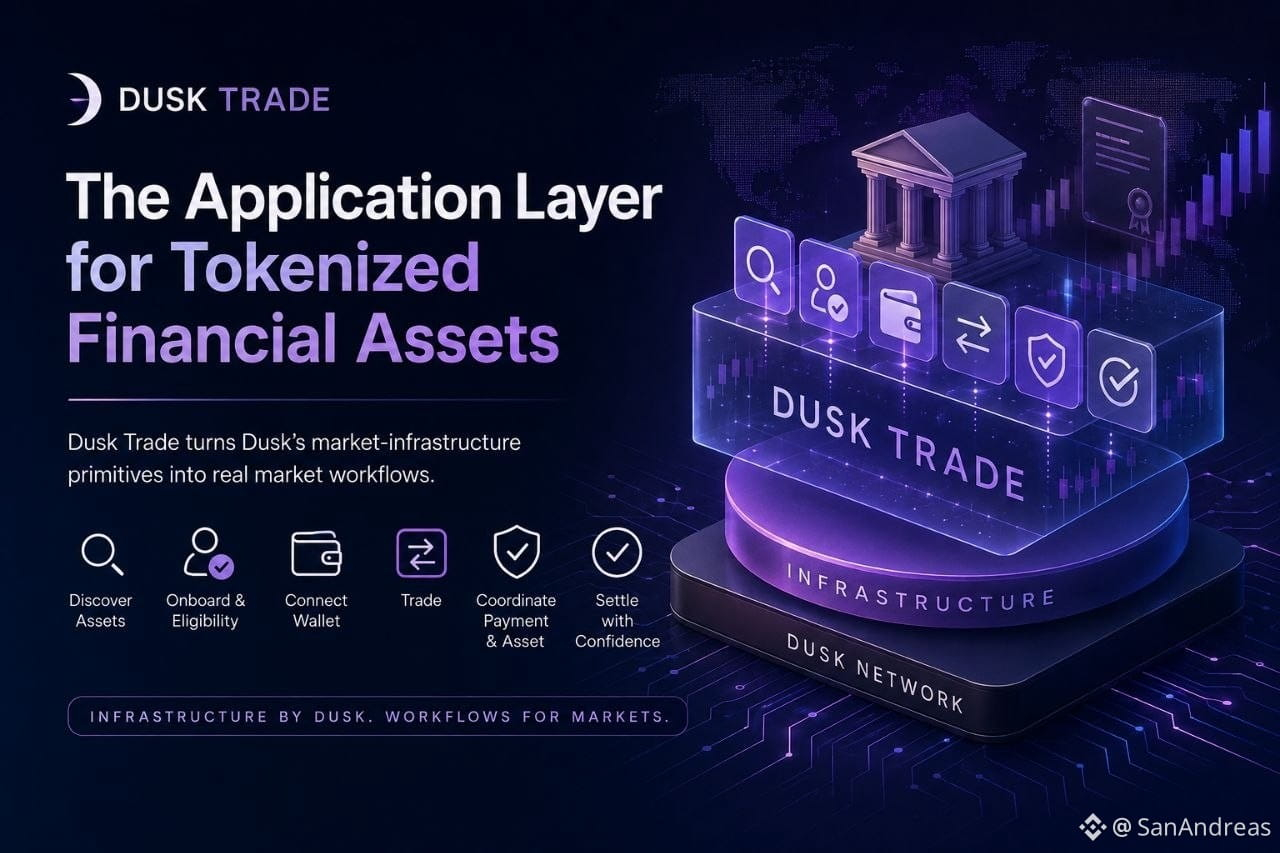
16
·
--


Binance Africa
·
--
🚀 Flash Quest: Stocks Are Moving Fast on Binance! The markets are on the move. 📈
Trade your favourite stocks on Binance, then share your trade on Binance Square for a chance to win rewards from our $ 1,000 USDC Prize pool
How to Participate:
🔸 Follow @Binance Africa
🔸 Like this post and repost
🔸 Share your bStocks trades on Square using the tradingcard with hashtag #TradebStocks #BinanceAfrica
🔸 Fill in this survey 👉🏾 Click on the Link to Participate Prizes: A total of 200 winners will receive 5 USDC each.
🔸 📆 Period: Aug 13, 2026 10:00 UTC – Aug 23, 2026 23:59 UTC
$TSLAB
Trade your favourite stocks on Binance, then share your trade on Binance Square for a chance to win rewards from our $ 1,000 USDC Prize pool
How to Participate:
🔸 Follow @Binance Africa
🔸 Like this post and repost
🔸 Share your bStocks trades on Square using the tradingcard with hashtag #TradebStocks #BinanceAfrica
🔸 Fill in this survey 👉🏾 Click on the Link to Participate Prizes: A total of 200 winners will receive 5 USDC each.
🔸 📆 Period: Aug 13, 2026 10:00 UTC – Aug 23, 2026 23:59 UTC
$TSLAB
45
·
--
From what I’ve researched, $AAPLB is still undervalued. It’s my favorite stock to trade and invest in right now. But also it nice to scalping. 💛
#TradeBStocks #BinanceAfrica
From what I’ve researched, $AAPLB is still undervalued. It’s my favorite stock to trade and invest in right now. But also it nice to scalping. 💛
#TradeBStocks #BinanceAfrica
#TradeBStocks #BinanceAfrica
70
·
--
@Dusk_Foundation #dusk $DUSK
Regulated securities can involve investor eligibility, disclosures, ownership restrictions, settlement requirements, and information that must only be accessible to authorized participants.
When these assets are tokenized, those requirements do not simply disappear.
In fact, they can become even more important.
A blockchain can provide the underlying infrastructure for ownership and settlement, but an actual financial market still needs applications that understand how investors, issuers, venues, and other participants interact.
Dusk Trade is designed around this problem.
Rather than treating tokenized financial assets like ordinary tokens, it focuses on the workflow surrounding the asset.
From Asset Discovery to Settlement
Imagine an investor wants to purchase a tokenized financial asset.
The journey could look something like this:
1. Discover
The investor first needs to find an available tokenized asset and understand the relevant information associated with it.
This creates an asset-discovery layer where users can identify opportunities rather than interacting with raw blockchain transactions.
2. Connect
The investor connects their wallet to the application.
The wallet becomes the interface through which the investor can interact with the tokenized asset and the underlying transaction process.
3. Onboard
Before participating in a regulated market, an investor may need to complete onboarding or eligibility requirements.
This is an important distinction between ordinary crypto trading and regulated financial markets.
Access to an asset may depend on who the investor is, whether they meet specific requirements, and whether they are authorized to participate.
4. Trade
Once the relevant requirements have been satisfied, the investor can initiate a buy or sell transaction.
At this stage, Dusk Trade connects the user-facing trading experience with the underlying infrastructure.
5. Coordinate Payment and Asset Transfer
A financial transaction involves more than moving an asset.
$DUSK
@Dusk #dusk $DUSK
Regulated securities can involve investor eligibility, disclosures, ownership restrictions, settlement requirements, and information that must only be accessible to authorized participants.
When these assets are tokenized, those requirements do not simply disappear.
In fact, they can become even more important.
A blockchain can provide the underlying infrastructure for ownership and settlement, but an actual financial market still needs applications that understand how investors, issuers, venues, and other participants interact.
Dusk Trade is designed around this problem.
Rather than treating tokenized financial assets like ordinary tokens, it focuses on the workflow surrounding the asset.
From Asset Discovery to Settlement
Imagine an investor wants to purchase a tokenized financial asset.
The journey could look something like this:
1. Discover
The investor first needs to find an available tokenized asset and understand the relevant information associated with it.
This creates an asset-discovery layer where users can identify opportunities rather than interacting with raw blockchain transactions.
2. Connect
The investor connects their wallet to the application.
The wallet becomes the interface through which the investor can interact with the tokenized asset and the underlying transaction process.
3. Onboard
Before participating in a regulated market, an investor may need to complete onboarding or eligibility requirements.
This is an important distinction between ordinary crypto trading and regulated financial markets.
Access to an asset may depend on who the investor is, whether they meet specific requirements, and whether they are authorized to participate.
4. Trade
Once the relevant requirements have been satisfied, the investor can initiate a buy or sell transaction.
At this stage, Dusk Trade connects the user-facing trading experience with the underlying infrastructure.
5. Coordinate Payment and Asset Transfer
A financial transaction involves more than moving an asset.
$DUSK
Regulated securities can involve investor eligibility, disclosures, ownership restrictions, settlement requirements, and information that must only be accessible to authorized participants.
When these assets are tokenized, those requirements do not simply disappear.
In fact, they can become even more important.
A blockchain can provide the underlying infrastructure for ownership and settlement, but an actual financial market still needs applications that understand how investors, issuers, venues, and other participants interact.
Dusk Trade is designed around this problem.
Rather than treating tokenized financial assets like ordinary tokens, it focuses on the workflow surrounding the asset.
From Asset Discovery to Settlement
Imagine an investor wants to purchase a tokenized financial asset.
The journey could look something like this:
1. Discover
The investor first needs to find an available tokenized asset and understand the relevant information associated with it.
This creates an asset-discovery layer where users can identify opportunities rather than interacting with raw blockchain transactions.
2. Connect
The investor connects their wallet to the application.
The wallet becomes the interface through which the investor can interact with the tokenized asset and the underlying transaction process.
3. Onboard
Before participating in a regulated market, an investor may need to complete onboarding or eligibility requirements.
This is an important distinction between ordinary crypto trading and regulated financial markets.
Access to an asset may depend on who the investor is, whether they meet specific requirements, and whether they are authorized to participate.
4. Trade
Once the relevant requirements have been satisfied, the investor can initiate a buy or sell transaction.
At this stage, Dusk Trade connects the user-facing trading experience with the underlying infrastructure.
5. Coordinate Payment and Asset Transfer
A financial transaction involves more than moving an asset.
$DUSK
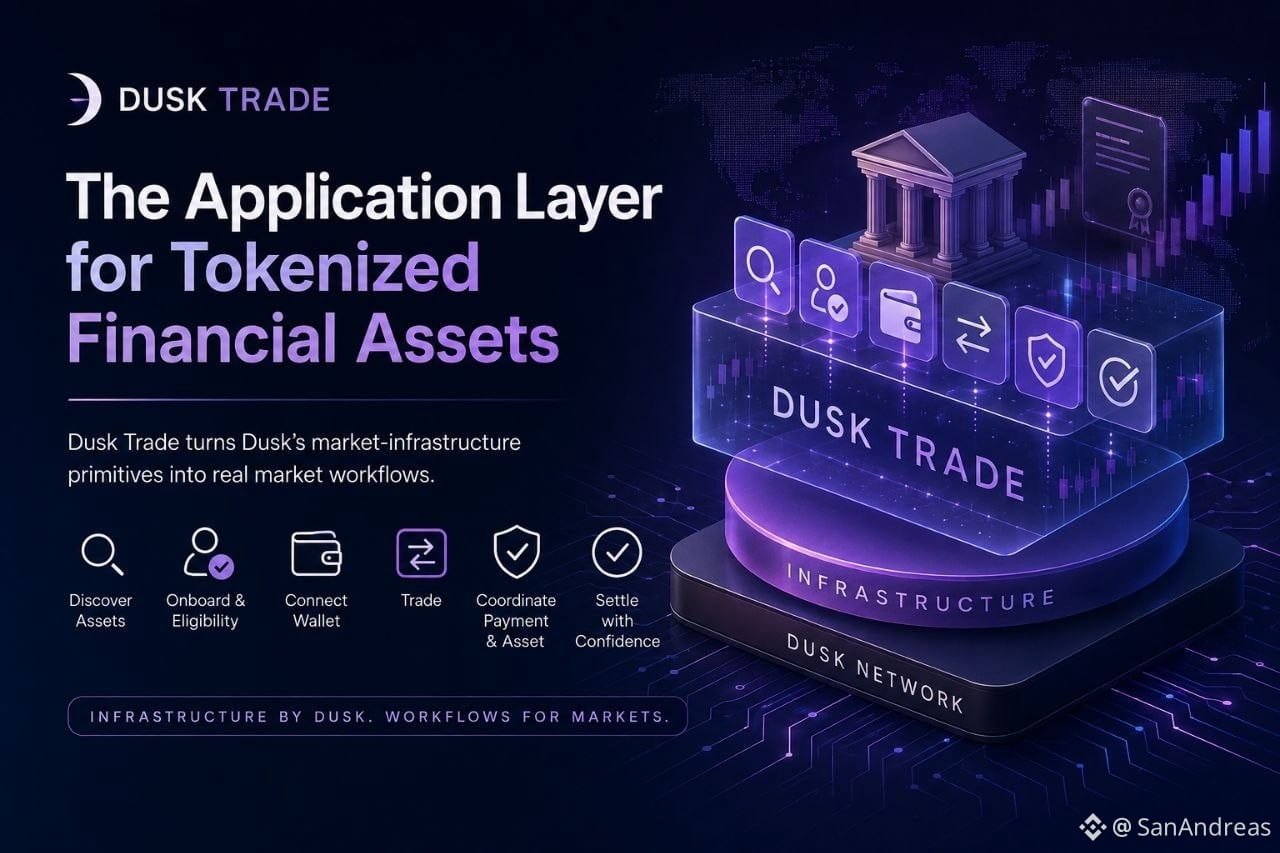
2
1
81
·
--
@Dusk_Foundation #dusk $DUSK
Dusk Trade: Turning Tokenized Financial Assets Into Real Market Workflows
Tokenization is changing the way financial assets can be represented, transferred, and settled on blockchain networks.
But putting an asset on-chain is only one part of the equation.
For regulated financial markets, investors need to discover assets, complete onboarding and eligibility requirements, connect their wallets, execute transactions, coordinate payments, and ultimately settle the transaction according to the rules of the market.
This is where Dusk Trade comes in.
What Is Dusk Trade?
Dusk Trade is the application layer for tokenized financial assets on Dusk.
It sits above the Dusk base protocol and transforms the network's market-infrastructure primitives into user-facing workflows.
Instead of requiring users to interact directly with complex blockchain infrastructure, Dusk Trade is designed to provide the practical workflows needed to participate in regulated tokenized markets.
These workflows can include:
Discovering tokenized financial assets
Connecting a wallet
Completing investor onboarding
Performing eligibility or compliance checks
Buying or selling assets
Coordinating the asset and payment legs of a transaction
Supporting settlement
Providing authorized parties with the information required for a transaction
The key idea is simple:
Dusk provides the infrastructure. Dusk Trade turns that infrastructure into market workflows.
Why Tokenized Assets Need More Than a Blockchain
A traditional financial asset is rarely as simple as "buy, transfer, and sell."
@Dusk #dusk $DUSK
Dusk Trade: Turning Tokenized Financial Assets Into Real Market Workflows
Tokenization is changing the way financial assets can be represented, transferred, and settled on blockchain networks.
But putting an asset on-chain is only one part of the equation.
For regulated financial markets, investors need to discover assets, complete onboarding and eligibility requirements, connect their wallets, execute transactions, coordinate payments, and ultimately settle the transaction according to the rules of the market.
This is where Dusk Trade comes in.
What Is Dusk Trade?
Dusk Trade is the application layer for tokenized financial assets on Dusk.
It sits above the Dusk base protocol and transforms the network's market-infrastructure primitives into user-facing workflows.
Instead of requiring users to interact directly with complex blockchain infrastructure, Dusk Trade is designed to provide the practical workflows needed to participate in regulated tokenized markets.
These workflows can include:
Discovering tokenized financial assets
Connecting a wallet
Completing investor onboarding
Performing eligibility or compliance checks
Buying or selling assets
Coordinating the asset and payment legs of a transaction
Supporting settlement
Providing authorized parties with the information required for a transaction
The key idea is simple:
Dusk provides the infrastructure. Dusk Trade turns that infrastructure into market workflows.
Why Tokenized Assets Need More Than a Blockchain
A traditional financial asset is rarely as simple as "buy, transfer, and sell."
Dusk Trade: Turning Tokenized Financial Assets Into Real Market Workflows
Tokenization is changing the way financial assets can be represented, transferred, and settled on blockchain networks.
But putting an asset on-chain is only one part of the equation.
For regulated financial markets, investors need to discover assets, complete onboarding and eligibility requirements, connect their wallets, execute transactions, coordinate payments, and ultimately settle the transaction according to the rules of the market.
This is where Dusk Trade comes in.
What Is Dusk Trade?
Dusk Trade is the application layer for tokenized financial assets on Dusk.
It sits above the Dusk base protocol and transforms the network's market-infrastructure primitives into user-facing workflows.
Instead of requiring users to interact directly with complex blockchain infrastructure, Dusk Trade is designed to provide the practical workflows needed to participate in regulated tokenized markets.
These workflows can include:
Discovering tokenized financial assets
Connecting a wallet
Completing investor onboarding
Performing eligibility or compliance checks
Buying or selling assets
Coordinating the asset and payment legs of a transaction
Supporting settlement
Providing authorized parties with the information required for a transaction
The key idea is simple:
Dusk provides the infrastructure. Dusk Trade turns that infrastructure into market workflows.
Why Tokenized Assets Need More Than a Blockchain
A traditional financial asset is rarely as simple as "buy, transfer, and sell."
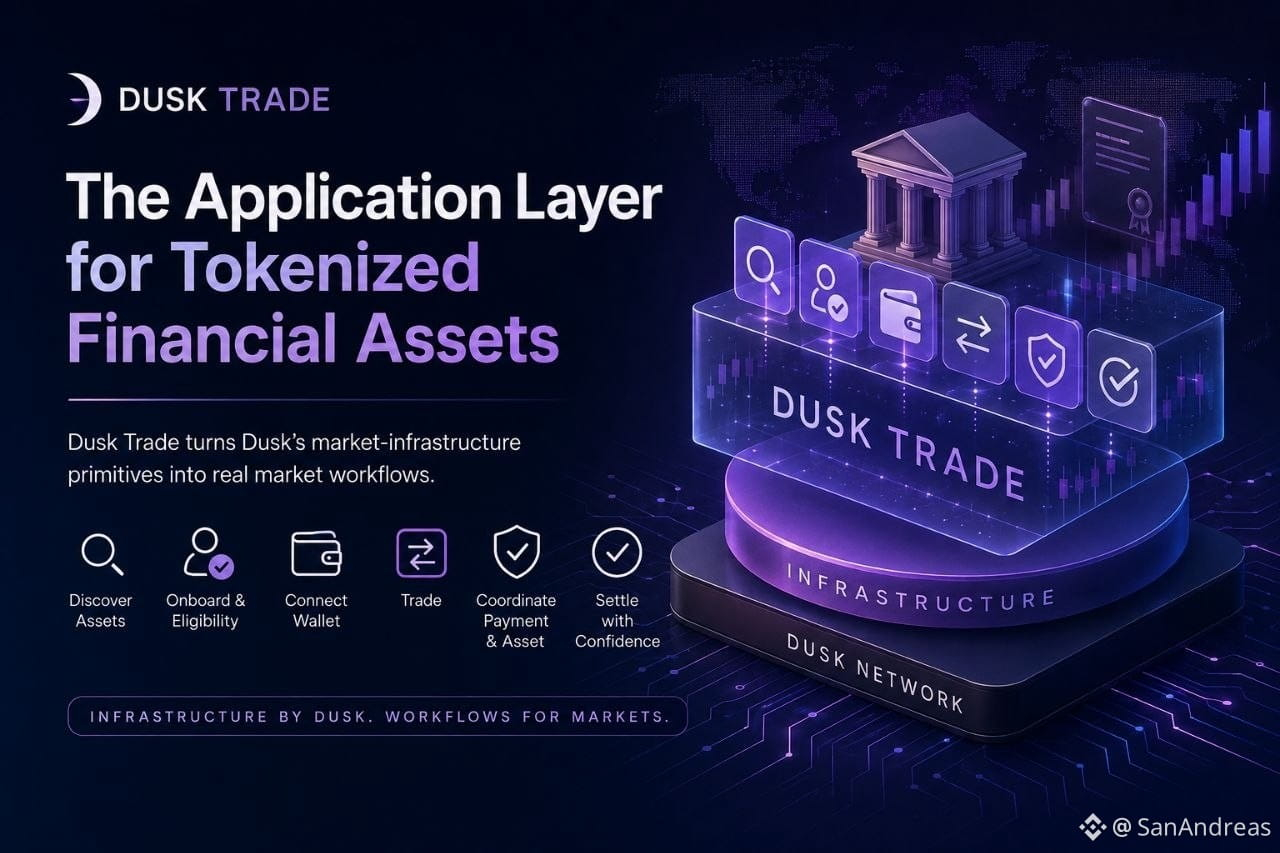
70
·
--
Another entry on $SPCX
Hodl and Waited for the setup.
Followed the plan.
Booked the profit.
#ShareMyTradFi
Another entry on $SPCX
Hodl and Waited for the setup.
Followed the plan.
Booked the profit.
#ShareMyTradFi
Hodl and Waited for the setup.
Followed the plan.
Booked the profit.
#ShareMyTradFi
43
Log in to explore more content
Join global crypto users on Binance Square
⚡️ Get latest and useful information about crypto.
💬 Trusted by the world’s largest crypto exchange.
👍 Discover real insights from verified creators.
Email / Phone number
Trending Topics
EtherGains70.9%InQ3
25,339 views
355 Discussing
One of the best third quarters in history 💰
September closed out last night, and with it, the quarter. For the quarter, BTC is up 42%—the second-best Q3 on record. ETH had a record-breaking Q3 overall, up 70%.
Looking at the chart, things are still looking good: we’re holding support, but we’re testing it more and more often. Plus, ETF momentum is weakening — inflows are gradually declining, and yesterday saw outflows for the first time in a long while.
Yes, historically, October has been a good month for crypto — it’s not called “Uptober” for nothing. But it’s also one of the most volatile months. Last year, for example, we managed to hit a new all-time high (ATH) and experience a flash crash.
🚀 High Accuracy Trades.
$BTC
$ETH
$SOL
#EtherGains70.9%InQ3 #DollarIndexHitsHighestSinceMay2025 #CFTCSubmitsTwoEventContractRulesToWhiteHouse #MicronBeatsEarningsLiftsGuidance
Knowledge is Power
·0 Likes
·80 views
TreasuryLetsStatesFileStablecoinCertificationsEarly
219 views
14 Discussing
US10YearYieldNears5.3%
61,740 views
565 Discussing