
交易员-柒歌
2.2k Posts

交易员-柒歌
Report
Block User
公众号:翻仓实战营 推特 X:QS112233 稳健类型博主,金色财经认证博主,专注于现货合约,以现货为主,合约为辅的有趣博主。
3 Following
1.4K+ Followers
1.1K+ Liked
Posts
All
Quotes
Videos
PINNED
·
--
👇👇👇Add friends, get the free strategy layout.
Qi Shen usually focuses on mainstream coin futures contracts and popular altcoin contracts, with spot short-term trading as the main approach. They’re good at spotting potential “dog” opportunities, uncovering 100x coins. It’s better for everyone to enjoy than just one person—if you reach out first, I’ll pull you to shore.
👇👇👇Add friends, get the free strategy layout.
Qi Shen usually focuses on mainstream coin futures contracts and popular altcoin contracts, with spot short-term trading as the main approach. They’re good at spotting potential “dog” opportunities, uncovering 100x coins. It’s better for everyone to enjoy than just one person—if you reach out first, I’ll pull you to shore.
Qi Shen usually focuses on mainstream coin futures contracts and popular altcoin contracts, with spot short-term trading as the main approach. They’re good at spotting potential “dog” opportunities, uncovering 100x coins. It’s better for everyone to enjoy than just one person—if you reach out first, I’ll pull you to shore.

10
12
14
20k
PINNED
·
--
The turnaround battle in the crypto world👇
As the saying goes, if you dare to act, the chips will be in your own hands; if you hesitate and hold back, what you want will always slip away!
The opportunity has been given to you. Ask yourself—can I seize it?
The turnaround battle in the crypto world👇
As the saying goes, if you dare to act, the chips will be in your own hands; if you hesitate and hold back, what you want will always slip away!
The opportunity has been given to you. Ask yourself—can I seize it?
As the saying goes, if you dare to act, the chips will be in your own hands; if you hesitate and hold back, what you want will always slip away!
The opportunity has been given to you. Ask yourself—can I seize it?


46
26
61
38.7k
·
--
The most mysterious place in the crypto world is the clash between East and West—the day and the night $SNDK #比特币涨1.64%突破78000美元
In this market, many times, the opportunities you see may be exactly when others are preparing to harvest you. Here are a few hard-earned lessons from years of experience:
1. A drop in the daytime isn’t necessarily a bad thing.
Often, market sentiment releases during the day, prices keep falling—and that can actually create opportunities.
But the premise is to watch the trend and your position; don’t blindly bottom-fish.
2. A sudden big rally—don’t rush to chase.
When the market quickly surges, many people start FOMO rushing in, and the result is often buying at the top.
Uptrends need confirmation; don’t chase just because it’s rising.
3. Pin-needles are an important signal.
Whether the move is up or down, sharp pin-needles often indicate extreme market sentiment.
The deeper the pin-needle, the more you should pay attention to possible reversal opportunities afterward.
4. Good news coming out doesn’t mean the price will definitely rise.
Many moves react in advance; once the news actually lands, a pullback may follow.
The market trades expectations—not just the news.
5. The more chaotic and “loud” the place is, the more you need to stay calm.
When people in groups疯狂推荐 (frenetically recommend) coins that everyone is watching and believing in, be especially careful.
Real opportunities often won’t wait until everyone knows about them.
6. Trading with heavy positions is the start of getting liquidated.
The heavier your position, the easier it is for emotions to get out of control.
Trading isn’t about who has bigger nerve—it’s about who can last longer.
7. Don’t let the market lead you by the nose.
Price rising after you cut losses doesn’t mean you were wrong.
Price continuing to surge after you take profit doesn’t mean you failed.
Make money within your own understanding.
There will always be people who profit in the market, and there will always be people who lose.
What truly determines the outcome isn’t predicting the main player—it’s controlling your position size, staying patient, and waiting for the opportunity that truly belongs to you.
The most mysterious place in the crypto world is the clash between East and West—the day and the night $SNDK #比特币涨1.64%突破78000美元
In this market, many times, the opportunities you see may be exactly when others are preparing to harvest you. Here are a few hard-earned lessons from years of experience:
1. A drop in the daytime isn’t necessarily a bad thing.
Often, market sentiment releases during the day, prices keep falling—and that can actually create opportunities.
But the premise is to watch the trend and your position; don’t blindly bottom-fish.
2. A sudden big rally—don’t rush to chase.
When the market quickly surges, many people start FOMO rushing in, and the result is often buying at the top.
Uptrends need confirmation; don’t chase just because it’s rising.
3. Pin-needles are an important signal.
Whether the move is up or down, sharp pin-needles often indicate extreme market sentiment.
The deeper the pin-needle, the more you should pay attention to possible reversal opportunities afterward.
4. Good news coming out doesn’t mean the price will definitely rise.
Many moves react in advance; once the news actually lands, a pullback may follow.
The market trades expectations—not just the news.
5. The more chaotic and “loud” the place is, the more you need to stay calm.
When people in groups疯狂推荐 (frenetically recommend) coins that everyone is watching and believing in, be especially careful.
Real opportunities often won’t wait until everyone knows about them.
6. Trading with heavy positions is the start of getting liquidated.
The heavier your position, the easier it is for emotions to get out of control.
Trading isn’t about who has bigger nerve—it’s about who can last longer.
7. Don’t let the market lead you by the nose.
Price rising after you cut losses doesn’t mean you were wrong.
Price continuing to surge after you take profit doesn’t mean you failed.
Make money within your own understanding.
There will always be people who profit in the market, and there will always be people who lose.
What truly determines the outcome isn’t predicting the main player—it’s controlling your position size, staying patient, and waiting for the opportunity that truly belongs to you.
In this market, many times, the opportunities you see may be exactly when others are preparing to harvest you. Here are a few hard-earned lessons from years of experience:
1. A drop in the daytime isn’t necessarily a bad thing.
Often, market sentiment releases during the day, prices keep falling—and that can actually create opportunities.
But the premise is to watch the trend and your position; don’t blindly bottom-fish.
2. A sudden big rally—don’t rush to chase.
When the market quickly surges, many people start FOMO rushing in, and the result is often buying at the top.
Uptrends need confirmation; don’t chase just because it’s rising.
3. Pin-needles are an important signal.
Whether the move is up or down, sharp pin-needles often indicate extreme market sentiment.
The deeper the pin-needle, the more you should pay attention to possible reversal opportunities afterward.
4. Good news coming out doesn’t mean the price will definitely rise.
Many moves react in advance; once the news actually lands, a pullback may follow.
The market trades expectations—not just the news.
5. The more chaotic and “loud” the place is, the more you need to stay calm.
When people in groups疯狂推荐 (frenetically recommend) coins that everyone is watching and believing in, be especially careful.
Real opportunities often won’t wait until everyone knows about them.
6. Trading with heavy positions is the start of getting liquidated.
The heavier your position, the easier it is for emotions to get out of control.
Trading isn’t about who has bigger nerve—it’s about who can last longer.
7. Don’t let the market lead you by the nose.
Price rising after you cut losses doesn’t mean you were wrong.
Price continuing to surge after you take profit doesn’t mean you failed.
Make money within your own understanding.
There will always be people who profit in the market, and there will always be people who lose.
What truly determines the outcome isn’t predicting the main player—it’s controlling your position size, staying patient, and waiting for the opportunity that truly belongs to you.

206
·
--
Friends with principal below 5000 USDT, pause for a moment and let me give you some advice. $SNDK #比特币涨1.64%突破78000美元
Crypto isn’t a casino—it’s a game of strategy and discipline. The smaller your principal is, the less you can afford to rush. In February, I guided a beginner with only 800 USDT. At the start, they were so nervous they couldn’t even place orders, afraid that one move could wipe out their principal. I told them, “Don’t think about turning it around overnight. First learn to make money by following the rules.” After two months, their account reached 19,000 USDT. In the third month, it broke 28,000 USDT. Throughout the whole process, they never blew up a position. People ask how? It wasn’t luck—it was discipline.
First rule: Always allocate your funds.
Split your principal into three parts: one part for short-term trades, focusing only on BTC and ETH, taking small profits promptly; one part for swing trades, only acting when the trend is clear; and the remaining part as reserve capital—don’t easily touch it in any extreme market conditions. Many people lose money because they go all-in, get excited when the price rises, and panic when it falls.
Second rule: Trade only trends, don’t waste energy on chop.
Most of the time the market is ranging, and when there’s no opportunity, wait. Frequent trading just burns through your capital. A truly good trade is one where you wait for a high-confidence opportunity.
Third rule: Rules always come before emotions.
Set your stop-loss before every trade. When the conditions are met, execute immediately. Take profits in batches—don’t always try to sell at the absolute top. Don’t impulsively add to positions when you’re losing, and don’t think you can make it back with one big move. With a small principal, flexibility is your biggest advantage. But your biggest enemy is the mindset that wants a quick turnaround.
There are always opportunities in the market, but only those who are prepared can seize them
Friends with principal below 5000 USDT, pause for a moment and let me give you some advice. $SNDK #比特币涨1.64%突破78000美元
Crypto isn’t a casino—it’s a game of strategy and discipline. The smaller your principal is, the less you can afford to rush. In February, I guided a beginner with only 800 USDT. At the start, they were so nervous they couldn’t even place orders, afraid that one move could wipe out their principal. I told them, “Don’t think about turning it around overnight. First learn to make money by following the rules.” After two months, their account reached 19,000 USDT. In the third month, it broke 28,000 USDT. Throughout the whole process, they never blew up a position. People ask how? It wasn’t luck—it was discipline.
First rule: Always allocate your funds.
Split your principal into three parts: one part for short-term trades, focusing only on BTC and ETH, taking small profits promptly; one part for swing trades, only acting when the trend is clear; and the remaining part as reserve capital—don’t easily touch it in any extreme market conditions. Many people lose money because they go all-in, get excited when the price rises, and panic when it falls.
Second rule: Trade only trends, don’t waste energy on chop.
Most of the time the market is ranging, and when there’s no opportunity, wait. Frequent trading just burns through your capital. A truly good trade is one where you wait for a high-confidence opportunity.
Third rule: Rules always come before emotions.
Set your stop-loss before every trade. When the conditions are met, execute immediately. Take profits in batches—don’t always try to sell at the absolute top. Don’t impulsively add to positions when you’re losing, and don’t think you can make it back with one big move. With a small principal, flexibility is your biggest advantage. But your biggest enemy is the mindset that wants a quick turnaround.
There are always opportunities in the market, but only those who are prepared can seize them
Crypto isn’t a casino—it’s a game of strategy and discipline. The smaller your principal is, the less you can afford to rush. In February, I guided a beginner with only 800 USDT. At the start, they were so nervous they couldn’t even place orders, afraid that one move could wipe out their principal. I told them, “Don’t think about turning it around overnight. First learn to make money by following the rules.” After two months, their account reached 19,000 USDT. In the third month, it broke 28,000 USDT. Throughout the whole process, they never blew up a position. People ask how? It wasn’t luck—it was discipline.
First rule: Always allocate your funds.
Split your principal into three parts: one part for short-term trades, focusing only on BTC and ETH, taking small profits promptly; one part for swing trades, only acting when the trend is clear; and the remaining part as reserve capital—don’t easily touch it in any extreme market conditions. Many people lose money because they go all-in, get excited when the price rises, and panic when it falls.
Second rule: Trade only trends, don’t waste energy on chop.
Most of the time the market is ranging, and when there’s no opportunity, wait. Frequent trading just burns through your capital. A truly good trade is one where you wait for a high-confidence opportunity.
Third rule: Rules always come before emotions.
Set your stop-loss before every trade. When the conditions are met, execute immediately. Take profits in batches—don’t always try to sell at the absolute top. Don’t impulsively add to positions when you’re losing, and don’t think you can make it back with one big move. With a small principal, flexibility is your biggest advantage. But your biggest enemy is the mindset that wants a quick turnaround.
There are always opportunities in the market, but only those who are prepared can seize them

110
·
--
If your market judgment is right, why are you still losing money?$SNDK #比特币涨1.64%突破78000美元
Many people, after entering the market, always feel that making money depends on picking the right direction. But anyone who has been through a few rounds of market action will understand: direction only determines how much you can earn, while position sizing (your allocation) determines whether you can survive.
There’s a saying in the market: beginners are busy rushing in, while experts study when to exit.]
But real experts don’t just wait—they also know how to control their position size. A lot of losses aren’t because your judgment was wrong; they happen because your position sizing is wrong. Going all-in and then not being able to hold through a single pullback; making a little profit and then blindly adding more, only for the trend to reverse and wipe out those gains; and when the real opportunity finally arrives, you can’t participate because you were already too heavily burdened by earlier losses. At their core, these are all issues of uncontrolled positioning.
Effective position management isn’t that complicated, really.
First, don’t go all-in at once.
Build your position in batches, leaving room for adjustment.
Second, set your stop-loss in advance.
Don’t wait until losses grow and you’re forced out.
Third, allocate funds separately.
Short-term trading, swing trading, and long-term investing each require different plans.
Fourth, use leverage reasonably.
Leverage can improve efficiency, but it can’t turn into a gambling tool.
If your direction is wrong, you can reassess and try again. But if your principal is gone, you lose the chance to do so next time. Manage your positions, control risk—this is what allows you to survive in the crypto market long term.
If your market judgment is right, why are you still losing money?$SNDK #比特币涨1.64%突破78000美元
Many people, after entering the market, always feel that making money depends on picking the right direction. But anyone who has been through a few rounds of market action will understand: direction only determines how much you can earn, while position sizing (your allocation) determines whether you can survive.
There’s a saying in the market: beginners are busy rushing in, while experts study when to exit.]
But real experts don’t just wait—they also know how to control their position size. A lot of losses aren’t because your judgment was wrong; they happen because your position sizing is wrong. Going all-in and then not being able to hold through a single pullback; making a little profit and then blindly adding more, only for the trend to reverse and wipe out those gains; and when the real opportunity finally arrives, you can’t participate because you were already too heavily burdened by earlier losses. At their core, these are all issues of uncontrolled positioning.
Effective position management isn’t that complicated, really.
First, don’t go all-in at once.
Build your position in batches, leaving room for adjustment.
Second, set your stop-loss in advance.
Don’t wait until losses grow and you’re forced out.
Third, allocate funds separately.
Short-term trading, swing trading, and long-term investing each require different plans.
Fourth, use leverage reasonably.
Leverage can improve efficiency, but it can’t turn into a gambling tool.
If your direction is wrong, you can reassess and try again. But if your principal is gone, you lose the chance to do so next time. Manage your positions, control risk—this is what allows you to survive in the crypto market long term.
Many people, after entering the market, always feel that making money depends on picking the right direction. But anyone who has been through a few rounds of market action will understand: direction only determines how much you can earn, while position sizing (your allocation) determines whether you can survive.
There’s a saying in the market: beginners are busy rushing in, while experts study when to exit.]
But real experts don’t just wait—they also know how to control their position size. A lot of losses aren’t because your judgment was wrong; they happen because your position sizing is wrong. Going all-in and then not being able to hold through a single pullback; making a little profit and then blindly adding more, only for the trend to reverse and wipe out those gains; and when the real opportunity finally arrives, you can’t participate because you were already too heavily burdened by earlier losses. At their core, these are all issues of uncontrolled positioning.
Effective position management isn’t that complicated, really.
First, don’t go all-in at once.
Build your position in batches, leaving room for adjustment.
Second, set your stop-loss in advance.
Don’t wait until losses grow and you’re forced out.
Third, allocate funds separately.
Short-term trading, swing trading, and long-term investing each require different plans.
Fourth, use leverage reasonably.
Leverage can improve efficiency, but it can’t turn into a gambling tool.
If your direction is wrong, you can reassess and try again. But if your principal is gone, you lose the chance to do so next time. Manage your positions, control risk—this is what allows you to survive in the crypto market long term.

15
·
--
People in the crypto world who have debts should first understand these points.$SNDK #英国就代币化黄金征询意见
Many people enter the crypto market not to invest, but hoping to turn things around quickly. They borrow money to top up, keep increasing leverage, and in the end their debt only grows bigger. To get out of trouble, the first step is not making money—it’s stopping losses.
First: cut off the source of debt.
Stop everything: credit cards, online loans, and any borrowing for trading. Don’t use new debt to fill old holes. When the principal is gone, you can accumulate again slowly; but when debt compounds, that’s the real pressure.
Second: build a safe position.
You must allocate funds—don’t put all your money into a single trade. Set aside part for low-risk operations, part to allocate to mainstream assets like BTC, ETH, and so on, and keep the remaining funds as reserves. Don’t touch high leverage; it amplifies not only returns, but also risk.
Third: accumulate gradually with small positions.
Don’t think about turning things around in a single day. Make small trades every day, and strictly set stop-loss and take-profit levels. If you hit your target, stop. If your losses reach your plan, exit. The people who truly make money aren’t the ones who trade the most every day—they’re the ones with the best discipline.
Remember: what the crypto world fears most isn’t losing once—it’s being controlled by emotions.
Stop wrong moves first, then build rules. Debt isn’t scary; what’s scary is continuing to solve the problem with the wrong methods. Stabilize your mindset, control risk, and stick to execution. As the principal comes back little by little, life will gradually return to the right track too.
People in the crypto world who have debts should first understand these points.$SNDK #英国就代币化黄金征询意见
Many people enter the crypto market not to invest, but hoping to turn things around quickly. They borrow money to top up, keep increasing leverage, and in the end their debt only grows bigger. To get out of trouble, the first step is not making money—it’s stopping losses.
First: cut off the source of debt.
Stop everything: credit cards, online loans, and any borrowing for trading. Don’t use new debt to fill old holes. When the principal is gone, you can accumulate again slowly; but when debt compounds, that’s the real pressure.
Second: build a safe position.
You must allocate funds—don’t put all your money into a single trade. Set aside part for low-risk operations, part to allocate to mainstream assets like BTC, ETH, and so on, and keep the remaining funds as reserves. Don’t touch high leverage; it amplifies not only returns, but also risk.
Third: accumulate gradually with small positions.
Don’t think about turning things around in a single day. Make small trades every day, and strictly set stop-loss and take-profit levels. If you hit your target, stop. If your losses reach your plan, exit. The people who truly make money aren’t the ones who trade the most every day—they’re the ones with the best discipline.
Remember: what the crypto world fears most isn’t losing once—it’s being controlled by emotions.
Stop wrong moves first, then build rules. Debt isn’t scary; what’s scary is continuing to solve the problem with the wrong methods. Stabilize your mindset, control risk, and stick to execution. As the principal comes back little by little, life will gradually return to the right track too.
Many people enter the crypto market not to invest, but hoping to turn things around quickly. They borrow money to top up, keep increasing leverage, and in the end their debt only grows bigger. To get out of trouble, the first step is not making money—it’s stopping losses.
First: cut off the source of debt.
Stop everything: credit cards, online loans, and any borrowing for trading. Don’t use new debt to fill old holes. When the principal is gone, you can accumulate again slowly; but when debt compounds, that’s the real pressure.
Second: build a safe position.
You must allocate funds—don’t put all your money into a single trade. Set aside part for low-risk operations, part to allocate to mainstream assets like BTC, ETH, and so on, and keep the remaining funds as reserves. Don’t touch high leverage; it amplifies not only returns, but also risk.
Third: accumulate gradually with small positions.
Don’t think about turning things around in a single day. Make small trades every day, and strictly set stop-loss and take-profit levels. If you hit your target, stop. If your losses reach your plan, exit. The people who truly make money aren’t the ones who trade the most every day—they’re the ones with the best discipline.
Remember: what the crypto world fears most isn’t losing once—it’s being controlled by emotions.
Stop wrong moves first, then build rules. Debt isn’t scary; what’s scary is continuing to solve the problem with the wrong methods. Stabilize your mindset, control risk, and stick to execution. As the principal comes back little by little, life will gradually return to the right track too.

272
·
--
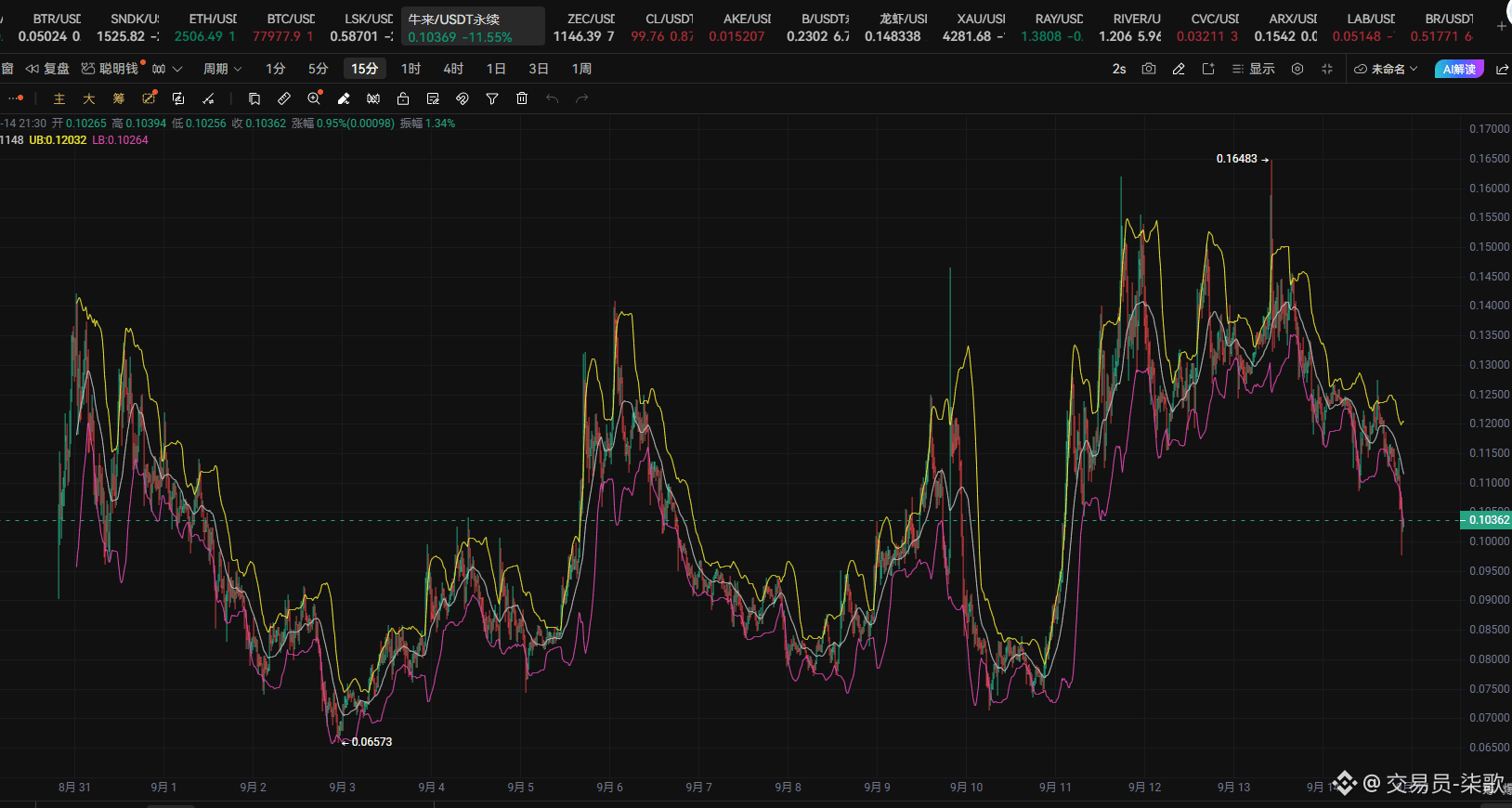
Brothers, don’t panic if $牛来 got caught in a high-position buy-in! 0.102 is the line tonight between life and death. The real chance to unwind is here!
Brothers, just now some fans asked me: $牛来 is stuck above 0.13—should we cut or not? I took a look at the chart for 15 minutes. First, here’s the conclusion: this level isn’t suitable for emotional stop-loss selling, and it’s also not a place for blindly adding. Tonight, what we really need to watch is around 0.102.
From the chart, Niu is already trading below the Bollinger midline. The short-term trend is clearly weak. MACD is also below the zero line with a dead cross, showing that the bears are temporarily in control. But here’s the other side of the story: after the continued decline, the trading volume hasn’t expanded further in panic. This suggests selling pressure underneath is weakening, and the main force may be accumulating.
So tonight, I’ll do it like this:
First observation level: around 0.102. If it can hold here, and then in the 15-minute chart it reclaims above 0.110–0.115, I’ll prioritize looking for a technical rebound. The first target would be around 0.125, and then around 0.138.
Second pressure zone: 0.145–0.150. This is the neckline area of the previous M-top. This is also the key for the bulls tonight to truly turn around. If it can’t break through, don’t fantasize about a direct V-shaped reversal into new highs—during the rebound, reduce positions as appropriate.
But if 0.102 breaks down effectively and the rebound can’t hold—if it can’t reclaim the level—then don’t stubbornly hold on. Below that, there’s another more important support area around 0.085.
So, brothers with positions stuck, remember one line: unwinding isn’t waiting for it to rise back—it’s first judging whether it has turned strong again.
Tonight, I won’t let fans chase a trade just because there’s a single bullish candle, and I won’t let anyone cut just because there’s a single bearish candle. First we’ll see the gain/loss around 0.102, then we decide the long/short rhythm.
People who truly know how to trade don’t make money on every single move—they know when to act and when to wait.
If your Niu is stuck right now, or you don’t know how to handle tonight, you can come find me. I’ll go through your current position and cost and reset the plan for tonight’s entries and exits.
The market won’t give you the same opportunity twice. But good levels often provide a window to get unstuck. Tonight, I’m only waiting for that window!!
Brothers, don’t panic if $牛来 got caught in a high-position buy-in! 0.102 is the line tonight between life and death. The real chance to unwind is here!
Brothers, just now some fans asked me: $牛来 is stuck above 0.13—should we cut or not? I took a look at the chart for 15 minutes. First, here’s the conclusion: this level isn’t suitable for emotional stop-loss selling, and it’s also not a place for blindly adding. Tonight, what we really need to watch is around 0.102.
From the chart, Niu is already trading below the Bollinger midline. The short-term trend is clearly weak. MACD is also below the zero line with a dead cross, showing that the bears are temporarily in control. But here’s the other side of the story: after the continued decline, the trading volume hasn’t expanded further in panic. This suggests selling pressure underneath is weakening, and the main force may be accumulating.
So tonight, I’ll do it like this:
First observation level: around 0.102. If it can hold here, and then in the 15-minute chart it reclaims above 0.110–0.115, I’ll prioritize looking for a technical rebound. The first target would be around 0.125, and then around 0.138.
Second pressure zone: 0.145–0.150. This is the neckline area of the previous M-top. This is also the key for the bulls tonight to truly turn around. If it can’t break through, don’t fantasize about a direct V-shaped reversal into new highs—during the rebound, reduce positions as appropriate.
But if 0.102 breaks down effectively and the rebound can’t hold—if it can’t reclaim the level—then don’t stubbornly hold on. Below that, there’s another more important support area around 0.085.
So, brothers with positions stuck, remember one line: unwinding isn’t waiting for it to rise back—it’s first judging whether it has turned strong again.
Tonight, I won’t let fans chase a trade just because there’s a single bullish candle, and I won’t let anyone cut just because there’s a single bearish candle. First we’ll see the gain/loss around 0.102, then we decide the long/short rhythm.
People who truly know how to trade don’t make money on every single move—they know when to act and when to wait.
If your Niu is stuck right now, or you don’t know how to handle tonight, you can come find me. I’ll go through your current position and cost and reset the plan for tonight’s entries and exits.
The market won’t give you the same opportunity twice. But good levels often provide a window to get unstuck. Tonight, I’m only waiting for that window!!
Brothers, just now some fans asked me: $牛来 is stuck above 0.13—should we cut or not? I took a look at the chart for 15 minutes. First, here’s the conclusion: this level isn’t suitable for emotional stop-loss selling, and it’s also not a place for blindly adding. Tonight, what we really need to watch is around 0.102.
From the chart, Niu is already trading below the Bollinger midline. The short-term trend is clearly weak. MACD is also below the zero line with a dead cross, showing that the bears are temporarily in control. But here’s the other side of the story: after the continued decline, the trading volume hasn’t expanded further in panic. This suggests selling pressure underneath is weakening, and the main force may be accumulating.
So tonight, I’ll do it like this:
First observation level: around 0.102. If it can hold here, and then in the 15-minute chart it reclaims above 0.110–0.115, I’ll prioritize looking for a technical rebound. The first target would be around 0.125, and then around 0.138.
Second pressure zone: 0.145–0.150. This is the neckline area of the previous M-top. This is also the key for the bulls tonight to truly turn around. If it can’t break through, don’t fantasize about a direct V-shaped reversal into new highs—during the rebound, reduce positions as appropriate.
But if 0.102 breaks down effectively and the rebound can’t hold—if it can’t reclaim the level—then don’t stubbornly hold on. Below that, there’s another more important support area around 0.085.
So, brothers with positions stuck, remember one line: unwinding isn’t waiting for it to rise back—it’s first judging whether it has turned strong again.
Tonight, I won’t let fans chase a trade just because there’s a single bullish candle, and I won’t let anyone cut just because there’s a single bearish candle. First we’ll see the gain/loss around 0.102, then we decide the long/short rhythm.
People who truly know how to trade don’t make money on every single move—they know when to act and when to wait.
If your Niu is stuck right now, or you don’t know how to handle tonight, you can come find me. I’ll go through your current position and cost and reset the plan for tonight’s entries and exits.
The market won’t give you the same opportunity twice. But good levels often provide a window to get unstuck. Tonight, I’m only waiting for that window!!
1
1
989
·
--
Everyone says that if you hold a long-term position, you can make money. Then how can you achieve stable profits in short-term trading? #比特币涨1.64%突破78000美元
Many retail investors do short-term trades and watch the gain/loss leaderboard every day. If they see a rally, they chase; if they see a pullback, they panic. They end up buying at the top or selling before the move even starts. In fact, short-term trading isn’t that complicated. I usually focus on three signals.
First, watch for a volume expansion breakout.
Some coins move sideways for a long time. Suddenly, with a surge in volume, they break through a key resistance level—this indicates that capital has started entering the market. Remember: the breakout itself isn’t scary; it’s the increased volume that matters. Without volume confirmation, the upward move usually won’t last.
Second, look for a pullback to buy at a low point.
After a strong coin starts moving, it rarely climbs in a straight line. There will usually be pullbacks to shake out weak hands along the way. If the pullback reaches a key support level, the trading volume shrinks, and the price stabilizes again, this spot is safer than chasing higher prices. The risk is smaller, and it’s easier to hold.
Third, track the hot-market leader.
In each market cycle, the first things to start often belong to the leader. My habit is to first see which sector the capital is flowing into, and then find the coins that are the first to break out with rising volume. The back end may still rise, but in most real big trends, they usually originate from the leader. Of course, even the best opportunities require discipline. Test with a small position, set a stop-loss in advance; don’t trade what you don’t understand—don’t trade with no volume—and don’t trade coins that no one is paying attention to.
Making money with short-term trades doesn’t rely on luck. Change the habit of chasing and killing, understand these signals, and you’ll find that trading is not as difficult as you imagine.
Everyone says that if you hold a long-term position, you can make money. Then how can you achieve stable profits in short-term trading? #比特币涨1.64%突破78000美元
Many retail investors do short-term trades and watch the gain/loss leaderboard every day. If they see a rally, they chase; if they see a pullback, they panic. They end up buying at the top or selling before the move even starts. In fact, short-term trading isn’t that complicated. I usually focus on three signals.
First, watch for a volume expansion breakout.
Some coins move sideways for a long time. Suddenly, with a surge in volume, they break through a key resistance level—this indicates that capital has started entering the market. Remember: the breakout itself isn’t scary; it’s the increased volume that matters. Without volume confirmation, the upward move usually won’t last.
Second, look for a pullback to buy at a low point.
After a strong coin starts moving, it rarely climbs in a straight line. There will usually be pullbacks to shake out weak hands along the way. If the pullback reaches a key support level, the trading volume shrinks, and the price stabilizes again, this spot is safer than chasing higher prices. The risk is smaller, and it’s easier to hold.
Third, track the hot-market leader.
In each market cycle, the first things to start often belong to the leader. My habit is to first see which sector the capital is flowing into, and then find the coins that are the first to break out with rising volume. The back end may still rise, but in most real big trends, they usually originate from the leader. Of course, even the best opportunities require discipline. Test with a small position, set a stop-loss in advance; don’t trade what you don’t understand—don’t trade with no volume—and don’t trade coins that no one is paying attention to.
Making money with short-term trades doesn’t rely on luck. Change the habit of chasing and killing, understand these signals, and you’ll find that trading is not as difficult as you imagine.
Many retail investors do short-term trades and watch the gain/loss leaderboard every day. If they see a rally, they chase; if they see a pullback, they panic. They end up buying at the top or selling before the move even starts. In fact, short-term trading isn’t that complicated. I usually focus on three signals.
First, watch for a volume expansion breakout.
Some coins move sideways for a long time. Suddenly, with a surge in volume, they break through a key resistance level—this indicates that capital has started entering the market. Remember: the breakout itself isn’t scary; it’s the increased volume that matters. Without volume confirmation, the upward move usually won’t last.
Second, look for a pullback to buy at a low point.
After a strong coin starts moving, it rarely climbs in a straight line. There will usually be pullbacks to shake out weak hands along the way. If the pullback reaches a key support level, the trading volume shrinks, and the price stabilizes again, this spot is safer than chasing higher prices. The risk is smaller, and it’s easier to hold.
Third, track the hot-market leader.
In each market cycle, the first things to start often belong to the leader. My habit is to first see which sector the capital is flowing into, and then find the coins that are the first to break out with rising volume. The back end may still rise, but in most real big trends, they usually originate from the leader. Of course, even the best opportunities require discipline. Test with a small position, set a stop-loss in advance; don’t trade what you don’t understand—don’t trade with no volume—and don’t trade coins that no one is paying attention to.
Making money with short-term trades doesn’t rely on luck. Change the habit of chasing and killing, understand these signals, and you’ll find that trading is not as difficult as you imagine.

320
·
--
Why do many people lose money with contracts the more they watch the order book? $SNDK #比特币涨1.64%突破78000美元
Because you’re not watching the market—you’re burning up your own decision-making power.
When people first start trading, many have this habit:
After buying in, they check the price every few minutes.
If it rises a little, they think maybe an opportunity is here;
if it dips a little, they immediately start to panic.
In the end, it’s not the market that affects you—your emotions control the trade.
Many people lose money not because they can’t analyze.
It’s because they watch the screen for too long until they run out of patience and lose discipline.
What does high leverage fear the most? Not one round of fluctuation.
But the wrong decisions people make under pressure.
Chasing after price jumps, cutting losses, averaging down, constantly changing direction…
Often, it’s not that the technicals aren’t enough—it’s that your mindset is already in chaos.
The truly mature way to trade is to prepare before opening a position.
Where to enter?
What to do if you’re wrong?
How to exit if you’re profitable?
Write it all clearly.
After entering, don’t spend every minute trying to change the outcome.
Letting the rules execute is more important than using emotions.
The market will always have opportunities.
But not every rise and fall is worth your participation.
In the end, trading isn’t about who can stare at the screen the longest.
It’s about who can control themselves.
Control your emotions, control your frequency, control your position size.
Only then can your account become truly stable.
Why do many people lose money with contracts the more they watch the order book? $SNDK #比特币涨1.64%突破78000美元
Because you’re not watching the market—you’re burning up your own decision-making power.
When people first start trading, many have this habit:
After buying in, they check the price every few minutes.
If it rises a little, they think maybe an opportunity is here;
if it dips a little, they immediately start to panic.
In the end, it’s not the market that affects you—your emotions control the trade.
Many people lose money not because they can’t analyze.
It’s because they watch the screen for too long until they run out of patience and lose discipline.
What does high leverage fear the most? Not one round of fluctuation.
But the wrong decisions people make under pressure.
Chasing after price jumps, cutting losses, averaging down, constantly changing direction…
Often, it’s not that the technicals aren’t enough—it’s that your mindset is already in chaos.
The truly mature way to trade is to prepare before opening a position.
Where to enter?
What to do if you’re wrong?
How to exit if you’re profitable?
Write it all clearly.
After entering, don’t spend every minute trying to change the outcome.
Letting the rules execute is more important than using emotions.
The market will always have opportunities.
But not every rise and fall is worth your participation.
In the end, trading isn’t about who can stare at the screen the longest.
It’s about who can control themselves.
Control your emotions, control your frequency, control your position size.
Only then can your account become truly stable.
Because you’re not watching the market—you’re burning up your own decision-making power.
When people first start trading, many have this habit:
After buying in, they check the price every few minutes.
If it rises a little, they think maybe an opportunity is here;
if it dips a little, they immediately start to panic.
In the end, it’s not the market that affects you—your emotions control the trade.
Many people lose money not because they can’t analyze.
It’s because they watch the screen for too long until they run out of patience and lose discipline.
What does high leverage fear the most? Not one round of fluctuation.
But the wrong decisions people make under pressure.
Chasing after price jumps, cutting losses, averaging down, constantly changing direction…
Often, it’s not that the technicals aren’t enough—it’s that your mindset is already in chaos.
The truly mature way to trade is to prepare before opening a position.
Where to enter?
What to do if you’re wrong?
How to exit if you’re profitable?
Write it all clearly.
After entering, don’t spend every minute trying to change the outcome.
Letting the rules execute is more important than using emotions.
The market will always have opportunities.
But not every rise and fall is worth your participation.
In the end, trading isn’t about who can stare at the screen the longest.
It’s about who can control themselves.
Control your emotions, control your frequency, control your position size.
Only then can your account become truly stable.

424
·
--
In the crypto world, the scariest thing is not only losing money—there’s another issue: $SNDK #比特币涨1.64%突破78000美元
Many people, after making money, don’t dare to withdraw it. They fear their bank accounts being questioned, they fear their funds getting frozen.
Actually, most of the time, what you’re afraid of is the unknown. The real problem isn’t how much money you make. It’s whether this money can be explained clearly. To reduce risk, do three things.
First, choose platforms carefully.
Don’t chase cheaper fees by dealing with channels you’re not familiar with.
Second, don’t change bank cards too frequently.
Use one card consistently, so your fund records stay clear.
Third, save transaction information in advance.
Keep records of deposits, trades, and withdrawals. If you ever need to prove your source of funds, that matters more than anything.
Many people think withdrawal is complicated. But normal trading and normal profits aren’t scary by themselves.
What’s truly dangerous is an unclear source and messy records. So don’t wait until you’ve made money to think about these issues. Before you trade, you should build good, complete habits for managing your funds. Earn with your ability—secure funds with preparation. Don’t give up reasonable returns just because you’re afraid of the unknown. Plan ahead and operate in a standardized way, and many things will be simpler than you imagine.
In the crypto world, the scariest thing is not only losing money—there’s another issue: $SNDK #比特币涨1.64%突破78000美元
Many people, after making money, don’t dare to withdraw it. They fear their bank accounts being questioned, they fear their funds getting frozen.
Actually, most of the time, what you’re afraid of is the unknown. The real problem isn’t how much money you make. It’s whether this money can be explained clearly. To reduce risk, do three things.
First, choose platforms carefully.
Don’t chase cheaper fees by dealing with channels you’re not familiar with.
Second, don’t change bank cards too frequently.
Use one card consistently, so your fund records stay clear.
Third, save transaction information in advance.
Keep records of deposits, trades, and withdrawals. If you ever need to prove your source of funds, that matters more than anything.
Many people think withdrawal is complicated. But normal trading and normal profits aren’t scary by themselves.
What’s truly dangerous is an unclear source and messy records. So don’t wait until you’ve made money to think about these issues. Before you trade, you should build good, complete habits for managing your funds. Earn with your ability—secure funds with preparation. Don’t give up reasonable returns just because you’re afraid of the unknown. Plan ahead and operate in a standardized way, and many things will be simpler than you imagine.
Many people, after making money, don’t dare to withdraw it. They fear their bank accounts being questioned, they fear their funds getting frozen.
Actually, most of the time, what you’re afraid of is the unknown. The real problem isn’t how much money you make. It’s whether this money can be explained clearly. To reduce risk, do three things.
First, choose platforms carefully.
Don’t chase cheaper fees by dealing with channels you’re not familiar with.
Second, don’t change bank cards too frequently.
Use one card consistently, so your fund records stay clear.
Third, save transaction information in advance.
Keep records of deposits, trades, and withdrawals. If you ever need to prove your source of funds, that matters more than anything.
Many people think withdrawal is complicated. But normal trading and normal profits aren’t scary by themselves.
What’s truly dangerous is an unclear source and messy records. So don’t wait until you’ve made money to think about these issues. Before you trade, you should build good, complete habits for managing your funds. Earn with your ability—secure funds with preparation. Don’t give up reasonable returns just because you’re afraid of the unknown. Plan ahead and operate in a standardized way, and many things will be simpler than you imagine.

494
·
--
In the crypto world, there’s a method that makes money the fastest—but it’s also the fastest way to get liquidated.$SNDK #特朗普就CLARITY法案条款存疑
The most typical example is—rollover trading.
It’s like a high-speed machine. When the market moves in your favor, profits grow very quickly. But if you get the direction wrong, it can also destroy your account in an instant. Many people study rollover trading and only look at the return model. For instance, small capital is constantly scaled up, and by continuously catching the market, you achieve rapid growth. But what truly determines the outcome isn’t the formula—it’s the person’s execution.
The three hardest things to control in the market are: greed, fear, and luck/hope.
After making money, you always feel there could still be more. After losing money, you always feel it can still come back. And finally, one last mistake can wipe out everything you accumulated. So anyone who truly does rollover trading must have a bottom line. If you’re wrong, stop in time. If you’re winning, protect your profits in time. When the trend ends, exit in time. Don’t try to earn the very last slice of profit—because the market won’t give you extra rewards just because you’re greedy.
Who is rollover trading suitable for? Not the most aggressive people. It’s for those with the most discipline.
If you don’t have a stable method and a risk awareness, it’s better to start with lower-risk approaches first.
The market will never lack opportunities. But your principal only comes once.
In the crypto world, there’s a method that makes money the fastest—but it’s also the fastest way to get liquidated.$SNDK #特朗普就CLARITY法案条款存疑
The most typical example is—rollover trading.
It’s like a high-speed machine. When the market moves in your favor, profits grow very quickly. But if you get the direction wrong, it can also destroy your account in an instant. Many people study rollover trading and only look at the return model. For instance, small capital is constantly scaled up, and by continuously catching the market, you achieve rapid growth. But what truly determines the outcome isn’t the formula—it’s the person’s execution.
The three hardest things to control in the market are: greed, fear, and luck/hope.
After making money, you always feel there could still be more. After losing money, you always feel it can still come back. And finally, one last mistake can wipe out everything you accumulated. So anyone who truly does rollover trading must have a bottom line. If you’re wrong, stop in time. If you’re winning, protect your profits in time. When the trend ends, exit in time. Don’t try to earn the very last slice of profit—because the market won’t give you extra rewards just because you’re greedy.
Who is rollover trading suitable for? Not the most aggressive people. It’s for those with the most discipline.
If you don’t have a stable method and a risk awareness, it’s better to start with lower-risk approaches first.
The market will never lack opportunities. But your principal only comes once.
The most typical example is—rollover trading.
It’s like a high-speed machine. When the market moves in your favor, profits grow very quickly. But if you get the direction wrong, it can also destroy your account in an instant. Many people study rollover trading and only look at the return model. For instance, small capital is constantly scaled up, and by continuously catching the market, you achieve rapid growth. But what truly determines the outcome isn’t the formula—it’s the person’s execution.
The three hardest things to control in the market are: greed, fear, and luck/hope.
After making money, you always feel there could still be more. After losing money, you always feel it can still come back. And finally, one last mistake can wipe out everything you accumulated. So anyone who truly does rollover trading must have a bottom line. If you’re wrong, stop in time. If you’re winning, protect your profits in time. When the trend ends, exit in time. Don’t try to earn the very last slice of profit—because the market won’t give you extra rewards just because you’re greedy.
Who is rollover trading suitable for? Not the most aggressive people. It’s for those with the most discipline.
If you don’t have a stable method and a risk awareness, it’s better to start with lower-risk approaches first.
The market will never lack opportunities. But your principal only comes once.


419
·
--
If you want to build a large account with under 1000 USDT, it’s not about having guts—it’s about whether you have self-control. $SNDK #比特币涨1.64%突破78000美元
When most people’s principal is small, the mistake they’re most likely to make is this: they’re always thinking about finding a coin that surges and riding one rally to turn things around. Seeing others make money makes them fear missing out. When a hot opportunity appears, they want to go all in and bet big.
After you’ve been trading for a while, you’ll understand: if you want a small capital to go far, the first step isn’t thinking about how much you can earn. It’s to avoid one catastrophic loss that wipes out your principal.
Over these years of trading, there are a few habits you must build.
First, don’t rush to prove yourself.
When you have less than 1000 USDT, the most important thing is to accumulate experience. Every trade is learning and improvement—not gambling on a one-time doubling.
Second, don’t force trades in market conditions you don’t understand.
The market fluctuates every day, but not every fluctuation is an opportunity meant for you. Waiting patiently for certainty matters more than trading frequently.
Third, think about risk before placing an order.
Don’t focus only on how much you can make—also be clear about the maximum you can afford to lose. Position sizing and risk control are always more important than the speed of profit.
Fourth, once you’ve made gains, learn how to protect them.
Don’t keep trying to capture the entire move from start to finish. Being able to leave profits intact is real profitability.
Fifth, as your capital grows, you must control your mindset even more.
Many people are bold when their funds are small. But once the account starts rising, they often become inflated. Then, in the last big all-in trade, they end up giving back everything they previously accumulated.
Trading isn’t about who’s willing to gamble more. It’s about who can maintain the rhythm long-term. As long as your principal is still there, opportunities will always exist. Control risk, wait for opportunities, and repeat the right methods. Even small capital can grow steadily. If you’re still confused, come to my chat room anytime below 👇👇👇—and save yourself ten years of detours.
If you want to build a large account with under 1000 USDT, it’s not about having guts—it’s about whether you have self-control. $SNDK #比特币涨1.64%突破78000美元
When most people’s principal is small, the mistake they’re most likely to make is this: they’re always thinking about finding a coin that surges and riding one rally to turn things around. Seeing others make money makes them fear missing out. When a hot opportunity appears, they want to go all in and bet big.
After you’ve been trading for a while, you’ll understand: if you want a small capital to go far, the first step isn’t thinking about how much you can earn. It’s to avoid one catastrophic loss that wipes out your principal.
Over these years of trading, there are a few habits you must build.
First, don’t rush to prove yourself.
When you have less than 1000 USDT, the most important thing is to accumulate experience. Every trade is learning and improvement—not gambling on a one-time doubling.
Second, don’t force trades in market conditions you don’t understand.
The market fluctuates every day, but not every fluctuation is an opportunity meant for you. Waiting patiently for certainty matters more than trading frequently.
Third, think about risk before placing an order.
Don’t focus only on how much you can make—also be clear about the maximum you can afford to lose. Position sizing and risk control are always more important than the speed of profit.
Fourth, once you’ve made gains, learn how to protect them.
Don’t keep trying to capture the entire move from start to finish. Being able to leave profits intact is real profitability.
Fifth, as your capital grows, you must control your mindset even more.
Many people are bold when their funds are small. But once the account starts rising, they often become inflated. Then, in the last big all-in trade, they end up giving back everything they previously accumulated.
Trading isn’t about who’s willing to gamble more. It’s about who can maintain the rhythm long-term. As long as your principal is still there, opportunities will always exist. Control risk, wait for opportunities, and repeat the right methods. Even small capital can grow steadily. If you’re still confused, come to my chat room anytime below 👇👇👇—and save yourself ten years of detours.
When most people’s principal is small, the mistake they’re most likely to make is this: they’re always thinking about finding a coin that surges and riding one rally to turn things around. Seeing others make money makes them fear missing out. When a hot opportunity appears, they want to go all in and bet big.
After you’ve been trading for a while, you’ll understand: if you want a small capital to go far, the first step isn’t thinking about how much you can earn. It’s to avoid one catastrophic loss that wipes out your principal.
Over these years of trading, there are a few habits you must build.
First, don’t rush to prove yourself.
When you have less than 1000 USDT, the most important thing is to accumulate experience. Every trade is learning and improvement—not gambling on a one-time doubling.
Second, don’t force trades in market conditions you don’t understand.
The market fluctuates every day, but not every fluctuation is an opportunity meant for you. Waiting patiently for certainty matters more than trading frequently.
Third, think about risk before placing an order.
Don’t focus only on how much you can make—also be clear about the maximum you can afford to lose. Position sizing and risk control are always more important than the speed of profit.
Fourth, once you’ve made gains, learn how to protect them.
Don’t keep trying to capture the entire move from start to finish. Being able to leave profits intact is real profitability.
Fifth, as your capital grows, you must control your mindset even more.
Many people are bold when their funds are small. But once the account starts rising, they often become inflated. Then, in the last big all-in trade, they end up giving back everything they previously accumulated.
Trading isn’t about who’s willing to gamble more. It’s about who can maintain the rhythm long-term. As long as your principal is still there, opportunities will always exist. Control risk, wait for opportunities, and repeat the right methods. Even small capital can grow steadily. If you’re still confused, come to my chat room anytime below 👇👇👇—and save yourself ten years of detours.


499
·
--
I just took a look at the on-chain data and the daily chart of $SNDK , and my spine went cold. #白宫拒绝放缓AI发展呼吁
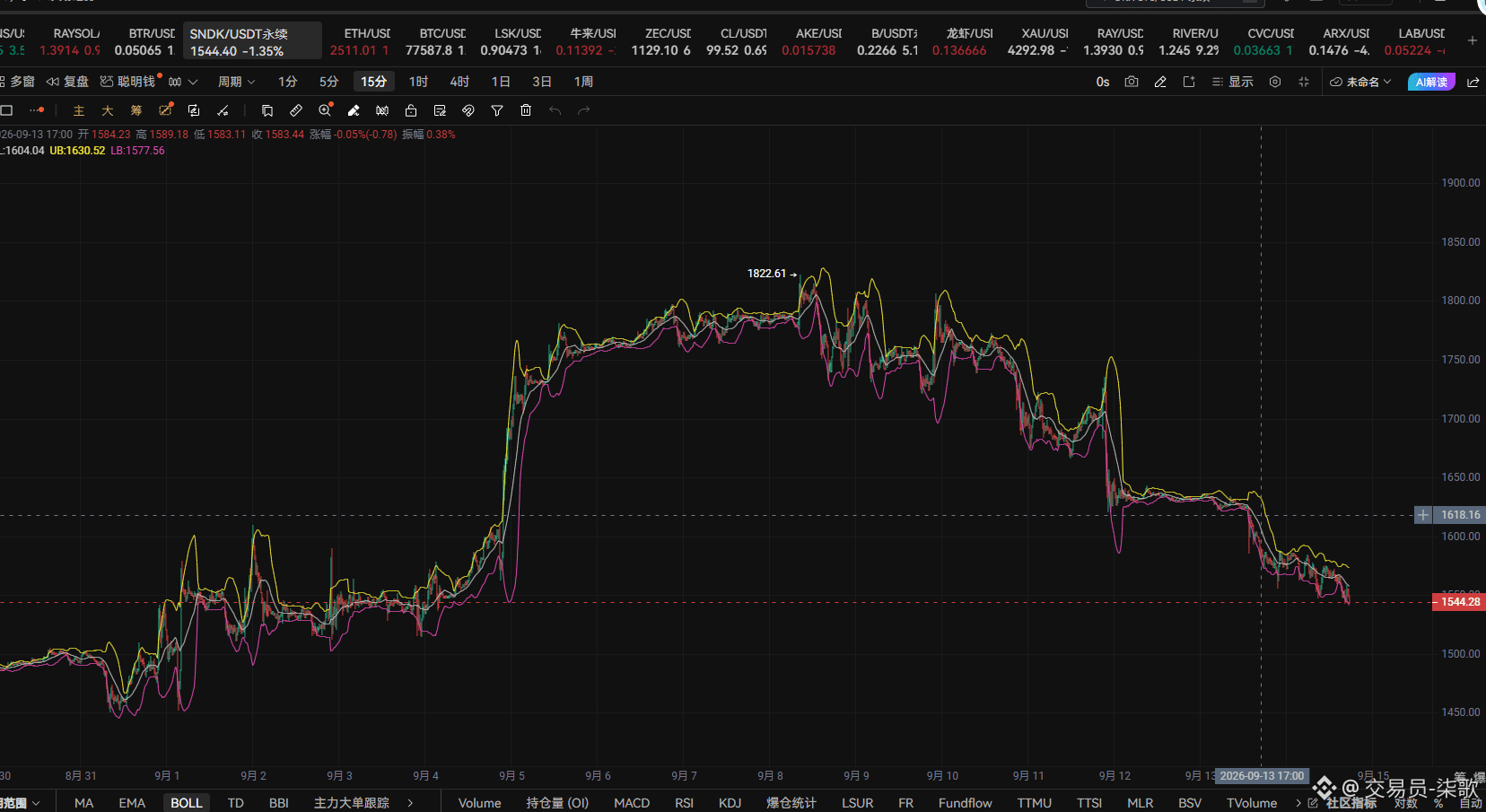
Many people ask me: Can you bottom-fish at 1544 now? Will it bounce once it drops enough?
I directly show them this “smart money” data.
Look how scary these numbers are:
👉 The long/short ratio is extremely imbalanced: the nominal long/short ratio is as high as 301%! For every one short position, there are 3 long positions. The ship is massively tilted toward longs, and retail investors are stubbornly holding on.
👉 The big players have already cashed out for profit: pay attention—the profit ratio of the short-side “smart money” is as high as 86.76%, with an average opening price at 1614. Now that the price has fallen below 1550, it shows that this round of decline is entirely led by the main force; they hold massive profits in their hands.
👉 Longs are trapped across the board: only 8.98% of longs are in profit, with an average cost of 1584. The price is currently hovering right above them—everything is trapped capital.
This is the typical “downward drift during the distribution period after the main force exits.”
My response strategy (for reference only; prioritize staying alive):
❌ Never blindly bottom-fish: the downtrend is still intact, and the main force shorts are still profitable. Entering now is just catching a falling knife.
✅ Key levels to watch:
First pressure zone (escape point): 1600–1620. This is the support platform that was just broken, as well as the cost zone for the main force’s shorts. If the market rebounds up to here, it will most likely get smashed again by the main force—this is the chance to exit.
Strong support zone (observation point): 1450–1480. This is the bottom area before the previous wave of the initial rise. Only if price falls to here and you see a high-volume bullish candle, then it might be the true bottom.
Stop-loss rule (iron law): If the rebound can’t get above 1580 and it breaks back below 1520 again, it means the downside space is completely open—don’t fantasize; run!
In this market, “going against the trend” is giving money to the main force. When smart money is making money on shorts, why do you think you can bottom-fish? Better miss the rebound than become one of those buried.
In the crypto space, don’t get your name smeared. If you want to avoid traps and secure steadier profits, follow the rhythm of Qige.
I just took a look at the on-chain data and the daily chart of $SNDK , and my spine went cold. #白宫拒绝放缓AI发展呼吁
Many people ask me: Can you bottom-fish at 1544 now? Will it bounce once it drops enough?
I directly show them this “smart money” data.
Look how scary these numbers are:
👉 The long/short ratio is extremely imbalanced: the nominal long/short ratio is as high as 301%! For every one short position, there are 3 long positions. The ship is massively tilted toward longs, and retail investors are stubbornly holding on.
👉 The big players have already cashed out for profit: pay attention—the profit ratio of the short-side “smart money” is as high as 86.76%, with an average opening price at 1614. Now that the price has fallen below 1550, it shows that this round of decline is entirely led by the main force; they hold massive profits in their hands.
👉 Longs are trapped across the board: only 8.98% of longs are in profit, with an average cost of 1584. The price is currently hovering right above them—everything is trapped capital.
This is the typical “downward drift during the distribution period after the main force exits.”
My response strategy (for reference only; prioritize staying alive):
❌ Never blindly bottom-fish: the downtrend is still intact, and the main force shorts are still profitable. Entering now is just catching a falling knife.
✅ Key levels to watch:
First pressure zone (escape point): 1600–1620. This is the support platform that was just broken, as well as the cost zone for the main force’s shorts. If the market rebounds up to here, it will most likely get smashed again by the main force—this is the chance to exit.
Strong support zone (observation point): 1450–1480. This is the bottom area before the previous wave of the initial rise. Only if price falls to here and you see a high-volume bullish candle, then it might be the true bottom.
Stop-loss rule (iron law): If the rebound can’t get above 1580 and it breaks back below 1520 again, it means the downside space is completely open—don’t fantasize; run!
In this market, “going against the trend” is giving money to the main force. When smart money is making money on shorts, why do you think you can bottom-fish? Better miss the rebound than become one of those buried.
In the crypto space, don’t get your name smeared. If you want to avoid traps and secure steadier profits, follow the rhythm of Qige.
Many people ask me: Can you bottom-fish at 1544 now? Will it bounce once it drops enough?
I directly show them this “smart money” data.
Look how scary these numbers are:
👉 The long/short ratio is extremely imbalanced: the nominal long/short ratio is as high as 301%! For every one short position, there are 3 long positions. The ship is massively tilted toward longs, and retail investors are stubbornly holding on.
👉 The big players have already cashed out for profit: pay attention—the profit ratio of the short-side “smart money” is as high as 86.76%, with an average opening price at 1614. Now that the price has fallen below 1550, it shows that this round of decline is entirely led by the main force; they hold massive profits in their hands.
👉 Longs are trapped across the board: only 8.98% of longs are in profit, with an average cost of 1584. The price is currently hovering right above them—everything is trapped capital.
This is the typical “downward drift during the distribution period after the main force exits.”
My response strategy (for reference only; prioritize staying alive):
❌ Never blindly bottom-fish: the downtrend is still intact, and the main force shorts are still profitable. Entering now is just catching a falling knife.
✅ Key levels to watch:
First pressure zone (escape point): 1600–1620. This is the support platform that was just broken, as well as the cost zone for the main force’s shorts. If the market rebounds up to here, it will most likely get smashed again by the main force—this is the chance to exit.
Strong support zone (observation point): 1450–1480. This is the bottom area before the previous wave of the initial rise. Only if price falls to here and you see a high-volume bullish candle, then it might be the true bottom.
Stop-loss rule (iron law): If the rebound can’t get above 1580 and it breaks back below 1520 again, it means the downside space is completely open—don’t fantasize; run!
In this market, “going against the trend” is giving money to the main force. When smart money is making money on shorts, why do you think you can bottom-fish? Better miss the rebound than become one of those buried.
In the crypto space, don’t get your name smeared. If you want to avoid traps and secure steadier profits, follow the rhythm of Qige.

527
·
--
This coin is a bit tough. It just can’t drop. If the people who shorted it got stuck, what should they do?
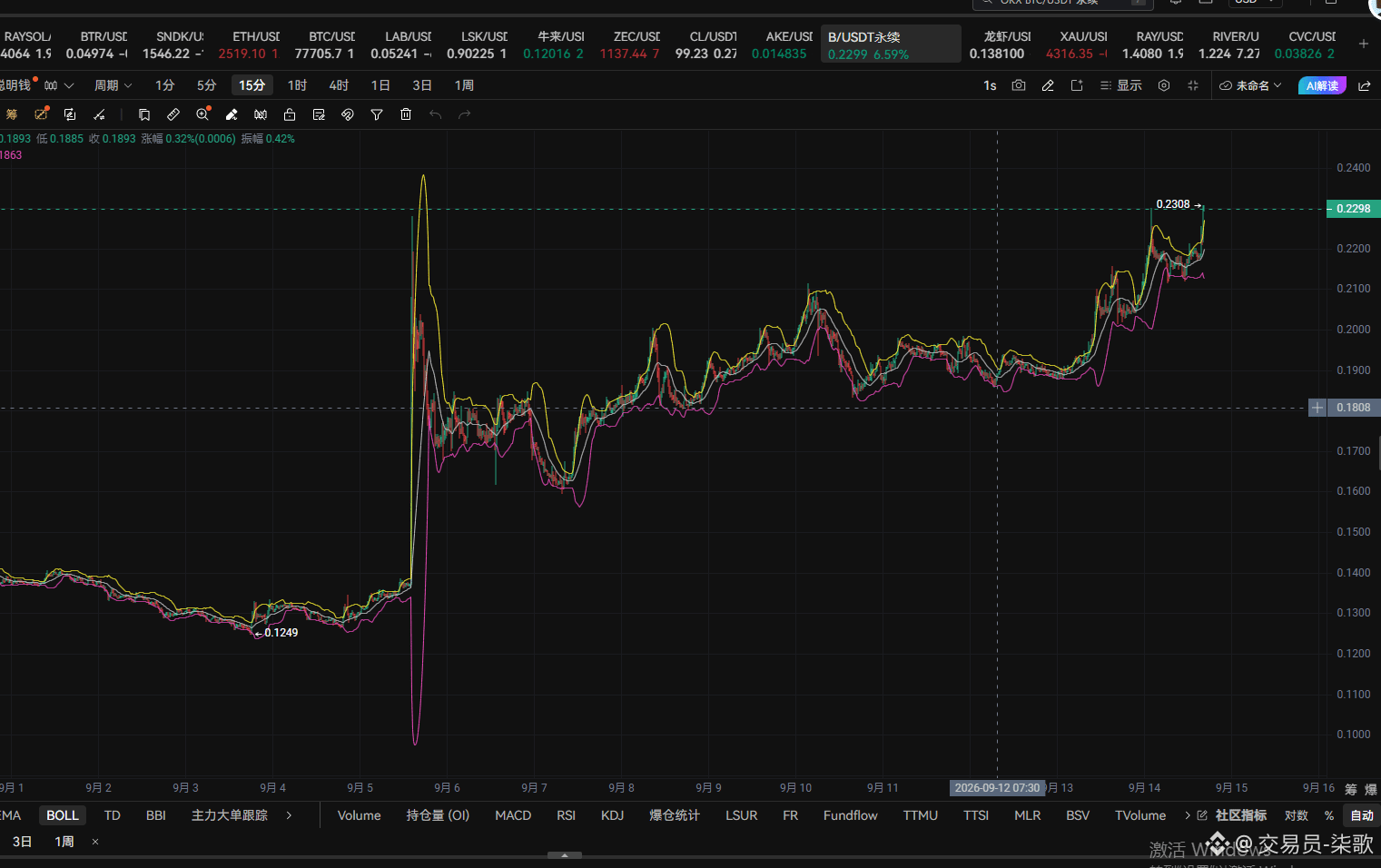
I just took a look at the 15-minute and daily charts for $B , and my spine is tingling.
Many people ask me: At 0.23, can you still chase? Is a breakout above the previous high going to kick off another round of a huge surge?
I directly showed them these two charts.
Look how tangled the price action is:
👉 High-level consolidation—unclear intent from the main players: On the 15-minute chart, B has just gone through a rally from 0.18 to 0.23. But notice—the rally hits exactly the previous dense trapped-loot area (0.23–0.24). The current price is right at the “bull-bear dividing line,” stuck between ups and downs.
👉 Long-term trapped positions like mountains: On the daily chart, pay attention to the 0.29–0.30 range. That’s where the historical highs used to be, with countless people stuck there. Now, 0.23 may look low, but for those who bought the bottom at 0.12, it’s already doubled. The profit-taking could crash the market at any moment.
👉 Short-term spike then pullback: On the 15-minute chart, right after printing a new high at 0.2308, it immediately followed with an upper shadow, which shows heavy sell pressure overhead.
This is the classic “consolidation and shakeout period before a breakout.”
My response strategy (for reference only—prioritize staying safe):
❌ Never blindly chase with heavy size: Right now you’re in a double squeeze between the historical trapped zone and the recent profit-taking zone. Entering now is likely to get badly hit.
✅ Key levels to watch:
First pressure level (breakout point): 0.24–0.25. This is the pullback resistance right after the earlier spike-and-fall. If it breaks out with volume and holds above this area, it means the main players’ shakeout is over, and upside room opens—you can look for a test toward 0.29.
Strong support (for adding positions): 0.20–0.21. This is the launch platform of this rally and also the moving-average support. If it retraces here without breaking, that’s an excellent “buy-the-dip” opportunity, with a very good risk-reward ratio.
Stop-loss rule: If it breaks below 0.19, it means this move is a “one-day wonder” designed to lure longs; the main players have already finished distributing. Don’t fantasize—run!
Traders’ thoughts:
In this market, “being afraid of buying high” is a miserable life, but “blindly chasing” is handing money to others. These bottom-suddenly-surge coins have extremely high volatility—either you get big gains, or you get a big hit. Better to wait for a pullback and stabilization before entering than to bet on that last spasm.
Don’t grope in the dark. If you want to avoid traps and secure profits, follow the rhythm of QiGe.
This coin is a bit tough. It just can’t drop. If the people who shorted it got stuck, what should they do?
I just took a look at the 15-minute and daily charts for $B , and my spine is tingling.
Many people ask me: At 0.23, can you still chase? Is a breakout above the previous high going to kick off another round of a huge surge?
I directly showed them these two charts.
Look how tangled the price action is:
👉 High-level consolidation—unclear intent from the main players: On the 15-minute chart, B has just gone through a rally from 0.18 to 0.23. But notice—the rally hits exactly the previous dense trapped-loot area (0.23–0.24). The current price is right at the “bull-bear dividing line,” stuck between ups and downs.
👉 Long-term trapped positions like mountains: On the daily chart, pay attention to the 0.29–0.30 range. That’s where the historical highs used to be, with countless people stuck there. Now, 0.23 may look low, but for those who bought the bottom at 0.12, it’s already doubled. The profit-taking could crash the market at any moment.
👉 Short-term spike then pullback: On the 15-minute chart, right after printing a new high at 0.2308, it immediately followed with an upper shadow, which shows heavy sell pressure overhead.
This is the classic “consolidation and shakeout period before a breakout.”
My response strategy (for reference only—prioritize staying safe):
❌ Never blindly chase with heavy size: Right now you’re in a double squeeze between the historical trapped zone and the recent profit-taking zone. Entering now is likely to get badly hit.
✅ Key levels to watch:
First pressure level (breakout point): 0.24–0.25. This is the pullback resistance right after the earlier spike-and-fall. If it breaks out with volume and holds above this area, it means the main players’ shakeout is over, and upside room opens—you can look for a test toward 0.29.
Strong support (for adding positions): 0.20–0.21. This is the launch platform of this rally and also the moving-average support. If it retraces here without breaking, that’s an excellent “buy-the-dip” opportunity, with a very good risk-reward ratio.
Stop-loss rule: If it breaks below 0.19, it means this move is a “one-day wonder” designed to lure longs; the main players have already finished distributing. Don’t fantasize—run!
Traders’ thoughts:
In this market, “being afraid of buying high” is a miserable life, but “blindly chasing” is handing money to others. These bottom-suddenly-surge coins have extremely high volatility—either you get big gains, or you get a big hit. Better to wait for a pullback and stabilization before entering than to bet on that last spasm.
Don’t grope in the dark. If you want to avoid traps and secure profits, follow the rhythm of QiGe.
I just took a look at the 15-minute and daily charts for $B , and my spine is tingling.
Many people ask me: At 0.23, can you still chase? Is a breakout above the previous high going to kick off another round of a huge surge?
I directly showed them these two charts.
Look how tangled the price action is:
👉 High-level consolidation—unclear intent from the main players: On the 15-minute chart, B has just gone through a rally from 0.18 to 0.23. But notice—the rally hits exactly the previous dense trapped-loot area (0.23–0.24). The current price is right at the “bull-bear dividing line,” stuck between ups and downs.
👉 Long-term trapped positions like mountains: On the daily chart, pay attention to the 0.29–0.30 range. That’s where the historical highs used to be, with countless people stuck there. Now, 0.23 may look low, but for those who bought the bottom at 0.12, it’s already doubled. The profit-taking could crash the market at any moment.
👉 Short-term spike then pullback: On the 15-minute chart, right after printing a new high at 0.2308, it immediately followed with an upper shadow, which shows heavy sell pressure overhead.
This is the classic “consolidation and shakeout period before a breakout.”
My response strategy (for reference only—prioritize staying safe):
❌ Never blindly chase with heavy size: Right now you’re in a double squeeze between the historical trapped zone and the recent profit-taking zone. Entering now is likely to get badly hit.
✅ Key levels to watch:
First pressure level (breakout point): 0.24–0.25. This is the pullback resistance right after the earlier spike-and-fall. If it breaks out with volume and holds above this area, it means the main players’ shakeout is over, and upside room opens—you can look for a test toward 0.29.
Strong support (for adding positions): 0.20–0.21. This is the launch platform of this rally and also the moving-average support. If it retraces here without breaking, that’s an excellent “buy-the-dip” opportunity, with a very good risk-reward ratio.
Stop-loss rule: If it breaks below 0.19, it means this move is a “one-day wonder” designed to lure longs; the main players have already finished distributing. Don’t fantasize—run!
Traders’ thoughts:
In this market, “being afraid of buying high” is a miserable life, but “blindly chasing” is handing money to others. These bottom-suddenly-surge coins have extremely high volatility—either you get big gains, or you get a big hit. Better to wait for a pullback and stabilization before entering than to bet on that last spasm.
Don’t grope in the dark. If you want to avoid traps and secure profits, follow the rhythm of QiGe.
140
·
--
If you’ve just entered the crypto world, these are the pieces of knowledge you must understand.$SNDK #以太坊跌破2500美元
“Want to make big money? Don’t gamble wildly first.”
When I first started, I also only had a few thousand USDT as capital—no connections, no special resources. I just kept summarizing experience and building my account step by step. Later, I realized that what truly determines the outcome isn’t how many times you catch a huge rally—it’s whether you can control risk over the long term.
My method is simple.
Phase 1: Train discipline with small capital.
For example, 1000 USDT—split it into several portions and don’t put it all in at once. For every trade, plan in advance your entry, stop-loss, and take-profit levels. Don’t chase pumps. Don’t “hold and bleed.” Don’t trade markets you don’t understand.
Phase 2: Scale up only after you start profiting.
As your account grows, you also won’t suddenly go all-in. When the trend is clear, add position in batches so your profits follow the market’s movement—not gamble the principal.
Phase 3: Learn to protect profits once you’ve earned them.
As your account becomes larger, regularly lock in part of your gains. Money in the market can never be fully “earned,” but the money you actually take—those are the gains that truly belong to you.
Many people lose money not because they lack opportunities, but because their position size is too heavy. They don’t cut losses, and when their direction is wrong, they keep holding stubbornly. The real test in trading has never been about boldness—it’s about discipline.
There’s no shortcut for making big money with small capital. Control risk, wait for opportunities, and repeat the right methods consistently—only then does your account have a chance to grow steadily.
If you’ve just entered the crypto world, these are the pieces of knowledge you must understand.$SNDK #以太坊跌破2500美元
“Want to make big money? Don’t gamble wildly first.”
When I first started, I also only had a few thousand USDT as capital—no connections, no special resources. I just kept summarizing experience and building my account step by step. Later, I realized that what truly determines the outcome isn’t how many times you catch a huge rally—it’s whether you can control risk over the long term.
My method is simple.
Phase 1: Train discipline with small capital.
For example, 1000 USDT—split it into several portions and don’t put it all in at once. For every trade, plan in advance your entry, stop-loss, and take-profit levels. Don’t chase pumps. Don’t “hold and bleed.” Don’t trade markets you don’t understand.
Phase 2: Scale up only after you start profiting.
As your account grows, you also won’t suddenly go all-in. When the trend is clear, add position in batches so your profits follow the market’s movement—not gamble the principal.
Phase 3: Learn to protect profits once you’ve earned them.
As your account becomes larger, regularly lock in part of your gains. Money in the market can never be fully “earned,” but the money you actually take—those are the gains that truly belong to you.
Many people lose money not because they lack opportunities, but because their position size is too heavy. They don’t cut losses, and when their direction is wrong, they keep holding stubbornly. The real test in trading has never been about boldness—it’s about discipline.
There’s no shortcut for making big money with small capital. Control risk, wait for opportunities, and repeat the right methods consistently—only then does your account have a chance to grow steadily.
“Want to make big money? Don’t gamble wildly first.”
When I first started, I also only had a few thousand USDT as capital—no connections, no special resources. I just kept summarizing experience and building my account step by step. Later, I realized that what truly determines the outcome isn’t how many times you catch a huge rally—it’s whether you can control risk over the long term.
My method is simple.
Phase 1: Train discipline with small capital.
For example, 1000 USDT—split it into several portions and don’t put it all in at once. For every trade, plan in advance your entry, stop-loss, and take-profit levels. Don’t chase pumps. Don’t “hold and bleed.” Don’t trade markets you don’t understand.
Phase 2: Scale up only after you start profiting.
As your account grows, you also won’t suddenly go all-in. When the trend is clear, add position in batches so your profits follow the market’s movement—not gamble the principal.
Phase 3: Learn to protect profits once you’ve earned them.
As your account becomes larger, regularly lock in part of your gains. Money in the market can never be fully “earned,” but the money you actually take—those are the gains that truly belong to you.
Many people lose money not because they lack opportunities, but because their position size is too heavy. They don’t cut losses, and when their direction is wrong, they keep holding stubbornly. The real test in trading has never been about boldness—it’s about discipline.
There’s no shortcut for making big money with small capital. Control risk, wait for opportunities, and repeat the right methods consistently—only then does your account have a chance to grow steadily.


369
·
--
I found a really interesting phenomenon: those people who think they’re very smart end up losing very badly.
Every day they study news, analyze data, and stare at the market until late at night, afraid of missing any opportunity. They look very hardworking, but their account keeps getting smaller. Why? It’s not that they lack ability—it’s that they’re trying too hard to prove they’re smarter than the market. They like to guess the top, like to bottom-fish, and like to predict reversals in advance. And then, time and again, the market educates them.
Later, I slowly realized that truly effective methods aren’t that complicated. Don’t guess the top. Don’t bet on the bottom. When a trend comes, follow it; when the trend ends, leave. If you can read the market, participate; if you can’t, wait. After you buy, you don’t need to fantasize about selling at the very highest point. Once you reach your target, reduce part of your position first. If it continues to rise, gradually protect your profits, and let the remaining position be handled by the trend.
Many people aren’t incapable of buying—they just don’t know how to sell. When they’re making money, they’re greedy and want to earn more. When they’re losing, they hesitate and don’t want to admit they’re wrong. In the end, a perfectly good winning trade turns into a losing one. The market always has opportunities. First learn how to survive, then think about making big money.$SNDK #比特币四周内第三次单块重组
I found a really interesting phenomenon: those people who think they’re very smart end up losing very badly.
Every day they study news, analyze data, and stare at the market until late at night, afraid of missing any opportunity. They look very hardworking, but their account keeps getting smaller. Why? It’s not that they lack ability—it’s that they’re trying too hard to prove they’re smarter than the market. They like to guess the top, like to bottom-fish, and like to predict reversals in advance. And then, time and again, the market educates them.
Later, I slowly realized that truly effective methods aren’t that complicated. Don’t guess the top. Don’t bet on the bottom. When a trend comes, follow it; when the trend ends, leave. If you can read the market, participate; if you can’t, wait. After you buy, you don’t need to fantasize about selling at the very highest point. Once you reach your target, reduce part of your position first. If it continues to rise, gradually protect your profits, and let the remaining position be handled by the trend.
Many people aren’t incapable of buying—they just don’t know how to sell. When they’re making money, they’re greedy and want to earn more. When they’re losing, they hesitate and don’t want to admit they’re wrong. In the end, a perfectly good winning trade turns into a losing one. The market always has opportunities. First learn how to survive, then think about making big money.$SNDK #比特币四周内第三次单块重组
Every day they study news, analyze data, and stare at the market until late at night, afraid of missing any opportunity. They look very hardworking, but their account keeps getting smaller. Why? It’s not that they lack ability—it’s that they’re trying too hard to prove they’re smarter than the market. They like to guess the top, like to bottom-fish, and like to predict reversals in advance. And then, time and again, the market educates them.
Later, I slowly realized that truly effective methods aren’t that complicated. Don’t guess the top. Don’t bet on the bottom. When a trend comes, follow it; when the trend ends, leave. If you can read the market, participate; if you can’t, wait. After you buy, you don’t need to fantasize about selling at the very highest point. Once you reach your target, reduce part of your position first. If it continues to rise, gradually protect your profits, and let the remaining position be handled by the trend.
Many people aren’t incapable of buying—they just don’t know how to sell. When they’re making money, they’re greedy and want to earn more. When they’re losing, they hesitate and don’t want to admit they’re wrong. In the end, a perfectly good winning trade turns into a losing one. The market always has opportunities. First learn how to survive, then think about making big money.$SNDK #比特币四周内第三次单块重组
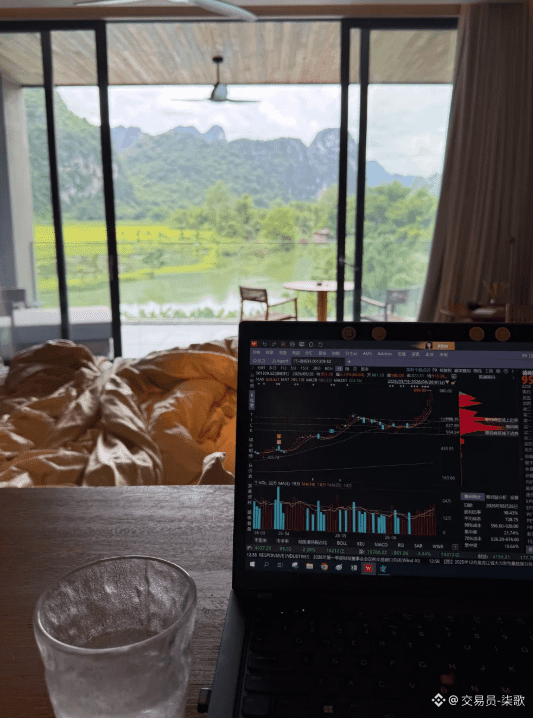

333
·
--
Just took a look at the 15-minute chart of $CVC . #以太坊跌破2500美元
Many people ask me: Can we chase at 0.036 now? Does it mean that if the pullback is in place, we should start the second wave of the main upswing?
I’ll answer with one sentence: 45 above is strong resistance. If it breaks through, the space above will open up.
If it can’t hold, go short instead.
In the crypto market, don’t trade in the dark. If you want to avoid traps and achieve steady profits, follow Qige’s rhythm.
Just took a look at the 15-minute chart of $CVC . #以太坊跌破2500美元
Many people ask me: Can we chase at 0.036 now? Does it mean that if the pullback is in place, we should start the second wave of the main upswing?
I’ll answer with one sentence: 45 above is strong resistance. If it breaks through, the space above will open up.
If it can’t hold, go short instead.
In the crypto market, don’t trade in the dark. If you want to avoid traps and achieve steady profits, follow Qige’s rhythm.
Many people ask me: Can we chase at 0.036 now? Does it mean that if the pullback is in place, we should start the second wave of the main upswing?
I’ll answer with one sentence: 45 above is strong resistance. If it breaks through, the space above will open up.
If it can’t hold, go short instead.
In the crypto market, don’t trade in the dark. If you want to avoid traps and achieve steady profits, follow Qige’s rhythm.
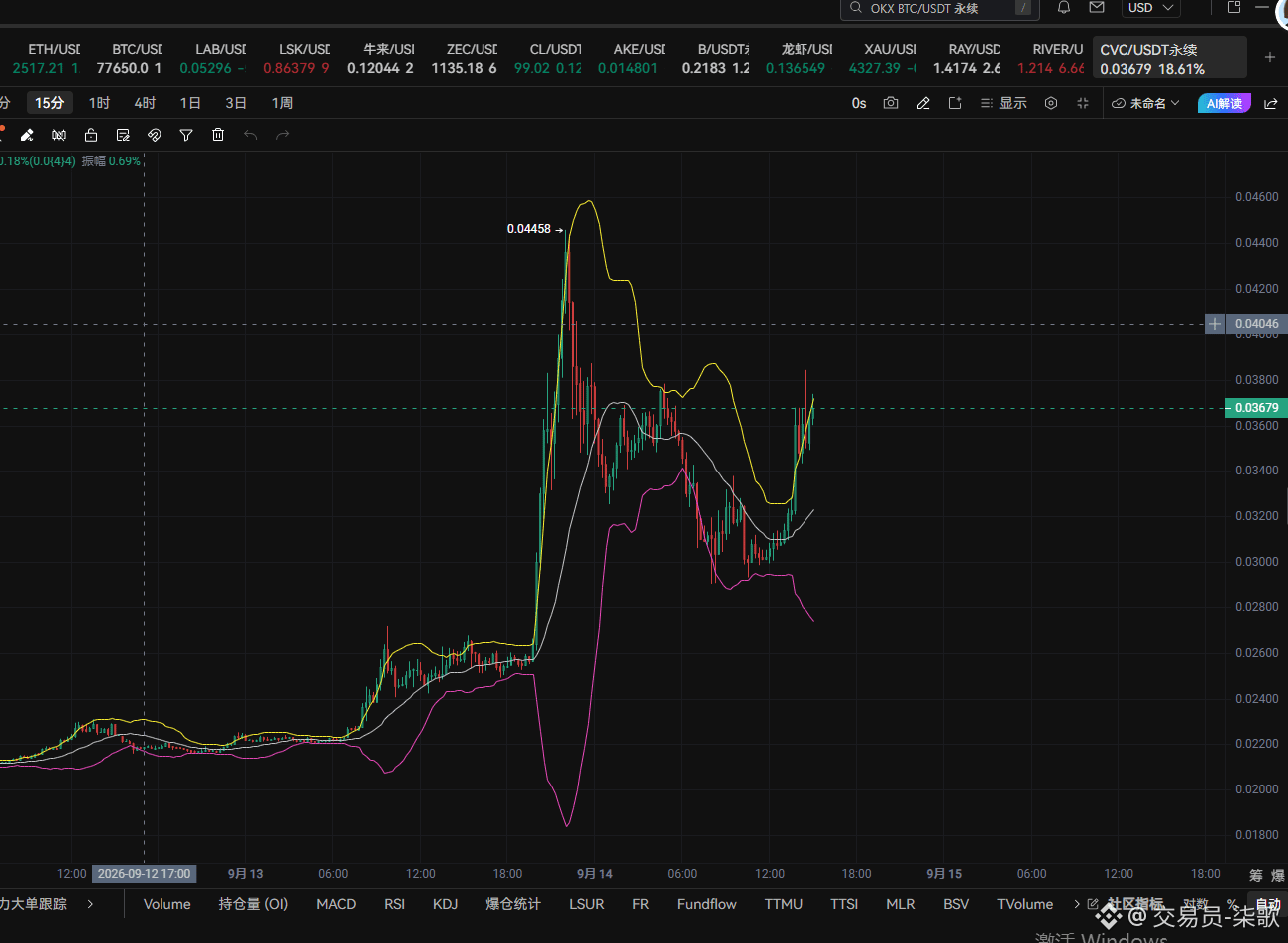
233
·
--
When should retail investors enter the market so they don’t get trapped? $SNDK #以太坊跌破2500美元
I want to offer one piece of advice: don’t interpret “no trades” as wasted time.
In the first few years when I started trading crypto, I was busiest—and yet I lost the most. I’d check the charts in the morning, search for coins in the afternoon, and watch the candlesticks at night. My account almost always had positions every day. Back then, I kept thinking that if I was diligent enough, I could catch the next wave. Later I realized the market doesn’t reward “being busy.” It only rewards you for acting when you should act.
What retail investors are truly suited for is entering when three things gradually come together: after the price has fallen, it stops being blindly sold off; the trend begins to show a direction; and trading volume is willing to follow. Note: it’s “starts forming,” not waiting until everyone starts shouting bullish and then jumping in. The most common mistake people make is seeing a single big bullish candle and thinking, “Here comes the opportunity.” But by the time your emotions kick in, the price often has already run a bit. On the other hand, setups that have been dropping for a long time, then sideways for a while, and suddenly start breaking out with rising volume—especially if, after a pullback, it can hold its ground—are actually more worth studying.
If your principal is small, don’t rush. A few hundred or a few thousand U—if you keep fiddling every day, trading fees are just a small issue. The real costly part is what happens after you make one wrong call: whether you’ll be too eager to “fix it” right away. That’s why nowadays I’d rather miss ten times than force ten trades just to avoid “not being able to miss the upside.” The market won’t disappear because you stayed out for a few days. Once the direction is clear, then use your principal to exchange for opportunities—that’s the rhythm retail investors should have.
When should retail investors enter the market so they don’t get trapped? $SNDK #以太坊跌破2500美元
I want to offer one piece of advice: don’t interpret “no trades” as wasted time.
In the first few years when I started trading crypto, I was busiest—and yet I lost the most. I’d check the charts in the morning, search for coins in the afternoon, and watch the candlesticks at night. My account almost always had positions every day. Back then, I kept thinking that if I was diligent enough, I could catch the next wave. Later I realized the market doesn’t reward “being busy.” It only rewards you for acting when you should act.
What retail investors are truly suited for is entering when three things gradually come together: after the price has fallen, it stops being blindly sold off; the trend begins to show a direction; and trading volume is willing to follow. Note: it’s “starts forming,” not waiting until everyone starts shouting bullish and then jumping in. The most common mistake people make is seeing a single big bullish candle and thinking, “Here comes the opportunity.” But by the time your emotions kick in, the price often has already run a bit. On the other hand, setups that have been dropping for a long time, then sideways for a while, and suddenly start breaking out with rising volume—especially if, after a pullback, it can hold its ground—are actually more worth studying.
If your principal is small, don’t rush. A few hundred or a few thousand U—if you keep fiddling every day, trading fees are just a small issue. The real costly part is what happens after you make one wrong call: whether you’ll be too eager to “fix it” right away. That’s why nowadays I’d rather miss ten times than force ten trades just to avoid “not being able to miss the upside.” The market won’t disappear because you stayed out for a few days. Once the direction is clear, then use your principal to exchange for opportunities—that’s the rhythm retail investors should have.
I want to offer one piece of advice: don’t interpret “no trades” as wasted time.
In the first few years when I started trading crypto, I was busiest—and yet I lost the most. I’d check the charts in the morning, search for coins in the afternoon, and watch the candlesticks at night. My account almost always had positions every day. Back then, I kept thinking that if I was diligent enough, I could catch the next wave. Later I realized the market doesn’t reward “being busy.” It only rewards you for acting when you should act.
What retail investors are truly suited for is entering when three things gradually come together: after the price has fallen, it stops being blindly sold off; the trend begins to show a direction; and trading volume is willing to follow. Note: it’s “starts forming,” not waiting until everyone starts shouting bullish and then jumping in. The most common mistake people make is seeing a single big bullish candle and thinking, “Here comes the opportunity.” But by the time your emotions kick in, the price often has already run a bit. On the other hand, setups that have been dropping for a long time, then sideways for a while, and suddenly start breaking out with rising volume—especially if, after a pullback, it can hold its ground—are actually more worth studying.
If your principal is small, don’t rush. A few hundred or a few thousand U—if you keep fiddling every day, trading fees are just a small issue. The real costly part is what happens after you make one wrong call: whether you’ll be too eager to “fix it” right away. That’s why nowadays I’d rather miss ten times than force ten trades just to avoid “not being able to miss the upside.” The market won’t disappear because you stayed out for a few days. Once the direction is clear, then use your principal to exchange for opportunities—that’s the rhythm retail investors should have.

427
·
--
If I told you there’s a method that can almost wipe out all profit, would you learn it? $SNDK
#比特币四周内第三次单块重组
The core is just one sentence: do less, do it slower, and go with the trend.
First, never do these three things:
1) Don’t chase the price and buy when it’s rising
When prices rise, it’s easiest to get emotionally carried away, but the real opportunities often show up when people panic during a drop. Train yourself to set up positions when others are afraid, and stay calm when others are疯狂.
2) Don’t place oversized orders
The market is always full of opportunities, but once you go all-in, you lose room for trial and error. The heavier your position, the more likely your mindset will warp—until eventually you end up being driven by the market.
3) Don’t trade frequently
Most of the time, the market is range-bound. Random trades only burn up commissions and your mindset. If there’s no clear trend, choose to stay in cash.
Now, a few key short-term trading rules of thumb:
1) After consolidation, a direction is inevitable
High-level range-bound action often breaks upward; low-level consolidation may continue to dip. The key is to wait for confirmation before acting.
2) Don’t trade during consolidation
This is the root cause of most people losing money. Patience matters more than execution.
3) Set your rhythm by reading the candlesticks
When the daily candle closes bearish, it’s more like a “buy the dip” mindset; when it closes bullish, it’s more like taking profit or observing. Don’t trade against your emotions.
4) After a trend accelerates, it usually moves into consolidation
Whether the market is rising or falling, it can’t continue forever. During consolidation, reduce your actions.
5) Build positions in batches—don’t go all-in at once
Use a pyramid approach to add gradually, avoiding buying at extreme levels.
6) Accept that the market will change direction
After a rally, don’t get greedy; after a drop, don’t panic. The key is to adjust promptly based on structural changes, not to predict the top and bottom.
In the end, what determines trading success isn’t technique—it’s restraint, patience, and execution. Only those who can control themselves have the right to stay in the market.
If I told you there’s a method that can almost wipe out all profit, would you learn it? $SNDK
#比特币四周内第三次单块重组
The core is just one sentence: do less, do it slower, and go with the trend.
First, never do these three things:
1) Don’t chase the price and buy when it’s rising
When prices rise, it’s easiest to get emotionally carried away, but the real opportunities often show up when people panic during a drop. Train yourself to set up positions when others are afraid, and stay calm when others are疯狂.
2) Don’t place oversized orders
The market is always full of opportunities, but once you go all-in, you lose room for trial and error. The heavier your position, the more likely your mindset will warp—until eventually you end up being driven by the market.
3) Don’t trade frequently
Most of the time, the market is range-bound. Random trades only burn up commissions and your mindset. If there’s no clear trend, choose to stay in cash.
Now, a few key short-term trading rules of thumb:
1) After consolidation, a direction is inevitable
High-level range-bound action often breaks upward; low-level consolidation may continue to dip. The key is to wait for confirmation before acting.
2) Don’t trade during consolidation
This is the root cause of most people losing money. Patience matters more than execution.
3) Set your rhythm by reading the candlesticks
When the daily candle closes bearish, it’s more like a “buy the dip” mindset; when it closes bullish, it’s more like taking profit or observing. Don’t trade against your emotions.
4) After a trend accelerates, it usually moves into consolidation
Whether the market is rising or falling, it can’t continue forever. During consolidation, reduce your actions.
5) Build positions in batches—don’t go all-in at once
Use a pyramid approach to add gradually, avoiding buying at extreme levels.
6) Accept that the market will change direction
After a rally, don’t get greedy; after a drop, don’t panic. The key is to adjust promptly based on structural changes, not to predict the top and bottom.
In the end, what determines trading success isn’t technique—it’s restraint, patience, and execution. Only those who can control themselves have the right to stay in the market.
#比特币四周内第三次单块重组
The core is just one sentence: do less, do it slower, and go with the trend.
First, never do these three things:
1) Don’t chase the price and buy when it’s rising
When prices rise, it’s easiest to get emotionally carried away, but the real opportunities often show up when people panic during a drop. Train yourself to set up positions when others are afraid, and stay calm when others are疯狂.
2) Don’t place oversized orders
The market is always full of opportunities, but once you go all-in, you lose room for trial and error. The heavier your position, the more likely your mindset will warp—until eventually you end up being driven by the market.
3) Don’t trade frequently
Most of the time, the market is range-bound. Random trades only burn up commissions and your mindset. If there’s no clear trend, choose to stay in cash.
Now, a few key short-term trading rules of thumb:
1) After consolidation, a direction is inevitable
High-level range-bound action often breaks upward; low-level consolidation may continue to dip. The key is to wait for confirmation before acting.
2) Don’t trade during consolidation
This is the root cause of most people losing money. Patience matters more than execution.
3) Set your rhythm by reading the candlesticks
When the daily candle closes bearish, it’s more like a “buy the dip” mindset; when it closes bullish, it’s more like taking profit or observing. Don’t trade against your emotions.
4) After a trend accelerates, it usually moves into consolidation
Whether the market is rising or falling, it can’t continue forever. During consolidation, reduce your actions.
5) Build positions in batches—don’t go all-in at once
Use a pyramid approach to add gradually, avoiding buying at extreme levels.
6) Accept that the market will change direction
After a rally, don’t get greedy; after a drop, don’t panic. The key is to adjust promptly based on structural changes, not to predict the top and bottom.
In the end, what determines trading success isn’t technique—it’s restraint, patience, and execution. Only those who can control themselves have the right to stay in the market.

290
·
--
Just took a quick look at the daily and 15-minute charts of $FIL —my spine is tingling.
A lot of people ask me: Can we chase at 1.02 now? Does breaking the bottom mean we’re about to kick off a new bull market?
I just showed him these two charts.
Look how tangled this action is:
👉 The long-term downtrend hasn’t changed: From the daily chart, FIL has been bleeding lower from a high above 10 yuan, and the current price is still hovering around 1.0. Although there was a recent bounce from 0.6 up to 1.03, notice this: the bounce just tagged the previous dense trapped-supply zone. The current price is exactly stuck on the “bull-bear dividing line.”
👉 Short-term spike then dump: Pay attention to the 15-minute chart. Right after it made a new high at 1.0347, it immediately got hit with a big bearish candle and plunged. Now the price has already broken below the whole-number level of 1.0. This suggests there’s too much profit-taking at the bottom—either the main force is selling while pushing higher, or they’re doing a violent “hand-switching washout.” At 1.02, the price is right at the edge of the prior breakout-from-rise platform—this is crucial.
👉 Moving-average support is in danger: The short-term moving averages are fanning upward, but the price is too far above them—as if you’ve pulled a rubber band too tight. Any moment now, it could snap back and correct.
This is a classic consolidation period after a bottom rebound.
My response strategy (for reference only—survival first):
❌ Never blindly chase with a heavy position: Right now you’re caught in a double squeeze—historical trapped holders on one side and recent profit-takers on the other. Entering here is likely to get hit with a big loss.
✅ Key levels to watch:
First pressure level (breakout point): 1.05 - 1.08. This is the pullback resistance after the recent spike-and-fall. If it breaks out with volume and holds above here, it means the washout is over, the upside opens up, and you can look higher—possibly to challenge 1.2.
Strong support (add-on points): 0.92 - 0.95. This is the launch platform and moving-average support for this leg up. If it dips back to here without breaking, that’s a great “get on the train while reversing” opportunity—great risk-reward. Stop-loss rule: If it breaks 0.88, it means this move was a “one-day wonder” to lure longs. The main force has finished distributing—don’t daydream; run!
In this market, being afraid of highs is a miserable life, but chasing blindly is basically giving money away. These coins that suddenly surge from the bottom have extremely high volatility—either you get big profit, or big pain. It’s better to wait for a pullback to stabilize before entering than to gamble on that last little spasm.
Don’t fumble around in the dark in crypto. If you want to avoid traps and stay profitable, follow Sister Xi’s rhythm.
Just took a quick look at the daily and 15-minute charts of $FIL —my spine is tingling.
A lot of people ask me: Can we chase at 1.02 now? Does breaking the bottom mean we’re about to kick off a new bull market?
I just showed him these two charts.
Look how tangled this action is:
👉 The long-term downtrend hasn’t changed: From the daily chart, FIL has been bleeding lower from a high above 10 yuan, and the current price is still hovering around 1.0. Although there was a recent bounce from 0.6 up to 1.03, notice this: the bounce just tagged the previous dense trapped-supply zone. The current price is exactly stuck on the “bull-bear dividing line.”
👉 Short-term spike then dump: Pay attention to the 15-minute chart. Right after it made a new high at 1.0347, it immediately got hit with a big bearish candle and plunged. Now the price has already broken below the whole-number level of 1.0. This suggests there’s too much profit-taking at the bottom—either the main force is selling while pushing higher, or they’re doing a violent “hand-switching washout.” At 1.02, the price is right at the edge of the prior breakout-from-rise platform—this is crucial.
👉 Moving-average support is in danger: The short-term moving averages are fanning upward, but the price is too far above them—as if you’ve pulled a rubber band too tight. Any moment now, it could snap back and correct.
This is a classic consolidation period after a bottom rebound.
My response strategy (for reference only—survival first):
❌ Never blindly chase with a heavy position: Right now you’re caught in a double squeeze—historical trapped holders on one side and recent profit-takers on the other. Entering here is likely to get hit with a big loss.
✅ Key levels to watch:
First pressure level (breakout point): 1.05 - 1.08. This is the pullback resistance after the recent spike-and-fall. If it breaks out with volume and holds above here, it means the washout is over, the upside opens up, and you can look higher—possibly to challenge 1.2.
Strong support (add-on points): 0.92 - 0.95. This is the launch platform and moving-average support for this leg up. If it dips back to here without breaking, that’s a great “get on the train while reversing” opportunity—great risk-reward. Stop-loss rule: If it breaks 0.88, it means this move was a “one-day wonder” to lure longs. The main force has finished distributing—don’t daydream; run!
In this market, being afraid of highs is a miserable life, but chasing blindly is basically giving money away. These coins that suddenly surge from the bottom have extremely high volatility—either you get big profit, or big pain. It’s better to wait for a pullback to stabilize before entering than to gamble on that last little spasm.
Don’t fumble around in the dark in crypto. If you want to avoid traps and stay profitable, follow Sister Xi’s rhythm.
A lot of people ask me: Can we chase at 1.02 now? Does breaking the bottom mean we’re about to kick off a new bull market?
I just showed him these two charts.
Look how tangled this action is:
👉 The long-term downtrend hasn’t changed: From the daily chart, FIL has been bleeding lower from a high above 10 yuan, and the current price is still hovering around 1.0. Although there was a recent bounce from 0.6 up to 1.03, notice this: the bounce just tagged the previous dense trapped-supply zone. The current price is exactly stuck on the “bull-bear dividing line.”
👉 Short-term spike then dump: Pay attention to the 15-minute chart. Right after it made a new high at 1.0347, it immediately got hit with a big bearish candle and plunged. Now the price has already broken below the whole-number level of 1.0. This suggests there’s too much profit-taking at the bottom—either the main force is selling while pushing higher, or they’re doing a violent “hand-switching washout.” At 1.02, the price is right at the edge of the prior breakout-from-rise platform—this is crucial.
👉 Moving-average support is in danger: The short-term moving averages are fanning upward, but the price is too far above them—as if you’ve pulled a rubber band too tight. Any moment now, it could snap back and correct.
This is a classic consolidation period after a bottom rebound.
My response strategy (for reference only—survival first):
❌ Never blindly chase with a heavy position: Right now you’re caught in a double squeeze—historical trapped holders on one side and recent profit-takers on the other. Entering here is likely to get hit with a big loss.
✅ Key levels to watch:
First pressure level (breakout point): 1.05 - 1.08. This is the pullback resistance after the recent spike-and-fall. If it breaks out with volume and holds above here, it means the washout is over, the upside opens up, and you can look higher—possibly to challenge 1.2.
Strong support (add-on points): 0.92 - 0.95. This is the launch platform and moving-average support for this leg up. If it dips back to here without breaking, that’s a great “get on the train while reversing” opportunity—great risk-reward. Stop-loss rule: If it breaks 0.88, it means this move was a “one-day wonder” to lure longs. The main force has finished distributing—don’t daydream; run!
In this market, being afraid of highs is a miserable life, but chasing blindly is basically giving money away. These coins that suddenly surge from the bottom have extremely high volatility—either you get big profit, or big pain. It’s better to wait for a pullback to stabilize before entering than to gamble on that last little spasm.
Don’t fumble around in the dark in crypto. If you want to avoid traps and stay profitable, follow Sister Xi’s rhythm.
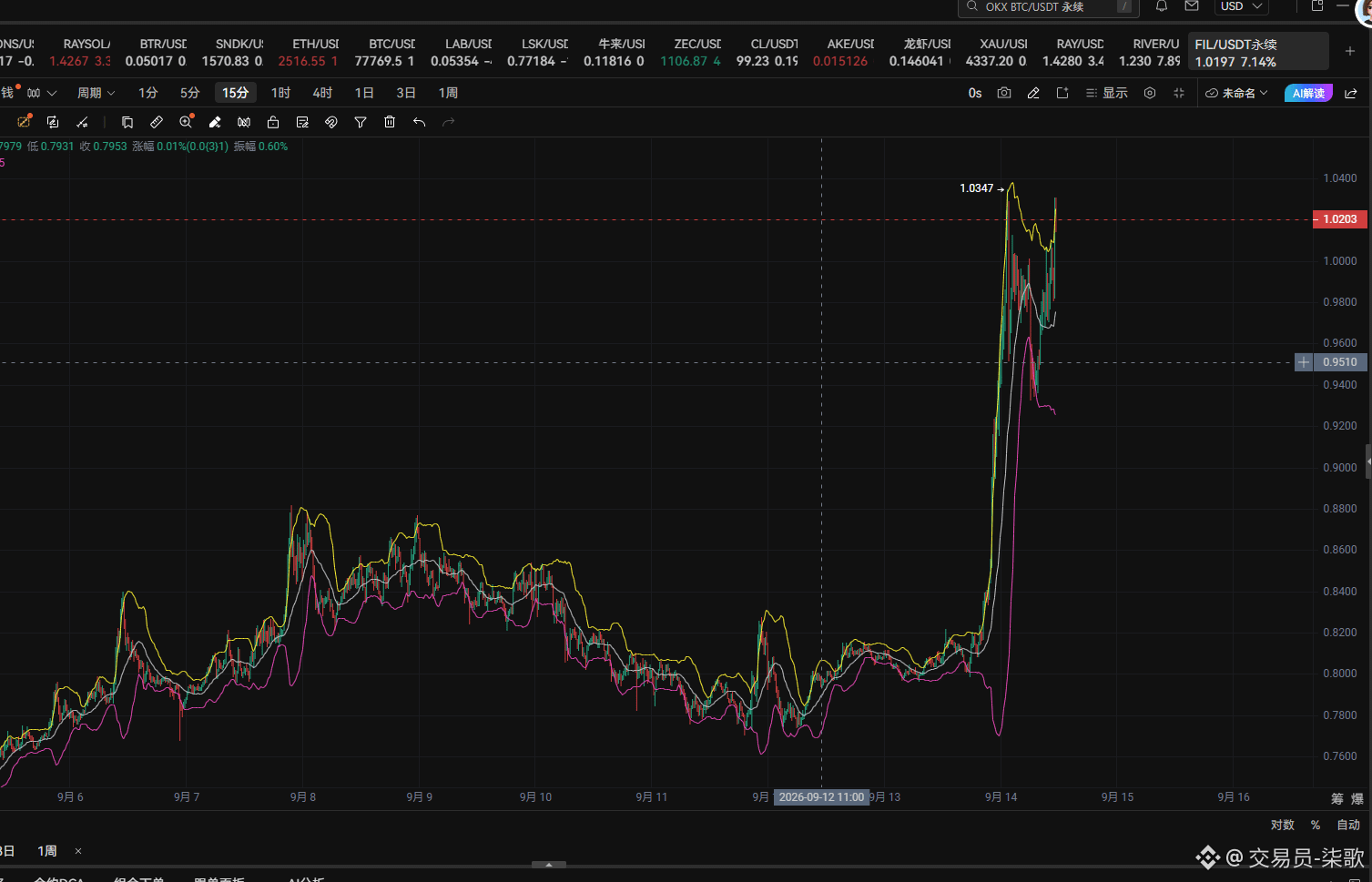

1
1
3.1k
Log in to explore more content
Join global crypto users on Binance Square
⚡️ Get latest and useful information about crypto.
💬 Trusted by the world’s largest crypto exchange.
👍 Discover real insights from verified creators.
Email / Phone number